Showing posts with label French setting. Show all posts

Monday, August 7, 2017

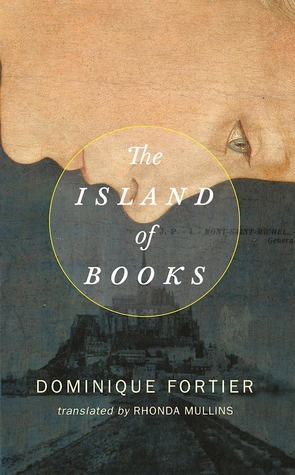
THE ISLAND OF BOOKS, romantic historical escapism


THE ISLAND OF BOOKS
DOMINIQUE FORTIER
(translated by Rhonda Mullins)
Coach House Books
$15.95 trade paper, available now

Rating: 4* of five

The Publisher Says: The library at Mont Saint=Michel was once known as the city of books. It is there, within the grey walls of its monastery, that a portrait painter grieving the sudden death of the woman he loved finds refuge. And it's there, between the sea and the sky, five centuries later, that a novelist tries to find her words again. They meet in the pages of a notebook left out in the rain.

Like the manuscripts out bereaved—and illiterate—painter is asked to copy over earlier texts, The Island of Books reveals traces of a time before Gutenberg beneath its present. With all the passion and intellect we've come to expect from her, Dominique Fortier offers us a moving homage to books and to those who write them.

***I RECEIVED THIS REVIEW COPY FROM COACH HOUSE PRESS AT MY REQUEST. THANK YOU!***

My Review: Exquisitely rendered grief. Author Fortier is outstanding at making the experience of life-altering grief full and real:
Seen from above, the monks all looked like with their brown cowls, the pale halos of their tonsures on the tops of their heads. They were small and interchangeable.


Wednesday, March 22, 2017

MY LIFE IN FRANCE, culinary goddess Julia Child tells enough to keep the pages turning...but not all


MY LIFE IN FRNACE
JULIA CHILD (with Alex Prud'homme)

Anchor Books
$16 trade paper, available now

Rating: 4* of five

The Publisher Says: Julia Child single handedly awakened America to the pleasures of good cooking with her cookbook Mastering the Art of French Cooking and her television show The French Chef, but as she reveals in this bestselling memoir, she didn't know the first thing about cooking when she landed in France. Indeed, when she first arrived in 1948 with her husband, Paul, she spoke no French and knew nothing about the country itself. But as she dove into French culture, buying food at local markets and taking classes at the Cordon Bleu, her life changed forever. Julia's unforgettable story unfolds with the spirit so key to her success as a cook and teacher and writer, brilliantly capturing one of the most endearing American personalities of the last fifty years.

My Review: Truth in advertising had no greater champion than Julia Child. Her book is called exactly and precisely what it is: The narrative of her life in France. She begins her book on November 3, 1948, with the Child family landing at Le Havre, getting into their gigantic Buick station wagon, and motoring off across northern France towards Paris. They stop at thirty-six-year-old native Californian Mrs. Child's first French restaurant, La Couronne, where her husband Paul (already fluent in French from his first stint living there more than 20 years before) consults with M. Dorin, the maitre d', and decides the young marrieds (relatively speaking, as he's 46 by then) will have a sole meuniere with a glass of wine! I mean! A nice Republican-raised gal from Pasadena, California, drinking wine with lunch! Who heard of this?! Mais certainement not Mme. Child, nee McWilliams!

It was the beginning of a life-long love affair between Julia Child and la belle France, and Julia Child and la cuisine Francaise. It led to several books, several TV series, and a long, happy life spent teaching, teaching, teaching. Mme. Child had found her metier, at close to forty, in a day and time where living past sixty-five was ** considered to be ancient. In the process, the person she became changed the American, and possibly the world as a result, culture surrounding food. Yet Julia Child wrote this book with her husband's great-nephew Alex Prud'homme, who tells us in his brief Foreword that getting his garrulous old relative to open up about the feelings and secrets that make up the majority of any human life. His degree of success was formidable, given the generational and gender-induced reticence he fought against to extract the juicy bits from her.

Bravo, M. Prud'homme, et merci bien par tout le faire.

Julia Child was a fixture around our house when I was young. I got the TV-watching habits I carry with me to this good day at a tender age, and part of the formative process was The French Chef. My mother didn't like Mrs. Child much. She was a fan of M.F.K. Fisher's food work, which wasn't in sympathy with Mrs. Child's careful and precise measuring and nice and accurate timing. Mama was a feast-maker, not a dinner-preparer, and that's why she watched Julia Child programs.

I learned about enthusiastic appreciation of food from my mother and Mrs. Child. I was never a picky eater, and only rejected a few foods. (I still hate corn on the cob.) It always seemed like the ladies were having so much fun making these weird dishes! It made sense to me that it would be fun to eat them, and so it proved to be.

In reading this memoir, I immersed myself in the flow of Child's later-life awakening to the joy of food and the sheer exhilaration of preparing special and delicious and carefully thought-out meals for one's loved ones. While I understand the co-author's challenge in balancing the need to afford the famous personality privacy against the buying public's desire to know the dirt, I can only lament that Prud'homme either didn't or couldn't press Child on the topic of her childlessness. I suspect burying herself in research and in obsessive experimentation was a means of assuaging her sadness at not being a mother. She was, or at least she is painted in this book as being, a very nurturing person, and given the prevailing attitudes of the era, it is unlikely that this absence did not cause her pangs of regret. I would have liked to see some exploration of that, mostly because I think glittering surfaces (which this book limns in loving detail) are even more beautiful when seen with shadows. It's like sterling silver flatware: When dipped into a cleaning bath as opposed to hand-polished, it's true that all the tarnish comes off, but all the character does too, and the pattern is flat and blah for lack of a bit of dark contrast that is left by the more labor-intensive hand polishing method.

The delight of the book was in Child's almost orgasmic recollections of the foods and wines she and her dearly beloved husband Paul Child ate and drank across the years. In the course of learning to cook the haute bourgeoise cuisine that she made famous in her native land, Child came alive to the joys and thrills of sight, smell, and taste in a way that only truly delicious food can cause a person to become. It was the positive counterpoint to her manifold frustrations in collaborative cook-bookery. The travails of preparing the Magnum Opus that is Mastering the Art of French Cooking simply don't do enough to make the author come off the page and join me in my reading chair. I rate books based on this type of measure, this degree of ability to enfold and immerse me in the narrative and the emotional reality of the tale being told. I thoroughly enjoyed this book, but I wasn't swept into it and away to France circa 1950, and that was what I came to the read expecting to happen. In fact, when I saw the film partially based on this book, Julie & Julia, I was completely swept away and eager to read the source material.

In the end, I got more out of watching Meryl Streep enact Julia Child than I did reading Julia Child reporting herself. I was disappointed.

And hungry.
Thursday, April 7, 2016

THE PRESIDENT, a non-Inspector Maigret Simenon novel...damn good, too


THE PRESIDENT
GEORGES SIMENON
translated by Daphne Woodward
The Neversink Library
$10.99 trade paper, available now

Rating: 3.8* of five

The Publisher Says: Restored to print for the first time in more than forty years, The President was hailed by the New York Times as a “tour de force.”

At 82, the former premier lives in alert and suspicious retirement—self exile—on the Normandy coast, writing his anxiously anticipated memoirs and receiving visits from statesman and biographers. In his library is the self-condemning, handwritten confession of the premier’s former attaché, Chalamont, hidden between the pages of a sumptuously produced work of privately printed pornography—a confession that the premier himself had dictated and forced Chalamont to sign. Now the long-thwarted Chalamont has been summoned to form a new coalition in the wake of the government’s collapse. The premier alone possesses the secret of Chalamont’s guilt, of his true character—and has publicly vowed: “He’ll never be Premier as long as I’m alive... Nor when I’m dead, either.” Inspired by French Premier Georges Clemenceau, The President is a masterpiece of psychological suspense and a probing account of the decline of power.

My Review: I got a CARE package from one of my old pals from Texas, filled to the brim with Simenon works...but not the Maigret stories, to my relief (read 'em all) and delight (I've never read any of the non-Maigret books)! The President is a delicate and careful autopsy of a once-powerful man's reluctant and relieved laying down his armaments. His life always consisted of public service, unmarried and childless and grasping for the levers of power to make his isolation into welcome solitude.

Simenon's Maigret novels are, as murder mysteries must be, formulaic. Simenon's gift came from creating a rich and satisfying story from these commonly available materials. It's a bit like watching Meryl Streep in a movie: She IS the role, she can't be more than glancingly perceived as the actress who starred in any other movie. Chameleons have that talent...so do cuttlefish...yet to find the gift of remodeling one's self in our smelly, sweaty human selves amazes and delights us every time.

This 152-page tale is a welcome surprise in this era of bloated, dull series books that could and should have been short stories. In my view, the less an author says, the more s/he has to focus and deliver a high-quality experience. Simenon wrote what was necessary to illuminate the long career of the eponymous president and place it in an historical setting. The impact of the actions taken by the president become, by design but still of necessity, quiet bombshells...silent even in their death throes.

This is a book to savor, to sip and ponder the complex flavors mixed in exacting proportions. A simple story, made well, translated carefully, and presented without hype. It is a treat in a literary landscape as pillowy-soft and cloyingly sweet as today's is simply to be told that great hearts still beat faster in pursuit of desired items and outcomes. And they remain great hearts, giving their all and making no excuses.

Saturday, July 5, 2014

THE DARK VINEYARD, fifth July meme book review


THE DARK VINEYARD (Bruno, Chief of Police #2)
MARTIN WALKER
Alfred A. Knopf
$16.95 trade paper, available now

Rating: 4* of five

The Publisher Says: In this riveting sequel to Martin Walker's internationally acclaimed novel Bruno, Chief of Police, some of France's great pleasures--wine, passion and intrigue--converge in a dark chain of events that threaten the peaceful village of Saint-Denis.

Benoît (Bruno) Courrèges, devoted friend, cuisinier extraordinaire and the town's only municipal policeman, rushes to the scene when a research station for genetically modified crops is burned down outside Saint-Denis. Bruno immediately suspects a group of fervent environmentalists who live nearby, but the fire is only the first in a string of mysteries centering on the region's fertile soil.

Then a bevy of winemakers descends on Saint-Denis, competing for its land and spurring resentment among the villagers. Romances blossom. Hearts are broken. Some of the sensual pleasures of the town--a dinner of a truffle omelette and grilled bécasses, a community grape-crushing--provide an opportunity for both warm friendship and bitter hostilities to form. The town's rivals--Max, an environmentalist who hopes to make organic wine; Jacqueline, a flirtatious, newly arrived Quebecoise; and Fernando, the heir to an American wine fortune--act increasingly erratically. Events grow ever darker, culminating in two suspicious deaths, and Bruno finds that the problems of the present are never far from those of the past.

A splendid mystery, and a delectable serving of the pleasures of France.

My Review: The Doubleday UK meme, a book a day for July 2014, is the goad I'm using to get through my snit-based unwritten reviews. Today's prompt is to discuss your favorite novel involving food.

Well now.

I haven't read any new Montalbano novels this year, but Martin Walker certainly dials up the yum-yum in this book! He centers the plot on discovering the identity of who wanted the GMOs on the secret hilltop farm in Saint-Denis burned, and why. As always with Bruno's adventures, we're treated to a bit of utterly drool-worthy wine and food talk, plus Bruno's cheery, simple sex life (only slightly sarcastic there).

I love that the series, even though it's dealing with the arson of a state-secret agricultural research station, and the murder of a local young man-about-town, also takes into account the murder of a resident's dearly beloved dog, the breaking of a two-thousand-euro bottle of wine (treated as a crime, as well it should be!), and the discreet arrangements between a devoted husband and his paralyzed wife.

You know, Life.

And in the end, when the killer is revealed, and the family secrets that no one wanted aired come to Bruno's attention and Right is finally done, what happens? Dinner, no a feast!, is planned, with bécasses (woodcocks) accompanied by some of the world's most exquisite wines...possibly even a 1975 Pétrus *fantods*, one of the greatest Bordeaux wine vintages ever. After all, what could be more apropos, since Bruno is celebrating a new love entering his life....

Oh dear, mustn't spoil the very welcome and long overdue surprise!

I love the experience of reading these books, I enjoy Bruno's delivery of comeupance to the damnfool ambition-poisoned gendarme Duroc, I absolutely dote on his dog Gigi, and I can't wait to see what happens with the new vineyard in town that Bruno owns part of! the entire cast of crazies that Walker has created to bring Saint-Denis to life.