Pages
- Home
- Mystery Series
- Bizarro, Fantasy & SF
- QUILTBAG...all genres
- Kindle Originals...all genres
- Politics & Social Issues
- Thrillers & True Crime
- Young Adult Books
- Poetry, Classics, Essays, Non-Fiction
- Science, Dinosaurs & Environmental Issues
- Literary Fiction & Short Story Collections
- Sookie Stackhouse/Southern Vampire Books & True Blood
- Books About Books, Authors & Biblioholism
Showing posts with label colonialism. Show all posts
Wednesday, May 13, 2026
NEWCOMERS: The Story of Anthony and Grietje and the Founding of New York, or "Why I ❤NY"
NEWCOMERS: The Story of Anthony and Grietje and the Founding of New York
ALAN MIKHAIL
Liveright / W.w. Norton (non-affiliate Bookshop.org link)
$28.45 ebook, available now
Rating: 4.5* of five
The Publisher Says: The exceptional tale of an unorthodox, seventeenth–century married couple whose rags-to-riches story fundamentally rewrites our knowledge of American history at its very beginnings.
A man thought to be Muslim from Morocco and a German barmaid are hardly the image we have of America’s founders. In Newcomers, Alan Mikhail upends the traditional story of American beginnings through the tale of Anthony “the Turk” and Grietje Reyniers.
Married in Amsterdam, they arrived in 1630s Dutch New Amsterdam, hoping to forge a new life. Always outsiders in the young colony, they battled Dutch authorities, brawled with neighbors, and seized land from Native Americans. In this revisionist portrait of the early American family, we learn of anti-Muslim sentiment through Anthony and of female defiance through Grietje.
Eventually banished from Manhattan to Long Island, Anthony and Grietje farmed, prospered, and raised a family whose descendants included the Vanderbilts and President Harding. Promising “to change the way we understand Colonial Gotham’s formative first years” (Susanah Shaw Romney), Alan Mikhail’s Newcomers provides revelatory insights into the seventeenth-century origins of New York.
I RECEIVED A DRC FROM THE PUBLISHER VIA EDELWEISS+. THANK YOU.
My Review: The New World was always a frontier where European countries saw the utility of sending its misfits, its non-conforming people, its "undesirables" to make their own way. It was better that way, really...these were the people who gave someone powerful some kind of uncomfortable trouble, and as we're all quite clear even unto today that is simply not to be borne. By them. By you? Troublesome peasant, it is your fault and you must pay the price of being obstreperous and too difficult for {whoever}'s comfort by leaving everything you've ever known or owned to begin again in an utterly alien place. Survive or not, it's up to you.
Anthony and Grietje Jansen van Salee were the survivor types. They stood up for themselves, mixed-race man of ambition and drive and mouthy broad with a gift for invective that they were. Quintessential New Yorkers, in fact; though there was no such identity in the late seventeenth century. They left a restrictive, stifling life of economic precarity and social exclusion for the possibilities of the edge of the map, as it was then. I'm glad Dr. Mikhail introduced me to Anthony and Grietje because I think they're my (spiritual) ancestors. They set the pattern for people like me who don't think or act the way our peers and neighbors do because we don't like their ways and see no reason to pretend otherwise, who find our home here in New York.
The legal records that Dr. Mikhail draws from, and they're extensive (as well as footnoted to a fare-thee-well), show that Anthony and Grietje totally never stopped being difficult. Their neighbors in Dutch colonial Manhattan didn't much like having a "Turk" (mixed-race Anthony, always suspected of being Muslim despite no evidence existing to support that idea) and a mouthy whore (grit-loaded survivor Grietje) in their midst. Off to the wilds of Brooklyn with you, aggressive and non-conformist folk that you are! Even non-conforming people don't like non-conformists.
Is this ringing any bells, Islamophobic sex-negative leftist political types who apply purity tests to each other? Who exile their leaders for not being "perfect" and thus lose elections but win at the Pure Ideology game?
Anthony and Grietje prospered in their next exile as much as in their first. Their energy was tremendous so when it could be directed mostly at their real goals...prosperity for themselves...it was a great benefit for the colonials as well as themselves. The people it cost the most were not their colonist neighbors but the Native Americans the entire settler-colonial enterprise harmed the most. Anthony and Grietje left marks there as well, so truly set the pattern for all us New Yorkers to come by their darker, less benign actions as well as their courageous, trailblazing ones.
I felt very seen in reading this very well-presented story. It's true that Anthony, after Grietje's death, returned to Manhattan...the quintessential Manhattanite, move to Long Island to raise the kids and come home when they're grown! these two are perfect twenty-first century stereotypes!...it's also true that Anthony did things that look terrible to our eyes like have Native slaves-in-fact if not name to work lands he stole from them, but were part of the entire settler-colonial enterprise that white people like me are the beneficiaries of. There are few black-and-white actions in this our life.
Dr. Mikhail is very clear that people are not pure, that actions in context look different as the context changes over time, and that this partial and compromised record of two ordinary peoples' extraordinary choices and actions can never be considered complete or definitive. Defining people long-dead by the records they leave behind is always an act of interpretation. That does not mean it is not also an act of truth-telling, only that the truths so told must be viewed as contingent.
Maps and illustrations completed my happy journey through the lives of two remarkable spiritual ancestors I'm glad I got to know.
Thursday, February 12, 2026
THE LAST OF EARTH, Tibetan national survival has been under threat forever
THE LAST OF EARTH
DEEPA ANAPPARA
Random House (non-affiliate Bookshop.org link)
$13.99 ebook, available now
Rating: 4* of five
The Publisher Says: From the award-winning author of Djinn Patrol on the Purple Line comes a stunning historical novel set in nineteenth-century Tibet that follows two outsiders—an Indian schoolteacher spying for the British Empire and an English “lady” explorer—as they venture into a forbidden kingdom.
1869. Tibet is closed to Europeans, an infuriating obstruction for the rap¬idly expanding British Empire. In response, Britain begins training Indians—permitted to cross borders that white men may not—to undertake illicit, dangerous surveying expeditions into Tibet.
Balram is one such surveyor-spy, an Indian schoolteacher who, for several years, has worked for the British, often alongside his dearest friend, Gyan. But Gyan went missing on his last expedition and is rumored to be imprisoned within Tibet. Desperate to rescue his friend, Balram agrees to guide an English captain on a foolhardy mission: After years of paying others to do the exploring, the captain, disguised as a monk, wants to personally chart a river that runs through southern Tibet. Their path will cross fatefully with that of another Westerner in disguise, fifty-year-old Katherine. Denied a fellowship in the all-male Royal Geographical Society in London, she intends to be the first European woman to reach Lhasa.
As Balram and Katherine make their way into Tibet, they will face storms and bandits, snow leopards and soldiers, fevers and frostbite. What’s more, they will have to battle their own doubts, ambitions, grief, and pasts in order to survive the treacherous landscape.
A polyphonic novel about the various ways humans try to leave a mark on the world—from the enduring nature of family and friendship to the egomania and obsessions of the colonial enterprise—The Last of Earth confirms Deepa Anappara as one of our greatest and most ambitious storytellers.
I RECEIVED A DRC FROM THE PUBLISHER VIA NETGALLEY. THANK YOU.
My Review: Tibet closed itself off from the Western powers playing "the Great Game," as it was dismissively described from 1840 onwards, because they saw its awful effects on India, Nepal, Burma, and China. The British took this as a challenge, like Katherine in this story...a mixed-race woman thwarted in desire to join the Royal Geographical Society despite her surveying achievements. They set about circumventing the Tibetans' desire to be left in peace (Katherine by disguising herself to become the first European woman to enter Lhasa) by training Indians like Balram in this story to survey the land for them. These men and one pretender disguise their purpose by the faking the trading of goods into and out of the country, pretending to be religious pilgrims visiting the holy places, and other subterfuges. (When your country covers the headwaters of the main waterways serving multiple billions of people, isolation is an untenable fantasy.)
The novel begins in 1869, a time when Tibet was also fighting the Qing Dynasty for territorial integrity. Its diplomatice relations with Nepal were strained by this series of wars. It is, then, a story of people doing things that are reprehensible and selfish at a time of upheaval engineered by reprehensible and selfish colonial powers. The different PoVs are each checked in with in alternating sections. It's a technique with many advantages, like avoiding awkward and forced joinings of forces, as well as perils, like leaving one PoV at a critical juncture for long enough to vitiate the plot's momentum. Both happen here. It is not as though there is a shortage of story; it's action that takes the hit.
Duty, freedom, self-willed assertions of independence, are all present in micro- and macro-scale facets of the plot. It never gets terribly deep into the whys and wherefores on the personal or the political scales. Like the prose itself, it limns the surfaces and reflects the highlights but leaves off before any deep diving takes place. I was utterly rapt at the descriptive language used for the landscapes, the customs, and the cultures around the characters. I felt distant from them, though, like they were cameras and I was viewing their footage played back after editing into a narrative.
Distanced as I was, I was quite clearly inspired to go poking around into the faxtual history of the time and place. Author Anappara has done this to me before: taken a truly epic story with ramifications reverberant well beyond the slice she chooses for her focus. It's clearly working on me at one level. I am once againg stopping short of a full five-star rating because I'm in too many places, too much is touched on but not explored, for the read to merit that accolade.
It's not like it was a failure of a read. I thoroughly enjoyed it. I was ready to pick it back up, but I was also ready to put it down to look up the details I wanted to know more about.
Sunday, April 6, 2025
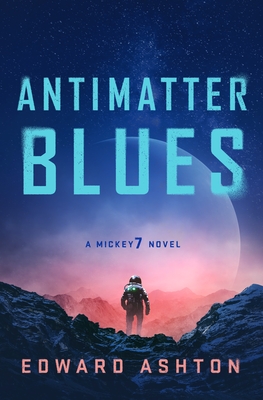
ANTIMATTER BLUES, Edward Ashton's second Mickey7 novel

ANTIMATTER BLUES (Mickey7 #2)
EDWARD ASHTON
St. Martin's Press (non-affiliate Amazon link)
$11.99 ebook, available now
Rating: 4* of five
The Publisher Says: Summer has come to Niflheim. The lichens are growing, the six-winged bat-things are chirping, and much to his own surprise, Mickey Barnes is still alive―that last part thanks almost entirely to the fact that Commander Marshall believes that the colony’s creeper neighbors are holding an antimatter bomb, and that Mickey is the only one who’s keeping them from using it. Mickey’s just another colonist now. Instead of cleaning out the reactor core, he spends his time these days cleaning out the rabbit hutches. It’s not a bad life.
It’s not going to last.
It may be sunny now, but winter is coming. The antimatter that fuels the colony is running low, and Marshall wants his bomb back. If Mickey agrees to retrieve it, he’ll be giving up the only thing that’s kept his head off of the chopping block. If he refuses, he might doom the entire colony. Meanwhile, the creepers have their own worries, and they’re not going to surrender the bomb without getting something in return. Once again, Mickey finds the fate of two species resting in his hands. If something goes wrong this time, though, he won’t be coming back.
I RECEIVED A DRC FROM THE PUBLISHER VIA NETGALLEY. THANK YOU.
My Review: I AM A VERY BAD MAN. I read this book in November 2022, made some notes on a document last computer, and...brain being its usual saboteur self...filed it as "done and dusted" thus forgetting to write an actual review.
Thank all those useless gods I never delete documents.
This is textbook idiotry. Guard against this carelessness, all y'all, and you will maintain your good standing with the review aggregators. Perfectionism is Public Enemy #1 for book reviewers, that is if they want to have their pick of the goodest of the good stuff to read. I am super lucky in that I do get a lot of excellent reads, but a chunk of disappointing turndowns too.
But enough about me, let's discuss Author Ashton's second Mickey7 novel. Well...this is Blogger so no one can talk to me here so I'm more or less soliloquizing. Still.
I hope you've read Mickey7 and seen Mickey 17 by now. If not I strongly urge you to do so; the latter in a theater. I'll say that the film deserves a sequel mostly because Niflheim is such a great visual experience, and seeing that cast (as necessarily amended) perform this story would be a major hoot. Robert Pattinson's endearing turn as an Expendable reformed many many times...eighteen to be precise...was pitch-perfect. This idea of slave labor made palatable to bourgeois sensibilities by being done by not-quite humans is one I've enjoyed since encountering it in Doctor Who's Eleventh Doctor episode "The Almost People" in 2011. I'm quite sure the earlier written versions, eg Cordwainer Smith's Scanners or the opposite end of the social scale of Richard K. Morgan's "Meths,", provided some inspiration for the Expendables and are due a lot of credit, but for me seeing the embodiment of the slave class as people-but-not-quite created by technology was a key a-ha moment.
Mickey7, now back to being Mickey Barnes after the events of the first book, is no longer considered an Expendable. He is also now the only person on Niflheim who can communicate with the planet's aboriginal inhabitants, the creepers. Interspecies harmony is, as always seems to be the case when equals share territory, conditional and intermittent. As this story opens, things are about to bust into open conflict because the creepers have The Bomb, just as the colonists need to use it for the fuel they'll need to survive a Niflheim winter. (Funny how it's always okay for the colonizers to have The Bomb but never the aboriginals.)
Hijinks of the bloodiest, most lethal sort seem destined to ensue. Of course the whole plot hinges on whether and how they ensue, or don't, and whether poor schlemiel Mickey7 (no more intellectually gifted now he's no longer considered an Expendable) can get The Bomb's urgently needed fissile material back from the very anxious creepers.
As he can communicate with them after a fashion, he's privy to a fact...the creepers seem to have another enemy besides the colonists...that could bring about a more secure peace as well as get The Bomb's fissile material back before winter comes to freeze the colonists into personcicles. Nothing like ganging up on a common enemy to create a warm glow of camaraderie, is there.
Shorter and lighter than Mickey7, this read was from the off one I'd hold to a lower standard. It's truly as fun a read as the first was, it's a solidly executed plot, and it has the great good fortune of lifting a lighter psychic load than its older sibling. Most of the hardest to explain stuff is already explained. We're more about learning Mickey7's mannerisms and exploring his human limitations. I think it was a lot less substantive (not always a bad thing), and as stated above, would greatly enjoy a film of it. Not very likely as Director Bong's not a maven for sequels.
The ethical considerations of colonialism are less weighty than those of slavery to my mind. That makes this story a very easy-to-enjoy diversion.
Wednesday, March 6, 2024
A SHORT HISTORY OF FLOWERS: The Stories that Make Our Gardens, pretty pretty pictures celebrating springtime in the Global North
A SHORT HISTORY OF FLOWERS: The Stories that Make Our Gardens
ADVOLLY RICHMOND (illus. Sarah Jane Humphrey)
Frances Lincoln Ltd
$24.99 hardcover, available now
Rating: 4* of five
The Publisher Says: Garden and social historian Advolly Richmond (of Gardener’s World) unravels the surprising histories of 60 flowers that shape our gardens.
Have you ever wondered where your favourite garden flowers came from? Where their names derived? Or why some cultivars go in and out of favor? Every flower in your herbaceous border has a story, and in this book Advolly Richmond takes you on a tour of the most intriguing, surprising and enriching ones.
Tales of exploration, everlasting love and bravery bring these beautiful flowers to life. Advolly has dug down to uncover the royalty, scholars, pioneers and a smuggler or two that have all played a part in discovering and cultivating some of our favourite species. From the lavish and exotic bougainvillea, found by an 18th century female botanist in disguise to the humble but majestic snowdrop casting a spell and causing a frenzy. These plants have played pivotal roles in our societies, from boom to bust economies, promises of riches, and making fashion statements. These unassuming blooms hold treasure troves of stories.
With specially commissioned artworks from award-winning botanical illustrator Sarah Jane Humphrey, which sumptuously bring each flower to life – this is a beautiful compendium for every garden lover.
I RECEIVED A DRC FROM THE PUBLISHER VIA EDELWEISS+. THANK YOU.
My Review: I needed something uncomplicatedly pretty. I expect y’all do, too.
There. Springtime sorted.
Of course, this being Reality, there are no uncomplicated pleasures. The stories of how your favorite flowers got to your garden is tied up with colonialism, capitalism, and the endless intertwining of greed and ownership between them.
Advolly Richmond does a far more deft job of making the connections than I have. She had a lot more room than I did:
This table of contents is like a really good garden’s plan, expansive and filled with beautiful sights. Richmond’s expertise is writing about the domesticated plants we adorn our built environment with, aka gardening. She has practiced the craft long enough to have honed her execution of it into art.
The fact that I myownself find the flower-gardening madness that so many of y’all suffer from inexplicable, and the money y’all lavish on it borderline obscene, does not mean I do not see and appreciate the beauty of the plants themselves.
I still think that the water, fertilizer, and hours of labor *should* be spent on growing vegetables.
Subscribe to:
Posts (Atom)