Showing posts with label ornithology. Show all posts

Wednesday, May 27, 2026

A BIRD'S IQ: Innovation, Intelligence, and Problem Solving in the Avian World


A BIRD'S IQ: Innovation, Intelligence, and Problem Solving in the Avian World
LOUIS LEFEBVRE
(tr. Pablo Strauss)
Greystone Books (non-affiliate Bookshop.org link)
$28.00 all editions, available now

Rating: 4.5* of five

The Publisher Says: For readers of Jennifer Ackerman comes a captivating exploration of avian intelligence that challenges traditional wisdom about animal cognition.

Surveying a wide variety of birds, including crows, finches, tits, and parrots, Louis Lefebvre, a world-renowned expert in animal behaviour, describes the remarkable innovations and problem-solving abilities of species often dismissed as ‘featherbrains’. From crows using cars as nutcrackers to cockatoos crafting tools, Lefebvre reveals how birds exhibit creativity, social learning, and even cultural transmission — traits once thought to be exclusive to humans and other primates.

Blending his decades of scientific research with engaging anecdotes, Lefebvre examines the evolutionary forces that have shaped avian intelligence. He explores how birds adapt to urban environments, innovate in response to challenges, and pass down knowledge across generations. This goldmine of bird behaviour yields an ‘innovation quotient’ widely used by researchers to measure and rank how innovative a bird species is. Using his encyclopaedic knowledge, Lefebvre answers questions such as:
  • When a bird species learns a new technique, how do their innovations spread?
  • Why is research on bird cognition being used to train AI models and even robots?
  • What makes certain birds endlessly innovative while others stubbornly repeat the same behaviors?
  • When a bird species learns a new technique, how do their innovations spread? Why is research on bird cognition being used to train AI models and even robots? What makes certain birds endlessly innovative while others stubbornly repeat the same behaviours? With vivid storytelling and groundbreaking insights, A A Bird’s IQ invites readers to reconsider their perceptions, celebrating the ingenuity of birds and highlighting the interconnectedness of all intelligent life.

    I RECEIVED A DRC FROM THE PUBLISHER VIA EDELWEISS+. THANK YOU.

    My Review
    : I loved this read. I am, as I think those familiar with my writing over the years will know, a corvidophile...crows particularly but ravens and magpies as well...as I find their intelligence palpable. It is obvious to me that I am in the presence of a sentient being when I'm around corvids, there's that recognition of fellowship that really can't be denied. Or I can't deny it anyway.

    Author Lefebvre seems to have had a similar experience though not specifically with corvids. His research into the intelligence of birds is built on a much longer tradition of inquiry into the subject than I ever suspected. It's a big part of my pleasure in reading this book to learn as much as I did about the history of research into avian intelligence. It felt as though I was sitting in an armchair next to him, having a wide-ranging conversation about science and its history wherein he answered my questions without my actually vocalizing them. It sounds fanciful, I know, but it was my emotional experience of this kind of intimacy that made the read so different from other popularizations of important scientific study.

    It really isn't a bit surprising that I'd have this experience while reading A Bird’s IQ when you learn that Author Lefebvre is also a novelist...one nominated twice for Canada's Governor General's Award for French-language fiction, so clearly possessed of solid narrative-creation chops. I liked the experience I had learning about the intelligence of dinosaurs which is where I'm clearly going to go since I'm still an eight-year-old when it comes to dinosaurs. (And yes, birds are unquestionably dinosaurs.) It can, however, lead to a bit of prolixity about what the kids (ie anyone under fifty) seem to like calling "side quests" into matters like a scientist's name-change, or the challenges of gathering usable data from birding-centered magazines published in England between the World Wars. Fascinating, but better left in the source notes.

    If I have a moment of...hesitation, let's call it, about some of Author Lefebvre's contentious assertions about cultural transmission of knowledge in bird populations, it's one that Author Lefebvre foresaw and forestalled by couching his contention of this fact in careful terms. The anecdotal evidence for this method of learning in bird populations is voluminous. It's not rigorous scientific data, and Author Lefebvre, to his credit, never tries to present it as such. He also very specifically states he does not share Rupert Sheldrake's more controversial ideas about how that kind of knowledge transmission could take place. As I am a bit uncomfortable with presenting that body of knowledge as scientific myownself, I am in harmony with Author Lefebvre on this point.

    As I am very much a satisfied reader of this book, I want to assure all who read this review that it's not perfect in my eyes, or in the author's. It is an interim progress report on a career's-worth of experience, knowledge-gathering, and synthesis. It's well presented. It's well sourced. It's mae to bring fundamentals of the topic to broad attention, and couched in language that does this unintimidatingly well. It also affords the author's scientific peers access to his resources and his thinking leadiing to the conclusions presented...all in the same sentences and style. And, of the greatest value to both audiences, Author Lefebvre does not present his case as closed, does not claim a unique and conversation-ending breakthrough is in the text.

    He is too sensible of work needing to be done and too respectful of the contributors to the overall field of research into intelligence. I was never more surprised in the read than when I learned how much two-way influence into robotics and "AI" there was. A story of how we got to where we are, and how much where we are has resonances beyond the obvious, in using our own intelligence to understand intelligence, expand its impact, and...I hope...gain humility about ourselves by learning about and from those unlike us.

    Thursday, December 14, 2023

    THE REAL JAMES BOND: A True Story of Identity Theft, Avian Intrigue, and Ian Fleming, not quite what you're expecting


    THE REAL JAMES BOND: A True Story of Identity Theft, Avian Intrigue, and Ian Fleming
    JIM WRIGHT

    Schiffer Books
    $24.99 hardcover, available now

    Rating: 4* of five

    The Publisher Says: Whatever happened to him actually outshines anything I’ve had my James Bond do. —Ian Fleming

    James Bond: author, ornithologist, marksman, and . . . identity-theft victim?


    When James Bond published his landmark book, Birds of the West Indies, he had no idea it would set in motion events that would link him to the most iconic spy in the Western world and turn his life upside down. Born into a wealthy family but cut off in his early twenties, James Bond took off to the West Indies in search of adventure.

    Armed with arsenic and a shotgun, he took months-long excursions to the Caribbean to collect material for his iconic book, Birds of the West Indies, navigating snake-infested swamps, sleeping in hammocks, and island-hopping on tramp steamers and primitive boats. Packed with archival photos, many never before published, and interviews with Bond's colleagues, here is the real story of the pipe-smoking, ruthless ornithologist who introduced the world to the exotic birds of the West Indies.

    I RECEIVED A DRC FROM THE PUBLISHER VIA EDELWEISS+. THANK YOU.

    My Review
    : Gotcha!
    You thought, like I did, that this was about someone glamourous and important to the intelligence agencies rife in the world, didn't you? After all, James Bond....

    Turns out that the REAL James Bond, the one whose book inspired the stuck-for-a-name birder Ian Fleming to call 007 by his name, was a bad-ass adventurer and ornithologist whose privileged background and education prepared him for a leisurely life of loafing and then poof! got pulled out from under him by his dear old Dad. (007 has some daddy issues, you'll recall.)
    The ancestral pile, now part of a university campus near Philadelphia, Pennsylvania
    Being disinherited in favor of second wife of father, Bond went out to get his daily bread the best he could. It was some adventuring best! His ornithological methods weren't to modern tastes:
    ...but that's how it was done in those days.

    The important part is that Bond and Ian Fleming shared a taste for adventure, an interest in birds, and resdency in the West Indies:
    The only known photo of the Real James Bond with Ian Fleming, at Fleming's Jamaica home
    ...or we'd never have had the iconic 007 that we do now.

    The book is quite a treat on the eyes with its over-a hundred photos, most in color, and its clear, easy-to-read text. The story of a man making another man's name and nature famous would play out very differently today. In this case the way it unfolded was amicable. The author got famous, but died young; the subject lived on, an ornithologist with the definitive textbook to his name; the character is immortal. The story's so astounding that your film-buff giftee might not believe it at first. If you know a Bond guy, he'll have heard the story in its outlines as part of the lore. The reality of James Bond, though, is less well-known and very much worth learning about. A birder friend? Get 'em in the tent by saying, perfectly truthfully, that James Bond was a bird-watcher.
    The world the Real James Bond spent his life exploring and explaining to the world
    Tomorrow I'm posting #Booksgiving ideas about Nature, so this seemed like a fun way to make the transition. Enjoy the read; I sure did.

    Wednesday, November 2, 2016

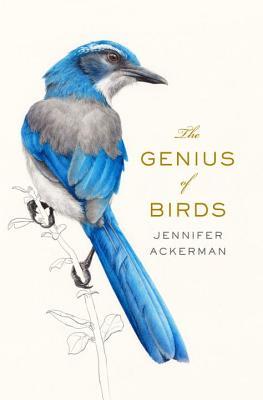
    THE GENIUS OF BIRDS, my 4.5* rave for a Goodreads Choice Awards nominee


    THE GENIUS OF BIRDS
    JENNIFER ACKERMAN

    Penguin Press
    $28.00 hardcover, available now

    Rating: 4.5* of five

    The Publisher Says: Birds are astonishingly intelligent creatures. In fact, according to revolutionary new research, some birds rival primates and even humans in their remarkable forms of intelligence. Like humans, many birds have enormous brains relative to their size. Although small, bird brains are packed with neurons that allow them to punch well above their weight.

    In The Genius of Birds, acclaimed author Jennifer Ackerman explores the newly discovered brilliance of birds and how it came about. As she travels around the world to the most cutting-edge frontiers of research— the distant laboratories of Barbados and New Caledonia, the great tit communities of the United Kingdom and the bowerbird habitats of Australia, the ravaged mid-Atlantic coast after Hurricane Sandy and the warming mountains of central Virginia and the western states—Ackerman not only tells the story of the recently uncovered genius of birds but also delves deeply into the latest findings about the bird brain itself that are revolutionizing our view of what it means to be intelligent.

    Consider, as Ackerman does, the Clark’s nutcracker, a bird that can hide as many as 30,000 seeds over dozens of square miles and remember where it put them several months later; the mockingbirds and thrashers, species that can store 200 to 2,000 different songs in a brain a thousand times smaller than ours; the well-known pigeon, which knows where it’s going, even thousands of miles from familiar territory; and the New Caledonian crow, an impressive bird that makes its own tools.

    But beyond highlighting how birds use their unique genius in technical ways, Ackerman points out the impressive social smarts of birds. They deceive and manipulate. They eavesdrop. They display a strong sense of fairness. They give gifts. They play keep-away and tug-of-war. They tease. They share. They cultivate social networks. They vie for status. They kiss to console one another. They teach their young. They blackmail their parents. They alert one another to danger. They summon witnesses to the death of a peer. They may even grieve.

    This elegant scientific investigation and travelogue weaves personal anecdotes with fascinating science. Ackerman delivers an extraordinary story that will both give readers a new appreciation for the exceptional talents of birds and let them discover what birds can reveal about our changing world. Incredibly informative and beautifully written, The Genius of Birds richly celebrates the triumphs of these surprising and fiercely intelligent creatures.

    My Review: I voted for this book in the 2016 Goodreads Choice Awards. It deserves ever one of its stars! I was fascinated by the breadth of the study's scope. I was impressed by Ackerman's lucidity of prose, despite the (inevitable, I suppose) use of a lot of scientific jargon.

    I've been a bird fancier since the first time I saw a Baltimore oriole's nest in 1967. In fact, after the birds had raised their chicks and migrated north again, I scaled (for the one and only time in my life! so scared of heights I had to be rescued by my aunt's gardener) the pecan tree where I'd watched them live their South Texas breeding lives and got me that empty nest. It was a staple of my home decor until a careless mover crushed it in 1999. I was so angry I had to leave the house for an hour or I'd've crushed him.

    Crows fascinate me to this day. In Austin in the 1970s, the street I lived on had gob-oodles of trees. Crows liked to perch in them because there was an extensive open space very near us. Great place to grub around (in the literal sense of the verb) and thus I could, over time, learn that there were certain trees where certain crows could normally be found. I also discovered that crows like multi-grain bread, which I do not, so they appreciated my gifts of whole crumbled loaves of the stuff that my mother couldn't afford to replace with anything except my preferred rye or pumpernickel bread. Thanks, guys!

    This book resonated with me for those reasons, and also taught me a goodly amount of new information. I am completely unsurprised by the expanded knowledge scientists are accumulating about birds. They've been evolving for over 300MM years! Dinosaurs weren't stupid to begin with; add the last 65MM years for the birds to accumulate new knowledge and it shouldn't surprise us they're smart, it should surprise us if we find that they're dimwitted instinct-driven dum-dums.

    Very highly recommended if you're already interested in birds; still recommended if you're only mildly curious about the avian family that we continue to decimate with our carelessness about the planet we live on. Pretty soon, ladies and gentlemen,THE BIRDS by Daphne du Maurier will be a prediction not a cautionary tale.