Showing posts with label pocket universe. Show all posts

Tuesday, December 8, 2020

ELYSIUM, a fan-damn-tastic first novel from a writer who we need to hear more from soon

ELYSIUM Or, The World After
JENNIFER MARIE BRISSETT
Aqueduct Press
$7.95 ebook editions, available now

Rating: 4.5* of five

The Publisher Says: A computer program etched into the atmosphere has a story to tell, the story of two people, of a city lost to chaos, of survival and love. The program's data, however, has been corrupted. As the novel's characters struggle to survive apocalypse, they are sustained and challenged by the demands of love in a shattered world both haunted and dangerous.

I GOT THIS BOOK FROM MY LOCAL LIBRARY (THEN HAD TO BUY ONE). SUPPORT YOUR LIBRARY, FOLKS.

My Review
: The author, whom I follow on Twitter, commented rather sadly on some people in the blogosphere who took her to task for this book, which apparently was not to their taste.

It was to mine. I enjoyed it so much that, after reading the library's copy, I ordered one for myself because I wanted to have ready access to some of my favorite quotes to share with my Young Gentleman Caller. He's quite partial to this one:
"...You got wings now. You might as well learn how to use 'em. I'll teach you and then you'll come with me."

It makes me very happy to be able to share that with him, and have it mean something good to him, too.

But here's the thing, readers. Here's the central principle of this book as I understand it: Forget Reality. It doesn't exist.

As this idea bothers a lot of people, and some people more than is remotely justified, let me talk a bit (vaguely, sorry, spoilerphobes are every-damn-where like the Wicked Witch's flying monkeys) about why I think this is Elysium's core value. First, are the characters male or female? Straight or gay? Lovers, friends, family? The proper answer to this question is "Yes." Full stop. There are no binaries or trinaries (is that a thing?) here. There is a world beset by failure from within...the computer code between sections and chapters is you clue to remove linear expectations from your reading repertoire. You're not spoon-fed anything in this book, nor are you denied the clear and intentional signs of what the author wants you to know before continuing your read.

Antoine and Antoinette being one person, though not the same person, is an idea that frightens a lot of (mostly straight, though certainly not all) people. That these two names for one being, one soul as the more spiritually inclined would say, are frequently interchanged and in a constellation of ways in relationship to Adrian/Adrianne will confuse many. Which, I think, is part of the point. We're in a world whose worldbuilding includes the concept that this is all a malfunctioning program. And now the technophobes have checked out...no, no, no, no! It's not about a HAL-9000 programmed by an Australopithecus at a Cosmic Terminal controlling the Universe. Perish forbid Author Brissett be so uncreative, so bog-standard boring.

There is a point at which Hector/Helen, the relationship spoiler between the primary dyad Adrian/Adrianne and Antoine/Antoinette, becomes...repetitive...and a new role surfaces, a different means of being within the circle of safety that these connected beings represent. A sibling has a powerful position in a person's life. But here there must be room made for change. Partners don't often make that accommodation where siblings will. Now and then the relationship drama can feel overdone, but one is wise to trust a storyteller to make it all make sense.

The larger canvas, the backdrop of The World Ending, isn't overplayed, isn't made the blaring obvious focus of the people we're invested in's lives. It happens almost offstage, it's so much a part of the way the players play out their scenes. It happens, and it happens, and it happens; it is in this endless loop of recursion that the computer code "interruptions" become ligatures. The linking of all the worlds that are failing, losing, coming unstuck, is always being battled and resisted. Our main characters might not be the ones doing the fighting (note use of conditional), but they're at the forefront of the evolving disaster.

The disasters, regrettably, include a bit of characterization that I'd call transphobic. It was an uncharacteristically lazy slip-up. I'm not going to belabor the point because it's part of an overall branching exploration of dichotomy, a sense of making the characters (and latterly introduced characters as well) conform to standards that are slapped on with labels. That's not always comfortable to explore...but I believe Author Brissett, a Jamaican-British person resident in New York City, would be very much inclined to do. How many labels can one entity, one consciousness, support or bear or exemplify? All three main characters bear the entire range of them, and others determined by cultures only invented instead of observed.

Comes the ending. I was, at that point, hazy and a little tired; but the book's ultimate frame gave me the five-star glow. This ending makes every odd and jagged edge Right and Proper. I loved it, and was so very happy that it came to be.

But for the transphobia...that's the half-star off.

Monday, December 7, 2020

PIRANESI, the latest hugely immersive and fathomlessly involving Susanna Clarke novel

PIRANESI
SUSANNA CLARKE

Bloomsbury USA
$27.00 hardcover, $18.99 ebook editions, available now

Epigraph for this review: “If the doors of perception were cleansed, everything would appear to man as it is - infinite.”—William Blake


Rating: 4.9* of five

WINNER of the 2021 Women's Prize for Fiction!

The Publisher Says: From the New York Times bestselling author of Jonathan Strange & Mr Norrell, an intoxicating, hypnotic new novel set in a dreamlike alternative reality.

Piranesi's house is no ordinary building: its rooms are infinite, its corridors endless, its walls are lined with thousands upon thousands of statues, each one different from all the others. Within the labyrinth of halls an ocean is imprisoned; waves thunder up staircases, rooms are flooded in an instant. But Piranesi is not afraid; he understands the tides as he understands the pattern of the labyrinth itself. He lives to explore the house.

There is one other person in the house—a man called The Other, who visits Piranesi twice a week and asks for help with research into A Great and Secret Knowledge. But as Piranesi explores, evidence emerges of another person, and a terrible truth begins to unravel, revealing a world beyond the one Piranesi has always known.

For readers of Neil Gaiman's The Ocean at the End of the Lane and fans of Madeline Miller's Circe, Piranesi introduces an astonishing new world, an infinite labyrinth, full of startling images and surreal beauty, haunted by the tides and the clouds.

I GOT THIS BOOK FROM MY LOCAL LIBRARY. BLESS THEM ALL TO BITS.

My Review
: When you begin this voyage into the unknown, you're lulled into a sense of Rightness by this author's almost-familiar archaic language...if one has read Jonathan Strange and Mr. Norrell, this feels similar enough to make the initial impression one of either familiar immersion in warm water or an icy-cold dash of horrified repulsion and fear and desire to escape.

Indeed, I found it so simple, so direct, that I suspected a trap was being laid for me. My attention could wander among All the Capital letters, looking for Discrete meaning where there is general background clutter, furniture for The House. The House, you see, is the world. The Worldhouse is Piranesi's Place of Worship and Study, and is as close to infinite as Piranesi can conceive.
The enormity of this task sometimes makes me feel a little dizzy, but as a scientist and an explorer I have a duty to bear witness to the Splendours of the World.
–and–
The Beautiful Orderliness of the House is what gives us Life.

Life is exactly what Piranesi derives from the House. In the Drowned Halls our resourceful cicerone catches fish; in the Coral Halls, among other places, he finds colonies of mussels, and immense floats of seaweed; so the House feeds him at a most modest expenditure of energy and effort. The glorious visuals of this book are like eating Sachertorte
then black forest gâteau
then prinsesstårta
with cheesecake for dessert. The headiest are the moments we see the Drowned Halls and the Western Halls, the latter with their Statue of a Faun:
I dreamt of him once; he was standing in a snowy forest and speaking to a female child.

Could a clearer note be sounded to hark back to Lucy Pevensie and Mr. Tumnus? We're in a Story, laddies and gentlewomen, make no mistake about it. Not some run-of-the-mill novel, a Story, a myth made of sterner Stuff than a mere jeu d'esprit destined for an hour's-worth of pale pleasure. And like all those Stories we've loved and suffered through as we grew into our best selves (which, of course, we all have done like Piranesi has done), there must be An Other. Others are friends. Others are enemies. The Other, in the Story we are told here, is both and neither:
The Other believes that there is a Great and Secret Knowledge hidden somewhere in the World that will grant us enormous powers once we have discovered it.
–and–
‘Who or what is Addy Domarus?’ I asked.

‘A king. Long dead. Someone who possessed the knowledge. Or some of it at any rate. I’ve had success calling on him for aid in other rituals, notably for …’ He stopped abruptly and for a brief moment looked confused. ‘I’ve had success calling on him in the past,’ he finished.

The Other, then, is a Liar and a Manipulator. We see it, standing (more likely sitting, possibly reclining) outside the Story as we must, but our glorious cicerone does not. Or else why would we need his Story told to us?

Like any well-made Myth, the story expands the House and the Other into very odd, very frightening sizes and directions. Piranesi is a Naïf and we can't help but fear for him in his Eternal Present. But he is a scientist, and a methodical man, and he must needs follow clues and puzzle out Meanings in all the things he encounters. He makes complex calculations to determine when the Tides will make some parts of the House dangerous to him; he remembers the cycles of them so he can get food (a thing previous inhabitants...Thirteen of them, now reduced to bones that he cares for and speaks to and feeds offerings...could or did not master). His wanderings in the Halls are carefully notated in his Journals. But all his skills in this world will not stop The End from coming wearing a body he calls 16.

Author Clarke begins to crack open Reality and let in the pestiferous Mundane World, and Piranesi really, really Dislikes it. So do I, dear. Especially when the Other's Origin story begins to come clear, with the appearance of someone Piranesi calls the Prophet:
'You must have been well worth looking at before, you know … before everything happened. Ah, well! Old age happened to me. And this happened to you. And now look at us!'
–and–
'...I’ve never been very interested in what you might call morality, but I drew the line at bringing about the collapse of civilisation. Perhaps that was wrong. I don’t know. I do have a rather sentimental streak.’

But let's be honest. Not one word of this stuff feels false; it's like she's at it again, that Minx of an author, reinventing reality because there's no Reality in it. And then, when the superiority of Piranesi's fracturing Reality to our mere, meager reality is self-evident, the trap snaps shut:
The House is valuable because it is the House. It is enough in and of Itself. It is not the means to an end.
–and–
I went to the Eighteenth North-Western Hall and had a long drink of water. It was delicious and refreshing (it had been a Cloud only hours before).
–and–
Reality was not only capable of taking part in a dialogue – intelligible and articulate – it was also persuadable.

...and there one is, kettle not yet boiling and egg-salad sandwich congealing, longing to find, to be in Reality, and unable to wash the fog from one's eyes. Piranesi might not be a map of the journey, plain and notated onto paper, leading you to the House. That journey, Journey to be precise, is purely personal.

Don't kid yourselves; Susanna Clarke knows how to get there.

Friday, April 1, 2016

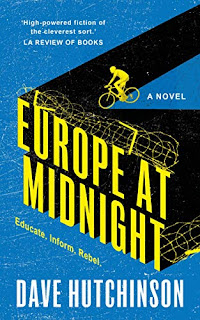
EUROPE AT MIDNIGHT weaves many threads into a glorious tapestry. Thanks Dave Hutchinson!


EUROPE AT MIDNIGHT
DAVE HUTCHINSON
(Fractured Europe Sequence #2)
Solaris Books (non-affiliate Amazon Link)
$6.99 ebook platforms, available now

Rating: 4.5* of five

The Publisher Says: In a fractured Europe, new nations are springing up everywhere, some literally overnight.

For an intelligence officer like Jim it's a nightmare. Every week or so a friendly power spawns a new and unknown national entity which may or may not be friendly to England's interests. It's hard to keep on top of it all.

But things are about to get worse for Jim. A stabbing on a London bus pitches him into a world where his intelligence service is preparing for war with another universe, and a man has appeared who may hold the key to unlocking Europe's most jealously guarded secret...

My Review: I have to disclose that, although I bought this book with my very own United States dollars, I'm pals with the author on social media. Believe me it affected my reading and opinion-making not at all, since an honest review is a better gift than a bunch of hot air. Also note that there are spoilers for EUROPE IN AUTUMN following.

At the very end of AUTUMN, a concept was introduced that's central to this book: The existence of "pocket universes," a modern-day physics concept that boggles my tiny 2-volt brain. It's defined as: "A pocket universe is a concept in inflationary theory, proposed by Alan Guth. It defines a realm like the one that contains the observable universe as only one of many inflationary zones." Wikipedia rocks, and everyone should throw some donations at Jimmy Wales.

So anyway, this pocket universe concept is the source of some really bad-ass events in the world we live in, including a hideous pandemic flu that's done what the Black Death did to 14th-century Europe. The devastation caused much economic misery. But as we all know, money for "black ops" will always flow copiously because there's always a secret to learn, one to protect, and no one dares to reveal it publicly in case The People rise up and shut off the money pipe. So our story threads all center on British Intelligence, the surviving Professor of Intelligence from a pocket universe called "the Campus," and the beloved (to me) Coueruers du Bois we learned so much about in AUTUMN.

All the adventures, the nightmares, the violent justice and injustice meted out are in search of a means to neutralize a threat to whatever place the character's loyalty lies. These people play hard and for keeps. Much bloodshed. All of it for ends that, in my opinion at least, make our world's conflicts seem as foolish as the story's stakes. Why is the mere existence of people your country can't or doesn't control so intolerable as to justify genocidal biowarfare?

EUROPE AT MIDNIGHT doesn't answer this question, raising it and examining it from several sides, but foregoing a simple and pompous jingoistic resolution. The use of pocket universes allows the author to compartmentalize the stories, in best spy-fiction fashion. The twist is that these pockets were created, not discovered, by a family of map-makers. The conflicts, therefore, are engineered and need not ever have happened had the greed and selfishness of one group not taken form in such an unusual way.

Or so it seems in this novel. The pocket countries that litter the near-future Europe after the pandemic, the pocket universes...were they created? Were they discovered and exploited, as the powers that be exploit the fragmentation of today's populations at the hands of venal and manipulative oligarchs?

If I've learned one thing while reading the Fractured Europe sequence, it's that perspective alters everything. I don't for a single second imagine that Hutchinson won't change our perspective on Fractured Europe in EUROPE IN WINTER, forthcoming late this year. Goddesses willing and the crick don't rise.