Showing posts with label 2017 film release. Show all posts

Monday, March 20, 2017

THE GLASS CASTLE, a neglected daughter's journey to forgiveness


THE GLASS CASTLE: A Memoir
JEANNETTE WALLS

Scribner
$12.99 ebook editions, available now

Rating: 4* of five

The Publisher Says: The Glass Castle is a remarkable memoir of resilience and redemption, and a revelatory look into a family at once deeply dysfunctional and uniquely vibrant. When sober, Jeannette's brilliant and charismatic father captured his children's imagination, teaching them physics, geology, and how to embrace life fearlessly. But when he drank, he was dishonest and destructive. Her mother was a free spirit who abhorred the idea of domesticity and didn't want the responsibility of raising a family.

The Walls children learned to take care of themselves. They fed, clothed, and protected one another, and eventually found their way to New York. Their parents followed them, choosing to be homeless even as their children prospered.

The Glass Castle is truly astonishing--a memoir permeated by the intense love of a peculiar but loyal family.

There will be a 2017 film whose release date isn't set just yet, so it seemed like a good time to revisit this influential, searingly honest, and personally relevant memoir.

My Review: Oh. My. God.

Walls has a non-fiction novel coming out this month, so I decided to re-read the book that started all the ruckus before I got to Half-Broke Horses. (NB I read that book, was disappointed, didn't review it.)

This memoir appealed to me as the youngest child (by a large margin) of two complete nutters. They were not like Walls' parents in that they never let us go hungry and we never lacked a roof over our heads. They were emotionally disturbed, though, and this passage sums up the sensation of being raised by a completely bizarre mother:
I wondered if the fire had been out to get me. I wondered if all fire was related, like Dad said all humans were related, if the fire that had burned me that day while I cooked hot dogs was somehow connected to the fire I had flushed down the toilet and the fire burning at the hotel. I didn't have the answers to those questions, but what I did know was that I lived in a world that at any moment could erupt into fire. It was the sort of knowledge that kept you on your toes.
The fires were, in my house, verbal. As a result of the noisy unsafe minefield I grew up in, I hate to raise my voice. If I have to shout it means (to me) that I've lost, there's no chance of being heard. I'm a sucker, as a consequence, for a man whose emotions are tightly reined in, especially if he's losing his battle against letting them loose. I empathize strongly.

A little backstory: I was romantically involved with a man for some time while I lived in Austin, whom I met on a bus. I got on the bus, sat a few seats behind the cute, sandy-haired, rumpled guy with the prominent ears devouring a book that I spotted from the pay-stile, and sighed the happy sigh of one whose world contains all the things he needs: A job, a home, and all the men he can mentally undress and ravish.

I was mid-mental ravishment when Mr. Man (as I came to call him) upset the applecart by bursting into tears. As quietly as he could, of course, but tears. A stop later, still crying. Stop after that, still crying. I got up, moved into the seat next to him but across the aisle, and said, "What the hell're you reading? I wanna be sure I never set an eyeball on it." That got a laugh, and he held up The Glass Castle and said it was sort of the story of his life.

We talked for four hours that day. I gave him my email and number, and things progressed pretty smoothly until one day they didn't, but that's another story.

He'd just read Walls's tale of her father taking her pubescent self to a pool-hall and getting her within an inch of getting raped, just so he'd have beer money:
Mom asked me if I was okay. I shrugged and nodded. “Well, there you go,” she said. She said that sexual assault was a crime of perception. “If you don’t think you’re hurt, then you aren’t,” she said. “So many women make such a big deal out of these things. But you’re stronger then that,” she went back to her crossword puzzle.
It struck a chord, and the story of his own stepfather's abuses of Mr. Man, and his mother's indifference to them, came spewing out of him. I've read the book before just now, specifically so I could discuss it with Mr. Man, but I did so with an already numbed horror bone and a severed humor tendon.

Only now that I am several years beyond that initial encounter with the book can I see how very funny the tragic events in it are, and were to the author. I can see that it's gallows humor of a sort...but also that it's all perfect proof that life's a Zen joke:
Mom always said people worried too much about their children. Suffering when you're young is good for you, she said. It immunized your body and your soul, and that was why she ignored us kids when we cried. Fussing over children who cry only encouraged them, she told us. That's positive reinforcement for negative behavior.

If you can chuckle at Dolly Parton's aperçu, "You have no idea how much it costs to look this cheap," then Walls is the next step up the Sisyphean slope of learning how to laugh like the Dalai Lama. It's a hard life that etches grooves in the looking-glass, but it's a path worth taking if you can get to the place where "textured" is valued more than smooth. Read the book, you'll know what I mean.

Sunday, July 31, 2016

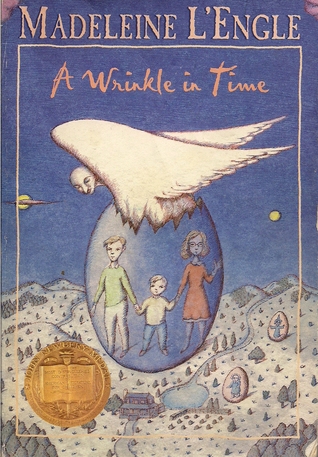
A WRINKLE IN TIME, Madeleine L'Engle's 1962 bestseller, is as revolutionary now as then


(this cover is for an out-of-print edition, but is still my favorite)

A WRINKLE IN TIME
MADELEINE L'ENGLE
(The Time Quintet #1)
Farrar, Straus & Giroux Books for Young Readers
$24.99 hardcover, available now

Rating: 4* of five

The Publisher Says: It was a dark and stormy night; Meg Murry, her small brother Charles Wallace, and her mother had come down to the kitchen for a midnight snack when they were upset by the arrival of a most disturbing stranger.

"Wild nights are my glory," the unearthly stranger told them. "I just got caught in a downdraft and blown off course. Let me be on my way. Speaking of way, by the way, there is such a thing as a tesseract."

Meg's father had been experimenting with this fifth dimension of time travel when he mysteriously disappeared. Now the time has come for Meg, her friend Calvin, and Charles Wallace to rescue him. But can they outwit the forces of evil they will encounter on their heart-stopping journey through space?

This text is from the edition I encourage you to buy:

Fifty years ago, Madeleine L'Engle introduced the world to A Wrinkle in Time and the wonderful and unforgettable characters Meg and Charles Wallace Murry, and their friend Calvin O'Keefe. When the children learn that Mr. Murry has been captured by the Dark Thing, they time travel to Camazotz, where they must face the leader IT in the ultimate battle between good and evil—a journey that threatens their lives and our universe. A Newbery Award winner, A Wrinkle in Time is an iconic novel that continues to inspire millions of fans around the world. This special edition has been redesigned and includes an introduction by Katherine Paterson, an afterword by Madeleine L'Engle's granddaughter Charlotte Jones Voiklis that includes photographs and memorabilia, the author's Newbery Medal acceptance speech, and other bonus materials.

THE BIG NEWS: A 2017 RELEASE NEW FILM ADAPTATION!

Okay, it's an *April 2018* release but principle photography is over at least.

My Review: Meg Murry's daddy left home unexpectedly and without saying goodbye. The adored parent left behind an adolescent daughter, three sons, and a beautiful and smart wife. Meg cannot make herself get used to his absence and can't even pretend that she's not hurt by the town's opinion that he ran off leaving her mother. This, plus braces, wildly curly hair, an intelligence far greater than her contemporaries', and glasses, isolate the girl with her even weirder little brother Charles Wallace against their normal brothers and the rest of the world.

In time-honored tradition, these misfits are actually being prepared to fight the ultimate battle of Good Versus Evil, no pressure on the children no no no, and save their Daddy, not like it's gettin' piled even higher oh no! One fine day, Meg and Charles Wallace are called to their destiny by Mrs Which, Mrs Who, and Mrs Whatsit, the eccentric old ladies who prove to be avatars of interdimensional good beings with the agenda of making the Universe safe for goodness and happiness again.

The children are joined by fellow misfit Calvin, a popular boy athlete in their town whose hidden depths have tormented him all his life, in the quest to make the evil entity, a disembodied brain called "IT," that slowly takes over planets and compels all life thereon to submit to being in a group mind, erasing individuality and leaching away happiness.

This is a YA novel, so all turns out well, with Mr. Murry coming home and the children being brought home all safe and sound. But how they get home is very interesting: They travel via tesseract, a geometric figure that extends into a fifth dimension beyond spacetime. Mr. and Mrs. Murry have been researching this in their roles as scientists, and Mr. Murry has used the tesseract to get to the planet from which he's rescued. The Mrs Who/Which/Whatsit interdimensional beings use the tesseract to "tesser" or wrinkle the fabric of spacetime to get the children there as well.

Fascinating stuff for a Christian housewife to be writing about in 1960-1961! And make no mistake, the book is a very Christianity-infested Message about the perils of brains without hearts leading to Communistic group-think. Mrs. Murry, a capable scientist, stays home with the kiddos and makes dinner over Bunsen burners so she can keep working while she stays home to be a wife and mom. Ew.

And Meg, poor lamb, worries that she's not pretty enough because she needs braces and glasses and she's not all gorgeous like her mom is. Then Calvin, a popular boy and an athlete, shows hidden depths and falls for little Meg. So bells ring, doves coo, and hands are held, so all is well. Ew.

But it ain't Twilight, so I'm good with it. In fact, because I first read it before I was ten, I'm good with all of it. The stiff, unrealistic dialogue, the socially regressive and reprehensible messages, the religiosity...all get a benign half-smile and an indulgent wink.

Because sometimes you just need to know that someone out there believes that good CAN triumph over evil.

Thursday, April 11, 2013

THE YELLOW BIRDS, a poet's first novel of the Iraq War

THE YELLOW BIRDS
KEVIN POWERS

Back Bay Books
$9.99 ebook editions, available now

Rating: 4.75* of five

WINNER OF THE 2013 PEN/HEMINGWAY AWARD FOR FIRST FICTION!

The Publisher Says: "The war tried to kill us in the spring," begins this breathtaking account of friendship and loss. In Al Tafar, Iraq, twenty-one-year old Private Bartle and eighteen-year-old Private Murphy cling to life as their platoon launches a bloody battle for the city. In the endless days that follow, the two young soldiers do everything to protect each other from the forces that press in on every side: the insurgents, physical fatigue, and the mental stress that comes from constant danger.

Bound together since basic training when their tough-as-nails Sergeant ordered Bartle to watch over Murphy, the two have been dropped into a war neither is prepared for. As reality begins to blur into a hazy nightmare, Murphy becomes increasingly unmoored from the world around him and Bartle takes impossible actions.

With profound emotional insight, especially into the effects of a hidden war on mothers and families at home, THE YELLOW BIRDS is a groundbreaking novel about the costs of war that is destined to become a classic.

My Review: I do so wish publishers would stop using the phrase “destined to become a classic” because, even if I agree with them (in this case I do), it's so obviously a sales pitch that it's a turn off.

No one knows for sure what the future will consider a classic. No one in 1955 would've given The Lord of the Rings future-classic status. No one in 1851 would've known about Moby-Dick, it was such a flop! The Great Gatsby? Please! Out of print by 1940!

This book, fragmented like PTSD memories, written in deceptively simple sentences by a *shudder* poet of all things, earns my admiration for its beauty, its simplicity, its sheer raw emotional up-front-ness. It has these, and many other, things in common with books that have stood the test of time and become classics. It is a first novel; it is about a young man's journey into a unique hell of memory and the maze he travels even to imagine daylight guiding him out; it is, one strongly suspects based on the author's CV, a roman à clef. So far, so good, for the oddsmakers' guess it will become a classic; so did The Naked and the Dead, so did The Sun Also Rises, and so on. I think it will be a classic. I hope it will, and I offer this passage as support for my hope and conviction:

When we neared the orchard a flock of birds lit from its outer rows. They hadn't been there long. The branches shook with their absent weight and the birds circled above in the ruddy mackerel sky, where they made an artless semaphore. I was afraid. I smelled copper and cheap wine. The sun was up, but a half-moon hung low on the opposite horizon, cutting through the morning sky like a figure from a child's pull-tab book.

We were lined along the ditch up to our ankles in a soupy muck. It all seemed in that moment to be the conclusion of a poorly designed experiment in inevitability. Everything was in its proper place, waiting for a pause in time, for the source of all momentum to be stilled, so that what remained would be nothing more than detritus to be tallied up. The world was paper-thin as far as I could tell. And the world was the orchard, and the orchard was what came next. But none of that was true. I was only afraid of dying.”
That, for me, is a lovely moment of mortal fear's hyperreality-inducing sensory twist. Never having been in war, I can't say it's what a soldier would feel, but having been afraid for my life from external causes, I can say that is the kind of sharp-edged seemingly odd clarity of perception that happened to me. The author was a soldier in Iraq. I suspect he saw and felt these exact things, and because he's *gag* an MFA-havin' poet, he remembered them with extreme precision.

Kevin Powers is One To Watch. This book won the 2012 Guardian First Book Award; the 2013 Anisfield-Wolf Book Award (which recognizes books that have made important contributions to our understanding of racism and our appreciation of the rich diversity of human cultures); the 2013 Sue Kaufman Prize for First Fiction (a $5,000 award administered by the American Academy of Arts and Letters); and the 2013 Prix littéraire étranger Le Monde, given by the French newspaper Le Monde. I strongly suspect this could be the best novel we see from him unless he gets back on the authorial horse to do better than his previous best. I hope he does, and I pray it doesn't blight his ambitions to be so successful so early in his novel-writing career. I most urgently petition the Muses for his beautiful, beautiful talent to survive intact the horrors of commerce, where the agonies of war built a palace for him.

The 2017 film gets a solid 4 stars of five from me, and is available free to Amazon Prime members. Alden Ehrenreich, from that Star Wars movie that got so much hate, is Bartle; and Toni Collette plays his mom; and Jennifer Aniston plays Mrs. Murphy, the mother who entrusts her son to Bartle. All three, as well as the other actors, give very creditable performances in a script that was of decidedly less exalted quality than the novel was. Not bad, not great, better than average by a hair or two; that is not high praise. The story itself makes the experience of watching the film satisfying.