Pages
- Home
- Mystery Series
- Bizarro, Fantasy & SF
- QUILTBAG...all genres
- Kindle Originals...all genres
- Politics & Social Issues
- Thrillers & True Crime
- Young Adult Books
- Poetry, Classics, Essays, Non-Fiction
- Science, Dinosaurs & Environmental Issues
- Literary Fiction & Short Story Collections
- Sookie Stackhouse/Southern Vampire Books & True Blood
- Books About Books, Authors & Biblioholism
Showing posts with label Picador USA. Show all posts
Friday, March 1, 2024
THE SIX: The Lives of the Mitford Sisters, bringing Us-v-Them all the way home
THE SIX: The Lives of the Mitford Sisters
LAURA THOMPSON
Picador
$20.00 trade paper, available now
Rating: 4* of five
The Publisher Says: The contrasting lives of the Mitford sisters—stylish, scandalous and tragic by turns—hold up a mirror to upper-class life before and after the Second World War.
The eldest was a razor-sharp novelist of upper-class manners; the second was loved by John Betjeman; the third was a fascist who married Oswald Mosley; the fourth idolized Hitler and shot herself in the head when Britain declared war on Germany; the fifth was a member of the American Communist Party; the sixth became Duchess of Devonshire.
They were the Mitford sisters: Nancy, Pamela, Diana, Unity, Jessica and Deborah. Born into country-house privilege, they became prominent as ‘bright young things’ in the high society of interwar London. Then, as the shadows crept over 1930s Europe, the stark—and very public—differences in their outlooks came to symbolise the political polarities of a dangerous decade.
The intertwined stories of their lives—recounted in masterly fashion by Laura Thompson—hold up a revelatory mirror to upper-class English life before and after World War II.
I RECEIVED A DRC FROM THE PUBLISHER VIA NETGALLEY. THANK YOU.
My Review: I have read The American Way of Death. I have read Love in a Cold Climate. That these books were written by sisters never fails to astonish me. If you have not yet, read them to see just how little two sisters can share...the folks in Nancy’s novels own the corporations that rip off the bereaved in Jessica’s book.
The gossipy goodness of a big family that has oodles of money and wildly talented members is a cultural icon these days, thanks to Succession and its imitators...but honestly, what kind of world would we live in if we couldn’t look at the source material with a more compassionate eye? The Mitford sisters were not villainesses. They disagreed on a lot of things...but won’t any six people when examined as closely as their fame enabled the Mitfords to be? Nancy, the eldest, was not overtly political, yet spent her life among the people she grew up among, the wealthiest in the world. That did not prevent her from shopping Diana and her repugnant fascist husband Oswald Mosley to the Intelligence services during WWII. She might have been rich and upper class, but she had limits that could not be transgressed, including treasonous actions against the UK that the fascists led by her brother-in-law were planning. That did not extend to Decca, Jessica’s family nickname, and her leftist principles...despite Jessica being so committed to those principles that she allowed her own child to die rather than accept help from her family.
So, clearly, this is a juicy, gossipy read. Does that make it a worthwhile one? We are, as of this writing, in a time of wealth inequality as stark as the one in the Mitford sisters’ lives. The natural consequence of battle-lines being drawn is depersonalizing the Other Side, attributing inhuman levels of focus to Them, all against what Our Side...clearly the side of God and the Angels, self-evidently Right in all ways and destined to prevail over Them...thus excusing ourselves in advance from the annoying burden of empathy with people we disagree with.
What Author Thompson does in this book is give us the gory details of rich people’s lives, while bringing our attention to the immutable nature of Family in forming its members...would Nancy, the eldest, ever have been able to turn into the radical that late-in-order rebel Jessica, or middle-child Diana, did? Likely not. Her world, Thompson shows, is that much different from theirs. Like any big family, the Mitfords were a very mixed bag of people formed by the pressure cooker of differing expectations and opportunities into very, very different people. What looks from the outside like a bloc of wealth and privilege is, from a closer view, a forest of unique trees.
This is a useful reminder now, when we look at the Othering that is so prevalent in modern society. They are not Them, they are all part of Us. We are, in fact, always an Us, just like the Mitfords were.
Friday, March 10, 2017
NICKEL AND DIMED, still relevant, still trenchant, still tendentious
NICKEL AND DIMED: On (Not) Getting By in America
BARBARA EHRENREICH
Picador USA
$17.00 trade paper, available now
Rating: 4* of five
The Publisher Says: Millions of Americans work for poverty-level wages, and one day Barbara Ehrenreich decided to join them. She was inspired in part by the rhetoric surrounding welfare reform, which promised that any job equals a better life. But how can anyone survive, let alone prosper, on $6 to $7 an hour? To find out, Ehrenreich moved from Florida to Maine to Minnesota, taking the cheapest lodgings available and accepting work as a waitress, hotel maid, house cleaner, nursing-home aide, and Wal-Mart salesperson. She soon discovered that even the "lowliest" occupations require exhausting mental and physical efforts. And one job is not enough; you need at least two if you intend to live indoors.
Nickel and Dimed reveals low-wage America in all its tenacity, anxiety, and surprising generosity -- a land of Big Boxes, fast food, and a thousand desperate strategies for survival. Instantly acclaimed for its insight, humor, and passion, this book is changing the way America perceives its working poor.
My Review: Let's get something out of the way right here and now: Ehrenreich has had a lot of snarky feedback about the fact that, in researching and writing this book, she's "playacting" and her privileged background as a PhD-having writer shows in every "condescending" moment of expressing surprise at how ground down her temporary colleagues are. She is the target of "ghetto tourism" accusations. And so on and so forth. I suppose for the stupider members of the audience the concept "investigative journalism" isn't familiar. She, a journalist, stepped out of her own life to investigate an important situation in American society. So we're clear: Her responses are part of the story. They are MEANT TO BE PART OF THE STORY, YA DIMWITS. Her privilege is showing because she's privileged and she's doing these crap jobs to see what it's like. Guess what? IT SUCKS. So she responds as anyone from her background would.
Not to mention her ancestors weren't middle class, they were the very people she's reporting on...with the important difference that their labor was rewarded adequately to support their families. How things change when the bidness bastards get their greedy mitts on the levers of power:
As a nouveau poor person, I can tell you I've never come close to breaking even on any transaction of any sort. The reason:
Ehrenreich brings us to the brink of a hideous cesspit of greed with this ongoing slimy, nauseating sludge of reality soup:
So Ehrenreich, an educated woman, has a thunderstruck moment of realization:
Of course, the opiate of the masses is now TV not Jeebus. Even there the poor person is slapped and kicked and punched with the expectation that we're all one big middle-class world:
I think the point of this book is best summed up here:
BARBARA EHRENREICH
Picador USA
$17.00 trade paper, available now
Rating: 4* of five
The Publisher Says: Millions of Americans work for poverty-level wages, and one day Barbara Ehrenreich decided to join them. She was inspired in part by the rhetoric surrounding welfare reform, which promised that any job equals a better life. But how can anyone survive, let alone prosper, on $6 to $7 an hour? To find out, Ehrenreich moved from Florida to Maine to Minnesota, taking the cheapest lodgings available and accepting work as a waitress, hotel maid, house cleaner, nursing-home aide, and Wal-Mart salesperson. She soon discovered that even the "lowliest" occupations require exhausting mental and physical efforts. And one job is not enough; you need at least two if you intend to live indoors.
Nickel and Dimed reveals low-wage America in all its tenacity, anxiety, and surprising generosity -- a land of Big Boxes, fast food, and a thousand desperate strategies for survival. Instantly acclaimed for its insight, humor, and passion, this book is changing the way America perceives its working poor.
My Review: Let's get something out of the way right here and now: Ehrenreich has had a lot of snarky feedback about the fact that, in researching and writing this book, she's "playacting" and her privileged background as a PhD-having writer shows in every "condescending" moment of expressing surprise at how ground down her temporary colleagues are. She is the target of "ghetto tourism" accusations. And so on and so forth. I suppose for the stupider members of the audience the concept "investigative journalism" isn't familiar. She, a journalist, stepped out of her own life to investigate an important situation in American society. So we're clear: Her responses are part of the story. They are MEANT TO BE PART OF THE STORY, YA DIMWITS. Her privilege is showing because she's privileged and she's doing these crap jobs to see what it's like. Guess what? IT SUCKS. So she responds as anyone from her background would.
Not to mention her ancestors weren't middle class, they were the very people she's reporting on...with the important difference that their labor was rewarded adequately to support their families. How things change when the bidness bastards get their greedy mitts on the levers of power:
My aim here was much more straightforward and objective — just to see whether I could match income to expenses, as the truly poor attempt to do every day. Besides, I've had enough unchosen encounters with poverty in my lifetime to know it's not a place you would want to visit for touristic purposes; it just smells too much like fear.I guess that passage whipped past the haters. Or they just decided it didn't matter for some arcane reason. Anyway, I consider that specious argument laid to rest. Allons-y!
As a nouveau poor person, I can tell you I've never come close to breaking even on any transaction of any sort. The reason:
There are no secret economies that nourish the poor; on the contrary, there are a host of special costs. If you can’t put up the two months’ rent you need to secure an apartment, you end up paying through the nose for a room by the week. If you have only a room, with a hot plate at best, you can’t save by cooking up huge lentil stews that can be frozen for the week ahead. You eat fast food or the hot dogs and Styrofoam cups of soup that can be microwaved in a convenience store.You get fat when you're poor because the only food you can afford is shitty, processed, and low-quality store-brand offal. No apartment? No fridge. No fresh anything, even assuming you go pay a buck for an apple (do the math when you're in the produce section). No milk, only "creamer" (terrifying stuff, look at the label sometime) for your coffee, tea, cereal. I personally am incredibly lucky because my most recent roommate left me his fridge when he had to go to the nursing home. Imagine! Frozen veggies!! Luxury.
Ehrenreich brings us to the brink of a hideous cesspit of greed with this ongoing slimy, nauseating sludge of reality soup:
As Louis Uchitelle has reported in the New York Times, many employers will offer almost anything—free meals, subsidized transportation, store discounts—rather than raise wages. The reason for this, in the words of one employer, is that such extras “can be shed more easily” than wage increases when changes in the market seem to make them unnecessary. In the same spirit, automobile manufacturers would rather offer their customers cash rebates than reduced prices; the advantage of the rebate is that it seems like a gift and can be withdrawn without explanation.Salary or wages become expectations, and can't have the hoi polloi expecting a decent living! After all, where will all those scumbag banksters get the extra zero on their bonus checks from if minimum wage is set at a livable level?
So Ehrenreich, an educated woman, has a thunderstruck moment of realization:
To draw for a moment from an entirely different corner of my life, that part of me still attached to the biological sciences, there is ample evidence that animals — rats and monkeys, for example — that are forced into a subordinate status within their social systems adapt their brain chemistry accordingly, becoming "depressed" in humanlike ways. Their behavior is anxious and withdrawn; the level of serotonin (the neurotransmitter boosted by some antidepressants) declines in their brains. And — what is especially relevant here — they avoid fighting even in self-defense ... My guess is that the indignities imposed on so many low-wage workers — the drug tests, the constant surveillance, being "reamed out" by managers — are part of what keeps wages low. If you're made to feel unworthy enough, you may come to think that what you're paid is what you are actually worth.She realizes that her response is typical of people whose lives are lived at this depth of society. Imagine how someone less able than she is internalizes this hideous reality. To her credit, she thinks about this, even though her genetic privilege of intelligence prevents her from fully experiencing its soul-crushing impact. And it's the bored upper classes who guzzle antidepressants by the fistful. Something's very wrong with that....
Of course, the opiate of the masses is now TV not Jeebus. Even there the poor person is slapped and kicked and punched with the expectation that we're all one big middle-class world:
Maybe it's low-wage work in general that has the effect of making you feel like a pariah. When I watch TV over my dinner at night, I see a world in which almost everyone makes $15 an hour or more, and I'm not just thinking of the anchor folks. The sitcoms and dramas are about fashion designers or schoolteachers or lawyers, so it's easy for a fast-food worker or nurse's aide to conclude that she is an anomaly — the only one, or almost the only one, who hasn't been invited to the party. And in a sense she would be right: the poor have disappeared from the culture at large, from its political rhetoric and intellectual endeavors as well as from its daily entertainment. Even religion seems to have little to say about the plight of the poor, if that tent revival was a fair sample. The moneylenders have finally gotten Jesus out of the temple.Really, what else needs be said? Can you watch your sitcom or your vampire show the same way after being awakened to the impact that its assumptions have on the maid who polishes your moss-covered three-handled family gradunza, the immigrant smiling as she hands over your greaseburger and fries with a molto grandissimo vat of fizzy death juice (which for gods' sweet sake STOP PUTTING IN YOUR BODY NOW!)?
I think the point of this book is best summed up here:
When someone works for less pay than she can live on — when, for example, she goes hungry so that you can eat more cheaply and conveniently — then she has made a great sacrifice for you, she has made you a gift of some part of her abilities, her health, and her life. The 'working poor,' as they are approvingly termed, are in fact the major philanthropists of our society. They neglect their own children so that the children of others will be cared for; they live in substandard housing so that other homes will be shiny and perfect; they endure privation so that inflation will be low and stock prices high. To be a member of the working poor is to be an anonymous donor, a nameless benefactor, to everyone else.If this isn't enough to shame you into activism on behalf of the people who mow your, your neighbor's, and the local church's lawn for a lousy $40 or so; bring your lazy ass a pizza in her own car, paying $4 or so for a gallon of gas and insurance and then you tip her $2 or $3; or teaching your snot-nosed privileged peanut-allergied unvaccinated brats while her own kids are a constant worry because the school system doesn't provide daycare, then I have no hope for your soul.
Saturday, November 5, 2016
SHELTER, my General Fiction vote for the Goodreads Choice Awards
SHELTER
JUNG YUN
Picador
$26.00 hardcover, available now
Rating: 3.5* of five
The Publisher Says: Kyung Cho is a young father burdened by a house he can’t afford. For years, he and his wife, Gillian, have lived beyond their means. Now their debts and bad decisions are catching up with them, and Kyung is anxious for his family’s future.
A few miles away, his parents, Jin and Mae, live in the town’s most exclusive neighborhood, surrounded by the material comforts that Kyung desires for his wife and son. Growing up, they gave him every possible advantage—private tutors, expensive hobbies—but they never showed him kindness. Kyung can hardly bear to see them now, much less ask for their help. Yet when an act of violence leaves Jin and Mae unable to live on their own, the dynamic suddenly changes, and he’s compelled to take them in. For the first time in years, the Chos find themselves living under the same roof. Tensions quickly mount as Kyung’s proximity to his parents forces old feelings of guilt and anger to the surface, along with a terrible and persistent question: how can he ever be a good husband, father, and son when he never knew affection as a child?
My Review: I voted for this in the 2016 Goodreads choice awards because it was the most interesting novel I'd read among the choices. It wasn't an easy read. I disliked everyone except Ethan Cho, the four-year-old, and given time I'm sure I'd've disliked him too.
What price family? I didn't have a close or happy family. My own parents weren't like the Chos, they were chaotic rather than cruel and cold. But what made the book interesting for me is the way Kyung tries to stop the vicious cycle of chill and distance, and fails again and again. His wife is just as guilty of emotional dysfunction as he is.
When this screwed-up couple is, in simple human decency, required to house the traumatized parents after their luxurious and hollow world cracks wide open, the fun truly begins. Think the set-up's dark? Wait until the parents move in!
The ending is a raggedy-looking bow tied on the fanny of the story which I didn't for one second believe came from any strand in the story itself. I'd still suggest reading it.
JUNG YUN
Picador
$26.00 hardcover, available now
Rating: 3.5* of five
The Publisher Says: Kyung Cho is a young father burdened by a house he can’t afford. For years, he and his wife, Gillian, have lived beyond their means. Now their debts and bad decisions are catching up with them, and Kyung is anxious for his family’s future.
A few miles away, his parents, Jin and Mae, live in the town’s most exclusive neighborhood, surrounded by the material comforts that Kyung desires for his wife and son. Growing up, they gave him every possible advantage—private tutors, expensive hobbies—but they never showed him kindness. Kyung can hardly bear to see them now, much less ask for their help. Yet when an act of violence leaves Jin and Mae unable to live on their own, the dynamic suddenly changes, and he’s compelled to take them in. For the first time in years, the Chos find themselves living under the same roof. Tensions quickly mount as Kyung’s proximity to his parents forces old feelings of guilt and anger to the surface, along with a terrible and persistent question: how can he ever be a good husband, father, and son when he never knew affection as a child?
My Review: I voted for this in the 2016 Goodreads choice awards because it was the most interesting novel I'd read among the choices. It wasn't an easy read. I disliked everyone except Ethan Cho, the four-year-old, and given time I'm sure I'd've disliked him too.
What price family? I didn't have a close or happy family. My own parents weren't like the Chos, they were chaotic rather than cruel and cold. But what made the book interesting for me is the way Kyung tries to stop the vicious cycle of chill and distance, and fails again and again. His wife is just as guilty of emotional dysfunction as he is.
When this screwed-up couple is, in simple human decency, required to house the traumatized parents after their luxurious and hollow world cracks wide open, the fun truly begins. Think the set-up's dark? Wait until the parents move in!
The ending is a raggedy-looking bow tied on the fanny of the story which I didn't for one second believe came from any strand in the story itself. I'd still suggest reading it.
Wednesday, April 27, 2016
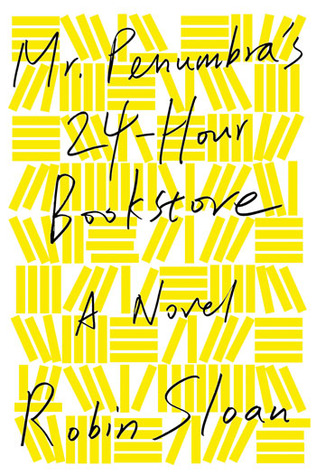
MR. PENUMBRA'S 24-HOUR BOOK STORE, smart people's escapist fun

MR. PENUMBRA'S 24-HOUR BOOKSTORE
ROBIN SLOAN
Picador USA
$16.00 trade paper, available now
Rating: 3.9* of five
The Publisher Says: A gleeful and exhilarating tale of global conspiracy, complex code-breaking, high-tech data visualization, young love, rollicking adventure, and the secret to eternal life—mostly set in a hole-in-the-wall San Francisco bookstore
The Great Recession has shuffled Clay Jannon out of his life as a San Francisco Web-design drone—and serendipity, sheer curiosity, and the ability to climb a ladder like a monkey has landed him a new gig working the night shift at Mr. Penumbra’s 24-Hour Bookstore. But after just a few days on the job, Clay begins to realize that this store is even more curious than the name suggests. There are only a few customers, but they come in repeatedly and never seem to actually buy anything, instead “checking out” impossibly obscure volumes from strange corners of the store, all according to some elaborate, long-standing arrangement with the gnomic Mr. Penumbra. The store must be a front for something larger, Clay concludes, and soon he’s embarked on a complex analysis of the customers’ behavior and roped his friends into helping to figure out just what’s going on. But once they bring their findings to Mr. Penumbra, it turns out the secrets extend far outside the walls of the bookstore.
With irresistible brio and dazzling intelligence, Robin Sloan has crafted a literary adventure story for the twenty-first century, evoking both the fairy-tale charm of Haruki Murakami and the enthusiastic novel-of-ideas wizardry of Neal Stephenson or a young Umberto Eco, but with a unique and feisty sensibility that’s rare to the world of literary fiction. Mr. Penumbra’s 24-Hour Bookstore is exactly what it sounds like: an establishment you have to enter and will never want to leave, a modern-day cabinet of wonders ready to give a jolt of energy to every curious reader, no matter the time of day.
My Review: A bookstore with no customers wanted. A secret society called “The Unbroken Spine.” A library of books in a code that even Google boffins have trouble breaking. In the end, a resolution to the seemingly mortal combat between tree books and ebooks that will leave the true-hearted reader smiling.
Escapist fun. Rollicking silliness. Eccentric amusement. All on offer in heaping helpings, with a garnish of goofy grins.
Election season has me on Outrage Overload, and my antidote to any ill is reading a good book. Short of terminal disease, I believe a good read will cure any ailment of mind, body, or spirit. I stopped frothing hysterically about Bain Capital owning an interest in a voting-machine contractor in Ohio for almost an hour while reading this book. Watching the evil-bastard GOP set up for another election steal like 2000 causes me to scream imprecations loudly, so Mr. Penumbra's 24-Hour Bookstore hath wrought a miracle!
Take a break from your cares. Read this enjoyable, entertaining book about improbable people doing implausible things to solve an impossible, absurd problem. It will leave you refreshed!
Subscribe to:
Posts (Atom)