Showing posts with label food addiction. Show all posts

Wednesday, February 25, 2026

PICKY: How American Children Became the Fussiest Eaters in History, Dr. Spock has a LOT to answer for


PICKY: How American Children Became the Fussiest Eaters in History
HELEN ZOE VEIT

St. Martin's Press (non-affiliate Bookshop.org link)
$14.99 ebook, available now

Rating: 4.5* of five

The Publisher Says: An eye-opening investigation into why American kids no longer eat broadly and with gusto

Are children naturally picky? It sure seems that way. Yet, amazingly, pickiness used to be almost nonexistent. Well into the 20th century, Americans saw children as joyful omnivores who were naturally curious and eager to eat. Of course, this doesn't make sense today. Don't kids have special taste buds? Aren't they highly sensitive to food's texture and color? Aren’t children incapable of liking “adult foods,” and don’t parents risk harming kids psychologically by urging them to eat?

But Americans in the past didn’t think any of those things. They assumed that children could enjoy the same foods as adults, and children almost always did. They loved spicy relishes, vinegary pickles, and bitter greens. They spent their allowances on raw oysters and looked forward to their daily coffee. So how did modern kids become such incredibly narrow eaters? The story is fascinating – and about much more than rising abundance. Picky shows how fussy eating came to define "children’s food" and reshape American diets at large. Maybe most importantly, it explains how we can still use the tools that parents used in the past to raise happy, healthy, wildly un-picky kids today.

I RECEIVED A DRC FROM THE PUBLISHER VIA NETGALLEY. THANK YOU.

My Review
: I wasn't a picky eater because I was raised by parents who loved food. I'm so grateful to them for the lesson they each taught: "try it, if you don't like it you don't have to finish it."

I'm also old. This message was more common among the Depression-era denizens who raised me than postwar-boom kids who raised the picky eaters we're discussing in this book.

As "experts" got hold of the conversation around food (author's scare quotes), the wheels came off. We know from decades of research findings being reported and then challenged, the "experts" (remember, not my scare quotes!) have been tarred by the backlash that keeps growing against expertise in general. It feels kind of justified to me, in this case, because there are no real reasons that the advice the "experts" gave should have been heeded as none of them made any sense at all. But, well, expertise needs to be respected. It's the world now that does NOT respect expertise that's in terrible trouble.

Author Veit has researched the question "is a generation of US-born kids pickier in their food choices than earlier generations?" and presented findings and posited reasons for the findings. It is a fascinating topic. The sources are broad-based and wide-ranging; cited in line which I appreciate; and to the extent I randomly sampled credible. What they aren't, and what the book itself isn't, is prescriptive. Nowhere in the text is there a solution to a problem identified. It was not promised, it was not suggested in the research sources to be intended; I bring it up because I don't want to give the impression there is anywhere anything about addressing the behavior being studied.

I get the impression that the title led previous readers down that garden path. Don't be one of them! I'm interested in the subject of picky eating because it seems so absurd to allow it. I was glad to read Author Veit's study because I feel much less...superior...about the realities of the issue. I think there's a lot of value in this lens on our present social moment's roots and results. I felt there was genuine curiosity, a real "I need to know" on the author's part, and I resonated with that feeling. It gave me a four-star reading experience. I was impressed with her research, her cogitations on the research, and convinced by her conclusions based on them. I was perhaps less drawn in than I might have been by the shifts I felt between the presentation of her digests of research and the chattier tone of her presentation of her conclusions drawn from it...this was more like feeling some charming cocktail-party acquaintance was suddenly taking me into the lecture hall.

Entirely irrelevant to the value I received from the read. It was a factor that impacted me on a reading-pleasure level alone. You might feel entirely differently. I hope you will get the book to find out for yourself.

Monday, March 17, 2025

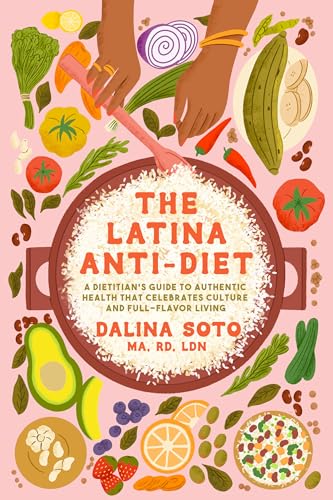
THE LATINA ANTI-DIET: A Dietitian's Guide to Authentic Health that Celebrates Culture and Full-Flavor Living, good, supportive guide to eating


THE LATINA ANTI-DIET: A Dietitian's Guide to Authentic Health that Celebrates Culture and Full-Flavor Living
DALINA SOTO

Ballantine Books (non-affiliate Amazon link)
$14.99 ebook, available now

Rating: 5* of five

The Publisher Says: Break away from diet culture while still honoring your body and incorporating cultural foods in this fresh, expansive guide from the registered dietitian and creator of Your Latina Nutritionist.

Diet culture is facing a reckoning, and intuitive eating has been leading the charge. The movement has taken the internet by storm, encouraging us to stop dieting and make food choices that feel good for our bodies rather than follow influencers and their shakes.

But intuitive eating is missing a key ingredient: culture. Like many movements, intuitive eating has become co-opted by a select few—placing the focus on “mainstream” food while discounting cultural cuisines. But how can we gain a healthy attitude towards food when our foods—our arroz, habichuelas, and plátanos—are left out of the conversation?

Dalina Soto is here to add them back to our plates.

As a registered dietitian, Soto understands the pros and cons of intuitive eating. As a first-generation Dominican American, she’s also seen firsthand how this movement has only catered to a certain demographic. With her easy-to-follow CHULA method, Soto teaches us how to:
  • Challenge negative thoughts
  • Honor our bodies and health
  • Understand our needs
  • Listen to our hunger
  • Acknowledge our emotions
  • She gives us tools to confront diet culture and the whitewashing of food so we can go back to eating what we love while managing our health.

    Engaging and incisive, The Latina Anti-Diet is for everyone who’s been told to lay off the tortillas and swap their white rice for brown. Soto shows us that food is so much more than calories; it’s about celebrating our culture and living a life full of flavor.

    I RECEIVED A DRC FROM THE PUBLISHER VIA NETGALLEY. THANK YOU.

    My Review
    : Food, fat, and flavor start with the same letter for a reason. I'm deeply anti-diet. This book crystalizes my objections to the diet industry's be-afraid-of-your-food message, its relentless focus on women and the concomitant relentless bombardment of negativity about appearance, or more stealthily but with the same objective, relentless "health" messaging that is anything but healthy.

    The author is a social-media Force. She's got followers in droves...legions...and she's been giving this very practical method to get yourself into a healthy, sustainable pattern of eating the food you enjoy for a while now. I hadn't heard of her because I'm not all that interested in diets except to belittle and insult the anti-food goblins that perpetrate and perpetuate the anti-food messaging that damages so many people.

    What else can I say? If you think you need a diet book, you really need this book. Skip the "one weird trick" fads, spend your time and your treasure here. Author Soto is Cicero to the Br'er Rabbits that abound in this space. She spends a deal of her page-count telling stories about those who've used her method...CHULA, explained above...to mend their fractured relationship to food. There's a lot of informative and explanatory text, so it's not just a paper version of an infomercial; the aim was to recreate her social-media presence's warm, approachable presentation of self. I found it effective, and agreeable, where I expected to feel it was kinda cringe.

    *I*, a certifiable curmudgeon with a long-standing hatred of the dietmongers, am rating this book 5 stars and recommending it to people who think they need to diet. Push a pin in that idea until you've read this book.

    Friday, November 3, 2017

    CRAVINGS, proof that fame doesn't guarantee happiness


    CRAVINGS: How I Conquered Food
    JUDY COLLINS

    Nan A. Talese Books
    $26 hardcover, available now

    Rating: 3.5* of five

    The Publisher Says: Since childhood Judy Collins has had a tumultuous, fraught relationship with food. Her issues with overeating nearly claimed her career and her life. For decades she thought she simply lacked self-discipline. She tried nearly every diet plan that exists, often turning to alcohol to dull the pain of yet another failed attempt to control her seemingly insatiable cravings.

    Today, Judy knows she suffers from an addiction to sugar and grains, flour and wheat. She adheres to a strict diet of unprocessed foods consumed in carefully measured portions. This solution has allowed her to maintain a healthy weight for years, to enjoy the glow of good health, and to attain peace of mind.

    Alternating between chapters on her life and those of the many diet gurus she has encountered along the way (Atkins, Jean Nidetch of Weight Watchers, Andrew Weil, to name a few), Cravings is the culmination of Judy's genuine desire to share what she's learned--so that no one else has navigate her heart-rending path to recovery.

    THE PUBLISHER SENT A REVIEW COPY AT MY REQUEST. THANK YOU.

    My Review: A lifetime spent in and out of the limelight, a lifetime of performing for audiences who cheer and boo and ignore, but performing all the same, always always putting her best out there...an enviable life, no?

    Not always. Judy Collins made her voice her fame, and when it became harder for her to perform it became another self-lacerating weapon in her battle with her body. Her diets and plans and struggles with her addictive personality are carefully presented here as *personal* struggles. Collins isn't preaching, she's giving witness to the struggle she knows many others go through. That technique is very much more effective than would be another guru prescribing actions and dictating methods for achieving the goal of being in control of one's own body.

    I'm also very appreciative of the quite interesting stories behind the gurus whose dictates Collins frequently failed to follow. I found these to be some of the most useful parts of the book, as the motivations of Saviors are almost always excellent means for demythologizing and even debunking the gurus' sacred words. I hasten to add that Collins isn't out to make people feel bad or wrong about their struggles or their need for advice. She just has clear eyes when it comes to the whys of the whats of dieting.

    The reason I'm not more generous with my star rating really comes down to one issue: The conquest of Collins's food addiction is so complete and so thoroughgoing that I am left with deep doubts. I don't think she's lying to me or even to herself; I think she's got an iron will forged through a generation-long struggle to control her body. What I question is the declaration of victory over something that's a fundamental part of her identity. She says she's a food addict but she's beaten it. That doesn't scan for me. I'm also not 100% Team Judy on the means by which she's conquered her food addiction, as it's *impossibly* restrictive and simply impossible for a person without her considerable financial and social resources to emulate.

    This is, to me at least, the principal failing of all eating-disorder diet nutrition etc etc books. Fine great and wonderful if you're upper middle class and up, have money, servants, time at your disposal. Useless and, worse, counterproductive if you're a 60-hour-a-week wage worker whose paycheck is never quite enough, has kids, a spouse, and no one to do diddly squat for them.

    That said, if you're not a desperate soul seeking a way out of the addiction trap, this is a sprightly and involving and educational read. I liked the experience of reading it quite a bit.