Pages
- Home
- Mystery Series
- Bizarro, Fantasy & SF
- QUILTBAG...all genres
- Kindle Originals...all genres
- Politics & Social Issues
- Thrillers & True Crime
- Young Adult Books
- Poetry, Classics, Essays, Non-Fiction
- Science, Dinosaurs & Environmental Issues
- Literary Fiction & Short Story Collections
- Sookie Stackhouse/Southern Vampire Books & True Blood
- Books About Books, Authors & Biblioholism
Showing posts with label 1950s gay characters. Show all posts
Saturday, June 20, 2026
LEV A.C. ROSEN'S PAGE: THE DISASTER GAY DETECTIVE AGENCY & EVANDER MILLS P.I. SERIES #1, #4
THE DISASTER GAY DETECTIVE AGENCY
LEV A.C. ROSEN
Poisoned Pen Press (non-affiliate Bookshop.org link)
$9.99 ebook, available now
Rating: 4.25* of five
The Publisher Says: From award—winning, critically acclaimed crime writer Lev Rosen comes a punchy, hilarious mystery—thriller. Meet the disaster gays: They're messy. They're queer. And they're about to solve a murder… Or die trying.
Brandon is a hopeless romantic. So when a handsome stranger named Jon checks in at the hotel he works at and invites Brandon to his room, Brandon ignores the advice of his crew—a group of loveable and messy queer twenty—somethings—and accepts. What follows is a tale as old as time: they hook up, Jon promises to text, Brandon falls in love, and Jon ghosts. Case closed—or is it?
When Jon checks out early, leaving behind a bag of belongings and his cellphone, Brandon takes the phone and sets out to find him, thinking that this must at last be his Cinderella story.
But he gets more than he bargained for when he witnesses a murder—and sees Jon fleeing the scene.
Determined (and not in over their heads whatsoever), Brandon, Ollie, Nicole, and Ian decide to solve the mystery of the murder and uncover Jon's true identity…they just have to figure it out before a target falls on their own backs.
I RECEIVED A DRC FROM THE PUBLISHER VIA NETGALLEY. THANK YOU.
My Review: Those heady first friendships, the ones you really learn how to adult by forming and inhabiting...they're deep and they're still important to older you because you are formed by them for better and worse.
Here we are among Brandon, Ollie, Nicole, and Ian as they navigate the first changes in the structures that supported them. It's usually a significant other arriving or one departing. Most of us have been through that.
Few of us have had a potential love discovered in what looks like a guilty act at what certainly is a murder scene, like Brandon.
What ensues is the scoobygroup all pitching in to resolve Brandon's maybeboyfriend's involvement (if any) in the murder he was seen running away from the scene of. Naturally this means they need to solve the murder. A lot like Dame Agatha's Five Little Pigs we're treated to the scoobygroup's individual PoVs on the investigation and on the unfolding issue of who it is Brandon's found himself to fall for. I think the technique is one that works or fails on your readerly taste for the writing style. Author Lev uses a solidly comedic register throughout the story, giving the different scoobygoupers reasonably distinctive voices and just enough difference in what they see to keep me focused.
I don't want to tell you there's a rom-com vibe to the proceedings because that suggests the group will be all matched up by the end of the story. It's not like that, though the bantering suggests it will be in the formula of rom-com. I was partly glad that it didn't end up in the predictable couplings. It certainly would've been...forced...unless they found partners outside the scoobygroup.
All said, I was pretty convinced this was really a screenplay made novel-like because Author Lev's a well-established force at Poisoned Pen Press. It was almost obtrusive how filmable, how designed for visual scenes, this story is. I'm not saying that as a knock, I found myself reading happily along with the movie playing in my mental Grauman's Egyptian Theater in 70mm CinemaScope. It was a hoot!
I can't quite attach a full fifth star. I felt the reality, the full gravity, of the events the scoobygroup uncovered really sat uneasily with the narrative technique. Still, four and a quarter stars for the chaotic energy of the story, the sheer verve of the cast for their different roles and discoveries as the truth and the facts begin to converge...it was immersive to me, will feel like the spin cycle of your washing machine for others.
I expect we'll see more from the Disaster Gays. I'll be there.
++++++++++++++++++++++++++++++++++++++++++++++++++++++++++++++++
LAVENDER HOUSE (Evander Mills #1)
LEV A.C. ROSEN
Forge Books (non-affiliate Bookshop.org link)
$11.99 ebook, available now
Rating: 4.5* of five
The Publisher Says: A delicious story from a new voice in suspense, Lev AC Rosen's Lavender House is Knives Out with a queer historical twist.
Lavender House, 1952: the family seat of recently deceased matriarch Irene Lamontaine, head of the famous Lamontaine soap empire. Irene’s recipes for her signature scents are a well guarded secret—but it's not the only one behind these gates. This estate offers a unique freedom, where none of the residents or staff hide who they are. But to keep their secret, they've needed to keep others out. And now they're worried they're keeping a murderer in.
Irene’s widow hires Evander Mills to uncover the truth behind her mysterious death. Andy, recently fired from the San Francisco police after being caught in a raid on a gay bar, is happy to accept—his calendar is wide open. And his secret is the kind of secret the Lamontaines understand.
Andy had never imagined a world like Lavender House. He's seduced by the safety and freedom found behind its gates, where a queer family lives honestly and openly. But that honesty doesn't extend to everything, and he quickly finds himself a pawn in a family game of old money, subterfuge, and jealousy—and Irene’s death is only the beginning.
When your existence is a crime, everything you do is criminal, and the gates of Lavender House can’t lock out the real world forever. Running a soap empire can be a dirty business.
I RECEIVED A DRC FROM THE PUBLISHER VIA NETGALLEY. THANK YOU.
My Review: First in a new series of gay-led private-eye mysteries. Set in 1952 San Francisco, borning and burgeoning gay Mecca on the cusp of the Lavender Scare that was the less-famous shadow of McCarthyism and the Second Red Scare, the story concerns a murder within the quiet confines of rich queers. Queerness has always been more or less tolerated among the wealthy...Peter Thiel and Sam Altman aren't being shouted about on the screamy white guys channel, faggots though they are...whereas guys like our sleuth have to live with police harassment and the possibility of ghastly consequences for one's life if outed.
As is always the case in a mystery series, I recommend starting here at book one to get the foundational ethos of the sleuth...in this case Evander Mills, called Andy, a private investigator whose specialty will become among the queer community he once helped to oppress. These are taxpayers who cannot expect helpful, effective action on their problems from the police. Andy becomes a discreet and effective investigator. This time his talents are required by the wealthy and privileged, who *still* can't reliably command the services of police without facing ugliness. Andy's never been in that world before. He's dazzled by it...he's coming to terms with how people like he once was have perpetuated a cruelty they've inflicted as much as received.
Andy's learning how much his skills are needed among those who he honed them against. The emotional heart of the novel is his coming to terms with his own awful past, his awful actions, and what he can do as an adult (emotionally speaking) to help people who can't expect it if they're honest and truthful about themselves.
It's a story I thoroughly enjoyed, told in a voice I resonated well with, about people who belonged to a generation I had family among. I'll pursue the series with the zeal of a vice cop.
++++++++++++++++++++++++++++++++++++++++++++++++++++++++++++++++
MIRAGE CITY (Evander Mills #4)
LEV A.C. ROSEN
Minotaur Books (non-affiliate Bookshop.org link)
$14.99 ebook, available now
Rating: 4.5* of five
The Publisher Says: Lev AC Rosen delivers a new and captivating 1950s mystery in this dazzling, award-winning series
Private Investigator Evander “Andy” Mills’ next case takes him out of his comfort zone in San Francisco—and much to his dismay, back home to Los Angeles. After a secretive queer rights organization called the Mattachine Society enlists Andy to find some missing members, he must dodge not only motorcycle gangs and mysterious forces, but his own mother, too.
Avoiding her proves to be a challenge when the case leads Andy to the psychological clinic she works at. Worlds collide, buried secrets are dug up, and Andy realizes he’s going to have to burn it all down this time if he wants to pull off a rescue. With secret societies, drugs, and doctors swirling around him, time is running out for Andy to locate the missing and get them to safety. And for him to make it back to San Francisco in one piece.
I RECEIVED A DRC FROM THE PUBLISHER VIA NETGALLEY. THANK YOU.
My Review: In the time of the Lavender Scare, there was an equal and opposite reaction from the Mattachine Society among mostly gay men and the Daughters of Bilitis among lesbians. These brave souls were fighting for recognition that is now under threat...queers are just plain ol' people, entitled by their basic common humanity to equal access to civilization's resources. Laws are applied unequally in most of the world but aggressively so among queer folk. These early rights-seekers were incredibly brave, very effective, and thus targeted.
Enter Andy Mills to a missing persons case among these pioneering souls. Investigating the possible crime(s) Andy discovers things most extraordinarily awful happening to queer people simply because they were guilty of being Other. It was a time where moral panic among high-control lunatics was at fever pitch. At this same moment the Comics Code Authority was established along the lines of the Hays Code for the movies to forestall the government imposing censorship. This also neatly sidestepped the remedy of suing the government for unconstitutional infringement of free-speech rights, ensuring the abusive restrictions on representing queer people positively could continue.
Andy's case takes him deep into the consequences of this system's probably intended consequences. It was tough to read at times. It was worse to live, as is always the case in rougher-edged fiction. Shifting Andy's field of action, however reluctant he was to do so, to LA from San Francisco, allowed me to see him wrong-footed, still determined, and ultimately successful in resolving the case. How, I won't say because the Spoiler Stasi always lurk in readiness to shout their unhappiness at your disobedience to their iron whims.
It's book four in a series I've only read book one of, yet I got the development of Andy's character that's continued on the trajectory set in the first book. It would've been an even richer experience had I read two and three, but I'll get back to them soon enough. This series combines gay history's dark corners and one man's coming into his queerness more and more in an effective mélange of meddlesome meanness combatively counteracted.
Sunday, December 7, 2025
THE GALLOPERS, fascinating story of loss
THE GALLOPERS
JON RANSOM
Muswell Press (non-affiliate Amazon link)
$22.99 hardcover, available now
Rating: 4* of five
The Publisher Says: From one of the most acclaimed debut novelists of 2022 author of the Polari Prize-shortlisted The Whale Tattoo. Jon's new book The Gallopers is a visceral and mesmerising novel of deceit, desire and unspeakable loss.
Three Men, One Secret
1953. Eli is nineteen years old and lives alongside a cursed field with his strange aunt Dreama. Six months before, his mother disappeared during the North Sea flood. Unsure of his place in the world and of the man he is becoming, Eli is ready to run.
Shane Wright is a man with plenty to hide. Caught in a complicated relationship with Eli, Shane is desperate to maintain the double life that he has created for himself. Then Jimmy Smart appears. Jimmy Smart, the mysterious showman who turns the gallopers at the fair. Under his watchful gaze, Eli discovers a world he knows nothing about with rules he cannot understand.
Three men bound together in a blistering story that spans 30 years, from 1953 into the 1980s and the AIDS epidemic.
I RECEIVED A DRC FROM THE PUBLISHER VIA NETGALLEY. THANK YOU.
My Review: Identity, belonging, self-knowledge...in the 1950s in rural Norfolk (an English county for those in the US)...for a queer kid, two opportunistic (in different ways) men on what we would now call "the downlow." The North Sea flood of 1953 was very severe in Eastern flatland England. Somehow Eli's mother vanishes, presumed dead, in the chaos; that's when our story begins. Social attitudes towards queers weren't liberal or positive, but Eli's a teen and no one anywhere ever has succeeded in stopping teens from having sex. Prohibit it all you like they're still doin' it. Eli sure is; so's shane, a cruel, mocking sort who feels bigger when he belittles but who needs Eli for release. Along comes older, worldly Jimmy and the sex really rocks.
Living with his Aunt Dreama, a weird woman with lots of Beliefs, Eli feels stifled and isolated. As what young queer wouldn't. Shane's coping meca=hanism is abuse; Jimmy's is pragmatism; Eli's is submission, accepting everything as how it must be, learning the odd country beliefs like in Midsommar so as not to be caught out.
There is a lot of sex in this novel. The eww-ick homophobes are ritually cautioned; but the not-queer-not-squeamish will likely feel it to be gratuitous. It belongs there, it really does have a point to make about physical intimacy, sexual intimacy, emotional intimacy existing on a spectrum, and often enough shifting between thrusts; if that sentence made you squirm a bit, this ain't a read for you.
Dialogue tags there are few; punctuation marks there are none; when we get to the 1980s bits of the story we switch to a screenplay format. Still without punctuation but told in short, punchy sentences. If you've read the nouveau roman by Robert Pinget, The Inquisitory, and did not want to hurl that book at a wall, you're safe to enter here. Beckett readers won't feel overly challenged.
I will say that I often felt as though your attention was deliberately being testingly demanded to little noticeable added effect. I can't get past four stars because of that. I won't deny that it does add layers of intrigue to the read; it also doesn't deliver on them in a conventional way. No one said it had to be conventional, of course, but it does not feel...welcoming...to the idly curious.
Setting a novel about queer desire outside the middle class, outside the sophisticated elite, is quite unusual for a 1950s setting. It's still not common to have working class gay men presented in stories. Author Ransom makes the choices work by using his demanding, no-hands-held style. You, dear reader, are outside the charmed circle, among people most of you won't ever have known, and so you need to keep your wits about you.
If you can go with the stylistic choices, and are willing to alter a few behaviors to keep yourself attentive and sharp, you're in for a very good read indeed.
Wednesday, July 9, 2025
MISS VEAL AND MISS HAM, touching, moving story of lesbian life and love in 1950s England
MISS VEAL AND MISS HAM
VIKKI HEYWOOD
Muswell Press (non-affiliate Amazon link)
$8.99 Kindle edition, available now
Rating: 4.25* of five
The Publisher Says: Public companions, private lovers.
1951: behind the counter of a modest post office in a Buckinghamshire village Miss Dora Ham and Miss Beatrix Veal maintain their careful facade as respected local spinsters. But their true story is one of passion, and together they have built a life of quiet dignity and service in rural England.
Their true story is one of suffragist activists who fell in love at a rally in the 1900s, danced in London's secret gay clubs between the wars, and comforted one another during the first night of the Blitz. Now over the course of one pivotal day their carefully constructed world begins to fracture. Through Beatrix's wry perspective we witness the severe impact of post-war changes on their peaceful existence. Changes that will lead to heart-breaking decisions for Miss Veal and Miss Ham.
At the heart of this intimate, moving and witty novel is a story of resilience, the dignity of love that cannot be spoken, and the challenges that come when the future no longer feels safe.
I RECEIVED A DRC FROM THE PUBLISHER VIA NETGALLEY. THANK YOU.
My Review: The antique dramatic structure of setting the action of your tale over the course of one day is antique for a reason: Focus. Audience focus, author focus, character focus, are all enhanced...even compelled...by setting all the action in one day. Author Heywood does that very well in Veal and Ham's life-challenging day.
These women are, very quietly, living as open a queer life as is possible in most of the world even today. Keep your head down, do your job, and people will mostly ignore you. Best you can hope for is that it will be a benign form of ignoring, not one of silent sneering. Veal and Ham, since they do work that's useful and even pleasant to the villagers they serve, get a big dose of selective attention on their service not on their behind-the-scenes lives; their dishonesty, though, in not being open does create mild ill-will instead of quiet acceptance. It's the last piece of even qualified good luck the ladies have on this terrible day.
Losing one's home ia an absolute emotional tornado. Veal and Ham, after moving out of London to escapr the Blitz, have lived the quiet village life...with excursions back to London for lesbian companionship...for a decade. In fact, the world around them is not the world they know, and still less the world they knew as suffragettes. The economic realities of the 1950s are austere and unforgiving, they are focused on survival as the people adjust their lives to being one among many markets not The British Empire. The main income Veal and Ham have had, expensive candy, is drying up in this new world so they can no longer make a go of it as they have been earning steadily less.
Does any of this ring any bells?
In the story we're told, no plan is in place for their future. They are...numb...at the overwhelming nature of losing home, livelihood, and status all at the same time. The one intention they had formed, a very permanent one, is for several reasons not carried out. But what are they to do? A mild enough venting of feelings against their odious landlord isn't a plan for a future.
Does there need to be a future? Are we...am I...so deeply conditioned as to find an ambiguous ending intolerable? No; not at all. I'm only giving this book four stars because it is a solid piece of plotting and a lovely job of writing about one day in a long life together. It is a complete story, as is the later-published (1973) original ending of Mrs. Dalloway called Mrs. Dalloway's Party. It was excised for a reason; where the novel ends is exactly where it should. Likewise, in this book, there are things as missing that should not be. Or, if a truly satisfying one-day novel was to come to being here, a different ending point (at 97%, if you're a curious Kindle reader) should have been chosen. As it stands, this is a marvelous story only a bit away from being excellent.
It is still a story I hope you will find and read.
Monday, May 5, 2025
AND INTRODUCING DEXTER GAINES: A Novel of Old Hollywood, lovely way to spend an afternoon
AND INTRODUCING DEXTER GAINES: A Novel of Old Hollywood
MARK B. PERRY
Amble Press(non-affiliate Amazon link)
$9.99 ebook edition, available tomorrow
Rating: 4* of five
The Publisher Says: Emmy, Golden Globe, and GLAAD Award-winning writer Mark B. Perry deftly weaves fictional characters with well-known personalities of Hollywood’s golden age into this powerful and sparkling novel about the wages of flesh and sin.
HOLLYWOOD, 1952
Blessed with the smoldering good looks that destine him for the silver screen, the unfortunately named Dan Root arrives on the scene as a naïve but ambitious 21-year-old. Mentored and exploited by a powerful and dashing Svengali-like producer and his beguiling wife (a movie star whose career is on the tragic cusp between fame and fade out), Dan is transformed into the promising young actor, Dexter Gaines.
Soon their three lives become dangerously entangled by sexual awakening and unrequited love, but when their passion and deceit lead to a crushing discovery and attempted murder, Dexter is forced to choose between stardom and survival. Four decades later, a heartbreaking event compels Dan to return to the city of lost dreams and confront his past. It is only then he begins to unravel the twists and turns of a long-ago emotional mystery, to make peace with his past and his foiled chance at stardom.
Mark B. Perry's alternating timelines explore the corrosive confluence of fame, fortune, sexuality, and ill-fated romance in this captivating Capote-esque novel.
And Introducing Dexter Gaines: A Novel of Old Hollywood is a revised and retitled version of City of Whores from Amble Press, an imprint of Bywater Books.
I RECEIVED A DRC FROM THE PUBLISHER VIA NETGALLEY. THANK YOU.
My Review: A book from ten years ago that I *vaguely* remember reading gets a glow-up. That's no doubt a good thing. I am far more sharply aware of this version of the story, and I'm very glad to say it deserved my sharpened attention.
I don't remember the cameos of real Hollywood stars anything like as clearly as they come across here, so I have to think those characterizations got a serious amount of attention...or my strokes ate more of my recall than I'm pretending to myself they did...either way, glamourous walk-ons like Tallulah Bankhead are such a joy to read.
The plot is a classic, an evergreen, and for a reason. It really happens. Read YOUNG MAN FROM THE PROVINCES: A Gay Life Before Stonewall if you want factual confirmation. There are so many memoirs from people whose beauty seduced powerful people into doing for them what they could not do for themselves, not always to their lasting benefit.
I don't think it will help you decide what to do about reading the story for me to run through the details. What I most want you to know is that, like all the best pulpy plots, this one hauled me along on each of its turns, implausible though I felt they were at times. I'm pretty sure I could find someone out there to whom even the most implausible things had honestly, in actual fact, occurred. Reality has that all over fiction: It isn't required to make sense.
There's intrigue, there's beautiful cinematically described settings and scenery...there to be chewed...there's exciting skulduggery in pursuit of...well, who really cares as long they're chewing the scenery with enough verve. I like a sudsy romantic read, and when it's also delivering commentary on period-appropriate homophobia and suchlike buffoonery, it's an extra win for this storytelling formula.
The missing star was lost in the time vortex between the 1950s and the 1990s. I really hate saying it out loud, but the 1990s were thirty years ago. *wince* A book about gay Hollywood set in two historical times that were both virulently homophobic felt...off, unbalanced, not to put too fine a point on it ill-judged.
Fun was had, though, and that ain't worth nothin' in today's horror movie of a world.
Thursday, January 13, 2022
SAM, a truly surprising look at New York's gay world on the cusp of Liberation
SAM
LONNIE COLEMAN
Goodness Knows Who
99¢ Kindle edition, available now
Rating: 4.25* of five
The 1959 Reviewer Said: In ONE Magazine (pp23-24), "M.J.B." said of this surprising book:
Lonnie Coleman's satisfactory new romance is a perfect example of misconception, one held to a certain extent by the author, of realism: it is not, simply because the author is on occasion more specific than otherwise as to situation and explicit as to word, life without glamor and an expose of the sordid. SAM is a good honest love story wherein the hero finds or appears to find the man of his dreams. In the trappings of 20th century New York it is still the Victorian drama of Love Triumphant, and I, for one, am all for it.
Sam (the name is an obviously homely touch) is Samuel Kendrick, a publisher by disposition as well as heritage who lives luxuriously in Greenwich Village with his faithful man-servant, Custer, an old family retainer. Custer rightly disapproves of Walter Roland, a handsome but untalented actor who satisfies Sam's physical needs for the sake of his own comforts. His dearest friend is a former employee, Adeline, pregnant by her irate husband, Toby, who rightfully but unfairly and even viciously reacts to their friendship with brutality and sadism going beyond the pale.
Sam gives a large party to help Walter get a part in a new show, even though he is aware that if the part is Walter's he will have to give Walter up to the leading lady, an aging actress with a large following and a larger penchant for men younger than herself. The party crystallizes all the ill-feeling pent up in Toby, in Jane, a former girlfriend of Walter's, in the McKenzies (she is to produce the new play), and in Walter and Sam. Reeve Keary, an aging tante appears as a gadfly to worsen the situation. Walter goes off to the aging actress and Sam to the Turkish bath.
It is the adroit and capable handling of the situations that now evolve, the tragedies that ensue, the loves that slowly begin to emerge that makes SAM the pleasant reading that it is. For the people are recognizable and for the most part rather true to life, or to those portions of life that Mr. Coleman here has chosen to confine himself. Sam is a little wooden, Richard (who appears late in the book) is almost too good to be true, Toby is not completely realized and has all the cards against him, but with all this there is a certain native honesty that gives the book some distinction.
Unfortunately, the library of homosexual literature is so small that SAM will shape larger on our shelves than it might otherwise. In any case it would earn the space it took!
Think of it, a happy ending, and a touch of humor, too!
KINDLED IT UP ON A WHIM.
My Review: First, read this:
"I don't like people the way I used to. I look at them sometimes on a street or in a theater and think: 'My God, what doltish sons of bitches you all are.' I get along with them, but they don't mean anything to me. You do. Walter does. Most of the others bore me. It's dangerous to feel that way about people. When you do, you've begun to die. Poor Reeve today. He was trying to be nice, and I've laughed with him a thousand times over just such things as he was saying. But I don't have the desire or energy any more."
–and–
He had known pain, but only his own. It was the first time he had felt another's pain, and he would never be entirely happy again. Happiness supposes security, and there is no security when mortality is comprehended.
–and–
Some hurts heal slowly, some quickly, and some never. Quickness of healing is not a measure of superficiality in a wound. Deep wounds may leave a negligible reminder, and slighter ones may, by their scars, proclaim a Civil War. So is it with emotional wounds and scars.
I don't know about you, but I feel Seen. Sam Kendrick, the hero either speaking or thinking these lines, is a younger...ouch...version of me. And the wonderful part is that I can shut the Kindle on him if he gets tiresome! Can't do that on your own sweet self, can you.
This book was not a hit in 1959, and it came out from a publisher not of the Top Drawer like Author Coleman worked for...Collier's...but did he know his people or what! I'll bet there wasn't a gay guy's coffee table that didn't sport that gawdawful lavender cover with its limp wrist on the front practically screaming, "FAGGOT!!" in Anno Domini 1959. It sported that rarest of things, a happy ending for its queers, and it was not the least bit shy or reticent about it. I don't know of many, if any, contemporaneous tomes with that claim to fame. The wonderful thing about that was the same then as now: A future is only possible when we believe it is, and seeing it in a book can be a lifeline. Someone GETS me! Someone IS me!
I'd like to think that, in the ten years between SAM coming out (!) and Stonewall, it helped men who flat could not imagine that people like them (load some extra venom on it, you know, so they don't miss the point!) could even aspire to happiness with someone they loved. I'd like to believe that it crept out of old boxes into young hands and entered young minds...nothing seriously salacious in these pages...to show them there's a future that is not bleak, solitary, miserably alone.
I surely hope it did.
And then, mirabile dictu, there is the almost-divinely-inspired definition of what we now call Found Family, or Made Family:
There was something else between Addie and Sam, something she could not explain but that she knew. It was what they meant when they said they were family to each other. It was a special intimacy provided by the sensitivity they felt to each other's thoughts and looks and words. The mystery of why it happened between Sam and Addie, and not between Sam and someone else, or Addie and someone else, would remain a mystery to the end of their days.
Probably the most important concept in the whole novel. Knowing that people could matter to you, could love you, could be there with you and for you because you're you not in spite of your being yourself, probably saved more lives than any other thing in these pages. Certainly not the smoking that literally everyone does on almost every page! Gawd has that not aged well.
There are characters in SAM whose very existence one wants to deny, but I'm here to tell you I've met every single one of these people in the flesh. Often had to be nice to them in spite of having the urge to fling them into the East River. I will say that, to a one, they got their just deserts in these pages and I couldn't be happier. There are people whose lives change after the almost criminally unfilmed Grand Party Scene so utterly, in such a contrived fashion, that I wonder how Author Coleman (he of Beulah Land fame, or infamy) thought he could get away with it. Oh, that reminds me: Gender and race relations are very much of their time. Author Coleman was one of those who called women "ladies" and Black folks "Negroes" but he was no forerunner of PC/Woke culture.
So, for a buck and knowing that it's not going to overload you with politics, I'd call this straight people safe and a worthwhile read for all of us 21st-century denizens who imagine this passage in history is Utterly Unique. Back when Cadillacs and glasses frames had fins, the world we think of as ours was pushing itself into being. Go on, risk the buck and the three hours!
Friday, December 6, 2019
VINTAGE 1954, a time-travel jeu d'esprit with heart and mischief for all
VINTAGE 1954
ANTOINE LAURAIN (tr. Jane Aitken & Emily Boyce)
Pushkin Press (non-affiliate Bookshop.org link)
$13.99 ebook, available 2 September 2025
Rating: 4* of five
The Publisher Says: When Hubert Larnaudie invites some fellow residents of his Parisian apartment building to drink an exceptional bottle of 1954 Bordeaux, he has no idea of its special properties.
The following morning, Hubert finds himself waking up in 1950s Paris, as do antique restorer Magalie, mixologist Julien, and Airbnb tenant Bob from Milwaukee, who's on his first trip to Europe.
After their initial shock, the city of Edith Piaf and An American in Paris begins to work its charm on them. The four delight in getting to know the French capital during this iconic period, whilst also playing with the possibilities that time travel allows.
But, ultimately, they need to work out how to get back to 2017. And the key lies in a legendary story and the vineyards of the Chateau St Antoine...
THE PUBLISHER PROVIDED ME WITH A DRC VIA EDELWEISS+. THANK YOU.
My Review: There's a lot to be said, in this Giddy Season, for retreating to your phone and reading something unchallenging, fun, and still...outside the norm, able to show you something you wouldn't expect to get while being fluffed. This story, by a born-and-bred Parisian (it's like being a multigeneration Manhattanite is in the US), is a time-travel fantasy about les jadis. First we must have The Couple. They are Julien, grandson of a man who saw a flying saucer...twice!...and Magalie, a Goth chick. Both are born and raised in Paris, though not of Old Families. They're perfect for each other. They just don't know it yet. They live in little apartments at 18, Rue Edgar-Charillier; Magalie has a studio on the ground floor where she plies her trade as an antiques restorer. Julien is a mixologist at Harry's New York bar, a legendary watering hole and now tourist spot. They're the modern young Parisians, not beholden to bureaucracy or Big Business, but nimble gig-economy hustlers.
Then we have Tradition. He (of course) is duty, honor, and boredom personified in Hubert Larnaudie. He is also a bombastic old Gaul:
‘Because of my position as chairman of the management committee, and my family history, it falls to me to defend … our patrimony!’ he concluded emphatically.Hubert, dreary sort that he is, owns an apartment in a building once his own family's. But that means he has a LOT of stuff in his various storage spaces. This will become important. He is a bureaucrat, mais naturellement, a property management managerial drone; he also sits on the apartment house's board. But of course.
Then, to balance our wheel, we must have The Stranger. Bob from Milwaukee is, well, a very Euro vision of the Good-Hearted American:
‘Didn’t the Americans take Lafayette’s cash during the War of Independence?’ ‘Yes …’ Hubert conceded. ‘Well, consider me your Lafayette,’ Bob said resolutely.He's in Paris without his deeply beloved wife, Goldie, whose coma is irreversible and who, countless people tell him, would insist he use the tickets to Paris that they'd intended to use for their anniversary. Alone in Paris, desperately sad, Bob's Airbnb apartment is in the building...and thus are our time travelers assembled.
What happens is the dream of a UFOlogist's dream. Julien's grandfather's fame resulting from his 1954 UFO encounter in a Saint-Antoine vineyard is family lore; but Larnaudie happens to have a bottle of it in his cellar (from which he has only that day needed rescuing by the American and his two fellow tenants). The four share the bottle, totter off to their separate couches...and awake in the same building, only somehow in 1954! They leave the 21st century as they step outside.
Audrey Hepburn. Harry's New York Bar, with Harry MacElhone in it. Robert Doisneau. Les Halles intact, just as Napoleon III saw them last. Piaf and Gabin having dinner together!! What a bloody glorious bottle of wine! Of course the time travelers are utterly bumfuzzled, broke, and homeless. This problem is resolved by Bob the American changing his American money, famously unchanged in looks for generations, into the old francs in use in 1954. (Never mind the big-head portraits on the bills we've got now! Go with it.) And Hubert knows the apartment across from his grand-père, now his own, is empty because family lore says the cousin it belonged to was in Chile...for twenty-five years! All Hubert needs to do is get the key from the concierge by pretending to be the cousin. Shelter = solved.
Only the concierge remembers the cousin...she proves to be elozable, though, so some francs later the four get to lay their weary heads down. And from there...the problem of how to get back to 2017 (why would they want to, I wonder) looms large until Julien recalls a fictional 1950s absent-minded professor called Charles Arpajon, whose 1955 (not a typo) book on UFOs as time-travel machines not space-travel ones he has read. The Scooby-group hotfoots their way to the train for the Saint-Antoine vineyard where the UFO sighting is about to take place....
I don't need to tell you the rest, you know we're all going to be okay in the end. The suspense here is minimal at best. What the point of this read is: Comfort. Four 2017 people Forrest-Gump their way through 1954 Paris, then the lost agrarian joys of the pays et temps perdu. It is a gentle and delightful caper through time, if not space. The author, whose previous whimsical works I would now like to read, is very Britishly translated into vernacular British..."sellotape" says it all...with four foul, reeking w-bombs to ruin my read. Why on this wide green Earth are there still people using "to w-i-n-k" as though it meant something clever? It's creepy.
But aside from that cavil, my thoughts on this book's appeal center on its ability to lull your anxiety centers and soothe your story cravings while delivering resolutions to all problems for all the people we've invested our three hours in. Really welcome in the Silly Season of family gatherings, work parties, and suchlike exhaustions. Load the Kindlebook onto your phone for $9.50, read it in bits and snatches...you'll recall everything because it's all right there.
Satisfying, savorable civet for your ease and delectation.
Friday, November 8, 2019
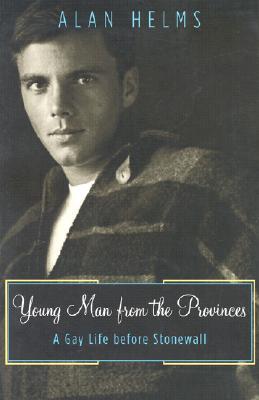
YOUNG MAN FROM THE PROVINCES, gay life as a sex toy in the pre-Stonewall world
YOUNG MAN FROM THE PROVINCES: A Gay Life Before Stonewall
ALAN HELMS
University of Minnesota Press
$16.95 trade paper, available now
Rating: 3.5* of five
The Publisher Says: Young, intelligent, and handsome, Alan Helms left a brutal midwestern childhood for New York City in 1955. Denied a Rhodes scholarship because of his sexual orientation, he soon became an object of desire in a gay underground scene frequented by, among many others, Noel Coward, Leonard Bernstein, and Marlene Dietrich. In this unusually vivid and sensitive account, Helms describes the business of being a sex object and its psychological and physical toll.
"Riveting."- New York Times Book Review
"Extraordinary and elegantly written. A record of a gay world that has virtually disappeared over the past twenty-five years of liberation and fifteen years of AIDS." -Boston Globe
"A beautifully written memoir. Helms sped through the celebrity-packed fast lanes, but he has learned how to stand back and get some perspective." -Los Angeles Times
"Sublimely funny, engaging, pathetic, highly literary, and painful to read. Helms seems like a gay Everyman whose quest for self-knowledge, respect, and contentment in this contemptuous world mirrors that of many other marginalized people." -Bloomsbury Review
Alan Helms is professor of literature at the University of Massachusetts, Boston.
I RECEIVED A REVIEW COPY OF THE BOOK FROM THE PUBLISHER. THANK YOU.
My Review: Beloved Boston cultural institution Alan Helms had a wildly exciting past! See the film! Admire his art collection, appreciate his cultured and elegant way of speaking, his breadth of cultural knowledge, and his charming sweetness.
What does a young, abused man from flyover country do the moment he realizes he's queer? RUN! Get to New York City as soon as possible. He got to Columbia University in 1955, leaving behind a life in Indianapolis, Indiana, that could charitably be described as "uncongenial." A father who thought his son was a bitter disappointment...how many of us queer boys can relate to that...a mother whose situation wasn't a lot better than his, a younger brother whose close brush with death was the single moment in his childhood when peace reigned. None of this is a recipe for a healthy adulthood...and add in the author's understandable, if off-putting, self-absorbtion and you get a difficult-to-empathize-with narrator.
But he was So. Beautiful. Look at that face on the cover! Hoo-ee!
And the awfulness of that...wow...to be so pretty and so readily available and so snobby, who can claim to be surprised that he wasn't a pleasant person? His sexual awakening came at the price of being raped. His family life prepared him for a life of abuse. He dived into it in the glamorous world of closeted gay life pre-Stonewall. Pretty sexually available intelligent boys found innumerable lovers, and the author wasn't about to say no. (I totally relate to this and would've done precisely the same in his shoes. Damn the bad luck of not being pretty!) So a decade and a half passed in what I imagine was a golden haze...this book's largest part. It's a bit less charming to me than it might be to a younger reader. I look at the wreckage he glosses over and think, "there's the real story."
Yes, sleeping with famous Hollywood stars and titled Eurotrash is all very well. But the people you stood up, the ones whose parties weren't quite glam enough that you said you'd attend, and so on and so forth? How did you sleep, look in the mirror, launch yourself at the next big fish in your hifalutin' pond without thinking about them?
The Fall took place when he was thirtyish, and some semblance of human feeling broke the ice he'd cultivated to keep his agony at bay and under the surface of a freezing cold lake he called his heart. Escape to Boston and the tender mercies of a shrink who began the process of waking the author up from his frozen state. Then it happened: His body aged. He wasn't the hot young muffin anymore; he wasn't even visible to the hot young muffins. That had to be a bad, bad day.
Now, let me not try to hide my glee here. This event has occurred in my life, too. I can not imagine how much worse it was for a formerly gorgeous creature, feted and celebrated and wined and dined, to be cut off from that gushing geyser of distractions. Luckily for his sanity, Helms had a brain and a deep love for the life of the mind that he'd never left behind or neglected. While learning what he'd never known, that feelings are best felt in the moment and not in retrospect, I'm sure he left yet more carnage in his wake. But the fact that no one ever killed him means that he learned enough to at least fake his way through professional, if not personal, relationships. So hope still shines for him to pull his head out of his ass and recognize that, in his swan-paddle through youth, he got into some ugly emotional habits that would be wise for him to shed before he's patted in the face with a shovel and 120 cubic feet of dirt dropped on him.
I guess it shows that I don't like the man too much. Yes, part of it is envy: I would've LOVED to live among those glittering parties and glamorous people, and I'm jealous that he won nature's looks lottery. But more of it is the sense that grew and grew as I read his (ampersand-laden) memoir that he wasn't sharing his journey with me.
He was bragging that it happened.
I suppose I would too, and that is a disappointing self-revelation that elicits deep sadness in my shallows. Read the book, o ye queer boys over 50 to relive a lovely, dead time when we were few but fabulous; QUILTBAG youth, especially young and pretty ones, definitely think about your history; y'all straight folks, mm, on balance I'd say not unless your Gay BFF approves it for your personal tastes.
Friday, August 8, 2014
SPLENDORA, a 1970s first novel with bite
SPLENDORA
EDWARD SWIFT
Open Road Media
$10.99 digital edition, available now
Rating: 4 very nostalgic stars out of five
The Book Report: The book description rots on ice. Here is the jacket copy from the 1978 hardcover I checked out of the library:
“Splendora: A steamy East Texas armpit of a town where Sue Ella Lightfoot furthers her study of “sexual motives” with every issue of Real Crime magazine while Agnes Pullens drills young ladies in the finer arts of Dance and Expression (tap-dancing, tumbling, and recitation inclusive) and Zeda Earl Goodridge faces a life of ruin if her Christmas yard display doesn't take first prize this year. Timothy John Coldridge was born and raised here, was fussed over and admired by all—Esther Ruth's beautiful grandson, Little Timothy John.
At eighteen, Timothy John left Splendora, unhappily. Now, at thirty-three, he returns with a dazzling companion: Miss Jessie Gatewood, the new hired-by-mail librarian, come to operate the county bookmobile. Draped (and impeccably accessorized) in Victorian finery and drenched in social graces, Miss Jessie takes the town by storm. But though it might be said that Timothy John arrived with her, it might also be said that he arrived within her...and therein lies the tale. Aided at every turn by a cast of relentless eccentrics, Miss Jessie endures a series of thoroughly splendid adventures. But while genteel romance, high drama, torment, and Technicolored bliss capture center page (Can the organza'd charms of a spinster booklady capture the cloistered heart of Assistant Pastor Brother Leggett? Will Maridel Washmoyer's yardful of Styrofoam igloos thwart Zeda Earl's anticipated Yuletide triumph?) a more subtle underscoring theme persists: What can Timothy John mean to Splendora...or Splendora to Timothy John?”
My Review: My 2000 review: "Seminal literary gay novel of my early queer phase. Wonderful writing and affecting characterization."
Well. Um. You see, I was really young when I read this, and in the throes of coming to terms with impending fatherhood. I figured if you were a gay guy, you'd like to be a woman, like Timothy John seems to want to be. (The idea of transgendered people was not part of my mental furniture.) I'd banged a bunch of guys by this time, and I knew for sure and certain that I wasn't interested in a life of bread-and-water imprisonment within heterosexuality's grim and cheerless razor-wire fences and brooding gun emplacements, but kid = duty so I did it. At least with other guys I knew what the hell we were talking about. But books like this one, they set me on a completely wrong path. Gay, woman...same diff, right, since Timothy John lived as a woman, right? I DO NOT WANT A WOMAN NOR TO BE A WOMAN said my insides. But look! said the outside world, it's in a book!
So I laughed when I was supposed to and patted myself for being Literary Enough to get the point of Swift's humid plot (Miss Jessie and Brother Leggett get engaged but Bro can't deal and comes out to Miss Jessie who says hey cool me too and they have a religion/salvation fight and one thing leads to another and Timothy John burns down his house while Brother Leggett is racing up to spirit him away to live as man and whatever and the town matriarch speeds them off with a happy {if toothless, this is East Texas we're talkin' about} smile). But reinforcing the wrong ideas in my head did not make my life easier, nor did a subsequent encounter with The Carnivorous Lamb with its brother-incest lovers. EWEWEW. No thanks! Gordon Merrick cheesy romances! Yes! But then there was that whole duty thing.
I held onto this as my idea of a Good Gay Novel for a very long time. Re-reading it now, at over 50, I realize it's an artifact of the author's past...it's set in some amorphous 40s-50s type time when there was train service to burgs like Splendora...it's gawkily written, it's pretty garishly bedizened with Faulknerian structure and O'Connoresques of characters, and if this were my first read, I'd probably Pearl Rule it and move on with my day.
Time may indeed heal, but it also inflicts, wounds.
Subscribe to:
Posts (Atom)