Showing posts with label road novel. Show all posts

Wednesday, July 8, 2026

COUNTRY PEOPLE, latest Daniel Mason book after North Woods


COUNTRY PEOPLE
DANIEL MASON

Random House (non-affiliate Bookshop.org link)
$14.99 ebook, available now

Rating: 4* of five

The Publisher Says: A rollicking work of lyricism and humor, about one family’s tumble into the unknown, from the Pulitzer Prize finalist and bestselling author of North Woods

Miles Krzelewski is a devoted husband, a doting father beloved for his outlandish bedtime stories, and the proud owner of a truffle-hunting dog in a land with no truffles. He is also a bit lost, twelve years late with his PhD on Russian folktales, and increasingly haunted by a sense that he's become a disappointment to his family. So when his wife Kate accepts a visiting professorship at a prestigious college in the far away forests of Vermont, he decides that this will be his year to finally move forward with his life.

But Miles is a man of many enthusiasms, one who possesses, in Kate’s words, “a great capacity to fall in with anyone, anywhere.” And no sooner does he arrive than he finds himself entangled with a cast of characters as colorful as any of his folktales, from a ghostly tree surgeon to a scythe-mad biochemist, a Shakespearean temptress and a photographer of snowflakes obsessed with chronicling, on thousands of index cards, the world’s delusions in a “Inventory of Wrong Ideas.”

The new friends, the enchanted woods, the sure, no PhD, but all good fun. Until Miles stumbles upon a bizarre—perhaps ridiculous—local legend, which, he soon suspects, might not be just a legend after all.

Joyous, absurd, and life-affirming, Country People is a luminous exploration of marriage and parenthood, the nature of belief and the power of stories, and the ways in which we find connection in an increasingly fragmented world.

I RECEIVED A DRC FROM THE PUBLISHER VIA NETGALLEY. THANK YOU.

My Review
: Absurd, overstuffed storytelling with the effect of making fun of tropey stories by being one.

California sophisticates uprooting themselves to follow the academic goldmine of research funding, tenure, the pot of gold at the end of the rainbow...all of these ideas are really the same...and encountering wacky neighbors sound familiar? Put New York in for Cali, and it's Newhart; putthe 1960s in for today, it's Green Acres; it's not the structure that makes the tale fresh it's the characters. We're going to care about them, or the book falls flat.

I myownself wasn't terribly excited by the cast.

Kate the breadwinner, was longsuffering, Miles the dreamer was impractical, the kids (Olive and Wesley) were precocious, and will you look at the time? Suddenly it's 1980! I gave it the full four stars because there are loads of lines like: "But what was he to do, stay out of the woods? Then he met a man in camouflage in a tree who told him that if he didn’t get some blaze orange on him and his dog, their heads were going to end up together on someone’s wall," and set-pieces like the truffle-hunting dog in the weird national park no one's ever heard of that Miles the dreamer makes sure they visit.

It's a book version of a superior sitcom from pre-social media/reality TV days. I chuckled, even laughed out loud. Now that it's been a week since I finished the read, I remember literally nothing from it. If I had no notes I'd've sworn an oath I'd never opened the thing at all. It's not poor, it's not substandard on a craft level, it's just that it's doing something I do not care about.

I'd be glad to find this book in my summer rental's scanty bookshelf. I'd even be fine with checking it out of the library. If you want one for Yule I'll be happy to give it to you.

I won't ever re-read it, and if I recommend it to you it will be because you've asked for ideas for gentle, unchallenging reads.

Wednesday, February 23, 2022

THE SELFLESS ACT OF BREATHING, a deeply felt meditative look at the cost of modern life


THE SELFLESS ACT OF BREATHING
J.J. BOLA

Atria Books
$27.00 hardcover, available now

A FILM IS IN THE WORKS! "I thank my readers and I look forward to reaching a new audience, via a new medium, and helping us all — which is the reason I wrote this novel — to remember that no matter how we feel, we are not alone,” says Author Bola.

Rating: 4* of five

The Publisher Says: Transcendent Kingdom meets A Man Called Ove in this heartwarming novel about a Congolese-British Londoner who decides to go on one last adventure in the United States, determined to end his life once his savings run out.

As a charismatic teacher living in London, Michael Kabongo strives to alleviate the injustices he sees around him: for the students who long for better lives, in memory of his father’s tragic death, and to end the violent marginalization of Black men around the world.

But after a devastating loss, he decides to embark on an adventure in the land of the free—the United States of America. From Dallas to San Francisco, Michael parties with new friends, engages in fleeting romances, splurges on thrilling escapades, all with the intention of ending his life once all his savings run out.

As he makes surprising new connections and faces old prejudices in odd but exciting new settings, Michael alone must decide if his life is worth living after all...

I RECEIVED A DRC FROM THE PUBLISHER VIA NETGALLEY. THANK YOU.

My Review
: I tried to commit suicide in 2014. It was a very low point in my life. It was fortunate that my life didn't end because of the disordered thinking...a woman named Julie made a fortuitous call as I was beginning the process and sent the police to intervene...so I am here to write this review. This is also why I wanted to review this book, given the narrator's plan to end his life when his savings were blown. (Side note: Howinahell did he get so far on a lousy $9000?!)

It's not clear to me why the topic of suicide isn't a trigger for reupping the suicidal ideation machine in me. I can read about the deeply depressed and the suicidal in novels and feel so much compassion, so much sympathy...but no desire to emulate them, only to reach out to them and say "this is a permanent solution to a temporary problem." I've gone through a lot of introspective stuff (CBT works!) and think of the idea of death as, well, honestly it's undisturbing to me. Neither attractive nor repulsive, just a fact. And the manner of Michael, our PoV character, making his decision to go blow his money then die rang memory bells. "This final act, then nothingness" probably sounds better to the truly suicidally depressed than more emotionally overwrought ideation does.

Michael addresses us in the parts of the book set in London. He's fully present, he's struggling to do his teaching job well, and he's floundering in grief deeper than even he can tell...grief too deep to be solely about a recent loss. Michael's decision to leave for the US with that paltry $9000 and live until it runs out (he'd be in Delaware Water Gap, New Jersey, not San Francisco!) is narrated in third person, a choice I took to be representative of his dissociation from the life he was abandoning and refusal to invest in the life he was going to exist through in the US. It wasn't a choice I felt did the story any great service. I think it probably just confused most readers. And I'm not all the way sure I am correct in my analysis, there are other possibilities but I can't make one up that makes the least bit of sense to me except the dissociation one.

What elevates this debut novel above the pack it comes out with is the lovely poetical aphoristic phrase making:
We fight to be seen, for the world to know that we are here, only for us to be forgotten, to be invisible once again.

–and–

Have you ever loved, knowing it would end, but giving your whole heart regardless?

–and–

The thing about losing love is makes you feel like you can never love again, like you are not worthy.

–and–

Loneliness is being there for everyone, everyone, in the hope that someone will be there for you. But no one ever is. You are the sun, lighting the world of another, while setting yourself on fire.

–and–

And above all, it is love, that spark of bright light, that dazzling flame, ephemeral or eternal, may it find us, may it be us, the will that carries us forward, the bond that brings us back, from beyond this lonely feeling to healing; the selfless act of breathing.

The author might be making his fiction debut (correction this is the author's second novel, after 2017's No Place to Call Home) but he's an established poet (Elevate and Daughter of the Sun among others) and it's ever so clear that his phrases will sound gorgeous when spoken aloud. That is also, to be frank, the issue that led to me docking a star off the story's subjective rating: It's performative, it's got an eye on its look in the mirror of your regard. It is, in other words, like poetry is to me: phonied up, heightened, exaggerated to make some point that I think you, O Writer, should trust me to get all on my own. If, that is, you've done your part of the job....

What I hope you'll do is sample the book. Put a bit on your Kindle and see if the way the author slings the lingo hits your sweet spot. If so, there's nothing to prevent you from enjoying the book in its entirety. The first chapters are a good index for the voice the entire book has. While I'm here today because suicide didn't turn out to be the best option for me, this is not an apologia for the act or I'd tell you to avoid it. What leads a person to consider suicide: depression, a sense of alienation from the world around them, a loneliness that pervades this world of exclusion and judgment...all this is the subject of Author Bola's work.
This sadness, how it falls upon you, like mist or fog, not there, then sudden and all at once; a greyness, enveloping you, submerged under water. This sadness in your bones, each step heavier than the last raises questions: how much longer is this journey? How much longer can I walk?

This is an elegant distillation of the greyness of depression and the desperation of feeling it's endless because you've got no perspective where this isn't what you see...all of that is very, very real and very salutary for all of those whose world doesn't have it anywhere (all five of you) to get into your brains. It could make your empathy bumps bigger, spread your hugging arms wider, and tune up your "there, there, my friend" to a fresher pitch.

Monday, August 23, 2021

TWENTY-FIVE TO LIFE, a title with more layers than an onion and just as apt to make you cry


TWENTY-FIVE TO LIFE
R.W.W. GREENE

Angry Robot (non-affiliate Amazon link)
$6.99 Kindle edition, available now

Rating: 4* of five

SUPER ULTRA BARGAIN ALERT You can get the sale-priced Kindle edition here for 99¢!!

The Publisher Says: Life goes on for the billions left behind after the humanity-saving colony mission to Proxima Centauri leaves Earth orbit ... but what's the point?

Julie Riley is two years too young to get out from under her mother's thumb, and what does it matter? She's over-educated, under-employed, and kept mostly numb by her pharma emplant. Her best friend, who she's mostly been interacting with via virtual reality for the past decade, is part of the colony mission to Proxima Centauri. Plus, the world is coming to an end. So, there's that.

When Julie's mother decides it's time to let go of the family home in a failing suburb and move to the city to be closer to work and her new beau, Julie decides to take matters into her own hands. She runs, illegally, hoping to find and hide with the Volksgeist, a loose-knit culture of tramps, hoboes, senior citizens, artists, and never-do-wells who have elected to ride out the end of the world in their campers and converted vans, constantly on the move over the back roads of America.

AUTHOR GREENE SENT ME A DRC OF THIS TITLE AT MY REQUEST. THANK YOU.

My Review
: You know that itchy little something that lives in the back of your brain? The one that says "...but...wait...what was...?" in a still, small voice but never quite speaks what it is you've forgotten? That's what happened to me with this book. I knew I wanted it...go look at my review for The Light Years...but forgot it was coming out this month. Completely. Until about a week ago.

Way too late to hit up the publisher, in other words. Fuck!

But given that Rob and I follow each other on Twitter, I used my privileged access (snort!) and DMed him to beg for a DRC in my preferred format. Next thing I knew it was in my inbox and I was off to the races. A week, though, isn't a lot of time to read something for a review. Contrary to the openly expressed opinion of a Famous SF Writer who, on Facebook, called my reviews "mediocre," I do expend a goodly amount of effort to engage with what it is I think the writer is trying to do, and if they've succeeded at it, in my opinion. Are there longueurs of style, are there errors of fact, and how exactly did I end up feeling about the story I was being told?

The news is good, readers. Author Greene does it again. He's made a post-apocalyptic future of Left-Behinders not only readable but fun.

Julie, twenty-three, is on her way into an underage person's rave-type party as we meet her. Mother signed off on her attendance..."just don't let anyone film you!"...and here she is, ready to have all the pharma-fun she can! The state wants people happy, so there are implants that go in as soon as possible; they give out SSRIs like they're nothing because, well, that's what the people Left Behind on Earth can expect: Nothing. The planet's given itself a terrible fever to get rid of the infection of Humanity, and it's working. Hence the Best and Brightest going to the Stars.

Julie, goddesses please bless her, wants...something. It's not going to happen if she stays where she is, so she makes the changes necessary (hello, drug withdrawal aka "brain zaps"!) and joins the Volksgeist. They're the few remaining souls who'd rather experience life instead of simply existing through it. Julie joins their caravan of fools (das NarrenVan?) and begins Life with Ranger, an older woman who takes her in and renames her "Runner." (It really fits.) And the novel goes On the Road!

The way things unfold is partly a commentary on the difficulty of detoxing from the astonishingly complex cocktail of brain-altering stuff we routinely ingest. This means Runner has periodic, what to call them, lapses? lacunae? in her sense of time and in the narrative of the story. Since that means some sorts of things don't get described (a party is simply not dealt with, only its aftermath, for example), it can feel a bit frustrating. I wanted to, like Runner herself, experience it all...but what happens in the telling is that I was given the sense of experiencing it as Runner did herself...a subtle, but bold, decision on Author Greene's part. I think it was successful in reinforcing my sense of Runner's reality, her actual experience, though I might've chosen a different course given the chance.

What do road novels do best? They give you a broad spectrum of experiences...and that's here, as well. The community of the Volksgeist is one amorphous, boundary-permeable entity. The places it rests are both changed by the experience of the group being there and the group is changed by additions and deletions of personal choices to remain or join. It makes the entire novel feel as though the goal is Canterbury, and the Wife of Bath will be here momentarily. While I'm medievalizing, since we've already got the Ship of Fools and the Pilgrim's Tale, let me point out that this is very much a morality play as well. Ranger and Runner, the Odd Couple in a way, are experiencing in unmediated form the consequences of my generation's criminal neglect of the warning signs of catastrophe to come. There's not a single thing that happens to the Volksgeist that isn't perfectly possible to believe is happening now, or to see how it will in the term left to me of my own life.

It doesn't look good. It doesn't make my generation look good. And it makes for one helluva good story.

On sale the 24th, tomorrow from when I'm writing this; preorder it now. You WILL want to have it ASAP.

Sunday, October 30, 2016

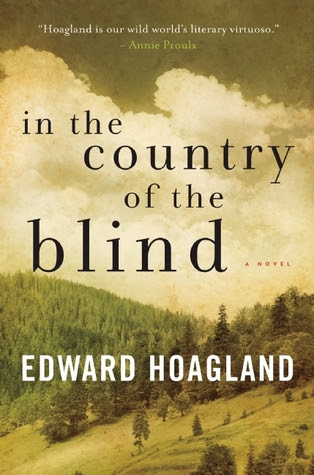
IN THE COUNTRY OF THE BLIND, essayist/novelist Hoagland's last novel


IN THE COUNTRY OF THE BLIND
EDWARD HOAGLAND

Arcade Publishing
$22.99 hardcover, available now

Rating: 3.5* of five

The Publisher Says: Sixty years after the publication of his first novel, Cat Man, Edward Hoagland is publishing his twenty-fifth book at the age of eighty-three. This capstone novel, set in Vermont’s Northeast Kingdom, introduces Press, a stockbroker going blind. Press has lost his job and his wife and is trying to figure out his next move, holed up in his Vermont cabin surrounded by a hippie commune, drug runners, farmers-gone-bust, blood-thirsty auctioneers, and general ne’er-do-wells. Solace and purpose come from the unlikeliest sources as he learns to navigate his new landscape without sight. Hoagland himself is going blind, and through this evocative, unsentimental novel, we experience the world closing in around Press, the rising panic of uncertainty, the isolation of exile, the increasing dependence upon the kindness of strangers, and a whole new appreciation of the world just beyond sight.

My Review: First, read this:
Press tucked necessities into an overnight bag and climbed in, cane and all, not omitting his passport. "Gone fishing" was what they said here. The smell was of sandwiches and coffee, but he sniffed for clues of who the car had belonged to before. A lady, a plasterer? Chuck drove east toward New Hampshire with careless aplomb, like a man who might put fifty thousand miles on a car's odometer every year or two. Blindness curtained much of the beauty they were passing but not his sense that it was there. White spots checkered his vision. How did people manage blind from youth?


Let me assure you that there's nothing in that excerpt to spoil your read. The novelist's last publication, though he is still alive as of 2021. Poignant story, as Hoagland is himself going blind (on top of a life-long stammer). Interesting in a terrifying way that it's an historical novel set in the Nixon era. All the accustomed Hoagland phrase-making is there in full force: “The milking machines sounded tranquilizing, and there was the collegiality of seventy animal spirits thriving, warming the barn with cud-chewing, nose-snuffling, and sisterly mammalhood.”

Well worth the eyeblinks.

Tuesday, August 5, 2014

DON'T START ME TALKIN' is a blues road novel done right

DON'T START ME TALKIN'
TOM WILLIAMS

Curbside Splendor Publishing
$5.00 trade paper via the link to the publisher's website above, available now

Rating: 4.75* of five

The Publisher Says: Don’t Start Me Talkin' is a comedic road novel about Brother Ben, the only remaining True Delta Bluesman, playing his final North American tour. Set in contemporary society, Brother Ben's protege Silent Sam Stamps narrates an episodic 'last ride,' laying bare America's complicated relationship with African American identity, music, and culture, and like his hero Sonny Boy Williamson once sang, Silent Sam promises "I'll tell everything I know."

Don’t Start Me Talkin’ is not merely a story about the blues, but with its rhythm, language, and sense of self and place, it also channels the DNA of this very American style of music.

THIS REVIEW FIRST APPEARED IN THE SMALL PRESS BOOK REVIEW.

My Review:
Why do you pick a book up? This book, not that book, a blue cover or a red jacket or a picture of a headless male torso glistening with glycerine sweat as he rubs his abs? What makes the choice for you?

Like picking a radio station on a road trip, picking a book from among the numberless offerings of eager publishers large and small is a matter of click, of fit between your brain and its style. The cover...the intro of the song...has to tickle a little place inside you that feels so good, makes a little smile come on your face. Then a short flip through some pages, look at a few sentences, like listening to the vocals come in or the horns join the bass. Does this one have what it takes? Hit the tuner, put the book down, or settle in with the cruise control set and the spine snugged in your palm?

So start with the cover. Curbside Splendor is a small house. They're based in Chicago. Neither of these things matter much until you see what they're doing. This cover is blue like the bluesmen in it. This cover is lifted, aesthetically, from 1956 and the Verve/Decca/Mercury aesthetic; the book's trim size echoes an album's proportions (or a CD's, for y'all young'uns); and the chapter list is an old-fashioned album label with the twelve chapters (like the number of tunes on an old 33-1/3 album) named and numbered.

They got me with the design. It spoke to me, old man that I am, and it spoke to the contents of the book, and it gave itself the side-eye in the text, knowing that it's not necessary for the reader to know, or care, about these things to get, really fully gut-level get, this book's beauties and strangenesses. But it helps.

Road novels all get compared to On The Road whether they need or deserve the comparison or not. Well, not me, not this one. This isn't the Quest Novel writ American.
I wonder if {he's} made it to the Delta, been inside a real jook. Many a blues lover flies to Memphis, rents a car and drives down 61, though I hear now Tunica and its casinos sits there like a juggernaut, keeping most from even making it to Clarksdale, let alone Rolling Fork or Alligator, or across the river to Sonny Boy's town, Helena. Truth is, though, {he} must have hired some good people to construct the building. Much study of old photographs and newsreels went into the work, maybe even a visit or two to Junior Kimbrough's place near Holly Springs. I allow my eyes to follow {his} hand to the Nehi, Jax, and Falstaff signs, artificially rust-spotted and rakishly hung on the exterior walls, which are made of a material that looks as faded and ready to fall apart as the warped and rotted shingles of a genuine jook but is surely as sound as a dollar and will probably be around for hundreds of years...There's even an empty sack of Sonny Boy corn meal next to the checkerboard atop an old wooden barrel. I try to jump a white piece with a black piece but they're all lacquered in place.
This is Hero's Journey, and the Hero changes more than once. Ben's the Last Delta Bluesman. Peter's the acolyte. But what's a Hero for but to make room for the next one? What's the point of a journey when each rest stop could lead to the dirt nap? Peter's place is beside Ben, picking up, moving on, cleaning the gene pool around the eminence of fame.
"Lawd but I hopes everyone all right," Ben says, his head tilting forward, his shut lids squeezing out tears.

"No one was hurt," the cop says. ... He stops, rubs a finger over his chin and turns to Ben's driver's license. "Just what brings you to Florida, Mr. Mabry?"

So here it is. Bad enough Ben was reckless—though I doubt the retirees slaloming through the lanes in their Caddies earn more than a warning—we're dressed like pimps, operating a vehicle preferred by drug dealers, and an out-of-state one, to boot. ... I read the cop's name tag and wonder if Officer Reese ever shed a tear for a song sung by Charlie Pride or O.B. McClinton. If it helps, I'll get out my harp and play "Okie From Muskogee."

Ben lifts his head, sniffles, and says, "My son and I here to look at some them whatchamacallits? What is they, junior?" He turns to me. Fuck if he doesn't wink. His son? We don't even look alike. "Them houses," he continues. "The connected kind. ... Start with a c. Kuh-kuh-kuh."

My cue, I guess. I stammer, "Condominium," getting stuck on the c and losing track of how many m's are needed. I know Ben's scheming to make us seem harmless—not sharp or belligerent—and Officer Reese is now smiling at us, though he does click his ballpoint pen.
But he's also absorbing and internalizing the ways and means of a dead, or dying, world's beauty. He's learning the music that grew from a fucked-up mating of meanness and stupidity with fear and desire. He's coming into an inheritance that he, only he, can have. He's becoming a blues man.
"Brothers and sisters been tired for years with that old, broken-down woke up this morning bullshit of yours. Tired." I'm now aware of people watching, none of them Ben, but sound crew, maintenance men, the pair of massive security guards. Perhaps this audience causes my voice to rise, or I just want to be absolutely sure {he} hears me. "Least we playing something. Besides other people records." Before {he} can say another word, I've got my harp in hand and blow the intro to "Fattening Frogs up For Snakes." I keep my eyes wide open now, watching...as each note flies past him. And because I'm sure he doesn't know the tune, I put down my harp and sing the first line:
It took me a long time, to find out my mistake
Took me a long time, long time, to find out my mistake
It sure did, man
But I'll bet you my bottom dollar, I'm not fattenin' no more frogs for snakes.

Don't need to sing or speak another word. Pocket my harp, turn around, and there's Ben before me. I blink. My contacts shift and settle. "Sam," he says, "you done been practicin'! ... Couldn't have drawn it up better myself," he says. "You just wrote your way into the book, Pete. ...You just wrote your first few sentences with that scene back there. ... Exactly the hook every kind of writer loves," he says. "Trust me."
Who's the hero, the teacher or the taught? The trust Ben talks about is unearned but deeply merited. The trust Pete can't give, only give up.

Trust Tom Williams, y'all. Give it to him, or give it up for him, he earns and he merits every eyeblink and pulse-pound you give him on this road trip. Wry knowing grins and purse-lipped nods await your crow's feet. Have I ever told you how lovely you are when you snort knowingly at an in-joke? Be lovely for me. We can't sell it, our used furniture, but let's sit on it and savor the dying licks from Pete's harp.