Showing posts with label Arcade Publishing. Show all posts

Thursday, January 30, 2025

SUE BLACK'S PAGE: WRITTEN IN BONE: Hidden Stories in What We Leave Behind, & ALL THAT REMAINS: A Renowned Forensic Scientist on Death, Mortality, and Solving Crimes


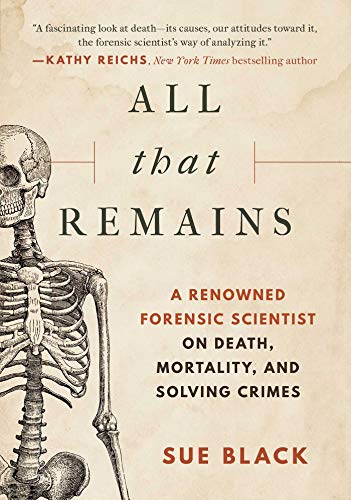
ALL THAT REMAINS: A Renowned Forensic Scientist on Death, Mortality, and Solving Crimes
SUE BLACK

Arcade Publishing (non-affiliate Amazon link)
$18.99 ebook, available now

Rating: 4* of five

The Publisher Says: For fans of Caitlin Doughty, Mary Roach, Kathy Reichs, and CSI shows, a renowned forensic scientist on death and mortality.

Dame Sue Black is an internationally renowned forensic anthropologist and human anatomist. She has lived her life eye to eye with the Grim Reaper, and she writes vividly about it in this book, which is part primer on the basics of identifying human remains, part frank memoir of a woman whose first paying job as a schoolgirl was to apprentice in a butcher shop, and part no-nonsense but deeply humane introduction to the reality of death in our lives. It is a treat for CSI junkies, murder mystery and thriller readers, and anyone seeking a clear-eyed guide to a subject that touches us all.

Cutting through hype, romanticism, and cliché, she recounts her first dissection; her own first acquaintance with a loved one’s death; the mortal remains in her lab and at burial sites as well as scenes of violence, murder, and criminal dismemberment; and about investigating mass fatalities due to war, accident, or natural disaster, such as the 2004 Indian Ocean tsunami. She uses key cases to reveal how forensic science has developed and what her work has taught her about human nature.

Acclaimed by bestselling crime writers and fellow scientists alike, All That Remains is neither sad nor macabre. While Professor Black tells of tragedy, she also infuses her stories with a wicked sense of humor and much common sense.

I RECEIVED A DRC FROM THE PUBLISHER VIA EDELWEISS+. THANK YOU.

My Review
: Professor Dame Sue Black has spent a long lifetime giving those deprived of life and their families the closure she has learned how to give them, their families, and the Body Politic. This book is a report of how she has done this important task that offers communities and survivors a (sometimes partial) restoration of ma'at. She presented a TV show in the teens called History Cold Case. I've watched those shows with great interest, several times, and honestly never understood why there were only two seasons of it. There can be no end of distant-enough ancient cases to investigate. I suppose the ratings weren't up to more...yet our cultural moment is full to bursting with forensics-based fiction. Why this isn't still running, then, is deeply mysterious to me.

The facts that Author Black works with in her job are often only described in jargon; looking them up, that seems like a means she uses to buffer her readers from the full weight of the horrifying things humans do to each other.

Starting off easy, we're led through her early life at a spanking pace. Her decision to become a firensic scientist was oddly inevitable, though she was not and is not a gloomy goth type. I get the strong impression she'd be a right hoot to sit down with down the pub. Surprisingly she's been a lead investigator at the sites of multiple human-rights violations, like Kosovo. One would imagine this would rob a person of the will, even ability, to find perspective in her job's inescapable conclusions.

Not so. This is a rugged, centered, practical and skilled person. Spending three hundred-plus pages with her was interesting, informative, and...oddly...a lot of fun. Given the deeply unhappy subject matter, a fifth star wasn't likely to materialize, but all four that were available shine bright on this very well-made book.

I recommend it to y'all legions of CSI, NCIS etc. etc. shows, the many thousands of us who read Jimmy Perez and Jackson Brodie mystery procedurals, and to anyone who just likes to know weird stuff.

+++++++++++++++++++++++++++++++++++++++++++++++++++++++++++++++


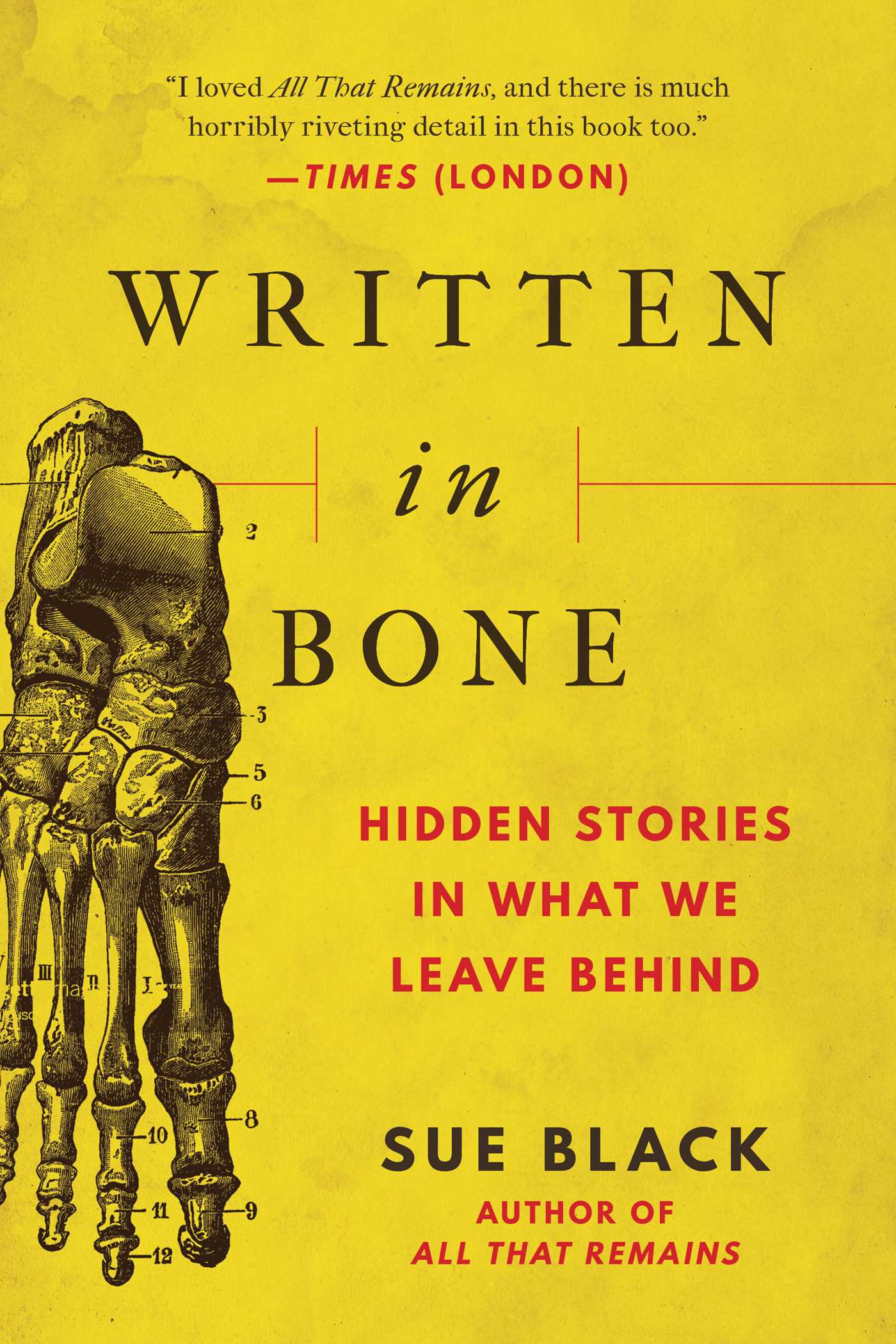
WRITTEN IN BONE: Hidden Stories in What We Leave Behind
SUE BLACK

Arcade Publishing (non-affiliate Amazon link)
$13.99 ebook edition, available now

Rating: 4* of five

The Publisher Says: Winner of the Crime Writers’ Association ALCS Gold Dagger for Nonfiction— A tour through the human skeleton and the secrets our bones reveal, from the author of All That Remains

In her memoir All That Remains, internationally renowned forensic anthropologist and human anatomist Dame Sue Black recounted her life lived eye to eye with the Grim Reaper. During the course of it, she offered a primer on the basics of identifying human remains, plenty of insights into the fascinating processes of death, and a sober, compassionate understanding of its inescapable presence in our existence, all leavened with her wicked sense of humor.

In her new book, Sue Black builds on the first, taking us on a guided tour of the human skeleton and explaining how each person's life history is revealed in their bones, which she calls "the last sentinels of our mortal life to bear witness to the way we lived it." Her narrative follows the skeleton from the top of the skull to the small bones in the foot. Each step of the journey includes an explanation of the biology—how the bone is formed in a person's development, how it changes as we age, the secrets it may hold—and is illustrated with anecdotes from the author's career helping solve crimes and identifying human remains, whether recent or historical. Written in Bone is full of entertaining stories that read like scenes from a true-life CSI drama, infused with humor and no-nonsense practicality about the realities of corpses and death.

I RECEIVED A DRC FROM THE PUBLISHER VIA EDELWEISS+. THANK YOU.

My Review
: A step back from the storytelling done in her first book, this book goes through the human skeleton to consider the way a life...and a death...affects the bone in question. I'm very involved as she discusses the ways we unthinkingly abuse our very skeletons, and the way that story is memorialized in the bones we leave behind.

Often enough the things that happen to us after we're born leave the most horrific traces. DO NOT READ THIS BOOK IF REPORTS OF CHILD HARM CAUSES YOU DISTRESS.

I was revolted in this book, more than the first, by the reports of the reasons people's skeletons show enduring damage. The harm we do, or tolerate being done to others, disgusts me. Author Sue Black has seen, understood, and reported on so much more than I will ever see or learn about...and yet she has maintained perspective, has developed immensely valuable skills, has made a positive difference in the social fabric of many communities and families. I am deeply impressed by her. I am awed at how much good a person whose career has led her down very, very dark paths following horrifyingly evil actors has and can do.

It is not for everyone, but if you can endure the child-harm descriptions, this is a weirdly hopeful story. Author Sue Black is facing horrors to restore the rents people have torn in ma'at.

Fred Rogers taught me, "look for the helpers," whenever there's a tragedy. Sue Black is who he meant. At this moment in time, I appreciate knowing there are still helpers out in the world.

Wednesday, November 8, 2023

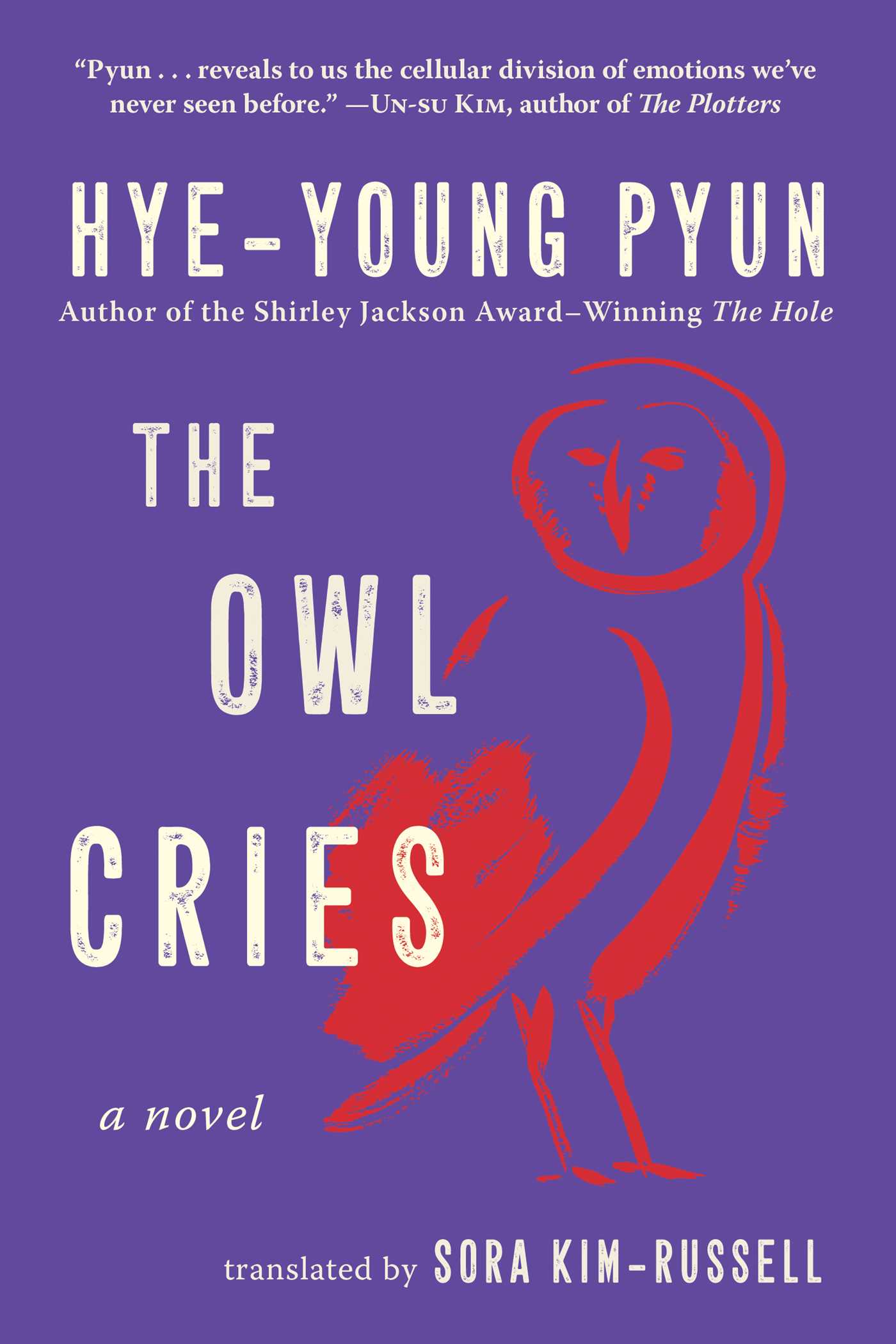
THE OWL CRIES, latest "anxiety fiction" from South Korea's artist of same


THE OWL CRIES
HYE-YOUNG PYUN
(tr. Sora Kim-Russell)
Arcade Publishing
$26.99 hardcover, available now

Rating: 3.5* of five

The Publisher Says: From the Shirley Jackson Award–winning author of The Hole, a slow-burning thriller with a touch of horror and the uncanny

A disappearance. A missing brother. A lawyer asking questions. And a vast forest in the mountains—the western woods—where the trees huddle close together emanating a crushing darkness and a chill dampness fills the air. The ranger, In-su Park, who lives nearby with his family, is a recovering alcoholic. He claims no knowledge of the man who disappeared, even though the missing man had worked as the ranger just before him. In the little village down the mountain, the shopkeepers will do the same and deny they ever saw or knew the man, though they’re less convincing; and his former supervisor at the Forestry Research Center, Professor Jin, dismisses his importance. But when an accident and a death derail the investigation and someone attempts to break into his office, In-su Park finds himself conducting his own inquiry into the goings-on deep in the heart of the western woods—spurred by the mysterious words he discovers on a piece of paper beneath his desk: “In the forest the owl cries.”

The Owl Cries is a treat for fans of Stephen King, David Lynch, and the nightmare dystopias of Franz Kafka.

I RECEIVED A DRC FROM THE PUBLISHER VIA EDELWEISS+. THANK YOU.

My Review
: You’ll all remember that I am a fan of Pyun’s earlier novels. Her fiction is, I think, perfectly described as “anxiety fiction.” Like the oft-cited comparison to Kafka, her characters don’t seem to know what the hell’s going on, much like the reader…for a while, anyway. We, of course, catch on before our main character Ranger Park does that there are wheels within wheels among the people of the village, in fact everywhere surrounding the strange world of the forest he's the ranger of.

What makes this read satisfying to me is the claustrophobic, contained world that Ranger Park thinks he's found refuge within turning into a stage for some of the most venal, terrible, conscienceless people to conduct the parts of their affairs that do not stand up to close scrutiny. Pyun's opinion of those we've ceded control of the world to matches mine: Poor.

I'm less inclined to forgive the book's, um, magisterial pace. If you're centering your story on the disappearance of a person, the previous Ranger to Park, and that person's relative comes to seek them and/or their fate out, pay attention to the means by which the people looking into it do this. That means, for me, allow me to be there for the asking and answering of relevant questions. What people say is one thing, what they do is often very different. Let me in on that journey or the book becomes, as this one does, an excercise in atmospherics.

It's a superior exercise therein...the forest is such a beautifully evoked entity, almost Kinglike in its mute menace...but again, nothing happens that makes it other than a lovely evocative setting. King would've had some dread spirit or creature do something. In this book, it's build-up without release. It becomes very easy to feel stalled in the read, as the investigation into the disappeared brother does nothing for long stretches of time.

What is often a beautiful read is not a satisfying story. The ending resolves enough fates and reveals enough "why"s to count as an actual ending. The main issue is the way it's done in presenting the conclusions. This makes the journey up to that time feel...hollow...because it's an unearned climax. I've read lovely image after lovely image upon interesting observation, yet there's nothing in all of it that contained the information I needed to get there with the author. This violates thriller ethics, and removes any hint of mystery novel from what is, in the end, a lovely literary exploration of surfaces not matching interiors, of how hard the terrible people in charge work to prevent us fro noticing how terrible they truly are.

That read appeals to me, so I liked the book fine. Your mileage may vary, of course.

Wednesday, August 2, 2023

HYE-YOUNG PYUN'S PAGE: CITY OF ASH AND RED; THE HOLE; THE LAW OF LINES for #WITMonth


THE HOLE
HYE-YOUNG PYUN
(tr. Sora Kim-Russell)
Arcade Publishing
$22.99 hardcover, available now

Rating: 5* of five

DEADLINE ANNOUNCED A FILM IN THE WORKS! The team behind it is pretty much the most experienced and excellent one could ask for.

The Publisher Says: Winner of the 2017 Shirley Jackson Award
Named One of the Top 10 Thrillers to Read This Summer by Time Magazine.


In this tense, gripping novel by a rising star of Korean literature, Oghi has woken from a coma after causing a devastating car accident that took his wife's life and left him paralyzed and badly disfigured. His caretaker is his mother-in-law, a widow grieving the loss of her only child. Oghi is neglected and left alone in his bed. His world shrinks to the room he lies in and his memories of his troubled relationship with his wife, a sensitive, intelligent woman who found all of her life goals thwarted except for one: cultivating the garden in front of their house. But soon Oghi notices his mother-in-law in the abandoned garden, uprooting what his wife had worked so hard to plant and obsessively digging larger and larger holes. When asked, she answers only that she is finishing what her daughter started.

A bestseller in Korea, award-winning author Hye-young Pyun's The Hole is a superbly crafted and deeply unnerving novel about the horrors of isolation and neglect in all of its banal and brutal forms. As Oghi desperately searches for a way to escape, he discovers the difficult truth about his wife and the toll their life together took on her.

I RECEIVED A DRC FROM THE PUBLISHER VIA EDELWEISS+. THANK YOU.

My Review
: First, read this:
It was difficult and exhausting, but he quickly accepted the fact that life had to go on without her. He’d lost love, and yet the world was not the slightest bit shaken by his loss. The part of his life that had had J in it went away, leaving behind a cavity, a hollow, and still the world was unmoved. Nothing would ever fill in that empty space. But Oghi’s world would keep on spinning regardless.
–and–
Oghi looked lovingly on his wife’s shallow vanity. She knew exactly what her goals were, and though she believed in them, she failed at nearly everything she set out to do. Yet she brushed off each failure, hardly any worse for the wear. Then quickly found herself a new role model and extolled their virtues ad nauseam. By doing so, she seemed to come to an understanding of the difference between longing and ambition.

Poor, crippled Oghi has survived a horrific car crash only to be confined to his head. He can barely communicate. He is cluaustrophobically trapped in a nightmare of dependence on others for his existence...a man accustomed to being the center of power in his own life and the delineator of Reality itself (he was a cartographer in his previous existence).

Ironic, that...as a mapmaker he relies on others to provide him data so he can graphically represent reality, yet he was completely and utterly uninterested in learning any single thing about his now-dead wife. I'd be surprised if he could describe her knees or fingers, things marital partners know very intimately about their spouse. He certainly took no trouble to learn a single thing about her wants and needs.

While this all sounds pretty tediously familiar to a generation raised on feminist screeds against the awfulness that is Man, it manages not to be the same old, same old by giving us enough of her thoughts by proxy. Oghi remembers things she said, or did; it's more than enough to reveal to the reader the depths of this man's appalling sense of entitlement to all his wife's energy and attention with no hint of reciprocation. As this is clearly something not reserved for his wife (his career success is clearly down to cheating and chicanery), we learn from his own memories he is that worst of all possible characters: the skilled manipulator of the feelings and needs of others, the sociopath.

This is a novella, so it won't eat your time making its effect on you any less powerful with foreshadowing. It's memorably, involvingly written and translated. It offers no moral uplift, or hint of redemption. Instead it breathes life into the very essence of its titular...object, subject, shape, space?...as well as, with its condign ending, gives us schadenfreude lovers of the world a huge chuckle.
The world’s oldest map, the Babylonian Map of the World, had a little circle bored through the center. Scholars explained that the hole had come from using a compass to trace the two outer rings of the map. Oghi was captivated more by that hole than by the geometric shapes engraved in the clay tablet, and had stared at it for a long time in the darkened exhibit room of the British Museum. That dark, narrow hole went as deep as the memory of an age that no one could ever return to. The only way to reach that lost age was through that hole, but the hole itself could never be reached.

++++++++++++++++++++++++++++++++++++++++++++++++++++++++++++++++

CITY OF ASH AND RED
HYE-YOUNG PYUN
(tr. Sora Kim-Russell)
Arcade Publishing
$24.99 hardcover, available now

Rating: 4* of five

The Publisher Says: NAMED AN NPR GREAT READ OF 2018

Distinguished for his talents as a rat killer, the nameless protagonist of Hye-young Pyun's City of Ash and Red is sent by the extermination company he works for on an extended assignment in C, a country descending into chaos and paranoia, swept by a contagious disease, and flooded with trash. No sooner does he disembark than he is whisked away by quarantine officials and detained overnight. Isolated and forgotten, he realizes that he is stranded with no means of contacting the outside world. Still worse, when he finally manages to reach an old friend, he is told that his ex-wife's body was found in his apartment and he is the prime suspect. Barely managing to escape arrest, he must struggle to survive in the streets of this foreign city gripped with fear of contamination and reestablish contact with his company and friends in order to clear his reputation.

But as the man's former life slips further and further from his grasp, and he looks back on his time with his wife, it becomes clear that he may not quite be who he seems. From the bestselling author of The Hole, City of Ash and Red is an apocalyptic account of the destructive impact of fear and paranoia on people's lives as well as a haunting novel about a man’s loss of himself and his humanity.

I RECEIVED A DRC FROM THE PUBLISHER VIA EDELWEISS+. THANK YOU.

My Review
: First, read this:
...the health inspector placed the thermometer directly against the man's right ear. An electric hum buzzed in his ear like an alarm. He barked out a loud cough as if in response to the sound, and the health inspector jumped back.

The inspections were due to the recent outbreak. An illness had been spreading fast, from country zero to most of the rest of the world, like fire jumping from roof to roof. No one knew exactly how it was spreading, treatment was still in the developmental stages, infection rates were high, and there was talk of a growing feud among countries to secure the limited supply of vaccines. And yet, luckily, there'd been few fatalities so far. The man figured the news back home was right: no matter how strong the virus was, he had nothing to worry about as long as he kept his hands clean.

This isn't going to hit the same way in 2023 as it did in 2018.

The unnervingly prescient pandemic thing aside, the story rings its tocsins of warning louder about the hazards of global totalitarianism turned up to eleven in a world with Modi, Xi, and Kim sharing a continent...not to mention Putin squatting just to their north.

Again, setting the essential-to-the-story geopolitics aside, the truly horrifying and visceral descriptions of the unnamed exterminator's environment during his quarantine (presaged in the above quote) and subsequent descent-cum-escape into the utter devastation and foulness of the literal, as well as figurative, underworld beneath the foreign city (whose language he can't speak) that his bosses have sent him to to ply his exterminator's trade are intensely and economically presented. There is no wasted veriage in this book.

There is also no memorable character. The two have always seemed to me to go hand-in-hand. In many ways this is intentional...no one in a totalitarian state should stand out as a memorable individual, or else...but it ended up feeling to my readerly sensibilities a bit foreshortened, lacking in explorable depth.

Accepting that this is almost certainly intentional and not a lack of ability (see The Hole below), I had to acknowledge the intended effect of alienation was simply not to my taste and rate the read a full four stars.

++++++++++++++++++++++++++++++++++++++++++++++++++++++++++++++++


THE LAW OF LINES
HYE-YOUNG PYUN
(tr. Sora Kim-Russell)
Arcade Publishing
$24.99 hardcover, available now

Rating: 4.5* of five

The Publisher Says: Winner of several of Korea's top literary awards, The Law of Lines follows the parallel stories of two young women whose lives are upended by sudden loss. When Se-oh, a recluse still living with her father, returns from an errand to find their house in flames, wrecked by a gas explosion, she is forced back into the world she had tried to escape. The detective investigating the incident tells her that her father caused the explosion to kill himself because of overwhelming debt she knew nothing about, but Se-oh suspects foul play by an aggressive debt collector and sets out on her own investigation, seeking vengeance.

Ki-jeong, a beleaguered high school teacher, receives a phone call that the body of her younger half-sister has just been found. Her sister was a college student she had grown distant from. Though her death, by drowning, is considered a suicide by the police, that doesn't satisfy Ki-jeong, and she goes to her sister's university to find out what happened. Her sister's cell phone reveals a thicket of lies and links to a company that lures students into a virtual pyramid scheme, preying on them and their relationships. One of the contacts in the call log is Se-oh.

Like Hye-young Pyun's Shirley Jackson Award–winning novel The Hole, an immersive thriller that explores the edges of criminality, the unseen forces in our most intimate lives, and grief and debt.

I RECEIVED A DRC FROM THE PUBLISHER VIA NETGALLEY. THANK YOU.

My Review
: First, read this:
When does evil intent become evil itself? Is it evil simply to imagine and harbor an idea? Does it begin when a thought is put into action? And if that action fails, then did evil never exist to begin with? If indeed there was no evil, then is it okay to allow bad intentions to make you change your behavior, move to a new place, change your lifestyle? Does that mean that evil thoughts are no worse than a daydream, a mere fantasy? Even fantasies and daydreams can sometimes alter reality.
–and–
There'd been good, and there'd been bad. That was all. At the time, she'd thought that all of it was bad. Because happiness had flitted on by while bad things had a way of lingering.
–and–
She'd felt the unfamiliar thrill that comes only when you amplify your malice.

Nothing in life ever prepares us for the rude awkakening to our utter insignificance and unimportance to others. The day someone, known to us or not, acts in a way that utterly changes our world and not for the better, for no reason that has anything to do with us, our needs or wants or just deserts, is hideously and often disfiguringly painful:
Those sounds and sentences were lost to her now. His unconditional love, his wordless yet tender gaze, his steely look of fatherly responsibility. All gone. They were each different, but to her they were all synonyms for a father.
–and–
The future was a dark corridor. And though she would grope her way through it, the door at the end would be locked tight.
–and–
The whole time she had stayed locked up at home, she had imagined the outside world as a place that could swallow her whole at any moment. But in truth, it was a place that paid her no attention at all.

The pain of changing from innocent to worldly is not to be underestimated. It is the primary driver of the action in this story of two women, disadvantaged by the mere fact of their sex, coming to terms with the knowledge that they are tiny, worthless objects in a world that belongs to venal, cruel, or simply indifferent men. The horrifyingly sadistic way poor people are treated and thought of (when they even are) rang exactly true to me after my experiences living as a poor person in Texas.

Both women set out to answer questions about their fresh life-losses because it's completely clear no one else will bother. Both women become entangled in the horrifying world of endless indebtedness that is many, many people's downfall, and was proximately responsible for their losses. The Dantean underworld of edging-on-illegal, all-the-way immoral collection tactics presented here should open some privilieged people's eyes.

Bleak and dark and unhappy as the story is, the reason it is worth reading is both the light it shines on live not like one's own, and the trademark incisivenss of the author's observations of people and places. Some of the darker characters do, unfortunately, veer into mustachio-twirling villainy. Hence that missing half-star. There are several predictable set-ups for the women to fall into. These aren't constantly appearing, or I'd be a lot harder on the work than I am. They're undeniably there, and I couldn't imagine that these characters were really THAT foolish so as to fall into them.

The end of the read, however, left me with the certainty that this is a book saying things I really want people to hear. The last word, then, is:
People don’t end up poor because they’re stupid. They end up poor because the system is fucked.

++++++++++++++++++++++++++++++++++++++++++++++++++++++++++++++++


The Owl Cries by Hye-Young Pyun and translated by Sora Kim-Russell is available now.
The Publisher Says: From the Shirley Jackson Award–winning author of The Hole, a slow-burning noir thriller with a touch of horror and the uncanny.

A lawyer asking questions. A disappearance. And a vast forest in the mountains—the western woods—where the trees huddle close together, emanating a crushing darkness, while a chill dampness fills the air. The forester, Bak Insu, is a recovering alcoholic. He claims no knowledge of the man who disappeared, even though the missing man had worked as a forester just before him. In the little village down the mountain, the shopkeepers will do the same and deny they ever saw or knew the man, though they’re less convincing, and his former supervisor at the forestry institute, Mr. Jin, dismisses his importance. But when an accident and a death derail the investigation and someone attempts to break into his office, Bak Insu finds himself conducting his own inquiry into the goings-on deep in the heart of the western woods—spurred by the mysterious words he discovers on a piece of paper in his desk drawer: “The owl lives in the forest.”

The Owl Cries is a treat for fans of Stephen King, David Lynch, and the nightmare dystopias of Franz Kafka.
Read my review here!
Wednesday, October 5, 2022

MANHATTAN CULT STORY: Abuse, Crime, Sex, and My Life inside a Secret Organization, delivers true-life #Spooktober chills


MANHATTAN CULT STORY: Abuse, Crime, Sex, and My Life inside a Secret Organization
SPENCER SCHNEIDER

Arcade Publishing
$26.99 hardcover, available now

Rating: 3.5* of five

The Publisher Says: “We were invisible. We had to be. We took an oath of absolute secrecy. We never even told our immediate families who we were. We went about our lives in New York City. Just like you. We were your accountants, money managers, lawyers, executive recruiters, doctors. We owned your child’s private school and sold you your brownstone. But you’d never guess our secret lives, how we lived in a kind of silent terror and fervor. There were hundreds of us.”

Right under the noses of neighbors, clients, spouses, children, and friends, a secret society, simply called School—a cult of snared Manhattan professionals—has been led by the charismatic, sociopathic and dangerous leader Sharon Gans for decades. Spencer Schneider was recruited in the eighties and he stayed for more than twenty-three years as his life disintegrated, his self-esteem eroded, and he lined the pockets of Gans and her cult.

Cult members met twice weekly, though they never acknowledged one another outside of meetings or gatherings. In the name of inner development, they endured the horrors of mental, sexual, and physical abuse, forced labor, arranged marriages, swindled inheritances and savings, and systematic terrorizing. Some of them broke the law. All for Gans.

“During those years,” Schneider writes, “my world was School. That’s what it’s like when you’re in a cult, even one that preys on and caters to New York’s educated elite. This is my story of how I got entangled in School and how I got out.”

At its core, Manhattan Cult Story is a cautionary tale of how hundreds of well-educated, savvy, and prosperous New Yorkers became fervent followers of a brilliant but demented cult leader who posed as a teacher of ancient knowledge. It’s about double-lives, the power of group psychology, and how easy it is to be radicalized—all too relevant in today's atmosphere of conspiracy and ideologue worship.

I RECEIVED A DRC FROM THE PUBLISHER VIA EDELWEISS+. THANK YOU.

My Review
: I'm going to reproduce the author's "Nine Tell-Tale Signs You're in a Cult":

  1. You give an inordinate amount of time and money to the group.


  2. The group's ideology is strict, exacting, and unforgiving.


  3. Your life is highly regulated by the group.


  4. You cannot challenge the leaders or the ideology—their word is final.


  5. The leaders will punish you for breaking the rules of the group.


  6. Former members are ostracized and denigrated.


  7. The group isolates you from your friends and family.


  8. The group discourages you from thinking for yourself.


  9. You are afraid to leave the group.


I was tense and uneasy as I read this book...I know lots of people like the author from my years living in Manhattan. It could easily be any one of them, any one!, who tells this awful, painful story. I don't think I know the author, though honestly it doesn't matter, the poor guy's been through so much and in service of so little.

His cult experience reminded me of my mentally ill mother's tactics and techniques for controlling others. I don't see that as a nurturing thing, though I suppose I can see why someone who felt...unmoored...would see it as such. It's a cruel world out there, and to be told...convinced...that the cruelty you're experiencing is actually lovingkindness replicated religious nuts' favorite tactic of "love, it's all done from love"...just not for you, vile sinner, but for the little animatronic cultist they are trying to free you to become! (I think they actually have the balls to call it "your best self.")

So his decades of serving the whims and needs of capricious, demanding, judgmental Others are a bitter recapitulation of the way my experience of christian and jewish religious nuts tried to grab hold of me in my youth. It was a chilling, dreadful reminder of how easy it is for others who have Othered you to convince you to give up the real, authentic you and submit to them and their warped, perverted will.

That said, the author's clearly got something to say about how he feels vis-a-vis gay people. No mention ever comes without his vigorous denial that he's gay. Okay, so...why bring it up? It kinda-sorta goes along with my main dissatisfaction with the read as a read. It feels scattershot. It takes time to explain a life, and I think that time was laser focused on the axe he quite genuinely and necessarily grinds against Sharon Gans and her vile School. It left me feeling like I was looking at the hole where that guy had been, not the guy who'd climbed out of said hole.

It's #Spooktober. Read something factual...and still truly, inescapably, chilling and horrifying.

Saturday, May 21, 2022

THE PLOT TO SEIZE THE WHITE HOUSE: The Shocking TRUE Story of the Conspiracy to Overthrow F.D.R., unnerving real history


THE PLOT TO SEIZE THE WHITE HOUSE: The Shocking TRUE Story of the Conspiracy to Overthrow F.D.R.
JULES ARCHER

Arcade Publishing
$10.97 ebook editions, available now

$1.99 on Kindle! (non-affiliate Amazon link)

Rating: 3.5* of five

The Publisher Says: Many people might not know that in 1933, a group of wealthy industrialists working closely with groups like the K.K.K. and the American Liberty League planned to overthrow the U.S. government and run F.D.R. out of office in a fascist coup. Readers will learn of their plan to turn unhappy war veterans into American brown shirts,” depose F.D.R., and stop the New Deal. They asked Medal of Honor recipient and Marine Major General Smedley Darlington Butler to work with them and become the first American Caesar.” Fortunately, Butler was a true patriot. Instead of working for the fascist coup, he revealed the plot to journalists and to Congress.

Archer writes a compelling account of a ploy that would have turned FDR into fascist puppet, threatened American democracy and changed the course of history. This book not only reveals the truth behind this shocking episode in history, but also tells the story of the man whose courage and bravery prevented it from happening.

Skyhorse Publishing, as well as our Arcade imprint, are proud to publish a broad range of books for readers interested in history—books about World War II, the Third Reich, Hitler and his henchmen, the JFK assassination, conspiracies, the American Civil War, the American Revolution, gladiators, Vikings, ancient Rome, medieval times, the old West, and much more. While not every title we publish becomes a New York Times bestseller or a national bestseller, we are committed to books on subjects that are sometimes overlooked and to authors whose work might not otherwise find a home.

I RECEIVED A DRC FROM THE PUBLISHER VIA EDELWEISS+. THANK YOU.

My Review
: The wonder of History as a study is how much of what sounds new and apocalyptically nightmarish to you is, in fact, the latest of many iterations of the same bull. Humans seek patterns, and novelty; "this is unprecedented! and it's just like this thing that happened way back when!" sums it up.

Author Jules Archer (1915 – 2008) was a prolific popular writer on history for all ages. He grew up in New York City during times of great changes and the fomenting of radical opposition to the status quo. He saw, firsthand, the causes of the New Deal's legislation. He spent a lot of time in later life using the free college education that New Yorkers of sufficient academic achievements were at that time entitled to explaining the country, and history itself, to others.

This book was published first in 1973, in the soft, rotten middle of the Watergate hearings. The timing, and the subject, were chosen carefully. Remembering your history, younger-than-50s, you'll recall we as a country were in the throes of indicting and removing an actual criminal from the presidency, as well as losing a war in Asia. That war left the country with a lot of badly damaged men and no jobs for them when they returned to civilian life.

Any of this ringing some bells?

So Jules Archer, explainer extraordinaire (seriously, go look at his bibliography!), reached into his own past for an analogous passage of disastrously concatenated events and found World War I, the Bonus Army, and the very little spoken-of Businessmans' Coup of 1933. "We have been here before," said Archer, "and the country survived."

The hero of this piece is a man of whom I guarantee you have not heard. General Smedley Darlington Butler is one of those figures that appear all too seldom, the Man of Conscience whose principles are strong and whose moral compass, whether or not it's calibrated as is one's own, is clearly aligned with honor on every axis. The plotters of this heinous act of subversion as Archer details it chose exactly and precisely the wrong man to execute their plot. (Goddesses please accept our thanks that they didn't approach Douglas MacArthur!) He blew so many whistles and did so with such enormous credibility and evidence that the entire plot had to be abandoned.

Not to say the idea went away. We've seen that in our own time. This Peter Arno cartoon could've been drawn in 2010 and been about Obama, or 2020 and been about Biden:
After reading this book, your illusions about this unique moment in history being absolutely the awfulest, most scum-ridden, darkest passage in the US will perforce vanish. But you'll also, I hope, read it and think, "this isn't the first time?! Holy maloley, we'd better pay attention!" Because I'm entirely sure that was the aim of Jules Archer's project in writing many explanatory books about history over many decades.

Wednesday, June 23, 2021

SINCE MY LAST CONFESSION, fun and funny account of being a gay Catholic


SINCE MY LAST CONFESSION: A Gay Catholic Memoir
SCOTT POMFRET

Arcade Publishing (non-affiliate Amazon link)
$14.95 trade paper, available now

Rating: 3.5* of five

The Publisher Says: Scott Pomfret serves as a lector at St. Anthony Shrine in Boston. He also writes gay porn. His boyfriend is a flaming atheist, and his boyfriend's Protestant grandmother counts Catholicism a sin worse than sodomy. From Pentecost to Pride, from the books of the Bible to the articles of The Advocate, Pomfret's wry, hysterically funny memoir maps with matchless humor the full spectrum of the gay Catholic experience.

Listen in as Pomfret learns a thing or two about love and compassion from Father Bear Daddy, a priest with a hot Gay.com profile, and the Three Hale Marys, and join him as he sets out on a brave quest to convince his arch-nemesis, Cardinal O'Malley, to invite him to serve at a weekly mass.

My Review: A gay Catholic engages with his native church. I am not Irish, as Pomfret is, but am gay (well, reasonably cheerful most of the time) and was Catholic (how awful that was); I suspected this would be a fun read. It was, though not only humor gets used to make his points. I mean, you get some great lines:
Brokenness is an opportunity for the spirit to enter.
–and–
Sin is a failure to love when you have the capacity to do so.
–and–
We come because we experience something of God at the Shrine, something that moves, a whisper, a current, in a setting that both rings true and is strangely unsettling, decidedly different, where listening is active if imperfect and where acts of corporal mercy always form part of the picture.

It was a pleasure to read a memoir about being Catholic and gay that wasn't a big ol' wad of misery. This was a book about Author Pomfret's relationship to one of the pillars of his identity as a man and a religious being. It wasn't, however, just a single book; it was a series of stand-up routines written by an out gay Irish Catholic Securities and Exchange Commission bureaucrat with an atheist boyfriend, on a self-assigned mission to save the Church from sinking into moral turpitude (too late!) under Bennie the Rat (Pope Benedict XVI, né Joseph Ratzinger) on the issue of gay marriage. Although the people have changed, notably Bennie the Rat who became the only pope in history to retire instead of die in harness who wasn't an Anti-Pope or under threat of death, the fight for liberalization in the church has not.

Fun, however, was definitely had. Straight people will get as many, if not more, chuckles out of this than will gay guys. The recurring trope Mr. Pomfret uses to describe himself (a colleague at the SEC put his photo in a lineup with the 20th century's ickiest serial killers, and asked people which person in the lineup looked like a lawyer; Pomfret, a lawyer, wasn't selected once) is funny the first few times, but loses punch quickly; likewise his cute nicknames for the people in his quest-story for Catholic gay marriage support. (Note: I read a Kindle edition of this book; for no obvious reason, there is no longer a Kindle edition available...?)

Read this book. It's good, but one SHOULD read it a chapter at a time between other books the way a careful reader does some themed anthologies of poems or stories (eg, The Rag and Bone Shop of the Heart or Fight Like a Girl. Otherwise, it's like eating carrot cake as your vegetable.

Sunday, October 30, 2016

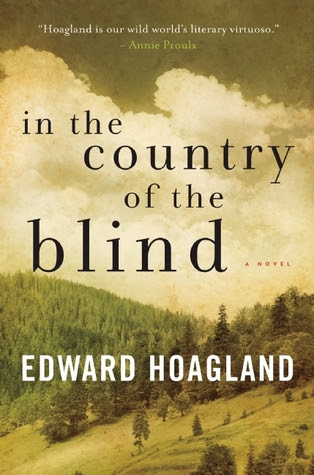
IN THE COUNTRY OF THE BLIND, essayist/novelist Hoagland's last novel


IN THE COUNTRY OF THE BLIND
EDWARD HOAGLAND

Arcade Publishing
$22.99 hardcover, available now

Rating: 3.5* of five

The Publisher Says: Sixty years after the publication of his first novel, Cat Man, Edward Hoagland is publishing his twenty-fifth book at the age of eighty-three. This capstone novel, set in Vermont’s Northeast Kingdom, introduces Press, a stockbroker going blind. Press has lost his job and his wife and is trying to figure out his next move, holed up in his Vermont cabin surrounded by a hippie commune, drug runners, farmers-gone-bust, blood-thirsty auctioneers, and general ne’er-do-wells. Solace and purpose come from the unlikeliest sources as he learns to navigate his new landscape without sight. Hoagland himself is going blind, and through this evocative, unsentimental novel, we experience the world closing in around Press, the rising panic of uncertainty, the isolation of exile, the increasing dependence upon the kindness of strangers, and a whole new appreciation of the world just beyond sight.

My Review: First, read this:
Press tucked necessities into an overnight bag and climbed in, cane and all, not omitting his passport. "Gone fishing" was what they said here. The smell was of sandwiches and coffee, but he sniffed for clues of who the car had belonged to before. A lady, a plasterer? Chuck drove east toward New Hampshire with careless aplomb, like a man who might put fifty thousand miles on a car's odometer every year or two. Blindness curtained much of the beauty they were passing but not his sense that it was there. White spots checkered his vision. How did people manage blind from youth?


Let me assure you that there's nothing in that excerpt to spoil your read. The novelist's last publication, though he is still alive as of 2021. Poignant story, as Hoagland is himself going blind (on top of a life-long stammer). Interesting in a terrifying way that it's an historical novel set in the Nixon era. All the accustomed Hoagland phrase-making is there in full force: “The milking machines sounded tranquilizing, and there was the collegiality of seventy animal spirits thriving, warming the barn with cud-chewing, nose-snuffling, and sisterly mammalhood.”

Well worth the eyeblinks.