Showing posts with label American history. Show all posts

Friday, August 28, 2026

A RESISTANCE HISTORY OF THE UNITED STATES, from Bookshop.org's Independent Press Top 40 Bestsellers: Non-Fiction list all summer long


A RESISTANCE HISTORY OF THE UNITED STATES
TAD STOERMER

Steerforth Press (non-affiliate Bookshop.org link)
$15.99 ebook, available now

The Independent Press Top 40 Bestsellers: Non-Fiction For the week ending September 16, 2026

Rating: 3.5* of five

The Publisher Says: An urgent, bracing new look at American history that Ava DuVernay calls "deeply necessary for this moment."

Revisit the Salem Witch Trials, the Underground Railroad, and other resistance movements of American history to get a bold new understanding of how resistance shaped our past—and how its principles can change our future.

The United States was shaped by resistance—but not in the way we’ve been taught. The Revolution did not secure liberty; it opened the door to either liberty or oppression, where only white men enjoyed all of the benefits and protections of citizenship.

In A Resistance History of the United States, public historian Tad Stoermer shows how from the very beginning, that tension—between the ideals of resistance and the realities of power—has defined America more than the Enlightenment ideals enshrined in the Declaration of Independence and the Constitution.

Utililizing powerful storytelling to focus on key—and often lesser-known—moments in American history, this book reveals the truth of how resistance movements from Colonial times have opposed the powers that be. Stoermer covers an impressive roster of pivotal movements, with each chapter identifying a key resistance movement and principle meant to inspire contemporary readers, including:
  • Bacon’s Rebellion/Metacomet’s War (1676)
  • Salem Witch Trials (1692)
  • The Black Loyalists (1783)
  • The Underground Railroad (1850)
  • Through these and many more examples, Stoermer dismantles the mythologies that pass for American history—exposing the curated nostalgia, moral evasions, and institutional silences that have long protected abusive power. What emerges is an essential look at how we can take lessons from the past to understand, and effectively respond to, the injustices we face today.

    I RECEIVED A DRC FROM THE PUBLISHER VIA EDELWEISS+. THANK YOU.

    My Review
    : There's a reason this story has been on the Bookshop.org non-fiction bestseller list since who-kicked-the-cat. It's organized like the podcast-a-holics like it, event by event. More like a podcast script collection than a narrative history, it is nonetheless a nevessary document of how *structural* change can get made.

    I myownself don't think that's the only kind that counts, where the author does.

    I'm far more annoyed by the absence of footnotes/inline citations in a serious work of non-fiction. Surely in the Age of AI it would be the work of but a moment to get that done! By itself, that was one star gone. I'm not convinced the choice of political changes enshrined in law was as restrictive as the author's use of it requires. To use my own pet peeve, where's the gay-marriage part? Where's the Homestead Strike?

    So not perfect but way way better, more corrective, than the triumphalist claptrap that's extruded by the yard from more mainstram publishers. Steerforth Press does interesting work all the time even when I quibble with it. This is a fine example of that reality.

    I think most readers would prefer to ear-read the book, as it plays into the podcasting ethos of it.

    Thursday, February 5, 2026

    THE UNFINISHED BUSINESS OF 1776: Why the American Revolution Never Ended


    THE UNFINISHED BUSINESS OF 1776: Why the American Revolution Never Ended
    THOMAS RICHARDS

    The New Press (non-affiliate Bookshop.org link)
    $29.99 all editions, available now

    Rating: 4* of five

    The Publisher Says: A clarion call for taking back the American Revolution from the far right, published for the 250th anniversary of the Declaration of Independence

    Who gets to claim the legacy of the American Revolution and the mantle of patriotism that goes along with it? In a sharp, irreverent, deeply informed account of the nation’s founding moment and its enduring legacies, historian Thomas Richards Jr. invites us to see the Revolution not just as a one-time fight for political freedom from Britain but as an ongoing struggle for equality, justice, and social and political independence for all Americans.

    A riveting work of narrative history, The Unfinished Business of 1776 shows that the Revolutionary struggle did not end in 1788 when the Constitution was ratified. Across nine dramatic chapters, Richards introduces readers to the vividly drawn characters who kept the Revolution alive for the next century and beyond, including the women’s rights advocate Judith Sargent Murray, the enslaved rebel Gabriel, the economic reformer Solomon Sharp, and the religious visionary Joseph Smith—each pushing for freedoms that extended well beyond the traditional narrative of the Revolution, and each revealing how the unfinished work of 1776 fueled demands for economic, social, and legal equality that lasted well beyond the Revolution itself.

    A myth-busting book about the history we think we know, The Unfinished Business of 1776 is the perfect antidote to jingoistic celebrations of America—offering an inclusive vision of our common past.

    I RECEIVED A DRC FROM THE PUBLISHER VIA EDELWEISS+. THANK YOU.

    My Review
    : The author's biography on his publisher's website is below:
    Thomas Richards Jr. teaches history at Springside Chestnut Hill Academy in Philadelphia and holds a PhD in History from Temple University. The author of Breakaway Americas: The Unmanifest Future of the Jacksonian United States and The Unfinished Business of 1776 (The New Press), he lives in Gulph Mills, Pennsylvania, where George Washington once camped.
    He's got credentials, he's teaching at a level I wish more PhD-holders would teach at, and he's singin' my song. He wants the left to take back the ideals of the 1776 Revolution from the the reactionaries and right-wingers.

    The case studies for his assertion that the Revolution contained the seeds of progressive action are decent; I myownself flinch away from his inclusion of that lunatic religiosifier Smith. He belongs, however; my distaste for him and the people who have used his example to create a polity I abominate, reject, and hold in deep scorn notwithstanding, what he set in motion is part of what's foreseen and protected in the US Constitution.

    I had not heard of Judith Sargent Murray, for example, or her advocacy of woman suffrage, and am glad I now know she existed despite her being primarily a poet. In filling the great gaps that exist in my own knowledge like this one, the author does me a great service. I suspect many will be less offended than i was by the pro-religious threads he weaves generously into his analyses.

    I would rate this book lower than I do had I not found this passage in the author's epilogue:
    Trumpism is also predicated on easily disprovable, often dangerous or malicious lies, unbridled demagoguery, and an open embrace of anti-intellectualism—all of which the Founding Fathers abhorred. The Founders were undoubtedly flawed, but they did not lie egregiously, embrace fanaticism, or celebrate stupidity.
    Preach, Brother Richards.

    Wednesday, January 28, 2026

    TOM PAINE'S WAR: The Words That Rallied a Nation and the Founder for Our Time, cursory look at a moment in history


    TOM PAINE'S WAR: The Words That Rallied a Nation and the Founder for Our Time
    JACK KELLY

    St. Martin's Press (non-affiliate Bookshop.org link)
    $15.99 ebook, available now

    Rating: 3.75* of five

    The Publisher Says: In 1776, one man's words—and the determination of American patriots—allowed our nation to survive its first crisis.

    We think of the "Declaration of Independence" as the Revolution's defining document. But two essays appealed even more directly to Americans' feelings in 1776. Thomas Paine—a recent immigrant and self-taught writer—saw that America's rebellion was not simply about taxes and representation. It was a true revolution that could upend the fraud of monarchy and dismantle the aristocratic privilege that had dominated the world for centuries. His pamphlet "Common Sense" convinced Americans that the king had no divine right to rule them—they could rule themselves.

    Having inspired patriots to declare their independence, Paine enlisted as a private in the militia. He saw Washington's army suffer defeats. He slogged through the mud with retreating troops to Pennsylvania. There, he wrote "The American Crisis," the most stirring rallying cry in our history. It began: "These are the times that try men's souls . . ." Washington and his men took heart, crossed the Delaware River, and prevailed to fight another day.

    A tribute to the Revolution's 250th anniversary, Tom Paine's War is a riveting exploration of the earliest days of our nation's birth. This is a story of the power of words—and the power of belief—and how both speak as well to America's current crisis.

    I RECEIVED A DRC FROM THE PUBLISHER VIA NETGALLEY. THANK YOU.

    My Review
    : I was eager to see how much I could add to my existing store of facts and ideas about the 1776 Revolution, particularly about Paine's role in both crystallizing its justification and fomenting its passions. I got enough interesting analysis regarding the impact, and the centrality, of Paine's expressive writing to find the read involving. Paine himself has left a small footprint in the records we know to exist. There could be others yet undiscovered. Adding new facts to the narrative, then, wasn't on the cards.

    This is in no way the author's responsibility, and factors in my rating only very slightly as a tinge of disappointment. I'm not able to offer a higher rating because I found the read felt disorganized, with Paine's words mostly sidelined by accounts of ordinary soldiers' opinions. It's not uninteresting, it's quite involving to see the early days of the Revolution through their eyes. But why say it's "Tom Paine's war" when he's a small part of the larger picture? Is the author attempting to demonstrate that Paine's words ignited revolutionary fervor sufficient to cause the war? In that case, many more examples, or a much deeper dive on the examples included...which frankly feels impossible to me given the paucity of records about ordinary people in eighteenth-century America...would be necessary.

    While interesting, this is a shorter, better monograph (honestly, the Author's Note and the Prologue say it all) lurking in a padded read. It would be ideal for a reader new to the topic of the Revolution discussed, or unfamiliar with mass-media's role in igniting war. I think it serves as a decent jumping-off point for other readers, as there are carefully attributed notes throughout as one would expect from this author.

    It was not my most successful read, but I can't complain about the prose or the idea animating the book. It's just not quite the book I expected given the title and synopsis.

    JACK KELLY'S PAGE: VALCOUR: The 1776 Campaign That Saved the Cause of Liberty; GOD SAVE BENEDICT AROLD: The True Story of America's Most Hated Man


    VALCOUR: The 1776 Campaign That Saved the Cause of Liberty
    JACK KELLY

    St. Martin's Press (non-affiliate Bookshop.org link)
    $11.99 ebook, available now

    Rating: 4* of five

    The Publisher Says: The wild and suspenseful story of one of the most crucial and least known campaigns of the Revolutionary War

    During the summer of 1776, a British incursion from Canada loomed. In response, citizen soldiers of the newly independent nation mounted a heroic defense. Patriots constructed a small fleet of gunboats on Lake Champlain in northern New York and confronted the Royal Navy in a desperate three-day battle near Valcour Island. Their effort surprised the arrogant British and forced the enemy to call off their invasion.

    Jack Kelly's Valcour is a story of people. The northern campaign of 1776 was led by the underrated general Philip Schuyler (Hamilton's father-in-law), the ambitious former British officer Horatio Gates, and the notorious Benedict Arnold. An experienced sea captain, Arnold devised a brilliant strategy that confounded his slow-witted opponents.

    America’s independence hung in the balance during 1776. Patriots endured one defeat after another. But two events turned the tide: Washington’s bold attack on Trenton and the equally audacious fight at Valcour Island. Together, they stunned the enemy and helped preserve the cause of liberty.

    I RECEIVED A DRC FROM THE PUBLISHER VIA NETGALLEY. THANK YOU.

    My Review
    : I've never really understood how very much the existence of the USA is contingent on the deep stupidity of the British before reading this book. It's shocking just how little we're taught about Arnold's real contribution to the existence of the US. Valcourt, without exaggeration, was central to the success of the war effort as it denied the British possession of an extremely strategic fort.

    So why is the name of the battle only a dim clang of a memory-bell in my history-loving brain? Because Arnold won it. And the reputation-destroying politicos in the Continental Congress who feared the success of anyone not named "Washington" would result in disruption of their narrative...and threaten their power...knew it. What they did after Valcourt was inexcusable, but only the first of many such slapdowns issued by politicians to military men. (They were all men; History is not satirized as "his story" for no reason.) Denying Arnold a richly merited promotion was pusillanimous.

    This story of Valcourt is heavily slanted towards the naval parts of the story, with mountains of details I never knew I didn't know about ships, their functioning, their strengths and weaknesses in battle, their command structures...it's a lot to take in. I wasn't always sure I cared, while being unwilling to skip over the data because the author's sneaky and uses these facts to good effect in battle anecdotes. An old didactic trick that never fails to trip up the facile reader/student. (In college I had an entire letter knocked off my essay grade because I knew the material, but skipped class the day it was applied to a specific place so did not relate it to that place despite that being clearly stated as part of the requirement.)

    Author Kelly is clearly setting a course into microhistory, prioritizing deep-but-narrow slices of the giant, continent-spanning contests facing the British and the French in the wake of their first-ever world war (The Seven Years' War, 1756 to 1763). If Valcour had not stopped the British from failing at Saratoga, it is doubtful Louis XVI would have funded the war for the American revolutionaries. It is easy, then, to see why someone with an historian's eye for the results of a conflict and a novelist's sense of story would light on this underknown event with glee.

    It is both strength and weakness in this story. If one is not au fait with the Revolution and its roots already, this is not the place to start that journey. Too much will slow the reader's pace that the author's at pains to set...looking people up, finding out who did what to whom before the events described. As it never pretended to be an introductory text to the conflict I'm only mentioning it as a fact for y'all to be aware of in deciding about the read's suitability for your taste. I felt I knew enough to be fully engaged in the material completely new to me without worrying about the background. It is, in fact, a favorite genre of mine. Microhistories suit my own readerly desire to dig into *why* if I already know *what* happened.

    I found the author's use of notes added to my interest but didn't point me in new directions for reading further about the subject. It's the reason I stopped at a fourth star. A five-star history read needs to blow me right away and/or point me in new or unexpected directions. None of that happened here. The notes demonstrated the author's superior command of archives, and his selections from those archives definitely were apt and germane.

    On balance I'll recommend the read to those already interested in the Revolutionary War, and familiar with its broad strokes, who seek more colorful aspects of its story.

    ++++++++++++++++++++++++++++++++++++++++++++++++++++++++++++++++


    GOD SAVE BENEDICT AROLD: The True Story of America's Most Hated Man
    JACK KELLY

    St. Martin's Press (non-affiliate Bookshop.org link)
    $14.99 ebook, available now

    Rating: 4* of five

    The Publisher Says: Benedict Arnold committed treason—for more than two centuries, that’s all that most Americans have known about him.

    Yet Arnold was much more than a turncoat—his achievements during the early years of the Revolutionary War defined him as the most successful soldier of the era. God Save Benedict Arnold tells the gripping story of Arnold’s rush of audacious feats—his capture of Fort Ticonderoga, his Maine mountain expedition to attack Quebec, the famous artillery brawl at Valcour Island, the turning-point battle at Saratoga—that laid the groundwork for our independence.

    Arnold was a superb leader, a brilliant tactician, a supremely courageous military officer. He was also imperfect, disloyal, villainous. One of the most paradoxical characters in American history, and one of the most interesting. God Save Benedict Arnold does not exonerate him for his treason—the stain on his character is permanent. But Kelly’s insightful exploration of Arnold’s career as a warrior shines a new light on this gutsy, fearless, and enigmatic figure. In the process, the book offers a fresh perspective on the reasons for Arnold’s momentous change of heart.

    I RECEIVED A DRC FROM THE PUBLISHER VIA NETGALLEY. THANK YOU.

    My Review
    : I love this description of Benedict Arnold:
    In many ways, he was a typical American—cocky, restless, grasping, perpetually optimistic, quick to take offense. He was a vivid example of the self-reliance and rugged individualism that would be celebrated by Americans from Ralph Wales Emerson to Ronald Reagan. But self-reliance can beget arrogance.
    The man behind the victory detailed in the book reviewed above, and the consequential actions he committed later, comes fully alive in Author Kelly's telling of his subject's character. It's not a biography, in the sense that the focus is not on Arnold the man and his life, but a political biography of the deeds he did and the responses of others that impacted him for good and ill.

    I was not at all familiar with the details of the very real grievances Arnold harbored against the men who, I agree, wronged and slighted him. I'm caught up with it now. As a person, the picture of Arnold that I got from the extensive quotations from period sources is of an eighteenth-century Elon Musk, someone who can make enemies much more readily than friends while delivering results. I suspect he was as thin-skinned as he comes across in these pages because he really was a better strategist than tactician.

    Ultimately his rage-quit of the Revolutionary War was completely understandable, predictable and preventable. The mediocre men who resented him for his strengths handed him the rope he used to hang himself. His own angry demons led him to use it; what he gained was material, what he lost was the lasting capital of reputation.

    As I've come to expect of Author Kelly, he uses period sources galore. I'm impressed with his notes because he is scrupulous in citing the sources of opinions not leaving us to wonder if this is his opinion or something considered to be fact in the period. When it's his opinion, I see it presented as such; when it's his analysis of period opinion the same applies.

    I don't suddenly like this traitor to the cause of American independence. I do empathize with him, understand "why" better, and still disapprove of his actions. A man of such tremendous capability and capacity for foresight, undone by the niggling ugliness of his character flaws.

    Where have we seen that story repeated here lately....

    Not a five-star, blow-me-away read, but a much better than average, really interesting story about an unjustly reviled but still critically flawed man.

    Monday, November 24, 2025

    THE ROUTE 66 COOKBOOK: The Best Recipes from Every Stop Along the Way, pretty. delicious.


    THE ROUTE 66 COOKBOOK: The Best Recipes from Every Stop Along the Way
    LINDA LY
    (photos by Will Taylor)
    Harvard Common Press (non-affiliate Bookshop.org link)
    $25.00 hardcover, available now

    Rating: 5* of five

    The Publisher Says: Embark on a colorful culinary journey traversing America’s Mother Road with stops to recreate the best eats along the way.

    In The Route 66 Cookbook, acclaimed author and lifestyle blogger Linda Ly combines armchair travel with a traditional cookbook to celebrate 100 years of the United States’ most recognizable roadway. This unique compilation of recipes honors American transportation history with a location-specific focus, encouraging you to explore new flavors, places, and perhaps even future vacation destinations.

    Discover fascinating historical facts and figures from the route’s early days to modern attractions as you try recipes organized by state, starting from the eastern start of the route in Chicago, Illinois, and continuing all the way through to its western endpoint in Los Angeles, California, making pit stops in Missouri, Kansas, Oklahoma, Texas, New Mexico, and Arizona. From cheap, quick eats to steakhouses and fine dining, this cookbook caters to varied budgets and palates. Recipes for breakfast, lunch, and dinner all make an appearance, and drinks and desserts get their time to shine too.

    Throughout its recipes and destinations, The Route 66 Cookbook pays homage to America’s diverse cultural history. Of course, there are recipes for a variety of standard American fare, such as diner food, burgers, and multiple styles of barbecue, but German, Mexican, Asian, Indigenous, and fusion foods are also included:
  • Apple Strudel – The Berghoff, Chicago, IL
  • Blackberry Wine Cake – St. James Winery, St. James, MO
  • Egg Cream – Monarch Pharmacy and Soda Fountain, Baxter Springs, KS
  • Späetzle – Rock Cafe, Stroud, OK
  • The Elvis Ugly Crust Pie – Midpoint Cafe, Adrian, TX
  • New Mexican Posole – Silver Moon Cafe, Santa Rosa, NM
  • Halibut Ceviche – The Turquoise Room at La Posada Hotel, Winslow, AZ
  • Strawberry Margarita Pie – Chiquita Rosita's, Barstow, CA
  • Spicy Seafood Soup – The Albright, Santa Monica, CA
  • With 66 recipes from the Midwest to the West Coast, The Route 66 Cookbook has it all, honoring an American road trip tradition and ensuring you can enjoy it even if you’re not on the road.

    I RECEIVED A DRC FROM THE PUBLISHER VIA EDELWEISS+. THANK YOU.

    My Review
    : The decommissioned "Route 66" highway from Chicago to Santa Monica, CA, has a legacy of visual and social clarity brand managers have dreams about. Like the "Wild West" icon fixed in the world's consciousness, it only covers about twenty years of real time...from the end of WWII until the youth rebellions of the middle 1960s, ramping up to fever pitch during the "Beat Generation's" louche and unfettered prestige ascendancy. Their experiences drove tourism as much as afforded cultural cachet.
    the midpoint sign and some trivia

    Even to this day, people around the world know what "Route 66" means. In a world-wide sense it's still pretty powerful signifier of coolness. This collection of recipes is designed to bring out your wallet by appealing to that enduring image. The journey aspect, following the road and eating/cooking at stops is nicely calculated to make home cooks curious:
    planning your journey

    No place on Route 66 is more famous or iconic than California. To get there on the route, one has to go through Arizona's huge swath of the Sonora Desert:
    Arizona
    California

    None of these recipes are terribly challenging. They're finely calculated to be a small stretch beyond the habit zone of home cooks, so they're fun to make and, not surprisingly, fun to eat.
    some samples

    As pretty to look at as it is practical to use, this is a gift item you'll get major points for thinking of and getting for the giftee.

    Sunday, December 15, 2024

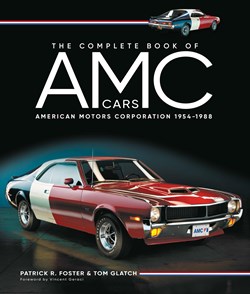
    THE COMPLETE BOOK OF AMC CARS, gifting for the car guy on your list


    THE COMPLETE BOOK OF AMC CARS: American Motors Corporation 1954-1988
    TOM GLATCH & PATRICK R. FOSTER
    (foreword by Vincent Geraci)
    Motorbooks International (non-affiliate Amazon link)
    $50.00 hardcover, available now

    Rating: 5* of five

    The Publisher Says: The Complete Book of AMC Cars is a thorough reference covering all of the production cars offered by American Motors Corporation from its founding in 1954 to its demise in 1988.

    Get an inside look at the American automaker that rose from the decline of a once-thriving independent auto industry to put up a valiant fight against Detroit’s Big Three automakers.

    In The Complete Book of AMC Cars: American Motors Corporation 1954-1988, authors Patrick Foster and Tom Glatch provide a thorough and fully illustrated review of all the production cars offered by AMC from its founding in 1954 to its demise in 1988, including:
  • Rambler
  • Metropolitan
  • Ambassador
  • Rebel
  • Marlin
  • Gremlin
  • Hornet
  • Matador
  • AMX/Javelin
  • Pacer
  • Eagle
  • Jeep

  • Born from the ashes of Hudson and Nash, AMC represented a last attempt at survival for an independent automobile company. Thanks to the capable leadership of CEO George Romney, the company not only survived but thrived, riding on the success of the firm’s small, economical cars like the Rambler. As the market began to shift more toward performance and luxury cars in the 1960s, AMC found itself challenged to compete with the output from Ford, Chrysler, and General Motors.

    The fuel crisis of the 1970s positioned AMC’s smaller cars to refill corporate coffers. The firm’s purchase of the Jeep brand also generated profits, but ultimately it was too little, too late. Even a partnership with French automaker Renault and the introduction of the all-wheel-drive Eagle couldn’t save AMC. In 1987, Chrysler Corporation purchased AMC and the story of the last independent automaker came to an end.

    Foster and Glatch’s engaging book covers all of the AMC models, as well as racing exploits, from its inception to its ultimate demise. Whether you are an AMC enthusiast or are simply intrigued by cars and the stories behind them, this volume is a must-have for your bookshelf.

    I RECEIVED A DRC FROM THE PUBLISHER VIA EDELWEISS+. THANK YOU.

    My Review
    : The first brand-new car I ever bought for myself was a 1977 Gremlin.

    Yuk it up. I'll wait. It was small outside and big inside because it was the front two-thirds of the family sedan, the Hornet, with a teeny little shelf of a seat in back...and a big cargo area. It was fine for one person who took the occasional passenger, which after years of wagging huge loads of kids in my 1968 Bonneville felt *marvelous*. So, of course, being a typical male in at least a few regards, I developed a slightly proprietorial interest in the history of the idea of AMC. I expect there are a few car guys scattered among my acquaintance, so here's a handsomely designed, factually informative resource and pleasure-read for them.

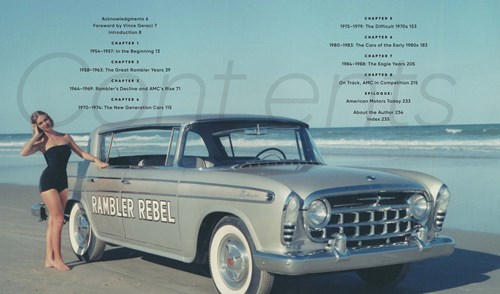
    The table of contents, as always, starts us as we are meant to go on:

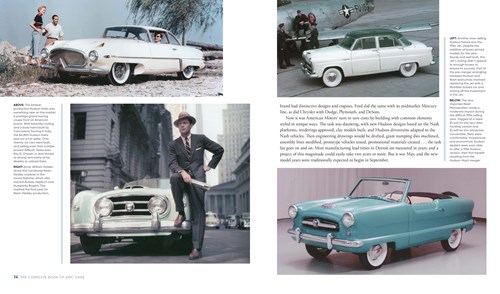
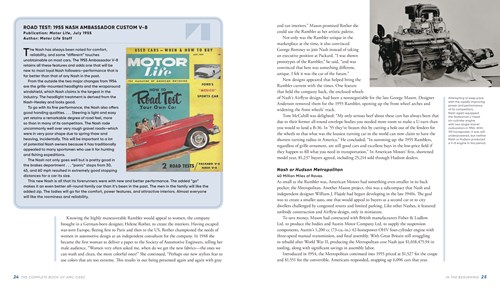
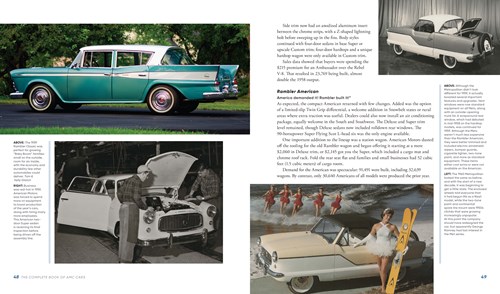
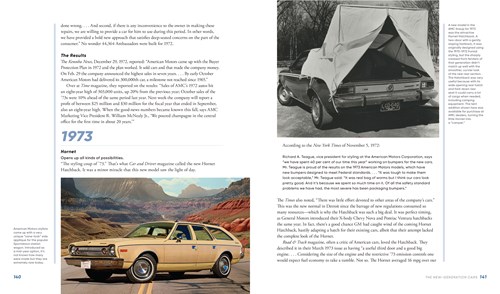
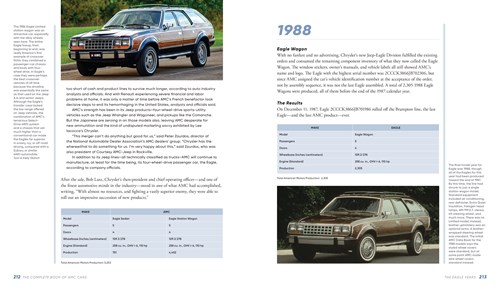
    The remaining sample spreads will tell the giver little enough; but if he's said the words "Nash" or "Hornet" in your hearing, and likes looking at Collectible Automobile magazine, this will not be a high-risk gift.

    Organized chronologically, this is an overview of an era-defining also-ran in the car market, that I'll wager a lot of us would prefer to have back instead of mourning another industry lost to the appalling greed of the banksters.

    As a gift book, it's going to delight the well-targeted recipient. As a radicalization tool, I'm guessing its dreadful story of betrayal and extinguishment might work on some more resistant male minds.

    Saturday, December 7, 2024

    THE AMERICAN ART-UNION: Utopia and Skepticism in the Antebellum Era, beautiful art history-filled object for #Booksgiving


    THE AMERICAN ART-UNION: Utopia and Skepticism in the Antebellum Era
    KIMBERLY A. ORCUTT

    Empire State Editions (non-affiliate Amazon link)
    $39.95 hardcover, available now

    Rating: 4.5* of five

    The Publisher Says: The first comprehensive treatment in seventy years of the American Art-Union's remarkable rise and fall

    For over a decade, the New York-based American Art-Union shaped art creation, display, and patronage nationwide. Boasting as many as 19,000 members from almost every state, its meteoric rise and its sudden and spectacular collapse still raise a crucial Why did such a successful and influential institution fail? The American Art-Union reveals a sprawling and fascinating account of the country's first nationwide artistic phenomenon, creating a shared experience of visual culture, art news and criticism, and a direct experience with original works.

    For an annual fee of five dollars, members of the American Art-Union received an engraving after a painting by a notable U.S. artist and the annual publication Transactions (1839–49) and later the monthly Bulletin (1848–53). Most importantly, members' names were entered in a drawing for hundreds of original paintings and sculptures by most of the era's best-known artists. Those artworks were displayed in its immensely popular Free Gallery. Unfortunately, the experiment was short-lived. Opposition grew, and a cascade of events led to an 1852 court case that proved to be the Art-Union's downfall. Illuminating the workings of the American art market, this study fills a gaping lacuna in the history of nineteenth-century U.S. art. Dr. Kimberly A. Orcutt draws from the American Art-Union's records as well as in-depth contextual research to track the organization's decisive impact that set the direction of the country's paintings, sculpture, and engravings for well over a decade.

    ​​Forged in cultural crosscurrents of utopianism and skepticism, the American Art-Union's demise can be traced to its nature as an attempt to create and control the complex system that the early nineteenth-century art world represented. This study breaks the organization's activities into their major components to offer a structural rather than chronological narrative that follows mounting tensions to their inevitable end. The institution was undone not by dramatic outward events or the character of its leadership but by the character of its utopianist plan.

    I RECEIVED A DRC FROM THE PUBLISHER VIA EDELWEISS+. THANK YOU.

    My Review
    : I've mentioned before my upbringing was very heavy on the art-world access, and a lot of art history came into my knowledge base as part of that. I was drawn to this book in part because it dealt with a topic I'd heard about, but had never gotten too much information regarding, so...well, curiosity got the better of me.

    Thomas Hicks, Calculating, 1844. Oil on canvas, 13 5/8 x 17 in. (34.61 x 43.18 cm). Museum of Fine Arts, Boston, Gift of Maxim Karolik for the M. and M. Karolik Collection of American Paintings, 62.273. Photograph © 2024 Museum of Fine Arts, Boston.


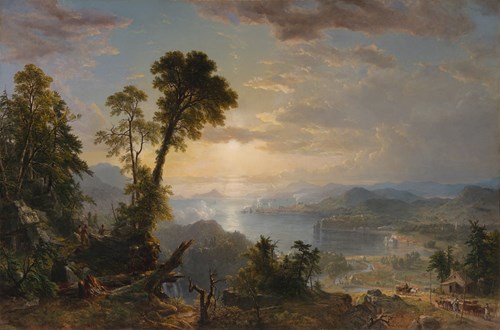
    George Inness, View in Berkshire County, Massachusetts, Clearing off After a September Storm, 1849. Oil on canvas, 48 x 72 1/4 in. (121.92 x 183.52 cm). Buffalo Bill Center of the West, Cody, Wyoming; Whitney Western Art Museum; Gift in Memory of L.G. Phelps and Frances Phelps Belden, 21.00.

    Asher B. Durand, Progress (The Advance of Civilization), 1853. Oil on canvas, 48 × 72 in. (121.92 × 182.88 cm). Virginia Museum of Fine Arts, Richmond. Gift of an anonymous donor, 2018.547. Photo: Travis Fullerton © Virginia Museum of Fine Arts.

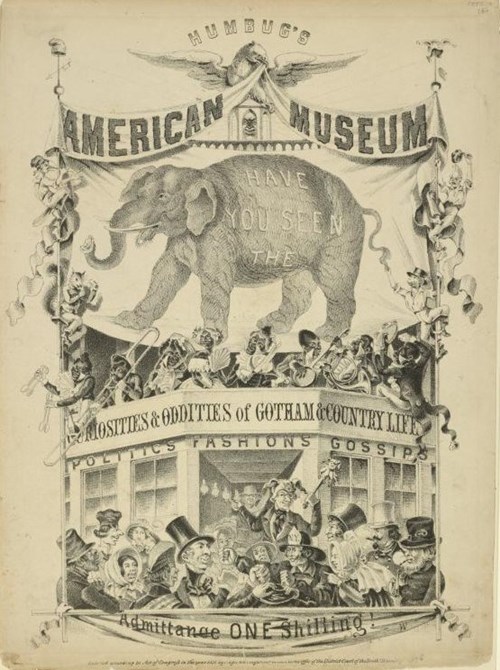
    Nagel and Weingärtner, Humbug’s American Museum, 1851. The Miriam and Ira D. Wallach Division of Art, Prints and Photographs: Print Collection, The New York Public Library.

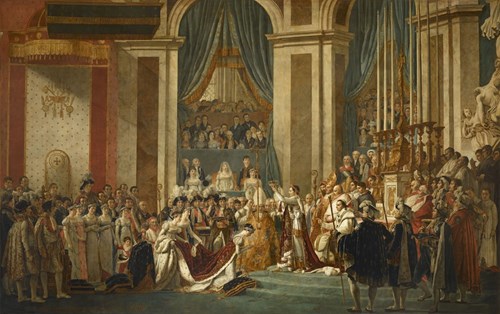
    Jacques Louis David, Coronation of Emperor Napoleon and Josephine at Notre-Dame in Paris, December 2, 1804, 1808–22. Oil on canvas, 240 1/8 x 382 1/4 in. (610 x 971 cm). Chateaux de Versailles et de Trianon. © RMN-Grand Palais / Art Resource, NY

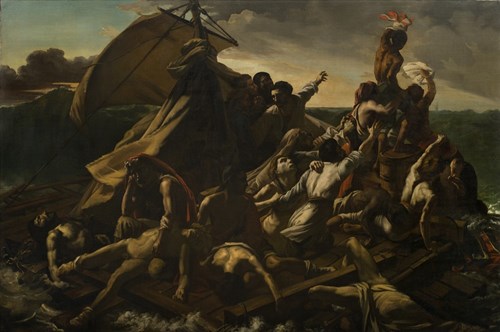
    George Cooke, Raft of the Medusa, ca. 1830. Oil on linen, 51 3/8 × 77 1/4 in. (130.5 × 196.2 cm). New-York Historical Society, Bequest of Uriah Phillips Levy, 1862.4. Photography © New-York Historical Society.

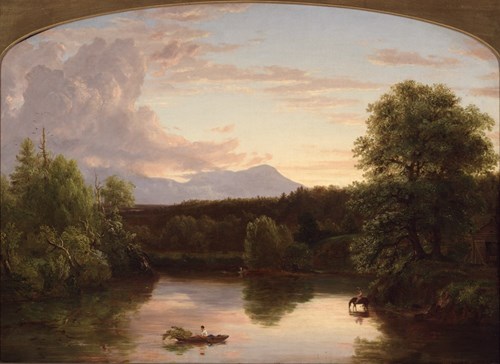
    Thomas Cole, North Mountain and Catskill Creek (Sunset on the Catskill), 1838. Oil on canvas, 26 7/16 × 36 7/16 in. (67.2 × 92.6 cm). Yale University Art Gallery, Gift of Anne Osborn Prentice, 1981.56.

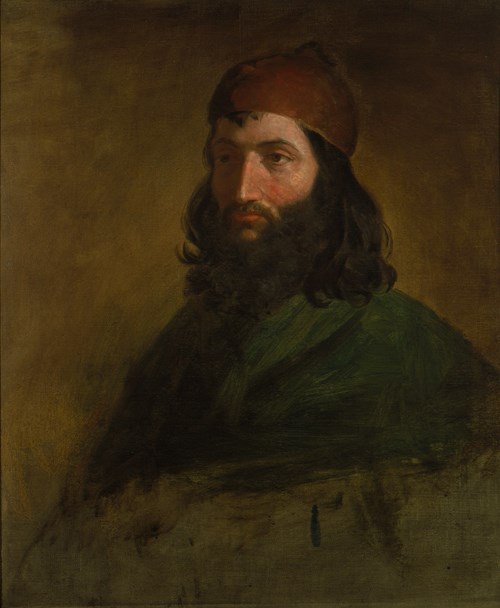
    Washington Allston, Sketch of a Polish Jew, 1817. Oil on canvas, 30 1/4 × 25 1/4 in. (76.8 × 64.1 cm). National Gallery of Art, Corcoran Collection (Museum Purchase, William A. Clark Fund).

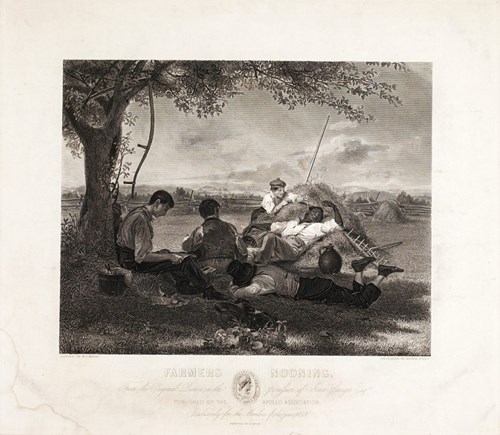
    Alfred Jones after William Sidney Mount, Farmers Nooning, 1843. Engraving. National Museum of American History, Smithsonian Institution.

    ☀☀☀☀☀☀☀☀☀☀☀☀☀☀☀☀☀☀☀☀☀☀☀☀☀☀☀☀☀☀☀☀☀☀☀☀☀☀
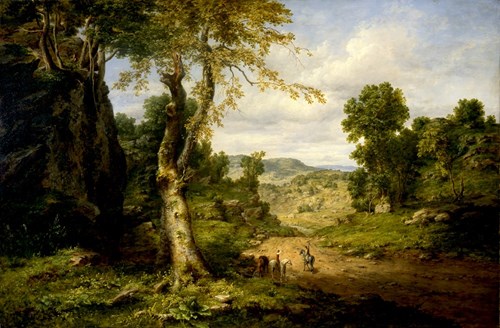
    I've selected these images from the ones made available for reviewers to draw from in their reviews. (There are eighty-seven illustrative images in the entire text.) I think these choices offer the gifter of the book, to self or others, a pretty solid overview of the aesthetic on display in the book. If you like nineteenth-century art, more or less academic in its emphasis, this book is a great choice to ornament your coffee table.

    The idea of the American Art-Union, its aim to bring visual culture to the entire borning nation, resonated with me like I was a bell and it was a clapper. Its aims, its choices, and the idea of a drawing to win original art...well, take my money, y'all.

    Sadly the times were just not in sync with this lofty aim. The inevitable problems with Authority, among the membership, and all the usual nonsense that attends doing something large and ambitious that exceeds the practical and the cultural infrastructure, concatenated in a spectacular flame-out.

    Unusually, the author chose to follow the internal threads of the story. I felt a bit at sea for a while, as I'd expected the bog-standard chronological structure. No indeed...and to be honest, it serves the story being told better than a chronolgy would have done. I can see that this technique will make enemies, though, so I don't want you to go in to a $40 book only to be blindsided with a synthetic approach where one expects an analytical one.

    I'm eager for fellow appreciators of nineteenth-century utopianism, of the urgent need to create a visual culture in this world of philistines, and those who just flat love to look at art, to get one of these beauties for themselves, or a like-minded friend.

    The Table of Contents, with its relative page counts, will show you better than I can what the author does with this story. The amount of text dedicated to the events chronicled is proportional to the importance of the events themselves, much more directly than I find is usual in art-history works:
    Introduction: The Dream of Art for the People | 1

    1 Engravings: To Lead Taste or to Follow? | 29

    2 Selecting Artworks for Distribution: From Democracy to Oligarchy | 63

    3 The Free Gallery: Art, Anxiety, and Revolution | 99

    4 Distributions and Membership: “Messengers and Missionaries of Art”? | 122

    5 The Bulletin: From Education to Provocation | 155

    6 Slowly, Then All at Once: The Demise of the American Art-Union | 180

    Acknowledgments | 209

    Appendix A: American Art-Union Resources | 211

    Appendix B: American Art-Union Officers and Committee of Management, 1839–51 | 213

    Appendix C: American Art-Union Engravings Distributed to All Members | 216

    Notes | 219

    Sources Cited | 253

    Index | 271
    This is a fine work of scholarly thought, meeting beautiful art images, and coming together to produce a book that your budding historian, your culture vulture, and your very artsy giftee will eat up with a terribly refined runcible spoon.

    I did.

    Thursday, September 5, 2024

    RED DEAD'S HISTORY: A Video Game, an Obsession, and America's Violent Past, solid read about a very interesting subject


    RED DEAD'S HISTORY: A Video Game, an Obsession, and America's Violent Past
    TORE C. OLSSON

    St. Martin's Press
    $30.00, hardcover, available now

    Rating: 4* of five

    The Publisher Says: A pathbreaking new way to examine US history, through the lens of a bestselling video game

    Red Dead Redemption and Red Dead Redemption II, set in 1911 and 1899, are the most-played American history video games since The Oregon Trail. Beloved by millions, they’ve been widely acclaimed for their realism and attention to detail. But how do they fare as recreations of history?

    In this engaging book, award-winning American history professor Tore Olsson takes up that question and more. Weaving the games’ plot and characters into an exploration of American violence between 1870 and 1920, Olsson shows that it was more often disputes over capitalism and race, not just poker games and bank robberies, that fueled the bloodshed of these turbulent years. As such, this era has much to teach us today. From the West to the Deep South to Appalachia, Olsson reveals the gritty and brutal world that inspired the games, but sometimes lacks context and complexity on the digital screen. Colorful, fast-paced, and dramatic, Red Dead’s History sheds light on dark corners of the American past for gamers and history buffs alike.

    I RECEIVED A DRC FROM THE PUBLISHER VIA NETGALLEY. THANK YOU.

    My Review
    : I don't play these kinds of games, even ones based on history, so I approach the books about games and gaming like I would explications of religious texts. This is fascinating, I think, why do people get invested in this stuff? I have never found an answer to that but I have definitely learned to appreciate the skill and craft of storytelling involved in creating these interactive spaces.

    No exception here. The author is a (tenured! Go Doc!) college professor trained to teach US history specifically, so has a deep knowledge of the universe the game discussed here inhabits; being a child of the time when games like this were in their infancy, and by his own admission an addicted game player until he went to college, he's brilliantly...almost uniquely...suited to see the game universe, more importantly this game and its universe, from both its important axes.

    After a long absence from the gaming world spent building and solidifying a career, the author got the giant clonk on the noggin that was the COVID pandemic. His life was upended and the time budget entailed in being an academic completely altered. What better way to use his time than rediscovering gaming, especially since a hot game of the time was Red Dead Redemption? History plus gaming equaled irresistible. The history content of the game was solid...and sometimes not.

    If there is better bait for a hook meant for academics, I do not know of it.

    As one might expect from a history professor, the "not" side gets the bulk of the attention. It's not presented in a "GOTCHA!!" way. The facts are presented, the footnote corroborates his source, and on we move. For a reader accustomed to accusatory fact-correcting, that might lessen the interest. For me it was a balm. If a fact isn't supported by historiography, but is supported by the needs of gameplay, this is noted. Doesn't make him call it correct, just...noted.

    As an opportunity to spread knowledge of US history, this book would not be my first suggestion. It is not a fast-paced trip down History's highway; it is not a slow meander through the woods, examining the flora and spotting the fauna. It is a solid, readable work of game analysis as this intersects with actual history, contextualized by very interesting meditations on what the choice of historical background, and the alterations to historiography, say about both gaming and overall culture.

    I was never bored, or even disengaged from, the story. For context recall that I am well into my seventh decade on Earth, and had no concept of home computing as a thing until the early Eighties. I liked card games and board games as a kid. Dungeons and Dragons felt like math class to me. And my interest was held. I hope that tells you what kind of work this is: Quality thinking expressed clearly and organized well.

    It didn't make me excited, gave me no frisson, so I can't add a fifth star. It is a solid, thought provoking read about two subjects of great interest to me, and very probably of even greater to those who skew towards interest in gaming than I do.

    Monday, January 15, 2024

    BLACK DIAMOND QUEENS: African American Women and Rock and Roll, another co-opted cultural theft from Black folks


    BLACK DIAMOND QUEENS: African American Women and Rock and Roll
    MAUREEN MAHON

    Duke University Press
    $30.95 trade paper, available now

    Rating: 5* of five

    The Publisher Says: African American women have played a pivotal part in rock and roll—from laying its foundations and singing chart-topping hits to influencing some of the genre's most iconic acts. Despite this, black women's importance to the music's history has been diminished by narratives of rock as a mostly white male enterprise.

    In Black Diamond Queens, Maureen Mahon draws on recordings, press coverage, archival materials, and interviews to document the history of African American women in rock and roll between the 1950s and the 1980s. Mahon details the musical contributions and cultural impact of Big Mama Thornton, LaVern Baker, Betty Davis, Tina Turner, Merry Clayton, Labelle, the Shirelles, and others, demonstrating how dominant views of gender, race, sexuality, and genre affected their careers.

    By uncovering this hidden history of black women in rock and roll, Mahon reveals a powerful sonic legacy that continues to reverberate into the twenty-first century.

    I RECEIVED A DRC FROM THE PUBLISHER VIA EDELWEISS+. THANK YOU.

    My Review
    : Get your pearl-clutching hand limbered up, y’all...white men grabbed a narrative and co-opted it again!
    I know, I know...no one saw that coming, did they?

    What I did not know about the history of women in rock and roll was a LOT. The underhanded way the gatekeepers would routinely mislabel Black women's music as soul or R&B, making it into an audience-awareness choice, reaching the natural market for these women's work, ie other Black folks. This made sure it all looked okay from the outside and still kept them separate from the white audiences that loved their music. Big Mama Thornton recorded major hits for white artists who got them from discovering her versions, eg Elvis re-recording "Hound Dog" after she did it, then refusing ever to acknowledge her as the source of the style and the rendition he made. She never got her public due, her deserved attention, or her merited rewards despite a many-decade career.

    There is an entire chapter on the girl groups like the Shirelles and the Supremes, huge cultural forces in their day and now largely ignored or forgotten entirely. Diana Ross might be familiar to some younger folk (likely as a solo act), but neither Florence Ballard nor Mary Wilson are, and that is nigh on criminal neglect! The history of the women who worked behind the stars, and in the session studios, are equally unknown to the broad swath of listeners. Who knows who Merry Clayton is, by name anyway? But listen to the Rolling Stones' absolutely ubiquitous "Gimme Shelter" and they know that voice. An actual human woman, with a career, made those glorious sounds behind Jagger's howl of lust. Women like Claudia Lennear and Minnie Riperton were "muses" for white, famous men, and had tiny fractions of their success.

    Of course no one can take a cursory look at this book and fail to see Tina Turner front and center. Rightly so. Her life and career were legendary from the beginning. Every action, every concert, was An Event. A life lived in the glare of publicity, though, is not always a career that works for the aritst. While Tina Turner did find justly given adulation and success for her talents, she worked for everything she ever got *against* the men resisting her input and rejecting her needs and wants. It was not until the 1980s, her fourth decade as a singer, that she finally shed the R&B ghettoization and became a megastar. The fact is that Tina Turner was a musical force of nature, and should have been lionized with the greatest of the British white men who gave the US white audiences covers of the Black women's originals.

    I think I learned most from Author Mahon's chapter on Betty Davis, one of Miles Davis' wives. Her astonishing music was a YouTube rathole I had not known existed. Listen to "If I'm In Luck I Might Get Picked Up" and tell me you don't feel deprived that you are hearing it for the first time in the 21st century. That is my—our—loss, and a bitter privation indeed. It slammed home the grotesque waste of Black women's talents and gifts this book was written to highlight.

    For this MLK Day of reviews, this read was both fascinating and infuriating. The misogyny, the racism, the sheer hideous waste of so much life force, all left me more hell bent than ever to seek voices, experiences, and talents in as many corners that are not spotlit than ever. Join me and let's start shoutin’ about it.

    Saturday, May 21, 2022

    THE PLOT TO SEIZE THE WHITE HOUSE: The Shocking TRUE Story of the Conspiracy to Overthrow F.D.R., unnerving real history


    THE PLOT TO SEIZE THE WHITE HOUSE: The Shocking TRUE Story of the Conspiracy to Overthrow F.D.R.
    JULES ARCHER

    Arcade Publishing
    $10.97 ebook editions, available now

    $1.99 on Kindle! (non-affiliate Amazon link)

    Rating: 3.5* of five

    The Publisher Says: Many people might not know that in 1933, a group of wealthy industrialists working closely with groups like the K.K.K. and the American Liberty League planned to overthrow the U.S. government and run F.D.R. out of office in a fascist coup. Readers will learn of their plan to turn unhappy war veterans into American brown shirts,” depose F.D.R., and stop the New Deal. They asked Medal of Honor recipient and Marine Major General Smedley Darlington Butler to work with them and become the first American Caesar.” Fortunately, Butler was a true patriot. Instead of working for the fascist coup, he revealed the plot to journalists and to Congress.

    Archer writes a compelling account of a ploy that would have turned FDR into fascist puppet, threatened American democracy and changed the course of history. This book not only reveals the truth behind this shocking episode in history, but also tells the story of the man whose courage and bravery prevented it from happening.

    Skyhorse Publishing, as well as our Arcade imprint, are proud to publish a broad range of books for readers interested in history—books about World War II, the Third Reich, Hitler and his henchmen, the JFK assassination, conspiracies, the American Civil War, the American Revolution, gladiators, Vikings, ancient Rome, medieval times, the old West, and much more. While not every title we publish becomes a New York Times bestseller or a national bestseller, we are committed to books on subjects that are sometimes overlooked and to authors whose work might not otherwise find a home.

    I RECEIVED A DRC FROM THE PUBLISHER VIA EDELWEISS+. THANK YOU.

    My Review
    : The wonder of History as a study is how much of what sounds new and apocalyptically nightmarish to you is, in fact, the latest of many iterations of the same bull. Humans seek patterns, and novelty; "this is unprecedented! and it's just like this thing that happened way back when!" sums it up.

    Author Jules Archer (1915 – 2008) was a prolific popular writer on history for all ages. He grew up in New York City during times of great changes and the fomenting of radical opposition to the status quo. He saw, firsthand, the causes of the New Deal's legislation. He spent a lot of time in later life using the free college education that New Yorkers of sufficient academic achievements were at that time entitled to explaining the country, and history itself, to others.

    This book was published first in 1973, in the soft, rotten middle of the Watergate hearings. The timing, and the subject, were chosen carefully. Remembering your history, younger-than-50s, you'll recall we as a country were in the throes of indicting and removing an actual criminal from the presidency, as well as losing a war in Asia. That war left the country with a lot of badly damaged men and no jobs for them when they returned to civilian life.

    Any of this ringing some bells?

    So Jules Archer, explainer extraordinaire (seriously, go look at his bibliography!), reached into his own past for an analogous passage of disastrously concatenated events and found World War I, the Bonus Army, and the very little spoken-of Businessmans' Coup of 1933. "We have been here before," said Archer, "and the country survived."

    The hero of this piece is a man of whom I guarantee you have not heard. General Smedley Darlington Butler is one of those figures that appear all too seldom, the Man of Conscience whose principles are strong and whose moral compass, whether or not it's calibrated as is one's own, is clearly aligned with honor on every axis. The plotters of this heinous act of subversion as Archer details it chose exactly and precisely the wrong man to execute their plot. (Goddesses please accept our thanks that they didn't approach Douglas MacArthur!) He blew so many whistles and did so with such enormous credibility and evidence that the entire plot had to be abandoned.

    Not to say the idea went away. We've seen that in our own time. This Peter Arno cartoon could've been drawn in 2010 and been about Obama, or 2020 and been about Biden:
    After reading this book, your illusions about this unique moment in history being absolutely the awfulest, most scum-ridden, darkest passage in the US will perforce vanish. But you'll also, I hope, read it and think, "this isn't the first time?! Holy maloley, we'd better pay attention!" Because I'm entirely sure that was the aim of Jules Archer's project in writing many explanatory books about history over many decades.

    Wednesday, January 12, 2022

    OUT FRONT THE FOLLOWING SEA, historical thriller of 17th century America


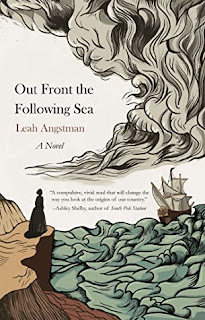
    OUT FRONT THE FOLLOWING SEA
    LEAH ANGSTMAN

    Regal House (non-affiliate Amazon link)
    $9.99 Kindle edition, available now

    Rating: 4* of five

    The Publisher Says: Out Front the Following Sea is a historical epic of one woman’s survival in a time when the wilderness is still wild, heresy is publicly punishable, and being independent is worse than scorned — it is a death sentence. At the onset of King William’s War between French and English settlers in 1689 New England, Ruth Miner is accused of witchcraft for the murder of her parents and must flee the brutality of her town. She stows away on the ship of the only other person who knows her innocence: an audacious sailor — Owen — bound to her by years of attraction, friendship, and shared secrets. But when Owen’s French ancestry finds him at odds with a violent English commander, the turmoil becomes life-or-death for the sailor, the headstrong Ruth, and the cast of Quakers, Pequot Indians, soldiers, highwaymen, and townsfolk dragged into the fray. Now Ruth must choose between sending Owen to the gallows or keeping her own neck from the noose.

    Steeped in historical events and culminating in a little-known war on pre-American soil, Out Front the Following Sea is a story of early feminism, misogyny, arbitrary rulings, and the treatment of outcasts, with parallels still mirrored and echoed in today’s society.

    I RECEIVED A DRC FROM THE PUBLISHER VIA EDELWEISS+. THANK YOU.

    My Review
    : I've been acquainted with, and even published by, Leah Angstman for the past decade. I am absolutely sure that I'd've rated this book even more highly if I hadn't been...such are the wages of sin, I'm afraid. I'm extra sure that nothing I've read in this COVID year has affected me as much as the tale of Ruth, a child of sixteen!, suffering under the sheer violent rage of an entire community of religious nuts. Regulars will recall my affection for the comic book Prophet Against Slavery, which trod similar outcast-for-being-honest ground. At least the Quaker prophet Lay was outcast, cruelly treated, with more than one slender reed of lovingkindness to support him...and I think Ruth's belovèd Owen, his oft-professed love for her notwithstanding, was a slender reed indeed...while being *actually*guilty* of what they accused him of.

    That is not the case in this story.

    Ruth's powerful mind, her greatest curse in a society that mistrusts women whole and entire but smart women most of all, also leads her to the only possible solution to her impossible conditions (given that the local Pequots aren't going to risk a world of trouble to take her in although they do offer her more honorable assitance than she had a right to expect)...and straight into a situation where she's in the path of life-storms and STORMS!!

    It is as breathless a ride of a read as I'm able to take at my advanced age.

    What made me invest myself so deeply in this unflattering depiction of theocratic society from the outside was my antipathy towards That Kind of Person. What kept the pages turning was my need to know: Are Ruth and Owen going to make it to the last page? will their love be rewarded with togetherness? And, this being a romantic novel not a category romance, there is no way to be sure. And I'll not spoil that for you.

    (That was me being very cruel, but only to be kind...you need to read this book.)

    Thursday, November 4, 2021

    PROPHET AGAINST SLAVERY: Benjamin Lay, A Graphic Novel is a stark work of art about a forgotten radical egalitarian


    PROPHET AGAINST SLAVERY: Benjamin Lay, A Graphic Novel
    DAVID LESTER
    (artist); MARCUS REDIKER, PAUL BUHLE (text)
    Beacon Press
    $15.00 trade paper, available now

    Rating: 5* of five

    The Publisher Says: The revolutionary life of an 18th-century dwarf activist who was among the first to fight against slavery and animal cruelty.

    Prophet Against Slavery is an action-packed chronicle of the remarkable and radical Benjamin Lay, based on the award-winning biography by Marcus Rediker that sparked the Quaker community to re-embrace Lay after 280 years of disownment. Graphic novelist David Lester brings the full scope of Lay’s activism and ideas to life.

    Born in 1682 to a humble Quaker family in Essex, England, Lay was a forceful and prescient visionary. Understanding the fundamental evil that slavery represented, he would unflinchingly use guerrilla theatre tactics and direct action to shame slave owners and traders in his community. The prejudice that Lay suffered as a dwarf and a hunchback, as well as his devout faith, informed his passion for human and animal liberation. Exhibiting stamina, fortitude, and integrity in the face of the cruelties practiced against what he called his “fellow creatures,” he was often a lonely voice that spoke truth to power.

    Lester’s beautiful imagery and storytelling, accompanied by afterwords from Rediker and Paul Buhle, capture the radicalism, the humor, and the humanity of this truly modern figure. A testament to the impact each of us can make, Prophet Against Slavery brings Lay’s prophetic vision to a new generation of young activists who today echo his call of 300 years ago: “No justice, no peace!”

    I RECEIVED A DRC FROM THE PUBLISHER VIA EDELWEISS+. THANK YOU.

    My Review
    : In today's world, Benjamin Lay woud be a firebrand and a demanding moral force. IMAGINE how he came across in the slave-owning times of the early eighteenth century. A dwarf...an iconoclast...an uncompromising, flinty, arrogantly sure of himself and his rightness, public speaker with a real gift for propaganda.

    He would be literally inescapable in this media landscape.

    We are the poorer for the absence of someone like him, taking on the horrors of international capitalism. The export of jobs has meant the export of problems like labor relations and environmental regulations, which no one can ever convince me was serendipity. Author and Artist Lester (The Listener and The Gruesome Acts of Capitalism are some of the other titles he's created) clearly understands the value of theater and public perception in the winning of the culture wars:
    He's got the entire subject of the Quaker dwarf with an outsider's grasp of the social and moral corruption around him in the economical monochrome of these spreads. Things *are* black-and-white when one reduces them to lines drawn in the sand. Using the palette he chose makes the starkness of Benjamin Lay's moral universe simply part of the experience of learning about him.

    It is unsurprising that, in this twenty-first century of information overload, we're needing to learn about Benjamin Lay. His brand of vegan, animal-rights activism, his uncompromising adherence to his moral understanding of the world, reminds me of Greta Thunberg. Only louder. While he had less command of the broader public's attention than she does, he used his voice, his mind's single focus on The Greatest Good, and his unique viewpoint as she has. His unswerving opposition to slavery was so broad in its intellectual base that he refused to ride horses or eat slaughtered animals. In the eighteenth century.

    After the Confederacy won the US Civil War in the courts, and gifted us with the Jim Crow laws and the voter suppression laws that they're succeeding in re-installing, the life of a man like Lay would've been deeply threatening to their agenda. A shining moral example? And one who took it to the extremes that Lay did...throwing fake blood on slave owners?! writing angry screeds filled with passion and yet based on reason?! blasphemy to the Capitalist Elite!...well, best to bury him again.

    They did; it worked. I'd never heard of him before I was granted this graphic novel's DRC by Beacon Press, that monadnock of Unitarian probity in publishing. The graphic-novel format has never been my favorite among publishing choices. I'd say that, despite this one's five-star rating, it still isn't. I've also given the full five stars to Nationalist Love, and the same reason obtains here: The only effective tool to use in bringing this story to a broad audience is the one used here. There's no way most people would pick up an all-text biography of Benjamin Lay, eighteenth-century dwarf; marry it to this format, they're more likely give it a shot.

    What Lay accomplished, in practical terms, was to change the hearts and minds of younger people...which is what the Ruling Elite did in the 1970s and 1980s with rampant consumerism and cheap, disposable goods. This long-buried story will make the effectiveness of that trick very obvious. Ray Bradbury, a true autodidact, famously said, "You don't have to burn books to destroy a culture. Just get people to stop reading them." The books by and about Benjamin Lay aren't widely read today, and there's a good reason for that: Their message is still resonant, and still damaging to the System's actions and inactions.

    Before anyone says it to me, let me say now that I am no Benjamin Lay. I'm a meat-eating cheap-goods-buying 21st-century consumer. That does not make me insensible to the man's message; it merely means that my inner struggle, to reconcile the way I live with the way I understand the world, is apparently endless. It's never a comfortable place to be. I exist because modern exploitive capitalism created medicines that prevent me from dying. I eat because of factory farming and cheap electricity. I am not naked because the supply chain includes vast quantities of cotton goods. The chemical industry has gifted me power, shoes, soaps and shampoos and tooth-cleaning goop.

    I am the problem Benjamin Lay railed against: I exist inside a system that requires others to be outside its benefits in order to function. He chose the morally superior course of opting out. He chose a lifetime of rejection and excoriation and outrage heaped upon him, in the name of standing up to be counted for his beliefs. I admit: I lack that courage.

    That does not impair my ability to see his message and know its rightness. It makes me more willing to shout and point and wave my arms at this simple, beautiful expression of a simple, beautiful soul's purpose on this Earth. We can all aspire to be celebrated Home as was Benjamin Lay.

    Friday, August 27, 2021

    THE BOOK OF ERRORS will delight and enlighten some, bewilder and befuddle others


    THE BOOK OF ERRORS
    ANNIE COGGAN (art) and MARK HAGE (text)

    A Public Space Books
    $18.00 trade paper, available now

    Rating: 4* of five

    The Publisher Says: A collection of three illustrated essays looking at the preservation of three historic houses—and the layered, messy process of reconstructing our past and reimagining history. An architect and artist, Annie Coggan delves into the history of three iconic American structures—the Henry Knox Memorial in Maine; Fraunces Tavern in New York City; and the Betsy Ross House in Philadelphia—and the stories of the people and ideas involved in their preservation to consider the ways in which history is reshaped by future generations.

    I RECEIVED A DRC FROM THE PUBLISHER VIA EDELWEISS+. THANK YOU.

    My Review
    : A literary magazine of some significance gave birth to a publishing company of some significance. I've reviewed So Much for That Winter, one of their earlier book publications of a translation from the Danish via Graywolf Press, on this blog. I've also reviewed their initial own-imprint publishing venture, the late and underknown Bette Howland's delight of a short-fiction collection, Calm Sea and Prosperous Voyage, on this blog. As both of those were positive reviews, I think you could safely say I am in tune with this press's aesthetic.


    Here you see the artwork that forms the spine of this book's conceit. It is a series of beautiful paper models, and drawings, and painted drawings, of three different historic homes that are going to be conserved, restored, or rebuilt. The specific examples I've used are those provided by the publisher; all are from the Henry Knox Memorial, a house named "Montpelier," in Thomaston, Maine. The facts about the house are: It is a nineteen-room recreation, finished in 1929, of the original space built in 1794; that space was demolished in 1871 to make way for the Thomaston Railroad. The essay about this house is in the form of letters to and from the architect of the reconstruction, William E. Putnam, to one of the commissioning parties, Miss Watts of the Daughters of the American Revolution. Are these "real," by which I mean were they written by the parties whose names are on them, and selected by Author Coggan; or are they fabrications of Author Coggan's, made to elucidate a point about the eternal and delicate process of reaching a working understanding between client and architect?

    I don't think it matters.
    I don't see how anything but the effect, the gentle and eloquent interplay of images such as the above, with the words such as:
    The evidence, even of eyewitnesses, as to the probable plans of the Knox House are so at variance that we have to consider it carefully and test each bit by things that we are sure of from a practical standpoint...

    I wish you would read carefully Miss Miller's description and check it up with your remembrance. Also, if she is still living, I should think that a talk between you and her might clear up many of the points about which a difference of opinion seems to exist....

    really makes a difference to the way one experiences this beautiful and thoroughly satisfying melding of idea, image, and purpose. We are brought into a quotidian conversation between patron and architect, between a man and a woman both of senior years, and thus in conjunction with the beautiful art, we are flies on the walls of these moments when History, long dead even then, was being negotiated for presentation to The Future. It is always a worthwhile endeavor to learn about what goes into the making of the world thee and me see.

    Author Coggan's beautiful paper-and-paint constructions offer something I think too many books about preservation, architectural history, and art in general lack: A what-if, a road-not-taken approach to visual arts that I resonated with. It could simply be that I am so enchanted by the art itself that I am happy to see it used in this unusual manner. I grant that others might not feel this is anything other than a very niche project, showing a blow-by-blow of things that didn't happen, or might have happened, instead of cold non-fiction.

    I see value in the exploration this approach allows of the why, the deeper why, of art and architecture pressed onto the service of History and the Monomyth of American History. The exceptionally contentious "restoration" of Fraunces Tavern, more precisely called a "conjectural reconstruction" (thanks, Wikipedia!), is illustrated in black-and-white drawings which, quite lovely though they are, suit the more angry and contentious responses to the Sons of the Revolution's major, and not uncontroversial, reimagining of the Tavern as of the 1790s (from the distance of 1904!):
    "On passing the Washington statue...I thought I heard a loud sobbing... I said, 'Why weepest thou?' He said, 'Hast been to Fraunces's Tavern lately and witnessed the scoundrelly piece of vandalism that they have perpetrated upon that hallowed building, with whose walls I embraced my loved comrades?'"
    —Letter to the New York Times (1906)

    Daniel Libeskind, he of the master-planned Freedom Tower complex on the site of the old World Trade Center Twin Towers, would've recognized the entire imbroglio as being New York City doing what she does best: Eating her young. Nothing can ever be accomplished in the City without a decade of brangling, infighting, and public bitching.

    The last of the three historic structures whose futures were assured by these early preservation attempts was famed upholsterer and flag-designer, Betsy Ross, whose residence in Philadelphia came in for a "re-configuration" to make it more suitable a setting for the probably apocryphal transfer of a flag designed by Mrs. Ross in her role as a famed upholsterer in Philadelphia society to General Washington. Since the probability is that Mrs. Ross didn't ever live in that tourist mecca, there's really no point getting exercised about it...and Author Coggan uses beautifully simple line drawings to evoke the scale of the house (it's dinky!) and the simplicity of its furnishings (spartan).

    I think this lovely object belongs on the coffee tables of those whose appreciation for art is not limited to visual expressions of design, but also reaches for the "why" of art...what about this is necessary, what in this artistic expression am I going to think about and become acquainted with that I haven't, wouldn't, or couldn't otherwise?

    This book is meant to close those gaps for you, elegantly, about parts of History that more often than not are so dead to us that we couldn't care less if they were there at all. I salute your vision, A Public Space Books, and your talent, Author Coggan!

    Friday, August 7, 2020

    DESTINY OF THE REPUBLIC, an excellent and unexplored alternate-history point of departure, a great President killed too soon

    DESTINY OF THE REPUBLIC: A Tale of Madness, Medicine, and the Murder of a President
    CANDICE MILLARD

    Anchor Books
    $17.00 trade paper, available now

    Rating: 4* of five

    The Publisher Says: James A. Garfield was one of the most extraordinary men ever elected president. Born into abject poverty, he rose to become a wunderkind scholar, a Civil War hero, and a renowned and admired reformist congressman. Nominated for president against his will, he engaged in a fierce battle with the corrupt political establishment. But four months after his inauguration, a deranged office seeker tracked Garfield down and shot him in the back. 

    But the shot didn’t kill Garfield. The drama of what hap­pened subsequently is a powerful story of a nation in tur­moil. The unhinged assassin’s half-delivered strike shattered the fragile national mood of a country so recently fractured by civil war, and left the wounded president as the object of a bitter behind-the-scenes struggle for power—over his administration, over the nation’s future, and, hauntingly, over his medical care. A team of physicians administered shockingly archaic treatments, to disastrous effect. As his con­dition worsened, Garfield received help: Alexander Graham Bell, the inventor of the telephone, worked around the clock to invent a new device capable of finding the bullet. 

    Meticulously researched, epic in scope, and pulsating with an intimate human focus and high-velocity narrative drive, The Destiny of the Republic will stand alongside The Devil in the White City and The Professor and the Madman as a classic of narrative history.

    My Review: I knew next to nothing about this president. I'd sort-of known he was assassinated, but not much about why. “Oh, the one in the 1880s? Didn't some nut kill him?”

    What a story this is. What a gargantuan loss to the USA his non-Presidency was. What an interesting, interesting man! We hear reams about presidents significantly less interesting than Garfield was. It's not right. But it makes sense...all he did as president was get killed a couple months after he was sworn in.

    Garfield was a self-made man, from a poor family, with a troubled marriage. (Ring any more recent bells?) His wife was a chilly intellectual on whom he cheated once. (PLEASE tell me you've got it now.) And even more like the C-man, Garfield entered the race for the White House with powerful people strongly opposed to his winning. He was thwarted and stymied and made to do battle over things that were deeply entrenched and very wrong with the political culture of the day, and he only sort of won.

    I trust my parallel is made.

    So I was surprised to learn that Garfield was a Republican, and a populist progressive reforming one. (That sentence gave me vertigo to type. I'm not used to saying nice things about Republicans.) My, how things have changed! And the system he fought against actually, literally ended up costing him his life. In that time, presidents controlled all government jobs, and so the people who wanted to get security got in good with the party and made their case for a job to one harassed man, with maybe a secretary or two to assist him...good people got jobs, I'm sure, but more bad ones got good jobs than the other way around. In denying a very bad applicant a “spoils” job, Garfield signed his own death warrant.

    Charles Guiteau, who shot Garfield in the back as he was to board a train in order to visit his recuperating wife, isn't his murderer. That person is the doctor who cared for him in the most backward possible way, Dr. D. Willard Bliss. Of evil memory ptooptoo. Despite Dr, James Lister's empirical proof of the germ theory's truth by means of reducing post-surgical mortality via sterilization of instruments and rooms, Bliss held to the old-fashioned view that it was falderol to say something you couldn't see could kill a man. Bliss, if you can believe this, stuck his finger in the bullet hole in Garfield's back in the train station, on the floor, with no washing!

    It's a wonder he didn't die a lot sooner, with this kind of “care,” isn't it? As it is, the almost obnoxiously healthy and virile Garfield was shot on 2 July and didn't die until 19 September. Months of infections, months of idiot Bliss being wrong about everything (he said categorically that the bullet was lodged on the right side...it was on the left, it turned out...and he refused to even investigate the left side), and the potential great president died in agony. His vice-president was Chester Alan Arthur, that monadnock of probity and intellect. Oh dear, I fear my sarcasm gland is dripping again.

    Well, okay, so it's clear I liked the story. I also liked the book. The author also wrote a book on Teddy Roosevelt, another Republican progressive and all-around fascinating man, called The River of Doubt. It's a really good story, and a very good read. She has an affinity for real-life drama, Madame Millard, and she has an excellent ear for the phrase that will illuminate it. In Chapter 14, entitled “All Evil Consequences,” this phrase in particular wrung my withers:

    Had Garfiled been shot just fifteen years later, the bullet in his back would have been quickly found by X-ray images, and the wound treated with antiseptic surgery. Had he been able to receive modern medical care, he likely would have spent no more than a few nights in the hospital.

    Such are the vagaries of history...the good wand worthy die, the evil and vile get new hearts at taxpayer expense.

    Candice Millard writes a good yarn. If all you want is an exciting and interesting story, this book will satisfy you. If you're interested in history, it will enrich you. If you're excited by the odd pathways of fate, this could be the best of 2012 for you. I'm all of the above. I was sucked in from the get-go, and came out a happy, happy angry man.