Showing posts with label 5-star review. Show all posts

Friday, June 17, 2022

ANTIMAN: A Hybrid Memoir will hoick you out of your lazy ease into a better one


ANTIMAN: A Hybrid Memoir
RAJIV MOHABIR

Restless Books
$27.00 hardcover, available now

Rating: 5* of five, or maybe even six....

The Publisher Says: Winner of the Restless Books Prize for New Immigrant Writing, Rajiv Mohabir’s Antiman is an impassioned, genre-blending memoir that navigates the fraught constellations of race, sexuality, and cultural heritage that have shaped his experiences as an Indo-Guyanese queer poet and immigrant to the United States.

Growing up a Guyanese Indian immigrant in Central Florida, Rajiv Mohabir is fascinated by his family’s abandoned Hindu history and the legacy of his ancestors, who were indentured laborers on British sugarcane plantations. In Toronto he sits at the feet of Aji, his grandmother, listening to her stories and songs in her Caribbean Bhojpuri. By now Aji’s eleven children have immigrated to North America and busied themselves with ascension, Christianity, and the erasure of their heritage and Caribbean accents. But Rajiv wants to know more: where did he come from, and why does he feel so out of place?

Embarking on a journey of discovery, he lives for a year in Varanasi, on the banks of the Ganges, perfecting his Hindi and Bhojpuri and tracing the lineage of his Aji’s music. Returning to Florida, the cognitive dissonance of confederate flags, Islamophobia, and his father’s disapproval sends him to New York, where finds community among like-minded brown activists, work as an ESL teacher, and intoxication in the queer nightlife scene. But even in the South Asian paradise of Jackson Heights, Rajiv feels like an outsider: “Coolie” rather than Desi. And then the final hammer of estrangement falls when his cousin outs him as an “antiman”—a Caribbean slur for men who love men—and his father and aunts disown him.

But Aji has taught Rajiv resilience. Emerging from the chrysalis of his ancestral poetics into a new life, he embraces his identity as a poet and reclaims his status as an antiman—forging a new way of being entirely his own. Rapturous, inventive, and devastating in its critique of our own failures of inclusion, Antiman is a hybrid memoir that helps us see ourselves and relationships anew, and announces an exciting new talent in Rajiv Mohabir.

I RECEIVED A DRC FROM THE PUBLISHER VIA EDELWEISS+. THANK YOU.

My Review
: If you read one sentence from this review, make it this one:
I'd never thought of writing as a gift, but a skill and a bravery that you have after refusing to burn up in flame. It was an act against death.

That's as perfect a description of the reason writers write, creators of anything create, as I can imagine there being.

Now. Remember who this is, talking to you: An avowed anti-poetry zealot. This is a person, the one writing this review, who reads poetry with a pained grimace (if required to in public) or not at all (if it can possibly be avoided).

You, my fellow Western people, need to read this poet's poetry of love and passion and the terror of not knowing what life is, what Life is we understand, but life? Why is there life? And what you will learn is that everyone fears death and hates loneliness and eagerly whores their body out for a brief look-in from connectedness to another.

It's all down to Ajiya, the author's grandmother, you see. Without her strength of will and flowering of soul, your author would not have come to be or learned to be. She powered his being, his existence in this Vale of Tears, with a dirty veil of Life cast aside at last so she could finally, finally! be where she belonged all along, with her grandson, her boy of the heart.

Inside, then, all of us. Everyone who reads this book. Everyone who has read the poems she gave to her grandson who turned them into words they weren't forged from and thus pounded a new meaning from the gold, the silver, the lead. We all have Rajiv Mohabir's Ajiya in us and we're lucky we do. It's a simple truth that our belovèd others are not always what we would've wished them to be. Immigrants are required to make themselves anew and Ajiya wasn't made of malleable stuff so she didn't. Instead she waited, quiet as she could make herself, until the ears she had got in exchange for the mouth she turned off showed up again.

So it is that her outsider Other grandson became the channel of her frequency and spoke its truth and its stories and its poems into our indifference-clouded intoxicated-with-vanity white/Western/privileged ears. His soul and hers...two for one...and you'll just have to pay for a single book. It's an amazing reading experience, with its Creole passages and its polyphonic choruses of lifestuff. Its ebullience carries you through the passages where cruel, small people following a character from a bad fantasy novel reject and belittle when they can be induced to notice anyone not like themselves.

That attitude is a specialist product, turned out by the megaton, of the US and its more revolting useless eaters.

There is absolutely a need for all y'all to come to this table, to sit down with all your long-lost spiritkin, and learn the songs and the poems of their walk through our world. Yours has shadows, but their light might help dispel those that frighten you the way night terrors and sleep paralysis...the states between states that humans do not want to inhabit...release you when they are rolled away.

I wait for years for reads like this to come along.

Friday, April 22, 2022

THE PONDER HEART, light-hearted, fun-loving, and just a bit darker than you think


THE PONDER HEART
EUDORA WELTY

Mariner Books (non-affiliate Amazon link, since the publisher's website is not responding)
$11.49 Kindle edition, available now

Rating: 5* of five

The Publisher Says: Daniel Ponder is the amiable heir to the wealthiest family in Clay County, Mississippi. To friends and strangers, he’s also the most generous, having given away heirlooms, a watch, and so far, at least one family business. His niece, Edna Earle, has a solution to save the Ponder fortune from Daniel’s mortifying philanthropy: As much as she loves Daniel, she’s decided to have him institutionalized.

Foolproof as the plan may seem, it comes with a kink—one that sets in motion a runaway scheme of mistaken identity, a hapless local widow, a reckless wedding, a dim-witted teenage bride, and a twist of dumb luck that lands this once-respectable Southern family in court to brave an embarrassing trial for murder. It’s become the talk of Clay County. And the loose-tongued Edna Earle will tell you all about it.

“The most revered figure in contemporary American letters,” said the New York Times of Eudora Welty, which also hailed The Ponder Heart—a winner of the William Dean Howells Medal which was adapted into both a 1956 Broadway play and a 2001 PBS Masterpiece series—as “Miss Welty at her comic, compassionate best.”

THIS IS MY ENTRY INTO THE 1954 CLUB...reviews of books published in 1954.

My Review: This magical moment of Southern history was first published in The New Yorker magazine, with the whimsically funny line drawings in my Kindle edition, in 1953. How I wish I had been there, that I'd seen it in that form...I was, obviously, unable to attend the 1956 Broadway performance of the play adapted from this book (being still as yet unborn) but I certainly saw the PBS Masterpiece Theater production with Peter MacNicol and JoBeth Williams as Uncle Daniel and Edna Earle Ponder. It was...fine. Not a patch on the read, but...fine. Like 2001 itself, it was no patch on 1953, or 1956.

The reason this novella marches on, I think, is that it is the perfect length and in the precise emotional register for Miss Eudora Welty's powers to come full bore on it. I am certain that its long-term popularity is down to Miss Edna Earle Ponder and her absolutely amazing narrative voice:
I used to dread he might get hold of one of these occasional travelers that wouldn’t come in unless they had to—the kind that would break in on a story with a set of questions, and wind it up with a list of what Uncle Daniel’s faults were: some Yankee.
–and–
Miss Teacake Magee lived here all her life. She sings in the choir of the Baptist Church every blessed Sunday; couldn’t get her out. And sings louder than all the rest put together, so loud it would make you lose your place.
–and–
The Peacocks are the kind of people keep the mirror outside on the front porch, and go out and pick railroad lilies to bring inside the house, and wave at trains till the day they die. The most they probably hoped for was that somebody’d come find oil in the front yard and fly in the house and tell them about it.

It's the voice that I sense in all Miss Eudora's very best writing, the voice of a certain woman whose presence in every Southern matriarchy is inevitable: The "excellent woman" of Barbara Pym's stories with a different accent and a slightly more acid tongue. In Miss Edna Earle, I do believe the type reached her apotheosis. She narrates the whole sorry saga of Grandpa Ponder's attempts to corral his son's bizarre, generous heart within the Institution of Marriage. After all, the mental institution couldn't even hold him a week. The problem is, you see, Uncle Daniel Ponder isn't crazy. Isn't, in fact, much of anything except smilingly delighted to be alive, and willing to do whatever it takes to give that same joy to others. And Miss Edna Earle, being a true-born Ponder and a lot sharper than Uncle Daniel, sees Grandpa's point...helps him as best she can...and, when the marriage "didn't hold out," she accepts Uncle Daniel's just going to need watching so he doesn't give away the whole of the Ponder fortune.

Nobody thought to worry about the dear soul finding another wife.

This time, though, as one might expect, Uncle Daniel finds the wrongest wife possible: A silly little girl of seventeen from a family of no-count nobodies. The shock of it! Why, Grandpa Ponder finally succumbs to this shock to "the Ponder heart" and now where is Miss Edna Earle going to get help dealing with Uncle Daniel? Especially now that his little child bride is all of a sudden dead....

What follows is an absolutely side-splittingly funny murder trial, a startling bunch of revelations about Uncle Daniel (not really) and a juicy trial for the gossips to chew over til Kingdom Come (that bit's true). There is, as always, The Welty Touch over every square inch of this magical little farce. There's the occasional nasty epithet, but never from Miss Edna Earle or Uncle Daniel; there's not one single sign of modernity in the story, in the structure or the tale of it. This is the way Southern women of a century ago told their stories to anyone who desired to listen.

I desired to listen.

Wednesday, April 20, 2022

SUBTLE BLOOD, third and (almost) final Will Darling Adventure, and HOW GOES THE WORLD, tidy-up small tale to complete this series


SUBTLE BLOOD
K.J. CHARLES
(Will Darling Adventures #3)
KJC Books (non-affiliate Amazon link)
$3.99 Kindle edition, available now

Rating: 5* of five

The Publisher Says: Will Darling is all right. His business is doing well, and so is his illicit relationship with Kim Secretan--disgraced aristocrat, ex-spy, amateur book-dealer. It’s starting to feel like he’s got his life under control.

And then a brutal murder in a gentleman’s club plunges them back into the shadow world of crime, deception, and the power of privilege. Worse, it brings them up against Kim’s noble, hostile family, and his upper-class life where Will can never belong.

With old and new enemies against them, and secrets on every side, Will and Kim have to fight for each other harder than ever—or be torn apart for good.

ANOTHER GIFT FROM MY YOUNG GENTLEMAN CALLER. HE TRULY IS THE BEST.

My Review
: This is how you end a series...not with a whimper, but a loud, resounding bang.

The entire world could've finished exploding and I'd've ignored it. I needed to know how this tale ended. I needed the series to live up to the start. (It did.) This is a rare enough occurrence that I wanted to mention it especially, and early in my review. If you're looking for a series to read, read this one; it's got the exciting action and the romantic tension and the period details that make a good read a superior one. Take a look at The Sugared Game's review to see how serious I am...despite the w-bomb Author Charles dropped on me, I still recommend the series. (Might not've had there been another one in this book. But there wasn't.)

In this last planned story of Will Darling and his belovèd Kim Secretan, we're treated to the strange spectacle of Kim without commitments to anything more than Will's bookshop, Will's bed, and Will himself. It's sweet, it's domestic, and it's peculiar! It also is destined to be but an interlude, as we know since the series is called "The Will Darling Adventures" not "The Will Darling Stories." As Kim's life is...unmoored...so Will's is ever more firmly anchored in Kim. Their expanded time together suits Will so completely that he can only be happy, even though...well, there's the little problem of boredom, isn't there, in the dailiness of life.
The list, as he well knew, comprised most of {his bookselling rival}’s hopes, dreams, and sexual fantasies, since he shared the deceased Lord Aveston’s love of Elizabethan and Jacobean music. Will couldn’t tell a madrigal from a macaroon, but he hadn’t got the job for his bibliographic skills. In fact, he’d spent much of his time with the Avestons simply chatting to the new viscount, a pleasantly dim young man who was far more interested in swapping war stories and rattling on about cricket than in anything that might be classed as intellectual pursuits.

Fear not...the long arm of Author Charles isn't about to leave us mired in the muck of Life as most people live it.
Will sighed. “We didn’t all go to Eton.”

“Aristocracy means ‘rule of the best’, and I can’t think of any company in which Chingford would be counted as best, including the average gaol. Yet the hereditary principle demands we grant power, authority, and vast swathes of land to a man who couldn’t run a whelk stall if you gave him a copy of How To Run A Whelk Stall with corners turned down to mark the good bits.”

–and–

Will felt a whole-body wave of refusal. It was bad enough Kim being Lord Arthur Secretan: he couldn’t become a marquess. It would be impossible. He’d vanish into a world of stately homes and impossible wealth, somewhere Will couldn’t hide and would never belong. They’d never belonged together in the first place. Everything between them had been built piece by piece over a chasm, and that bridge had proved fragile enough in the past without having to bear the crushing weight of Kim’s heritage. They wouldn’t survive this. He’d lose him. “Oh shit,” he said.

It's Kim's family, you know it's bad and going to get worse; you also know that Will's anxiety about Kim's privileged upbringing, Kim's membership in the aristocracy, and Will's unworthiness to be with such a Personage is going to hit overdrive...along with Kim's complete and utter indifference to anything except what keeps him apart from Will. Which, if he has any say whatever about it, will be nothing now, nothing to come, nothing ever.

Kim, like most members of his class, has a lot to say about what happens in the world.

And, as noted above, we're whisked from Will's inherited bookshop into Kim's ancestral manse, with Kim driving the vehicle of their love-match at the destination of not inheriting the worldly goods he so deeply detests.
“Because even if they did think we were fucking, they wouldn’t believe I was anything more than your bit of rough, would they?”

“No,” Kim said. “That’s the daily drip of insult you can expect as things are now, which is why I don’t want them to get worse. Because you are everything more, and I resent to the bottom of my soul that you should feel any other way. Wait for me; I’ll call you. Be good.”

–and–

It wasn’t just that the place was so big and so lavish and so horribly empty. It was that as they walked through room after room, decorated with trappings Will didn’t know how to appreciate, the tomblike silence of the place descended on them both. Kim’s descriptions were mannered and forced, and when he didn’t speak, it was not in the usual way they were quiet together, but in a nothing-to-say way that made an empty space between them. And how could Will talk when it felt like he was on a Cook’s Tour of a stately home, and everything he said was an advertisement of how little he belonged?

Of course, this being a situation that Cannot Be Discussed with Kim's laughingly-termed-family, and his odious brother Chingford is going to make things hard for the faggot loser traitor brother he's spent his entire life detesting, despising, and resenting, despite the fact that the aforementioned man is doing his utmost to prevent Chingford from being hanged for murder.

He's not only ungrateful and a jackanapes, he's deeply stupid. Every action he takes in the course of this story is evidence of the fact that Chingford is all that is bad and unworthy about the aristocracy. And there is not a single second at which he changes course. In some people, there is no impulse to decency. Chingford is one of those people.

But Kim, with his Will standing ever vigilant and always prepared for violence, at his shoulder, does not give up. He runs out of ideas for actions to take on Chingford's behalf; he loses his cool, abandons his self-assurance, and still...with a lot of help from Will's observational skills and his own finely honed instinct for making a lot of waffle sound portentous...comes into the very information that will allow him to rescue his clot of an elder brother and never so much as see him, or his objectionable father, again.

This being a K.J. Charles novel, you know that will not be the end of it.

Chingford, like so many thick people, snatches defeat from the jaws of victory.
He led the way along, and round, and down the stairs to a corridor where they came face to face with Lord Chingford. He was wearing plus fours. Will had always thought they were the stupidest way you could wear trousers short of putting them on your head, and Lord Chingford’s appearance wasn’t changing his mind.

“Christ,” the Earl said in lieu of greeting. “Must you be underfoot all the damned time?”

“I’d prefer not to be,” Kim said. “Perhaps we could have the conversation that I came here for, and then I can remove myself from your presence.”

I can sense your despairing moan from here. You're correct: This is Chingford dodging the shield Kim is prepared and able to offer him, so he can make a much, much worse hash of things.

But that is just the icing on the cake. The rich, buttery madeira cake. The full-bodied, overloaded friutcake. The truly astounding stupidities that Chingford commits aren't for this brief review to reveal. For one thing I don't want to be shouted at about spoilers and for another, there is so very much pleasure to be had in the journey this story takes to get our men to their Happily Ever After that I want to leave it to you to explore and experience. It is...absolutely...bloody...perfect.

I can't recall too many times I've said that. I can recall that, each time I have, I've meant it.

A three-plus book story about a pair of gay men in a time and a place that doesn't like that mode of existence, that brings them together over class lines and around high-stakes spy-story threats, and brings the pair of them and their found family safely home believably (within the universe depicted) is a beautiful thing. In this story cycle, a man damaged by what he had to do to survive in the Great War's trenches meets a badly damaged aristocrat, a queer younger son with quirky (by the standards of his class) moral principles, who declines to serve in that war in any way, and from those opposite poles they fall in love. Along the way, spycraft is used to bring very, very nasty people to justice, if not always via the law. In the course of this, our main men hash out issues between themselves, issues that stem from their miserable pasts, and they discover the true joy of the tales being told: Making a Life out of what was only an existence.

Their discussions of the problems they've faced already, of the issues they can foresee, and the deep-seated terrors of Being Together in the Cold, Cruel World that any couple of any configuration must face are very real.
“A future. You know the concept? The shape you want the rest of your life to take? I want mine with you, all of it. A future, a forever. I love you.” He said it quite calmly, as if it was an established fact. “People say I love you to madness, but I love you to sanity, because loving you is the sanest thing I have ever done. You are everything to me, Will, and I cannot lose you to my miserable family and an accident of birth.”

–then–

“Stop being strong at me. You weren’t ready for that conversation, that’s all.”

“No. I wasn’t. Thanks for understanding that. I just...”

“Panicked.”

“I did not panic.”

“I don’t think the less of you for it. But you definitely panicked.”

“Sod off.”

“It’s merely an observation.”

“Sod off.”

“If it’s any consolation, I’m still more of a shambles than you.”

“I’m beginning to wonder,” Will muttered. He brushed his lips over Kim’s fingers, and felt the sense of—not panic, obviously, but extreme nervous tension recede.

Real conversations. Ones I can hear myself having. Ones I have in fact had. And that's the beauty of the whole-series read, as the capstone of a series of stories wherein we've made an emotional investment in the characters: It's not life, it's better than, more organized than, and more fully fleshed than the life mere mortals can expect to lead.

Will, I think, has the best way of putting his—probably all of our—feelings into his relatable perspective.
So he’d do better. He had to: he wasn’t giving this up now. There was something in Kim that called to something in himself with a fierce urgency like the baying of hounds on the scent, and that was all that mattered. Yes, there were going to be problems and he’d have to make sure he didn’t add to them by, for example, punching any more rich people. But he’d never felt the sort of connection with another human soul that he did with Kim, and he wasn’t letting it go either by choice or by stupidity, and that was all there was to it.

That is, in fact, all there ever is to it.

+++++++++++++++++++++++++++++++++++++++++++++++++++++++++++++++++


HOW GOES THE WORLD?
K.J. CHARLES
(Will Darling Adventures #3.5)
Author's website
Free PDF download

Rating: 5* of five

The Publisher Says: The Positively Final Appearance: a two-part epilogue with Daniel and Archie at a house party and Kim and Will in a gentleman's club, because those are definitely settings that go well for them.

Epilogue to Think of England/Will Darling Adventures.

My Review: As the author says: "This isn’t a standalone story at all. It will make sense only if you’ve read Think of England, Proper English, and the Will Darling Adventures trilogy, and contains spoilers for some of those."

This is absolutely true, and one would do well to heed her words.
Bill and Jimmy, Pat and Fen and Daniel: at dinner, they all looked to Archie almost as they had twenty years ago, with no glare of electricity to expose weary eyes and wrinkles. That in itself made him reflect on quite how much they had, or had not, changed.

–and–

“...I’m sure I told you I met him in my club? Not the Symposium. And...well. I saw him look at Curtis.”

Will, it is safe to say, does not have the gift of spotting people’s inclinations and affections. If there is a direct opposite of that gift, in fact, that’s what he has. At least he takes my word for these things.

“Really? Sir Archie? Bloody hell.”

Will and Kim meeting Daniel and Archie...it is a heart-filling, eye-watering, nose-blowing moment. It means a lot to see the world from one's agèd viewpoint acknowledged and made part of the future. It was inspired of Author Charles to have Archie and Will meet, but to tell it from Kim's point of view. We don't need to hear the two of them connecting, in fact it would feel so invasive as to cause embarrassment. Daniel and Kim, however...well. Sneaky, weaselly bastards the pair of 'em, can't violate their space since they'll violate yours without a qualm.

But only if they must. And that really is one of the main messages of this series. Boundaries, while they are there to be pushed, must also be respected. And that was the burden of the refrain throughout these delightful reads.

I don't know about you but I need to believe this world can exist. It contains an honor and honesty so much more deeply rooted than the stereotypical conceptualization of the concepts we're accustomed to. It doesn't shy away from hard choices or minimize risks behind lazy, or worse, dishonest screens of Propriety.

Neither Archie nor Will would consent to be in harness next to a dishonest man. A liar, well...clearly that's got to be done, doesn't it, to accomplish the goals. As to those goals, it's the clever ones that figure those out. Archies and Wills feel the trust they feel for their men because they see what the sneaks point at and are smart enough to get it, though utterly incapable of articulating it for themselves.

In this short read, we cap five books and a story with the assurance that, come what may, these men whose love and whose lives are valued at little to nothing by the rest of the world are all right, will be all right, and have made their place in that unforgiving and intolerant world big enough to bring more of our kind into, their safety to assure.

World without end.

Monday, November 22, 2021

COCKROACHES, a truly terrible tale told in perfect, sharp-edged sentences


COCKROACHES
SCHOLASTIQUE MUKASONGA
(tr. Jordan Stump)
Archipelago Books
$16.00 trade paper, available now

Rating: 5* of five

The Publisher Says: Imagine being born into a world where everything about you—the shape of your nose, the look of your hair, the place of your birth—designates you as an undesirable, an inferior, a menace, no better than a cockroach, something to be driven away and ultimately exterminated. Imagine being thousands of miles away while your family and friends are brutally and methodically slaughtered. Imagine being entrusted by your parents with the mission of leaving everything you know and finding some way to survive, in the name of your family and your people.

Scholastique Mukasonga's Cockroaches is the story of growing up a Tutsi in Hutu-dominated Rwanda—the story of a happy child, a loving family, all wiped out in the genocide of 1994. A vivid, bitterwsweet depiction of family life and bond in a time of immense hardship, it is also a story of incredible endurance, and the duty to remember that loss and those lost while somehow carrying on. Sweet, funny, wrenching, and deeply moving, Cockroaches is a window onto an unforgettable world of love, grief, and horror.

I RECEIVED A DRC FROM THE PUBLISHER VIA EDELWEISS+. THANK YOU.

My Review
: Each and every time you try to explain away hateful, horrible things someone you love says, you bring the fate of the ones they're spreading hate for a small step closer to Scholastique Mukasonga's family's fate. She is not dead because she was away at boarding school, by a lucky chance, when the Tutsi people she was born among were once again displaced by the Hutu.
The soldiers demanded that President Kayibanda’s portrait be hung in every house. The missionaries made sure the image of Mary was put up beside him. We lived our lives under the twin portraits of the President who’d vowed to exterminate us and Mary who was waiting for us in heaven.

The boarding school in Kigali, thank goodness, was close enough to Burundi that her Hutu classmates, who called her "inyenzi" (the cockroaches of the title), weren't successful in eliminating her after the school no longer taught Tutsi students in 1973. Her family, driven out of the place she was born during the 1959 pogrom by Hutu against Tutsi, made the horrible decision to save Scholastique and her also-educated brother André. Their time in Burundi led Scholastique to marry a French man in 1992. She was in France when the genocide occurred.

But, in all honesty, she makes it plain that the genocide was set in motion when the Belgians divided the Hutu majority from the Tutsi, and placed the taller, straighter-nosed Tutsi in power over the Hutu. The country's independence was always going to be a starting bell for a race war after that. Incidents; laws backing them up; and those "harmless" socially acceptable slurs made 1994 a slow-motion cataclysm.

The last chapter of this book is so painful to read that it took me a month to finish it.

What the hell, I hear the voices mutter as they click away, this is supposed to be the recommended-reading season on this blog! And it is. I recommend you read it as our neighbors, our families, even (perish forbid) our friends fall into the hateful, ignorant, yet addictive rage-mind that we're seeing "populist" authority figures promote around the world. We in the US are primed for it by the existence of vaccine refusers, Holocaust deniers, CRT scare-mongers, gay-baiters, and all the "socially conservative" religious liars and hate-mongers. Conservative my ass! They're radical right-wing dictatorship-building under decent (or at least not actively evil) people's very noses. They're gerrymadering something as close to permanent power as they can; packing the courts with their vile minions; and it won't take that long, well under forty years, for the Rwandan genocide to come true here, as well.
All I have of my loved ones' deaths are black holes and fragments of horror. What hurts the worst? Not knowing how they died or knowing how they were killed? The fear they felt, the cruelty they endured, sometimes it seems I now have to endure it in turn, flee it in turn. All I have left is the terrible guilt of living on amid so many dead. But what is my pain next to everything they suffered before their tormentors granted them the death that was their only escape?

Do not wait until it's too late. Buy and read this uncomfortable, disquieting tale of a country that lost its mind and then threw its soul away. We in the US should not be forced to endure this, when we still can head it off.
Over and over, I write and rewrite their names in the blue-covered notebook, trying to prove to myself that they existed; I speak their names one by one, in the dark and the silence. I have to fix a face on each name, hang some shred of a memory. I don’t want to cry, I feel tears running down my cheeks. I close my eyes. This will be another sleepless night. I have so many dead to sit up with.

I survived the AIDS years. I relate to what Author Mukasonga is telling us in this book with, perhaps because I am a survivor, a great deal of urgency. I do not want some young gay man's sister to write these words after the next Kyle Rittenhouse gets his jollification from opening fire on a group of gay protestors. I live in dread of the #BlackLivesMatter moms and dads writing these words for their sons, dead at the hands of murderous bigots.

Learn from the past. At long last, look. Learn. Do not allow the whole country to sleepwalk down the tracks to another Auschwitz.

Thursday, November 4, 2021

PROPHET AGAINST SLAVERY: Benjamin Lay, A Graphic Novel is a stark work of art about a forgotten radical egalitarian


PROPHET AGAINST SLAVERY: Benjamin Lay, A Graphic Novel
DAVID LESTER
(artist); MARCUS REDIKER, PAUL BUHLE (text)
Beacon Press
$15.00 trade paper, available now

Rating: 5* of five

The Publisher Says: The revolutionary life of an 18th-century dwarf activist who was among the first to fight against slavery and animal cruelty.

Prophet Against Slavery is an action-packed chronicle of the remarkable and radical Benjamin Lay, based on the award-winning biography by Marcus Rediker that sparked the Quaker community to re-embrace Lay after 280 years of disownment. Graphic novelist David Lester brings the full scope of Lay’s activism and ideas to life.

Born in 1682 to a humble Quaker family in Essex, England, Lay was a forceful and prescient visionary. Understanding the fundamental evil that slavery represented, he would unflinchingly use guerrilla theatre tactics and direct action to shame slave owners and traders in his community. The prejudice that Lay suffered as a dwarf and a hunchback, as well as his devout faith, informed his passion for human and animal liberation. Exhibiting stamina, fortitude, and integrity in the face of the cruelties practiced against what he called his “fellow creatures,” he was often a lonely voice that spoke truth to power.

Lester’s beautiful imagery and storytelling, accompanied by afterwords from Rediker and Paul Buhle, capture the radicalism, the humor, and the humanity of this truly modern figure. A testament to the impact each of us can make, Prophet Against Slavery brings Lay’s prophetic vision to a new generation of young activists who today echo his call of 300 years ago: “No justice, no peace!”

I RECEIVED A DRC FROM THE PUBLISHER VIA EDELWEISS+. THANK YOU.

My Review
: In today's world, Benjamin Lay woud be a firebrand and a demanding moral force. IMAGINE how he came across in the slave-owning times of the early eighteenth century. A dwarf...an iconoclast...an uncompromising, flinty, arrogantly sure of himself and his rightness, public speaker with a real gift for propaganda.

He would be literally inescapable in this media landscape.

We are the poorer for the absence of someone like him, taking on the horrors of international capitalism. The export of jobs has meant the export of problems like labor relations and environmental regulations, which no one can ever convince me was serendipity. Author and Artist Lester (The Listener and The Gruesome Acts of Capitalism are some of the other titles he's created) clearly understands the value of theater and public perception in the winning of the culture wars:
He's got the entire subject of the Quaker dwarf with an outsider's grasp of the social and moral corruption around him in the economical monochrome of these spreads. Things *are* black-and-white when one reduces them to lines drawn in the sand. Using the palette he chose makes the starkness of Benjamin Lay's moral universe simply part of the experience of learning about him.

It is unsurprising that, in this twenty-first century of information overload, we're needing to learn about Benjamin Lay. His brand of vegan, animal-rights activism, his uncompromising adherence to his moral understanding of the world, reminds me of Greta Thunberg. Only louder. While he had less command of the broader public's attention than she does, he used his voice, his mind's single focus on The Greatest Good, and his unique viewpoint as she has. His unswerving opposition to slavery was so broad in its intellectual base that he refused to ride horses or eat slaughtered animals. In the eighteenth century.

After the Confederacy won the US Civil War in the courts, and gifted us with the Jim Crow laws and the voter suppression laws that they're succeeding in re-installing, the life of a man like Lay would've been deeply threatening to their agenda. A shining moral example? And one who took it to the extremes that Lay did...throwing fake blood on slave owners?! writing angry screeds filled with passion and yet based on reason?! blasphemy to the Capitalist Elite!...well, best to bury him again.

They did; it worked. I'd never heard of him before I was granted this graphic novel's DRC by Beacon Press, that monadnock of Unitarian probity in publishing. The graphic-novel format has never been my favorite among publishing choices. I'd say that, despite this one's five-star rating, it still isn't. I've also given the full five stars to Nationalist Love, and the same reason obtains here: The only effective tool to use in bringing this story to a broad audience is the one used here. There's no way most people would pick up an all-text biography of Benjamin Lay, eighteenth-century dwarf; marry it to this format, they're more likely give it a shot.

What Lay accomplished, in practical terms, was to change the hearts and minds of younger people...which is what the Ruling Elite did in the 1970s and 1980s with rampant consumerism and cheap, disposable goods. This long-buried story will make the effectiveness of that trick very obvious. Ray Bradbury, a true autodidact, famously said, "You don't have to burn books to destroy a culture. Just get people to stop reading them." The books by and about Benjamin Lay aren't widely read today, and there's a good reason for that: Their message is still resonant, and still damaging to the System's actions and inactions.

Before anyone says it to me, let me say now that I am no Benjamin Lay. I'm a meat-eating cheap-goods-buying 21st-century consumer. That does not make me insensible to the man's message; it merely means that my inner struggle, to reconcile the way I live with the way I understand the world, is apparently endless. It's never a comfortable place to be. I exist because modern exploitive capitalism created medicines that prevent me from dying. I eat because of factory farming and cheap electricity. I am not naked because the supply chain includes vast quantities of cotton goods. The chemical industry has gifted me power, shoes, soaps and shampoos and tooth-cleaning goop.

I am the problem Benjamin Lay railed against: I exist inside a system that requires others to be outside its benefits in order to function. He chose the morally superior course of opting out. He chose a lifetime of rejection and excoriation and outrage heaped upon him, in the name of standing up to be counted for his beliefs. I admit: I lack that courage.

That does not impair my ability to see his message and know its rightness. It makes me more willing to shout and point and wave my arms at this simple, beautiful expression of a simple, beautiful soul's purpose on this Earth. We can all aspire to be celebrated Home as was Benjamin Lay.

Thursday, August 5, 2021

DONA FLOR AND HER TWO HUSBANDS, fifty-five years old and going strong


DONA FLOR AND HER TWO HUSBANDS
JORGE AMADO
(tr. Harriet de Onís)
Vintage Books (non-affiliate Amazon link)
$16.95 trade paper, available now

Rating: 5* of five

The Publisher Says: It surprises no one that the charming but wayward Vadinho dos Guimaraes–a gambler notorious for never winning—dies during Carnival. His long suffering widow Dona Flor devotes herself to her cooking school and her friends, who urge her to remarry. She is soon drawn to a kind pharmacist who is everything Vadinho was not, and is altogether happy to marry him. But after her wedding she finds herself dreaming about her first husband’s amorous attentions; and one evening Vadinho himself appears by her bed, as lusty as ever, to claim his marital rights.

My Review: I've explained on my profile over at LibraryThing that I was in a book circle in RL for many years. I posted our group reading list with my one-line assessments of the books. Most of those books I read long long long before I LT or GoodReads existed, and so I've either never reviewed them or reviewed them for the long-vanished book blog.

Whatthehell, I figured, I should go back and glance over the list of one-liners I put onto them, maybe write some reviews of those oldsters.

So that's what I'm a-gonna do.

BkC1) DONA FLOR AND HER TWO HUSBANDS by Jorge Amado: Adored it! Ghosts get horny, too, and why not?

I stand by the one-liner. It's a wonderful book, so it deserves a real appreciation. A marriage of opposites whose love just...happens:
The whole street took part in the serenade to Flor, Flor leaning against her high window, all ruffles and lace, drenched in moonlight. Down below Vadinho, her gallant knight, with the red rose in his hand, so red it was almost black, the rose of her love.

Flor and Vadinho are as happy as any two opposites can be in a marriage. Their relationship doesn't make sense to any of Flor's stuffy, social-climbing family (really, whose relationship makes sense to the family?), as Vadinho spends and cheats and generally makes a spectacle of himself in dreary 1940s Bahia (provincial Brazilian city, think Baltimore or Philadelphia). Especially the day he drops dead in a Carnival street dance.

Flor grieves for him, but life goes on, and the aforementioned stuffy family won't tolerate a single woman in her prime to be left in peace. So Flor marries Babbitt. Oh dear, I mean Teodoro (which is Brazilian for Babbitt). He's not a lot of fun, but he's thoughtful, and gentle, and considerate of her feelings, and a BIG FAT BORE especially in bed. Flor settles in for a life of having settled. So many people of both genders and all persuasions can relate to this.
"And why don't I have the right to contribute to buying us a house? Or don't you consider me your helpmate in everything? Am I only good to clean up, look after your clothes, cook your meals, and go to bed with you?" Dona Flor was in a temper. "Just a servant and a strumpet."

Then...then...Vadinho's horny ghost shows up! Moral crisis: Is it cheating on your husband to sleep with your dead husband? Is this a serious question? To Flor it is, and to be frank, I was so bought in at that point that I took it seriously too.
He took her as though she were a toy, a toy or a closed rosebud which he brought into bloom each night of pleasure. [She] began to lose her timidity, giving herself over to that lascivious union, growing in response, turning into a heartsome, spirited lover.

I mean! Could you say no to the returned ghost of a lover who could do that to you?! Written in 1966, this novel felt as fresh as yesterday to me when I read it in the 1990s. It is subtle and grotesque and sly and, in the end, it's the way a real person is: Conflicted. Is the story in Flor's mind, a desperately bored woman's attempt to recapture some small sense of joy in life, or is Vadinho real?

I don't exactly know, even yet. But you know what? Don't matter one little speck. I believe Flor. She woould never lie to me.
All this took place; let him who will believe. It took place in Bahia, where these and other acts of magic occur without startling anybody. If anyone has his doubts, let his ask Cardoso e Sa., and he will tell him whether or not it is the truth. He can be found on the planet Mars or on any poor corner of the city.

Amado was that good. Recommended, ESPECIALLY for married people of all persuasions.

Sunday, June 20, 2021

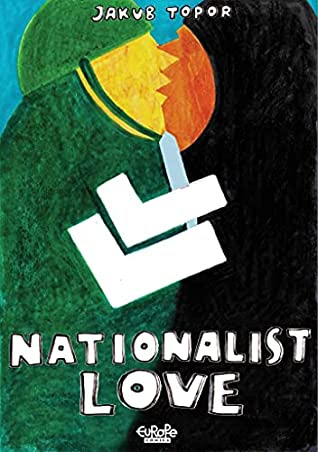
NATIONALIST LOVE, a Polish graphic novel about QUILTBAG people...just not the ones you're thinking of


NATIONALIST LOVE
JAKUB TOPOR

Europe Comics (non-affiliate Amazon link)
$11.99 ebook editions, available now

Rating: 5* of five

The Publisher Says: When Zapsky and Byro meet during a right-wing nationalist march, their joint escape from the police results in an unexpected and violent outburst of passion. Their initial euphoria quickly turns into doubt and fear—after all, if their buddies found out about them, the consequences would be terrible... But now that they’ve come together, will they be able to simply forget and move on with their lives? Or is it something more lasting, despite the risk it represents for both?

"Nationalist Love" is the third graphic novel by Jakub Topor, nominated for the graphic novel of the year award at the Lodz Comics Festival.

I RECEIVED A DRC FROM THE PUBLISHER VIA NETGALLEY. THANK YOU.

My Review
: Two skinhead boys, Zapsky and Byro, meet at a hate-rally held in their Polish city. The Nationalists, our Proud Boys writ Euro, throw stuff and set fires and hurt cops. These are some revolting people. They're each stupider than the other, they got no class or brains, yet still they find each other...attractive? available? attainable maybe. Their stupid antics require them to hide from the cops...naturally they decide to do it together, since Zapsky's mother is away for a month. Hijinks ensue.

This isn't the first time I've seen these boys, just never so thoroughly reduced to their ugliest shapes and colors. As a not-especially-convinced experiencer of sequential art, this was always something I found irritating...this kind of "artwork" would get the horselaugh from so many artsy types I've known. I'd absorbed that prejudice and simply never bothered to challenge or examine it until the past few years. Now, I look at this art's clumsiness and its garishness and think...well, how better to narrate this story?

Whaddaya expect, anyway, in a world centered on two losers without a shred of class or decency between them? They are always gonna have to hide abnormal, sick sexual proclivities from the world their undereducated, credulous, angry, and powerless class lives in. Funnily enough, like so many who live in that hate-defined and -bounded world, it's also the one they resent. But Zapsky and Byro got lucky, found each other....found love...which is the most dangerous thing of all. Zapsky definitely feels this, after a brief and deeply unsettling period of being truly happy with Byro, and under pressure to prove he's not a fag to his co-workers, he sends a break-up text that callously dismisses Byro.

Zapsky's Mammele, escaping her loser son's ubiquity and her own pointless existence, is at a beach resort-cum-health spa. And guess what? She meets A Man too! (Called Manfred. No lie.) The sheer awfulness of the art, as in the ugliness of the people and the garishness of the colors, goes so well with this horrible tale of numerous disgusting creeps that it's almost eerie. And that's when I felt myself really giving up, shedding the weight of, that habit of contempt. It isn't pretty! But who said art needs to be pretty? I like Jackson Pollock and Agnes Martin, for gods' sweet sake. I'm not one of those Impressionism-über-Alles sofa-matching-art people!

Or maybe I am...and hide it from myself by liking things that made my mother cringe? That certainly includes comic books...I've been so snobby about them for so long that it feels fake to say, "there is no other way this story could've been told, and it very much needed to be told," but it's just the truth.

Chapter 3 is called "Spoiled Rich Kids"...seems to be a pattern among Polish émigré writers. Like Jedrowski in Swimming in the Dark, Topor gets a character (Byro Bad-skin here) among the wealthy who are privileged to consume and exist as they like. Then he lets him sink or swim...sink in this case. Byro's rebounding from his breakup text, and searches the Internet for gay clubs...he decides he's going to fix himself up, be less Nationalist looking, by dressing better and hiding his skinhead under his loser father's long-unused toupée. The club scene scares him, he doesn't know the culture and is about to get himself into serious trouble but is rescued by one of the rich kids. They decide to keep him when leaving the club becomes a good idea...he almost loses his cool when a "darkie" (an Arab guy called Jamal) is in the house party, too. He's eventually, and inevitably, outed as a Nationalist; but not until after kissing a straight guy at the party. The violence the posers inflict on Byro is pretty mild...more about humiliating him for not being like them. And that, despite the fact he doesn't *want* to be like them, is the worst rejection he suffers. (Not that he is recovered from being rejected by Zapsky, please understand. Just trying to figure out how to move on.)

Mammele gets lucky with Manfred. That scene's just grisly. Even Byro's parents decide to fool around (more grisly still). Byro's Dadzio figures out the kid's got his wig. That should be fun! I thought, watching him explain what the hell he was doing with the damn thing....

Chapter 4 is "Zapsky Looks for a Girlfriend"...the co-workers' plan to get Zapsky laid results in him finding one. Because he's never been in any relationship at all except the brief honeymoon with Byro, he ignores the red flags of an abusive, angry, selfish woman looking for something in exchange for the sex she doles out to him. In his months-long journey through this hell, Zapsky confronts low self-esteem, and his work pals do a lot to support him and care for him. They are crude but actually touchingly kind. Since we focus on Zapsky, we never learn anything more about what happened after Byro's night out...disappointingly...or about Mammele's reactions to the girl Zapsky gets with.

But long story short: Girl gets dumped. Zapsky gets lonely. One rainy day who does he see under a bus shelter but...BYRO!! It's a loving reunion, the bond of real love between them reasserts itself, and they, well, do what young guys do when under the heady influence of reciprocal attraction and genuine connection. They fool around.

...and there's a PoS from their earlier Nationalist lives filming their reunion.

Naturally, the evidence gets shown to the wrong people. All the old gang, I mean this literally, are on the hunt for Zapsky. They find him.

Things end as they so often do.

It's awful to know that this happens and happens and happens to men and women, cis and trans, all around the world because "don't be so sensitive" and "it's just a joke" aren't seen for what they are.

They are normalizations of hate, and soft volleys preparing the way for violence.

I downloaded this graphic novel from Europe Comics, an outfit with whom I am unfamiliar...how shocking...so, if you're in the same boat, here's their mission statement from NetGalley:
Europe Comics is a joint digital initiative run by 13 European comics industry players from 8 European countries. Its main purpose is the creation of a pan-European catalog of award-winning graphic novels from across the continent, published digitally in English and available through major retailers and library networks. Europe Comics also works towards the promotion of European authors and the creation of a European comics online directory, meant for both comics readers and professionals.

Well...so this Polish creator found his way to this American oldster via a social system intermediated by several levels of technology that are under a lot of pressure all the time to justify its worst users' behaviors. This is an example of positive social and personal results from being massively online. Say hallelujah and bring the jubilee.

Thursday, January 14, 2021

THREE QUILTBAG HISTORIES: Shuggie Bain, When Brooklyn Was Queer, A Very English Scandal


WHEN BROOKLYN WAS QUEER
HUGH RYAN

St. Martin's Press
$11.99 ebook editions, available now

Rating: 5* of five

The Publisher Says: The groundbreaking, never-before-told story of Brooklyn’s vibrant and forgotten queer history, from the mid-1850s up to the present day.

When Brooklyn Was Queer is a groundbreaking exploration of the LGBT history of Brooklyn, from the early days of Walt Whitman in the 1850s up through the women who worked at the Brooklyn Navy Yard during World War II, and beyond. No other book, movie, or exhibition has ever told this sweeping story. Not only has Brooklyn always lived in the shadow of queer Manhattan neighborhoods like Greenwich Village and Harlem, but there has also been a systematic erasure of its queer history—a great forgetting.

Ryan is here to unearth that history for the first time, and show how the formation of Brooklyn is inextricably linked to the stories of the incredible people who created the Brooklyn we know today. Folks like Ella Wesner and Florence Hines, the most famous drag kings of the late-1800s; E. Trondle, a transgender man whose arrest in Brooklyn captured headlines for weeks in 1913; Hamilton Easter Field, whose art commune in Brooklyn Heights nurtured Hart Crane and John Dos Passos; Mabel Hampton, a black lesbian who worked as a dancer at Coney Island in the 1920s; Gustave Beekman, the Brooklyn brothel owner at the center of a WWII gay Nazi spy scandal; and Josiah Marvel, a curator at the Brooklyn Museum who helped create a first-of-its-kind treatment program for gay men arrested for public sex in the 1950s. Through their stories, WBWQ brings Brooklyn’s queer past to life.

I RECEIVED AN ARC OF THIS BOOK FROM ST. MARTIN'S PRESS. THANK YOU.

My Review
: One of my very favorite possessions is this hardcover copy I received from my friend Katie after the Déluge of 2019 ruined my ARC. The author tells us from the start that:
I use the catchall queer...to refer to people whose sexuality or gender identity isn’t conventional for their time, which helps me avoid projecting specific modern identities (such as gay or transgender) on folks for whom those ideas wouldn’t necessarily have made a lot of sense.


That is all the explanation you need for how, and why, he wrote this history of being "other" in the US's biggest city. It's deeply researched, very well-written, and fascinating to read. Who knew Gypsy Rose Lee and Carson McCullers were close? Who had any idea that Coney Island was known as a queer neighborhood before it was known as a boardwalk and sideshow mecca?

It's enjoyable to learn about New York's most-populous borough with author Hugh Ryan.

+++++++++++++++++++++++++++++++++++++++++++++++++++++++++++++++++


SHUGGIE BAIN
DOUGLAS STUART

Grove Press
$17.00 trade paper or ebook editions, available now

Rating: 5* of five

The Publisher Says: Shuggie Bain is the unforgettable story of young Hugh "Shuggie" Bain, a sweet and lonely boy who spends his 1980s childhood in run-down public housing in Glasgow, Scotland. Thatcher's policies have put husbands and sons out of work, and the city's notorious drugs epidemic is waiting in the wings. Shuggie's mother Agnes walks a wayward path: she is Shuggie's guiding light but a burden for him and his siblings.

She dreams of a house with its own front door while she flicks through the pages of the Freemans catalogue, ordering a little happiness on credit, anything to brighten up her grey life. Married to a philandering taxi-driver husband, Agnes keeps her pride by looking good—her beehive, make-up, and pearly-white false teeth offer a glamourous image of a Glaswegian Elizabeth Taylor. But under the surface, Agnes finds increasing solace in drink, and she drains away the lion's share of each week's benefits—all the family has to live on—on cans of extra-strong lager hidden in handbags and poured into tea mugs. Agnes's older children find their own ways to get a safe distance from their mother, abandoning Shuggie to care for her as she swings between alcoholic binges and sobriety. Shuggie is meanwhile struggling to somehow become the normal boy he desperately longs to be, but everyone has realized that he is "no right," a boy with a secret that all but him can see. Agnes is supportive of her son, but her addiction has the power to eclipse everyone close to her—even her beloved Shuggie.

A heartbreaking story of addiction, sexuality, and love, Shuggie Bain is an epic portrayal of a working-class family that is rarely seen in fiction. Recalling the work of Edouard Louis, Alan Hollinghurst, Frank McCourt, and Hanya Yanagihara, it is a blistering debut by a brilliant novelist who has a powerful and important story to tell.

I CHECKED THIS BOOK OUT FROM MY LOCAL LIBRARY VIA OVERDRIVE. USE THE LIBRARY, FOLKS! THEY NEED THE PATRONAGE.

My Review
: If you don't know already, the 2020 Booker Prize was presented to Author Stuart for this fictionalized account of growing up gay in a deeply dysfunctional, working class family. His story is not unique, though his voice is; he is a survivor of times and tides most of us who read novels are apart from, unacquainted with. A taste for grit lit, an ear for the music of Scottish voices, and a love for searingly honest, uncompromising, and unflinching life-fictions will be sated and elated by this read.

A few of the more beautiful lines from Shuggie's point of view as a teen:
He found his long, thick moustache and sat absent-mindedly stroking it, like a favourite pet. Under it his spare chin wobbled.
–and–
The morning light was the colour of too-milky tea. It snuck into the bedsit like a sly ghost, crossing the carpet and inching slowly up his bare legs.The morning light was the colour of too-milky tea. It snuck into the bedsit like a sly ghost, crossing the carpet and inching slowly up his bare legs.

+++++++++++++++++++++++++++++++++++++++++++++++++++++++++++++++++


A VERY ENGLISH SCANDAL: Sex, Lies and a Murder Plot at the Heart of the Establishment
JOHN PRESTON

Penguin Books
$16.95 trade paper, available now

Rating: 4* of five

The Publisher Says: The shocking true story of the first British politician to stand trial for murder

Behind oak-panelled doors in the House of Commons, men with cut-glass accents and gold signet rings are conspiring to murder. It's the late 1960s and homosexuality has only just been legalised, and Jeremy Thorpe, the leader of the Liberal party, has a secret he's desperate to hide. As long as Norman Scott, his beautiful, unstable lover is around, Thorpe's brilliant career is at risk. With the help of his fellow politicians, Thorpe schemes, deceives, embezzles—until he can see only one way to silence Scott for good.

The trial of Jeremy Thorpe changed our society forever: it was the moment the British public discovered the truth about its political class. Illuminating the darkest secrets of the Establishment, the Thorpe affair revealed such breath-taking deceit and corruption in an entire section of British society that, at the time, hardly anyone dared believe it could be true.

A Very English Scandal is an eye-opening tale of how the powerful protect their own, and an extraordinary insight into the forces that shaped modern Britain.

I CHECKED THE EBOOK EDITION OUT FROM MY LOCAL LIBRARY. USE THE LIBRARY, FOLKS, THEY NEED US!

My Review
: The Emmy-winning TV series available on Amazon is an ideal adaptation of the story told in this book.

The morality play that was Jeremy Thorpe's life is hard to misunderstand: Bisexual in a time when any taint of same-sex love was fatal to a career in any walk of public life, Thorpe resorted to attempted murder of his younger, unstable ex-lover when he reached power in Parliament. Like any good scandal, this one only *starts* with the title event; as proceedings widen their cast of involved characters, many renowned British figures of the era get involved and implicated...men whose own sexual misdeeds far, far exceeded Thorpe's consensual buggery. Ironically, Thorpe's attempt to forestall scandal is what brought him down (shades of Nixon and Trump!), as he was acquitted of the charge of attempted murder but was never again any force in British politics.

A thumping good read, a slice of history that we cannot seem to keep from replaying, and a story to make one grateful the world has changed as much as it has.

Thursday, January 7, 2021

THE STONE WÄ’TÄ€ and COME WATER, BE ONE OF US, never mistake short for weak

THE STONE WĒTĀ
OCTAVIA CADE
Paper Road Press NON-Affiliate link to Amazon; the author published the book from New Zealand
$3.99 Kindle edition, available now

WINNER OF THE 2021 SIR JULIUS VOGEL AWARD FOR BEST NOVEL!

Rating: 5* of five

The Publisher Says: “We talk about the tyranny of distance a lot in this country. That distance will not save us.”

With governments denying climate science, scientists from affected countries and organizations are forced to traffic data to ensure the preservation of research that could in turn preserve the world. From Antarctica, to the Chihuahuan Desert, to the International Space Station, a fragile network forms. A web of knowledge. Secret. But not secret enough.

When the cold war of data preservation turns bloody – and then explosive – an underground network of scientists, all working in isolation, must decide how much they are willing to risk for the truth. For themselves, their colleagues, and their future.

Murder on Antarctic ice. A university lecturer’s car, found abandoned on a desert road. And the first crewed mission to colonize Mars, isolated and vulnerable in the depths of space.

How far would you go to save the world?

My Review: When the Revolution comes, it will be women leading it. Secular Saint Stacey Abrams will likely be honking the biggest horn and causing the biggest ruckus. But that's not because it's her M.O. It's because her cover's blown. There is no point in trying to sneak when every-damn-body knows your shoe size and when you cheat on your diet.

So here is a story I read last month about the Revolution led by women and made up of scientists who'll be damned to hell if they're going to make nice for no gain when the planet is dying:
Resistance was revolution, sometimes, blood and dramatic acts, but more often it was survival. More often it was preservation, and the data she carried with her was for preservation more than revolution.

This near-future Earth has gone well past tipping point. The vileness that is Capitalism is still spinning its lies and soothing its consumers to keep them buying while...to be honest I haven't the foggiest clue what they're thinking they can do that we can't, how they will survive the *actual* End of Days, but there it is. The lie-maker machinery behind the popular songs is still humming "Big Yellow Taxi" and cheerfully killing people who know it's all a lie and can't be arsed to do anything about it.
It was hard to be an astronaut and not be an environmentalist.
–and–
She’d seen the photos—Earthrise and The Blue Marble—known the watershed impact they’d had on the conservation movement.

The women in this resistance movement are identified in a clever, amusing way; I won't say, you should find out for yourself. Actually the biggest advantage to this technique is the flexibility it gives Author Cade in prefiguring the events of the chapters and sections. What she does with it is that sly, side-eye fun-making that you and at least one of your friends have, that one whose eye you cannot afford to meet when you're together but not in a safe place to fall out laughing at embarrassing moments. The story is one that today, the sixth of January, 2021, was so perfect in subject, in tenor, and resonance, that I had to re-read it. These women, these scientists, are all in flux and transition (!) and trying to protect the only home we have from the misguided and stupid who are deliberately trying to destroy it.

The challenges of doing that by concealing accurate data, the enemy of fascists and authoritarians everywhere. Do y'all remember my review of The Badass Librarians of Timbuktu? That culture of concealment for survival is mentioned here, alongside its increasingly popular young grandniece:
All those manuscripts, and Timbuktu a place of historic learning, of literacy and knowledge passing on. What it passed on now could be the lessons and skills of resistance, the ways of smuggling out and networking.
–and–
There was a tendency with so much digital to make all copies electronic, and rely on the internet for keeping multiple copies visible and tamper-proof. But any system could be hacked, any data deleted. The information she intended to facilitate had to be kept discretely, separate from any possible influence.

There is no hope for rebuilding from looming catastrophes—and there is a dilly of a disaster we see even before the collapse we're too soon to witness completing itself—without accurate, complete data hidden somewhere, cared for by someone with the skills to use it when it's finally safe to do so. Think of the world we might have had the religious nuts not burned the Library at Alexandria! So there's a precendent for Author Cade telling us this story, and a reason for you to spend the money to read it at this moment in US and UK history. Today's multiple klans of barbarians are doing their damnedest to finish burning the norms and conventions that have protected and enriched the greatest number of people. Author Cade tells us, and the evidence right now points to her prescience, that they won't stop even at murder to finish the destruction of whatever institutions, whatever systems and learning and techniques, prevent them from staying in complete control.

We've fought wars ostensibly to prevent that from happening, against an enemy whose words and iconography we saw used in the Capitol of the United States of America. One woman, identity as yet not revealed, has died from a gunshot wound received during the violence. It is eerie, then, to realize this is not so shockingly unthinkable. Author Cade thought it. She framed it, though, differently from the US news media, as what it is:
One person was such a small-scale loss, comparatively. (One person was enormous.)

+++++++++++++++++++++++++++++++++++++++++++++++++++++++++++++++++

COME WATER, BE ONE OF US
OCTAVIA CADE

Strange Horizons magazine
Free to read online

Rating: 5* of five

We made the corporations people, but then we did the same to the rivers.

A fever dream of anti-capitalist and pro-planet activism. A simply told, easily understood explication of why it was such a *colossally* stupid thing to create the legal fiction of "corporate personhood."

People are greedy, selfish fucks, so why would one expect an atl-law-only person to be any different? But...here's the thing...bad ideas come with good uses. This one comes with the personification of Water in their riverine expression. If rivers are people, they have rights and they have legal standing; it then becomes possible, nay necessary, to act in their behalf. To give them the care and assistance necessary for them to thrive and prosper, just like all persons whether biological or legal.

Take THAT, capitalism.

Sunday, January 3, 2021

COVE, beginning my 2021 reviews on a Cynan-Jones-caused 5-star high


COVE
CYNAN JONES

Catapult
$19.95 hardcover, available now

I can not forget this read. I refer to it in my head, I think about its stark, vividly limned images. I am so deeply glad Author Cynan wrote it. This is my 2021 Six-Stars-of-Five read.

Rating: 5* 6 stars of five

The Publisher Says: Out at sea, in a sudden storm, a man is struck by lightning. When he wakes, injured and adrift on a kayak, his memory of who he is and how he came to be there is all but shattered. Now he must pit himself against the pain and rely on his instincts to get back to shore, and to the woman he dimly senses waiting for his return.

THIS WAS A YULE GIFT FROM MY YOUNG GENTLEMAN CALLER. THANK YOU, MY LOVE.

My Review
: Don't ever, ever think you're in a dark place again, is the primary message of this novella-cum-prose poem.
He is holding his hands in the water, rubbing the blood from them, when the hairs on his arms stand up. The sway briefly, like seaweed in the current. Then lie down again.

He looks up. A strange ruffle come across the surface.

The birds had lifted suddenly and gone away. As if there were some signal. They are flecks now, a hiatus disappearing against the light off the sea.

He is far enough out for the land to have paled in view.

Our nameless point-of-view man is busy preparing to take his kayak out of the cove near his home. With his experienced preparations, catching a fish for his supper and with the material goods he needs to make the short trip comfortable, there is a heaviness. The foreboding the above passage evokes in me is matched by the fact that he's there to scatter his father's ashes. But the world doesn't have time to mourn for anyone:
There was a piping of oystercatchers, a clap of water as a fish jumped. He saw it for a moment, a silver nail. A thing deliberately, for a brief astounding moment, broken from its element.

These passages make me think I live in Author Cynan's head. I see and hear them in realtime. I am deeply unsettled...what is coming must be difficult because these quotidian sensations are so powerful. The ashes, the small moments of daily reality going on despite the huge gaping hole of his father's death...going out of the shelter of this homely cove, noticing its real-world comforts...
...
...
...I've read your books before, Author Cynan, something terrible this way comes.

A moment truly as before-and-after as it is portrayed to be: A lightning strike.

While alone at sea. In a kayak. With a few hours' trip supplies.

Waking up alive, though after how long he doesn't know and with the arm that conducted the current dead (the fern-like pattern of Lichtenberg figures disfiguring his now-useless hand and arm), he inventories his few supplies and begins preparations to survive. It is grueling to read and almost reeks of experience, which I hope is second-hand:
He takes off the buoyancy aid & pulls on the thick sweater, useless arm first. The smell of the sweater triggers something, but it is like a piano key hitting strings that are gone.

That image is both terrifying to me, and gorgeous to read. What a superbly wrought way to describe the sensation of losing a piece of yourself, your experience. Where one expects resonant musical pleasure, there is the presence of silence and not just the absence of sound.

There is a miserable fight, with the good luck of an itchy sunfish rubbing against his kayak and beneficently steering it towards land; there is a moment of aesthetic joy as night luminescent seas trace the presence of his hand; there is so much work and so much pain:
If you disappear you will grow into a myth for them. You will exist only as an absence. If you get back, you will exist as a legend.

That's effective self-talk for a man who's been through some huge change. "They" are the woman pregnant with his child, and the unborn person itself. For, as the sea's many thefts (water, skin) bite ever deeper, he needs this goal to focus on, and needs also his dead father's ghost in his own head reminding him how to do this, how to survive.

An image of fatherhood that I am so unspeakably glad to see in fiction, littered as it is with cheating lying beating abusing men.

The ordeal continues. The night and the day and then there is land...land within sight...with lights...and he MacGyvers up a sail to speed his bonny boat...
...
...into a squall.
All of his life he's had a recurring dream: the car leaves the road. It is never the impact that terrifies him, wakes him. His fear comes the moment he feels the car go.

His life does not pass before his eyes. There is even a point he feels calm. But then he sees the faces of the people he loves. He sees their faces as they see him go.

Here is a man driven to Be There, never to leave, always support and defend, finally driven to his uttermost extreme in search of survival.

And that is where we end.

I close my remarks by noting that this is the book I wish The Old Man and the Sea had been, but was not.

Tuesday, December 29, 2020

THE DARK ARCHIVE, seventh Invisible Library story that I want to see on Netflix soonest thank you and please


THE DARK ARCHIVE
GENEVIEVE COGMAN
(The Invisible Library #7)
Ace Books
$16.00 trade paper, available today!

KINDLE EDITION ONLY $1.99!

Rating: 5* of five

The Publisher Says: A professional spy for a mysterious Library which harvests fiction from different realities, Irene faces a series of assassination attempts that threaten to destroy her and everything she has worked for.

Irene is teaching her new assistant the fundamentals of a Librarian's job, and finding that training a young Fae is more difficult than she expected. But when they both narrowly avoid getting killed in an assassination attempt, she decides that learning by doing is the only option they have left - especially when the assassins keep coming for them, and for Irene's other friends as well...

In order to protect themselves, Irene and her friends must do what they do best: search for information to defeat the overwhelming threat they face and identify their unseen enemy. To do that, Irene will have to delve deeper into her own history than she ever has before, face an ancient foe, and uncover secrets that will change her life and the course of the Library forever.

I RECEIVED A DRC FROM ACE BOOKS VIA NETGALLEY, AT THE BEHEST OF MY GOODREADS FRIEND STEVEN. THANK YOU!

The Invisible Library reviewThe Masked City reviewThe Burning Page reviewThe Lost Plot reviewThe Mortal Word reviewThe Secret Chapter review

My Review
: I mean! Let me sit and catch my breath for a bit. Gracious me, this one was exciting times eleven.

So are they all, yes, but there are stakes then there are stakes and the superlative of stakes is what we experience in The Dark Archive.

Comme d'habitude, Kai and Vale and Irene are in pursuit of a Book on Vale's home, and Irene and Kai's adopted favorite base-world, B-395. New character Catherine (where's Heathcliff, Author Cogman?) is a Fae (and the niece of powerful adversary Fae Lord Silver) who is to be trained as a Librarian. Hence her presence here.

But, I hear fellow fans complain, Fae can't go into the Library! They're Chaos on legs, they would be extinguished or combust or something! And you're correct, they can't. Catherine's tried with no success and a good deal of pain. Now she's on a Librarian spycrafty expedition, nursing a distinctly adolescent sense of being Hard Done By and making poor Kai pay for her inner crappy mood. Irene and Vale? Elsewhere. Being, in fact, booby-trapped into a submarine explosion and a major, major discovery. A Certain Someone is not as dead as Irene left him, and his Lady Wife seems to be ready to take on the Library to get revenge for Irene's dastardly nerve in killing him in the first place.

These are but the opening notes of the symphony. And I can assure you that the pace doesn't slacken, the chases are truly cinematic (one B-395 London library is *begging* to be filmed with its multi-story Guggenheim-esque open atrium architecture, only 18th century and marble not 1959 concrete), the characters constantly going to extremes in service of their families, their peoples (Fae, Dragons, Librarians...the odd human tempest-tost in the deep end of a cosmic pool they never suspected existed), and the Treaty that our intrepid gang damn near died to bring into effect. After all, a multiverse of opposing sides defined by antithetical modes of being needs rules or there's going to be lots of casualties.

I don't for a moment expect anyone who hasn't read the first six books to know what much of that really means. I hope you'll take this, the release day of The Dark Archive, to look over my reviews of The Invisible Library, The Masked City (alt-Venice!), The Burning Page, The Lost Plot, The Mortal Word, and The Secret Chapter to see if anything in those reviews grabs you. You know my taste by now...I don't tolerate boredom well, I don't want to read about eye-rolley majgickq that makes not one whit of sense, or kiddie-kinses as they Find Their Snowflake Selves...so you already know there's none of that here. There's also no sex, and apparently no one in the multiverse is queer (though I suspect that Vale is ace), but nothing made by humankind can be perfect.

What I look for that Author Cogman delivers book after book is a group of people whose honor is stronger than their fear, whose shared values hold them up when they're so battered by enemies they just want to lie down and rest, and whose relationships adjust to Earth-shattering new information.

That last one? That's the Big Reveal. You'll think, "oh THIS is what he was on about!" And it will most definitely NOT be. And you won't know it until a book falls on your metaphorical head and rings your bells.

It's worth it.

Saturday, December 26, 2020

GIFT CARDS! GIFT CARDS!! Now what shall I get myself....


The wrapping paper's all smoothed out and saved (right? RIGHT?! because it's hugely wasteful to just pile it into the landfill, and no one who reads my stuff is that selfish, RIGHT?!), the pile of returns is in something portable against the day the plague is beaten back, and now there are those lovely, lovely, lovely gift cards to spend!


Now, what to spend them on. Eternally recurring question, isn't it. I mean, mystery series: start or continue? Fantasy novels: Nonillionology or stand alone (rare things, those)? Science fiction: TV adaptation already out or being developed? Short stories: familiar author or start sampling some new work? Pize winners: this year, start from the inception of the prize, or just pick a date and read the winners from that year...you get my point, which book(s) to buy is a vexed and vexing question. (If you're the sort of person who buys clothes or tchotchkes, what are you doing here?)


There are over eight hundred review posts on this blog. Reading some of them, as I assume you have, you're bound to form an opinion of my taste and how it marches with yours. If this is your first visit, welcome! Click around. Nothing bad will happen to your browsing history. But the sheer number of options can feel overwhelming to some. (The more the merrier says I, but I bore easily so novelty and variety are my crack.) Use the search function! It's that little box at the top left of the Home page. Enter a term like "science fiction" or "mystery" or "economic royalists" and lots of options will magically present themselves in scrollable form! Don't care as much about genres, freeze when asked to think of spmething specific? The bottom of this post has all the star listings I've used...well, up to 200 characters it does...and there are the genre tabs to peruse, too.


I am always, um, taxed with the fact that some links go to a book's listing on Amazon. These are not affiliate links, which you can readily ascertain because they're all "Smile" links and those can not be affiliate links. Usually I've explained why it's to Amazon, but in general it's for books out of print or whose publisher sites make my nose hairs combust with frustration when trying to navigate. (Publishers: It's the 21st century. UPDATE YOUR STORES TO MODERN BEST PRACTICES.)

One final note: Only members of the blog, those who have Google accounts and click on the "Follow" button, can comment on here. People whose presence I find unpleasant have in the past exercised their free speech to say unkind, unpleasant, or unwelcome things. Don't do that. But please, if you find a broken link or a weird problem, please comment on that post! I can't keep track of everything that changes in the past eight years. I need and welcome the help. It's a kindness and a mitzvah.

Shop hearty!