Showing posts with label 1940s setting. Show all posts

Sunday, August 2, 2026

JEAN GIONO'S PAGE: Fragments of a Paradise & Occupation Journal & Ennemonde


OCCUPATION JOURNAL
JEAN GIONO
(tr. Jody Gladding)
Archipelago Books (non-affiliate Bookshop.org link)
$7.99 ebook, available now

Rating: 4.5* of five

The Publisher Says: A captivating literary and historical record, Jean Giono's Occupation Journal offers a glimpse into life in collaborationist France during the Second World War, as seen through the eyes and thoughts of one of France's greatest and most independent writers.

Written during the years of France's occupation by the Nazis, Jean Giono's Occupation Journal reveals the inner workings of one of France's great literary minds during one of the country's darkest hours. A renowned writer and committed pacifist throughout the 1930s—a conviction that resulted in his imprisonment before and after the Occupation—Giono spent the war in the village of Contadour in Provence, where he wrote, corresponded with other writers, and cared for his consumptive daughter. This journal records his musings on art and literature, his observations of life, his interactions with the machinery of the collaborationist Vichy regime, as well as his forceful political convictions. Giono recounts the details of his life with fierce independence of thought and novelistic attention to character and dialogue.

Occupation Journal is a fascinating historical document as well as a unique window into one of French literature's most voracious and critical minds.

I RECEIVED A DRC FROM THE PUBLISHER VIA EDELWEISS+. THANK YOU.

My Review
: Knowing that these quotidian topics of no great interest are Author Giono's middle-of-WWII maunderings while his pacifist life was under the Vichy apparatus of Nazi occupation's close scrutiny makes them fascinating. It's a universal truth that life goes on, kids need clothes and meals and trips to the doctor. Author Giono navigates his way around every obstacle with his money and his persistence and his connections. Being in the toils of legal proceedings for his well-documented lifelong pacifism meant he was never a serious threat who needed close custody. Left to read and write, though subject to censorship, Author Giono writes unselfconsciously in these journal pages (always intended to remain private) of his process as a writer, his frank assessment of other writers' work, and the people of the village of Contadour.

It reminded me that the evergreen thought experiment "whatever you're doing now is what you'd be doing under Nazi occupation" makes one stop short and think hard for a reason. Author Giono took his privilege as a reason to spread the good fortune around: he never has any cash, and owes the government a pile of money, all because he's supporting his whole family...nine people in total...as well as bankrolling the escapes of those who are at lethal risk from that government he owes so much money to.

Using "their" money to keep "them" from committing murder against people whose morals he shared. Full marks, sir. And he did not stop there. He completed six novels (translated another...oh, there were plays too!) during the German occupation. Author Giono was a truly inspiring example of how to live a morally good life in bad times and under dark circumstances.

++++++++++++++++++++++++++++++++++++++++++++++++++++++++++++++++


FRAGMENTS OF A PARADISE
JEAN GIONO
(tr. Paul Eprile)
Archipelago Books (non-affiliate Bookshop.org link)
$13.99 ebook, available now

Rating: 3.5* of five

The Publisher Says: “Giono’s prose is a singularly fine blend of realism and poetic sensibility.” — The Washington Post Giono’s very own Moby-Dick, a sensational maritime journey that follows a crew inwards on a spiritual tale of evocative sea-glimpses

An allegorical critique of modern civilization and the damages of war, Giono’s oft-overlooked seafaring tale sweeps the reader along a narrative as poetic and undulating as the wind, tacking between the sea’s mysteries and the intricacies of the men’s conversations and inner thoughts as they attempt to grasp the sensory reality around them.

“I no longer have any interest in living under the conditions that this era allows,” writes the Captain of L’Indien, a ship whose radio remains packed in a crate in the hold. The men aboard won’t be needing it; they have no interest in connecting with the world of ordinary men. With enough provisions to last them five years, they set sail in July of 1940 for the South Seas, leaving civilization behind in search of the unknown.

Hastening onwards, Giono’s men steer deeper into themselves, seeking a purpose beyond the “world in upheaval” they left behind—a moving and spiritual work written by one of Europe’s most ardent 20th-century pacifists.

A sensational novel that delves into the unknown reaches of the sea and soul, perfect for readers seeking a poetic escape that challenges the political and social status-quo.

I RECEIVED A DRC FROM THE PUBLISHER VIA EDELWEISS+. THANK YOU.

My Review
: Really, do I even need to say it?

This read was a beacon of psychic coolness in a summer beset by wildfires, smoke particles, and the looming, ugly threat of super-El Niño to come with its heat and its drought. It's beautiful, as one would expect from a writer of Author Giono's stature, sentences making images that endure on the eye the nose the ear of the mind as the men on this sailing ship leave their families and friends behind to fight their war, rebuild their world, however they like.

No one who leaves the world does so without leaving others behind.

It's beautiful until the thought, "you have provisions for FIVE YEARS and you left a literal WAR ZONE to escape into a cosmic search for love, truth, and beauty?!" hits.

Stay there and use that magical power to feed hungry wounded orphaned victims.

Yes yes yes, it's a fable, an unreality meant to instruct and to offer guidance on one's search for Meaning, all very well. Author Giono was a pacifist who was punished for opposing the Vichy regime...see above for his journals in review...but this kind of navel-gazing is for the time leading up to war, in an attempt to forestall the slide; this tale appeared in 1948, as the rebuilding of the continent was gathering steam. That was the moment to support peaceful action not hightailing it off to sea to have cool adventures.

Anyway. Beautiful sentences, we're not rebuilding stuff (though we should be), so read and enjoy.

+++++++++++++++++++++++++++++++++++++++++++++++++++++++++++++++


ENNEMONDE
JEAN GIONO
(tr. Bill Johnston)
Archipelago Books (non-affiliate Bookshop.org link)
$12.99 ebook, available now

Rating: 4* of five

The Publisher Says: One of the final novellas by the acclaimed French writer Jean Giono, Ennemonde is a fierce and jubilant portrait of a life intensely lived

Ennemonde Girard: Obese. Toothless. Razor-sharp. Loving mother and murderous wife: a character like none other in literature. In telling us Ennemonde’s astounding story of undetected crimes, Jean Giono immerses us in the perverse and often lurid lifeways of the people of the High Country, where vengeance is an art form, hearts are superfluous, and only boldness and cunning such as Ennemonde’s can win the day. A gleeful, broad sardonic grin of a novel.

"Roads move cautiously around the High Country..." So begins the story of Ennemonde, but also of her sons, daughters, neighbors, lovers, and enemies, and especially of the mountains that stand guard behind their home in the Camargue. This is a place of stark and terrifying beauty, where violence strikes suddenly, whether from the hand of a neighbor or from the sky itself.

Giono captures every wrinkle, glare, and glance with wry delight, celebrating the uniquely tough people whose eyes sparkle with the cruel majesty of the landscape. Full of delectable detours and startling insights, Ennemonde will take you by the hand for an unforgettable tour of this master novelist's singular world.

I RECEIVED A DRC FROM THE PUBLISHER VIA EDELWEISS+. THANK YOU.

My Review
: Not remotely comfortable reading, Giono using this female body's looks and size as commentary on her character and morality. Perfectly ordinary in its time; sixtyish years ago people said terribly cruel things about those larger than, or in any way divergent from, "average."
The young women, while they're still maidens, possess a fruit-like beauty; then the beauty bursts, and fragments of it can be seen in their children. Truly nothing remains of these women's former state. Some Venuses turn into fearsome monsters; almost all of them have seventeenth-century mouths, toothless or, even worse, with a handful of loose teeth on which they suck. It's pretty ghastly. But their simple-minded appearance shouldn't be taken at face value. Almost all of them are commanding women. With their back to the wall they achieve wonders. People still remember Ennemonde Girard.
It does not hit the same register in 2026 as it did in 1968, when it first appeared. It feels false, hostile, spoken for effect in the #MeToo world.

There's probably a good reason for that: the French are not so terribly far from the US despite their fantasies:
The tool that people around here have most often in their hand is a shotgun, whether it’s for hunting or for, let’s say, philosophical reflection; in either case, there’s no solution without a shot being fired...
–and–
The Protestants of these parts had since time immemorial protested against Protestantism. They’d ended up worshipping anything at all, so long as the anything at all demanded intolerance. Crown of thorns were consumed in every household, at every meal. Religion was a sort of commerce in which discomfort was always preferred to joy, scorn to pleasure, and ultimately vice to virtue.

"These parts" are Author Giono's native Provençal mountains, where he lived his life.

It's not so weird after all, fellow intolerant lefties; humans been MAGAts a long damn time.

I can't claim to love this story, I can't tell if it's because I'm a judgmental old man or I'm just a product of the times that brought this novella (150pp barely) into being, holding its subjects up for a cold-eyed considering examination. Author Giono does not vouchsafe a verdict; I do.

Me no likee.

Wednesday, February 18, 2026

SADEQA JOHNSON'S PAGE: KEEPER OF LOST CHILDREN; THE HOUSE OF EVE


KEEPER OF LOST CHILDREN
SADEQA JOHNSON

37 Ink/Simon & Schuster (non-affiliate Bookshop.org link)
$14.99 ebook, available now

Rating: 4.25* of five

The Publisher Says: In this new novel from the New York Times bestselling author of The House of Eve, one American woman’s vision in post WWII Germany will tie together three people in an unexpected way.

Lost in the streets and smoldering rubble of Occupied Germany, Ethel Gathers, the proud wife of an American soldier spots a gaggle of mixed-race children following a nun. Desperate to conceive her own family, she feels compelled to follow them to learn their story.

Ozzie Philips volunteers for the army in 1948, eager to break barriers for Black soldiers. Despite his best efforts, he finds the racism he encountered at home in Philadelphia has followed him overseas. He finds solace in the arms of Jelka, a German woman struggling with the lack of resources and even joy in her destroyed country.

In 1965, Sophia Clark discovers she’s been given an opportunity to integrate a prestigious boarding school in Maryland and leave behind her spiteful parents and the grueling demands. In a chance meeting with a fellow classmate, she discovers a secret that upends her world.

Toggling between the lives of these three individuals, Keeper of Lost Children explores how one woman’s vision will change the course of countless lives, and demonstrates that love in its myriad of forms—familial, parental, and forbidden, even love of self—can be transcendent.

I RECEIVED A DRC FROM THE PUBLISHER VIA NETGALLEY. THANK YOU.

My Review
: On a kernel of fact, Author Sadeqa coaxes a mighty oak of a story about the power of determination and the motivation of compassion. Three characters are entwined in a narrative of prejudice endured, triumphally defeated by love, and made into the beautiful thing that is selfhood.

Ethel Gathers has the most nominitively determinative name ever. I understand why Author Sadeqa chose it in place of the rather blander name of the woman who started the Brown Baby Plan, Mabel Grammer. Of course I, a white child of privilege, did not ever hear of this marvelous plan or its tutelary spirit. Being both about Black folks and established by a woman, that information is not startling. I have never been so heartened by the factual roots of a story! It entwines Ozzie, a "colored" man in the post-WWII US Army who merits and desires a promotion into the Intelligence service only to be stymied because, what else, racism shuts doors nominally opened by executive order; Ethel, as her time in 1951 Germany as an Army wife introduces her to the issue central to the story; and Sophia, a biracial teen in 1965 when we meet her.

No points for sussing out the interconnections among them all.

It's not an advanced storytelling technique that draws on into this read, it's the human connection, the fellowship of people who know anger, feel frustration and loss and sadness, and revel in goodness and rightness triumphing. Our older PoV characters proceed into the future while Sophia is mostly looking into her own past as she works to escape her truly awful upbringing. All three threads come together at a powerfully symbolic and racially charged moment in the 1960s.

It's not coyness that leaves me with lamentably vague language there. As you read along you'll see the interconnections forming. I'm not going to reveal them because they're a very big part of the finale of the story, giving it a lot of its oomph. I hate when reviewers do that but...trust me, you want to take this ride innocent of these facts.

++++++++++++++++++++++++++++++++++++++++++++++++++++++++++++++++


THE HOUSE OF EVE
SADEQA JOHNSON

37 Ink/Simon & Schuster (non-affiliate Bookshop.org link)
$13.99 ebook, available now

Rating: 3.75* of five

The Publisher Says: 1950s Philadelphia: fifteen-year-old Ruby Pearsall is on track to becoming the first in her family to attend college. But a taboo love affair threatens to pull her back down into the poverty and desperation that has been passed on to her like a birthright.

Eleanor Quarles arrives in Washington, DC, with ambition and secrets. When she meets the handsome William Pride at Howard University, they fall madly in love. But William hails from one of DC’s elite wealthy Black families, and his parents don’t let just anyone into their fold. Eleanor hopes that a baby will make her finally feel at home in William’s family and grant her the life she’s been searching for. But having a baby—and fitting in—is easier said than done.

With their stories colliding in the most unexpected of ways, Ruby and Eleanor will both make decisions that shape the trajectory of their lives.

I RECEIVED A DRC FROM THE PUBLISHER VIA NETGALLEY. THANK YOU.

My Review
: Playing the mother card does not earn a story my esteem. The Cult of Mother is, oddly, not the focus of Author Sadeqa's stories...it's about how women, in relation to motherhood, are required to make hard decisions and come to terms with how fathers create mothers but mothers do not create fathers. Many factors haunt Author Sadeqa's mothers in this story of how becoming pregnant is not always, or in all ways, a happy moment for a woman. Leaving aside the permanence of motherhood, the social milieu a child is brought into is almost more important than the love, or lack of it, a mother feels for that child.

In exploring these complexities in a 1950s racist US Author Sadeqa brings struggles and battles to light that can not help but move the reader. It is a sentimental story, it will cause you to well up with tears (or you're a sociopath), it does its romantic-fiction job with verve and gusto. It is not a prose megalith to be held up in future literary seminars, and is not meant to be, but it is effective at its chosen task. It entertains, it informs about the deep emotional ties humans form...willingly or not...to those they might or might not admire.

It's a good read for a dull weekend that will give you a solid satisfying ending for its story.

Wednesday, May 29, 2024

OUT AT THE PLATE: The Dot Wilkinson Story, deep dive into a QUILTBAG legendary life


OUT AT THE PLATE: The Dot Wilkinson Story
LYNN AMES

Chicago Review Press
$28.99 hardcover, available now

Rating: 4.25* of five

The Publisher Says: “Dot Wilkinson is the greatest female catcher ever to play softball . A bold, pioneering athlete, she refused to let others define her and instead defined herself. Her story is an inspiration to people everywhere.” — Billie Jean King, Sports Icon and Champion for Equality

It’s not simply that Dot Wilkinson was one of the most decorated women’s softball players, bowlers, and athletes of all time and one of the original players from the three-time-world-champion PBSW Phoenix Ramblers softball team (1933–1965). Nor was it the length of her time here on Earth—over a century—although any of these things by itself would be impressive.

The magic of Dot’s story is in the details. It’s the tale of a childhood spent in poverty, an indomitable, unbreakable spirit, a determination to be the very best to play whatever sport she undertook, the independence to live her personal life on her own terms, and her tremendous success at all of it.

Over more than a decade of countless conversations and interviews, Dot shared all of it with her dear friend, author Lynn Ames. Dot held nothing back. Out at the Plate , told through the lens of Dot and Lynn’s friendship, is the story of a forgotten era in women’s history and sports, and one extraordinary woman’s place at the center of it all.

I RECEIVED A DRC FROM THE PUBLISHER VIA EDELWEISS+. THANK YOU.

My Review
: I had a lesbian "grandma" of sorts, older than Dot Wilkinson, but with the same kind of unwillingness to submit to woman=weakness stereotyping. She saw what she wanted and went out of all ladylike bounds to get it. This included the love of her life, a widow with a son, and the family they made.

Dot Wilkinson is my kinda woman. (Or man, if I'm honest.) Reading about her life, its ups-downs-failures and unimaginably exciting successes, made me smile uncontrollably. QUILTBAG folk are fed a steady diet of disaster and crime with us as the victims, expecting that this will keep us quiet and invisible. This is the classic Linebarger tactic, used for generations now on "minorities" of all sorts. It is now modulated by stories of assimilation, of increased access to "The American Dream" of mortgaged house, kids who need college funds, etc etc. The Dot Wilkinsons who decide to do what the hell they want to do when they want to do it do not, oddly enough, get a lot of overcultural attention.

I can't think why this should be.

Dot Wilkinson deserves every bit of attention you have at your command because she actually was what we're told we love the most, should strive to be, here in the USA. She was strong by every metric, she was a maverick. She was routinely successful in her careers (plural). She lived with the love of her life for almost a half-century. Her example of grace and graciousness under pressure is one to emulate. She never turned it into any kind of doormat behavior. She was likable and well-liked at a time when her rejection of "normative womanhood" could easily have made her a pariah. Lynn Ames manages to convey all this without becoming cloying, though her fangirling over Dot is not at all veiled...or misplaced.

The one thing that leads to, on the "missing three-quarters-star" front, is the tendency to overexplain and repeat. By using many primary sources, Author Ames falls into the "it's really cool how much stuff there is" ditch and doesn't climb out. The sources very often concur, and maybe picking one quote then saying "this is one of the half-dozen angles on this story" could've been less wearing on the reader's nerve. My interest in softball, Dot's biggest claim to Fame and spotlights, is significantly less than hers....

Family issues weren't minimized. It was heartbreaking to learn of Dot's first love's early passing from the then-untreatable scourge of metastatic breast cancer. It was more heartbreaking still to read of Dot's mother's callous...let me be fair, surprisingly insensitive...response to Dot's deep grief at her loss. The fact is a sapphic love wouldn't register with most people as "real" in that day and time, so grief of that depth and duration would seem odd. Still, it's your child! Wouldn't that attune you to the reality of the feeling and thus summon up empathy not dismissiveness?

Apparently not. And honestly that bit upset me as much as the loss did. I was, as you can tell from that, fully invested in Dot Wilkinson's life, and was very, very happy I had this chance to learn about this older sister in queerness. I hope you will give it a chance to grab you, too.

Friday, December 15, 2023

JANE'S COUNTRY YEAR, another Handheld Classics reissued delight


JANE'S COUNTRY YEAR
MALCOLM SAVILLE

Handheld Classics
$19.99 trade paper, available now

Rating: 4.5* of five

The Publisher Says: The first edition since 1946, with full colour illustrations throughout.

'At last she reached the brow of the hill ... now the country opened out below her and she looked down into a wide and lovely valley ... Still patched with snow the little fields spread like a carpet below her and here and there a farmhouse with barns and golden ricks was clearly seen. Across the plain ran, straight as a ruler, a railway line and she saw a toy train puffing and crawling across the picture.'

Malcolm Saville's classic novel is about eleven-year old Jane's discovery of nature and country life during a year spent convalescing on her uncle's farm, after having been dangerously ill in post-war London. This deeply-felt novel was written while Saville was extending his range as a writer, alongside his very successful Lone Pine adventure series, and nature anthologies for children. Inspired by the experiences of Saville's own god-daughter, this marvellous novel is full of the wonder of discovery, as well the happiness of regaining health, making friends, and learning to love the natural world. The novel is also a record of rural England eighty years ago, written by one of the great twentieth century English nature writers.

The Introduction is written by Hazel Sheeky Bird of the University of Newcastle. The illustrations by Bernard Bowerman have been reproduced from the first edition.

I RECEIVED A DRC FROM THE PUBLISHER VIA EDELWEISS+. THANK YOU.

My Review
: A quiet, gentle read for your tween-years reader. Beautiful reprint edition of a very prolific author for children's post-WWII novel. It follows Jane, a young girl recuperating from a serious illness at her aunt and uncle's farm in rural England. The framing device is, I know you'll know from the off, an excuse to write an elegy for the rural life that generations of people around the world were abandoning in increasing numbers as the world adjusted to new realities.
The text is, of course, not telling you this directly. It's a very sweet, very detailed love-letter to a vanishing time as it faded away. The reason it is interesting to read now is the world is rediscovering a need, once amply fulfilled, to recognize and relate our lives to the rhythms of the natural world. We do our descendants a service by giving them books of this sort. The way that urban outsider Jane comes to understand and treasure this world and its beauties and cycles is edifying without feeling condescending.
A kid today will read this with a sense of shock, I think, that this was ever a way of life that millions followed. It is clearly written and, while there are people winking in it, they are doing so from adult to child, so it's revoltingly condescending but not unexpected. The kind of folk who lived this life at that distant time:
...would have done the w-verb without thinking a thing of it. *shudder* The good old days, they were rotten.

The Introduction by Hazel Sheeky Bird is a wondeful overview of Saville's extended career as a writer for tweens and teens. It makes the book suitable for adults nostalgic for an earlier way of life by contextualizing it in its social milieu. I guess most of the people I'd gift it to, those between 11 and 14, will skip past that essay. If you were old enough to remember the Coronation, or the Rosenberg case, this book with Introduction will very likely hit every last nostalgia bump on your noggin.
Gifted to yourself or a younger reader, one who is beginning to wonder about the natural world around them, this novel of self-discovery, and family love, and the cycle of the seasons embedding them all, will hit a high note for #Booksgiving.

Tuesday, June 14, 2022

BORN TO BE POSTHUMOUS, as mordantly amusing as it sounds


BORN TO BE POSTHUMOUS: The Eccentric Life and Mysterious Genius of Edward Gorey
MARK DERY

Little, Brown
$35.00 hardcover, available now

Rating: 4* of five

The Publisher Says: From The Gashlycrumb Tinies to The Doubtful Guest, Edward Gorey's wickedly funny and deliciously sinister little books have influenced our culture in innumerable ways, from the works of Tim Burton and Neil Gaiman to Lemony Snicket. Some even call him the Grandfather of Goth.

But who was this man, who lived with over twenty thousand books and six cats, who roomed with Frank O'Hara at Harvard, and was known—in the late 1940s, no less—to traipse around in full-length fur coats, clanking bracelets, and an Edwardian beard? An eccentric, a gregarious recluse, an enigmatic auteur of whimsically morbid masterpieces, yes but who was the real Edward Gorey behind the Oscar Wildean pose?

He published over a hundred books and illustrated works by Samuel Beckett, T.S. Eliot, Edward Lear, John Updike, Charles Dickens, Hilaire Belloc, Muriel Spark, Bram Stoker, Gilbert & Sullivan, and others. At the same time, he was a deeply complicated and conflicted individual, a man whose art reflected his obsessions with the disquieting and the darkly hilarious.

Based on newly uncovered correspondence and interviews with personalities as diverse as John Ashbery, Donald Hall, Lemony Snicket, Neil Gaiman, and Anna Sui, Born to be Posthumous draws back the curtain on the eccentric genius and mysterious life of Edward Gorey.

I CHECKED THIS BOOK OUT OF THE LIBRARY. SIX TIMES. ULTIMATELY A LIBRARIAN BOUGHT ME A SALE KINDLEBOOK. (True story!)

My Review
: There are few things my elder sister and I agree on. One of them is that Edward Gorey's a bloody genius, and about as hilarious as it's possible to be. (We also both love Jo Walton, so it's not as though she's a waste of space. Entirely, anyway.)

That's what Edward Gorey's superpower is, though. He speaks to a certain inner weirdo in some people, a rebellious streak that demands the sheer nonsensical pointlessness of Life be acknowledged and celebrated. Poor Xerxes...a Gashlycrumb Tiny I truly felt for.

Now that Gorey's safely dead, what's the skinny on his narrow gay ass? Welllll...not that fascinating, if I'm honest. He was exactly as you'd expect someone who could think up a child called "Xerxes" would be. Strange, a misfit, completely and utterly himself because he *designed* himself with great care. His artwork was justly celebrated for its technical merit...by three or four people. Weirdness exacts costs from the weirdo. Gorey was famous...if you know who he is. I'm never sad or sorry that I know who he is, unlike many famous people. But Gorey's talent as an artist was never the subject of major retrospectives at the Museum of Snooty Stuff or the Obscene Wealth Collection.

Unlike most of the art you'll see in those cultural institutions, you've seen a Gorey image. (If you're reading this blog, you have.) The Mystery! series opening sequence? Gorey. The 1950s Anchor Books images? Gorey. Over 100 of his own books, popular culture objects. He was a niche force, but a force nonetheless.

However, Dery's exhaustively researched biography goes into some detail about the skinny on Gorey's sexual nature. I think, like Greta Garbo, he wanted to be left alone. He never, ever once said he was gay. He lived through Stonewall...long after it was entirely okay with most people to come out as gay, he didn't.

Because he wasn't.

He said, in an interview collected in Ascending Peculiarity, "I'm neither one thing nor the other particularly. I am fortunate in that I am apparently reasonably undersexed or something ... I've never said that I was gay and I've never said that I wasn't ... what I'm trying to say is that I am a person before I am anything else ... " That, mes amis, is a clear statement of being. He was what we, in 2022, call "asexual." That doesn't prevent him from presenting himself in a striking and deeply queer-coded manner. But if the twenty-first century has taught me anything, it's that people are who and what they say they are. Gorey? Asexual, and presenting himself as a strange misfit. And that is all there is to it.

I wasn't pleased by Author Dery's claiming of him for the gay men of the world solely because we have his own words on the subject and they are not, despite the fact they could easily and safely have been, "I am gay." So. He wasn't. Yes, let's claim him as an ikon of the QUILTBAG spectrum! Yes, let's celebrate his Otherness, his determined design of his Otherness, and the glorious art that came out of it..."There's so little heartless work around," said Gorey. "So I feel I am filling a small but necessary gap."

But let's not posthumously (!) reassign his stripe on the flag for our own need to possess him. Let's celebrate the way he said he was with the gratitude and laughter and little frisson of unnerved nerves that he designed it to evoke in his viewers.

Thursday, August 5, 2021

DONA FLOR AND HER TWO HUSBANDS, fifty-five years old and going strong


DONA FLOR AND HER TWO HUSBANDS
JORGE AMADO
(tr. Harriet de Onís)
Vintage Books (non-affiliate Amazon link)
$16.95 trade paper, available now

Rating: 5* of five

The Publisher Says: It surprises no one that the charming but wayward Vadinho dos Guimaraes–a gambler notorious for never winning—dies during Carnival. His long suffering widow Dona Flor devotes herself to her cooking school and her friends, who urge her to remarry. She is soon drawn to a kind pharmacist who is everything Vadinho was not, and is altogether happy to marry him. But after her wedding she finds herself dreaming about her first husband’s amorous attentions; and one evening Vadinho himself appears by her bed, as lusty as ever, to claim his marital rights.

My Review: I've explained on my profile over at LibraryThing that I was in a book circle in RL for many years. I posted our group reading list with my one-line assessments of the books. Most of those books I read long long long before I LT or GoodReads existed, and so I've either never reviewed them or reviewed them for the long-vanished book blog.

Whatthehell, I figured, I should go back and glance over the list of one-liners I put onto them, maybe write some reviews of those oldsters.

So that's what I'm a-gonna do.

BkC1) DONA FLOR AND HER TWO HUSBANDS by Jorge Amado: Adored it! Ghosts get horny, too, and why not?

I stand by the one-liner. It's a wonderful book, so it deserves a real appreciation. A marriage of opposites whose love just...happens:
The whole street took part in the serenade to Flor, Flor leaning against her high window, all ruffles and lace, drenched in moonlight. Down below Vadinho, her gallant knight, with the red rose in his hand, so red it was almost black, the rose of her love.

Flor and Vadinho are as happy as any two opposites can be in a marriage. Their relationship doesn't make sense to any of Flor's stuffy, social-climbing family (really, whose relationship makes sense to the family?), as Vadinho spends and cheats and generally makes a spectacle of himself in dreary 1940s Bahia (provincial Brazilian city, think Baltimore or Philadelphia). Especially the day he drops dead in a Carnival street dance.

Flor grieves for him, but life goes on, and the aforementioned stuffy family won't tolerate a single woman in her prime to be left in peace. So Flor marries Babbitt. Oh dear, I mean Teodoro (which is Brazilian for Babbitt). He's not a lot of fun, but he's thoughtful, and gentle, and considerate of her feelings, and a BIG FAT BORE especially in bed. Flor settles in for a life of having settled. So many people of both genders and all persuasions can relate to this.
"And why don't I have the right to contribute to buying us a house? Or don't you consider me your helpmate in everything? Am I only good to clean up, look after your clothes, cook your meals, and go to bed with you?" Dona Flor was in a temper. "Just a servant and a strumpet."

Then...then...Vadinho's horny ghost shows up! Moral crisis: Is it cheating on your husband to sleep with your dead husband? Is this a serious question? To Flor it is, and to be frank, I was so bought in at that point that I took it seriously too.
He took her as though she were a toy, a toy or a closed rosebud which he brought into bloom each night of pleasure. [She] began to lose her timidity, giving herself over to that lascivious union, growing in response, turning into a heartsome, spirited lover.

I mean! Could you say no to the returned ghost of a lover who could do that to you?! Written in 1966, this novel felt as fresh as yesterday to me when I read it in the 1990s. It is subtle and grotesque and sly and, in the end, it's the way a real person is: Conflicted. Is the story in Flor's mind, a desperately bored woman's attempt to recapture some small sense of joy in life, or is Vadinho real?

I don't exactly know, even yet. But you know what? Don't matter one little speck. I believe Flor. She woould never lie to me.
All this took place; let him who will believe. It took place in Bahia, where these and other acts of magic occur without startling anybody. If anyone has his doubts, let his ask Cardoso e Sa., and he will tell him whether or not it is the truth. He can be found on the planet Mars or on any poor corner of the city.

Amado was that good. Recommended, ESPECIALLY for married people of all persuasions.

Saturday, June 26, 2021

PHILIP SPARROW TELLS ALL, a long-forgotten side of a queer elder statesman's career


PHILIP SPARROW TELLS ALL: Lost Essays by Samuel Steward, Writer, Professor, Tattoo Artist
SAMUEL STEWARD (author) & JEREMY MULDERIG (editor)

Foreword by Justin Spring, author of SECRET HISTORIAN: The Life and Times of Samuel Steward, Professor, Tattoo Artist, and Sexual Renegade
University of Chicago Press
$20.00 ebook or trade paper editions, available now

Rating: 4.75* of five

The Publisher Says: Samuel Steward (1909–93) was an English professor, a tattoo artist for the Hells Angels, a sexual adventurer who shared the considerable scope of his experiences with Alfred Kinsey, and a prolific writer whose publications ranged from scholarly articles to gay erotica (the latter appearing under the pen name Phil Andros). Perhaps his oddest authorial role was as a monthly contributor between 1944 and 1949 to the Illinois Dental Journal, an obscure trade publication for dentists, where writing as Philip Sparrow he produced a series of charming, richly allusive, and often quirky essays on a wildly eclectic assortment of topics.

In Philip Sparrow Tells All, Jeremy Mulderig has collected thirty of these engaging but forgotten columns, prefacing them with revealing introductions that relate the essays to people and events in Steward’s life and to the intellectual and cultural contexts in which he wrote during the 1940s. In these essays we encounter such famous friends of Steward as Gertrude Stein, André Gide, and Thornton Wilder. We hear of his stint as a holiday sales clerk at Marshall Field’s (where he met and seduced fellow employee Rock Hudson), of his roles as an opera and ballet extra in hilariously shoddy costumes, of his hoarding tendencies, his disappointment with the drabness of men’s fashions, and his dread of turning forty. We go along with him to a bodybuilding competition and a pet cemetery, and together we wander the boulevards of Paris and the alleys of Algiers. Throughout, Mulderig’s entertaining annotations explain the essays’ wide-ranging allusions and also highlight their gay subtext, which constituted a kind of private game that Steward played with his mostly oblivious audience of Midwestern dentists.

The first collection of any of Samuel Steward’s writings to be republished since his death in 1993, Philip Sparrow Tells All makes these lost essays available to a broad readership that Steward imagined but never actually enjoyed when he wrote them. In doing so, it takes a major step toward documenting his important place in twentieth-century gay literature and history.

I REQUESTED AND RECEIVED A REVIEW COPY FROM THE PUBLISHER. THANK YOU.

My Review
: First, read this:
There is a quality to the City of the Big Shoulders that grows on a person, like the taste of a martini, like learning to like pineapple and cottage cheese. There are so many things against it that have to be forgotten. When we first arrived we hated it—the dirty papers flying loosely on the streets, the sprawling quality it had, the "maryann" backs of the apartment houses that you see from the elevated tracks as the train groans and screeches on its way to the Loop. We loathed the dirty clothes hanging on the little wooden back porches, we suffered over the unbelievable squalor and filth of the south-side tenements, the naked babies playing in the mud of the backyards—and the incredible hypocrisy of the bright shops on Michigan Boulevard, and the white lights on the whiter Wrigley Tower.
    from "On Chicago"

Now, go read his Wikipedia page to get a sense of why this basic little twink was a Very, Very Big Deal; it explains a lot when you know he was a literary writer of merit while young, an esteemed literary scholar during middle age, and a pornographer of godlike renown in his later years. Throughout his life he was the proverbial "good time had by all," racking up over eight hundred (800!) sex partners in a Satyr-esque lifetime of over four thousand five hundred (4,500!!) sexual encounters.

He even impressed Alfred Kinsey. (You know, the one Liam Neeson played in that movie, the one you're referencing when you say someone's a "Kinsey 6" or whatever.) His journals and other related materials went to the Kinsey Institute...I'm sure they're still popping students' eyes.

Knowing what we know now of Steward's life and lifestyle, one can't but help wondering rather bemusèdly what the hell the Illinois Dentistry Journal was thinking when they asked Professor Steward to write a column for them. Reading these pieces with modern eyes, it's damned incredible what he was able to get away with saying. But in 1944, when he began this work, he was an outwardly respectable scholar...how far social media has dragged (!) us into the private lives of all the people we know! A simple Googling, had it existed in 1944, would've made the staid, stolid dentists of Illinois aware that they wouldn't want Steward's hands anywhere near their instruments.

So to speak.

Probably the most fun thing about reading this collection, for me as a gay kid who loved Phil Andros's first-person hustling tales, is the astonishing freedom to camp it up that came from invisibility! There is no single-edged sword, is there. It delighted me to spend time with Uncle Philip (Auntie Philip?) as we went behind the scenes at the Opera...a thing one should really never do with the performing arts, go look behind the curtain, it utterly ruins the illusions and one can not ever recover them.
I showed up at seven, trembling a little. I heard my name called, and within moments was being whisked up the elevator to the fifth floor...where the men dressed. ... The costume master handed me a mustard-colored costume: a pair of breeches, a short bolero jacket, a string of red cheesecloth for a necktie, and a salmon-colored cummerbund to wrap around my manly form. ... Within a short while I discovered that the breeches were size 46, which is a little large for my svelte thirty-inch waist. I was soon madly fumbling at my rear, trying to pull in the straps and pin myself together. ... At last a kind old gentleman saw my troubles. "Come here," he said. He applied two safety pins, took an extra-long cummerbund, and twirled me into it. Then he took two three-inch folds in my rear, and warned me not to turn my backside to the audience. And we went down to the stage, where a little man rubbed our cheeks briefly with bright rouge, and with a black eyebrow pencil gave us romantic sideburns, and let us go.
    from "On Operas and Operating"

It's like being backstage again...the bit about the cummerbund, for the uninitiated, is precisely accurate. One cannot put on a real cummerbund solo. One needs a deft companion to hold the long cloth at precise and varying angles while one (gracelessly, in my case) twirls and the cummer does its bunding of your trousers. Excellent practice for diapering a toddler, I note for those who might benefit from this knowledge.

One of my mother's cultural touchstones, and thus mine by osmosis, was the inimitable food writer M.F.K. Fisher. She introduced the concept of Dining to many an aspiring flyover-country lassie like Mama. If you have never encountered her lapidary prose, and her conoisseur's eye for what makes a meal A Feast, please do not read the rest of this review until you've procured and at least sampled The Measure of Her Powers or The Art of Eating, which last title is free to read for Amazon Prime members! Oh, don't just take my word for it; read Philip Sparrow's "On How to Cook a Wolf" to get the arch, exquisite Friend-of-Dorothy look at the medieval table's, ermmm, pleasures. There is a recipe to cook a wolf! Fisher quotes it, so does Auntie; and then, in the dropping-of-hairpins to end them all, says this:
For my part, I cannot rest until I find a wolf to try it. Unfortunately, there is in these parts a scarcity of the four-legged kind, so I have a notion to call up "Esquire Escorts" [Bonded Male and Female Escorts for All Occasions] and ask them to send me out an unbonded one, a tall, husky, grey-eyed blond of the two-legged variety. Then, clutching my trusty cudgel, I'll lay him flat as he enters the door, and set to work.
    from "On How to Cook a Wolf"

Whoa, Nelly! (or nelly, I suppose) That's pretty darned Out for that day and time...and his audience wouldn't've known that a "wolf" in the time's gay argot was a studly muffin who did boys on the side, like the current term "trade" covers. Sam Steward was a twink, thin and blond and very much a bottom in today's parlance. He was also a genuine masochist, he liked the leathers and the games of dominance and submission too...but mostly, in his own time, he was invisible as a gay man because there wasn't a large group of people aware of such beings existing among them...and it shows, as we say now.

What I think you might wonder, you poor benighted straight person who happened across my blog, is how the hell you're supposed to be in on the joke when I might as well be speaking Croatian to you right now. Editor Mulderig to the rescue! Everything I've just told you is on the page with the article I'm quoting. It's not called out in a footnote...it's just printed at the bottom of the page and references to the place in the text are in italics to call your attention, eg:
a wolf to try it. In the urban parlance of the early twentieth century, ...

This is, after all, an academic press's book; one must expect the resident academicians have worked their magic on the obscure points in the text. It's hugely helpful; it's unobtrusive; and in the end it added immeasurably to my pleasure in the read.

That said, the pleasure was one I felt inclined to prolong. One, sometimes two, pieces back-to-back; selected on whim, or mood, not in chronological order; thus it took about four times as long to read the whole text as it would have had it been a novel or other form of narrative. The articles, their subjects, the gestalt of the pieces being written for dentists who almost certainly were innocent of any knowledge of what Auntie Philip was really saying, the biographical detail that the author had serious hotness for the editor he was working for; all of it makes this 256-page slenderness of a treat so much more delicious than most summer reads you can buy.

Just spread the pleasure out over more time and savor the spicy scent of cakes long since baked and tea long since served.

Friday, July 24, 2020

THE MERCY SEAT, taut and tense and timely tale of the Wages of Sin...just not the sin the characters think

THE MERCY SEAT
ELIZABETH H. WINTHROP

Grove Press
$16.00 trade paper, available now

Rating: 4* of five

The Publisher Says: “One of the finest writers of her generation” (Brad Watson), and author of three previously acclaimed novels, Elizabeth H. Winthrop delivers a brave new book that will launch her distinguished career anew. An incisive, meticulously crafted portrait of race, racism, and injustice in the Jim Crow era South that is as intimate and tense as a stage drama, The Mercy Seat is a stunning account of one town’s foundering over a trauma in their midst.

On the eve of his execution, eighteen year old Willie Jones sits in his cell in New Iberia awaiting his end. Across the state, a truck driven by a convict and his keeper carries the executioner’s chair closer. On a nearby highway, Willie’s father Frank lugs a gravestone on the back of his fading, old mule. In his office the DA who prosecuted Willie reckons with his sentencing, while at their gas station at the crossroads outside of town, married couple Ora and Dale grapple with their grief and their secrets.

As various members of the township consider and reflect on what Willie’s execution means, an intricately layered and complex portrait of a Jim Crow era Southern community emerges. Moving from voice to voice, Winthrop elegantly brings to stark light the story of a town, its people, and its injustices. The Mercy Seat is a brutally incisive and tender novel from one of our most acute literary observers.

THIS WAS A LIBRARY EBOOK CHECKOUT. THANK GOODNESS FOR LIBRARIES!

My Review
: The beautiful writing! The moving story! The unbearable whiteness of the novel's voices, however, don't lead to celebration.

There are many third-person cinematic, or subjective, points of view. That gives us a kaleidoscope view of a day in the life of a bog-standard racist Louisiana burg in the waning days of Jim Crow. The entire story, the trial for rape of a Black young man, his conviction and sentencing to death, and remand into local custody the night before his judicial murder, takes place before we join the proceedings.

I read the story with great reluctance after a bookish-social-media friend damn near blew her brains out warbling its virtues. I can honestly say, Kickass Katie, you've never steered me less wrong than with this wonderful, tight, dense tale of a day in the life of a dead man and those who killed him. The factual inspirations for the work, detailed in the Afterword, are so grim as to make me want to bury myself in something soft so as to absorb the blows the mere idea of them give my already-battered psyche.

But in fiction's no-less-brutal embrace, the violation doesn't stop: As I read this book, I was bashed and struck and shoved into realizing this is a similar, though not identical, set-up to the also nonfictonally inspired 1981 novella Chronicle of a Death Foretold by Gabriel García Márquez. I'll assume that most people who read my blog are familiar with, at the least, the story of the incredibly wonderfully named Santiago (patron saint of Spain, country eternally "reconquering" itself from the Muslims) Nasar (as in Gamal Abdel Nasser, President of Egypt)'s murder at the hands of his ex-girlfriend and lover, Angela Vicario's, twin brothers. Both are stories of sex "crimes" that are, in fact, the crimes of women who love too freely for the comfort of the men around them. Who exactly asked them, I don't know; but they certainly receive a lot of cultural support for their rage and hate of the men who "defiled" the women in question. WHo were, let us note, both in love with the defilers....

Well, such was and is the lot of Woman in a world defined by and run by and for men. It revolts and disgusts me. It twists every act into something pointed and edged with noxious bigotry and unforgiving judgment. It demands lies to sustain itself, and the lies are to self and others in equally toxic and ruinous measure. Willie remembers his time with Grace as love; Grace, whose death was ruled a suicide, isn't there to tell us what she felt and no one, evidently, thought to ask. It is Grace's father who brings this nightmare into being. He, like the Vicario twins in García Márquez's story, decides that his daughter's sexual indiscretion must be punished, and raises the hue and cry against the "perpetrator" Willie. She must've been raped! No good white woman would open her legs to a Black man voluntarily!

Hogwash.

And Grace, poor lamb, pays the ultimate price for her "crime" as she dies of a gunshot wound to the head. We're given no information about that, it is announced as a fait accompli, and no investigation or even questioning of it occurs. I question it. I suspect Grace's father, faced with a daughter who would defile herself by offering her body to a Black man (yes, yes, the N-Word is used throughout the book, but I am not so constituted as to be able to use it myself), couldn't live with her and couldn't allow her to live. He is the epitome of the man I loathe and despise the most: The zealot. He resorts to the foulest, most evil-souled means to enforce his will for the world onto all others. Never mind what they think, feel, want. He Knows Best and you, scum, exist to obey him.

So here is Willie, doomed by the State to die. We spend some time with Willie on this, his last day of life. But he's not a memorable character. He's a kid, a boy in love for the first time (never stated but feels so implicit that I assume it's true), and barely aware of life before and after his flare-up of primal passion. Memories come to him, simple things like frost and a brother's love; but in the end, they are nothing compared to the fact that Grace, the reason he existed so hard if so briefly, is dead. He ponders what a normal boy does:
...the stuff in the Bible he doesn’t believe, though he’s tried—he’s read the Bible, he’s prayed, he’s gone through all the Christian motions, hoping to believe. Wanting to believe. He figures it would make this whole thing easier if he did, but he can find no comfort in religion, in the book his mother lives by.
–and–
...{Willie} stays where he is, watching his white breath curl away and slowly mingle with the world’s cold air, watching himself breathe for the first time.
Try as he might, this guff makes no headway against the rushing river of regret that Grace is dead, Grace is dead, he killed her, Grace is dead. And so he, the victim of appalling and malevolent men's rage, does nothing to fight the horror of his impending judicial murder:
And when these visions come, it is all Willie can do not to beat his head against the concrete walls of his cell, his soul aching with regret; he ran away. He’d have never let it happen if he’d stayed.
Willie is not the first man to be killed by his regrets.

And the state whose judgment will kill him at midnight, served by the local District Attorney? What does the state have to say for itself? Nothing, really; the DA's participation in the judicial murder of a boy whose only crime was falling in love was not easy or uncomplicated.
If he’s read it once, he’s read it a thousand times, the warrant he chased after, sentencing Willie Jones to a current of electricity of sufficient intensity to cause death, and the application and continuance of such current through the body of the said Willie Jones until said Willie Jones is dead.
He and his Massachusetts Yankee wife were set at odds by this execution's run-up, and on this day, they both are doing their best to be fully present with each other. They are not succeeding:
...he wonders which is worse, to be lynched or to be shocked to death in an electric chair. There was a time when he was sure there was difference, but now that he’s had a hand in it, he wonders if it really matters in the end what kind of justice it is—mob or legal—when the end result is death.
–and–
“I suppose I care for many things, but what I live for is my boy.” (spoken by the wife)
Each in their own way made a hell of this moment by living it again and again and each has left the other behind in search of meaning outside their pair bond. A wife and mother, a woman, thinks of her son as the center of her existence; her son's father demanded this boy be murdered by the state. The husband and father can't force himself to contemplate the reason he did this thing that so troubles himself and his wife. And they each remain unaware of the other's cause of turmoil, assigning it to things that make sense to them but, in all honesty, wouldn't to the other.

The ending is so wrenching, so extreme, so deeply fitting, that I can't bear to take away your unmediated reaction to it. Suffice to say that it, too, is based on fact. The parts invented to make the story work as fiction are pitch-perfect enhancements of the facts.

There are other stories told here, not at all lower in emotional resonance than the main one; but they are, of necessity, less urgent: A wife's long-brewing loathing of a once-loved husband; a man's reckoning with the universality of fatherhood; a father's wretchedness and loss and dignity; a religious man's struggles against demons his god has no way to defeat but whose reality is tragically evident; a gormless man-boy without his own place in the world whose effort to carve one has dire consequences. All weave a beautiful basket to carry the main story in; others could easily see them as the main story in and of themselves. I won't say they're wrong. I will say that, in light of the polyphonic choices made by the author, the many stories are well-chosen and work together to make a syncretic whole.

There has to be a bruise, or it's not an apple: What the hell is the DA's dying mother doing here? Nothing at all. She's used as somewhat mawkish window-dressing for a sentimental moment or two. The story's momentum and depth would not change were she to be cut entirely.

At long last, I'll get to the point: Go get this book, and I swear it won't be wasted time to read it.

Sunday, September 29, 2019

DEEP ROOTS, the Innsmouth Legacy's second novel, so eagerly anticipated!!


DEEP ROOTS
RUTHANNA EMRYS
(The Innsmouth Legacy #2)
Tor.com Publishing
$26.99 hardcover, $9.99 ebook platforms, available now

Rating: 3.75* of five

The Publisher Says: Aphra Marsh, descendant of the People of the Water, has survived Deep One internment camps and made a grudging peace with the government that destroyed her home and exterminated her people on land. "Deep Roots" continues Aphra’s journey to rebuild her life and family on land, as she tracks down long-lost relatives. She must repopulate Innsmouth or risk seeing it torn down by greedy developers, but as she searches she discovers that people have been going missing. She will have to unravel the mystery, or risk seeing her way of life slip away.

My Review: Second novel in what I devoutly hope will be an ongoing exploration of the Lovecraftian (or Cthulhu) Mythos by QULTBAG Author Emrys; this time it's the Summer Solstice, so we're six months after the events of Winter Tide. The writing is, as always, luxurious and replete with the most pleasurably unexpected moments of character definition:
Neko’s familiar dreams lay open above me. Twists of color, scattered images: buildings, imagined cities, the people on the subway. She twitched among incomplete ideas. They spilled over the edges of everyday reality, coloring directions that she wasn’t able to travel. (Aphra is speaking of her Nisei internee "sister" from the camps.)
He separated his hands, unraveling finger from finger. (Ron Spector, gay FBI agent, is described here. He is a man torn and mended one too many times.)
A pale man, gangling in a tweed jacket, walked hunched as if against blistering wind, arms tight across his chest. He caught sight of an awning marked in Chinese characters and shuddered, hurrying on. (Lovecraft cameo! And bloody well perfect!)
In every case, Author Emrys makes this kind of observation completely without fuss or fanfare. These are the characters, the behaviors and thoughts are theirs; no need to make a song and dance about it, this is what that person would do/say/feel. I trust Author Emrys implicitly to tell me what I need to know when it is most helpful for me to know it. This is a characteristic of all of her writing that I've read. It's why I will buy and read more of her stories as and when they come out.

The Mythos itself is replete with amazing, juicy weirdnesses like the Mi-Go, or as the Deep Ones call them "meigo," betentacled crustaceany Outer Ones whose corporeal presence in out tediously limited and limiting 4D spacetime isn't remotely complete; entire segments of the creatures exist in dimensions we cannot access with our sensory equipment. Here's one image of the beings, slightly off from what Author Emrys's evocation of them summons in my brain but better than trying to word-paint them for you (or spoil the book's amazing evocation!) so you can get some traction on where this story *is*:

The Outer Ones are repugnant to Aphra, our main character; they aren't right, the way she knows that she herself isn't right to "People of the Air" like thee and me. But they are practically speaking immortal, unlimited by mere 4D spacetime's demands, and so vastly more intelligent than merely mortal Humanity; they have developed a (strange) moral code they adhere to, they are very much creatures of deep philosophical thought:
Doesn’t Nyarlathotep tell even you to ask the most dangerous questions, and travel as far as you need, wherever you need, to find the answers?
(Nyarlathobuddha, sounds like to me.)
To accept, without trying to change, the errors of the universe. Worse, though, to let our haven enforce the illusion that the universe can always be altered. Architecture as debate. Very much my thrice-mate’s style. (Spoken by one of the Outer Ones allied with Aphra about the leader of the Outer Ones's opposition.)
We seek the civilizations capable of living with difference, who can look on the vast and variable universes without fear, who can recognize wisdom wherever it’s found.
This, then, is the heart of the Outer Ones's need in our dimension: They are learning about us for their own purposes, not quite like the Yith, those truly immortal and utterly amoral scholars and recorders in the Archive of the entire body of knowledge that all beings in all dimensions have accumulated:
They boast of all they’ve learned, but write nothing down and call their work finished when all they’ve done is talk. They see everything and learn nothing; they are an embarrassment to Nyarlathotep.
The Mi-Go need something. This is value, for them, created value that pleases Nyarlathotep. The Yith? As we learned last book, and as several of Aphra's confluence (her metaphor for created family, logical as opposed to biological family) continue to wrestle with the aftermath of in this story, they aren't interested in what the knowledge they are collecting is, they are only determined to collect it, however and wherever they can, consequences be hanged. Which is why Winter Tide took place in Arkham and at Miskatonic University; and now that the Outer Ones are the opponents, where better to acquire truly useful knowledge than New York City?

Author Emrys agrees with me. She celebrates the very things that make this my home:
New York is full of immigrants and the United States is used to taking them in—we may be able to help you.
The city’s rhythm was constant when I paid it mind, but fickle in its effects. It could buoy me with excess energy, then wear me out a moment later with the pace of its million heartbeats.
Outside, the breeze brought relief: still rich with sweat and trash, but topped with the remnant of sugared pastry and the homesick scent of hot dogs.
New York, for all its height and humanity, was a breath from the ocean, and would pass in a geological instant.
Gigantically and brobdingnagianly replete with differences and conflicts and all the other things that vastly increase a culture's store of knowledge and wisdom, New York is the perfect place for the Outer Ones to set up shop! Add in the borning Cold War, the incredible postwar economic boom, and the seaport...well! I ask you! What better stewpot, pressure cooker, percolator of a place to locate a spy ring! Which is what the Outer Ones are...their internal factions can't agree whether to continue to passively watch Humanity boil itself or, out of deep savior complex fantasy needs, to intervene and "help"/force us to behave:
We needed Nnnnnn-gt-vvv’s passivist faction to reassert their influence and to hold sway over what their species did on Earth.
But Aphra and Company need to adjust their prickly, offended sensibilities to the Outer Ones's very real intent to help fellow creatures on a path to self-destruct:
You think we don’t understand family, but we do. We recognize many kinds of family, many kinds of connections that matter. We understand duties beyond obedience, and loyalty that can transcend species. We’re not the demons you think, tempting children away from the safe shadow of the gravestone. We serve a greater purpose too.
But help ain't help when it ain't asked for, is it. And that is where the whole rushing, roaring climax of the story leads us: What help are we willing to ask for? And what price offering to help a species that, in the main, wants to vomit when your pandimensional person enters its members's frames of reference?

Good times.

The attentive will recall that I gave Winter Tide four and a half stars two years ago. Then the attentive will cast their eyes upon my less-than-four-stars rating for this book. Then consider the warbles of pleasure in this story and its writing, its very universe, that have occupied me for over a thousand words. "What gives, Papaw?" the attentive will ask.

Freddy and Frances, excess baggage in general; S'vlk, Obed Marsh, and Shelean; not one of these characters has a hope in hell of making a lasting impression on the reader. They are competing for attention with characters the reader has already invested in and much more heavily than possible with them. I have read this book twice, a year apart. That was deliberate and calculated. I wanted to be absolutely sure I felt that I was fair and reasonable in my annoyance and subsequent chastisement of almost a whole star's docking. (I mean, it's not like Author Emrys will be hurt and dismayed about my review or like there'll be any kind of backlash; but it's an article of faith with me that I should behave online the way I would in person and I'm always quick to praise and deliberate in disappointment.)

The extra characters add little, detract much, and cost a great deal of forward momentum. The fact is that I'm always shifting gears, like driving a five-speed sports car up Lombard Street in San Francisco during rush hour. The issue grows and becomes very distracting by halfway through the book. I want the urgency of Winter Tide to continue, and with the immense broadening of this story, it does not.

I did not want to offer false praise, and I haven't; I did not want to stint on what I feel is merited celebration of Author Emrys's reimagined Mythos, and I do not think that I have; but, in the end and after a year's thought and consideration, I can't help but share Aphra's prayer for Cthulhu's help in her desperately overworked mind's ease:
Ïa, Cthulhu, help me sleep in the shadow of others’ dreams. Teach me patience in the shadow of frustrated desire. Teach me stillness in the shadow of ever-changing threats.

Sunday, February 25, 2018

DRAWING FROM MEMORY, Allen Say's gorgeous graphic memoir, full five stars


DRAWING FROM MEMORY
ALLEN SAY

Scholastic Press
$17.99 hardcover, available now

Rating: 5* of five

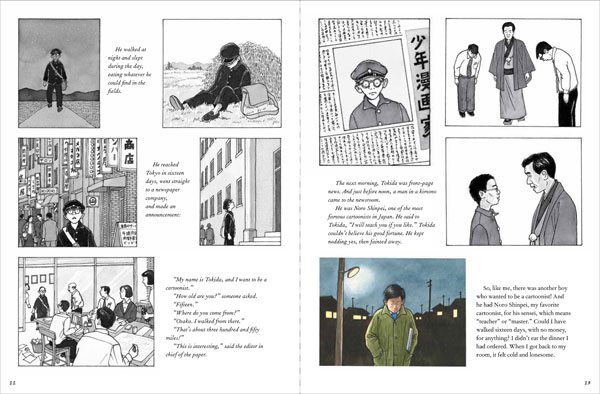
The Publisher Says: Caldecott Medalist Allen Say presents a stunning graphic novel chronicling his journey as an artist during WWII, when he apprenticed under Noro Shinpei, Japan’s premier cartoonist.

DRAWING FROM MEMORY is Allen Say's own story of his path to becoming the renowned artist he is today. Shunned by his father, who didn't understand his son's artistic leanings, Allen was embraced by Noro Shinpei, Japan's leading cartoonist and the man he came to love as his "spiritual father." As WWII raged, Allen was further inspired to consider questions of his own heritage and the motivations of those around him. He worked hard in rigorous drawing classes, studied, trained--and ultimately came to understand who he really is.

Part memoir, part graphic novel, part narrative history, DRAWING FROM MEMORY presents a complex look at the real-life relationship between a mentor and his student. With watercolor paintings, original cartoons, vintage photographs, and maps, Allen Say has created a book that will inspire the artist in all of us.

My Review: Allen Say's world doesn't exist anymore. This is the roughest part of getting truly old. The kind of universe where a twelve-year-old boy could be thought capable of living on his own is long gone. The kind of world where the famous cartoonist could be reached by the simple expedient of showing up at his place of work and saying, "I'd like to work for you," well! Need I belabor the point? Say wrote this book in a world that could be on a different planet than the one he grew up on. But from such foreign stones he built an exciting life, a life of art and creation and replete with stories that need telling.

This book, a graphic memoir I suppose, though it's less thoroughgoing than is Lynda Barry's work (eg Syllabus: Notes from an Accidental Professor), is no whit less sophisticated.

I recently read Artist Say's magisterial Silent Days, Silent Dreams. It was such a gorgeous visual feast and so deeply affecting a tale that I couldn't bear to leave his world for long. Look above, look below...do you blame me?

Look at the great simplicity of the lines you're tricked into believing are real, three-dimensional objects:

Look at the care and attention you're not smacked with, look at the invisible framing of each image that makes it the perfect size and the perfect space for exactly that moment of storytelling to be within.

See the colors? See the volume of each object, each space between objects?

See the texture of matte-coated paper, the way that it creates the same effect as a gallery's neutral wall color does? See the fruit of more than seventy years practicing what a master, a cicerone, a sensei was wise, prescient, generous enough to give the boy artist? We receive the gift's fruit.

There was never a truer aperçu proverbialized than, "A society grows great when old men plant trees whose shade they know they shall never sit in." To your private orchard you bring trees whose shade soothes you, yet almost never will you stop to regard still less thank the long-gone hands and long-past rains that made the tree into what it is now.

Take that moment now, be grateful to Noro Shinpei for himself and for the soothing shadows of Allen Say's talented evocation of a world we can never see any other way but through his eyes and by his hands. Let him plant you a tree.

Sunday, September 17, 2017

THE HEART OF THE MATTER, a book that had the opposite of its intended effect on me


THE HEART OF THE MATTER
GRAHAM GREENE

Penguin Classics
$17.00 trade paper, available now

Rating: 4* of five

The Publisher Says: Graham Greene's masterpiece The Heart of the Matter tells the story of a good man enmeshed in love, intrigue, and evil in a West African coastal town. Scobie is bound by strict integrity to his role as assistant police commissioner and by severe responsibility to his wife, Louise, for whom he cares with a fatal pity.

When Scobie falls in love with the young widow Helen, he finds vital passion again yielding to pity, integrity giving way to deceit and dishonor—a vortex leading directly to murder. As Scobie's world crumbles, his personal crisis makes for a novel that is suspenseful, fascinating, and, finally, tragic.

Originally published in 1948, The Heart of the Matter is the unforgettable portrait of one man, flawed yet heroic, destroyed and redeemed by a terrible conflict of passion and faith.

My Review: An excellent book. Simply magnificent writing, as always, but more than that the story is perfectly paced (a thing Greene's stories aren't always, eg The Power and the Glory) and deeply emotional (another thing Greene's stories aren't always, eg Travels With My Aunt).

Greene himself didn't like the book, which was a species of roman à clef. I suspect, though I don't have proof, that he was simply uncomfortable at how much of his inner life he revealed in the book. Scobie's infidelity and his fraught relationship with the wife he's saddled with must have been bad reading for Mrs. Greene. But the essential conflict of the book is man versus church, the giant looming monster of judgment and hatred that is Catholicism. Greene's convert's zeal for the idiotic strictures, rules, and overarching dumb "philosophy" of the religion are tested here, and ultimately upheld, though the price of the struggle and the upholding aren't scanted in the text.

Stories require conflicts to make them interesting, and the essential question an author must address is "what's at stake here?" The more intense and vivid the answer to that question is, the more of an impact the story is able to make. Greene was fond of the story he tells here, that of an individual against his individuality. He told and retold the story. The state, the colonial power whose interests Scobie/Greene serves, is revealed in the text to be an uncaring and ungrateful master; the rules of the state are broken with remarkably few qualms when the stakes get high enough. It is the monolith of the oppressive church, admonishing Scobie of his "moral" failings and withholding "absolution of his sins", that he is in full rebellion against...and in the end it is the church that causes all parties the most trouble and pain.

Greene remained a more-or-less believing Catholic. I read this book and was stumped as to why. The vileness of the hierarchy was so clear to me, I couldn't imagine why anyone would read it and not drop christianity on the spot. But no matter one's stance on the religion herein portrayed, there's no denying the power of the tension between authority and self in creating an engaging and passionate story. A must-read.

Wednesday, August 23, 2017

WINTER TIDE, a marvelous expansion and deepening of Lovecraft's Cthulhu Mythos


WINTER TIDE
RUTHANNA EMRYS
(The Innsmouth Legacy #1)
Tor.com
$25.99 hardcover, available now

Rating: 4.5* of five

I need some more bandwidth to become available prior to reviewing this novel. Watch this space. And don't forget to read my review of The Litany of Earth, the link to the Tor.com free read is in it.

The Publisher Says: After attacking Devil’s Reef in 1928, the U.S. Government rounded up the people of Innsmouth and took them to the desert, far from their ocean, their Deep One ancestors, and their sleeping god Cthulhu. Only Aphra and Caleb Marsh survived the camps, and they emerged without a past or a future.

The government that stole Aphra's life now needs her help. FBI agent Ron Spector believes that Communist spies have stolen dangerous magical secrets from Miskatonic University, secrets that could turn the Cold War hot in an instant, and hasten the end of the human race.

Aphra must return to the ruins of her home, gather scraps of her stolen history, and assemble a new family to face the darkness of human nature.

TOR DOT COM SENT ME THIS BOOK AT MY REQUEST**THANKS Y'ALL**

My Review: I began this book hoping it would be at least as good as THE LITANY OF EARTH (link above) and would expand my sense of the reality of Miskatonic University. I've had enough contact with the Cthulhu Mythos to have developed a deep desire to become an alumnus of Miskatonic. It is not to be, of course, Arkham being fictional as well as in coastal Massachusetts *shiver*, but it gives you a sense of how real this mythos seems to me. Current titles like Lovecraft Country and Carter & Lovecraft have passed before my approving gaze, deepening my appreciation for the talent, if not the person, of racist sexist nativist H.P. Lovecraft. There is something in the Elder Gods that answers a need in people, since there are so very many people using the Mythos today to explore the dystopia in which we live, which seems only to get worse (viz., Charlottesville, Virginia).

Author Emrys's particular flash of genius is to make the Mythos spread over time, writing an historical novel set in 1948 from the standpoint of a World War II-to-Cold-War world where Innsmouth and the Water People were interned before the Japanese were. It's brilliant. The government needed only to turn their bureaucratic gaze a few inches to get a ready-made solution to the "Nisei Threat." I was completely convinced by this. I can think of nothing to prevent this from being true...except it isn't.

Feels to me like it should be. Families like the Marshes, longtime residents of Innsmouth and leaders among the Water People who make up most of Innsmouth's population, are wrenched from the spawning grounds (being humans although amphibious, they need to breed on terra firma before they can undergo final metamorphosis and go back to the sea) and sent to desert camps. Most died in the violence of the round-up, or in the deserts, and now only Aphra Marsh of San Francisco and her brother Caleb of Arkham, Massachusetts, are left. The sole full-blooded Water People who can breed are, in returning to Innsmouth to assist the government that committed genocide against their kind, coming to grips with what it means to be the future not simply to have a future.

As we submerge deeper and deeper into the cold, dark, high-pressure depths of human hatred of otherness and intolerance of difference, WINTER TIDE feels more and more like a howl from the edge of the pack: A better trail is over here! Come this way, accept and embrace the not-usual, accept and embrace the viewpoint of the outsider, and you'll see the whole picture much more clearly. The threats are real. They simply aren't where you're looking for them.

How perfect a co-opting of the Cthulhu Mythos that is. In keeping with the co-opting we, the sane and normal, need to do with the lunatic fringe's ideological excesses. Making the bad spirits better is, as the titanic struggles Aphra and her rag-tag family of choice endure and prevail over, extremely hard. But the will to do it, the willingness to suffer the literal and psychic pains and amputations required by it, exist in us. We need to need the end results as much as Aphra and her family, as well as her blood family, need the results of their internecine war.

Aphra Marsh for President.

Thursday, September 8, 2016

THE ATOMIC WEIGHT OF LOVE, a novel for women that men *NEED* to read

THE ATOMIC WEIGHT OF LOVE
ELIZABETH J. CHURCH

Algonquin Books of Chapel Hill
$15.95 all editions, available now

Rating: 4* of five

The Publisher Says: In her sweeping debut novel, Elizabeth J. Church takes us from the World War II years in Chicago to the vast sun-parched canyons of New Mexico in the 1970s as we follow the journey of a driven, spirited young woman, Meridian Wallace, whose scientific ambitions are subverted by the expectations of her era.

In 1941, at seventeen years old, Meridian begins her ornithology studies at the University of Chicago. She is soon drawn to Alden Whetstone, a brilliant, complicated physics professor who opens her eyes to the fundamentals and poetry of his field, the beauty of motion, space and time, the delicate balance of force and energy that allows a bird to fly.

Entranced and in love, Meridian defers her own career path and follows Alden west to Los Alamos, where he is engaged in a secret government project (later known to be the atomic bomb). In married life, though, she feels lost and left behind. She channels her academic ambitions into studying a particular family of crows, whose free life and companionship are the very things that seem beyond her reach. There in her canyons, years later at the dawn of the 1970s, with counterculture youth filling the streets and protests against the war rupturing college campuses across the country, Meridian meets Clay, a young geologist and veteran of the Vietnam War, and together they seek ways to mend what the world has broken.

Exquisitely capturing the claustrophobic eras of 1940s and 1950s America, The Atomic Weight of Love also examines the changing roles of women during the decades that followed. And in Meridian Wallace we find an unforgettable heroine whose metamorphosis shows how the women’s movement opened up the world for a whole generation.

**ALGONQUIN BOOKS OF CHAPEL HILL SENT ME THIS REVIEW COPY. THANK YOU!**

My Review: At long, long last, a book about a woman's life of rigorous self-denial and eventual blossoming that cleanses the humid, metallic bloodiness of The Awakening from my mental palate. A dry, cold blast of piñon-scented mountain air sweeping clean a century's accumulation of moldy, clammy death-scented grave dirt.

And that, in case I am being unclear, is as rave a review as a novel not aimed primarily at me is ever likely to get. How utterly refreshing it is to have a heroine whose many personal sacrifices are made 1) NOT for her children and 2) result in a genuine, joyous opening of her own and her friends' eyes to the very real obstacles faced by young women in making independent lives for themselves and each other. It seems a shame that this is fiction, in point of fact. Meridian Wallace Whetstone should be a real woman. (I am quite sure that Author Church composited many of the women she grew up among into Mrs. Whetstone, but she...Whetstone...is so lovingly limned it seems a shame she isn't "real"-real.)

We meet Meridian in the fullness of her life as she glances over her shoulder down the slope of her life's mountain. It is a tried-and-true narrative technique, and one I've always been a bit suspicious of; I put my reservations on hold because, early on, I came to trust Author Church and her choices:
I remember an ozone-scented April afternoon when he pulled my hand from my raincoat pocket and held it in his hot, enveloping hands. Abruptly, suddenly aware of his own gesture, he paused in his description of atomic half-life, radioactive decay. We stood on the rain-darkened campus sidewalk, looked at each other, and I used my free hand to tuck a curl of his hair behind his ear. I felt so calm with Alden. ...[He] gave me sure footing. He's solid, I thought... My thoughts surprised me. Unconscious, unbidden, I was falling in love.
I resonated with this description of the moment of falling in love like a gong. Okay, then, I said aloud, where to now?

Where to indeed. We went to the altar, metaphorically anyway, as Meridian and Alden marry in the rush of wartime; Meridian remains in school, takes her bachelor's degree and is accepted into graduate school at Cornell, while Alden lives and works in Los Alamos on the Trinity Project. What comes next is, I suppose, the central incident of the novel. As one might expect, Alden is offered a permanent place at the Los Alamos research facility that succeeded the Trinity Project. As Alden most clearly expected, Meridian was to drop her own plans and fall into line with his. There was some sense to that in the day: His job was both prestigious and well-paid, whereas her career after graduate school, even after a Ph. D., would never be either of those things. Women in academia, as in all other parts of the postwar economy, were not accorded the respect or remuneration that men were. I am told things are different now. *snort*

Meridian adjusts herself, not entirely willingly, to a culture of secrecy as the wife of an employee of "the Lab" as it is referred to. She adjusts herself to childlessness with much greater ease, especially after an ectopic pregnancy. Alden isn't so sanguine about that. He thought he had made himself clear in their courting days, referring to his first wife's miscarriages, as wanting children. Their absence of communication is beginning to tell on their relationship, but neither is equipped with the words or the inclination to reach beyond his or her own ideas of communication. Each is perfectly clear...to themselves, anyway...so what is there to do but accept the other's limitations, sigh, and move forward?

The issue is forward which way. Meridian's disastrous ectopic pregnancy has led her into the life of a woman nurse, Belle, who is wide-open, fun-loving, outspoken, and married to one of the Lab's security guards. It's instant chemistry between the two women, a best friendship that is unique in Meridian's experience and comes to be the most important relationship in her life. Alden, unsurprisingly to everyone except Meridian herself, wants none of it, and makes himself obnoxiously clear about it. So Belle stays exclusively Meridian's friend and remains a touchstone in her life until its end.

Years tick by, Meridian brings her widowed mother from Pennsylvania to New Mexico for her one and only visit to see this strange new place her only child has made her home. Mother is an old-school working-class mama. She cleaned houses and took in laundry and did without any selfish luxury to be sure her daughter could go to college and be more than she herself had had the education to be. We can only guess at her feelings, since Meridian is our first-person narrator. This is one of the risks of first person narration, that some major emotional seams are left unmined. I would have loved to hear more of and even from Mother. Nonetheless, Mother comes through her visit to the Brave New World and the knowledge of her daughter's increasing isolation from and anger towards her husband in true Mother fashion. She writes Meridian a thank-you letter, sends a charmingly left-field gift of a hostessing manual, and offers some excellent insight:
Maybe I didn't teach you enough about how couples get along or about the necessary compromises wives must make. Love does not stay romantic. It changes. Sometimes it's even boring. ... Don't ask Alden to give your life meaning.
Yuh-huh. Every grown-up in the room knows what the lady's talkin' bout, though I surely hope that nowadays it's *both* parties who compromise. I don't have the liveliest confidence in that assertion, but don't nobody mess with my denial, 'kay?

Meridian sets her sights on making her life mean something. She lines up activities like ninepins, with and without Alden, sets about knocking them down, and thus distracts herself from her increasing isolation from her emotional core. She does continue her undergraduate interest in crows by observing the families of crows an easy hike away from Los Alamos. It leads her into discovering art, drawing then watercolor painting. The years continue to tick by. The inevitable happens when Meridian learns that her mother, her life's bedrock for her entire thirty-nine years on the planet, has died. She returns to her Pennsylvania home alone as Alden is too busy to attend the ceremonies with her. The return itself is her first ever airplane flight:
It was magic to be above [the clouds], to see their uppermost contours, the way they caught the light and held it, their vast shadows moving upon the face of the earth. I wished I could open the window and know what the world sounded like at that altitude. I thought about the solitude of that world, how it must be inhabited by the voice of the wind, only. ... I thought about what my crows saw as they flew above canyons and treetops, the birds-eye view of life. They would recognize specific trees, perches, and nesting sites from a completely different perspective than I could. Their maps differed from mine; they knew the topography, the contours of the landscape, on a much grander scale.
Nothing makes me happier than beautiful appreciations of the value of perspective. Meridian has lost her anchor and is floating far above the mere mundanity of land; she gains from that loss a brand new idea of her relationship to land. So nicely done, Author Church.

Returning to earth and to Alden, Meridian is no longer content to jog along in her well-worn path. She casts about for something, anything, that will both satisfy and fulfill her. It's one thing to want satisfaction and fulfillment, and quite another to know it when you see it; yet another to accept the gift that the goddesses have given you. Clay enters Meridian's life at their mutual peak. She is a woman in her prime, forty-six; he is a twenty-five-year old man fractured by war and healing himself with the one universal balm, the world of nature. Their courtship is abbreviated, their love urgent, their time limited, and for all that it transforms each of them into so much more than either would ever have been without the other. Many new experiences are had:
Next to his stove lurked a bowl containing an ominous dark brown liquid and pale, beige cubes of some unidentifiable matter.
"This is dinner?"
"Tofu. I'm marinating it in soy sauce."
"What?"
"Tofu. It's bean curd, or coagulated soy milk."
"You can't afford meat? I could have brought some steak or chicken."
"I'm a vegetarian, Meridian. I don't eat meat."
I stood there, flummoxed. Now I was involved with a vegetarian hippie.
I suppose an equivalent sense of being completely at sea would be a well-off woman today falling for a rapper, someone with few if any cultural touchstones in common with her. Equally laughter-inducing is Clay's introduction of marijuana to Meridian. Author Church's description of that is also big fun, but too long for my arthritic fingers to transcribe.

Happiness and fulfillment, emotional and sexual, must needs be fleeting in drama (and all too often in life). It is obvious to Meridian from the start that this isn't a life-long love affair. Clay wants her to leave the stale mundanity of her marriage to Alden, and works long and hard for her to acquiesce. She does, and the goddesses exact their price for the brief interlude of joy: Alden is dying of cancer.

That is the end of the affair. Only it isn't, because like every Great Love I've ever known or read about, the Greatly Belovéd is always part of one's mental furniture. (Twenty-four years after his death, I still have mental conversations with my own Greatly Belovéd, and I expect I always will.) As Meridian grieves the loss of her intimate enemy, she grows into the fullness of herself she glimpsed for the first time during her passion with Clay. She takes charge of herself and sets about taking charge of a corner of her world. Her life is now about making changes in the worlds of young women in New Mexico using the sizable wad of money that Alden socked away before his death, and which Meridian had to struggle against a restrictive, almost vengeful, trust to get control of for herself.

It is a wonderful third act to a long life, making a difference in the lives of the young. And the ending of that journey is where we began, where Meridian began talking to us. Remember the reservations I set aside at the beginning of The Atomic Weight of Love? I am so glad that I did, because this narrative frame is exactly what made the ending of the book so very deeply satisfying and so beautiful. I can't bring myself to say why, but you will, I very much hope, see for yourself soon.