Pages
- Home
- Mystery Series
- Bizarro, Fantasy & SF
- QUILTBAG...all genres
- Kindle Originals...all genres
- Politics & Social Issues
- Thrillers & True Crime
- Young Adult Books
- Poetry, Classics, Essays, Non-Fiction
- Science, Dinosaurs & Environmental Issues
- Literary Fiction & Short Story Collections
- Sookie Stackhouse/Southern Vampire Books & True Blood
- Books About Books, Authors & Biblioholism
Showing posts with label artist biography. Show all posts
Wednesday, August 13, 2025
TOO GOOD TO GET MARRIED: The Life and Photographs of Miss Alice Austen, biography of a recovered queer elder
TOO GOOD TO GET MARRIED: The Life and Photographs of Miss Alice Austen
BONNIE YOCHELSON (foreword by Victoria Munro & Jessica B Phillips)
Empire State Editions (non-affiliate Bookshop.org link)
$39.95 hardcover, available now
Rating: 4.5* of five
The Publisher Says: Explore Gilded Age New York through the lens of Alice Austen, who captured the social rituals of New York’s leisured class and the bustling streets of the modern city. Celebrated as a queer artist, she was this and much more
Alice Austen (1866–1952) lived at Clear Comfort, her grandparent’s Victorian cottage on Staten Island, which is now a National Historic Landmark. As a teenager, she devoted herself to photography, recording what she called “the larky life” of tennis matches, yacht races, and lavish parties.
When she was 25 and expected to marry, Austen used her camera to satirize gender norms by posing with her friends in their undergarments and in men’s clothes, “smoking” cigarettes, and feigning drunkenness. As she later remarked, she was “too good to get married.” Austen embraced the rebellious spirit of the “New Woman,” a moniker given to those who defied expectations by pursuing athletics, higher education, or careers. She had romantic affairs with women, and at 31, she met Gertrude Tate, who became her life partner. Briefly, Austen considered becoming a professional photographer. She illustrated Bicycling for Ladies, a guide written by her friend Violet Ward, and she explored the working-class neighborhoods of Manhattan to produce a portfolio, “Street Types of New York.” Rejecting the taint of commerce, however, she remained within the confines of elite society with Tate by her side.
Although interest in Austen has accelerated since 2017, when the Alice Austen House was designated a national site of LGBTQ history, the only prior book on Austen was published in 1976. Copiously illustrated, Too Good to Get Married fills the need for a fresh and deeply researched look at this skillful and witty photographer. Through analysis of Austen’s photographs, Yochelson illuminates the history of American photography and the history of sexuality.
I RECEIVED A DRC FROM THE PUBLISHER VIA EDELWEISS+. THANK YOU.
My Review: This isn't an obvious fit for the usual definition of #WITMonth I've been working with. Indulge me for a moment: In society, now as much as in Austen's time, there is a phenomenon called "code switching." It's a kind of translation your queer friends know well, and your young friends, your opposite-gender friend;, we are most all of us doing a bit of code-switching.
What Author Yochelson does in this magisterial biography of lesbian artist and bon vivant is a translation of Austen's code-switching between woman of substance and closeted (as all were then required to be)...if only barely...lesbian in a long-term partnership.
It occurred to me to call this a translation when I read more about how Austen "{rejected} the taint of commerce...{and} remained within the confines of elite society with Tate by her side." This was a woman who spoke one language, of intimacy and sapphic love, at home, and a very, very different one among her public social circle. Austen documented, and Author Yochelson caringly and carefully examines, the world of women we would otherwise never know existed.
What this book does with skill and panache is the very thing the presently installed in government social reactionaries hate the most: Demonstrate in words and pictures that queerness, its existence and its joyfulness, has always existed and thus is among the real identities others can ascribe to.
There is more shock in the world of today at these intimate, fun-having images than there was in the earlier Gilded Age, because the sexual lives of others are more publicly known and thus easier to discuss...and judge...than the private lives of the day. Gossip was then shameful, vulgar, low; and is now journalism, casually reported and widely and openly discussed. Reality TV and celebrity journalism are thoroughly established in respectability.
It is a world I suspect Miss Austen would thoroughly dislike.
This house, this family, is Miss Austen's native world. Gossip about personal lives, while surely (humanly) indulged in, would not be done in public by these folk. Officially. Behind hands and doors and fans, sure! Thus the need to code-switch constantly would've kept Miss Austen and later Miss Tate (her partner) as well quite busy and alert.
The ladies in question in later life
The value of this explication of life among the hidden sapphic sisters of the era can't be overstated. Aesthetically we're all much richer for the re-emergence of these images; societally, we are hugely enriched by this evidence of the way diversity has flourished and enriched the culture of every era.
Look carefully, these were shocking, as tame as they seem now!
I think this work of translation from lives once unable to be spoken openly to the mass medium of publishing, as a rescue operation of identity and artistry previously masked and ignored, is worth the purchase price. There are over 100 photographs in the text. It is a treasure trove of lesbian life in the first Gilded Age. It is also a human life's worth of creative joy and pleasure shared.
It is, most importantly in my eyes, my elder sibling in queerness restored to me, guiding me through the world's rage and hate by her example. Celebrate that beauty and gift.
Saturday, December 14, 2024
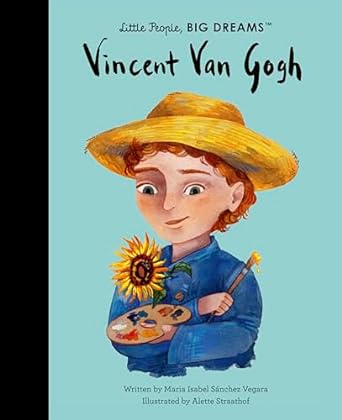
Little People, BIG DREAMS series: VINCENT VAN GOGH, great troubled artist, & ROALD DAHL, great troubling writer
VINCENT VAN GOGH
MARIA ISABEL SÁNCHEZ VEGARA (Little People,BIG DREAMS series; illus. Alette Straathof)
Frances Lincoln Children's Books (non-affiliate Amazon link)
$15.99 hardcover, available now
Rating: 5* of five
The Publisher Says: Learn about the life of Vincent van Gogh, one of the world's most influential and best-loved artists.
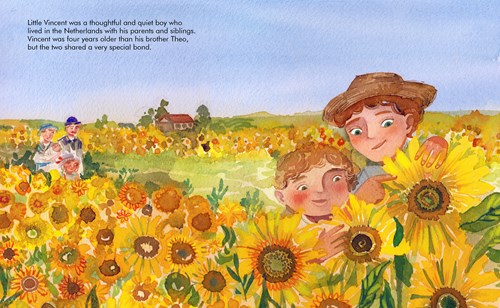
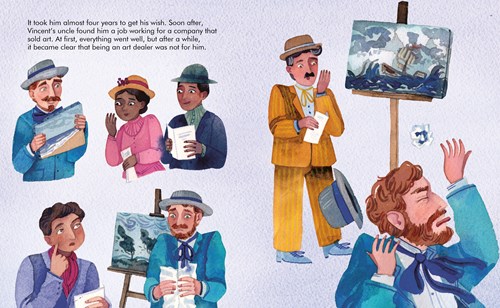
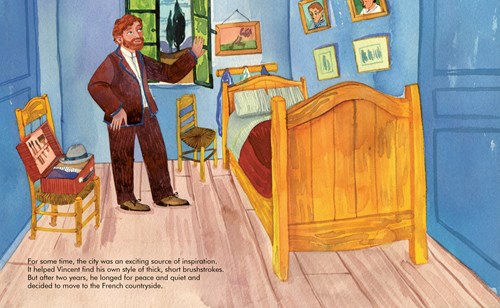
Little Vincent was a quiet child. He loved spending time in nature and playing with his brother Theo. After leaving school, he began working as an art dealer. Vincent showed promise, but he found it more and more difficult to control his emotions and eventually had to leave. He had a go at many different jobs, including a teacher and a bookseller, but nothing felt right.
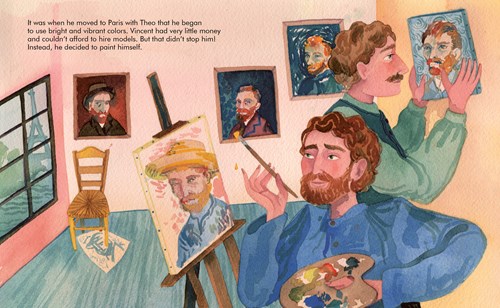
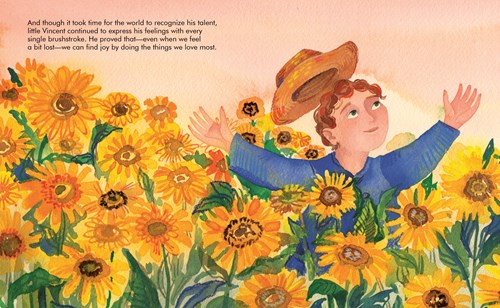
When he wasn’t working, he wrote Theo long letters that included beautiful drawings. Theo loved his work and suggested that he try being an artist. Vincent dedicated himself to painting and never looked back! He developed his own style and expressed his emotions through his art: from sorrow to joy, and everything in between.
During his life, Vincent had little success, but today, his paintings are admired and celebrated in galleries across the world.
This powerful book features stylish and quirky illustrations and extra facts at the back, including a biographical timeline with historical photos and a detailed profile of the artist's life.
Little People, BIG DREAMS is a bestselling biography series for kids that explores the lives of outstanding people, from designers and artists to scientists and activists. All of them achieved incredible things, yet each began life as a child with a dream.
This empowering series of books offers inspiring messages to children of all ages, in a range of formats. The board books are told in simple sentences, perfect for reading aloud to babies and toddlers. The hardcover and paperback versions present expanded stories for beginning readers. With rewritten text for older children, the treasuries each bring together a multitude of dreamers in a single volume. You can also collect a selection of the books by theme in boxed gift sets. Activity books and a journal provide even more ways to make the lives of these role models accessible to children.
Inspire the next generation of outstanding people who will change the world with Little People, BIG DREAMS!
I RECEIVED A DRC FROM THE PUBLISHER VIA EDELWEISS+. THANK YOU.
My Review: You don't need to be told who van Gogh is. (I hope.) A kid who's got the world to learn does, and here's a way for you to help that happen. A series like this has so many good layers: facts about the world, facts about life as others lead it, examples of what we as a culture value.
The value here is obvious, I trust:


Gorgeous as artworks, pitch perfect as illustrations of van Gogh's life...which is ably recounted by Sánchez Vegara's simple but effective text...this small person's excellent introduction to the life of one of the present day's most venerated artists adds luster to a terrific series.
Worth reading yourself. An absolute must for your grand/nibling's education in art, biography, and the value of being Different in a conformist world.
+++++++++++++++++++++++++++++++++++++++++++++++++++++++++++++++
ROALD DAHL
MARIA ISABEL SÁNCHEZ VEGARA Little People,BIG DREAMS series; illus. Francis Martin)
Frances Lincoln Children's Books(non-affiliate Amazon link)
$15.99 hardcover, available now
Rating: 5* of five
The Publisher Says: Discover the life of Roald Dahl, the groundbreaking author whose work is beloved by children all over the world.
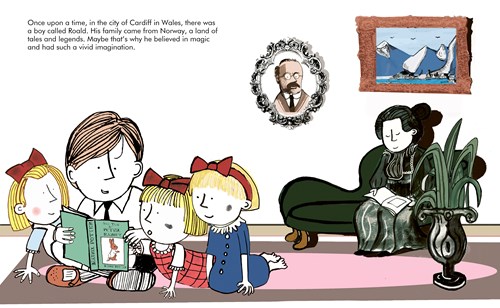
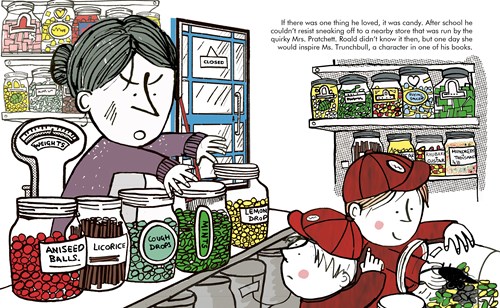
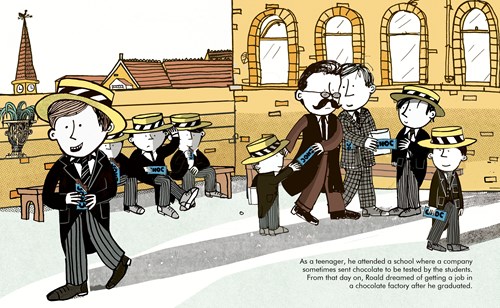
Little Roald grew up in the city of Cardiff in Wales. He loved to spend time reading with his family and visiting the local candy store for yummy chocolatey treats. But he found school difficult. No one believed in Roald’s potential.
When Roald finished school, he was ready to make his life an adventure! He traveled the world and saw some amazing sights. When World War II started, he was ready to serve his country and joined the air force. During his service, his plane crashed over a desert, leaving him blind for a period of time. Roald wrote about his experience of the crash, and enjoyed doing it so much that from then on, he knew he wanted to be an author.
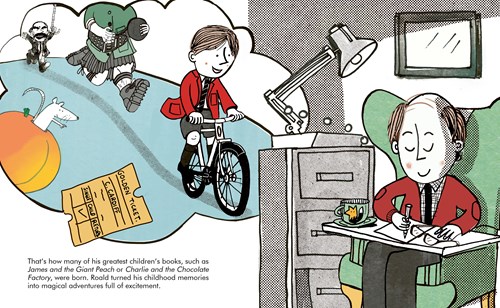
Roald began crafting books for children, working away in the shed at the bottom of his garden. From Charlie and the Chocolate Factory to James and the Giant Peach, his wonderful stories have captivated generations of readers. The magical worlds he created have been brought to the stage and screen, with hit musicals and films, like Matilda and The Witches.
The story also boldly addresses the antisemitic remarks that Roald Dahl made during his lifetime, highlighting the power and impact that our words can have: both to delight or cause lasting harm.
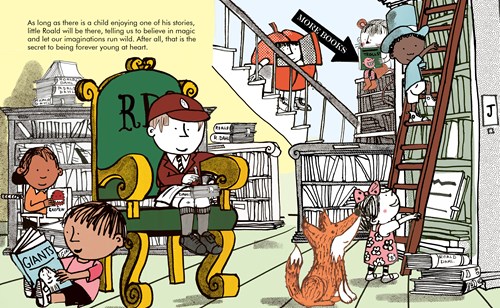
This thoughtful book features quirky illustrations and extra facts at the back, including a biographical timeline with historical photos and a detailed profile of Roald’s life. His story shows that extraordinary talent lies within each and every one of us.
I RECEIVED A DRC FROM THE PUBLISHER VIA EDELWEISS+. THANK YOU.
My Review: From the beginning, we're in possession of the facts of Dahl's troubling life. He was very much not a nice man, even by the lax standards of the day; he was hateful, and cruel to his wives, he wrote truly awful stereotypes into his books for children, and let's not discuss his adult fiction at all. Given the delight his children's books have brought on page and screen, it feels only right to introduce the children who will be in his audience to the real man.
To do it honestly and without tendentious vilification, and in conjunction with æsthetically pleasing artwork, shows me how much thought and effort Quarto's children's imprint has put into this series of essential cultural figures' biographies.


Such a great match between illustrations and subject! Tey look like they could be from Dahl's heyday in the 1950s and 1960s. They're fresh, original, and in great keeping with the ethos Dahl worked within.
Perfect for introducing those too young to get his work delivered directly to the ideas of it. Even better for those who have had some of his work read to them already to him as a person, as they can read it themselves. I remain troubled by Dahl and his unpleasant personality, and I'd recommend to you the giver of the book to check with the recipient's parents to be positive this body of work is acceptable for their child before committing even this minimal amount to procuring it.
Tuesday, June 14, 2022
BORN TO BE POSTHUMOUS, as mordantly amusing as it sounds
BORN TO BE POSTHUMOUS: The Eccentric Life and Mysterious Genius of Edward Gorey
MARK DERY
Little, Brown
$35.00 hardcover, available now
Rating: 4* of five
The Publisher Says: From The Gashlycrumb Tinies to The Doubtful Guest, Edward Gorey's wickedly funny and deliciously sinister little books have influenced our culture in innumerable ways, from the works of Tim Burton and Neil Gaiman to Lemony Snicket. Some even call him the Grandfather of Goth.
But who was this man, who lived with over twenty thousand books and six cats, who roomed with Frank O'Hara at Harvard, and was known—in the late 1940s, no less—to traipse around in full-length fur coats, clanking bracelets, and an Edwardian beard? An eccentric, a gregarious recluse, an enigmatic auteur of whimsically morbid masterpieces, yes but who was the real Edward Gorey behind the Oscar Wildean pose?
He published over a hundred books and illustrated works by Samuel Beckett, T.S. Eliot, Edward Lear, John Updike, Charles Dickens, Hilaire Belloc, Muriel Spark, Bram Stoker, Gilbert & Sullivan, and others. At the same time, he was a deeply complicated and conflicted individual, a man whose art reflected his obsessions with the disquieting and the darkly hilarious.
Based on newly uncovered correspondence and interviews with personalities as diverse as John Ashbery, Donald Hall, Lemony Snicket, Neil Gaiman, and Anna Sui, Born to be Posthumous draws back the curtain on the eccentric genius and mysterious life of Edward Gorey.
I CHECKED THIS BOOK OUT OF THE LIBRARY. SIX TIMES. ULTIMATELY A LIBRARIAN BOUGHT ME A SALE KINDLEBOOK. (True story!)
My Review: There are few things my elder sister and I agree on. One of them is that Edward Gorey's a bloody genius, and about as hilarious as it's possible to be. (We also both love Jo Walton, so it's not as though she's a waste of space. Entirely, anyway.)

That's what Edward Gorey's superpower is, though. He speaks to a certain inner weirdo in some people, a rebellious streak that demands the sheer nonsensical pointlessness of Life be acknowledged and celebrated. Poor Xerxes...a Gashlycrumb Tiny I truly felt for.
Now that Gorey's safely dead, what's the skinny on his narrow gay ass? Welllll...not that fascinating, if I'm honest. He was exactly as you'd expect someone who could think up a child called "Xerxes" would be. Strange, a misfit, completely and utterly himself because he *designed* himself with great care. His artwork was justly celebrated for its technical merit...by three or four people. Weirdness exacts costs from the weirdo. Gorey was famous...if you know who he is. I'm never sad or sorry that I know who he is, unlike many famous people. But Gorey's talent as an artist was never the subject of major retrospectives at the Museum of Snooty Stuff or the Obscene Wealth Collection.
Unlike most of the art you'll see in those cultural institutions, you've seen a Gorey image. (If you're reading this blog, you have.) The Mystery! series opening sequence? Gorey. The 1950s Anchor Books images? Gorey. Over 100 of his own books, popular culture objects. He was a niche force, but a force nonetheless.
However, Dery's exhaustively researched biography goes into some detail about the skinny on Gorey's sexual nature. I think, like Greta Garbo, he wanted to be left alone. He never, ever once said he was gay. He lived through Stonewall...long after it was entirely okay with most people to come out as gay, he didn't.
Because he wasn't.
He said, in an interview collected in Ascending Peculiarity, "I'm neither one thing nor the other particularly. I am fortunate in that I am apparently reasonably undersexed or something ... I've never said that I was gay and I've never said that I wasn't ... what I'm trying to say is that I am a person before I am anything else ... " That, mes amis, is a clear statement of being. He was what we, in 2022, call "asexual." That doesn't prevent him from presenting himself in a striking and deeply queer-coded manner. But if the twenty-first century has taught me anything, it's that people are who and what they say they are. Gorey? Asexual, and presenting himself as a strange misfit. And that is all there is to it.
I wasn't pleased by Author Dery's claiming of him for the gay men of the world solely because we have his own words on the subject and they are not, despite the fact they could easily and safely have been, "I am gay." So. He wasn't. Yes, let's claim him as an ikon of the QUILTBAG spectrum! Yes, let's celebrate his Otherness, his determined design of his Otherness, and the glorious art that came out of it..."There's so little heartless work around," said Gorey. "So I feel I am filling a small but necessary gap."
But let's not posthumously (!) reassign his stripe on the flag for our own need to possess him. Let's celebrate the way he said he was with the gratitude and laughter and little frisson of unnerved nerves that he designed it to evoke in his viewers.
Wednesday, March 8, 2017
JOAN MITCHELL: LADY PAINTER, though painter she was lady she most assuredly was not
JOAN MITCHELL: LADY PAINTER
PATRICIA ALBERS
Alfred A. Knopf
$21.99 Kindle edition, available now
Rating: 4* of five
The Publisher Says: “Gee, Joan, if only you were French and male and dead.” —New York art dealer to Joan Mitchell, the 1950s
She was a steel heiress from the Midwest—Chicago and Lake Forest (her grandfather built Chicago’s bridges and worked for Andrew Carnegie). She was a daughter of the American Revolution—Anglo-Saxon, Republican, Episcopalian.
She was tough, disciplined, courageous, dazzling, and went up against the masculine art world at its most entrenched, made her way in it, and disproved their notion that women couldn’t paint.
Joan Mitchell is the first full-scale biography of the abstract expressionist painter who came of age in the 1950s, ’60s, and ’70s; a portrait of an outrageous artist and her struggling artist world, painters making their way in the second part of America’s twentieth century.
As a young girl she was a champion figure skater, and though she lacked balance and coordination, accomplished one athletic triumph after another, until giving up competitive skating to become a painter.
Mitchell saw people and things in color; color and emotion were the same to her. She said, “I use the past to make my pic[tures] and I want all of it and even you and me in candlelight on the train and every ‘lover’ I’ve ever had—every friend—nothing closed out. It’s all part of me and I want to confront it and sleep with it—the dreams—and paint it.”
Her work had an unerring sense of formal rectitude, daring, and discipline, as well as delicacy, grace, and awkwardness.
Mitchell exuded a young, smoky, tough glamour and was thought of as “sexy as hell.”
Albers writes about how Mitchell married her girlhood pal, Barnet Rosset, Jr.—scion of a financier who was head of Chicago’s Metropolitan Trust and partner of Jimmy Roosevelt. Rosset went on to buy Grove Press in 1951, at Mitchell’s urging, and to publish Henry Miller, Samuel Beckett, Jean Genet, Jack Kerouac, Allen Ginsberg, et al., making Grove into the great avant-garde publishing house of its time.
Mitchell’s life was messy and reckless: in New York and East Hampton carousing with de Kooning, Frank O’Hara, James Schuyler, Jane Freilicher, Franz Kline, Helen Frankenthaler, and others; going to clambakes, cocktail parties, softball games—and living an entirely different existence in Paris and Vétheuil.
Mitchell’s inner life embraced a world beyond her own craft, especially literature . . . her compositions were informed by imagined landscapes or feelings about places.
In Joan Mitchell, Patricia Albers brilliantly reconstructs the painter’s large and impassioned life: her growing prominence as an artist; her marriage and affairs; her friendships with poets and painters; her extraordinary work.
Joan Mitchell re-creates the times, the people, and her worlds from the 1920s through the 1990s and brings it all spectacularly to life.
My Review: This is a life, not a biography, in the sense that it offers more of a rounded picture of Joan Mitchell than a rigorous analysis of her milieu and her position and her place in history. Mitchell, a hard-drinking, hard-loving, hard broad, is famous if you know who she is, and invisible if you don't. I suspect that would make her really, really mad. Mitchell was a daughter of privilege, wealthy dermatologist father and novelist/poet/editor (Marion Sobel Mitchell) mother, who felt unloved and grew into a figure-skating champ, then an early Abstract Expressionist/Action painter, then the wife of serial monogamist/avant garde publisher Barney Rosset (an old friend of ours), whose life-work running Grove Press was all due to Joan telling him about her friend's failing little publishing company, and finally ending her days as an expatriated eminence grise of feminist art in America. How she hated that! The expatriating part she loved, living in a small French village where Monet had honed his Impressionist chops; the feminist part? Loathed it from the depths of her gin-soaked soul. She felt no kinship with Woman. She felt no unmixed feeling, frankly, on any subject. She was a difficult, dangerous friend and a worse enemy. She was deeply disagreeable, arguing to no great purpose about anything with anyone, and seldom offering any kind of apology for the havoc she caused in the lives and worlds of those around her.
She died of cancer at sixty-seven, after drinking, smoking, and boinking enough for three dozen misspent youths. Barney was sincerely distraught. I suspect he never got over her. He talked about her quite a lot...the other four wives, not so much, unless there was some child or grandchild related reason to do so. I don't imagine anyone else had an unmixed response.
Her work was...it remains...well...go here to see Field for Skyes, which she painted to release the grief of losing her beloved Skye terrier Bertie. It's an IMMENSE piece of art, but even in the inkydinky Internet form, it's lovely. In person, Mitchell paintings are all about paint...the effects of different techniques of putting paint onto a painting are crucially important to the visual experience of the painting. In photos, that's simply not possible to reproduce. But enough survives to give you a chance to experience Mitchell's passion. Like it or don't, and I don't much, Mitchell's work is strong and intense and accomplished. What it isn't, and what I suspect she knew it wasn't, is great.

Field for Skyes, Hirshhorn Museum of the Smithsonian Institution
Books about art are, unless they're big and all in color and lushly produced, like safe sex: enough of the real thing survives that you're inclined to continue, but it ain't like the real damn thing, and no amount of skill or wishing or forcing yourself to believe is gonna make it so.
Patricia Albers does a decent job conveying the chaos and the bleakness of Mitchell's life. She does a lot less well at giving any hint as to why the woman didn't kill herself in existential crisis...does ANYthing make Mitchell happy? I couldn't say...but the inevitable moment when Albers must speak to us, her readers, about paintings she cannot show us in a 400+-page mostly text book, points up this book's major failing. Here, from p249, is Albers describing Mitchell's painting Ladybug, painted per Albers very shortly after the death of Mitchell's beloved singer Billie Holiday in 1959:
"Luscious garden hues -- cadmium red, celadon, cobalt blue, ultramarine, slurry brown, carmine, ochre, acid raspberry -- splash and streak through this luminous nine-foot-wide oil. Some colors optically blend. Others pop from the picture plane, thanks in part to the painter's astute use of red-green and blue-ochre polarities. (The latter, along with Ladybug's architectural exactitude and play of colors against aerating whites, evoke the late work of Cezanne.) Mitchell's gloriously variegated brushstrokes push and tug and shimmer and float, like the edges of planes jostling in a shallow space or foliage lifted and twirled by a breeze, kissing the light, then heaving away." (There's more, but I'm tired of typing this stuff.)
This is Ladybug, on view at the Museum of Modern Art:

I've seen the painting with my own two baby greens and, to be frank, I would not picture anything like that painting from those words. And lest it be said that everyone's experience of art is subjective, I counter that I've seen a LOT of art and even a lot of Mitchells...I, an experienced and sophisticated viewer, should be able to recognize a painting I've actually seen from this kind of description.
So...would I recommend the book to you? No, not unless you're an art aficionado possessed of a strong and broad visual vocabulary. It wouldn't hurt to read the stuff about the world of the 1950s New York School of Abstract Expressionists in here, but that's frankly not enough to make it worth your while to pick the book up. Dare if you must. But keep Google Images open and use it freely and frequently if you're braving these waters without your own mental map. Shoals abound for the innocent and the unwary.
But for the initiate, this grimoire of grimness illuminates (how ironic) some dingy corners of an important passage in American and world art. In the end, I'm glad I read it, but I suspect many would not share my interest.
PATRICIA ALBERS
Alfred A. Knopf
$21.99 Kindle edition, available now
Rating: 4* of five
The Publisher Says: “Gee, Joan, if only you were French and male and dead.” —New York art dealer to Joan Mitchell, the 1950s
She was a steel heiress from the Midwest—Chicago and Lake Forest (her grandfather built Chicago’s bridges and worked for Andrew Carnegie). She was a daughter of the American Revolution—Anglo-Saxon, Republican, Episcopalian.
She was tough, disciplined, courageous, dazzling, and went up against the masculine art world at its most entrenched, made her way in it, and disproved their notion that women couldn’t paint.
Joan Mitchell is the first full-scale biography of the abstract expressionist painter who came of age in the 1950s, ’60s, and ’70s; a portrait of an outrageous artist and her struggling artist world, painters making their way in the second part of America’s twentieth century.
As a young girl she was a champion figure skater, and though she lacked balance and coordination, accomplished one athletic triumph after another, until giving up competitive skating to become a painter.
Mitchell saw people and things in color; color and emotion were the same to her. She said, “I use the past to make my pic[tures] and I want all of it and even you and me in candlelight on the train and every ‘lover’ I’ve ever had—every friend—nothing closed out. It’s all part of me and I want to confront it and sleep with it—the dreams—and paint it.”
Her work had an unerring sense of formal rectitude, daring, and discipline, as well as delicacy, grace, and awkwardness.
Mitchell exuded a young, smoky, tough glamour and was thought of as “sexy as hell.”
Albers writes about how Mitchell married her girlhood pal, Barnet Rosset, Jr.—scion of a financier who was head of Chicago’s Metropolitan Trust and partner of Jimmy Roosevelt. Rosset went on to buy Grove Press in 1951, at Mitchell’s urging, and to publish Henry Miller, Samuel Beckett, Jean Genet, Jack Kerouac, Allen Ginsberg, et al., making Grove into the great avant-garde publishing house of its time.
Mitchell’s life was messy and reckless: in New York and East Hampton carousing with de Kooning, Frank O’Hara, James Schuyler, Jane Freilicher, Franz Kline, Helen Frankenthaler, and others; going to clambakes, cocktail parties, softball games—and living an entirely different existence in Paris and Vétheuil.
Mitchell’s inner life embraced a world beyond her own craft, especially literature . . . her compositions were informed by imagined landscapes or feelings about places.
In Joan Mitchell, Patricia Albers brilliantly reconstructs the painter’s large and impassioned life: her growing prominence as an artist; her marriage and affairs; her friendships with poets and painters; her extraordinary work.
Joan Mitchell re-creates the times, the people, and her worlds from the 1920s through the 1990s and brings it all spectacularly to life.
My Review: This is a life, not a biography, in the sense that it offers more of a rounded picture of Joan Mitchell than a rigorous analysis of her milieu and her position and her place in history. Mitchell, a hard-drinking, hard-loving, hard broad, is famous if you know who she is, and invisible if you don't. I suspect that would make her really, really mad. Mitchell was a daughter of privilege, wealthy dermatologist father and novelist/poet/editor (Marion Sobel Mitchell) mother, who felt unloved and grew into a figure-skating champ, then an early Abstract Expressionist/Action painter, then the wife of serial monogamist/avant garde publisher Barney Rosset (an old friend of ours), whose life-work running Grove Press was all due to Joan telling him about her friend's failing little publishing company, and finally ending her days as an expatriated eminence grise of feminist art in America. How she hated that! The expatriating part she loved, living in a small French village where Monet had honed his Impressionist chops; the feminist part? Loathed it from the depths of her gin-soaked soul. She felt no kinship with Woman. She felt no unmixed feeling, frankly, on any subject. She was a difficult, dangerous friend and a worse enemy. She was deeply disagreeable, arguing to no great purpose about anything with anyone, and seldom offering any kind of apology for the havoc she caused in the lives and worlds of those around her.
She died of cancer at sixty-seven, after drinking, smoking, and boinking enough for three dozen misspent youths. Barney was sincerely distraught. I suspect he never got over her. He talked about her quite a lot...the other four wives, not so much, unless there was some child or grandchild related reason to do so. I don't imagine anyone else had an unmixed response.
Her work was...it remains...well...go here to see Field for Skyes, which she painted to release the grief of losing her beloved Skye terrier Bertie. It's an IMMENSE piece of art, but even in the inkydinky Internet form, it's lovely. In person, Mitchell paintings are all about paint...the effects of different techniques of putting paint onto a painting are crucially important to the visual experience of the painting. In photos, that's simply not possible to reproduce. But enough survives to give you a chance to experience Mitchell's passion. Like it or don't, and I don't much, Mitchell's work is strong and intense and accomplished. What it isn't, and what I suspect she knew it wasn't, is great.
Field for Skyes, Hirshhorn Museum of the Smithsonian Institution
Books about art are, unless they're big and all in color and lushly produced, like safe sex: enough of the real thing survives that you're inclined to continue, but it ain't like the real damn thing, and no amount of skill or wishing or forcing yourself to believe is gonna make it so.
Patricia Albers does a decent job conveying the chaos and the bleakness of Mitchell's life. She does a lot less well at giving any hint as to why the woman didn't kill herself in existential crisis...does ANYthing make Mitchell happy? I couldn't say...but the inevitable moment when Albers must speak to us, her readers, about paintings she cannot show us in a 400+-page mostly text book, points up this book's major failing. Here, from p249, is Albers describing Mitchell's painting Ladybug, painted per Albers very shortly after the death of Mitchell's beloved singer Billie Holiday in 1959:
"Luscious garden hues -- cadmium red, celadon, cobalt blue, ultramarine, slurry brown, carmine, ochre, acid raspberry -- splash and streak through this luminous nine-foot-wide oil. Some colors optically blend. Others pop from the picture plane, thanks in part to the painter's astute use of red-green and blue-ochre polarities. (The latter, along with Ladybug's architectural exactitude and play of colors against aerating whites, evoke the late work of Cezanne.) Mitchell's gloriously variegated brushstrokes push and tug and shimmer and float, like the edges of planes jostling in a shallow space or foliage lifted and twirled by a breeze, kissing the light, then heaving away." (There's more, but I'm tired of typing this stuff.)
This is Ladybug, on view at the Museum of Modern Art:
I've seen the painting with my own two baby greens and, to be frank, I would not picture anything like that painting from those words. And lest it be said that everyone's experience of art is subjective, I counter that I've seen a LOT of art and even a lot of Mitchells...I, an experienced and sophisticated viewer, should be able to recognize a painting I've actually seen from this kind of description.
So...would I recommend the book to you? No, not unless you're an art aficionado possessed of a strong and broad visual vocabulary. It wouldn't hurt to read the stuff about the world of the 1950s New York School of Abstract Expressionists in here, but that's frankly not enough to make it worth your while to pick the book up. Dare if you must. But keep Google Images open and use it freely and frequently if you're braving these waters without your own mental map. Shoals abound for the innocent and the unwary.
But for the initiate, this grimoire of grimness illuminates (how ironic) some dingy corners of an important passage in American and world art. In the end, I'm glad I read it, but I suspect many would not share my interest.
Subscribe to:
Posts (Atom)