Showing posts with label #WITMonth. Show all posts

Sunday, August 30, 2026

August 2026's Burgoine and Pearl-Rule reviews


Author 'Nathan Burgoine posted this simple, direct method of not getting paralyzed by the prospect of having to write reviews. The Three-Sentence Review is, as he notes, very helpful and also simple to achieve. I get completely unmanned at the idea of saying something trenchant about each book I read, when there often just isn't that much to say...now I can use this structure to say what I think is the most important idea I took away from the read and not try to dig for more.

Think about using it yourselves!

++++++++++++++++++++++++++++++++++++++++++++++++++++++++++++++++
++++++++++++++++++++++++++++++++++++++++++++++++++++++++++++++++


The Women in White by Sarah Pekkanen

Rating: 2.5* of five

The Publisher Says: The next thriller from #1 bestselling author Sarah Pekkanen combines a decades-old mystery with spine-tingling paranormal elements in this twisty novel of the seen and unseen.

Extrasensory perception.
The Gift.
A Sixth Sense.
Or something else…


In 1964, four remarkable young women at a prestigious university became the subjects of parapsychology experiments by a visionary scientist. On the cusp of a historic breakthrough, the women mysteriously vanished and the program was erased from history.

Decades later, Riley Bell, newly divorced and desperate for a fresh start, accepts a caretaker job for an elderly widow named Betty. Riley steps into a home that is frozen in another era—no microwave, television, or cell phones, and Betty has never heard of the internet.

Why has Betty lived in such profound isolation for so many years, and why does she need Riley now? As the story unfolds across two timelines—Betty’s 1960s era of 5 o’clock martinis and high-stakes experiments, and Riley’s quest to uncover the truth about the missing women—old secrets rise to the surface. And the only way to survive is to confront the mystery that has lingered for sixty years.

I RECEIVED A DRC FROM THE PUBLISHER VIA NETGALLEY. THANK YOU.

My Review
: It's not you, book, it's me...I am allergic to storylines about parapsychology now. I had no idea this would happen; I've enjoyed stories in this vein fairly recently. I'm really disappointed.

So my rating is only for me, I need to remind muself not to ask for ESP/parapsychology tales anymore ::sad trombone::


St. Martin's Press (non-affiliate Bookshop.org link) will gladly accept $14.99 from you to get the ebook onto your Kindle. I say do it, though without fervor.

++++++++++++++++++++++++++++++++++++++++++++++++++++++++++++++++


Dislocations by Sylvia Molloy (tr. Jennifer Croft)

Rating: 3.5* of five

The Publisher Says: How do you keep a friendship intact, when Alzheimer's has stolen the common ground of language, memory, and experience, that unites you?

In brief, sharply drawn moments, Sylvia Molloy’s Dislocations records the gradual loss of a beloved friend, M.L., a disappearance in ways expected (forgotten names, forgotten moments) and painfully surprising (the reversion to a formal, proper Spanish from their previous shared vernacular). There are occasions of wonder, too—M.L. can no longer find the words to say she is dizzy, but can translate that message from Spanish to English, when it's passed along by a friend.

This loss holds Molloy’s sense of herself too—the person she is in relation to M.L. fades as her friend’s memory does. But the writer remains: 'I’m not writing to patch up holes and make people (or myself) think that there’s nothing to see here, but rather to bear witness to unintelligibilities and breaches and silences. That is my continuity, that of the scribe.' In 2007, at New York University, she created the MFA in Creative Writing in Spanish, which was the first programme of its kind in the United States.

I RECEIVED A DRC FROM THE PUBLISHER VIA EDELWEISS+. THANK YOU.

My Review
: In under 100pp, the terrifying journey that is dementia is not possible to plumb...only to evoke. It's a quick hit of a terrible drug whose side effects are agonizing.

I did not feel I was particularly drawn in as a short story can do; nor was I afforded insight; nor was I entertained; it was fine sentence-by-sentence writing and image-making but not storytelling.

Charco Press (non-affiliate Bookshop.org link) wants $15.95 for an ebook. Ask the library to get one.

++++++++++++++++++++++++++++++++++++++++++++++++++++++++++++++++


This is Amiko, Do You Copy? by Natsuko Imamura (tr. Hitomi Yoshio)

Rating: 3.5* of five

The Publisher Says: Other people don’t seem to understand Amiko. Whether eating curry rice with her hands at school or peeking through the sliding doors at her mother’s calligraphy class, her curious, exuberant nature mostly meets with confusion.

When her stepmother falls into a depression and her brother begins spending all his time with a motorcycle gang, Amiko is left increasingly alone to navigate a world where she doesn’t quite fit.

Subtle, tender and moving, This is Amiko shows us life through the eyes of a unique, irrepressible, neurodivergent young character.

I RECEIVED A DRC FROM THE PUBLISHER VIA EDELWEISS+. THANK YOU.

My Review
: Very interesting look at Japanese culture through the eyes of a young, naïve girl who is also neurodivergent. It is very much her book, in the manner of the French récit; but I know so little about Japanese culture that much flew above my head.

I can't tell if that is my problem really perceiving Amiko's affect on others, or if it is her naïveté that presents the obstacles to her success communicating with others.

Pushkin Press (non-affiliate Bookshop.org link) needs $11.99 for you to legally access the ebook. An afternoon's involving if slight reading so do it if you're in that mood.

++++++++++++++++++++++++++++++++++++++++++++++++++++++++++++++++


January by Sara Gallardo (tr. Frances Riddle, and Maureen Shaughnessy)

Rating: 3.5* of five

The Publisher Says: A revelatory, pioneering masterpiece about the life, rape, and abortion of a 16-year-old Argentine farmworker—now in English for the very first time

With echoes of Edith Wharton’s Summer, this radical feminist novel broke the silence around abortion to reshape the way women’s bodies and rights were perceived in 20th-century Argentina.

Perfect for readers of Tove Ditlevsen, Annie Ernaux’s Happening, and Claudia Piñeiro’s Elana Knows.

In the sweltering Argentine pampas, all things bow to Nefer. Reeds nod when she digs her heels into her horse, unripe peaches snap and fall as she gallops past. Sickly-sweet air bends, churns in Nefer’s throat.

Nefer measures the distance between her body and the table, and feels something filling her up, turning against her. Her belly swells.

Desperate, Nefer visits a local medicine woman who is known to perform abortions but Nefer becomes too afraid to explain why she is truly there.

She attends confession at church but cannot confide in the priest. During a fierce argument with her mother, she finally blurts out her secret.

A radical feminist text, January was the first Argentine novel to represent rape from the survivor’s perspective and to explore the life-threatening risks pregnancy posed, in a society where abortion was both outlawed and taboo.

With a narcotic musicality and voice scorched through with honesty, Gallardo hangs before us an experience that has been lived and ignored a thousand times over. Nefer closes her eyes. We careen to her and we see.

I RECEIVED A DRC FROM THE PUBLISHER VIA EDELWEISS+. THANK YOU.

My Review
: I quibble with "has been lived and ignored a thousand times over" and would put "billion" in that place. I have not read the Spanish version; I can say the English one might be more...flattened out, unmusical...to me as a man who has a pretty simple idea of how to fix rape: Teach your fucking son to keep it in his pants. "No" means no, "stop" means stop. Do it anyway and we lock you in a room with her family and a baseball bat, whatever's left of you raping bastard after five minutes we arrest or bury as appropriate. No further questions.

Abortion is healthcare, healthcare is a human right.

Archipelago (non-affiliate Bookshop.org link) charges $13.99 for an ebook.

++++++++++++++++++++++++++++++++++++++++++++++++++++++++++++++++


Black Box: The Memoir That Sparked Japan’s #MeToo Movement by Shiori Ito (tr. Allison Markin Powell)

Rating: 5* of five

The Publisher Says: The internationally recognized sexual assault memoir that revolutionized a feminist movement around rape, stigma, and silence in Japan.

In 2015, an aspiring young journalist named Shiori Ito charged prominent reporter Noriyuki Yamaguchi with rape. After meeting up for drinks and networking, Ito remembers regaining consciousness in a hotel room whilst being assaulted. But when she went to the police, Ito was told that her case was a "black box"—untouchable and unprosecutable.

Upon publication in 2017, Ito’s searing account foregrounded the #MeToo movement in Japan and became the center of an urgent cultural and legal shift around recognizing sexual assault and gender-based violence. As international outlets covered every step of her story—even documenting it in the BBC film Japan’s Secret Shame—this book launched a societal reckoning. At the end of 2019, Ito won a civil case against Yamaguchi.

With careful and quiet fury, Black Box recounts a broken system of repression and violence—but it also heralds the beginning of a new solidarity movement seeking a more equitable path toward justice.

I RECEIVED A DRC FROM THE PUBLISHER VIA EDELWEISS+. THANK YOU.

My Review
: Rape is a disgusting criminal act of bodily and psychological violation; it is the world's most common crime; it's also, for its frequency of occurrence, the least prosecuted because no one wants to believe the victim.

No one believed my mother was raping me, so I relate, Ms. Ito; but your courage while rage-fueled was ultimately what changed the game in Japan. I hope your example continues to inspire victims of rape to come forward in their legions to seek, and receive, justice.

Feminist Press (non-affiliate Bookshop.org link) wants a pretty hefty $17.95 for any edition. Be prepared for graphic, horrifying words evoking graphic, horrifying acts.

++++++++++++++++++++++++++++++++++++++++++++++++++++++++++++++++


Variations on the Body by María Ospina Pizano (tr. Heather Cleary)

Rating: 3.75* of five

The Publisher Says: A constellation of short stories illustrate the intersecting lives of women on various peripheries of society in and around Bogotá, Colombia.

In six subtly connected stories, Variations on the Body explores the obsessions, desires, and idiosyncrasies of women and girls from different strata of Colombian society. A former FARC guerilla fighter adjusts to urban life and faces the new violence of an editor co-opting her experiences. A woman adrift in the city she left as a child looks for someone to care for, even if it has to be by force, while another documents a flea infestation with a catalog of the marks on her flesh. A little girl copes with her anxiety about the adult world by exacting revenge on her nanny, who she thinks belongs to her.

Combining humor, heartbreak, and unexpected violence, Ospina constructs a keen reflection on the body as a simultaneous vehicle of connection and alienation in vibrant, gleaming prose.

I RECEIVED A DRC FROM THE PUBLISHER VIA VIA EDELWEISS+. THANK YOU.

My Review
: Six stories in ~127pp that came across like weirdly semi-autonomous chapters in a surreal novel, not quite different enough to be full stories but instead feeling to me as though Author Ospina is re-writing the same idea from different angles.

"When she reached that age of abstract yearnings that concentrate in and cloud the body, not long after she moved to the United States with her parents, Aurora used to scrape the bottom of her yogurt cup in desperation, ashamed of her desire for so much more when it was clear there was nothing left, sensing that her distress meant something else, something wretched and essential she couldn't put into words." It's finely wrought but seemingly undifferentiated from the others. I hope we see more, and more developed, other ideas soon.

Coffee House Press (non-affiliate Bookshop.org link) asks for $16.95 for any edition. Need a short read to get into in fits and starts? It's perfect for you.

++++++++++++++++++++++++++++++++++++++++++++++++++++++++++++++++


So We Look to the Sky: A Novel by Misumi Kubo (tr. Polly Barton)

Rating: 3.5* of five

The Publisher Says: This shocking, boisterous novel was a runaway bestseller and award winner in Japan

Searingly honest and sexually explicit, So We Look to the Sky is a novel told in five linked stories that begin with an affair between a student, Takumi, and a woman ten years his senior. Their scandalous liaison, which the woman's husband makes public by posting a secretly taped video online, frames all of the stories, each exploring different aspects of the passages of life and the hardships ordinary people face.

A teenager experimenting with sex and then, perhaps, experiencing love and loss; a young, anime-obsessed wife bullied by her mother-in-law to produce the child she and her husband cannot conceive; a high school girl, spurned by Takumi, realizing that being cute and fertile is all others expect of her; Takumi's best friend, who lives in the projects and is left alone to support and care for his voracious, senile grandmother; and Takumi's mother, a divorced single parent and midwife, who guides women bringing new life into this world and must rescue her son, crushed by the twin blows of public humiliation and loss, from giving up on his own.

Narrating each story in the distinctive voice of its protagonist, Misumi Kubo weaves themes including sex, love, the female body, gossip, and the bullying that leaves young people feeling burdened and helpless into a profoundly original novel that stays with you for its affirmation of the raw, unstoppable force of life.

I RECEIVED A DRC FROM THE PUBLISHER VIA EDELWEISS+. THANK YOU.

My Review
: I feel a bit dimwitted because I did not get how these stories cohered into a novel at all. Braided stories don't usually flummox me like this; the framing device did not relate to the other stories enough for my old queer's brain to follow its story logic.

However heterosexual I'm not, I did get involved in the events herein and recommend the read to straight people.

Arcade (non-affiliate Bookshop.org link) ants what I find a pretty steep $17.95 for the ebook.

++++++++++++++++++++++++++++++++++++++++++++++++++++++++++++++++
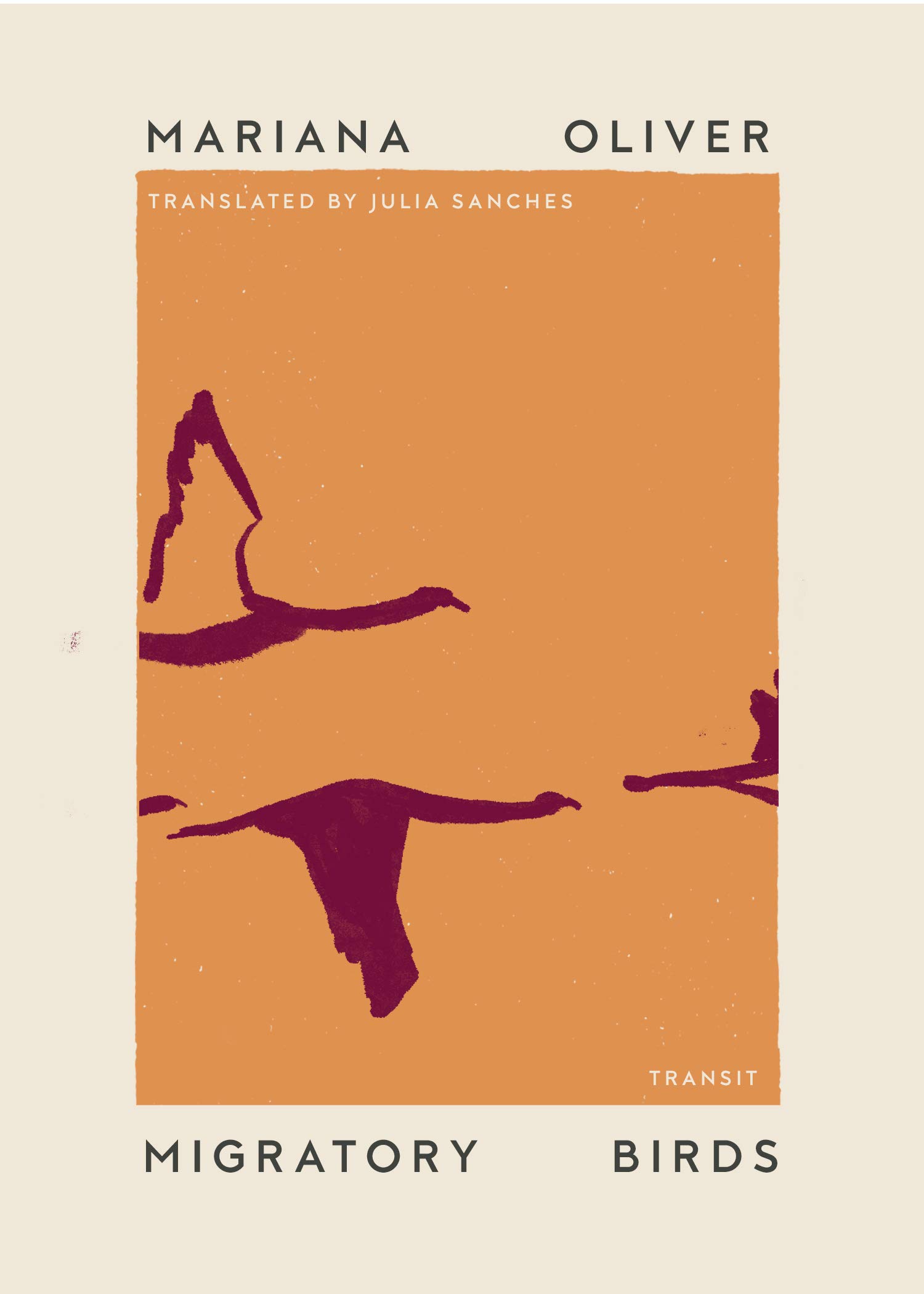

Migratory Birds (Undelivered Lectures series) by Mariana Oliver (tr. Julia Sanches)

Rating: 3.5* of five

The Publisher Says: A sensitive, stunning debut on movement, migration, and loss, in the vein of Valeria Luiselli’s Sidewalks.

In her prize-winning debut, Mexican essayist Mariana Oliver trains her gaze on migration in its many forms, moving between real cities and other more inaccessible territories: language, memory, pain, desire, and the body. With an abiding curiosity and poetic ease, Oliver leads us through the underground city of Cappadocia, explores the vicissitudes of a Berlin marked by historical fracture, recalls a shocking childhood exodus, and recreates the intimacy of the spaces we inhabit. Blending criticism, reportage, and a travel writing all her own, Oliver presents a brilliant collection of essays that asks us what it means to leave the familiar behind and make the unfamiliar our own.

I RECEIVED A DRC FROM THE PUBLISHER VIA VIA EDELWEISS+. THANK YOU.

My Review
:
"A place at once empty and full, Cappadocia inspires bewilderment. Which is why it is useless to try and take in the landscape with only your eyes. Trees are few and far between and sunlight pours mercilessly onto your skin, drenching it." –and–
A man pilots a yellow ultralight across the sky. His name, Bill, Bill, Bill, is the last thing he hears before his feet take wing. All liftoffs are the same, he thinks, a ritual by which we become birds. As the body rises, the mind blots out all sounds and refashions them one by one, as if they existed in isolation. First heartbeat, then breath, then saliva moistening the throat; then the whoosh of air as the ultralight’s wings break it into a white trail.

Prose like this is...fine. In small doses. I hit my maximum dose before the book was over.


Transit Books (non-affiliate Bookshop.org link) charges you $14.99 for the ebook. I might not be thrilled with it, you might be; at least it's not wasted money.

++++++++++++++++++++++++++++++++++++++++++++++++++++++++++++++++


In Bad Company (Sandhamn Murders #9) by Viveca Sten (tr. Marlaine Delargy)

Rating: 2.5* of five

The Publisher Says: Sandhamn Island’s archipelago is a beautiful place to visit. For a mother on the run, it’s the only place to hide in a novel of escalating suspense by Viveca Sten, bestselling author of Still Waters.

Building a case against Andreis Kovač is a risky strategy for prosecutor Nora Linde. A violent key player in Stockholm’s drug trade and untouchable when it comes to financial crimes, he has the best defense money can buy. To topple Andreis’s empire, Nora’s working a different angle. It’s personal. Nora’s critical witness is Andreis’s wife, Mina—if she’ll testify.

Mina has suffered her husband’s rage too long. It’s nearly cost her her life. Still carrying the traumas of the Bosnian War, Andreis can be triggered like an explosive. He must be taken down. And as the trial looms, Mina and her infant son must disappear. The police have found her a safe place to hide on Runmarö Island in Sandhamn’s archipelago. But there’s no shelter from a man as powerful and merciless as Andreis. Especially when he’s being crossed.

His campaign of terror has just begun. He’s prepared to crush anyone who stands in his way: Mina, Nora, and everyone they know and love. Andreis is coming for them. This time, Nora is on the defense.

I RECEIVED A DRC FROM THE PUBLISHER VIA NETGALLEY. THANK YOU.

My Review
: It's time I left the series behind. I was not involved in this one at all, and after finishing it felt no relief, no regret, nothing at all.

It could be comparison bias after The Camino, it could be Bosnian-War criminal fatigue, it could be I'm just tired of Nora...but poke me with a fork, I'm done.

Amazon Crossing (non-affiliate Bookshop.org link) requests and requires $14.95 for a paperback.

++++++++++++++++++++++++++++++++++++++++++++++++++++++++++++++++
++++++++++++++++++++++++++++++++++++++++++++++++++++++++++++++++


This space is dedicated to Nancy Pearl's Rule of 50, or "the Pearl Rule" as I've always called it. After realizing five times in December 2021 alone that I'd already Pearl-Ruled a book I picked up on a whim, I realized how close my Half-heimer's is getting to the full-on article. Hence my decision to track my Pearls!

As she says:
People frequently ask me how many pages they should give a book before they give up on it. In response to that question, I came up with my “rule of fifty,” which is based on the shortness of time and the immensity of the world of books. If you’re fifty years of age or younger, give a book fifty pages before you decide to commit to reading it or give it up. If you’re over fifty, which is when time gets even shorter, subtract your age from 100—the result is the number of pages you should read before making your decision to stay with it or quit.

So this space will be each month's listing of Pearl-Ruled books. Earlier Pearl-Rule posts will be linked below the current month's crop.

++++++++++++++++++++++++++++++++++++++++++++++++++++++++++++++++
++++++++++++++++++++++++++++++++++++++++++++++++++++++++++++++++


An Ordinary Violence: A Novel (58%) by Adriana Chartrand

Rating: 2.5* of five

The Publisher Says: Terrible things happen side by side with the ordinary.

Dawn hasn't spoken to her brother, Cody, since he was sent to prison for a violent crime seven years ago. But when Dawn's seemingly perfect life in the big city implodes, she is forced to return to her childhood home and the prairie city that still holds so much pain for her and her fractured family. Cody is released from prison with a mysterious new friend by his side, and Dawn must follow increasingly sinister leads to uncover their nefarious plans to access a dangerous supernatural network.

As the lines between right and wrong blur and dissolve, Dawn reckons with trauma and violence, loss and reclamation in an unsettling world where spirit realms entwine with the living—and where it is humans who carry out the truly monstrous acts.

I RECEIVED A DRC FROM THE PUBLISHER VIA EDELWEISS+. THANK YOU.

My Review
: "Maybe that's why Violet talks to her, why she can feel a buzzing sometimes, an insistent mechanical whine from somewhere distant that, if she listened hard enough, might turn ou to be the sound of her name, hissing through a hundred thousand alien throats."
I made it all the way to that line before my experiment with #Summerween blew up. Maybe I need actual fall, leaf-changing pumpkin-carving fall, short-day clock-turning fall, to put me in the mood for spooky shenanigans.

Or maybe this just isn't great and I'm done.

Spiderline/House of Anansi Press (non-affiliate Bookshop.org link) asks $18.99 for a paperback.

++++++++++++++++++++++++++++++++++++++++++++++++++++++++++++++++


Accidental Genius: An Oral History of The Room (32%) edited by Andrew J. Rausch

Rating: 2* of five

The Publisher Says: Accidental Genius features intimate and laugh-out-loud commentary from The Room cast and crew, including interviews from its star Greg Sestero.

What a story indeed! A rollicking recollection of experiences from the legendary “so bad it's good” film. This comprehensively chronicled book offers a fascinating glimpse into the cultural phenomenon that brings together die-hard fans and newcomers alike.

Everything you could have possibly wondered about The Room all in one book!

Take a look at Tommy Wiseau's infamous 2003 release through the eyes of the people who made it. Get the low-down on bizarre audition calls, film set antics, and accounts from the very first fans who experienced The Room at its earliest screenings. Also including interviews focusing on the aftermath of the movie: Sestero’s The Disaster Artist, where are they now, and its lasting legacy.

Here you will get a glimpse of how it all began, why it remains popular, and just what audiences still get out of this unusual film that people love to hate.

I RECEIVED A DRC FROM THE PUBLISHER VIA EDELWEISS+. THANK YOU.

My Review:
I thought these were essays on the OTHER bad movie, from 2015, but that one's just called Room. The 2003 excrescence these snippets are about was too ghastly to watch so I really didn't...I heckled and jeered. That was kinda fun, I guess, but not enough to read about the reeking shitpile I've tried to forget seeing.

CLASH Books (non-affiliate Bookshop.org link)
has the effrontery to ask you to PAY for this! $18.95 no less...any edition...I'd laugh if I wasn't so pissed off at being pissed on by that Wiseau...person.

Saturday, August 29, 2026

THE CULTURE OF LIES, last collection of essays I have of Dubravka Ugrešić's to review


THE CULTURE OF LIES
DUBRAVKA UGREŠIĆ
(tr. Celia Hawkesworth)
Open Letter Books (non-affiliate Bookshop.org link)
$9.95 ebook, available now

Rating: 4.75* of five

The Publisher Says: The Culture of Lies is one of the most intelligent and lucid accounts of an appalling episode in history. It shows us the banality and brutality of nationalism and the way that nationalistic ideology permeates every pore of life. Ugrešić's acerbic and penetrating essays cover everything from politics to daily routine, from public to private life.

With a diverse and unusual perspective, she writes about memory, soap operas, the destruction of everyday life, kitsch, the conformity of intellectuals, propaganda and censorship, the strategies of human manipulation and the walls of Europe which, she argues, never really did fall.

Shot through with irony and sadness, satirical protest and bitter melancholy, The Culture of Lies is a gesture of intellectual resistance by a writer branded "a traitor" and "a witch" in Croatia.

I RECEIVED A DRC FROM THE PUBLISHER VIA EDELWEISS+. THANK YOU.

My Review
: A collection of very wise, trenchant, and tendentious essays to cap off #WITMonth.

Shifting from Yugoslav nationality to Croatian was not a seamless process for Author Dubravka. A new passport under a new governing entity does not change the passport holder's identity or thought processes or, dangerously, political beliefs. Dissent is even more dangerous in a newly created state struggling to distance itself from the burdensome and ill-fitting imposed identity and ideology. Author Dubravka didn't fit in when Yugoslav was a political state's demonym, but neither did loads of other folk. "Croatian" as a political demonym is new enough that to dissent from the new ruling class is to risk losing the right to use it. This is where Author Dubravka ended up, an ethnic Croat instead of a Croatian citizen.

Labels don't matter much to me in my white US male's privilege. Unless I insist on bringing my Otherness to the fore, I can simply walk around being an "American," a label that makes me wince at its arrogance. Author Dubravka did not exist in that bubble of certainty. Her identity, dissenter, observer, critic, meant her labeling got complicated quickly in the upheavals of Communism's death throes. The wry tone of these works does not foreground a thing I perceive, possibly that I interpolate, the trauma and pain of losing an identity, a building block of selfhood. It's clear the fact of that loss is central to Author Dubravka's work; she does not wallow or lament but rather observes and analyzes. I still feel an edge of strong emotion despite it not being foregrounded.
I know of a writer colleague who claimed to a foreign journalist that he was ‘the victim of repression’ under Yugo-communism, that his books were banned, and that he had been in prison. That colleague was never in prison nor was he ‘the victim of repression’ and all his books were regularly published. I do not believe that he was lying. Exposed to media brainwashing, terror by forgetting and collective compulsion, my colleague had simply forgotten his personal history, he carried out an unconscious mental touching-up, and in the general context the spoken lie became an acceptable truth. And after all, the foreign journalist had come to hear just such a story, in his Westerner’s head he already carried such a stereotype: the story of a repressed writer in the former communist regime and a happy end in the new, democratic one.
It's not a shouted pain, it's a carefully phrased analysis of trauma's aftermath that shows how very painful it was for all to need to re-craft selves when their world ended. New nationalisms, new canons, new ethnic expressions glorified...all processes we undergo in youth and that are painful enough to live through even in that more mentally agile passage of life; as an older, even an old, person...!
I am no one. And everyone. In Croatia I shall be a Serb, in Serbia a Croat, in Bulgaria a Turk, in Turkey a Greek, in Greece a Macedonian, in Macedonia a Bulgarian… Being an ethnic ‘bastard’ or ’schizophrenic’ is my natural choice, I even consider it a sign of mental and moral health. And I know that I am not alone. Violent, stubborn insistence on national identities has provoked a response: today many young citizens of former Yugoslavia, particularly those scattered throughout the world, stubbornly refuse any ethnic labels.

There is a lot to be learned for us in the US on the subject of nationalism and identity in 2026 that a public intellectual from a disintegrating polity can teach us from the 1990s. Author Dubravka felt, though, analyzed, contextualized for us already. I hope more of us will now absorb and appreciate that gift in our own parlous times.

Wednesday, August 26, 2026

THE CAMINO, Anglophone debut of Dutch-language suspense star


THE CAMINO
ANYA NIEWIERRA
(tr.Eileen Stevens)
Simon & Schuster (non-affiliate Bookshop.org link)
$14.99 ebook, available now

Rating: 4.5- of five

The Publisher Says: From the Netherlands’s most popular crime writer, a literary thriller following a woman who walks the Camino de Santiago, searching for answers about her husband’s death.

Forty-four-year-old chocolatier Lotte Bonnet has been living happily in South Limburg for years with her husband Emil, a former refugee from Bosnia. But when Emil unexpectedly dies by suicide while walking the Camino de Santiago, or Way of Saint James, Lotte is devastated.

Shocked and confused, Lotte resolves to follow Emil’s exact path on the Camino one year later, hoping for answers, or at least insights into what could have compelled him to take his own life. While walking the arduous trail through central France, passing idyllic villages and meeting fellow pilgrims, Lotte’s thoughts are also elsewhere, in Sarajevo, as she learns the terrors of a war and shocking secrets about her husband’s identity.

Inspired by the natural beauty that surrounds her, forming new friendships, and possibly a romantic connection on the Camino, Lotte is distracted as the trail grows more treacherous, and as it becomes clear someone is following her, someone who does not want her to know the truth.

Fans of Louise Penny’s Inspector Armand Gamache will be delighted by Lotte’s easy charm and enthralled by the revelations on her journey. Anya Niewierra’s blockbuster mystery The Camino has taken Europe by storm and is finally available in English for the first time.

I RECEIVED A DRC FROM THE PUBLISHER VIA NETGALLEY. THANK YOU.

My Review
: I was dazzled.

It wasn't always *comfortable* reading but it was always to-the-point, even when it felt like it might not be. Every detail does indeed serve a purpose. There are dreadful deeds done in the past from the framework of the novel, that are definitely not for the fainthearted. I *strongly* discourage readers whose tolerance doe not extend to child harm not to read this book at all.

I'm not at all clear that the story's a thriller by my own lights. I'd call it an historical mystery/suspense novel that examines recent European history from a grieving woman's perspective; Lotte's decision to go on the Santiago de Compostela pilgrimage as a means of discovering her late husband Emil's secrets felt...forced...until I sank into the full implications of pilgrimage.

Her discoveries about her husband of a quarter century are, well, intense and not at all expected. It's a truth in any intimate relationship that there are unspoken things; mostly unspoken because they're not really important.

Not this time.

The Spoiler Stasi being among the nastiest of hazards on the internet, I won't detail the discoveries she makes; the CWs will be enough to warn the sensitive. I began my read aware of a few details so I was prepared, but I reiterate for clarity that you must heed the CWs.

The issues that arise as Lotte retraces the Way of St, James in the present are treated in a way that was very suspenseful...I worried for her safety from the time she decided to undertake her parallel pilgrimage, since Emil's suicide was at best suspicious. The bad stuff that happens is very well designed, in that it makes the stakes of her rash decision that much more obvious as each instance of near-miss violence more obviously targeted.

The why that we eventually learn for these events is fully explanatory. It changes the game for Lotte and for the reader as we learn why Emil's secrets and his lies are revealed to Lotte, and why that revelation is so deeply disturbing to the unseen others on her trail following his trail.

If the CWs make you nervous, read the book, because the resolution/revelations are well worth it. If they leave you deeply upset merely reading the words, do not touch the book at all.

It proved to me that Author Niewierra deserves her European fame as a creator of suspenseful stories.

Saturday, August 22, 2026

DREAMS OF AYN ARA, never to forgive! never to forget!


DREAMS OF AYN ARA
SARA ABOU GHAZAL
(tr. Katharine Halls)
The Feminist Press (non-affiliate Bookshop.org link)
$17.95 ebook, available now

Rating: 4* of five

The Publisher Says: In Stockholm, Zein al-Abedin shivers, far from the warmth of simmering revolt years ago in Shatila. In Paris, his son Nidal toils in solitude, ignoring his father’s phone calls and dousing his desire for Bassam back in Lebanon. Salwa, refusing to leave Beirut for Sweden, digs backward in time through Facebook and discovers an unlikely channel to the one place in the world she can’t go: Ayn Ara, the Abu Sukkar family’s ancestral home in Palestine.

Invoking the long wake of the 1948 Nakba and its displacement of 750,000 Palestinians from their homes, Sara Abou Ghazal webs the worldwide, timewide scatter of the Abu Sukkar family. At every turn, Ayn Ara disrupts their otherwise “normal” days in new terrains through memory, pain, and strange magic—culminating with a journey into both the past and a parallel present of Zionist settler violence.

Be it through a ghostly return to the brutal event of the Nakba, or grandmother Nijmeh’s psychic drift from land to no-land and back, Dreams of Ayn Ara portrays time as a false phenomenon for people ripped from their rightful place—and points to fissures in the fragile reality that denies Palestine to Palestinians.

I RECEIVED A DRC FROM THE PUBLISHER VIA EDELWEISS+. THANK YOU.

My Review
: Chilling, sobering, appalling, revolting.

Under 150pp telling most of a hundred years of historical dispossession, repression, genocide sounds...and is...ambitious, requiring time-jumps and dreaming visitations and other such narrative flummery that distracts from the core of the story: My home was forcibly taken from me. I do not have access to my family's source of identity. I live in a world without my roots, epiphytically resting on the place I am without a way to reach into it and root myself in welcoming soil.

It is ever and always the problem of the Othered. It is the reason ghettos exist, for the inhabitants; the sounds and smells of home plopped atop foreign soil. For the foreign-soil owners, it's crowd control, easy honeytrapping concentration without the bad optics of the word "camp." Not like this Palestinian family in these pages escaped the spaces where the word "camp" was le mot juste for what they were confined to. It's appalling that those confining them there were themselves the survivors or children of survivors of the same treatment....

Stories like this are proof that generational trauma is real. Damage done in malice survives and thrives and metastasizes and entumors its poisons like the body does when protecting itself. Stories like this are the pearl versions of the tumor-forming process, wrapping severed bits of essence in layer upon layer of nacreous story.

It's not long, it's not exhaustively researched and fact-checked. It's the living memory of a family victimized to redress wrongs done by others, done to strangers, and made into their problem by colonizers. Tale as old as time, then.

Sunday, August 9, 2026

STEFAN ZWEIG'S PAGE: LETTER FROM AN UNKNOWN WOMAN and Other Stories, & ENCOUNTERS AND DESTINIES: A Farewell to Europe


LETTER FROM AN UNKNOWN WOMAN and Other Stories
STEFAN ZWEIG
(tr. Anthea Bell)
Pushkin Press Classics (non-affiliate Bookshop.org link)
$7.99 ebook, available now

Rating: 4.5* of five

The Publisher Says: Stefan's Zweig's Letter from an Unknown Woman and other stories contains a new translation by the award-winning Anthea Bell of one of his most celebrated novellas, Letter from an Unknown Woman, the inspiration for a classic 1948 Hollywood film by Max Ophüls, as well as three new stories, appearing in English for the first time.

A famous author receives a letter on his forty-first birthday. He doesn't know the sender, but still the letter concerns him intimately. Its story is earnest, even the story of a life lived in service to an unannounced, unnoticed love.

In the other stories in this collection, a young man mistakes the girl he loves for her sister; two erstwhile lovers meet after an age spent apart; and a married woman repays a debt of gratitude. All four tales, newly translated by the award-winning Anthea Bell, are among Zweig's most celebrated and compelling work-expertly paced, laced with empathy and an unwaveringly acute sense of psychological detail.

I RECEIVED A DRC FROM THE PUBLISHER VIA EDELWEISS+. THANK YOU.

My Review
: It's the fate pf a popular, I mean with readers more than critics, writer to fall out of favor. Without critics in one's corner, the voice of the people who voted with their time and their treasure to engage with one's stories gets ignored.

This was the public's loved one Zweig's fate. Modern critics don't like him either, one saying he "...tastes fake...the Pepsi of Austrian writing." Ouch.

It's true to my experience of his writing that there's no deathless quality the I can discern, the sort of intense transporting intensity I experience in Thomas Mann or Kafka. At his most eloquent Zweig brings me an appreciative lightness of spirit; at his most Germanic he's pissy, irritable, and unbearably portentous. On balance he's the precise kind of writer who becomes popular because his (very real) talent does not have threatening depths. It seems a shame to me the world that loved him best, the US and Brazil, has left his memory in a drawer. Not a great, but still a good, storyteller, it feels to me like Pushkin Press Classics is doing good work to keep bringing him to our notice.

In my usual, fussy (so I'm told) fashion, the four stories will be dealt with by the Bryce Method.

Letter from an Unknown Woman is unsettling, uneasy-making; a woman writes to a famous author in terms of the greatest, most appreciative intimacy...but he has absolutely not one clue who she is. It is clear from the terms she's using for him that there was a legitimate connection between them. It is chilling how deep this connection truly is, given his unawareness of her as a person. (It could have something to do with her age at their first meeting....)

It's certainly true in my own life this kind of connection has formed, so I might be a bit more in tune with the awfulness of it. It ends a damn sight more tragically than anything like I've ever been a party to, and uses what would then be a current event...the 1918 flu pandemic...as both a resolution and an intensification of how terrible his guilt truthfully is.

A 1948 film was made of Letter from an Unknown Woman starring Joan Fontaine and Louis Jourdan that did not slap a happy li'l bow on its end. It's been preserved for posterity by the National Film Registry, probably in part for that courageous act of honesty in preserving the source material's more nihilistic intent (despite much jiggery-pokery to satisfy the Hays Code). It would be a terrific adaptation to make, faithfully this time, in the 21st century. all five stars

A Story Told in Twilight explores the first-kiss mishegas of a very ordinary boy. It happens in circumstances that, if you squint, might possibly lead to the, um, inattention and subsequent mistaken identity that plague this most commonplace rite of passage.

The translation's deft, the language felt like the entire enterprise was fun for the translator, but a more outdated premise would be tough to conjure in 2026. Not memorable, not terrible, not much of anything really. 3 stars

The Debt Paid Late looks at the running theme of missed/mistaken connections in these stories at a more mature angle. Like the old saying about "even small men cast big shadows at sunset" comes the accidental meeting of a woman with an old man who once meant everything to her. Because the story is about older people who reconnect from a genuine, if squicky by today's lights, connection it involved me more. Not a lot more, but more. 3.5 stars

Forgotten Dreams happened to me. It was as unpleasant as Zweig writes it. If you put yourself back into the path of your past self you will not come out unscathed. No man should ever expect the women from his past to spare his feelings, I'll tell you that for free. 3.5 stars

++++++++++++++++++++++++++++++++++++++++++++++++++++++++++++++++


ENCOUNTERS AND DESTINIES: A Farewell to Europe
STEFAN ZWEIG
(tr. Will Stone)
Pushkin Press
$13.99 ebook, available now

Rating: 4* of five

The Publisher Says: A new selection of essays by Stefan Zweig: tributes to the great artists and thinkers of the Europe of his day

Stefan Zweig was one of the twentieth century's greatest authors and a tireless champion of freedom, tolerance and friendship across borders. Encounters and Destinies collects his most impassioned and moving tributes to his many illustrious friends and peers: literary, philosophical and artistic luminaries from across the Old Europe that Zweig loved so much, and which he grieved to see so cruelly destroyed by two world wars.

Including pieces on Rainer Maria Rilke, Marcel Proust, Sigmund Freud, Maxim Gorky and Arturo Toscanini, this essential collection is also Zweig's tribute to the ideal of friendship: an ideal he clung to as the world he knew was torn apart.

I RECEIVED A DRC FROM THE PUBLISHER VIA EDELWEISS+. THANK YOU.

My Review
: "Gorky" means bitter? I'd always known Peshkov chose a pseudonym, who wouldn't with a collection of ugly spitty sounds like "Peshkov" staring you down, but "bitter?" Wow. A lot of details I'd forgotten I noticed clicked into place in my long-ago readings of Gorky...The Lower Depths, The Artamonov Business...suddenly make all the sense in the world.

Zweig knew the great and the good of the Interwar Period wherein he spent the bulk of his life. He would've been a lot of fun at a dinner party because, while it does not seem that he had a bitchy bone in his body, he had a very retentive memory and a strong desire to keep the friends he made so he heard a lot about them.

I am hard-pressed to imagine anyone who does not know who John Drinkwater was without the aid of Wikipedia will be inclined to pick up a book of musings on people like Toscanini, Arthur Schnitzler, and Emile Verhaeren. (For someone who doesn't like poetry, I sure know who a lot of poets are.)

If for no other reason than to bask in the glow of warm, appreciative writing by a friend who treasured friendship writing about his friends, this is a Zweig book to immerse yourself into. It brought me up short to realize how much the culture of that time formed my sense of aesthetics. I still revere Remarque and Joyce. I think many serious readers do. But it goes deeper, forming a bedrock sense of what is "worthy" in the art world, and that interested me to realize.

So here's Zweig, eighty-four years dead and mostly forgotten, still teaching a now-old man about himself. Published again and again after being forgotten for decades.

I hope there's an afterlife just so he can know it was, in fact, all worth it.

Thursday, August 6, 2026

HILDA HILST'S PAGE: #WITMonth DELIGHT THE OBSCENE MADAME D; pervy LETTERS FROM A SEDUCER


THE OBSCENE MADAME D
HILDA HILST
(tr. Nathanaël, & Rachel Gontijo Araujo)
Pushkin Press Classics (non-affiliate Bookshop.org link)
$11.99 ebook, available now

Rating: 4.75* of five

The Publisher Says: A wickedly funny work of depraved genius by one of Brazil’s most radical twentieth-century writers; imagine the Marquis de Sade as written by Clarice Lispector

An electrifying masterpiece by one of modern Brazilian literature’s most significant and controversial writers, Hilda Hilst takes us into the disorder and beauty of a mind restlessly testing its own limits.

Every month I ingested the body of God, not in the way one swallows green peas or agrostis, or swallows swords, I ingested the body of God the way people do when they know they are swallowing the More, the All, the Incommensurable, for not believing in finitude I would lose myself in absolute infinity...

The Obscene Madame D tells the story of Hillé, a sixty-year-old woman who has decided to abandon conventional life and spend the rest of her days in contemplation in a recess under the stairs. There, she is haunted by the perplexity of her recently deceased lover, Ehud, who cannot understand her rejection of common sense, sex and a simple life in favour of metaphysical speculations that he considers delusional and vain.

In a stream-of-consciousness monologue that’s part James Joyce, part Clarice Lispector, and part de Sade, Hillé speaks of her search for spiritual fulfilment from a space of dereliction, as she searches for answers to great questions of life, death and the relationship between body and soul.

I RECEIVED A DRC FROM THE PUBLISHER VIA EDELWEISS+. THANK YOU.

My Review
: Wow. *fans self*

Horny, thy name is Hillé. No wonder poor ol' Ehud is (it would seem) grouchy about being dead and about Hillé's decision to take herself into seclusion and contemplate The Divine. Saint Teresa of Ávila got nothin' on her! Observant, intelligent, philosophical, self-reflective...all apply to both women. Such a waste for a pervy old ghost/revenant/remnant.
"You wear a mask, love , a livid and violent mask, to look at you is to penetrate into the vortex of nothingness, may your silence make itself mine and we’ll wander together in a lacunous vastitude, that’s why I speak, speak to exorcise you, that’s why I work with words, also to exorcize myself, that the bitterness of the abysses may cease, that may break in this tide of phonemes, of syllables, that a light may break, exempt of anguish it’s best to be quiet when your name is passion."

In under 100pp, Hillé does more to demonstrate the primacy of sensual awareness as a motivating factor in every mode of life than Freud's entire all-too-male œuvre. It is a work where the images, the words used in forming them, the events described by them, the colors smells sensations all evoke the kind of sexual awareness of the world that slots in with the saint's immanent experiences of her god.
I don't understand the body either, that caltrop, nor the bloody logic of days, nor the faces that stare me down in this village in which I live, nor what are a house, a concept, what legs are, what is coming and going, toward where and what, Ehud, what these old women are, the howls of childhood, these spent men, what do the fools think of themselves, the children, what is thinking, what is clarity, the sonorous, what is sound, a trill, a cry, a howl, what's a wing uhn?
What happens in these pages is alchemical, psychological simmering and then the transubstantiation of breakdown breaking fracturing into insight:
Dross, yes, the attempt to compose a speech without knowing anything of its beginning nor its end, nor why the necessity for this speech, why the necessity to try to situate oneself, which amounts to attempting to remain clutching a rope over the abyss and without even knowing how it is that one wound up there, nor whether one ought now to move to the right rather than the left, around the fog, bellow a roar, or above it? water? voices? ships? I am reconstituting sophisticated evenings, politics, duties, a sociology of future, a being here, they ask me, kindred with the world, and acting, and authors, citations, foaming verbosity, the ear hearing itself foremost but responding to the people with elegance propriety care as though in fact it had listened to people, theatre, all theatre
I know a lot of y'all don't like long quotes and/or don't see how the quotes I've selected are connected to my ideas in the review. I put them in less and less often because of that feedback.

Here is my last quote from this remarkable fever-dream of a story. It is a summation of life as lived inside a human body. It looks at the processes proceeding all unseen, invisible, hidden and covered up because they're ugly, because to be ugly is terrible and shameful and not to be shared:
Animals, say, why do we kill them? To eat. But eating is abominable, no? All that stuff going down the tube and later becoming mass and even later shit. Close your eyes and try to imagine your body inside. Wriggling, blood. Take the microscope. Ah, not me. What a thing, flesh, nails, hair, and such colors in there, purplish-red. Look at yourself. Where are you now? I'm looking at my stomach. It's horrible Ehud. And you? I'm looking at my lungs. They dilate, compress. Everything enters into me, everything goes out. There's nothing that only goes in? No. And God? God enters and goes out, Ehud? I don't know about that. The priest says that God is inside the heart. So, look at yours, see if it's there, inside. I'm lookin'. Is it? No. Let me listen to your heart. Lord, how it beats!
...and realize Ehud is not alive, a woman in psychological distress is sharing these gobbets of thought and powerfully phrasing the offal in her mind to address it to a man who was but is not.

A deeply, enfoldingly, humanely beautiful story of life and need and longing and love. Profound. Moving. So short it's one long sitting of a Sunday afternoon read. I've left Madame D and her Ehud a warmer, more accepting soul.

Also horny.

+++++++++++++++++++++++++++++++++++++++++++++++++++++++++++++++


LETTERS FROM A SEDUCER
HILDA HILST
(tr. John Keene)
Pushkin Press Classics (non-affiliate Bookshop.org link)
$12.99 ebook, available now

Rating: 4.25* of five

The Publisher Says: A grand, perturbing erotic novel in which the wealthy, amoral Karl records his sexual life and search for meaning in letters with a surprising legacy

This epistolary novel tells the story of Karl, a wealthy, amoral and erudite man who records his daily life in a series of 20 letters to his sister Cordelia. She is cloistered and chaste, but the letters are wildly promiscuous—not just in their explicit sexual content, which have earned the novel the epithet ‘pornographic’, but in their form. Ranging in style and register from modernist fragments worthy of James Joyce and Samuel Beckett, to letters that could have been penned by Enlightenment libertines like Choderlos de Laclos and the Marquis de Sade, the letters make up a polyphonic text that pushes the boundaries both of fiction and of decency.

The novel—a standalone masterpiece which originally appeared as part of a Brazilian tetralogy—changes form again partway through, when the indigent poet Stamatius finds Karl’s record of his erotic adventures in a trash can, and begins to write stories based on what he reads, and then to break down those stories into even briefer fragments. Karl’s letters inspire Stamatius’ writing, and their narratives and identities become ever more fragmented, until we begin to doubt whether they are truly separate people. What unites them is an abundantly lewd imagination and a fantastically creative relationship to the greatest seducer of all: language.

I RECEIVED A DRC FROM THE PUBLISHER VIA EDELWEISS+. THANK YOU.

My Review
: Straight-people sex *shudder* in astoundingly intense, deeply evocative flashes, fragments, and impressionistic sweeps of imagery. Lovely writing, the imagination behind these pieces is one that gets far, far too little attention in Anglophone readership.

It is going to offend prudes. It will genuinely repulse people who do not like the bodyness of sex. For the rest of us, it's aspirational; it proves the largest human sex organ is the brain. It is also the most important sex organ. The way these bits and moments work is in a frame that might make some unwilling to read the work at all: Karl, a rich, bored jerk writes to his sister about his bedroom gymnastics in detail. It kept me away from the read until, for #WITMonth, I had to become Stamatius...the starving artist whose sections of narrative are no less erotically charged but because he's impoverished it's okay (?...no more sense made here than Karl's wealth TBH), and he's, um, not quite so...he's free-form let's say.

Highly literary porn. It's the kind of "story" one associates with those old-timey one-handed reading letters from "real readers" magazines (do those still exist, or is the advent of streaming porn to blame for another cultural shift?) that kinda petered out when the writer'd uhh finished their thought.

No-plot all-vibes readers will love this little novella-length piece. Those who need an actual crafted narrative aren't really likely to enjoy it. And if reading about the juice and friction of the body in congress with others bothers you, click away, turn the corner, go wash something.

Sunday, August 2, 2026

JEAN GIONO'S PAGE: Fragments of a Paradise & Occupation Journal & Ennemonde


OCCUPATION JOURNAL
JEAN GIONO
(tr. Jody Gladding)
Archipelago Books (non-affiliate Bookshop.org link)
$7.99 ebook, available now

Rating: 4.5* of five

The Publisher Says: A captivating literary and historical record, Jean Giono's Occupation Journal offers a glimpse into life in collaborationist France during the Second World War, as seen through the eyes and thoughts of one of France's greatest and most independent writers.

Written during the years of France's occupation by the Nazis, Jean Giono's Occupation Journal reveals the inner workings of one of France's great literary minds during one of the country's darkest hours. A renowned writer and committed pacifist throughout the 1930s—a conviction that resulted in his imprisonment before and after the Occupation—Giono spent the war in the village of Contadour in Provence, where he wrote, corresponded with other writers, and cared for his consumptive daughter. This journal records his musings on art and literature, his observations of life, his interactions with the machinery of the collaborationist Vichy regime, as well as his forceful political convictions. Giono recounts the details of his life with fierce independence of thought and novelistic attention to character and dialogue.

Occupation Journal is a fascinating historical document as well as a unique window into one of French literature's most voracious and critical minds.

I RECEIVED A DRC FROM THE PUBLISHER VIA EDELWEISS+. THANK YOU.

My Review
: Knowing that these quotidian topics of no great interest are Author Giono's middle-of-WWII maunderings while his pacifist life was under the Vichy apparatus of Nazi occupation's close scrutiny makes them fascinating. It's a universal truth that life goes on, kids need clothes and meals and trips to the doctor. Author Giono navigates his way around every obstacle with his money and his persistence and his connections. Being in the toils of legal proceedings for his well-documented lifelong pacifism meant he was never a serious threat who needed close custody. Left to read and write, though subject to censorship, Author Giono writes unselfconsciously in these journal pages (always intended to remain private) of his process as a writer, his frank assessment of other writers' work, and the people of the village of Contadour.

It reminded me that the evergreen thought experiment "whatever you're doing now is what you'd be doing under Nazi occupation" makes one stop short and think hard for a reason. Author Giono took his privilege as a reason to spread the good fortune around: he never has any cash, and owes the government a pile of money, all because he's supporting his whole family...nine people in total...as well as bankrolling the escapes of those who are at lethal risk from that government he owes so much money to.

Using "their" money to keep "them" from committing murder against people whose morals he shared. Full marks, sir. And he did not stop there. He completed six novels (translated another...oh, there were plays too!) during the German occupation. Author Giono was a truly inspiring example of how to live a morally good life in bad times and under dark circumstances.

++++++++++++++++++++++++++++++++++++++++++++++++++++++++++++++++


FRAGMENTS OF A PARADISE
JEAN GIONO
(tr. Paul Eprile)
Archipelago Books (non-affiliate Bookshop.org link)
$13.99 ebook, available now

Rating: 3.5* of five

The Publisher Says: “Giono’s prose is a singularly fine blend of realism and poetic sensibility.” — The Washington Post Giono’s very own Moby-Dick, a sensational maritime journey that follows a crew inwards on a spiritual tale of evocative sea-glimpses

An allegorical critique of modern civilization and the damages of war, Giono’s oft-overlooked seafaring tale sweeps the reader along a narrative as poetic and undulating as the wind, tacking between the sea’s mysteries and the intricacies of the men’s conversations and inner thoughts as they attempt to grasp the sensory reality around them.

“I no longer have any interest in living under the conditions that this era allows,” writes the Captain of L’Indien, a ship whose radio remains packed in a crate in the hold. The men aboard won’t be needing it; they have no interest in connecting with the world of ordinary men. With enough provisions to last them five years, they set sail in July of 1940 for the South Seas, leaving civilization behind in search of the unknown.

Hastening onwards, Giono’s men steer deeper into themselves, seeking a purpose beyond the “world in upheaval” they left behind—a moving and spiritual work written by one of Europe’s most ardent 20th-century pacifists.

A sensational novel that delves into the unknown reaches of the sea and soul, perfect for readers seeking a poetic escape that challenges the political and social status-quo.

I RECEIVED A DRC FROM THE PUBLISHER VIA EDELWEISS+. THANK YOU.

My Review
: Really, do I even need to say it?

This read was a beacon of psychic coolness in a summer beset by wildfires, smoke particles, and the looming, ugly threat of super-El Niño to come with its heat and its drought. It's beautiful, as one would expect from a writer of Author Giono's stature, sentences making images that endure on the eye the nose the ear of the mind as the men on this sailing ship leave their families and friends behind to fight their war, rebuild their world, however they like.

No one who leaves the world does so without leaving others behind.

It's beautiful until the thought, "you have provisions for FIVE YEARS and you left a literal WAR ZONE to escape into a cosmic search for love, truth, and beauty?!" hits.

Stay there and use that magical power to feed hungry wounded orphaned victims.

Yes yes yes, it's a fable, an unreality meant to instruct and to offer guidance on one's search for Meaning, all very well. Author Giono was a pacifist who was punished for opposing the Vichy regime...see above for his journals in review...but this kind of navel-gazing is for the time leading up to war, in an attempt to forestall the slide; this tale appeared in 1948, as the rebuilding of the continent was gathering steam. That was the moment to support peaceful action not hightailing it off to sea to have cool adventures.

Anyway. Beautiful sentences, we're not rebuilding stuff (though we should be), so read and enjoy.

+++++++++++++++++++++++++++++++++++++++++++++++++++++++++++++++


ENNEMONDE
JEAN GIONO
(tr. Bill Johnston)
Archipelago Books (non-affiliate Bookshop.org link)
$12.99 ebook, available now

Rating: 4* of five

The Publisher Says: One of the final novellas by the acclaimed French writer Jean Giono, Ennemonde is a fierce and jubilant portrait of a life intensely lived

Ennemonde Girard: Obese. Toothless. Razor-sharp. Loving mother and murderous wife: a character like none other in literature. In telling us Ennemonde’s astounding story of undetected crimes, Jean Giono immerses us in the perverse and often lurid lifeways of the people of the High Country, where vengeance is an art form, hearts are superfluous, and only boldness and cunning such as Ennemonde’s can win the day. A gleeful, broad sardonic grin of a novel.

"Roads move cautiously around the High Country..." So begins the story of Ennemonde, but also of her sons, daughters, neighbors, lovers, and enemies, and especially of the mountains that stand guard behind their home in the Camargue. This is a place of stark and terrifying beauty, where violence strikes suddenly, whether from the hand of a neighbor or from the sky itself.

Giono captures every wrinkle, glare, and glance with wry delight, celebrating the uniquely tough people whose eyes sparkle with the cruel majesty of the landscape. Full of delectable detours and startling insights, Ennemonde will take you by the hand for an unforgettable tour of this master novelist's singular world.

I RECEIVED A DRC FROM THE PUBLISHER VIA EDELWEISS+. THANK YOU.

My Review
: Not remotely comfortable reading, Giono using this female body's looks and size as commentary on her character and morality. Perfectly ordinary in its time; sixtyish years ago people said terribly cruel things about those larger than, or in any way divergent from, "average."
The young women, while they're still maidens, possess a fruit-like beauty; then the beauty bursts, and fragments of it can be seen in their children. Truly nothing remains of these women's former state. Some Venuses turn into fearsome monsters; almost all of them have seventeenth-century mouths, toothless or, even worse, with a handful of loose teeth on which they suck. It's pretty ghastly. But their simple-minded appearance shouldn't be taken at face value. Almost all of them are commanding women. With their back to the wall they achieve wonders. People still remember Ennemonde Girard.
It does not hit the same register in 2026 as it did in 1968, when it first appeared. It feels false, hostile, spoken for effect in the #MeToo world.

There's probably a good reason for that: the French are not so terribly far from the US despite their fantasies:
The tool that people around here have most often in their hand is a shotgun, whether it’s for hunting or for, let’s say, philosophical reflection; in either case, there’s no solution without a shot being fired...
–and–
The Protestants of these parts had since time immemorial protested against Protestantism. They’d ended up worshipping anything at all, so long as the anything at all demanded intolerance. Crown of thorns were consumed in every household, at every meal. Religion was a sort of commerce in which discomfort was always preferred to joy, scorn to pleasure, and ultimately vice to virtue.

"These parts" are Author Giono's native Provençal mountains, where he lived his life.

It's not so weird after all, fellow intolerant lefties; humans been MAGAts a long damn time.

I can't claim to love this story, I can't tell if it's because I'm a judgmental old man or I'm just a product of the times that brought this novella (150pp barely) into being, holding its subjects up for a cold-eyed considering examination. Author Giono does not vouchsafe a verdict; I do.

Me no likee.

Saturday, August 1, 2026

JULY 2026 IN REVIEW & August 2026 is #WITMonth

Amplifying voices: celebrating women in translation month | ProZ.com, via LinkedIn
JULY IN REVIEW

A month of wonders was had by all. Forty-one reviews written, fifty-three DRCs received; twenty-three of those reviewed in their publication month. That's 43%! Could not be happier with that. Of the remaining eighteen reviews, one was a five-star review of a 2020 novel from New Vessel Press: The Piano Student by Lea Singer, translated from German by Elisabeth Lauffer. I five-starred Beginning Middle End by Valeria Luiselli, and all but five-starred Ada by Mark Haber; Unsayable: A Life in Writing by Michael Cunningham; The Sixth Nik by Pulitzer-winner Daniel Kraus; Event Horizon by [[Balsam Karam]]; and shockingly Grief Eater, lesbian zombie story by [[Emma Osborne]].

What a month! That's better than some years (notably 2018, only 65 reviews blogged the whole year)! While there were disappointments, they weren't Biblical disasters like The Dove and the Dragon: A Cultural History of the Apocalypse. *shudder*

On to August, with a high heart and a happy soul. Women in Translation Month is an August staple on my blog. Entries start in 2014. I'm always delighted to tell all y'all about this twelve-year tradition of shouting out the incredibly broad and wildly varied works by, about, and translated from every language and country I can think of, by women. Working in multiple languages to represent as accurately as possible the artistry of another person for the reading joy Anglophone readers is truly an act of the greatest generosity and highest cultural importance. Open Letter Books' site says, "Women in Translation Month is always an exciting time to discover, read, discuss, and celebrate books by women from around the world. It was created by Meytal Radzinski back in 2014, and has since spawned numerous articles, events, and even the Warwick Prize for Women in Translation." And WomenInTranslation.org, the Mothership if you will, says it most authoritatively:
"WITMonth—aka Women in Translation Month—is an annual celebration of women writers from around the world, writing in languages other than English. Started by Meytal Radzinski in 2014, WITMonth has grown to become a staple of the online literary community, as well as a prominent presence in independent bookstores around the world. Every August, readers from all continents around the world (except Antarctica, but we’ll get those penguins yet!) gather in spirit (and sometimes in person) to read, review, and discuss works by women writers in translation. The idea is to spread the word about the Women in Translation project at large, and promote individual women writers in translation specifically. Follow #WITMonth on Twitter, Instagram, Booktube, and across the world!" I'm planning to write at least thirty-one full reviews of works translated by women this month. Even if they're translating men's writing. (I've been told before that this is "not in the spirit of the celebration" and I'm "diluting the intended impact of the hashtag," both of which snarky stupidities I have very consciously and intentionally ignored. This will not change.)

As an act of celebration I'm including a few special discounts I know publishers are offering on parts of their lists below with all the relevant details and the links to their sites. I'll add to these links as and when I come across more:

SEVEN STORIESThrough the end of August 2026, take 25% off all currently available translated books by women authors! Please note that all forthcoming books are available for preorder at 10% off. https://sevenstories.com/blogs/385-celebrate-women-in-translation-month-2026

TRANSIT BOOKS 30% off all titles by women in translation through the end of August with the discount code WITMONTH. https://www.transitbooks.org/postscript/women-in-translation-month

OPEN LETTER BOOKS 40% discount on all Open Letter print titles written by women, along with any book translated by a woman, for the whole month of August. Discount applied automatically at checkout. https://www.openletterbooks.org/collections/women-in-translation-month

COLUMBIA UNIVERSITY PRESS Use coupon code WITM at checkout to save 20% on your purchase. https://cup.columbia.edu/promotions/women-in-translation-month/women-in-translation-booklist/*
More, I hope, to come below:

SYRACUSE UNIVERSITY PRESS Women in Translation Month celbration: 40% off all translations. Offer valid through September 15, use discount code 05FAIR26 at checkout. https://press.syr.edu/supressbook-subject/literature-in-translation/

WORLD EDITIONS offers a 40% discount on any orders (US, UK & Canada) of our WIT books. Please use code wit26 at checkout if you'd like to take advantage. https://worldeditions.org/home-4/books-written-translated-by-women/

Friday, July 31, 2026

THE PIANO STUDENT, fictionalized gay love story from the scariest part of the 1930s


THE PIANO STUDENT
LEA SINGER
(tr. Elisabeth Lauffer)
New Vessel Press (non-affiliate Bookshop.org link)
$10.99 ebook, available now

Rating: 5* of five

The Publisher Says: The Piano Student centers on an affair between one of the 20th century’s most celebrated pianists, Vladimir Horowitz, and his young male student, Nico Kaufmann, in the late 1930s.

As Europe hurtles toward political catastrophe and Horowitz ascends to the pinnacle of artistic achievement, the great pianist hides his illicit love from his wife Wanda, the daughter of the renowned conductor Arturo Toscanini. The affair is narrated by Kaufmann in the 1980s to another music devotee, who comes to him enchanted by Schumann’s composition Träumerei and awakens memories of the thwarted relationship. Kaufmann is spending his final years playing in small-time Zurich bars, never rivaling his teacher’s musical mastery and rapturously received concerts.

Based on unpublished letters by Horowitz to Kaufmann that author Lea Singer herself discovered in Switzerland, the novel portrays the anguish that the acclaimed musician felt about his never publicly acknowledged homosexuality and the attendant duplicity of his personal life. It's a riveting and sensitive tale of musical perfection, love, and longing denied, with multiple historical layers and insights into artistic creativity.

I RECEIVED A DRC FROM THE PUBLISHER VIA EDELWEISS+. THANK YOU.

My Review
: Given the times and the stakes, Horowitz staying closeted was a solid decision to make. If his wife didn't see a golden opportunity in his necessary secret, I'll kiss a pig. But being "out" as we twenty-first centuryans conceptualize it would've been career...possibly literal...suicide.

Suicide's a major part of this work. Do not pick it up if you are in distress, or if ongoing ideation around ending your own life is an issue for you. This review will not be delving more deeply into the topic.

This novel polarizes readers. It's more a stream of consciousness work than a standard narrative. It does not spoon-feed readers, it expects you'll be paying attention to the details well enough to follow or at least be able to figure out who is speaking, whose head you're in, or whose PoV is dominant at that moment. For those not looking for a read of that nature just now, it's best to pass it by.

As a story this is a pretty ordinary one: lovers must hide from the world because the world does not and would not accept their love as valid or acceptable. This moment in history we in the Anglophone world are seeing how much that story resonates with readers and viewers with the wild ascendancy of Heated Rivalry. I do not recall anything like this level of investment or passion for a yearning-romance story since Moonlighting in the 1980s. I hope it does not fizzle like that show did...or this excellent novel has done in the past six years.

I'm certain that the author's choices of narrative complexity were deliberate and considered. The framing device of Robert Donati avoiding the consequences of a decision he made but regretted meeting Nico Kaufmann and exchanging stories is a well-worn one, only rescued from triteness by its stream-of-consciousness presentation. It establishes the psychological safety of baring one's soul to a stranger as the reason we're hearing the stories at all. Considering the pseudonymous author discovered the Kaufmann story in letters buried in an archive the device is very apt, reflective of her own presumptive experience of discovery.

The unbearably sad life of a man who does not control his own destiny isn't a new idea for a story either. Wanda Toscanini Horowitz managed the career of her husband for her benefit, his safety, and their material security. Horowitz did not have any freedom, any latitude, in the course of his musical career—though not one soul could claim much credit for directing his astounding musical gift, how it became world-famous cost him a lifetime of terrible depression, emotional collapses, and caustic unfreedom of living an honest, open love. Kaufmann was the first (we know of) musical protege who was really a lover. Nico's story makes it plain he loved Volodya very much but was ultimately unable to commit to a life on Wanda's terms. Or Volodya's...Nico was too young to consider monogamy a good personal choice, and that was always going to be their downfall as lovers.

It does not prevent their friendship, based in the camaraderie of living double (dishonest) lives, from persisting...Horowitz writes to Nico over the years of his ups and downs. It's a sad truth of life that friendships based in shared trauma can, as this one did, curdle; ultimately the choices of a life lived for an external goal amputate the lingering ties to a life lived for personal happiness incompatible with that goal.

Nico's unexceptional talent and Volodya's era-defining one were doomed to clash. Their moment of lovingkindness and connection was a gift each man treasured. It could not be celebrated in their world, but it can be now.

I'd recommend this passionate love-chronicle to the readers who enjoy, and are in the mood for, putting some effort into living inside a great love's contained world.

Wednesday, July 29, 2026

THE WINDS OF MARACAIBO: A Novel, deeply felt, beautifully said family saga


THE WINDS OF MARACAIBO: A Novel
MARÍA ELENA MORÁN
(tr. Madeline Jones)
Alfred A. Knopf (non-affiliate Bookshop.org link)
$13.99 ebook, available now

Rating: 4.25* of five

The Publisher Says: A propulsive family drama, the story of a woman determined to recover her kidnapped daughter in the ruins of Chávez’s social revolution—the fast-paced English-language debut of an award-winning and bestselling author that brings the Venezuelan migrant crisis to life in lyrical, seething prose, for readers of Elizabeth Acevedo, Jesmyn Ward, and Gabriela Garcia

It was too late, y la ternura no basta—now that she’d tasted the gunpowder, and the gunpowder was bolivariano, revolutionary. And that unthinkable traitor Camilo was using it to blow up her life.

“Elisa left with Camilo.” “Camilo took her out of the country.”


These are the text messages Nina receives while living in the storage room of a university in Porto Alegre, Brazil, where she’s cleaning houses to make money to send back home.

Home is 4,500 miles away, in Maracaibo, Venezuela, where the water never runs on Mondays and there’s yet another blackout. Where a trip to the grocery store costs 220 times the minimum wage.

Home is Elisa, her thirteen-year-old daughter, who loves to run around the house and belt out Queen’s “Don’t Stop Me Now.” Who should be growing, when instead her waist is shrinking. Home is Graciela, Nina's mother, who lately stays shut up in her room all day talking with her dead, most urgently her beloved husband, Raúl (who’s just as eager to talk back from the grave).

And what the hell does Camilo think he’s doing now, stealing off with their daughter to the United States of America—the one place Nina most assuredly never wants to call home?

Narrated through the voices of Nina and her family, and through the voice of her treacherous ex, Camilo, The Winds of Maracaibo is the heart-racing tale of a mother fighting to get her daughter back across the border, at any cost—a brave and furious reversal of the American Dream and an ode to the Venezuelan women who gave their blood, sweat, and tears to a nation dismantled by the egos of men.

I RECEIVED A DRC FROM THE PUBLISHER VIA NETGALLEY. THANK YOU.

My Review
: I wonder how many people in the US will make it past the brutal evocation of what our government's calculated-to-immiserate destruction of Venezuela's civil society resulted in. It's almost a third, more than a quarter, of the beginning of the book. This is a country our regime hates enough to have kidnapped its sitting president and first lady because they wouldn't pay the vig that was demanded of them.

The living and the dead speak to us. It's a narrative structure that will take some time to settle into, though I think it's less off-putting than the rage they all feel, the terrible emotional toll they've paid and keep paying in this manufactured chaos, and the terrible decisions they make under its duress. I was so deeply offended by the intended-yet-impersonal misery and chaos they all, in their different ways, endure. My human fellow feeling circuits overheated multiple times.

The awful truth of people living under occupation and under economic sanctions is that they are not capable of...do not have the capacity to think...any thinking beyond the shortest of horizons. That's what survival mode does to a human being. It makes the people in its toils easily manipulable, its real intent, but it also causes their moral capacities to...short circuit, is my best approximation.

Camilo, lookin' right at you, miserable "enchufado" bastard. (Really worth looking up, Anglophones.)

The recent history, the past thirty years or so, of Venezuela has been dominated by Hugo Chávez and his disrupted revolution. One guess who did the disrupting...the results of that reformist binge collapsing have been horrendous for average Venezualans like Nina. She's forced to leave her young daughter Elisa with her own mother Graciela, recently widowed by Raúl's death and struggling emotionally, financially, and practically. Elisa is thus parentified much to her resentful fury, which means when Nina's father Camilo shows back up with the idea of moving to the US so as to earn their money there, Elisa jumps at the chance to be a kid again.

Nina finds out when Graciela thinks to tell her Camilo's got Elisa now and they went to the US. Tank goodness, right? No! Nina's carrying a load of fury towards the US for its wanton destruction of her country, a thing that seems not to bother Camilo and exists in the same nebulous faraway as the rest of reality to Graciela. None of this happens as neatly as I'm presenting it to you. All those PoVs are following each other but not linearly, rather in twining braids of recursion. It's not direct but it felt more like I was in the natural process of getting to know the characters.

Given that I related most powerfully to the highly principled Elisa, who rejected Camilo and all he represented because he should only rot under the pile of money he's stolen from worthier needier people, you might feel surprise when I say Raúl's PoV, anguished for the unhappy present of the family he loves and annoyed he can't make them see sense, was the one that often moved me to tears. Graciela is overmatched by reality and Elisa is warping under the strain of growing up too fast. Nina is rigidly refusing to budge an inch; great for a single person but not for a mom.

It's a moving, enlightening family saga of mess, real-feeling people, and a very lovely story to read.

Until you think about what it means.

Sleep tight GOP voters.

Sunday, July 19, 2026

FORTRESS OF THE FORGOTTEN ONES, don't delay learning about them


FORTRESS OF THE FORGOTTEN ONES
FAHMIDA RIAZ
(tr. Sana R. Chaudhry)
Open Letter Books (non-affiliate Bookshop.org link)
$15.95 paperback, available now

Rating: 4* of five

The Publisher Says: Winner of the Armory Square Prize for South Asian Literature in Translation

In Fortress of the Forgotten Ones, Fahmida Riaz transports readers to fifth-century Ctesiphon, the zenith of the Sassanian Empire, in a brilliant historical novel that blends rich cultural memory with striking political relevance. Set against the backdrop of fire worshippers, Parsi kings, and the ancient Avesta, this ambitious tale follows Mazdak, the first socialist revolutionary in history, as he challenges the power structures of his time.

With vivid depictions of the Great Palace of King Qobad, the lands of the White Huns, and the impoverished masses, Riaz delves deep into the forces of history that shaped Mazdak’s quest for social justice. A masterpiece of historical fiction, Fortress of the Forgotten Ones is a powerful meditation on erasure, cultural identity, and the fight for justice that resonates with our contemporary world.

I RECEIVED A DRC FROM THE PUBLISHER VIA EDELWEISS+. THANK YOU.

My Review
: What a fascinating read! I was constantly intrigued by the strangeness of the settings, and eager to get the next interesting tidbit of knowledge.

And that's where my problem lies. I genuinely could not wait for my lessons in history to commence but I was never empathetically crushed when the history was dark. I am still not sure who the characters are, but I am very clear on what happened to them. Ctesiphon is no longer a name on a map of archaeological sites, it's a place. It vibrates with events so huge their echoing claps of collapse, of rupture, their crackling roars of inflammation, reverberate (I now see) in 2026's tragedies.

That's heady stuff. It's why there are four stars up top. There'd be six if I could remember anyone's name. Events occur...curiously impersonally. Power vanishes...but no one lost it. It's a narrative choice that other authors have made over time, and more particularly when telling sweeping historical stories. If one isn't willing to create a doorstopper like War & Peace, Jean-Cristophe, or their ilk, a narrower focus on facts and events will keep pages turning.

It worked on me. It would most likely have worked on me with many more pages, too. As things stand I'm a happy reader, sated in my desire to be presented with a very interesting story about places and events completely new to me in a landscape foreign to my eyes.

I missed the portraits that could've showed me the people is all.

Thursday, July 16, 2026

THE BREAK-UP RETREAT, latest from Sweden's bright star doesn't twinkle as bright


THE BREAK-UP RETREAT
CAMILLA STEN
(translator not credited)
Minotaur Books (non-affiliate Bookshop.org link)
$14.99 ebook, available now

Rating: 3.5* of five

The Publisher Says: An undercover journalist goes to expose an exclusive psychological wellness clinic where women go to recover from heartbreak, with dire consequences, in this creepy thriller from The Bachelorette Party author Camilla Sten.

Welcome to Himlafall Clinic, where we use revolutionary therapy techniques to heal you from heartbreak. Whether you are going through a devastating breakup, or can’t seem to stop picking the wrong partners, we are here to help you change your life, once and for all…

Isobel Anderssen has heard rumors. Nestled deep in the Swedish woods, there is a retreat. Primarily aimed at helping women who have gone through devastating break-ups, the Himlafall Clinic is meant to heal your mind and help you move on.

Sometimes people are never heard from again.

Armed with a fake story and a contraband phone to record interviews, Isobel is ready to expose Himlafall’s founder and get closure for the families of missing loved ones. But when she gets there, nothing goes to plan. Her contact is missing. The founder, Dr. Martina Hastings, knows how to get under Isobel’s skin in ways she didn’t anticipate. And all the while, the ghosts of the missing haunt her at every turn. It is clear something is going wrong and Himlafall, and Isobel must uncover the truth, before she disappears once and for all.

I RECEIVED A DRC FROM THE PUBLISHER VIA NETGALLEY. THANK YOU.

My Review
: This reads uncomfortably like the transcripts of some brainwashing sessions, brutal and demeaning and very destructive. It's written in Camilla Sten's voice, but in this uncredited translation, reads more like it's not-quite-Sten enough to be all her own work. The Bachelorette Party I reviewed in June 2025 had a similar effect on me. It's not *bad* but it's not like her earlier books in that it never sparkles, its cast feels...cast from a mold, but never painted, lacquered and polished, buffed up.

It struck me as odd that Author Sten would choose to have Isobel make herself so incredibly obvious as an interloper. In 2026, you need to expend a great deal of thought on how someone even *could* assume a fake identity. Surveillance capitalism demands to know who you are, even (especially) the very wealthy who could afford this emotional Abu Ghraib for brokenhearted rich ladies (and at no time did any of the men...all men 0.o...feel worthy of more than a sneak-eaten grocery-store pastry as mourning). If Author Sten did that here, I did not see it. I was quite surprised that someone who could make me really feel how prosopagnosia affects one's life in The Resting Place that wasn't up to her earlier storytelling standard. Isobel's daft actions would've been glaringly obvious to anyone with a reasonably observant eye and a modicum of common sense, and her vaunted Plan was basically "wing it based on vibes."

Disappointing...this is a premise that the earlier Sten would've embroidered a Bayeux Tapestry of story over, yet what I got was a sampler.

Come home, Alexandra Fleming and Camilla Sten! Y'all were the dynamic duo. Whatever's gone wrong fix it and make more magic.

Please.