Showing posts with label Arabic translation. Show all posts

Saturday, August 22, 2026

DREAMS OF AYN ARA, never to forgive! never to forget!


DREAMS OF AYN ARA
SARA ABOU GHAZAL
(tr. Katharine Halls)
The Feminist Press (non-affiliate Bookshop.org link)
$17.95 ebook, available now

Rating: 4* of five

The Publisher Says: In Stockholm, Zein al-Abedin shivers, far from the warmth of simmering revolt years ago in Shatila. In Paris, his son Nidal toils in solitude, ignoring his father’s phone calls and dousing his desire for Bassam back in Lebanon. Salwa, refusing to leave Beirut for Sweden, digs backward in time through Facebook and discovers an unlikely channel to the one place in the world she can’t go: Ayn Ara, the Abu Sukkar family’s ancestral home in Palestine.

Invoking the long wake of the 1948 Nakba and its displacement of 750,000 Palestinians from their homes, Sara Abou Ghazal webs the worldwide, timewide scatter of the Abu Sukkar family. At every turn, Ayn Ara disrupts their otherwise “normal” days in new terrains through memory, pain, and strange magic—culminating with a journey into both the past and a parallel present of Zionist settler violence.

Be it through a ghostly return to the brutal event of the Nakba, or grandmother Nijmeh’s psychic drift from land to no-land and back, Dreams of Ayn Ara portrays time as a false phenomenon for people ripped from their rightful place—and points to fissures in the fragile reality that denies Palestine to Palestinians.

I RECEIVED A DRC FROM THE PUBLISHER VIA EDELWEISS+. THANK YOU.

My Review
: Chilling, sobering, appalling, revolting.

Under 150pp telling most of a hundred years of historical dispossession, repression, genocide sounds...and is...ambitious, requiring time-jumps and dreaming visitations and other such narrative flummery that distracts from the core of the story: My home was forcibly taken from me. I do not have access to my family's source of identity. I live in a world without my roots, epiphytically resting on the place I am without a way to reach into it and root myself in welcoming soil.

It is ever and always the problem of the Othered. It is the reason ghettos exist, for the inhabitants; the sounds and smells of home plopped atop foreign soil. For the foreign-soil owners, it's crowd control, easy honeytrapping concentration without the bad optics of the word "camp." Not like this Palestinian family in these pages escaped the spaces where the word "camp" was le mot juste for what they were confined to. It's appalling that those confining them there were themselves the survivors or children of survivors of the same treatment....

Stories like this are proof that generational trauma is real. Damage done in malice survives and thrives and metastasizes and entumors its poisons like the body does when protecting itself. Stories like this are the pearl versions of the tumor-forming process, wrapping severed bits of essence in layer upon layer of nacreous story.

It's not long, it's not exhaustively researched and fact-checked. It's the living memory of a family victimized to redress wrongs done by others, done to strangers, and made into their problem by colonizers. Tale as old as time, then.

Friday, September 26, 2025

IMPOSTURES by AL-HARIRI, as Englished by Michael Cooperson, is a loopy, looping funhouse ride of a read


IMPOSTURES
AL-HARIRI
(tr. Michael Cooperson
NYU Press (non-affiliate Amazon link)
$18.00 ebook, available now

Rating: 4* of five

The Publisher Says: Winner, 2020 Sheikh Zayed Book Award, Translation Category

Shortlist, 2021 National Translation Award
Finalist, 2021 PROSE Award, Literature Category

Fifty rogue's tales translated fifty ways


An itinerant con man. A gullible eyewitness narrator. Voices spanning continents and centuries. These elements come together in Impostures, a groundbreaking new translation of a celebrated work of Arabic literature.

Impostures follows the roguish Abū Zayd al-Sarūjī in his adventures around the medieval Middle East—we encounter him impersonating a preacher, pretending to be blind, and lying to a judge. In every escapade he shows himself to be a brilliant and persuasive wordsmith, composing poetry, palindromes, and riddles on the spot. Award-winning translator Michael Cooperson transforms Arabic wordplay into English wordplay of his own, using fifty different registers of English, from the distinctive literary styles of authors such as Geoffrey Chaucer, Mark Twain, and Virginia Woolf, to global varieties of English including Cockney rhyming slang, Nigerian English, and Singaporean English.

Featuring picaresque adventures and linguistic acrobatics, Impostures brings the spirit of this masterpiece of Arabic literature into English in a dazzling display of translation.

I RECEIVED A DRC FROM THE PUBLISHER VIA EDELWEISS+. THANK YOU.

My Review
: I'm dazzled, and a bit frazzled, by this high-intensity read. Unlike most times I read vignettes, I was compelled to read the book in two sittings, instead of a more normal-for-me five or six. It is fun, often enough funny, and always about a fun-loving merry prankster and bon vivant living for the next encounter.

It's also a sarcastic snook-cocking at the pious liars who talk a godly game while fleecing or planning to fleece you. The Englishing of these cultural treasures of the Arabic language...wonderful word, better concept, "Englishing" for something like this that can not possibly be a translation...is the source of most of the fun. Many's the time I used the glossary, and thank goodness it was there.

What makes the read so much more than it sounds like it is from my maunderings is that indefinable *something* that clicks a switch in the reader, that makes words into stories, stories into memories.

That's what happened to me. I can only hope that is what will happen to you.

Monday, September 1, 2025

HASSOUNA MOSBAHI'S PAGE: WE NEVER SWIM IN THE SAME RIVER TWICE, both a truism and an Eternal Verity; and SOLITAIRE: A Novel, a title very fitting


WE NEVER SWIM IN THE SAME RIVER TWICE
HASSOUNA MOSBAHI
(tr. William Maynard Hutchins)
Syracuse University Press
$32.95 trade paper, available now

Rating: 3.75* of five

The Publisher Says: Originally published in 2020, Hassouna Mosbahi’s riveting novel explores the human psyche amidst the turbulent aftermath of the Arab Spring in Tunisia. Through the experiences of three friends, Mosbahi narrates the profound impact of violence and cultural change in Tunisian society and the ways in which those shifts are reflected in their personal lives.

We meet Saleem, on the brink of turning fifty, whose once blissful marriage teeters on the edge as his mental health deteriorates. Aziz, a retired postal clerk with an unassuming appearance, finds solace in literature and international cinema. And Omran, a well-traveled writer and public intellectual, navigates a complex relationship with a young Franco-Tunisian woman who lives in Paris. As these men forge an unlikely friendship over drinks at a coastal bar in Bizerte, and through long walks along the beach, they grapple with the increasing political extremism that surrounds them. Repelled by the Jihadist rhetoric and the brand of masculinity it represents, the three friends question their relationship to their country, which is both their home and a place they feel alienated from.

We Never Swim in the Same River Twice offers an alternative narrative of the Arab Spring, one that challenges Western media’s depiction of a “blessed revolution,” and gives readers an intimate and elegiac portrait of Tunisian history.

I RECEIVED A DRC FROM THE PUBLISHER VIA EDELWEISS+. THANK YOU.

My Review
: William Maynard Hutchins, who translated this story, is soeone whose work I admire and seek out. He came to my attention thirty-plus years ago when I first read, and loved, Naguib Mahfouz's Cairo Trilogy. In the hands of a less skiled translator that somewhat sudsy family saga could've become cloyingly moralistic...a fate that befell the later translation of Midaq Alley in my opinion.

I've been at a loss; this book did not irresistibly draw me in, but it's much better than most books I read. It's not to my taste. Its message very much is. Then I read World Literature Today's review of it, by M.D. Allen, of whom I've never heard before: (link: https://worldliteraturetoday.org/2025/july/we-never-swim-same-river-twice-hassouna-mosbahi)
...{visiting} a newly independent Algeria makes {the author's stand-in} consider that the Islamist establishment there also now misrepresents the protracted and bloody war that has just ended as having been fought not against colonial rule but in favor of “fatwas advocating violence, [and] a culture of hatred and loathing.”

Mosbahi’s high reputation as a novelist will not be hurt by this very readable work, which gives a vivid if not especially pleasant picture of post–Arab Spring Tunisia; nor will anyone but the most intransigent of his political opponents deny his moral courage.
This is a message I can not help but support, said however, aimed wherever, in whichever language of culture. Moral courage IN PUBLIC is more important now than it has ever been in my lifetime, though I stipulate that it is not and has never been unimportant.

+++++++++++++++++++++++++++++++++++++++++++++++++++++++++++++++


SOLITAIRE: A Novel
HASSOUNA MOSBAHI

Syracuse University Press (non-affiliate Bookshop.org link)
$24.95 all editions, available now

Rating: 3.5* of five

The Publisher Says: In Hassouna Mosbahi’s engrossing and keenly observed novel, he takes readers deep into one day in the life of Yunus, a Tunisian intellectual.

A professor of French language and Flaubert specialist, Yunus is recently retired and separated from his wife, as he leaves the city to settle in the Tunisian coastal city of Nabeul.

Searching for solitude, he hopes to spend the remainder of his life among the books he loves.

On the day of his sixtieth birthday, Yunus plunges into a delayed midlife crisis as he reflects on the major moments in his life, from taking up writing as a young man to his career as a university professor to his failed marriage.

Yunus’s identity crisis mirrors that of his Tunisian homeland with its tumultuous history of political and cultural upheaval.

He meditates on the lives of his friends, drawing from his memory a colorful cast of characters whose experiences reflect the outsized influence of religion and tradition in their lives.

Through the eyes of Yunus, Mosbahi’s elegiac, literary novel explores life and death, love and writing, and the relationship between puritanism and extremism in the Arab world today.

I RECEIVED A DRC FROM THE PUBLISHER VIA EDELWEISS+. THANK YOU.

My Review
: Quiet ruminations of a man younger than me that I'd've hated at forty, been scared by at fifty, and...uncomfortably...relate to at *mumble*ty-five.
I seemed to be a dead man granted a chance to observe the joy of life from the darkness of the tomb. The glass escaped from my hand, and shards of its glass flew across the kitchen floor. I did not hear the laughter overflowing with love that a smashing glass had inspired in a poet—it may have been Apollinaire, Eluard, or someone else. What I heard was my spirit splintering like the dry bough of a green tree. I left the kitchen and went to the bedroom to curl up in bed. I closed my eyes, wishing to flee from my black soul to another world. At some moment, a different vision of my country dawned on me—not the vague, gloomy one I had grown accustomed to harboring as an expatriate. It came to me with the radiant light of a Mediterranean morning on the beach at Les Grottes in Bizerte, green and fragrant like the vineyards and the orchards of figs and almonds in the spring at Raf Raf, dreamy like sunset in the oases of el-Djerid, and white and blue like the houses in Sidi Bou Said. I leapt out of bed happily, like someone who had long misplaced something and found it again after despairing that he ever would find it. So, I returned to my fatherland.
It's nice, and it's resonant...I felt the same way returning to New York after exile in Texas...but y'all, do not overlook that "fatherland" ending this passage. This is not a western country but a westernized one, and it really shows. There are assumptions inside this narrative invisible to a Tunisian man of a certain age, women exist in relation to me being the most toxic one.

It's not unusual, honestly, in literature from anywhere to see men taking women for granted. It bothers me more now than ever because the world is at the intersection of multiple crises and can not remotely afford to turn away minds and hands needed to figure out then apply solutions to the problems we face.

A shame it's not so stone-cold simple, and obvious, to the old white men desperately clinging to power.

As I was saying...Author Mosbahi has some assumptions that jangle warning bells in my 21st-century-woke mind. The narrator, still less the author, demonstrate the remotest awareness of their cultural blinders, which the best, the most successful critically anyway, US writers are at long last coming to do. We've all got miles to go before we sleep.

Friday, August 8, 2025

EMPTY CAGES, latest read from Hoopoe Books for #WITMonth


EMPTY CAGES
FATMA QANDIL

Hoopoe Books|American University in Cairo Press (non-affiliate Bookshop.org link)
$18.99 ebook, available now

Rating: 4.5* of five

The Publisher Says: Winner of the Naguib Mahfouz Medal for Literature, Empty Cages is an urgent and raw confessional of memory and family and all that is lost and won in one woman's lifetime

The discovery of an old tin of chocolates, its contents long ago devoured, marks the entry into this intimate story that reaches back through a lifetime of memories in search of self and home.

In celebration and suffering, triumph and disappointment, Qandil’s voice is unflinching, revealing both a determination to speak the truth and a poetic sensitivity that is disarming. Reflecting on a family disintegrating—and with it, perhaps, a whole way of life—memories of a happy childhood melt away to reveal the fecklessness of selfish older brothers, a father’s addiction, a mother’s illness, and the violence and death—both literal and figurative—of those nearby.

Recipient of the Naguib Mahfouz Medal for Literature, this stunning fictional debut marks the arrival of a stunning new voice.

I RECEIVED A DRC FROM THE PUBLISHER VIA EDELWEISS+. THANK YOU.

My Review
: Lyrically examining disappointment as a goad to seek one's own path is not an ordinary novelistic choice. Author Qandil chooses that course in this story of Fatma designing a life that suits her, that agrees with her, and that excludes the always unpleasant reality of family failures and failings. Quite radical for a woman in Egypt...or anywhere for that matter...to choose.

I can see the reasons Author Qandil was awarded a literary prize, and it is meet and right that she should receive one named for Nahfouz. Adam Talib has rendered her prose into fluid, mellifluous English, so I can feel the richness and harmony of her native language underpinning the translation. The story commences with meditations on a Cadbury's chocolates tin, and for several pages we follow Fatma's thoughts and memories as they swirl and coruscate to form a story out of what I'd see as trash.

When poets write prose it can be a beautiful gift. Poet and novelist Qandil's story exemplifies this in her (I assume, perhaps incorrectly) autobiographical novel. I was never sure, nor do I feel I was expected to be, how much Fatma was Everywoman, and how much was generalized from the unending fight against the plight of women in a patriarchal world.

That plight is exemplified by novel-Fatma's cultural expectation of her advantageous (to the men in her family) marriage. She bears much cultural weight in coping alone (dead mother, only girl) with her addict father and her unbearably narcissistic brothers. Marriage she flatly rejects. Takes bold, brassy confidence to do that, and succeed...yet never trigger a violent backlash in a world around her that is steeped in misogynistic violence.

Mostly.

Whenever you read a passage and think, "oh, that means this," don't get too invested in that interpretation. Author Qandil does not traffic in certainty or security or any other absolutes. Her story is smoke, water, sunlight...smooth to look at, seeming solid from this way or that of examining it, but grasp it and end up with something you did not expect left in your hands.

That, my friends, is how you know you're seeing Art being made before your dazzled gaze.

Why not five stars? Some details are culture-specific enough as to require explication that does not happen. I think none are holes that make the story unrelatable, just smaller moments that add nothing in English but feel like they did originally. If they did not, then the docked half-star stays the same.

Friday, February 21, 2025

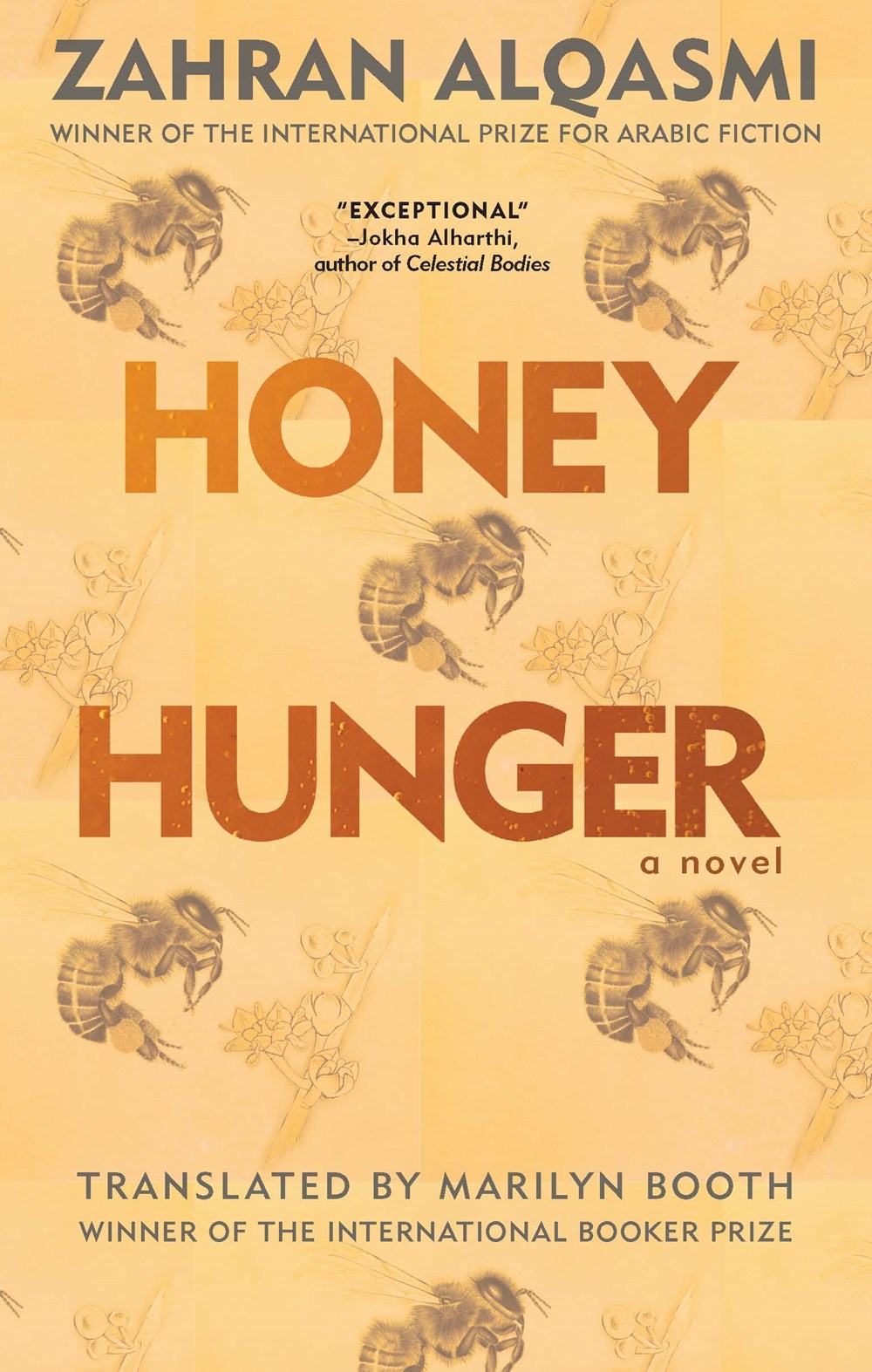
HONEY HUNGER: A Novel, Marilyn Booth's excellent translation of Zahran Alqasmi's novel of Oman


HONEY HUNGER: A Novel
ZAHRAN ALQASIMI
(tr. Marilyn Booth)
Hoopoe Books|American University in Cairo Press (non-affiliate Amazon link)
$18.95 ebook edition, available now

Rating: 4.75* of five

The Publisher Says: A breathtaking novel of longing, uncertainty, and ultimately of hope, written by an International Prize for Arabic Fiction-winning author and an International Booker-prize winning translator

Azzan is a beekeeper in a rural community in Oman. Devoted to tending his bees and searching for wild hives, he encounters Thamna, a lone shepherd woman, on a mountain slope and is captivated by her and her honey-colored eyes. Across the breathtaking vistas of Oman’s remote mountains and plains, Azzan’s troubled past and present unfold. A disappointment to his family, he turns to drink, and ultimately discovers the healing power of his beekeeping, before an accident in which he loses all.

Zahran Alqasmi’s masterful novel thrums forward with a subtle momentum. His lucid, poetic writing conveys a visceral sense of time and place, of the fragile ecologies inhabited by both bees and humans alike, in this intense and compelling novel of loss and hope.

I RECEIVED A DRC FROM THE PUBLISHER VIA EDELWEISS+. THANK YOU.

My Review
: Does the old nostrum, "still waters run deep," ring a bell in your cultural education? Azzan is the personification of it. He's quiet on these pages. He's still physically and psychically until summoned into action in service to some need. Author Alqasmi uses his stillness to carefully, incrementally, accustom you to the reality of Oman, of a place he seems to assume you will want to know feel and smell and hear, without intrusive human-ness. Gradually, Azzan's eyes...our cameras onto this sparely furnished landscape...show us more, bring us to the places—in the company that hearken to the quiet sounds that we call "silence" in technology's noisy embrace. Azzan's not a beekeeper by happenstance, either as a character or a PoV.

These are the choices that lead you the audience into the creation of an author whose poetry output outweighs his prose, ten to four; but whose prose garnered him the 2023 International Prize for Arabic Fiction (IPAF) for The Water Diviner; I believe this is the immediate predecessor to this novel in Arabic. It is obvious to me that the quality of the vision here is not a chance sport, an artifact of a talented translator's vision alone. That disappointment has befallen me before when a multiple translation career has yielded...inconsistent...results. Being the first of his works translated into English, I could still be disappointed; it just *feels* like a good bet to make, after reading this story.

I'm sure the idea of beekeeping in a landscape as arid as Arabia is overall seems odd. It is an ancient reality though. Deserts bloom, even if sparingly. Beekeepers are not hugely wealthy anywhere bit seldom lack for work for very long. It is a surprisingly mobile task in this story, one that enables Azzan to be see, hear, participate in, a lot of lives in making his life with bees. The honey they make is the life he leads; but it's also large in the life of the people. The product that makes life just enough less harsh to be fun at times for the people Azzan's belovèd bees serve. His knowledge of the lies, cheats, and kindnesses others never even think they don't know about all revolve around his deep and unwavering interest in and commitment to his charges the bees.

It gives the author a free rein to point up character traits in the narrator's orbit and beyond, for good and for ill; is Thamna, the herdswoman he encounters so fleetingly, an object of obsessive lust, actual love, or simply a fixation because of her novelty in his mostly male world? Does his thinking about bees, those matriarchal marvels without a permanent male presence, and their coveted honey drive or lead his itinerancy? If he's led by it, it makes his questing for wild honey that much more about the world he observes so intently; if driven instead, that condition of needing the honey makes his sharply observant eye that of the exploiter, the taker of all the work of others he is not entitled to have. All of these are within this novel's possible meanings.

Azzan's obsession with bees and their care is, while unusual to the US-fiction reader, an outgrowth of his blighted past. He is a recovering alcoholic in a society that frowns on alcohol use. He has never been a success, felt as though he was enough for or even wanted by those who raised him. It is this strange selfness, this sense of himself as needing and wanting but never receiving unless he takes (as from the bees, his compatriots), that is reinforced by the lyrical language of description that never devolves into possession; rather it settles on taking the product without "owning" the producer, on caring for and feeling committed to the bees, the goats, the donkeys and living among them in place of being their "owner."

Is that the place held by the exploiter, the user, the rentier? Azzan does not give off that vibe; I can still see it in the flow of his honeyed words of praise and appreciation and admiration for the bees. It comes down to the sense the author gives all these people who live among the animals they use; they take on the risks and protect their charges from harms they will all suffer from. In return they exert a right to practical rewards of sustenance.

A man who longs for love he is sure he does not deserve and whose object is safely always independent of his custodial care and capable of being just fine without him sounds to me like a man in need of a perspective check; he's fine how he is, too, just busily denying himself the peace of contentment to punish his perceived failings as received from the eyes and ideas of others.

So with all this praise why not five whole stars? Because these ideas and words of beauty and layers of meaning come with a labor tax of non-Western-standard punctuation and dialogue tags. I don't think that's a bad thing myownself. It does mean I can't five-star flag it for all y'all to pick up and devour ASAP. So many won't work this hard. Heck, even *I* had to read some things over twice to choose meanings that would change depending on to whom I attributed the words.

For me that's fun, for most it's work, so four and three-quarter stars seems fair.

Monday, August 5, 2024

THE NIGHT WILL HAVE ITS SAY, historical fiction about the Muslim Wars of Conquest


THE NIGHT WILL HAVE ITS SAY
IBRAHIM al-KONI
(tr. Nancy Roberts)
Hoopoe Books|American University in Cairo Press
$18.95 trade paper, available now

20% Off when ordered on their website (link above)! Just enter promo code: summer24 at checkout. Valid until 10 August 2024 in North America, the UK, Europe, and (naturally) Egypt.

Rating: 4* of five

The Publisher Says: The year is 693 and a tense exchange, mediated by an interpreter, takes place between Berber warrior queen al-Kahina and an emissary from the Umayyad General Hassan ibn Nu'man. Her predecessor had been captured and killed by the Umayyad forces some years earlier, but she will go on to defeat Ibn Nu'man's forces.

The Night Will Have Its Say is a retelling of the Muslim wars of conquest in North Africa during the seventh century CE, narrated from the perspective of the conquered peoples. Written in Ibrahim al-Koni's unique and enchanting voice, his lyrical and deeply poetic prose speaks to themes that are intensely timely. Through the wars and conflicts of this distant, turbulent era, he addresses the futility of war, the privilege of an elite few at the expense of the many, the destruction of natural habitats and indigenous cultures, and questions about literal and fundamentalist interpretations of religious texts.

Al-Koni's masterly account of conquest and resistance is both timeless and timely, infused with a sense of disaster and exile—from language, the desert, and homeland.

I RECEIVED A DRC FROM THE PUBLISHER VIA EDELWEISS+. THANK YOU.

My Review
: I'm kind of an outlier among this book's Anglophone readers: I like the formal, "speechifying" tone. This is historical fiction about the incredibly consequential events surrounding the Arab Wars of Conquest, specifically of the Maghreb. This century-long expansion of Islam and political control by Baghdad's rulers formed the fault lines of our present-day world. It felt appropriate to me that the words they spoke on the page were...heightened...not quotidian, not the same ones you'd use to ask your housekeeper why your nan's vase is suddenly chipped.

So, please understand that I'm aware of the formality, the speech-giving style, the focus on the characters as actors on the world's stage, and am okay with and invested in that. The consequentiality of the events in this book very definitely merit it. The author is telling this story from the PoV of the conquered, not the triumphal and celebratory version preferred (see the linked Wikipedia article) by the conquerors. In many ways the story is so very astonishing that it feels a bit like a fantasy epic. This story's The Lord of the Rings, only for real...and y'all lap up that deep-purple prose.

Give this a shot.

About the story itself I am so ignorant that I can point to no departures from History's pages. The North African civilizations were very old indeed. Pharaonic Egypt had diplomatic ties and cultural interchanges with the Libyan cultures millennia ago; the Berbers are, I think, their descendants. Roman, Byzantine, and then Arab Muslim conquests have overlaid rulers and rules and religion on the enduring people. The book's assumption of the conquered ones' voices is delightful to me, who daily bumps against the heterohegemony and religious restrictiveness on my right to exist. To have a woman assering her and her people's right to exist as they are and have always been, against a man sent to chnage them on a basic level, seems like a story you're going to want to read just now. It's not like it's got any modern resonances, is it? A woman standing up for freedom to exist unchanged against an overbearing, bloviating hypocrite of a man?

I'm suddenly seeing an orange haze between me and the screen....

However much I want you to read this story, I feel there's a resistance inside my mostly Anglophone and largely American readers. It's about people you know (most likely) nothing about. It takes the side of the powerless, to induce you to get over that hurdle. It's negatively focused on religion. The main character is a woman asserting herself, to get you over that hurdle. The prose is...well...I said above it's heightened, and really, given the stuff I see y'all reading, I don't think that's a hurdle you need much help getting over in and of itself. I suspect most objections like that are more about resisting the unfamiliarity of the subject matter. I strongly encourage you to get over that hurdle. This story is deeply rooted in an entire ancient civilization's resistance to being restyled and remade to suit the opinions of powerful men with an arsenal of weapons superior to its own and fueled by rage and the lust for Control.

These stakes should resonate with all y'all in the Anglophone world, and I hope inspire you to resist what we see around us from becoming normal.

Again.

Wednesday, June 26, 2024

SELAMLIK, a lovely idea, a word we in the world need


SELAMLIK
KHALED ALSMAEL
(tr. Leri Price)
World Editions
$19.99 trade paper, available now

Rating: 4.5* of five

The Publisher Says: An emotional and unflinching story about Arab masculinity and homoeroticism

Furat, a Syrian in his early 20s, visits Sibki Park in Damascus, which serves as a gathering place for gay men from all over the city. He learns about the Hammams, secret meeting places for gays located throughout the old city.

Inside these public baths, the air is thick with the scent of bay laurel soap, and naked men hide in the steam. Despite society, religion and regime disapproval, Furat finds the love he seeks just before being forced to flee as his world changes. Later on, Furat wakes up in a cold sweat at an asylum in the Swedish forest recalling a terrifying dream in which he was blindfolded and bound. Having seen the horrific clips of what extremists do to gays circulating on the internet, he begins to write about his experience while locked in the toilet.

This is the story of Furat's journey, along with that of other refugees, as they struggle against physical and economic challenges, migration laws, and deep-seated fears of loss, shame, and hatred. However, amid these difficulties also lie moments of passion and pleasure. Despite everything, Furat remains steadfast in his pursuit of love.

I RECEIVED A DRC FROM THE PUBLISHER VIA EDELWEISS+. THANK YOU.

My Review
: This story felt to me like a roadmap of what the great-haters want gay life to become in the US. Religious nuts are not to be trusted with the well being of those they don't like. Their allgedly holy book allows things well beyond the pale in the modern world. That's where the damn things belong, beyond the pale.

Think I'm being strident again? Read Furat's story, much like the author's own, to see how disfiguringly awful it is to be denied expression of your honest, authentic self.

The book isn't long, under two hundred pages, and covers three countries that create, dislike, or accept refugees. Syria's pre-civil-war accommodation of gay men wasn't acceptance, exactly, more a species of tolerance..."don't make us notice you, stay over there"...and Turkey's is roughly similar. Furat's deep discomfort dealing with the straight men (and "straight" men) who surround him comes vibrating off the page. The author clearly drew this from his own lived experience. It's a revelation of self that would likely get him beaten or worse in most macho cultures.

The way the novel is structured is likely going to put some people off. I hope you'll think of the structure as a way of communicating Furat's lived experience of fragmentation and alienation; as a deliberate and careful evocation of the world as it appears to someone who has no home, never felt at home, never had more than mere toleration offered to him. The jagged edges of severed relationships...what happened to Ali?...are the price exacted by the great-haters for one's being alive in "their" world.

"Their" world definitely includes the world of Sweden. This paragon of accepting refugees hasn't told its people that kindness and acceptance might be better for all concerned than rejection and intolerance. That's rich coming from an American, I agree, but the fact is that my majority-immigrant country has its head up its religious-nut ass. I would hope for better from the Swedes. I would, it seems, be wrong. Furat's life is better. It's not in danger anymore. His Life is. This Life, this wonderful world of lovingkindness and acceptance, of deep connection and relationship, is still beyond his reach.

The title's a word that describes and defines the concept gay men, all that I've known in my nearing-seventy years on earth, want: a place of intimate connection of men's bodies and minds.

The story has its challenges for the reader. It's not going to make the eww-ick homophobes blench. It's not going to make the linear-story reader into a fan of stream of consciousness. It's not the book's job. It is going to give its readers a personal intimate view of the way a man of multiple marginalizations navigates becoming his authentic self.

That, for this reader, is a beautiful gift.

Saturday, May 18, 2024

PACKAGED LIVES: Ten Stories and a Novella, fiction that tells the truths of Iraqi lives


PACKAGED LIVES: Ten Stories and a Novella
HAIFA ZANGANA
(tr. Wen-Chin Ouyang)
Syracuse University Press
$14.95 all editions, available now

Save 40% off on direct-from-publisher purchases of all literature in translation with discount code 05WIT25 now through September 15, 2025.

Rating: 4.5* of five

The Publisher Says: The carefully crafted, subtle, and humorous stories in Packaged Lives show Zangana at her best as a fiction writer. She portrays her subjects keenly, sensitively, and lovingly but without compromise. Iraqis living in exile come to life in her narratives as men and women who are caught between two worlds. They cannot return to their homeland and are forced to wait for news of Iraq from afar. At the same time, they are unable to fully adjust to life in Britain and make a new home for themselves. The question “What is home?” is at the heart of each story in this collection. Her protagonists, who are stuck in ready-made lives, or “packaged lives,” struggle to set themselves free from a web of relationships in which they are entangled. Art, poetry, and nature provide lines of escape. The relief may be fleeting, but the peace of mind and serenity are reached through the moment of epiphany at the end of each story, a much-needed balm.

Haifa Zangana is an Iraqi Kurdish writer and activist. She is the author of Women on a Journey: Between Baghdad and London, City of Widows: An Iraqi Woman’s Account of War and Resistance, Dreaming of Baghdad, and Party for Thaera: Palestinian Women Writing Life, among others.

Wen-chin Ouyang is professor of Arabic and comparative literature at the School of Oriental and African Studies, University of London. She is the author of Poetics of Love in the Arabic Novel: Nation-State, Modernity and Tradition, and Politics of Nostalgia in the Arabic Novel: Nation-State, Modernity and Tradition. She has been working towards Arabic-Chinese comparative literary and cultural studies, including Silk Road studies.

I RECEIVED A DRC FROM THE PUBLISHER VIA EDELWEISS+. THANK YOU.

My Review
: The author's life is, in the tiny squib above, an abbreviated roll call of her creativity. What is most important you don't discover until reading Michael Beard's Introduction: She is old enough to remember a pre-Saddam Iraq, one that was becoming its best self; then the translator, in her fresh bereavement, fills in those bones with the emotional muscles and life-lived sinews of her long friendship with the author and her own husband. The image called forth is of a loose, but powerful, bond of those few friends one makes in life who can be called "true blue through-and-through besties."

As is my established custom, you'll get a story-by-story note and rating, then a summation, or the Bryce Method as it's better known around here.

Evensong


Chatter


Delirium


Duck


Day


Refuge


Turnstile


Cave


Pilgrimage


Painting


Packaged Life


Thursday, September 28, 2023

THE HOUSE OF THE COPTIC WOMAN, the wages of sin never seem to be paid by the sinners & NAILS AND EYES, eerie, unsettling, but unsatisfying


THE HOUSE OF THE COPTIC WOMAN
ASHRAF EL-ASHMAWI
(tr. Peter Daniel)
Hoopoe Books|American University in Cairo Press
$18.95 trade paper, available now

Rating: 3.5* of five

The Publisher Says: Tightly plotted and taboo-breaking, this explosive story takes readers to the roots of religious strife where the smallest of sparks can start a bonfire

Nader, an idealistic public prosecutor at the outset of his career, leaves Cairo to start a new posting in rural upper Egypt. On his first night, a mysterious woman named Huda shows up at his lodgings. She is on the run from an abusive husband and, harboring a dark secret, seeks a new start in this small village and escape her harrowing past.

Nothing is to be easy for Huda or Nader, and the dramatic circumstances of their first meeting signal the disquiet to come. It is not long before tensions between Copts and Muslims, already on a knife-edge, spiral into a spate of unexplained killings and arson attacks. The locals blame the trouble on the supernatural, and Nader is thrown into a quagmire of sectarian conflict and superstition that no amount of formal training could have prepared him for. His investigations are thwarted at every turn, by uncooperative witnesses and an obstructive police force. As Nader and Huda each pursue happiness and justice, their parallel journeys struggle against the forces of ignorance, poverty, hatred, and greed.

With its echoes of Tawfiq al-Hakim’s Diary of a Country Prosecutor, this is a powerful and personal tale of conflict, crime, and upheaval in rural Egypt.

I RECEIVED A DRC FROM THE PUBLISHER VIA EDELWEISS+. THANK YOU.

My Review
: There were several problems for me in this read. The biggest one was the sense that I was just...missing something, there were puns, wordplay, ironical quirkings of the eyebrow that I wasn't privy to but could still feel taking place.

I hate that.

The plot...runaway abused woman takes refuge with idealistic legal-eagle just having his wings clipped by the Reality of Power...isn't any great shakes but is certainly capable of carrying much more weight than it's asked to here. Nothing that happens is a surprise, no one here becomes more than a supporting character in a story that has a diffuse, generalized main character called "Life."

I rated it more highly than my pleasure in reading it would've led me to do because I really had no idea the sectarian hatreds so common in a world hag-ridden by religion were so very sharp in Egypt. Why the woman must always be punished in these kinds of stories for having the audacity to want something for herself is another source of dissatisfaction for me. I think readers interested in social-issue fiction will get more from the read than mystery/crime readers will.

++++++++++++++++++++++++++++++++++++++++++++++++++++++++++++++++


NAILS AND EYES
KAORI FUJINO
(tr. Kendall Heitzmann)
Pushkin Press Japanese Novellas Series
$11.99 Kindle edition, available now

Rating: 3* of five

The Publisher Says: Tense, subtly disturbing Japanese literary horror perfect for fans of The Memory Police, Tender is the Flesh, Fever Dream, and The Vegetarian.

Paired with two stories of creeping tension and unsettled minds, the unnerving title novella Nails and Eyes introduces a unique new voice in Japanese literature.

With masterful narrative control, Nails and Eyes—appearing in English for the first time—builds to a conclusion of uncanny power.

A young girl addresses her stepmother, who has moved in shortly after her mother’s death in unusual circumstances. The girl shows strangely detailed knowledge of the older woman’s life, and as her stepmother settles into the house, the girl’s obsession sharpens to an ever finer point.

I RECEIVED A DRC FROM THE PUBLISHER VIA NETGALLEY. THANK YOU.

My Review
: A mini-collection of Japanese shorter fiction. We start with a promising novella, a very eerie, atmospheric study in female-centered horror. The narrator is a girl-child, one recalling with eerie clarity things that happened when she was three years old. A woman now lives in her mother's place, after mother dies in peculiar and suspicious circumstances. The story's narrated in the ever-chest-pokey second person to "you," who is the replacement her father brings into their lives for dead, blogger-mom mother. The problem is that "you" has terrible vision, is a terrible judge of character in trusting the father and the daughter, and never quite coheres as more than a collection of those kinds of heavy-handed symbolic traits. What really threw me out of the narrative flow was the fact that I'm somehow supposed to believe this is a child's memories. I'm just too literal-minded for that to work. Three-year-olds are still pretty iffy with object permanence and a robust theory of mind hasn't had a chance to develop. Therefore, this is not realistic. I know it's not supposed to be. But I need its hows and whys not to be unexplained if it's going to require me to suspend my disbelief from a noose twelve feet up.

What Shoko Forgets isn't very interesting as horror, being a ghastly case of elder abuse and failing memory covering up the perpetrator; far too close to my own life's circumstances for me to think anything except "WHERE IS THE CASE MANAGER?!"

Lastly there was Minute Fears which, sad to say, was an unmemorable story of a little boy's deeply off-kilter perception of and obsession with the kami-spirit of a park, told by his bemused mother; the abrupt, somewhat silly ending just reinforced how underdeveloped the whole felt to me, as well as so short I got very little impression of its players.

I liked the unsettling mismatch of the tone to the subjects. I strongly suspect, and even hope, that others with less onerously literal minds will try this very, very short (took me two hours from start to finish) Spooky-Season selection for their Oktoberreads.

Monday, August 28, 2023

HISTORY OF ASH, debut novel from Moroccan civil rights campaigner and literature professor via American University in Cairo Press


HISTORY OF ASH
KHADIJA MAROUAZI
(tr. Alexander E. Elinson)
Hoopoe Books|American University in Cairo Press
$18.95 trade paper, available now

20% Off when ordered on their website! Just enter promo code: summer24 at checkout. Valid until 10 August 2024 in North America, the Uk, Europe, and (naturally) Egypt.

Rating: 4.75* of five

The Publisher Says: An unforgettable and eviscerating novel of human frailty, brutality, and resistance as told through the first-person prison narratives of a man and a woman

History of Ash is a fictional prison account narrated by Mouline and Leila, who have been imprisoned for their political activities during the so-called Lead Years of the 1970s and 1980s in Morocco, a period that was characterized by heavy state repression.

Moving between past and present, between experiences lived inside the prison cell and outside it, in the torture chamber and the judicial system, and the challenges they faced upon their release, Mouline and Leila describe their strategies for survival and resistance in lucid, often searing detail, and reassess their political engagements and the movements in which they are involved.

Written with compassion and insight, History of Ash speaks to human brutality, resilience, and the power of the human spirit. It succeeds in both documenting the prison experience and humanizing it, while ultimately holding out the promise of redemption through a new generation.

I RECEIVED A DRC FROM THE PUBLISHER VIA EDELWEISS+. THANK YOU.

My Review
: Kafka meets de Sade in Morocco.

Cruelty is such a defining trait of human beings that I really don't understand why it still shocks me to what depths the forces of social control will sink to enforce hegemony, specifically in this case the hegemony of Morocco's royal government. It was a desire to experience the chaotic good of democracy and cultural self-determination that motivated the narrators of these separate prison stories to resist, at long last, control from above. Morocco lived with this both as a colony of France then as an autocracy. Generations of pent-up frustration on the parts of millions whose lives weren't in significant ways their own led to a repressive response. It's now called The Years of Lead, and the details of it events and abuses are stomach-churning.

What most histories forego is the personal costs of repressive regimes to their victims. As History is supposed to be academic and impartial, not immediate and visceral, this makes some sense...the issue is that history is never impartial and "academic" is coded language now for sanitized and watered down, attenuated enough to avoid letting real experiences in. This, then, is why historical novels must exist, why we must read them, and why they ought not be held to an artifical standard of "impartiality" like historiography is.

The role of fiction by academics is often a marginal one, one not centered in the commercial world for many reasons. One of them is very clear here. While Leila, an academic, relates her torture a bit more viscerally than does Mouline (the male narrator), she also uses more allusions to the vast literature of imprisonment, resistance, and injustice than does the younger, but still culturally very literate Mouline. This presupposes either familiarity with or curiosity about this body of literature in the reader. Commercially oriented publishers on the order of Simon & Schuster, to take an example much in the business news of late, can't trust this interest to exist and are certain their consumers haven't read those kinds of books. While I am not at all sure that's a reasonable thing to be certain of, I'm aware that the economics under which publicly-traded companies operate demand aiming for the lowest common denominator. Luckily this is not the only avenue for readers with either familiarity or curiosity or both to get their fix of enriching, exciting, challenging works like this one.

Hoopoe Fiction is a line of works, mainly in translation, centering Maghrebi and African more broadly voices. The American University in Cairo Press does us a great service by bringing these works to market. August being Women In Translation Month, I've centered works like this by women, and/or translated by women. My purpose is to alert the audience for book reviews that I'm grateful to say continue to find me here in their hundreds about. The Press offers great opportunities for discovery of reads that expand and furnish one's mind with viewpoints we don't come across with any regularity in US capitalist culture.

This book's deeply personal take on the prison narrative is based in the author's generational identification with the Years of Lead. She's also personally acquainted with resistance figures and prisoners of conscience, and has included details of the experiences she's learned about in this work. It is, as one can readily imagine, very hard to read the accounts of torture. It's far more difficult for me personally because I know the author isn't inventing them but transmuting the real experiences of people she's met into fiction. This is not a story for the faint of heart's amusement and delectation. It is a very hard read but one that is, in so many ways, urgent for the complacently comfortable to discover. This is what totalitarians do. Heed the warnings implicit in the existence of these two characters' narratives. They're fictional and based on fact; resist with EVERY FIBER the increasing possibility of experiencing, or knowing someone who experiences, these horrors. Learn the stakes you're risking when you don't believe political rhetoric coming from those you might agree with about some things. They mean it. And somoene will be paying an awful price for your mistake.

Monday, May 16, 2022

BITTER ORANGE TREE, vibrant, passionate, *alive* woman's dark desires & MISTER N, a frank discussion of getting old and its price (not what it costs)


BITTER ORANGE TREE
JOKHA ALHARTHI
(tr. Marilyn Booth)
Catapult
$26.00 hardcover, available now

Trade Paper Edition On Sale: 07/11/2023 | $16.95

Read the Electric Literature mutual interview between Author Alharthi and Translator Booth!

One of Time Magazine's 100 Must-Read Books of 2022

Rating: 4* of five

The Publisher Says: From Man Booker International Prize–winning author Jokha Alharthi, Bitter Orange Tree is a profound exploration of social status, wealth, desire, and female agency. It presents a mosaic portrait of one young woman’s attempt to understand the roots she has grown from, and to envisage an adulthood in which her own power and happiness might find the freedom necessary to bear fruit and flourish.

Zuhour, an Omani student at a British university, is caught between the past and the present. As she attempts to form friendships and assimilate in Britain, she can’t help but ruminate on the relationships that have been central to her life. Most prominent is her strong emotional bond with Bint Amir, a woman she always thought of as her grandmother, who passed away just after Zuhour left the Arabian Peninsula.

As the historical narrative of Bint Amir’s challenged circumstances unfurls in captivating fragments, so too does Zuhour’s isolated and unfulfilled present, one narrative segueing into another as time slips and dreams mingle with memories.

I RECEIVED A DRC FROM THE PUBLISHER VIA EDELWEISS+. THANK YOU.

My Review
: Celestial Bodies, Author Alharthi and Translator Booth's previous literary collaboration, revolved around three women and their men...present, absent, loved, loathed, and longed for. It received the 2019 Man Booker International Prize, as it was called then. I myownself checked it out of the library and would've given it a three-star review had I bothered to review it at all...stories centering women organizing themselves and their worlds around men don't appeal to me. The prose was lyrical and pungent.

That last is what I love about this read:
I had gone. And then she had gone. And it wasn't possible to change anything. What the hand of fate had written could not be unwritten. That ancient line of poetry: All your tears, all your pleas, will erase not a line of that which is written. For I had gone, and I went away without smiling. I just went, in my cocky presumption that I could look the other way. That I didn't know; that I didn't need to know. And then remorse. Harsh, grating regret, making me more fragile than the brittle autumn leaves crumbling under the janitor's broom beneath my window.

–and–

"My grandmother would've given anything to be a peasant farmer," I said. And then immediately I regretted my abrupt reaction. Suroor raised her head. "Your grandmother?" Right. The words had come out and they couldn't be put back. I had said it: my grandmother. Why don't words come automatically with threads that we can yank to pull them back inside ourselves? But there are no threads attached. Those words had been said. What's done is done.

It's all there. Author Alharthi's style, the sentences not too terribly complex but the interrelationship of the words and images is dense, is active, is trellising the reader's vines of awareness into specific patterns that cast wildly distorting shadows on the life in the text.

It is exhilarating to read a simple story that reaches into shadows and under storage shelves and behind armoires in the reader. It means the writer and the translator have offered us everything they found when they rummaged through those spaces in themselves. If you, as I strongly suggest that you do, read the Electric Lit piece I've linked above, you'll come at this read with a vastly bigger experience of the intentionality of the writing. I think the best thing about that awareness, acquired before (in your case) or after (as in mine) finishing the novel, is its honing, its sharpening, of the decoding tools you have at your disposal to be in the read. I've chosen those two passages from the same early section of the story to illustrate that enriching quality.

What reading Bitter Orange Tree offered me was a stroll in a garden planted with almost-familiar-scented plants in service of a geometry slightly not what I am accustomed to (read: not centered so heavily on the women's men). The way the choices I've selected above interrelate and build on the character of Zuhour's perceptual world, the sensory and the eidetic, are the principal pleasure of this read. Like my stream-of-consciousness idol Virginia Woolf, the words build images and the images are shaped by the words as well as by the things the words evoke from us in their saying. Everything Zuhour senses is an image from her startlingly acute inner world...no fogs of forgetfulness (even when summoned, as above) cloud her quietly desperate longing for one more, once again, please just this single time.

Of course she gets none. No one does, and no depths of longing can break the iron arrow...crossbow quarrel, more like...of time. No matter how many times one says ignore, actually performing the act of ignoring is entirely different and often opposed by the metaphysical gravity of love. (I think it was this strange, off-kilter perceptual frame that reduced my rating from five to four stars, though....)

Because yes, this is a love story. Aren't they all. Yes, they all are but this love, Zuhour's love, is so tragically lacking self-love that it's the desperately sad kind of love-ungiven story that can reshape a life. Yours, o reader, if you will allow it; better or worse, as you use it.

++++++++++++++++++++++++++++++++++++++++++++++++++++++++++++++++


MISTER N
NAJWA BARAKAT
(tr. Luke Leafgreen)
And Other Stories
$17.95 trade paper, available now

Rating: 4* of five

The Publisher Says: Modern-day Beirut is seen through the eyes of a failed writer, the eponymous Mister N. He has left his comfortable apartment and checked himself into a hotel—he thinks. Certainly, they take good care of him there. Meanwhile, on the streets below, a grim pageant: poverty, violence and fear.

How is anyone supposed to write deathless prose in such circumstances? Let alone an old man like Mister N., whose life and memories have become scattered, whose family regards him as an embarrassment, and whose next-door neighbours torment him with their noise, dinner invitations, and inconvenient suicides. Comical and tragic by turns, his misadventures climax in the arrival in what Mister N. had supposed to be his “real life” of a character from one of his early novels – a vicious militiaman. Now, does the old writer need to arm himself…or just seek psychiatric help?

I RECEIVED A DRC FROM THE PUBLISHER VIA EDELWEISS+. THANK YOU.

My Review
: And Other Stories publishes unusual and often puzzling books. This one feels a little bit like someone found Kafka's Akashic records and channeled them through a Lebanese American writer's intense psychedelic dreams.
He liked precision and hated rough estimates. The approximate was arbitrary, the arbitrary was random, the random was chaotic, and chaos was a killer. Mr. N liked to cut away the imprecise, as he did with his pencils when he sharpened them, shaving their tips into points to make their lines clear and defined. Pens? Pens were unacceptable. Pens could leak, flooding pages with smothering ink. Ink behaved like a dictator: ordering, forbidding, controlling, brooking no dissent. Lead, meanwhile, was merciful, quick to forgive mistakes. Whatever your soul was brooding over, lead would let it speak. Ink soiled the white page; lead dissolved upon the surface, exactly as pain dissolved in the act of writing…

–and–

The human ability to adapt—to things positive and negative, to plenty and scarcity, to life and death—is terrifying. I watched {her} transform day by day. She contracted within the apartment; then she expanded to fill it. She feared her pimp would find her; then she relaxed into her new situation and her new identity. … …I felt her skin expanding, her limbs lengthening, her face settling into gladness. I saw her unwinding into something more tender, like dough when it relaxes.

Mister N is a guest in a swanky hotel. Mister N's a writer...published several novels, well-received ones...whose home is Beirut with all that implies. Mister N's...not feeling himself. Mister N's been through some stuff. Mister N's older brother is the last vestige of family he has, dead father, dead mother, in fact only his old, established nemesis, his Moriarty, a man called Luqman, is visiting Mister N despite his many vociferous complaints to Mr. Andrew, the, um, concierge or owner or someone like that, that these are unwelcome and invasive occasions of great upset.

The blows to Mister N's fragile peace of mind never really stop coming. There are so many old issues that need to be put to rest. There are absurdly youthful old people acting like hormonal kids! (Not Mister N...beta blockers, don't you know, those desire-slayers, are among his meds.) Mister N witnesses a...a...hanging, certainly, though not actually a murder as Mister N tells it. Mister N rides herd on the unruly voices in his head, the ones that enable Mister N to write their stories. As I've always said, being a writer is actually the socially acceptable face of schizophrenia. And sometimes just barely that.

The blows to Mister N's reality don't stop coming. Author Barakat is not kind. In memory, in fantasy, in reality...none of these states, and they all exist in the course of Mister N's time with us, are delineated. I don't think one gains a single, solitary thing trying to tease out the "different" frames of reference in this story. It won't make passages such as this:
Our mosquitoes and other local insects have developed quite the work ethic in recent years. They toil now not only to feed themselves, but from the pleasure of causing pain, which, having tasted once, they find impossible to relinquish. Rats, mosquitoes, flies, cockroaches, feral cats, pariah dogs: all of them are vicious now and liable to get drunk on the simple taste of killing, much as humans do.

...one whit more or less effective to think of them as belonging to "reality" or "fantasy" within the book's constructed world. Mister N, you see, is not in the least who he thinks he is; and, as we are all the sum of our memories, that simple fact makes Mister N a construct, a chimera of parts from we can never know where. More to the point, neither can Mister N:
My head is a train of many cars, each of them going in a different direction. All I need to do is put them back in line so they might travel in the correct direction. Is this my entire life that I have put on the wall? How old have I become now?

The only necessary answer to this question, directed from and/or to wherever one may, is "as old as my eyes, a little older than my teeth." (The Santa Claus response.) Mister N can not really answer it as phrased. Reality passes at different rates on different scales...the days drag, the years fly by...for us all, but most of all for those of disordered thinking. And to some degree, that's my beef with the read. I don't think the story itself comes out of the time-frame-hopping all the way intact. I grant that characters in this récit are all internal to Mister N, but they still jar with their sudden vanishings and dangling conversations. An itchy lack-of-closure feeling pervaded my reading experience.

Exactly how disordered Mister N's thinking is, for all that, is one of the pleasures of reading this short, powerful, frequently authorially self-referential récit all the way to the end. I recommend you do that soonest. Preorder it now!

Wednesday, November 17, 2021

PLANET OF CLAY, tale of the toll living exacts on the different


PLANET OF CLAY
SAMAR YAZBEK
(tr. Leri Price)
World Editions
$16.99 trade paper, available now

Rating: 4* of five

The Publisher Says: An ode to fantasy and beauty in the midst of war-torn Damascus

Rima, a young girl from Damascus, longs to walk, to be free to follow the will of her feet, but instead is perpetually constrained. She finds refuge in a fantasy world full of colored crayons, secret planets, and The Little Prince, reciting passages of the Qur’an like a mantra as everything and everyone around her is blown to bits. Since Rima hardly ever speaks, people think she’s crazy, but she is no fool—the madness is in the battered city around her.

One day while taking a bus through Damascus, a soldier opens fire and her mother is killed. Rima, wounded, is taken to a military hospital before her brother leads her to the besieged area of Ghouta—where, between bombings, she writes her story.

In Planet of Clay, Samar Yazbek offers a surreal depiction of the horrors taking place in Syria, in vivid and poetic language and with a sharp eye for detail and beauty.

I RECEIVED A DRC FROM THE PUBLISHER VIA EDELWEISS+. THANK YOU.

My Review
: First, read this:
We needed to take two buses to reach {my mother's job} from our house, which was at the end of Jaramana Camp in southern Damascus. I am happy for you if you haven't heard of it.
–and–
Personally, I turn over the coffee tray and make it into a desk, then I pick up the blue pen which I found among the stacks of paper, and I begin. You must not set off before the sound has started. Don't stop unless you are faint from exhaustion, but it must be from exhaustion and not fear. If all this isn't done properly, I mean using the blue pen to play with words on a blank page, then my instructions will fail, the blank page won't like you, and the roar of the aeroplanes won't disappear.

The rational response to an irrational world, one filled with mortal danger, will always be different for a small child. When a small child is required to make the world make sense when it simply doesn't, such as in a war zone, there will arise adaptive responses that are in the long run maladaptive. And add in the probability of the person being neurodivergent from the get-go...well, what are the odds of that person reaching adulthood? Still less unscathed.

Rima's mother knows her daughter isn't the usual sort of child. She's got "her brains in her feet," meaning a mania for walking, walking, always walking if she can stay on her feet...in other words, a need to escape...and on one of her very first outings, so to speak, a group of well-meaning adults stop her and ask her all sorts of urgent questions...what's your name, where's your mother...that she simply can't process fast enough to answer. Thus is an elective mute created.

So now Rima's mother is living in a war zone with a manic, elective mute daughter. She does what any mother would do...she makes the medical rounds, seeking answers. Getting none, she does the thing mothers have done since the beginning of time: She improvises. She gets some rope and ties Rima to her wrist when she has to go out and, when the girl's too much of a woman for that to be safe, she ties her to their bed.

That sounds horrific to a Western person who's safe inside a house every night, with only police drones and cop cars to worry about. But think of this: How safe is a young woman on the streets here in your fat-and-happy country? You'll always teach her to be aware of the threat posed by Them. (You'll be filling in that space with the people you dislike the most, of course, but I assure you she's safer from Them than from the nice, entitled, self-satisfied boys in her school.) For someone with fewer resources than the poorest person in this country of ours, the solution fits the need admirably.

What it doesn't, can't do is prepare Rima for one of the personal calamities that even the mildest "police action" or "guerrilla war" engenders: The loss of a parent. In this case, an only parent...her father's never even been a presence for his absence to be felt. What this means is her world is effectively over. And yet her life goes on, in her mother's permanent absence and her brother's disappearance into the guerrillas' ranks.

What makes this such a perfect read for this moment is the Belarus-vs-Poland manufactured refugee crisis permeating the news cycle right now. It's a necessary and salutary reminder that the world's not in good shape, plague aside; the people, living breathing people, who are caught between two sets of disgusting racist piece-of-shit countries and who will continue to die of exposure as the world idly watches it happen, aren't going to get what they need any more than Rima did.

Mirabile dictu, Rima's brother shows up! He finds her! And they begin the refugee's eternal dance, the homeless and placeless and stateless state of being, of non-personhood. Of course to Rima it's not that way...she simply does. She lives. She is in touch with something utterly invaluable for a refugee: Her self. It is clear to her who she is, she is Rima and she reads, she sings the Qu'ran's sutras, she draws. It is a saving grace. What it isn't is easy for a storyteller to sell. She is simultaneously simple and sophisticated, ignorant and wise and way over her head.

Let me show you:
You will understand that I don't have enough time to explain to you about forgetting. Later, you can throw away whatever pages you want to. What matters to me is {the old caretaking woman} who wanted to understand how I knew how to use tartil in reciting the Qu'ran. Really, it was difficult to explain to her, because my tongue was stopped, and like {her} I don't understand much of what surrounds me.
–and–
I am a story, I too will disappear (or maybe I am with you now as you read my scattered words) like the Cheshire Cat did in the story of Alice.

That is some very sophisticated abstract thought for someone with the neurodivergence Rima has displayed...in the circumstances of her upbringing, I'd be impressed with that level of eloquent abstraction in a neurotypical young adult.

All in all, though, as a work of fiction, I was compelled by the story, by the character, by the narrative's timeliness and timelessness. I'm very impressed as this is the first work I've read by Author Yazbek. It is, as she has Rima say of her own storytelling, one of those "circular stories with intersecting centers which are only completed by retellings and new details."

The problem is reassembling my heart after the story ends....

This is a very special, very timely yet a timeless read...there is no realistic chance the subject matter will lose its relevance. It is a FINALIST for the 2021 Best Translated Literature category at the National Book Awards! The winner will be announced this evening.

Sunday, August 30, 2020

THE SLAVE YARDS, nightmarish Benghazi reality translated from Arabic

THE SLAVE YARDS
NAJWA BIN SHATWAN
(tr. Nancy Roberts)
Syracuse University Press
$24.95 trade paper, $14.95 Kindle, available now

Special Offer—Save 40% off all literature in translation with discount code 05FALL24 now through October 15, 2024.

Rating: 4* of five

Save 40% off on direct-from-publisher purchases of all literature in translation with discount code 05WIT25 now through September 15, 2025.

The Publisher Says: Set in late nineteenth-century Benghazi, Najwa Bin Shatwan's powerful novel tells the story of Atiqa, the daughter of a slave woman and her white master. We meet Atiqa as a grown woman, happily married with two children and working. When her cousin Ali unexpectedly enters her life, Atiqa learns the true identity of her parents, both long deceased, and slowly builds a friendship with Ali as they share stories of their past.

We learn of Atiqa's childhood, growing up in the "slave yards," a makeshift encampment on the outskirts of Benghazi for Black Africans who were brought to Libya as slaves. Ali narrates the tragic life of Atiqa's mother, Tawida, a black woman enslaved to a wealthy merchant family who finds herself the object of her master's desires. Though such unions were common in slave-holding societies, their relationship intensifies as both come to care deeply for each other and share a bond that endures throughout their lives.

Shortlisted for the 2017 International Prize for Arabic Fiction, Bin Shatwan's unforgettable novel offers a window into a dark chapter of Libyan history and illuminates the lives of women with great pathos and humanity.

I RECEIVED A DRC OF THIS BOOK FROM THE PUBLISHER VIA EDELWEISS+. THANK YOU.

My Review
: What a horrible life slaves have always led.

There's an earth-shattering insight for you. I can't believe anyone didn't say it before me, can you? Well, this book's like that. It's not telling you anything that you didn't know before. It's making you feel, see, smell it instead of intellectually knowing. Slavery, at its heart, is about bodies. The thing we take for granted, the autonomy of the corpus delicti of our lives as sinners on this, gawd's private torture grounds, is abrogated; no man controls his labor, no woman her womb, no child its curiosity. A slave exists, doesn't live. A slave possesses nothing, not even a soul, or else no religion would allow the practice. No religion has ever, to the best of my knowledge, forbidden slavery. At best a few wild-eyed bizarro outlier sects like the Quakers, or the Northern Baptists in the US, could even be bothered to protest its wrongness.
Many were the slaves who had forgotten the story of their enslavement and had integrated gladly into the life of those owned by Muslim masters. As for those who married other members of their own race and, in some cases, won emancipation, they were delivered from hunger to hunger, and from poverty to poverty.
That is a sad and eternal truth: Poverty closely resembles slavery, and as poverty is entirely curable, that cannot be an accident. It suits the people at the top to keep the system just unfair and evil enough that they can keep the best for themselves and run the lowest risk of the huge majority figuring out that they can't kill *all* of us and rebelling.

I hope to High Hallack that the US is at such an inflection point right now. But I digress.

At any rate. The Slave Yards tells a story, fairly simple in its outlines, about Atiqa growing herself up in Benghazi's Slave Yards, suffering multiple orphanings, and growing into a woman with a loving family, both made and born. Into that world comes a man with secrets to tell her about her past, secrets she buried during the worst night of her entire existence, and proofs that she was not just a slave girl and never had to be one. Too late, of course, to prevent the slave girl from suffering the degradation of not even owning the lungs she breathed with.

But Atiqa, the self-made therefore self-possessed woman of the story, doesn't come to this knowledge simply or directly. The whole novel is, as the title suggests, the Slave Yards whole and entire, its incredibly rich culture, its appalling degrading poverty, its joys and hates and endings and beginnings. The stories Atiqa remembers, tells herself anew, feels and smells again in her hard-earned, richly merited new life, are the meat of this book. Maybe "meat" isn't the word...the asida in the bazeen of this book. The story is dispensed with for long stretches of tale-spinning, of life-living memories. And that is a good, good thing.

I felt as though I had gone completely away from 2020 Long Island and its existential anxieties, thence to gain perspective:
Without a word {the groom} handed the bride's uncle a blood-spattered white sheet. The uncle...took it out to a group of men gathered in front of the house. This done, he gleefully set about emptying the contents of his shotgun into the air. ... The uncle unfurled it like a victory banner, the battle of innocence now won...they could hold their heads high in the knowledge that their honor was intact.
The present-day abortion-rights battles are the not-distant descendents of this kind of complete and utter idiocy. The entirety of monotheistic religion's thrust (please pardon wordplay) has been to stand on the neck of Womankind's autonomy out of anxiety. What? Anxious manhood? Perish forbid, say the abortion-deniers, and throw a thousand words into the void between their fears and the actual world. (THEIR daughters, white as snow, will always be able to get abortions...multiple women I'm related to had them pre-Roe-v-Wade. We're white. Connect the dots.) The real issue is control. The real issue is covering up for the men's fear of being robbed of their control over women's bodies:
Nobody seemed to notice that there was something wrong with the custom of having the groom use his hand {to break the woman's hymen} on the wedding night to determine whether his bride was a virgin. On the contrary, even the women thought is was perfectly normal. It had never occurred to them that it was just a way of covering up for a man's possible impotence.
Huh. Imagine that, a custom arising (you should forgive) to protect a fragile boy-ego at the expense of a woman. My pearls, my pearls.

So for a moment, I was swept into a world where the power imbalances made no smallest effort to hide themselves. It was a relief, in a way, to be in a place where the crushing and cruelty were open and acknowledged; were simply the way things are. Because to fight the way things are is to crusade, to smash and shatter and slaughter the old, the bad, but the *known* and the *open* awfulnesses. Today it is harder by far to protect gains not evenly spread, to defend boundaries set to deliberately disadvantage some, and then work to spread and reset them. The world of Benghazi in the 1890s, the 1900s was bitter to be Black in, and the wrongness of it was everywhere. To root out racism in the richest country on Earth? The battle never ends, the rebellion is bought and undermined and softened and, in the end, prevented from making changes that discomfit the wealthy.

Better to be somewhere else, then, even for four hours. To be, however temporarily:
...the legacy of those who didn't look at their dead, who closed their eyes so that they wouldn't see death's cruelty, leaving them open just enough to let their tears escape. I'm the plant that was watered by those tears.
Instead I look with horrified eyes at the photos of Emmett Till https://tinyurl.com/y53q9w9s or videos of fucking racist pigs https://tinyurl.com/y272hvz3
and think, "slavery? what the hell's the difference between that and this?"
and I have no answer for myself.

Thursday, June 2, 2016

INFIDELS, Author Abdellah Taïa's deeply felt & extremely unpopular among Muslims short novel


INFIDELS: A Novel
ABDELLAH TAÏA
(tr. Alison L. Strayer)
Seven Stories Press
$23.95 hardcover, available now

25% OFF DIRECT PURCHASES OF #WITMONTH TITLES HERE: https://sevenstories.com/blogs/385-celebrate-women-in-translation-month-2025

Rating: 4* of five

The Publisher Says: Set in Salé, Morocco—the hometown Abdellah Taïa fled but to which he returns again and again in his acclaimed fiction and films—Infidels follows the life of Jallal, the son of a prostitute witch doctor—"a woman who knew men, humanity, better than anyone. In sex. Beyond sex." As a ten-year-old sidekick to his mother, Jallal spits in the face of her enemies both real and imagined.

The cast of characters that rush into their lives are unforgettable for their dreams of love and belonging that unravel in turn. Built as a series of monologues that are emotionally relentless—a mix of confession, heart's murmuring, and shouting match—the book follows Jallal out of boyhood on the path to Jihad. It's a path that surprises even him.

I RECEIVED AN ARC FROM THE PUBLISHER. THANK YOU.

My Review
: Stellar, stellar read. I was sent to the online translation-dictionary at least 10 times, which is a good thing for me. It's a genuine pleasure to look at and hold, as you'd expect from a Seven Stories book. The story only makes the aesthetic pleasure better, as well-crafted as such a concentrated fiction can possibly be.

As with all of Taïa's writing, this is a spectacularly beautiful-sounding text.
War was declared from the very first note. This woman...was not afraid of repeating herself, of saying the same words over and over, fighting a solitary battle. The battle of love, of course.
You whose love gave my life flavor, color
I'll never give you up, whatever happens
Whatever happens
And if a word was said in anger
And injured our hearts
We forget our sadness
And which of us spoke,
It's through the soul that we love
We'll always be together
All our lives, together
Whatever happens
I loved you
When I found you
Before my eyes a distant dream
Was in my eyes
Out of reach
The next moment it was in my hand
Who chooses to leave paradise?
Why destroy our own hopes
And spend the rest of our lives regretting
What happened?
You whose love gave my life flavor, color
I'll never give you up, whatever happens
Whatever happens
Never
Never
Give you up
Whatever happens.

It took our breath away.
The song lasted almost seven minutes. It was so powerful. And the voice...rang out from the heart of the war. War to the bitter end, the final breath. ...
"The man she's talking about in that song doesn't exist. No man can be worthy of such love and sacrifice."

You will never know how much the moment costs while you're in it, but that is the precise inflection point where a youth becomes a warrior.

It is Part III that seems to cause Muslims the most outrage, the betrayed hurt of being misunderstood from within; Taïa is one of their own! He sends young Jallal into such pain and loneliness that not even a god could endure; a mother murdered before her body dies and all for what? What justifies the torture of another soul? (Nothing, of course, but there's always a reason even when there can be no excuse.) And here is Mouad, a stranger, a Belgian whose heart heard the Prophet's call; he has parts of Jallal's mother that her son can't see or hear, so naturally he hates the man who usurped his child's place beside his mother.

But it is Mouad who, indirectly, leads Jallal to Mathis-Mahmoud; leads him to a death that is Resurrection and completion.

Yes, the horror happens.

But God is beyond mere human hates and judgments. Mathis-Mahmoud and Jallal are, in a soliloquy of God's, united and blessed and made whole together.
You see, I'm like you. In misfortune and in power. Divine and orphaned. I'm made of the same stuff as you. I'm in you. In every body. Every night. Every dream.
Don't cry, Jallal.
Take his hand, Mathis.
Go. Go. As brothers of the heart. There, behind that door, life has not even begun for you.
Go. On the way you'll pass a beautiful pomegranate tree. Pick two pomegranates. And later, before you go to sleep, take a moment to eat them.