Showing posts with label rural setting. Show all posts

Monday, February 2, 2026

THE SECRET OF SNOW, cozy, sentimental Swedishness


THE SECRET OF SNOW
TINA HARNESK
(tr. Alice Menzies)
Atria Books (non-affiliate Bookshop.org link)
$14.99 ebook, available now

Rating: 3.75* of five

The Publisher Says: This lyrical runaway Swedish hit follows a reclusive, elderly couple who cross paths with a pair of twentysomething newcomers in a small mountain town, revealing an unexpected, shared history and the reclamation of a nearly extinct culture.

Meet Máriddja: eccentric, eighty-five years old, and facing a cancer diagnosis. She’s determined to keep the truth about her illness from her husband Biera, while also finding someone who can take care of him once she’s gone.

Meet Kaj: a new transplant to the village, recently engaged to Mimmi, and mourning the death of his mother. One day, when Kaj unexpectedly finds a box of Sámi—the indigenous people of Scandinavia—handicrafts belonging to his mother, he unlocks something he never anticipated, something that will change his life for years to come.

A “brilliant debut” (Aftonbladet Söndag, Sweden) full of humor and heartbreak, The Secrets of Snow movingly grapples with grief, love, and the power of history.

I RECEIVED A DRC FROM THE PUBLISHER VIA NETGALLEY. THANK YOU.

My Review
: As with most bestsellers, this story is pitched right down the middle. Take one old (straight, natch) couple facing end of life issues of varying but intense urgency. Add one young (straight, natch) couple facing relationship teething pains and life traumas. Connect them by geography in a place small enough to breed affinity through enforced proximity. Add a glaze of native cultural issues. Give the old woman an iPhone and have her repurpose Siri as a confidant for comic relief. Serve.

It's fine if this is dessert after a hearty substantial meal. This is presented as the meal. If these were the concluding chapters of a much longer book that dug into Kaj's relationship with his mother and dialed down the awkward obvious coincidence that's telegraphed early and often, and the roots of Mári's anguished love for Biera (though who wouldn't be mad for someone who thinks his wife "was generous with everything, including her dignity" when everyone else thinks she's a madwoman!), I'd be wadding up the Kleenex with the rest of y'all.

It's a debut novel, and as I've said many times I grade on a curve for debut novelists, or I'd be a lot less tactful in expressing my dissatisfaction. I now turn your attention to the marvelous, evocative writing. Particularly effective, probably even moreso in Swedish, is the evocation of Sámi culture...the indigenous folk of the Arctic are about as well-presented in Sweden as First Nations people are in Canada, and only Black people are presented worse than Native Americans in the US. Author Harnesk does not stint on her vocabulary. Menzies, our translator, has worked hard and successfully to render the tone of the original. I don't speak Swedish, but there's a feel, an aura around a really well-made work of prose that comes through in the very best translations. It came through here.

While understanding why this became a bestseller does not add to my desire to praise it, I predict all y'all would love the read if you gave it a try. The Fredrik Backman bus, the Shelby van Pelt posse, the Sally Hepworth squad, should bypass the library hold list and put your credit cards on the line. This book is aimed right at you. Any reader wanting a lingering look at love, grief, and a lifetime of being true to your lights finally being rewarded should get it from the library. Request it if you don't see it in the catalog.

It's built to make you feel the warm glow of goodness.

Wednesday, May 14, 2025

THE BOY FROM THE SEA, Irish fable-making for this century's needs


THE BOY FROM THE SEA
GARRETT CARR

Alfred A. Knopf (non-affiliate Amazon link)
$14.99 ebook, available now

NOMINATED for the 2026 Dublin Literary Award...a longlist of twenty will be announced in February 2026, the shortlist of six in April 2026, the winner(s) in May's festival.

Rating: 4* of five

The Publisher Says: 'Compulsive reading. Compassionate, lyrical and full of devilment' Louise Kennedy, author of Trespasses

1973. In a close-knit community on Ireland’s west coast, a baby is found abandoned on the beach. Named Brendan Bonnar by Ambrose, the fisherman who adopts him, Brendan will become a source of fascination and hope for a town caught in the storm of a rapidly changing world.

Ambrose, a man more comfortable at sea than on land, brings Brendan into his home out of love. But it’s a decision that will fracture his family and force him to try to understand himself and those he cares for.

Bookended by the arrival and departure of a single mesmerizing boy, Garrett Carr's The Boy From the Sea is an exploration of the ties that make us and bind us, as a family and community move irresistibly towards the future.

I RECEIVED A DRC FROM THE PUBLISHER VIA NETGALLEY. THANK YOU.

My Review
: Funny thing how kindness skips a generation. Declan, the titular "Boy"'s older sibling, wouldn't know kindness if it fucked him. The elder Bonnar couple love their magical gift of a child..."Parents knew you can never tell how a child will turn out, naturally yours or not. They had learned, fundamentally, every child comes in from the sea, washes up against the ankles of their parents, arms outstretched, ready to be shaped by them but with some disposition already in place, deep-set and never quite knowable"...Brendan, named for the Navigator, that famously fostered child. The boy, like mythical Brendan, never has his own place to take root...thanks, Declan...but instead becomes a source of bemusement in the community.

The narrative is from a godlike omniscient third-person PoV...the godlike, or royal, "we." It's a choice that, while conferring the reader with the advantage of being privy to things a more limited PoV would make awkward to show, removes us from the action. Observing from a distance is always going to slow one down when reading about the intimate life of a community. It did here. There are so many small, mean-souled people in Brendan's world. It doesn't relent, either, when we see his "family"...mother Christine's horrifying sister and father, and unwilling sibling Declan...being so unreservedly awful to him. As though being abandoned in a Moses-like way was somehow his fault, or merited (like any infant deserves abandonment).

So quite a melancholy read for me. As I've come to expect from Irish writers, or the ones who get published in the US anyway, the prose has real lyricism. Unexpectedly it breaks into quotidian musings on things like the EU and its fishing quotas..."He still felt guilty about his comportment with Christine later, as he sat in his car outside the fisheries office. He’d never actually apologize but he’d be extra jovial in their next few encounters; this was how we indicated we were sorry for something we’d said or done: by acting oddly the next time we met you"...and the waning control of the church on peoples' inner lives..."A note on our use of the word ‘grand’ is here required. It might sound like a relative of good or great but in our usage it was something different. ‘Grand’ was how we acknowledged that something wasn’t good or great while also saying nothing could be done and there was no point going on about it"...and eldercare..."Eunan {Christine's ghastly father} was against anything without set purpose and complete predictability and a human tended to fail on these requirements. He was against surprises, he hadn’t allowed a telephone in the house for many years as you never knew when it might ring on you. He mocked anything frivolous: placemats, dessert, having a lie-in, suffering from your nerves. ‘Get away out of that!’ he’d shout at cream cakes and people with hay fever."

What you're getting in this story is not showy, or fast, or loud. It is just like the sea that dominates this Western Irish town. It is quiet and inner-directed, with wild outbursts of damage and trouble, followed by the calmer gift-giving phase again. It is a lovely, involving visit to a lifeway long since altered by the relentlessness of change grown from within anf imposed from without.

I very much enjoyed the story's two-decade time frame. They were the last years of an Ireland now so completely vanished that one would be hard pressed to see it in modern Ireland. An elegy, albeit an emotionally honest one, to the way the country once was, with characters standing in for ways old and new. A read I expect will launch the writer into world notice because it is so plangently plucking heartstrings all the way through.

I don't mean that as a diss, only a recognition. I'm hip to your tricks, Author Carr, and I see how well you're performing them. That earns you a respectful tip-of-the-cap four stars.

Thursday, September 28, 2023

THE HOUSE OF THE COPTIC WOMAN, the wages of sin never seem to be paid by the sinners & NAILS AND EYES, eerie, unsettling, but unsatisfying


THE HOUSE OF THE COPTIC WOMAN
ASHRAF EL-ASHMAWI
(tr. Peter Daniel)
Hoopoe Books|American University in Cairo Press
$18.95 trade paper, available now

Rating: 3.5* of five

The Publisher Says: Tightly plotted and taboo-breaking, this explosive story takes readers to the roots of religious strife where the smallest of sparks can start a bonfire

Nader, an idealistic public prosecutor at the outset of his career, leaves Cairo to start a new posting in rural upper Egypt. On his first night, a mysterious woman named Huda shows up at his lodgings. She is on the run from an abusive husband and, harboring a dark secret, seeks a new start in this small village and escape her harrowing past.

Nothing is to be easy for Huda or Nader, and the dramatic circumstances of their first meeting signal the disquiet to come. It is not long before tensions between Copts and Muslims, already on a knife-edge, spiral into a spate of unexplained killings and arson attacks. The locals blame the trouble on the supernatural, and Nader is thrown into a quagmire of sectarian conflict and superstition that no amount of formal training could have prepared him for. His investigations are thwarted at every turn, by uncooperative witnesses and an obstructive police force. As Nader and Huda each pursue happiness and justice, their parallel journeys struggle against the forces of ignorance, poverty, hatred, and greed.

With its echoes of Tawfiq al-Hakim’s Diary of a Country Prosecutor, this is a powerful and personal tale of conflict, crime, and upheaval in rural Egypt.

I RECEIVED A DRC FROM THE PUBLISHER VIA EDELWEISS+. THANK YOU.

My Review
: There were several problems for me in this read. The biggest one was the sense that I was just...missing something, there were puns, wordplay, ironical quirkings of the eyebrow that I wasn't privy to but could still feel taking place.

I hate that.

The plot...runaway abused woman takes refuge with idealistic legal-eagle just having his wings clipped by the Reality of Power...isn't any great shakes but is certainly capable of carrying much more weight than it's asked to here. Nothing that happens is a surprise, no one here becomes more than a supporting character in a story that has a diffuse, generalized main character called "Life."

I rated it more highly than my pleasure in reading it would've led me to do because I really had no idea the sectarian hatreds so common in a world hag-ridden by religion were so very sharp in Egypt. Why the woman must always be punished in these kinds of stories for having the audacity to want something for herself is another source of dissatisfaction for me. I think readers interested in social-issue fiction will get more from the read than mystery/crime readers will.

++++++++++++++++++++++++++++++++++++++++++++++++++++++++++++++++


NAILS AND EYES
KAORI FUJINO
(tr. Kendall Heitzmann)
Pushkin Press Japanese Novellas Series
$11.99 Kindle edition, available now

Rating: 3* of five

The Publisher Says: Tense, subtly disturbing Japanese literary horror perfect for fans of The Memory Police, Tender is the Flesh, Fever Dream, and The Vegetarian.

Paired with two stories of creeping tension and unsettled minds, the unnerving title novella Nails and Eyes introduces a unique new voice in Japanese literature.

With masterful narrative control, Nails and Eyes—appearing in English for the first time—builds to a conclusion of uncanny power.

A young girl addresses her stepmother, who has moved in shortly after her mother’s death in unusual circumstances. The girl shows strangely detailed knowledge of the older woman’s life, and as her stepmother settles into the house, the girl’s obsession sharpens to an ever finer point.

I RECEIVED A DRC FROM THE PUBLISHER VIA NETGALLEY. THANK YOU.

My Review
: A mini-collection of Japanese shorter fiction. We start with a promising novella, a very eerie, atmospheric study in female-centered horror. The narrator is a girl-child, one recalling with eerie clarity things that happened when she was three years old. A woman now lives in her mother's place, after mother dies in peculiar and suspicious circumstances. The story's narrated in the ever-chest-pokey second person to "you," who is the replacement her father brings into their lives for dead, blogger-mom mother. The problem is that "you" has terrible vision, is a terrible judge of character in trusting the father and the daughter, and never quite coheres as more than a collection of those kinds of heavy-handed symbolic traits. What really threw me out of the narrative flow was the fact that I'm somehow supposed to believe this is a child's memories. I'm just too literal-minded for that to work. Three-year-olds are still pretty iffy with object permanence and a robust theory of mind hasn't had a chance to develop. Therefore, this is not realistic. I know it's not supposed to be. But I need its hows and whys not to be unexplained if it's going to require me to suspend my disbelief from a noose twelve feet up.

What Shoko Forgets isn't very interesting as horror, being a ghastly case of elder abuse and failing memory covering up the perpetrator; far too close to my own life's circumstances for me to think anything except "WHERE IS THE CASE MANAGER?!"

Lastly there was Minute Fears which, sad to say, was an unmemorable story of a little boy's deeply off-kilter perception of and obsession with the kami-spirit of a park, told by his bemused mother; the abrupt, somewhat silly ending just reinforced how underdeveloped the whole felt to me, as well as so short I got very little impression of its players.

I liked the unsettling mismatch of the tone to the subjects. I strongly suspect, and even hope, that others with less onerously literal minds will try this very, very short (took me two hours from start to finish) Spooky-Season selection for their Oktoberreads.

Monday, July 11, 2022

WHAT MOVES THE DEAD, mycological nightmare fodder


WHAT MOVES THE DEAD
T. KINGFISHER

Nightfire Books
$19.99 hardcover, available now

Rating: 5* of five
WINNER OF THE LOCUS AWARD FOR BEST HORROR NOVEL!


The Publisher Says: From the award-winning author of The Twisted Ones comes a gripping and atmospheric retelling of Edgar Allan Poe's classic "The Fall of the House of Usher."

When Alex Easton, a retired soldier, receives word that their childhood friend Madeline Usher is dying, they race to the ancestral home of the Ushers in the remote countryside of Ruritania.

What they find there is a nightmare of fungal growths and possessed wildlife, surrounding a dark, pulsing lake. Madeline sleepwalks and speaks in strange voices at night, and her brother Roderick is consumed with a mysterious malady of the nerves.

Aided by a redoubtable British mycologist and a baffled American doctor, Alex must unravel the secret of the House of Usher before it consumes them all.

I RECEIVED A DRC FROM THE PUBLISHER VIA NETGALLEY. THANK YOU.

My Review
: I've marked this as a story with "transgender representation," and although that is a way of seeing Alex Easton I don't know of it's one ka would approve of. I could simply be another American man committing a dreadful solecism in kan opinion. Oh well.

Now. On to the bad, awful, hideous, nightmarish stuff.

You've most likely read "The Fall of the House of Usher" at some point in your school career/teenaged glooms. (Not-Americans even know about this story, and I understand it's popular among Poe's French-speaking admirers.) So did T. Kingfisher, and did she have questions after reading it! Wowee toledo.

Alex Easton, our narrator-cum-PoV person, has a strangely English name and a uniquely different cultural outlook. Ka was born female and swore into the life of a soldier, an ungendered occupation among kan fellow countrymen. I suspect it wasn't uncommon for warrior societies to have permeable gender boundaries given that not all man-plumbed persons are suited to soldiering and not all woman-plumbed persons are suitable to motherhood. Those being the basic occupations of the sexes for much of human history, it would surprise me greatly if most didn't have some kind or sort of accommodation to this reality. I believe the warrior graves with female bodies in them discovered all over Europe and Asia are an indicator of this.

Easton, as ka is known to the Usher siblings ka knew in distant childhood and youth, has at last emerged from soldiering...one senses unwillingly...now that peace has returned. A letter from kan friend Madeline Usher brings ka at the trot: "Roderick thinks I am dying." For one thing, bonds that old...and ka was Roderick's commander during the war, to boot...can't be gainsaid. Off ka, and kan batman Angus, and kan horse Hob (all well-sketched characters of great sensitivity in their portrayal) trot to the Ushers' ancestral home in neighboring Ruravia (!) to Do What Needs Doing.

Thus the nightmare begins. Ka finds Roderick a wisp, Madeline a cold shell of her former lovely self, and Roderick's American friend Denton...whose soldiering was done in the Civil War, in a medical tent. Despite kan poor opinion of Americans, this earns him a degree of latitude for being gauche and unfamiliar with how to treat sworn soldiers like ka. (That little pronoun, in kan Gallacian language, is used for both sexes of sworn soldiers. Tidily solves the vexed problem of gendered soldiery.) Alex finds Denton, and the English language, adequate but frustratingly unsophisticated, leading to kan delightful outburst, "Damnable English language—more words than anybody can be expected to keep track of, and then they use the same one for about three different things."

I relate, my soul sibling Alex. I so so relate.

I don't think it helps anything to recapitulate "The Fall of the House of Usher." I am aware that some people haven't read it, though honestly I find that easier to conceptualize than to understand. Let's just say that the mycohorror subgenre that's come into being and has fetidly overgrown the various horror and adjacent literary fields...Annihilation and its siblings, The Girl with All the Gifts, on and on...have been gazumped (from German gesumpf, tossed into a swamp) by T. Kingfisher's lighter, brighter touch and inimitable ability to slosh humor over a rankly rotting, unnaturally ambulating, little-white-hyphae-shedding Object of Horror, and not have the results resemble a desecrated grave.

I loved the read. I think most people I know would at the very least like it. And, fellow old-enough-to-remember souls, I think Denton the American is a call-out to The Rocky Horror Picture Show. I can't prove it...the author doesn't mention it in her self-deprecating endnotes...but I found myself humming "Denton, Denton/you've got no pretensions" every time he hove into view.

...wait...what are those little white...EEEEEEEEEEEEEEEEEEEEEEEEEEEEEEEEEEEEEEEEEEEEEEEE

Wednesday, June 8, 2022

DID YE HEAR MAMMY DIED?: A Memoir, or "How to Laugh Your Way Through Grief"


DID YE HEAR MAMMY DIED?: A Memoir
SÉAMAS O'REILLY

Little, Brown
$28.00 hardcover, available now

One of NPR's Best Books of 2022!

A 2022 New York Public Library Best Adult book!

Rating: 4.75* of five

The Publisher Says: A heart-warming and hilarious family memoir of growing up as one of eleven siblings raised by a single dad in Northern Ireland at the end of the Troubles.

After the untimely death of his mother, five-year old Seamas and his ten (TEN!) siblings were left to the care of their loving but understandably beleaguered father. In this thoroughly delightful memoir, we follow Seamas and the rest of his rowdy clan as they learn to cook, clean, do the laundry, and struggle (often hilariously) to keep the household running smoothly and turn into adults in the absence of the woman who had held them together.

Along the way, we see Seamas through various adventures: There's the time the family's windows were blown out by an IRA bomb; the time a priest blessed their thirteen-seater caravan before they took off for a holiday on which they narrowly escaped death; the time Seamas worked as a guide in a leprechaun museum during the recession; and of course, the time he inadvertently found himself on ketamine while serving drinks to the President of Ireland.

Through it all, the lovable, ginger-haired Seamas regales us with his combination of wit, absurdity, and tenderness, creating a charming and unforgettable portrait of an oddly gigantic family's search for some semblance of normalcy.

I RECEIVED A DRC FROM THE PUBLISHER VIA NETGALLEY. THANK YOU.

My Review
: First, read this:
Thankfully, he laughs heartily throughout, and his main objections are less of taste or decency and more points of fact he felt I needed hearing. Besides telling me, several more times, to slow down, most of his input cleaves close to the pedantic. Such is the case with my description of the priest who came to bless our 26-foot-long caravan before the 3,200 mile round trip we took to Spain, the year after my mother died. I describe the oddness of the scene, the priest swinging incense around our giant caravan, in full vestments, conducting himself with the stately grace of an altogether more solemn occasion. “He wasn’t in full vestments” Daddy interjects, a hint of mocking laughter in his voice. “He was wearing a sotan” he says, with an incredulity that suggests I’d committed a faux pas equivalent to forgetting my own name.

The fact that I’d misidentified this sotan—an only marginally less formal, long cassock type affair—is sufficient for my father to consider me very badly caught out. He denies outright that he ever killed a mouse with a tiny plastic bottle of holy water in the shape of the virgin Mary, and seems particularly aggrieved that I keep saying he knows every priest in Ireland. This he decries as emblematic of my addiction to overstatement—“Séamas, there should be a disclaimer on every page”—before suggesting a figure like 70-80% would be more realistic.

That's from the LitHub piece about Author Séamas reading parts of his memoir to his blinded-by-diabetes Daddy. Because, in the end, you're not going to thank me for ruining the fun of this read by quoting some parts I highlighted to you. I think you're best going into this read, and I really, really hope you *will* go into this read, without too much explicit information.

You already know the bones, the author's one of eleven children...I need a lie-down every time I think about that...raised by a man alone. Modern sensibilities have it that men can't raise children, and that there's such a thing as overpopulation, and dear goddesses below us why the hell didn't she just kick him out of bed?! But to the devil with all that, dive into the absolutely astonishing O'Reilly family's beautifully bizarre world as remembered by the ninth of the eleven souls born to two people whose love was, I am shocked to say, well attested by all and sundry. Especially their children.

The author being gainfully employed, and even a success at his career, and none of his siblings having gone to prison, well I'd say they did very well, those delightfully out-of-step parents. I'd also say, given Séamas's astonishing capacity for reading, that the whole ecosystem of family was a healthy, if really weird, one. Who else had a Daddy whose response to an IRA bombing that shattered some of their remote house's windows was to be, in a word, unconcerned? Larger implications, political ideas, the safety of his family, all came down to "if I panic and go to pieces there is no hope of ever making all of them feel safe again." And he chose their sense of serenity, of faith that the world would be right, over his probable fears and sleeplessness...but he held no brief with hate, or with unkindness of any sort.

What stands out for me, reading this memoir of a man so much younger than myself and from such a widely divergent background, is how included I felt as I read the anecdotes. I was a guest being given the lay of the land. I was the stranger who, accidentally wandering into the ambit of the family, was welcomed with the greatest possible camaraderie and bonhomie. My drink glass was never empty and the snacks were endless, so my new friends were set to make me one of the neighbors and friends whose bemused orbits are noted and needed without breaking the harmony within.

I am so happy I read this memoir of a five-year-old "half-orphan" and his trip through this one wild and precious life (bless you, Mary Oliver, for that perfect locution) among a family he clearly loves and likes. If I were just slightly more evil, I'd be so jealous of him I'd spoiler all his jokes and tread on his every punchline. But I know when I've been offered a beautiful gift. This is one.

So, Joe O'Reilly...I know you're not going to read my words about your lad Séamas...but you should know that your work, the hard slogging work of being alive when your mate is dead...is the reason we all have a very fine gift in your son. In his gifts, so many that owe their existence and their potency to you.

A glass of cheer to you, sir.

Friday, April 22, 2022

THE PONDER HEART, light-hearted, fun-loving, and just a bit darker than you think


THE PONDER HEART
EUDORA WELTY

Mariner Books (non-affiliate Amazon link, since the publisher's website is not responding)
$11.49 Kindle edition, available now

Rating: 5* of five

The Publisher Says: Daniel Ponder is the amiable heir to the wealthiest family in Clay County, Mississippi. To friends and strangers, he’s also the most generous, having given away heirlooms, a watch, and so far, at least one family business. His niece, Edna Earle, has a solution to save the Ponder fortune from Daniel’s mortifying philanthropy: As much as she loves Daniel, she’s decided to have him institutionalized.

Foolproof as the plan may seem, it comes with a kink—one that sets in motion a runaway scheme of mistaken identity, a hapless local widow, a reckless wedding, a dim-witted teenage bride, and a twist of dumb luck that lands this once-respectable Southern family in court to brave an embarrassing trial for murder. It’s become the talk of Clay County. And the loose-tongued Edna Earle will tell you all about it.

“The most revered figure in contemporary American letters,” said the New York Times of Eudora Welty, which also hailed The Ponder Heart—a winner of the William Dean Howells Medal which was adapted into both a 1956 Broadway play and a 2001 PBS Masterpiece series—as “Miss Welty at her comic, compassionate best.”

THIS IS MY ENTRY INTO THE 1954 CLUB...reviews of books published in 1954.

My Review: This magical moment of Southern history was first published in The New Yorker magazine, with the whimsically funny line drawings in my Kindle edition, in 1953. How I wish I had been there, that I'd seen it in that form...I was, obviously, unable to attend the 1956 Broadway performance of the play adapted from this book (being still as yet unborn) but I certainly saw the PBS Masterpiece Theater production with Peter MacNicol and JoBeth Williams as Uncle Daniel and Edna Earle Ponder. It was...fine. Not a patch on the read, but...fine. Like 2001 itself, it was no patch on 1953, or 1956.

The reason this novella marches on, I think, is that it is the perfect length and in the precise emotional register for Miss Eudora Welty's powers to come full bore on it. I am certain that its long-term popularity is down to Miss Edna Earle Ponder and her absolutely amazing narrative voice:
I used to dread he might get hold of one of these occasional travelers that wouldn’t come in unless they had to—the kind that would break in on a story with a set of questions, and wind it up with a list of what Uncle Daniel’s faults were: some Yankee.
–and–
Miss Teacake Magee lived here all her life. She sings in the choir of the Baptist Church every blessed Sunday; couldn’t get her out. And sings louder than all the rest put together, so loud it would make you lose your place.
–and–
The Peacocks are the kind of people keep the mirror outside on the front porch, and go out and pick railroad lilies to bring inside the house, and wave at trains till the day they die. The most they probably hoped for was that somebody’d come find oil in the front yard and fly in the house and tell them about it.

It's the voice that I sense in all Miss Eudora's very best writing, the voice of a certain woman whose presence in every Southern matriarchy is inevitable: The "excellent woman" of Barbara Pym's stories with a different accent and a slightly more acid tongue. In Miss Edna Earle, I do believe the type reached her apotheosis. She narrates the whole sorry saga of Grandpa Ponder's attempts to corral his son's bizarre, generous heart within the Institution of Marriage. After all, the mental institution couldn't even hold him a week. The problem is, you see, Uncle Daniel Ponder isn't crazy. Isn't, in fact, much of anything except smilingly delighted to be alive, and willing to do whatever it takes to give that same joy to others. And Miss Edna Earle, being a true-born Ponder and a lot sharper than Uncle Daniel, sees Grandpa's point...helps him as best she can...and, when the marriage "didn't hold out," she accepts Uncle Daniel's just going to need watching so he doesn't give away the whole of the Ponder fortune.

Nobody thought to worry about the dear soul finding another wife.

This time, though, as one might expect, Uncle Daniel finds the wrongest wife possible: A silly little girl of seventeen from a family of no-count nobodies. The shock of it! Why, Grandpa Ponder finally succumbs to this shock to "the Ponder heart" and now where is Miss Edna Earle going to get help dealing with Uncle Daniel? Especially now that his little child bride is all of a sudden dead....

What follows is an absolutely side-splittingly funny murder trial, a startling bunch of revelations about Uncle Daniel (not really) and a juicy trial for the gossips to chew over til Kingdom Come (that bit's true). There is, as always, The Welty Touch over every square inch of this magical little farce. There's the occasional nasty epithet, but never from Miss Edna Earle or Uncle Daniel; there's not one single sign of modernity in the story, in the structure or the tale of it. This is the way Southern women of a century ago told their stories to anyone who desired to listen.

I desired to listen.

Wednesday, September 1, 2021

DEER SEASON, debut novel from seasoned short-fictioneer runs Life through her paces


DEER SEASON
ERIN FLANAGAN

University of Nebraska Press/Flyover Fiction
$21.95 all editions, available today

Rating: 4.75* of five

The Publisher Says: It’s the opening weekend of deer season in Gunthrum, Nebraska, in 1985, and Alma Costagan’s intellectually disabled farmhand, Hal Bullard, has gone hunting with some of the locals, leaving her in a huff. That same weekend, a teenage girl goes missing, and Hal returns with a flimsy story about the blood in his truck and a dent near the headlight. When the situation escalates from that of a missing girl to something more sinister, Alma and her husband are forced to confront what Hal might be capable of, as rumors fly and townspeople see Hal’s violent past in a new light.

A drama about the complicated relationships connecting the residents of a small-town farming community, Deer Season explores troubling questions about how far people will go to safeguard the ones they love and what it means to be a family.

I RECEIVED A DRC FROM THE PUBLISHER VIA EDELWEISS+. THANK YOU.

My Review
: Have you looked at the cover image of this book? Go on, get your nose up to the screen...now did you notice the shape of that "D" in "Deer"? There's a clue in it.

Author Flanagan, no stranger to the "Flyover Fiction" series with two story collections in it, here gives us her first novel. It's set thirty-five years ago in a rural place that, in our own time, has doubtless vanished entirely. Farming being the corporate endeavor it is now. This time, the one we're inhabiting in this novel, feels like something from a Russian novel with peasants and kulaks and tsars in their palaces so far above us. Actually, it's just families farming land they'd inherited and living lives they don't feel embarrassed by.

The major event of the novel is the disappearance of teenaged minx Peggy Ahern. The rampant drinking culture of the area and era was the source of the problem...Peggy, too smart and too young to control it yet, was in the habit of sneaking out on weekends to partake of the big, wild world of the after-hours partying at Castle Farm. You know, as practice for when she'd be off at college.

But one fine night...the one before her little brother's going to be confirmed in the Lutheran Church, no less...she doesn't come home to have her hangover in her bed. And days go by. She doesn't come home; she isn't Found; and the town decides that Hal Did Something. Hal, big and nice-looking but sadly with an intellectual incapacity, has about an eleven-year-old's scope to understand the world. And an adult man's body, and an adult man's needs; without the wherewithal to get context of Peggy's flirting, or realize when he was going too far in responding to her. As he does for the first time at a town picnic. In front of everyone, including Peggy's drunk father.

But Alma and Clyle step in, as usual. They are his de facto parents and they, as has been their habit for a decade or more, disentangle him from the worst of the consequences. They took him on when he was still in high school, and really into their family, partially because they could never have kids. They're in their late fifties, so a twenty-eight-year-old man-child is the right age and, though Alma would bristle at the idea, his absence of adulthood soothes an ache left from desiring motherhood and not being given it.

Now, though...now the town that Clyle isn't much inclined to leave but Alma genuinely despises is in formation against Hal, their only family, their changeling chick, and despite their staunch stance in support of him they begin to wonder. After all...temper and strength of a man...no functioning social sense...pretty girl he fell for when she flirted with him....

There's a long, slow road to follow, like driving on the noisy gravel roads of the area, to get to the deeply saddening and utterly infuriating resolution to the plot. But you already know: Hal will never, ever be free of the stain of Being A Suspect. Rightly or wrongly accused, accused is enough. In the end, the resolution to the disappearance is...curiously irrelevant. Secrets get unburied in hearts that just don't open that easily. Words are said, the kind that never heal, the kind that have to lacerate for the pain to find a way out. But the world changes every day, and how many times do we get to look that change in the eyes as it comes at us? To decide, yes I will do this or no I can't be that any more. To use the horror of a life-altering misery for good; to sluice the life-long wretchedness of old and dirty hurts out.

Those moments are, and I expect all y'all know it, rare, and horrible, and greatly to be treasured.

What Author Flanagan does with this story is to make the inevitable a damn sight more high-stakes for everyone than it usually is in real life. Milo, the preteen brother, is the one who quietly and completely revamps his life. Alma and Clyle are old, but there's no need to die before you lie down! Their souls, despite never getting what they wanted, still yearn...so the world after the crisis is resolved (and the resolution made me so goddamned mad I screamed at the book) takes a deeply familiar form.

It's a funny old thing, fiction, it lets us work through our bitterest disappointments safely. It doesn't promise it'll be fun. In the case of this novel, the satisfaction of the plot's resolution is mostly schadenfreude. I know some people think there's a Sanctity about Motherhood, but I am decidedly not among them. I don't think Author Flanagan is, either. This is her third book, though first novel, all in the "Flyover Fiction" series. Her two story collections, 2013's It's Not Going to Kill You, and Other Stories, and 2005's The Usual Mistakes, all have mothers without maternal credibility in them.

I can't give the book all five stars because there are so many w-bombs dropped that I've got sleaze-shrapnel in every single one of my eyes. I don't enjoy stories with as much helplessness as this one made me feel...the fact is that from the moment we learn Peggy's disappeared, we know there can't be a Happy Ending...but this story's not about the ending. It's about the ways and means of putting a life together when you don't have a single solitary scrap of hope. It's about loving someone enough to be sure they have dinner when you'd like to brain them with a rock. It's about what happens when you can not even try one more time, then you get up and do the chores because they don't do themselves.

I would strongly encourage you to read it, to get your eyes into it. The way the world is today, we need this example of making the effort because there's work that needs doing inside, outside, betwixt and between. And Author Flanagan (her penchant for w-bombs aside) does this with assurance and in a style replete with the smallest pleasures of being in this world of the senses.

Monday, September 2, 2019

LANNY, which by the time y'all see this, we'll know the Booker fate of


LANNY
MAX PORTER

Graywolf Press
$24.00 hardcover, available now

Rating: 3* of five

The Publisher Says: There’s a village sixty miles outside London. It’s no different from many other villages in England: one pub, one church, red-brick cottages, council cottages and a few bigger houses dotted about. Voices rise up, as they might do anywhere, speaking of loving and needing and working and dying and walking the dogs.

This village belongs to the people who live in it and to the people who lived in it hundreds of years ago. It belongs to England’s mysterious past and its confounding present. But it also belongs to Dead Papa Toothwort, a figure schoolchildren used to draw green and leafy, choked by tendrils growing out of his mouth.

Dead Papa Toothwort is awake. He is listening to this twenty-first-century village, to his English symphony. He is listening, intently, for a mischievous, enchanting boy whose parents have recently made the village their home. Lanny.

I BORROWED THIS BOOK (THANK GOODNESS!) FROM MY LOCAL PUBLIC LIBRARY. THANK YOU!

My Review
: This book is on the Booker Prize longlist. That means I, to remain engaged with the literary world as much as I can be, want to read it. I should've made a moment in my headlong rush to consider the portent of finding this typographical sensibility-bashing right up front:
from p9 (set in the fashion of the spread above):
and then he hears it, clear and true, the lovely sound of his favourite.
The boy.

It would have the head of a dolphin and the wings of a peregrine, and it would be a storm-warning beast, watching the weather while we sleep.
Dead Papa Toothwart hugs himself with diseased larch arms and dribbles cuckoo spit down his chin. ... Surgical longings invade him, he wants to chop the village open and pull the child out. Extract him.
***
I am old enough to remember concrete poetry's last go-round in the 1960s. But good lawsy me, the concept of using text design, then typography, to force the reader to step outside the linearity of the ordinary reading experience has been around for quite some time (Aldus Manutius, anyone? Hypnerotomachia Poliphilii jangling a distant bell?), even predating by over one thousand five hundred years the invention of moveable type.

So yes, Dead Papa Toothwort's sections weren't a surprise to me, and I was a wee bit unhappy to encounter this dratted artsy-fartsy over-the-top goof in a book so short it needs to be marketed as a novella. Really. You, Author Porter, don't trust me to be swept along by your words, so you play silly buggers with the poor printers and binders. I wonder what the spoilage rate was on this title.

So let's look at this book's actual text, shall we? That way it's not me offering my opinion, as I can hear the GOTCHA!! Gangers tuning up their tutters to tut at me, in YOUR opinion, goes the intended-to-be-caustic dismissal of my tedious, overbearing man-ness daring to say I think something without hedging it about with disclaimers etc etc etc:
from p31 (Pete is speaking):
This, Lanny, is a significant place.

Why?

This is the point at which you can no longer be seen. The village is always watching, but past this point you're beyond their gaze.
Basically, a more loudly trumpeted and darkly foreshadowed plot twist I have not seen.

from p35 (dinner party narrated by "Lanny's Mum" the nameless-so-far actress/novelist):
I vote it's not the slightest bit weird, said Greg. He's Peter Blythe, he was pretty famous back in the day, so you're getting a bargain. And if they get on well, and he needs the company, go for it.

'Needs the company' is exactly why it's not right. It's unprofessional, said Sally.

Exactly, says Robert, waving his expensive salad tongs. Who needs the company? Are we lending out our son to stave off Pete's loneliness? Like conversational meals on wheels for sad old artists?

Oh, fuck off, Robert, I said. Is it beyond your shrunken world view to imagine that something nice might exist without money ever needing to change hands?
Mum, Dad, and the Village arranging themselves on the sides they'll occupy when The Twist twists their collective nose hairs.

from p47 (Dead Papa Toothwort speaking, hence the boldface):
He leaves the village riding the smells from the kitchens, spinning and surfing, wafting and curling, from Jenny's lasagne to Larton's microwave stroganoff, Derek's hotpot-for-one, such rich sauces, so much sugar, was never so varied as this, not-very-recently-dead meat dressed in fancy flavours, he laughs, funny busy worker bees of the village stuffing their faces and endlessly rebuilding and replacing things. All they are is bags of shopping and bags of rubbish. He takes such offence to the smell of Pam Foy's stir-in jalfrezi sauce that he tears a bit of his nightmare skin off and shoves it through her window. A truly horrid dream. Sleep well Pam, he chuckles, as he floats homeward across the field.
Portentous. Are the frissons frissonning up your horripilating arms?

p61 (Lanny's mum, whose name we still haven't learned yet, is speaking):
One morning, I heard a little scream. A pained noise. Animal rasping. I couldn't tell where it was coming from. I didn't know what to do. I felt I needed a rural life-advice number I could call. Hello, there is tiny screaming, there is a small beast whining, and I am a depressed out-of-work actress and my husband is a city slicker who wouldn't know a cow from a boar.
***
The next page and a half aren't pleasant.
***
Now how do you feel?

I felt good.

I felt capable, competent, and clear-minded. I bleached the sink, washed the knife and returned it to the drawer. You and I have a little secret now, I said to the blade.
1) Actress? An actress who never hears or even thinks her own name? 2) What's your husband got to do with what happens? 3) ::eyeroll:: MEN WRITING WOMEN: WOMEN ARE NOT ALWAYS THINKING ABOUT US. GET OVER IT.

p68 (Pete is speaking):
I can usually see a way to understand terrible things. Satanic worship, decaffeinated coffee, cosmetic surgery, but Renoir's portrait of Madame de Bonnières? No. It cannot be understood or forgiven. And framed in gold plastic and spot-lit from above? No offence intended, Charlotte, there is not a chamber in hell hot enough for a woman of your taste.
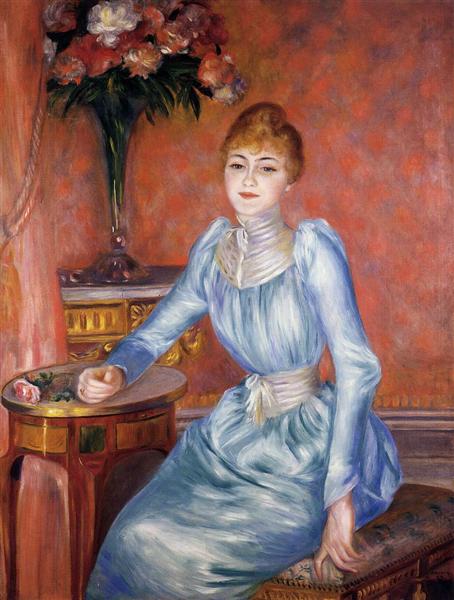
Portrait of Madame De Bonnières (Henriette Arnaud-Gentil, Gräfin De Bonnière), painted 1889
This is a meditation in response to a local mum whose...discomfort...with Mad Old Pete the faggot coming to pick up Lanny for his actress mum, as she makes him wait outside her sacred child-stuffed grotto while she calls actress-mum to be sure she's not sending the child to be raped and murdered by the slavering pedophile. *sigh* Familiar with that one, I am.

p76 (Pete still speaking):
In the bus shelter as we passed there was the Henderson boy with Oscar whatsisname from Yew Tree Cottage and they were passing back and forth a joint as big as a church candle, a floppy, knuckled, badly-built thing, and my word it smelled nice. We nodded as we passed and I raised a hand in greeting.

WEIRDO coughed one of them, spluttering into giggles.

We walked on.

I was a little stuck for what to say and then Lanny asked, Do you think they were talking about me or you?
Tedious petit-bourgeois snobs with the cultural nous of parsnips judge what they can't understand and, as The TWIST!!! approaches, Pete's gonna get it in the neck.

Seriously. Everybody got that? Are we all on the same page now? Permaybehaps not...

p85 (Peggy Something-or-other, the Town Crone, is speaking):
It says, in small letters at the end of the {Domesday Book} entry {about their dreary little village}, barely legible but I've seen a photograph of it, Puer Toothwort.

Oh Peggy, I tut, you rotter, what a load of old bollocks.

It says it, Peter. It is written. He's been here as long as there's been a here. He was young once, when this island was freshly formed. Nobody was truly born here, apart from him.

So he's older than you? Surely not. Right then, must deliver this little artist home to his parents.

Night night, Peggy, sweet dream, sings Lanny.

Sleep well good child, she says. Sleep well, Mad Pete, and she winks.
Now, are you there YET?! Seriously, do. you. get. where. the. train. is. headed.

Oh, and the horriblity of the w-bomb puts the moldy cherry on the shit sundae with extra worms we're being served, doesn't it.

p96 (Pete is speaking again):
The sound in the village was all wrong. I went for my walk around the block and got the ill feeling and hurried back. The darkness was uneven, slippery. I sought refuge in my kitchen but the pressure between different objects in my house was all wrong. Something was bad. I had a glass of drink on the table, a newspaper and a pen, and the three of them were fit to lift off and explode. Things were closing in.
Now. Not even the most backward, most challenged reader can possibly misunderstand The Import of that last sentence. Wait...can't count on it...best explain: PETE IS SOMEHOW AWARE THAT HE'S ABOUT TO BE BLAMED FOR A BAD BAD THING. Would you care to guess what that bad bad thing is, who the bad bad thing relates to? Anyone?

Now there are two more sections of this overblown sludge. I read them, but honestly, I do not think you need to. If you don't already know what happens, and allow me to assure you that there is indeed A Twist, please send me a message and I'll tell you.

Or I'll mess it up so the shy can still read it: Lanny survives to adulthood but Jolie the actress/novelist divorces tedious Robert and by goddesses they are well and truly better apart. The Toothwort thing doesn't end, it just stops. There's Pete and Lanny (now called something else) drawin' and drankin' in the purged-of-evil woods.

Seriously. We go all this fucking way and there are pages of typographical shenanigans and THAT. IS. FUCKING. IT.


I think Author Porter deserves some serious kudos for making the points he makes about how the very bones of reality are malevolent in some deeply alien ways. He doesn't spend a lot of time soppily sloshing tears and humidly summoning sobs, either, so there's that going for him. Hence all three of my stars. Seriously? Spare yourself. If this wins the (now-Man-less) Booker I'll eat your hat.

FLASH 3 SEPTEMBER 2019

But the news is *excellent*: This book wasn't on the shortlist!