Pages
- Home
- Mystery Series
- Bizarro, Fantasy & SF
- QUILTBAG...all genres
- Kindle Originals...all genres
- Politics & Social Issues
- Thrillers & True Crime
- Young Adult Books
- Poetry, Classics, Essays, Non-Fiction
- Science, Dinosaurs & Environmental Issues
- Literary Fiction & Short Story Collections
- Sookie Stackhouse/Southern Vampire Books & True Blood
- Books About Books, Authors & Biblioholism
Showing posts with label novel. Show all posts
Tuesday, August 12, 2025
PROFESSOR SCHIFF'S GUILT, humor is hard, but better when hard-edged
PROFESSOR SCHIFF'S GUILT
AGUR SCHIFF (tr. Jessica Cohen)
New Vessel Press (non-affiliate Bookshop.org link)
$17.95 all editions, available now
Rating: 4* of five
The Publisher Says: A stellar novel rendered into a darkly comic, unforgettable narrative by Booker International Prize winning translator Jessica Cohen.
An Israeli professor travels to a fictitious West African nation to trace a slave-trading ancestor, only to be imprisoned under a new law barring successive generations from profiting off the proceeds of slavery. But before departing from Tel Aviv, the protagonist falls in love with Lucile, a mysterious African migrant worker who cleans his house.
Entertaining and thought-provoking, this satire of contemporary attitudes toward racism and the legacy of colonialism examines economic inequality and the global refugee crisis, as well as the memory of transatlantic chattel slavery and the Holocaust. Is the professor’s passion for Africa merely a fashionable pose and the book he's secretly writing about his experience there nothing but a modern version of the slave trade?
I RECEIVED A DRC FROM THE PUBLISHER VIA EDELWEISS+. THANK YOU.
My Review: I'm willing to bet that most people squirm just reading the synopsis. It's a reckoning with the long shadow of chattel slavery and its ties to Jewish merchants.
I think the best choice Author Schiff made was to tell the story in a comedic register, relying on farcical coincidences of crime and punishment to acknowledge past harms while lampooning present ones caused by some clumsy, bureaucratic attempt at balancing cosmic scales.
The far more interesting point Author Schiff makes, to me at least, is the sheer ubiquity of the mental construct of Africa as lesser, as broken and needing "us" to fix it. The way Professor Schiff approaches his putative project in the narrative begs the question "why are you doing this?"
As a meditation on white guilt versus White Guilt, I think it's a great contribution to necessary conversations about Jewish complicity in the crimes of chattel slavery. As a novel about an individual man's coming to self-awareness, it felt...off.
The parallels drawn between Ancestor Schiff and his appropriation of the slavegirl, and Storyteller Schiff and his relationship to his cleaner, weren't that successful in my reading eyes. They felt as performative as the arrest and legal proceedings of Storyteller Schiff did, without the sharp edge of satire to make them cut my tough hide of willful ignorance. As a result, I was more squicked out than I was challenged to contemplate the real meaning of these sexual crimes. In fact I felt less sympathy for Ancestor Schiff before Storyteller Schiff's peccadillo was brought in. I think the opposite was intended.
I know that could really be a "me" thing, but I bring it up to alert readers who find sexual exploitation deeply unpleasant that this could decrease their reading pleasure.
I'm not as delighted by the read as others were but I am happy to have read a reckoning with an underrepresented crime of historical complicity.
Wednesday, May 14, 2025
THE BOY FROM THE SEA, Irish fable-making for this century's needs
THE BOY FROM THE SEA
GARRETT CARR
Alfred A. Knopf (non-affiliate Amazon link)
$14.99 ebook, available now
NOMINATED for the 2026 Dublin Literary Award...a longlist of twenty will be announced in February 2026, the shortlist of six in April 2026, the winner(s) in May's festival.
Rating: 4* of five
The Publisher Says: 'Compulsive reading. Compassionate, lyrical and full of devilment' Louise Kennedy, author of Trespasses
1973. In a close-knit community on Ireland’s west coast, a baby is found abandoned on the beach. Named Brendan Bonnar by Ambrose, the fisherman who adopts him, Brendan will become a source of fascination and hope for a town caught in the storm of a rapidly changing world.
Ambrose, a man more comfortable at sea than on land, brings Brendan into his home out of love. But it’s a decision that will fracture his family and force him to try to understand himself and those he cares for.
Bookended by the arrival and departure of a single mesmerizing boy, Garrett Carr's The Boy From the Sea is an exploration of the ties that make us and bind us, as a family and community move irresistibly towards the future.
I RECEIVED A DRC FROM THE PUBLISHER VIA NETGALLEY. THANK YOU.
My Review: Funny thing how kindness skips a generation. Declan, the titular "Boy"'s older sibling, wouldn't know kindness if it fucked him. The elder Bonnar couple love their magical gift of a child..."Parents knew you can never tell how a child will turn out, naturally yours or not. They had learned, fundamentally, every child comes in from the sea, washes up against the ankles of their parents, arms outstretched, ready to be shaped by them but with some disposition already in place, deep-set and never quite knowable"...Brendan, named for the Navigator, that famously fostered child. The boy, like mythical Brendan, never has his own place to take root...thanks, Declan...but instead becomes a source of bemusement in the community.
The narrative is from a godlike omniscient third-person PoV...the godlike, or royal, "we." It's a choice that, while conferring the reader with the advantage of being privy to things a more limited PoV would make awkward to show, removes us from the action. Observing from a distance is always going to slow one down when reading about the intimate life of a community. It did here. There are so many small, mean-souled people in Brendan's world. It doesn't relent, either, when we see his "family"...mother Christine's horrifying sister and father, and unwilling sibling Declan...being so unreservedly awful to him. As though being abandoned in a Moses-like way was somehow his fault, or merited (like any infant deserves abandonment).
So quite a melancholy read for me. As I've come to expect from Irish writers, or the ones who get published in the US anyway, the prose has real lyricism. Unexpectedly it breaks into quotidian musings on things like the EU and its fishing quotas..."He still felt guilty about his comportment with Christine later, as he sat in his car outside the fisheries office. He’d never actually apologize but he’d be extra jovial in their next few encounters; this was how we indicated we were sorry for something we’d said or done: by acting oddly the next time we met you"...and the waning control of the church on peoples' inner lives..."A note on our use of the word ‘grand’ is here required. It might sound like a relative of good or great but in our usage it was something different. ‘Grand’ was how we acknowledged that something wasn’t good or great while also saying nothing could be done and there was no point going on about it"...and eldercare..."Eunan {Christine's ghastly father} was against anything without set purpose and complete predictability and a human tended to fail on these requirements. He was against surprises, he hadn’t allowed a telephone in the house for many years as you never knew when it might ring on you. He mocked anything frivolous: placemats, dessert, having a lie-in, suffering from your nerves. ‘Get away out of that!’ he’d shout at cream cakes and people with hay fever."
What you're getting in this story is not showy, or fast, or loud. It is just like the sea that dominates this Western Irish town. It is quiet and inner-directed, with wild outbursts of damage and trouble, followed by the calmer gift-giving phase again. It is a lovely, involving visit to a lifeway long since altered by the relentlessness of change grown from within anf imposed from without.
I very much enjoyed the story's two-decade time frame. They were the last years of an Ireland now so completely vanished that one would be hard pressed to see it in modern Ireland. An elegy, albeit an emotionally honest one, to the way the country once was, with characters standing in for ways old and new. A read I expect will launch the writer into world notice because it is so plangently plucking heartstrings all the way through.
I don't mean that as a diss, only a recognition. I'm hip to your tricks, Author Carr, and I see how well you're performing them. That earns you a respectful tip-of-the-cap four stars.
Monday, March 24, 2025
TWIST is Colum McCann's latest, aptly titled, exploration of communication and its breakdowns

TWIST
COLUM McCANN
Random House (non-affiliate Amazon link)
$13.99 ebook, available now
Rating: 4.5* of five
One of Publishers Weekly's Best Books of 2025!
The Publisher Says: A propulsive novel of rupture and repair in the digital age, delving into a hidden world deep under the ocean—from the New York Times bestselling author of Apeirogon and Let the Great World Spin
“Everything gets fixed, and we all stay broken.”
Anthony Fennell, an Irish journalist and playwright, is assigned to cover the underwater cables that carry the world’s information. The sum of human existence—words, images, transactions, memes, voices, viruses—travels through the tiny fiber-optic tubes. But sometimes the tubes break, at an unfathomable depth. Fennell’s journey brings him to the west coast of Africa, where he uncovers a story about the raw human labor behind the dazzling veneer of the technological world. He meets a fellow Irishman, John Conway, the chief of mission on a cable repair ship. The mysterious Conway is a skilled engineer and a freediver capable of reaching extraordinary depths. He is also in love with a South African actress, Zanele, who must leave to go on her own literary adventure to London.
When the ship is sent up the coast to repair a series of major underwater breaks, both men learn that the very cables they seek to fix carry the news that may cause their lives to unravel. At sea, they are forced to confront the most elemental questions of life, love, absence, belonging, and the perils of our severed connections. Can we, in our fractured world, reweave ourselves out of the thin, broken threads of our pasts? Can the ruptured things awaken us from our despair?
Resoundingly simple and turbulent at the same time, Twist is a meditation on the nature of narrative and truth from one of the great storytellers of our times.
I RECEIVED A DRC FROM THE PUBLISHER VIA NETGALLEY. THANK YOU.
My Review: Setting your repair story at the mouth of the Congo River is asking for Joseph Conrad comparisons. On a craft level, Author McCann is *streets* ahead of Conrad. On an imaginitive axis, he's at the fatal disadvantage that time presents us all. Somebody else did it a century-plus ago. That isn't always a problem since, after all, nothing's original after The Tale of Gilgamesh.
This story is focused more on Kurtz, sorry Conway, and his South African actress lover Zanele, than on Fennell the journalist covering Conway's really, really interesting role in maintaining the infrastructure we're so completely dependent on for modern life. I was captivated by the bits of the story that featured the underwater cables and their care, the hazards that beset them, and the clever, dangerous ways we use to maintain and repair them.
This is Colum McCann's métier: Metaphor. Underwater cables carrying all the world's information, all the connections between people, the vast accumulation of meaning enabled by them; the threat to them in the story is natural and requires huge, dangerous effort by multiple people; the man whose job it is to tell us about it is, unsurprisingly, in crisis of the same sort.
Because Fennell is the PoV man doesn't make him the center of the action, necessarily, and the argument that Conway's the main character is possible to make. All the action centers Conway. Every physical thing done of any consequence is done by Conway. His are the skills...freediving! ZOMG...that will repair the vital cable. Fennell has to learn all this data, and so we have an excuse to learn it with him. He is us...Conway is the action hero doing the stuff to make us more comfortanle, safer, in our cocoons. Fennell is there to tell us his story.
And Fennell himself? He's got the whole world in his head. He needs the same repairs as the cables. His ex, and his son, can tell you stories of the man who tells stories and yet has no emotional facility; no facility at moving the emotional data through the wildly pressurized cables of his emotional system out into the places they're needed. On this assignment, he's doing everything he can from miles away to understand and present to his audience the facts of the situation when, in reality, he's trying to explain how communication is invisible until it's broken. This is a central-to-life human fact.
What makes the men at the center of this story do what they do is women. That's a dreary, heteronormative reality. The actress...note her profession's essential artifice...that Conway and, though less blatantly, Fennell desire is a professional dissimulator who presents emotional realities in an unreal, fictional way to illuminate their truth.
Acting is Orwellian...lying to create truth. Like writing, an artifice, an epicyclic system humans have created.
This is McCann's métier. He's operating within nominal parameters. He's found a story to tell that makes its mark by taking all Conrad's colonial-era concerns and trimming them to fit a twenty-first century audience's blind spots. He then uses the people he's created to fulfill the archetypal duties once held by Marlow and his blank-spaces-on-maps fascination, Kurtz, and the largely forgettable women Kurtz acquires. It's got verve, it's stylish, and it's built on foundations that have withstood the test of time. All that is the basis of a five-star rating, surely! Yes, but...the novella length is notably absent. This is a novel in full, not to say a maximalist one; but novels allow a scope that can lead the ambitious into temptation of prolixity. Author McCann's succumbed to this fiction-fever. The ending of the story is not the end of the novel. It goes on a bit. Not long enough to get boring but long enough to feel baggy as an old, well-loved cardigan.
So I'm recommending it to all y'all who want a solid, involving story that is not perfect but is delightful and successful at revivifying a classic story that can never get stale.
Friday, February 21, 2025
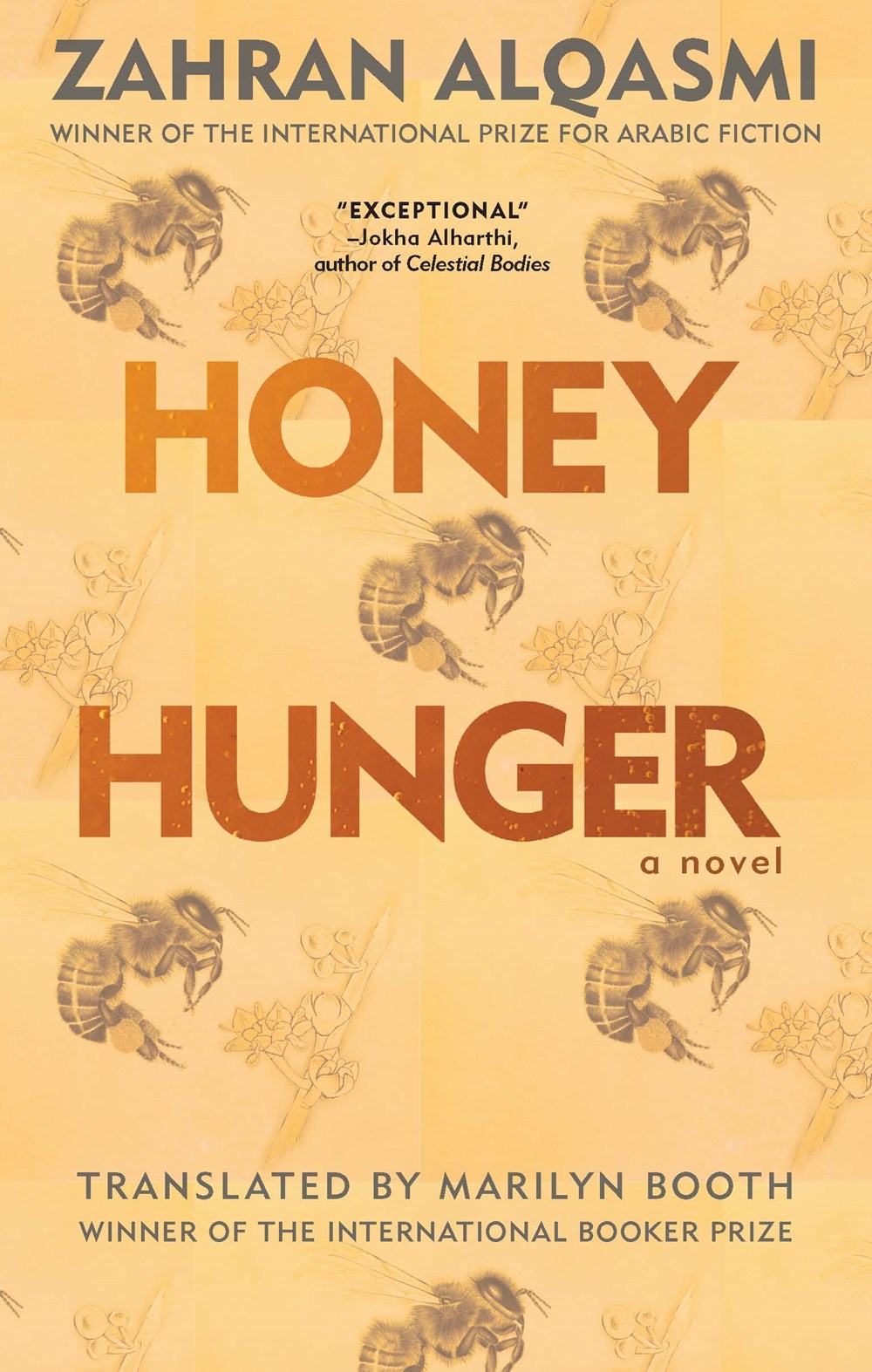
HONEY HUNGER: A Novel, Marilyn Booth's excellent translation of Zahran Alqasmi's novel of Oman
HONEY HUNGER: A Novel
ZAHRAN ALQASIMI (tr. Marilyn Booth)
Hoopoe Books|American University in Cairo Press (non-affiliate Amazon link)
$18.95 ebook edition, available now
Rating: 4.75* of five
The Publisher Says: A breathtaking novel of longing, uncertainty, and ultimately of hope, written by an International Prize for Arabic Fiction-winning author and an International Booker-prize winning translator
Azzan is a beekeeper in a rural community in Oman. Devoted to tending his bees and searching for wild hives, he encounters Thamna, a lone shepherd woman, on a mountain slope and is captivated by her and her honey-colored eyes. Across the breathtaking vistas of Oman’s remote mountains and plains, Azzan’s troubled past and present unfold. A disappointment to his family, he turns to drink, and ultimately discovers the healing power of his beekeeping, before an accident in which he loses all.
Zahran Alqasmi’s masterful novel thrums forward with a subtle momentum. His lucid, poetic writing conveys a visceral sense of time and place, of the fragile ecologies inhabited by both bees and humans alike, in this intense and compelling novel of loss and hope.
I RECEIVED A DRC FROM THE PUBLISHER VIA EDELWEISS+. THANK YOU.
My Review: Does the old nostrum, "still waters run deep," ring a bell in your cultural education? Azzan is the personification of it. He's quiet on these pages. He's still physically and psychically until summoned into action in service to some need. Author Alqasmi uses his stillness to carefully, incrementally, accustom you to the reality of Oman, of a place he seems to assume you will want to know feel and smell and hear, without intrusive human-ness. Gradually, Azzan's eyes...our cameras onto this sparely furnished landscape...show us more, bring us to the places—in the company that hearken to the quiet sounds that we call "silence" in technology's noisy embrace. Azzan's not a beekeeper by happenstance, either as a character or a PoV.
These are the choices that lead you the audience into the creation of an author whose poetry output outweighs his prose, ten to four; but whose prose garnered him the 2023 International Prize for Arabic Fiction (IPAF) for The Water Diviner; I believe this is the immediate predecessor to this novel in Arabic. It is obvious to me that the quality of the vision here is not a chance sport, an artifact of a talented translator's vision alone. That disappointment has befallen me before when a multiple translation career has yielded...inconsistent...results. Being the first of his works translated into English, I could still be disappointed; it just *feels* like a good bet to make, after reading this story.
I'm sure the idea of beekeeping in a landscape as arid as Arabia is overall seems odd. It is an ancient reality though. Deserts bloom, even if sparingly. Beekeepers are not hugely wealthy anywhere bit seldom lack for work for very long. It is a surprisingly mobile task in this story, one that enables Azzan to be see, hear, participate in, a lot of lives in making his life with bees. The honey they make is the life he leads; but it's also large in the life of the people. The product that makes life just enough less harsh to be fun at times for the people Azzan's belovèd bees serve. His knowledge of the lies, cheats, and kindnesses others never even think they don't know about all revolve around his deep and unwavering interest in and commitment to his charges the bees.
It gives the author a free rein to point up character traits in the narrator's orbit and beyond, for good and for ill; is Thamna, the herdswoman he encounters so fleetingly, an object of obsessive lust, actual love, or simply a fixation because of her novelty in his mostly male world? Does his thinking about bees, those matriarchal marvels without a permanent male presence, and their coveted honey drive or lead his itinerancy? If he's led by it, it makes his questing for wild honey that much more about the world he observes so intently; if driven instead, that condition of needing the honey makes his sharply observant eye that of the exploiter, the taker of all the work of others he is not entitled to have. All of these are within this novel's possible meanings.
Azzan's obsession with bees and their care is, while unusual to the US-fiction reader, an outgrowth of his blighted past. He is a recovering alcoholic in a society that frowns on alcohol use. He has never been a success, felt as though he was enough for or even wanted by those who raised him. It is this strange selfness, this sense of himself as needing and wanting but never receiving unless he takes (as from the bees, his compatriots), that is reinforced by the lyrical language of description that never devolves into possession; rather it settles on taking the product without "owning" the producer, on caring for and feeling committed to the bees, the goats, the donkeys and living among them in place of being their "owner."
Is that the place held by the exploiter, the user, the rentier? Azzan does not give off that vibe; I can still see it in the flow of his honeyed words of praise and appreciation and admiration for the bees. It comes down to the sense the author gives all these people who live among the animals they use; they take on the risks and protect their charges from harms they will all suffer from. In return they exert a right to practical rewards of sustenance.
A man who longs for love he is sure he does not deserve and whose object is safely always independent of his custodial care and capable of being just fine without him sounds to me like a man in need of a perspective check; he's fine how he is, too, just busily denying himself the peace of contentment to punish his perceived failings as received from the eyes and ideas of others.
So with all this praise why not five whole stars? Because these ideas and words of beauty and layers of meaning come with a labor tax of non-Western-standard punctuation and dialogue tags. I don't think that's a bad thing myownself. It does mean I can't five-star flag it for all y'all to pick up and devour ASAP. So many won't work this hard. Heck, even *I* had to read some things over twice to choose meanings that would change depending on to whom I attributed the words.
For me that's fun, for most it's work, so four and three-quarter stars seems fair.
Labels:
#WITMonth,
Arabic translation,
beekeeping,
bees,
coming to terms,
ecological awareness,
ecology,
Hoopoe Books,
low self-esteem,
lyrical prose,
Marilyn Booth,
novel,
Oman setting,
Zahran Alqasmi
Thursday, September 12, 2024
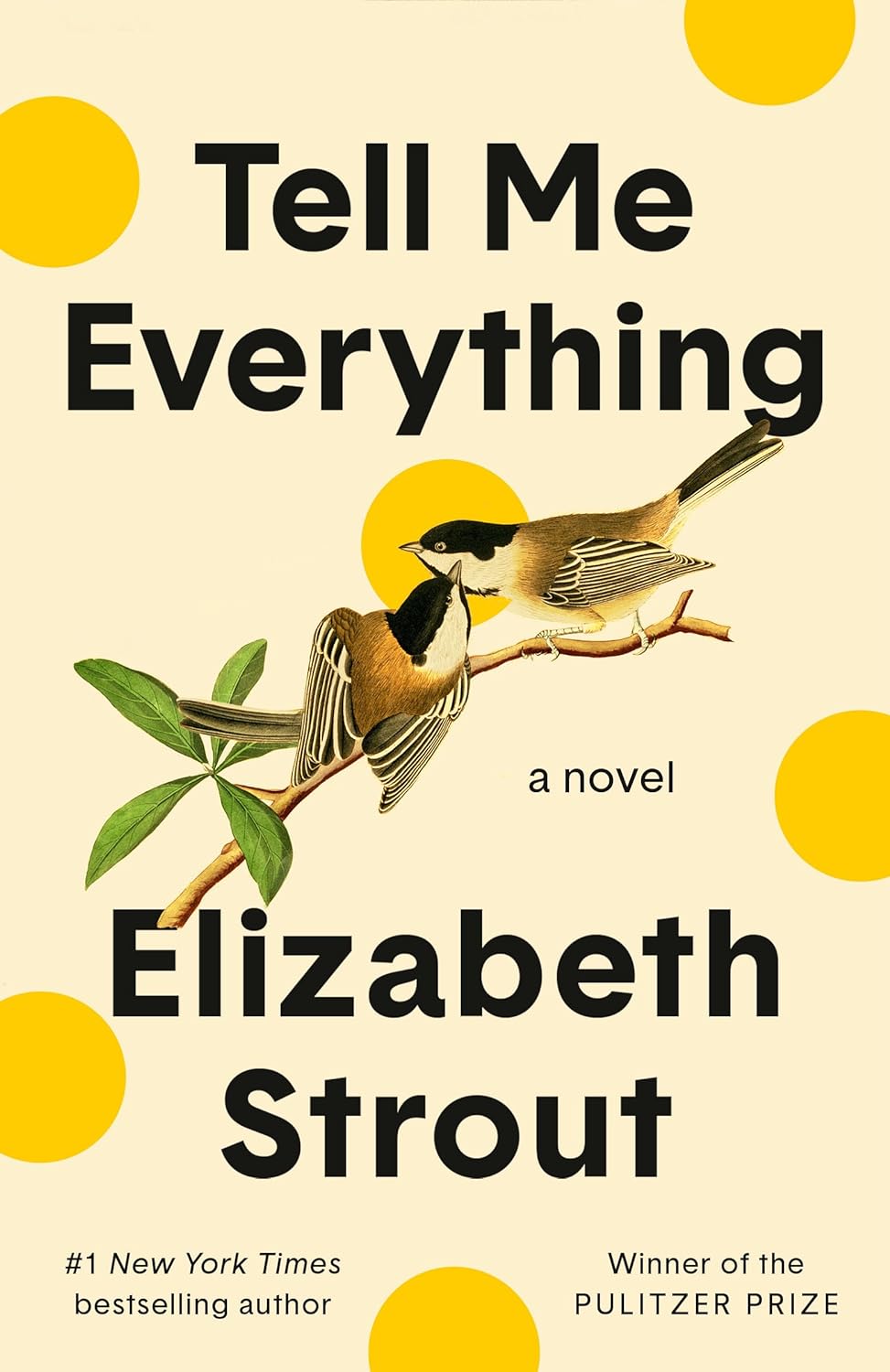
TELL ME EVERYTHING, the familiar salutation in Italian marking you out as special to the speaker
TELL ME EVERYTHING
ELIZABETH STROUT
Random House (non-affiliate Bookshop.org link)
$16.99 trade paper, $14.99 ebook, available now
Rating: 3.75* of five
The Publisher Says: From Pulitzer Prize–winning author Elizabeth Strout comes a hopeful, healing novel about new friendships, old loves, and the very human desire to leave a mark on the world.
With her “extraordinary capacity for radical empathy” (The Boston Globe), remarkable insight into the human condition, and silences that contain multitudes, Elizabeth Strout returns to the town of Crosby, Maine, and to her beloved cast of characters—Lucy Barton, Olive Kitteridge, Bob Burgess, and more—as they deal with a shocking crime in their midst, fall in love and yet choose to be apart, and grapple with the question, as Lucy Barton puts it, “What does anyone’s life mean?”
It’s autumn in Maine, and the town lawyer Bob Burgess has become enmeshed in an unfolding murder investigation, defending a lonely, isolated man accused of killing his mother. He has also fallen into a deep and abiding friendship with the acclaimed writer Lucy Barton, who lives down the road in a house by the sea with her ex-husband, William. Together, Lucy and Bob go on walks and talk about their lives, their fears and regrets, and what might have been. Lucy, meanwhile, is finally introduced to the iconic Olive Kitteridge, now living in a retirement community on the edge of town. They spend afternoons together in Olive’s apartment, telling each other stories. Stories about people they have known—“unrecorded lives,” Olive calls them—reanimating them, and, in the process, imbuing their lives with meaning.
Brimming with empathy and pathos, Tell Me Everything is Elizabeth Strout operating at the height of her powers, illuminating the ways in which our relationships keep us afloat. As Lucy says, “Love comes in so many different forms, but it is always love.”
I RECEIVED A DRC FROM THE PUBLISHER VIA NETGALLEY. THANK YOU.
My Review: Well, here we are...next in a series of books about people I care less about than I probably am safe admitting to publicly. Lucy Barton's fans are legion, and they looove her for being her mildly chaotic self. I mean, they've stuck by her despite her ongoing friendship with her truly toxic, lightly pathetic first husband! That would get a flesh-and-blood woman canceled fast.
I myownself admire her for it. Own your mistakes, forgive your abusers, move forward standing on the past and pushing into the future on those rocks.
This outing has Author Strout doing something bold: Lucy meets her *other* famous older-woman character, Olive Kitteridge! The glue is a story about a murder...you can read the synopsis above, I feel no need to yak on about it...and, surprisingly, sparks do not fly. They clash, of course, Olive is after all a nasty bully who I myownself disliked the second I met her, but no snarktastic duels of wits ensue. Pity, that, but in keeping with the world Author Strout's created.
Amgash/Crosby is another fictional universe where characters have multiple chances to shine. This time it's mostly about Lucy's platonic bestie, Bob Burgess. They are each other's confidante, talking over things they don't have anyone else to confide in. His troubles, his life's burdens, are the topic he least discusses as he busily solves others' problems, much like Lucy herself.
I am generally very receptive to this sort of intertwined storytelling technique. I've read, and love, EF Benson's Mapp and Lucia books, the massive Barsetshire series shared by Trollope and Thirkell, and some of Miss Read's Fairacre series. These all have the virtue of following a group of characters more or less closely, with individual books having one or another focused on, albeit not usually exclusively. So that's how I keep coming back to this wellhead. I'm ready to involve myself in the lives of strangers when they all know each other, more or less well.
I don't think the Amgash series makes the grade as a successor to those series, at least in my own affections, because I myownself find the dithering that Lucy does, and the bullying that Olive does, incompatible with a lovely immersive read. Entirely a personal assessment, and not in the least meant to discourage anyone from pursuing these reads; just, well, be aware that Lucy's insightful comments and Olive's shrewd observations come wrapped in definite personalities. Since they're not really the ones I find most congenial, I'm not going to warble my fool lungs out singing their praises.
I will say that, in this book's case, I think you're best off reading it after having read Olive Kitteridge and My Name is Lucy Barton first. They're not strictly speaking necessary to have done so but, well, the way this storyverse goes, it helps to know the ladies you're relying on for context before going in.
If those are under your belt, dive in. I'm such an outlier when it comes to these characters. They irk and annoy me. They also come with such a well-conceived storyverse, one that soothes the need to make fictional friends, one that is part of a web of interrelated characters you don't know yet...much like life is. That more than any other quality is why I read the books. It feels prosocial.
Enjoy! I did.
Friday, December 15, 2023
JANE'S COUNTRY YEAR, another Handheld Classics reissued delight
JANE'S COUNTRY YEAR
MALCOLM SAVILLE
Handheld Classics
$19.99 trade paper, available now
Rating: 4.5* of five
The Publisher Says: The first edition since 1946, with full colour illustrations throughout.
'At last she reached the brow of the hill ... now the country opened out below her and she looked down into a wide and lovely valley ... Still patched with snow the little fields spread like a carpet below her and here and there a farmhouse with barns and golden ricks was clearly seen. Across the plain ran, straight as a ruler, a railway line and she saw a toy train puffing and crawling across the picture.'
Malcolm Saville's classic novel is about eleven-year old Jane's discovery of nature and country life during a year spent convalescing on her uncle's farm, after having been dangerously ill in post-war London. This deeply-felt novel was written while Saville was extending his range as a writer, alongside his very successful Lone Pine adventure series, and nature anthologies for children. Inspired by the experiences of Saville's own god-daughter, this marvellous novel is full of the wonder of discovery, as well the happiness of regaining health, making friends, and learning to love the natural world. The novel is also a record of rural England eighty years ago, written by one of the great twentieth century English nature writers.
The Introduction is written by Hazel Sheeky Bird of the University of Newcastle. The illustrations by Bernard Bowerman have been reproduced from the first edition.
I RECEIVED A DRC FROM THE PUBLISHER VIA EDELWEISS+. THANK YOU.
My Review: A quiet, gentle read for your tween-years reader. Beautiful reprint edition of a very prolific author for children's post-WWII novel. It follows Jane, a young girl recuperating from a serious illness at her aunt and uncle's farm in rural England. The framing device is, I know you'll know from the off, an excuse to write an elegy for the rural life that generations of people around the world were abandoning in increasing numbers as the world adjusted to new realities.
The text is, of course, not telling you this directly. It's a very sweet, very detailed love-letter to a vanishing time as it faded away. The reason it is interesting to read now is the world is rediscovering a need, once amply fulfilled, to recognize and relate our lives to the rhythms of the natural world. We do our descendants a service by giving them books of this sort. The way that urban outsider Jane comes to understand and treasure this world and its beauties and cycles is edifying without feeling condescending.
A kid today will read this with a sense of shock, I think, that this was ever a way of life that millions followed. It is clearly written and, while there are people winking in it, they are doing so from adult to child, so it's revoltingly condescending but not unexpected. The kind of folk who lived this life at that distant time:
...would have done the w-verb without thinking a thing of it. *shudder* The good old days, they were rotten.
The Introduction by Hazel Sheeky Bird is a wondeful overview of Saville's extended career as a writer for tweens and teens. It makes the book suitable for adults nostalgic for an earlier way of life by contextualizing it in its social milieu. I guess most of the people I'd gift it to, those between 11 and 14, will skip past that essay. If you were old enough to remember the Coronation, or the Rosenberg case, this book with Introduction will very likely hit every last nostalgia bump on your noggin.
Gifted to yourself or a younger reader, one who is beginning to wonder about the natural world around them, this novel of self-discovery, and family love, and the cycle of the seasons embedding them all, will hit a high note for #Booksgiving.
Thursday, June 1, 2023
THE KELLY ANN JACOBSON PAGE for the DISCERNING YA reader: ROBIN AND HER MISFITS, & TINK AND WENDY
ROBIN AND HER MISFITS
KELLY ANN JACOBSON
Three Rooms Press
$14.00 trade paper, available now
Rating: 4.5* of five
The Publisher Says: A roving female gang of fun-loving rebel bikers, street racers, and bandits led by Robin agree to give back to queer girls in need of help in this stunning modern reimagining of the Robin Hood legend.
Robin and her four Misfits—Little John, White Rabbit, Daisy Chain, and Skillet—have run away from their families in order to live off the grid on their own terms. For a while, they’re hidden, safe, and happy as they commit petty crimes that provide enough to get by. All that matters is keeping their small clan alive. Then, one mission proposed by an unfriendly associate from their past reminds them of their former lives and motivates the group to a new purpose. The five Misfits develop into a league of strong individuals united by a fresh goal: do whatever it takes to help queer girls rise above oppressive laws and attitudes.
Kelly Ann Jacobson, the author of the award-winning LGBTQ+ young adult novel Tink and Wendy, is back with another diverse twist on a popular legend.
I RECEIVED A DRC FROM THE PUBLISHER VIA EDELWEISS+. THANK YOU.
My Review: I love Daisy Chain the best because her sibylline utterings aren't remotely clear to her listeners, fellow very young women, except by accident; or, I suspect, by her deeply sneaky inner sibyl wishing to make clear messages only occasionally.
The Prologue, by its nature, is a giant spoiler. Even I, deeply indifferent to spoilers, thought as we then moved back in time for the bulk of the novel, "what's suspenseful now that I know what I know?"
"There is nothing either good or bad, but thinking makes it so."
In that Daisy Chain-uttered Shakespearean truism, laddies and gentlewomen, lies the essential truth of this book. Every runaway runs out of steam at last. All lies are signposts aimed directly at the truth. And when eternal runaway Daisy Chain at long last finds herself, she then finds the greatly belovèd carved-granite mass that is Robin right where she left her.
So that Prologue? What does it spoil? Does knowing where mean how has no value? Or is "Don't waste your love on somebody who doesn't value it" more than one lie told in one sentence? That hand is always pointing its curled fingers directly at the truth of love never being wasted because it is valued...if, perhaps, differently than one would ask for it to be...but still valued.
What's on offer here is this: A story designed to be eaten up by young, questioning women in search of Identities in a world awash with given, never chosen, names. It's going to offer those young women snow chains for the tires on the unchosen, unsuitable dune-buggy that in their ill-suited design keep slipping on the glaciers where they inexplicably find themselves. This story can be their Nottingham of the spirit while their bodies work out how to steer their unstable, utterly unreliable transportation on to as-yet-unseen safer paths.
Highly recommended for those young women among your graduating family who could use a nudge to become Robin Hood not the Pretty, prized-but-powerless Maid Marian.
++++++++++++++++++++++++++++++++++++++++++++++++++++++++++++++++
TINK AND WENDY
KELLY ANN JACOBSON
Three Rooms Press
$14.00 trade paper, available now
Rating: 4.5* of five
The Publisher Says: What happens when Tinker Bell is in love with both Peter Pan and Wendy? In this sparkling re-imagining of Peter Pan, Peter and Wendy’s granddaughter Hope Darling finds the reclusive Tinker Bell squatting at the Darling mansion in order to care for the graves of her two lost friends after a love triangle gone awry. As Hope wins the fairy’s trust, Tink tells her the truth about Wendy and Peter—and her own role in their ultimate fate. Told in three alternating perspectives—past, present, and excerpts from a book called Neverland: A History written by Tink’s own fairy godmother—this queer adaptation is for anyone who has ever wondered if there might have been more to the story of Tinker Bell and the rest of the Peter Pan legend.
I RECEIVED AN ARC FROM THE PUBLISHER. THANK YOU.
My Review: Never for a moment have I believed that the story of Peter Pan and Wendy and the Lost Boys was sweet and Innocent and all on the up-and-up. There is a seedy adult-mediated sexuality in the whole concept of the story. The Lost Boys and Peter trapped in that eternal tween-age: where parents can comfortably if mendaciously Not Know that their kids are steadily, stealthily beginning the sad journey into adolescent sexual awakening. They're busily putting together hints and clues, and feeling weird new things without possessing words to explain them yet. Wendy, here as always the odd creature out, has a body the Boy and his boys don't know inside out already. She has a mind they can't fathom and she can't explain, because who can explain how they are built different from you? And because no one really talks to kids about what they want to know regarding sex and sexuality, parents keep giving kids the original deeply subversive story about the tragedy that befalls the innocent when Innocence is finally and forever lost. Never mind that the kids don't want this Innocence we're determined to protect in them. Having no idea of what Innocence means, the Innocent can't wait to get rid of it.
"It's harmless," goes the reassuring hiss of the lying snake within the well-meaning adult. "After all, it's got a tiny fairy standing between them, so Nothing Can Happen."
That's what this book is about: what happens when the tiny fairy, sick of being Between too many things and having no ground of her own, takes her rightful place in the action. As seasoned readers we know that's the starting gun for tragedy to unfold. This book is about the price that loving one, being in love with the other, exacts on the lover. Also what terrors there lurk within the armor-plated ignorance of being the belovèd. This story rips the dishonesty off the older story of wanting to keep your cake but eat it too...that evergreen source of unhappy resolutions to love triangles. Teach them young that there is no frictionless way to be in love: If you care enough to make it count, like Tink does, you will suffer most when your belovèd suffers. Teach them before they create disaster by refusing to choose, by declining to believe they can, they truly can! have happiness if they bravely reach out for it. It's better done like this than the Innocence-celebrating original.
These readers come away clear about what prolonging Innocence costs. What they probably don't—maybe eevn shouldn't yet— see is the pale and semi-conscious illness-ridden compromised and dishonest simulacrum that will, like here in this story, become the best you can have if you waver betwixt and between, refusing to make a choice.
As stories for youths go, this one is honest, well-told, and contains what looks like a happy ending that is, in fact, a dire warning. I'd time-travel to give this morally complex, intellectually serious retelling of a deeply problematic story told by a very sketchy source I wouldn't let near anyone under twenty-five to every teen I knew when I was one myself.
Wednesday, February 23, 2022
CAROLINA BUILT, fictionalized story of a superbly determined woman's battles
CAROLINA BUILT
KIANNA ALEXANDER
Gallery Books (non-affiliate Amazon link)
$13.99 ebook edition, available now
Rating: 4* of five
The Publisher Says: This “exuberant celebration of Black women’s joy as well as their achievements” (Kate Quinn, New York Times bestselling author) novelizes the life of real estate magnate Josephine N. Leary in a previously untold story of passion, perseverance, and building a legacy after emancipation in North Carolina.
Josephine N. Leary is determined to build a life of her own and a future for her family. When she moves to Edenton, North Carolina from the plantation where she was born, she is free, newly married, and ready to follow her dreams.
As the demands of life pull Josephine’s attention away, it becomes increasingly difficult for her to pursue her real estate aspirations. She finds herself immersed in deepening her marriage, mothering her daughters, and being a dutiful daughter and granddaughter. Still, she manages to teach herself to be a businesswoman, to manage her finances, and to make smart investments in the local real estate market. But with each passing year, it grows more and more difficult to focus on building her legacy from the ground up.
“Filled with passion and perseverance, Josephine Leary is frankly a woman that everyone should know” (Sadeqa Johnson, author of Yellow Wife) and her story speaks to the part of us that dares to dream bigger, tear down whatever stands in our way, and build something better for the loved ones we leave behind.
I RECEIVED A DRC FROM THE PUBLISHER VIA NETGALLEY. THANK YOU.
My Review: It's always been hard to be a woman. In the US, it's always been hard to be Black. Now put the two disadvantages together...that's what Josephine Leary is up against. She's equal to any task, though; the novel begins in 1870, during the last days of Reconstruction. Having lived her childhood as a slave, Josephine knows that every single act she takes in this life has to have as its aim the increase of freedom and the assurance of security for herself, her husband, and their two daughters, as each addition to her life is made.
Her slaveowner was also her father, and that piece of "good luck" played out in her favor. She was able to buy the barbershop she and her husband ran together from him. And from there forward, it was all Mrs. Leary and all the way up Sweety, her husband, backed her.
Until her success threatened his Manhood.
It's a testament to the author's ability to pace a story that I didn't just quietly close the book and ignore it at that point. I know it happened; I am told it still happens. But it makes for dull reading, the expected flaw in the expected place. But to her credit, Author Alexander dwells on it not...it's not like it's played down but it's not protracted either.
What made me so dad-blamed mad that I screamed at my Kindle (for which I apologize to my roommate, he was sleeping and was utterly terrified as I shouted "NO SHE DID NOT!!" into the dark) came close to the end of the book when there's a fire that deprives Mrs. Leary of her (uninsured, of course, she was a Black woman, who'd write that policy in the 1890s?!) hard-earned gains! But...and this is where I almost cheered but was too shy to wake the grouch up again...she still owned the land. And she chose to rebuild, to build back better.
Unlike certain scumbag politicians with "R"s after their names.
Well, that all sounds very five-starry, doesn't it? But there's a four up there...and I feel generous giving it. The fact is that this is a very dialogue-heavy novel and there's not much vigor in the dialogue. It's not awful but it doesn't lend itself to quoting the quotable quotes. There's not any.
"The only thing that truly frightens me is the idea that I might not take full advantage of the gift of freedom. I refuse to let that happen."
And that is as snappy as it gets. I'm in total agreement with the sentiment. I just wish it had more oomph behind it.
But in the end, this is an historical novel and it's a lot better served by thinking of it as a novelized biography. Josephine Leary very much deserves to be remembered for her indomitable will, her savvy, and her sheer cussèd determination to overcome every obstacle the world shoves in front of her. Reading the story is a good, and a worthy, way to honor the memory of such a remarkable person.
Wednesday, August 31, 2016
IMPERIAL WOMAN, Nobel Prize-winning novelist Pearl S. Buck's 1956 take on events of her own childhood
IMPERIAL WOMAN
PEARL S. BUCK
Open Road Media
$9.99 Kindle edition, available now
Rating: 3.5* of five
The Publisher Says: Imperial Woman is the fictionalized biography of the last Empress in China, Ci-xi, who began as a concubine of the Xianfeng Emperor and on his death became the de facto head of the Qing Dynasty until her death in 1908. Buck recreates the life of one of the most intriguing rulers during a time of intense turbulence. Tzu Hsi was born into one of the lowly ranks of the Imperial dynasty. According to custom, she moved to the Forbidden City at the age of seventeen to become one of hundreds of concubines. But her singular beauty and powers of manipulation quickly moved her into the position of Second Consort. Tzu Hsi was feared and hated by many in the court, but adored by the people. The Empress's rise to power (even during her husband's life) parallels the story of China's transition from the ancient to the modern way.
My Review: Few women in China's very long history have been as well-documented as rulers as Cixi. I suspect that Mrs. Buck, daughter of missionaries to China and a reluctant missionary herself, wrote of this larger-than-life figure because she felt great kinship with her. Cixi was an outsider in a closed world, the Imperial Court, but whose sterling native qualities gave her tremendous influence over that closed world. Buck was in much the same situation vis-a-vis the Chinese culture she was native to for the first forty years of her life. Her parents raised her to be bilingual in Chinese and English, gave her no model for a racist view of the Chinese, and allowed her to mingle with the children of their Chinese converts to Presbyterianism mostly without interference. This made her a fish out of water everywhere, but also gifted her with an amazing insight into the cross-cultural communication disasters that have plagued China's relations with the world forever.
Cixi was an intelligent young woman of relatively modest, though not humble, birth, gifted with great personal grace and beauty. Her enormous elevation to the relatively modest in Imperial Court terms position of Imperial Concubine afforded Cixi the opening to become a powerful woman; her excellent fortune in giving birth to the Emperor's only son allowed her to move well beyond the considerable but constrained power of a favored concubine/consort into a full governing partnership as a Regent for her son, with a council appointed by her late Imperial master.
Buck portrays Cixi as a schemer, but not a wastrel as she is often portrayed. Her intrigues had at their heart a sincere and abiding belief that dynastic continuity was the sole means by which the Chinese body politic could be served by their government as foils against the colonial depredations of the Western powers. All the pomp and the excess Cixi loved was put on for the demonstration of her dynasty's power and dominance. All the machinations she undertook were meant to keep her position—but so that she might continue to fight against China's diminution and beggarment.
Fundamentally, Cixi behaved no differently than the Communist Party has since Chairman Mao's death in 1976. She was a strong leader, and a flawed person; she was also too late to do much about the long, slow fall of her for of government. History's tides catch up with all governments eventually; the Party's current grandees know this, and are behaving in their stewardship of China as Cixi herself did 125 years ago.
As all Pearl S. Buck novels are, this gracefully told tale is a pleasure to read and a treasure house of outside/insider information and opinions now irreplaceable with the death of the author. It is an exciting story, a well-told tale, and a still-invaluable look into a difficult life lived in service to a misunderstood ideal. A must-read for all Sinophiles.
Thursday, August 25, 2016
FOR YOU, MADAM LENIN is on sale! A novel of the domestic life of a revolutionary
FOR YOU, MADAM LENIN
KAT MEADS
Livingston Press
$10.00 SALE PRICE trade paper, available now
Rating: 4* of five
The Publisher Says: Nadezhda Krupskaya, Vladimir Lenin's comrade/wife, was an only child. Where she went, her mother went also. In Siberia and Europe, Lenin and the two Krupskayas shared close quarters: two- and three-room apartments.
Lenin obliged to live with an in-house, sharp-tongued critic, Nadya Krupskaya and Lenin trying to run a revolution while living with mom/mother-in-law, the daily rituals and domestic lives of subversives--fictionally promising territory.
For You, Madam Lenin covers pre-revolutionary St. Petersburg, the Revolutions of 1905 and 1917, and the Soviet experiment post-Lenin. Trotsky with his abundant hair, Stalin with his webbed feet, Lenin's lovely mistress Inessa Armand, and half-blind Fanny Kaplan, Lenin's would-be assassin, are all present and accounted for.
But the novel belongs to the two Krupskayas. In this version of events, the male triumvirate Lenin-Trotsky-Stalin doesn't outshine Russia's long line of tough, resilient, radical female luminaries.
THE PUBLISHER SENT ME A REVIEW COPY. THANK YOU!
My Review: I like historical novels, I'm interested in Russian history, and I'm culturally in tune with the idea of a husband being the butt of womanly disdain...it's such a common trope, after all. Mothers-in-law don't come much more beady-eyed and observant than Krupskaya Senior.
I don't know that I'd ever so much as given a second's thought to Lenin's domestic arrangements. If anything, I assumed pretty young cadres were at his beck and call. I can't say from my own original research how much of this novel was fictionalized, but I'd certainly say the *feeling* is convincing.
The narrative told from Matushka Krupskaya's point of view is, in fact, charming in its illusionlessness about Lenin's failings as a husband and as a leader. His susceptibility to a pretty Parisian piece, Inessa, surprises his mother-in-law not at all. She admits she thinks Inessa is a lovely, fun girl. But she remains her daughter's mother, so much so that she is Nadezhda's emotional ballast through the inevitable trials of being a famous man's wife. (This part I know to be fictional, as Krupskaya Senior died before the October Revolution.) What impact that has on the power couple, well, three is a crowd didn't become a cliché for no reason.
The other narrative voices, all anonymous omniscient and convenient, are there for the author to offer commentary on the events unfolding before the Krupskayas. It's handy from a plotting point of view, and the "interrogator" of history is at times amusing, but it feels a bit contrived. Krupskaya Senior is telling the story to some unnamed someone, us the readers; the omniscient narrator is too; then the interrogations by History of, for example, Marx's daughters is thrown in, and none of the scenes is terribly long...well, it's choppy out here on this Russian lake.
What sold me on the novel, concerns aside, is the delicate and ever-so-charming arabesque of a life Meads makes for the three women at the heart of things: Mother and confessor, critic and protector, sad survivor and acerbic battler; passionate advocate and wife, lover and beloved, widow and guardian of the flame; and soft, worshipful, accepting refuge for an aging man's sad and defeated needy heart. None of the three can be in any orbit except Lenin's, and in all their actions, they choose this course. They choose to be Lenin's womenfolk. Not because That's What Women Do. Because, first to last, each is committed to the vision of himself that Lenin shows her.
Tart, critical, practical, obsessive, and passionate. Not one of these women is ever less than herself in these pages. That's a lot to say for a trio of wildly different fictionalized people. I'm glad I read it.
KAT MEADS
Livingston Press
$10.00 SALE PRICE trade paper, available now
Rating: 4* of five
The Publisher Says: Nadezhda Krupskaya, Vladimir Lenin's comrade/wife, was an only child. Where she went, her mother went also. In Siberia and Europe, Lenin and the two Krupskayas shared close quarters: two- and three-room apartments.
Lenin obliged to live with an in-house, sharp-tongued critic, Nadya Krupskaya and Lenin trying to run a revolution while living with mom/mother-in-law, the daily rituals and domestic lives of subversives--fictionally promising territory.
For You, Madam Lenin covers pre-revolutionary St. Petersburg, the Revolutions of 1905 and 1917, and the Soviet experiment post-Lenin. Trotsky with his abundant hair, Stalin with his webbed feet, Lenin's lovely mistress Inessa Armand, and half-blind Fanny Kaplan, Lenin's would-be assassin, are all present and accounted for.
But the novel belongs to the two Krupskayas. In this version of events, the male triumvirate Lenin-Trotsky-Stalin doesn't outshine Russia's long line of tough, resilient, radical female luminaries.
THE PUBLISHER SENT ME A REVIEW COPY. THANK YOU!
My Review: I like historical novels, I'm interested in Russian history, and I'm culturally in tune with the idea of a husband being the butt of womanly disdain...it's such a common trope, after all. Mothers-in-law don't come much more beady-eyed and observant than Krupskaya Senior.
I don't know that I'd ever so much as given a second's thought to Lenin's domestic arrangements. If anything, I assumed pretty young cadres were at his beck and call. I can't say from my own original research how much of this novel was fictionalized, but I'd certainly say the *feeling* is convincing.
The narrative told from Matushka Krupskaya's point of view is, in fact, charming in its illusionlessness about Lenin's failings as a husband and as a leader. His susceptibility to a pretty Parisian piece, Inessa, surprises his mother-in-law not at all. She admits she thinks Inessa is a lovely, fun girl. But she remains her daughter's mother, so much so that she is Nadezhda's emotional ballast through the inevitable trials of being a famous man's wife. (This part I know to be fictional, as Krupskaya Senior died before the October Revolution.) What impact that has on the power couple, well, three is a crowd didn't become a cliché for no reason.
The other narrative voices, all anonymous omniscient and convenient, are there for the author to offer commentary on the events unfolding before the Krupskayas. It's handy from a plotting point of view, and the "interrogator" of history is at times amusing, but it feels a bit contrived. Krupskaya Senior is telling the story to some unnamed someone, us the readers; the omniscient narrator is too; then the interrogations by History of, for example, Marx's daughters is thrown in, and none of the scenes is terribly long...well, it's choppy out here on this Russian lake.
What sold me on the novel, concerns aside, is the delicate and ever-so-charming arabesque of a life Meads makes for the three women at the heart of things: Mother and confessor, critic and protector, sad survivor and acerbic battler; passionate advocate and wife, lover and beloved, widow and guardian of the flame; and soft, worshipful, accepting refuge for an aging man's sad and defeated needy heart. None of the three can be in any orbit except Lenin's, and in all their actions, they choose this course. They choose to be Lenin's womenfolk. Not because That's What Women Do. Because, first to last, each is committed to the vision of himself that Lenin shows her.
Tart, critical, practical, obsessive, and passionate. Not one of these women is ever less than herself in these pages. That's a lot to say for a trio of wildly different fictionalized people. I'm glad I read it.
Sunday, July 13, 2014
Book-A-Day #13: A great novel title, HILL WILLIAM
HILL WILLIAM
SCOTT MCCLANAHAN
Tyrant Books
$15.00 trade paper, available now
Rating: 4* of five
The Publisher Says: Beginning to read Hill William is like tuning into a blues station at 4:00 a.m. while driving down the highway. Scott McClanahan's work soars with a brisk and lively plainsong, offering a boisterous peek into a place often passed over in fiction: West Virginia, where coal and heartbreak reign supreme. Hill William testifies to the way place creates and sometimes stifles one's ability to hope. It reads like a Homeric hymn to adventure, to the human comedy's upsets and small downfalls, and revels in its whispers of victory. So grab coffee, beer—whatever gets you through the night—and join Scott around the hearth. Lend him your ear, but be warned: you might not want it back.
My Review: The Doubleday UK meme, a book a day for July 2014, is the goad I'm using to get through my snit-based unwritten reviews. Today's prompt, lucky number 13, asks us to discuss a novel with the best title. I think this is about it.
Now surely y'all remember my review of Crapalachia: A Biography of Place from 2013, right? How I warbled myself hoarse over its 4.5-star glory? Sure! Okay then, go take a quick peek at it and get back in the head of appreciating hillbilly noir or hick lit or whatever we've decided to call it.
And here he is again, Scott McClanahan, to make the fat and oblivious mainstream look, really look, at life among those who don't have much, and that includes hope. This time it's explicitly labeled fiction, so no one's going to run up to McClanahan on stage at a reading and demand to know if Event X happened and when.
Yeah, right.
The reason that's still going to happen is simple: Scott McClanahan inhabits this book the way a djinn inhabits a lamp. He's on your bookshelf. He's lookin' paper-pale, somebody feed the boy some vitamin D-for-decoding! We vivify the writer as we read the writing.
Go on the trip. Yes, it's off your route, past your exit, beyond your slip. Fiction, fact-ion, roman à clef, metafiction, whatever tidy label you need to smack on the package, smack it on and open it up and settle in for an afternoon with someone who doesn't speak Cultured like a native because he isn't.
In a world that celebrates the bland venality of getting and spending, a moment like this...a scant two, maybe three hours' read for most of us serious bookheads...is uncommon and worthy of note and celebration. This isn't bland, and it's less venal than venereal. It won't lull or cosset you, but Hill William (isn't that a great title?) will not send you to bed wondering what you read that day. If anything.
SCOTT MCCLANAHAN
Tyrant Books
$15.00 trade paper, available now
Rating: 4* of five
The Publisher Says: Beginning to read Hill William is like tuning into a blues station at 4:00 a.m. while driving down the highway. Scott McClanahan's work soars with a brisk and lively plainsong, offering a boisterous peek into a place often passed over in fiction: West Virginia, where coal and heartbreak reign supreme. Hill William testifies to the way place creates and sometimes stifles one's ability to hope. It reads like a Homeric hymn to adventure, to the human comedy's upsets and small downfalls, and revels in its whispers of victory. So grab coffee, beer—whatever gets you through the night—and join Scott around the hearth. Lend him your ear, but be warned: you might not want it back.
My Review: The Doubleday UK meme, a book a day for July 2014, is the goad I'm using to get through my snit-based unwritten reviews. Today's prompt, lucky number 13, asks us to discuss a novel with the best title. I think this is about it.
Now surely y'all remember my review of Crapalachia: A Biography of Place from 2013, right? How I warbled myself hoarse over its 4.5-star glory? Sure! Okay then, go take a quick peek at it and get back in the head of appreciating hillbilly noir or hick lit or whatever we've decided to call it.
And here he is again, Scott McClanahan, to make the fat and oblivious mainstream look, really look, at life among those who don't have much, and that includes hope. This time it's explicitly labeled fiction, so no one's going to run up to McClanahan on stage at a reading and demand to know if Event X happened and when.
Yeah, right.
The reason that's still going to happen is simple: Scott McClanahan inhabits this book the way a djinn inhabits a lamp. He's on your bookshelf. He's lookin' paper-pale, somebody feed the boy some vitamin D-for-decoding! We vivify the writer as we read the writing.
I couldn't stop. I couldn't stop because it felt good.And that's before the page count gets to double digits. Now, some several of you aren't liking this too terrible much. It's not your favorite thing, it's not going somewhere you're interested in going...yes yes, I get it, it's challenging your definition of entertainment. It did mine, too.
Just like right now I find myself getting ready to do it.
I hit myself.
I feel the blood surging to my head.
I hit myself.
I feel my jaw tightening.
I hit myself.
It feels like a prayer.
I hit myself.
It feels like something strange.
I hit myself.
It feels like something beautiful.
Go on the trip. Yes, it's off your route, past your exit, beyond your slip. Fiction, fact-ion, roman à clef, metafiction, whatever tidy label you need to smack on the package, smack it on and open it up and settle in for an afternoon with someone who doesn't speak Cultured like a native because he isn't.
In a world that celebrates the bland venality of getting and spending, a moment like this...a scant two, maybe three hours' read for most of us serious bookheads...is uncommon and worthy of note and celebration. This isn't bland, and it's less venal than venereal. It won't lull or cosset you, but Hill William (isn't that a great title?) will not send you to bed wondering what you read that day. If anything.
Friday, March 28, 2014
JANEY by Richard Matturo on sale now! 4-star review
JANEY
RICHARD MATTURO
Livingston Press
$9.00 trade paper, available now
Rating: 4* of five
The Publisher Says: The Twelve Labors of Hercules might seem an easier task than warming up to someone as caustic and misanthropic as Janey. If you hate her at the beginning, though, be warned: by the end you may very well fall in love with her.
Richard Matturro (author of four previous novels: Leslie, Luna, Perseus, and Troy) is a native of Rye, New York. He holds a doctorate in English with a specialization in Shakespeare and Greek Mythology. After sixteen years at the Albany Times Union, he now teaches literature in the English Department at the University of Albany, and lives on an old farm in the foothills of the Berkshires.
THE PUBLISHER SENT ME A REVIEW COPY. THANK YOU!
My Review: Author Matturro wrote three previous novels that were takes on classical subjects, and now gives us misery-guts Janey Heracles, a sculptress (she'd smack me one for saying that) and a general all-around Pain In The Ass of a woman. For those Louise Penny fans out there, think Louise Penny's deathless old-lady-with-a-tude Ruth Zardo before menopause calmed her caustic wit down.
No, no lie not kidding not exaggerating. Serious.
Janey's Twelve Labors are nothing short of reinventing herself in her late forties. She's got a great gallery show to prepare a piece for, but to navigate her way to that Promised Land, she must unload her literal and metaphorical baggage: Sell the empty hotel her dead parents left to her and her conventional, estrangedish sister Laura; empty the said hotel of its Augean Stables-level hoarded crap; cope with her husband divorcing her; cope with a new man, DJ Bugs Mudge, bringing his gray-ponytail-having gerontological tantric sex and laid-backness into her life; cope with Stanley the Evil Gay Imp in whose adjacent studio to hers he makes paintings of naked boys that bring him, well, something he wants...but not enough to keep him from renaming himself Stanislav. Which Janey, with her usual People Person attitude, ignores and calls him, at every opportunity, Stanley.
I found the author's breaking the book into twelve two-chapter segments named after the Twelve Labors of myth a wee bit forced, but I think for many it might be a useful way of calling attention to the point of the book: Janey is, like her namesake, laboring mightily (if in her case more than a little unwillingly and for no clearly defined purpose) to master and contain her own power, her self-transformation, her life.
In a “review” of Janey's sculpture Pillars, created for her big gallery show, author Matturro sums up Janey's journey, and a fundamental insight into human nature and life results:
The Ionic column is polished smooth and gleaming white. The Doric is discolored, stained, chipped, and pockmarked, the object of a thousand injuries and indignities. Worse, there's a diagonal crack that threatens at any moment to split it in two. ...these are the dual natures we all share after a certain age. That ideal, upright pillar we wish we were, and that damaged, blemished old post that we are. And yet one is as necessary as the other for our “life support.”(p183, softcover edition)
...Art indeed may not change anything, and yet on some very basic level, life is insupportable without it.
A very nicely phrased way to say something that, as readers, I suspect we all agree with; and as good a summation of the reasons one would want to read this novel as any I can write. I recommend the book to your readerly mercies.
Tuesday, March 25, 2014
BEASTS OF NO NATION, art of a high order and indictment of an entire species
BEASTS OF NO NATION
UZODINMA IWEALA
HarperCollins
$13.99 trade paper, available now
This title is one of 2021's Olive Editions and it's a whopping $10!
Rating: 4* of five
The Publisher Says: In this stunning debut novel, Agu, a young boy in an unnamed West African nation, is recruited into a unit of guerrilla fighters as civil war engulfs his country. Haunted by his father's own death at the hands of militants, Agu is vulnerable to the dangerous yet paternal nature of his new commander. While the war rages on, Agu becomes increasingly divorced from the life he had known before the conflict started a life of school friends, church services, and time with his family still intact.
In a powerful, strikingly original voice that vividly captures Agu's youth and confusion, Uzodinma Iweala has produced a harrowing, inventive, and deeply affecting novel.
WINNER OF Sue Kaufman Prize for First Fiction–Barnes & Noble Discover Great New Writers Award for Fiction–Los Angeles Times Book Award
My Review: Men writing in the voice of a child are at a disadvantage because childhood is traditionally thought of as a woman's preserve. Iweala writes about a boy who is only nominally a child, though; one of the thousands of boys who are compelled to serve in the civil wars and rebellions of Africa's troubled states.
He does this with force, beauty, and horror.
This moment is the narrator's first moment of joy:
Nobody is seeing me as I am getting up and walking through the tree right to the road. I am feeling breezes to my back that is pushing me to walk far far away from here and I am moving quickly quickly onto the road where I am just walking walking walking to where the sun is setting. I am looking at it and wanting to catch it in my hand to be squeezing until the color are dripping out from it forever. That way everywhere it is always dark and nobody is ever having to see any of the terrible thing that is happening in this world.I can't stress enough that this first novel is To Be Read! The passage above, in the context of the story, brought me to tears. It's a lovely piece of writing no matter what...but coming where it does in this wrenchingly infuriating story, it's got a wallop that must be experienced.
Beasts of No Nation was published in 2005. It's written by a Nigerian man of (then) some 23 years of age. Jamaica Kincaid acted as his advisor. Someone explain to me, that all being said, why the Adichie (of similar background and age) cult got rollin' and there was not an Iweala cult...?
This author deserves your attention. Please read his work. It's not flawless, but it's head and shoulders above most things that clutter our shelves!
Strongly recommended.
Sunday, March 16, 2014
SOLO by Rana Dasgupta...lovely and unsettling, unnerving and deeply satisfying

SOLO
RANA DASGUPTA
Houghton Mifflin Harcourt
various prices, now out of print
Rating: 5* of five
The Publisher Says: With an imaginative audacity and lyrical brilliance that puts him in the company of David Mitchell and Alexander Hemon, Rana Dasgupta paints a portrait of a century though the story of a hundred-year-old blind Bulgarian man in a first novel that announces the arrival of an exhilarating new voice in fiction.
In the first movement of Solo we meet Ulrich, the son of a railroad engineer, who has two great passions: the violin and chemistry. Denied the first by his father, he leaves for the Berlin of Einstein and Fritz Haber to study the latter. His studies are cut short when his father’s fortune evaporates, and he must return to Sofia to look after his parents. He never leaves Bulgaria again. Except in his daydreams--and it is those dreams we enter in the volatile second half of the book. In a radical leap from past to present, from life lived to life imagined, Dasgupta follows Ulrich’s fantasy children, born of communism but making their way into a post-communist world of celebrity and violence.
Intertwining science and heartbreak, the old world and the new, the real and imagined, Solo is a virtuoso work.
My Review: It's very tough to reduce this book to a synopsis. Ulrich, born in the dawning years of the 20th century in Sofia, Bulgaria, is the thwarted and stunted son of a Germanophile railway engineer. His Philistine father and dreamy mother battle their lives away, not listening or hearing or caring; they end up deaf. Ulrich ends up unable to feel, to engage with life, or to make sense of the world. His wife and son vanish; his career grows ever thicker and more ungainly to fill the space; then, one day, it too vanishes. What he is left with, after a lifetime of failure and eventual blindness, is...space. He is a void encompassed by flesh. He is one hundred when we meet him. His slow, exquisite dis-integration is the resolution of the story of his life...it is the final act of a mind unable to bear frictionless, affectless existence one more second.
It is beautiful. Rana Dasgupta, the author of Solo, is only now forty. I hate his skinny ass. This is the book James Joyce would've written if he'd ever found his way past the success of the tedious and pretentious Ulysses. And here this guy with a short story collection under his belt unrolls this gorgeous Caucasian carpet of a book before he's forty! Hate is so mild a term for the envious longing and shivering, ecstatic loathing that possesses me as I read his sentences, and twine myself about his fractal geometry of a story.
Rather than try to make things clear to you myself, let me quote to you from pp334-335 of the book:
"He was like the other half of myself," says Boris...Ulrich says, "You haven't lost {him}, you know. I don't know if it helps to say that. I lost a friend once myself, and I know how it goes.
"He'll find his way inside you, and you'll carry him onward. Behind your heartbeat, you'll hear another one, faint and out of step. People will say you are speaking his opinons, or your hair has turned like his.
"There are no more facts about him -- that part is over. Now is the time for essential things...Gradually you'll grow older than him, and love him as your son.
"You'll live astride the line that separates life from death. You'll become experienced in the wisdom of grief. You won't wait until people die to grieve for them; you'll give them their grief while they are still alive, for then judgment falls away, and there remains only the miracle of being."
In reading that passage again, I feel like Annie Dillard's bell..."it was as though I had lived my entire life as a bell and never known it until I was struck"...and I finally unraveled the book I'd read: Meditation on failure and grief? No; not that; a more subtle and wonderful thing: Like "The Love Song of J. Alfred Prufrock", a shout in the face of closed minds to open, to live, to exist fully if only for one glittering moment.
Friday, March 7, 2014
Deeply Uninteresting and Hugely Overpraised: THE BOOK OF ILLUSIONS by Paul Auster

THE BOOK OF ILLUSIONS
PAUL AUSTER
Picador USA
$16.00 trade paper, available now
Book Circle Reads 3 Sorry I read it, and what a slog.
Another one where I stand by my one-liner. Ye gods and little fishes, what a snore!
Rating: one furious, disgusted star of however many stars there are in a galaxy
The Publisher Says: Six months after losing his wife and two young sons, Vermont Professor David Zimmer spends his waking hours mired in a blur of alcoholic grief and self-pity. One night, he stumbles upon a clip from a lost film by silent comedian Hector Mann. His interest is piqued, and he soon finds himself embarking on a journey around the world to research a book on this mysterious figure, who vanished from sight in 1929.
When the book is published the following year, a letter turns up in Zimmer’s mailbox bearing a return address from a small town in New Mexico inviting him to meet Hector. Zimmer hesitates, until one night a strange woman appears on his doorstep and makes the decision for him, changing his life forever.
My Review: Protagonist loses family, isolates self from world to plumb solipsistic depths of grief and depression, discovers obsessive interest in an artist now of no great interest, sets out to rediscover and rehabilitate said artist, succeeds, and through a miracle of identification with the vanished artist's sufferings which mirror his own, protagonist resumes living in the real world again.
Does that sound familiar? It ought to...it's also the plot of the over-praised and underwhelming "New York Trilogy." Every writer, every artist, rides their hobbyhorses. Nothing new there. The question is, do you want to go along for the ride? In Auster's case, I do not.
But why not? Because I experienced a lot lot lot of grieving very early in life, when the AIDS epidemic was at its height. I lost every gay friend I'd made. I volunteered as a helper in the hospital...just showed up and did stuff, no training, no pay, and lots of nurses and porters would teach me what to do so they wouldn't risk getting the disease.
I held a lot of hands as men died. I saw a few mothers come to their sons' bedsides to excoriate them one last time for being queer and so embarrassing the church, the family, god. I had no idea what to say to their terrified faces as they died at 23...27...31.
But I fuckin' got up every morning and I went and DID SOMETHING.
I have ZERO tolerance for these a-holes who think their teensy little selves are so important that their pain is all that matters in the world. SHUT THE FUCK UP and get out of your own asshole and DO SOMETHING.
Okay, unsympathetic much? Yes. I lost the love of my life to AIDS in 1992. He died at 35. I do not want to hear crap from anyone about depression 'cause I been there too, and didn't treat it like it was All Important. I went to the doctor, I got help, I gave up some very unpleasant addictions, and I got on with life the whole time.
And I would give anything I have ever had to have my man back. Anything. I miss him fiercely even now, 20 years later.
So Mr. Auster can keep his wet-mouthed wet-eyed puling to his damn self.
This work is licensed under a Creative Commons Attribution-NonCommercial-ShareAlike 3.0 Unported License.
Friday, February 28, 2014
MOSQUITOES by William Faulkner...an overachiever's second novel

MOSQUITOES
WILLIAM FAULKNER
Liveright
$14.95 trade paper, available now
Rating: 3* of five
The Publisher Says: Mosquitoes centers around a colorful assortment of passengers, out on a boating excursion from New Orleans. The rich and the aspiring, social butterflies and dissolute dilettantes are all easy game for Faulkner's barbed wit in this engaging high-spirited novel which offers a fascinating glimpse of Faulkner as a young artist.
"It approaches in the first half and reaches in the second half a brilliance that you can rightfully expect only in the writings of a few men. It is full of the fine kind of swift and lusty writing that comes from a healthy, fresh pen."--Lillian Hellman, New York Herald Tribune
My Review: Well, that's over. And thank goodness for that. I loves me some Faulkner, but this is a mediocre book.
It's an hour-by-hour, day-by-day account of a Lake Pontchartrain boat ride, peopled by the louche and the bohemian second-ranking artistes (spoken in a veddy, veddy affected tone) who infest the ever-pretentious city of New Orleans. (I mean, really, the place is a swamp, it's rotting around its own ears, it's poor as dirt, and it's so effin' hot that even mosquitoes have the sense to move out to the lakeshore for the summer. THIS is a place to build a city?)
It's a roman à clef, taking its "inspiration" from an actual boat ride Faulkner went on in New Orleans before moving to Paris. Where, not coincidentally, Faulkner met Sylvia Beach, who published Ulysses, the famously banned-in-Murrika sexytime (for its day in the early 1920s) novel that "inspired" the hour-by-hour day-by-day format of this book.
Also not coincidentally, Joyce's masterwork (which I don't much like) "inspired" Uncle Bill to put in a lot of sex-talk, including *gasp* explicitly lesbian desires!! Maud Martha, bring the sal volatile and loosen my stays, the wimminfolk are runnin' amok!
Now that might seem a tad mean-spirited for a man writing 87 years later, to go after such a very surprising and open sexual transgression of the day, but trust me when I tell you: The roman à clef aspects of the book completely render the daringness of the author's choices into tawdry score-settling and Bret-Easton-Ellisy tittle-tattle.
Want to know why I say that? I'm tellin' ya anyway: Every character on the damn boat (the Nausicaa, "Burner of Ships," get it huh get it get it? Faulkner's bein' all erudite an' stuff!) is a loser, and Faulkner writes himself in as the only "successful" artist around:
"Anyway, I didn't go in swimming where the man got drowned. I was waiting for them, and I got talking to a funny man. A little kind of black man--"The speaker goes on to remember his name was something like Walker or Foster, but whatever it was it started with an "F" like her friend's middle name, Frances.
"A nigger?"
"No, he was a white man, except he was awful sunburned and kind of shabby dressed--no necktie and hat. Say, he said some funny things to me. He said I had the best digestion he ever saw, and he said if the straps of my dress was to break I'd devastate the country. He said he was a liar by profession, and he made good money at it, enough to own a Ford as soon as he got it paid out. I think he was crazy. Not dangerous, just crazy."
Ye gods.
Well, it was only his second novel. And he'd just come home from Paris when he (most probably) wrote it, so he was still digesting the *huge* bolus of Kulcher he'd swallowed and wallowed in. He was young and this is a very young-man-overachiever kind of a novel. It's not the worst book I've ever read, and not even the least impressive Faulkner I've read (no fan of Wild Palms, me).
But it's just too good to dismiss and just too clever-clever to enjoy and just too coltish to admire in the context of the Faulkner ouevre. Neither fish nor fowl, as Mama said of suchlike creations.
Perfect title, then: Mosquitoes.
This work is licensed under a Creative Commons Attribution-NonCommercial-ShareAlike 3.0 Unported License.
A few other good quotes:
“Talk, talk, talk: the utter and heartbreaking stupidity of words.”
On a loser's "way" with women, spoken by a woman bystander:
“You tell 'em, big boy; treat 'em rough.”
Saturday, November 2, 2013
THE TELEPORTATION ACCIDENT review
THE TELEPORTATION ACCIDENT
NED BEAUMAN
Bloomsbury USA
$25.00 hardcover, available now
Rating: 4.8* of five
The Publisher Says: HISTORY HAPPENED WHILE YOU WERE HUNGOVER.
When you haven't had sex in a long time, it feels like the worst thing that is happening to anyone anywhere. If you're living in Germany in the 1930s, it probably isn't.
But that's no consolation to Egon Loeser, whose carnal misfortunes will push him from the experimental theatres of Berlin to the absinthe bars of Paris to the physics laboratories of Los Angeles, trying all the while to solve two mysteries: whether it was really a deal with Satan that claimed the life of his hero, the great Renaissance stage designer Adriano Lavicini; and why a handsome, clever, charming, modest guy like him can't, just once in a while, get himself laid.
From the author of the acclaimed Boxer, Beetle comes an historical novel that doesn't know what year it is; a noir novel that turns all the lights on; a romance novel that arrives drunk to dinner; a science fiction novel that can't remember what 'isotope' means; a stunningly inventive, exceptionally funny, dangerously unsteady and (largely) coherent novel about sex, violence, space, time, and how the best way to deal with history is to ignore it.
LET'S HOPE THE PARTY WAS WORTH IT.
My Review: My review, if I was up for it, would be nothing but retyping the entire novel in this space. You don't need to read my yodels of praise and warbles of inducement to buy the book, you need to read the book.
Is the book funny, as is claimed for it in so many "real" review sources? Here's something I marked on page 7:
Klugweil, meanwhile, was a twenty-four-year-old so languid as to be almost liquid, except when he went on stage and broke open some inner asylum of shrieks and contortions, wild eyes and bared teeth—which made him perfectly suited to Expressionist acting and almost useless for any other type. He'd been at university with Loesser, who had always wondered what he was like during sex but had never quite had the cheek to make an enquiry with his dull girlfriend.Page seven and I'm chuckling, building to a snorting laugh. This is my kind of humor, this droll and dry as a good martini sort of language making ironic-verging-on-facetious observations of all those about the main character...and which observations comment quietly on the main character himself.
What about the romance mentioned so prominently in the book's sales materials, and in "mainstream" reviews? Loesser pursues the elusive, rich, and utterly madcap Adele Hitler (no relation) across continents, despite this exchange from page 54:
"You'll fuck the man who brings your coffee just because he's handsome, and yet I chase you for two years and --"Well, all righty then! That's him told. Loesser's anguished suspicion that Adele is right wars with his indignation at being evaluated, pigeonholed, and relegated to a non-starter position before he can make so much as a move. This propels the rest of the novel.
She waved her hand as if to swat him away. "Oh, please let's not get into that again. 'Love is the foolish overestimation of the difference between one sexual object and another.'"
"Who said that?"
"I saw it on the wall at a party."
"Oh, so it must be true! And all my devotion means nothing?"
"I'm flattered, but there'd be no point in us even trying. You're the sort of man who couldn't stand it if I were unfaithful, but you're also the sort of man I couldn't help but be unfaithful to. You're that type. You're an apprentice cuckold."
For noir tropes, we have Loesser's falling in with one Dr. Voronoff, famous in the demi-monde of Paris for his impotence cure: Insert the testicle of a monkey between a man's own testicles and let its nature suffuse the aging roué with unquenchable virility. For madame, there is a similar cure for the debilities of aging: Skin cream made from the foreskins of newly circumcised babies. Fresh, innocent skin cells from a body part famed for its stretchiness...well, what could possibly make more sense? A can't-fail nostrum for wrinkles and crow's feet! And Loesser, plus an accomplice-cum-con man called Scramsfield (who promises Loesser that he will reunite him with Adele, already vanished to Los Angeles), will happily liberate wealthy, stupid American women from their desperately needed money in order to survive the Great Depression.
After a spectacular failure in the quackery trade makes Paris too hot for Loesser, he continues his pursuit of Adele to Los Angeles, and here the story becomes an extremely strange (even stranger, I suppose) send-up of Golden Age science fiction tropes, decadent capitalist stereotypes, rumors of Hollywood loucheness, all of which so deeply informed the interwar popular culture's storytelling.
Teleportation. Actual physical teleportation. Research and development for same. It's almost incalculably difficult to imagine how this could be done on a macro scale in today's scientific universe, but thankfully Beauman hasn't set his story in our world but in 1935 (as it now is in the story). And here we come to a place in the narrative where, although there is no diminution of the chuckle-inducing phrasemaking or the wince-cringe-and-giggle observation that's characterized the book until now, the window-dressing is just that, decoration.
The heart of this book is yearning. Everyone in the book yearns for something, be it a person, a state of feeling, a quantum of knowledge, a passed opportunity, a deed desperately regretted that's in need of recall; yearning and searching for the way to fill the void left by the object yearned for. Adele, that object of Loesser's yearning, seeks to fill her own void by assisting in the creation of an actual, physical teleportation device, being the amanuensis and magician's assistant to Professor Bailey of the currently rechristened California Institute of Technology. The Professor has the most yearning of anyone in the entire book, stretching back to a time in Los Angeles history when what was then the Throop College of Technology welcomed a Midwestern boy called Bailey....
I don't believe anyone would thank me for the spoiler that completes that sentence. It's worth the trip to discover it yourself.
This novel was longlisted for the 2012 Booker Prize, and I see why. Beauman's linguistic playfulness and inventive use of tropes in ways both satirical and satisfying to trope fans is amazing when one considers his revolting youth. (He is under thirty, which I consider an affront to God. No one born after Man left the Moon for the final time to date should understand the world Beauman builds with deft and dextrous motions. Ain't natural.)
I left this reading experience amused, satisfied, and to my own surprise, quite moved. I liked the process of getting to the end of the story. I liked the scenery painted for me along the way. I liked the moral, or to give it less gravitas, the point of Beauman's engrossing, enfolding, bemusing narrative. I really want to know what happens next in Beauman's career. I hope I can keep all my buttons in the proper buttonholes until he finishes his ideas' fermentation.
I've rated the book under five stars, which all of the foregoing would seem to support, because I wasn't catapulted to a new level of spiritual awareness or aesthetic ecstasy (0.1 off), and because the dust jacket of the hardcover edition is coated in some sort of spoodge that has the hand-feel of the years-old bacon grease that coats the interior of a none-too-clean greasy spoon's range hood (0.1 off, after an entire star disappeared; seemed unfair to Beauman, since *he* didn't choose this icky stuff. If I come to find out he *did* choose it, another star off, and no mistake).
Wednesday, April 17, 2013
Today's Review Posts for 17 April 2013
LAZARUS IS DEAD in Literary Fiction & Story Collections
HOUSEKEEPING vs THE DIRT in Books About Books, Authors & Biblioholism
PALACE OF JUSTICE in Mystery Series
Quality stuff one and all! Come and look.
All reviews posted in this blog are subject to
This work is licensed under a Creative Commons Attribution-NonCommercial-ShareAlike 3.0 Unported License.
HOUSEKEEPING vs THE DIRT in Books About Books, Authors & Biblioholism
PALACE OF JUSTICE in Mystery Series
Quality stuff one and all! Come and look.
All reviews posted in this blog are subject to
This work is licensed under a Creative Commons Attribution-NonCommercial-ShareAlike 3.0 Unported License.
Sunday, April 14, 2013
THE ALUMINUM CHRISTMAS TREE, end-stage capitalism almost ruins a marriage and a family
THE ALUMINUM CHRISTMAS TREE
THOMAS J. DAVIS
Rutledge Hill Press (non-affiliate Amazon link)
$2.99 Kindle edition, available now
Rating: 3* of five
The Publisher Says: The shiny aluminum tree was the symbol of everything he thought was right in their lives and everything she thought was wrong. It was 1958 and Jimmy Jackson had it all: a wife, two kids, and the promotion that was his ticket to success. Finally, he could afford all those things he had gazed at in the Sears Roebuck catalog. But now that he had the money, would he find that the true cost was more than he could pay?
My Review: A gift from a delightful old friend, this book arrived at precisely the right time. I was not at my most pleased and happy the day it came. I read the whole book in a sitting, and was much restored and refreshed.
Thomas Davis tells an oft-told tale of a man's descent into depression caused by his single-minded pursuit of material success with no nods towards his inner needs. His wife recounts the tale to her sympathetic audience after his death, which causes her to move to a new, smaller home in town from their half-century long country life on an apple orchard. She tells her cousin and his wife, who are helping her pack and move, the story of the year that almost ended the marriage most people thought was perfect.
I think the story of any well-lived life contains the passage that Mildred, our narratrix, recounts. It's instructive to be reminded of this in fiction as well as fact. All of us fallible humans can run off the rails, and it's often only after losing "everything" that we realize how much we really have that *can't* be lost, only thrown away.
The book breaks no new ground anywhere, but it takes the reader on its well-worn path with a pleasant tone and a loving heart. I can't recommend it to the cynical or the youthful, but anyone over 40 will recognize the situation and could probably benefit from a reminder of its perils and the tenuous nature of human relationships. Take care of them, feed them, prune them carefully, and a lifetime will seem too short.
Subscribe to:
Posts (Atom)