Showing posts with label Maine setting. Show all posts

Sunday, May 4, 2025

NIGHT OF THE LIVING REZ, Native American author Morgan Talty bursts onto the literary radar bigtime


NIGHT OF THE LIVING REZ: Stories
MORGAN TALTY

Tin House Books (non-affiliate Amazon link)
$9.99 ebook editions, available now

Rating: 5* of five

The Publisher Says: Winner of the PEN/Robert W. Bingham Prize, National Book Critics Circle John Leonard Prize, American Academy of Arts & Letters Sue Kaufman Prize, The New England Book Award, and the National Book Foundation 5 Under 35 Honoree

A Finalist for the Andrew Carnegie Medal for Fiction, the Chautauqua Prize 2023, and Barnes & Noble Discover Book Prize

Named a Best Book of the Year by The New York Times, NPR, Esquire, Oprah Daily, and more


Set in a Native community in Maine, Night of the Living Rez is a riveting debut collection about what it means to be Penobscot in the twenty-first century and what it means to live, to survive, and to persevere after tragedy.

In twelve striking, luminescent stories, author Morgan Talty—with searing humor, abiding compassion, and deep insight—breathes life into tales of family and a community as they struggle with a painful past and an uncertain future. A boy unearths a jar that holds an old curse, which sets into motion his family’s unraveling; a man, while trying to swindle some pot from a dealer, discovers a friend passed out in the woods, his hair frozen into the snow; a grandmother suffering from Alzheimer’s projects the past onto her grandson; and two friends, inspired by Antiques Roadshow, attempt to rob the tribal museum for valuable root clubs.

A collection that examines the consequences and merits of inheritance, Night of the Living Rez is an unforgettable portrayal of an Indigenous community and marks the arrival of a standout talent in contemporary fiction.

I RECEIVED A DRC FROM THE PUBLISHER VIA EDELWEISS+. THANK YOU.

My Review
: When a new voice speaks in a jaded crowd, it feels like being next to a rocket launch does. The sound is so loud, so intense, its pressure unbalances your legs and knocks you back on your heels.

Morgan Talty, laddies and gentlewomen. From the first story, where we're confronted with cultural touchstones not in upper-class white peoples' frames of reference, we're in assured hands...the limning of the setting, the colors of the relationship dynamics, the milieu, all in three paragraphs...and challenged to accept the entire package as it is.
"Fucking bullshit, fucking goddamn winter, what the fuck."
I laughed.
"It ain't funny, Dee."
"Look," I said. "Do you want me to cut my braid too?"
I shall, comme d'habitude, use the Bryce Method to assess the stories one-by-one.


Burn is the story I quoted above. A short, sharp shock, a shot across the bow of your luxury literary yacht, a foghorn on a sunny cruise. Disorienting by design, this is your chance to return to familiar shores.

I didn't. 5 impressed stars

In a Jar follows David studying his fractured family as it re-forms in unfamiliar ways. His much older sister, first an absence, then a hard sharp corner; his Mumma, inscrutable to kid-eyed David, touchy and strange; Frick, a man new to David and in a place his abandoned father once didn't want.

All the surprise in this concatenated chain of beings comes from knockings in walls, from jars of ill will, from refrigerated poisons ingested through other mouths. 5 more stars

Get Me Some Medicine follows low-life Fellis...the one talking to Dee in the quote all the way above...as he and Dee scrape the bottom of the barrel, drain the butt-end-filled last can of beer, and do themselves no good whatever doing it.

You can't save people. Nor should you, after a while, try. I don't think these boys, these pushing-thirty boys, can be saved. And neither do they. Dee is, at the very least, possessed of glimmers of self-awareness; Fellis, none. 4*

Food for the Common Cold shakes the ugly bits you never tell your partner loose. David, eleven now, can't quite grasp why Frick is so angry; Mumma can't tell him, he's too young; his Dad's far away and shut out like always; so it festers and seethes, finally David lances the boil out of fear for his mother, and out it all oozes for everyone to see, smell, and finally clean up.

Leaving David sick with, what, a cold? A cloggy, soggy cold? Maybe, maybe more. 4.5*

In a Field of Stray Caterpillars gets useless shitty Fellis even deeper into the badness, as he's now got Dee driving him home from his ECT treatments then spending the night there...and Dee's got a white woman on the line, knowing there's never going to be a good ending to that story, still running from what he knows he needs to do by using Fellis.

And this night, the one we're joining the boys to live through, is in the midst of a major mating season overload. The reek of the rotting animals mirrors Fellis and Dee's vacuity by filling the world with a passing stink that won't even result in better-nourished weeds. Fellis is so far gone the nurses are taking about putting a port in him so they don't have to hunt for a vein when they need to fry him with ECT.

How perfect. 5*

The Blessing Tobacco is a family...David's family, now with his much-older sister home...coming to terms with the end of an elder's life, when her body will not die at the same rate as her mind. It's just terrible and painful and all folded in with each others' craziness, fear, and anger.

Outliving your mind is a terrible curse. Outliving your family? Oh. It's scalding water on an icy windshield. 5*

Safe Harbor isn't...when is it ever? How do you ever know when you're going to have that moment of final fear? The one that changes your orientation in the world, the one where you are not the same person between seconds? David becoming Dee doesn't happen in front of us. But happen it does and we don't know him one speck better than before. 5*

Smokes Last brings me face-to-face with one of my most beloathèd addictions: cigarettes. I despise smokers. They reek, they're so unbelievably selfish, taking up all the air in a room and then flinging the leftover chunk of spit-soaked stinking garbage wherever and however it suits them, slowly drowning in the phlegm they hack onto streets and sidewalks for other people to deal with.

And here's fourteen-year-old David shovin' one into his mouth, "just suck a cock! it tastes better and at least somebody's happy!" I want to (maybe did) shout at him. He and his buds out bein' hooligans, beatin' each other up, chuckin' rocks...kids are so much the same everywhere.

Growing up. Not getting any guidance. No wonder what happens happened. 4*

Half-Life is the sharp part of the descent. It's harrowing and appalling and brutally bitterly honest. 4.5*

Earth, Speak is rock bottom. Harrowing. 5*

Night of the Living Rez would've been more palatable if it'd been zombies, or pugwagees; instead it was all over the fucking TV because of course it was and, if it'd been a white woman, it would've been self defense. 5 appalled stars

The Name Means Thunder burns in my head. The sheer horror of what happens when you can't undo a deed. The never-ending awfulness of life's worst moments defining you, charting your course. Too many undone deeds that lead to a done one. The worst of it is: you can't not see it in every moment of every awful undone deed. 5*

Morgan Talty's debut. Can you even imagine having this in you and no way for it to come out that won't change...everything.


Monday, March 31, 2025

HEARTWOOD: A Novel, A Read with Jenna Pick, takes us with three very strong women to resolutions they did not expect


HEARTWOOD: A Novel (A Read with Jenna Pick)
AMITY GAIGE
Simon & Schuster (non-affiliate Amazon link)
$14.99 ebook, available now

A New York Times 100 Notable Books of 2025 selection

Rating: 4* of five

The Publisher Says: Heartwood takes you on a gripping journey as a search and rescue team race against time when an experienced hiker mysteriously disappears on the Appalachian Trail in Maine.

In the heart of the Maine woods, an experienced Appalachian Trail hiker goes missing. She is forty-two-year-old Valerie Gillis, who has vanished 200 miles from her final destination. Alone in the wilderness, Valerie pours her thoughts into fractured, poetic letters to her mother as she battles the elements and struggles to keep hoping.

At the heart of the investigation is Beverly, the determined Maine State Game Warden tasked with finding Valerie, who leads the search on the ground. Meanwhile, Lena, a seventy-six-year-old birdwatcher in a Connecticut retirement community, becomes an unexpected armchair detective. Roving between these compelling narratives, a puzzle emerges, intensifying the frantic search, as Valerie’s disappearance may not be accidental.

Heartwood is a “gem of a thousand facets—suspenseful, transporting, tender, and ultimately soul-mending,” (Megan Majumdar, New York Times bestselling author of A Burning) that tells the story of a lost hiker’s odyssey and is a moving rendering of each character’s interior journey. The mystery inspires larger questions about the many ways in which we get lost, and how we are found. At its core, Heartwood is a redemptive novel, written with both enormous literary ambition and love.

I RECEIVED A DRC FROM THE PUBLISHER VIA NETGALLEY. THANK YOU.

My Review
: What I liked about this read, which on its face is not one I would resonate positively with, is that we're not in doubt about Valerie's disappearance. We're reading her letters to her mom as the search for her unfolds. And yet it's a suspense novel...so how does Amity Gaige pull that off?

Deftly.

Honestly I'm still allergic to the Cult of Mother stuff...you'll have noticed an absence of any part of a fifth star...but the beautiful nature descriptions and the bleeding honesty of the toll that living in times celebrating dehumanizing "values" earned all four the story remaining stars. Leaving out the mother-daughter mealymouthing would've earned at least another half, just for Valerie's impressive if misused commitment to helping. Everyone, except herself...and how'd that little poison pill get in there. We do see that realization come to her. Her early-story-days burnout from nursing nursing nursing during COVID's worst passage means she's in need of time to process and consolidate her new emotional world...that won't include the husband she does't love anymore, but who is her logistical support on this trip....

Beverly the Maine warden tasked with finding Valerie before her week's-worth of supplies runs out is, well, standard. She's a salty salt-of-the-earth supercompetent woman who throws herself into a job she's damned good at...to avoid dealing with her mother's steady decline into death. It's not like this is a groundbreaking idea. It is, however, very relatable; Beverly is rewarded and praised for the good work she does when other work must be neglected to do it. Work she does not want to do. "Women's work." Caring for her mother is...just too hard, given the older woman's dereliction of care for her, and effective devolution of care for Bev's sisters onto her too-young shoulders. Finding strangers who are a lot less competent than she is? Easy; and very much needed in the huge spaces that Maine has never "developed."

Lena is retired, lives a dull life of nothing much except chatting about birds to an unknown-in-meatspace mystery soul after her "useful" existence is done with her. She's sharp; she's savvy; she's got online skills that enable her to help Valerie and Beverly; so she does. I liked her best...I am her, I guess that won't surprise anyone that I think she's a good'un. She's estranged from her only child; she's difficult and spiky; and still can't resist doing something useful in despite of her physical disability. Yup. Thass me. The style of storytelling allows one to follow the developments, even Lena's, in the story's real time. It really worked on me.

How it all fits together is the fun of the read. I won't spoiler it because I am boot-quakingly afraid of the Spoiler Stasi. I'll say that misdirection я Amity. I had a firm opinion about where this was going and, when it got to the Big Reveal, I was correct. It gave me a lovely warm glow of satisfaction.

What makes this good Book Club Fiction™ is this mélange of traits, but most especially the dull mother-daughter conflicts. My own mother was awful; I do my goddamnedest to think around and past her gargoyle-statue-shaped lump in my head. But I've had decades of therapy and most of y'all ain't, so stories told about this feel better to you. I think Jenna Bush Hager picked a great iteration of the undistinguished, indistinguishable mass of Book Club Fiction™ to show y'all.

Buy one to say thank you to a talented author with her finger on The Pulse℠, and a celeb who's Book Club Fiction™ taste is solidly on the side of craft mastery instead of glam glitz and suchlike gubbins.

Not at all mad I read it.

Monday, January 27, 2025

FIRE EXIT, Native American author Morgan Talty's debut novel


FIRE EXIT
MORGAN TALTY

Tin House Books/Zando (non-affiliate Bookshop.org link)
$17.99 paperback edition, available now

Rating: 4.75* of five

The Publisher Says: From the porch of his home, Charles Lamosway has watched the life he might have had unfold across the river on Maine’s Penobscot Reservation. On the far bank, he caught brief moments of his neighbor Elizabeth’s life—from the day she came home from the hospital to her early twenties. But there’s always been something deeper and more dangerous than the river that divides him from her and the rest of the tribal community. It’s the secret that Elizabeth is his daughter, a secret Charles is no longer willing to keep.

Now, it’s been weeks since he’s seen Elizabeth, and Charles is worried. As he attempts to hold on to and care for what he can—his home and property; his alcoholic, quick-tempered, and bighearted friend Bobby; and his mother, Louise, who is slipping ever deeper into dementia—he becomes increasingly haunted by his past. Forced to confront a lost childhood on the reservation, a love affair cut short, and the death of his beloved stepfather, Fredrick, in a hunting accident—a death he and Louise are at odds over as to where to lay blame—Charles contends with questions he’s long been afraid to ask. Is his secret about Elizabeth his to share? And would his daughter want to know the truth, even if it could cost her everything she’s ever known?

From the award-winning author of Night of the Living Rez, Morgan Talty’s debut novel, Fire Exit, is a masterful and unforgettable story of family, legacy, bloodlines, culture and inheritance, and what, if anything, we owe one another.

I RECEIVED A DRC FROM THE PUBLISHER VIA NETGALLEY. THANK YOU.

My Review
: Twice in the course of this read I stopped to think carefully about the truth, encapsulated in the truism "every tool is a weapon," that the greatest evils come from the least expected places. Honesty, or simple vanity, or (as reality is next to never binary) somewhere on the spectrum defined by those endpoints, in claiming a daughter Charles has always known he fathered though he was never allowed to parent her thanks to the blood quantum laws (weapons of oppression formed into tools of exclusion by the Penobscots themselves) would ruin her life as it is. Does she still have that life? Why hasn't Charles, her immediate neighbor all her life, seen her at all in weeks? Has she moved away, run away or vanished under more sinister circumstances? He has no standing to ask any of these questions, an off-reservation neighbor in the eyes of the law. "To think that the reservation is what makes an Indian an Indian is to massacre all over again the Natives who do not populate it," thinks Charles.

Elizabeth's mother chose to have his child, who was conceived while Charles was able to live on the reservation thanks to his mother's marriage to a Penobscot man, Charles's alcoholic best reservation-dwelling buddy Bobby, by pretending she was his child...a Penobscot father. Charles's avknowledged paternity would have denied Elizabeth a place on reservation, thus her ancestral identity and such benefits as are available to Native Americans who pass the blood quantum tests. Adding injury to this insult, Charles's dearly loved Penobscot stepfather dies...hunting accident? darker tragedy?...so he must leave the reservation for good. A tool, a gift of identity and grudging economic benefit for Elizabeth, becomes a weapon to deprive Charles of a life he wanted. Charles identifies the weaponization of the tool of identity, of belonging: "It was {dead stepfather} Fredrick’s love that made me feel Native. He loved me so much that I was, and still am, convinced that I was from him, part of him, part of what he was part of. That was how I felt about Elizabeth—in truth, she was a descendant only from her mother’s side, and if that were to come out and she were taken off the census, would she feel any less Native? I didn’t think so."

Charles now wants his daughter found, and to tell her at last who her family truly includes. Armistead Maupin, a true treasure of a writer, activist, and thinker, titled his memoir of coming out after coming of age as a true Southern right-wing boy Logical Family. The journey, the destination, the idea of clipping "bio" from "family," all form part of Charles's heterosexual journey. He is more proof that the reality of love forming family not family necessarily forming love, is more than ever a bulwark against increasingly harsh reality. "I wanted to say it all: wanted to give her all the history that is hers. This past. This family. I wanted her to know, wanted her to understand what it meant that she was being stretched beyond the walls of her parents' house," her family of origin was not all there was to her...or his...world. As the story unfolds Charles grapples with claiming the bio- and logical family as his mother descends into dementia thus dying to him before her body finally dies. All of these are issues I've faced; I was totally engrossed, enmeshed in this multipart logical family struggling to be formed.

Charles spends the entire book obsessing over Elizabeth and his denied paternity, over the ethics of telling her this potentially tribal-membership ending reality...and it suddenly hit me almost three-quarters if the way through: Elizabeth is in her middle twenties! I'd simply never done the math. It changed everything to know this.

Telling an adult who can decide for herself what to do with the life-changing factual information is a duty. It's not optional. Her life is built on a lie, and that is unconscionable to continue to hide from a twentysomething. She's got the life experience to decide for herself if she wants to continue to lie to the authorities. How to handle the fallout, if she tells the truth. She's not a kid...and I also realized that Charles'a obsessive worry about why she's vanished is completely misplaced, even a little creepy.

Charles switched from being "poor old Charles" to being "pick your balls up, put 'em back on, and take action for once" Charles. At almost the same narrative moment, a major plot point resolves. I was left wondering what to think about this altered idea of and opinion about the character I'd invested in so deeply.

That is a very, very good reminder to check the facile, shallow interpretations at Author Talty's doorstep...his short fiction should've taught me that! There is no surface without structure around here. I can't quite finish that fifth star because I found some of Charles's passive acceptance and supine acquiescence unpleasant, if relatable throughout, but the awareness misdirection was truly *chef's kiss*

If you haven't read Night of the Living Rez, his story collection, by all means do. Starting here, or starting as I did with the stories, your decision to make Morgan Talty part of your reading universe is one you aren't likely to regret.

(Where the HELL is my 2022 review of the stories?! Panic stations until I find it!)

Thursday, September 12, 2024

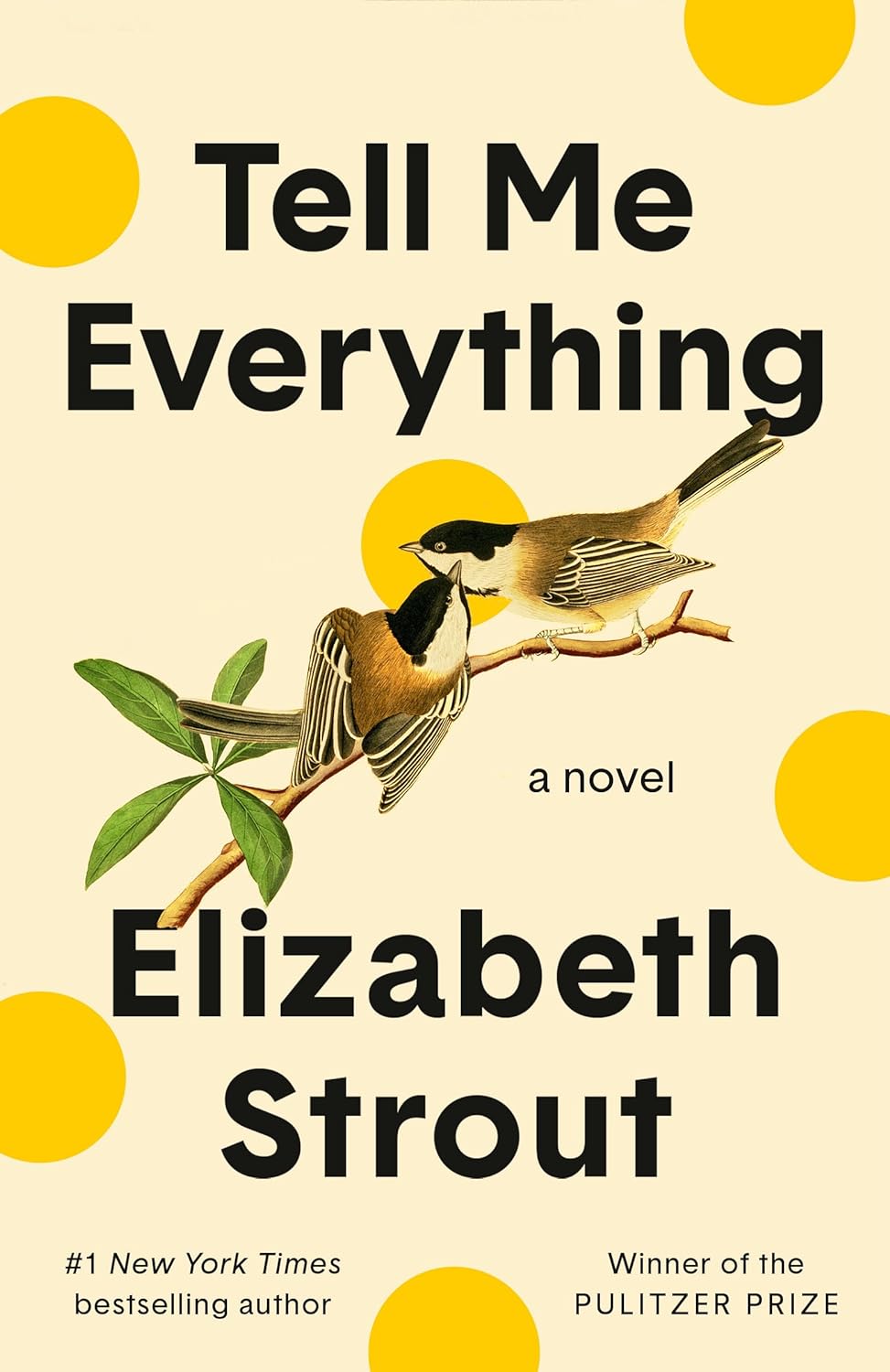
TELL ME EVERYTHING, the familiar salutation in Italian marking you out as special to the speaker


TELL ME EVERYTHING
ELIZABETH STROUT

Random House (non-affiliate Bookshop.org link)
$16.99 trade paper, $14.99 ebook, available now

Rating: 3.75* of five

The Publisher Says: From Pulitzer Prize–winning author Elizabeth Strout comes a hopeful, healing novel about new friendships, old loves, and the very human desire to leave a mark on the world.

With her “extraordinary capacity for radical empathy” (The Boston Globe), remarkable insight into the human condition, and silences that contain multitudes, Elizabeth Strout returns to the town of Crosby, Maine, and to her beloved cast of characters—Lucy Barton, Olive Kitteridge, Bob Burgess, and more—as they deal with a shocking crime in their midst, fall in love and yet choose to be apart, and grapple with the question, as Lucy Barton puts it, “What does anyone’s life mean?”

It’s autumn in Maine, and the town lawyer Bob Burgess has become enmeshed in an unfolding murder investigation, defending a lonely, isolated man accused of killing his mother. He has also fallen into a deep and abiding friendship with the acclaimed writer Lucy Barton, who lives down the road in a house by the sea with her ex-husband, William. Together, Lucy and Bob go on walks and talk about their lives, their fears and regrets, and what might have been. Lucy, meanwhile, is finally introduced to the iconic Olive Kitteridge, now living in a retirement community on the edge of town. They spend afternoons together in Olive’s apartment, telling each other stories. Stories about people they have known—“unrecorded lives,” Olive calls them—reanimating them, and, in the process, imbuing their lives with meaning.

Brimming with empathy and pathos, Tell Me Everything is Elizabeth Strout operating at the height of her powers, illuminating the ways in which our relationships keep us afloat. As Lucy says, “Love comes in so many different forms, but it is always love.”

I RECEIVED A DRC FROM THE PUBLISHER VIA NETGALLEY. THANK YOU.

My Review
: Well, here we are...next in a series of books about people I care less about than I probably am safe admitting to publicly. Lucy Barton's fans are legion, and they looove her for being her mildly chaotic self. I mean, they've stuck by her despite her ongoing friendship with her truly toxic, lightly pathetic first husband! That would get a flesh-and-blood woman canceled fast.

I myownself admire her for it. Own your mistakes, forgive your abusers, move forward standing on the past and pushing into the future on those rocks.

This outing has Author Strout doing something bold: Lucy meets her *other* famous older-woman character, Olive Kitteridge! The glue is a story about a murder...you can read the synopsis above, I feel no need to yak on about it...and, surprisingly, sparks do not fly. They clash, of course, Olive is after all a nasty bully who I myownself disliked the second I met her, but no snarktastic duels of wits ensue. Pity, that, but in keeping with the world Author Strout's created.

Amgash/Crosby is another fictional universe where characters have multiple chances to shine. This time it's mostly about Lucy's platonic bestie, Bob Burgess. They are each other's confidante, talking over things they don't have anyone else to confide in. His troubles, his life's burdens, are the topic he least discusses as he busily solves others' problems, much like Lucy herself.

I am generally very receptive to this sort of intertwined storytelling technique. I've read, and love, EF Benson's Mapp and Lucia books, the massive Barsetshire series shared by Trollope and Thirkell, and some of Miss Read's Fairacre series. These all have the virtue of following a group of characters more or less closely, with individual books having one or another focused on, albeit not usually exclusively. So that's how I keep coming back to this wellhead. I'm ready to involve myself in the lives of strangers when they all know each other, more or less well.

I don't think the Amgash series makes the grade as a successor to those series, at least in my own affections, because I myownself find the dithering that Lucy does, and the bullying that Olive does, incompatible with a lovely immersive read. Entirely a personal assessment, and not in the least meant to discourage anyone from pursuing these reads; just, well, be aware that Lucy's insightful comments and Olive's shrewd observations come wrapped in definite personalities. Since they're not really the ones I find most congenial, I'm not going to warble my fool lungs out singing their praises.

I will say that, in this book's case, I think you're best off reading it after having read Olive Kitteridge and My Name is Lucy Barton first. They're not strictly speaking necessary to have done so but, well, the way this storyverse goes, it helps to know the ladies you're relying on for context before going in.

If those are under your belt, dive in. I'm such an outlier when it comes to these characters. They irk and annoy me. They also come with such a well-conceived storyverse, one that soothes the need to make fictional friends, one that is part of a web of interrelated characters you don't know yet...much like life is. That more than any other quality is why I read the books. It feels prosocial.

Enjoy! I did.

Wednesday, September 11, 2024

THE MIKE BOWDITCH PAGE: Paul Doiron's sleuth in his latest cases


PITCH DARK (Mike Bowditch #15)
PAUL DOIRON
Minotaur Books
$29.00 hardcover, available now

Rating: 4* of five

The Publisher Says: Game Warden Mike Bowditch must chase down a cunning and dangerous fugitive in the North Maine Woods in this nail-biter of a thriller from Edgar Award-nominated author Paul Doiron, Pitch Dark.

Legendary bush pilot Josie Jonson can’t believe her luck when a skilled builder just happens to show up after she purchases land near Prentiss Pond. All Mark Redmond asks in return for building Josie’s dream cabin is that he be left alone to homeschool his 12-year-old daughter, Cady.

For Maine game warden investigator Mike Bowditch, the intensity of Redmond's secretiveness is troubling, especially in light of suspicious criminal activity being reported around the area―including rumors of an armed man offering large sums of money in exchange for the location of Redmond and Cady. Josie, though hesitant to violate the trust of her prized builder, eventually agrees to fly Mike and his father-in-law Charley Stevens to the secluded pond in an attempt to protect Redmond and Cady. But hours after landing, the trip takes a dark turn when they witness a horrific murder and are taken captive themselves.

Freeing himself, Mike is forced to set off through the impenetrable Maine forest towards Canada, alone and unarmed in pursuit of a mysterious fugitive. As he navigates a windblown landscape choked with deadfalls and blocked by swollen streams, he marvels at his enemy’s bush craft. The killer possesses skills surpassing his own, and Bowditch can't tell if he is the cat or the mouse in this dangerous game. Can Mike Bowditch stop his adversary in time to save the life of a young girl, or will he be forced to watch another innocent soul die?

I RECEIVED A DRC FROM THE PUBLISHER VIA NETGALLEY. THANK YOU.

My Review
: I'm going to address the elephant in the room now: appearances deceive in this set-up. Suspend your reflexive judgments.

Fifteenth in a procedural series I've read four of before this one. I'm glad to say I liked this one, too. I do now recall why I stopped reading them back when: There is not one likable woman except Mike's new wife, Stacey. It calls to my mind the series reads in the vein of Scot Horvath or Jack Reacher.

The set-up of this story, father and daughter living off the grid in the big fat middle of a chunk of Maine that even tracker-dude Bowditch says, "nah, gimme a plane ride," already has my spidey senses a-tingle. Add an armed stranger on the hunt for these two and, well, there's not much left to wonder is there?

Yes there is.

The twists and surprises kept me interested enough that I got snarled at about my reading lamp. I was expecting things thoroughly unpleasant to develop that didn't...whew...and not expecting things to develop that did, which was pleasantly surprising. I'm usually very averse to a child being put in jeopardy for amusement. I ws not really a fan here, but the issues surrounding the jeopardy are such that I felt less like this was a cheap ploy than a timely use of a horrifying reality.

By the end of the read, I was ready for the light to go off and sleep to come. It didn't for a half-hour (that's really long for me, I usually get to sleep in minutes) because I kept replaying some of the scenes in my mind. That is a good story! Keeps me up late, hard to do, then keeps me wakeful thinking about it.

Good work, Author Doiron. Recommended for procedural fans tired of the usual settings and attitudes based on arrogance and/or testosterone poisoning. Bowditch's 'tude is amply backed up, and earned, by his skills and his moral cdnter.

I hope he come looking for me after my kidnapping.

+++++++++++++++++++++++++++++++++++++++++++++++++++++++++++++++++


DEAD MAN'S WAKE (Mike Bowditch #14)
PAUL DOIRON
Minotaur Books
$29.00 hardcover, available now

Rating: 4.25* of five

The Publisher Says: Game Warden Mike Bowditch's engagement party is interrupted by the discovery of a gruesome double murder in Dead Man's Wake, a new thriller from Edgar Award-winning author Paul Doiron.

On the evening of their engagement party, Maine Game Warden Investigator Mike Bowditch and Stacey Stevens witness what seems to be a hit-and-run speedboat crash on a darkened lake. When they arrive at the scene, their spotlight reveals a gruesome sight: a severed arm beneath the surface. As day breaks, the warden dive team recovers not one but two naked corpses: the dismembered man and the married woman with whom he was having an affair. Mike begins to suspect the swimmers' deaths were not a senseless accident but a coldly calculated murder. Alone among his fellow officers, Mike begins to sense the involvement of a trained professional, smarter and more dangerous than any enemy he has faced. As Mike and Stacey get closer to identifying the killer, their own lives are suddenly put on the line, leading to a confrontation designed to silence them forever.

I RECEIVED A DRC FROM THE PUBLISHER VIA NETGALLEY. THANK YOU.

My Review
: Picking this series up after dropping it after Bad Little Falls (book #3), for no particular reason I can recall, I'm glad to say I got the hang of things again right quick.

Mike's in a place I wouldn't necessarily have predicted back then, what with planning to marry Stacey, but there we are. What hasn't changed much is this sarcastic, tangy dude's ability to offend everyone while doing far too good a job to get his smart mouth fired.

Stacey feels like a fairly generic character, if I'm honest, but then again who really cares about the sleuth's love interest? She doesn't simply exist to take up space like Bruno's lady-friends in Martin Walker's series; she has skills and uses them with Mike's investigation in this story. I remembered her name as Jamie, but either this is a different woman or my memory is wrong.

The plot starts out really strong, again as remembered from Author Doiron's earlier books. The events start weird and grisly early on. A lot of names are thrown at you from the start, which is often the case in series mysteries at this stage of their run. Here I suppose I'm running on the assumption that these characters are as I remember them. If they aren't, well...serves me right for being away more than ten books.

What the reader of series mysteries looks for, as far as I can see, is the sense that ma'at is served, that the Rightness of things is restored when the crime is solved. Murder is a gross insult to the body politic no matter who's killed; yes, even if it's someone who needs killin', responsibility must be apportioned or the precedent it sets is unthinkably dangerous. That's what I felt about this particular murder, TBH. Understandable that someone taking your spouse away from you would piss you off; but then again, why was said spouse in play, exactly? And no one's gonna support the old-fashioned sense that a man's wife is his, as in his property, in the twenty-first century.

Maine's as much of a character as any human was. The atmospherics will either immerse you in the setting (me) or make you a crazy person. Particularly prominent in this outing is information on boating that will quite possibly make some wish for an acute drought to dry up the whole state. Maine's unusually powerful wardens...power of arrest?! really?...make this series a procedural of the sort I enjoy. It's detailed without feeling, to me at least, dense and chewy. It doesn't hurt that I feel Mike's spiny, acerbic nature makes him a kindred spirit. Stacey is detailed enough to give me the slightly uncomfortable feeling she sees herself as "riding herd" on her man. I don't know this; she's developed over eleven books since I met her in book three. If indeed this is the same woman....

You already know I picked up the next one, so my vote is in. Good series.

Friday, March 24, 2017

THE SPRUCE GUM BOX, historical novel about a corner of history little recalled today or outside Maine


THE SPRUCE GUM BOX
ELIZABETH EGERTON WILDER

Red Dobie Press
$15.95 trade paper, available now

Rating: 4* of five

The Publisher Says: Addie loved to run along the river’s edge so the wind could blow through her long hair, released from the strict bun her father demanded. When Jed returned from the lumber harvest in the spring, she would fly into his arms, releasing her pent-up passion from its winter prison. Little did they know their forbidden love would set in motion a series of events that would forever change their lives and make Jed a fugitive.

With a bounty on his head and his infant son hidden beneath his coat, Jed turned to the only man he felt he could trust—the leader of a nearby Micmac settlement. The unlikely partnership that ensued defied all odds, overcoming bigotry, betrayal, and the unforgiving 1820s Maine wilderness, to stake a claim on the primitive New England landscape.

As the strife escalated between Great Britain and the United States over the border of Maine and the rights to its lucrative lumber industry, determination to survive and create a life for his young son drove Jed into uncharted territory and perilous adventure.

My Review: When a man falls in love with a pretty woman in our world, things take their course pretty much without drama most of the time. This makes this moment in history almost unique. The consideration of who the woman's father is, the idea that a woman is off-limits due to her family, is a bad and fading memory in Western culture. Unless you're a royal, of course, but there are very very few of them left.

Mercy me. The idea would have seemed like paradise to Jed, the hero of this tale. He and his "bastard" son are driven away, in a profane rage, by Adelaide Wingate's English father. His only recourse is to put them both at the mercy of the local Indian people, the Micmac. Guess what? The welcome mat is rolled out! Jed and Ben, his son, are made to understand they're family. Addie, by contrast, is sent back to their native England, leaving their lives forever.

Separating a mother from her child is a horrible act of cruelty and violence. To deprive a child of its mother is a lifelong wound inflicted on the spirit of a child. The saving grace is the acceptance and kindness of the native American people, believing as they do in the necessity of life's continuing in as much kindness as is possible.

But the glory of the book is its beautiful evocation of the County...Aroostook's old name in Maine...as it is the subject of boundary disputes between the fledgling US and Canada, as well as the setting for an economic boom of the logging industry in the old-growth forest.

For anyone who would like to read a story of a father and son relationship that is loving, respectful, and characterized by reciprocal loyalty, this is the only book I can think of to recommend to you. That alone makes it worth reading! I'd recommend any historical fiction fan dip in because of the geopolitical goings-on. And sexism gets a battering from every angle in this book. Good stuff, all!

Tuesday, January 3, 2017

THE COUNTRY OF THE POINTED FIRS, a local-color author's portrait of changing times


THE COUNTRY OF THE POINTED FIRS
SARAH ORNE JEWETT

Dover Publications
$4 trade paper, available now

Rating: 5* of five

The Publisher Says: In scene after memorable scene of Sarah Orne Jewett's fictional masterpiece, The Country of the Pointed Firs, the Maine-born author recorded what she felt were the rapidly disappearing traditions, manners and dialect of Maine coast natives at the turn of the 20th century. In luminous evocations of their lives--a happy family reunion, an old seaman's ghostly vision, a disappointed lover's self-imposed exile and more--Jewett created startlingly real portraits of individual New Englanders and a warm, humorous and compassionate vision of the New England character.

My Review: There aren't all that many loud, public admirers of Sarah Orne Jewett's fiction. Willa Cather, she of Death Comes for the Archbishop fame, was an admirer, but that's most of a century ago. I think that's too bad. Jewett's lovely, lapidary prose is a treat. She's more than likely a gay lady, given her "Boston marriage" *snort* to Annie Adams Fields from 1881 until her death in 1909. That makes enjoying her work incumbent on me, I suppose, though I can honestly say that I've enjoyed her way with words and her sharply observed and economically told tales since I found out about her in high school forty years ago. This novella is, in my never-remotely-humble opinion, one of the nineteenth century's literary high points, right up there with Silas Marner and The Aspern Papers.

From the minute our narrator addresses us, the tone and the tenor are set:
When one really knows a village like this and its surroundings, it is like becoming acquainted with a single person. The process of falling in love at first sight is as final as it is swift in such a case, but the growth of true friendship may be a lifelong affair.
We are launched on a voyage of discovery in love. We have as our captain a lady of a certain vintage, not old and not young, who is hiding in Dunnet Landing, Maine, in order to meet her publishing deadline...which she has already blown past, as she tells us early on. Her landlady Mrs. Todd has presented her with to tempting a distraction as she tantalizes the narrator with reminiscences of her long-ago lost love and his subsequent marriage, her subsequent marriage....

And then, after the narrator moves her workspace to the local schoolhouse (it being summer, the building is unused) to reduce interruptions and avoid gossiping time-sinks, comes the fascinating old man, Captain Littlepage, to tell his own love story:
"It was a hard life at sea in those days, I am sure," said I, with redoubled interest.

"It was a dog's life," said the poor gentleman, quite reassured, "but it made men of those who followed it. I see a change for the worse even in our own town here; full of loafers now, small and poor though 'tis, who once would have followed the sea, every lazy soul of 'em. There is no occupation so fit for just that class o' men who never get beyond the fo'cas'le. I view it, in addition, that a community narrows down and grows dreadful ignorant when it is shut up to its own affairs, and gets no knowledge of the outside world except from a cheap, unprincipled newspaper. In the old days, a good part o' the best men here knew a hundred ports and something of the way folks lived in them. They saw the world for themselves, and like's not their wives and children saw it with them. They may not have had the best of knowledge to carry with 'em sight-seein', but they were some acquainted with foreign lands an' their laws, an' could see outside the battle for town clerk here in Dunnet; they got some sense o' proportion. Yes, they lived more dignified, and their houses were better within an' without. Shipping's a terrible loss to this part o' New England from a social point o' view, ma'am."
Shipping...anything that takes a person out of a narrow area of interest...is a terrible loss for the world's average people. We have the internet now, thus we have almost instantaneous access to information and news and opinions from every corner of the globe. But we don't have any particular reason to seek it out, since the fact is most Americans are un- or underemployed compared to generations gone by, and thus are unlikely to seek beyond the dark alleys of CNN and Fox "News" for news and views on world and national events. With the inevitable bad results.

Captain Littlepage continues:
"No, there's nothing to take the place of shipping in a place like ours. These bicycles offend me dreadfully; they don't afford no real opportunities of experience such as a man gained on a voyage. No: when folks left home in the old days they left it to some purpose, and when they got home they stayed there and had some pride in it. There's no large-minded way of thinking now: the worst have got to be best and rule everything; we're all turned upside down and going back year by year."

"Oh no, Captain Littlepage, I hope not," said I, trying to soothe his feelings.

There was silence in the schoolhouse, but we could hear the noise of the water on a beach below. It sounded like the strange warning wave that gives notice of the turn of the tide. A late golden robin, with the most joyful and eager of voices, was singing close by in a thicket of wild roses.
Ladies and gentlemen, everything old is made new again. Captain Cassandra Littlepage sings a lament at the end of the nineteenth century that many of us have been reprising here in the twenty-first. Or, as the old Frenchman had it, "the more things change, the more they stay the same."

After a lovely summer outing to Green Island, in the bay off Dunnet Landing, Mrs. Todd welcomes to her herb-gardeny home an old friend, a Mrs. Fosdick. The narrator and Mrs. Todd have now the extra-strength bonding compound of family approval. Green Island is home to Mrs. Todd's mother and younger brother, a wight of some sixty summers; both the Blacketts of Green Island love the narrator as soon as she steps ashore from the dory, and she them. Into this mutual admiration society steps Susan Fosdick, contemporary of Mrs. Todd, and plants herself for a long afternoon's gossip. When you've known someone all your life, the words come easy if they need to come at all:
It does seem so pleasant to talk with an old acquaintance that knows what you know. I see so many of these new folks nowadays, that seem to have neither past nor future. Conversation's got to have some root in the past, or else you've got to explain every remark you make, an' it wears a person out.
Jewett's gift is to limn a lovely scene against a delicately scented and lit background. It is a great deal like that rooted-in-the-past conversation that is so relaxing and welcome, reading this...and her other...work. Direct and unfussy. Lovely and simple. A vase of daisies on a linen cloth, not a candelabra gleaming over a cornucopia of pineapples on fine lace...each beautiful, one way or the other.

I believe that the pleasures of reading a novella are as rich and gorgeously textured as any novel's are. The difference, for me at least, and in the instance of this novella, comes down to the writer's ability to evoke a place, a time, a season, a slant of light; at greater length, her strength could become a weakness, a surfeit, when piled on a larger plate. As it stands, though, this serving is a beautifully balanced, perfectly presented summer picnic on the cool, seaside meadow of a Maine island. Your eyes and ears and nose all attune you to a simple pleasure, a familiar scent, a welcome patch of emotional shade in a hot summer of life.
In the life of each of us, I said to myself, there is a place remote and islanded, and given to endless regret or secret happiness; we are each the uncompanioned hermit and recluse of an hour or a day; we understand our fellows of the cell to whatever age of history they may belong.

Tuesday, June 25, 2013

UNDER THE DOME, Stephen King Book & TV Review Posted 25 June 2013

UNDER THE DOME
STEPHEN KING

Scribner
$10.99 ebook platforms, available now

Rating: 4.25* of five

The Publisher Says: On an entirely normal, beautiful fall day in Chester's Mill, Maine, the town is inexplicably and suddenly sealed off from the rest of the world by an invisible force field. Planes crash into it and fall from the sky in flaming wreckage, a gardener's hand is severed as "the dome" comes down on it, people running errands in the neighboring town are divided from their families, and cars explode on impact. No one can fathom what this barrier is, where it came from, and when — or if — it will go away.

Dale Barbara, Iraq vet and now a short-order cook, finds himself teamed with a few intrepid citizens — town newspaper owner Julia Shumway, a physician's assistant at the hospital, a select-woman, and three brave kids. Against them stands Big Jim Rennie, a politician who will stop at nothing — even murder — to hold the reins of power, and his son, who is keeping a horrible secret in a dark pantry. But their main adversary is the Dome itself. Because time isn't just short. It's running out.

My Review: Chester's Mills, Maine, is having itself an ordinary morning, and its citizens are gettin' up to all the usual things: Spending too much of their husband's money, killing girls, beating up people they don't like and driving them out of town, making evil brews, only thing missing really is a bonfire and a faggot. Business as usual for the human race, in other words.

*WHAM*

Down comes the Dome.

No way in, no way out, no one can understand the nature, the origin, or the purpose of the Dome inside or outside of it. National security issues crop up. The town misfit, an Iraqi war vet, is called back into national service to solve the mystery. And then things get **really** ugly: The local used car salesman takes control.

Think Nixon with a mean streak and a Big Fat Secret to protect.

"From Bad to Worse" could be the subtitle of every Stephen King novel, but this time it's so so so so bad and then it gets so so so much worse that the reader is calling out to Divine Providence for the mercy of Death...and then comes The Twist. The Dome is revealed to be...but no, you have to read it. Because Stephen King = what Chuckles the Dick would've been if he'd had talent.

Just sayin'.

I hated liking this book. I resented the demands on my gouty wrists and fingers, supporting its mammoth weight, flipping the pages faster and faster and faster as I got more and more sucked in to the story. I snorted snobbily at myself, caught up in this not-terribly-sophisticated narrative. None of which stopped me finishing the book and sighing with mitigated contentment at its sudsy, gloriously cinematically trajectory. I can see the miniseries...I want to see the miniseries! soon please!...unfold in my mind. It's what Stephen King does brilliantly: Tells you a story of human nature, irrefutably making points that need making about Mankind and its flaws, while wringing your withers with fear, excitement, and sadness.

The Dome was a really cool narrative device. I liked its unknowability, I was completely on board with mystery forces causing it who-knows-why...and then we find out why. I wasn't especially interested in that part, and felt it was a tidge unimaginitive coming from Mr. Shock-and-Awe himself.

Eh...so what...I had over 1000pp of reading pleasure. It's like potato-chip sex. The kind you have because you can. It still feels good, and no way are you gonna stop just because it's meaningless.

(I suppose this last isn't comprehensible to my girly readers of either gender.)

Relax. Enjoy. Don't think too much. You'll end up in a much better mood than you started out in.

UNLESS, of course, you watch the TV series that King himself participated in...from a premiere of over 13 million viewers to a finale of just under 5 million in three short seasons!

It had very pretty actors, and it had some terrific episodes, but it was plagued by a series of changes made to the storyline for no obvious reason. Fans of the book were, understandably and predictably, pissed. So why do the creatives insist on doing this? They weren't even changes made to ease filming or reduce cast! (The cast was staggeringly large.)

King himself addressed the irritated fans from his website, speaking ex cathedra:
Many of the changes wrought by Brian K. Vaughan and his team of writers have been of necessity, and I approved of them wholeheartedly. Some have been occasioned by their plan to keep the dome in place over Chester's Mill for months instead of little more than a week, as is the case in the book. Other story modifications are slotting into place because the writers have completely reimagined the source of the dome.
Sadly, they did not respond positively, and took their toys home in a snit. I'm not sure they were right, to be honest, and found the series more than entertaining enough to keep me watching from season one through the finale.

But I'm not one of the gatekeeping fanboys in any fandom. I find those sorts of people tiresomely similar to religious nuts in their insistence of Being Right. And I ain't down with that.