Showing posts with label short stories. Show all posts

Sunday, August 9, 2026

STEFAN ZWEIG'S PAGE: LETTER FROM AN UNKNOWN WOMAN and Other Stories, & ENCOUNTERS AND DESTINIES: A Farewell to Europe


LETTER FROM AN UNKNOWN WOMAN and Other Stories
STEFAN ZWEIG
(tr. Anthea Bell)
Pushkin Press Classics (non-affiliate Bookshop.org link)
$7.99 ebook, available now

Rating: 4.5* of five

The Publisher Says: Stefan's Zweig's Letter from an Unknown Woman and other stories contains a new translation by the award-winning Anthea Bell of one of his most celebrated novellas, Letter from an Unknown Woman, the inspiration for a classic 1948 Hollywood film by Max Ophüls, as well as three new stories, appearing in English for the first time.

A famous author receives a letter on his forty-first birthday. He doesn't know the sender, but still the letter concerns him intimately. Its story is earnest, even the story of a life lived in service to an unannounced, unnoticed love.

In the other stories in this collection, a young man mistakes the girl he loves for her sister; two erstwhile lovers meet after an age spent apart; and a married woman repays a debt of gratitude. All four tales, newly translated by the award-winning Anthea Bell, are among Zweig's most celebrated and compelling work-expertly paced, laced with empathy and an unwaveringly acute sense of psychological detail.

I RECEIVED A DRC FROM THE PUBLISHER VIA EDELWEISS+. THANK YOU.

My Review
: It's the fate pf a popular, I mean with readers more than critics, writer to fall out of favor. Without critics in one's corner, the voice of the people who voted with their time and their treasure to engage with one's stories gets ignored.

This was the public's loved one Zweig's fate. Modern critics don't like him either, one saying he "...tastes fake...the Pepsi of Austrian writing." Ouch.

It's true to my experience of his writing that there's no deathless quality the I can discern, the sort of intense transporting intensity I experience in Thomas Mann or Kafka. At his most eloquent Zweig brings me an appreciative lightness of spirit; at his most Germanic he's pissy, irritable, and unbearably portentous. On balance he's the precise kind of writer who becomes popular because his (very real) talent does not have threatening depths. It seems a shame to me the world that loved him best, the US and Brazil, has left his memory in a drawer. Not a great, but still a good, storyteller, it feels to me like Pushkin Press Classics is doing good work to keep bringing him to our notice.

In my usual, fussy (so I'm told) fashion, the four stories will be dealt with by the Bryce Method.

Letter from an Unknown Woman is unsettling, uneasy-making; a woman writes to a famous author in terms of the greatest, most appreciative intimacy...but he has absolutely not one clue who she is. It is clear from the terms she's using for him that there was a legitimate connection between them. It is chilling how deep this connection truly is, given his unawareness of her as a person. (It could have something to do with her age at their first meeting....)

It's certainly true in my own life this kind of connection has formed, so I might be a bit more in tune with the awfulness of it. It ends a damn sight more tragically than anything like I've ever been a party to, and uses what would then be a current event...the 1918 flu pandemic...as both a resolution and an intensification of how terrible his guilt truthfully is.

A 1948 film was made of Letter from an Unknown Woman starring Joan Fontaine and Louis Jourdan that did not slap a happy li'l bow on its end. It's been preserved for posterity by the National Film Registry, probably in part for that courageous act of honesty in preserving the source material's more nihilistic intent (despite much jiggery-pokery to satisfy the Hays Code). It would be a terrific adaptation to make, faithfully this time, in the 21st century. all five stars

A Story Told in Twilight explores the first-kiss mishegas of a very ordinary boy. It happens in circumstances that, if you squint, might possibly lead to the, um, inattention and subsequent mistaken identity that plague this most commonplace rite of passage.

The translation's deft, the language felt like the entire enterprise was fun for the translator, but a more outdated premise would be tough to conjure in 2026. Not memorable, not terrible, not much of anything really. 3 stars

The Debt Paid Late looks at the running theme of missed/mistaken connections in these stories at a more mature angle. Like the old saying about "even small men cast big shadows at sunset" comes the accidental meeting of a woman with an old man who once meant everything to her. Because the story is about older people who reconnect from a genuine, if squicky by today's lights, connection it involved me more. Not a lot more, but more. 3.5 stars

Forgotten Dreams happened to me. It was as unpleasant as Zweig writes it. If you put yourself back into the path of your past self you will not come out unscathed. No man should ever expect the women from his past to spare his feelings, I'll tell you that for free. 3.5 stars

++++++++++++++++++++++++++++++++++++++++++++++++++++++++++++++++


ENCOUNTERS AND DESTINIES: A Farewell to Europe
STEFAN ZWEIG
(tr. Will Stone)
Pushkin Press
$13.99 ebook, available now

Rating: 4* of five

The Publisher Says: A new selection of essays by Stefan Zweig: tributes to the great artists and thinkers of the Europe of his day

Stefan Zweig was one of the twentieth century's greatest authors and a tireless champion of freedom, tolerance and friendship across borders. Encounters and Destinies collects his most impassioned and moving tributes to his many illustrious friends and peers: literary, philosophical and artistic luminaries from across the Old Europe that Zweig loved so much, and which he grieved to see so cruelly destroyed by two world wars.

Including pieces on Rainer Maria Rilke, Marcel Proust, Sigmund Freud, Maxim Gorky and Arturo Toscanini, this essential collection is also Zweig's tribute to the ideal of friendship: an ideal he clung to as the world he knew was torn apart.

I RECEIVED A DRC FROM THE PUBLISHER VIA EDELWEISS+. THANK YOU.

My Review
: "Gorky" means bitter? I'd always known Peshkov chose a pseudonym, who wouldn't with a collection of ugly spitty sounds like "Peshkov" staring you down, but "bitter?" Wow. A lot of details I'd forgotten I noticed clicked into place in my long-ago readings of Gorky...The Lower Depths, The Artamonov Business...suddenly make all the sense in the world.

Zweig knew the great and the good of the Interwar Period wherein he spent the bulk of his life. He would've been a lot of fun at a dinner party because, while it does not seem that he had a bitchy bone in his body, he had a very retentive memory and a strong desire to keep the friends he made so he heard a lot about them.

I am hard-pressed to imagine anyone who does not know who John Drinkwater was without the aid of Wikipedia will be inclined to pick up a book of musings on people like Toscanini, Arthur Schnitzler, and Emile Verhaeren. (For someone who doesn't like poetry, I sure know who a lot of poets are.)

If for no other reason than to bask in the glow of warm, appreciative writing by a friend who treasured friendship writing about his friends, this is a Zweig book to immerse yourself into. It brought me up short to realize how much the culture of that time formed my sense of aesthetics. I still revere Remarque and Joyce. I think many serious readers do. But it goes deeper, forming a bedrock sense of what is "worthy" in the art world, and that interested me to realize.

So here's Zweig, eighty-four years dead and mostly forgotten, still teaching a now-old man about himself. Published again and again after being forgotten for decades.

I hope there's an afterlife just so he can know it was, in fact, all worth it.

Monday, July 6, 2026

WE WERE FORBIDDEN, feminist author at her tendentious best


WE WERE FORBIDDEN
JACQUELINE HARPMAN
(tr. Roz Schwartz)
Transit Books (non-affiliate Bookshop.org link)
$17.99 ebook, available now

The Independent Press Top 40 Bestsellers: Fiction For the week ending September 9, 2026

Rating: 4* of five

The Publisher Says: From the author of I Who Have Never Known Men comes a startling new collection of three never-before-translated stories, each plumbing the depths of that most necessary human defiance.

Wandering the forest in the wake of some unfathomable war, a woman and her fellow survivors are forbidden from leaving its boundaries or pausing in their march through its strange depths.

As part of her rigid schooling, a teenage girl is barred from questioning the dogma she is taught to believe—her punishment for doing so will be as disturbing as it is disproportionate.

Locked in a loveless marriage, a young woman satisfies her husband’s desires, twice-weekly, as directed. She has not yet thought to pursue her own.

In varying ways, and across varying worlds, each of these women are trapped. Do they have the will to escape?

I RECEIVED A DRC FROM THE PUBLISHER VIA EDELWEISS+. THANK YOU.

My Review
: One of the most enduring stories in Western Anglophone culture is the princess in the tower, locked away and in the absolute control of A Man/A System/An Enemy, and how she must connive to survive with whatever degree of success the cruel, cruel storyteller allows her. Now firmly grounded in the reality of being female over the millennia, along comes Author Harpman with Translator Schwartz as amanuensis, extrapolating this cultural juggernaut to include all those trapped in subservience and obedience to high-control systems.

In "The Outcast" Author Harpman uses the most familiar iteration of the story. A teenaged girl is in the intertwining coils of adolescence and sexual maturation and cultural demands for conformity. It's harrowing to see Author Harpman's keen observations of fascism turned loose on one so hugely vulnerable and malleable...it is a shorter and refocused version of the juggernaut I Who Have Never Known Men and should appeal to those seeking more of that story only dressed in a shorter, more contemporaneous skirt.

Moving into times and ties more concrete, "The Broom Closet" is a woman's struggle to find her footing in 1920s Belgium. The demands of domesticity on women are different from those made on men even now; in the deeply conservative culture of postwar Belgium, where the battles that killed millions were barely over let alone their damage repaired, they were starkly different. As one adds the inexorable advance of marriage's compromises conflicting with the absolute tyranny of the need to create stories, the trap of cultural expectations springs shut. Virginia Woolf's A Room of One's Own's observations made specific and played out with the intensity of "The Yellow Wallpaper."

Expanding the story logic to those enmeshed in the military of an apocalyptic future, "The Ardennes Forest" is the most immediately reminiscent in its setting to I Who Have Never Known Men while expanding scope beyond one woman's life. A group of conscripts are mapping and scouting the terrain for what they imagine, not unreasonably, to be a future battlefield. That future never comes. They continue the work they've been assigned.

Endlessly.

As the story goes into nothing deeply, it became obvious to me this is Author Harpman meditating on the tedious tasks of daily life performed under nebulous, ominous duress. There's a weirdly onanistic edge to the submission of these soldiers to their assigned task even as they begin to question what it is they're doing as nothing ever changes as a result of its self-similar patterns.

Three stories of people in a system of depersonalizing cruelty, and how that strips an individual of any sense of agency; numbing the essential "You"ness of you into submissive obedience. I'm not a bit sure it will make new Harpman fans. For one thing, there are limits to the efficacy of compactness in the involving process of storytelling. I think these three stories are on the shortest end of that effort, possibly too short for anyone not already familiar with Author Harpman's thematic hobbyhorses to fully invest in them.

Existing fans are in for a treat.

Thursday, December 4, 2025

AN ORAL HISTORY OF ATLANTIS, Ed Park's story collection spanning 25 years-plus


AN ORAL HISTORY OF ATLANTIS
ED PARK

Random House
$13.99 ebook, available now

Time's The 100 Must-Read Books of 2025 selection

Rating: 4.5* of five

The Publisher Says: A deadpan, wildly imaginative collection of stories that slices clean through the mundanity and absurdity of modern life, from the author of the Los Angeles Times Book Prize–winner and Pulitzer Prize finalist Same Bed Different Dreams

In “Machine City,” a college student’s role in a friend’s movie causes lines to blur between his character and his true self. In “Slide to Unlock,” a man comes to terms with his life, via the passwords he struggles to remember in a moment of extremis. And in “Weird Menace,” a director and faded movie star discuss science fiction, memory, and lost loves on a commentary track for a film from the ’80s that neither seems to remember all that well.

In Ed Park’s utterly original collection, An Oral History of Atlantis, characters question the fleetingness of youth and art, reckon with the consequences of the everyday, and find solace in the absurd, the beautiful, and the sublime. Throughout, Park deploys his trademark wit to create a world both strikingly recognizable and delightfully other. All together, these sixteen stories have much to say about the meaning—and transitory nature—of our lives. And they are proof positive that Ed Park is one of the most insightful and imaginative writers working today.

I RECEIVED A DRC FROM NETGALLEY. THANK YOU.

My Review
: What I have not highlighted that could make a difference to your pleasure...or not...is something I didn't notice until after I read the whole collection: There seems to be interconnection of settings and/or characters in many of the stories. As these stories have appeared over the course of years, this must reflect Author Park's real interests. It does indeed show. A collection sure to please Park fans and anyone who likes a laugh with their "hmm" sci fi. I mean, who among us does not love "His thoughts were shrouded in rumor, perfumed with adventure and abstruse interlinear controversy" as a quotable quote? One knows one's own.

Comme d'habitude, these sixteen stories will be dealt with by the Bryce Method of general remarks followed by brief responses to each one below.


A Note to My Translator is the funniest takedown of the Culture Industry℠'s bizarre effort to translate the work of an author into a local cultural property, thus causing huge misunderstanding and much ill-will:
Page eight, a little lower down: The doctrine of transubstantiation has nothing to do with pinball.
Page nine: Solomon Eveready reappears, smoking cut-grade reefer and imitating a trout. Explain this to me. Explain also the presence of scuba gear that "reeks of melon."
Honestly, I've read translations that felt as though they must've been the subject of a correspondence much like this.

It was hilarious to me, and sets an irreverent, mischievous tone I batten on. 5*

Bring on the Dancing Horses's unnamed narrator hit me with "Penumbra College in Vermont" and made me cackle, then his girlfriend's name "Tabitha Grammaticus"...and that housecoat...! Seriously, I'm still trying to sketch it to understand the topology.

The story itself, well, what a sad little incel this guy is, if I didn't know better I'd say he was fever-dreaming it all. You know what...maybe he is. 3.5*

The Wife on Ambien sketches anomie in cold relief as "the wife on Ambien" does things our Prufrockian putz of a narrator would never dare to do, I half expected her to eat a peach for gods' sake. I wished the refrain wasn't quite so Lucy-Ellmanly.
The wife on Ambien recites the poetry of T. S. Eliot, sings the music of the Jesus and Mary Chain, calculates how much we need to save to retire. Her figures vary. The wife on Ambien also tells me it doesn’t matter, that the sun will swallow the earth exactly eight billion years, or thirteen weeks, or twenty-four hours from now. The wife on Ambien hails Uber after Uber. The cars stream toward us like a series of sharks. It’s four a.m. Drivers from many countries gather on the corner, fling curses at our window, break out the booze, and promise each other their children in marriage. The wife on Ambien hacks into my Facebook account and leaves slurs on the pages of my enemies. Get a life, you’re a joke. She joins political causes directly opposed to her own. I spend an hour every morning cleaning up the digital trail.
3.5*
Machine City makes that film-student friend into a last gasp of the end-of-adolescence pretentiousness. Bethany Blanket...sounds like a manic pixie girl, right?...puts "Ed" in her student film requiring him to be honest and natural with the girl he just got broken up with by her also-Korean parents objecting to his ancestry. Now, of course, he's a lawyer with a fancy life thinking about les jadis. Not fascinating but oddly...compelling...familiar maybe. 4*

An Accurate Account proves that drama is easy, comedy is *hard*. A stand-up routine that, for me, was a real misfire...like a less-offensive Matt Rife set. 3*

The Air as Air is elegiac in tone, is the air's testator, is clearly about the processing of profound sadness, grief, loneliness: "The jukebox kicked in. Some song I used to hate, but at the moment it made me sad. It pinned me down."

It pinned down the entire mechanism of gaining, painfully and slowly, perspective. The narrator (PTSD and all) and his father, whom he calls "The Big Man" at the man's insistence:
"So you know about Uncle Buck," he said. "The movie?" "What movie? I’m talking about your Uncle Buck. He went on that show where they give you a makeover. It was Lindy’s idea, the whole stupid TV thing. She has connections. You know Buck. He dresses worse than I do. He dresses like he smeared rubber cement on his chest and rolled around in a pile of undershirts. So they show the episode and it went a little too well, if you get my gist."
Sad, funny, unfortunately very relatable...they're not communicating or connecting even a little bit. 4.5*

Seven Women has a therapist elucidating the long and grueling self-confrontation of therapy from her point of view, the way she thinks about the deep-dives into other people's emotions. "Sometimes people tell stories and they leave out the feelings—My job is to show them where the feelings are." 5* for that insight alone...Hannah the patient's a really crappy human being.

The Gift offers me a course I really want to take: "Advanced Aphorism" though not with Dublinski necessarily. The letter to the alumni magazine being written says it was never offered again. I demand a retake on all my school years so I can take this course! Fun wordplay, slight idea. 4*

Watch Your Step is a log-line for a technothriller that feels like it was being fleshed out; as the story progresses, I was trying to think of reasons Author Park left it here, when there's enough, to my story-ear, to support a novella. What gives? 3.5* because it's marooned without coming into port.

Two Laptops does nothing for me because the "man loses family through no fault of his own" trope bugs me. The wife and son he's misplaced live close but...never mind, no point really, as he is reduced to a skype face to the son, I realized he deserved it. 3* for choice of subject matter.

Weird Menace stresses the role memory can't help but play in our relationships to our past, to the people in our lives, and to this weird idea we think is a reality called the self. It's all dialogue, all the time, and all the more fun for that, since I like "Toner Low" as the director's name. DVD commentary was never like this when I was watching horror movies! 4*

Thought and Memory centers transness, but managed to make me wince by leaving in "transgendered" which ain't a good thing. I wish it had not been there like a turd in the punchbowl. Still, a decent and overall surprisingly good effort for someone not trans. 3.5*

Well-Moistened with Cheap Wine, the Sailor and the Wayfarer Sing of Their Absent Sweethearts didn't really excite me much...Tabby doesn't inspire sympathy as she is presented here...and her career is very amusing indeed, but doesn't make up for the sour note of the narrator's overall dissatisfaction, his dislike and disdain for so many around him. "My girlfriend, Tabby, reviews science fiction for a living, which just goes to show you that America is still the greatest, most useless country in the world," sums it up on the tone front; not my fave but very well-written, with some humor that broke through my dissatisfaction. 4*

Eat Pray Click might hit you differently than it did me...my boyfriend is in Chat psychosis so the way the machine comes alive, sort of, and what it does, just did not feel fictional, while feeling mentally disturbing. No rating.

Slide to Unlock might be the most unnerving story in here...almost horror...memory problems scare me leaky. It's a modern problem, trying to keep clear in one's mind the very complicated ways we're required to interface with a world gone digital...in fact, it's not much more complicated than the past, only the medium's changed from speaking to a fallible human to fallibly humanly speaking to a system made by fallible humans. I got the wry humor in here in my bones. 5*

An Oral History of Atlantis isn't so much a story as a proof of concept...every emotional register, every techno-detail, every beat in this collection gets its bones into this stew. What I couldn't find was a through-line to make me invest in it the way MtPR was meant to. 3.25*

Sunday, November 30, 2025

APSARA ENGINE, South Asian graphic story collection


APSARA ENGINE
Bishakh Kumar Som

The Feminist Press (non-affiliate Bookshop.org link)
$24.95 paperback, available now

Rating: 4* of five

The Publisher Says: By turns fantastical and familiar, this graphic short story collection with South Asian roots is immersed in questions of gender, the body, and existential conformity.
  • Winner of the 2020 Los Angeles Times Book Prize for Graphic Novel/Comics
  • Winner of the 2021 Lambda Literary Award for LGBTQ Comics
  • Finalist for the 2021 Ferro-Grumley Literary Award for LGBTQ Fiction
  • The eight delightfully eerie stories in Apsara Engine are a subtle intervention into everyday reality. A woman drowns herself in a past affair, a tourist chases another guest into an unforeseen past, and a nonbinary academic researches postcolonial cartography. Imagining diverse futures and rewriting old mythologies, these comics delve into strange architectures, fetishism, and heartbreak.

    Painted in rich, sepia-toned watercolors, Apsara Engine is Bishakh Som's highly anticipated debut work of fiction. Showcasing a series of fraught, darkly humorous, and seemingly alien worlds—which ring all too familiar—Som captures the weight of twenty-first-century life as we hurl ourselves forward into the unknown.

    I RECEIVED A DRC FROM THE PUBLISHER VIA EDELWEISS+. THANK YOU.

    My Review
    : A beautiful work of South Asian-set and -themed mostly queer stories. All take place in elegantly, cleanly rendered spaces, involve women in transitional times and relationships, and stress the pleasures and/or complexities of being in the midst of Life.
    these are the spreads provided for publicity use

    The author's website contains much more varied artwork from the book. It is very much worth you time to view.
    The stories themselves are not really interlinked, though all feel like they're meant to form something greater than the sum of their parts. If there's more than the thinnest connective tissue, though, I didn't find it. Straight people on a shoreline are surprised by merfolk accosting them; differing degrees of queer/trans people in their cells...apartments really, but cells in all the confinement senses...are the focus of the title story, one that fascinated me but never paid off in the way I was built up to expect. I think my personal favorite story was "Swandive," in which Onima...a "cartographer of trans realities" who uses her own blood to make maps, thus create art, that explains other Desi trans people to themselves.

    It's not hard to see this opening a young trans person's eyes to the welcome reality that others feel the same way they do. No one in the 21st century, with all its stunning technological advances in medicine, psychology, communication should ever again feel isolated. A work like this that was created by someone deeply marginalized yet extending her hand to others, is a lifeline for a struggling trans person.

    "You, as you are right now, are not alone and do not need to change to be loved" is still the most intensely powerful message you can send with this gift.

    Friday, May 9, 2025

    BAD HANDWRITING: Stories, angry, bitter, truthtelling stories without any need to coddle you


    BAD HANDWRITING: Stories
    SARA MESA
    (tr. Katie Whittemore & Frances Riddle)
    Open Letter Books (non-affiliate Amazon link)
    $9.95 ebook, available now

    August 2025: 40% discount on all Open Letter titles written or translated by female-identifying artists. (Discount is applied automatically at checkout on publisher's website and applies to all hardcover, paperback, and ebook editions.)

    Rating: 4.5* of five

    The Publisher Says: From the author of the highly acclaimed Four by Four and Among the Hedges comes a collection of unsettling, captivating stories.

    The eleven stories in this collection approach themes of childhood and adolescence, guilt and redemption, power and freedom. There are children who resist authority and experience the process of growing up with shock, and loneliness; alienated young girls whose rebellion lies under the surface—subterranean, furious and impotent; people who are tormented—or not—by regret and doubt, addicted to feelings of culpability; men who take advantage of women and adults who exercise power over children with a disturbing degree of control; kids abandoned by their parents; the suicide of the elderly and the young; lives that hide crimes—both real and imagined. Eschewing cosmopolitanism in favor of the micro-world of her characters, Mesa depicts a reality that is messy and disturbing, on even the smallest scale of an individual life, a single family.

    I RECEIVED A DRC FROM THE PUBLISHER VIA EDELWEISS+. THANK YOU.

    My Review
    : Sara Mesa's collection does something exciting to me: It presents a woman's unexpurgated thoughts on her role, her world's extent, and why it is (not could or should be) that way. The women in question aren't always adults, or the PoV characters. They are always, though, the heart of the tale told.

    Where men should know to go, they are clueless, or narcissistic, enough not to. All the stories together make a dark and compelling vision of our cruel world. Little hope is offered here that there is light at the end of the tunnel, even that of an oncoming freight train's headlight.

    In accordance with the Prophecy, the use of the Bryce Method hereinafter applies.

    The Screech Owl might refer to the bird, or the unkind and minatory older woman in charge of this forest picnic:
    The snap of the pine needles breaking beneath her feet grew quieter as she drew near, strangled by the voice of the aunt, a voice from the depths of an earthen jar, deep, strong, stony. ... The aunt always knew exactly what had to be done and the proper steps to do it. ...allowing no one to disturb her ritual. She performed it deliberately, unhurried, as if time itself was obliged to mold to her pace.

    Nothing good comes of wondering and wandering when your real purpose is escape. From so very much, it turns out; the screech owl least of all. Darkly suggestive of bitter secrets and unspoken unhappiness, redolent of the matriarchal control by guilt and shame, a very, very sad and betrayed start to the collection. 4*

    Mármol finds us in the memories of a writer whose class is jolted by the suicide of the freckle-faced titular character at the sad age of fourteen. She recalls for us the way she felt before the event, the childish concerns and hatreds that consume all schoolkids in that passage of life; her older sister bonding with her over a particularly weird and awful teacher; the way she held her pencil, apparently so odd and unpleasant to others that they recall it decades later. Nothing much about the boy himself, unsurprisingly, since this isn't his story only one of the life that goes on after tragedy. The writer narrating the story is formed by the event and her observations set in stone because of it. Reads differently in the age of ever-increasing rate of youth suicide than it would've when written. 3.5*

    Just a Few Millimeters limns some uneasy cultural attitudes towards disability as a young teacher copes awkwardly with a severely disabled teenaged boy with all his thoughts and feelings but who is trapped in his head. She is in his room to administer a school exam, as he communicates (like Hawking) via tiny eye movements.

    Told in a headlong rush of listening in on her private thoughts, the story hurts in its voyeuristic honesty of prejudice, of Othering, of silent but vocalized rejection. The cruelty we all possess, express inside our heads, and so reject community, communication, simple communing with The Other. Hard subject, but when did that stop Mesa from tackling it? 4.5*

    "Creamy Milk and Crunchy Chocolate" explores the shadow side of accepting responsibility for one's actions: Guilt. Not "I did this thing that hurt you, I'm sorry" guilt; the kind that, in its intensity, recenters the causer of harm, focuses all the attention on the committer of the harm thus re-robbing the harmed of centrality in their life. In other words, toxic narcissism wrapped in saintly clothes.

    A man and woman come together in a guilt-issues therapy group. Their self-centeredness keeps on reinforcing their narcissism. They continue to cope, not by reaching for healing, rather with extravagant sex accompanied by religiosity and toxic outward focus to avoid the learning guilt, remorse, and regret can offer.

    Subtle language point: The title of the story is in English in the original Spanish text. It carries an extra weight that way, that the quotes around it in translation approximates. 5 stars, a story that lives with me

    Stonewords takes place in the past of "The Screech Owl" above. The origin story, so to speak, of the unhappiness and bitter resentment in that tale of horrors committed with "Love" in the mouth of a woman for whom it is only a word, devoid of any interiority.

    A childhood, then adolescence, lived with a harpy whose grudges and jealousy masquerade as concern for her reputation (though not her feelings), leaves the narrator used to insults, belittlement, cruelty she labels "stonewords." She describes them in the same terms one would rain: as sliding down her arms, her legs, unsurprising and ordinary. The day comes to her, as it does to all of us, that all the exciting fumbling around has an end, a purpose, that does not follow rules.

    Accidentally matured, she explains to her aunt the sight that brought this loss of innocence to her. The line she (which she?) never understood is finally crossed, and...offscreen, as it were...the full weight of all the stonewords lands on her (which her?). 4.25*

    Nothing New foretells the death of the old, useless, addicted men who supported a system now in its rigor mortis and wrapping tightly around the few remaining pleasures of life: hatred, booze, and pointless cruelty, all horribly addictive.

    The grandson recounting, sort of, the story of the old man's last hours on Earth, wasn't there wasn't even interested in it except as a story told to an anonymous audience. A bleak picture of an end that will come to so many. I hope it comes exactly this way to the old bastards in charge in 2025. 4*

    White People portrays the unconsidered use of power associated with gender, as well as skin color. A young woman turns down an invitation to see her parents at Christmas so she can visit her sister, While she is there, her sister decides not to have an abortion or put her unborn baby up for adoption in spite of the pressure to do so after she is sent to prison for murder. Unmemorable, if nicely written. 3.5*

    Papa is Made of Rubber tells us of three young brothers, one an infant, struggling to survive in an apartment that their parents have, for unknown reasons, abandoned. Mesa has writes about children in crisis, or simply in hard-to-fathom difficulty, and it is a strength of hers. It is a moving, unnerving piece of storytelling, but there's a missing heart of meaning. 4*

    What is Going On with Us is the ugly aftermath of rape. It's told in Sara Mesa's most usual stream-of-consciousness prose.

    Nothing graphic happens. I wish it had. I'd feel less...dirty...compromised...maybe revulsion for the act is cathartic. I've been this woman, and this is exactly what it felt like, still feels like, and can never be expunged from any part of you. 5*

    Cattle Tyrants Short and sharp. Vivid vignette of being assaulted, being brutalized, just because They can. It's in the aftermath the tragedy unfolds. A bit like "The Screech Owl," it's more about what They will think than about what happened to you. 4*

    Mustelids...those weird little critters that combine mammalian fur, reptilian sinuosity, and add a hefty dash of playful destructiveness...are her favorite animals. He's left trying to put that into the puzzle he has some pieces to, though not the ones he supposes he does. The corner piece is her published collection of violent, dark stories; then his picture's blown into new configurations as she explains how otters and incest coexist in her head, before "falling asleep" on his shoulder as they go back to their home city.

    He will never know if she listened to any of the interesting facts he shared. He waits for her while she creates all kinds of embarrassing fuss and ruction looking for her left-behind otter plushie.

    Clueless to the end. 4*

    Sunday, May 4, 2025

    NIGHT OF THE LIVING REZ, Native American author Morgan Talty bursts onto the literary radar bigtime


    NIGHT OF THE LIVING REZ: Stories
    MORGAN TALTY

    Tin House Books (non-affiliate Amazon link)
    $9.99 ebook editions, available now

    Rating: 5* of five

    The Publisher Says: Winner of the PEN/Robert W. Bingham Prize, National Book Critics Circle John Leonard Prize, American Academy of Arts & Letters Sue Kaufman Prize, The New England Book Award, and the National Book Foundation 5 Under 35 Honoree

    A Finalist for the Andrew Carnegie Medal for Fiction, the Chautauqua Prize 2023, and Barnes & Noble Discover Book Prize

    Named a Best Book of the Year by The New York Times, NPR, Esquire, Oprah Daily, and more


    Set in a Native community in Maine, Night of the Living Rez is a riveting debut collection about what it means to be Penobscot in the twenty-first century and what it means to live, to survive, and to persevere after tragedy.

    In twelve striking, luminescent stories, author Morgan Talty—with searing humor, abiding compassion, and deep insight—breathes life into tales of family and a community as they struggle with a painful past and an uncertain future. A boy unearths a jar that holds an old curse, which sets into motion his family’s unraveling; a man, while trying to swindle some pot from a dealer, discovers a friend passed out in the woods, his hair frozen into the snow; a grandmother suffering from Alzheimer’s projects the past onto her grandson; and two friends, inspired by Antiques Roadshow, attempt to rob the tribal museum for valuable root clubs.

    A collection that examines the consequences and merits of inheritance, Night of the Living Rez is an unforgettable portrayal of an Indigenous community and marks the arrival of a standout talent in contemporary fiction.

    I RECEIVED A DRC FROM THE PUBLISHER VIA EDELWEISS+. THANK YOU.

    My Review
    : When a new voice speaks in a jaded crowd, it feels like being next to a rocket launch does. The sound is so loud, so intense, its pressure unbalances your legs and knocks you back on your heels.

    Morgan Talty, laddies and gentlewomen. From the first story, where we're confronted with cultural touchstones not in upper-class white peoples' frames of reference, we're in assured hands...the limning of the setting, the colors of the relationship dynamics, the milieu, all in three paragraphs...and challenged to accept the entire package as it is.
    "Fucking bullshit, fucking goddamn winter, what the fuck."
    I laughed.
    "It ain't funny, Dee."
    "Look," I said. "Do you want me to cut my braid too?"
    I shall, comme d'habitude, use the Bryce Method to assess the stories one-by-one.


    Burn is the story I quoted above. A short, sharp shock, a shot across the bow of your luxury literary yacht, a foghorn on a sunny cruise. Disorienting by design, this is your chance to return to familiar shores.

    I didn't. 5 impressed stars

    In a Jar follows David studying his fractured family as it re-forms in unfamiliar ways. His much older sister, first an absence, then a hard sharp corner; his Mumma, inscrutable to kid-eyed David, touchy and strange; Frick, a man new to David and in a place his abandoned father once didn't want.

    All the surprise in this concatenated chain of beings comes from knockings in walls, from jars of ill will, from refrigerated poisons ingested through other mouths. 5 more stars

    Get Me Some Medicine follows low-life Fellis...the one talking to Dee in the quote all the way above...as he and Dee scrape the bottom of the barrel, drain the butt-end-filled last can of beer, and do themselves no good whatever doing it.

    You can't save people. Nor should you, after a while, try. I don't think these boys, these pushing-thirty boys, can be saved. And neither do they. Dee is, at the very least, possessed of glimmers of self-awareness; Fellis, none. 4*

    Food for the Common Cold shakes the ugly bits you never tell your partner loose. David, eleven now, can't quite grasp why Frick is so angry; Mumma can't tell him, he's too young; his Dad's far away and shut out like always; so it festers and seethes, finally David lances the boil out of fear for his mother, and out it all oozes for everyone to see, smell, and finally clean up.

    Leaving David sick with, what, a cold? A cloggy, soggy cold? Maybe, maybe more. 4.5*

    In a Field of Stray Caterpillars gets useless shitty Fellis even deeper into the badness, as he's now got Dee driving him home from his ECT treatments then spending the night there...and Dee's got a white woman on the line, knowing there's never going to be a good ending to that story, still running from what he knows he needs to do by using Fellis.

    And this night, the one we're joining the boys to live through, is in the midst of a major mating season overload. The reek of the rotting animals mirrors Fellis and Dee's vacuity by filling the world with a passing stink that won't even result in better-nourished weeds. Fellis is so far gone the nurses are taking about putting a port in him so they don't have to hunt for a vein when they need to fry him with ECT.

    How perfect. 5*

    The Blessing Tobacco is a family...David's family, now with his much-older sister home...coming to terms with the end of an elder's life, when her body will not die at the same rate as her mind. It's just terrible and painful and all folded in with each others' craziness, fear, and anger.

    Outliving your mind is a terrible curse. Outliving your family? Oh. It's scalding water on an icy windshield. 5*

    Safe Harbor isn't...when is it ever? How do you ever know when you're going to have that moment of final fear? The one that changes your orientation in the world, the one where you are not the same person between seconds? David becoming Dee doesn't happen in front of us. But happen it does and we don't know him one speck better than before. 5*

    Smokes Last brings me face-to-face with one of my most beloathèd addictions: cigarettes. I despise smokers. They reek, they're so unbelievably selfish, taking up all the air in a room and then flinging the leftover chunk of spit-soaked stinking garbage wherever and however it suits them, slowly drowning in the phlegm they hack onto streets and sidewalks for other people to deal with.

    And here's fourteen-year-old David shovin' one into his mouth, "just suck a cock! it tastes better and at least somebody's happy!" I want to (maybe did) shout at him. He and his buds out bein' hooligans, beatin' each other up, chuckin' rocks...kids are so much the same everywhere.

    Growing up. Not getting any guidance. No wonder what happens happened. 4*

    Half-Life is the sharp part of the descent. It's harrowing and appalling and brutally bitterly honest. 4.5*

    Earth, Speak is rock bottom. Harrowing. 5*

    Night of the Living Rez would've been more palatable if it'd been zombies, or pugwagees; instead it was all over the fucking TV because of course it was and, if it'd been a white woman, it would've been self defense. 5 appalled stars

    The Name Means Thunder burns in my head. The sheer horror of what happens when you can't undo a deed. The never-ending awfulness of life's worst moments defining you, charting your course. Too many undone deeds that lead to a done one. The worst of it is: you can't not see it in every moment of every awful undone deed. 5*

    Morgan Talty's debut. Can you even imagine having this in you and no way for it to come out that won't change...everything.

    Saturday, May 3, 2025

    AT NIGHT HE LIFTS WEIGHTS: STORIES, bestselling collection translated from Korean by award-winning Janet Hong


    AT NIGHT HE LIFTS WEIGHTS: STORIES
    KANG YOUNG-SOOK
    (tr. Janet Hong)
    Transit Books (non-affiliate Amazon link)
    $9.50 trade paper, available now

    Rating: 3.75* of five

    The Publisher Says: A disquieting vision of ecological dystopia in a collection by a major Korean writer.

    An artist is plagued by desire for her mysterious double as disease spreads through an uncanny suburban landscape. An elderly woman suspects the old man who lifts weights in her neighborhood playground of being responsible for a spate of murders. While elsewhere, a woman who believes she’s been exposed to radioactive radiation inherits a warehouse where those fleeing the city can store their possessions.

    Beneath the calm surface of the stories collected here, Kang Young-sook offers a disquieting vision of a society grappling with ecological catastrophe and unplaceable forms of loss.

    I RECEIVED A DRC FROM THE PUBLISHER VIA EDELWEISS+. THANK YOU.

    My Review
    : It's not hard to see how this one stayed a bestseller in Korea, a country where they ousted their wannabe-dictator sitting president, yet failed to get much traction here, where the hoi polloi wished a stupid old man with a loud, grating voice and a Nixonesque "enemies list" into office. This kind of behavior used to shock us, like it did the South Koreans; when did that stop?

    Nonetheless, the stories are individually crafted to keep one reading. I found it was easy to put the collection down between stories, but was always glad to pick it back up so I could reimmerse myself in a world worse than mine.

    For now, anyway.

    By long-established custom, we're going into the whole collection via the Bryce Method. Bless his cotton socks, this method of escaping the dead hand of shoulda-gotta on my creative juices is right up there with 'Nathan Burgoine's three-sentence review, and Nancy Pearl's Rule of Fifty.

    From Mullae unsettles and disorients us, along with our psychologically fragile narrator, as the natural world undergoes a series of unexplored, barely explained disasters. Blood is the recurring visual...blood on the ground, blood on the newspapers set out to protect the floor of an apartment the narrator and her husband move into, blood permeating the air as countless pig corpses are dumped at his unspecified, but clearly horrible, workplace as the narrator peers down at it from a mound of earth that might be more pig carcasses. Women accost the narrator outside her building, forcing pamphlets on her urging resistance...to what? why? is this related to the unfolding disaster her husband begs her to remain indoors to escape? Unexplained. To say this story made me uneasy is to observe that the sun is a small, round spot in the sky. After the pandemic that killed so many people in my building, being trapped indoors while awful things happened and happened and happened...yeah, this one's sharp indeed. 4 stars

    At Night He Lifts Weights gives us an elderly lady without family or purpose, living in an industrially destroyed environment, who suspects an elderly man of committing a series of horrible murders across the city. It's brutally honest about how lonely and useless people become in old age, though this silly, fluttering soul was always useless; the elderly man she suspects of crimes is, by contrast, vital, vigorous, and—ready for this?—lifts weights to stay in shape! Weird, right?

    It must Mean Something, unlike the environmentally destroyed, stinking lake, the chronically backed-up toilet in her apartment (though this is handy because the plumber, a stripling of forty, is good to look at), or any of her other real problems. Like the other story I just read, it doesn't really end per se, it just has a natural place to stop. Resolution there is none. 4 stars

    Radio and River Korean war survivor Oh emigrates to the US, a bleak now-ish California most likely, with a family he doesn't care about who heartily return his indifference. He starts work in some factory or another and makes a Korean friend, Kim. His inner silence is only broken with Kim, but like so many silent-cored people he surrounds himself with noise...dance music, hip hop: "Every time he heard this kind of shrieking, he felt like his corners had been filed down, so much so that he'd become a smooth lump of metal."

    When a huge flood ravages the town, Oh loses his friend Kim. It snaps his last tenuous bond to his life. The road trip (and results of same) he goes on are...Lynchian, Twin Peaksy. 4*

    Death Road features a suicidal woman whose childhood best buddy...a boy, against even mire powerful norms than in the US...all unknowingly and with opposite intent tells her about a Bolivian Andean road that she thinks will do nicely. That's not somewhere she can just...go, from Seoul anyway, so next up is Seoul's "Death Highway" as it's become called, an expressway interconnecting bridges, neighborhoods, etc etc. Unable to do the deed, flatten her foot on the accelerator and cause lethal havoc, she calls people from the car picking fights to work up the resolve, ending with her childhood bestie.

    What a selfish and narcissistic person. Her inner and outer personas are not in harmony, which made this an effective rumination on the immense cost of misogyny, and the powerful rage of entrapped women...but nothing changes in the story (definitely the point) so it feels weak, weakening, draining without refilling. 4* for accurate reflection of womens' reality, but I never wanna read it again

    Disaster Area Tour Bus follows a young Korean woman as she tours post-Katrina New Orleans. The tour bus driver's Black, and speaks in a really racist kind of dialect-Southern speech...author or translator or, most probably, both has never been to New Orleans...and, while I approve the anticapitalist disaster tourism messaging, and appreciate seeing how we look to outsiders, I couldn't get past the itchy icky sense that even your friends get it wrong sometimes. 3*

    Greenland follows the life trajectory of ordinary people, no better or worse than they need to be, as they stagger unwittingly through traps, honey- and tiger-, as capitalism has its brutal way with them. Greed and selfishness and narcissism all play a role in the unraveling and redistribution of burdens...onto the women...and benefits...onto the men. Indexed to the modern history of Korea as it developed into a finance economy from a manufacturing one, the constant is that it's always a woman's thankless, unthanked job to do the work and clean up the messes. 4*

    City of Anxiety is just that: full-on anxiety attacks, one after another, close third-person PoV that relentlessly charts a man's disintegration when his ex-wife disappears.

    Searching for her entails a long litany of place names that mean nothing to me, innocent of all but the broadest sweeps of Korean geographical reality; it does not stop me from my apprehensive apprehension of this nameless man's unending fearful descent into a self-curated hellscape of obsessive regret. Nothing breaks him out of his narrow, bony, confining morass of unproductive, blindingly painful need.

    Untrustworthy PoV, methinks, I reflected as his self-absorption drags him around without surcease. Was he the one who left the ex-wife? Did she, suffocating in his mire of inabilities, just...run? Did he kill her in a fit of emotional insanity as she tried to? It is a supremely evocative piece of writing. 4.5*

    Pripyat Storage is named for the city nearest Chernobyl, of the 1986 nuclear disaster. A business the young woman narrator, turned thirty as 2006 marks her assuming of ownership and control from her newly-widowed mother, soon becomes engrossed in the minutiae of owning and running a business. It leaves her less time for obsessing over how her Chernobyl-blighted generation fails and fails and fails.

    As her mother retreats into well-outfitted trips to distant mountains, she tries to reshape the storage business. As much as the indifference of her mother to the fate of the storage business annoys her, it also frees her to carve a new way to shed the unwanted garbage her father had piled up. It makes room for new people to fill this extra space, sparklingly clean from her mop and bucket, with the things they need to keep but can't bear to see in their faces.

    Generational trauma making its way through the stages of grief. Deeply, sadly relatable. 4.5*

    Processions proceeds from the knocking together of two empty vessels, a man and a woman who possess nothing, take nothing, give nothing, and thus find themselves attracted to the other's vacuum.

    Quotidian things occur in the time they decide they will spend together; none important, none memorable, and since neither of them are those things, it is fitting they occur this way. No revelation, no great awareness shift, just two lonelinesses touching then parting. 3.5*
    ***

    As a gestalt, this collection is less than the sum of its parts; as you'd expect from someone who has published four novels and five other collections before this one, nothing is wrong on a craft level nor is the translation somehow lacking in that hard-to-pin-down way. I'm just not full of anything now it's over. It's just...over. No fourth star for you, book.

    Thursday, May 1, 2025

    LESSER KNOWN MONSTERS OF THE 21ST CENTURY, what an amazing story collection!


    LESSER KNOWN MONSTERS OF THE 21ST CENTURY
    KIM FU

    Tin House
    $16.95 trade paper, available now

    Rating: 4.5* of five

    The Publisher Says: In the twelve unforgettable tales of Lesser Known Monsters of the 21st Century, the strange is made familiar and the familiar strange, such that a girl growing wings on her legs feels like an ordinary rite of passage, while a bug-infested house becomes an impossible, Kafkaesque nightmare. Each story builds a new world all its own: a group of children steal a haunted doll; a runaway bride encounters a sea monster; a vendor sells toy boxes that seemingly control the passage of time; an insomniac is seduced by the Sandman. These visions of modern life wrestle with themes of death and technological consequence, guilt and sexuality, and unmask the contradictions that exist within all of us.

    Mesmerizing, electric, and wholly original, Kim Fu’s Lesser Known Monsters of the 21st Century blurs the boundaries of the real and fantastic, offering intricate and surprising insights into human nature.

    I RECEIVED A DRC FROM THE PUBLISHER VIA EDELWEISS+. THANK YOU.

    My Review
    : Listen to Author Fu on The Next Chapter for some very interesting insights into her writing.

    This collection kicks off May is Short Story Month with a loud, explosive crashing percussive event. This is the best kind of short speculative fiction: Nothing shouts at you, no readily dateable stylistic flourishes that never do what the author imagines they will.

    Strap in...we're headin' into the venerable institution of the Bryce Method. Short comments on each story, starting below.

    Pre-Simulation Consultation XF007867 is the best intro to the author and her hobby horses. A world where there is a simulation technology that enables people to see whomever or whatever they desire, someone wants to see their recently dead mother to take a fantastic opportunity to get it right this time BEFORE she dies. An operator denies the application time after time, saying the truth is it's proven to be too addictive... plus the technology could present Mother in a quantum superposition of both alive and dead. The ideas are way richer than you or I would so much as dare to think about, still less explore as deeply as Author Fu does. Bold, fearless, deeply troubling. 5* and a cheer for this being the story that won the short-fiction 2022 Shirley Jackson Award!

    Liddy, First to Fly explores the horrors of puberty via body horror...a girl grows wings on her lower kegs, decides she will use them, her world turns upside down in each possible area of her life. The role of friends comes in for some scary but bracing contextual changes. The adolescence of any girl, turned up to eleven on the scay-meter. 4*

    Time Cubes truly gave me nightmares without needing to go to sleep first. Alice lives in our not-that-distant future as a "Depressive Insider." Her one fervent desire is to be no longer alive; all else is pale and vague. One day her existence brings her ro someone whose one amazing invention is an anti-aging machine. It has a reverse gear...4* for ineffable weird and eerieness.

    #ClimbingNation rings a...fun? engrossing, anyway...change on the "a stranger calls" story when April, a social-media fangirl, attends an Instagram star mountaineer's wake using an old scraped acquaintance as her entrée. The way to be unobtrusive is to be helpful, and inconspicuous. It leads, in this case, to her learning how one accidental death is about to become two. Very Poe-esque. 4* and a solid shivering bow of respect

    Sandman ruined forever my ability to listen to "Mister Sandman", previously a favorite...now it feels prurient, almost pornographic. "Please turn on your magic beam" indeed. Since I seldom have trouble getting to sleep, I have no voluptuous response to it, though it is obvious why this would be the case. Terrifying to know how many have reason to find ecstasy in what I just...do. 5 utterly unnerved stars

    Twenty Hours "After I killed my wife, I had twenty hours before her new body finished printing downstairs." A terrible, horrible, no-good way to combat the quotidian sameness of marriage, a toy that makes another person an object...literally, not merely "objectified"...and manages also to indict capitalism as the vicious, sadistic thing it truly is. 4.5*

    The Doll is doll horror *convulsive shudder* plus Babbitty snobbery and class judgment seen through a kid's eyes. Effective iteration of a nothing-new plot. 3.5*

    In This Fantasy will drive the Punctuation Prioresses potty. Every-damn-thing is a parenthesis. And that's the point. What does a life so deeply, existentially, killingly boring leave is inhabitant but fantasy lived in parentheses? Sad, saddening, filled with the masked hatred of the trapped. 4*

    Scissors is...there's no other word, okay phrase then pedants, than "D/s porn". Two women enact a performance-art version of so many subs' fantasy of being used, passed around. As the first explicitly lesbian story, it stands out; as a story for mainstream audiences in a collection, telling it from the sub's close first-person PoV makes it fluoresce and strobe with intense, focused sexual energy. WILL OFFEND SOME. 5 deeply moved, slightly aroused stars

    June Bugs traces Martha and Neil's intense, toxic connection from giddy-up to whoa. The abuse escalates from verbal to physical to emotional as their accidental, impulsive couplehood deteriorates, Martha leaves...Neil follows...and those june bugs! 3.5* for big "Who's Afraid of Virginia Wolff?" energy

    Bridezilla is the slightly off-putting third-person close PoV narrative of a woman who, in spite of her chosen man's entire expression of passive selfhood, agrees to marry him...then doesn't go through with it, in the most humiliating possible way. There's a sea monster in there, though for the life of me I could not see how or why. My least favorite story. 3*

    Do You Remember Candy? is my worst NIGHTMARE! Something...we never learn what...destroys everyone's (around the world, it seems, though we stay focused on Allie and her daughter Jay) ability to taste food. Can you even *imagine* the response in France? Or...holy mother goddesses...ITALY?! So Allie is one of the few who really care about this, keeping her memories of the glories of eating real food alive as Industry pivots to making goos, glops, and pills to keep people nourished. It becomes a fetish, shared among the few, the embarrassed oddballs, to keep those memories alive. Allie becomes the keeper of this secretive sensuous crowd's fantasies made physical. Her daughter, young when...whatever it was, no one looks into it much after a time...happened and is utterly unmoved by the consuming (!) passion of her elders. Awful, scary reminder that no matter how we feel about things as they are, they become normal. And the past...vanishes. 4.5*

    Superb speculative fictions that made me think, squirm, and pray for the future to all those useless gods I don't believe in. Not quite even enough in quality for all five stars.

    Monday, February 24, 2025

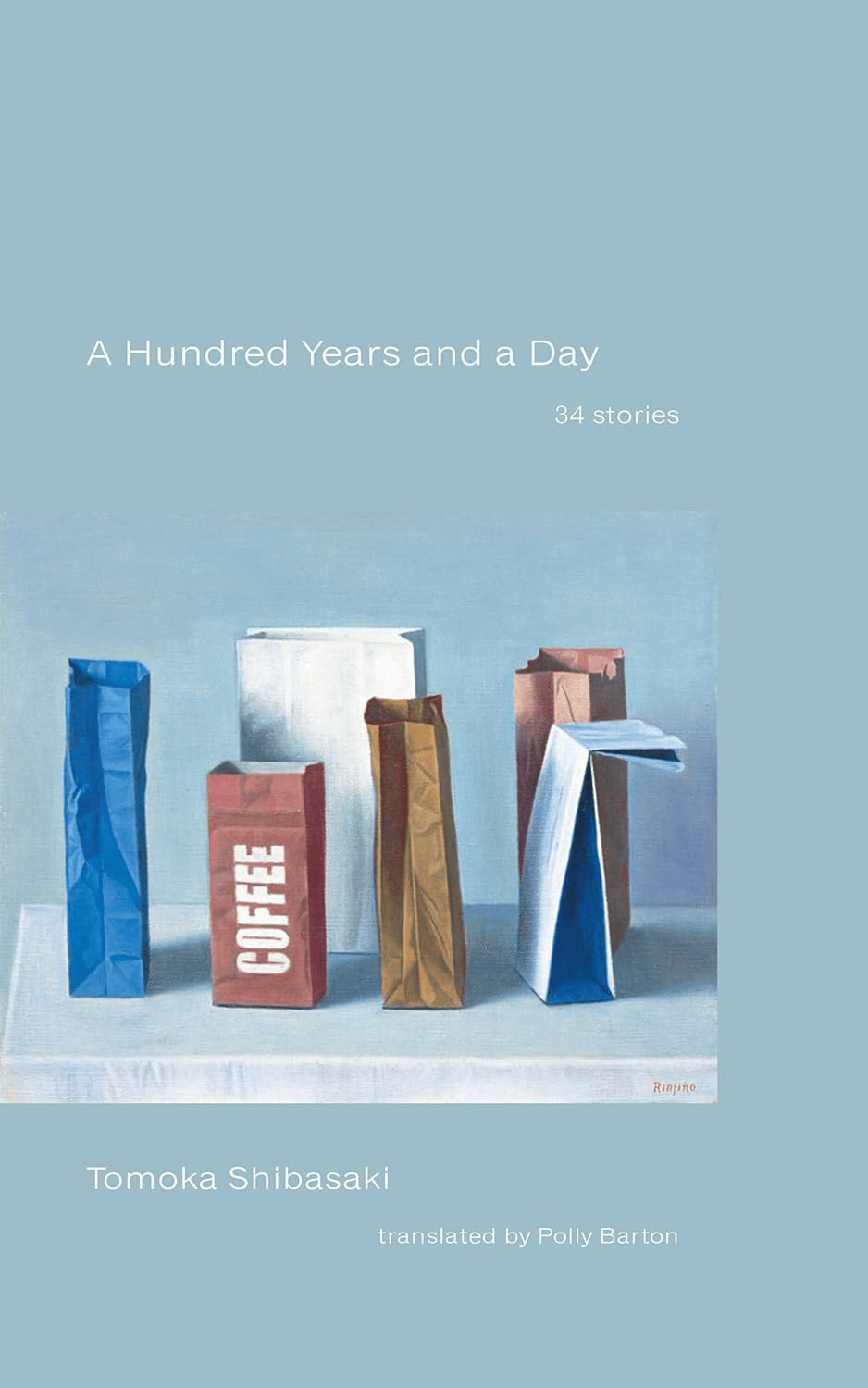
    A HUNDRED YEARS AND A DAY: 34 Stories defies all the Japanese-fiction expectations by embracing the form


    A HUNDRED YEARS AND A DAY: 34 Stories
    TOMOKA SHIBASAKI
    (tr. Polly Barton)
    MONKEY/Stone Bridge Press (non-affiliate Amazon link)
    $9.95 ebook edition, available now

    Rating: 4.5* of five

    The Publisher Says: This ground-breaking collection from Tomoka Shibasaki, author of the acclaimed novel Spring Garden, pushes the short story to a new level.

    In these stories of human connection in a contemporary, alienated world, people come together to share pieces of their lives, then part. We meet the women who share a house after the outbreak of war before going their separate ways once it is over; the man who lives in a succession of rooftop apartments; the diverging lives of two brothers who are raised as latch-key kids by factory workers; the old ramen restaurant that endures despite the demolition of all surrounding buildings; people who watch a new type of spaceship lift off from a pier that once belonged to an island resort; and more.

    These 34 tales from all over the planet have the compulsive power of news reports, narrated in a crisp yet allegorical style.

    I RECEIVED A DRC FROM THE PUBLISHER VIA NETGALLEY. THANK YOU.

    My Review
    : There is a pattern I follow when reviewing short stories: I call it, for convenience, The Bryce Method after my old friend Bryce and his collection-spanning short summary followed by a very short summary and rating of the individual story habits from his blogging days.

    Not going to work here.

    Thirty-four stories in two hundred pages is problem one; not much between summary and spoiler. Two is these are stories that begin with something I'd call a spoiler: a summary-like paragraph set off from the text, which honestly took a half-star off my overall rating for off-puttingness. I think it's pointless, for these reasons, to use my old method as it would really add to the wall-to-wall spoilers. To avoid a close encounter with the shrieking Spoiler Stasi maniacs, allow me to review the gestalt of the collection for you.

    It was fine. Nice prose, I'd say based on a long reading life with more than the usual number of translated works in many genres, quite gracefully translated. Plenty of well-woven-in clues to words that wouldn't translate. A solid, creditable job for a nice book of stories.

    Does anything here do something that "pushes the short story to a new level"? No.

    Does it really need to? No. Breathless copy does nothing good for this solid, well-crafted collection of short fiction mostly exploring the horrors of trying to communicate with actual other human beings in mutually satisfying connective ways. It's a collection full of fun, if weird, ways for that to fail. It has no central character or group, unlike that Ryu Murakami book I wasn't keen on that did mostly the same thing. It isn't set in one place like Pleasantville, that braided-stories novel I liked so well. In the off-kilter liminal spaces we're in for the whole collection, I'm most put in mind of the way Brian Evenson, in his uneasy style, makes the world feel. These are *not* horror, or even horror-adjacent, stories; instead, they partake of the weirdness and not-quite-ness of horror without any of the sillier trappings.

    Polly Barton's ear for, say, how a wisteria vine relates to the wisteria vine it's been entwined with for goddesses only know how long, is the main vehicle for little minds like thee and me to get access to the core of longing and need in each of these very Japanese tales. Will we really know what's what? Not in my experience, and all the more fun to read because of it.

    When I finished this read I had to sit a minute and look into my emotional reactor core to see what this bolus of new fuel was doing. I'm impressed that the way Author Shibasaki and her able translator, Polly Barton, never once threw a sucker punch. These stories deliver their intensely meant, unshielded radioactivity to you direct. It's not fussy; it's not overwrought; it's the high-quality story-ore, direct to your well-shielded reactor core to be processed.

    I gave it a half-star less than perfect because, in some cases, the oddball opening paragraphs say too much even for me. That's hard to do!

    Saturday, May 18, 2024

    PACKAGED LIVES: Ten Stories and a Novella, fiction that tells the truths of Iraqi lives


    PACKAGED LIVES: Ten Stories and a Novella
    HAIFA ZANGANA
    (tr. Wen-Chin Ouyang)
    Syracuse University Press
    $14.95 all editions, available now

    Save 40% off on direct-from-publisher purchases of all literature in translation with discount code 05WIT25 now through September 15, 2025.

    Rating: 4.5* of five

    The Publisher Says: The carefully crafted, subtle, and humorous stories in Packaged Lives show Zangana at her best as a fiction writer. She portrays her subjects keenly, sensitively, and lovingly but without compromise. Iraqis living in exile come to life in her narratives as men and women who are caught between two worlds. They cannot return to their homeland and are forced to wait for news of Iraq from afar. At the same time, they are unable to fully adjust to life in Britain and make a new home for themselves. The question “What is home?” is at the heart of each story in this collection. Her protagonists, who are stuck in ready-made lives, or “packaged lives,” struggle to set themselves free from a web of relationships in which they are entangled. Art, poetry, and nature provide lines of escape. The relief may be fleeting, but the peace of mind and serenity are reached through the moment of epiphany at the end of each story, a much-needed balm.

    Haifa Zangana is an Iraqi Kurdish writer and activist. She is the author of Women on a Journey: Between Baghdad and London, City of Widows: An Iraqi Woman’s Account of War and Resistance, Dreaming of Baghdad, and Party for Thaera: Palestinian Women Writing Life, among others.

    Wen-chin Ouyang is professor of Arabic and comparative literature at the School of Oriental and African Studies, University of London. She is the author of Poetics of Love in the Arabic Novel: Nation-State, Modernity and Tradition, and Politics of Nostalgia in the Arabic Novel: Nation-State, Modernity and Tradition. She has been working towards Arabic-Chinese comparative literary and cultural studies, including Silk Road studies.

    I RECEIVED A DRC FROM THE PUBLISHER VIA EDELWEISS+. THANK YOU.

    My Review
    : The author's life is, in the tiny squib above, an abbreviated roll call of her creativity. What is most important you don't discover until reading Michael Beard's Introduction: She is old enough to remember a pre-Saddam Iraq, one that was becoming its best self; then the translator, in her fresh bereavement, fills in those bones with the emotional muscles and life-lived sinews of her long friendship with the author and her own husband. The image called forth is of a loose, but powerful, bond of those few friends one makes in life who can be called "true blue through-and-through besties."

    As is my established custom, you'll get a story-by-story note and rating, then a summation, or the Bryce Method as it's better known around here.

    Evensong


    Chatter


    Delirium


    Duck


    Day


    Refuge


    Turnstile


    Cave


    Pilgrimage


    Painting


    Packaged Life


    Sunday, December 10, 2023

    A WORLD FULL OF WINTER STORIES: 50 Folk Tales and Legends from Around the World


    A WORLD FULL OF WINTER STORIES: 50 Folk Tales and Legends from Around the World
    ANGELA McALLISTER
    (illus. Olga Baumert)
    Frances Lincoln Children's Books
    $24.99 hardcover, available now

    Rating: 4.5* of five

    The Publisher Says: Get ready for winter with this treasury of 50 frosty stories from around the globe.

    Curl up beside the fire and uncover stories from all over the world with this rich resource of wintery folk tales, myths and legends. Featuring stories of Norse gods; hibernating bears; Christmas feasts and wicked witches, there is something for everyone in this collection of winter inspired stories.

    The perfect anthology for Christmas, or any time you want to uncover chilly tales from lands near and far. Collected and retold by award-winning author Angela McAllister, with enchanting illustrations by Olga Baumert, this is an anthology to be read when the weather turns colder and the nights draw in.

    Stories
  • The Spider and the Christmas Tree (Ukraine)
  • Mother Holle (Germany)
  • Shingebiss (Ojibwe, North America)
  • The First Rabbits (Japan)
  • The Girl and the Winter Whirlwinds (Bulgaria)
  • The First Evergreens (Mongolia)
  • The Snow Man (Denmark)
  • Why the Bear Sleeps All Winter (North America)
  • The Wind, the Clouds and the Snow (China)

  • I RECEIVED A DRC FROM THE PUBLISHER VIA EDELWEISS+. THANK YOU.

    My Review
    : As usual, a beautiful book filled with lovely art. Frances Lincoln, a UK-based imprint dedicated to aesthetic appreciation of beautiful artwork, gives us here a selection of winter-themed stories that neither focus on nor ignore the Western winter holidays. We're celebrating the season, as usual, with gifting. The need for stories to keep our young readers of school age entertained and challenged in the evening before the big gifts get opened is well served with this book:
    I take off a half-star for one thing: I found the stories a bit saccharine, far too unchallenging, for eight-year-olds and certainly older than that. I don't think that does most readers that age a good turn. Better to make them stretch, fo all of me; but many others do not agree. Some readers more challenged by complexity will enjoy the stories. The artwork is technically irreproachable, if uninspiring to my jaded eye; again, perfect for a reader whose preferences aren't served by challenge.

    A good gift indeed for the right reader.

    Friday, September 29, 2023

    SEASONS OF PURGATORY, English-language debut story collection from exiled Iranian author


    SEASONS OF PURGATORY
    SHAHRIYAR MANDANIPOUR
    (tr. Sara Khalili)
    Bellevue Literary Press
    $16.99 trade paper, available now

    Long-listed for the 2022 National Book Award for Literature in Translation!

    Rating: 4* of five

    The Publisher Says: The first English-language story collection from “one of Iran’s most important living fiction writers” (Guardian)

    In Seasons of Purgatory, the fantastical and the visceral merge in tales of tender desire and collective violence, the boredom and brutality of war, and the clash of modern urban life and rural traditions. Mandanipour, banned from publication in his native Iran, vividly renders the individual consciousness in extremis from a variety of perspectives: young and old, man and woman, conscript and prisoner. While delivering a ferocious social critique, these stories are steeped in the poetry and stark beauty of an ancient land and culture.

    Shahriar Mandanipour is an award-winning, exiled Iranian author and journalist who served in the Iran-Iraq war. His fiction has been published throughout the world, including two acclaimed novels published in English. He lives in California.

    I RECEIVED A DRC FROM THE PUBLISHER VIA EDELWEISS+. THANK YOU.

    My Review
    : Men, men, men...all men, all the time. Even when a female person appears, she isn't really given anything to do except respond to the men around her. There's a lot of that down to the war background that the stories share; a lot of serious issues in war just don't make room for women. The war happens to all the characters, in all the time-frames and settings the different stories take place in. Nothing about these particular men says they are, or feel, in control of too much in their different worlds.

    The disorientation of the world as it is run by totalitarians is evident in the slightly seasick sensation of being tossed from time-frame to time-frame between and within stories. Occasionally we are placed in medias res within a thought or a sentence. It does what it's intended to do and leaves the reader unsure, not in control, just as the characters are not. The author is not yclept with "award-winning" for playing it safe, after all. He doesn't spoon-feed one's imagination but requires us to attend to the words and images we're presented in order to derive our full measure of aesthetic pleasure from them.

    Unexpectedly, I herewith revive the Bryce Method of offering a story-by-story opinion of each piece.

    Shadows of the Cave revels in the aging man's pleasure of Being Right About Things. Mr. Farvaneh has a window in his apartment overlooking the smelly, gross zoo and its caged beasts:
    "If you realize that people are mocking you, and you behave in such a way that they remain ignorant of your realization, and especially if you repeat the cause of their mockery, it is, in fact, you who has mocked them and who has the upper hand. These {zoo} animals use the same intelligent ploy; with only a few exceptions, in their cage they behave as they would in the jungle. At times their indifference to humans is truly insulting. Don't you understand?" No! Many didn't grasp this fine point, or they didn't want to.

    As old men will, Mr. Farvaneh keeps trying to elucidate his vision of the present and its awful stench, its degeneracy from The Noble Past, reads his history books, and occasionally shouts at people to leave him alone. He is, in other words, me. I approve this ironical quirked eyebrow of an extended metaphor. 4 stars

    Mummy and Honey tells a Faulknerian tale of the Wages of Greed, Pride, and Sin...and spends a lot of time talking about a viper and a bitter orange tree, which clearly have a cultural resonance that is lost on me. I wouldn't expect a Farsi speaker to get, for example, a central image of a magnolia tree in a Southern Gothic story, and that's what this felt like to me. Still and all, an enjoyable tale if just a bit too long. 4 stars

    Shatter the Stone Tooth First, read this:
    Then he wrote a lot about the mud huts that are connected to one another by underground tunnels, and of villagers with trachoma, and of "gusts of dust that get into your throat and make you retch," and he wrote, "Would you believe that dust can rot?" I can't believe he wrote this letter. His earlier letters were not like this; they were real letters. Even his handwriting used to enchant me. His letters were filled with words that men in love string together an that every woman loves to read or hear, even though just after they are read or heard they seem banal.
    A woman mourns the death, of sorts, of the young man who left her for the regime's benefit; he goes to a remote place to be of service to people who didn't ask for help, so they won't become a fifth column for the regime's enemies. It's a soul-killing job he's doing, to give your life up to live for others who don't want you or care about you. The narrator's only role is to witness for us the death of hope. Bleak, bleak, bleak but piercingly honest. 4 stars

    Seasons of Purgatory gives us, from the start, the kind of body-horror story that wars toss into civilian worlds like grenades; but in addition the story offers an especially bleak look at how power works down among the powerless. It is perfectly told, and is my second-favorite story in the collection. 5 stars

    If She Has No Coffin indulges a child's belief in and discovery of Goodness via her father's acceptance of her imaginary friend. Her imaginary friend is wicked, honest, and unruly...all the things she isn't allowed to be. Bleak wartime fiction illuminated by paternal love, probably misplaced. A little gem of the price that dishonesty, even for the most kindly of motives, exacts from the liar. Very interesting, given the place the author's exiled from, that the trip to the graveyard to "bury" the "dead" imaginary friend, is interrupted by bombs falling at random, as they do. 4 stars

    King of the Graveyard grieves the denied rituals of grief that enable the grief-stricken in their necessary release of hope. The old couple whose son is buried in cold earth but unmarked for and unknown to them bicker and argue and blame but never dare to speak the truth. Their son died for nothing, and they're left with the amputated stumps of life and love and the future. And there is no place to put that grief, that pain, that rage at the waste and futility of war over trifles. My favorite story. 5 stars

    The Color of Midday Fire goes into a father's grief as his beloved daughter is eaten by a leopard, upon which creature he vows to revenge himself. Only, as the opportunity arises, the reality of revenge as the most futile act of destruction there is, comes down on him. A lesson for more men to learn in this world. 3.5 stars

    Seven Captains is another damn sausage-fest...yes, there's a woman in it; she attempts to make a choice for herself and, in accordance with the culture, pays the ultimate price. This male-sexual-possession "honor" stuff gets old for me. The real emotional heart of the story to me was one man's sccumbaggy betrayal of another over a woman. 3 stars because it's beautifully written but I don't enjoy the story

    If You Didn't Kill the Cuckoo Bird reveals a very personal sense of hurt in the author from his condition of living in exile. The sheer misery of the prison that totalitarians make of our own minds is appalling, enduring, and intentional. Has anyone escaped? Is there a second man inside the man? What, inside the tight confines of a cell, is real? Even bodies are fungible. 4 stars

    Monday, August 21, 2023

    RUMENA BUŽAROVSKA'S PAGE: Macedonian tale-teller new to the Anglophone reader


    I'M NOT GOING ANYWHERE
    RUMENA BUŽAROVSKA
    (tr. Steve Bradbury)
    Dalkey Archive
    $16.95 trade paper, available now

    Rating: 4.75* of five

    The Publisher Says: Razor-sharp social commentary, Jane Austen for contemporary feminists unafraid to confront a dark world

    In her latest translated volume of collected short fiction, Rumena Bužarovska delivers more of what established her as “one of the most interesting writers working in Europe today.” Already a bestseller across her native Macedonia, I’m Not Going Anywhere is an unsentimental and hyperrealist collection in which Macedonians leave their country of origin to escape bleakness—only to find, in other locales, new kinds of desolation in these dark, biting, and utterly absorbing stories.

    I RECEIVED A DRC FROM THE PUBLISHER VIA EDELWEISS+. THANK YOU.

    My Review
    : Seven stories, all centering women and their feelings; few socially acceptable, none positive.

    Not having participted in heterosexuality for quite some time now, I am left utterly verschmeckeled by its continued existence. Exactly no women whose writing gets attention write of happiness connected to men. In romantic fiction, after the couple is established, the story ends; and none of them start with happy straight people. Of my own personal knowledge, there are almost no women really happy in their state of making eternal compromises and settlings they make to maintain relationships to their men. Why are y'all bothering? It's not great for anyone involved to be in what amounts to prison with a cellmate you condescendingly tolerate at best, despise and detest at worst.

    Well...no one's makin' me do it, so my only interest is an outsider's appalled fascination. Self-inflicted harm seems so wasteful. Not one of these stories is going to challenge my observation's validity; that Author Bužarovska is a multi-award-winning chronicler of straight women's experience suggests to me that she's on to something or the kudos wouldn't flow.

    Strap in...we're headin' into the venerable institution of the Bryce Method to examine a little of what she is talking about in this collection.

    The Vase reminds me of the drunken fights, the rage and hatred of being Stuck, stuck with-stuck in-stuck under, that there bursts out the sudden overpowering need to break shit just to make the world hurt a little bit like you are. That time in my own life was hellish. It's all right here in a few pages.
    With every drink I am getting more and more pissed at him, and at his mother for not dying. The idea that she is sitting there all sick and hideous in her living room like a neglected houseplant, watching stupid soap operas all day, enrages me.

    The poison of disappointment and the rage of thwarted entitlement eat caustically away until they spill out, paradoxically, as acid recrimination. 4 unhappy stars

    Blackberries charts the course of a passive, purposeless thirty-three year old as she aimlessly moves towards the scene of a dreamlike past to test whether she was even real as a child. Her memories of the place guide her in opening the old cottage her grandparents had. The scenes of domestic contentment shining in front of her dingy present include memories of a vivid friend from that past; these seem to conjure the now-woman from the stones, summon her back to this crumbling haunt from her passionate intense life in the US. A tiny flicker of life, a spark of connection, then the fog descends again.

    Was it even real? Does it matter if it isn't? She is never going to burst into glorious flower, like her childhood friend. There is no mass in her to go critical. 4 stars
    I flick on the living room light: it works. I flick on all the light switches: everything is working; nothing is amiss. But it can't be, I say to myself. Nothing is ever right. That's just how it looks.

    Tsi-Tse brings the cost of settling instead of settling down to the diametric opposite of the earlier stories' impoverished as well as unhappy lives. Elena thought she escaped Macedonia's grinding poverty by marrying an American man with a good job and moving to New Mexico. She found loneliness, isolation, and motherhood's endless unmeetable demands. She also failed to disentangle herself from her ill, needy father. Returning to Skopje when he has a stroke, she's in the eternally tempting path of cheating because her high-school crush Jovan has been in email contact...ain't the twenty-first century grand?...and the lure of Home is so deep...dreams are, after all, deepest when one is dreaming. Pesky reality has no chance to screw things up in dreams. Pity dreams can't last. 4 stars

    I'm Not Going Anywhere is Riste-the-incel's humiliated homecoming to his Mama in Skopje after his hottie wife and teenaged daughter finally work up the nous to trade up men. The escape to Australia that he participated in gave them the scope to do better than his bitter, furious, abusive self. Now he's unloading all his pent-up anger on his mother, a portly, poor, elderly woman whose life has clearly been spent as some man or another's dogsbody.

    After throwing a tantrum about his mother's goulash being inferior, he storms off to get some veal and show her how it's done. This leads ro a reckoning with his past that he clearly expected to go differently than it did. I found spending time in Riste's company thoroughly unpleasant. 3.5 stars

    Medusa pilots us to what, from the off, I was certain was going to be a grisly cocktail party with a pair of Balkan academics visiting some very, very nouveau riche fellow-countrymen in that couple's ever-so-new-money new-build mansion. It doesn't help that the guest's husband is in the sights of the host's wife....

    We've been to that party, or at least those of us over a certain age have, and it's a grim, brutal evening. In this telling of it, it very much is that awful, brutal evening for all concerned. 4 stars

    Cherokee Red brutalizes a gay kid with a homophobic father whose immigrant status marks the whole family out in ever-so-sunny, ever-so-hot Phoenix...about as far from Macedonia geographically and culturally as a place on Earth can get.

    You never know what words will fall where they can do the most damage, do you, and yet there most people are spouting the most revolting kind of hatred and ignorance without a care in the world. Bitter anger, hatred, self-loathing all wound up in a bloated, bombastic, shouting boozehound's nightmarish effusion demonstrating his nithingness. 4 stars

    The 8th of March plunged me back into the bad memories of being in alcoholic relationships. The utter, appalling humiliation of Vesna-the-drunk stirred up bad old days, and brought a giant rush of anxiety my way. Horrifyingly cruel, this portrait of self-pity and utter, abject, appallingly public humiliation is easily the most perfectly realized of the whole collection. No alcoholic needs any help destroying their life, but sometimes Life provides them a stage. Harrowing. 5 stars

    ++++++++++++++++++++++++++++++++++++++++++++++++++++++++++++++++

    MY HUSBAND
    RUMENA BUŽAROVSKA
    (tr. Paul Filev)
    Dalkey Archive
    $15.95 trade paper, available now

    Rating: 4* of five

    The Publisher Says: Adulterers, cheats, hypocrites, bad seeds—in My Husband, Rumena Bužarovska turns her wry and razor-sharp gaze on men, and on the lives of the women who suffer them.

    In these eleven devastatingly precise and psychologically unsettling stories, we follow the female protagonists’ thwarted attempts at intimacy, ranging from pretense, to denial, to violent and ultimately self-destructive acts. This smart, funny, provocative collection demonstrates the profound skills that have made Rumena Bužarovska one of the finest contemporary writers of short fiction in Macedonia. This story collection Mojot Maž in Croatian, (My Husband in English), won the Edo BudiÅ¡a Award for Best Short Story Collection.

    I RECEIVED AN ARC FROM THE PUBLISHER. THANK YOU.

    My Review
    : At eight or nine pages apiece, these stories can't be subjects of my usual Bryce method of synopsizing each one individually. That way spoilers lie, and y'all're very likely to go nuts about them spoilers. In a certain way, though, no matter what I say it'll be a spoiler because in eleven stories nothing changes. Women marry cads and bounders and abusive jackasses who treat them like dirt. Much of a muchness, then.

    The reason I finished the book was that the author's voice, as translated by Paul Filev, is raw, blunt, almost brutally rageful; never less than seethingly aware of the injustice of "belonging" to a man and being subject to his will and whims. I cartainly won't re-read it. I'm glad I did read it in the first place. It's the first work translated from Macedonian that I've read. The author seems to be, based on the limited biographical information I can find in English, a big literary light in Macedonia.

    Based on this first collection of hers to appear in English, I can see why. Her sort of caustic honesty isn't going to be to everyone's taste, but I found it to be to mine.