Showing posts with label political SF. Show all posts

Monday, July 6, 2026

WE WERE FORBIDDEN, feminist author at her tendentious best


WE WERE FORBIDDEN
JACQUELINE HARPMAN
(tr. Roz Schwartz)
Transit Books (non-affiliate Bookshop.org link)
$17.99 ebook, available now

The Independent Press Top 40 Bestsellers: Fiction For the week ending September 9, 2026

Rating: 4* of five

The Publisher Says: From the author of I Who Have Never Known Men comes a startling new collection of three never-before-translated stories, each plumbing the depths of that most necessary human defiance.

Wandering the forest in the wake of some unfathomable war, a woman and her fellow survivors are forbidden from leaving its boundaries or pausing in their march through its strange depths.

As part of her rigid schooling, a teenage girl is barred from questioning the dogma she is taught to believe—her punishment for doing so will be as disturbing as it is disproportionate.

Locked in a loveless marriage, a young woman satisfies her husband’s desires, twice-weekly, as directed. She has not yet thought to pursue her own.

In varying ways, and across varying worlds, each of these women are trapped. Do they have the will to escape?

I RECEIVED A DRC FROM THE PUBLISHER VIA EDELWEISS+. THANK YOU.

My Review
: One of the most enduring stories in Western Anglophone culture is the princess in the tower, locked away and in the absolute control of A Man/A System/An Enemy, and how she must connive to survive with whatever degree of success the cruel, cruel storyteller allows her. Now firmly grounded in the reality of being female over the millennia, along comes Author Harpman with Translator Schwartz as amanuensis, extrapolating this cultural juggernaut to include all those trapped in subservience and obedience to high-control systems.

In "The Outcast" Author Harpman uses the most familiar iteration of the story. A teenaged girl is in the intertwining coils of adolescence and sexual maturation and cultural demands for conformity. It's harrowing to see Author Harpman's keen observations of fascism turned loose on one so hugely vulnerable and malleable...it is a shorter and refocused version of the juggernaut I Who Have Never Known Men and should appeal to those seeking more of that story only dressed in a shorter, more contemporaneous skirt.

Moving into times and ties more concrete, "The Broom Closet" is a woman's struggle to find her footing in 1920s Belgium. The demands of domesticity on women are different from those made on men even now; in the deeply conservative culture of postwar Belgium, where the battles that killed millions were barely over let alone their damage repaired, they were starkly different. As one adds the inexorable advance of marriage's compromises conflicting with the absolute tyranny of the need to create stories, the trap of cultural expectations springs shut. Virginia Woolf's A Room of One's Own's observations made specific and played out with the intensity of "The Yellow Wallpaper."

Expanding the story logic to those enmeshed in the military of an apocalyptic future, "The Ardennes Forest" is the most immediately reminiscent in its setting to I Who Have Never Known Men while expanding scope beyond one woman's life. A group of conscripts are mapping and scouting the terrain for what they imagine, not unreasonably, to be a future battlefield. That future never comes. They continue the work they've been assigned.

Endlessly.

As the story goes into nothing deeply, it became obvious to me this is Author Harpman meditating on the tedious tasks of daily life performed under nebulous, ominous duress. There's a weirdly onanistic edge to the submission of these soldiers to their assigned task even as they begin to question what it is they're doing as nothing ever changes as a result of its self-similar patterns.

Three stories of people in a system of depersonalizing cruelty, and how that strips an individual of any sense of agency; numbing the essential "You"ness of you into submissive obedience. I'm not a bit sure it will make new Harpman fans. For one thing, there are limits to the efficacy of compactness in the involving process of storytelling. I think these three stories are on the shortest end of that effort, possibly too short for anyone not already familiar with Author Harpman's thematic hobbyhorses to fully invest in them.

Existing fans are in for a treat.

Wednesday, March 11, 2026

AFTER THE FALL, latest Edward Ashton outing


AFTER THE FALL
EDWARD ASHTON

St. Martin's Press (non-affiliate Bookshop.org link)
$14.99 ebook, available now

Rating: 4* of five

The Publisher Says: Would humans really make great pets?

Humans must be silent.
Humans must be obedient.
Humans must be good.

All his life, John has tried to live by those rules. Most days, it’s not too difficult. A hundred and twenty years after The Fall, and a hundred years after the grays swept in to pick the last dregs of humanity out of the wreckage of a ruined world, John has found himself bonded to Martok Barden nee Black Hand, one of the "good" grays. Sure, Martok is broke, homeless, and borderline manic, but he’s always treated John like an actual person, and sometimes like a friend. It’s a better deal than most humans get.

But when Martok puts John’s bond up as collateral against an abandoned house in the woods that he hopes to turn into a wilderness retreat for wealthy grays, John learns that there are limits to Martok’s friendship. Soon he finds himself caught between an underworld boss who thinks Martok is something that he very much is not, a girl who was raised by feral humans and has nothing but contempt for pets like John, and Martok himself, whose delusions of grandeur seem to be finally catching up with him.

Also, not for nothing, something in the woods has been killing people.

John has sixty days before Martok’s loan comes due to unravel the mystery of how humans wound up holding the wrong end of the domestication stick and find a way to turn Martok’s half-baked plans into profit enough to buy back his life, all while avoiding getting butchered by feral humans or having his head crushed by an angry gray. Easy peasy, right?

I RECEIVED A DRC FROM THE PUBLISHER VIA NETGALLEY. THANK YOU.

My Review
: I really hope y'all're catching on to Author Ashton. I confess I don't *get* why people weren't excited by Mickey17, because I thought it was a decent adaptation of Mickey7 as well as a good movie on its own; but mostly I'm a bit bumfuzzled as to how all Author Ashton's books aren't on the bestseller list. Every one I've read has been good-plus. I enjoy them, I spend time after reading them pondering about this bit that's really made me think, or that character who's so awful it must've been a big hoot to write them (specifically thinking of the one in The Fourth Consort of whom I said "'kindness and acceptance' sounds better than 'craven lickspittle sycophancy' doesn't it.") In a lot of ways this novel feels like Author Ashton taking a crack at some of the ideas not fully explored in that story.

I'm really thinking mostly of the ownership angle we delve into in this story, the ethics of cannibalism are unambiguous in The Fourth Consort whereas the Grays in this book are arguably the more vicious in their treatment of humans because they see us, say "aww how cute" and then go right on looking at us like there is nothing else to say or think. Someone who slaughters and eats you regards you as valuable; someone who views you as fungible, as a pet, does not. In a lot of ways it feels like the plays from the Roman Republic and early empire where the clever slave runs master's business better than master, saving the day and earning master's gratitude but never respect.

Like all Author Ashton's work, you're going to get some funny lines, and you'll never have any trouble remembering who said what to whom...I think that's why I like the Mickey series and why I think Director Bong did too, there's such a clear sense of the main characters' identity. What there isn't is a clear path towards resolving the conundrum the story orbits around: Is the condition of the humans going to change for the better? John and Martok are coming out of these events in a different state than they entered them but...well...is there a larger point to this larger story? If not, why bear down on it?

I enjoyed this stand-alone read, I thought it raised interesting points and gave me some good pondering to do. I was not convinced this was the best place to end the story, but it wasn't like it was poor on a craft level. It just could've leveled the read up, but chose not to.

Not the worst, or least forgivable, authorial peccadillo. I'll definitely await the next Ashton book with attentive eagerness.

Saturday, November 15, 2025

WHO KNOWS YOU BY HEART, layered storytelling...in the Satanic second person


WHO KNOWS YOU BY HEART
C.J. FARLEY

William Morrow (non-affiliate Bookshop.org link)
$14.99 ebook, available now

Rating: 3.75* of five

The Publisher Says: Part social thriller, part modern love story, Who Knows You by Heart is a sly, witty, and endlessly discussable tale of Big Tech, new money, relationships, race, and discovering what’s real in an age of artificial intelligence.

Octavia Crenshaw, a Jamaican-American coder living in Manhattan, is broke, burned out, and haunted by her parents’ deaths. Desperate to pay off some debts, she ditches her nonprofit job for a high-paying gig at Eustachian Inc., a Big Tech company that specializes in audio entertainment. Language, communication, human connection—these are the markets Eustachian wants to revolutionize...and dominate.

Octavia finds herself swept up in the world of the Tech Titans, with its lure of instant riches and its seemingly limitless future. But as one of Eustachian’s very few Black employees, Octavia is uncomfortably aware of things that seem to escape her unexplained tech glitches, cryptic remarks, a mysterious secret floor in the corporation’s gleaming headquarters.

But she sets her suspicions aside when she’s recruited by another Black coder—the infuriating but attractive Walcott—to collaborate on a secret project code-named Zion. Zion is a new kind of AI-powered storytelling, one that’s programmed to be free from the racist and sexist biases that plague other AI products. Zion could launch Eustachian into a bold new future and make its developers super rich while righting all kinds of injustices. Octavia and Walcott’s excitement over their creation sets off romantic sparks between the two of them, until they discover a toxic secret about their employer—something that they can’t unlearn, or overlook, but must overcome.

I RECEIVED A DRC FROM THE PUBLISHER VIA NETGALLEY. THANK YOU.

My Review
: Told in second person, so no possibility for anything above four of five stars exists. A Columbia educated (as we're reminded often) Black woman succumbs to the lure of tech money in this romance-tinged technothriller. It's very much a game of two halves, as the beginning sets up the circumstances of Octavia's decision to accept cold capitalist reality and take a high-paying, not likely to be fulfilling job in order to buy her way out of debt...much of which was inherited from her mother, thus involving Octavia in debt peonage.Fortunately for her a megacompany, Eustachian, Inc.'s, testing algorithm taps her as A Talent.

As witty, obsevant Octavia spends time in Eustachian, Inc., we get the deeply uneasy sense of "offness" that a thriller needs to make it exciting. The author chooses to make this a very extended part of the book, not igniting the thriller part until Walcott, the love interest/cospirator with excellent aims, appears far too near the halfway point. This is also when the language shifts registers as technobabble (for all of me, anyway) predominates from here on out. I perked up, though, because the stated aim of these two Black folks in a lily-white tech company staffed by tech bros is to subvert the systemic racism and misogyny from within using coding skills.

As this is exactly what I think keeps Aynholes awake at night and causes them to refuse DEI anything with all their might, I was so down with this! Especially since I was being tenderized by the (for white people) immersion into Black culture, use of Black contributions to the world, and centering of a Black woman in a plot about confronting and subverting racism and misogyny.

You'll have noticed the incomplete fourth star. I was a bit surprised by Author Farley's complete absence of Asian characters in a novel centering race-based prejudice. Historical reckoning with racism and combating is perpetuation is very much incomplete without more inclusion. Still, It's not fatal as flaws go, nowhere near as guaranteed to put me off as Satanic second-person narration.

I would've relegated this novel to a short review until I got to the final chapter. A summation of the extreme dangers inherent in AI's development *at*all* left me slightly winded from the emotional ooof as the gut-punch landed.

For that alone I hope you'll read the book. (I won't forgive the second-personning waterboard torture, though.)

Friday, December 20, 2024

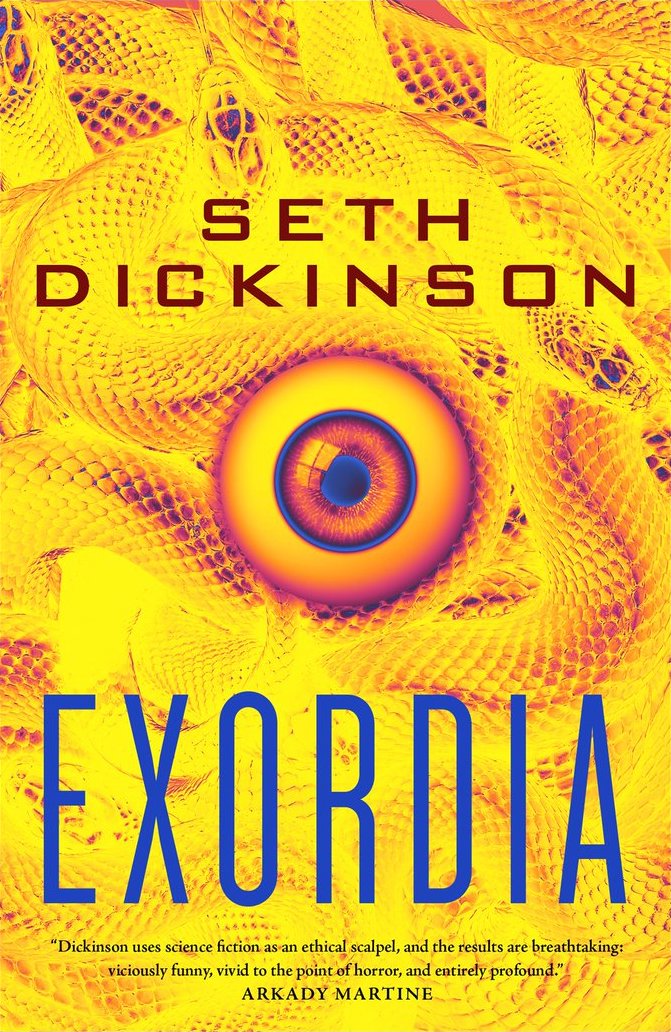
EXORDIA, rich, immersive story to block out the world's noise


EXORDIA
SETH DICKINSON

Tor Books (non-affiliate Amazon link)
$29.99 hardcover, available now

Rating: 4.5* of five

The Publisher Says: “Anna, I came to Earth tracking a very old story, a story that goes back to the dawn of time. it’s very unlikely that you’ll die right now. It wouldn’t be narratively complete.”

Anna Sinjari―refugee, survivor of genocide, disaffected office worker―has a close encounter that reveals universe-threatening stakes. While humanity reels from disaster, she must join a small team of civilians, soldiers, and scientists to investigate a mysterious broadcast and unknowable horror. If they can manage to face their own demons, they just might save the world.

I RECEIVED A DRC FROM THE PUBLISHER VIA NETGALLEY. THANK YOU.

My Review
: A species (!) of hard sci fi from a writer previously celebrated in the fantasy field for The Traitor Baru Cormorant, here blending queer representation with cosmic horror via military sci-fi in the paranoid Cold-War mode, heavily Cthulhu-ized.

That sounds like something I'd hate. Why didn't I?

Seth Dickinson. He has a deft touch with humor to lighten the darkness, irony to show the urgency of perspective, and unflinching realism to get the reader's investment in the stakes. Which are, I know this will surprise you, existential for Humanity.

On the nose, in our present political and environmental climate? I thought so going in. I think so now. However, there's a reason I recommend this story for your immersion and entertainment anyway. It is about the ways and means used to accomplish political goals while using people's fears and anxieties to motivate them into actions that are genuinely necessary. It takes us into the labyrinth of tech-dominated institutions of force apllication, and shows us the internal conflicts that impact everything done or not done in these institutions. The stakes are often secondary to the purposes of the instituion's inmates.

Yet...in the end, after much troubling back-and-forth...the people are clearly all working for something they see as Right and Good. No matter what outcome eventuates, someone's plans will fail, and someone else's will sorta-kinda work. Will anyone be fully happy? No. The way the book's structured, the changing PoVs are the way to keep this story from devolving into Us-v-Them predictability. Whose ideas and goals you empathize with really isn't the point. It's recognizing the goals and ideas matter TO THEM, and using that knowledge to get what *you* want.

A hard leap to make, as witness the fact that so few ever make it. Author Seth shows the reader the idea of it with startling clarity and not a little dark humor. The results...you'll discover the specifics...are exactly and precisely what the actions of all the characters add up to. There is no deus ex machina here. There is, in the second half, a lot of science to go with your fiction, mostly physics.

I typed that sentence with a sinking heart. I know some significant fraction of my readers just went *click* into the off position. It is, of course, entirely y'all's privilege...but please hear me out. Your prior knowledge of physics would enrich the uses of it. Your entire ignorance of it will not in any way diminish the force of its uses in the story. You read about magic without understanding how it works, this is essentially the same thing. The scientists are casting spells on ushabtis, not writing code to make drones work in concert...it's all a matter of looking at the technology talk in the proper storytelling spirit.

Appeal made. You decide. What you'll miss, if you ignore my recommendation of this read, is a cracking good story about how people, real people with needs and wants and ideals, get together to accomplish goals in the real world. That story will, I wager, appeal to readers of technothrillers, geopolitical spy stories, and SF gulpers as we head into the season where a big, immersive read will keep you from needing to pay attention to Aunt Lurlene's stories about her neighbors you've never met and couldn't care less about, or your nephew's reprehensible politics.

Monday, November 11, 2024

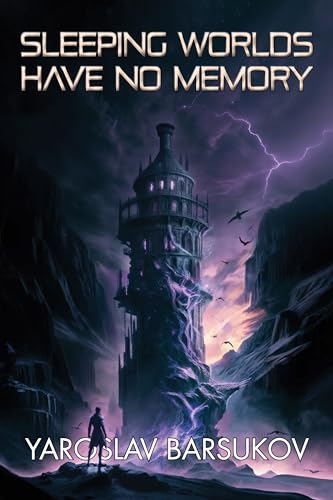
2024 NEBULA FINALISTS: SLEEPING WORLDS HAVE NO MEMORY, thought-provoking story with a hopeful twist


SLEEPING WORLDS HAVE NO MEMORY
YAROSLAV BARSUKOV

CAEZIK SF & Fantasy (non-affiliate Amazon link)
$4.99 Kindle edition, available tomorrow

Rating: 4.75* of five

FINALIST for the 2024 Nebula Award! Winner announced at the 2025 Nebula Conference, 5 through 8 June 2025.

The Publisher Says: When lies become truths and two kingdoms head to a bloody war, a man is exiled for his conscience

Refusing the queen’s order to gas a crowd of protesters, Minister Shea Ashcroft is banished to the border to oversee construction of the biggest defensive tower in history. However, the use of advanced technology taken from refugees makes the tower volatile and dangerous, becoming a threat to local interests. Shea has no choice but to fight the local hierarchy to ensure the construction succeeds—and to reclaim his own life.

Surviving an assassination attempt, Shea confronts his inner demons, encounters an ancient legend, and discovers a portal to a dead world—all the while struggling to stay true to his own principles and maintain his sanity. Fighting memories and hallucinations, he starts to question everything...

Sleeping Worlds Have No Memory is a thought-provoking meditation on the fragility of the human condition, our beliefs, the manipulation of propaganda for political gains, and our ability to distinguish the real from the unreal and willingness to accept convenient “truths.” The novel is a compelling exploration of memory, its fragile nature, and its profound impact on our perception of identity, relationships, and facts themselves.

A unique blend of science fiction, fantasy and noir, with zeitgeist and prophetic qualities (the original novella anticipated the Russo-Ukrainian War), this is a must for fans of China Miéville’s Bas-Lag series, Ted Chiang’s Tower of Babylon, and Robert Silverberg’s Tower of Glass.

I RECEIVED A DRC FROM THE PUBLISHER VIA NETGALLEY. THANK YOU.

My Review
: We can use some entertainment. We can use a bit of moral instruction, it seems. Author Barsukov said these things to himself, at least in my reconstruction of the thought process that led to this book, and decided that he'd make a world and a man to resist its slide into darkness.

I found this book very inspiring. I'm inspired to bring it to y'all's attention because of this piece from The Guardian, "'It will renew your faith in humanity': books to bring comfort in dark times":
A surprising number of readers believe a happy ending should mean automatic disqualification from any serious literary award. Good luck to them: I wish them joy in their wallowing. In my turn, I’ve come to believe the opposite. To reach only for novels that reaffirm our darkest fears is merely to make an escape of a different sort, not the escapism of brooding heroes and wedding finales, but the security blanket of an equally foregone conclusion: the safety of imagining the worst. I would argue that to live only in that place is simply cowardice in better camouflage. The truth is that it’s far riskier to remain in uncertainty. Far braver, far more radical to keep hoping.
The truth of this is in Shea's dogged determination to do what's Right; it's in his determination's effect on engineer Brielle, whose expertise is central in what their shared need to do what's Right creates.

There's a lot of the epic fantasy ethos in this urban-fantasy story, sans the usual military glorification; but there is a very welcome leavening of SF in the story that prevents me from the usual somnolent, glazed-eyed scanning to get to the ending. I was alert and involved as Brielle's skills were deployed to create the tower that Shea's tasked with defending, to little avail:
The tower took the length of the world—only it was an alien world, replicating itself over and over as it climbed to a distant, ghostly gap into the clouds. Or did he stare down a well? Shea's head spun again as up and down flip-flopped like axes on a gyroscope.
Does this dimensionally daft structure need defending? Does this technology need help, or resistance to its implications? Can anyone, still less a proven-murderous tyrant, be trusted with a tool/weapon of this magnitude? Are the Others, the aliens, to be trusted, or are they there to treat Shea and his people as the Others...with the usual result?

Ethical questions, existential ones, that resonate clearly with our post-November 6th world. They aren't easy, or easily solved ones; Author Barsukov doesn't pretend his ending is a solution to them all. There aren't any escape routes from the consequences of greed and lust for power provided. There are stern meditations on what we try to use, though:
What makes guilt so grotesque is the fact that it adorns itself with whatever remains of our righteousness.

And so the sadness of life as a moral actor, as a being with agency and puissance outreaching the lessons of their past, is revealed and refined. The story, an expansion of his 2021 novella Tower of Mud and Straw, reminded me more and more of THE DEEP SEA DIVER'S SYNDROME (qv) which French translation also delves into the intersection between dreamlike states and meatspace with equal care. Does anyone really know what the Tower is/can do? Do their...reveries, memories, dreamlike experiences...come without cost yet replete with warning signs?

An ending that addresses these queries of reality yet doesn't wrap them in a tight, constricting little bow gave me both inspiration and information to examine this moment in which I am deeply unhappy, afraid, and emotionally bereft, with a dose of hope. There is a reason Author Barsukov chose this particular stream-of-consciousness style, and this superposed urban-fantasy/SF genre mashup, to tell you this story. Intrinsic to the story, the way everything meshes...and the things that don't...are all made to present a frame for a very intensely resonant meditation.

There is not a lot more valuable for a story to give as its gift than that.

Wednesday, December 6, 2023

WE ARE THE CRISIS, Convergence Saga #2 after NO GODS, NO MONSTERS


WE ARE THE CRISIS
CADWELL TURNBULL
(Convergence Saga #2)
Blackstone Publishing
$26.99 hardcover, available now

Rating: 4.5* of five

The Publisher Says: In We Are the Crisis—the second book in the Convergence Saga from award-winning author Cadwell Turnbull—humans and monsters come into conflict in a magical and dangerous world as civil rights collide with preternatural forces.

In this highly anticipated sequel, set a few years after No Gods, No Monsters, humanity continues to grapple with the revelation that supernatural beings exist. A werewolf pack investigates the strange disappearances of former members and ends up unraveling a greater conspiracy, while back on St. Thomas, a hurricane approaches and a political debate over monster’s rights ignites tensions in the local community.

Meanwhile, New Era—a pro-monster activist group—works to build a network between monsters and humans, but their mission is threatened by hate crimes perpetrated by a human-supremacist group known as the Black Hand. And beneath it all two ancient orders escalate their conflict, revealing dangerous secrets about the gods and the very origins of magic in the universe.

Told backward and forward in time as events escalate and unravel, We Are the Crisis is a brilliant contemporary fantasy that takes readers on an immersive and thrilling journey.

I RECEIVED A DRC FROM THE PUBLISHER VIA EDELWEISS+. THANK YOU.

My Review
: I think this series of novels that discuss the sources of Otherness and the artificiality of the idea of a permanent identity deserves all the praise I can heap on it. Using modern culture's delight in cryptids and monsters as real entities, Author Turnbull offers a wise and inclusive look at how identity can be imposed from outside and then used to oppress and persecute the recipient of that imposed "self". Horror fiction is supposed to scare us with the monsters, not FOR them. This subversion of the literary status quo is ideally suited to slide in under the resistant person's radar and make them think again about what a monster is, and who decides what that identity means. This is something that has needed doing since the days of myth...Beowulf is, at the end of the day, about a mother seeking vengeance for the harm done to her child...and what could be more subversive than that?

The very concept of debating rights is absurd on its face. You don't grant rights. Rights are, then they get denied by the controlling elites to serve their own purposes. Granting rights is best framed as removing impediments unjustly placed in the path of those attempting to exercise their natural rights. When that fact comes dangerously close to becoming part of the great mass of people's consciousness, a crisis must be manufactured to distract and re-Other the group that is deemed undesirable by the controlling elites.

The existence of Others is necessary for the forces of control to make the eternally useful and rouinely succesful lie of Us-vs-Them work to absorb the mass of humanity in fighting against those who have the most in common with them so the controlling elites don't have to worry about how they can keep their power, privilege, and prestige intact against the outrage and hatred of those they oppress to serve them, not their own needs.

Political fiction done so well that, unless you already knew it was political, you wouldn't know. For that reason, I encourage you to gift it to your videogame addicted teen boy. Anything we can do to wedge his mind open a wee tiny bit for non-authoritarian thoughts to enter is good.

Sunday, May 1, 2022

NO GODS, NO MONSTERS, first in a series, author's second novel, lauded and loved and awarded


NO GODS, NO MONSTERS
CADWELL TURNBULL
(Convergence Saga #1)
Blackstone Publishing (non-affiliate Amazon link)
$4.99 Kindle edition, avaiable now

Nominated for the BEST NOVEL AWARD—2021 SHIRLEY JACKSON AWARDS!

Rating: 4* of five, all for the slow-burn realization of the identity of the true main character

FINALIST FOR THE 2022 LOCUS AWARD—BEST FANTASY NOVEL! Winners announced 25 June 2022.

WINNER OF THE 34th Lambda Literary Award—BEST LGBTQ SPECULATIVE FICTION!

A NEW YORK PUBLIC LIBRARY 2021 BEST BOOK FOR ADULTS RECOMMENDATION!

The Publisher Says
: One October morning, Laina gets the news that her brother was shot and killed by Boston cops. But what looks like a case of police brutality soon reveals something much stranger. Monsters are real. And they want everyone to know it.

As creatures from myth and legend come out of the shadows, seeking safety through visibility, their emergence sets off a chain of seemingly unrelated events. Members of a local werewolf pack are threatened into silence. A professor follows a missing friend’s trail of bread crumbs to a mysterious secret society. And a young boy with unique abilities seeks refuge in a pro-monster organization with secrets of its own. Meanwhile, more people start disappearing, suicides and hate crimes increase, and protests erupt globally, both for and against the monsters.

At the center is a mystery no one thinks to ask: Why now? What has frightened the monsters out of the dark?

The world will soon find out.

I GOT THIS BOOK FREE WITH KINDLE CREDITS. SHOP OFTEN! THE REWARDS ARE REAL. (/irony)

My Review
: I think the worst part of reading this book was realizing that the monsters, the not-villainous villains of the piece, are me, my friends, my lover, all of us Othered by...so many factors.
“I’m sorry to do it this way, but I had to be safe,” Melku explains. “I won’t waste any more time. Our collective’s mission is to support the solidarity movement. Often, that has meant supporting marginalized peoples. Some of you are part of the queer and trans community, like me. Many of the most valuable monsters are also a part of these communities, which is why redefining to include them is so important. In that spirit, I think we should extend our support to monsters since it is likely that they’re already in the movement but have chosen to remain silent.”

A political meeting of anarchists in a collective...votes to include literal monsters...the kind that actually DO eat people...in its aims. This book...its imagination shames me.

I've never, ever once thought, "well, civil rights for werewolves should absolutely be guaranteed."

What is left for me to learn over the remainder of my life never, ever stops expanding. ...Yay...? And before anyone says it, no there are not actually werewolves or any other creatures we call monsters, but there are a LOT of humans I'd unhesitatingly call monsters all over the country where I live. All over the only planet we know of that has life on it. So there's clearly no god, either, because if so they're either weak or malevolent since they can't or won't fix things they broke. The book's title, then, snaps into focus: "NO GODS, NO MASTERS," the anarchist chant goes; now that "monsters" are real and have come out of their socially imposed hiding, it needs refreshing: "NO GODS, NO MONSTERS," or a simple acknowledgment that we are all on this lifeboat in the middle of a deadly environment and had all better get busy saving owrselves and each other from paying the ultimate price. No one above means no one below. And that, somehow, is terrible, bad, threatening...why, exactly? Because monsters are Evil? Because, if no one is In Control, things will be...worse? ("For whom" is left unstated. Obviously things will be worse for the ones who benefit from the way they are now.)

But the truth is, it never turns out that way. Marriage equality didn't turn Society into limp-wristed men in feather boas, or women in plaid shirts and bad haircuts. It resulted in a revolting boom in the wedding industrial complex. A lot of bigots making noise about being asked to bake cakes for people they didn't like much. COVID kills us all (in the USA, a million in two years which is more than the 698,000-plus AIDS has killed in 42), and capitalism couldn't care less about who's zoomin' who as long as the survivors consume consume consume.

The principal problem for me is the story's diffusion of narrative drive among so many characters. I do understand this fits the anarchist genesis of the story. But it plays into a problem that trumps political concerns: How am I supposed to sustain momentum in the read? I was able to make my way through the book but it took me longer than it usually does to finish it...almost a month. For fewer than three hundred pages.

I overcame that issue by remembering this phrase that I've entered into my commonplace book:
As he walks with the crowd, he understands what he had forgotten: that a march is not just a voice against violence and trauma, but also a reminder that even in a cause that is stacked against them, no one is alone.

Remember the Tiananmen Tank Guy? He is the reason governments work so hard to suppress free media; he is the reason many of us bother to protest in whatever ways we can. He stood alone, but crowds of protestors aren't when he appears in our minds' eyes. This is also why crowds become mobs, and why protest is something that deeply disturbs the Powers That Be.

When cops kill innocent people nowadays, we as a society are almost sure there will be protests. But now there is a complicating factor of monsters, creatures we're afraid of and whose means of making a living is violent by their very nature; they are, by the definitions we've all come to understand and possibly even accept, but certainly internalize, unnatural:
Near Ridley, a man yells, “No Gods.”

“No monsters,” the crowd chants back.

The chant is an evolution of an anarchist slogan: “No Gods, No Masters,” the original version meaning no human above. It is a call against hierarchy. Ridley assumes the variation means no human above, no human below, or something like it. A call against hierarchy and discrimination.


Simon-pure anarchist speak. Like being in a steering committee meeting for any politics at the local level organization. It is, in other words, bedrock truth that this story rests on. It is this meticulous inclusiveness by dint of hard-fought local battles that gives me little moments of happy recognition and pleasurable fellow feeling, of not being alone as I face a hostile-to-me world.

Go with Author Turnbull on the hunt for the truth of Power through these many points of view. Power resisted, power obtained, power flouted and abused...there is all the power any one being or group can ever use in the simplest truth of them all: Mystery exerts power in ways nothing else can hope to equal, still less surpass.