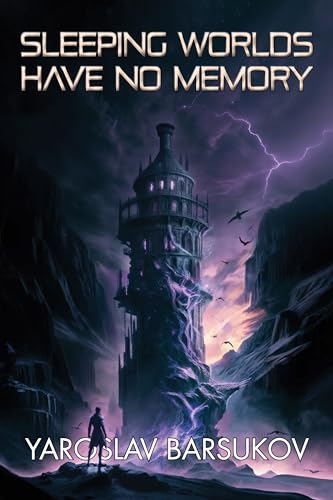
SLEEPING WORLDS HAVE NO MEMORY
YAROSLAV BARSUKOV
CAEZIK SF & Fantasy (non-affiliate Amazon link)
$4.99 Kindle edition, available tomorrow
Rating: 4.75* of five
FINALIST for the 2024 Nebula Award! Winner announced at the 2025 Nebula Conference, 5 through 8 June 2025.
The Publisher Says: When lies become truths and two kingdoms head to a bloody war, a man is exiled for his conscience
Refusing the queen’s order to gas a crowd of protesters, Minister Shea Ashcroft is banished to the border to oversee construction of the biggest defensive tower in history. However, the use of advanced technology taken from refugees makes the tower volatile and dangerous, becoming a threat to local interests. Shea has no choice but to fight the local hierarchy to ensure the construction succeeds—and to reclaim his own life.
Surviving an assassination attempt, Shea confronts his inner demons, encounters an ancient legend, and discovers a portal to a dead world—all the while struggling to stay true to his own principles and maintain his sanity. Fighting memories and hallucinations, he starts to question everything...
Sleeping Worlds Have No Memory is a thought-provoking meditation on the fragility of the human condition, our beliefs, the manipulation of propaganda for political gains, and our ability to distinguish the real from the unreal and willingness to accept convenient “truths.” The novel is a compelling exploration of memory, its fragile nature, and its profound impact on our perception of identity, relationships, and facts themselves.
A unique blend of science fiction, fantasy and noir, with zeitgeist and prophetic qualities (the original novella anticipated the Russo-Ukrainian War), this is a must for fans of China Miéville’s Bas-Lag series, Ted Chiang’s Tower of Babylon, and Robert Silverberg’s Tower of Glass.
I RECEIVED A DRC FROM THE PUBLISHER VIA NETGALLEY. THANK YOU.
My Review: We can use some entertainment. We can use a bit of moral instruction, it seems. Author Barsukov said these things to himself, at least in my reconstruction of the thought process that led to this book, and decided that he'd make a world and a man to resist its slide into darkness.
I found this book very inspiring. I'm inspired to bring it to y'all's attention because of this piece from The Guardian, "'It will renew your faith in humanity': books to bring comfort in dark times":
A surprising number of readers believe a happy ending should mean automatic disqualification from any serious literary award. Good luck to them: I wish them joy in their wallowing. In my turn, I’ve come to believe the opposite. To reach only for novels that reaffirm our darkest fears is merely to make an escape of a different sort, not the escapism of brooding heroes and wedding finales, but the security blanket of an equally foregone conclusion: the safety of imagining the worst. I would argue that to live only in that place is simply cowardice in better camouflage. The truth is that it’s far riskier to remain in uncertainty. Far braver, far more radical to keep hoping.The truth of this is in Shea's dogged determination to do what's Right; it's in his determination's effect on engineer Brielle, whose expertise is central in what their shared need to do what's Right creates.
There's a lot of the epic fantasy ethos in this urban-fantasy story, sans the usual military glorification; but there is a very welcome leavening of SF in the story that prevents me from the usual somnolent, glazed-eyed scanning to get to the ending. I was alert and involved as Brielle's skills were deployed to create the tower that Shea's tasked with defending, to little avail:
The tower took the length of the world—only it was an alien world, replicating itself over and over as it climbed to a distant, ghostly gap into the clouds. Or did he stare down a well? Shea's head spun again as up and down flip-flopped like axes on a gyroscope.Does this dimensionally daft structure need defending? Does this technology need help, or resistance to its implications? Can anyone, still less a proven-murderous tyrant, be trusted with a tool/weapon of this magnitude? Are the Others, the aliens, to be trusted, or are they there to treat Shea and his people as the Others...with the usual result?
Ethical questions, existential ones, that resonate clearly with our post-November 6th world. They aren't easy, or easily solved ones; Author Barsukov doesn't pretend his ending is a solution to them all. There aren't any escape routes from the consequences of greed and lust for power provided. There are stern meditations on what we try to use, though:
What makes guilt so grotesque is the fact that it adorns itself with whatever remains of our righteousness.
And so the sadness of life as a moral actor, as a being with agency and puissance outreaching the lessons of their past, is revealed and refined. The story, an expansion of his 2021 novella Tower of Mud and Straw, reminded me more and more of THE DEEP SEA DIVER'S SYNDROME (qv) which French translation also delves into the intersection between dreamlike states and meatspace with equal care. Does anyone really know what the Tower is/can do? Do their...reveries, memories, dreamlike experiences...come without cost yet replete with warning signs?
An ending that addresses these queries of reality yet doesn't wrap them in a tight, constricting little bow gave me both inspiration and information to examine this moment in which I am deeply unhappy, afraid, and emotionally bereft, with a dose of hope. There is a reason Author Barsukov chose this particular stream-of-consciousness style, and this superposed urban-fantasy/SF genre mashup, to tell you this story. Intrinsic to the story, the way everything meshes...and the things that don't...are all made to present a frame for a very intensely resonant meditation.
There is not a lot more valuable for a story to give as its gift than that.

