Showing posts with label philosophical musing. Show all posts

Monday, August 24, 2026

GHOST CITIES: A Novel, the trade of creating illusions at apotheosis


GHOST CITIES: A Novel
SIANG LU

Summit Books (non-affiliate Bookshop.org link)
$14.99 ebook, available now

Rating: 4* of five

The Publisher Says: From an award-winning international rising star, a dazzlingly inventive novel, spanning ancient and modern China, that interweaves stories of romance and showbiz

Inspired by the vacant, uninhabited megacities of China, Ghost Cities follows multiple narratives, including one in which a young man named Xiang is fired from his job as a translator at Sydney's Chinese Consulate after it is discovered he doesn't speak a word of Chinese and has been relying entirely on Google Translate for his work. The incident goes viral under the hashtag #BadChinese and attracts the attention of the eccentric film director Baby Bao, who uses Lu to attract press for his latest film. Bao’s movie, based on ancient legends, is to be filmed in one of China’s “ghost cities”.

How is his relocation to a ghost city connected to a parallel odyssey in which an ancient Emperor creates a thousand doubles of Himself? Or where a horny mountain gains sentience? Where a chess-playing automaton hides a deadly secret? Or a tale in which every book in the known Empire is destroyed—then recreated, page by page and book by book—all in the name of love and art?

I RECEIVED A DRC FROM THE PUBLISHER VIA NETGALLEY. THANK YOU.

My Review
: Xiang Lu...notice the author's first name's first letter is the sole difference in these names...is a man with excellent luck. Blagging his way into a job at the Sydney, Australia, consulate of China based on ethnicity and the ubiquity of Google Translate; getting fired when his incompetence at Chinese-language skills is exposed and then pilloried on social media; thereupon being discovered by a Chinese equivalent to Roger Corman, and getting hired to do the publicity on the guy's new film...no way could that be an unfolding, subtle plan on Xiang Lu's part, too much could go too wrong.

After joining Director "Baby Bao" in Port Man Tou, one of the infamous ghost cities of the title, Xiang Lu and Bao join a cast of thousands, and the spirits of Emperor Lu Huang Du and his willed-into-being alters across the multiverse. (Say the "Chinese" names aloud, more than once and with an approximate Aussie accent. It's a hoot.) The Wikipedia articles I've linked to offer some background will also afford a flattering angle of light on this slightly-too-long story, and should be read as they appear for best results. This story is subtle, is layered with jeux d'esprit, and that's the problem. Humor, satire oh dear oh my, is tough to convince people to read. Tristram Shandy and Candide aren't read as often as they're bought; and this skewering of the overweening egos that, in fact, summon their creators' visions into a weird kind of being is not at that celestial level.

Siang Lu is the 2025 Miles Franklin Award–winning author of this odd confection of past and present, reality as we know it and the self-aggrandizing reality-dismissing fantasies of two powerful creators of images. The Miles Franklin Award resembles the US Pulitzer Prize in that it is "...an annual literary prize awarded to 'a novel which is of the highest literary merit and presents Australian life in any of its phases'." So we know the author is either born or based in Australia; the utter absence of any indication of a translator on this or his first novel, The Whitewash (no US publisher, but available on Ammy's Kindle via the Aussie publisher University of Queensland Press), and the fact he "holds a Master of Letters from the University of Sydney" all rather makes me think he either writes novels directly in English or her self-translates his work. Author Lu also "...has written for television on Malaysia's Astro network. In 2021, {he} won the Glendower Award for an Emerging Queensland Writer for The Whitewash. He is based in Brisbane, Australia, and Kuala Lumpur, Malaysia," (all from his Goodreads bio) so I'm betting he's pretty thoroughly polygot; there's no way in hell this read was made using Google Translate! So the opposite of Xiang Lu he writes in this novel, in other words.

As a story it was fun to read the ever-increasing parallel delusions of Baby Bao and Lu Huang Du, and those delusions' assuming a mirror corporeality and a deeply unsettling unity of purpose. It says so much about the visionaries of the world who dream big and act small and petty. Xiang and Baby Bao's assistant/translator/enabler Yuan (I believe this is a word for cash, get it?) are endlessly discussing how eerie it is that all Portmanteau...I mean Port Man Tou, of course I do!...are so indistinguishable, in their empty expensiveness, chewing over how it takes a powerful mind to snatch low-hanging fruit before others seize it...well, it's all very undergrad-philosophy, very obvious and ye I am absolutely certain that it will zoom over most heads like the starship Enterprise.

Maybe I'm just letting my inner old snob run the show. It made me snerk and chortle and even nod along once in a while. It's a good story, and a fine read. I'm not rating it a full five because I suspect most target readers will feel lost at key moments.
"You know," she {Yuan} says, looking out the window, "I have always had this silly thought that maybe, somehow, every city is the same. So when you go from one place to another, it's simply an illusion of flight. The take-off and landing is a simulation. In reality, you've never left the ground, or maybe you have, but are simply flying around in circles for hours, waiting for the new city to 'load.'"
Either too obvious or too weird or too simplistic, but too-too is likely to be a common response. I'm glad Author Siang made the story and that Simon & Schuster's international-lit imprint brought it out here in the US because it's the kind of story that skewers the pretensions and pretentiousness of people badly in need of it.

I'm so glad this story's coming out now, before the US version of #Jólabókaflóð that we prosaically call "fall new book releases" but are really the Yuletide rush. It could get buried now, of course, but I hope some few of y'all will see the appeal and feel the need to chortle along with Siang Lu and me.

Monday, July 27, 2026

BEGINNING MIDDLE END, Luiselli speaks infrequently but always eloquently and elegantly


BEGINNING MIDDLE END
VALERIA LUISELLI

Alfred A. Knopf (non-affiliate Bookshop.org link)
$14.99 ebook, available now

On the 2026 Longlist for the National Book Award for Fiction.

Rating: 5* of five

The Publisher Says: From the beloved, award-winning author of the modern classics Lost Children Archive and Tell Me How It Ends comes her most powerful and page-turning novel yet: the tale of a mother and a daughter starting over, searching for a new story.

This story begins when a mother and her daughter take off on a trip. It is a summer of rapidly changing winds, volcanic rumbles, and sudden tempests. They’ve landed in Sicily, near the ancient ruins where the mother’s grandmother worked long ago on an archaeological dig. The narrator’s marriage has collapsed, her mother is losing her memory, and her daughter is on the threshold of adolescence, starting to ask difficult questions and form complex memories. How do you begin again? the narrator wonders, pondering her family line. How do you begin again if you got the beginning wrong?

While the mother tries to figure out how to reconstruct their lives as a duo—cooking meals side by side, reading out loud to each other, playing chess, bickering and making up—her daughter takes the reins of the story, and their journey soon becomes a quest for origins, not just to the familial past across continents, languages, and generations, but also farther back, to a mythical and even geological past.

Beginning Middle End evolves into a road novel of exquisite tenderness, spanning four generations of women. In their travels through Sicily, mother and daughter cross paths with the island’s migrants, storekeepers, and elders, and also its volcanoes, its winds, and its waters. Weaving myths, ancient philosophy, and natural history with fleeting moments of contemporary life, the unforgettable characters in this novel take us on a journey across time, and confront some of life’s primary questions: How do stories shape our children’s memories and imagination? How do we situate ourselves deeply in the world while accepting our transience in it? How are a family’s memories made and what happens when they disappear?

Warm, funny, and poetic, this novel is an ode to imagination and possibility in dark times.

I RECEIVED A DRC FROM THE PUBLISHER VIA NETGALLEY. THANK YOU.

My Review
: How do you begin again if you got the beginning wrong?

As a mission statement you don't get a lot clearer than that one, the simple reflection on how hard it is to create a story afresh. The women in this story are unnamed, because naming is a deterministic act, a story's half over when you're named because identity isn't fluid after that. A label like mother or daughter is subject to refinement...whose mother? daughter of whom?...but a name stops the question, collapses the possibility in the narrative by making in the identity "mother" or "daughter" concrete to that one person.

Sicily's ancient land is littered with bits and fragments of many identities that seemed immovable in other times. Ruins of homes, temples, fields, volcanoes, none in their original condition and most only tentatively identified and that with modern superimposed names that we use in place of older names from other stories that built, were built from, other identities. What better place to tell the story of telling the story of building anew identities that were never anything except conditional.

Volcanic violent emotions are everywhere in this story of re/invention. The women are scraped raw and still bleeding without bandages or protection for their wounds as the mother's book tour takes them to this ancient place of ancestral memory for them both. With them is a piece of Classical foreknowledge...a head of Proteus...that belongs in this restless shaky earth because he came from here. And how fitting: coming home in the hands of people reduced to relationship, deprived of the story they shared by loss, amputation, severing of a former castmate; here Proteus and continue a fragment of the story this fragment of a created piece of an idea of his physical form, this godly figment of millions of minds back on eruptive, earthquakey home soil (not even the sea he was an assistant god of in those fevered imaginings). It is the story of this story in a hand-holdable bit of broken-off antique knick-knack.

Mother and daughter move through this not-really native ancestral world, mother doing the mother thing by wondering if her daughter is really going to be the woman she sees coming into focus. Is the Proteus a stolen fragment of patrimony, or a piece of the homeland carted to a frightening new world by a feisty, scared girl shifted by her needs into a simulacrum of male freedom? Does this mean there is a hard-edged channel for the fast-flooding rage of the world in her daughter, or is the idea of belonging uniquely to a time and a place moving her feelings into Earthly action on Proteus' behalf?

Stories have no beginning middle end. We impose those ideas on the world. Time...that thing we are slaves to, are shackled on the side of being dragged along always trying not to be crushed under the wheels of the misunderstood, mischaracterized "juggernaut"...has no inherent direction, the equations don't define beginning middle end. It isn't the gods, then, that created time. That was us.

So here are two women out of place and out of their time, defining new beginnings middles ends with Author Luiselli sweeping the temple steps for their ascent. It is masterful work. It deserves to define your time as beginning middle end.

Monday, March 10, 2025

LESSER RUINS, shortlisted for the 2025 Republic of Consciousness Prize—United States & Canada—for Small Presses


LESSER RUINS
MARK HABER

Coffee House Press (non-affiliate Amazon link)
$9.99 ebook editions, available now

Rating: 3 very grouchy stars of five

Shortlisted for the 2025 Republic of Consciousness Prize—United States & Canada—for Small Presses Winner announced 12 March 2025

The Publisher Says: From the author of Reinhardt's Garden and Saint Sebastian's Abyss comes a breathless new novel of delirious obsession.

Bereft after the death of his ailing wife, a retired professor has resumed his life's work—a book that will stand as a towering cathedral to Michel de Montaigne, reframing the inventor of the essay for the modern age. The challenge is the litany of intrusions that bar his way—from memories of his past to the nattering of smartphones to his son's relentless desire to make an electronic dance album.

As he sifts through the contents of his desk, his thoughts pulsing and receding in a haze of caffeine, ghosts and grievances spill out across the page. From the community college where he toiled in vain to an artists' colony in the Berkshires, from the endless pleasures of coffee to the finer points of Holocaust art, the professor's memories churn with sculptors, poets, painters, and inventors, all obsessed with escaping both mediocrity and themselves.

Laced with humor as acrid as it is absurd, Lesser Ruins is a spiraling meditation on ambition, grief, and humanity's ecstatic, agonizing search for meaning through art.

I RECEIVED A DRC FROM THE PUBLISHER VIA EDELWEISS+. THANK YOU.

My Review
: I connected with this sad-sack whiner in his grief for his dead wife, and his beautifully evoked love for coffee.

Apart from that, I loathed him and wanted him to shut his moan-hole.

I live (involuntarily and with poor grace) in proximity to a grievance-led, dementia-addled, old drunk. This is like reading the smart version of him venting his legit sadness and tiresome regrets in the key of "they done me wrong" on endless repeat.

I think this book is better than I perceive it to be, due to my own life's issues and difficulties. It has to be, to have elicited from me the degree of irritated disgust with its protagonist that it did. Had it been simply a poor job of writing or storytelling, I'd simply have Pearl-Ruled it and moved on with my day.

Read the free sample that Kindle offers you, you'll know right away if this resonates with you, and if the resonance is on a frequency you enjoy reverberating to. I very much did not like this read. The reasons I've given suggest to me that others without my life circumstances will feel otherwise.

My rating being an expression of my personal pleasure in the read explains its paltriness. You will most likely, or so I hope, disagree with me.

Thursday, February 6, 2025

IMMATERIAL (Undelivered Lectures series), offering a different take on what there is to lose


IMMATERIAL (Undelivered Lectures series)
LAUREN MARKHAM

Transit Books (non-affiliate Amazon link)
$16.99 ebook edition, available now

Rating: 4.5* of five

The Publisher Says: A speculative essay on language in the face of climate catastrophe: how we memorialize what has been lost and what soon will be, pushing public imagination into generative realms.

“I am in need of a word,” writes Lauren Markham in an email to the Bureau of Linguistical Reality, an organization that coins neologisms. She describes her desire to memorialize something that is in the process of being lost—a landscape, a species, birdsong. How do we mourn the abstracted casualties of what’s to come?

In a dazzling synthesis of reporting, memoir, and essay, Markham reflects on the design and function of memorials, from the traditional to the speculative—the Vietnam Memorial in Washington, DC, a converted prison in Ljubljana, a “ghost forest” of dead cedar trees in a Manhattan park—in an attempt to reckon with the grief of climate catastrophe. Can memorials look toward the future as they do to the past? How can we create “a psychic space for feeling” while spurring action and agitating for change?

I RECEIVED A DRC FROM THE PUBLISHER VIA EDELWEISS+. THANK YOU.

My Review
: The issue many of us have been braying about for a generation now has burst upon us unmissably. The climate has changed. The results are blatantly obvious and the profiteers, mainly insurance companies and oil companies at the moment, are raking in the money out of your pockets.

The other costs, the ones not as tangible as lost spending power, are still to be named, and still to be felt. Until we can name something, like "spending power," it's nebulous to us as linear-time-trapped people. What name can we give to sights we will never see again? To descendants who can never be born, or can't be kept alive? To lives unlivable, to thoughts unthinkable, because there was/is no one trained, taught, allowed to think them?

Author Markham does the heavy lifting of identifying this dawning reality for us. She asks us to make room in our heads and hearts for an unbearable, unthinkably terrible, loss we're not making room for. It takes a person to speak a truth for it to be recognized. This truth, still nameless, is spoken, and it's now in our collective court to put a stop to our losses before they mount up in reality.

There is something like a haunting, a poltergeist infestation, in the idea of absences as losses. The absence of children unborn, of life...not unlived, nor even unlivable, simply "un"...impossible to experience this void of Reality unless one's alerted to it. Author Markham's essay, tight and compact of duration, carries resonances forward into time for her readers, makes patterns of thought that, now they exist, are indelible. An example of how the "un" is real....

Time's weird at the simplest level...what is it? explain it and how you know what it is, I'll wait...but when bent like this, when folded into a curve that feels untraversable, it begins to feel physical to me. I can respond to time in a new way, not a fun way but a new one, thanks to Author Markham. Immaterial is an ironic title for something that, through its power of observation alone, caused me to concpetualize time as a physical, separate entity from my world. Its positing of conditional loss, of non-existence as a loss, is a powerful insight I'd never have come up with on my own.

I won't get all the way to a fifth star because I felt at times a punch being pulled, an implication she knew was too much being avoided. The rigorous honesty of the piece was incomplete, partial; but I'd be extremely hard pressed to do half so well as Author Markham's done. Don't allow my weird frisson to dissuade you from wrapping your head around her arguments.

Thursday, September 12, 2024

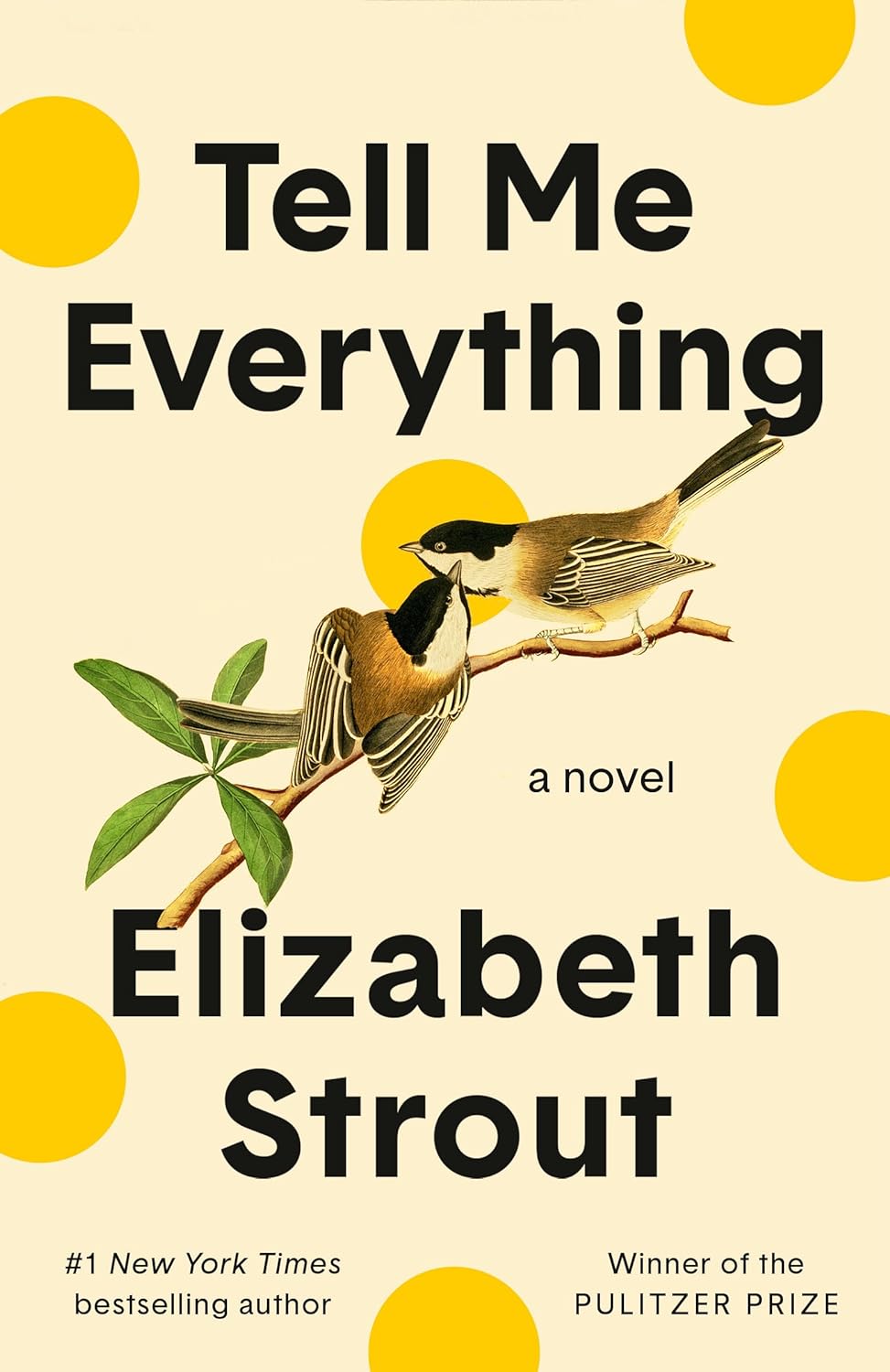
TELL ME EVERYTHING, the familiar salutation in Italian marking you out as special to the speaker


TELL ME EVERYTHING
ELIZABETH STROUT

Random House (non-affiliate Bookshop.org link)
$16.99 trade paper, $14.99 ebook, available now

Rating: 3.75* of five

The Publisher Says: From Pulitzer Prize–winning author Elizabeth Strout comes a hopeful, healing novel about new friendships, old loves, and the very human desire to leave a mark on the world.

With her “extraordinary capacity for radical empathy” (The Boston Globe), remarkable insight into the human condition, and silences that contain multitudes, Elizabeth Strout returns to the town of Crosby, Maine, and to her beloved cast of characters—Lucy Barton, Olive Kitteridge, Bob Burgess, and more—as they deal with a shocking crime in their midst, fall in love and yet choose to be apart, and grapple with the question, as Lucy Barton puts it, “What does anyone’s life mean?”

It’s autumn in Maine, and the town lawyer Bob Burgess has become enmeshed in an unfolding murder investigation, defending a lonely, isolated man accused of killing his mother. He has also fallen into a deep and abiding friendship with the acclaimed writer Lucy Barton, who lives down the road in a house by the sea with her ex-husband, William. Together, Lucy and Bob go on walks and talk about their lives, their fears and regrets, and what might have been. Lucy, meanwhile, is finally introduced to the iconic Olive Kitteridge, now living in a retirement community on the edge of town. They spend afternoons together in Olive’s apartment, telling each other stories. Stories about people they have known—“unrecorded lives,” Olive calls them—reanimating them, and, in the process, imbuing their lives with meaning.

Brimming with empathy and pathos, Tell Me Everything is Elizabeth Strout operating at the height of her powers, illuminating the ways in which our relationships keep us afloat. As Lucy says, “Love comes in so many different forms, but it is always love.”

I RECEIVED A DRC FROM THE PUBLISHER VIA NETGALLEY. THANK YOU.

My Review
: Well, here we are...next in a series of books about people I care less about than I probably am safe admitting to publicly. Lucy Barton's fans are legion, and they looove her for being her mildly chaotic self. I mean, they've stuck by her despite her ongoing friendship with her truly toxic, lightly pathetic first husband! That would get a flesh-and-blood woman canceled fast.

I myownself admire her for it. Own your mistakes, forgive your abusers, move forward standing on the past and pushing into the future on those rocks.

This outing has Author Strout doing something bold: Lucy meets her *other* famous older-woman character, Olive Kitteridge! The glue is a story about a murder...you can read the synopsis above, I feel no need to yak on about it...and, surprisingly, sparks do not fly. They clash, of course, Olive is after all a nasty bully who I myownself disliked the second I met her, but no snarktastic duels of wits ensue. Pity, that, but in keeping with the world Author Strout's created.

Amgash/Crosby is another fictional universe where characters have multiple chances to shine. This time it's mostly about Lucy's platonic bestie, Bob Burgess. They are each other's confidante, talking over things they don't have anyone else to confide in. His troubles, his life's burdens, are the topic he least discusses as he busily solves others' problems, much like Lucy herself.

I am generally very receptive to this sort of intertwined storytelling technique. I've read, and love, EF Benson's Mapp and Lucia books, the massive Barsetshire series shared by Trollope and Thirkell, and some of Miss Read's Fairacre series. These all have the virtue of following a group of characters more or less closely, with individual books having one or another focused on, albeit not usually exclusively. So that's how I keep coming back to this wellhead. I'm ready to involve myself in the lives of strangers when they all know each other, more or less well.

I don't think the Amgash series makes the grade as a successor to those series, at least in my own affections, because I myownself find the dithering that Lucy does, and the bullying that Olive does, incompatible with a lovely immersive read. Entirely a personal assessment, and not in the least meant to discourage anyone from pursuing these reads; just, well, be aware that Lucy's insightful comments and Olive's shrewd observations come wrapped in definite personalities. Since they're not really the ones I find most congenial, I'm not going to warble my fool lungs out singing their praises.

I will say that, in this book's case, I think you're best off reading it after having read Olive Kitteridge and My Name is Lucy Barton first. They're not strictly speaking necessary to have done so but, well, the way this storyverse goes, it helps to know the ladies you're relying on for context before going in.

If those are under your belt, dive in. I'm such an outlier when it comes to these characters. They irk and annoy me. They also come with such a well-conceived storyverse, one that soothes the need to make fictional friends, one that is part of a web of interrelated characters you don't know yet...much like life is. That more than any other quality is why I read the books. It feels prosocial.

Enjoy! I did.

Saturday, December 16, 2023

BIOGRAPHY OF A FLY, lovely gift item for someone who loves Art & Nature both, either...


BIOGRAPHY OF A FLY
JAAP ROBBEN
(tr. David Doherty) Art by Paul Faassen
World Editions
$16.99 hardcover, available now

Rating: 4.5* of five

The Publisher Says: For readers of The Boy, the Mole, the Fox and the Horse comes a beautifully illustrated philosophical book on the value of friendship and life, told from the perspective of a fly, and a gift book for all ages.

What if you were thrown into existence in the middle of your life, with numbered days left ahead of you? Would you see the world in the same way?

In his inimitable style, Jaap Robben answers these questions through the unexpectedly witty lens of a fly, from the moment it enters the world as a larva right up to its deathbed. Watch this humble fly throw himself into life and his unlikely friendships with gusto, however short that life may be. Irresistibly charming, funny, and sprinkled with entomological details, this is a moving tale for any stage of life, about how we are all ultimately alone, and yet also together.

I RECEIVED A DRC FROM THE PUBLISHER VIA EDELWEISS+. THANK YOU.

My Review
: Beautiful, weird little meditation on Nature, and the nature of Life. A fly’s life, from larva to deathbed, told in direct and (as far as I could tell without doing more research than seemed warranted) accurate manner.
That life being short, it’s good to follow it chronologically and to deal with the Stuff of Life (warning to the squeamish...lots of honest talk about shit) in a way that will inform the reader of, say, eight and up about more than just the biology involved in living.

I don’t find bodily functions as unpleasant to discuss as many seem to. The fact is, we all shit or we are dead. Eating, sleeping, shitting, sweating...take the stigma out of bodily functions for kids, I beg of you. It does no good at all to teach a child to feel disgust for their body.

A book like this is a very easy way to start that goal off. Enjoyable on many levels, for many ages...most art fans will like the minimalist color palette and the gloriously weird framing of the images, and thoughtful readers will enjoy the philosophizing.
What kind of squeamish speciesist could resist this face?

Saturday, December 31, 2022

THE STRANGEST, or "Meursault for the Modern Cyberworld"...outstanding!


THE STRANGEST
MICHAEL J. SEIDLINGER

O/R Books
$17.00 trade paper, available now

Rating: 4.5* of five

The Publisher Says: Michael Seidlinger has dared tackle one of the literary classics of the 20th century literature and reimagined it for the 21st: and in Albert Camus’ anti-hero Meursault, at once apathetic and violent, unable to connect with his fellow humans, Seidlinger exhumes a perfect metaphor for the Internet Generation. Zachary Weinham, anchorless in terms of morals and committed to nothing except commenting on comments and their comments etc., finds himself involved in the sinister machinations of Rios, someone he meets in a bar, and allows himself to be set up—whether out of apathy or a desire for self-destruction it’s hard to tell. A murder ensues. Shunned by his friends and associates, not sure of what he has gotten into, Zachary heads for confrontation with society—and his own moral values.

I RECEIVED A DRC FROM THE PUBLISHER VIA EDELWEISS+. THANK YOU.

My Review
: Routine blog readers will recall Michael Seidlinger's name. The Fun We've Had was 2014's 6-stars-of-five read; Mother of a Machine Gun, a novella deconstructing Identity and Motherhood from a son's perspective; Falter Kingdom, Anybody Home?, all of them four star-plus reads for me. This book's appeal to me wasn't as immediate or as visceral as the other reads were. I'm somewhat trapped in Meursault's Otherness via Camus. Exploring his identity further didn't necessarily strike me as urgent, and there's nothing Michael Seidlinger creates that stops short of Urgency.

I've said of him before:
Every writer needs a trope. Seidlinger's is musical brevity. He'd be called a poet if he made less sense.
–and–
Seidlinger is what a mating between Djuna Barnes and Samuel Beckett would've produced: Illusionless in his pessimism, joyful in his schadenfreude, and both human and humane enough to wrap his bitter pills in pretty words.

I stand by those words, I believe them to be fair in their assessment of his talent and his presentation of it. So this book? It came out almost a decade ago and...I wasn't a fan, exactly, because...well...Meursault.

In my never-ending quest to tie up loose ends, since I can't tie Michael up but *can* finish reviewing the DRCs of his work that I have, I thought a real review of this book to end 2022 would feel condign.

When taking on classics, there are two ways to approach them from a positive energy field: Hommage or retelling. Leave it to a poet to say, "naaah," and enter into a dialogue with the piece. The Stranger, subject of Camus's astonishing and ever-fresh novella of Meursault's crime and punishment, is now about Zachary, The Strangest...the man, like Guy is to Bruno from Strangers on a Train, whose blankness is observing the surfaces of a mediated landscape with no concrete referents. Only what is outside The Strangest is real. This, of course, means he has no reality because his internal world is only the external world reflected on the shiny, frictionless surfaces of his many mirrors. Like a human Hubble Space Telescope, he has only the visible light of distant, unreachable reality to furnish meaning and encourage existence.

What makes that so dangerous is visible in the social-media obsessed, whipped to a froth "activism" and "radicalization" of many, many empty shells with AR-15s. Nothing outside can give a person a core, as Camus made plain in Meursault's completely avoidable descent into murder. And here, though it's framed by a modern concern unknown to the Camus of 1944, we're going down the same rabbit-hole. No core? Barely a shell! Constantly obsessed with fitting in, The Strangest isn't ever going to achieve that.

"For a line to exist, it would first have to be crossed."

You can't fit if you have no shape.

And that is the thing, in 2015, Michael Seidlinger saw and said that, to my slight embarrassment, I did not pay enough attention to. The way that Meursault would go along the hot and sandy beach in Algeria to get along was fundamentally different from The Strangest's endlessly, heatlessly reflective but never reflexive attempts to build Reality from the weak material of light. There is no real reason not to murder someone, a lot of someones in fact, if there is no texture or heft to the world for you. It's light, from a screen or from a geometric solid, it's only light and therefore has only the meaning your analysis gives it.

If light and its shadows are all you possess, there is no reason to obsess over life and fate and pain and grief. Death is only the light going out, only the local light covered or extinguished. Light still exists. Shadows and darkness aren't real.

Maybe one of the most chilling meditations I've read in 2022. I can't call it perfect...it's cold and disconnected, so doesn't make the impact something so impartant should...but I can call it excellent. Highly recommended for serious thinkers about twenty-first century life and society.

Wednesday, August 25, 2021

IF YOU EXIST, probably a better question than answer


IF YOU EXIST: In Search of a Reader Deep in the Future
LILLIAN MOATS

Three Arts Press (non-affiliate Amazon link)
$5.99 Kindle edition, available now

Rating: what? rate this how exactly?

The Publisher Says: If You Exist is a personal message written to one of our human progeny who might find it many generations in the future. The narrator, like others in her generation, faces her own mortality at the same time she faces the possibility of thousands more species, including her own, becoming extinct.

As a private heartfelt message to someone who may never exist, the writer likens her missive to “a note in a bottle set to sea in hopes of reaching you, if you exist in the future on some unfathomable shore.” The narrator shares her personal take on where humanity is now and where we might be heading depending on what choices we will make. She writes about climate change and such topics as human migration, racism, the pandemic, as well as her projected concerns about the possibilities of unbridled technical advancement and human redesign.

After offering her perspective on where hope could lie, the writer ends her note with “the stuff of fairy tales,” her positive fantasy in the final chapter called, “If We Could Meet.”

I RECEIVED A DRC FROM THE PUBLISHER VIA NETGALLEY. THANK YOU.

My Review
: First, read this:
The impulse to hunt takes aim instead, to separate, conquer or eradicate whatever may be defined by some group as less than human. With the future of the planet now so much in doubt, I think it's a rare person who does not, at least unconsciously, align hopes for the survival of this world with either gathering or hunting.
–and–
What it means to be human is quite a different question from "What is human nature?" for which we finally realize there can be no answer except to include what any human culture has done or felt.

For me, the question of what it means to be human is more pressing than ever, though my own answers reside in recollected incidents, not in academic definitions.

Published to coincide with the author's seventy-fifth birthday on Monday, the twenty-third, this compact meditation on what the world is, what our role as humans in the world is, and why that urgently needs to change is the topic of the book. "Has the stranger been gathered in, or hunted down?" is quite probably the clearest statement of purpose any book could have, and it comes exactly on time as the catastrophic exit of US troops from Afghanistan unfolds.
Just as with refugees today, the pattern of slavery has always been that the darker skinned peoples were owned and abused by the lighter skinned. There were notable exceptions, such as ancient Africa where emperors of dark nations owned dark slaves from different tribes. Slavery was never just about color, but about power and wealth. ... Today, prejudice and brutality by many police in the U.S. have outlived legal slavery by more than a hundred and fifty years.

So you're reading this review and wondering what the point of my telling you about this small book written by someone who isn't a Big Name, hasn't written think pieces and hefty reports and the like, is? Because you have a vaccine-resisting climate-change denying (or at the least skeptical) aunt, or mother, or church elder. No one is talking to her. They're talking to Greta Thunberg (who comes in for some quiet praise here) and her mom. They're marshaling innumerable facts about chemistry and computing that say absolutely nothing to that friend, relative, elder.

I think she deserves the respect of someone sitting down and speaking to her, peer-to-peer, reminding her of *why* she made those decades of sacrifices and plans and worked so hard to bring about what she hoped would be a better world. And so did Lillian Moats...here, she's written the book she hoped to read and thus engage with a wider world of people who, like her, haven't been mindfully included in the world they made as it decides its future.

Yuletide is coming. Maybe a birthday before that. Try talking to the people you'd like to mobilize the way they need to hear you.