Showing posts with label climate change. Show all posts

Friday, August 21, 2026

GENERATION REGENERATION, one-stop shop for practical usable solutions to ugly problems


GENERATION REGENERATION
TONY CHO

Greenleaf Book Group Press (non-affiliate Bookshop.org link)
$9.99 ebook, available now

Rating: 4* of five

The Publisher Says: In an era where concrete dominates and nature feels distant, regenerative placemaking is a movement transforming our cities and rekindling our connection to what truly matters. Generation Regeneration shows us how to rebuild balance between people, communities, and the planet.

Drawing from decades of lived experience, impact entrepreneur and visionary real estate developer Tony Cho introduces you to regenerative placemaking—a transformative approach that moves beyond sustainability toward systems that actively heal, uplift, and regenerate. Through this lens, cities become living ecosystems where community, nature, and culture work in harmony to create abundance for all.

This book equips policymakers, developers, cultural builders, and everyday citizens with the tools to reimagine urban life. You'll explore the three pillars of regenerative placemaking and learn how they can cultivate economic vitality, deepen human connection, and foster environments that nourish both people and the planet. Through real stories from pioneers on the front lines, you will discover that a regenerative future isn’t just possible—it’s already emerging.

Generation Regeneration is an invitation to become a co-creator of thriving, life-affirming cities for generations to come. Join the movement to help shape a world where humanity and nature flourish together.

I RECEIVED A DRC FROM THE PUBLISHER VIA NETGALLEY. THANK YOU.

My Review
: A developer writes a book about how development, the process of turning our planet's surface into living spaces and zones of economic productivity, into less ecologically and emotionally harmful, wasteful, unpleasant places to be.

I would never have believed you had you told me this would occur in my lifetime. Here it is.

Greens will snort derisively about human greed and outrageous destructiveness. Boosters will blow cigarette smoke at you as they dismiss everything in it as pie-in-the-sky too expensive and who cares anyway. And neither entrenched camp will have read a word.

Bunkered and siloed in our Rightness we can let compromise solutions like these slide through our fingers to fall into the landfill/sewerage outflow pipe. We need solutions, imperfect ones are all we're ever going to have, so think with me about whose mind we can still reach to get these ideas, these goals in front of. Parks department people. High school students and their science teachers. Recent graduates. At ten bucks a pop, you can likely afford a well-thought-out gift to one of these folks; you have their email addy and an ebook can be sent to them blind or to a young person with a phone app.

You and I, doing our whatever we can, will not ever know whose mind we changed that one little bit to get them to do one small thing. Maybe not even something related to this book's topic; but something. And activists who think of development and developers as hopeless causes (as I used to do) can get lots of really valuable ideas for how to approach them with real, viable thoughts on development instead of destruction.

A book that is easy to read and also cracks the nonsense barrier with commonsensical ideas is a great investment. I encourage all y'all to make it.

Monday, June 15, 2026

THE BEASTS OF THE EAST: The Fall and Rise of America's Eastern Wilderness, positive stories from the frontlines of ecological recovery


THE BEASTS OF THE EAST: The Fall and Rise of America's Eastern Wilderness
ANDREW MOORE

Mariner Books (non-affiliate Bookshop.org link)
$15.99 ebook, available now

Rating: 4.25* of five

The Publisher Says: A celebration of the extraordinary lost natural wonder of the eastern U.S.—once the center of American wildness before its despoliation—and a lively tour through recent efforts to return elk, bison, wolves, and other creatures to their verdant native landscapes.

Before skyscrapers and smokestacks rose across the eastern U.S., elk, bison, wolves, and cougars roamed. Typically imagined as icons of the West, these large mammals are in fact native to what was once a kind of Eden—towering forests in the Northeast, rolling prairies in the Midwest, and cypress swamps in the Deep South. But, in mere decades, industrialization and unregulated hunting brought these emblems of the East to the precipice of extinction; by the 1950s, squirrels were one of the few wild mammals an easterner was likely to encounter.

Now, even as the climate and biodiversity crises loom, eastern wildlife are staging an unlikely comeback. Herds of bison graze on Illinois prairies, red wolves lurk in North Carolina’s coastal marshes, and abandoned coal mines in Kentucky are now home to thousands of elk. Such rewilding promises to restore balance to eastern ecosystems and return one of the most biodiverse regions in the world to its former luster—but not without controversy.

In Beasts in the East, we follow environmental writer and James Beard Award finalist Andrew Moore as he meets conservationists, hunters, biologists, and nature lovers as they confront herculean How can we enable wildlife migration in the midst of suburban sprawl? Are these success stories viable in the long-term? When humans and wildlife come in close contact, how do we define wilderness?

I RECEIVED A DRC FROM THE PUBLISHER VIA NETGALLEY. THANK YOU.

My Review
: As Fathers' Day looms, the eternal conundrum of what to get Dad or father-figure that is nit some wearable or technological frippery he'll forget he owns is pressing. If your Dad's like me, he reads or watches news and frets about you, your kids, or the world going directly to hell in his lifetime.

He/we ain't all the way wrong.

BUT! There is hope to be found. It's true we've screwed up the planet pretty hard and done too little to fix it. Some people have done more than most to ameliorate some of the worst, stupidest damage our (well my anyway) generation, the Boomers, have done. Their successes are underdiscussed generally, and likely do not reach far enough into awareness to combat the gloom that's so paralyzing.

Author Moore, whose delightful book Pawpaw: In Search of America’s Forgotten Fruit was nominated for a James Beard Foundation Award in 2016, writes capably and informatively about the successes and the failures of the US scientific and govermental bodies charged with mitigating disasters their predecessors either caused or failed to prevent. It's a chonky boi, weighing in at almost 450 pages, but that's how much room is needed to really do justice to the good and the bad news.

I don't know about the men in your gifting circle but I don't trust the happy-clappy "this is fine" dawgs who tell us good things and chirp relentlessly cheery stuff from their high perches. I guess they see different landscapes from up there, whereas I see and smell sewage while they're making noise meant to distract me. I trust Author Moore's presentation of the significant environmental gains all over the highly urbanized Eastern US *because* the failures aren't ignored or hurried past; they're not lingered over, either, which is the other untrustworthy pole: sticking into gloom and doom.

There are copious notes, sources that held up everywhere I stress-tested them, and a tone of honest and truthful pleasure in the impressive successes won. The battles going well, eg red wolves rewilded in North Carolina, truly heartened me. I was astonished to learn there were populations of bison as far East as Pennsylvania! Imagine looking out of your sod hut in Pittsburgh and seeing a six-foot tall bison wandering the streets! Less surprising was the story of the reclaimed tall-grass prairies of Illinois that now sustain smallish herds of bison, but keep expanding.

The many people Author Moore consulted in preparing the book all come across as guardedly optimistic...I've mentioned the absence of chirpiness...which, given their various fields of knowledge and work, makes me believe we're not Doomed!...Doooomed!...just yet.

Given how little celebratory noise I hear daily and how assiduously I seek it out, I think a book like this is a good gift idea for Dad, Uncle, father-figure who also gets tired of treading sewage not water, and still can't believe or trust the sunshine enema people to be fully truthful. It's evidently expertise-laden author does an admirable tightrope walk with his tone of delivery. Including so many sources is helpful too.

It's good to offer a counter-narrative to doom and gloom that's grounded in facts and data. A very good gift for anxious science nerds of every gender.

Wednesday, March 25, 2026

SINGING BONES: An Epic Saga of Loss and Survival in an Ancient Neolithic World, Téuta's World series #2


SINGING BONES: An Epic Saga of Loss and Survival in an Ancient Neolithic World
S.G. ULLMAN
Stuart Ullman (non-affiliate Amazon link)
$5.99 ebook, available now

Rating: 4* of five

The Publisher Says: Nearly 8,300 years ago, a sudden climate collapse reshaped the earth. Winters grew longer and colder, harvests failed, coastlines flooded, and the ground itself became unstable. For the Téuta, a settled Neolithic village that had endured for generations, survival became uncertain.

Eini is born with troubling visions of disaster—warnings her people dismiss as superstition. As the climate worsens and violence spreads among desperate neighbors, Eini spends her lifetime trying to protect her family and preserve the fragile traditions that hold her community together. When catastrophe finally strikes, the Téuta must face the unthinkable: abandoning their ancestral home and redefining who they are in a transformed world.

Told across generations, Singing Bones follows the lives of women whose strength, memory, and resilience shape the fate of their people—from prophecy, to survival, to leadership forged in loss. Song, story, and shared history become tools of endurance in a world where nothing can be taken for granted.

Grounded in real archaeological and climate research, Singing Bones is ancient historical fiction set during the Neolithic era. Its spiritual elements arise from a prehistoric worldview in which nature, belief, and survival are inseparable. Sweeping yet intimate, it explores how early civilizations responded to climate catastrophe, displacement, and change.

Perfect for readers of immersive historical fiction, ancient civilizations, prehistoric survival stories, and epic sagas rooted in humanity’s deep past.

I RECEIVED A DRC FROM THE PUBLISHER VIA NETGALLEY. THANK YOU.

My Review
: Three years ago, I gave Author Ullman's The Téuta's Child four stars. It's a deeply human story of dealing with the hand that's dealt to you, one that patiently invites you to be in a human world long vanished and still, because humans are truly never going to change in basic needs, familiar within its fascinating surface differences.

One basic reality of human life is loss, losing love, losing comfortable certainty; the other angle of view on this is change, that difficult-to-endure condition of uncertainty and adjustment and learning. The world our characters inhabit is changing with relentless momentum. It was a time in human history wherein the very earth beneath people's feet was vanishing, prey animals were simply vanishing, the whole basis of life was unsettled, no longer trustworthy and familiar. The last days of vanished Doggerland brought to vivid life through the story of a woman and her descendants is poignant and very emotionally involving.

I was a little confused about how Eini's visions could be dismissed in a time of supernatural reality being the only way to understand the world. It's necessary, of course, for there to be a story...the hero faces the obstacle of disbelief in order to make the reader invest in their rightness...but rwally, simply being required to question how that could happen made me reflect on how, eg, climate scientists must experience their world. I bear down hard on the concept of "vanishing" because its connotation of helplessness, of cruel inevitability and enforced absence. It is inherent in the idea of seeing the world around you change into something you've never seen before, have no idea how to deal with, can't even imagine what to change in yourself to cause positive adjustment.

There's a lot to be said for that kind of rattling uncertainty to make a story work. This story made me sit still and absorb the fear, the panic, the resolve summoned from one's depths, as these brave human beings took their lives in their hands and...angrily, fearfully...made the changes they needed to in order to survive.

I hope very much we will get more stories in this dynamic world.

Monday, November 17, 2025

HYBRED: A Graphic Novel, meditating on how bad the world will get set to *gorgeous* artwork


HYBRED: A Graphic Novel
JAMIE MUSTARD
(illus. Francesca Filomena)
Street Noise Books (non-affiliate Bookshop.org link)
$20.99 paperback, available now

Rating: 5* of five

The Publisher Says: Set in a future-adjacent, alternative Los Angeles, this is a story of staggering poverty, drugs, and violence and of an artistic child who finds beauty in the ugly and sublime hope in our conflicts.

HYBRED shows us how in our most marginalized communities lies an astonishing amount of genius which goes unnoticed and is so often tragically wasted.

Nine-year-old Johnny James lives in The Casque, the poorest neighborhood in Greater Angeles, where he shares a one-room apartment with his mother, stepfather, two brothers, and an army of cockroaches. He spends his days in the sweltering heat of the neighborhood, at the movie theaters, playing tackleball, or drawing—but there’s no money for him to go to school.

As death, addiction, and violence swirl through the neighborhood, Johnny grows up with friends, adventures, and magic around him. And he discovers how to use art, beauty, and personal strength to transcend the forces destined to hold him back.

I RECEIVED A DRC FROM THE PUBLISHER VIA EDELWEISS+. THANK YOU.

My Review
: This graphic story is a heightened, fictionalized alternate-history version of Author Mustard's real-life memoir Child X, recently published by BenBella Books. Added fantastical moments...levitating while in a flow state from making art, conjuring rain to ease "the Long Drought" afflicting his alternate LA...Author Mustard works within the world-view of a kid with no memories of brighter days, who can't conjure a brighter future.
we set our scene; Johnny exhibits powers

It comes to pass that, even in the direst, most terrible poverty, living with his four-person family in one room and unable (due to lack of money) to attend school, Johnny is capable of seeing true beauty, of creating from the drabness around him glimpses of a world imbued with the hope inherent in beauty.
Johnny's home is his world

I don't think you'll be surprised to learn that Johnny is magical, like so many trapped in his terrible circumstances...without hope, without prospects, paths to escape.

There is inside him the wellspring of beauty and art, and this story paired with the gorgeous artwork, does its best to show that anyone, no matter how deeply oppressed and neglected, can escape.

I don't know that Author Mustard really turned the trick of proving this point; in the end, I was more uplifted by the gestalt of the artwork and the story's points of view on the world Author Mustard created to hold his only mildly distorting mirror to our complacent, privileged faces.

Hold the image of the beautiful inside and out Johnny in your mind's eye; he will shine beauty back at you, nourish you with his goodness.

A treasure indeed.

Monday, October 27, 2025

CAI EMMONS' PAGE: THE BELLS; two Bronwyn Artair cli-fics


THE BELLS
CAI EMMONS

Red Hen Press (non-affiliate Bookshop.org link)
$9.99 ebook, available now

Rating: 3.75* of five

The Publisher Says: As The Bells opens, thirty-three-year-old Niall O'Malley has failed a five-year mission to live as a monk and is attempting to redefine himself as a high school teacher in New Jersey. The transition has been bumpy. He loves teaching history to inner city teens, but he hits a roadblock when a belligerent student, Colton, possibly a white-supremacist, behaves in ways that threaten Niall.

As troubles mount at school, Niall's girlfriend Lluvia pressures him into make a deeper commitment to their relationship. She wants them to move in together with Lluvia's pre-teen daughter and elderly mother. Haunted by his failure as a Cistercian monk and his troubles with one man in particular, the abusive Brother Thomas, Niall abandons Lluvia and heads back to his old monastery in Massachusetts for a final showdown with Thomas, now dying of ALS. Redemption for Niall is elusive as he strives to mend his faith.

I RECEIVED A DRC FROM THE PUBLISHER VIA EDELWEISS+. THANK YOU.

My Review
: Odd as it sounds, unsympathetic people deserve sympathy and understanding, no matter how hard it is to offer. Niall, one of life's least-lovable characters, is a passive abuse sponge. In this story, we hear him absorbing the pressures that the predators around him...his female companion, one of his students in the high-school history class he teaches...sense his vulnerability and mount their cruelty campaigns against him to...what? prove they can? get a desired result from him?...it's this that resulted in my rating being under four full stars.

I completely get why this is a story worth telling. I know others will not be able to invest in Niall because he feels so passive, yet clearly feels rage about his many instances of abuse. As a horror story for the spooky season, this (to me) makes it a perfect read: Finally acting against Lluvia's pressures and demands, going back to the escape-turned-hellscape of his early adult life in the monastery, it seems as though Niall might at last lift the fog of rage that hides his horizons.

Resolving a lifetime of trauma is very very hard. Closer to seventy than fifty, I'm still mid-process. Niall's not even fiftyish, so I'm right there with him, understanding his issues and his weirdly ineffectual...has life taught him nothing?...attempts to gain a handle on the reality of a lifetime spent being acted on, not acting. It is a big ask to spend 250pp with someone floundering in wreckage he does not see clearly, has no map to understand, and no sense of agency (though plenty of urgency propelling him hither thither and yon) in coping with. It is truly psychological horror.

I'm sorry to say I wasn't satisfied by the resolution *on a story level* not based on the result that occurred. If I'd simply wanted a different resolution I'd be giving the writing alone 4+ stars. What I'm referring to is the resolution to the story does not use the beats to build to something, to make the read a journey. It is very probable that this is intentional, as Author Emmons was capable of writing effective outrage fueling logical story resolution.

It feels very poignant that Author Emmons gave the abuser her own fatal affliction as a trigger to cause Niall to act at last. ALS is a terrible, terrifying condition. It is nightmare fodder to understand what is happening to you and still to know what is happening can not be altered.

I'm not interested in most "horror" because it relies on tropes I find deeply silly and utterly incredible. The psychological horror of this story might, had the author lived longer, have resolved itself in a more effective manner commensurate with the investment of time and attention required of the reader. As it is I got genuine frissons of horror from this resolutely reality-anchored story of psychological abuse and its consequences.

+++++++++++++++++++++++++++++++++++++++++++++++++++++++++++++++


SINKING ISLANDS
CAI EMMONS

Red Hen Press (non-affiliate Bookshop.org link)
$9.99 ebook, available now

Rating: 4* of five

The Publisher Says: Sinking Islands continues the story of Bronwyn Artair, a scientist who possesses the power to influence the natural forces of the Earth. After several successful interventions, including one in Siberia, she has gone into hiding, worried about unintended consequences of her actions, as well as about the ethics of operating solo. But circumstances call her to action again, and an idea takes shape: What if she could impart her skill to other people?

Gathering a few kindred souls from climate-troubled places around the world—Felipe from São Paulo, where drought conditions are creating strains on day-to-day life; Analu and his daughter Penina from a sinking island in the South Pacific; and Patty from the tornado-ridden plains of Kansas—she takes them to the wilds of Northern New Hampshire where she tries to teach them her skill. The novel, realistic but for the single fantastical element, explores how we might become more attuned to the Earth and act more collaboratively to solve the enormity of our climate problem.

I RECEIVED A DRC FROM THE PUBLISHER VIA EDELWEISS+. THANK YOU.

My Review
: Now that Bronwyn's "out of the closet," so to speak, as someone with a unique and effective ability to change the world's weather as climate change bites us ever harder, she's got qualms.

The men who want to use her powers do not.Retreating from the pressures of the desperate world witb a scoobygroup of others she will teach how to use her newly discovered powers, Bronwyn learns, tests, grows.

Should she simply use her abilities to effect local changes without ever knowing in advance what the global consequences are? Should the same behavior, in other words, that was used to get us into this mess be used to try getting us out? Unlike lesser writers' heroes, Bronwyn considers this ethical and practical conundrum seriously. She does it collaboratively, not solipsistically. She does it with all due haste because the world is changing fast and the consequences are dire (I'd argue condign, as well, but I'm sorta Savonarola-y on the subject.) “Death turns everything inside out. After death, nothing’s the same, for the living or the dead.”

Then, when she's determined what the course of action should be based on all the evidence she can accumulate and all the counsel she can trust, the world feels her scoobygroup's efforts. As climate catastrophes mount, as Bronwyn and her support staff take more and more drastic action, things do change.

Change, then, is possible. Change is necessary. Change can...must...come from inside you as you effect it wherever you are, as you model its reality to anyone who looks or even watches you effect it, and those few who study your efforts to reproduce them for themselves.

This 2021 title deserves our attention, with its prequel for multiple reasons. One is the men and women who surround, support, and assist Bronwyn to bring her vision and her power to reality. Another is the sheer idiocy of male-dominated power structures in their dismissal or outright rejection of ideas from women. A further idea that needs wider currency is the need for women to simply up and do stuff because it all needs doing. Waiting for validation attention or perish forbid permission is no longer an option. The world is very badly in need of all hands running to the pumps to do their own best.

Author Emmons left Bronwyn and company here. I think that's a good thing. I felt the message was delivered, the ideas explored in the depth that informed and encouraged but stopped before overwhelm set in. The books are a good set, a good length of time with these admirable people, and that counts for a lot in a world with too much and not enough always tipping, tipping, tipping....

+++++++++++++++++++++++++++++++++++++++++++++++++++++++++++++++


WEATHER WOMAN
CAI EMMONS

Red Hen Press
$11.99 ebook, available now

Rating: 4* of five

The Publisher Says: 30-year-old Bronwyn Artair, feeling out of place in her doctoral program in Atmospheric Sciences at MIT, drops out and takes a job as a TV meteorologist, much to the dismay of her mentor, Diane Fenwick. After a year of living alone in Southern New Hampshire, enduring the indignities of her job, dumped by her boyfriend, she discovers her deep connection to the natural world has given her an ability to affect natural forces.

When she finally accepts she really possesses this startling capability, she must then negotiate a new relationship to the world. Who will she tell? Who will believe her? Most importantly, how will she put this new skill of hers to use? As she seeks answers to these questions, she travels to Kansas to see the tornado maverick she worships; falls in love with Matt, the tabloid journalist who has come to investigate her; visits fires raging out of control in Los Angeles; and eventually voyages with Matt and Diane to the methane fields of Siberia.

A woman experiencing power for the first time in her life, she must figure out what she can do for the world without hurting it further. The story poses questions about science and intuition, women and power, and what the earth needs from humans.

I CHECKED THIS BOOK OUT OF MY LOCAL LIBRARY. USE THEIR SERVICES OFTEN, THEY NEED US!

My Review
: What the heck are women supposed to do when they discover they have actual, utilizable power? Hide it, or course, because some man somewhere will feel threatened by it because he doesn't have it, or have a way to control it, or simply doesn't like that a woman can do something without needing to check it until a man approves of it.

Meet Bronwyn. She's an ordinary woman in an ordinary relationship with an ordinary man. It ends because he ends it. It ends, in other words, because someone not her has determined her worth is not sufficient to deserve his august attention.

So far this is realist fiction with the twist that the woman has Something Extra. But how she discovers that, what it is, and how extremely valuable it is...that's Cai Emmons' secret story sauce. In giving ordinary-everywoman Bronwyn the Something Extra, Author Emmons is sneaking into a realist-fiction piece the verity that all women have power through the metaphor of A Power. She does this as the world...hers of 2018, ours of 2025...faces unprecednted challenges to our future as a species. This passage in time is very reminiscent of the Black Death in its existential crisis. And here's unregarded Bronwyn discovering she could very well have the means to alter a seemingly inevitable death spiral.

Exploring that is, I think, the reason most reviews and ratings that ridicule and belittle the story are by men. Author Emmons dares to say, "what if a woman has the solution to our crisis? Not because a man worked on it, or because she earned it by studying under men, but in and of herself she possesses the answer, the solution, our collective way out?"

Watch the rats empty from the sinking ship to devour the rope tying us to reality.

That's why I'm offering a full four stars to this cli-fic story of how stupid it is to think you know everything thus shutting down possibly lifesaving ideas from outside your purview.

Saturday, October 11, 2025

A GUARDIAN AND A THIEF, FINALIST FOR THE 2025 NATIONAL BOOK AWARD


A GUARDIAN AND A THIEF
MEGHA MAJUMDAR

Alfred A. Knopf (non-affiliate Bookshop.org link)
$14.99 ebook, available now

The Carol Shields Prize for Fiction’s SHORTLIST nominee! Winner announced 2 June 2026.

LONGLISTED for the 2026 Women’s Prize for Fiction. Shortlist coming on 22 April 2026.

Time's The 100 Must-Read Books of 2025 selection

One of Lit Hub’s 43 Favorite Books of 2025!

A New York Times 100 Notable Books of 2025 selection

On the ALA's 2026 Andrew Carnegie Medals for Excellence longlist.

Rating: 4.75* of five

The Publisher Says: FINALIST FOR THE 2025 NATIONAL BOOK AWARD (Winner announced 19 November 2025) • FINALIST FOR THE KIRKUS PRIZE • Megha Majumdar’s electrifying new novel, following her acclaimed New York Times bestseller A Burning—longlisted for the National Book Award—is a piercing and propulsive tour de force.

In a near-future Kolkata beset by flooding and famine, Ma, her two-year-old daughter, and her elderly father are just days from leaving the collapsing city behind to join Ma’s husband in Ann Arbor, Michigan. After procuring long-awaited visas from the consulate, they pack their bags for the flight to America. But in the morning they awaken to discover that Ma’s purse, containing their treasured immigration documents, has been stolen.

Set over the course of one week, A Guardian and a Thief tells two stories: the story of Ma’s frantic search for the thief while keeping hunger at bay during a worsening food shortage; and the story of Boomba, the thief, whose desperation to care for his family drives him to commit a series of escalating crimes whose consequences he cannot fathom. With stunning control and command, Megha Majumdar paints a kaleidoscopic portrait of two families, each operating from a place of ferocious love and undefeated hope, each discovering how far they will go to secure their children’s future as they stave off encroaching catastrophe.

A masterful new work from one of the most exciting voices of her generation.

I RECEIVED A DRC FROM THE PUBLISHER VIA NETGALLEY. THANK YOU.

My Review
: No better way to explain the world to itself exists than the telling of stories. We do not all create for ourselves stories of consequences and of forces that exact consequences absent any input from ourselves. It's why we have writers, they do this heavy lifting for us.

Author Majumdar does the lifting with a careful design and a powerful effort. Boomba, Ma, Dadu, and Mishti are all very much people in my story-eye. I know why Boomba did what he did; I know why Ma does what she does; I am in each place seeing each reality, feeling the desperation in each action.

Choosing the best of your very bad options is an evergreen storytelling plot. Being a guardian, a thief, a human, is always a moving spot on a spectrum, and highly dependent on the point of view of the observer. Nothing in life is fixed, or at least not for very long; Boomba exemplifies the observer-makes-the-interpretation paradox. No one in this story is going to end up happy. "HappiER" is even a stretch. Yet they all strive, they all do something, no matter how weird to our twice-removed eyes.

It can never, ever be more obvious that the drive to live, the will to go on because on is the only way to go, is the proper material of storytelling. We are creatures of story who require heartening to go on, even though it is the only way To Go. Hearten yourselves. Go on.
It was her duty, as a guardian, to put into action the beautiful ideal of hope. Ma thought harshly: This was what it looked like. Hope for the future was no shy bloom but a blood-maddened creature, fanged and toothed, with its own knowledge of history’s hostilities and the cages of the present. Hope wasn’t soft or tender. It was mean. It snarled. It fought. It deceived. On this day, hope lived in the delivery of gold to a man who might be a scammer, and, perhaps, hope lived also in opening the doors to a thief.

Monday, September 8, 2025

THE NEW GLOBAL POSSIBLE: Rebuilding Optimism in the Age of Climate Crisis, factual combat with soul-sucking sadness


THE NEW GLOBAL POSSIBLE: Rebuilding Optimism in the Age of Climate Crisis
ANI DASGUPTA

Disruption Books (non-affiliate Bookshop.org link)
$29.00 hardcover, available now

Rating: 4.5* of five

The Publisher Says: Global environmental leader Ani Dasgupta takes an honest look at lagging climate action and maps out what can be done to rebuild hope for the future.

In 2015, world leaders came together in Paris and signed an agreement to save the planet. Ten years later, we have made little progress on the ground, and the climate crisis is worse than ever. We’ve mostly figured out what we need to do, but not how to get it done—and time is running out.

In this groundbreaking new book, World Resources Institute President and CEO Ani Dasgupta explores how to orchestrate change at speed and scale. How do we get countries to keep working together on climate action when multilateralism is declining? How do we harness technological innovation to protect nature, rather than destroy it? How do we dismantle entrenched power structures and rapidly transition to a clean, resilient economy?

Based on conversations with more than one hundred leaders around the world, The New Global Possible weaves together stories of unusual partnerships, collaborative leadership, and lessons learned from failure. Mining the rich history of the climate movement, Dasgupta defines the narrow path to a hopeful future—one requiring all of our collective focus and determination—and offers a radical new practice for orchestrating change for good.

I RECEIVED A DRC FROM THE PUBLISHER VIA EDELWEISS+. THANK YOU.

My Review
: I'm always ready to agree with the old saw, "Cheer up! Darker days are coming," because in my own lifetime I've lost large numbers of people to plagues that could've and should've been stopped sooner than they were; seen my country pull the flush chain on decency and inclusion; and sweated through summers like the ones I knew in 1960s Texas...despite living in 2025 New York.

This is to let you know that I'm not the easiest to jolly-up among the audience. I respond to "it'll all work out fine" with a snarky rendition of "yeah, yeah, pull the other one" if I'm feeling polite. So I am what comedians call a tough room for optimism that isn't firmly grounded in facts and analytically robust everywhere I, with my knowledge independently gained, can push on it. Author Dasgupta, president and CEO of the World Resources Institute, passes my pressure test. (The link is to their website, for your reference; it will verify you're a human, not a malware-spreading, dDOS-havocin' bot, so be patient a few seconds.)

Starting our tour of optimism in the wake of the 2004 tsunami...in flattened Banda Aceh, no less...seemed counterintuitive to me at first. Oh gawd, I thought, another every problem an opportunity sermon. While that is a surface truth of the book, it is not close to its affect, or its intent. One of the many weapons in the catastrophist's mental arsenal is, "well it's always been this way, what can you do?" 1) No. It has not "always been this way." b) You can do something...if you look, you can do a small thing like start buying rechargeable batteries for your electronics. "It costs too much! Those create pollution and damage too!" Yep. Initial purchases are more; but, like compact fluorescent lightbulbs in place of incandescents, you buy them once for every ten or fifteen purchases of the old ones; and stopping pollution/environmental damage also includes reducing your use of the trash to dispose of the old-style items. All of this kind of "yes, but" obstructive arguing is what Author Dasgupta is supremely adept at defusing and redirecting. (I can't read by LED lights so don't use them; but they're coming like it or not, and I don't, so I'm as much a problem as the louder naysayers. I have spare compact fluorescents....)

Which segues into, the more of these things you buy, the less capitalism charges for them. And here is where we discuss capitalism. The author's job in Banda Aceh was to administer the World Bank's huge pot of money meant to restore...even upgrade in the process...the tsunami's giant destruction of the area's infrastructure. Using regional governmental coordinating bodies, microcredit lending (think of the hugely successful Kiva.org system) to the affected, and capitalism's value-generating dynamo in balance, the author succeeded in doing what FEMA was prevented from doing post-Katrina.

The US has a terrible case of libertarianism, and refuses to learn that it is not an absolute theory of governmental everything, because there are no functional theories of everything. Ask a physicist. Nothing truer has ever been said than "perfectionism is the end of action." Requiring a solution to be perfect is the fastest way to perpetuating the status quo. (You've never wondered why leftists fail so very often in the US? Look at how their policies are picked apart, scrutinized, and flaws, faults, and problems get shouted about. Funny how much more muted the criticism of capitalism, authoritarianism, religion, and other regressive evils are, isn't it.)

The truth is there are people out there doing loads of practical good across multiple axes of needed change and succeeding at it. Want a dose of climate change real-life success? Follow Simon Clark on YouTube. Want to know what's worked, in reality, on the ground, in the world of positive change? Read this book. Climate Week 2025 is the 21st through the 28th of Sepember. Join the conversation in an informed, energized way.

Jane Goodall's blurb really sums it up best: “A compelling and hopeful reminder that change is not only within our grasp—it is already happening.”

Sunday, August 10, 2025

FISHING FOR THE LITTLE PIKE, Finnish language translation of folk/cozy horror-tinged fantasy murder mystery...no, really


FISHING FOR THE LITTLE PIKE
JUHANI KARILA
(tr. Lola Rogers)
Restless Books (non-affiliate Bookshop.org link)
$9.99 ebook, available now

Rating: 4.5* of five

The Publisher Says: In the utterly original, genre-defying, English-language debut of Finnish author Juhani Karila, a young woman’s annual pilgrimage to her home in Lapland to catch an elusive pike in three days is complicated by a host of mythical creatures, a murder detective hot on her trail, and a deadly curse hanging over her head.

When Elina makes her annual summer pilgrimage to her remote family farm in Lapland, she has three days to catch the pike in a local pond or she and the love of her life will both die. This year her task is made more difficult by the intervention of a host of deadly supernatural creatures and a murder detective on her tail.

Can Elina catch the pike and put to rest the curse that has been hanging over her head since a youthful love affair turned sour? Can Sergeant Janatuinen make it back to civilization in one piece? And just why is Lapland in summer so weird?

Fishing for the Little Pike is an audacious, genre-defying blend of fantasy, folk tale, and nature writing.

I RECEIVED A DRC FROM THE PUBLISHER VIA EDELWEISS+. THANK YOU.

My Review
: I'm endlessly absorbed in stories about the Arctic, and learning to be so about stories in the Sámi culture. The more I learn about these complex interrelationships, and the fascinating people and cultures they produce, the more acutely aware of climate change's personal costs I grow.

At no time was I sure what was going on. That's by the author's design. Is the mythic world of the Sámi real? I mean on the consensus-reality scale, none of what happens ought to happen; so is the Sámi model of reality real? It is to Elina, and the consensus-reality world of the story's framing device can't account for the stranger events, so....

It's just delightful to be in that "no, that thing can not exist but she's...omigawd, what?!" head when there's a police detective from the consensus-reality world as flummoxed as we are, as stymied as possible in the execution of an apprehension, and just as bewildered as we are. The people of Vuopio don't hesitate to gossip around her, like the time the mayor, well...her consensus-reality mind doesn't accept that.

The nature writing in this story is evocative enough to make me feel summer sunburnt and skeeter-bit, colorful enough to fit seamlessly around the frankly disturbing delineation of Sámi supernatural entities, and the gestalt becomes as immersive as The Man Who Spoke Snakish. I'm charmed, I'm unnerved, I've laughed, I've stressed my limbic system into believing I've Seen Things.
Slabber Olli told her about the places he had been. He had been to the bottom of the sea and wandered endless gardens of stars in outer space. He said that human time as we know it was over. That the waters would rise and then fall, and then fiery waters would come. The Earth would be reshaped into something new. Mud would flow. Boiling canyons would open up.

"The mountains are already starting to move,” Slabber Olli said.

He told her about creatures that used to live in the sea, like reptiles with two mouths, a horizontal one and a vertical one. He told her about creatures at the bottom of the sea shaped like elm leaves, with five eyes and long, bendy elephant trunks and scissors on their heads.

About sharks with anvils growing on their backs. Flightless birds three meters tall that ran after deer on graceful, muscular legs that bent and stretched, bent and stretched, their beaks opened wide. He told her about the rockets people would build to shoot themselves off to other planets, and how badly it would turn out. Humans would continue their journey. They would find doors to knock on and portals that wouldn't open when they knocked, and the humans would break them down, and the ones they couldn't break they would build keys for. And all the while, humans would be changing. Humans would be changed not just by time but by humans themselves, and before long you'd have to call them human derivatives, and then something else entirely. In the end, it was just matter rearranging itself over and over. What was the Earth? Nothing more than an entrance hall where humanity had once briefly waited.

The consensus-reality world doesn't knowingly or willingly contain these things. Elina, in her calm way, accepts this deluge of weirdness, and then goes on about being in Lapland to prevent a curse from activating and ruining her life.

After all, why else are there raskels, or frakuses, or that bloody murderous knacky who's trapped her into the highest-imaginable stakes card game? And was the mayor of her hometown really...disappeared...by a wraith? The consensus-reality detective, who just wants to bring Elina in for questioning as there's reason to believe she's, um, involved in a murder, certainly thinks so. The villagers say so, too. (The wraith thing not the murder, although....)

I'd give this truly wacky, fun, off-kilter setting all five stars alone. I can't get that high because Elina's curse is unsatisfyingly acquired and self-perpetuated. She's taken it on to process a set of guilts that do not properly belong to her. I'm down for the fantasy aspects of the story but I draw the line at emotionally self-sabotaging women.

I'm as close to all five stars as that grunt of dissatisfaction will allow me to get. I'll read anything Author Juhani Karila writes that's translated, though, because I had a fine old time with this story.

Wednesday, July 2, 2025

WE ARE EATING THE EARTH: The Race to Fix Our Food System and Save Our Climate, klaxon in your ear


WE ARE EATING THE EARTH: The Race to Fix Our Food System and Save Our Climate
MICHAEL GRUNWALD

Simon & Schuster (non-affiliate Bookshop.org link)
$29.99 hardcover, available now

Rating: 4* of five

The Publisher Says: From the author of New York Times bestseller The New New Deal, a groundbreaking piece of reportage from the trenches of the next climate the fight to fix our food system.

Humanity has cleared a land mass the size of Asia plus Europe to grow food, and our food system generates a third of our carbon emissions. By 2050, we’re going to need a lot more calories to fill nearly 10 billion bellies, but we can’t feed the world without frying it if we keep tearing down an acre of rainforest every six seconds. We are eating the earth, an ingenious phrase coined by Michael Grunwald, and the greatest challenge facing our species will be to slow our relentless expansion of farmland into nature. Even if we quit fossil fuels, we’ll keep hurtling towards climate chaos if we don’t solve our food and land problems.

In this rollicking, shocking narrative, Grunwald shows how the world, after decades of ignoring the climate problem at the center of our plates, has pivoted to making it worse, embracing solutions that sound sustainable but could make it even harder to grow more food with less land. But he also tells the stories of the dynamic scientists and entrepreneurs pursuing real solutions, from a jungle-tough miracle crop called pongamia to genetically-edited cattle embryos, from Impossible Whoppers to a non-polluting pesticide that uses the technology behind the COVID vaccines to constipate beetles to death. It’s an often infuriating saga of lobbyists, politicians, and even the scientific establishment making terrible choices for humanity, but it’s also a hopeful account of the people figuring out what needs to be done—and trying to do it.

Michael Grunwald, bestselling author of The Swamp and The New New Deal, builds his narrative around a brilliant, relentless, unforgettable food and land expert named Tim Searchinger. He chronicles Searchinger’s uphill battles against bad science and bad politics, both driven by the overwhelming influence of agricultural interests. And he illuminates a path that could save our planetary home for ourselves and future generations—through better policy, technology, and behavior, as well as a new land ethic recognizing that every acre matters.

I RECEIVED A DRC FROM THE PUBLISHER VIA EDELWEISS+. THANK YOU.

My Review
: If one emerges from this read an ardent capitalist, political "conservative", and a climate-change skeptic, one is defective intellectually and morally.

Honestly I could end the review there because anything else I say will only be repetition of these statements with embellishments.

We are at a crossroads in many areas of our existence as a species. We have access to immense mountains of information and have little training to contextualize and interpret it. We are, for the first time ever, able to see with our own eyes, the entire Earth as it appears from space...a literal god's-eye view...and have done nothing to make that unique in humankind's entire history as a species awareness part of our worldview. We act as though problems are local, or localizable, and have just one cause so need only one solution.

Nothing in Nature supports this delusion. It is debunked in immense bodies of data collected, analyzed, and tested over generations now. Bad-faith arguments made by profit-seeking entities have ruined, to an extent I naïvely thought was actually impossible, the very idea of the data we already have being usable to start patching up the mess we have before us.

Books like this one walk you through the way we know what we know...briskly, but with integrity and expertise balanced by enthusiasm...and what we can in fact do now to make a positive impact on the course we're taking. I could wish for more viewpoints drawn from our Global Southern neighbors, and the women who outside the West perform the vast majority of food growth and harvest. I could wish for a less preaching-to-the-choir bent to the narrative.

But I can't fault Author Grunwald's data sources or synthesis. I can't fault his palpable sense of urgency. I can't help but wish more of y'all would get the message he's putting out: Action is the need and it's an urgent one.

Tuesday, July 1, 2025

RED FLAG WARNING: Mutual Aid and Survival in California’s Fire Country, a very useful anthology of leaders-by-example


RED FLAG WARNING: Mutual Aid and Survival in California’s Fire Country
DANI BURLISON & MARGARET ELYSIA GARCIA
(editors; introduction by Manjula Martin)
AK Press (non-affiliate Bookshop.org link)
$18.00 ebook, available now

Rating: 4* of five

The Publisher Says: Two survivors of California fires compile a guide for living physically, mentally, and emotionally amid ecological destruction.

When warm temperatures, low humidity, and strong winds combine they produce an increased risk of fire danger called a "red flag warning"—a common event in Northern California. Through essays and interviews, Red Flag Warning sheds light on how wildfire impacts our communities and offers wisdom on living with fire from Indigenous Californians, community organizers, mental health care workers, environmentalists, fire analysts, sustainable loggers, parents, and more.

The collection explores the ways these fires take root and impact rural and urban Northern California, it examines our relationships to place and community and to understand the importance of mutual aid, organizing, community care, land stewardship, and resilience. Red Flag Warning covers the stories not frequently found in the often disaster-porn obsessed media and exposes what is lost in the news written by parachute journalists. Readers are invited to examine what fire can and does mean to them, what it means for us to reimagine the world, to prepare for the worst, and to examine flames through different lenses. Contributors include Manjula Martin, Hiya Swanhuyser, Zeke Lunder, Lasara Firefox Allen, Margo Robbins, Kailea Frederick, Redbird Willie, and more.

I RECEIVED A DRC FROM THE PUBLISHER VIA EDELWEISS+. THANK YOU.

My Review
: "Victims of climate disaster" is a very effective distancing and Othering way to look at the results of humanity's unbridled greed. It puts the reader, or viewer, outside the horrors enacted for their titillated pity.

This anthology of essays is not about that. It is a series of accounts from the people in the (sometimes literal) trenches; these are the stories that your news source draws from to present its gods'-eye view and enable thereby your hunger for information without the emotional investment of intimacy.

Tear off the bandage, look at the real wound.

We're pretty complacent, us readers. We eagerly feed our heads information. It's the miracle, and I do not use the term lightly, of the internet age. We sit on an IMMENSE information structure, one designed ad hoc. We get to edit what from it we consume, how we consume it...we never need to examine the act of consumption itself. When one consumes a thing it must be processed, broken into needed and not-needed parts, then winnowed to remove the not-needed bits.

Our minds perform this function automatically (thanks to many thousands of hours' training), just like our guts do with sustenance. The main difference is we can train our brains to do different things more readily than our guts. What we put into them is in both cases the determining factor of what we get out.

Consuming more "disaster porn" reportage is not informing you of anything more than some selectively presented bits of fact in a heavy sauce of context, aka distortion. It's not usually done maliciously or with the intent to misinform you, but that is always, inevitably, the effect of choosing an "angle" to report.

This very short anthology, under two hundred pages, is an excellent way to jailbreak your information stream with stories of how people really there, with property at risk and friends/lovers/neighbors to care for, managed the balancing act of keeping themselves safe while taking needed action. What did they lose? Who did they lose? How does the world look to them now? What does taking personal action look like in an overwhelming, immense, uncontrollable apocalypse?

More news coverage will only create a seriously unhelpful sense of remove from what is happening to us. It is not just happening around us. In the voices of those who actually faced this unimaginable horror and still used their learned empathetic response to do something selfless, the essays here give us a gift of example to use and to praise. Not every essay is perfectly polished, or equally carefully thought out; but that's the nature of this format, and they all add their bit to the gestalt: Do something. Help. Serve a greater purpose.

Learn and take inspiration from these stories of what ordinary people, acting on their empathetic promptings, did (and can do) for themselves and each other.

Thursday, February 6, 2025

IMMATERIAL (Undelivered Lectures series), offering a different take on what there is to lose


IMMATERIAL (Undelivered Lectures series)
LAUREN MARKHAM

Transit Books (non-affiliate Amazon link)
$16.99 ebook edition, available now

Rating: 4.5* of five

The Publisher Says: A speculative essay on language in the face of climate catastrophe: how we memorialize what has been lost and what soon will be, pushing public imagination into generative realms.

“I am in need of a word,” writes Lauren Markham in an email to the Bureau of Linguistical Reality, an organization that coins neologisms. She describes her desire to memorialize something that is in the process of being lost—a landscape, a species, birdsong. How do we mourn the abstracted casualties of what’s to come?

In a dazzling synthesis of reporting, memoir, and essay, Markham reflects on the design and function of memorials, from the traditional to the speculative—the Vietnam Memorial in Washington, DC, a converted prison in Ljubljana, a “ghost forest” of dead cedar trees in a Manhattan park—in an attempt to reckon with the grief of climate catastrophe. Can memorials look toward the future as they do to the past? How can we create “a psychic space for feeling” while spurring action and agitating for change?

I RECEIVED A DRC FROM THE PUBLISHER VIA EDELWEISS+. THANK YOU.

My Review
: The issue many of us have been braying about for a generation now has burst upon us unmissably. The climate has changed. The results are blatantly obvious and the profiteers, mainly insurance companies and oil companies at the moment, are raking in the money out of your pockets.

The other costs, the ones not as tangible as lost spending power, are still to be named, and still to be felt. Until we can name something, like "spending power," it's nebulous to us as linear-time-trapped people. What name can we give to sights we will never see again? To descendants who can never be born, or can't be kept alive? To lives unlivable, to thoughts unthinkable, because there was/is no one trained, taught, allowed to think them?

Author Markham does the heavy lifting of identifying this dawning reality for us. She asks us to make room in our heads and hearts for an unbearable, unthinkably terrible, loss we're not making room for. It takes a person to speak a truth for it to be recognized. This truth, still nameless, is spoken, and it's now in our collective court to put a stop to our losses before they mount up in reality.

There is something like a haunting, a poltergeist infestation, in the idea of absences as losses. The absence of children unborn, of life...not unlived, nor even unlivable, simply "un"...impossible to experience this void of Reality unless one's alerted to it. Author Markham's essay, tight and compact of duration, carries resonances forward into time for her readers, makes patterns of thought that, now they exist, are indelible. An example of how the "un" is real....

Time's weird at the simplest level...what is it? explain it and how you know what it is, I'll wait...but when bent like this, when folded into a curve that feels untraversable, it begins to feel physical to me. I can respond to time in a new way, not a fun way but a new one, thanks to Author Markham. Immaterial is an ironic title for something that, through its power of observation alone, caused me to concpetualize time as a physical, separate entity from my world. Its positing of conditional loss, of non-existence as a loss, is a powerful insight I'd never have come up with on my own.

I won't get all the way to a fifth star because I felt at times a punch being pulled, an implication she knew was too much being avoided. The rigorous honesty of the piece was incomplete, partial; but I'd be extremely hard pressed to do half so well as Author Markham's done. Don't allow my weird frisson to dissuade you from wrapping your head around her arguments.

Sunday, November 26, 2023

FOR DUNEheads: Two 2023 titles about Dune & its impact


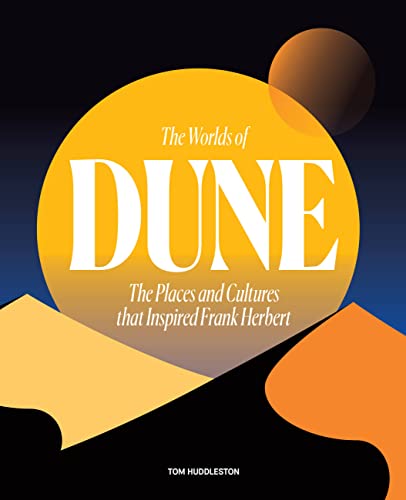
THE WORLDS OF DUNE: The Places and Cultures that Inspired Frank Herbert
TOM HUDDLESTON
Frances Lincoln Ltd
$35.00 hardcover, available now

Rating: 4* of five

The Publisher Says: Some writers build worlds. Others birth entire universes.

In the decades since its publication, Frank Herbert’s Dune has become arguably the best-selling and certainly the best-known science fiction novel ever written. So how did an ex-Navy newspaperman from Washington State come to write such a world-conquering novel? And how was he able to pack it with so many layers of myth and meaning?

Herbert’s boundless imagination was sparked by a dizzying array of ideas, from classical history to cutting-edge science, from environmentalism to Zen philosophy, and from Arabic texts to Shakespeare’s tragedies.

Beginning on Arrakis and going planet by planet, The Worlds of Dune offers a supremely deep dive into Herbert's universe—detailing along the way the many diverse strands that he wove into his epic creation to offer a visually rich accompaniment to this sci-fi legend.

I RECEIVED A DRC FROM THE PUBLISHER VIA EDELWEISS+. THANK YOU.

My Review
: Glorious illustrated companion to the Duneiverse was published in October 2023 to coincide with the pre-WGA/SAG strikes release of Dune Part Two. Now scheduled for release on 1 March 2024 in the US (per IMDb), the companion film to 2021's gorgeous Dune means we can finally show the marketing case for a beautiful, informative arty book about how Frank Herbert came up with the ideas, and examined the cultures, that he based his utterly engrossing work on.

Take a gander at this table of contents...the design's beautiful to my eye, the clarity of information presentation is usable, and the synopsis is amply supported by the part and chapter titles:

Part One: ARRAKIS
  • Chapter One Desert Planet
  • Chapter Two The Fremen
  • Chapter Three The Spice
  • Part Two: CALADAN
  • Chapter Four House Atreides
  • Chapter Five Paul Muad'dib
  • Chapter Six Lady Jessica and the Bene Gesserit
  • Part Three: GIEDI PRIME
  • Chapter Seven House Harkonnen
  • Chapter Eight Piter De Vries and the Mentats
  • Chapter Nine The CHOAM Corporation
  • Part Four: KAITAN
  • Chapter Ten House Corrino and the Padishah Emperor
  • Chapter Eleven The Landsraad
  • Chapter Twelve The Spacing Guild
  • An introduction to Herbert's life whizzes along in just over ten pages, and there are the usual things in the back matter: An Epilogue, notes, credits, sources, etc.

    This is not a long book, nor is it a scholarly evaluation of Dune in all its genre glory. This is a book for the aficionado of the world of to have for their display and their aesthetic pleasure. It will not elucidate matters of great debate within the Duneiverse, nor will it enlighten most long-time fans about most matters around the creation of the Duneiverse in print or on screens. The point of it is to make the reality of the great work beautiful and ready to seduce the eyes:


    br />


    A gift to give that shows you listened, a gift to yourself if you're a genre fan, a beautiful object to have and enjoy.

    ++++++++++++++++++++++++++++++++++++++++++++++++++++++++++++++++


    THE SPICE MUST FLOW: The Story of Dune, from Cult Novels to Visionary Sci-Fi Movies
    RYAN BRITT

    Plume Books
    $18.00 trade paper, available now

    Rating: 4* of five

    The Publisher Says: Geek-culture expert Ryan Britt takes us behind the pages and scenes of the science-fiction phenomenon Dune, charting the series' life from cult sci-fi novels to some of the most visionary movies of all time.

    Using original, deep-access reporting, extensive research, and insightful commentary, The Spice Must Flow brings the true popularity of Dune out into the light for the very first time. With original interviews with the beloved actors and directors behind the films—including Timothée Chalamet, Kyle Maclachlan, Denis Villeneuve, Patrick Stewart, Rebecca Ferguson, Alec Newman, and many more—The Spice Must Flow also examines the far-reaching influence of Dune on art, music, politics, and, most notably, its status as the first ecological science-fiction story specifically concerned with climate change.

    Britt skillfully and entertainingly guides readers through the history of how the Dune universe has unfolded, including the novel’s unlikely evolution from a failed piece of journalism about Oregon sand dunes into an epic science-fiction story, the way Herbert’s work inspired George Lucas, untold stories from the 1984 David Lynch film, the knife-edge balance between blockbuster hit and indie film Timothée Chalamet brings to the 2021 movie, and the exciting future of the franchise. Through a blend of narrative, oral history elements, and fascinating trivia, The Spice Must Flow is the new essential guide to the behind-the-scenes story of Dune. The fiction of Dune is deadly serious, but the real-life story of how it came into existence is full of wonder, surprises, and spice.

    I RECEIVED A DRC FROM THE PUBLISHER VIA NETGALLEY. THANK YOU.

    My Review
    : What I said the book above wasn't this book is. It's by archgeek Ryan Britt of LUKE SKYWALKER CAN'T READ fame, so he's got the chops and knows both the beat and the drill. Plume's published three of his books now, so clearly he commands the geek-culture street cred to make it profitable. Plus he's got a witty way with words that makes his deep familiarity with the subject less...creepy, more fun and funny.

    This fictional universe has a lot of hot-button topics in it: Religion, climate change, religion, anti-technological bias, religion, and sheer unsurpassed-in-SF canon-guarding/gatekeeping/incel-friendly detail. Britt doesn't exactly dwell on the toxic parts of the fandom but neither does he ignore them. There are lots of worldbuilding details that he discusses and there are lots of ideas pinned under them, set in stories that are brimful of unapologetically partisan points of view. This is guaranteed to make some people go into full-on rages when their preferred interpretation of some detail is argued against.

    This makes me sad, and reminds me of Kit Connor (of Heartstopper fame) feeling forced to reveal his private sexuality to stop muttered accusations of queerbaiting. As he said at the time this was occurring:
    "I'm bi. Congrats for forcing an 18-year-old to out himself. I think some of you missed the point of the show. Bye."
    (emphasis added to point up the disconnect between messages in the original and fannish gatekeeping)
    That's the downside of passionate fandom. Anyone who has been in the Geek Culture world for more than A Minute has seen/been caught up in a pile-on when someone dares to be/say/assert an opinion or a take or even present a closely-reasoned analysis of that fandom's shared object that somehow rubs (some of) the fans the wrong way.

    Quite a lot of people, myself included, stay away from fandoms for this reason. This book is a gentle, explanatory rebuke of our skittishness in the form of a reasonable geek-culture maven's informed, excited (almost besotted) exlainer of just why this fandom came to be. Also a gentle chiding of the obsessive gatekeeping by some groups of fans. The book makes the point that Frank Herbert, and his son Brian after him, have created and are curating an immense, expansive Duneiverse of fiction, films, comics, and cosplay that contains literal multitudes. There is such astonishingly varied information in this fiction! Letting new players into the sandbox is Author Britt's aim in much of what he's doing...yet he never loses sight of the established fan's desire to see the whole Duneiverse from a wide-angled view...at least as far as the 2021 film...the 2024 one was filming as he wrote, so details and gossip were all embargoed.

    I need to be reminded from time to time that fandom can be fun, and fascinating, and an all-around good experience. I hope this book will do the same for you, as a gift to yourself, and your other giftees.

    Monday, July 3, 2023

    TARRY THIS NIGHT, dystopian cult-plus-incest-plus-climate change near-future nightmare...for teens!


    TARRY THIS NIGHT
    KRISTYN DUNNION

    Arsenal Pulp Press
    $14.95 trade paper, available now

    Rating: 4* of five

    The Publsher Says: In this dystopian, eerily relevant novel, a civil war is brewing in America. Below ground, a cult led by the deluded and narcissistic Father Ernst is ensconced in an underground bunker, waiting out the conflict. When "The Family" runs out of food, Ruth, coming of age and terrified of serving as Ernst's next wife, must choose between obeying her faith and fighting for survival. In this unsettling modern Lilith tale, spirited women resist their violent, racist culture and, in so doing, become outlaws.

    I RECEIVED AN ARC FROM THE PUBLISHER. THANK YOU.

    My Review
    : Another call-to-arms for the young women of the US. It's dystopian, all right, but in the six years since its publiction it's only bexome more prescient.

    The profound evil of religious belief is its de facto division of the world into Us and Them. There's no need to be saved if everyone is, regardless of their behavior and/or diet and/or sex life,right? So it must be that some people aren't saved; therefore they must be wicked for not following the way to salvation, because of course everyone who's good wants to be saved, and if you explain how to be saved and they don't do it, they're Bad...They are Bad, because WE are Good! This being the least talked-about part of religious belief, it's fertile ground for Author Dunnion to poke around to see what kind of struggle-bugs come out of the dark, smelly pit underneath the pile of unexamined Articles of Faith.

    The horror of this system is its endless supply of unquestioning followers, perpetuating abuse and calling it love.

    That might be the single most evil thing ever done by one human to another.

    My issue with this story isn't the story itself, or the worldbuilding the Canadian author does for the US South, but the pacing of the plot. Reading the first half of the book, one is trapped in a slooow-motion car crash, awaiting the inevitable explosion. It all takes far longer to reach ignition than it should to keep readers engaged...it took me six years and a nagging sense of unfinished business to get back to it.

    In spite of that serious misgiving, though, I think the experience by the end is one of horrified and outraged identification with the situation and the characters, and should fill a void in your trapped-indoors-by-the-heat summer 2023 reading.

    Friday, September 2, 2022

    KRAKEN CALLING, best be sure to pick up *now*


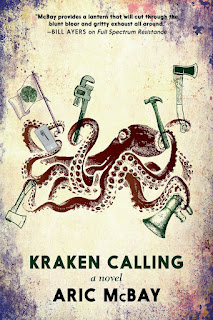
    KRAKEN CALLING
    ARIC McBAY

    Seven Stories Press
    $22.95 trade paper, available now

    Rating: 4* of five

    The Publisher Says: A sweeping near future dystopic fantasy in the Octavia Butlerian vein of the Parable of the Sower novels.

    Political activist and anarchist author Aric McBay (Full Spectrum Resistance) toggles between the years 2028 and 2051 to give us the experience, with breathtaking realism, of what might happen in the span of just one generation to a society that is already on the brink of collapse.

    In 2028 environmental activists hesitate to take the fight to the extreme of violent revolution. Twenty years later, with the natural environment now seriously degraded, the revolution is brought to the activists, rather than the other way around, by an authoritarian government willing to resort to violence, willing to let the majority suffer from hunger and poverty, in order to control its citizens when the government can no longer provide them with a decent quality of life.

    So it is the activists who must defend their communities, their neighbors, through a more humane and in some ways more conservative status quo of care and moderation.

    And the outcome here is determined by the actions of those who resist more than it is by the actions of the nominally powerful.

    I RECEIVED A DRC FROM THE PUBLISHER VIA EDELWEISS+. THANK YOU.

    My Review
    : Non-fiction writer (Peak Oil Survival, Deep Green Resistance) Aric McBay makes his points in fictional form. What he has done is not the usual thing for him, analyzing and contextualizing social and political trends for a left-leaning audience; this has always been his forte as a writer.

    I think it still is. This novel makes a very trenchant attempt to put human skin on the bones of social movements for change, favoring equitable and reasonable restructuring of our self-evidently unsustainable lives.
    “It’s always hard to tell, isn’t it? How the future could change from the smallest actions,“ Simón mused. “I believe we made things better. We bought time. Breathing room. We stopped one more. We didn’t improve things as dramatically as we hoped. But we made room for a hundred other movements to flower. Some of them failed, but some of them are amazing....”

    “The tides always rise and fall for us,”Simón said. “That’s the nature of struggle. There is no guarantee, no permanent victory.”

    “The work of the revolutionary is to plow the sea,” Addy quoted.”

    It is indeed, Addy. It is indeed. To see your best efforts subsumed under the heaving mass of humanity in its indifference and fearful rejection of change. To know you're not ever going to prevail, no matter how many times you win. But to be sure you're harrowing the surfaces of the waters plowed and allowing things buried to come to the surface? It's a reward beyond price.

    Dystopia, then, is inevitable? I don't think it is, though a lot depends on the individual's concept of "dystopia" and their tolerance for ambiguity. Most revolutionaries are absolutists, and should be kept far, far away from the levers of power. We're seeing that in the House of Representatives in the US during 2022. Revolution is hard, and requires people to be very, very hard...and these revolutionaries are obdurate, but brittle.

    This means that, like Evelyn in our near-term future (2028), we need to be sure to combat that obduracy effectively. Or the 2051 sections of the story won't be a warning klaxon but a sad prediction.