Pages
- Home
- Mystery Series
- Bizarro, Fantasy & SF
- QUILTBAG...all genres
- Kindle Originals...all genres
- Politics & Social Issues
- Thrillers & True Crime
- Young Adult Books
- Poetry, Classics, Essays, Non-Fiction
- Science, Dinosaurs & Environmental Issues
- Literary Fiction & Short Story Collections
- Sookie Stackhouse/Southern Vampire Books & True Blood
- Books About Books, Authors & Biblioholism
Showing posts with label authoritarian dystopia. Show all posts
Friday, September 4, 2026
HOW TO DATE A FANATIC, two halves make a funny-shaped whole
HOW TO DATE A FANATIC
ARUNI KASHYAP
HarperVia (non-affiliate Bookshop.org link)
$12.99 ebook, available now
Rating: 4* of five
The Publisher Says: In this compassionate, poignant novel set in contemporary India, a young professor searches for connection and love during a time of political and cultural upheaval.
As political tensions rise precipitously across India, Rohit returns to Delhi University to teach and gets caught in a web of unrequited love with his friend Dhruv. To alleviate his inevitable heartbreak, Rohit seeks relationships with other men on campus, until he meets and embarks on a delicate new romance with the effervescent Sayan, a literature student he hopes will be the answer to getting over Dhruv.
Rohit’s life soon becomes more complicated as the country's political tensions erupt on campus, sparking a turbulent student-led movement that entangles Rohit when Dhruv joins the fray, a tipping point that changes Rohit’s life forever. Set against the vibrant, volatile tapestry of modern India, Rohit and his friends must learn to navigate the challenges and triumphs of queer life to survive in an unpredictable political landscape.
Propulsive, tense, and charged with humor and tenderness, How to Date a Fanatic is an exploration of identity, connection, and the enduring hope for a better future in a rapidly changing world.
I RECEIVED A DRC FROM THE PUBLISHER VIA NETGALLEY. THANK YOU.
My Review: India's right-wing horrible human beings are enough like our US versions that I was stressed for Rohit from the get-go; I was also reminded that au fond, humans are not different anywhere on this globe. The same insatiable desire to control others in every way, the same pressure to conform or else, the same kinds of violent resistance and repression, for reasons only cosmetically different.
The reason I'm not offering perfect ratings and warbles of delight for this clear-sighted takedown of the repression and conformity machine is simple: Dhruv's a bastard. Rohit needs to get over his addiction to an emotionally unavailable man, and that story is *uncomfortably* close to home. It's all on Rohit, of course, Dhruv's uninterest could've been more kindly expressed but that is not incumbent on any of us to come up with in the moment. Rohit losing himself in the pursuit of distraction is deeply relatable. His choices are very interesting to me because they're further evidence of human nature being consistent across cultures.
Where the mess that is the authoritarian horror India lives under (and the US seems to be rushing to emulate) takes hold of the narrative, the second half becomes more a political argument against authoritarianism while backgrounding Rohit's emotional life. The shift in tome is always going to be tricky to navigate; I didn't feel it was all that well handled. I was taken from one focus, on the intimate life and choices of Rohit, into another, the violent and vicious reactionary response of a right-wing regime to gay men.
Both were very involving, though a reader looking for more of the first story might not like being catapulted into the second much. Readers interested in the second stiry might have preferred it to be more than just lightly foreshadowed from the beginning. It's this dichotomy between the (roughly) halves that stalled me out at four stars. There are that many because I really liked and invested in Rohit and his happiness. Sure, I wanted to shake him by the shoulders and demand he get on with finding someone who deserves his love. But he really deserves that kind of happy ending. (Other kinds too but permaybehaps on the page in my imagined other story...not this unsteamy one.)
A successful read for all my quibbly niggles, a story I'd enjoy seeing more of, should a follow-on tale eventuate. That ain't the most common end to a review I write about a book that frustrated me!
Monday, July 13, 2026
ASTRONAUT!: A Novel, a metaphor for escape from here-and-now that makes it sound so...frictionless
ASTRONAUT!: A Novel
OANA ARISTIDE
W.W. Norton (non-affiliate Bookshop.org link)
$27.99 hardcover, available now
The Independent Press Top 40 Bestsellers: Fiction For the week ending July 28, 2026
Rating: 4.5* of five
The Publisher Says: A tense, darkly funny, and politically resonant novel of life under authoritarian rule.
Romania, 1989, the twilight of Ceausescu’s dictatorship: A time when every neighbor, every friend, every family member may be an informant for the regime. When news emerges of a man-eating bear terrorizing the country, two bright lives collide. Constantin, an idealistic police detective—prone to daydreaming and scribbling fairytales in his notebook for his four-year-old son—is tasked with solving the string of mysterious deaths. Lia, a rebellious, inquisitive schoolgirl pining for more color in her life, is unwittingly drawn into an elderly neighbor’s secret plot against the regime. The decisions they make amid the constant gray skies and fear of speaking out will have sweeping consequences—for themselves, for their families, and for their country. Astronaut! is a chilling, suspenseful, and resonant tale by a dynamic new novelist.
I RECEIVED A DRC FROM THE PUBLISHER VIA EDELWEISS+. THANK YOU.
My Review: What a claustrophobic read. At eery turn there's a wall, at every corner there's an uneasy dread of what you'll find when you turn it. Even the fun of a kid wanting to give Mama a special birthday gift...disastrous, unmitigatable harm follows.
I was uneasy, I was unnerved, and I was totally hooked. I stopped feeling like I was reading a novel pretty quickly. I winced, chuckled hollowly, got staring prickles, I felt as much a part of the cold greyness of 1989 Romania as a guy in the sunshiney summer of 2026 New York City is likely ever to feel. Lia is in the midst of things she does not realize are seismic shifts. Her sense of self-preservation hasn't taught her what safety is yet. She barrels into danger as she searches for the vibrancy and color of her home country. Honestly I wondered where she might've seen that, the eternal dankness and foggy grey of 1989 Romania was so pervasive.
Then we shift our story attention to detective Constantin, tasked with solving a brutal death, one that lends itself in its mindless ferocity of commission to the spurious explanation of a bear attack.
One that just happens to take place near the hunting party at Dictator Ceaușescu's hunting lodge.
These narratives don't appear to be connected at first. Constantin escapes from the Orwellian "investigation" he's performing to instructions from...well...Securitate (the secret police)? who can be sure, they're very secretive these secret police never doing anything directly that Constantin's seen just by innuendo and "they said"-style rumors. He writes fairy tales for his much-loved son Sandu. The fairy tales are so completely adorable and so trenchant that I want illustrated books of them!
Sandu's story-lessons in how things really are in the world are all so trenchant and targeted that they become our primary means to follow the backgrounded collapse of the Ceaușescu regime. It's a clever and enjoyable way to tell me a larger story behind the story I'm paying attention to. More violent vicious deaths occur that Constantin feels he needs to escape from absorbing, as he turns to creating stories about an astronaut (not the Party-approved term "cosmonaut" please note) to make up in his mind for the nonsensical stories titillating the people about bear attacks with escape from Earth's surly bonds entirely.
Lia's absolute unwillingness to dim down her search for color, for life, in her country and her school leads her into a dangerous association with a real honest to goodness rebel. It's something she puts her whole heart into, this small role in a small eddy of the current of rebellion in 1989 Romania, leading her into a dangerous conflict with a Party official's daughter in her school. She is clearly, obviously the winner of a contest that girl was supposed to win..."he's at the top of the page, the bravest explorer of all. She gives him a light blue helmet and matching spacesuit, and he's smiling through the visor. Why the smile? Because he has just realized that the view from the outer space is like being deep inside a Christmas tree, and he is never afraid. Lia smiles back at him. She names the drawing, flattening the black letters across the surface of the sun, 'Astronaut!'"...whose prize was a face-to-face with Ceaușescu himself. Special classes, intensive training, the usual efforts to make sure no tinge of reality can intrude on the leader's dreamworld.
Lia and her family figure in Constantin's investigation...the part without the bear story in it...and as Lia's meeting with Ceaușescu draws closer, more and more strands of story logic bind them together. We discover Constantin's dark, painful secret; we watch Lia as she draws closer to murderous scum without feeling the appropriate level of fear; we are *frantic* to save whomever we can from the explosion looming.
It's a novel with a satisfying resolution. I will say nothing of the ending.
"We've grown numb. It's like this, kid: in wars, you have to face guns and cannons and soldiers, and the situation is somehow so obviously serious that we mobilise our courage, and our will, and so on. But here, we are supposed to be heroic at our kitchen table, at the factory, on the bus. We are supposed to risk terrible consequences just for saying some perfectly commonsense thing. It never seems worth it."
{Lia}'s pretending to listen, but really she's thinking how lucky she is Comrade Mantea is her friend. He talks complete gibberish but it never feels like he's lying to her. He's nice to her, and he has ideas, not only about grown-up problems but about everyone's problems.
Don't kid yourself: Oana Aristide will show you a mirror, she will shine a harsh raking light on you while she does it.
But she sees everyone's problems in the unflattering shadows.
Wednesday, January 7, 2026
WHERE THE AXE IS BURIED, Ray Nayler gets his Nostradamus on
WHERE THE AXE IS BURIED
RAY NAYLER
MCD x FSG (non-affiliate Bookshop.org link)
$14.99 ebook, available now
FINALIST for the 2026 Locus Award for SCIENCE FICTION NOVEL!
Rating: 4.5* of five
The Publisher Says: All systems fail. All societies crumble. All worlds end.
In the authoritarian Federation, there is a plot to assassinate and replace the President, a man who has downloaded his mind to a succession of new bodies to maintain his grip on power. Meanwhile, on the fringes of a Western Europe that has renounced human governance in favor of ostensibly more efficient, objective, and peaceful AI Prime Ministers, an experimental artificial mind is malfunctioning, threatening to set off a chain of events that may spell the end of the Western world.
As the Federation and the West both start to crumble, Lilia, the brilliant scientist whose invention may be central to bringing down the seemingly immortal President, goes on the run, trying to break out from a near-impenetrable web of Federation surveillance. Her fate is bound up with a worldwide group of others fighting against the global status quo: Palmer, the man Lilia left behind in London, desperate to solve the mystery of her disappearance; Zoya, a veteran activist imprisoned in the taiga, whose book has inspired a revolutionary movement; Nikolai, the President’s personal physician, who has been forced into more and more harrowing decisions as he navigates the Federation’s palace politics; and Nurlan, the hapless parliamentary staffer whose attempt to save his Republic goes terribly awry. And then there is Krotov, head of the Federation’s security services, whose plots, agents, and assassins are everywhere.
Following the success of his debut novel, The Mountain in the Sea, Ray Nayler launches readers into a thrilling near-future world of geopolitical espionage. A cybernetic novel of political intrigue, Where the Axe is Buriedcombines the story of a near-impossible revolutionary operation with a blistering indictment of the many forms of authoritarianism that suffocate human freedom.
I RECEIVED A DRC FROM THE PUBLISHER VIA NETGALLEY. THANK YOU.
My Review: Political allegory is risky for authors to indulge themselves by creating. "The irony that haunts our entire history is that we humans have been the ones standing in the way of our own happiness the whole time" is a pithy truism. It's not much to hang a novel on.
Yet hang it does. The near-future techno-dystopia is all too real, all too probable, and dankly depressingly akin to the tech...bros...in charge of the most important functions of infrastructure's clear intentions. Why is "hacking" a crime? Because it interferes with the Aynholes' desires to install ransomware in all societal functions to exert supreme control over all humans. "The question isn’t who is going to let me; it’s who is going to stop me," is Ayn Rand's own deeply evil, greedy, and selfish distillation of the deeply evil, selfish, and destructive soi-disant "philosophy" entrenched in the tech industry, that reaches apotheosis in this story.
There are no good, humane systems in this novel, albeit they are uniformly very human-centered. Control of Humanity has always been at the center of all social and governmental systems throughout time. The eternal tension between the ideal of individual liberty and the safety of others has never, in my opinion can never, be anything more than temporarily balanced. It's the moment of imbalance, the time when the system built is not in equilibrium that makes this a novel not a short story. Looking into a dark and a deep void is courting vertigo. It's vertigo, a sense of the ground deciding it's not going to support one's weight any longer that defined this story to me.
Author Nayler blew past the discomfiting (to me) notion of AI government leaders into nightmare territory with the Federation president whose personality is digitized and downloaded time and time again into fresh bodies. An immortal being, like the Meths in Richard K. Morgan's Altered Carbon, will not in any meaningful way be human. I don't even think the present-day model for this character is human. Well, genetically so but not humane or honorable in human terms. Be that as it may...this is a cautionary tale about ignoring mile-long freight trains barreling towards you. You will get flattened.
“What a world, Nikolai,” the president had said. “no old age, no sickness, and no death. Finally, we can have both our wisdom and our health.”Like the immense benefits promised to thee and me in the rollout of "AI" there's a very, very low likelihood of anyone under billionaire status deriving more than the tiniest benefits, and as few of those as they can manage, from "AI". Assuming it's ever better than it is at this moment, where the divide is already stark, it will immiserate billions and make greedy oligarchs a scoche richer.
The president said we—but it was only he who could have those things. It was only he who could escape old age, sickness, and death.”
The essence of the story is:
“That was how it was. One day you had your own country. Next day you were a refugee. You were in a line, waiting to be someone again. To be legal again. Not to be nothing....and you will.
You could spend your whole life waiting.”
It's a bitter pill of a tale written by Author Naylor from a far greater pool of knowledge than mine on every story axis. It is not me, an old, bitter, angry socialist, shouting at the clouds the tech...bros...float atop. It is one of their own saying, "pay attention now before you pay a very steep price for lazy inattention."
It behooves us without his knowledge, or his storytelling nous, to listen up while we can.
Monday, December 1, 2025
PIGEONS!: A Fable For Our Times, and many others throughout history
PIGEONS!: A Fable For Our Times
MARC CHALVIN
Street Noise Books (non-affiliate Bookshop.org link)
$25.99, available now
Rating: 4.5* of five
The Publisher Says: A contemporary political allegory of power, to remind us of the dangers of following a dictator and surrendering your freedom.
Life is simple for the pigeons. They have no desire to contemplate their future or take control of it. Free from responsibility, they are all too willing to submit to a strong authority. This is precisely what a cruel and power-hungry crow was waiting for—a perfect opportunity to wield his natural talents as a tyrant. The crow enforces law and order, but also terror and arbitrary rules. Everyone seems to accept this situation—or maybe, they are too scared to resist. Until an idealistic seagull steps in, determined to challenge the system through debate and free elections.
I RECEIVED A DRC FROM THE PUBLISHER VIA EDELWEISS+. THANK YOU.
My Review: I really think everything I could say would be superfluous...if you wonder, like me, WHY people choose authoritarian social orders with such alacrity and frequency, this is your answer. Only told with sequential artwork, featuring pigeons.
Now look at the art.
I could go on, the publisher's been very generous with art for publicity, but I feel my point is made. Wisecracking birds in thrall to an authoritarian bird might make some of this make some sense.
Mostly I think the graphic-novel medium will let some messages slide through your at-risk young male giftee's defenses. It sure as hell can't hurt, it's cheap as a psychic inoculation against authoritarian/fascist bullshit goes.
Thursday, August 28, 2025
THE HIDDEN ISLAND, essay collections by exiled Cuban journalist
THE HIDDEN ISLAND
ABRAHAM JIMÉNEZ ENOA (introduction by Jon Lee Anderson; tr. Lily Meyer)
Ig Publishing (non-affiliate Bookshop.org link)
$19.95 trade paper, available now
Rating: 4* of five
The Publisher Says: The work of one of the most powerful new voices in independent Cuban journalism, The Hidden Island is a searing portrait of life in contemporary Cuba, where the struggles of ordinary citizens collide with the brutal repression of the government.
In this powerful collection of essays, we encounter a memorable and diverse cast of regular Cubans who are trying to survive with few resources and little hope—including a female boxer in a country that has long outlawed women's boxing, a boy who collects money for the country's underground lottery, a male gigolo, and the residents of a neighborhood that is so poor that the government doesn't officially recognize its existence. We also meet the homeless, and vendors who eke out a meager living by selling fruit and vegetables, scraping by in a former socialist paradise.
Jiménez Enoa juxtaposes these ordinary lives against the repressive tactics of the government, or "regime." He describes his “walks” around Villa Marista, the headquarters of the secret police, and the spies, confidantes, informers and regime sympathizers who crush anyone who questions the official narrative, which forces many independent journalists into exile. In a final self-portrait in the book about his own exile, Jiménez Enoa writes that, “to escape from Cuba is to fall into the world, to realize that Cuba is an island that has been hijacked by a political system which ensures that the country remains locked inside the twentieth century.”
I RECEIVED A DRC FROM THE PUBLISHER VIA EDELWEISS+. THANK YOU.
My Review: Essays by journalists, especially ones that don't get a gentle massaging to flow into each other, can make for somewhat choppy, repetitive reading. Founder of online Cuban resistance magazine, El Estornudo, Author Jiménez Enoa highlights "...fresh perspectives on challenges for independent journalists and reporting on issues rarely covered by {Cuban} state media, including racism in Cuba. In 2020, state security officers strip-searched and handcuffed Jiménez Enoa, interrogated him for five hours, and threatened him and his family over his writings about life in Cuba in his {now-defunct} Washington Post column. The persistent harassment and censorship forced Jiménez to flee to Spain in 2021, where he is currently living in exile."
All that potted biographical information (from Ig Publishing's website) should tell you that this is a book by a man who's living by his principles, is in fact doing the very thing authoritarians hate the most: Talking about them factually, therefore in unflattering terms. As expected, the terms change little; the essays, taken in large doses, thus become repetitive. Space them out, intersperse them with jolly Wodehouse stories or something in that vein.
Make no mistake that Cuba is an authoritarian state; it always was. Its slide into poverty came when the Soviet Union crashed out and Russia, as the successor state, opted not to resume propping up the Cuban economy. Things do not go well for former client states that suddenly lose the support of their masters. There was no plan for a way to transition into a new economic model, so misery resulted, as always when one system collapses and no new ideas are allowed to arise.
Author Jiménez Enoa dared to point this out publicly. The regime did not like having its failures openly discussed and used bullying and intimidation to silence him. That website I've linked to above is his riposte. Not silenced, but rather energized, motivated to say his piece on the biggest stage he could find.
I wonder how many more times this game of repression and rebellion will need to be played out before the real message gets through to the powerful: What you're doing is wrong, and we all know it and see it. You are not going to fool anyone by acting the bully.
All the essays Jiménez Enoa has written about the Cubans he's met...especially the sex-worker guy, who reminds me of John Kilo...show how resilient people are, how many ways they find to keep their lives moving and thriving.
Good people are so often cursed by bad governments, aren't they.
Wednesday, August 6, 2025
THE MOUNTAIN AND THE WALL, urgent and trenchant and tendentious reading
THE MOUNTAIN AND THE WALL
ALISA GANIEVA (tr. Carol Apollonio; intro. Ronald Meyer)
Deep Vellum Publishing (non-affiliate Bookshop.org link)
$9.95 ebook, available now
Rating: 4* of five
The Publisher Says: This remarkable debut novel by a unique young Russian voice portrays the influence of political intolerance and religious violence in the lives of people forced to choose between evils.
The Mountain and the Wall focuses on Shamil, a young local reporter in Makhachkala, and his reactions, or lack thereof, to rumors that the Russian government is building a wall to cut off the Muslim provinces of the Caucasus from the rest of Russia. As unrest spreads and the tension builds, Shamil's life is turned upside down, and he can no longer afford to ignore the violence surrounding him.
With a fine sense for mounting catastrophe, Alisa Ganieva tells the story of the decline of a society torn apart by its inherent extremes.
I RECEIVED A DRC FROM THE PUBLISHER VIA EDELWEISS+. THANK YOU.
My Review: Wow. The 2025 US needs a writer of this caliber, of this perspicacity, and possessed of this level of moral courage in flensing the rotting whale carcass of our Body Politic. Despite being ten years old (!), this near-future story of a country's takeover by religious extremists with an extremely high-control agenda is fresh as yesterday's op-ed page.
The unnervingly spot-on takedowns of "do as I say not as I do" hypocrisy, of hyperconsumerist end-stage capitalism, and of youthful hedonism's blinding obfuscation of the petty tyrannies and ideological inconsisencies of the new regime *rock*. Author Ganieva saw what was happening in Dagestan, a north Caucasian conflict zone nominally still part of Russia, and puts it all on just over 250 pages of unsparing prose.
Complacent US people ought to read it as soon as possible. The consequences of remaining blind to the end result of the unfolding coup are dire. It's all made perfectly plain here. It's also wryly amusing, at time darkly funny, and a very quick read. Shamil, our intrepid reporter main character, would win a Pulitzer in the US journalism space despite being pretty hapless...though largely not culpable for it, given the system he works within.
The atrocious anti-intellectual and anti-historical religious nuts are the better armed barbarian compadres of the Corporation for Public Broadcasting-killing, science-denying, book-banning idiots in the US. Their biggest head start on our vandals is their well-honed dagger of misogyny, held at the throats of every woman not veiled and submissive.
I do not want to live in their world. Their solution to that is to kill men like me for refusing to pretend they are the god-anointed masters of Earth. Resisting them is the way I stay able to look at myself in the mirror.
I hope you will take the same heart from this brief, inexpensive read.
Friday, May 9, 2025
FOUR BY FOUR, Sara Mesa's odd, claustrophobic, upsetting challenge to smugness
FOUR BY FOUR
SARA MESA (tr. Katie Whittemore)
Open Letter Books
$15.95 trade paper, available now
August 2025: 40% discount on all Open Letter titles written or translated by female-identifying artists. (Discount is applied automatically at checkout on publisher's website and applies to all hardcover, paperback, and ebook editions.)
Rating: 4.25* of five
The Publisher Says: Set entirely at Wybrany College—a school where the wealthy keep their kids safe from the chaos erupting in the cities—Four by Four is a novel of insinuation and gossip, in which the truth about Wybrany’s “program” is always palpable, but never explicit. The mysteries populating the novel open with the disappearance of one of the “special,” scholarship students. As the first part unfolds, it becomes clear that all is not well in Wybrany, and that something more sordid lurks beneath the surface.
In the second part—a self-indulgent, wry diary written by an impostor who has infiltrated the school as a substitute teacher—the eerie sense of what’s happening in this space removed from society, becomes more acute and potentially sinister.
An exploration of the relationship between the powerful and powerless—and the repetition of these patterns—Mesa’s "sophisticated nightmare" calls to mind great works of gothic literature (think Shirley Jackson) and social thrillers to create a unique, unsettling view of freedom and how a fear of the outside world can create monsters.
I RECEIVED A DRC FROM THE PUBLISHER VIA EDELWEISS+. THANK YOU.
My Review: There's enough animal cruelty in here for me to warn the sensitive to cross the story off their radar for good. It was a very close-run thing for me to finish the book, in fact.
What moved me forward was the nature of the story. It's a closed society, a hierarchy run on the tacit rules of conduct that never get enumerated and therefore are that much harder to fight against, to resist inside and out. The "colich" (as everyone refers to it) was established to keep the children within safe from...honestly, at this point, I can't help myself: from what, given that what happens in the "colich" is so utterly unspeakably awful...the Outside, the terrors of the unknown-but-known. (Like all "security states" the unknown being protected from must be known to someone or else how would one know it was worse than the security state?) Sexual assaults, class enmities, all the sins of the world are routine within the "colich" and the outside world's worse? Hm.
Anyway, Mesa's tight and tiny little microcosm of all authoritarian states is limned in hot acid on living flesh, her story unfolds as a fever dream had by a starving political prisoner might with all its abuses and horrors. Her singular talent for controlling the reader's attention...leaving the basic reality of the world outside the "colich" unexplored, undescribed, but making the contrast to the well-fed and privileged comforts of staff and students plain...creates the slightly seasick sense of knowing someone is being abused, but not quite knowing how. Still less realizing that it is also happening to you. Author Mesa's narrative, then, is finely balanced between the states of revulsion and empathy, between understanding and comprehending viscerally, always shifting the reader's attention away when clarity threatens to lift that so-necessary fog.
A lot like life in the world, then.
What makes this a four-star read, not a five-star one, is the nature of the animal cruelty (it's the reason not solely the fact that's so upsetting to me) and the strange, third-act summing-up bit written by a teacher who's no longer at the "colich" but which was presumably written while there and is now, suddenly, here in our face. The framing device wasn't as effective as it seemed to want to be in this case, and rather fractured the eerie, claustrophobic darkness that's prevailed in the novel until now.
As a reading experience, it's definitely one I can recommend to you. As an extended metaphor for the nature of wealth-measured success in Society, I can even urge it on you. As Spanish Gothic, it excels. As a gestalt, it falls only slightly—but perceptibly—short.
Thursday, May 8, 2025
KEVIN NGUYEN's latest, MỸ DOCUMENTS, a near-future I do not want
MỸ DOCUMENTS
KEVIN NGUYEN
One World (non-affiliate Amazon link)
$13.99 ebook, available now
Time's The 100 Must-Read Books of 2025 selection
Rating: 4* of five
The Publisher Says: The paths of four family members diverge drastically when the U.S. government begins detaining Vietnamese Americans, in this sharp and touching novel about growing up at the intersection of ambition and assimilation.
Ursula, Alvin, Jen, and Duncan grew up as cousins in the sprawling Nguyen family, but the truth about their family is much more complicated. As young adults, they're on the precipice of new ventures—Ursula as a budding journalist in Manhattan, Alvin as an engineering intern for Google, Jen as a naive freshman at NYU, and Duncan as a promising newcomer on his high school football team. Their lives are upended when a series of violent, senseless attacks across America create a national panic, prompting a government policy forcing Vietnamese Americans into internment camps. Jen and Duncan are sent with their mother to Camp Tacoma while Ursula and Alvin receive exemptions.
Cut off entirely from the outside world, Jen and Duncan try to withstand long dusty days in camp, forced to work jobs they hate and acclimate to life without the internet. That is until Jen discovers a way to get messages to the outside. Her first instinct is to reach out to Ursula, who sees this as an opportunity to tell the world about the horrors of detention—and bolster her own reporting career in the process.
Informed by real-life events from Japanese incarceration, the Vietnam War, and modern-day immigrant detention, Kevin Nguyen gives us a version of reality only a few degrees away from our own—much too close for comfort. Moving and finely attuned to both the brutalities and mundanities of racism in America, Mỹ Documents is a strangely funny and touching portrait of American ambition, fear, and family. The story of the Nguyens is one of resilience and how we return to each other, and to ourselves, after tragedy.
I RECEIVED A DRC FROM THE PUBLISHER VIA NETGALLEY. THANK YOU.
My Review: How awful for Author Nguyen to publish this trenchant story at exactly the moment it becomes predictive. He didn't tell it with that in mind (it's not a paywall yet, you can dismiss it), saying in the article linked above that "...I worried that in all of the conversation around Mỹ Documents being timely, that its actual conflicts and themes had been obfuscated by the emphasis on the news cycle".
Steamrolled by events you thought you were extrapolating? It has to be the ultimate first sex in your stateroom on the Titanic feeling: Will I get to do this again? He's done it before. His first novel, New Waves, came out in March...of TWENTY-TWENTY. Melpomene seems to have it in for this poor author.
All that out of the way, let's have a look at the storyverse Author Nguyen's made for us. An absent father unites Ursula and Jen, half-sisters born to white and ethnically Vietnamese mothers respectively. Each woman has a full brother. Their appearance mirrors their mothers' features, so the elder appears white. She is a journalist, exempted from being incarcerated because of her less-visible paternal heritage. She is also not interested in exposing herself to difficulties by claiming kin with her incarcerated half-sibs...a continuation of her uninterest in becoming close to these people...until their connection can be useful
As the internment camp's realities begin to bite her, no internet, limited contact outside the confines of the camp or even within it, no access to any communication technology. Jen becomes part of an in-camp samizdat operation called Korematsu. Ow, my nose. That gives her something Ursula the journalist needs: reliable intel from the inside of a buttoned-up space. The sisters, with poor grace on both sides, cooperate to tell The Truth About It. How that pans out, well...white people, even half-white people prosper in correlation to their willingness to become exploiters, says Author Nguyen of Ursula; glittering kudos, lucrative contracts rain on her. Jen, her source, is traumatized by hellish deprivation and the loss of the brother she loved and Ursula did not care a fig about.
And here is where I talk about the characters, not their arcs. The absent father was a rolling stone who was too damaged...by what?...to contemplate settling down. Why the hell he didn't use a condom instead of fathering kids he wasn't around to raise remains unaddressed. (Selfishness, of course, but it's unaddressed.) Ursula and her full sib are All American White People, Jen and her full sib are not. My, that's tidy. The mothers barely registered on me. That's why there's no part of a fifth star.
The ending of the story finds Jen and Ursula...Ursula's sib vanishes somewhere along the line...completing their trajectories as set. It's all pretty pat. What it isn't is poorly told. I'm not saying "described" here by considered usage. We are not centered in a physical locale. That is not the story being told. There's little scene-setting beyond what is needed to get the immediate point across. This is, for some readers, a huge flaw. To my read of the book it is the way to immerse you in (mostly Ursula's) development, and by extension, the entire exercise's purpose of indicting our culture for simply accepting injustice, for treating injustice as infotainment, and criticizing the people seduced by empty plaudits into betrayals of human bonds that are, by rights, sacred and cherished.
Pay attention to the people who wander, all unmoored. Ask yourself why that is the choice they made for a life spent among other humans. Is it a choice you can understand?
Listening to Ursula, I can do so better than before I read this book.
Monday, January 20, 2025
DARKMOTHERLAND, an IMAX movie played on a 1080i screen

DARKMOTHERLAND
SAMRAT UPADHYAY
Soho Press (non-affiliate Amazon link)
$14.99 Kindle edition, available now
Rating: 3.75* of five
The Publisher Says: An epic tale of love and political violence set in earthquake-ravaged Darkmotherland, a dystopian reimagining of Nepal, from the Whiting Award–winning author of Arresting God in Kathmandu
In Darkmotherland, Nepali writer Samrat Upadhyay has created a novel of infinite embrace—filled with lovers and widows, dictators and dissidents, paupers, fundamentalists, and a genderqueer power player with her eyes on the throne.
At its heart are two intertwining narratives: one of Kranti, a revolutionary’s daughter, who marries into a plutocratic dynasty and becomes ensnared in the family’s politics. And then there is the tale of Darkmotherland’s new dictator and his mistress, Rozy, who undergoes radical body changes and grows into a figure of immense power.
Darkmotherland is a romp through the vast space of a globalized universe where personal ambitions are inextricably tied to political fortunes, where individual identities are shaped by family pressures and social reins, and where the East connects to and collides with the West in brilliant and unsettling ways.
I RECEIVED A DRC FROM THE PUBLISHER VIA DEDLWEISS+. THANK YOU.
My Review: There is a lot to be said for ambition in storytelling. This book, for the first third, was destined for enshrinement in my hall of fame; the second third for my favorites list; and by the end for my "you should read it if you love, or need, a full-immersion wide-angle view of what chaos really does." You should know going in that women have significant challenges regarding consensual sex here. The centering of a transfem character's experiences made for sharp commentary on gender roles in a repressive, fascistic regime, yet also made my hackles rise. I have trans folk in my life whose potential feelings about this book's explicitness I constantly found obtruding in my reading.
It's not to say this is a pure negative. I'm all for people writing uncomfortable takes on the world as we find it today. The fact that Rozy is a person with agency, albeit in a very twisted system, felt both natural and unhappy. Her choices were severely limited, and yet also used to prove the point that pressure can cause a person to become more powerful the same way water under pressure can become a weapon.
The fictionalized country in the story was a background for me, a setting; the events played out on its stage. I was unable to get deeper than that, despite the story's evident desire for me to do so, by the sheer size if the cast we're following. It is always a risk to expand a cast beyond a handful of people. The great trick of numbing people to the reality of suffering is to follow Stalin's epigrammatic maxim: "The death of one man is a tragedy. The death of millions is a statistic." Like teaching history, telling a story in novel form only becomes less involving when you dilute your message (especially when it's essentially the same message repeated) beyond a certain point. I'm not clear if that was an intentional choice of metacommentary on the author's and publisher's part.
This story of the chaos and upheaval that attend a violent ending suffers from this dilution. It also tries its best to invest you in its very deeply felt observations on how cruelty ultimately undermines itself as it metastasizes. As ever, the issue of what is celebration and/or normalization arises as repetition of violent language and behaviors continues to assault one's readerly experience. This fine balance between intention and reception is always deeply personal. It crossed my internal line shortly after midpoint; I was too deeply interested in the results the author intended to bring to quit, as I ordinarily would have done. That's why I got as close as I did to a full four stars.
I'm not doing a good job, I fear, of expressing how deeply enfolding a tale is told here. I'm very much a fan of stories that require me to think and deeply consider the places and times and inhabitants of the storyscape before me. I think a read that makes demands on my deeper cognitive resources is a fun read. This story does that. I'm very interested in tales of messy endings that are inevitable and inherent in the setup of the world being built. This story could be the poster child for that. I was, then, very much on the side of the author and his project of elucidation.
But because of certain choices he made, it began to feel like it was just that: a project.
I wanted to end the read as much, or more in love with it as I started our being. I'm bummed that I couldn't.
Tuesday, August 6, 2024
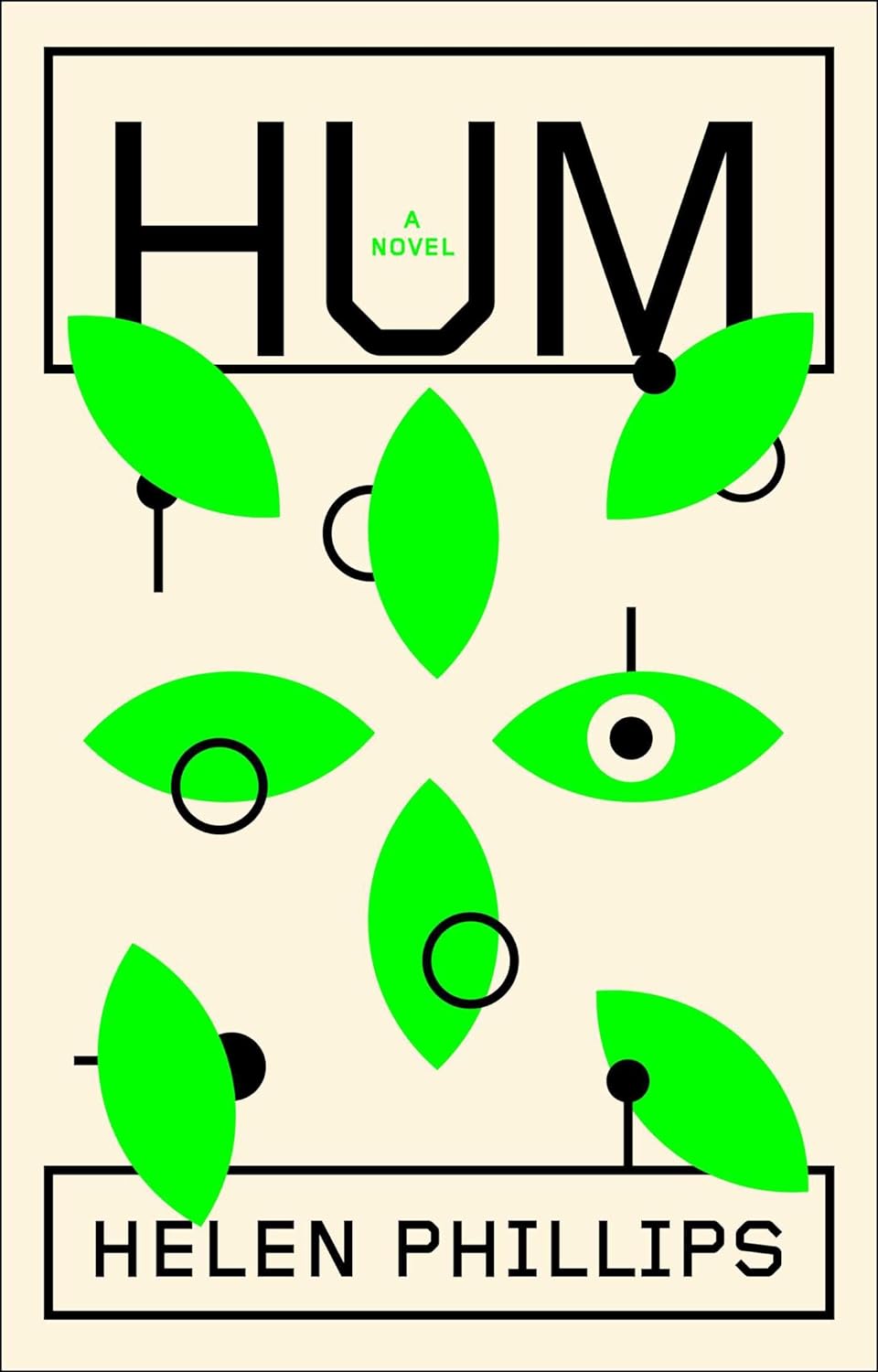
HUM, Helen Phillips reveals a terrifying, sobering prediction for a possible future

HUM
HELEN PHILLIPS
Marysue Rucci Books/S&S
$27.99 hardcover, available now
WINNER of 2026's The Climate Fiction Prize.
Rating: 5* of five
The Publisher Says: From the National Book Award–longlisted author of The Need comes an extraordinary novel about a wife and mother who—after losing her job to AI—undergoes a procedure that renders her undetectable to surveillance…but at what cost? In a city addled by climate change and populated by intelligent robots called “hums,” May loses her job to artificial intelligence. In a desperate bid to resolve her family’s debt and secure their future for another few months, she becomes a guinea pig in an experiment that alters her face so it cannot be recognized by surveillance.
Seeking some reprieve from her recent hardships and from her family’s addiction to their devices, she splurges on passes that allow them three nights’ respite inside the Botanical Garden: a rare green refuge where forests, streams, and animals flourish. But her insistence that her son, daughter, and husband leave their devices at home proves far more fraught than she anticipated, and the lush beauty of the Botanical Garden is not the balm she hoped it would be. When her children come under threat, May is forced to put her trust in a hum of uncertain motives as she works to restore the life of her family.
Written in taut, urgent prose, Hum is a work of speculative fiction that unflinchingly explores marriage, motherhood, and selfhood in a world compromised by global warming and dizzying technological advancement, a world of both dystopian and utopian possibilities. As New York Times bestselling author Jeff VanderMeer says, “Helen Phillips, in typical bravura fashion, has found a way to make visible uncomfortable truths about our present by interrogating the near-future.”
I RECEIVED A DRC FROM THE PUBLISHER VIA NETGALLEY. THANK YOU.
My Review: SciFi from a woman's PoV by an actual woman is not as rare a thing as it once was. Even women SF writers of the comparatively recent past wrote a boy's or man's PoV as often as not. Now this ignoring of The Future (as seen by women in it) is passé. We still don't see a ton of mothers as PoV characters, though.
May is such a PoV character, and she resonates powerfully with me. Her steely determination to provide for her family is the bedrock of the story. The worldbuilding is subtle, as one would expect from an author working in the (very) near future. Probably my single favorite touch of worldbuilding is one I think is largely invisible to most: May, our main charater, is married to Jem; their children are Sy and Lu.
Even their names are minimized. That most human of sounds, our names, is clipped down to the minimum of syllables, squeezing these beings into a narrower, and narrowing, bandwidth. One better suited, not coincidentally, to the vocal apparatus of the "hums" of the title.
Ah, the hums...the titular beings who represent the next (?) generation of the smartphones now falling out of favor among the young (to me) user base. If, as I suspect, their increasing disenchantment with these devices is being quietly steered, I suspect the course they're being steered ON is the one Author Phillips is showing us in this story.
The worst nightmare of a parent is to lose their children. Especially very young ones whose understanding of the World around them is unformed. Why else did the Satanic Panic/Stranger Danger epidemic get rolling? Losing a child to death by disease is less and less common...thank all those useless gods for that...but accidents, and malicious actions like addictions, malefactors who prey on the innocent are still there to obsess the fretful. Now add AI to that mix, and Author Phillips is on a winner to speak to this seething mass market. She does not do this cynically. Her brushes against the eerieness of the surveillance capitalism around us border on entry into the Uncanny Valley. Her own previous writing has been used without permission or compensation to train the generative AI we're being told will take over. I myownself think, however, that Sabine Hossenfelder's got the right handle on the reality of the eventual results. Author Phillips is wise to point to the ways this borning system is likely to fail Humanity, to the humans who still have time to change course.
Hum traverses nightmarish loss, dystopian social catastrophe, and failures of a deeply human sort in this tale. I wish I could pooh-pooh its premise, or its cconclusions, but I can't. I think all y'all who read my reviews will know what you need to know about my opinion of the read by the fact that a) I published a review on a Tuesday, 2) I was apprived for this DRC on 2 August and am reviewing it four days later, and iii) have not said, and do not intend to say, one critical word about its conception or execution.
Many of y'all do not like anything SFnal or speculative. I encourage those folk most especially to get this from the library and read it.
You're going to live it soon enough.
Monday, July 3, 2023
TARRY THIS NIGHT, dystopian cult-plus-incest-plus-climate change near-future nightmare...for teens!
TARRY THIS NIGHT
KRISTYN DUNNION
Arsenal Pulp Press
$14.95 trade paper, available now
Rating: 4* of five
The Publsher Says: In this dystopian, eerily relevant novel, a civil war is brewing in America. Below ground, a cult led by the deluded and narcissistic Father Ernst is ensconced in an underground bunker, waiting out the conflict. When "The Family" runs out of food, Ruth, coming of age and terrified of serving as Ernst's next wife, must choose between obeying her faith and fighting for survival. In this unsettling modern Lilith tale, spirited women resist their violent, racist culture and, in so doing, become outlaws.
I RECEIVED AN ARC FROM THE PUBLISHER. THANK YOU.
My Review: Another call-to-arms for the young women of the US. It's dystopian, all right, but in the six years since its publiction it's only bexome more prescient.
The profound evil of religious belief is its de facto division of the world into Us and Them. There's no need to be saved if everyone is, regardless of their behavior and/or diet and/or sex life,right? So it must be that some people aren't saved; therefore they must be wicked for not following the way to salvation, because of course everyone who's good wants to be saved, and if you explain how to be saved and they don't do it, they're Bad...They are Bad, because WE are Good! This being the least talked-about part of religious belief, it's fertile ground for Author Dunnion to poke around to see what kind of struggle-bugs come out of the dark, smelly pit underneath the pile of unexamined Articles of Faith.
The horror of this system is its endless supply of unquestioning followers, perpetuating abuse and calling it love.
That might be the single most evil thing ever done by one human to another.
My issue with this story isn't the story itself, or the worldbuilding the Canadian author does for the US South, but the pacing of the plot. Reading the first half of the book, one is trapped in a slooow-motion car crash, awaiting the inevitable explosion. It all takes far longer to reach ignition than it should to keep readers engaged...it took me six years and a nagging sense of unfinished business to get back to it.
In spite of that serious misgiving, though, I think the experience by the end is one of horrified and outraged identification with the situation and the characters, and should fill a void in your trapped-indoors-by-the-heat summer 2023 reading.
Wednesday, October 26, 2022
THE GAUTAM BHATIA PAGE: THE WALL, an apt title for a claustrophobic tale & THE HORIZON, the consequences of trading agoraphobia for claustrophobia
THE WALL
GAUTAM BHATIA (Sumer #1)
HarperCollins India (non-affiliate Amazon link)
$9.99 Kindle edition, available now
Rating: 4* of five
The Publisher Says: Mithila’s world is bound by a Wall enclosing the city of Sumer—nobody goes out, nothing comes in. The days pass as they have for two thousand years: just enough to eat for just enough people, living by the rules. Within the city, everyone knows their place.
But when Mithila tries to cross the Wall, every power in Sumer comes together to stop her. To break the rules is to risk all of civilization collapsing. But to follow them is to never know: who built the Wall? Why? And what would the world look like if it didn’t exist?
As Mithila and her friends search for the truth, they must risk losing their families, the ones they love, and even their lives. Is a world they can’t imagine worth the only world they have?
For fans of Isaac Asimov’s Nightfall and Ursula Le Guin’s The Dispossessed comes an astonishingly powerful voice in speculative fiction that explores what it means to truly be free.
I RECEIVED A DRC FROM THE AUTHOR. THANK YOU.
My Review: The author is a social-media acquaintance of mine, one whose work in the world of Indian Constitutional law I admire unreservedly. He is also among those who run Strange Horizons magazine, which work I admire immoderately as well. I think it's fair to say I approached this read with the dread of a fan...
...who then became a stan. The pace of this book probably puts a lot of sci-fi fans off but, for me, it was a perfect and langourous introduction to a two-thousand-year-old utopia whose principles hadn't changed but whose use of them had. The oppressive weight of a society that is sure that it's Right can not be overdramatized. What Author Gautam did, choosing a pace for its affect on the reader, was evoke a deep and abiding dread, a building sense of wrongness, that worked so much better than a more whiz-bang approach would have done. I found the legal sections, pertaining to Sumer's laws, to be the grace notes I've always enjoyed in my speculative fiction. They set the stakes of the rebellion against the status quo better than any other choice...rebelling against a government, after all, is rebelling against its laws.
Mithila, our PoV character, is a woman on a mission: GET OUT OF SUMER. Her rebellion isn't against intolerable and burdensome living conditions, there's enough food and plenty of stuff that one actually needs. It's a deeper rebellion: Mithila needs to be free, to have the chance to make her own choices and decisions. It's simply too much for her spirit to bear to conform.
Young people have ever felt thus, it's true. In a utopian society where you simply can not speak your mind or ask questions that deserve and require answers, it really becomes a Hell for the Mithilas of the world. She and some like-minded friends aren't glad to be safe inside the walls of Sumer. They want OUT, and the ever-threatened consequences seem like small potatoes to them.
The Powers That Be can't take that challenge lying down...and don't...but the end of the story sees Mithila and her faction winning the war because, once you introduce doubt into the world, things fall apart pretty quickly. The eternal verity that monoliths aren't stable and can fall with a well-placed shove is demonstrable using physics (Stonehenge hasn't always been the way it is now). People's hearts and minds, once engaged on a project of destruction, are very powerfully motivated to see the project through. (There's a recent example of this in the US.)
But in the end, even a novel of ideas needs to bring its concerns to a personal level or it fails to entertain...a novel's first duty. The concepts of Wallrise and Wallset, exactly what you are thinking they are, break a seaside-dwelling ocean lover's heart. The concept of a horizon is so utterly beyond the ken of people who have always lived inside encircling walls...Imagine water extending from your feet, buildings and fields receding and disappearing, imagine the water filling the empty space elicits exhilaration in a few, terror in many...and doesn't that just scare you! And, lest you wonder if the world-building is dry and flavorless, I present you the concept of the Towers of Rebirth...remembering that Sumer is a closed society, with limited resources, imagine what "rebirth" might entail for a *real* scare....
Enough to move on to the sequel, it did, and procure same with my very own United States dollars.
++++++++++++++++++++++++++++++++++++++++++++++++++++++++++++++++
THE HORIZON
GAUTAM BHATIA
HarperCollins India (non-affiliate Amazon link)
$20.00 trade paper, available now
Rating: 4* of five
The Publisher Says: ‘Did we not once promise that we would always be honest with each other?’
‘I no longer ask for honesty. Just tell me a lie that I can forgive.’
After 2000 years, the Wall has been breached. As Mithila steps into a world unknown, her sister Minakshi tightens her grasp on a city bracing for chaos and violence under a red sky. The ghost of an old Revolution stalks the streets, while the shadow of a new one threatens to tear Sumer apart.
Spreading word about this historical transgression, Alvar and Mankala find themselves facing new perils in a City they can barely recognise—one torn between old fears and new desires, while caught in a deadly power struggle. But soon, they will know that the crossing of the Wall has consequences not just for the City, but for the world.
My Review: Be careful what you ask the gods for, lest the answer be "Yes."
Mithila's prayers were assented to; now she must live in the aftermath. The Walls of Sumer are no more; this doesn't mean Sumer is no more, of course, any more than the ending of Constantinople's play-Roman society meant it didn't exist anymore. (What do you imagine sparked the Renaissance if not the sudden outflow of people and books that had been behind Constantinople's walls?) The discovery that there is...stuff, people, a whole Universe...outside Sumer's walls doens't mean that Mithila and her peeps just win because Mithila has a sister. Sibling rivalry will do more than a little to prevent things from moving too fast, and Minakshi (Author Gautam! These names, so many are so similar! NOT COOL, DUDE) is a sibling in the throes of serious rivalry. She uses Mithila's discovery of the outside to force a confrontation with Powers That Be who previously defeated *her* attempt to take over Sumer and she is ripe and ready for revenge against them. And if Mithila suffers too, well, omelettes, eggs....
Writing about chaotic change in a society whose stasis was thoroughly established earlier should feel, I don't know, complicated. It does here. I was also very pleased that the read was propulsive, violent where necessary and exciting throughout, and driven from the real-feeling needs and desires of characters unafraid to throw their hearts and bodies into the future. There is no landing in safety, there is no landing even, visible to them. But Mithila and Rama (her lesbian lover) do it anyway, commit themselves and their people to a brave new world. (Arrogant, of course, as one must be to be a rebel.) What became difficult for me as I read this book is my sense that I am empathizing with people who aren't in sympathy with the world they were born into so they...tear it all down...? That's a very big step to take with no plan for the future. I understand that Author Gautam has said he's done with this storyverse. I'm really not sure if the characters agree with him. I predict sleepless nights flipping the pillow, looking for some way to cool their anger as they struggle to get out of his brain.
There is an appendix where Author Gautam goes through the sources and inspirations for Sumer, and it by itself should be required reading for aspiring fantasy/speculative fiction writers. It is thorough without feeling like a course syllabus.
All in all, two books telling one story in a deeply, empathetically imagined alternate reality to our own. Spending time in this place poised on the brink of rebellion is, strange to say, a great escape from a darkening world.
Friday, September 2, 2022
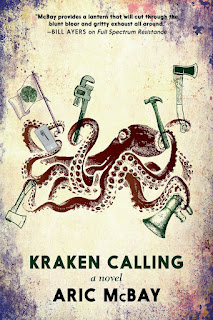
KRAKEN CALLING, best be sure to pick up *now*
KRAKEN CALLING
ARIC McBAY
Seven Stories Press
$22.95 trade paper, available now
Rating: 4* of five
The Publisher Says: A sweeping near future dystopic fantasy in the Octavia Butlerian vein of the Parable of the Sower novels.
Political activist and anarchist author Aric McBay (Full Spectrum Resistance) toggles between the years 2028 and 2051 to give us the experience, with breathtaking realism, of what might happen in the span of just one generation to a society that is already on the brink of collapse.
In 2028 environmental activists hesitate to take the fight to the extreme of violent revolution. Twenty years later, with the natural environment now seriously degraded, the revolution is brought to the activists, rather than the other way around, by an authoritarian government willing to resort to violence, willing to let the majority suffer from hunger and poverty, in order to control its citizens when the government can no longer provide them with a decent quality of life.
So it is the activists who must defend their communities, their neighbors, through a more humane and in some ways more conservative status quo of care and moderation.
And the outcome here is determined by the actions of those who resist more than it is by the actions of the nominally powerful.
I RECEIVED A DRC FROM THE PUBLISHER VIA EDELWEISS+. THANK YOU.
My Review: Non-fiction writer (Peak Oil Survival, Deep Green Resistance) Aric McBay makes his points in fictional form. What he has done is not the usual thing for him, analyzing and contextualizing social and political trends for a left-leaning audience; this has always been his forte as a writer.
I think it still is. This novel makes a very trenchant attempt to put human skin on the bones of social movements for change, favoring equitable and reasonable restructuring of our self-evidently unsustainable lives.
“It’s always hard to tell, isn’t it? How the future could change from the smallest actions,“ Simón mused. “I believe we made things better. We bought time. Breathing room. We stopped one more. We didn’t improve things as dramatically as we hoped. But we made room for a hundred other movements to flower. Some of them failed, but some of them are amazing....”
“The tides always rise and fall for us,”Simón said. “That’s the nature of struggle. There is no guarantee, no permanent victory.”
“The work of the revolutionary is to plow the sea,” Addy quoted.”
It is indeed, Addy. It is indeed. To see your best efforts subsumed under the heaving mass of humanity in its indifference and fearful rejection of change. To know you're not ever going to prevail, no matter how many times you win. But to be sure you're harrowing the surfaces of the waters plowed and allowing things buried to come to the surface? It's a reward beyond price.
Dystopia, then, is inevitable? I don't think it is, though a lot depends on the individual's concept of "dystopia" and their tolerance for ambiguity. Most revolutionaries are absolutists, and should be kept far, far away from the levers of power. We're seeing that in the House of Representatives in the US during 2022. Revolution is hard, and requires people to be very, very hard...and these revolutionaries are obdurate, but brittle.
This means that, like Evelyn in our near-term future (2028), we need to be sure to combat that obduracy effectively. Or the 2051 sections of the story won't be a warning klaxon but a sad prediction.
Subscribe to:
Posts (Atom)