Showing posts with label journalist. Show all posts

Monday, September 8, 2025

A THOUSAND WAYS TO DIE: The True Cost of Violence on Black Life in America, proof the personal is political...again


A THOUSAND WAYS TO DIE: The True Cost of Violence on Black Life in America
TRYMAINE LEE

St. Martin's Press (non-affiliate Bookshop.org link)
$14.99 ebook, available now

Rating: 4.5* of five

The Publisher Says: A deeply personal exploration of the generational impact of guns on the Black experience in America

A few years ago, Trymaine Lee, though fit and only 38, nearly died of a heart attack. When his then five-year-old daughter, Nola, asked her daddy why, he realized that to answer her honestly, he had to confront what almost killed him—the weight of being a Black man in America; of bearing witness, as a journalist, to relentless Black death; and of a family history scarred by enslavement, lynching, the Great Migration, the also insidious racism of the North, and gun violence that stole the lives of two great-uncles, a grandfather, a stepbrother, and two cousins.

In this powerful narrative, Lee weaves three the long and bloody history of African Americans and guns; his work as a chronicler of gun violence, tallying the costs and riches generated by both the legal and illegal gun industries; and his own life story—from almost being caught up in gun violence as a young man, to exploring the legacy of the Middle Passage in Ghana through his ancestors’ footsteps, and navigating the challenges of representing his people accurately in an overwhelmingly white and often hostile media world, and most importantly, to celebrating the enduring strength of his family and community.

In A Thousand Ways to Die, Lee answers Nola and all who seek a more just America. He shares the hard truths and complexities of the Black experience, but he also celebrates the beauty and resilience that is Nola’s legacy.

I RECEIVED A DRC FROM THE PUBLISHER VIA NETGALLEY. THANK YOU.

My Review
: Nothing is free. All actions have reactions, consequences. A causal chain has a beginning. Identifying that beginning is a challenge when the subjects are human beings.

Author Trymaine had a near-fatal heart attack at 38. There's a dramatic effect for you...but the cause...? How does a man tease out the causes of poor health outcomes like a heart attack in very early middle age? His five-year old crystallizes the question with the clarity of a child: Why? Why did your heart attack you?

If you're a Pulitzer Prize-winning journalist like Author Trymaine, you look into the stressors of a life led in a high-intensity job, and start digging the roots now that you see the stems...and hope to grow the leaves. The heart attack made a lot more sense as the stress of life reporting on the truly terrible things people do to each other daily, without resting between awfulnesses, led him into the eternal source of human misery: Why? Why does a journalist always have an inexhaustible well of misery and cruelty and callousness to draw from? As Author Trymaine focuses on the Black community he lives in, why does that well so very often have a gun at the bottom of it?

Thinking of his own morality, he naturally thinks of those dead before him, those whose lives were cut short by gun violence. There are members of his own family dead too young because of guns. So answering why for himself means looking at the thing all of them have in common.

They live in a violent country rife with systemic racism. Watch your local news, notice the times there's a violent crime, the photos they choose to show. The criminal's a Black man? Picture of him, mugshot if possible. Perp's a white guy? Picture of the victim. Of course it's impacted all of us, but where is the hatred and the violence aimed? At minorities. The fields sown with hatred and violence are the places it grows. There's a lot of personal pain in this book, but none of it is paraded for the reader's sympathy or judgment. It tells of a system designed to oppress and Other those of a certain skin color that is "working" in that the targets have internalized the nastiness. It's no wonder Author Trymaine is a busy reporter with the amount of rage and hate there is heaped on Black people from outside bubbling and erupting.

The central problem is that systemic rage and hatred; it's the root of many, many evils, though, so if religion can't fix it neither can secular measures. What simple and effective tool is there to address the hideous societal and personal cost of this fact of human existence? What tried and tested means is there to prevent the incompetent, ill-intentioned, sociopathic from acting out their hatred?

Controlling access to the means to kill. Licenses for driving cars are harder to get than licenses to own guns.

Very simple, really.

In exploring the fact of his too-early heart attack with a journalist's training, a seeker's mind, and a father's heart, Author Trymaine lays bare the real, personal, intimate costs of failure. We've all failed. This world of 2025 was not inevitable. Author Trymaine shows us the ways we failed.

But while we are still alive, we can...and should...choose not to fail any longer.

Thursday, August 28, 2025

THE HIDDEN ISLAND, essay collections by exiled Cuban journalist


THE HIDDEN ISLAND
ABRAHAM JIMÉNEZ ENOA
(introduction by Jon Lee Anderson; tr. Lily Meyer)
Ig Publishing (non-affiliate Bookshop.org link)
$19.95 trade paper, available now

Rating: 4* of five

The Publisher Says: The work of one of the most powerful new voices in independent Cuban journalism, The Hidden Island is a searing portrait of life in contemporary Cuba, where the struggles of ordinary citizens collide with the brutal repression of the government.

In this powerful collection of essays, we encounter a memorable and diverse cast of regular Cubans who are trying to survive with few resources and little hope—including a female boxer in a country that has long outlawed women's boxing, a boy who collects money for the country's underground lottery, a male gigolo, and the residents of a neighborhood that is so poor that the government doesn't officially recognize its existence. We also meet the homeless, and vendors who eke out a meager living by selling fruit and vegetables, scraping by in a former socialist paradise.

Jiménez Enoa juxtaposes these ordinary lives against the repressive tactics of the government, or "regime." He describes his “walks” around Villa Marista, the headquarters of the secret police, and the spies, confidantes, informers and regime sympathizers who crush anyone who questions the official narrative, which forces many independent journalists into exile. In a final self-portrait in the book about his own exile, Jiménez Enoa writes that, “to escape from Cuba is to fall into the world, to realize that Cuba is an island that has been hijacked by a political system which ensures that the country remains locked inside the twentieth century.”

I RECEIVED A DRC FROM THE PUBLISHER VIA EDELWEISS+. THANK YOU.

My Review
: Essays by journalists, especially ones that don't get a gentle massaging to flow into each other, can make for somewhat choppy, repetitive reading. Founder of online Cuban resistance magazine, El Estornudo, Author Jiménez Enoa highlights "...fresh perspectives on challenges for independent journalists and reporting on issues rarely covered by {Cuban} state media, including racism in Cuba. In 2020, state security officers strip-searched and handcuffed Jiménez Enoa, interrogated him for five hours, and threatened him and his family over his writings about life in Cuba in his {now-defunct} Washington Post column. The persistent harassment and censorship forced Jiménez to flee to Spain in 2021, where he is currently living in exile."

All that potted biographical information (from Ig Publishing's website) should tell you that this is a book by a man who's living by his principles, is in fact doing the very thing authoritarians hate the most: Talking about them factually, therefore in unflattering terms. As expected, the terms change little; the essays, taken in large doses, thus become repetitive. Space them out, intersperse them with jolly Wodehouse stories or something in that vein.

Make no mistake that Cuba is an authoritarian state; it always was. Its slide into poverty came when the Soviet Union crashed out and Russia, as the successor state, opted not to resume propping up the Cuban economy. Things do not go well for former client states that suddenly lose the support of their masters. There was no plan for a way to transition into a new economic model, so misery resulted, as always when one system collapses and no new ideas are allowed to arise.

Author Jiménez Enoa dared to point this out publicly. The regime did not like having its failures openly discussed and used bullying and intimidation to silence him. That website I've linked to above is his riposte. Not silenced, but rather energized, motivated to say his piece on the biggest stage he could find.

I wonder how many more times this game of repression and rebellion will need to be played out before the real message gets through to the powerful: What you're doing is wrong, and we all know it and see it. You are not going to fool anyone by acting the bully.

All the essays Jiménez Enoa has written about the Cubans he's met...especially the sex-worker guy, who reminds me of John Kilo...show how resilient people are, how many ways they find to keep their lives moving and thriving.

Good people are so often cursed by bad governments, aren't they.

Friday, November 8, 2024

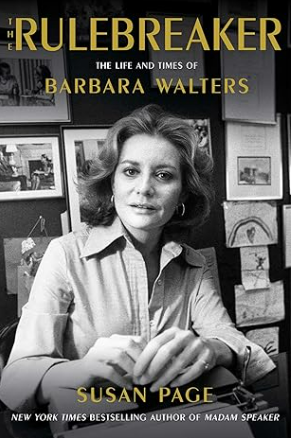
THE RULEBREAKER: The Life and Times of Barbara Walters, clarion call to women everywhere: get out of your own way, we need you


THE RULEBREAKER: The Life and Times of Barbara Walters
SUSAN PAGE

Simon & Schuster
$30.99 hardcover, available now

Rating: 4* of five

The Publisher Says: The definitive biography of the most successful female broadcaster of all time—Barbara Walters—a woman whose personal demons fueled an ambition that broke all the rules and finally gave women a permanent place on the air, written by bestselling author Susan Page.

Barbara Walters was a force from the time TV was exploding on the American scene in the 1960s to its waning dominance in a new world of competition from streaming services and social media half a century later. She was not just a groundbreaker for women (Oprah announced when she was seventeen that she wanted to be Barbara Walters), but also expanded the big TV interview and then dominated the genre. By the end of her career, she had interviewed more of the famous and infamous, from presidents to movie stars to criminals to despots, than any other journalist in history. Then at sixty-seven, past the age many female broadcasters found themselves involuntarily retired, she pioneered a new form of talk TV called The View. She is on the short list of those who have left the biggest imprints on television news and on our culture, male or female. So, who was the woman behind the legacy?

In The Rulebreaker, Susan Page conducts 150 interviews and extensive archival research to discover that Walters was driven to keep herself and her family afloat after her mercurial and famous impresario father attempted suicide. But she never lost the fear of an impending catastrophe, which is what led her to ask for things no woman had ever asked for before, to ignore the rules of misogynistic culture, to outcompete her most ferocious competitors, and to protect her complicated marriages and love life from scrutiny.

Page breaks news on every front—from the daring things Walters did to become the woman who reinvented the TV interview to the secrets she kept until her death. This is the eye-opening account of the woman who knew she had to break all the rules so she could break all the rules about what viewers deserved to know.

I RECEIVED A DRC FROM THE PUBLISHER VIA NETGALLEY. THANK YOU.

My Review
: Fighting misogyny, antisemitism, and the apathy of the public was one helluva training ground for becoming a powerful presence on the US cultural map. Her drive, and her zeal for journalism as a contact sport, were unprecedented in the pop culture of the 1960s. Her success was fueled by huge ambition...she would not fail in her duty to her chosen calling, like her father had done, and she would use every ounce of her will to make things happen her way.

These qualities are, annoyingly, still considered male. She out-manned the majority of men, then, and did it in a skirt and heels. It seems to me it's time to put down the bludgeon this kind of thinking represents to knock women back into antique roles that make "men" (boys, really) feel comfortable. Walters was a power in politics, a power in entertainment, and used her power to influence people to think. Even her celebrity interviews were impactful, raising or restoring some to new or renewed influence. She didn't lie to the people, she asked honest questions, and she never showed up unprepared.

The main thing I think made her a legend was her careful control...of herself, of her material, of her image. She didn't love Gilda Radner's SNL character "Baba Wawa" yet, when sending a condolence note to Radner's widower, she signed it "Baba Wawa"...and made sure this fact was known. Careful image curation is not the sole province of today's influencers. Her clarity of thought when she was at her peak was unrivaled. Even in later years her ability to present questions her audience would really like the answers to made her a popular figure on the cultural landscape.

Like all driven people, she left damage in her wake. She was rubbish as a mother, shouldn't've adopted a child; she was not a good wife, or a good partner, but there's no one to blame for that except societal expectations. No one ever whinges about the failings and failures of famous men in those regards. She was a force of nature. Those people are hurricanes, tornados, epic tsunamis. They aren't domesticated or domesticatable.

I suspect I'd've disliked the woman had I ever met her. She comes across in these interviews and the author's analysis as the kind of self-absorbed person who ignores you unless you're immediately useful. I dislike and mistrust those people. I can admire what she did without having warm personal feelings for her. Trailblazers and groundbreakers burn and break; it's in the epithets. Comfortable friends? Not likely. Powerful allies? Yes indeed, and that's enough! Adjusting expectations to match what's really there, what's on actual offer, is a key skill in the life of a person who sees a need for change and sets out to effect it.

Read this careful, honest, thorough story of one remarkable woman's life to feel inspired yourself. Gift it to your girlchild who is nosy, noisy, and obstreperous, that she may channel her talents into service. We need women to ask questions and require answers to them just like Barbara Walters did. We need women to confront idiots and show them up as idiots just like Barbara Walters did. Showing your girlchildren that it's been done, and done well, is a great way to get them to do the same.

Who knows who they'll end up photographed next to, or whose highlight reel they'll be responsible for, or whose foolishness they'll expose to end it? Barbara Walters had pages and pages and pages of evidence she had made a difference before she died. An ambition to be like her isn't a bad thing to ignite in young women.

Friday, November 6, 2020

MISS LONELYHEARTS, a biting and supremely outraged novella of alienation and the Problem of Evil


MISS LONELYHEARTS
NATHANAEL WEST
Books on Demand (non-affiliate Amazon link)
99¢ Kindle edition, available now

Rating: 4.75* of five

The Publisher Says: Praised by great writers from Flannery O'Conner to Jonathan Lethem, Miss Lonelyhearts is an American classic. A newspaper reporter assigned to write the agony column in the depths of the Great Depression seeks respite from the poor souls who send in their sad letters, only to be further tormented by his viciously cynical editor, Shrike.

This single volume of Miss Lonelyhearts features its original Alvin Lustig jacket design, as well as a new introduction by Harold Bloom, who calls it "my favorite work of modern American fiction."

My Review: Totally with Harold Bloom here, this is one of the USA's cultural treasures. In just under 100pp, anomie and alienation and the Problem of Evil (solved, allegedly anyway, by theodicy, resolving the evidential problem of evil that is the essence of the story West tells here) are examined thoroughly and from several viewpoints. While telling a louche little tale of drinking, fucking, and cheating, West also manages to incorporate an acid bath of gallows humor into the proceedings:

But now let us consider the holes in our own bodies and into what these congenital wounds open. Under the skin of man is a wondrous jungle where veins like lush tropical growths hang along over-ripe organs and weed-like entrails writhe in squirming tangles of red and yellow. In this jungle, flitting from rock-gray lungs to golden intestines, from liver to lights and back to liver again, lives a bird called the soul.


His nudges and winks at the audience are almost post-modern: Shrike, who is the otherwise-unnamed Miss Lonelyhearts' editor, is named for a particularly nasty bird of prey, and the man we call "Miss Lonelyhearts" is both emasculated and depersonalized by his yclepture.

He knew now what this thing was — hysteria, a snake whose scales are tiny mirrors in which the dead world takes on a semblance of life. And how dead the world is . . . a world of doorknobs. He wondered if hysteria were really too steep a price to pay for bringing it to life.


It's hard to imagine a more complete telling of the tale of man's bitter fate than this one. Trudge along in your path, you dumb oxen, and this is what will overtake you; lift your heads, look at the sky, and dare to yearn?

Love a man even in his sin, for that is the semblance of Divine Love and is the highest love on eath. Love all God's creation, the whole and every grain of sand in it. Love the animals, love the plants, love everything. If you love everything, you will percieve the divine mystery in things. Once you percieve it, you will begin to comprehend it better every day. And you will come at last to love the whole world with an all-embracing love.


This is what will overtake you. West knew it, felt it, and ultimately lived it by dying early as he drove drunk.

Fitting, isn't it.