Pages
- Home
- Mystery Series
- Bizarro, Fantasy & SF
- QUILTBAG...all genres
- Kindle Originals...all genres
- Politics & Social Issues
- Thrillers & True Crime
- Young Adult Books
- Poetry, Classics, Essays, Non-Fiction
- Science, Dinosaurs & Environmental Issues
- Literary Fiction & Short Story Collections
- Sookie Stackhouse/Southern Vampire Books & True Blood
- Books About Books, Authors & Biblioholism
Showing posts with label 1930s setting. Show all posts
Thursday, February 19, 2026
SKYLARK, Author Paula McLain's dual-timelines historical Paris novel
SKYLARK
PAULA McLAIN
Atria Books (non-affiliate Bookshop.org link)
$14.99 ebook, available now
Rating: 3* of five
The Publisher Says: The New York Times bestselling author of The Paris Wife weaves a mesmerizing tale of Paris above and below—where a woman’s quest for artistic freedom in 1664 intertwines with a doctor’s dangerous mission during the German occupation in the 1940s, revealing a story of courage and resistance that transcends time.
1664: Alouette Voland is the daughter of a master dyer at the famed Gobelin Tapestry Works, who secretly dreams of escaping her circumstances and creating her own masterpiece. When her father is unjustly imprisoned, Alouette's efforts to save him lead to her own confinement in the notorious Salpêtrière asylum, where thousands of women are held captive and cruelly treated. But within its grim walls, she discovers a small group of brave allies, and the possibility of a life bigger than she ever imagined.
1939: Kristof Larson is a medical student beginning his psychiatric residency in Paris, whose neighbors on the Rue de Gobelins are a Jewish family who have fled Poland. When Nazi forces descend on the city, Kristof becomes their only hope for survival, even as his work as a doctor is jeopardized.
A spellbinding and transportive look at a side of Paris known to very few—the underground city that is a mirror reflection of the glories above—Paula McLain’s unforgettable new novel chronicles two parallel journeys of defiance and rescue that connect in ways both surprising and deeply moving.
I RECEIVED A DRC FROM THE PUBLISHER VIA NETGALLEY. THANK YOU.
My Review: Tunnels, underground/out of sight communication, hidden pathways...thematically this is the heart of Author McLain's story. The literal, factual tunnels under Paris start us out on the careful and hazardous reality of being a woman or, later, that other despised minority a Jew...yes, women were a social minority, rendered voiceless and affectless the way minorities always are...so we're going underground to follow them as they fight to survive without being Seen and still being effective actors in society. Spoiler alert: It doesn't go well.
There ya go. That's the story. It took almost five hundred pages of pretty sentences to get there.
They are pretty sentences but honestly, taken out of context they're pretty much meaningless. Describing a sculpture made by a side character, "... a lark with wings unfurled, fashioned from pale limestone with such delicate precision that it seems almost alive," is lovely...but its entire reason for being described is in fact its meaning and that's a gestalt. This is not a criticism of the writing, it's a statement of why I'm not quoting a lot more pretty sentences.
In my opinion reading this really interesting story-idea could have been a lot more fun had the author been less pretty and more concise in her writing. It's a fine way to spend a weekend in the company of two people marginalized for being...unpopular because they're Other...but I don't know that I felt adequately entertained to justify the length of time it all took to come together.
Saturday, September 27, 2025
THE TOKYO ZODIAC MURDERS, a fair-play, betcha-you-won't-solve-it Japanese locked room mystery
THE TOKYO ZODIAC MURDERS
SŌJI SHIMADA (tr. Ross MacKenzie & Shika MacKenzie)
Pushkin Vertigo (non-affiliate Bookshop.org link)
$9.99 ebook, available now
Rating: 4.5* of five
The Publisher Says: An amateur detective races to solve a decades-old murder mystery in this “bloody and bizarre” Japanese crime novel with a twist hailed as “one of the most original” (Daily Mail).
Astrologer, fortune teller, and self-styled detective Kiyoshi Mitarai must solve a macabre murder mystery that has baffled Japan for 40 years—in just one week.
With the help of his freelance illustrator friend, Kiyoshi sets out to answer the questions that have haunted the country ever since: Who murdered the artist Umezawa, raped and killed his daughter, and then chopped up the bodies of six others to create Azoth, ‘the perfect woman’?
With maps, charts, and other illustrations, this story of magic and illusion—pieced together like a great stage tragedy—challenges the reader to unravel the mystery before the final curtain falls.
This quintessential Japanese “logic mystery”—eerie, gory, and intriguing—combines the puzzle-solving of Golden Age Western detective fiction with elements of shocking horror and dark humor.
I RECEIVED A DRC FROM THE PUBLISHER VIA EDELWEISS+. THANK YOU.
My Review: Japanese locked-room mysteries are pretty much exemplars of the genre. Unlike Dame Agatha's versions of the genre, they include a bit more gore...this one feels like it could easily have made itself a mild body-horror story with very little authorial effort...but the focus really is on the puzzle.
That focus is evident from the epistolary outset. The entire first thirty-plus pages is a letter written in 1936. It is the statement of purpose for the rest of the book: A murderer pens is intended crimes in detail, explaining why he intends to do these...vile, violent, violating...things to women.
Now, that right there? The crimes being committed against women for a man's gratification? That will get me to Pearl-Rule a book for good and ever. In this case I did not because I felt the facts presented in this introductory letter-cum-statement-of-purpose put the reader into the mindset of knowing the murderer's sickness. As a result, there was no prurient titillation of discovering the women's bodies to learn what had been done to them. I got in my head the purpose of the story, as it shifted into forensics, into crime-solving, because I knew what the crimes were for. I had already decided how twisted and sick the crimes were.
You should know this going in: Misogyny is on full display in very deeply disturbing ways.
Kiyoshi Mitarai, our sleuth, is in the modern day of the book...early 1980s Japan...solving an unsolved cold case. He's unusual in today's world for being a New-Age practitioner of astrology, a thing that was really prominent in culture at that time. He gets interested because the daughter of the police detective who failed to solve the case, dead now after a blighted career from this case, thinks her dad's soul can rest if the failure is reversed by solving it. Her brother horns in and sets our sleuth a serious time limit of five days to complete the puzzle, or the son will blow up old dirt about Kiyoshi.
As is necessary for a locked-room puzzle to get solved, Kiyoshi has a sidekick to think out loud to, and to do some legwork that the audience doesn't need to see. We'll learn it when mystery book lover, and importantly book illustrator, Kazumi Ishioka delivers the information anyway. (Side note: There is, for each timeline, a dramatis personae...prepare to use it A LOT.) The way the story is presented is largely through these two guys sitting and talking through what they know, how they know it, where they've been, and the like. Direct action? Not a lot. Fun little grace notes of these dudes preening for each other, making friend-jokes, talking about stuff that really does have something to do with the case but does not look like it? I'll read that over a run-around drenched in gore-fest. The world is violent enough.
The story's replete with floorplans and crime-scene illustrations (courtesy of Kizumi) and the details are numerous, hard to track, well-buried meanings abound. It is a delightful time for logic-puzzle reader. It turns meta when, approaching the end, the author directly addresses the reader, asking if we've solved the puzzle yet. Okay, thought I, now I'm aware that I have all the information I need to do it. So I sat me down to think. I flipped to some illustrations. I thought some more. I came up with a perp's identity. I read the rest of the story.
I was wrong. I was sure I was right, and I did not see until it was explained to me what I had missed.
That's a reading experience I really enjoy a lot. Get you one for some #Deathtober fun and games.
Saturday, June 14, 2025
GIVE MY LOVE TO BERLIN, a story I love but a novel I don't
GIVE MY LOVE TO BERLIN
KATHERINE BRYANT
Walrus Publishing (non-affiliate Amazon link)
$18.95 trade paper, available now
Rating: 3* of five
The Publisher Says: In 1927, the beautiful city of Berlin is the gay capitol of the world. Ruth, a performer at one of the nightclubs in the city, and her girlfriend, Tillie, are living their lives and enjoying the freedom of the Weimar Republic. They are surrounded by a chosen family that includes drag performers, transgender women, and the prominent physician, Dr. Magnus Hirschfeld. Ruth, Tillie, and their best friends, James and Ernesto spend much of their time at the Institute for Sexual Science, the hub of the queer community in the twenties and early thirties.
As the '20s come to a close, Tillie watches her father, a prominent lawyer, as he becomes more entrenched with the Nazi Party. Working in his law office as his secretary, she meets prominent figures in the Nazi Party, including Joseph Goebbels and Hermann Göring, and becomes increasingly concerned as time passes that there is much more at stake than just her relationship with Ruth, who is also Jewish.
Tillie becomes privy to the planning of rallies, the plans the Nazi party is making in order to ensure Nazi victories in major elections, and how the Nazis are taking over Germany one neighborhood at a time. The novel jumps between the twenties and thirties and the early nineties and a young woman named Thea. Thea is dealing with the onset of her grandmother's dementia, and discovers secrets hidden away that her grandmother never intended for her to uncover.
Alternating between Tillie's perspective during the '20s and '30s as the Weimar Republic slowly gives way to a dictatorship and Thea's perspective in the '90s as the secrets of her grandmother's history come to light, Give My Love to Berlin follows the lives of two gay couples—Tillie and Ruth, and their best friends, James and Ernesto—trying to navigate falling in love, thriving in their community, and coming to terms with the danger they are in just by being who they are.
The author wrote this book for several reasons, mainly because she had never heard of Dr. Magnus Hirschfeld, or his work and she did not know that Berlin had been such a huge part of gay culture. After the 2016 election, the author could see parallels between the vitriol for the queer community in many parts of the United States and the way queer people were being treated as the Nazis gained power, particularly in Berlin. Now, with all the anti-drag and anti-transgender legislation, it is more important than ever to tell these stories so we can keep them from repeating in the future.
I RECEIVED A DRC FROM THE PUBLISHER VIA NETGALLEY. THANK YOU.
My Review: The reviews of this book on Goodreads are very divided. Many apparently Jewish reviewers seem to take exception to the author's inclusion of queer people as victims of the Holocaust. Many others seem to dislike the wooden prose. I'm in the latter camp. (Pardon the wordplay.)
It's a great idea for a book, one that would've come across better had it felt less like research notes made to fit...poorly...around fictional standards. It's not clear to me that all the plot points were thought through...why would a woman working for literal Nazis ever question a trans person feeling threatened anywhere at all?...so I was left with the idea that this story seized the author's imagination but didn't get the mulling time, or followed editorial guidance, to smooth some of the burrs on its edge.
I was utterly repelled by the amount of sexual violence, as I know I was expected to be; the response to it from every character seemed...off. One does not just seamlessly drop the horror of sexual violence. It's ordinary to mask the trauma as a survival mechanism, but this felt more like just being okay with it. Again, I think this is more about the author not taking enough time to think these issues through, or not having (or heeding) editorial feedback.
If the author ever revisits the story with a strong editorial eye, this could be a good, interesting, involving novel. As it is, this is not a great read. I'm disappointed and saddened to say it.
Saturday, September 28, 2024
A BOOK I READ FOR MY LONG-AGO BOOK CIRCLE: SNOW COUNTRY by Nobel-winner YASUNARI KAWABATA
SNOW COUNTRY
YASUNARI KAWABATA (tr. Edward G. Seidensticker)
Vintage Books
$11.99 Kindle edition, available now
Rating: 3.5* of five
The Publisher Says: Nobel Prize recipient Yasunari Kawabata's Snow Country is widely considered to be the writer's masterpiece, a powerful tale of wasted love set amid the desolate beauty of western Japan.
At an isolated mountain hot spring, with snow blanketing every surface, Shimamura, a wealthy dilettante meets Komako, a lowly geisha. She gives herself to him fully and without remorse, despite knowing that their passion cannot last and that the affair can have only one outcome. In chronicling the course of this doomed romance, Kawabata has created a story for the ages, a stunning novel dense in implication and exalting in its sadness.
I CHECKED THIS BOOK OUT OF MY LOCAL LIBRARY. USE THEIR SERVICES OFTEN, THEY NEED US!
My Review: Married, bored (but I repeat myself) aesthete, philanderer, and flâneur Shimamura, an aficionado of Western ballet (although he's never seen one), takes a solo trip into Japan's Snow Country. While there in the wildest of boondocks Japan possesses, he meets Komako, probably the world's worst geisha, but apparently a fascinating contrast to all other women for Shimamura. They meet a total of three times in two years. Another woman, Yoko, hovers purposelessly around the narrative until, for no apparent reason, Komako and Shimamura have a fight over his feelings (?) for Yoko, who for some reason nursed Komako's not-quite-fiance Yukio while he died, despite the fact that Komako indentured herself to the (apparently quite unsuitable) career of geisha to pay for his death expenses.
Then a fire breaks out and Komako runs into the burning building and saves Yoko while Shimamura stands there and looks up at the sky. Fin.
No, seriously.
I spent the entire month I was reading this book, all 175pp of it, alternately claustrophobic and bemused. WTF, I kept thinking, why am I still at this rock-pile, trying to winkle out some small purpose to the narrative; then along would come a gem, eg:
It was a stern night landscape. The sound of the freezing of snow over the land seemed to roar deep into the earth. There was no moon. The stars, almost too many of them to be true, came forward so brightly that it was as if they were falling with the swiftness of the void.
p44, 1996 Vintage ed.
Oh wow, I thought, and plowed on. And on. And on. Every damn time Komako exhibits what today we'd call a bipolar break exacerbated by alcohol abuse, I'd find myself thinking, "This damned book is Come Back, Little Sheba directed by Kurosawa." Seriously. Shirley Booth did the same bloody role in that movie, only Burt Lancaster (whose role as her husband bewitched by a younger woman was pretty much exactly like Shimamura) is the one who drank.
I drank a good bit myself, trudging ever onward, marching off to war with the cross of Jesus going on before; okay, I'm a piss-poor Christian soldier, but you get the sense of futility I was experiencing. Then, it happened.
He had stayed so long that one might wonder whether he had forgotten his wife and children. He stayed not because he could not leave Komako nor because he did not want to. He had simply fallen into the habit of waiting for those frequent visits. And the more continuous the assault became, the more he began to wonder what was lacking in him, what kept him from living as completely...All of Komako came to him, but it seemed that nothing went out from him to her. He heard in his chest, like snow piling up, the sound of Komako, an echo beating against empty walls. And he knew he could not go on pampering himself forever. pp154-155So there *is* a point to this hike! And a profound one: The sudden awakening of human feeling in an otherwise dead heart. It was a payoff, and a major one. But did it have to be such a Bataan Death March of a journey to get here? And the stupid-ass last line of the book, which made me so bloody angry that I began raining curses on the lady whose idea it was our book circle read the book...! INFURIATINGLY SOPHOMORICALLY PORTENTOUS, I shrieked. The dog ran away from me. The same dog who, at an earlier moment in my tossing about of the book, expressed her opinion of it by fanging the corner. She calmed down after I did, but really...does one *want* to read this book? I won't do it again. But, on balance and after sleeping on it, I'm glad that I did.
Saturday, September 14, 2024
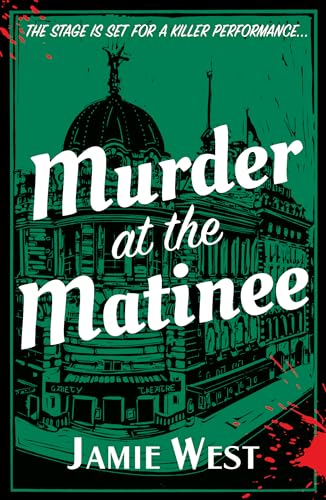
MURDER AT THE MATINEE, second quozy Bertie Carroll mystery...good fun!

MURDER AT THE MATINEE
JAMIE WEST
Brabinger Publishing (non-affiliate Amazon link)
$4.42 Kindle edition, available now
Rating: 4* of five
The Publisher Says: Following on from the success of Death on the Pier, gay playwright detective Bertie Carroll returns for the second book in this golden-age-style whodunnit series, set in the exciting world of theatreland in 1930s London.
An unexpected phone call from a rival playwright puts Bertie centre stage in another mystery. Can he help unravel the motive behind a mysterious newspaper advert that boldly declares a murder will take place during a show’s third act? There’s only one problem, there is no murder in the third act of the play!
When a victim is discovered and the police are brought in, Bertie and Inspector Hugh Chapman get thrown awkwardly back together as they both work to find the killer.
The spotlight falls on each suspect in turn and, this time, even Bertie is not above suspicion. But can rivalries and differences be put aside to solve this devious murder?
I RECEIVED A DRC FROM THE PUBLISHER VIA NETGALLEY. THANK YOU.
My Review: A riff on Dame Agatha's A Murder is Announced, this quozy story of Bertie Carroll coming to the aid of frenemy Alice, with his...well, his policeman Hugh there to do...rather less than in the first book; and then narrowly miss out on taking a starring role in the murder as a suspect so that comes out okay.
The reason that sounds incoherent is that I felt more at sea this time than last. How is it Hugh, clearly being set up as Bertie's Gentleman Caller, recedes more into the background? I wasn't expecting grand passion, it may be set in the theatre world but it's 1930s London so discretion was all. However Hugh and Bertie weren't as bantering-mates-with-subtext this time. That was disappointing. I suspect we'll get more of the bantering, and maybe even that mooted swim from the first book, in the next one.
I was pretty clear on who killed Alice but really didn't know why until the polyphonic ending unfolded. This was more than enough to satisfy my series-mytery reader brain. The first book's adeptness at scene-setting that transported me, this time, to 1930s London (instead of the first book's Brighton) is very much in evidence again. The author is a theatre professional. It's clear he's also willing to do careful research into the past. It is always a pleasure to read the words of someone who presents the world being evoked with such panache and confidence.
Aside from missing more Hugh-time for Bertie and me, I felt the mystery was satisfying my series-story craving enough to get a solid four stars. I probably wouldn't have been as generous if I'd read this book first, so read Death on the Pier (my review linked above) before this. But don't miss out. Bertie and Hugh will wile away a few hours while you're focused on the made-up problems of fictional people.
Monday, October 31, 2022
FRACTURE, Holocaust gay love affair & BEFORE ALL THE WORLD, gay Jew and his Black lover in Depression-era Philadelphia
BEFORE ALL THE WORLD
MORIEL ROTHMAN-ZECHER
Farrar, Straus & Giroux
$27.00 hardcover, available now
Picador's trade paper edition out 10 October 2023 for $19.00
One of NPR's Best Books of 2022!
Read Jean Hets's review here!
Rating: 4.5* of five
The Publisher Says: A mesmerizing, inventive story of three souls in 1930s Philadelphia seizing new life while haunted by the old.
"ikh gleyb nit az di gantze velt iz kheyshekh."
"I do not believe that all the world is darkness."
In the swirl of Philadelphia at the end of Prohibition, Leyb meets Charles. They are at a former speakeasy called Cricket’s, a bar that welcomes, as Charles says in his secondhand Yiddish, feygeles. Leyb is startled; fourteen years in amerike has taught him that his native tongue is not known beyond his people. And yet here is suave Charles—fingers stained with ink, an easy manner with the barkeep—a Black man from the Seventh Ward, a fellow traveler of Red Emma’s, speaking Jewish to a young man he will come to call Lion.
Lion is haunted by memories of life before, in Zatelsk, where everyone in his village, everyone except the ten non-Jews, a young poet named Gittl, and Leyb himself, was taken to the forest and killed.
Then, miraculously, Gittl is in Philadelphia, too, thanks to a poem she wrote and the intervention of a shadowy character known only as the Baroness of Philadelphia. And surrounding Gittl are malokhim, the spirits of her siblings.
Flowing and churning and seething with a glorious surge of language, carried along by questions of survival and hope and the possibility of a better world, Moriel Rothman-Zecher’s Before All the World lays bare the impossibility of escaping trauma, the necessity of believing in a better way ahead, and the power that comes from our responsibility to the future. It asks, in the voices of its angels, the most essential question: What do you intend to do before all the world?
I RECEIVED A DRC FROM THE PUBLISHER VIA NETGALLEY. THANK YOU.
My Review: I fear what I am about to say will doom a very fine read in too many of y'all's eyes: This isn't a standard-English-only novel. The characters sometimes speak Yiddish, sometimes speak as though mentally translating Yiddish into English on the fly, and all of it at the author's preferred energetic pace. The best I can say about those whose reading doesn't often stretch to variants of English is, there are very helpful footnotes.
Oh well. I had to say it despite the fact that most of y'all just clicked over to I Can Has Cheezburger? for a chuckle or two.
If you're still here, let me assure you that there's a lot to love about this story. Leyb/Lion, a gay Jew, is really and truly alive for me; his on-again, off-again love for the surprising Charles, a Black labor-organizing socialist-sympathizing Yiddish-speaking multihyphenate whose precarious identities are beautifully balanced. Their love story, to my gay eye vanishingly light on sex, is only one of the story's love stories. Gittl, a poet/seer of angels, is Leyb/Lion's nowsister who was presumed killed in a Red Army pogrom he avoided by being thrown out of Zatelsk for his faggoty ways. She shows up in Philadelphia, mirabile dictu, and is fêted by the middle-class Jewish community led by a soi-disant Baroness there as a harbinger of socialist paradise...despite almost dying at the hands of the "socialist" Soviets. This lionization ends when Gittl and Charles, um, well.
How this dissonant collection of adherents and believers and practitioners harmonizes their modes of being, their inner identities, and their actions is as one would expect: inconsistently and imperfectly and, all too often, inconsiderately. Every adult has learned to accept that others love in their own ways, or has been carted off to a safe place with lots of lovely pills to manage the aftermath of refusing the lesson. Leyb/Lion and Charles with their utterly amazing intersections of identity are, to no one's surprise, among the most wounded. Charles's belief in the socialist revolution survives the movement's apathy towards acknowledging the hideous harm caused by slavery, and its continuing horrors and cruelties. Leyb/Lion's gayness, well...Jews weren't mad for it then, though I understand there are more accepting branches of Judaism in modern times, and have no reluctance about letting him know he's less than, lower down in their esteem because of it. Gittl's a woman. What else needs be said, that fully explains the horrors she has and will endure before, during, and likely after amerike, philadelphiye, the doctor who slurmed out (of) his amerikanische, tooth jutting mouth the horrible, cruel orders to sedate her...are all in Life's past. It is this dissonance, however, that shaved a half-star off my rating. I wasn't as convinced as I thought the author expected me to be that these people would enact the steps they danced to. I was close to believing it for Gittl and less so for Leyb/Lion; Charles, the man made of and for Love, perhaps least of all. It wasn't an existential, "what are you even talking about?" level of dissonance but a quietly uneasy mental drumbeat of "...really...?" throughout the read.
“What will you do before all the world?”
That is the heart of the novel; that is the wisdom the reader is offered by the read. It's not clear to me that the characters *answer* this question. It is clear to me that they live in its words, that they think inside the whorls of that question mark and fall onto the finality of the period at its base.
++++++++++++++++++++++++++++++++++++++++++++++++++++++++++++++++
FRACTURE
ELYSE HOFFMAN
Project 613 Publishing (non-affiliate Amazon link)
99¢ Kindle edition, available now
Rating: 4* of five
The Publisher Says: A heart-wrenching WW2 story of forbidden love and torn allegiances.
Franz Keidel is a monsterous SS soldier: loyal, hateful, and devoted to Hitler. With a cold heart, he hunts down his Führer’s enemies, but one fateful mission will fracture his shield of ice.
While hunting for Jews, Franz stumbles across a familiar face: Amos Auman, his childhood friend. Amos is the only source of joy in Franz’s life, but he is also a Jew. Unable to bring himself to kill his friend, Franz vows to protect Amos from his fellow Nazis.
As Franz spends more time with Amos, bringing him food and books, he falls in love with his kind-hearted friend. How could he fall in love with a man, a Jew? How can he continue to hate Jews when a Jew has thawed his icy heart?
And what will Franz do if he has to choose between Amos and his loyalty to Hitler? What choices does he have when he is already beyond redemption?
I RECEIVED A DRC FROM THE PUBLISHER VIA NETGALLEY. THANK YOU.
My Review: I think a lot of us in the QUILTBAG community have forgotten, or at least not paid much attention to, the fact that Jews who were gay during the Nazi era were doubly endangered by their identities (where do y'all imagine the pink triangle symbol still widely used in our community came from if not a repurposing of a hate symbol?). It's simple, really, to focus on the six-million-dead mantra; there's no such count, either kept or kept alive in the public's awareness, for QUILTBAG or other victims of the eugenic nightmare of Nazi Germany and its eager hench-rats all over conquered Europe.
Amos is doubly blessed, then, as a gay Jew...two targets on his thin shoulders. Franz, abused and brutalized all childhood long, found such refuge as was possible with Amos and his family. But events conspire to separate the boys, as is usual in life. What counts for more with Franz than any memories of happiness is the community and sense of belonging that he finds in the hate-filled and -fueled ideological mob of brutes and bastards that replicate his abusive family...from the inside this time, as he gets to be the abuser instead of the abused.
Meeting fugitive Jew Amos again, knowing it's his friend Amos, and being in the position of power over Amos instead of dependent on him, his family, for such kindness as he ever knew, enables Franz to find a way through the maze of rage and pain he's carried inside for his whole life. He chooses, in a split second, a course of honor and love when he has accepted the course of hatred and violence that come naturally to him. To all humans, really. His decision to lie in order to save Amos's life is the crack in his armor that will lead him to accept the truth about himself and thus about his world. He loves Amos as a friend, he desires Amos as a lover, and he must then reject the lies and distortions he's been embracing as fundamental to his sense of himself to be the self who deserves Amos's return of love.
The first-kiss scene between the young men was very moving.
That might have made the inevitable ending more saddening, more painfully awfully real. One knows this can't, outside the realm of fairy tale, end in Happily Ever After. But the actual events are a gut-punch of reality after a honeymoon of discovery and love. (Side note: The Epilogue wasn't successful to me. It's a full-star deduction for silliness.)
But the four-star rating above should tell you what you need to know about my opinion of the story. It's a shame nothing made by human hands can be perfect, or at least not often, but perfect is the enemy of good. This is a good story told well. If it didn't actually, factually happen this way somewhere, I'll be surprised. And that ain't nothin' in my reading life.
Monday, October 10, 2022
THE LINDBERGH NANNY, historical fiction about a case we still talk about 90 years on & HESTER, speculation about Hawthorne's THE SCARLET LETTER
HESTER
LAURIE LICO ALBANESE
St. Martin's Press
$27.99 hardcover, available now
Rating: 3.75* of five
The Publisher Says: A vivid reimagining of the woman who inspired Hester Prynne, the tragic heroine of Nathaniel Hawthorne's The Scarlet Letter, and a journey into the enduring legacy of New England's witchcraft trials.
Who is the real Hester Prynne?
Isobel Gamble is a young seamstress carrying generations of secrets when she sets sail from Scotland in the early 1800s with her husband, Edward. An apothecary who has fallen under the spell of opium, his pile of debts have forced them to flee Edinburgh for a fresh start in the New World. But only days after they've arrived in Salem, Edward abruptly joins a departing ship as a medic—leaving Isobel penniless and alone in a strange country, forced to make her way by any means possible.
When she meets a young Nathaniel Hawthorne, the two are instantly drawn to each other: he is a man haunted by his ancestors, who sent innocent women to the gallows—while she is an unusually gifted needleworker, troubled by her own strange talents. As the weeks pass and Edward's safe return grows increasingly unlikely, Nathaniel and Isobel grow closer and closer. Together, they are a muse and a dark storyteller; the enchanter and the enchanted. But which is which?
In this sensuous and hypnotizing tale, a young immigrant woman grapples with our country's complicated past, and learns that America's ideas of freedom and liberty often fall short of their promise. Interwoven with Isobel and Nathaniel's story is a vivid interrogation of who gets to be a "real" American in the first half of the 19th century, a depiction of the early days of the Underground Railroad in New England, and atmospheric interstitials that capture the long history of "unusual" women being accused of witchcraft. Meticulously researched yet evocatively imagined, Laurie Lico Albanese's Hester is a timeless tale of art, ambition, and desire that examines the roots of female creative power and the men who try to shut it down.
I RECEIVED A DRC FROM THE PUBLISHER VIA NETGALLEY. THANK YOU.
My Review: A book about passion elicits passionate responses. Thus The Scarlet Letter from its date of publication to the present. What Author Albanese did was meld a fact of Hawthorne's life...all his novels save this one sprang from known biographical incidents..and said, "...except...? Hmmm" and ran with it.
Thus we have this novel, which I stress so loudly because I've seen a lot of responses to the book that take exception to the author's assumption that Hawthorne was always a writer working from his own biography. I fail to understand this. It's a novel, and novels are fiction. The way they get their lives is someone thinking, "hey, what if..." and running with it. "Oh it's unsourced in anything from the time" well now, our little firebug Hawthorne might've hidden many a secret forever in his purgings, mightn't he? What he didn't want us to know, we do not know. ...that sounds weird but I don't know how to fix it.
Anyway, considering the story on its own merits...I like it okay. I don't love it.
Too much, too much, I thought as Isobel synesthesia came to the fore, then as we whizzed back into the seventeenth century again.... It's just another thing to mark her out as weird, this strange sensory disorder. Her life was eventful and her loves bone-rattlingly deep wasn't enough? When I read novels I want to think about how the life unfolding before me is moving, not how it's making me move between emotional registers. That's when I begin to feel a bit like a footstool, moved here, plopped there, and all in service of someone else's visions and needs.
Yes yes, I know, that is what novelists do. But the ones whose work I treasure do it with less grunting and heaving.
Setting the novel in Salem, and with Hawthorne...well, the parallels to his probable state of guilt and discomfort over the history even then looked on as brutal and his treatment of Isobel aren't challenging to form are they. I wasn't particularly enamoured with the author's take on Hawthorne, finding him a dreary sort of navel-gazing git. I'm not all the way sure that he could've been as quivery as a blancmange and still written the work he did. I could, of course, be wrong. After all, I suspect that Melville's obvious tendresse for Hawthorne was not entirely unreciprocated and I am *loudly*assured* this is unthinkable.
Back to Hester. I wish it was less hectic. I would've enjoyed a more uncluttered interior for the novel to present itself to me; one colored less hectically and decorated less thoroughly with lovely bibelots and literary objet d'art. But the read as it was, distractingly stuffed into a space a bit too small for it, was a deeply interesting and quite soundly reasoned story. The passive little Hawthorne falling for the intensely alive Isobel? Yes, I see it. The quivering awakening of the young people to bodily pleasure? It is ever thus, and so always involving to me. The resolution of the matters that, quite inevitably, come from the aforementioned awakening? Fortuitous! And, as the epilogue-y thing at the end makes Ever. So. Clear, it all came good.
Please don't tie bows and smack 'em on the butts of my stories. I'd like some room to put my own thoughts into the story's likely continuation.
These are the things that kept me from warbling my fool lungs out about this read. Others will, I do not doubt, feel differently. I expect so, in fact, and hope I'll be seeing the author's gorgeous cover art in many a gift pile this Yule.
++++++++++++++++++++++++++++++++++++++++++++++++++++++++++++++++
THE LINDBERGH NANNY
MARIAH FREDERICKS
Minotaur Books
$27.99 hardcover, available 15 November 2022
Rating: 4* of five
The Publisher Says: Mariah Fredericks's The Lindbergh Nanny is powerful, propulsive novel about America’s most notorious kidnapping through the eyes of the woman who found herself at the heart of this deadly crime.
When the most famous toddler in America, Charles Lindbergh, Jr., is kidnapped from his family home in New Jersey in 1932, the case makes international headlines. Already celebrated for his flight across the Atlantic, his father, Charles, Sr., is the country’s golden boy, with his wealthy, lovely wife, Anne Morrow Lindbergh, by his side. But there’s someone else in their household—Betty Gow, a formerly obscure young woman, now known around the world by another name: the Lindbergh Nanny.
A Scottish immigrant deciphering the rules of her new homeland and its East Coast elite, Betty finds Colonel Lindbergh eccentric and often odd, Mrs. Lindbergh kind yet nervous, and Charlie simply a darling. Far from home and bruised from a love affair gone horribly wrong, Betty finds comfort in caring for the child, and warms to the attentions of handsome sailor Henrik, sometimes known as Red. Then, Charlie disappears.
Suddenly a suspect in the eyes of both the media and the public, Betty must find the truth about what really happened that night, in order to clear her own name—and to find justice for the child she loves.
I RECEIVED A DRC FROM THE PUBLISHER VIA NETGALLEY. THANK YOU.
My Review: A lot of ink is still spilled about this dreadful criminal act, ninety years on; it has everything we love in a public spectacle: a pretty woman, a handsome hero, a quiet young girl with big dreams. That these won't survive contact with the ever-increasing celebrity culture that mass media, only recently including newsreels and radio broadcasts, with its invasive tentacles shoving into each and every cranny of the principals' lives, thoughts, actions before, during, and after the events described, is the darkest tinge of tragedy.
As part of this non-fiction novel coming this November, Author Fredericks presents her research in epitome..."this is true, this bit's been changed but is mostly true"...which to my mind is the proper way to handle a researched work of fiction that is based on fact. I do not care for the research-paper lists of sources, citations, and so forth, that some authors provide so as to spike the many, many guns aimed at creators in internet culture. "Appropriation! Inaccuracies and falsehoods!" ::eyeroll:: It's called FICTION, people, CTFD.
My personal axe now ground to my own satisfaction, let me tell you what I enjoyed most about the read:
It's not clear where I'll be living. I'm part of the Lindbergh household, but they have no house of their own yet, which is why they're living with her parents. They've not even been married two years and seem to have spent most of that time in the air.
That's Betty's voice from the beginning of chapter three. She's direct. She's concise. She does not shilly-shally, not ever and not once. I like that in a person, I appreciate that in a character, and I am glad to say that Betty was (despite the media circus that she endured without much in the way of role models to guide her) a delightful companion in her own life as well. (The author speaks of her meeting with A. Scott Berg when he was writing his Lindbergh biography, what transpired during that meeting, and this informed her awareness of how she wants Betty's voice to sound. She nailed it.)
This being a factual story, and the author giving no hint that she intended to pull a fast one at the end, I was deeply pleased to feel invested in the unfolding tale. It's really easy, with a story not exactly underreported, and about which there is quite an extensive trove of writing already. (Ye gawds some of what's been said...!) No, the ending hasn't changed; yes, the guilty party's guilt is evident; but there are so many cockroaches scuttling for cover in any person's existence if an arc-lamp like the one aimed at the Lindberghs is trained on it that there's room for a lot of juicy speculation.
How can you not be impressed when someone takes ninety-year-old facts and makes a solid, well-made story out of them?
But...I hear the Gotcha! Gang clearing their throats...this is a four-star review and you're describing a five-star experience. Well, no thing made by human hands is perfect, is it. I rankle mightily at the author's choice to ascribe a certain suspect's furtive, secretive, and frankly unpleasant suspiciousness as down to that suspect's gayness. Yes indeed, the suspect's actual sexuality was not ever even hinted to be "deviant" in the parlance of the day. In the endnotes, the author says she made this deliberate choice to give the character a "need for privacy that would be instantly understandable to the modern reader."
Uh-huh.
That star-losing choice aside...Yes, I'm impressed. Yes, I'd say go pre-order one. I'm so glad I was able to read it as a DRC because the wait for the library's inevitable copy will be long. Get on it soon.
Saturday, May 21, 2022
HITLER'S AMERICAN FRIENDS: The Third Reich’s Supporters in the United States, traitorous fascist sympathizers aren't new
HITLER'S AMERICAN FRIENDS: The Third Reich’s Supporters in the United States
BRADLEY W. HART
Thomas Dunne Books
$11.99 Kindle edition, available now
Rating: 4* of five
The Publisher Says: A book examining the strange terrain of Nazi sympathizers, nonintervention campaigners and other voices in America who advocated on behalf of Nazi Germany in the years before World War II.
Americans who remember World War II reminisce about how it brought the country together. The less popular truth behind this warm nostalgia: until the attack on Pearl Harbor, America was deeply, dangerously divided.
Bradley W. Hart's Hitler's American Friends exposes the homegrown antagonists who sought to protect and promote Hitler, leave Europeans (and especially European Jews) to fend for themselves, and elevate the Nazi regime.
Some of these friends were Americans of German heritage who joined the Bund, whose leadership dreamed of installing a stateside Führer. Some were as bizarre and hair-raising as the Silver Shirt Legion, run by an eccentric who claimed that Hitler fulfilled a religious prophesy. Some were Midwestern Catholics like Father Charles Coughlin, an early right-wing radio star who broadcast anti-Semitic tirades. They were even members of Congress who used their franking privilege—sending mail at cost to American taxpayers—to distribute German propaganda. And celebrity pilot Charles Lindbergh ended up speaking for them all at the America First Committee.
We try to tell ourselves it couldn't happen here, but Americans are not immune to the lure of fascism. Hitler's American Friends is a powerful look at how the forces of evil manipulate ordinary people, how we stepped back from the ledge, and the disturbing ease with which we could return to it.
I RECEIVED A DRC FROM THE PUBLISHER VIA NETGALLEY. THANK YOU.
My Review: It's always been a failing of the left-wing political folk to see the Apocalypse in each and every thunderation from the Christo-Fascist Right as the ongoing battle for the USA's soul continues. There are now, there were in the 1950s, there were in the 1930s and 1940s, traitorous scum whose personal vision of a Perfect World contains only people like them, who are willing to do anything legal or not to enforce their will on the eternal majority who don't want that. In an article in The Nation, the author of the think piece I've linked to comments most saliently on the Red Scare years' school-textbook battles, book burnings, and other such performative outrage with this pithy remark:
Most Americans don’t think that proponents of critical race theory are secretly spreading “Marxism” in the schools, either, or that woke corporations are somehow supporting the same evil project. The people who make such claims are a small minority, just as they were in the 1950s.
The fact is that our country's been under some form of internal attack from fascist and/or authoritarian right-wing rabble since Day One. So has every other political structure. Let's not forget the fate of Periclean Athens. It's the eternal project of greedy, selfish control freaks to get everything they can into their own hands and to control what they can't possess.
Author Hart made a well-researched and -written alarm call against calm, resigned acceptance of the culture coup attempted during the 45th president's term in this book. He uses the well-documented and clearly overcome existence, activities, and failures of Nazi sympathizers in the US. It is an effective technique; it uses as its organizing principle a simple structure: Each chapter is dedicated to a single organization active in promoting German/Nazi interests in the US, and gives some crucial details about how and why this choice was made. It also characterizes and puts into timely context the people who made up the institution in question. This avoids a common trap in histories of zeitgeists or social movements, the dreaded alphabet soup of initialism and too-similar or too-often-repeated names. That admittedly more synthetic approach can weave a tapestry of details. It more often than that causes severe MEGO disease.
The most disturbing take-away of this entire loudly rung tocsin is that these forces of anti-democratic rage failed because they lacked a credible, powerful leader. Today's versions, it is very frightening to realize, do not suffer from that lack. It isn't that Author Hart is unaware of this, it's that he seemed to feel he shouldn't make as much of the echoes I heard in each chapter of current events as I would've preferred. There is something to be said for taking off the gloves and hitting the enemy within hard. It's something "they" do a lot of (see my review of The Obama Hate Machine) and with a lot less factual basis than Author Hart presents.
Why this book only gets four stars from me is the quite startling number of uncorrected typos that made it from the DRC I read into the library copy I checked out. Scandalous! And, in the end, there were moments that I found myself not quite satisfied with the case the author made for some person or organization's motivation for opposing the US entry into WWII. Mixed motives are more common than pure ones on every gradation of the ideological spectrum, as (for example) morally based pacifism is present among right-wingers, too.
Perhaps the most telling thing that I noticed go underremarked was the utter ineffectuality of Hoover's FBI in going after right-wing terrorism. Red Scare propaganda against our nominal allies the Soviets was rife. How telling that is...British intelligence informed the US government better about domestic threats than Hoover's FBI.
I was still angered and unsettled and unnerved by this read. I am recommending it to all and sundry who think the Right's victory in the 2022 midterm elections is somehow inevitable. We who do not wish to have our country scourged by the hypocrites and religious nuts of this book's modern counterparts should heed Author Hart's dictum: "{U}nfortunately, the merchants of hate always seem to have someone to listen to them." Let's plug the holes in our national awareness. It can only help the side dedicated to the rights and duties of citizens against the Right's attacks on them.
Friday, November 6, 2020
MISS LONELYHEARTS, a biting and supremely outraged novella of alienation and the Problem of Evil
MISS LONELYHEARTS
NATHANAEL WEST
Books on Demand (non-affiliate Amazon link)
99¢ Kindle edition, available now
Rating: 4.75* of five
The Publisher Says: Praised by great writers from Flannery O'Conner to Jonathan Lethem, Miss Lonelyhearts is an American classic. A newspaper reporter assigned to write the agony column in the depths of the Great Depression seeks respite from the poor souls who send in their sad letters, only to be further tormented by his viciously cynical editor, Shrike.
This single volume of Miss Lonelyhearts features its original Alvin Lustig jacket design, as well as a new introduction by Harold Bloom, who calls it "my favorite work of modern American fiction."
My Review: Totally with Harold Bloom here, this is one of the USA's cultural treasures. In just under 100pp, anomie and alienation and the Problem of Evil (solved, allegedly anyway, by theodicy, resolving the evidential problem of evil that is the essence of the story West tells here) are examined thoroughly and from several viewpoints. While telling a louche little tale of drinking, fucking, and cheating, West also manages to incorporate an acid bath of gallows humor into the proceedings:
But now let us consider the holes in our own bodies and into what these congenital wounds open. Under the skin of man is a wondrous jungle where veins like lush tropical growths hang along over-ripe organs and weed-like entrails writhe in squirming tangles of red and yellow. In this jungle, flitting from rock-gray lungs to golden intestines, from liver to lights and back to liver again, lives a bird called the soul.
His nudges and winks at the audience are almost post-modern: Shrike, who is the otherwise-unnamed Miss Lonelyhearts' editor, is named for a particularly nasty bird of prey, and the man we call "Miss Lonelyhearts" is both emasculated and depersonalized by his yclepture.
He knew now what this thing was — hysteria, a snake whose scales are tiny mirrors in which the dead world takes on a semblance of life. And how dead the world is . . . a world of doorknobs. He wondered if hysteria were really too steep a price to pay for bringing it to life.
It's hard to imagine a more complete telling of the tale of man's bitter fate than this one. Trudge along in your path, you dumb oxen, and this is what will overtake you; lift your heads, look at the sky, and dare to yearn?
Love a man even in his sin, for that is the semblance of Divine Love and is the highest love on eath. Love all God's creation, the whole and every grain of sand in it. Love the animals, love the plants, love everything. If you love everything, you will percieve the divine mystery in things. Once you percieve it, you will begin to comprehend it better every day. And you will come at last to love the whole world with an all-embracing love.
This is what will overtake you. West knew it, felt it, and ultimately lived it by dying early as he drove drunk.
Fitting, isn't it.
Thursday, August 31, 2017
WATER FOR ELEPHANTS, a rare film adaptation that does the book justice
WATER FOR ELEPHANTS
SARA GRUEN
Algonquin Books of Chapel Hill
$14.95 trade paper, available now
Rating: 3* of five
The Publisher Says: Though he may not speak of them, the memories still dwell inside Jacob Jankowski’s ninety-something-year-old mind. Memories of himself as a young man, tossed by fate onto a rickety train that was home to the Benzini Brothers Most Spectacular Show on Earth. Memories of a world filled with freaks and clowns, with wonder and pain and anger and passion; a world with its own narrow, irrational rules, its own way of life, and its own way of death. The world of the circus: to Jacob it was both salvation and a living hell.
Jacob was there because his luck had run out—orphaned and penniless, he had no direction until he landed on this locomotive “ship of fools.” It was the early part of the Great Depression, and everyone in this third-rate circus was lucky to have any job at all. Marlena, the star of the equestrian act, was there because she fell in love with the wrong man, a handsome circus boss with a wide mean streak. And Rosie the elephant was there because she was the great gray hope, the new act that was going to be the salvation of the circus; the only problem was, Rosie didn’t have an act—in fact, she couldn’t even follow instructions. The bond that grew among this unlikely trio was one of love and trust, and ultimately, it was their only hope for survival.
Surprising, poignant, and funny, Water for Elephants is that rare novel with a story so engrossing, one is reluctant to put it down; with characters so engaging, they continue to live long after the last page has been turned; with a world built of wonder, a world so real, one starts to breathe its air.
My Review: I don't want to give anyone the wrong impression here. I am not a sentimental old softie whose external resemblance to a conker
is meant to scare off the timid.
But books about old folks remembering their bittersweet pasts, books about people caring for and about the animals that they share their lives with, and books about losing your beloved far too damned soon in life do drive a teensy-tinsy little wedge into my sharp green spikes, revealing what I laughingly refer to as a "heart" for the briefest of moments.
Without spoilering anything, the clue I will give you to my rating of this novel is that all three stars are for Rosie.
When this book came out in 2006, it was a huge smash success. Sara Gruen touched a nerve with her evocation of the 1930s traveling-circus world. People resonated like rung bells from one end of the US to the other. I read the book then, and reacquainted myself with it recently, to remember what it was that caused the ruckus.
Age is a terrible thief. Just when you're getting the hang of life, it knocks your legs out from under you and stoops your back. It makes you ache and muddies your head and silently spreads cancer throughout your spouse.***
Although there are times I'd give anything to have her back, I'm glad she went first. Losing her was like being cleft down the middle. It was the moment it all ended for me, and I wouldn't have wanted her to go through that.I think many, if not most, of the book's fans really resonate with these assessments. I know I do. It's not the most original kind of observation ever made but it's presented in a pleasantly conversational tone, one that gives the meaning precedence over the words.
Gruen also has Jacob thinking through the problems of great age. Since the main body of the story is set quite a long time ago, Jacob gets to tell us his story unchallenged. His memories may be unreliable, how would we know?, but he gives them to us with gusto and a charming smile. That's what we all hope to do, isn't it, give the younger folks coming behind us a reason to smile as we share what we have stored in our Random Access Memory?
My platitudes don't hold their interest and I can hardly blame them for that. My real stories are all out of date. So what if I can speak firsthand about the Spanish flu, the advent of the automobile, world wars, cold wars, guerrilla wars, and Sputnik — that's all ancient history now. What else do I have to offer? Nothing happens to me anymore. That’s the reality of getting old, and I guess that’s really the crux of the matter. I’m not ready to be old yet.***
Sometimes when you get older — and I’m not talking about you, I’m talking generally, because everyone ages differently — things you think on and wish on start to seem real. And then you believe them, and before you know it they’re part of your history, and if someone challenges you on them and says they’re not true — why, then you get offended because you can’t remember the first part. All you know is that you’ve been called a liar.It's an indignity perpetrated on most of us by the vast legions of those addicted to Being Right. Really, I want to say to the I'm Right And Don't You Forget It judges, give it a rest. Believe me when I tell you your own turn in the unreliable memory chair is coming soon. It's better to treat those memories other folks choose to share with you as their stories and not be ready to hop on the Being Right Soapbox. It's a theme that Gruen seems to me to be developing, though rather in the breach than the observance.
So these quotes give you a fair sampling of the book's storytelling voice. These ideas are the ones that Gruen really bears down hard on exploring in Jacob's voice. So why am I giving all the stars to Rosie? Because this elephant, though she never utters a word, is the most vibrantly alive character in the book. Jacob is any-old-man. Rosie is not, I promise you, any old elephant! And the pleasure of Jacob and Rosie having their relationship makes this a book I didn't mind revisiting. The love affair that is the primary catalyst of all the story's action, that between Marlena and Jacob, centers on Rosie as Marlena performs her act for the circus with Rosie. Jacob, the vet, is Rosie's constant companion. Rosie is, in my mind at least, the real star of the circus and the book.
In 2011, Reese Witherspoon and Robert Pattinson added a layer to the book's luster by embodying (damn near perfectly, in my never-humble opinion) Marlena and Jacob, the star-crossed lovers at the human heart of the tale. I'm no great fan of ~meh~ movie adaptations to popular books. I've generally got some choice invective for incompetent or poorly handled film versions of books. This adaptation is one I felt got the tone, the indefinable something that made the book such a success, right. The adaptation is also visually stunning, simply pitch-perfect in its period details and an immersive delight to watch.
The one problem I had with both the book and the movie is a big one: I didn't buy the love story in either medium. I just do not get the sense that Jacob really had the grand passion for Marlena that's reported everywhere in the text and the script. I certainly don't think Ms. Witherspoon and Mr. Pattinson were attracted to each other. That kept cropping up in the way of my full investment in the story.
Rotten Tomatoes, the internet movie-review aggregator, counts this as a mostly-fresh release. Its total number of professional reviews is a whopping 191, making its Fresh rating of 60% quite impressive. 68,000 regular civilians who use Rotten Tomatoes to track their film likes and dislikes give the adaptation Fresh ratings 70% of the time. 1.1 million ratings on Goodreads average 4.07 out of five for the novel. No matter the medium, the message to the audience comes through loud and clear, and the audience agrees with it. That, my friends, is called "huge success" and deserves the rewards thereof.
The reading group guide lives here, free to download.
Monday, March 6, 2017
FOLLOW THE RABBIT-PROOF FENCE, Aboriginal Australian girl-children with more grit than most adults
FOLLOW THE RABBIT-PROOF FENCE
DORIS PILKINGTON aka Nugi Garimara
University of Queensland Press
$9.99 Kindle edition, available now
Rating: 3.5* of five
The Publisher Says: This extraordinary story of courage and faith is based on the actual experiences of three girls who fled from the repressive life of Moore River Native Settlement, following along the rabbit-proof fence back to their homelands. Assimilationist policy dictated that these girls be taken from their kin and their homes in order to be made white. Settlement life was unbearable with its chains and padlocks, barred windows, hard cold beds, and horrible food. Solitary confinement was doled out as regular punishment. The girls were not even allowed to speak their language. Of all the journeys made since white people set foot on Australian soil, the journey made by these girls born of Aboriginal mothers and white fathers speaks something to everyone.
My Review: Doris Pilkington's grandfather was a cowardly white man who failed to protect his three half-Aboriginal daughters from the colonial mentality espousing their forced removal from their parents. Their mother left the cad, good on her, and was still powerless to act against the white government to get her daughters out of their "residential school" where they were maltreated. The aim of their removal from Aboriginal society was to prevent them from passing on the values of their society, instead becoming darker-skinned white people. Oh, and not just that, but inferior servant-class white people.
Can't imagine where the Aussies got such a horrible idea. Nope. Just can't. Nor where the South Africans got the idea for apartheid. Nuh-uh. Imponderable. No relation to the American policies on Native peoples or former slaves. Dear me, no.
That sarcasm out of the way, I will remark that the story is presented as a novel despite the fact that Pilkington aka Garimara (1937-2014) was writing about her very own mother's story. It freed her to write about the details of the girls' experiences, ones she must have heard from her mother's own lips, without the burden of fact-checking or documenting things that were never written down or part of any official record in the first event.
The prose isn't stellar. In fact it's pretty clunky. I enjoyed the Aboriginal words used without explanation, since there was a handy-dandy glossary in the back of the book; I didn't want the author to lead me by my lily-white hand to the Promised Land of Otherness. I expect that my rating would've been a lot lower had she done that. I was simply dropped into the otherness, as Molly and her sisters were. It's a good technique, effectively putting the reader into the shoes of scared children.
In the end, the experience of reading the book was better than the book itself. What a weird sentence that is; I know I must sound like a raving loonie. But what I mean by that is that this is a truly important and continually relevant (depressingly) tale of oppression and victimization based on ethnic difference. It just isn't a particularly well-written one. And still it makes a strong impression on the reader, one that means something inside shifts a bit, hopefully in a positive direction. I'd suggest reading it to anyone who thinks the segregation of an ethnic minority is in any way a good idea.
The 2002 film, Rabbit-Proof Fence, is only $2.99 to rent at Amazon. It's got some areas where it's a bit better than the book, and some lovely cinematography. The book and the film are best enjoyed together. How unusual is that!
Monday, September 26, 2016
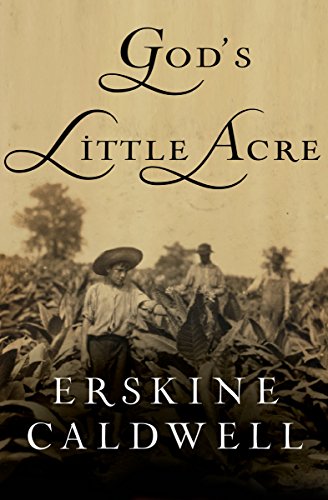
GOD'S LITTLE ACRE, a Banned Books Week sale from Open Road Media

GOD'S LITTLE ACRE
ERSKINE CALDWELL
Open Road Media
$1.99 Kindle edition, available now
Rating: 3.75* of five
The University of Georgia Says: Like Tobacco Road, this novel chronicles the final decline of a poor white family in rural Georgia. Exhorted by their patriarch Ty Ty, the Waldens ruin their land by digging it up in search of gold. Complex sexual entanglements and betrayals lead to a murder within the family that completes its dissolution. Juxtaposed against the Waldens' obsessive search is the story of Ty Ty's son-in-law, a cotton mill worker in a nearby town who is killed during a strike.First published in 1933, God's Little Acre was censured by the Georgia Literary Commission, banned in Boston, and once led the all-time best-seller list, with more than ten million copies in print. (This is the edition I read in 2012, which has a foreword by Lewis Nordan that I consider very important to read.)
Open Road Media Says: Caldwell’s blockbuster bestseller: In the Depression-era Deep South, destitute farmer Ty Ty Walden struggles to raise a family on his own
Single father and poor Southern farmer Ty Ty Walden has a plan to save his farm and his family: He will tear his fields apart until he finds gold. While Ty Ty obsesses over his fool’s quest, his sons and daughters search in vain for their own dreams of instant happiness—whether from money, violence, or sex.
God’s Little Acre is a classic dark comedy, a satire that lampoons a broken South while holding a light to the toll that poverty takes on the hopes and dreams of the poor themselves.
This ebook features an illustrated biography of Erskine Caldwell including rare photos and never-before-seen documents courtesy of the Dartmouth College Library.
**THE E-BOOK EDITIONS ARE ON SALE FOR BANNED BOOKS WEEK 2016**
My Review: First published in 1933, when the author was a mere slip of a thirty-year-old, this novel starts in a hole and keeps digging deeper and deeper. Literally, not metaphorically. Well, literally AND metaphorically.
Ty Ty and his sons are poor white Southern Americans in the grimmest economic times of the 20th century. There was revolution brewing because of the depth of the economic crisis, and the complete absence of any safety net for anyone at all. Ty Ty and his boys, like modern-day conservatives, are digging for gold in their unpromising Georgia home's unyielding land, and finding lots of dirt and not much else. The womenfolk are trying to keep food on the table and as many rapists as possible outside. The ones at home, well, we all have our crosses to bear, don't we?
Since the land's being dug up for gold instead of farmed for food, the boys go off to work in the textile mills. Yes Virginia, there once was a textile industry in the USA. Now it's all in Pakistan, where a couple dollars a month is a (barely) living wage. Mill owners naturally want to keep their costs down to maximize profits, and families are going hungry to make sure the rich get richer (is this sounding familiar?), until the unions come to town. With predictable results.
There's death, there's misery, there's hard work followed by failure, there's more misery, the end.
And what an end! What a beautiful piece of writing this is, and how very grim the picture it paints in its simple shapes and clear colors. There is nothing unclear or muddy about the book, except the minds of the characters, and that is by the author's design.
The search for gold isn't as stupid as it sounds. The Georgia north was Cherokee country until white folks found gold in them thar hills and booted the native inhabitants off the land. In the novel, some few flakes are found, but never enough to do what Ty Ty wants, which is free him and his family from want and dependence on others. It works well as a metaphor for the frayed and threadbare Murrikin dream, too: Keep working keep working keep working and the rewards will (not) come! Or if they come, at what cost, and ultimately to what end?
The title, God's Little Acre, refers to Ty Ty's gift of one acre of his farmland to God to support the church. But because Ty Ty wants gold for himself and his family, he moves the location of the acre at will, so he'll be sure not to give his gold away. Not so unfamiliar here, either, is it?
Murder, betrayal, lust, rage, and that's all before we get to the workplace! Is it any wonder this book was called obscene by the forces of reaction? It *was* obscene! The horrible exploitive relationships in every single nook and cranny of the world the characters inhabit is obscene. The dreadful ignorance, the grinding and maliciously intentional poverty, all of it obscene!
Sadly, with the slow withering of liberalism, the story's outlines are rapidly recrudescing in the modern Murrika being carved from the living flesh of the unwashed masses too drugged on the crack of an American Dream they will never, ever attain by Lotto or hard work or virtue rewarded. The horror is we've been here before, and a few brave and good men tried to steer us away from this hideous abyss. And here we are, back again.
Sick-making, isn't it? Read the book, and use it as a cautionary tale.
Thursday, April 28, 2016
A RASKOLNIKOFF, newly translated Bove novella, hits reading pleasure centers out of the park

A RASKOLNIKOFF
EMMANUEL BOVE translated by Mitchell Abidor
Red Dust Books
$16.95 paperback, available now
Rating: 4.5* of five
The Publisher Says: A Raskolnikoff was originally commissioned for a series of novels called “The Great fable: Chronicle of Imaginary Characters,” in which figures from literature, theater, film, and legend were brought back to life. Other writers chose Merlin, and Chaplin's Tramp; Bove's choice was to write “a continuation of Crime and Punishment.” In a letter to his publisher he said that Raskolnikoff “Doesn't appear in flesh and blood, but his influence on the young man's spirit is very visible.”
My Review: So often US readers approach translations from the French with fear: I won't understand it, it will be impossible to mentally pronounce the names, French writers are all pervy. Small, shining gems called récits go ignored and unsold here; perfect novellas, longer and more complex than récits, never make it past the mail room of the Big Five. Just too expensive to pay for translation, editing, promotion, and then sell 10.
This is the mindset. I've seen it from the inside, and heard the rationales with my own two shell-like ears. Blessedly there are presses like Red Dust Books whose mission is to bring the finest literature the world to the English-speaking market.
Bove's work isn't familiar to a lot of that market because it hasn't been translated very completely. Red Dust is doing what they can afford to do in order to rectify that. A Raskolnikoff should help their efforts, because there isn't very much to criticize about this wonderful book. I can't compliment the translator highly enough. Nuances of tone are beautifully preserved, descriptive passages are delicately rendered:
The snow kept falling, melting as soon as it touched the ground, transforming the sidewalks into swamps. They entered a café where people were playing cards, where the banquettes were dry, where a gentle heat floated like the joy in living. ... A feeling of well-being overcame them. There are moments that are particularly beloved by the dissatisfied, transitory moments. For them these moments are a luxury, and one shouldn't only see in certain people's mania for going to new cabarets their need to get drunk, but also that of changing their status.That snow-swamp, dryness and heat representing joy. The well-being of the dissatisfied manifesting in the craving for novelty and drunkenness. We all know people with that set of problems, or have experienced some of them yourself. To place the earthiness and the ethereal...swamps with joy...in close proximity echoes the experience of the average person's life, only better said.
But the spirit of Dostoyevsky's villainous, selfish Raskolnikov, true to the remit of the series Bove was commissioned to add to, doesn't leave much room for the finer things to come to our protagonist Pierre or his gal-pal Violette:
All the distress of a miserable life, of a joyless life, of a life that no love had ever made beautiful could be seen in his face. It was the same expression that can be seen on the faces of all men when they don't know they're being observed and when, ceasing to observe themselves or others, for a moment they are themselves.Life's hard, then you die, and nothing alleviates the painful trudge from cradle to grave. Even God, on whom Pierre calls to defend and protect him in his innocence, speaks to him and confirms his worst possible fears, that God knows how we sever our connections to God and to each other, how we must live alone and die alone. And that is that for the man's sanity. His behavior cracks wide open, leaving Violette to follow behind him as she always does, begging for some scrap of sanity to enter his smashed, flaking personality, come home, and let her take care of him as she always has, as she builds her identity around.
Nothing about this story is uplifting, and no one here is any kind of hero or heroine. What makes this story so delightful to read isn't hope for the world to embrace and accept these broken people, it's that a flawed and cruel and useless man can utter these words to his favorite whipping post, Violette:
"On the contrary, you're an angel. You pass through suffering and ugliness while keeping your heart intact. There is nothing more beautiful than this in all the world, and you can tell anyone who wants to condemn you for any reason to come and see me. And if they don't want to believe me I'll fight them until I'm worn out."And if anyone believes that, it sure isn't Violette. She loves Pierre, she can't leave him by himself, but she can't change him. She knows it, accepts it. And if that isn't a reason for someone to fight for her, what is? But he never lifts a finger for her, and she's unsurprised and unhurt by it.
Vanishing around the corner, this story ends with simple directness. The job that Bove set out to do, to reveal the Raskolnikov in a perfectly ordinary, utterly bizarre, wildly uncontrolled young man, is perfect and satisfying. It's a single-sitting serving of intense and beautiful inner violence and outer inconsistency.
What can I say? I loved the book. Try it and you might love it too.
Sunday, April 3, 2016
EUPHORIA, a rare treat...anthropology, New Guinea, and good reading in one book!
EUPHORIA
LILY KING
Grove Press
$16.00 trade paper, available now
Rating: 4* of five
$1.99 on Kindle today!
The Publisher Says: English anthropologist Andrew Bankson has been alone in the field for several years, studying the Kiona river tribe in the Territory of New Guinea. Haunted by the memory of his brothers’ deaths and increasingly frustrated and isolated by his research, Bankson is on the verge of suicide when a chance encounter with colleagues, the controversial Nell Stone and her wry and mercurial Australian husband Fen, pulls him back from the brink. Nell and Fen have just fled the bloodthirsty Mumbanyo and, in spite of Nell’s poor health, are hungry for a new discovery. When Bankson finds them a new tribe nearby, the artistic, female-dominated Tam, he ignites an intellectual and romantic firestorm between the three of them that burns out of anyone’s control.
My Review: Five stars were well within reach, in fact were more or less guaranteed, but there was a problem. Well, isn't there always. But this is my happy place:
I asked her if she believed you could ever truly understand another culture. I told her the longer I stayed, the more asinine the attempt seemed, and that what I’d become more interested in is how we believed we could be objective in any way at all, we who each came in with our own personal definitions of kindness, strength, masculinity, femininity, God, civilisation, right and wrong.Yum. And many more like it:
It’s that moment about two months in, when you think you’ve finally got a handle on the place. Suddenly it feels within your grasp. It’s a delusion – you’ve only been there eight weeks – and it’s followed by the complete despair of ever understanding anything. But at the moment the place feels entirely yours. It’s the briefest, purest euphoria.But the beautiful writing is only part of the story. The plot follows, not overly closely to be sure, the New Guinea experiences of Margaret Mead and her team. But as we draw closer and closer to the end, the setting changes to Australia and becomes pot-boilery, overheated, and unconvincing to me.
It is, however, one of the last passages set in the 1930s that made me shout at the page: The events of the ending made little sense in the context of the story that preceded them. Unworthy of a writer of the caliber Lily King is.
But the ride...the pages flying and the telephone ignored and the dinner gulped...that can't be discounted or devalued by a misstep, no matter how infuriating I found it.
Saturday, February 27, 2016
BOXER, BEETLE earns a 4-plus star review
BOXER, BEETLE
NED BEAUMAN
Bloomsbury USA
$16.00 trade paper, available now
Rating: 4.25* of five
The Publisher Says: Kevin "Fishy" Broom has his nickname for a reason-a rare genetic condition that makes his sweat and other bodily excretions smell markedly like rotting fish. Consequently, he rarely ventures out of the London apartment where he deals online in Nazi memorabilia. But when Fishy stumbles upon a crime scene, he finds himself on the long-cold trail of a pair of small-time players in interwar British history. First, there's Philip Erskine, a fascist gentleman entomologist who dreams of breeding an indomitable beetle as tribute to Reich Chancellor Hitler's glory, all the while aspiring to arguably more sinister projects in human eugenics. And then there's Seth "Sinner" Roach, a homosexual Jewish boxer, nine-toed, runtish, brutish-but perfect in his way-who becomes an object of obsession for Erskine, professionally and most decidedly otherwise. What became of the boxer? What became of the beetle? And what will become of anyone who dares to unearth the answers?
First-time novelist Ned Beauman spins out a dazzling narrative across decades and continents, weaving his manic fiction through the back alleys of history. Boxer, Beetle is a remarkably assured, wildly enjoyable debut.
My Review: Pawn Stars meets Queer as Folk, directed by Leni Riefenstahl and produced by Russell T Davies.
I read this after I'd gulped down The Teleportation Accident. Whatever Ned Beauman writes, he leavens with amusing dialogue and mildly incredible situations. I've heard his work characterized as science fiction. I think of that as a compliment, yet I'm not sure that label fits. It feels to me more as though Beauman has Anglicized the South American Magical Realism, shining the black light and the strobe light simultaneously on real situations, recognizable people, and commonplace locations, thereby revealing the bloodstains, the slug tracks, and the frightened faces of bystanders to the events unfurling before us.
This strange tale of fascists obsessed with Jewish sex objects is made much more fun by the modern-day frame around it. The Nazi-memorabilia thread made the whole story come together, as there was no missing the echoes of the insanity of the 1930s in modern times.
But to me the 4ft11in Sinner Roach (a piece of word-play that only makes sense in the book's context) steals the book. A boxer who makes more money from the men he fucks than he'd ever dreamed possible, goes to New York to fight the biggest fight of his career. If he can stay sober, he'll be in the big time. Well...Sinner is aptly named, let's say. His antics in New York and London are worth the book's cost. But the modern-day outcast, Sinner's echo, good-guy hacker/thief Fishy is just as amusing as he races around London in Sinner's long-ago wake to make his own big-time score. Where the two paths converge is a very moving moment. Considering Beauman's apparent dislike of sentimentality, it's also unusual.
I can't help but complain about one thing: The Philip Erskine Malaise. As soon as he takes over the narrative, he leaches the fun and slows the pace from the narrative. His wishy-washy mealy-mouthed scaredy-cat snobbery made me cringe, roll my eyes, and snort impatiently. Hence the 3/4-star deduction from the rating. Because this started out as a 5-star read, and should have stayed one. Don't cheat yourself, though, get the book on your TBR hillock somewhere near the top.
Sunday, January 24, 2016
Pretentious, tedious, and frankly just not that good: NIGHTWOOD by Djuna Barnes

NIGHTWOOD
DJUNA BARNES
New Directions
$14.95 trade paper, available since 1936 for some reason
Rating: 1.75* of five
The Publisher Says: Nightwood, Djuna Barnes' strange and sinuous tour de force, "belongs to that small class of books that somehow reflect a time or an epoch" (TLS). That time is the period between the two World Wars, and Barnes' novel unfolds in the decadent shadows of Europe's great cities, Paris, Berlin, and Vienna—a world in which the boundaries of class, religion, and sexuality are bold but surprisingly porous. The outsized characters who inhabit this world are some of the most memorable in all of fiction—there is Guido Volkbein, the Wandering Jew and son of a self-proclaimed baron; Robin Vote, the American expatriate who marries him and then engages in a series of affairs, first with Nora Flood and then with Jenny Petherbridge, driving all of her lovers to distraction with her passion for wandering alone in the night; and there is Dr. Matthew-Mighty-Grain-of-Salt-Dante-O'Connor, a transvestite and ostensible gynecologist, whose digressive speeches brim with fury, keen insights, and surprising allusions. Barnes' depiction of these characters and their relationships (Nora says, "A man is another person—a woman is yourself, caught as you turn in panic; on her mouth you kiss your own") has made the novel a landmark of feminist and lesbian literature. Most striking of all is Barnes' unparalleled stylistic innovation, which led T. S. Eliot to proclaim the book "so good a novel that only sensibilities trained on poetry can wholly appreciate it." Now with a new preface by Jeanette Winterson, Nightwood still crackles with the same electric charge it had on its first publication in 1936.
My Review: Serial adultress and all-around malcontent Robin leaves her too, too unendurable husband "Baron Felix" after presenting him with the desired heir...only the child is crippled...and takes up with Nora, a whiny dishrag of a nothing-much who represents Robin's desire for dreary domesticity. Needless to say, Robin can't stand too much of that and leaves Nora at home so she can cavort and disport herself with all and sundry. While so doing, Robin meets Jenny, a serial widow (why does no one wonder how this dry, juiceless woman LOST FOUR HUSBANDS?!) and a sociopath whose sole pleasure in life is making others unhappy. Bye bye Nora, hello Jenny, and ultimately Robin seeks the help of Dr. O'Connor, a male transvestite and fraudulent medico, with predictable results. The ending of the book is one of the weirdest I've ever read, involving Nora, Robin, a dog, and a truly weird accident in a church.
Queer Ulysses. Famous for "raunchy" sex descriptions,most of which would not raise a Baptist preacher's eyebrows in this day and time. Dreadful, sesquipedalian sentences recounting unpleasant peoples' doings in endlessly recursive and curiously directionless arabesques.
Do not read this after the age of twenty-four. It will cause your nose hairs to ignite and your T-zone to break out in painful cysts. Seriously...don't.
Sunday, September 14, 2014
THE DAY OF THE LOCUST, 3 stars and a bumfuzzled headscratch
THE DAY OF THE LOCUST
NATHANAEL WEST
New Directions (non-affiliate Amazon link)
$9.99 ebook editions, available now
Rating: 3* of five
The Publisher Says: The Day of the Locust is a novel about Hollywood and its corrupting touch, about the American dream turned into a sun-drenched California nightmare. Nathaniel West's Hollywood is not the glamorous "home of the stars" but a seedy world of little people, some hopeful, some desparing, all twisted by their by their own desires—from the ironically romantic artist narrator to a macho movie cowboy, a middle-aged innocent from America's heartland, and the hard-as-nails call girl would-be-star whom they all lust after. An unforgettable portrayal of a world that mocks the real and rewards the sham, turns its back on love to plunge into empty sex, and breeds a savage violence that is its own undoing, this novel stands as a classic indictment of all that is most extravagant and uncontrolled in American life.
My Review: First, read this:
It is hard to laugh at the need for beauty and romance, no matter how tasteless, even horrible, the results of that need are. But it is easy to sigh. Few things are sadder than the truly monstrous.
Sad. Yes, that's it, I feel sad. This is a classic of Hollywood literature, I can even sort of see that, but it's as bleak as they come and it's all told, very little shown, at very crucial points. If this is a novel, I'm at a loss to see how; it's some biting character studies glued together by accidents of geography. To me it reads more like a treatment that had to be abandoned, was too dear to West's heart-shaped ice cube, and instead got its B12 shots, 50,000 volts, and liiiiiived.
So Tod (Death in German, get it?) HACKett (movie hanger-on, usu. a writer, get it?) falls for the vapidity that is bleached-blonde Faye Greener, as does poor rube-a-licious Homer Simpson (!!), as does no-bit extra Earle Shoop...I suspect, from some of Faye's father's mannerisms, that he and Faye got up to the badger game a time or two. What in the name of common sense is the appeal?! She's hard as nails, not terribly bright, and unbelievably self-centered. I couldn't abide her from the moment West put this in her mouth:
“I'm going to be a star some day," she announced as though daring him to contradict her.That wasn't fresh and new in 1939, either. I agree that this person exists in her legions at every doorway to stardom, but Faye doesn't rise above that generic feel at any turn. After each encounter with Faye, particularly the après-cockfight cocktail party and its aftermath, I want to ask West, "...AND?! What is it, why are these men so hot-to-trot for this trollop?" He's dead these eighty-plus years, so he won't answer even if I shout, so I'm left bewildered.
"I'm sure you..."
"It's my life. It's the only thing in the whole world that I want."
"It's good to know what you want. I used to be a bookkeeper in a hotel,
but..."
"If I'm not, I'll commit suicide.”
Homer Simpson, apparently the lovable loser who gave cartoonist Matt Groening the name for his well-over-a-quarter-century old cartoon oaf, is the most realistic and fully drawn character in the piece. In creating Homer, West has fully focused our attention on him and relegated narrator Tod to the Nick Carraway position as he focuses on Homer and his back-story, his sad and empty existence (the part about the deck chair and the view is one of the best an most telling character tics West ladles on to Homer), and his doom (in the original Celtic meaning of Bha so an dàn duit, this was destined for thee). Homer tries and misses, tries and misses again, tries.... He's never, ever the fun guy or the sweet guy, he's the useful but horrendously annoying guy with the car and the cards.
Only those who still have hope can benefit from tears. When they finish, they feel better. But to those without hope, whose anguish is basic and permanent, no good comes from crying. Nothing changes for them. They usually know this, but still can’t help crying.His passion for the cipher Faye comes to its absolutely clearly telegraphed and inevitable conclusion, Tod twitters and flails ineffectually to interfere with it, and in the end it drives both Tod and Homer into the climactic ending of the book:
Their boredom becomes more and more terrible. They realize that they’ve been tricked and burn with resentment. Every day of their lives they read the newspapers and went to the movies. Both fed them on lynchings, murder, sex crimes, explosions, wrecks, love nests, fires, miracles, revolutions, war. This daily diet made sophisticates of them. The sun is a joke. Oranges can’t titillate their jaded palates. Nothing can ever be violent enough to make taut their slack minds and bodies. They have been cheated and betrayed. They have slaved and saved for nothing.And this at last wove the book together for me, made the preceding ~200pp make some sense to me. This is West's cri de coueur and shout to the gods that Prometheus is back to make trouble again.
A year later he was dead. Hm.
There is no smallest question that West can craft some lovely sentences and some incisive character sketches. He can hang all them on a plot of sorts and make your readerly curiousity bump itch so bad you have to scratch it with his tyrannosaurus-armed stories, even at the risk of running afoul of the brute's severing teeth. But here, in this book, the alchemy that elevates Miss Lonelyhearts to the cold and glittering glory of Everest's heights settles instead into the weirder, less pristine shape of Kilimanjaro: Feet in the humid heat, midsection arid and weirdly populated with things not seen elsewhere, and then the transcendent snowy glory of the ending.
Some years back, my real-life book circle read What Makes Sammy Run? by Budd Schulberg. Sammy Glick, he of the title, is a character I can't forget and find myself thinking about. Sammy's is a story of hustle and flow, make and do and create...Tod never does one damned thing in this book except chase Faye and wander around. Yet which of these two books has been made into a movie? Not the solid, excellent What Makes Sammy Run?, no sirree, but this collection of grotesques gets made. In a weird sort of way, The Day of the Locust feels to me like a precursor to the viciously cuttingly unfunny humor of A Confederacy of Dunces. Both are utterly of a place, can't be told against the backdrop of any other place, and are pitilessly clear of vision. Both are the best-remembered works by their early-dead authors. And each is, taken on its own merits, marvelous parts in search of a gestalt to animate into more than some wonderful, memorable set-pieces embedded in perfunctory plotlike matrices.
Subscribe to:
Posts (Atom)