Showing posts with label St. Martin' s Press. Show all posts

Wednesday, August 20, 2025

MILENA AND MARGARETE: A Love Story in Ravensbrück, not often you see "love" and a concentration camp in the same sentence


MILENA AND MARGARETE: A Love Story in Ravensbrück
GWEN STRAUSS

St. Martin's Press (non-affiliate Bookshop.org link)
$14.99 ebook, available now

Rating: 4* of five

The Publisher Says: A profoundly moving celebration of love under the darkest of circumstances

From the moment they met in 1940 in Ravensbrück concentration camp, Milena Jesenska and Margarete Buber-Neumann were inseparable. Czech Milena was Kafka’s first translator and epistolary lover, and a journalist opposed to fascism. A non-conformist, bi-sexual feminist, she was way ahead of her time. With the German occupation of Czechoslovakia, her home became a central meeting place for Jewish refugees. German Margarete, born to a middle-class family, married the son of the Jewish philosopher Martin Buber. But soon swept up in the fervor of the Bolshevik Revolution, she met her second partner, the Communist Heinz Neumann. Called to Moscow for his “political deviations,” he fell victim to Stalin’s purges while Margarete was exiled to the hell of the Soviet gulag. Two years later, traded by Stalin to Hitler, she ended up outside Berlin in Ravensbrück, the only concentration camp built for women.

Milena and Margarete loved each other at the risk of their lives. But in the post-war survivors’ accounts, lesbians were stigmatized, and survivors kept silent. This book explores those silences, and finally celebrates two strong women who never gave up and continue to inspire. As Margarete wrote: “I was thankful for having been sent to Ravensbrück, because it was there I met Milena.”

I RECEIVED A DRC FROM THE PUBLISHER VIA NETGALLEY. THANK YOU.

My Review
: Any time anyone, anyone at all, asks, "why can't you just keep quiet about all that queer stuff?" show them this story.

Because people died for being themselves. And the survivors were too afraid to talk about it.

That's down to people, "nice" people, privileged people, simply not wanting to know that some girls like girls and some boys like boys. That culture of silence to avoid making the most privileged, spoiled brats among the world's most privileged, spoiled people...the most privileged the planet has ever produced!...just don't think they should ever have to think uncomfortable thoughts or consider other people's existence and freedom to be themselves as important.

"Alligator Alcatraz" is a concentration camp. If you think it isn't go look at the definition of one.

So think about this: your silence, your uninterest in speaking up for whatever selfish, personal reason, puts someone you know...me...at the very real risk of being treated like these two "passionate friends" (if you imagine there was a way to consummate their love in Ravensbrück, you're wrong). I'm not made of the tough, gritty stuff these women are, so....

We need to stand up to this ever-developing system. Talk about it on social media, post memes, do anything except nothing. Milena and Grete (as she is most often referred to) can't speak to us with their mouths. Author Strauss, in confronting the silence about queer people in Holocaust literature, is pointing the way to a fuller understanding of the Holocaust's horrors and evils, and the vileness of Stalin's mirror of it in the gulag system, as we see the steady slide back into a system that accepts this horror as normal.

It's not a particularly smooth pointing...it's narratively idea-driven, putting the small person's need for linear narratives behind following a thought to its conclusion. One person whose name we learn only to discover she dies, before we hear the rest of her anecdotal appearance, particularly stands out as an infelicity of organization. Another factor that led me to rate the book four stars was the sheer, numbing weight of the horrors inflicted by the Nazis on the inmates. It happened; reasonable people know it happened; but because we are often far afield from Milena and Grete, the weight of horror often outweighs the burden of these two women's joyous discovery of love.

It does a fine job of personalizing the horrors of the Holocaust, but a less stellar job of making Milena and Grete come alive. I don't know that this is avoidable, given time and the destruction of records, but it was something I felt disappointment about.

Good writing and a truly underrepresented subject within Holocaust literature compensated me well: "I am using their beautiful love story to shine a light on sexuality in the camps and how it was seen, hidden, and the important role it played in survival, because to have found love in a concentration camp is extraordinary."

It absolutely is.

Thursday, January 16, 2025

ALL THE WATER IN THE WORLD, good iteration of my delight the "Now what?" post-apocalyptic tale


ALL THE WATER IN THE WORLD
EIREN CAFFALL

St. Martin's Press (non-affiliate Amazon link)
$14.99 Kindle edition, available now

One of Ancillary Review of Books' 2025 Notable Books!

Rating: 4* of five

The Publisher Says: In the tradition of Station Eleven, a literary thriller set partly on the roof of New York’s Museum of Natural History in a flooded future.

All the Water in the World is told in the voice of a girl gifted with a deep feeling for water. In the years after the glaciers melt, Nonie, her older sister and her parents and their researcher friends have stayed behind in an almost deserted New York City, creating a settlement on the roof of the American Museum of Natural History. The rule: Take from the exhibits only in dire need. They hunt and grow their food in Central Park as they work to save the collections of human history and science. When a superstorm breaches the city’s flood walls, Nonie and her family must escape north on the Hudson. They carry with them a book that holds their records of the lost collections. Racing on the swollen river towards what may be safety, they encounter communities that have adapted in very different and sometimes frightening ways to the new reality. But they are determined to find a way to make a new world that honors all they've saved.

Inspired by the stories of the curators in Iraq and Leningrad who worked to protect their collections from war, All the Water in the World is both a meditation on what we save from collapse and an adventure story—with danger, storms, and a fight for survival. In the spirit of From the Mixed-Up Files of Mrs. Basil E. Frankweiler and Parable of the Sower, this wild journey offers the hope that what matters most—love and work, community and knowledge—will survive.

I RECEIVED A DRC FROM THE PUBLISHER VIA NETGALLEY. THANK YOU.

My Review
: I really liked Station Eleven a lot. I'm a sucker for this story: After the Fall, now what? Maybe proof of this enduring fascination is my championing of Earth Abides (now a TV show) and Day of the Triffids. The genre presents a long tail of goodwill, then, as well as wide scope for action set in the present. This story is split between the present crisis...being flooded out of their home on the roof of the American Museum of Natural History...and how things came to be so terrible that this is where their home needs to be.

A really good story idea, one that has a lot of genuine and affecting emotional resonance; then uses up its narrative momentum by structuring the past as flashbacks. Once or twice, okay; more than that it becomes a real drag. Start the story in the past. Trust the reader to invest in the characters, and rip our lungs out by showing us in real time what's happening. It felt to me the author was cushioning the blow by using this method of storytelling.

So no fifth star from me.

Four stars were assured when this happened:
“Hell, it was happening, I saw it happening. But I couldn’t picture it, you know? I couldn’t picture how we’d lose the seasons, how it would be tropical heat in November, but still have blizzards that melted into heat waves. I couldn’t picture the way the storms come and then come back. Not the polar cold fronts in the south. Not the new hurricanes, the hot winters, the king tides, the typhoons going east then west then east again. It should have been easy to see. It was in the data.”

This is exactly and precisely how I've been feeling about others' apparent inability to retain the thread between the past climate events and their all-but-certain genesis. My problem is that I *can* picture it and am cursed with seeing it before my appalled eyes...it's like, in the space of thirty-nine years, I've moved from New York to Maryland. Without moving an inch.

I won't live long enough (I hope) to see this novel's world in the flesh. I expect that, if I'm cursed to do so, it will look a lot like this. It was Author Caffall's gift to me to make me a lot gladder that I'm really old and fairly infirm.

The reason I hope you'll read it, though, is that its sisters Nonie and Bix are the kind of kids we should all strive to raise. They are resilient, they are resourceful, they are respectful of the limited resources they can command and mindful of their good fortune, they are angry enough to work for more and humble enough to know what "enough" means.

They made the issues I had with the structure into cavils. Had I not had them to invest my emotional energy into, I would've enjoyed the story a lot less. As it is, I do recommend it, and hope you'll take this as your nudge to see what a wounded planet will do to heal itself.

Monday, August 26, 2024

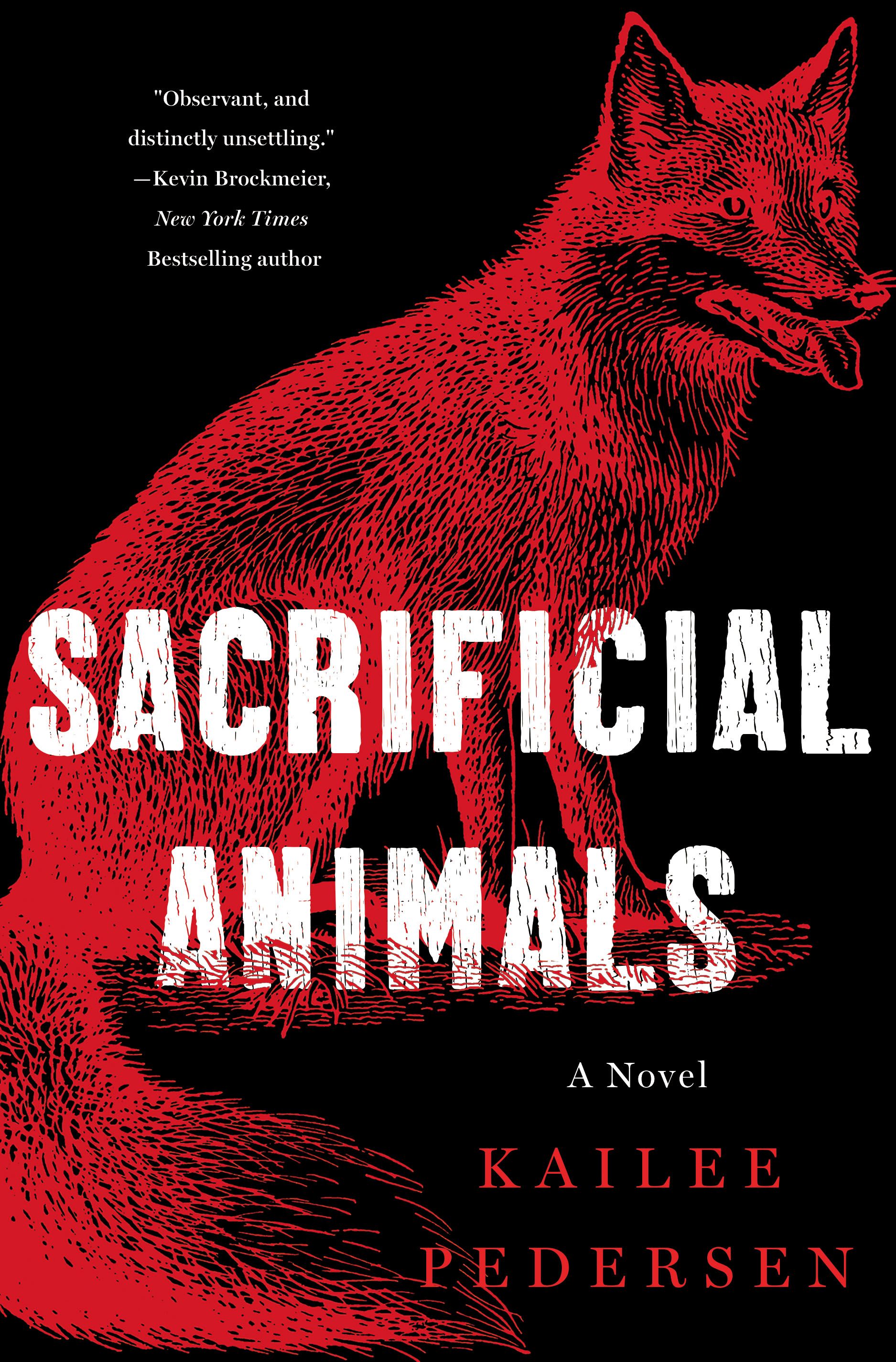
SACRIFICIAL ANIMALS, the kind of uneasy horror-inflected thriller I enjoy reading the most


SACRIFICIAL ANIMALS
KAILEE PEDERSEN

St. Martin' s Press
$29.00 hardcover, available now

Rating: 4* of five

The Publisher Says: Inspired by Kailee Pedersen's own journey being adopted from Nanning, China in 1996 and growing up on a farm in Nebraska, this rich and atmospheric supernatural horror debut explores an ancient Chinese mythology.

The last thing Nick Morrow expected to receive was an invitation from his father to return home. When he left rural Nebraska behind, he believed he was leaving everything there, including his abusive father, Carlyle, and the farm that loomed so large in memory, forever.

But neither Nick nor his brother Joshua, disowned for marrying Emilia, a woman of Asian descent, can ignore such summons from their father, who hopes for a deathbed reconciliation. Predictably, Joshua and Carlyle quickly warm to each other while Nick and Emilia are left to their own devices. Nick puts the time to good use and his flirtation with Emilia quickly blooms into romance. Though not long after the affair turns intimate, Nick begins to suspect that Emilia’s interest in him may have sinister, and possibly even ancient, motivations.

Punctuated by scenes from Nick’s adolescent years, when memories of a queer awakening and a shadowy presence stalking the farm altered the trajectory of his life forever, Sacrificial Animals explores the violent legacy of inherited trauma and the total collapse of a family in its wake.

I RECEIVED A DRC FROM THE PUBLISHER VIA NETGALLEY. THANK YOU.

My Review
: The pleasure I felt reading this book about a bisexual man embroiled in a failing family that's falling to pieces under a culturally unexpected malevolence...! If your mood says, "make it fast," move on to the next cookie-cutter thriller. If your mood says, "give me the literary equivalent of edging," you opened the right book.

The pacing of the read itself is fast. The way the short chapters propel your reading is not, however, equaled by the pace of the story unfolding. The relocation into different periods of time that unfold the wide fan of motives and motivations is much more deliberate. I was surprised by this at first, but in time found my footing in this technique of moving the pages at a different rate from the story itself. In the end, the mechanism I used for dealing with this mismatch was the same one I'd used eons ago when I watched All My Children...the stories moved slower than the episodes.

That said...the story is very familiar. Using this technique helped a Gothic romance-cum-horror tale feel more exciting than that description does. Emilia, the exoticized Other, gets the modern reader's sympathy at first. She's rejected and devalues based on her Otherness. We respond to this behavior nowadays with complete sympathy for the Othered, as goodness only knows it was long past time for us to do as a default.

...but what if that could be used to wreak havoc...?

The author, an ethnic Chinese adoptee into Midwestern culture, decided she would use this very, very clever repurposing of the wide paranoid streak in US culture to create a Gothic story of supernatural entities causing havoc for, apparently, the hell of it. The nine-tailed fox of East Asian folklore seems, more often than not, to just do stuff to see what'll happen next. That seems to me, when attributed to conscious entities, like a wicked, immoral, rotten-souled thing to do, as it is guaranteed to hurt someone who does not know what they're getting into when they fall for the fox-spirit's lures. One can argue that, really basically, Nick fucking his brother's wife for any reason at all is just cause for everything that follows.

I agree.

But everyone else? They didn't ask for this.

So runs my usual horror-themed read response. Like Walschots's Hench, I've always seen super"heroes" as agents of chaos and misery; I watched Poltergeist and asked my then-date, "what the hell are these people gonna do when their insurance won't replace the house?" (He broke up with me a few weeks later.) It doesn't help that I do not believe in The Supernatural, or spirits, or gods. (The vastness of just measurable spacetime isn't awe-inspiring enough for you?) That's one steep hill of disbelief to climb for one little story.

Where I got invested in Author Pedersen's iteration of it was back to that soap-opera technique of unfolding the fan behind the shadowplay of the story. I was constantly thinking "what's that going to mean?" and "what's his zipper doing down?" not focusing on the action in the moment.

For some of y'all, that's the nail in the coffin right there. Good. This will not be a good read for someone whose story in-the-moment expectations are to move from cause to effect and ever onwards, kicked in the hindquarters by heavy boots of Action. A more satisfied reader will come from the ranks of the curious ones who climb hills to look around from the top, then walk down to look at the top.

Satisfying reading, though not in the easy, ordinary way.

Wednesday, July 3, 2024

MISS MAY DOES NOT EXIST: The Life and Work of Elaine May, Hollywood’s Hidden Genius, an unjustly underknown and underappreciated woman


MISS MAY DOES NOT EXIST: The Life and Work of Elaine May, Hollywood’s Hidden Genius
CARRIE COUROGEN

St. Martin' s Press
$30.00 hardcover, available now

Rating: 4* of five

The Publisher Says: Miss May Does Not Exist, by Carrie Courogen, is the riveting biography of comedian, director, actor and writer Elaine May, one of America’s greatest comic geniuses. May began her career as one-half of the legendary comedy team known as Nichols and May, the duo that revolutionized the comedy sketch.

After performing their Broadway smash An Evening with Mike Nichols and Elaine May, Elaine set out on her own. She toiled unsuccessfully on Broadway for a while, but then headed to Hollywood where she became the director of A New Leaf, The Heartbreak Kid, Mikey and Nicky, and the legendary Ishtar. She was hired as a script doctor on countless films like Heaven Can Wait, Reds, Tootsie, and The Birdcage. In 2019, she returned to Broadway where she won the Tony Award for Best Leading Actress in The Waverly Gallery. Besides her considerable talent, May is well known for her reclusiveness. On one of the albums she made with Mike Nichols, her bio is “Miss May does not exist.” Until now.

Carrie Courogen has uncovered the Elaine May who does exist. Conducting countless interviews, she has filled in the blanks May has forcibly kept blank for years, creating a fascinating portrait of the way women were mistreated and held back in Hollywood. Miss May Does Not Exist is a remarkable love story about a prickly genius who was never easy to work with, not always easy to love and frequently often punished for those things, despite revolutionizing the way we think about comedy, acting, and what a film or play can be.

I RECEIVED A DRC FROM THE PUBLISHER VIA NETGALLEY. THANK YOU.

My Review
: A biography of a living person, one famously Private and Reclusive, faces an uphill battle when that person declines to participate in the project. The issues become apparent early. I felt put off by one tic the author has: Referring to her subject as "Elaine" seemingly in an attempt to give a spurious sense of her own intimacy with the steadfastly unavailable Miss May.

This is really a minor stylistic issue in most cases of biography. When Miss May simply won't show up...apparently a habit of hers, as the author rather disconcertingly learns via stalking the woman...it looms large because there is nothing of a personal connection in the biographer's tale. This is a very well-researched and capably written dissection of a classic parasocial relationship. Miss May is a public figure as an actress of stage and screen fame. The ways in which the author collects information about her subject are available to other members of the public. Miss May therefore maintains control of the master narrative available to the author, as to the rest of the world. The amount of research required to write this book is, as it must be to make any kind of a story, deep. The border between that depth and stalking is blurry in all cases. I was, however, pushed into "really? Ew!" territory when the author used her own artist connections to find out when and where her subject would be attending public events and getting herself invited to them.

My own personal line was crossed when I read that. I saw the project in a very different light afterwards.

How the heck do you tell The Truth about someone who so values her privacy that she will invent stuff for public dissemination, decline to interact with people in any unmediated fashion, and simply not show up at invitation-only public events? This is someone who doesn't want people rummaging in her drawers. I expect that, like those Victorian folks who directed that their records be burned after their deaths, we will discover that this level of erasure is Miss May's wish as well. So the public record as ably collated and presumptiously contextualized (possibly inaccurately and unfairly, I doubt we will ever be allowed to know) by the author might very well be the only formal record of the long and excellent career of an unfairly overlooked and undervalued creative force.

That will, I expect, have to do. The work she did will speak for itself in the long run; absent a change of heart or a sudden betrayal of Miss May, here is a record of the truth she wanted the audience to know. Fellow pedants please note the citation style is inconsistent and incompletely explanatory.

Tuesday, December 19, 2023

FOLLOWING CAESAR: From Rome to Constantinople, the Pathways That Planted the Seeds of Empire, armchair travel with the best kind of guide


FOLLOWING CAESAR: From Rome to Constantinople, the Pathways That Planted the Seeds of Empire
JOHN KEAHEY

St. Martin's Press
$30.00 hardcover, available now

Rating: 4* of five

The Publisher Says: A travel narrative following three ancient roads and looking at more than two thousand years of history of Ancient Rome through the modern eye.

In 66 B.C., young, ambitious Julius Caesar, seeking recognition and authority, became the curator of the Via Appia. He borrowed significant sums to restore the ancient highway. It was a way to curry favor from Roman citizens in villages along the route, built from Rome to Brindisi between 312-191 B.C. He succeeded and rapidly grew in popularity. After achieving greatness in Rome and the far reaches of Gaul, he led armies along this road to battle enemies in Roman civil wars. And then, across the Adriatic Sea, he joined Via Appia's sister road, the Via Egnatia that began in today's Albania. Other armies followed these two roads that eventually connected Rome to Byzantium, today's Istanbul. Octavian, who became, in 27 B.C., Rome's first emperor, and his friend and later enemy Mark Antony traveled portions of both roads to defeat Caesar's murderers Brutus and Cassius at Philippi in eastern Macedonia. The great Roman statesman Cicero, the Roman poet Homer, the historian Virgil and many other notables traveled along one or both of these roads. In the first century of the Roman Empire in the earliest years of Christianity, the apostles Peter and Paul traversed portions of them. Pilgrims, seeking salvation in far-away Jerusalem, followed them as well throughout much of the Middle Ages. In the early second century A.D., the emperor Trajan charted a new coastal route between Benevento and Brindisi, later called the Via Traiana.

Today, short stretches of the original three roads can be seen in the ruins of ancient Roman cities, now preserved as archaeological wonders, and through the countryside near, and sometimes under, modern highways. Following those routes is the purpose of treading along the path that Caesar and so many others took over the early centuries. Modern eyes, seeing through the mists of more than two thousand years of history, lead the traveler along these three roads coursing through six countries between Rome and Istanbul. It is a journey full of adventure, discovery, and friendship―one one worth taking.

I RECEIVED A DRC FROM THE PUBLISHER VIA NETGALLEY. THANK YOU.

My Review
: I enjoy history for itself, and the many present-day echoes of historical events just add texture to my pleasure. This historical-tourism book was as deeply involving to me as a standard historical narrative because the conceit...following the Roman roads...is my idea of a great adventure vacation. The author was my guide on this escape from home. It worked as well as anything could because I knew I was in experienced hands (he has written four other books on touring Italy as a history buff.)

While I was very interested in his veteran-journalist's observations of the world traversed by the Roman roads he then traversed himself, and by his reports of his companions' responses to the modern world as well as the archaeology of the paths they traveled together, I was very disappointed that the book contained NO maps or photos.

Don't let that lapse stop you from enjoying the informed, intelligent voice of this forty-five-year veteran reporter as he shares his observations of the world he's moving through. His lifelong fascination with Italy and Rome (men really *are* obsessed with Rome!) gives him a very full view of the countries and regions he takes us through. This book is one of those rare books that, just as a reading experience, solely for the way the author builds an image and creates a simile, is a pleasure to read.

That his trip in Turkey, Asia Minor that was, coincided with COVID and its joys was very evocative for him. Plenty of plagues to meditate on. His religious ruminations are interesting to my deeply, faithfully atheist self...the road network of ancient Rome, and its internal postal connections enabled thereby, are largely responsible for the spread of the religion all across the empire. (There were christians in Pompeii...they found a ROTAS square there! By 79AD there were christians in Italy!)

I do want to mention that the "Caesar" of the title is not Julius; remember that Caesar was a title during the empire, and Trajan, whose Via Traiana is followed, was also a Caesar.

Self-gifting for a lovely time on #Booksgiving, as you settle down in your favorite reading spot, a beverage and a snack close at hand...Italy is involved, there is going to be food talk...and immerse yourself in a part of the world that could not possibly be richer in cultural highlights.

One star off for the absence of photos and/or illustrations.

Friday, September 15, 2023

LARRY McMURTRY: A LIFE, and what a life it was!


LARRY McMURTRY: A LIFE
TRACY DAUGHERTY

St. Martin's Press
$35.00 hardcover, available now

Rating: 4* of five

The Publisher Says: A biography of the late Pulitzer Prize-winning American novelist and screenwriter Larry McMurtry from New York Times bestselling author Tracy Daugherty.

In over forty books, in a career that spanned over sixty years, Larry McMurtry staked his claim as a superior chronicler of the American West, and as the Great Plains’ keenest witness since Willa Cather and Wallace Stegner. Larry McMurtry: A Life traces his origins as one of the last American writers who had direct contact with this country’s pioneer traditions. It follows his astonishing career as bestselling novelist, Pulitzer-Prize winner, author of the beloved Lonesome Dove, Academy-Award winning screenwriter, public intellectual, and passionate bookseller. A sweeping and insightful look at a versatile, one-of-a-kind American writer, this book is a must-read for every Larry McMurtry fan.

I RECEIVED A DRC FROM THE PUBLISHER VIA NETGALLEY. THANK YOU.

My Review
: First, I want to salute Tracy Daugherty, fellow Texan and indefatigable researcher. This is a thoroughly sourced book withe compendious endnotes hyperlinked in the DRC I read. Some things didn't really need so much sourcing, being opinions of interviewees, but too much beats too little all hollow in non-fiction. More especially in the notes because reading them is entirely optional. I do it because I'm a fussbudget. I don't often comment about it either way, but here it's appropriate...a William Zinsser opinion from The American Scholar Magazine impressed me by being so niche a quote and being checkably sourced, I felt compelled to bring it up.

Then, I want to diss Larry McMurtry, petulant whiny adolescent of great age. No matter where he was, he was dissatisfied by it; no matter who he knew, he critiqued them with a flensing-knife of an eye; yest his curmudgeonliness gave the world some impressive art and a lot of filler. He had honesty enough to know it, though, that's a saving grace.

He was an inveterate lover of women. Married or not, he was always glad to meet another lady...with predictable results for the existing relationship...but he wasn't always sexually involved with them. He really just loved women as beings. His writing partner was Diana Ossana, and their closeness created a collaboration that made Annie Proulx's story "Brokeback Mountain" into a delight of a screenplay (one well worth reading on its own). He was friends with Merry Prankster and fellow novelist Ken Kesey, whose widow Faye he married in 2011—a decade after Kesey's death in 2001. This was a man who, in spite of a pretty spiky personality, could sustain a friendship!

He identified as a Texan. That in spite of his flensing-knife eye seeing, and his venom-filled pen chronicling, the failings of his fellow Texans in the gloriously angry The Last Picture Show, and his honest appraisal of Texas's self-aggrandizing mythology in the most famous book of his career Lonesome Dove. I think it's weird that people misinterpret Lonesome Dove as a celebration of the West, but that's another project that I can't tackle here. I rated this book more highly than my enjoyment of its subject would've led me to do because I so enjoyed reading McMurtry's opinions of the fans of his books. I'm not going into details because spoilers but this was one serious curmudgeon.

That's where I ran into a problem. I ended up knowing McMurtry better but not liking him more. This wasn't promised to me, so I'm not complaining that I was led to believe something was going to be offered that was not. I wasn't his biggest fan, actively disliking Texasville and the sequels to Lonesome Dove; but I always admired his clearsightedness. Now I know what I do about him as a person, I don't see it as clearsightedness any more. He was a chronic fault-finder who made, so far as I could tell or the author reported to me, no effort to use this in any constructive way in his own life. The consequences are predictable, and largely suffered by others.

That moody snort aside, I am sure that my world is enriched by his work, and I'm glad that this fascinating, difficult man came along to tell us all about our dirty, grubby, grasping, grouchy selves. I expect my Young Gentleman Caller is on to something when he remarked, "he reminds me of you."

Wednesday, September 6, 2023

CONTAINING BIG TECH: How to Protect Our Civil Rights, Economy, and Democracy & THE PERENNIALS: The Megatrends Creating a Postgenerational Society, huge forces reshaping our lives


CONTAINING BIG TECH: How to Protect Our Civil Rights, Economy, and Democracy
TOM KEMP
Fast Company Press
$27.95 hardcover, available now

Rating: 4.5* of five

The Publisher Says: The path forward to rein in online surveillance, AI, and tech monopolies

Technology is a gift and a curse. The five Big Tech companies—Meta, Apple, Amazon, Microsoft, and Google—have built innovative products that improve many aspects of our lives. But their intrusiveness and our dependence on them have created pressing threats to our civil rights, economy, and democracy.

Coming from an extensive background building Silicon Valley–based tech startups, Tom Kemp eloquently and precisely weaves together the threats posed by Big Tech:
  • the overcollection and weaponization of our most sensitive data
  • the problematic ways Big Tech uses AI to process and act upon our data
  • the stifling of competition and entrepreneurship due to Big Tech’s dominant market position

  • This richly detailed book exposes the consequences of Big Tech’s digital surveillance, exploitative use of AI, and monopolistic and anticompetitive practices. It offers actionable solutions to these problems and a clear path forward for individuals and policymakers to advocate for change. By containing the excesses of Big Tech, we will ensure our civil rights are respected and preserved, our economy is competitive, and our democracy is protected.

    I RECEIVED A DRC FROM THE PUBLISHER VIA NETGALLEY. THANK YOU.

    My Review
    : We are, as a society, in serious danger. A lot of things that were once difficult to find effective ways to influence and manipulate are becoming trivially easy to do. The perpetrators of this violation of our essential freedom to be safe in our own heads have, in eight concise chapters, each been named and shamed, their tactics analyzed and the consequences of them sketched out, by one of their own.

    True, it wasn't like any of them were trying to fly under the radar about this...for a famous example, Jeff Bezos clearly said he wanted to control ecommerce way back when, but really only accidentally:
    When his goals did slip out, they were improbably grandiose. Though the startup’s focus was clearly on books, Davis recalls Bezos saying he wanted to build “the next Sears,” a lasting company that was a major force in retail. {An investor who was also a} kayaking enthusiast...remembers Bezos telling him that he envisioned a day when the site would sell not only books about kayaks but kayaks themselves, subscriptions to kayaking magazines, and reservations for kayaking trips—everything related to the sport. “I thought he was a little bit crazy,” says {the investor}.
    (source: The Everything Store: Jeff Bezos and the Age of Amazon by Brad Stone)

    What this immense ambition created was The Literal Everything Store, used by everyone even marginally online at some point for something they need or want. They might not even realize it's Amazon they're doing business with...how many of even the most committed Amazonphobes know who hosts their online commercial interactions? or where bricks-and-mortar stores buy their stock?...but their data is in some way harvested by Amazon. The other members of Big Tech's five brothers are dealt similar serious blows to their frequently protested innocence of maleficent intent and wrongdoing in the moral if not the legal sense.

    It's part of their business plans to amass a chillingly immense digital dossier on every internet user by the entire tech industry. The purpose is to make them incomprehensible piles of money; they then use that money, extracted directly and indirectly from your pockets, to influence the course of world events on political and economic stages to benefit themselves and themselves alone. Refer back to 1953, when the famous kludged-up quote "What’s good for General Motors is good for America" was supposedly said by a GM exec being vetted by the Senate for a senior government job. (The truth is more nuanced, if less punchy.) The usual course of a person interested in the US's economic health is to consult the newspaper or equivalent's reporting of the stock market's performance. How this casino capitalism came to be conflated with the country's overall economic health is outside the book's or this review of it's scope, but is part of the larger picture painted herein of the actions taken by the surveillance economy's owners and drivers.

    The means of information gathering and opinion-sharing are increasingly in the hands of the same few corporate entities that harvest your data and the windfalls it generates. The AI revolution we're relentlessly being told is coming has lifted the increasingly fragile casino economy's entirely notional values into new superstratospheric heights. Go look at Nvidia's stock prices then its history to see what I'm talking about. The way to make people believe something is inevitable is to tell them over and over again that it is, and that includes the inevitability of Big Tech's dominance. In these eight chapters, the author presents a very good case for what each player in the surveillance capitalism/totalitarian state apparatus's purpose is in pursuing its goals. In the appendices he outlines the personal, as well as the societal, steps one can take to corral the presently untrammelled ability these corporate actors have to present only information and opinion positively inclined towards them and their agenda.

    A book that blares alarms at you without offering actionable items to prevent or mitigate the warnings taking place or effect isn't doing a service but simply further harm. I think the author here is doing a great service by performing both the warning function about the problems we're facing and the directions they're approaching us from, and outlining potential solutions on actionable on multiple fronts.

    I'd like to stress that my use of "actionable" with such regularity is intentional and meant to convey my personal sense of urgency in addressing these issues. I think reading this book will convince many to stop wondering if it's even worth paying attention to these issues of surveillance and manipulation, and start taking steps to mitigate the harms being caused by the overreach of an identifiable coterie of bad actors.

    That means I'd really like you to read it. Get it from the author's website linked above. Get it from Amazon, they sell it. Get your local library to buy one or two and check one out. Just get it and its ideas in your heads.

    It's not exaggerating to say that, if the AI future being drummed into us as inevitable comes to pass, we're going to need the checks and balances in this book to survive with even a whisper of autonomy intact.

    +++++++++++++++++++++++++++++++++++++++++++++++++++++++++++++++++

    THE PERENNIALS: The Megatrends Creating a Postgenerational Society
    MAURO GUILLÉN
    St. Martin's Press
    $30.00 hardcover, available now

    Rating: 4.5* of five

    The Publisher Says: In today’s world, the acceleration of megatrends—increasing longevity and the explosion of technology among many others—are transforming life as we now know it.

    In The Perennials, bestselling author of 2030 Mauro Guillén unpacks a sweeping societal shift triggered by demographic and technological transformation. Guillén argues that outmoded terms like Boomers, Gen X, Millennials, and Gen Z have long been used to pigeonhole us into rigid categories and life stages, artificially preventing people from reaching their full potential. A new postgenerational workforce known as "perennials"—individuals who are not pitted against each other either by their age or experience—makes it possible to liberate scores of people from the constraints of the sequential model of life and level the playing field so that everyone has a chance at living a rewarding life.

    This multigenerational revolution is already happening and Mauro Guillén identifies the specific cultural, organizational and policy changes that need to be made in order to switch to a new template and usher in a new era of innovation powered by The Perennials.

    I RECEIVED A DRC FROM THE PUBLISHER VIA NETGALLEY. THANK YOU.

    My Review
    : I'm well into my geezerdom. I think this gent's insight is a corker. Not just because he acknowledges the role of experience in a functioning world but because he says it's really the only way out of the looming crises of employment, productivity, and collapsing ecology. Well, I added the last one, but it seems to me that the problems the planet is facing are best faced with all hands on deck.

    Most people don't live in the way I grew up, or likely that my readers did: A mother, a father, some siblings, one house, a couple cars; some orbiting family from the parents' siblings, closer or farther from us with whatever degree of connection our families could/chose to maintain; maybe grandparents on big family occasions. Life was preordained to follow that pattern through our generation, and we thought beyond it, too. Varying political movements and social pressures began to change the tiny, nuclear-family model...not least a reality of the nuclear world is that fission is easier and more common than fusion, and produces very, very toxic waste with a hugely long lifespan.

    As a result of demographic realities the huge boost of living standards after World War II across most of the globe produced a gigantic population bubble. Better lives for "all" keep coming about, and all meant so many more than ever. The sociological changes wrought by the various liberation and empowerment movements around the world meant that there were huge numbers of people who needed jobs that had little or no family component. University educations became necessary (in theory anyway) to get ahead, to make a decent living. Maybe, if you wanted to, have a family of your own. It was the choice of many not to do so much of that old model, but the world's picture of school then work and then finally retirement...the whole structure of the twentieth century's body politic...has changed very little. Our lives within it are, however, being lived in a more flexible and inclusive way than ever.

    What the author propounds in his fascinating look at how we could all benefit from adapting our model to lived reality is the acceptance that people live longer and need to live better. All of us need challenges and face the reality that those challenges ae changing. He proposes the deeply pragmatic solution of adopting a life-long learning model. This means we're not In A Job for life but in a habit of honing skills we have and acquiring new ones.

    Addressing the looming labor shortages as people get older and stay fit longer means second, third, or fourth careers for many of us will have to be planned for by employers. Age discrimination is very much a reality. The companies that emulate BMW in their age-blended team models will make a big bonus for their shareholders. The entire landscape of work will need to change (see my review of THE ONLY GAME IN TOWN for some background on this; also that author, Mohammed El-Erian, approves of this book and its thesis) to accommodate different needs and desires, like the work-from-home lifestyle that most people prefer and Big Tech is leading the charge to reverse in the wake of the pandemic's accidental proof of concept that it works.

    Possibly the most resonant part of the book to me was its model of exchanging skills among the generations. I know that, in my own life, my Young Gentleman Caller has helped me remain more comfortable with information technology and its many nuances than almost all the people I live among. I know also that my experience has alerted him to some less-than-honorable intentions among his acquaintance. It's a joy to be able to both learn and be taught. And I don't exaggerate when I use the word "joy." In my own life, as in his, learning stuff is a source of real joy for each of us...it's one reason we remain in relationship in supervention of the challenges we face.

    The author's thesis is particularly informative of th challenges the world being summoned into being by Big Tech (see review above) being met with effective control. It will take an intergenerational conversation of great depth and serious intent to prevent the dystopic possibilities of surveillance capitalism and totalitarian governance from happening.

    Reading these books together was one of the most challenging emotional rides of 2023 for me. There's a lot to be deeply concerned about in the direction that our present system of inaction and wasteful misdirection of energy is following. There are ways to solve it, and this read's author has one of the best structural models for directing growth into sustainable channels I've read. This is largely, I suspect, because I already implement the lifelong learner model of being. It's paid such huge dividends in my own life. Not least by giving me the mental framework and the emotional push needed to recover faculties many like me lose when they have the multiple strokes that I had in January 2023. I'm slower, and quicker to tire, than before my problems got worse; but unlike those whose retirements or simply aging lifestyles aren't focused, I had something to recover for and get back to doing: This. Reading. Thinking about what I've read. Thinking about how to support the changes I want to see and resist the ones I don't want to see effectively. Communicating those thoughts on this little blog I've run for ten years, that still attracts about two hundred viewers on an average day.

    I think more people would find ways to do what I've done if they read these two books: the first to learn what's at stake and how to get a handle on it; the second to learn why it's a good use of your time to overcome inertia and restart your mind's journey.

    Sunday, May 28, 2023

    MAGNIFICENT REBEL: Nancy Cunard in Jazz Age Paris


    MAGNIFICENT REBEL: Nancy Cunard in Jazz Age Paris
    ANNE DE COURCY

    St. Martin's Press
    $14.99 ebook editions, $29.99 hardcover, available now

    Rating: 4* of five

    The Publisher Says: Anne de Courcy, the author of Husband Hunters and Chanel's Riviera, examines the controversial life of legendary beauty, writer and rich girl Nancy Cunard during her thirteen years in Jazz-Age Paris.

    Paris in the 1920s was bursting with talent in the worlds of art, design and literature. The city was at the forefront of everything new and exciting; there was no censorship; life and love were there for the taking. At its center was the gorgeous, seductive English socialite Nancy Cunard, scion of the famous shipping line. Her lovers were legion, but this book focuses on five of the most significant and a lifelong friendship.

    Her affairs with acclaimed writers Ezra Pound, Aldous Huxley, Michael Arlen and Louis Aragon were passionate and tempestuous, as was her romance with black jazz pianist Henry Crowder. Her friendship with the famous Irish novelist George Moore, her mother’s lover and a man falsely rumored to be Nancy’s father, was the longest-lasting of her life. Cunard’s early years were ones of great wealth but also emotional deprivation. Her mother Lady Cunard, the American heiress Maud Alice Burke (who later changed her name to Emerald) became a reigning London hostess; Nancy, from an early age, was given to promiscuity and heavy drinking and preferred a life in the arts to one in the social sphere into which she had been born. Highly intelligent, a gifted poet and widely read, she founded a small press that published Samuel Beckett among others. A muse to many, she was also a courageous crusader against racism and fascism. She left Paris in 1933, at the end of its most glittering years and remained unafraid to live life on the edge until her death in 1965.

    Magnificent Rebel is a nuanced portrait of a complex woman, set against the backdrop of the City of Light during one of its most important and fascinating decades.

    I RECEIVED A DRC FROM THE PUBLISHER VIA NETGALLEY. THANK YOU.

    My Review
    : How the hell do I rate and review this book? Author de Courcy writes very well, has clearly done research I have no reason to suspect contains careless errors (ie, I as a non-expert possess no knowledge that contradicts anything contained in here), and clearly understands the role of conflict and drama in non-fiction...yet I hated every minute of the read.

    Let me explain.

    Nancy Cunard knew everyone, went everywhere, did everything adventurous and fun one can dream up to do when there is a giant pot of cash under one's checkbook. She was also a narcissist, and probably a sociopath. She had no moral compass I could discern from any anecdote herein. She was "mad, bad, and dangerous to know," because she could and did turn on people who had given her no cause to dislike them.

    And men flocked to her orbit! They wanted sex, of course, but quite a lot of them fell for her! All the mor amazing because of her one reasonably good quality, by modern standards: she never bothered herself to dissemble. As the great majority of people prefer to be told pretty little lies by their lovers, I'd say this shows that the men who fell for her really, truly fell, to accept her honest and usually very scathing opinion of them and keep coming back. Her "honesty" (which, as presented herein, is really just brutal unnecessary unkindness) comes in for a helping of praise I don't feel is warranted. She did many laudable things in pursuit of social justice, which no one should try to minimize. Her addiction issues and mental illness, which the author is careful to make unmistakable for the reader, is obvious in hindsight from the present century's ludicrously low "heights" of enlightenment, do not excuse the abusive and manipulative behaviors she displayed. To Author de Courcy's credit, she makes no excuses for the troubling behviors but goes out of her way to explain how the Cunards were less a family than threesome of selfish, oblivious rich people. How else could Nancy have turned out?

    So I liked the book. But I loathed the subject. I am not glad I know more about her than my previous awareness of her name and sterling literary taste and activities. I feel...soiled...by the knowledge that this awful person is a feminist icon to some because she was as free as the male abusers and rotters of her day. Yuck! "But they were worse!" hardly seems like a justification for someone to behave badly.

    I've settled on four stars, all for the felicity of Author de Courcy's discourse, and none for this awful, abusive human being.

    Thursday, January 5, 2023

    THE VILLA, subtle, fun, and in the end, more than it says on the tin


    THE VILLA
    RACHEL HAWKINS

    St. Martin' s Press
    $28.99 hardcover, available now

    Rating: 4* of five

    NOW $2.99 on KINDLE

    The Publisher Says: The bestselling author of The Wife Upstairs returns with a brilliant new gothic suspense set at an Italian villa with a dark history.

    As kids, Emily and Chess were inseparable. But by their 30s, their bond has been strained by the demands of their adult lives. So when Chess suggests a girls trip to Italy, Emily jumps at the chance to reconnect with her best friend.

    Villa Aestas in Orvieto is a high-end holiday home now, but in 1974, it was known as Villa Rosato, and rented for the summer by a notorious rock star, Noel Gordon. In an attempt to reignite his creative spark, Noel invites up-and-coming musician, Pierce Sheldon to join him, as well as Pierce’s girlfriend, Mari, and her stepsister, Lara. But he also sets in motion a chain of events that leads to Mari writing one of the greatest horror novels of all time, Lara composing a platinum album—and ends in Pierce’s brutal murder.

    As Emily digs into the villa’s complicated history, she begins to think there might be more to the story of that fateful summer in 1974. That perhaps Pierce’s murder wasn’t just a tale of sex, drugs, and rock & roll gone wrong, but that something more sinister might have occurred—and that there might be clues hidden in the now-iconic works that Mari and Lara left behind.

    Yet the closer that Emily gets to the truth, the more tension she feels developing between her and Chess. As secrets from the past come to light, equally dangerous betrayals from the present also emerge—and it begins to look like the villa will claim another victim before the summer ends.

    Inspired by Fleetwood Mac, the Manson murders, and the infamous summer Percy and Mary Shelley spent with Lord Byron at a Lake Geneva castle—the birthplace of Frankenstein—The Villa welcomes you into its deadly legacy.

    I RECEIVED A DRC FROM THE PUBLISHER VIA NETGALLEY. THANK YOU.

    My Review
    : What fun it is to sit, or lie in bed, with a read leaning/sitting/suspended above you by your boytoy at your preferred angle, and just submerge into a story. It must needs be a hefty stew, a thick and savory amalgam of tastes powerful and subtle, to get through the fog of quotidian tedium we're all settling back into in the wintry northern hemisphere. Remember it for August reading, global southerners!

    Rachel Hawkins delivers a big, full bowl of it all. The middle-escent quondam besties who, in the present, are surprising themselves when they decide to spend girl-time together at one of those fabulously gorgeous rentable family seats in gloriously scenic Italy. Each woman, trying to gin up something to fulfill a publishing contract, is finding that she just is not feeling the love for anything she's got at that moment. The mystery writer's cozy series is sour for her now that her soon-to-be-ex husband is suing her for a chunk of her future royalties because she, in a moment of candor, told an interviewer that her series' most beloved character was based on him. The self-help writer's having an existential crisis because she's been fleecing desperate people by ladling out craptastic nostrums knowing full well that a trip to the Hallmark card shop would give them the same level of help and insight into their problems.

    Oh dear! Silly me, saying what I really think about things again. Strike that! Of course, she's simply seeking something to afford her fresh insights and, well, what better than a friend in the middle of a rancorous divorce? (I don't in all honesty see how that's better but I'm not here to judge.) (Well, only the story I'm being told, not the realities of publishing.)

    Em and Chess, in the present day, are going through the middle-escent crisis of "is this it?" and need to make their eyes see past the same-old same-old surfaces. At their gorgeous holiday Villa Aestas, they learn to listen to themselves more carefully as the delicious herbal remedy of being in Italy brings up things neither was ever planning to work through, or even acknowledge...admit. That stew has tough cuts of meat that just about break your jaw muscles to chew....

    Their motivation to do that tough work is the fifty-years-gone history of Villa Aestas. Golden-boy rocker, two teenaged girls in love with his fame and poetry, a Svengali older man...all of twenty-six!...who guides the group into a Byron-and-Shelley creative ferment that he uses to elicit full-body responses to the sexual tensions inevitable in this situation. Tell me how any writer of anything at all could resist poking this spiritual sore tooth! And the existence of a memoir-by-novel about it, telling a story so soppily romantic that you just know a teenager wrote it. Should they, and we, trust the story we're told here, the story in front of us? Emily, she of the murder-mystery instincts, doesn't seem to question Mari's published version of the 1974 events until present-day events make her think carefully for once in a long, foggy, unhappy time.

    But writers, you know, writers aren't simple little souls ready to take dictation from their imaginary friends the voices. Writers (of murder mysteries, of books about changing your life) need to be ruthless and "kill their darlings." Success can breed jealousy as always, but so can a lifetime of coming up short when comparing yourself to someone else...and poets (as songwriters insist they are) are doubly susceptible to this. Add in a hefty libido and a sense of entitlement and, well....

    What Author Hawkins does is not something unexpected. But what she accomplishes by bringing all the strands...the two parties visiting Villa Aestas and the book that Mari, the central voice in 1974's strands, writes...into one bundle is to scrape away the grease she's been applying to the ropes of the plot so they won't rub too hard together and weaken each other. The bare ropes of the meanings and emotions scrape and snarl and burn each other as they are suddenly and forcefully made to change the story's velocity and angle. No tangles, some fraying...I think Mari's book got just a hair (heh) more time in the spotlight than it merited...but supporting structure of the thriller parts of the story suspend their scenery and allow you to scrape your stew-bowl clean without feeling like you need to rush before it all comes crashing down. I heard some creaking from behind the scenes but, crucially, felt that this was not the ropes complaining as they got overworked in moving the parts. It was a quiet invitation from Author Hawkins to consider the thriller you've seen in its intended configuration and perspective.

    And question if, just maybe, there had not been a last-minute change of plans, well laid to achieve one result, to achieve instead another result entirely.

    This elevated a solid three-and-a-half stars entertainment to a four-star puzzle (despite some eye-rolling but period-appropriate homophobia). Definitely recommended to thriller fans and to the small corps of remaining lovers still thrilling to the wonderful Cary Grant did-he-or-didn't-he films of the 1940s.

    Monday, December 26, 2022

    THE DEATH PAGE: ALL THE LIVING AND THE DEAD: from Embalmers to Executioners, an Exploration of the People Who Have Made Death Their Life's Work & THIS PARTY'S DEAD: Grief, Joy and Spilled Rum at the World’s Death Festivals


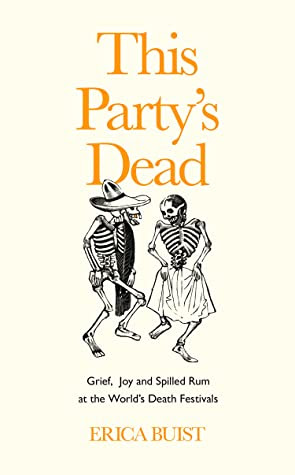
    THIS PARTY'S DEAD: Grief, Joy and Spilled Rum at the World’s Death Festivals
    ERICA BUIST

    Unbound Books
    $25.00 hardcover, available now

    Rating: 4.5* of five

    The Publisher Says: What if we responded to death... by throwing a party?

    By the time Erica Buist’s father-in-law Chris was discovered, upstairs in his bed, his book resting on his chest, he had been dead for over a week. She searched for answers (the artery-clogging cheeses in his fridge?) and tried to reason with herself (does daughter-in-law even feature in the grief hierarchy?) and eventually landed on an inevitable, uncomfortable truth: everybody dies.

    With Mexico’s Day of the Dead festivities as a starting point, Erica decided to confront death head-on by visiting seven death festivals around the world—one for every day they didn’t find Chris. From Mexico to Nepal, Sicily, Thailand, Madagascar, Japan and finally Indonesia—with a stopover in New Orleans, where the dead outnumber the living ten to one—Erica searched for the answers to both fundamental and unexpected questions around death anxiety.

    This Party’s Dead is the account of her journey to understand how other cultures deal with mortal terror, how they move past the knowledge that they’re going to die in order to live happily day-to-day, how they celebrate rather than shy away from the topic of death – and how when this openness and acceptance are passed down through the generations, death suddenly doesn’t seem so scary after all.

    I RECEIVED A DRC FROM THE PUBLISHER VIA EDELWEISS+. THANK YOU.

    My Review
    : I grew up in the Southwest. It's part of my mental furniture to know what calaveras are and to appreciate that marigolds are the right floral tributes on Día de los Muertos. Skeletons, and skulls, are endlessly fascinating. An old artist-friend of mine created one of my most treasured possessions, sadly destroyed in a move, of a drawing she entitled "Martinis on My Horizon" with stylish skeletons quaffing the elixir of the goddesses, the gin martini.

    I am, in other words, the exact reader Author Buist aimed at. She shot; she scored.

    I found her grief for the death of her friend Chris, father of her future husband, entirely ordinary. He sounds to me like someone it would very much hurt to lose. And, since humankind can't physiologically stay in protracted peak states like grieving, what better way to cope with the pain than toss a party? The author's dedicatory "Love is not a reward, and death is not a punishment. If you thought they were, this book is for you," made me legs twitch with the fight-or-flight response. It's that true, it's that deep.

    What made me glad that I got the book from the publisher via Edelweiss+ is the timelessness of grief and grieving. Every generation of humans feels it, which is why we have so many grave goods for archaeologists to plunder and ponder; many of our animal cohabitants seem to as well, eg elephants and crows; life being, then not being, inside someone we know and love is just flat weird. My old friend D'Anne died just before Christmas. I'd known her for fifty-three years. All the things that meant something to her in relation to me are now only in my mind. It's...strange.

    And I hope her current husband is planning a bash! She'd've loved that. It's a great way to remember someone. As witness some of the author's rowdier experiences of parties where the guest of honor isn't breathing anymore. Offering the dead many of life's little luxuries has an old and distinguished history. The Japanese and Chinese, in today's cultural landscape, are the masters of the offerings with many things like paper iPhones burnt for the departed's use in the afterlife. Mexico's Day of the Dead isn't quite that au courant but it's got the best material culture, the calaveras de azúcar offered to the ancestors:
    ...and the modern innovation of the Día de los Muertos parade that the James Bond film Spectre made popular before COVID killed it, too.
    So as I said, the author found her dream reader here. Why, then, didn't I rate the read more highly? I enjoyed it. I was educated by it, as painlessly as I think is possible. But the very thing that made it a painless read, a lovely glass of juice with a hefty glug of 151 rum in it (as the author discovers in New Orleans, visiting the Museum of Death and quaffing a Hurricane at Pat O'Brien's for afters), makes it feel more like it's about Author Buist on a weird kind of very amusing dark tourism trip. (I myownself vote that we start normalizing "thanatourism" for this; it's not necessarily dark!), is the thing that wore thin: It's about her. Her grief, her loss. Learning about other cultures was her way of coping, of giving her husband support in his own grieving process.

    I know that's what it said on the tin. I know that's the explicit purpose for the book's existence. I support the author's quest and am glad I made her acquaintance, happy that her journey was rewarded as richly as it was in ways familiar and unfamiliar as her friends and her bosses and her husband made room for it all.

    But I can't help my feeling of slight "I'm done now"ness. Her job, ably performed, merits the full four stars. Her amusing and emotionally resonant narrative voice merit the other half-star. But the tone, in the end, brought my personal enjoyment down from all the stars to almost all of them.

    Still very much a book I'd urge you to make room for on your shelf.

    ++++++++++++++++++++++++++++++++++++++++++++++++++++++++++++++++


    ALL THE LIVING AND THE DEAD: from Embalmers to Executioners, an Exploration of the People Who Have Made Death Their Life's Work
    HAYLEY CAMPBELL

    St. Martin's Press
    $29.99 hardcover, available now

    Rating: 4.5* of five

    The Publisher Says: A deeply compelling exploration of the death industry and the people—morticians, detectives, crime scene cleaners, embalmers, executioners—who work in it and what led them there.

    We are surrounded by death. It is in our news, our nursery rhymes, our true-crime podcasts. Yet from a young age, we are told that death is something to be feared. How are we supposed to know what we’re so afraid of, when we are never given the chance to look?

    Fueled by a childhood fascination with death, journalist Hayley Campbell searches for answers in the people who make a living by working with the dead. Along the way, she encounters mass fatality investigators, embalmers, and a former executioner who is responsible for ending sixty-two lives. She meets gravediggers who have already dug their own graves, visits a cryonics facility in Michigan, goes for late-night Chinese with a homicide detective, and questions a man whose job it is to make crime scenes disappear.

    Through Campbell’s incisive and candid interviews with these people who see death every day, she asks: Why would someone choose this kind of life? Does it change you as a person? And are we missing something vital by letting death remain hidden? A dazzling work of cultural criticism, All the Living and the Dead weaves together reportage with memoir, history, and philosophy, to offer readers a fascinating look into the psychology of Western death.

    I RECEIVED A DRC FROM THE PUBLISHER VIA NETGALLEY. THANK YOU.

    My Review
    : A book with a truly tragic genesis, the author losing a baby at birth; but it led her to look for her grief to be assuaged in discovering the connective tissue in our society's death industry. She made a terrible tragedy into a very interesting study and came away with the kind of book that many of us read with squeamishness as we're utterly disconnected from death.

    No one doesn't think about death, and dying; and, as we've professionalized and medicalized every part of the process, we're going to the bookshelf for our answers. Luckily there are those among us who like learning things and then explaining them. (As long as they're not men, they're lauded for it.) Author Hayley Campbell did a major research project in this book's genesis. It comes across more in the endnotes...they're extensive. I realize I'm very much in the minority here, but I prefer endnotes with spiffy little superscript numbers that, in ebooks, function as hyperlinks; I'm perfectly willing to navigate away from the page when I want to know something's source. But la, the wishes and the wants of one not the author, or the editor, are mere wing-flappings of the tiniest of midges. (I'm waxing lyrical. Send help!) Encountering, for example, the saline hydrocremation process was something I wanted to know more about right then and there...but you can bet your sweet bippy I've bookmarked the UK WIRED Magazine story for future discovery.

    A less delightful thing that somewhat tarnished my reading experience, and is the source of the missing half-star on the rating about, was the lived experience of her tragic loss of a baby. It was very, very present in the text. It is a loss second to none in the world for painful permanence. As such it felt, to be honest, overused as a rhetorical device. This is a subjective measure, and I freely acknowledge that a recently bereaved parent might find this inclusion unobtrusive, or positively helpful. I did not.

    The other side of that coin, however, was my discovery that there are certain souls, who if there is a god deserve a total and complete remission from their sins, who specialize in bereavement midwifery. How very, very beautiful a soul those people must possess. How vast their reserves of kindness and empathy must be. And how deeply glad I am that they do this job.

    Executioners, on the utterly other hand, aren't people I think should be employed. I have this wacky idea that killing people is wrong. Killing them as a profession is not one iota different in my own eyes to being a serial killer. And that, mes vieux, is that. (The executioner interview was interesting, I will admit, but changed my opinion not one jot.)

    While I'm sure others might feel triggered at a frank discussion of the process of one's body's cessation of function, it fascinated me. It is a sad truth that most people in today's Western, privileged society have little or nothing to do with their dying fellow beings. They're the ones most in need of this book's honesty. I fear they won't pick it up and I truly advise you, should you be so unfortunate as to face your own mortality in an imminent way, to read and gift this fascinating story of what dealing with death truly entails.

    I will always advocate for the "it's better to know than to wonder and fear" end of the information-reading spectrum. Author Hayley makes the process of educating yourself about the aftermath of dying as painless and as compelling as is, for example, one of the mysteries or thrillers that so many of us devour.

    Wednesday, December 7, 2022

    RED SKY MORNING: The Epic True Story of Texas Ranger Company F, the kind of focused-on-a-story history that fascinates my Texas-rooted self


    RED SKY MORNING: The Epic True Story of Texas Ranger Company F
    JOE PAPPALARDO

    St. Martin's Press
    $29.99 hardcover, available now

    Rating: 4.5* of five

    The Publisher Says: The explosive and bloody true history of Texas Rangers Company F, made up of hard men who risked their lives to bring justice to a lawless frontier.

    Between 1886 and 1888, Sergeant James Brooks, of Texas Ranger Company F, was engaged in three fatal gunfights, endured disfiguring bullet wounds, engaged in countless manhunts, was convicted of second-degree murder, and rattled Washington, D.C. with a request for a pardon from the US president. His story anchors the tale of Joe Pappalardo's Red Sky Morning, an epic saga of lawmen and criminals set in Texas during the waning years of the “Old West.”

    Alongside Brooks are the Rangers of Company F, who range from a pious teetotaler to a cowboy fleeing retribution for killing a man. They are all led by Captain William Scott, who cut his teeth as a freelance undercover informant but was facing the end of his Ranger career. Company F hunted criminals across Texas and beyond, killing them as needed, and were confident they could bring anyone to “Ranger justice.” But Brooks’ men met their match in the Conner family, East Texas master hunters and jailbreakers who were wanted for their part in a bloody family feud.

    The full story of Company F’s showdown with the Conner family is finally being told, with long dead voices being heard for the first time. This truly hidden history paints the grim picture of neighbors and relatives becoming snitches and bounty hunters, and a company of Texas Rangers who waded into the conflict only to find themselves over their heads—and in the fight of their lives.

    I RECEIVED A DRC FROM THE PUBLISHER VIA NETGALLEY. THANK YOU.

    My Review
    : I'll start by lauding what other readers have liked least about this book: It is a mosaic of multiple stories, and intentionally so. The design of a history that's focused on a story, not a biography, is to collate the fascinating pieces and ugly, disfiguring truths that make up the whole picture of the moment in question...it's meant to be taken in piece by piece, and assembled in one's mental theater as a whole image of The Defining Conflict.

    To that end, we meet the main main, James Brooks, as he surveys Cotulla, Texas, on the day he joins the Texas Rangers in 1883. Author Pappalardo begins, then, at a beginning...but we're going to see other beginnings as we go along. We'll see the last of active Rangers Captain Brooks in Cotulla, too...and that's the kind of symmetry I appreciate in a story.

    What happens between those two events, not hugely distant in time, is...a lot. A great deal more than one person's life generally holds, and a great deal less as well. Brooks, in his entire life of genuine service to the people of Texas, never shook a debilitating addiction to alcohol and an equally debilitating inability to form sustaining, intimate friendships with anyone. This included, as it is so sad to say, his own family. He was married to one woman his entire adult life. There is no record or indication in any recorded memory that he found any sense of companionship or happiness in their union, nor did she express any enduring or undying affection for her husband. His children were dutiful, and always played their role of help and sustenance for him, but again there is not any record of them feeling hero-worship for their truly outsized and outstanding father.

    Brooks County, named for the Captain (as he always preferred to be referred to and addressed despite having the options of Representative or Judge), was a creation of the remarkable man's efforts to drag a thousand square miles of mesquite scrub and caliche and its few thousand residents out of the hands of a corrupt Democratic party machine in the early twentieth century. He was, at the time, a State Representative, and his life-long campaign of fair treatment for Spanish-speaking people and law-abiding souls of all skin colors and ethnicities made Brooks County and Falfurrias havens of good, equitable Democratic-party led government.

    In the chapter dedicated to this end-of-life résumé of Brooks, there are résumés of his cohorts in Company F, all of whom were with the Captain during the main action of the book...the take-down of the Sabine County-based Conner crime family in the weird swampy Louisiana-like East Texas world. It was a long, tense fight on the logistical and legal levels, and Author Pappalardo doesn't stint on the practical details. There are a LOT of people in this story. There are a LOT of names that appear, then aren't mentioned for a while, then reappear with minimal fanfare. There is a Dramatis Personae that can be bookmarked or hyperlinked in your ereader, and I strongly suggest that any readers do that very thing. I found it hugely helpful and on occasion, to my utter lack of surprise, its completeness and thoroughgoing explanatory notes were interesting enough to make me want more books about this century-old vanished culture.

    What I want from histories is a sense of the why of things. The what is great as a launchpad but I really treasure whys. In that arena, Author Pappalardo is a strong deliverer. I was never at a loss for reasons to pick up the book. I took it at a measured pace, a chapter a week and a section or two a day. I think this is the most likely technique to give the story its full room to expand and its details to slot into each others' proper settings. Since I am from Texas, I was prepared with some ideas of the roles of lawmen, and specifically the Texas Rangers, in the state's history. Since I am from that part of Texas, it was even more of a sense of homecoming, of learning my own family's cultural past. That added soupçon of personal connection is likely the source of the extra half-star I hung on the book.

    It really is extra, as I can understand from others' responses to the read. Quite a few readers were unable to see the nature of the story being told and that is squarely on the author's shoulders. His stated aim is to answer this quote from one N.A. Jennings, a former Texas Ranger of that time and later an author in his own right:
    "Near everyone has heard of the Texas Rangers, but how many know what the Rangers really are, or what are their duties? In a general way, everyone knows they are men who ride around on the Texas border, do a good deal of shooting, and now and then get killed or kill someone. But why they ride around, or why they do the shooting, is a question which might go begging for an answer for a long time without getting a correct one."

    This expectation being set in the Introduction, I can see a history buff feeling let down. This isn't the book that answers that question. It doesn't seem to me to be particularly likely to, set up as it is to tell the story of a group of Rangers involved in one of the organization's formative operations. The personal focus falls most heavily, and in my opinion correctly so, on the Captain, James A. Brooks, and the people he led come in for bits and snatches of attention. But the light that shed on the Texas Rangers as a whole, while bright and revealing, does not get even partway to explaining the entire late-1800s period of the organization's existence that Author Pappalardo indicated it will.

    But what the book actually does is, to my way of thinking at least, as valuable or even more so. It traces the roots and the branches of a conflict between the law-and-order forces of state power and the flouters of same whose actions and influence were seriously detrimental to the community as a whole's ability to live their lives free from fear and danger. There are people worse than police today, there were in the 1880s, and the worst is when those terrible actors turn the police into their henchmen. Along come the Texas Rangers of Company F to reset the expectations of the community for law enforcement...and they do.

    For the better.

    It might not be what we think of in terms of law enforcement's role today, after Rodney King's beating and George Floyd's and Ahmaud Arbery's murders at their hands; but it is true, it happened, and it's worth considering that if it seemed impossible to the people of Sabine County in 1885, and it wasn't, that it isn't impossible today either.

    That deserves my attention, and my praise.

    Friday, October 28, 2022

    THE STEVEN KOTLER PAGE: LAST TANGO IN CYBERSPACE, cyberpunk about *empathy* of all things & THE DEVIL'S DICTIONARY, the apotheosis of Lion Zorn


    LAST TANGO IN CYBERSPACE
    STEVEN KOTLER

    St. Martin's Press
    $11.99 Kindle edition, available now

    Rating: 4.5* of five

    The Publisher Says: It was a new skill…

    One that might change the world.

    What could a person do who could track empathy?

    His friends call him Lion, he is the first of his kind. Some describe it as emotional foresight, but really, he can see cultural trends before they emerge. What he didn’t expect was for Big Pharma to come calling.

    In 2025, technology has made massive leaps forward.

    Not every group wants to use it for good.

    Arctic Pharmaceuticals has a new drug and a bad idea. They call on Lion, because he is the key to getting the formula they need. But when he starts to sense their hidden agenda, will they take drastic action?

    Then Lion discovers a decapitated human head…

    Is he being hunted?

    Can he stop a global disaster?

    You’ll love this edge-of-your seat cyberpunk thriller, because it will keep you turning the pages late into the night.

    Get it now.

    I RECEIVED A DRC FROM THE PUBLISHER VIA NETGALLEY. THANK YOU.

    My Review
    : The first paragraph reads:
    He steps off the plane and into a shimmering world. They've hidden the airport beneath a thick coat of dazzle. A parade of razor-thin screens, angled atrium glass, and staccato mirror work. Everything scrolls, winks, and blinks, but softly, like Sunset Strip on mute.

    I knew from the off that I was in for one of Those Reads, the ones I bore people with by shoving it in their faces despite innumerable social cues...sighs, eyerolls, signs scrawled in orange crayon on a Big Chief tablet reading "GO AWAY"...that they would greatly prefer I not.

    A book with chapter titles like "The Double Tap of Holy Exclamations" and "Residual Goat Shit" and "Shut Your Mouth When You Talk to Me" simply must be read. A book that weaves Dune references throughout its text for the Fremen to follow. A book that centers empathy, that commercially rewards empathy, that perverts empathy into a product that enables empaths to resist and rebel and still get paid...that is, this is, a book that demands your eyeblinks. Demands, and rewards. Lion Zorn, he's just this guy, you know? About like Zaphod Beeblebrox was.
    The early researchers described em-tracking as a hardware upgrade for the nervous system, maybe the result of a genetic shift, possibly a fast adaptation, Studies revealed an assortment of cognitive improvements: acute perceptual sensitivity, rapid data acquisition, high speed pattern recognition. The biggest change was in future prediction. Normally, the human brain is a selfish prognosticator, built to trace an individual’s path into the future. The em-tracker’s brain offers a wider oracle, capable of following a whole culture’s path into the future.

    Ripsnort through our world (almost) with Lion and see what things really look like when you drink the Water of Life. There's nothing specifically tech-SFnal about the world Lion roams, but the psychopharmacology is waaay trippy. Lion and his ladyfriend Penelope are always on the move because Lion's empathy skills are so useful...he can spot the newest tendrils of a social movement, he can pinpoint who's coming up with what and when and why that's a thing...Lion is, in other words, a bloody nightmare of a gifted and talented drug user. It's Sietch Tabr that expands him, and honestly I think I'd prefer the reality where he's shrunk back inside his skull. I'm already angry about surveillance capitalism.
    “Buckminster Fuller said don’t try to change human behavior. It’s s a waste of time. Evolution doesn’t mess around; the patterns are too deep. Fuller said go after the tools. Better tools lead to better people. Arctic doesn’t develop products. We may cultivate them, occasionally, in our own particular way, but our business is change. Significant change.”

    Only Lion's subversive....
    Lion was the one who pointed out that naming hotels after Millennial values—the Truth, the Purpose, the Community—now that his generation had reached the age where the luxury of billboard ethics had been derailed by the verities of life, might be lucrative. "Aspirational nostalgia," he dubbed it.

    Okay, cyberpunk, one expects that. But there's an AI involved in this picture that, well, it's AI so it's got to be bad. But somehow this isn't dystopian. There's a lot of interesting animal-rights activism information and action...there's a little bit of information about how pharmaceutical companies pharmaceut. There's a little bit about Penelope and her life; there's not a lot more about Lion. The characters are the weakest links in the story. They exist, they are differentiatable, they aren't very compelling. I found that, the longer I spent with them, the less that mattered to me. I don't know exactly what that says about the read or this reader. I'm not at all sure I want to find out.
    Lots of people believe consciousness is a fundamental property of the universe, like space and time. If that's the case, then it is turtles all the way down. We'll have this debate about our microbiome. About rocks and atoms and quarks. Until we have Gaia consciousness, there will always be an us-them divide, always a next frontier for empathy.

    So find space on your Kindle, or order a used tree-book, but get this story inside you.
    “Shifting culture requires a confluence of inciting incidents. Something directional that leads to a tribal fracturing and reknitting. Often shows up in language first. In music. Fashion. It can feel a little like hope.” He points at the images. “This doesn’t feel like hope.”

    Oddly enough I felt more hope after the read than I did going in to it. I think you might, too.

    ++++++++++++++++++++++++++++++++++++++++++++++++++++++++++++++++


    THE DEVIL'S DICTIONARY
    STEVEN KOTLER

    St. Martin's Press
    $27.99 hardcover, available now

    Rating: 4* of five

    The Publisher Says: Hard to say exactly when the human species fractured. Harder to say when this new talent arrived. But Lion Zorn, protagonist of Last Tango in Cyberspace, is the first of his kind—an empathy tracker, an emotional forecaster, with a felt sense for how culture evolves and the future arrives.

    It’s also a useful skill in today’s competitive business market.

    In The Devil’s Dictionary, when a routine em-tracking job goes sideways and em-trackers themselves start disappearing, Lion finds himself not knowing who to trust in a life and death race to uncover the truth. And when the trail leads to the world’s first mega-linkage, a continent-wide national park advertised as the best way to stave off environmental collapse, and exotic animals unlike any on Earth start showing up—Lion’s quest for truth becomes a fight for the survival of the species.

    Packed with intrigue and heart-pounding action, marked by unforgettable characters and vivid storytelling, filled with science-based brilliance and cult comic touches, The Devil’s Dictionary is Steven Kotler at his thrilling science fiction best.

    I RECEIVED A DRC FROM THE PUBLISHER VIA NETGALLEY. THANK YOU.

    My Review
    : Okay, same drill:
    "People," says Ramen, like they're some kind of disease.

    He jabs the air with his chopsticks, pointing at something behind Lion's left shoulder.

    Ramen is ancient, Asian, and given to blaring Billy Idol out of cheap speakers duct-taped to the top of his decrepit food cart. He wears an old chef's coat over a dirty t-shirt, the sleeves pushed back, revealing arms flecked with burns and scars. Still, there's truth in his adverstising. Ramen makes ramen. "Best in London," according to the sign, even if you have to sit in the cold rain, under a cheap plastic awning, on the rotting edge of Chinatown, to enjoy it.

    Rotting—that is definitely the right word.

    There's a reason, not an instantly obvious one, to begin this book in exactly this way at precisely that spot. I think a lot of y'all might not find that an easy sell...it means Author Kotler's work repays close attention. I hasten to add that it isn't *required* to undertand what's going on. It's a lot like the easter eggs in y'all's video games, or the post-credits scene in those Marvel movies. Laugh along, or howl until it hurts if you're in on the joke.

    The WhistlePig? The snow snake? No, explaining isn't necessary now. You just need to see the words, parse them, slot their shapes into a spot in your brain. Just take it easy, read one chapter at a time, and always be prepared to go with the flow.

    Unlike the Humans-First scumbags, who are serious major buzz-kill nasties after shutting down the entire existence of Sietch Tabr, the huge empathy uptake of humanity, and the inevitable knock-on effect of people and animals coming to realize we're all one big Gaia. And their (I think) creation, the anti-Sietch Tabr, EVO. It harshes everyone's buzz and it is brutal about it.

    But this book, second Lion's Story, gets more in its own way by making a bit too little effort to connect me to more of the cast than even the first one, light on character attachment, did. People are labeled, not named, and the ability to invest in them as more than handy props is limited. So I took a half-star off the ratine because I really want to be swept up in the reasons the story's being told. That doesn't happen for me unless I can invest in the characters...postively or negatively.

    That is the big gritch. The smaller ones are really not important to me, so definitely not likely to be to you...I'm pretty sure anyone who's read Last Tango in Cyberspace will be eager to get to this one, and I won't say don't. I will say adjust your speed to match the bumps...if technospeak is not for you, these stories aren't either. But, and this is important, taking the story in slowly is a very successful reading strategy with Author Kotler's books. It allows you to marinate his ideas in your head without being bombarded with too much verbiage. Try the stories. This storyverse feels predictive to me, and I suspect we'll be back in Lion's head willy-nilly as the years fly by.