Showing posts with label Chinese American family. Show all posts

Friday, June 13, 2025

THE PHOENIX PENCIL COMPANY, debut magical-realism Chinese culture novel...very worthy Reese's Book Club pick for #PrideMonth


THE PHOENIX PENCIL COMPANY
ALLISON KING

William Morrow (non-affiliate Bookshop.org link)
$14.99 ebook, available now

Rating: 4.75* of five

The Publisher Says: A REESE'S BOOK CLUB PICK!

In this dazzling debut novel, a hidden and nearly forgotten magic—of Reforging pencils, bringing the memories they contain back to life—holds the power to transform a young woman’s relationship with her grandmother, and to mend long-lost connections across time and space.


Monica Tsai spends most days on her computer, journaling the details of her ordinary life and coding for a program that seeks to connect strangers online. A self-proclaimed recluse, she's always struggled to make friends and, as a college freshman, finds herself escaping into a digital world, counting the days until she can return home to her beloved grandparents. They are now in their nineties, and Monica worries about them constantly—especially her grandmother, Yun, who survived two wars in China before coming to the States, and whose memory has begun to fade.

Though Yun rarely speaks of her past, Monica is determined to find the long-lost cousin she was separated from years ago. One day, the very program Monica is helping to build connects her to a young woman, whose gift of a single pencil holds a surprising clue. Monica’s discovery of a hidden family history is exquisitely braided with Yun’s own memories as she writes of her years in Shanghai, working at the Phoenix Pencil Company. As WWII rages outside their door, Yun and her cousin, Meng, learn of a special power the women in their family possess: the ability to Reforge a pencil’s words. But when the government uncovers their secret, they are forced into a life of espionage, betraying other people’s stories to survive.

Combining the cross-generational family saga and epistolary form of A Tale for the Time Being with the uplifting, emotional magic of The Midnight Library, Allison King’s stunning debut novel asks: who owns and inherits our stories? The answers and secrets that surface on the page may have the unerasable power to reconnect a family and restore a legacy.

I RECEIVED A DRC FROM THE PUBLISHER VIA NETGALLEY. THANK YOU.

My Review
: I so very badly want Meng's superpower of Reforging that, once I encountered it, I was unable...okay, unwilling but really, really unwilling...to stop reading the story. Injecting an author's actual words directly into my veins?

Magical pencil me, Yun! (Or Monica, if you're now possessed of the power.)

So there you have it, laddies and gentlewomen. My officially enthroned favorite fantasy trope that utterly bypasses my usual Chosen-One Hidden Powers flush button. There really is a way around every prejudice. What didn't really ring for me was Monica's modern-day iteration of these magically delicious pencils made by Yun and her cousin Meng in 1937 Shanghai (all you Iris Chang readers know what the implications of that are already; if you haven't read Chang, go do so.) EMBR, Monica's boss's startup, seems to be a not-evil iteration of Facebook, in my own crude and unnuanced terms, and that's a concept so toxified by that fuck Zuck and his henchrats that I was preemptively squicked out by it.

It's a cool idea for a story, and one that feels like Author King has really gone into to develop her world's natural development. I think the decision not to go into how and what Meng and Yun have as a power paradoxically let me just accept it...use one of the pencils they created and in a future that's never defined by length or relationship, someone hip to the trick can utterly exist within the words you've created. Trying to build out a system around this would not have made it easier to believe.

As to *why* these pencils exist, this brings me to the almost-all-five starrèdness of the read: The entire book is suffused with a deep and highly loving sadness as memory, its utter unreliability, its undeniable centrality to one's identity and selfhood, are examined. Monica, Yun, all their ties and all the facts of their family's life, swept away in the fires of war; recoverable with this one astonishing instrument, writing itself entire in a new head. Monica's journey to understanding this...power, gift, supernatural geas...is tied back to Grandmother Yun and forward to new lover Louise. I've said elsewhere that reading is the act of thinking with another head.

Writing, creating stories, are under direct and explicit threat in a time of rampant and overly successful suppression of books, ideas, and fields of study. NASA's proposed budget eliminates entirely astrophysical research, funding for space-sciences fellowships, all Earth sciences research. Libraries suffer huge challenges to remove particularly queer books and media...all orchestrated and funded by certain religious groups. This is something I'm morally certain Author King is indirectly, and all the more effectively for it, commenting on with Yun and Monica's interconnectedness via the magic of stories to pass forward the truth and the facts of a violent past.

If you wonder how this can happen in the modern world, look at what's under attack...learning, information-gathering, all the weapons against ignorance and chaos. Resisting this, refusing to simply accept it, why this is a thing to be worked toward and desired, you should trust Shakespeare:
Not marble, nor the gilded monuments
Of princes, shall outlive this powerful rhyme;
But you shall shine more bright in these contents
Than unswept stone, besmeared with sluttish time.

When wasteful war shall statues overturn
And broils root out the work of masonry,
Nor Mars his sword, nor war’s quick fire, shall burn
The living record of your memory:

’Gainst death, and all oblivious enmity,
Shall you pace forth; your praise shall still find room
Even in the eyes of all posterity
That wear this world out to the ending doom.

So, till the judgement that yourself arise,
You live in this, and dwell in lovers’ eyes.

It is impious to speak after Divinity has spoken.

Monday, August 26, 2024

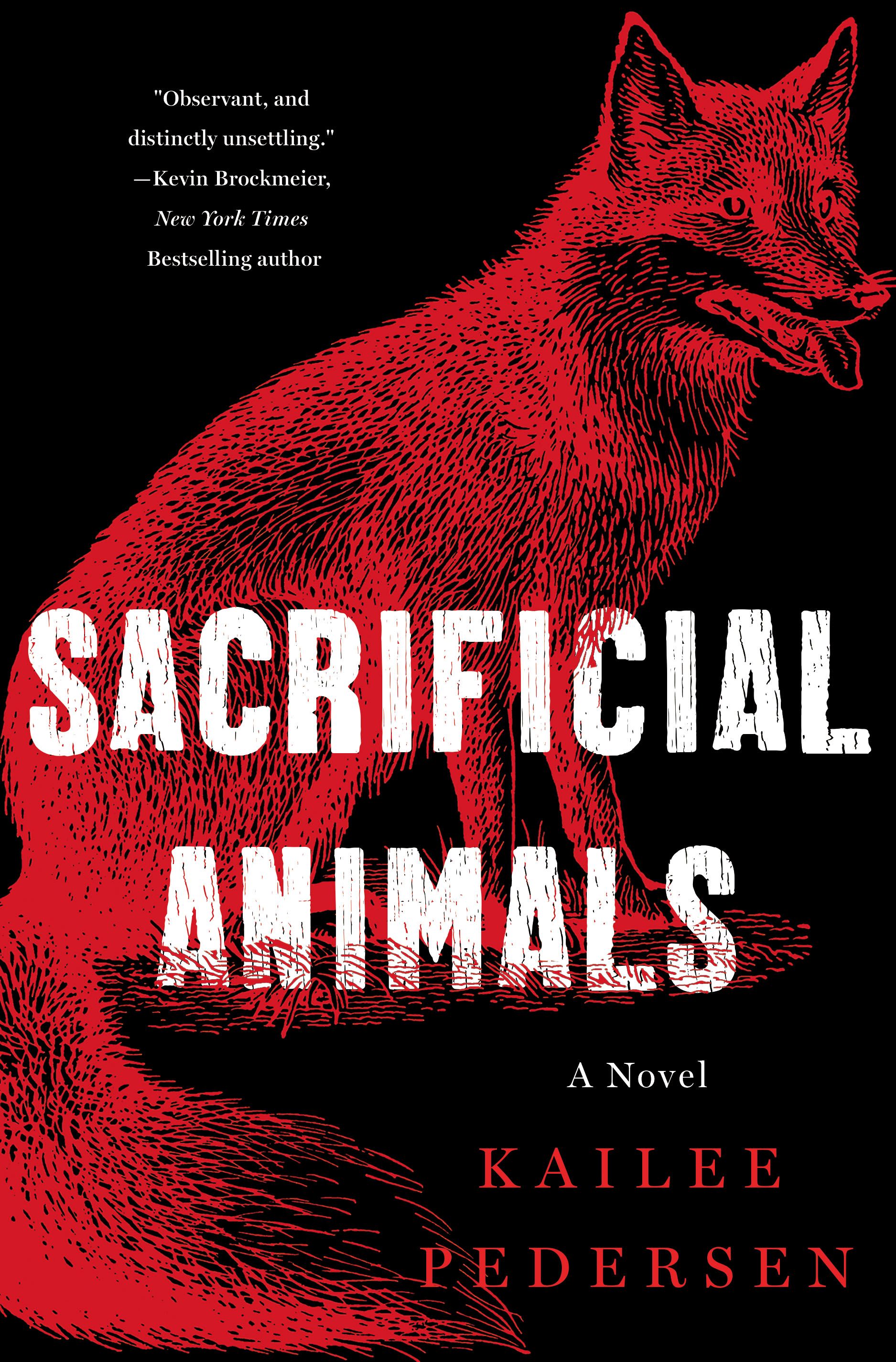
SACRIFICIAL ANIMALS, the kind of uneasy horror-inflected thriller I enjoy reading the most


SACRIFICIAL ANIMALS
KAILEE PEDERSEN

St. Martin' s Press
$29.00 hardcover, available now

Rating: 4* of five

The Publisher Says: Inspired by Kailee Pedersen's own journey being adopted from Nanning, China in 1996 and growing up on a farm in Nebraska, this rich and atmospheric supernatural horror debut explores an ancient Chinese mythology.

The last thing Nick Morrow expected to receive was an invitation from his father to return home. When he left rural Nebraska behind, he believed he was leaving everything there, including his abusive father, Carlyle, and the farm that loomed so large in memory, forever.

But neither Nick nor his brother Joshua, disowned for marrying Emilia, a woman of Asian descent, can ignore such summons from their father, who hopes for a deathbed reconciliation. Predictably, Joshua and Carlyle quickly warm to each other while Nick and Emilia are left to their own devices. Nick puts the time to good use and his flirtation with Emilia quickly blooms into romance. Though not long after the affair turns intimate, Nick begins to suspect that Emilia’s interest in him may have sinister, and possibly even ancient, motivations.

Punctuated by scenes from Nick’s adolescent years, when memories of a queer awakening and a shadowy presence stalking the farm altered the trajectory of his life forever, Sacrificial Animals explores the violent legacy of inherited trauma and the total collapse of a family in its wake.

I RECEIVED A DRC FROM THE PUBLISHER VIA NETGALLEY. THANK YOU.

My Review
: The pleasure I felt reading this book about a bisexual man embroiled in a failing family that's falling to pieces under a culturally unexpected malevolence...! If your mood says, "make it fast," move on to the next cookie-cutter thriller. If your mood says, "give me the literary equivalent of edging," you opened the right book.

The pacing of the read itself is fast. The way the short chapters propel your reading is not, however, equaled by the pace of the story unfolding. The relocation into different periods of time that unfold the wide fan of motives and motivations is much more deliberate. I was surprised by this at first, but in time found my footing in this technique of moving the pages at a different rate from the story itself. In the end, the mechanism I used for dealing with this mismatch was the same one I'd used eons ago when I watched All My Children...the stories moved slower than the episodes.

That said...the story is very familiar. Using this technique helped a Gothic romance-cum-horror tale feel more exciting than that description does. Emilia, the exoticized Other, gets the modern reader's sympathy at first. She's rejected and devalues based on her Otherness. We respond to this behavior nowadays with complete sympathy for the Othered, as goodness only knows it was long past time for us to do as a default.

...but what if that could be used to wreak havoc...?

The author, an ethnic Chinese adoptee into Midwestern culture, decided she would use this very, very clever repurposing of the wide paranoid streak in US culture to create a Gothic story of supernatural entities causing havoc for, apparently, the hell of it. The nine-tailed fox of East Asian folklore seems, more often than not, to just do stuff to see what'll happen next. That seems to me, when attributed to conscious entities, like a wicked, immoral, rotten-souled thing to do, as it is guaranteed to hurt someone who does not know what they're getting into when they fall for the fox-spirit's lures. One can argue that, really basically, Nick fucking his brother's wife for any reason at all is just cause for everything that follows.

I agree.

But everyone else? They didn't ask for this.

So runs my usual horror-themed read response. Like Walschots's Hench, I've always seen super"heroes" as agents of chaos and misery; I watched Poltergeist and asked my then-date, "what the hell are these people gonna do when their insurance won't replace the house?" (He broke up with me a few weeks later.) It doesn't help that I do not believe in The Supernatural, or spirits, or gods. (The vastness of just measurable spacetime isn't awe-inspiring enough for you?) That's one steep hill of disbelief to climb for one little story.

Where I got invested in Author Pedersen's iteration of it was back to that soap-opera technique of unfolding the fan behind the shadowplay of the story. I was constantly thinking "what's that going to mean?" and "what's his zipper doing down?" not focusing on the action in the moment.

For some of y'all, that's the nail in the coffin right there. Good. This will not be a good read for someone whose story in-the-moment expectations are to move from cause to effect and ever onwards, kicked in the hindquarters by heavy boots of Action. A more satisfied reader will come from the ranks of the curious ones who climb hills to look around from the top, then walk down to look at the top.

Satisfying reading, though not in the easy, ordinary way.

Wednesday, January 26, 2022

LIGHT YEARS FROM HOME, a poignant story of the cost of being where you fit not belong


LIGHT YEARS FROM HOME
MIKE CHEN

MIRA Books (non-affiliate Amazon link)
$12.99 Kindle edition, available now

Rating: 3.75* of five

The Publisher Says: Every family has issues. Most can’t blame them on extraterrestrials.

Evie Shao and her sister, Kass, aren’t on speaking terms. Fifteen years ago on a family camping trip, their father and brother vanished. Their dad turned up days later, dehydrated and confused—and convinced he'd been abducted by aliens. Their brother, Jakob, remained missing. The women dealt with it very differently. Kass, suspecting her college-dropout twin simply ran off, became the rock of the family. Evie traded academics to pursue alien conspiracy theories, always looking for Jakob.

When Evie's UFO network uncovers a new event, she goes to investigate. And discovers Jakob is back. He's different—older, stranger, and talking of an intergalactic war—but the tensions between the siblings haven't changed at all. If the family is going to come together to help Jakob, then Kass and Evie are going to have to fix their issues, and fast. Because the FBI is after Jakob, and if their brother is telling the truth, possibly an entire space armada, too.

The perfect combination of action, imagination and heart, Light Years From Home is a touching drama about a challenge as difficult as saving the galaxy: making peace with your family…and yourself.

I RECEIVED A DRC FROM THE PUBLISHER VIA EDELWEISS+. THANK YOU.

My Review
: Every damn word of this is so heartfelt, so honest and so completely resonant with my Kassie-like self that I feel like a rotter for not giving it that fourth star. But yet again, sexuality (Evie's probably Lesbian or Bisexual) is window-dressed onto an otherwise complete character. Please stop doing that.

When Arnold, the family patriarch (and doesn't he just know it!) disappears with Jakob, the underperforming (according to Arnold) son, the whole family flies into a state of emergency! Then Arnold comes back from that camping trip, without Jakob, but with a Purpose: Find him and bring him home.

No matter what, no matter who gets hurt or slighted.

So the family is broken again, not re-broken but the existing broken structure is smashed on a new rock. That rock is a vanished son...who returns one day! But what baggage he drags...and what a life he's led...and what his sisters had to put up with...and what they're coping with now.... And, as I am sure you've tipped to by now, this isn't a seamless, straight-through narrative. There are flashbacks!

Every single soul in this narrative has reasons for what they have done that do not depend on what the others did or didn't do. However, as in all toxic families, they blame each other publicly and themselves privately. Jakob made it easy for his twin sister to avoid the tough parts of growing up by leaving her the job of fulfilling the family's expectations. That'll make anyone angry! His little sister, growing up in the vacancy left by a father whose obsession with his lost son is all-consuming, opts out of sane, mainstream society...and this puts yet more pressure on her older sister. Then, wouldn't you just know, Dad dies! And Mom gets dementia!

I think it was around here that I went inside my emotional hidey-hole for a while. It's a lot. I related to Kassie. I was angry with Jakob for...vanishing...without a word. (I mean, come on! He can come back now, but he couldn't send some sort of interplanetary post card? "Having a wonderful war, be glad you aren't here" or something?) But that doesn't put the blame on him, Kassie, the way you want it to...you chose your path, and everyone has choices. Yes, some are harder to make than others, but they're still within the realm of possibility. A thing you, in your faithlessness, have every reason to know....

So this is sci fi? Well...yyyeeesss, but in a curious way no. It's what happens in the space opera between the acts. The messy human bits of the story that get elided over when you're telling the Ultimate Battle of Good Versus Evil!!! and the Hero is tasked with getting {thing} from his home, and whee! he comes back with {thing} and a story about his father being dead. Well, this is what actually happened then!

What makes the story compulsively readable for me is that quality, that interstitial nature. I am always interested in what occurs between the acts. I was not as interested in the seemingly grafted-on piece about the FBI thinking Jakob had run off to become a terrorist...Jakob?! lazy schlub that he was?!...but I can see how it felt timely for young Mister Shao to be branded as something he clearly could never bring himself to be. In a very odd way, though, I guess he did become a violent actor. Just not on Earth. Which, funnily enough, makes it okay...? Or does it?

Kassie's point-of-view narration is cringe-inducingly spot-on for the judgmental left-behind Responsible One's angle. It wasn't fun for me, but it was so real that at times I had to go look and make sure I was still an old, white man and hadn't transmogrified into Kassie Shao. So well done, Author Chen...sort of.

I don't think for a minute that the sci-fi elements will pass muster among the die-hard fans of the genre. They really aren't made for those readers. So if you're a hard SF reader, don't come here with those expectations. This is the moving, affecting, real story of one family's emotional dysfunction over the course of fifteen long, hard, lonely years of alienation and isolation, and the reason for it is science-fictional in nature.

I honestly wondered why I was so caught up in this family cess pit when the Universe is in danger out there! The first part makes you believe that Jakob's quest is URGENT and REAL and then...his sisters kludge onto him, Evie in a credulous, uncritical way and Kassie with her trademark judgment and blame (and she's a therapist?! Yikes), and suddenly it's possible that this is reality and Jakob's just not in it with us.

It gave my reading a focus, a real sense of the stakes, for the story to be presented in this way, though I would've predicted it to have been otherwise. Author Chen's work, which I've been reading for years now, has always made itself a home on my devices because he visibly grows with each published work. I haven't always liked his growing pains, but I appreciate that he is clear about what it is he needs to do and always tries to do it better every time. That he succeeds is a testament to his talent.

Thursday, January 20, 2022

JOAN IS OKAY, the title's a complete lie; & THREE APPLES FELL FROM THE SKY, a fairy/folk tale of the Armenian Genocide


JOAN IS OKAY
WEIKE WANG

Random House
$27.00 hardcover, available now

One of NPR's Best Books of 2022!

Funny how Life works out, isn't it? This wasn't *meant* to be a pandemic novel, says Weike Wang.

LONGLISTED for the 2023 Andrew Carnegie Medal for Excellence in Fiction!


Rating: 4* of five

The Publisher Says: A witty, moving, piercingly insightful new novel about a marvelously complicated woman who can’t be anyone but herself, from the award-winning author of Chemistry

Joan is a thirtysomething ICU doctor at a busy New York City hospital. The daughter of Chinese parents who came to the United States to secure the American dream for their children, Joan is intensely devoted to her work, happily solitary, successful. She does look up sometimes and wonder where her true roots lie: at the hospital, where her white coat makes her feel needed, or with her family, who try to shape her life by their own cultural and social expectations.

Once Joan and her brother, Fang, were established in their careers, her parents moved back to China, hoping to spend the rest of their lives in their homeland. But when Joan’s father suddenly dies and her mother returns to America to reconnect with her children, a series of events sends Joan spiraling out of her comfort zone just as her hospital, her city, and the world are forced to reckon with a health crisis more devastating than anyone could have imagined.

Deceptively spare yet quietly powerful, laced with sharp humor, Joan Is Okay touches on matters that feel deeply resonant: being Chinese-American right now; working in medicine at a high-stakes time; finding one’s voice within a dominant culture; being a woman in a male-dominated workplace; and staying independent within a tight-knit family. But above all, it’s a portrait of one remarkable woman so surprising that you can’t get her out of your head.

I RECEIVED A DRC FROM THE PUBLISHER VIA NETGALLEY. THANK YOU.

My Review
: First things first: I think Joan's neurodivergent. There. I said it.

What else is Joan? A disappointing daughter, who isn't going to give her mother the expected grands. An annoying sister, who is resolutely unimpressed with her brother's lavish getting-and-spending lifestyle. A breathtakingly good, effective ICU doctor at the outset of the Plague. A clueless, oblivious object of somewhat diffident romantic interest...utterly unrequited...for her neighbor. And most of all, most satisfyingly and unbreakably, Joan is herself.

If you don't like to read "women's fiction" because it's about men (how to catch), read this book. It's about Others (how to evade), when it's about anyone not Joan. And that was exactly why I enjoyed the read so much. Joan's struggles are typical for an atypical person, and her intelligence isn't a problem but a solution, making her an extra delightful companion for this reader. As everyone around her tries to make her feel she's missing out, lacking something, somehow wanting for something, and until she decides for herself what she thinks, she remains upset and at sea. In her enforced idleness (bereavement leave? for a father she felt little connection to still less affection for, shouting abuser that he was?) she loses the armor of being too busy to deal with all the mishegas of ordinary life.

It is great to read about the woman lead's sense of self being explored and resolved without a boyfriend at the beginning, middle, or end of the process. It is bracing to read the genuinely painful experience of the first-generation American in attempting to come to a happy resolution to a parent's desires when these are rooted in a wildly different world. But then, as the visibly different as well as culturally different as well as neurologically different (this last is not explicit in the text, but its factuality is the hill I'll die on) Joan thinks, "Why try to explain yourself to someone who had no capacity to listen?" She thinks this in a different relationship's context but the truth is, it is Joan all the way. She's not going to do the same thing a dozen...even, I suspect, a pair of...times expecting or hoping for different results. What kept me from giving it all five stars was, however, that very thing: I felt Joan was harshly judgmental from beginning to end, despite questioning herself and her responses as we went through the story. I think that's a bit unbelievable, it seemed to me she would've adjusted some of her private judgments...still, not a fatal flaw since I liked her from giddy-up to whoa.

In fact, in just over 200pp, I fell in love with Joan as she is. I think you might do the same. Give her a few of your hours. She's a good companion.

++++++++++++++++++++++++++++++++++++++++++++++++++++++++++++++++


THREE APPLES FELL FROM THE SKY
NARINE ABGARYAN
(tr. Lisa C. Hayden)
OneWorld Publications (non-affiliate Amazon link)
99¢ Kindle edition, available now

Rating: 4* of five

The Publisher Says: The Russian bestseller about love and second chances, brimming with warmth and humour

In the tiny village of Maran nestled high in the Armenian mountains, a place where dreams, curses and miracles are taken very seriously, a close-knit community bickers, gossips and laughs, untouched by the passage of time. A lifelong resident, Anatolia is happily set in her ways. Until, that is, she wakes up one day utterly convinced that she is dying. She lies down on her bed and prepares to meet her maker, but just when she thinks everything is ready, she is interrupted by a surprise visit from a neighbour with an unexpected proposal.

So begins a tale of unforeseen twists and unlikely romance that will turn Maran on its head and breathe a new lease of life into a forgotten village. Narine Abgaryan's enchanting fable is a heart-warming tale of community, courage, and the irresistible joy of everyday friendship.

THIS WAS A FREE DOWNLOAD VIA BOOKBUB. I THINK. ANYWAY, THANK YOU.

My Review
: A clever little folk-tale that mimics the forms of earlier tales with modern, relatable trappings. It’s meant to be a means of processing the upheavals of Armenia as it bumpily traveled from tsars to commissars to…chaos, pure capitalism, as part of Russia then on its own with no stops at any rational place anywhere along the way. We’re not given much information but the wretchedness of the people to use as a calendar. The main event is World War I's Armenian Genocide, there was much suffering; there was much suffering throughout, but the weird thing about it is how little of it seemed to penetrate the inner lives of the characters, really better called "survivors" given how many die in the course of the story. Their village, isolated and insulated all together, goes on, despite the horrific events that unfurl between and around them.

Is that realistic? What do I, fat comfortable American that I am, know about that; I know the author chose the fairy-tale/folk-tale structure and tenor for a reason. The Armenians have a saying:
As has been established in Maran legends since time immemorial, the night will drop them to earth from the sky:
And three apples fell from heaven:
One for the storyteller,
One for the listener,
And one for the eavesdropper.

Welcome, fellow eavesdropper, to the juicy apple of Narine Abgaryan's bestselling Russian-language tale of Armenia's wild ride through the 20th century. Strap your helmet on a little tighter. You're going to meet a lot of people, and not all of them have names you'll be able to pronounce. It does not matter a whit. Love them for who they are, not how they sound in your monoglot's ear. Anatolia, the woman at the actual center of the story, is one of the world's readers-cum-librarians so she merits our rapt attention. It's not hard to give.
Little by little, thanks to intuition and innate taste, she learned to distinguish good literature from bad and fell in love with Russian and French classics, though she came to hate Count Tolstoy, unequivocally and forever, as soon as she finished Anna Karenina.
Happen I agree...but the less said of her shelving preferences the better. Her travails, those of her fellow villagers, are deeply experienced in the author's (and translator's, what a great job Lisa Hayden did on this book! I honestly forgot it was a translation most of the time, and that is meant as a compliment) open, honest, and still lyrical prose:
For eight long, unbearable years, the war reaped a harvest of restless souls around the world, but one day it sputtered out and retreated, howling and limping and licking its bloody paws.
–and–
Anatolia suddenly grasped that there was no heaven and no hell: happiness was heaven and grief was hell. And their God was everywhere, all over, not just because He was all-powerful but also because He was the unseen threads that connect them with each other.

The other feature of the prose you'll have discerned by now is the simple, direct wisdom of it. The author and translator have taken care to make sentences that sound like they've rolled around simple peoples' minds and mouths for long enough to become weighty with meaning and light of touch:
“There’s nothing more destructive than idleness,” his father had loved repeating. “Idleness and leisure deprive life of purpose.”

Vasily now understood the truth of his father’s words. Life does, indeed, lose its purpose at the very instant a person ceases bringing benefit to those around him.

Which is a truth that many of us, disabled and/or retired, learn at a very high cost in self-esteem and peace of mind. It's not, youthful imaginings to the contrary, at all fun to be idle. So what is one meant to do? Find something useful to do! Me, I write book reviews...how about you?