Showing posts with label Russian translation. Show all posts

Wednesday, April 8, 2026

MY DREADFUL BODY, five-star novella debunking misogyny's lies


MY DREADFUL BODY
EGANA DJABBAROVA
(tr. Lisa C. Hayden)
New Vessel Press (non-affiliate Bookshop.org link)
$17.95 all editions, available now

On the 2026 Longlist for the National Book Award for Translated Literature

Rating: 5* of five

The Publisher Says: A dazzling debut novel about a young woman's vexed coming of age in a traditional Azerbaijani community in Russia, grappling under the weight of Muslim patriarchal norms and a debilitating neurological condition.

The mysterious affliction leaves her unable to control her muscles, plagued by pain and speech disorders, defying diagnosis. Addressing each body part with the scrupulousness of a medical researcher, the narrator explores memories, traditions, and taboos related to her physical self. In the process, a woman once destined for the role of a beautiful marriageable daughter comes to be perceived as damaged goods.

With verbal elegance and poetic power, Egana Djabbarova unveils a hidden world in which illness unexpectedly facilitates her liberation.

I RECEIVED A DRC FROM THE PUBLISHER VIA EDELWEISS+. THANK YOU.

My Review
: Poetically laconic, elegantly simple, maximally affecting prose telling a woman's life of contradictions in identity. For a woman in Azeri culture, her body defines her. It is female therefore these are her options, this set of rules apply to her. Then along comes Egana, like the author's name...probably like the author. She yearns not to be defined by her body, and paradoxically freed by having a woman's body defined by a painful, disabling illness called dystonia blends both those realities.

Eleven body parts define the course of this narrative, under 150pp in length, and still eternal. It's Egana coming to terms with patriarchy and its religious, its community, its intimate controls over women. This is a fierce and outraged shout in the face of a god and a culture that insists femaleness has no agency, can only exist in relation, in submission, to masculine needs and wants. Egana doesn't shout her rage, she trumpets her horrible escape from the unkind fate of a life spent in drudgery and servitude...a decidedly mixed blessing, but a blessing she catalogs in careful, intimate detail. This is what makes this read so different from US feminist fiction: It prescribes no path to follow, defines no road not taken or taken by stricture. Egana has no say in her desirable opting-out from Womanhood's duties as prescribed by her culture. It was wished on her by a bodily dysfunction, a painful affliction; but it serves as a space separate from her culture's expectations so is a vantage point from which to observe the power of normative expectation. It is a meditation and an examination, not a prescription for others to follow.

Possibly the most powerful strand in the tight, compact story for my disabled-by-pain self was not related to that shared experience but the equally defining quality of being in a cultural diaspora. A Muslim and an Azeri in Russia, the colonial power that defined her family's country's course in the modern world telling the story of her intimate estrangement from that community was perhaps the least expected source of empathy and pathos in my read of the story. I felt as though I was fully in Egana's life when I realized how alienated from her Othered cultural reality...doubly, triply Othered by religion, sex, and culture.

It's astonishing how deep this experience of identification was as I considered my own alienation from US culture with its youth-worship, its heteronormativity, its serious lack of interest in including the disabled or the chronically ill. It lifted the read into five-star territory because it managed this feat without once telling me how terrible Egana's fate was. I got to experience her life with her, in her words, grounded in her own body...each discussed part of which I also possess. Nothing in Egana's "dreadful" body is unique to femaleness. It is female because she is a woman. It is discussed as a woman's body in relation to every other cultural reality only because she is a woman.

If you can think of a better way to point up the sheer idiocy of misogyny, its illogic and its sadism, I encourage you strongly to write about it. You'll be a bestseller in no time at all.

As My Dreadful Body should be.

Monday, September 29, 2025

VLADIMIR SOROKIN'S PAGE: Oprichnik's Russia duology


THE SUGAR KREMLIN (Oprichnik's Russia #2)
VLADIMIR SOROKIN (tr. Max Lawton)
Dalkey Archive Press (non-affiliate Bookshop.org link)
$18.95 trade paper, preorder for fulfillment tomorrow

Rating: 4* of five

The Publisher Says: A puzzle of colorful, sardonic episodes that come together as a portrait of totalitarian society as a whole.

Sugar Kremlin follows the near-future universe of Sorokin’s Day of the Oprichnik, crafting a set of 15 chapters that all return to the symbol of the The Sugar Kremlin. Thousands of these creations are being given away to citizens on the street, from lucky children to secret political dissidents, torture-obsessed civil servants, sex workers in a nearby bordello, and more.

As Sorokin moves from story to story, he draws the reader through the dark streets of life in Russia, creating a metaphysical encyclopedia of the Russian soul through a deceptively sweet sugary treat. Presenting a wide variety of genres and tones, Sugar Kremlin lays out a frightening vision of speculative mercilessness and quirky political horror.

I RECEIVED A DRC FROM THE PUBLISHER VIA EDELWEISS+. THANK YOU.

My Review
: Not a novel. A collection of fifteen stories set in the storyverse of Day of the Oprichnik but without overlapping or recurring characters. The structure here is centered around a literal "sugar Kremlin", a treat made of sugar in the shape of the Kremlin that's like an Advent calendar or a fruitcake or other holiday treat in ubiquity and celebratory affect.

That alone makes this unnerving, dystopian fantasia of a 2028 Russia unsettlingly like the Project 2025 US we're living in. The characters are constantly munching on, consuming, discussing the lusciousness of, this nutritionless pure sugar abomination.

On the nose much, Author Sorokin?

Expect the usual transgressive behaviors (I've been uneasily eyeing my hammer), the expected degradation and cruelty, the obligatory violent and vicious conduct. Sorokin is not going to coddle your imagination. The stakes here are too high. This duology (this one published in 2008 in Russian, 2025 in English, printed now that Dalkey Archive's under new ownership) is a trumpet blast, containing every dissonant and perverse note in Literature's instrumentation, to get the reader to see, really see, what is going on. It's been the brief of this press since its founding in 1984.

What made this a slightly-less-stellar read than Day of the Oprichnik for me was the episodic nature of stories...they don't really synergize to create a paralyzing terrified awareness of the overarching story's validity and possibly even applicability to 2025 US life. It's not what stories do, nor are they supposed to. What they've done as collected here is make the whole feel more melodramatic than dramatizing reality as a novel does. I was a bit thrown by a story titled "The Queue" because that's also an (unrelated) novel by Author Sorokin. It was brief but it threw me out of my flow state.

I am, then, one of those who are not au fait with Author Sorokin's contention that "The contemporary world is so complex and protean that it is no longer possible to describe it with linear prose and squeeze it into a traditional novel's structure." (From his interview with Joshua Cohen that forms the Introduction to the book.) I read a lot of linear novels; they do a creditable job of linear presentation of an inherently nonlinear world; I do not see that what I've just read has a notable advantage over, say, The Words That Remain (a linear-prose novel that presents complexity, pathos, cruelty, and love effectively). I readily stipulate that I'm possibly missing the point of his statement, or too dull of apprehension to get more than a dim gist of it.

Nonetheless, I experienced this read as a collection of well-made stories ready to épater les bourgeois as they...we...so badly need literature to do. Author Sorokin is ready, willing, and able to do this duty, with verve and panache, and scatology and violence.

It needs doing. It needs reading.

++++++++++++++++++++++++++++++++++++++++++++++++++++++++++++++++


DAY OF THE OPRICHNIK (Oprichnik's Russia #1)
VLADIMIR SOROKIN (tr. Jamey Gambrell)
FSG
$9.99 ebook, available now

Rating: 4.5* of five

The Publisher Says: Moscow, 2028. A cold, snowy morning.

Andrei Danilovich Komiaga is fast asleep. A scream, a moan, and a death rattle slowly pull him out of his drunken stupor—but wait, that’s just his ring tone. And so begins another day in the life of an oprichnik, one of the czar’s most trusted courtiers—and one of the country’s most feared men.

Welcome to the new New Russia, where futuristic technology and the draconian codes of Ivan the Terrible are in perfect synergy. Corporal punishment is back, as is a divine monarch, but these days everyone gets information from high-tech news bubbles, and the elite get high on hallucinogenic, genetically modified fish.

Over the course of one day, Andrei Komiaga will bear witness to—and participate in—brutal executions; extravagant parties; meetings with ballerinas, soothsayers, and even the czarina. He will rape and pillage, and he will be moved to tears by the sweetly sung songs of his homeland. He will consume an arsenal of drugs and denounce threats to his great nation’s morals. And he will fall in love—perhaps even with a number of his colleagues.

Vladimir Sorokin, the man described by Keith Gessen (in The New York Review of Books) as “[the] only real prose writer, and resident genius” of late-Soviet fiction, has imagined a near future both too disturbing to contemplate and too realistic to dismiss. But like all of his best work, Sorokin’s new novel explodes with invention and dark humor. A startling, relentless portrait of a troubled and troubling empire, Day of the Oprichnik is at once a richly imagined vision of the future and a razor-sharp diagnosis of a country in crisis.

I RECEIVED A DRC FROM THE PUBLISHER. THANK YOU.

My Review
: From the vantage point of late 2025, a post-Putin neo-medieval Russia in 2028 sounds...oddly optimistic...as well as wrong. From 2005's standpoint it probably seemed more likely; even though nothing in this book could be called hopeful, it was probably sounding good to Sorokin just not to have Little Vladdy Pu-Pu on the tsar's throne.

Predictions always miss something. Usually they're too optimistic, too hopeful, and weird to say that's the problem with this bleak prediction-fest. *waves at Little Vladdy Pu-Pu on his throne* I'm not entirely convinced the religious fervor of the Oprichnia, as revived from the days of Ivan the Terrible (an epithet with multiple valences in English, all of them applicable to the bearer then...and by extension now), is not active in 2025 let alone 2028.

With his characteristic OTT revulsion-inducing behaviors foregrounded, this book is automatically beyond the pale of all too many squeamish readers. I would say "try to get past it" but honestly...don't. One is meant to be revolted and put off by it, much as the 1972 John Waters shocker Pink Flamingos is not meant to titillate but shock and offend (fifty-plus years on, it still does). The world Author Sorokin posits is intended to be just as appalling and revolting, to disgust you and repel you! The entire reason to hold a dark mirror of satire up is to draw attention to the wrongness and cruelty of the world being posited. By no means is it accidental that so much of it is grimly familiar. The theocratic angle is the one not quite fully rolled out by our allegedly separate government. Just wait.

This edition was published in 2011, and it is only more relevant and more horripilating in 2025's world of ICEstapo and wholesale social upheaval caused and inflamed by the most powerful in our country.

Wednesday, September 3, 2025

THEIR FOUR HEARTS, intense, appalling, urgent, amazing


THEIR FOUR HEARTS
VLADIMIR SOROKIN
(illus. Gregory Klassen; tr. Max Lawton)
Dalkey Archive Press (non-affiliate Bookshop.org link)
$17.95 all editions, available now

Rating: ?5*? but on what scale....

The Publisher Says: In many respects, Their Four Hearts is a book of endings and final things. Vladimir Sorokin wrote it in the year the Soviet Union collapsed and then didn't write fiction for ten years after completing it—his next book being the infamous Blue Lard (q.v.), which he wrote in 1998. Without exaggerating too much, one might call it the last book of the Russian twentieth century and Blue Lard the first book of the Russian twenty-first century. It is a novel about the failure of the Soviet Union, about its metaphysical designs, and about the violence it produced, but presented as God might see it or Bataille might write it.

Their Four Hearts follows the violent and nonsensical missions carried out by a group of four characters who represent Socialist Realist archetypes: Seryozha, a naive and optimistic young boy; Olga, a dedicated female athlete; Shtaube, a wise old man; and Rebrov, a factory worker and a Stakhanovite embodying Soviet manhood. However, the degradation inflicted upon them is hardly a Socialist Realist trope. Are the acts of violence they carry out a more realistic vision of what the Soviet Union forced its "heroes" to live out? A corporealization and desacralization of self-sacrificing acts of Soviet heroism? How the Soviet Union truly looked if you were to strip away the ideological infrastructure? As we see in the long monologues Shtaube performs for his companions—some of which are scatological nonsense and some of which are accurate reproductions of Soviet language—Sorokin is interested in burrowing down to the libidinal impulses that fuel a totalitarian system and forcing the reader to take part in them in a way that isn't entirely devoid of aesthetic pleasure.

As presented alongside Greg Klassen's brilliant charcoal illustrations, which have been compared to the work of Bruno Schulz by Alexander Genis and the work of Ralph Steadman as filtered through Francis Bacon by several gallerists, this angular work of fiction becomes a scatological storybook-world that the reader is dared to immerse themselves in.

I RECEIVED A DRC FROM THE PUBLISHER VIA EDELWEISS+. THANK YOU.

My Review
: Before I begin, let me say:
→H↔E↔E↔D↔T↔H↔E↔C↔O↔N↔T↔E↔N↔T↔W↔A↔R↔N↔I↔N↔G←

If you need a content warning for gore, body horror, transgressive...anything...horseman, pass by. This is Sorokin, of Blue Lard fame, playing Literature's organ with the unsettling pedal fully depressed and the weird stop pulled all the way out. Comme d'habitude, then.

So, the audience now being self-winnowed, I'm going to tell you as little as I can about the transgressions and more about why I care enough to suggest you read this tooth-ripped bloody gobbet shoved in a sweaty gym sock of a book. Because you still can, that's why. This is a litmus test for collapse. If you read it and are not repulsed fairly often, you're probably on the barricades now. If you read this and think, "oh my gawd how'd he geta away with THAT?!" twice a chapter, you're marching somewhere, and shitposting about the 2025ness of it all, and postcarding the hell out of red districts. Everyone else, the "this is repulsive!" to the "this should be banned!" folk, why are you even here? It is not safe for you to be reading anything here when you're under curfew. Off to The New York Times, now, quick as you like, no hands outside the windows!

Like Blue Lard, like Moderan, like everything Burroughs or Dennis Cooper ever wrote, this weird, janky, slightly collapsing edifice of artifice requires you to participate. Very few things in the content-consuming 2025 we live in *require* you to participate to make them work. Sorokin's works aren't simple, even simplistic, slickly made entertainments, they are viscera of story hoicked out of places you didn't think there was spare narrative flesh. There wasn't spare narrative flesh. Vital organs of awareness and complicity and oblivious cruelty are wrenched out and held up before your dumbfounded gaze...and the chapter-opening art adds to that impact.

Sound unappealing? It's not here to appeal to you, it's here to make you reach inside yourself and find the pieces...they're only going to be pieces, I don't think inchoate monstruous sadists read my blog...of these characters in crises they did not make, or try to make better in any way. It is in all of us to look away, to accept pretty surfaces on ugly things, ugly selves. That response is not possible while reading Their Four Hearts.

And that's the point of reading it. I think it could do you a power of good between retches.

Friday, August 22, 2025

UNTRACEABLE, ex-Soviet thriller author slyly pokes powerful people in the ribs..."I saw that!" with deniability


UNTRACEABLE
SERGEI LEBEDEV
(tr. Antonina W. Bouis)
New Vessel Press (non-affiliate Bookshop.org link)
$22.95 all editions, available now

Rating: 4.5* of five

The Publisher Says: In 2018, a former Russian secret agent and his daughter were poisoned with a lethal neurotoxin that left them slumped over on a British park bench in critical condition. The story of who did it, and how these horrendous contaminants were developed, captivates and terrifies in equal measure. It has inspired acclaimed author Sergei Lebedev’s latest page-turning novel.

At its center is a scheming chemist named Professor Kalitin, obsessed with developing an absolutely deadly, undetectable and untraceable poison for which there is no antidote. He becomes consumed by guilt over the death of his wife, the first accidental victim of his Faustian pact to create the ultimate venom, and the deaths of hundreds of test subjects. After he defects from the Soviet Union to spend his “retirement” years in the West, two Russian secret agents are dispatched to assassinate him.

In this fast-paced, genre-bending novel, Lebedev weaves tension-filled pages of stunningly beautiful prose exploring the historical trajectories of evil. From Nazi labs, Stalinist plots, the Chechen Wars, to present-day Russia, Lebedev probes the ethical responsibilities of scientists supplying modern tyrants and autocrats with ever newer instruments of retribution, destruction and control. Lebedev, one of Russia’s most important and exciting writers, has never been better.

I RECEIVED A DRC FROM THE PUBLISHER VIA EDELWEISS+. THANK YOU.

My Review
: I do not know why this story did not sell a million copies on release, or why so many highly respected outlets' praise (The New York Times, Library Journal, CrimeReads) did not result in bestsellerdom and a residency on top of the lists. It couldn't be the quiet discouragement of Powerful People, of course not...but somehow y'all slept on this well-told, excitingly plotted, extremely timely thriller.

What do you mean, "so did you"? No of course I didn't! I had...COVID...oh yeah...forgot about that.

Time to rectify that.

Let's start with the prose:
Kalitan felt uncomfortable. The pushy women, the noisy, grumbling line, the obnoxious kids annoyed him. The boys suddenly ran off and whispered to the adults pointing at the car. Kalitin turned around and saw that the bouncing ride had loosened the tarp. The sun shone on the monkey's dead face, yellow teeth bared in the pink mouth; shiny chrome-green flies crawled over the black fur.
A Goodreads friend, herself a novelist, used this passage to illustrate why the story did not work for her. I'm the opposite, in this case. As a reader of thrillers I want to see, to get into my eyes, the scenes; it's the m.o. of the thriller to be cinematic and evoke a response with urgency not build-up in most situations. I got my cues...yellow, pink interiors of vulnerability; metallic green, black, shiny exteriors of impermeability. My eyes are there.

It isn't going to work for everyone, but what does? Translator Bouis did not overcomplicate or undersell at any turn the intent of a thriller. I really got involved, as a result, in the way the story presents the conflict of guilt and culpability as reluctant internalization of results in physical reality.

Poisoning someone by premeditated action would come across as depraved, indifferent, if done in this framework. Instead this story is about creating conditions by one's curiosity and labor to resolve that curiosity in physical form that result in...entirely without one's own involvement...the greatest possible harm to a stranger. Think it's implausible? Go watch Oppenheimer, and/or read American Prometheus.

What works best in this way of presenting the story is (for me) the sheer number of SNAFUs and FUMTUs that plague attempts to "neutralize the threat" that is Kalitin's continued existence, after his creation is revealed to be the cause of death of politically inconvenient people. While he is not-really trying to deal with knowledge that processing would render horrifyingly painful, those trying to make their orders from on high real get more and more tripped up, screwed up, and outright thwarted by...well, everything.

It is always the case that ability to act outpaces ability to reflect. Kalitin is now reflecting, reluctantly, on his actions. We are not, thank goodness, subjected to his self-justifications. We see actions and results, we perceive probable responses, but we are never in the muck that is this morally compromised, no bankrupt, man's head. I think listening to a human's self-exculpatory inner chatter is pointless and painful.

A reckoning is a cathartic experience in life and in reading. Very, very seldom do reckonings come cleanly defined, with sharp edges and self-evident results. Fiction tries for that completeness at its peril, as this is fantasy fulfillment. Would you expect a Russian author, in the time of Little Vladdy Pu-Pu, to attempt that kind of blame assignment?

Saturday, August 16, 2025

THE TEARS AND PRAYERS OF FOOLS, Russian translation of Pale-of-Settlement historical novel


THE TEARS AND PRAYERS OF FOOLS
GRIGORY KANOVICH
(tr. Mary Ann Szporluk)
Syracuse University Press (non-affiliate Bookshop.org link)
$39.95 all editions, available now

40% off purchases of translations direct from the publisher until 15 September 2025

Rating: 4* of five

The Publisher Says: This extraordinary novel is part of Grigory Kanovich’s “Litvak saga,” his tribute to Jewish life before the Holocaust. Set in a small Lithuanian town in the late nineteenth century, the story begins with the arrival of a stranger who sets everyone on edge and seems to know their secrets. Is he a messenger from God, a long-lost son, a saint, or a madman?


As the stranger in the velvet yarmulke makes his rounds, we meet an unforgettable cast of characters—Rabbi Uri, the aged rabbi; Itsik Magid, the strapping young woodcutter; Golda, the resourceful widow; Markus Fradkin, the wealthy timber merchant, and his beautiful daughter Zelda; Yeshua Mandel, the tavern keeper, his troubled son Simeon, and Morta, their devoted servant girl. A work of realism as well as a parable, Kanovich’s novel illuminates the most intimate fears, dreams, and longings of the shtetl’s inhabitants.

I RECEIVED A DRC FROM THE PUBLISHER VIA EDELWEISS+. THANK YOU.

My Review
: I feel utterly inadequate to the task of reviewing this book, after reading this on Edelweiss+: "‘Shtetl noir’ meets Hasidic legend in this deeply philosophical work. In a word, this novel is the work of an exceptional writer with a unique voice.—Barbara Kirshenblatt-Gimblett, Professor Emerita, New York University". That is it, she's said it all, go get you one.

"Shtetl noir" is a term I've never heard before, but the instant I read it crystallized the affect of this story. I'm not all the way sure about the realism angle the publisher trumpets in the synopsis because I was never there in 1880s Imperial Russia, and after reading the story do not feel as though I've been there. It's the usual problem with historical fiction. It's enough removed from my life that I'm not adept at putting myself into the place; 1880s Pale-of-Settlement Russian Empire life is not in my 1960s-Sunbelt American worldview.

I'm astonished that the author lived to know, though I don't think see, this favorite of his ten novels appear at long last in English. He died at 93 in 2023, a life lived during the waning days of the Yiddish culture of Eastern European Jewry, through to Soviet times before he emigrated to Israel.

This novel feels much like I'd expect it to, knowing all that. There are bits and snatches of memory, scenes I was sure were utterly clear before his eyes as he wrote them. Maybe it's telling, though I can't know on whom, that the most clearly limned scenes and characters in my reading were Simeon Mandel the...troubled...son of the innkeeper and that man himself.

I loved the way I felt included in the read as we moved from scene to scene and place to place. In part that's because the book has a map in the front. I so appreciate that when the story takes place in several locations. I'm also grateful for the glossary (and please note the transliterations are not the usual ones, but reflect Lithuanian pronunciation) and dramatis personae, though that last is in the back of the book which strikes me as odd.

The author's grandson made art for the chapter opens that I found pitch-perfect. The images are human and yet caught in moments of almost Mannerist...distortion, contortion, well incongruity with the geometry of consensus reality. In many ways that is the "noir" I noted above as crystalizing the read for me. I found all the multivarious problems the characters face almost absurd, they bend and twist the sense of right and reason, all applied from the outside in. As in all noir tales, it's the unseen and faceless threats that unsettle and unnerve.

A story I don't know how to summarize because it is so deep but so deft with it; so dense with meanings we're not in daily contact with; so rife with assumptions we don't make in the twenty-first century, that I'm overwhelmed with the need to explain. It's not clear to me why you'll read this story. I wish you would. It's a world-view opener.

Wednesday, August 6, 2025

THE MOUNTAIN AND THE WALL, urgent and trenchant and tendentious reading


THE MOUNTAIN AND THE WALL
ALISA GANIEVA
(tr. Carol Apollonio; intro. Ronald Meyer)
Deep Vellum Publishing (non-affiliate Bookshop.org link)
$9.95 ebook, available now

Rating: 4* of five

The Publisher Says: This remarkable debut novel by a unique young Russian voice portrays the influence of political intolerance and religious violence in the lives of people forced to choose between evils.

The Mountain and the Wall focuses on Shamil, a young local reporter in Makhachkala, and his reactions, or lack thereof, to rumors that the Russian government is building a wall to cut off the Muslim provinces of the Caucasus from the rest of Russia. As unrest spreads and the tension builds, Shamil's life is turned upside down, and he can no longer afford to ignore the violence surrounding him.

With a fine sense for mounting catastrophe, Alisa Ganieva tells the story of the decline of a society torn apart by its inherent extremes.

I RECEIVED A DRC FROM THE PUBLISHER VIA EDELWEISS+. THANK YOU.

My Review
: Wow. The 2025 US needs a writer of this caliber, of this perspicacity, and possessed of this level of moral courage in flensing the rotting whale carcass of our Body Politic. Despite being ten years old (!), this near-future story of a country's takeover by religious extremists with an extremely high-control agenda is fresh as yesterday's op-ed page.

The unnervingly spot-on takedowns of "do as I say not as I do" hypocrisy, of hyperconsumerist end-stage capitalism, and of youthful hedonism's blinding obfuscation of the petty tyrannies and ideological inconsisencies of the new regime *rock*. Author Ganieva saw what was happening in Dagestan, a north Caucasian conflict zone nominally still part of Russia, and puts it all on just over 250 pages of unsparing prose.

Complacent US people ought to read it as soon as possible. The consequences of remaining blind to the end result of the unfolding coup are dire. It's all made perfectly plain here. It's also wryly amusing, at time darkly funny, and a very quick read. Shamil, our intrepid reporter main character, would win a Pulitzer in the US journalism space despite being pretty hapless...though largely not culpable for it, given the system he works within.

The atrocious anti-intellectual and anti-historical religious nuts are the better armed barbarian compadres of the Corporation for Public Broadcasting-killing, science-denying, book-banning idiots in the US. Their biggest head start on our vandals is their well-honed dagger of misogyny, held at the throats of every woman not veiled and submissive.

I do not want to live in their world. Their solution to that is to kill men like me for refusing to pretend they are the god-anointed masters of Earth. Resisting them is the way I stay able to look at myself in the mirror.

I hope you will take the same heart from this brief, inexpensive read.

Monday, June 2, 2025

PIONEER SUMMER, banned in Russia, authors forced to flee, publisher put out of business...buy now


PIONEER SUMMER
ELENA MALISOVA & KATERYNA SYLVANOVA
(tr. Anne O. Fisher)
Abrams Press (non-affiliate Amazon link)
$24.30 ebook, available tomorrow

Rating: 4* of five

The Publisher Says: This star-crossed gay romance is a #1 bestselling TikTok sensation that made international news and catalyzed one of Russia’s largest-ever crackdowns on LGBTQ representation

The banned gay romance that took Russia by storm . . .

In the waning days of the Soviet Union, two teenage boys find each other at Pioneer Camp, a patriotic summer program similar to the Boy Scouts. Yury Konev, 16, anticipates the weeks ahead of him with boredom and dread, but things change when he meets 19-year-old counselor Volodya. The two boys are drawn to each other, and though both fear the consequences of their illegal attraction, its gravity pulls them together.

Now, 20 years later, Yury returns to the abandoned camp to reminisce on the relationship that changed his life forever—and discovers that not all history is destined to remain in the past.

Cowritten by a Ukrainian–Russian duo and originally published by an independent publisher, Popcorn Books, Pioneer Summer became a TikTok sensation and runaway #1 bestseller in Russia. Catalyzed by this success, Russian Parliament officials and anti-LGBT activists began a campaign to ban the novel and others like it, an effort which became law just two months after the second book in the series was published. The authors were forced to flee the country, and Popcorn Books ceased publication.

But they—and we—will not be so easily cowed. Beginning in the summer of 2025, Pioneer Summer will become available for the first time in English, with the other two novels to follow.

I RECEIVED A DRC FROM THE PUBLISHER VIA EDELWEISS+. THANK YOU.

My Review
: I don't care if the sound of the book makes your nosehairs combust from discomfort, outrage, or just plain homophobia, if you possess a single functioning neuron the stakes of buying a copy of this book with or without the intent to read it ought to compel you to spend the money.

Little Vladdy Pu-Pu (I saw an image of him with cartoon bunny ears and stil can't stop laughing, singing "Little Bunny Foo-Foo" in my head with his name inserted...gawd how I wish Randy Rainbow would do one of his epic takedowns on him!) is TACO's hero/paymaster (or else why is he exempt from the tariffs?), and role model for his desperately accelerated drive to create an authoritarian state in the US. The 2023 law (see link above) that targeted the book's Russian publisher has similar aims to the many drives to censor and remove these books from public libraries, so you can bet—given the recent distressing ruling in the Llano County case—a lot of prior obedience and censorship will be occurring in the US publishing sphere. The one and only way to hurt capitalists is also the way to make them pay attention: money. The more queer-themed books you buy this Pride Month, the louder your voice is in the war against censorship and the rollback of human rights that will follow it unopposed success. Remember the universal truism that it might not be your turn today...but tomorrow is anothe thing. These christofascist scum have already lied about reproductive rights enshrined in law and every person with a uterus did not and has not risen publicly to shout down and decry this incredibly, horrifically invasive and demeaning government intrusion into private lives (read about this arrest and explain how you're too tired too poor too busy too too too to do more than wring your hands) so They are speeding up before 2026 flushes 'em down a Whataburger toilet. That is, if They don't simply cancel outright our right to vote....

This particular book is a charming romantic confection featuring young men falling into first love. In many ways it felt to me like reading a new-adult (aka "YA with pubic hair") version of Heartstopper but Russian. I was predisposed to like it because of its political meaning, much like I think Abolitionists liked Uncle Tom's Cabin *shudder*. It ended up not being even a small bit like that. I found the young guys in question a bit thinly drawn for my personal taste, but background is (I'm informed) in the very setting, nothing else really needed for a Russian/Ukrainian reader. Okay, I'll go with that...and it's not like we don't spend plenty of time with the guys while they're falling in love. It's really quite charming, if protracted...then comes the ending, and yes indeed I will be requesting the next one as soon as it has a release date. I not only want to support the creators and the publisher, I want to know if "Volodya and Yury" will be the new, matured "Nick and Charlie."

I really hope so.

Wednesday, January 15, 2025

THE LADY OF THE MINE, bitter take-down of imperialism's Silent Majority


THE LADY OF THE MINE
SERGEI LEBEDEV
(tr. Antonina W. Bouis)
New Vessel Press (non-affiliate Bookshop.org link)
$17.95 Kindle edition, available now

Rating: 4.25* of five

The Publisher Says: The mystical laundress at the center of this novel is obsessed with purity. Her task is formidable as she stands guard over a sealed shaft at a Ukrainian coal mine that hides terrible truths.

The bodies of dead Jews lying in its depths seem to attract still more present-day crimes. Acclaimed Russian author Sergei Lebedev portrays a ghostly realm riven by lust and fear just as the Kremlin invades the same part of Ukraine occupied by the Wehrmacht in World War Two.

Then corpses rain from the sky when a jet liner is shot down overhead, scattering luxury goods along with the mortal remains. Eerie coincidences and gruesome discoveries fill this riveting exploration of an uncanny place where the geography exudes violence, and where the sins of the past are never all that in the past.

Lebedev, who has won international praise for his soul-searching prose and unflinching examination of history’s evils, shines light on the fault line where Nazism met Soviet communism, evolving into the new fascism of today’s Russia.

I RECEIVED A DRC FROM THE PUBLISHER VIA EDELWEISS+. THANK YOU.

My Review
: When someone sets out to write about how truly vilely humans treat, and think about, each other, they get...pushback. Unsurprisingly a man from Moscow known to support anti-Russian causes gets review-bombed for this bitterly anti-imperialist examination and take-down of the memory hole people put their dark collusions into on Goodreads. 82% of all the reviews are one-star Cyrillic alphabet ones. I don't speak or read Russian so I can't comment on what those reviewers say. The few among the one-starrers who wrote in English don't seem to me like real people based on their profiles, which fits.

I wish nothing but the best for Ukraine. This book is set there because it's the place most in the news; because it's clear the Russian Army is there to forcibly reintegrate Ukraine into whatever Little Vladdy Pu-Pu plans to call the new Soviet Union. The entire thrust in the guts of this book is aimed at imperialism and conquest, using the silently collusive's various ways of justifying their collusion against them, in service of the downtrodden. Simply not doing something active in support of evil is not enough to remain a decent human being. The mine in this story has no bottom, has no end, it never closes or runs out of its resource: Victims who were not saved by those who could have.

If you, cishet white person reading this, are feeling a wee bit uncomfortable about now, you should pay attention to that feeling. It's as fresh as the headlines: we're reading everywhere about disasters, and doing the "easy" to do; about how our nature as humans is to go along to get along, to survive, to be small targets. That will only gain force in the coming years as duck-and-cover feels safe, feels good.

There is no safe.

Stand up whatever way you can. Not doing so will not keep you safe. Ask those people in this novel's crashed airplane...they weren't safe.

I assume I don't need to explain the metaphors used by Levedev, they're not very subtle. I hope I don't need to say "not getting this book and reading it isn't anything but denial of your humane duty." Listen to the people who know what they're talking about, like exiled writers; plan your resistance with their examples. Help them keep the message going, keep the help spreading.

Or sit and wait for it to happen to you. It will.

Not quite five stars for me, because as mentioned above the metaphors aren't terribly subtle. The story deserves your time and treasure.

Saturday, August 24, 2024

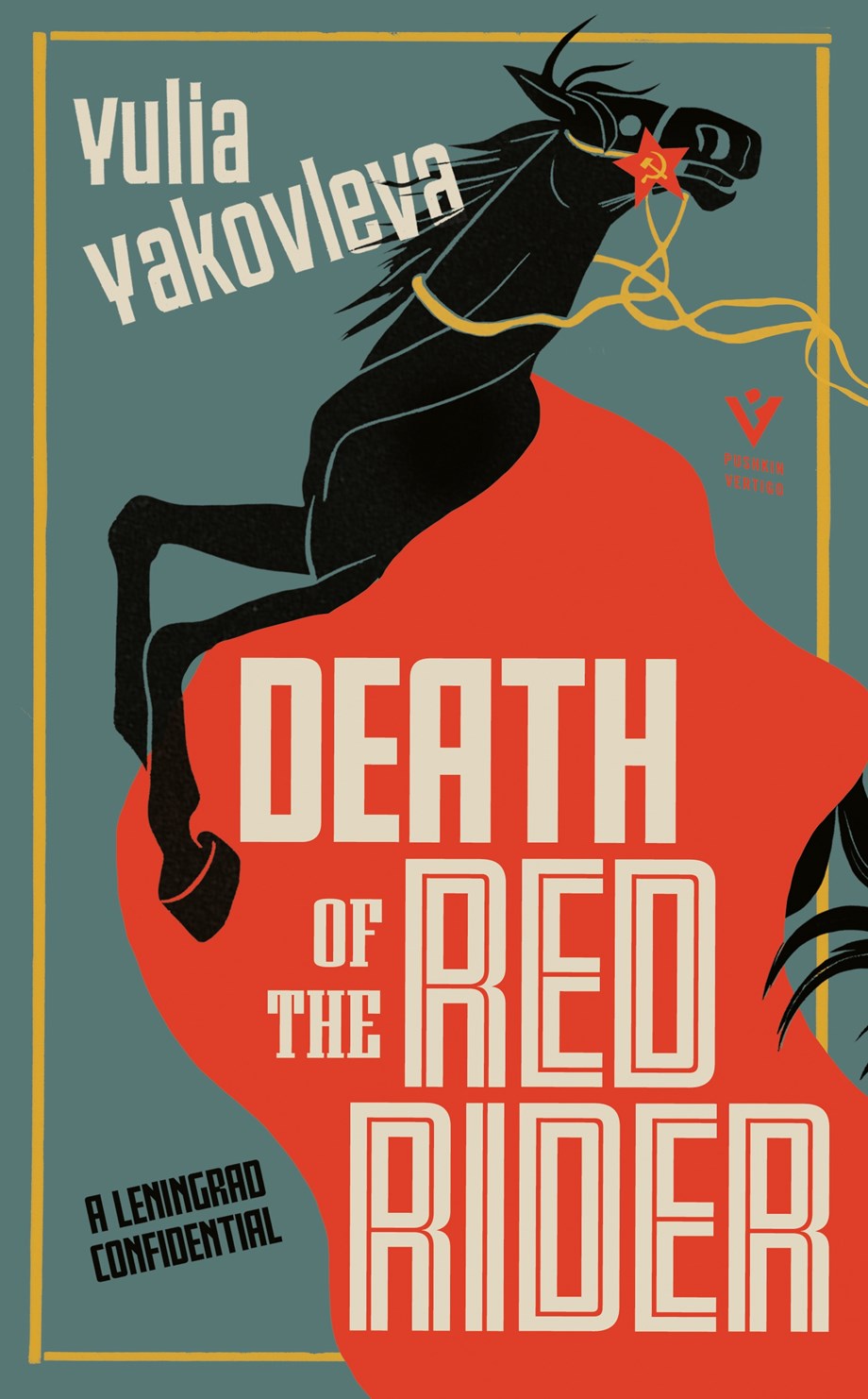
DEATH OF THE RED RIDER, The Leningrad Confidential series #2


DEATH OF THE RED RIDER
YULIA YAKOVLEVA
(The Leningrad Confidential series #2) (tr. Ruth Ahmedzai Kemp) Pushkin Vertigo (non-affiliate Amazon link)
$9.99 ebook editions, available now

Rating: 4.5* of five

The Publisher Says: As the Red Terror gathers pace, a horseman and horse mysteriously collapse in the middle of a race in Leningrad. Weary Detective Zaitsev, still raw from his last brush with the Party, is dispatched to the Soviet state cavalry school in Novocherkassk, southern Russia, to investigate. As he witnesses the horror of the Holodomor, and the impact of Soviet collectivisation, he struggles to penetrate the murky, secretive world of the cavalry school.

Why has this particular murder attracted so much attention from Soviet officials? Zaitsev needs to answer this question and solve the case before the increasingly paranoid authorities turn their attention towards him...

Don’t miss the second installment in the atmospheric and relentlessly dark detective series set in Stalinist Russia, where corruption, informers, and purges take paranoia to the next level.

I RECEIVED A DRC FROM THE PUBLISHER VIA EDELWEISS+. THANK YOU.

My Review
: Less gray-skied than Punishment of a Hunter, just as paranoid, just as nail-bitingly intense. The action moving south of Leningrad to "Cossack country," a nomenclatural sidestep from the modern name of a place Little Vladdy Pu-Pu doesn't much like having mentioned at present, changes the externals and, if anything, ramps up the internal conflicts between self and State present in every single breath taken in Stalinist times.

Zaitsev has a new...comrade? minder? internal spy?...in Zoya, a woman with a chip on her shoulder about being judged unfairly (because woman), a woman with a difficult attitude of disrespect for the people among whom she and Zaitsev must do their investigative job, and a general poor substitute for last book's Nefyodov. When you're among people who are extra-suspicious of you because you're Russian when they were already unhappy to see someone sent by the central authorities to poke around in places they'd just as soon leave unpoked, thanks, to solve a crime that took place a world away, to someone whose life was a-rattle with the skeletons in his closet...this will not end well for plenty of folks.

It's heavenly!

No one can be trusted! About/with/for ANYthing! Every time Zaitsev finds something out he has to unwrap more shades of meanings than Tut had embalmers' bandages! Impressively, Author Yakovleva manages to make the thriller-y bits cohere well. There's a secondary theme in who was murdered, where, and why, though it's not particularly energetically explored. It very much comes with the murdered man's identity, and I found it and its deeper ramifications interesting, but if I don't holler about it the importance won't be obvious to most. And I won't. This series has, as one of its main pleasures, the pressure cooker of Zaitsev sweating out the clues, in the teeth of multiple prongs of opposition, while uncovering realities of his life lived in Soviet Russia that break him on a human level.

So my attention was riveted again...last book I gave an extra quarter-star to, elevating it almost to fivehood. Not this one, despite my praising it; so why?

As pleasure reading, deeply interesting history of the Red Terror is...challenging. The information Zaitsev discovers as his investigation goes on would've gotten him shot in 1937 Russia. He could not have survived learning what he did...too much evidence to the contrary exists in the identities of the many murdered. So my disbelief muscle was sore from overuse. Also, why didn't he just shove Zoya under a tram or into a combine harvester and have done with it? She was more than a poor partner for an investigator, she was a provocatively bad investigator herself.

So there's the missing fractional star. Noe of that made me less eager to get to the next chapter, and I could not wait to pick up the read every day.

So a big #WITMonth win for Pushkin Vertigo, and me; y'all, too, if you go get one now.

Wednesday, February 28, 2024

BLUE LARD, transgressive Russian SFF oddity


BLUE LARD
VLADIMIR SOROKIN
(tr. Max Lawton)
NYRB Classics
$18.95 trade paper, available now

Rating: 4.5* of five

The Publisher Says: The Russian master's most infamous novel, a dystopian fever dream about cloning, alternative histories, and world domination.

Vladimir Sorokin’s Blue Lard is the most iconic and iconoclastic Russian novel of the last forty years. Thanks in part to its depiction of Stalin and Khrushchev having sex, which inspired a Putinist youth group to throw shredded copies of the author’s books into an enormous toilet erected in front of Moscow’s Bolshoi Theater, Blue Lard is the novel that tore Sorokin out of the Moscow Conceptualist underground and into the headlines.

The book begins in a futuristic laboratory where genetic scientists speak in a Joycean dialect of Russian mixed with Chinese—peppered with ample neologisms—and work to clone famous Russian writers, who are then made to produce texts in the style of their forebears. The goal of this “script-process” is not the texts themselves, but the blue lard that collects in the small of their backs as they write.

This substance is to be used to power reactors on the moon—that is, until a sect of devout nationalists breaks in to steal the blue lard, planning to send it back in time to an alternate version of the Soviet Union, one that exists on the margins of a Europe conquered by a long-haired Hitler with the ability to shoot electricity from his hands. What will come of this blue lard? Who will finally make use of its mysterious powers?

Blue Lard is a stylistically acrobatic book, translated by Max Lawton into an English idiom just as bizarre as the Russian original. Evoking both Pulp Fiction and the masterpieces of Marquis de Sade, Sorokin’s novel is a brutal, heady trip that annihilates all of its twentieth- (and twenty-first-) century competition in the Russian canon—and that annihilates Russia itself in a resounding act of heavy-metal dissidence.

I RECEIVED A DRC FROM THE PUBLISHER VIA EDELWEISS+. THANK YOU.

My Review
: Unquestionably the weirdest NYRB book I have yet read...and the second-weirdest alternate history book I have read this century.

It requires serious effort to engage with the first third or so of the book, as you are in medias res without even the usual linguistic snowpoles showing you where the obstacles are. You are, as is so often the case in Life, in a strange place with strange people you do not know or even understand as they have conversations around you.

After that point, there is a shift in the linguistic register that brings us closer to normal conversational tones. Not normal-normal, mind you, though closer. (There is a partial Glossary at the end for the desperately confused.) But, like Claude Simon’s nouveau roman novels, there is a difficult beginning that requires you to make an investment of concentration. We have left the normie-world of relatable plots, ordinary characters you could meet at the supermarket, sentences that start and finish in the same paragraph, and other such bourgeois fripperies. This is not a read that rewards being treated as a novel. This is writing that needs to be experienced and absorbed for itself not its meanings.

Sorokin, like so many truly inventive folk, is a natural iconoclast. At twenty-five, in 1980, he was baptized into the Russian Orthodox Church, at that time still under Communist-Party suspicion. The nature of iconoclasm is always to resist, so in this era of Church/state rapprochement, he opposes Putin’s war against Ukraine. It is not as though his work work was ever popular with the regime, what with Hitler raping Stalin’s daughter, Stalin and Khruschev sexing it up (ewww!), and a variety of body-horror tropes, that Little Vladdy Pu-Pu just could not ever be on board with. This, among other not-socialist-realist flourishes, will mean no invite-to-dinner from the Kremlin. Now, being good little bourgeois decoders, we too like our novels to Mean Something, like socialist realist work...but that is not on offer here.

Sorokin does not Make Sense, he makes you think about how a story is more than just the beginning-middle-end structure we are ingrained to expect. He offers not one kind of Sense, but multiple ways to experience words and ideas forming into stories. This, and the transgressive nature of the words and ideas he does present us, makes a lot...A LOT...of people really, really angry. This being a feature of the Sorokin brand. I do not get the point of their outrage and negativity being performed. Giving the man the thing he tried to get from you? The point of that is...?

A read that demands effort, does it an awful lot of the time, and allows you to decide for yourself if it means anything at all.

Like Life itself, it makes you the Author’s apprentice. You can decide if that is your jam, but I am here to say that it is a read very much worth my time and effort and could be for you as well. Remember how mad it made the Russian overlord. Buy it to be ornery, to oppose the banning/forbidding/controlling ethos that increasingly envelops the information-delivery world.

I bet lots of y’all end up liking it.

Thursday, January 20, 2022

JOAN IS OKAY, the title's a complete lie; & THREE APPLES FELL FROM THE SKY, a fairy/folk tale of the Armenian Genocide


JOAN IS OKAY
WEIKE WANG

Random House
$27.00 hardcover, available now

One of NPR's Best Books of 2022!

Funny how Life works out, isn't it? This wasn't *meant* to be a pandemic novel, says Weike Wang.

LONGLISTED for the 2023 Andrew Carnegie Medal for Excellence in Fiction!


Rating: 4* of five

The Publisher Says: A witty, moving, piercingly insightful new novel about a marvelously complicated woman who can’t be anyone but herself, from the award-winning author of Chemistry

Joan is a thirtysomething ICU doctor at a busy New York City hospital. The daughter of Chinese parents who came to the United States to secure the American dream for their children, Joan is intensely devoted to her work, happily solitary, successful. She does look up sometimes and wonder where her true roots lie: at the hospital, where her white coat makes her feel needed, or with her family, who try to shape her life by their own cultural and social expectations.

Once Joan and her brother, Fang, were established in their careers, her parents moved back to China, hoping to spend the rest of their lives in their homeland. But when Joan’s father suddenly dies and her mother returns to America to reconnect with her children, a series of events sends Joan spiraling out of her comfort zone just as her hospital, her city, and the world are forced to reckon with a health crisis more devastating than anyone could have imagined.

Deceptively spare yet quietly powerful, laced with sharp humor, Joan Is Okay touches on matters that feel deeply resonant: being Chinese-American right now; working in medicine at a high-stakes time; finding one’s voice within a dominant culture; being a woman in a male-dominated workplace; and staying independent within a tight-knit family. But above all, it’s a portrait of one remarkable woman so surprising that you can’t get her out of your head.

I RECEIVED A DRC FROM THE PUBLISHER VIA NETGALLEY. THANK YOU.

My Review
: First things first: I think Joan's neurodivergent. There. I said it.

What else is Joan? A disappointing daughter, who isn't going to give her mother the expected grands. An annoying sister, who is resolutely unimpressed with her brother's lavish getting-and-spending lifestyle. A breathtakingly good, effective ICU doctor at the outset of the Plague. A clueless, oblivious object of somewhat diffident romantic interest...utterly unrequited...for her neighbor. And most of all, most satisfyingly and unbreakably, Joan is herself.

If you don't like to read "women's fiction" because it's about men (how to catch), read this book. It's about Others (how to evade), when it's about anyone not Joan. And that was exactly why I enjoyed the read so much. Joan's struggles are typical for an atypical person, and her intelligence isn't a problem but a solution, making her an extra delightful companion for this reader. As everyone around her tries to make her feel she's missing out, lacking something, somehow wanting for something, and until she decides for herself what she thinks, she remains upset and at sea. In her enforced idleness (bereavement leave? for a father she felt little connection to still less affection for, shouting abuser that he was?) she loses the armor of being too busy to deal with all the mishegas of ordinary life.

It is great to read about the woman lead's sense of self being explored and resolved without a boyfriend at the beginning, middle, or end of the process. It is bracing to read the genuinely painful experience of the first-generation American in attempting to come to a happy resolution to a parent's desires when these are rooted in a wildly different world. But then, as the visibly different as well as culturally different as well as neurologically different (this last is not explicit in the text, but its factuality is the hill I'll die on) Joan thinks, "Why try to explain yourself to someone who had no capacity to listen?" She thinks this in a different relationship's context but the truth is, it is Joan all the way. She's not going to do the same thing a dozen...even, I suspect, a pair of...times expecting or hoping for different results. What kept me from giving it all five stars was, however, that very thing: I felt Joan was harshly judgmental from beginning to end, despite questioning herself and her responses as we went through the story. I think that's a bit unbelievable, it seemed to me she would've adjusted some of her private judgments...still, not a fatal flaw since I liked her from giddy-up to whoa.

In fact, in just over 200pp, I fell in love with Joan as she is. I think you might do the same. Give her a few of your hours. She's a good companion.

++++++++++++++++++++++++++++++++++++++++++++++++++++++++++++++++


THREE APPLES FELL FROM THE SKY
NARINE ABGARYAN
(tr. Lisa C. Hayden)
OneWorld Publications (non-affiliate Amazon link)
99¢ Kindle edition, available now

Rating: 4* of five

The Publisher Says: The Russian bestseller about love and second chances, brimming with warmth and humour

In the tiny village of Maran nestled high in the Armenian mountains, a place where dreams, curses and miracles are taken very seriously, a close-knit community bickers, gossips and laughs, untouched by the passage of time. A lifelong resident, Anatolia is happily set in her ways. Until, that is, she wakes up one day utterly convinced that she is dying. She lies down on her bed and prepares to meet her maker, but just when she thinks everything is ready, she is interrupted by a surprise visit from a neighbour with an unexpected proposal.

So begins a tale of unforeseen twists and unlikely romance that will turn Maran on its head and breathe a new lease of life into a forgotten village. Narine Abgaryan's enchanting fable is a heart-warming tale of community, courage, and the irresistible joy of everyday friendship.

THIS WAS A FREE DOWNLOAD VIA BOOKBUB. I THINK. ANYWAY, THANK YOU.

My Review
: A clever little folk-tale that mimics the forms of earlier tales with modern, relatable trappings. It’s meant to be a means of processing the upheavals of Armenia as it bumpily traveled from tsars to commissars to…chaos, pure capitalism, as part of Russia then on its own with no stops at any rational place anywhere along the way. We’re not given much information but the wretchedness of the people to use as a calendar. The main event is World War I's Armenian Genocide, there was much suffering; there was much suffering throughout, but the weird thing about it is how little of it seemed to penetrate the inner lives of the characters, really better called "survivors" given how many die in the course of the story. Their village, isolated and insulated all together, goes on, despite the horrific events that unfurl between and around them.

Is that realistic? What do I, fat comfortable American that I am, know about that; I know the author chose the fairy-tale/folk-tale structure and tenor for a reason. The Armenians have a saying:
As has been established in Maran legends since time immemorial, the night will drop them to earth from the sky:
And three apples fell from heaven:
One for the storyteller,
One for the listener,
And one for the eavesdropper.

Welcome, fellow eavesdropper, to the juicy apple of Narine Abgaryan's bestselling Russian-language tale of Armenia's wild ride through the 20th century. Strap your helmet on a little tighter. You're going to meet a lot of people, and not all of them have names you'll be able to pronounce. It does not matter a whit. Love them for who they are, not how they sound in your monoglot's ear. Anatolia, the woman at the actual center of the story, is one of the world's readers-cum-librarians so she merits our rapt attention. It's not hard to give.
Little by little, thanks to intuition and innate taste, she learned to distinguish good literature from bad and fell in love with Russian and French classics, though she came to hate Count Tolstoy, unequivocally and forever, as soon as she finished Anna Karenina.
Happen I agree...but the less said of her shelving preferences the better. Her travails, those of her fellow villagers, are deeply experienced in the author's (and translator's, what a great job Lisa Hayden did on this book! I honestly forgot it was a translation most of the time, and that is meant as a compliment) open, honest, and still lyrical prose:
For eight long, unbearable years, the war reaped a harvest of restless souls around the world, but one day it sputtered out and retreated, howling and limping and licking its bloody paws.
–and–
Anatolia suddenly grasped that there was no heaven and no hell: happiness was heaven and grief was hell. And their God was everywhere, all over, not just because He was all-powerful but also because He was the unseen threads that connect them with each other.

The other feature of the prose you'll have discerned by now is the simple, direct wisdom of it. The author and translator have taken care to make sentences that sound like they've rolled around simple peoples' minds and mouths for long enough to become weighty with meaning and light of touch:
“There’s nothing more destructive than idleness,” his father had loved repeating. “Idleness and leisure deprive life of purpose.”

Vasily now understood the truth of his father’s words. Life does, indeed, lose its purpose at the very instant a person ceases bringing benefit to those around him.

Which is a truth that many of us, disabled and/or retired, learn at a very high cost in self-esteem and peace of mind. It's not, youthful imaginings to the contrary, at all fun to be idle. So what is one meant to do? Find something useful to do! Me, I write book reviews...how about you?

Monday, October 18, 2021

AN EVENING WITH CLAIRE, the end of innocence from a Russian master & BEAUTY SALON, a pandemic tale from a Mexican auteur


AN EVENING WITH CLAIRE
GAITO GAZDANOV
(tr. Bryan Karetnyk)
Pushkin Press (non-affiliate Amazon link)
$18.00 trade paper, available 19 October 2021

Rating: 3* of five

The Publisher Says: Two old friends meet nightly in Paris, trading conversational barbs and dancing around submerged feelings. Throughout the ten years of their separation, thoughts of Claire lingered persistently in Kolya’s mind. As the imagined romance finally becomes real, Kolya is thrown into recollections of formative moments from his youth in Russia, from his solitary early years through military school and service in the White Army in the Civil War, all leading to this union with                                                          Claire.

The first novel by the celebrated Russian master Gaito Gazdanov, An Evening with Claire is a lyrical, finely crafted portrait of a lost innocence and a vanished era.

I RECEIVED A DRC FROM THE PUBLISHER VIA EDELWEISS+. THANK YOU.

My Review
: While there is some lovely language in this short read, I did not end up thinking it was Deathless Prose.
These first, carefree years of life at the gymnasium were only rarely aggravated by those emotional crises from which I suffered so greatly but in which I nonetheless found an agonizing satisfaction. I lived happily—if one can live happily when a persistent shadow floats behind one’s shoulders. Death was never far away, and the abyss into which my imagination plunged me seemed to belong to it.

High school's like that. The highs are empyrean; the lows abyssal. Claire gets a whole lot fewer lines than an evening should hold. I was reminded of the Doobie Brothers' 1977 hit song, "What A Fool Believes", which covers the same territory in three minutes, forty-seven seconds.

Blasphemy to the literary, I know, but really I'll listen to the song again (and it was never one of my favorites) before I'll re-read this history lesson with straight-boy crush object posed in front of it. The entire Russian Civil War—one of history's major social paroxysms!—took place with a sleepwalking Kolya (Claire's fanboy) apparently numb to it. But of course he is...he is superior to the victims. (Where he got that idea, and what it's based on, must've been in a part of the read I didn't get in my DRC.) So, Claire of the title barely shows her face; the narrator's a numbed-out zombie or a sociopathic prick; and the story's too long for the récit it could've quite successfully been and too detached to work as a novel.

I'll see myself out.

++++++++++++++++++++++++++++++++++++++++++++++++++++++++++++++++


BEAUTY SALON
MARIO BELLATIN
(tr. David Shook)
Deep Vellum
$14.95 trade paper, available now

Rating: 5* of five

The Publisher Says: Mario Bellatin’s earth-shattering allegory of plague that brought him to his cult status as auteur of Latin America's most singular literary vision, in a brand-new translation by poet and translator Shook.

Mario Bellatin’s complex dreamscape, offered here in a brand-new translation, presents a timely allegorical portrait of the body and society in decay, victim to inscrutable pandemic.

In a large, unnamed city, a strange, highly infectious disease begins to spread, afflicting its victims with an excruciating descent toward death, particularly unsparing in its assault of those on society's margins. Spurned by their loved ones and denied treatment by hospitals, the sick are left to die on the streets until a beauty salon owner, whose previous caretaking experience extended only to the exotic fish tanks scattered among his workstations, opens his doors as a refuge. In the ramshackle Morgue, victim to persecution and violence, he accompanies his male guests as they suffer through the lifeless anticipation of certain death, eventually leaving the wistful narrator in complete, ill-fated isolation.

I RECEIVED A DRC FROM THE PUBLISHER VIA EDELWEISS+. THANK YOU.

My Review
: AIDS was my first plague. Unnameable for most of its first five years of blazing, horrible death, when a name was agreed upon it gave us something to fight. A name is more than a label. It is a badge, a target, a focus.

A badge is also, as the Holocaust taught us, a symbolic sentence of death.

That's what this short prose poem is here to remind us. It's eleven years old in English. It's a quietly bitter, carefully outraged indictment of the fear and loathing that queers with AIDS faced when there was no hope, no treatment, no medical possibility of a future.
It's no longer just my acquaintances with the sickness advancing through their bodies. The majority are now strangers who have no place to go. If it weren't for this place, their only alternative would be to perish in the street.
–and–
Now I have to run the Mortuary. To provide a bed and a bowl of soup to the victims whose bodies have already been ravaged by the disease. And I alone must do it.

Our narrator in this bitter récit is a nameless drag queen/retired beauty salonista whose own life is ending from the disease. She makes her world starkly plain in those sentences, showing that her life lived in service is ending in service. She's been a whore, she's been a beauty maven, and now she's tending to the last needs of those, like her, whose bodies aren't bodies any more:
I ask myself {as lovers come to the Mortuary's door seeking the dying} what moves those poor creatures to search for the sick. And why come in? Only to find themselves before someone who is no longer a person. Someone who, besides the space they take up, is nothing but a simple carrier for sickness.
–and–
{The Mortuary's inhabitants} become so mired in their lethargy that it's often no longer even possible for them to ask how they're doing. This is the ideal condition for doing my work. It's how I avoid getting involved with any one of them in particular, which makes my labors more expeditious.

Heartless? Or disheartened? One young lad gave our narrator a reason to be glad, for a moment, that he was alive. The disease ended the way the disease always does:
We took up collections to purchase his medicines, which were exceedingly expensive. It was all useless. The conclusion was simple. The sickness has no cure. All our efforts were no more than vain attempts to appease our consciences. ... Because of that experience, I made the decision that if there was no cure, the best outcome was a quick death, in the best possible conditions for the suffering.

That, my olds, is what we call "dissociation." And as a survival strategy, during a plague, there's not a better one to be found.

In the end, of course, there's no hope to be found in this bleak little bagatelle. There's nothing to mitigate the agony of knowing you're going to die, and it's going to suck, and then there's the Great Unknown. What is Death? Where do we go when we die?

Folks...that's a question for the privileged. The living. The dying aren't worried about it near as much as one thinks they will be. They're worried about stuff they didn't do or say or couldn't do or say or wanted to do or say. They aren't all that worried about The After, but they do get worried about The Ending. Suffering preoccupies the suffering. The sense of "let it just be over" is quite, quite common.

Bellatín knows this. He's not giving anyone great death scenes here. He's not exploring the living's worries about Death. The closest we come is when our beautiful psychopomp has a huge bonfire of all his vanities, the dresses and the gewgaws and gimcracks of his life spent on the make for sex:
The more I sang, the more clearly I remembered new songs. It kept growing, the sensation that I was entering, bit by bit, the memories they evoked. Slowly, the fire burned out, until it was nothing but a slight wisp of smoke rising from the charred remains.


That, in the end, is pretty much all we have. A wisp of smoke, a singed satin hem, a moment of song snatched from a toxic conflagration of things not worth taking, of stuff we are ready to leave behind.

Friday, December 15, 2017

THE DOOMED CITY, Soviet-era scary predictive fiction


THE DOOMED CITY
ARKADY AND BORIS STRUGATSKY
(tr. Andrew Bromfield)
Chicago Review Press
$13.00 ereader platforms, available now

Rating: 5* of five

The Publisher Says: Arkady and Boris Strugatsky are widely considered the greatest of Russian science fiction masters, and their most famous work, Roadside Picnic, has enjoyed great popularity worldwide. Yet the novel that was their own favorite, and that readers worldwide have acclaimed as their magnum opus, has never before been published in English. The Doomed City was so politically risky that the Strugatsky brothers kept its existence a complete secret even from their best friends for sixteen years after its completion in 1972. It was only published in Russia in the late 1980s, the last of their works to see publication.

It was translated into a host of major European languages, and now appears in English in a major new translation by acclaimed translator Andrew Bromfield. The Doomed City is set in an experimental city bordered by an abyss on one side and an impossibly high wall on the other. Its sole inhabitants are people who were plucked from Earth's history and left to govern themselves under conditions established by Mentors whose purpose seems inscrutable. Andrei Voronin, a young astronomer plucked from Leningrad in the 1950s, is a diehard believer in the Experiment, even though he's now a garbage collector. And as increasingly nightmarish scenarios begin to affect the city, he rises through the political hierarchy, with devastating effect.

THE PUBLISHER PROVIDED ME WITH A REVIEW COPY. THANK YOU.

My Review: I'll say this about the Strugatsky Brothers: They had *fearless* imaginations, tempered by fearful souls that quailed before publishing this nihilistic, absurdist, deeply subversive book in Soviet Russia. Completed in 1972, shelved until 1989, and published in a professional English translation only in 2016, this stateless satirical look at the amoral roots of True Belief in a System reads as well in 45's Amurruhkuh as it did in Brezhnev's USSR.

Voronin, our astronomer-turned-state-official, is an ideal. He is every system's beloved child, the True Believer who makes excuses and finds reasons instead of asking, "...the fuck...? Are they kidding with this?" As experience teaches him to question, he sidesteps. He changes his beliefs without batting an eyelash, a clue to his essential hollowness. For all that he is an eager participant in all the City's shifts of philosophical direction, the reason he can do so remains unexamined: He's complicit in the acts of the State, not driven by a desire to enact a Vision. His lack of an inner compass is rather amusing given that almost the entire novel is an internal monologue. I myownself found this a delightful twist, enjoying the musings of a centerless man as irony. Others might find that conceit wearing.

The things I found wearing were the astoundingly sexist and anti-Semitic attitudes of the characters (and, I suspect, the authors as well). There are horrible words used in connection with the two women I can recall at all...they might indeed have been the only two women mentioned, for I can summon no other woman to mind...and Katzman's presence in stereotypical fashion was not obviously played for ironic effect.

Given my track record for objecting to these facets of other older books, why am I giving this one the Full Five? Because, my friends, the story of a city between an unscalable wall and an endless abyss recommends itself to me as a parable for all of human life, and the awful attitudes of the PoV character are part and parcel of the falling, failing world that the Strugatskys were lampooning, dissecting, parodying, itemizing. These facets seem to me, even though I suspect and believe they were presented unironically, to be so much of a piece with the Experiment being ridiculed that I could easily make them objects of fun. Nonetheless they are there and merit mention lest an unsuspecting reader trip over them and feel blindsided.

Boris Strugatsky, in his Afterword, says it all and best:
How to live in conditions of ideological vacuum? How and what for? In my opinion this question remains highly relevant even today—which is why City, despite being so vehemently politicized and so categorically of its own time, potentially remains of interest to the present-day reader—provided that this reader has any interest at all in problems of this kind.

Thursday, March 31, 2016

THE GOOD LIFE ELSEWHERE, modern myth of prosperity just over there skewered & pounded & smashed


THE GOOD LIFE ELSEWHERE
VLADIMIR LORCHENKO
translated by Ross Ufberg
New Vessel Press
$14.99 trade paper, available now

Rating: 4.5* of five

The Publisher Says: The Good Life Elsewhere is a very funny book. It is also a very sad one. Moldovan writer Vladimir Lorchenkov tells the story of a group of villagers and their tragicomic efforts, against all odds and at any cost, to emigrate from Europe’s most impoverished nation to Italy for work. The Good Life Elsewhere aims to present the complexity of a new Europe, where allegiances shift but memories are rooted in place. The book integrates small-scale human follies with strategic partnerships, unification plans, and the Soviet legacies that still hang over the former Eastern Bloc. Lorchenkov addresses the vexing question of what to do when many formerly pro-Soviet/pro-Russia countries want to link arms with their Western European brethren. In this uproarious tale, an Orthodox priest is deserted by his wife for an art-dealing atheist; a mechanic redesigns his tractor for travel by air and sea; thousands of villagers take to the road on a modern-day religious crusade to make it to the promised land of Italy; meanwhile, politicians remain politicians.

Like many great satirists from Voltaire to Gogol to Vonnegut, Lorchenkov makes use of the grotesque to both horrify us and help us laugh. It is not often that stories from forgotten countries such as Moldova reach us in the English-speaking world. A country where 25 percent of its population works abroad, where remittances make up nearly 40 percent of the GDP, where alcohol consumption per capita is the highest in the world, and which has the lowest per capita income in all of Europe – this is a country that surely has its problems. But, as Lorchenkov vividly shows, it’s a country whose residents don’t easily give up.

Russian critics have praised Lorchenkov’s work, calling this novel “a bleeding, wild work, grotesque in every twist of its plot and in every character, written brightly, bitterly, humorously, and – paradoxically, as we’re dealing with the grotesque – honestly.” In The Good Life Elsewhere, Vladimir Lorchenkov shows himself to be a fearless critic, an enduring optimist, and a master stylist. And he does it all “in vivid colors, with a pamphleteer’s spite, and a good-humored smile.”

My Review: When I was a tot, I loved the Warner Brothers-Merrie Melodies cartoons. My mother, vigilant on the subject of what and how much TV I could watch, wrinkled her nose and pursed her lips like last night's prune whip was disagreeing with her, but ultimately gave in.

Joy! Unrestricted access to the Meep-Meep Duck!

"...the...Meep...Dick, what have you been telling the boy? And what does that mean?"

As everyone my age knows already, it was the Roadrunner, and how I loved those gravity-defying falls Wile E. Coyote took, the razzberry the Roadrunner invariably blew at him, and of course MEEP MEEP!!

The entire book, I felt like the Moldovan people one and all were the collective reincarnation of Wile E. Coyote. "All the poor bastard ever wanted was some lunch," was my father's summation of the cartoons. Yeah, I thought every time another hare-brained scheme to get to Italy failed, all the poor bastards want is some food!

And somehow, through some collective karmic deficiency, not one success story leavens this heavy dough. But the icing of absurdity and dreamy impracticality kept me smiling and turning pages.

I wanted to send the poor guys contact information for the Acme Corporation, but couldn't figure out how.

Tuesday, March 15, 2016

THE HEART OF A DOG: Even before THE MASTER & MARGARITA, Bulgakov's imagination was unstoppable


THE HEART OF A DOG
MIKHAIL BULGAKOV
translated by Michael Glenny
Melville House
$15.95 trade paper, available now

Rating: 4* of five

The Publisher Says: A new edition of Bulgakov’s fantastical precursor to The Master and Margarita, part of Melville House’s reissue of the Bulgakov backlist in Michael Glenny’s celebrated translations.

A key work of early modernism, this is the superbly comic story of a Soviet scientist and a scroungy Moscow mongrel named Sharik. Attempting a medical first, the scientist transplants the glands of a petty criminal into the dog and, with that, turns a distinctly worryingly human animal loose on the city. The new, lecherous, vulgar, Engels-spouting Sharik soon finds his niche in governmental bureaucracy as the official in charge of purging the city of cats.

A Frankenstein fable that’s as funny as it is terrifying, The Heart of a Dog has also been read as a fierce parable of the Russian Revolution. It was rejected for publication by the censors in 1925, and circulated in samizdat for years until Michael Glenny translated it into English in 1968—long before it was allowed to be officially published in the Soviet Union. That happened only in 1987, although till this day the book remains one of Mikhail Bulgakov’s most controversial novels in his native country.

My Review: Anyone who's ever read The Master and Margarita already knows that Bulgakov is a rebel, an anarchist, and damn good and funny with it. His thoughts were, based on the novels I've read, contrarian in the extreme as well as profoundly sensitive to practical concerns:
“The rule apparently is – once a social revolution takes place there’s no need to stoke the boiler. But I ask you: why, when this whole business started, should everybody suddenly start clumping up and down the marble staircase in dirty galoshes and felt boots? Why must we now keep our galoshes under lock and key? And put a soldier on guard over them to prevent them from being stolen? Why has the carpet been removed from the front staircase? Did Marx forbid people to keep their staircases carpeted? Did Karl Marx say anywhere that the front door of No. 2 Kalabukhov House in Prechistenka Street must be boarded up so that people have to go round and come in by the back door? What good does it do anybody? Why can’t the proletarians leave their galoshes downstairs instead of dirtying the staircase?’
‘But the proletarians don’t have any galoshes, Philip Philipovich,’ stammered the doctor.”
And the simple truth about revolution that probably contributed heavily to the book's suppression in the Soviet era:
“People who think you can use terror are quite wrong. No, no, terror is useless, whatever its colour—white, red or even brown! Terror completely paralyses the nervous system.”

He saw the terror around him, saw the results, and distilled a response into a short phrase. That's writing that's a joy to read.

But we can't leave revolutionary-era Moscow without hearing from the eponymous heart-haver. Early in the book, we're told the sad tale of an unwanted dog whose people-savvy beats that of most of the humans I've ever met:
Eyes mean a lot. Like a barometer. They tell you everything—they tell you who has a heart of stone, who would poke the toe of his boot in your ribs as soon as look at you—and who’s afraid of you. The cowards—they’re the ones whose ankles I like to snap at. If they’re scared, I go for them. Serve them right...grrr...bow-wow…”

All hail Michael Glenny, of blessed memory since dying in 1990. Without him, Bulgakov's banned and suppressed works might remain out of the English-speaker's reach.