Showing posts with label Deep Vellum. Show all posts

Friday, August 7, 2026

BLOOD OF THE DAWN, Peru's violent past made personal


BLOOD OF THE DAWN
CLAUDIA SALAZAR JIMÉNEZ
(tr. Elizabeth Bryer)
Deep Vellum (non-affiliate Bookshop.org link)
$9.95 ebook, available now

Rating: 4* of five

The Publisher Says: Debut novel by Peruvian author viscerally revisits Peru's recent, traumatic history through the eyes of three women

Blood of the Dawn follows three women whose lives intertwine and are ripped apart during what's known as "the time of fear" in Peruvian history, when the Shining Path militant insurgency was at its peak. The novel rewrites the conflict through the voice of women, activating memory through a mixture of politics, desire, and pain in a lucid and brutal prose.

Claudia Salazar Jiménez was born in 1975 in Lima, Peru. She is a critic, a scholar, and an author; she founded PERUFEST, the first Peruvian film festival in New York, where she lives; and she won the 2014 Americas Narrative Prize for this, her debut novel.

I RECEIVED A DRC FROM THE PUBLISHER VIA EDELWEISS+. THANK YOU.

My Review
: A nasty proxy war was fought by the US versus the USSR as part of what we in the US are taught to call "the Cold War." How cold is a war whose victims number in the hundreds of thousands in one theater of its coldness, eg Latin America? Are people's families less fractured because no US soldiers (to speak of) were killed? Are those (mostly) men less dead because they weren't casualties of great pitched battles?

One nasty war was the struggle Peruvians fought against Sendero Luminoso (Shining Path in English), a Soviet-backed militia that committed atrocities against ordinary people with seeming success throughout the 1980s. The brutality of the US-backed military's responses to Sendero Luminoso drove some into the rebels' camp, others away from it. In any civil war there are no real winners. This was never more evident than in Peru. Author Salazar Jiménez limns that very clearly by decentering the male (mostly) combatants in favor of three women whose lives are both upended and defined by the conflict.

It's a depressing truth that this book came out in 2016, I read it in 2017, and while I made my notes on it at the time I never wrote them into a review. The biggest part of my failure to review it stems from the stream-of-consciousness narrative vignettes feeling unlinked-up. This is a debut, so it deserves generosity of treatment; however I was very, very irritated by the sense that, if there was a common thread in the background tapestry, I did not see it.

On skimming the story ten years later, I still don't. The PoV women are all enmeshed in the struggles of Peru, none on the government side but Melanie the city-born colonizer-stock photographer is probably closest as photography and its granddaughter filmmaking's very much an outgrowth of bourgeois culture more broadly; her desire to show the world what's happening to her country gets her resoundingly abused by Sendero Luminoso perpetrators. Her narrative voice wasn't distinctive, particularly in (unclear) distinction to Modesta the impoverished country-dwelling Quecha woman's.

That both were raped quite violently (there is no non-violent rape, I'm saying their experiences were even more violent than baseline horror) did not make them more distinguishable in a narrative technique used to emphasize the commonalities of sexualized assault. It served that function. a side-effect of that function is it's more difficult to build specific empathy for that character. As the story progresses, Modesta faces the challenge of carrying then birthing a daughter from her horrifying experience...a daughter she cannot easily or readily bond with. Since I'm more distant emotionally from her by not having a clear sense of her as Modesta but rather as a woman caught in war, it's harder for that horrific truth to make its most intense impact on me-the-reader.

Comrade Marta, the cadre of the Sendero Luminoso, was probably the one easiest to tell apart because she was seeing, participating in, perpetrating, but centrally seeing the violence her group committed as a necessary step to gaining meaningful freedom for the people of Peru. I got why she fell into that way of thinking, but it's always hard to see that path as justified to my bourgeois self. How does killing stop killing? I do not observe that result from those actions anywhere in my own world.

So my rating does not rest primarily on my pleasure in the prose from any angle. I would rate the book two and a half stars were it still 2016 out there. Today we have the US starting bullshit wars to protect a bunch of pedophile rapists from facing the consequences of their crimes instead of simply enriching some scumbags; we have a government so dedicated to white supremacist misogyny as policy instead of more nebulously ideology that voting rights and bodily autonomy are being dismantled as matters of law; we are, in short, more in danger from our government than from any external enemy.

In that sociopolitical milieu this book is four stars of klaxon-sounding warning. Heed these words, understand these threats viscerally by reading this story.

Friday, August 15, 2025

THE CURIOUS CASE OF DASSOUKINE'S TROUSERS, Moroccan author's Anglophone debut from 2016


THE CURIOUS CASE OF DASSOUKINE'S TROUSERS
FOUAD LAROUI
(tr. Emma Ramadan; intro. Laila Lalami)
Deep Vellum (non-affiliate Bookshop.org link)
$9.95 ebook, available now

Rating: 4.5* of five

The Publisher Says: Award-winning English-language debut by Morocco's most prominent contemporary author, a linked story collection exploring what it means to be foreign.

  • Included in World Literature Today's "75 Notable Translations of 2016"
  • One of Literary Hub's Books to Read this May
  • One of Asbury Park Press Books to Read this Summer
    This long-awaited English-language debut from Morocco's most prominent contemporary writer won the Prix Gouncourt de Nouvelles, France's most prestigious literary award, for best story collection. Laroui uses surrealism, laugh-out-loud humor, and profound compassion across a variety of literary styles to highlight the absurdity of the human condition, exploring the realities of life in a world where everything is foreign.

    I RECEIVED A DRC FROM THE PUBLISHER VIA EDELWEISS+. THANK YOU.

    My Review
    : Funny, farcical, sometimes surreal...or do I just lack context to get the concrete reality of what he's saying...we have Laila Lalami to thank for this collection's appearance in English nine years ago. She set out to interest US publishers in a different book entirely, On Islamism: A Personal Refutation of Religious Fundamentalism, which is still untranslated into English (though available in Dutch and, of course, French) and which I myownself would devour whole, but this collection won the nod of premiering Laroui's quirky worldview to us. Deep Vellum does this work from multiple languages into US English and, every #WITMonth, takes a strong lead on books reviewed here.

    The tone of this collection is deadpan. Much of the humor, culturally bound, in it requires a moment's thought to "get" but is never crudely or condescendingly signposted by either the author or translator Emma Ramadan. I find this refreshing; I am happy to make an effort to understand what I'm reading, and I'm aware people who read my reviews are, too. There is a lot of surface fun, and a lot of surreal oddness, to enjoy in the stories. It's a collection that tells us, no matter where we are in space and time, others in other spaces and times were and are just as perplexed, bemused, and wryly amused as we are.

    Comme d'habitude, these nine stories will be dealt with by the Bryce Method.

    The Curious Case of Dassoukine's Trousers has fun with the fish-out-of-water trope, telling it in slightly Kafkaesque twists as a self-important fool has truly weird things...your trousers ever just disappear on you?...then even stranger responses to his predicament that are wildly disproportionate. Skewers every archetype of The Establishment. As the fool narrates his story to "us" (the invisible audience stand-in) he grows more and more agitated, and I grew louder and louder in my cackles and snorts. 4.5*

    Dislocation does what it says on the tin...dislocates you. The question, repeated with variations. "What would it be like, he asked himself, a world where everything is foreign?" and we are off into an entire field of rabbit holes leading into misuderstandings, double entendres, miscommunications. What does Maati's "sweet, kind Anna" mean when she says he's "Moroccan by birth, in body, but "French in the head"? What levels of displacement, belonging without being accepted, are there in "sweet, kind Anna" (who isn't) "laughed in his face {when} even he wasn't very convinced by his pro domo plea." (An argument made in support of one's existing case.) Deeper and deeper, Anna the touchstone, the source of all the emotion (mostly anger) as the narrator, I kept thinking of him as the interlocutor, the straight man, feeding me thoughts I found funny-hmmm and funny-haha in differing proportions the deeper we got into Utrecht where he seeks asylum and has married "sweet, kind Anna" as "{t}his one went forth in quest of truth as a hero, and at last got for himself a small, decked-up lie: his marriage he calleth it."

    He decides, stunned, what these twists and turns and gyrations mean. You get the same privilege. I was swept into the slipstream and liked where I went. 4*

    Born Nowhere is hung on the story-nail in the wall of Melpomene's study holding up the tragedy's summation: "After all, I know who I am, right?"

    That remains to be seen, Moroccan in Paris, trying to evade repression oppression and impression: "This story proves what I have always believed. Identity problems don't exist. We create them! 'Who am I? Where am I going? What am I good for?'" He's in for an ugly surprise, like so many in this ever-more-tightly surveilled world of 2025. 3.5* for its sketchiness, incompleteness of narrative

    Kuourigba, or the Laws of the Universe allows us to eavesdrop on the coffee-house chat of several young men, one a stringer for La Tribune de Casablanca with a tale of Kuourigba to tell. A general strike, a blow against global capitalism, and the forces of reaction writ small, local, petty in the French sense. Much palaver there in the Café de le Univers, in the shaggy-dog story way of young men solving problems they're a ways off from understanding. 3*

    What's Not Said in Brussels is just not sayable. How does a couple survive long-distance (a question I'm intimately enmeshed in now) and survive language mismatches and cultural cross-purposes too? Annie (who doesn't get his jokes) and John (who "mansplains" everything) arrange to meet in Brussels with the intent of breaking up, though neither has said that to the other yet. A cloud of seemingly random bits and patches of thought and memory obtrude, intrude, exude a mist of influence over each of them.

    Never decide things in the silence of your head when they need to be enacted in the clamor of life as we humans live it. It's pointless and it causes a lot of wasted anxiety. 4*

    Bennani's Bodyguard poor Nagib, those autoimmune diseases might've been preferable.

    Another Café romp through what language does when friends, close enemies that they are, become, and embody for each other, are in full cry as they pursue storycraft to the detriment, or the exaltation in reverse, of mere logic. 4.5*

    The Invention of Dry Swimming is so surreal, so funny within that range of unreality, and so impossible to convey in summary that I'm offering only this: "If this story does not make you laugh in startled awareness of these thoughts being expressed, seek medical assistance for your probable ischemic event." 4.5*

    Fifteen Minutes as Philosophers feels the most like it was written by a French intellectual (it was) and aimed at other French intellectuals (I ain't). I can't decide if this is intended to cause embarrassment or amusement. It left me unmoved. The only one in the entire collection I did not fully enjoy, it was still very intriguing because I was uncertain of the effect on me that was intended. 3*

    The Night Before Revolution! War! Action at last! Overthrowing the Oppressor!

    ...and then what...? 4*
  • Wednesday, August 6, 2025

    THE MOUNTAIN AND THE WALL, urgent and trenchant and tendentious reading


    THE MOUNTAIN AND THE WALL
    ALISA GANIEVA
    (tr. Carol Apollonio; intro. Ronald Meyer)
    Deep Vellum Publishing (non-affiliate Bookshop.org link)
    $9.95 ebook, available now

    Rating: 4* of five

    The Publisher Says: This remarkable debut novel by a unique young Russian voice portrays the influence of political intolerance and religious violence in the lives of people forced to choose between evils.

    The Mountain and the Wall focuses on Shamil, a young local reporter in Makhachkala, and his reactions, or lack thereof, to rumors that the Russian government is building a wall to cut off the Muslim provinces of the Caucasus from the rest of Russia. As unrest spreads and the tension builds, Shamil's life is turned upside down, and he can no longer afford to ignore the violence surrounding him.

    With a fine sense for mounting catastrophe, Alisa Ganieva tells the story of the decline of a society torn apart by its inherent extremes.

    I RECEIVED A DRC FROM THE PUBLISHER VIA EDELWEISS+. THANK YOU.

    My Review
    : Wow. The 2025 US needs a writer of this caliber, of this perspicacity, and possessed of this level of moral courage in flensing the rotting whale carcass of our Body Politic. Despite being ten years old (!), this near-future story of a country's takeover by religious extremists with an extremely high-control agenda is fresh as yesterday's op-ed page.

    The unnervingly spot-on takedowns of "do as I say not as I do" hypocrisy, of hyperconsumerist end-stage capitalism, and of youthful hedonism's blinding obfuscation of the petty tyrannies and ideological inconsisencies of the new regime *rock*. Author Ganieva saw what was happening in Dagestan, a north Caucasian conflict zone nominally still part of Russia, and puts it all on just over 250 pages of unsparing prose.

    Complacent US people ought to read it as soon as possible. The consequences of remaining blind to the end result of the unfolding coup are dire. It's all made perfectly plain here. It's also wryly amusing, at time darkly funny, and a very quick read. Shamil, our intrepid reporter main character, would win a Pulitzer in the US journalism space despite being pretty hapless...though largely not culpable for it, given the system he works within.

    The atrocious anti-intellectual and anti-historical religious nuts are the better armed barbarian compadres of the Corporation for Public Broadcasting-killing, science-denying, book-banning idiots in the US. Their biggest head start on our vandals is their well-honed dagger of misogyny, held at the throats of every woman not veiled and submissive.

    I do not want to live in their world. Their solution to that is to kill men like me for refusing to pretend they are the god-anointed masters of Earth. Resisting them is the way I stay able to look at myself in the mirror.

    I hope you will take the same heart from this brief, inexpensive read.

    Tuesday, March 18, 2025

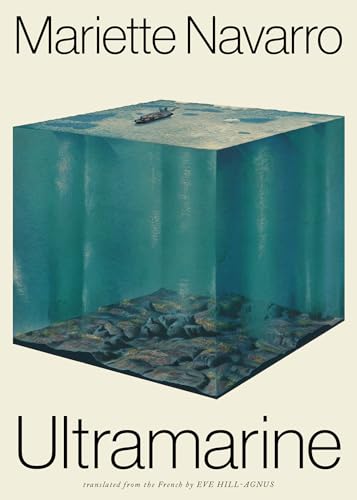
    ULTRAMARINE, translated novella that punches way above its weight in impact


    ULTRAMARINE
    MARIETTE NAVARRO
    (tr. Eve Hill-Agnus)
    Deep Vellum (non-affiliate Bookshop.org link)
    $17.95 all editions, available now

    One of Lit Hub’s 43 Favorite Books of 2025!

    One of Ancillary Review of Books' 2025 Notable Books!

    Rating: 4.5* of five

    The Publisher Says: A female captain in a male-dominated field, the unnamed narrator of Ultramarine has secured her success through strict adherence to protocol; she now manages a crew of twenty men and helms her own vessel. Uncharacteristically, one day, she allows her crew to cut the engines and swim in the deep open water. Returning from this moment of leisure, the crew of mariners no longer totals twenty men: now, they are twenty-one.

    Sparse and psychological, Ultramarine grips the reader in a tussle with reality, its rhythmic language mimicking the rocking of the boat. As instruments fail, weather reports contradict the senses, and the ship’s navigation mechanisms break down, Navarro “lulls her readers into accepting the unacceptable” (Asymptote) through deft, lyrical prose and pared-down dialogue. In Eve Hill-Agnus's poetic translation, Mariette Navarro emerges as an exciting, mature voice in French literature.

    I RECEIVED A DRC FROM THE PUBLISHER VIA EDELWEISS+. THANK YOU.

    My Review
    : Men led by a woman...really, that right there is subversive enough for one book, isn't it...get an unexpected, uncharacteristic concession to play from Authority. This is odd, but it's nothing compared to what's on the way in this novella.

    I'm calling it psychological horror, not suspense, because the point isn't to solve some riddle before A Bad Thing happens; it's about what unsettling things happening around, and to, you as a group, can elicit from the members of the group. I've labeled it "magical realism" as well because the odd things that happen aren't explained, aren't the point, and are very much not of this consensus reality.

    The title is a real pleasure. "Ultramarin" in French means the shade of blue, as well as the French colonial possessions that the ship's heading out over the bright blue tropical sea to. It's the role of a cargo ship to serve capitalism's need to get people things to buy. In her sudden subversion of the great Goddess Capitalism's need for Things to arrive so Commerce may eventuate, what is the captain thinking? The market is not being centered in her actions! The men are, wisely, unsettled and even unnerved despite their request for the halt being honored. They have their swim in the blueness of the sea, turning slightly blue with the heat-leaching nature of oceans.

    Then, as is usual when unsanctioned fun is had, the price comes due...the extra crewman who just...appears, the end of some perfectly calm weather that enabled their swim, the unraveling of their social order as they contend with the mounting pressures...there is a serious amonut of unease traveling among all the ship's company. In a very odd way they become a "company" in the non-commercial sense only when they are guilty of not serving the company they're employed by; and the captain, a true seafarer in her very bones, for the first time feels herself of the ship's company as the weirdness unfolds.

    Fantastical, unsettling, and very very beautiful. Subversively reminds the characters and the reader that. as powerful a religion as Capitalism may be, it is less than nothing set against the power of the sea.

    I recommend this very short read to all y'all. It would've gotten the full five had we not, in under 150pp, still had too many points of view and not all of them resolved.

    Wednesday, November 13, 2024

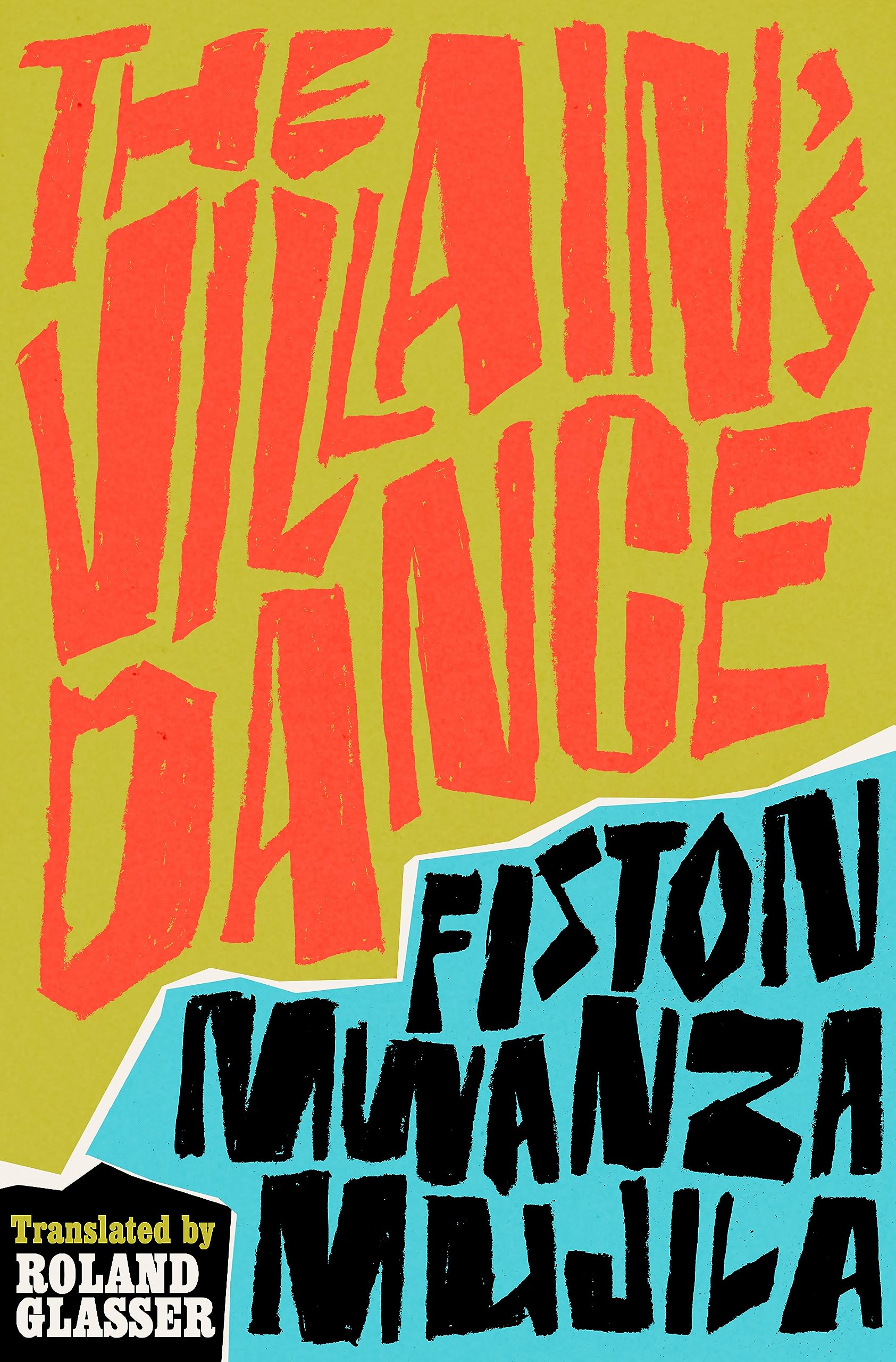
    THE VILLAIN'S DANCE, apt title for this cautionary tale of the societal chaos of civil war


    THE VILLAIN'S DANCE
    FISTON MWANZA MUJILA
    (tr. Roland Glasser)
    Deep Vellum (non-affiliate Amazon link)
    $9.99 Kindle edition, available now

    Rating: 4.5* of five

    The Publisher Says: Following the international success of his debut novel Tram 83, Fiston Mwanza Mujila is back with his highly anticipated second novel, which follows a remarkable series of characters during the Mobutu regime.

    The Democratic Republic of Congo, otherwise known as Congo-Kinshasa or DRCongo, has had a series of names since its founding. The name of Zaire best corresponds to the experience of the novel’s characters. The years of Mobutu’s regime were filled with utopias, dreams, fantasies and other uncontrolled desires for social redemption, the quest for easy enrichment and the desecration of places of power.

    Among these Zairians’ immigration to Angola during the civil war boycotting the borders inherited from colonization, as if the country did not have its own diamonds, and the occupation of public places by children from outside. The author creates the atmosphere of the time through a roundup of the diviner Tshiamuena, also known as Madonna of the Cafunfo mines, prides herself of being God with whoever is willing to listen to her. Franz Baumgartner, an apprentice writer originally from Austria and rumba lover, goes around the bars in search of material for his novel. Sanza, Le Blanc and other street children share information to the intelligence services when they are not living off begging and robbery. Djibril, taxi driver, only lives for reggae music.

    As soon as night falls, each character dances and plays his own role in a country mined by dictatorship.

    I RECEIVED A DRC FROM THE PUBLISHER VIA EDELWEISS+. THANK YOU.

    My Review
    : Want to know how much I appreciate Author Fiston Mwanza Mujila's talents?

    I didn't pan, belittle, or insult his poetry. All y'all know how I feel about poetry. And I gave it more than three stars! Be amazed, be impressed...I hope you'll be inspired to go get one. Tram 83 worked for me, as well; I know a lot of folks were't fans but it felt like a breeze from Africa to me, hot, wet, heavily freighted. This impression left me for dead in the first instance; I was less enrapt with its story and atmosphere then than I am in retrospect. In part that's down to my subsequent experience of reading The Villain's Dance.

    In common with my earlier reads of the author's books, I began this one with an awareness of atmosphere. He is always, or so it feels to me, careful to begin as he means to go on. I'm reasonably sure the huge majority of my readers are unaware of Mobutu's identity, and are more or less uninformed about tthe name "Zaire" and its history...many in my generation will have known the name Zaire vaguely applies to a huge place near the Congo River but be blissfully unaware that the name is no longer used, or why that happened.

    I think that gives the novel almost an SFnal appeal. There's little sense of geography encompassing the story in US readers, so why not just go all the way and market it as taking place on a different planet entirely? *I* can do this, I'm a book reviewer, the publisher can't. The level of outrage engendered would be epic. However, let me propose this to you: If you're willing to learn the names of made-up places like Middle Earth, Arrakis, Pern, Atlantis, Downbelow Station, and their different inhabitants, conflicts, social norms, what's the hold up on Zaire and Brazzaville?

    Maybe the tiniest taint of racism? Worth some energy to think about.

    Assuming you're in the already-overcame-it or the overcoming-it-now group, this story's got great conflicts between dark-grey, pitch-black, and palest shades of violet people trying their best to make it in a world where up and down just switched places...like being on a space station whose spin just changed speeds dramatically.

    Maybe my increased appreciation for this read makes more sense than I thought it did at first.

    The people in this book aren't just as well-realized as the setting, for the most part; see below. The pace of the story is provided by history, as it's based on the realities then prevailing. The entire enterprise of nation-building collapsing into civil war (by definition a chaotic break in the life of a society) honestly needs little of that tarting up to make it compelling, even riveting, reading. What Author Fiston does very well here is to fragment the locations of the chaos to give different people reason to speak their truth without losing the core purpose of telling us this story. Like Do Androids Dream of Electric Sheep?, we are taken into realms of deep desperation and left there long enough to get it; then we're offered a peek into the purpose of the extraction and the exploitation that requires...we're not left to wallow, the way The Octopus, f/ex, does with us in service of the same sharp criticism of the cutting edge of capitalism. Poe said it very succinctly in the nineteenth century:  "{C}orporations, it is very well known, have neither posteriors to be kicked, nor souls to be damned." (Thanks for showing me the accurate quote again, P-E!)

    Edges, as noted above, cut; in this story we're in the path of the blade so see both the wielding and cutting inherent in its very existence. People fail. It is inevitable. Challenges go unmet still less mastered. As often as not that is a design feature of the challenge. It engenders judgment and contempt for failure, but leaves the challenge, well, unchallenged. I suspect the true-to-life experience of people showing up for a minute then vanishing will affront a lot of complacently smug story-structure addicts. It's not by accident, y'all; it's a feature not a bug. Like life in an unstable place at a volatile time, different people will come, only to go without fanfare, or even explanation. Most of the characters trying to make it any old how they can haven't got the wherewithal to care, often enough to notice, who is who except at the precise flash of the camera that "now" represents.

    I am trying as best I can to explain away the most common issues I've seen raised in others's assessments of the book. I'm not sure it matters. I hope y'all will attend to my 4.5* rating more closely than to my blandishments. A book of this trenchance is not to be dismissed. I'm hopeful that a few will take this moment of US culture shock to see what has happened in other places at this kind of inflection point.

    Forewarned is forearmed.

    Thursday, August 29, 2024

    EVE OUT OF HER RUINS, Paradise for whom?


    EVE OUT OF HER RUINS
    ANANDA DEVI
    (tr. Jeffrey Zuckerman)
    Deep Vellum (non-affiliate Amazon link)
    $7.96 Kindle edition, available now

    Rating: 4* of five

    The Publisher Says: "Devi writes about terrible and bitter events with a soft, delicate voice."—Le Figaro

    With brutal honesty and poetic urgency, Ananda Devi relates the tale of four young Mauritians trapped in their country's endless cycle of fear and violence: Eve, whose body is her only weapon and source of power; Savita, Eve's best friend, the only one who loves Eve without self-interest, who has plans to leave but will not go alone; Saadiq, gifted would-be poet, inspired by Rimbaud, in love with Eve; Clélio, belligerent rebel, waiting without hope for his brother to send for him from France.

    Eve out of Her Ruins is a heartbreaking look at the dark corners of the island nation of Mauritius that tourists never see, and a poignant exploration of the construction of personhood at the margins of society. Awarded the prestigious Prix des cinq continents upon publication as the best book written in French outside of France, Eve Out of her Ruins is a harrowing account of the violent reality of life in her native country by the figurehead of Mauritian literature.

    The book featurues an original introduction by Nobel Prize winner J.M.G. Le Clézio, who declares Devi "a truly great writer."

    I RECEIVED A DRC FROM THE PUBLISHER VIA EDELWEISS+. THANK YOU.

    My Review
    : Paradise is always a fantasy, a construct imposed on a much more complicated reality. It is also used, with distressing regularity and near-universal success, as a trap for the seekers and for the sacrificial victims the entrappers designate.
    The sea by the luxury hotel gleams with hazy fire. Where we live, it looks like oil and smells like an armpit. People walk past, sit at a café, take in the air, drink beers, enjoy the weather, and think about nothing. Eve once told me that we were on another planet. I think she’s right. Our sun and theirs aren’t the same.

    No tourist could fail to wince at the reality of Paradise; so they're carefully steered away from contact with it.
    Sometimes, when the neighbourhood is quiet, the island’s sounds seem different. Other kinds of music, less funereal tones, the clang of cash registers, the dazzle of development. The tourists scorn us without realizing it. Money has made them naïve. We cheat them out of a few rupees until they begin to mistrust our pleasant, false faces.

    The country puts on its sky-blue dress, the better to seduce them. A marine perfume wafts from its crotch. From here we can’t see the island all dolled up, and their eyes, dazzled by the sun, can’t see us. As things should be.

    Fantasy is good business, and good for business. Look at Disney's "entertainment" empire, its parks, hotels, cruise ships, retirement homes for fucksake. What it costs, what it does to the homes of real people, isn't priced into the fantasist's experience. It's an economic externality. Tourists, often with the very best of intentions, go to places to have experiences, learn things, be broadened and hopefully improved. Travel does alter people who can afford to do it.

    The capitalist system demands that, wherever there is money to be made, as much as possible of it should be funnelled into the pockets of the very richest. So that broadening travel? It benefits you, the comparatively rich tourist and it enriches the service providers; leaving the people whose home you're staying in, whose lives you're altering, with less than a fair share. Most destructively, people like Eve are encouraged to commodify their being on this Earth:
    The school principal told me: Vous vous devez de réussir. Then she said it again in English: You owe it to yourself to succeed. And finally in Mauritian Creole: Pa gaspiy u lavi.

    Careful now...read that again. This is the colonizer's hand showing through the glove. Like that deeply and disturbingly unchristian "prosperity doctrine," it exchanges the idea of development, improvement, education for "success" that ever-elusive endlessly mutable chimera of the economic system. And look how beautifully succinct that message is, delivered in the colonizers' tongue, the dominant language of capitalism, then the hearer's local language. The hierarchy is laid bare. Fewer than thirty words to create the spine of a story.

    Eve is, in the eyes of those around her who purport to love her, a wild creature of iron whims and large passions. She is a small woman. That means her intensity is almost fetishized in acknowledging it; it also has the side effect of making her sexually desirable. As she's a person very capable of dissociation, like many intelligent women, she uses sex to acquire things she needs and things she wants.

    This willingness to divorce herself from the use of her body is, ironically, the greatest guide to the woman she loves and who returns that love, Savita.
    Eve's silence is the rumble deep within the volcano. It hurts me to see her so fragile when she thinks she's so strong.

    Savita sees Eve's magma, her soul heating the rock of her life to boiling point. She longs for the abillity to soothe her, to release the pressure that pushes Eve away from everyone else. In a grim, horrible way, she does that.

    The shortness of this read shouldn't be mistaken for truncation or cursoriness. Savita's arc, not long, so hugely, consequentially alters Eve's and Troumaron's as an entire "native" (that ugly colonizers' term for the owners of the land) community, that an entire fifty thousand more words could be spent on it without adding a scintilla of intensity, meaning, or passion. Eve is transformed, attains an apotheosis, that alters her male admirer Saadiq (a poetry-obsessed yobbo whose yearning for her organizes his life and leaves hers untouched) perhaps most. The end of the story isn't a cheery, uplifting one. The end of the story is, instead, the realization of the inevitability of sacrifices in pursuit of the idea of Paradise.

    I'll comment that the narrative voice here is not, nor was it meant to be, an accurate presentation of young people's actual spoken language. When you're telling a story this consequential, using more poetic, lyrical cadences is a useful way of communicating to the reader they're to look for more than the surface of the tale. I also note that Nobel-winner J.M.G. Le Clézio wrote an introduction that is one long spoiler for the story. I advise you to read it last.

    I enjoyed this read very much. I hope you'll take heed of the content warning for sexual abuse...it's not graphically shown but it is absolutely pervasive of every aspect of the story told here.

    Wednesday, August 28, 2024

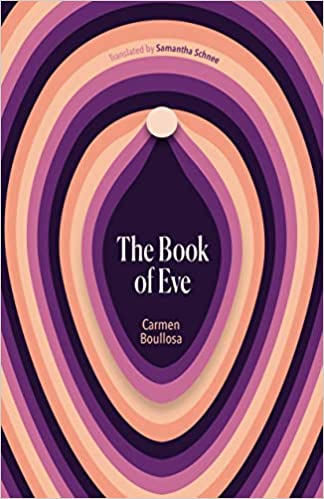
    THE BOOK OF EVE, woman-centered retelling of the Biblical Font of Misogyny


    THE BOOK OF EVE
    CARMEN BOULLOSA
    (tr. Samantha Schnee)
    Deep Vellum (non-affiliate Bookshop.org link)
    $9.95 ebook, available now

    Rating: 3.75* of five

    The Publisher Says: What if everything they’ve told us about the Garden was the other way around? Faced with what appears to be an apocryphal manuscript containing ten books and 91 passages, Eve decides to tell her version: she was neither created from Adam's rib, nor is it exact that she was expelled by the apple and the serpent, nor is story they tell of Abel and Cain true, neither that of the Flood, nor that of the Tower of Babel...

    With brilliant prose, Carmen Boullosa gives a twist to the book of Genesis to dismantle the male figure and rebuild the world, the origin of gastronomy, the domestication of animals, the cultivation of land and pleasure, through the feminine gaze. Based on this exploration, sometimes fun and other times painful, The Book of Eve takes a tour through the stories they’ve told us and which have helped to foster (and cement) the absurd idea that woman is the companion, complement, and even accessory to man, which opens the door to criminal violence against women. Boullosa refutes and breaks them in this feminist novel, foundational and brazen.

    I RECEIVED A DRC FROM THE PUBLISHER VIA EDELWEISS+. THANK YOU.

    My Review
    : Feminist retelling of Adam and Eve from Genesis.

    As one might expect I was no fan of the patriarchal version, it being part of a religious tradition that I detest. I can't say that flipping the script to make it clear that Eve was hard done by in the Abrahamic original, and offering an Eve-centered corrective, was particularly agreeable, either; the entire religious framework is just so utterly nonsensical that making a shift in viewpoint doesn't make it less ridiculous.

    I've seen significant consumer-review criticism of Author Boullosa (of Heavens on Earth fame) for sounding angry and anti-man in this retelling of the ur-text of misogyny. Well, honestly! How silly of the woman to feel some kinda way about a story that's been used for literal millennia to bludgeon women into submission to men in god's name? Outrageous!

    The storytelling volume is indeed turned to eleven of ten, and the weird stop on the organ is out all the way. Eve reclaims the Ark myth as her own (which makes a lot of sense TBH) and has a really, um, off-center story of how we all came to have those indispensible things, the anus. Have to read it to find out. But the fact is, neither Adam nor Eve as created being would have one...or a navel...as they never gestated so never grew 'em. What the hell did I just read was my most frequent thought as I kept reading this uncorked, vociferous Eve's take on the stories I value so little.

    So, on the one hand, yes indeed this woman's take on a man's story of why women should submit to him is plenty angry, on the other hand it always makes a story more interesting and more relevant to look at it upside down. Author Boullosa is a dab hand at making her characters sound like they are in the room with you. I found this storytelling voice compelling, angry, and Eve herself resolutely unwilling to be a good girl and quiet down. Thank goodness, though in spite of her absence of sham modesty Eve never addressed my most burning Biblical question:

    Can anyone explain to me why the myth got started the Eve was created from Adam's rib, when we've all got the same number of these bones? Clearly it makes more sense...insofar as any of this guff does...to have her created from his baculum, since humans ain't got those no more.

    Wednesday, August 7, 2024

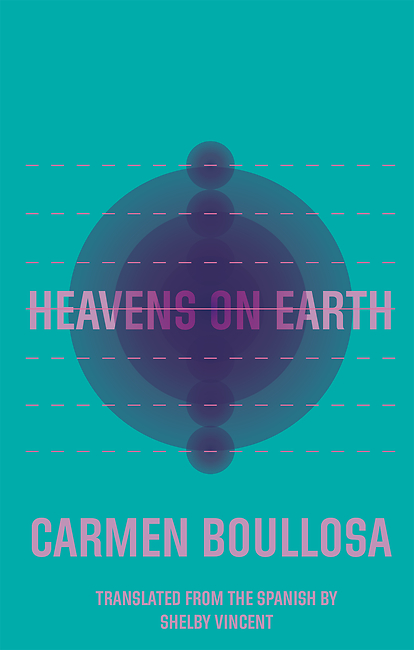
    HEAVENS ON EARTH, as though such a thing could exist...which is the point of the read


    HEAVENS ON EARTH
    CARMEN BOULLOSA
    (tr. Shelby Vincent)
    Deep Vellum (non-affiliate Amazon link)
    $16.95 trade paper, available now

    Rating: 4.5* of five

    The Publisher Says: Three narrators from different historical eras engage in preserving history in Heavens on Earth. As her narrators sense each other and interact through time and space, Boullosa challenges the primacy of recorded history and asserts literature and language's power to transcend the barriers of time and space in vivid, urgent prose.

    Carmen Boullosa is one of Mexico's leading novelists, poets, and playwrights. Her most recent novel The Great Theft (Deep Vellum, 2014) was shortlisted for the PEN Translation Prize, nominated for the International Dublin Literary Award, and won Typographical Era's Translation Award. She lives in Brooklyn, New York, and Mexico City, Mexico.

    I RECEIVED A DRC FROM THE PUBLISHER VIA EDELWEISS+. THANK YOU.

    My Review
    : Deeply, deeply examines our modern-US obsession with The Past. Every excursion into The Past requires acts of translation. You and I, reading and writing on our devices, pushing our words into strangers' faces as a matter of course (possibly detrimentally to discourse) can't know what anyone in The Past really meant to say. We can see the words. We can, but mostly won't bother to, study the time and thus learn some cultural facts that help us get a hint. But, like the radical fascist folk who assert their politicosocial ideas as representing those of the US "founders," we're translating words, not recovering facts. Author Boullosa uses multiple narrators in multiple timelines to examine the role of History and Tradition as anchors, as dead weights, and as foundations. What even is The Past, a key question for each narrator. The same events look hugely different to people with different perspectives.

    I am usually a bit iffy on this narrative technique. In this case, I lapped it up because Estela in the present, Learo in the future, and Don Hernando in the past each explore this story's central thesis, the nature of narrative in shaping culture, without resorting to speeches. No one says, "if they/we had only known" or the equivalent. They tell us, their readers, the reality they live in as seen from their differing levels of privilege granted to each one's identity. Fair warning, there is frank...but uncelebrated...homophobia, colorism, and racism. They are facts of the past and present. The future, well...we won't know for a while, will we?

    The narrative conceit is of a manuscript written in Latin when the Conquest was within living memory. Its author's a gay man in Holy Orders; not so shocking an idea for the time. It falls into the hands of a present-day scholar, Estela, who translates it (into Spanish). She is living in the failing Western country, Mexico. She annotates the manuscript with an academic eye on the roots of the present-day struggles in the clueless past, intending to make it public. Somehow the manuscript reaches Learo living in a wildly posthuman, post-scarcity future where The Past is not discussed, not heeded, not mined for clues or used as either guide or horrible warning. Learo's narrative is, unsurprisingly, polyphonic with Don Hernando's account of how the Conquest violently and cruelly mangled the memories and the bodies of the dwellers in "New Spain," an utterly invented and brutally enforced culture. As is always the case in examples of conquest, the ordinary person is required to graft a new identity onto their lifelong one, an intimate violation of self that begets more and more violence.

    It is a stunning psychic violence that pollutes every facet of the future.

    Yet without an honest reckoning with it, the present is unmoored, is prone to equal, congruent violence. The future that creates is...chilling. I'll say, for fear of spoilers, what Author Boullosa says: this novel explores "the prohibition of memory that will take us to the abolition of language, the repercussions of which the reader will witness."

    "Repercussions" might be the best-translated word Shelby Vincent chose.

    This novel, in its translation from Spanish to English, offers a far more trenchant riposte to foolhardy US politicosocial "essentialism" than a dozen more "factual" analyses could. A story does something an analysis can't: Personalizes the reverberations of actions taken or not taken, of salvations offered and denied. How we read this novel, in English, is already a thing apart from how it was written in Spanish. Its echoes of Anglophone sensation Cloud Atlas will be seen by the myriads of y'all who read (and mostly loved) that timeweaving narrative. More recently we had the multiversal Everything Everywhere All at Once pursuing the layering of causality in its own specially fraught way. The topic is a delightfully rich one, offering many opportunities to contemplate the story, its message, its execution, and its presentation in an enhanced framework. The effort of following the story through its curlicues and oddly bent pathways is richly repaid.

    What effort you make at translation is always a life-altering thing. Reader be aware. You will leave a different soul than the one you entered as.

    Saturday, September 23, 2023

    RECITAL OF THE DARK VERSES, translation of Mexican poet's bizarre, fact-based religious heist novel


    RECITAL OF THE DARK VERSES
    LUIS FELIPE FABRE
    (tr. Heather Cleary)
    Deep Vellum
    $17.95 trade paper ,available now

    Rating: 4.5* of five

    The Publisher Says: A masterful undertaking of historical literature, following 16th century religious fervor in a picaresque novel about Saint John of the Cross.

    In August 1592, a bailiff and his two assistants arrive at the monastery of Úbeda, with the secret task of transferring the body of Saint John of the Cross, the great Carmelite poet and mystic who had died the previous year, to his final abode in Segovia. When they exhume him, they find a body incorrupted and as fresh as when he died.

    Thus commences a series of adventures and misfortunes, with characters that seem to be drawn from mythology. The story written by Luis Felipe Fabre masterfully intertwines with the verses of the friar, as if in them he had prophesied the delirium that would surround his own posthumous transfer. Fabre's text is a highly entertaining novel, full of a sense of humor that manages to honor the mystical poetry of the Carmelite while inviting the reader to reflect on issues such as the sacred and the profane, the body and the soul, and spiritual (and carnal) ecstasy.

    I RECEIVED A DRC FROM THE PUBLISHER VIA EDELWEISS+. THANK YOU.

    My Review
    : This is another novel inspred by actual events. Unlike Amy Chua's fictionalized take on a horrible man's murder, this is so wildly OTT from its start to its finish that I was never sure if I should be laughing as hard as I was...it was AT the inept thieves and their looney beliefs, not gently with their haplessness...or just shaking my damn head at how religion screws people up and over seven ways from Sunday. There's nothing to it, I thought. Pick it up and the snark will flow like spice from Arrakis.

    I think there might really be a God, because that was so very not what happened.

    This is a piercingly beautiful translation of what I'm sure is a glorious read in its native Spanish. The author's very clearly a poet...who else would've chosen St. John of the Cross, that queer-coding mystic (itself Catholic code for "weirdo we can't afford to ignore") poet, and his deeply hilarious and utterly inappropriate post-mortem heist-cum-road-trip from his monastery to Segovia, there to be enshrined until finally officially made a saint? The best part is that this is fictionalized, not fictional. This weirdness really happened! History is so very much more peculiar than fantasy. Humanity, in all its unpreditability, can't be bettered by one human's imagination. Just the bare facts of the saint's life...impoverished yet noble childhood, imprisonment and torture for being Too Much for his monastic brethren, summons by St. Teresa of Ávila (herself a mystically horny writer) to join her in founding the Discalced Carmelites.

    The book is structured around verses of the saint's poetry. It is part and parcel of the reading experience. I, famously allergic to poetry, would rush right out to buy a copy of the translator's edition of St. John of the Cross's works. The reason is simple: This is, for all its mannered construction and sonorous linguistic register, the horniest stuff I've ever read that wasn't ab initio meant to be one-handed reading. Reading the quoted passages to my Young Gentleman Caller, I realized how very badly I miss having him in the same place as me. If you get my drift.

    The thing that most surprised me about this read is its playfulness. Not one page doesn't contain something to raise a smile or a happy reflection. This is not something I ever expect from a story about a religious figure, though that was short-sighted of me...the mystics were by definition not religious figures but spiritual seekers co-opted by religion. The three stooges who are sent to convey the body of St. John of the Cross to Segovia are not religious figures but servants of power tasked with a temptingly valuable object's care. That the object is a body really isn't that important to them, as it wouldn't be in that time and place. Holy relics were objects to be traded, stolen, acquired, and coveted, not a person's Earthly remains. Holy people were of a different substance than mere mortals and were thus not treated in death as were us dirtballs.

    This is completely part of the story. I am not religious (let go of your pearls, Mary, it's not the first time you've heard that) but am very much of the mindset that, once one's done with the meat of the body, it ought to go back to the earth that formed it. Every so often, as the posthumous indignities were wrought on John of the Cross's person, I found myself surprised into awareness that this was a person's flesh. The casual presumption that the problem with the things happening to the flesh were centered around others's claims to ownership of it, not the horror of doing these dreadful things to a person (even though a dead one) jolted me.

    The prose in this translation is, to my soul's ear, exactly right in its register of formal, mildly archaic, still fluidly readable English. Different enough to give the effect of listening to someone with a beautiful voice speaking to you in foreigner's English...a thing I myownself enjoy...but not to everyone's taste, I know. Be aware of this fact before buying...the Kindle edition, available the tenth of October, allows one to try a sample before buying and the sensitive-to-Otherness would do well to try before committing to ownership. Alternatively, an excerpt appeared on the LitHub website.

    One aspect of the English read that I found extra-pleasurable was the mental image of reading a translation of a story about a Translation was quite piquant. It's one of the more rareified pleasures of reading translations, but a deep one. In general, the Anglophone world sees little appeal in reading translated literature. This really is never more sad to me than when discovering an imagination as agile and as horny as Author Fabre's is. This story, fact-based as it is, should be on everyone's radar. The pleasures of being in the deeply, delightedly earthy and Earthly company of the three men who Translate the holy remains (though not wholly, pun intended) as they discover themselves and their Otherness in his company are readily available to you thanks to Translator Cleary and Deep Vellum.

    No less a luminary than Valeria Luiselli (Lost Children Archive, The Story of My Teeth) thinks this book should make waves among Anglophone readers. Happen I agree. It certainly should, and let it start with you.

    Wednesday, August 3, 2022

    IN CONCRETE, most-recent novel from playful stylist & SPHINX, Anne Garréta's groundbreaking first novel translated perfectly


    SPHINX
    ANNE GARRÉTA
    (tr. Emma Ramadan)
    Deep Vellum
    $14.95 trade paper, available now

    Rating: 4* of five

    The Publisher Says: Sphinx is the remarkable debut novel, originally published in 1986, by the incredibly talented and inventive French author Anne Garréta, one of the few female members of Oulipo, the influential and exclusive French experimental literary group whose mission is to create literature based on mathematical and linguistic restraints, and whose ranks include Georges Perec and Italo Calvino, among others.

    A beautiful and complex love story between two characters, the narrator, "I," and their lover, A***, written without using any gender markers to refer to the main characters, Sphinx is a remarkable linguistic feat and paragon of experimental literature that has never been accomplished before or since in the strictly-gendered French language.

    Sphinx is a landmark text in the feminist and LGBT literary canon appearing in English for the first time.

    I RECEIVED A DRC FROM THE PUBLISHER VIA EDELWEISS+. THANK YOU.

    My Review
    : First-novel longueurs are here, but they are eclipsed by the astonishingly ambitious project that it represents. It's not a spoiler, or if it is it's already occurred in the blurb above, to say that a sexy novel about lovers written without any gender markers is a very different challenge in English than in French, a very strictly gendered language.

    Translator Ramadan took a trait that eased Author Garréta's trajectory to accomplish this complex feat, the use of a grammatical tense that English does not have and that makes the speaker sound ever so pretentious, and then she runs with its effect on the prose.
    Soul heavy from too much knowing, body tired from feeling pensive and powerless at the same time, so riven by this obsessive ennui that nothing, or almost nothing, can distract from it anymore. Back then, if I recall correctly, I used to describe the world as a theater where processions of corpses danced in a macabre ball of drives and desires. My contempt and ennui did not, however, keep me from observing how this dance dissolved into an amorous waltz. Languid nights at the whim of syncopated rhythms and fleeting pulses; the road to hell was lit with pale lanterns; the bottom of the abyss drew closer indefinitely; I moved through the smooth insides of a whirlwind and gazed at deformed images of ecstatic bodies in the slow, hoarse death rattle of tortured flesh.

    That is, I thiink you'll all agree with me, pretty mannered writing. I like it, but then I would; the semi-colons, the layering of clauses...well! My Christmas came early with this read! It felt like I was reading a good translation of Proust.

    Yes, that is so a compliment.

    What shines through in this croquembouche of a story is the way that eliminating the simple fact of gender enables a love story, a passionate, consummated love story, to take on layers of meaning that otherwise wouldn't be available to readers. It enables the narrator to muse on the unsuitability of their fellow theology student, a man, as a target for a fling, a little light sexual fun...but because the fellow student is set on becoming a celibate priest, or because he is a man? It doesn't necessarily matter, but the two possibilities are very different even today. They were even moreso in the France of 1986.

    And now we butt up against the one real issue I can see someone taking with this read: A***, lover of our narrator, is Black. It's a fact that we're made aware of, and that plays a significant role in the narrator's attraction to and arousal with A***'s body. I'm not quite convinced it's exoticization, in the fetishistic sense. It's present in the narrator's arousal, though I can't see that being any other way...after all, the object of one's lust is always possessed of traits and qualities that are arousing, including physical ones; and there is not a single thing about the narrator's other appraisals of A*** that suggest a less-than-genuine interest in all their facets. What is more troubling is that the ending is what it is. There is a racialized account of violence and the actions in question take place in Harlem. Granted that the book appeared in 1986 and that was a historically extra-violent time in Harlem, in New York, and in multiple other major US cities as the crack epidemic was reaching its peak.

    Still, it's a thing that is present in the story and that could present a very different impression to a Person of Color. I give the information to you for your consideration. I lived in New York City at that time and was routinely very cautious for my personal safety, so it's permaybehaps down to my own familiarity with the milieu that prevents me from seeing it as anything but a reflection of the reality I lived here, and then.

    I will say that what happened, and how it went down, knocked a star off my rating. My respect for the project of creating an ungendered love story that still contained passionate pleasure is undimmed. It's the manner in which Author Garréta chose to dismount the story-horse that did not meet with my whole-hearted approval.

    Nothing is ever exactly as one would wish it to be, though, is it.

    ++++++++++++++++++++++++++++++++++++++++++++++++++++++++++++++++


    IN CONCRETE
    ANNE GARRÉTA
    (tr. Emma Ramadan)
    Deep Vellum
    $15.95 trade paper, available now

    Rating: 4.5* of five

    The Publisher Says: Garréta’s first new novel in a decade follows two young sisters who are dragged into one adventure after another when their father finds himself in possession of a concrete mixer. As he seeks to modernize every aspect of their lives, disaster strikes when the younger sister, Poulette, is subsumed by concrete.

    Through puns, wordplay, and dizzying verbal effect, Garréta reinvents the novel form and blurs the line between spoken and written language in an attempt to modernize—or fundamentally undercut—the elasticity of communication.

    I RECEIVED A DRC FROM THE PUBLISHER VIA EDELWEISS+. THANK YOU.

    My Review
    : I'm old enough to remember reading Zazie dans le Métro by Raymond Queneau during the early-1980s height of Valley-Girl speak. It was snortingly urged on me by an older film-school-attending friend, whose encounter with Queneau's 1959 breakout novel was prompted by seeing Louis Malle's 1960 film of the same title. He said that Queneau did it better than the Valley Girls. I was, after reading Barbara Wright's translation, inclined to agree.

    So here's Anne Garréta pulling the same stunt as Queneau, her spiritual godparent and co-founder of Oulipo, to which organization she belongs, pulled sixty years before. Is that hommage or le plagiat? After chortlesnorting my way through In Concrete, I'll go with hommage and a darn funny one at that.

    I'm not at all sure, to be honest, that our narrator is a sex-linked girl; there's nothing in the text that specifically says she is, and there's a certain je ne sais quoi to the narrative voice that leads me to wonder if she isn't trans. It just *feels* that way. And given Queneau's Zazie has impeccable gaydar, ascertaining Gabriel is queer in seconds flat and constantly offering him chances to own up to it (he's a married drag entertainer, so there's your ambiguity for you) which he declines repeatedly (it was 1959), it would fit well with Mme Garréta's presumptive model and her earlier project (see above) for this to be so but unsaid.

    Anyway. Manic energy, fun little not-quite-right malapropisms in a precocious kid's foul mouth, a family life that (for once) is loving while still being supremely dysfunctional...and all just as French as bœuf bourguignon. Does that sound like fun? I did to me, and I'm delighted to report that Translator Ramadan delivers verbal pyrotechnics that land just right. I know they did in French, not from having read them...waaay too advanced for me!...but because they were lauded by French critics for their anarchic jubilance. Having them come anywhere close to the original is a major achievement. Though not a surprise, given the nature of her translation of Sphinx as a linguistic exercise in French coming through in English as well.

    Here, try this piece:
    Lucky, they say, are those to whom the favor of the gods—or if not the favor of the gods then paternal klutziness—grants the privilege of experiencing things that deserve to be scribed!

    Lucky also, it seems, are those who are entrusted to scribe on the tablets the things that deserved to be recorded, such as paternal klutziness and lapidary scatastrophes!

    And even luckier are those, like Poulette and me, who are given the double privilege of finding themselves encased in greasy mortar and feeding the koalas.

    Yup, the koalas . . .

    Don't ask me why koalas . . . Can't you see it snot a good time?!

    As for klutziness, if you don't know what that is, let's just say to keep it short that it's the specialty of generals, of top brass and rulers. But snot just them. Klutziness worms its way into everything. No need to be a high roller to be swimming in it. Klutziness has no end, no limit, and it's within the reach of any ol' poodle.

    Epic klutziness, imperial klutziness, the lurid panache of klutziness pushed to heroic apogee and even to entropic scatastrophe—I fear we're the last of the klutzes.

    We're not the last, are we, but we might just be looking at 'em.

    Wednesday, June 29, 2022

    THE VISITORS, trippy anti-capitalist lesbian breakdown with tech & psychosis & DIARY OF A FILM, who gets to tell queer stories?


    DIARY OF A FILM
    NIVEN GOVINDEN

    Deep Vellum
    $25.95 hardcover, now available in paperback $18.95

    Rating: 4* of five

    The Publisher Says: In this highly-lauded novel, a filmmaker meets a woman named Cosima at an Italian espresso bar, spinning a gorgeous tale of love and the creative process.

    An auteur, together with his lead actors, is at a prestigious European festival to premiere his latest film. Alone one morning at a backstreet café, he strikes up a conversation with a local woman who takes him on a walk to uncover the city's secrets, historic and personal. As the walk unwinds, a story of love and tragedy emerges, and he begins to see the chance meeting as fate. He is entranced, wholly clear in his mind: her story must surely form the basis for his next film. This is a novel about cinema, flâneurs, and queer love — it is about the sometimes troubled, sometimes ecstatic creative process, and the toll it takes on its makers. But it is also a novel about stories, and the persistent question of who has the right to tell them.

    I RECEIVED A DRC FROM THE PUBLISHER VIA EDELWEISS+. THANK YOU.

    My Review
    : First, read this:
    There was a moment in a theatre as the lights went down that you truly understood the depth of your vulnerability: that for all the good wishes and the boosting presence of family around you, the truth that you were about to be judged was inescapable. Your visual imagination and use of language, your depth and humour, as well as compassion and emotional intelligence: these were to be dissected, held aloft and appraised. I knew of no other art form that took apart a human being to the same degree of complexity.

    –and–

    I was jealous of the lives novelists lived but I knew that I was not a solitary creature. Novels were a different kind of cage, one where you willingly locked yourself in. {His newly discovered muse} had something of the captive in her, I thought; that same mixture of passion and restraint I’d seen in other novelists I’d worked with.

    The words, musings really, of a cinema auteur of the pretentiously arty sort; all the inducement, or warning, you need about the read to come. I'm pretty sure you know right now which it is for you. I was left eager for more as I read the first sentence:
    I flew to the Italian city of B. to attend the film festival in late March. Our entry into the competition, a liberal adaptation of William Maxwell’s novel The Folded Leaf, had been officially confirmed, and I was expected to participate in three days of interviews and panels to promote the release, with a jury screening on the second evening.

    ...because that novel contains one of my commonplace book's fattest sections. Maxwell's story, simple on the surface, of unrequited and unrequested love, is a tour-de-force of understatement that would be damned close to impossible to film. How does one get this:
    But to live in the world at all is to be committed to some kind of a journey... On a turning earth, in a mechanically revolving universe, there is no place to stand still. Neither the destination nor the point of departure are important. People often find themselves midway on a journey they had no intention of taking and that began they are not exactly sure where.

    ...onto film? How in the hell can Lymie, the speaker, ever be really captured outside a reader's head? So we know what kind of filmmaker we're with in B., and it ain't Quentin Tarantino. Did Wallace Shawn ever direct a film? It would've been a lot like the narrator's films, I'll wager.

    As he is in B. for the second time with a film almost certainly receiving an award, I was a touch surprised that Maestro (the tag that everyone uses to refer to and address the narrator, ugh) didn't have his husband and son with him. They are there in spirit, I suppose; the Maestro does refer to them. But the principal story here is about Cosima, a novelist who meets the Maestro quite by accident (or is it an accident?). Her long, intimate ramble and rambling chat with him becomes the center of the Maestro's world. He is captivated, both by Cosima and her story of a dead and gone artist lover of hers. He does what I think all truly driven artists do: He absorbs Cosima's story, Cosima's love; he appropriates them, in more modern terms. After all, he's decided with the arrogance of his sex and class that he's Going To Make This Film, the life and art of these lovers. So what that Cosima doesn't want him to? Who owns the facts?

    The Maestro, then, is accustomed to taking what he wants. It's also obvious in his creepily Hitchcockesque insertion of himself into his lead actors' (from The Folded Leaf, the novel he's filmed, remember?) new off-screen romance. He's very benign about it, but it's there, and it reads badly in the twenty-first century. As it's intended to do....

    The unbearably lush sensory world of Italy, its food and its lavish sensual feast of a landscape, is all I can picture after this read. The parties and events surrounding the Maestro's film release aren't very interesting to me, and luckily receded into the background as I read, but I'm attuned to the food and wine descriptions. (If I were a dog, I'd be reward-oriented in training.)

    The stylistic choice to make each chapter a paragraph makes sense when one twigs to the fact this is a récit. All speech not the Maestro's is reported by him, is heard through his ears. We're always inside his head, always with his eyes doing our seeing...it's actually like we're the audience at the movie of his life. In fact, based on what he says, I'm willing to bet the Maestro's a narcissist on the ragged edge of pre-disorder-level presentation. It wouldn't take much to shove him into a full-blown clinical case.

    The simple saving grace for the Maestro is, I suspect, that he's a storyteller by profession and passion.
    Too much of life is given to analysis. I agree with that, I said, more than you realise. That's not to say I want to live blindly, maestro, more that you have to give yourself up to the day in order to live it. I learned a lesson from reading that novel. You're not always in control of when and how things end. What you can control is whether you embrace the moment.

    You're not in control of how things end...but the author, the auteur, is. And there's no better place to be than that. The truth is the Maestro will always assume control of wherever he is, whenever he is there.

    The main response I predict most people will have to the story is formal: Many are the folk who do not like absent dialogue tags and paragraphs that go on for pages. These are not the readers for Govinden's strange and lovely artwork. If you enjoyed Milkman with its men called things like Maybe-boyfriend and the neverending sentence with "the fact that" as a kind of punctuation in Lucy Elliman's Ducks, Newburyport, you'll be fine with this read. In fact it's downright simple in comparison to those two, or their French ancestors Pinget or Proust.

    If those aren't happy memories for you, this isn't likely to be either. If you're willing to put in some concentration I predict this story in its very 21st century preoccupations with story, ownership, misogyny, and the Cult of the Creator, you'll like this read a lot.

    ++++++++++++++++++++++++++++++++++++++++++++++++++++++++++++++++


    THE VISITORS
    JESSI JEZEWSKA STEVENS

    And Other Stories
    $25.95 hardcover, available now

    The author discusses her book with Christian Lorentzen.

    Rating: 3? 5? 9? stars of five

    The Publisher Says: From the author of The Exhibition of Persephone Q, a chilling fable about the necessity—and impossibility—of productivity, art, and love in an age governed by capitalist logic.

    On the eve of the Occupy Wall Street protests, C is flat broke. Once a renowned textile artist, she’s now the sole proprietor of an arts supply store in Lower Manhattan. Divorced, alone, at loose ends, C is stuck with a struggling business, a stack of bills, a new erotic interest in her oldest girlfriend, and a persistent hallucination in the form of a rogue garden gnome with a pointed interest in systems collapse…

    C needs to put her medical debt and her sex life in order, but how to make concrete plans with this little visitor haunting her apartment, sporting a three-piece suit and delivering impromptu lectures on the vulnerability of the national grid? Moreover, what's all this computer code doing in the story of her life? And do the answers to all of C's questions lie with an eco-hacktivist cabal threatening to end modern life as we know it?

    Replaying recent history through a distorting glass, The Visitors is a mordantly funny tour through through a world where not only civic infrastructure but our darkest desires (not to mention our novels) are vulnerable to malware; where mythical creatures talk like Don DeLillo; where love is little more than a blip in our metadata. It peers into How We Got Here and asks What We Do Next, charting the last days of a broken status quo as the path is cleared for something new.

    I RECEIVED A DRC FROM THE PUBLISHER VIA EDELWEISS+. THANK YOU.

    My Review
    : All progress, so it seems, is coupled to regression elsewhere. — Author JESSI JEZEWSKA STEVENS, The Visitors

    A Hymn of Praise to the Great Publisher AND OTHER STORIES, which dwelleth in the Sheffield of Reeds, the Rulers of Literature! Thou art the first-born fruit of Stefan Tobler's psychic womb. Thou art they whose brows are lofty. Thou hast gained possession of the Formula of Publishing, Publishing = Supply + Demand + Magic, and used this with the rank and dignity of the divine forebears Knopf, Calder, and Busby. Thy literary nous is wide-spread. Thy existence shall resound in the welkin of words. Grant thou to me glory in reading and breadth in comprehension in the form of an unbenighted reader, and the power to pass in through and to pass out from the bewilderingly dense and mannerèd prose of this, thy author JESSI JEZEWSKA STEVENS, whose words possess humor and trenchance yet surpass my ability to grasp them.

    Homage to thee, O Progenitors of Those En Avant. I have fought for thee, I am one of those who wisheth for words of wisdom and meaning beyond those that make the women tear out their hair. I unbolt the door on the Shrine of Feminism in TERFless lands. I enter in among and come forth with the Goddesses of Literary Experimentation on the day of the destruction of James Patterson and J.K. Rowling. I look upon the hidden things in THE VISITORS and recite the words of the liturgy of Rachel Cusk.

    Hail, O Ye Who Make Perfect Souls to enter into the House of Woolf and Stein, make ye the well-instructed soul of the Reader Mudge. Let him hear even as ye hear; let him have sight even as ye have sight; let him stand up under this onslaught of ideas even as ye have stood up; let him take his seat even as ye have taken your seats, for he is mightily worn out.

    Hail, O Ye Who Open Up The Way, who act as guides through the thickets of recursion and coding-inflected ideas, to the perfect souls in the House of Literature. May he enter into the House of AND OTHER STORIES with boldness, because there is no trace of comprehension in him. May there be no opposition made to him, nor may he be sent out again therefrom for his dimwittedness. May he not be found light in the Balance, and may the Feather of Book-Ma'at decide his case.

    with my most sincere apologies to the shade of E.A. Wallis Budge, translator of The Book of Going Forth By Day, to whose prose I have done great and grievous violence; and to JESSI JEZEWSKA STEVENS, whose erudition and verve with language dwarf my own limited capacities to comprehend them

    Saturday, April 9, 2022

    THE MIRACULOUS TRUE HISTORY OF NOMI ALI, intense and urgent and deeply necessary reading


    THE MIRACULOUS TRUE HISTORY OF NOMI ALI
    UZMA ASLAM KHAN

    Deep Vellum (non-affiliate Bookshop.org link)
    $9.95 ebook, available now

    Rating: 4* of five

    The Publisher Says: Nomi and Zee are Local Borns—their father a convict condemned by the British to the Andaman Islands, their mother shipped off with him. The islands are an inhospitable place, despite their surreal beauty. In this unreliable world, the children have their friend Aye, the pet hen Priya and the distracted love of their parents to shore them up from one day to the next. Meanwhile, within the walls of the prison, Prisoner 218 D wages a war on her jailers with only her body and her memory.

    When war descends upon this overlooked outpost of Empire, the British are forced out and the Japanese move in. Soon the first shot is fired and Zee is forced to flee, leaving Nomi and the other islanders to contend with a new malice. The islands—and the seas surrounding them—become a battlefield, resulting in tragedy for some and a brittle kind of freedom for others, who find themselves increasingly entangled in a mesh of alliances and betrayals.

    Ambitiously imagined and hauntingly alive, The Miraculous True History of Nomi Ali writes into being the interwoven stories of people caught in the vortex of history, powerless yet with powers of their own: of bravery and wonder, empathy and endurance. Uzma Aslam Khan’s extraordinary new novel is an unflinching and lyrical page-turner, an epic telling of a largely forgotten chapter in the history of the subcontinent.

    I RECEIVED A DRC FROM THE PUBLISHER VIA EDELWEISS+. THANK YOU.

    My Review
    : First, read this:
    “Have you noticed that when men want freedom, the conversation is about the nature of action, violence or non-violence? But when women want freedom, the conversation is about the nature of women, natural or unnatural?”
    –and–
    Somewhere in the great sky beyond this sky of planes was a star made entirely of words. And on the star lived as many different kinds of words as birds in all the skies, fish in all the seas, and clay patterns in all the hands of adoring women. Some words were cautious as the crabs nesting on the beach. Others, bold as the giant hornbills prattling in the trees. Then there were those that made no sound, but were equally fearless, folding their arms and waiting for her to sit on their lap. The prisoner who was no longer a prisoner was gathering all these many words to herself and would speak them, if there were but someone to listen, even a little.

    The reason to read, or not to read, this story is there in those quotes. There are adults imprisoned in this story, adults whose sufferings are inflicted on bodies as well as souls; their children are, revoltingly but oddly mercifully, imprisoned with them in a soul-warping hothouse of rage and mistrust...but with their loving (if distracted) parents. These strands are braided throughout this intense, powerful, experiential read.

    The bones of the story...a political prison on the Andaman Islands during WWII is attacked by the Japanese, slaughter is heaped on torture, and through it all a family makes a life amid the death...are unfamiliar to most of us in the US. The existence of the Andamans, those odd and liminal boundary markers between marine biomes and cultural fault lines between the Bay of Bengal and the Andaman Sea, is probably unfamiliar even to geographically savvy folk here. Unless, of course, they're familiar with that idiotic spiritual imperialist who got himself murdered by the North Sentinelese isolationists. (Got what he deserved, in my never-remotely humble opinion.) These islands are very charged with an intense and irresistible energy for storytellers. Author Khan is the one who should be trusted to tell you the saga of their restless spirits.

    I can't really imagine it's a spoiler to reveal that the British Raj wasn't too terribly popular with quite a lot of the people they ruled. If you haven't heard of the Mahatma, take a quick peek at Wikipedia and then come back. He wasn't alone; he didn't work in isolation; and he wasn't the first freedom fighter on the Indian subcontinent. The parents in this story are, like the Mahatma, resisters of British imperial rule of India. For their beliefs and the actions they inspired them to take, they're imprisoned in the Cellular Jail. This hellscape was built after the 1857 Indian Rebellion exploded the political-prisoner population the British detained.

    History lesson aside, though it's very much not an aside but a central part of the experience of this read, the story Author Khan tells us is a deeply personal one. Nomi Ali, a Muslim child, is brought up with her brother in the Cellular Jail's ambit...and, odd as it sounds, it's...just a childhood. An abnormal one to the reader. Nomi doesn't really process this...she experiences the pains of growing up as the child of adults who are distracted, whose attention doesn't center on her or her needs. The awfulness an adult reader barely needs to infer, it feels so pervasive to us, isn't her issue. She feels alone. Her life isn't, in her observation, very important or even all that interesting. So she finds companionship and she comes of age in this stew of people who have only one thing in common: the colonial oppressors want them kept away from their homes enough to isolate them thoroughly. In the ordinary course of her life, Nomi wouldn't have encountered a Burmese person, or lived in a place with an Indigenous population older than her own ancestors, or been directly in the path of the Japanese army as they swept through South Asia.

    Brutal as the British were as jailers, the Japanese arrived to add much more misery...need I remind anyone of the "comfort women" and their heinous sufferings?...to the existing awfulness. For Nomi, though, this is...life. She gets on with the task of being alive and growing up.

    It is for that reason that I kept reading this chronicle in multiple voices of the horrors of war in a colonial setting. I was not taken with the author's choice to spread her narrative over multiple points of view and multiple strands of time. It was an extra call on my attention, an extra demand to retain details, that seemed to me to be unnecessary to make the larger point. Author Khan was asking that I invest in many lives, but shallowly; had I been given a choice, I would've invested in Nomi very deeply, and her story would still have enabled the deep interrogation of the immorality of colonialism and its inevitable offshoot, war.

    I would not in any way recommend that you shy away from reading this story. I want it to be part of all of our mental furniture, to fix itself in the legendarium of World War II. The urgency and the passion of Author Khan's storytelling voice will woo resistant readers into investing in a painful read, I honestly believe, and the story told is one of such tremendous relevance and urgency in 2022. We're witnessing analogous events unfold in Xinjiang. We're watching in horror as Mariupol and Kramatorsk see vile crimes against children, therefore against the future of humanity itself, perpetrated by invaders bent on territorial occupation. We aren't entitled to remain ignorant of the ways that impacts those who suffer it.

    But it's entirely too much to doomscroll the day away, to surrender to a helpless wretchedness. So turn, as I always have and recommend that you do too, to the past perfect, the completed action that explains and illuminates the present. This novel will give you furniture to rest your unanchored anguish and rage on. Nomi, and the characters around her, will afford us in our privileged isolation from the physical realities of war, a trellis to grow the vines of empathy into maturity. I hope they will root strongly in you, and bloom flowers of yellow and blue tolerance and understanding.

    Understanding the experience of war, as THE MIRACULOUS TRUE HISTORY OF NOMI ALI affords you the opportunity to do, might lead to more compassionate actions in one's own sphere of reality. This true story, told as a novel, gives you the chance to think through the consequences of inattention and indifference.

    Monday, October 18, 2021

    AN EVENING WITH CLAIRE, the end of innocence from a Russian master & BEAUTY SALON, a pandemic tale from a Mexican auteur


    AN EVENING WITH CLAIRE
    GAITO GAZDANOV
    (tr. Bryan Karetnyk)
    Pushkin Press (non-affiliate Amazon link)
    $18.00 trade paper, available 19 October 2021

    Rating: 3* of five

    The Publisher Says: Two old friends meet nightly in Paris, trading conversational barbs and dancing around submerged feelings. Throughout the ten years of their separation, thoughts of Claire lingered persistently in Kolya’s mind. As the imagined romance finally becomes real, Kolya is thrown into recollections of formative moments from his youth in Russia, from his solitary early years through military school and service in the White Army in the Civil War, all leading to this union with                                                          Claire.

    The first novel by the celebrated Russian master Gaito Gazdanov, An Evening with Claire is a lyrical, finely crafted portrait of a lost innocence and a vanished era.

    I RECEIVED A DRC FROM THE PUBLISHER VIA EDELWEISS+. THANK YOU.

    My Review
    : While there is some lovely language in this short read, I did not end up thinking it was Deathless Prose.
    These first, carefree years of life at the gymnasium were only rarely aggravated by those emotional crises from which I suffered so greatly but in which I nonetheless found an agonizing satisfaction. I lived happily—if one can live happily when a persistent shadow floats behind one’s shoulders. Death was never far away, and the abyss into which my imagination plunged me seemed to belong to it.

    High school's like that. The highs are empyrean; the lows abyssal. Claire gets a whole lot fewer lines than an evening should hold. I was reminded of the Doobie Brothers' 1977 hit song, "What A Fool Believes", which covers the same territory in three minutes, forty-seven seconds.

    Blasphemy to the literary, I know, but really I'll listen to the song again (and it was never one of my favorites) before I'll re-read this history lesson with straight-boy crush object posed in front of it. The entire Russian Civil War—one of history's major social paroxysms!—took place with a sleepwalking Kolya (Claire's fanboy) apparently numb to it. But of course he is...he is superior to the victims. (Where he got that idea, and what it's based on, must've been in a part of the read I didn't get in my DRC.) So, Claire of the title barely shows her face; the narrator's a numbed-out zombie or a sociopathic prick; and the story's too long for the récit it could've quite successfully been and too detached to work as a novel.

    I'll see myself out.

    ++++++++++++++++++++++++++++++++++++++++++++++++++++++++++++++++


    BEAUTY SALON
    MARIO BELLATIN
    (tr. David Shook)
    Deep Vellum
    $14.95 trade paper, available now

    Rating: 5* of five

    The Publisher Says: Mario Bellatin’s earth-shattering allegory of plague that brought him to his cult status as auteur of Latin America's most singular literary vision, in a brand-new translation by poet and translator Shook.

    Mario Bellatin’s complex dreamscape, offered here in a brand-new translation, presents a timely allegorical portrait of the body and society in decay, victim to inscrutable pandemic.

    In a large, unnamed city, a strange, highly infectious disease begins to spread, afflicting its victims with an excruciating descent toward death, particularly unsparing in its assault of those on society's margins. Spurned by their loved ones and denied treatment by hospitals, the sick are left to die on the streets until a beauty salon owner, whose previous caretaking experience extended only to the exotic fish tanks scattered among his workstations, opens his doors as a refuge. In the ramshackle Morgue, victim to persecution and violence, he accompanies his male guests as they suffer through the lifeless anticipation of certain death, eventually leaving the wistful narrator in complete, ill-fated isolation.

    I RECEIVED A DRC FROM THE PUBLISHER VIA EDELWEISS+. THANK YOU.

    My Review
    : AIDS was my first plague. Unnameable for most of its first five years of blazing, horrible death, when a name was agreed upon it gave us something to fight. A name is more than a label. It is a badge, a target, a focus.

    A badge is also, as the Holocaust taught us, a symbolic sentence of death.

    That's what this short prose poem is here to remind us. It's eleven years old in English. It's a quietly bitter, carefully outraged indictment of the fear and loathing that queers with AIDS faced when there was no hope, no treatment, no medical possibility of a future.
    It's no longer just my acquaintances with the sickness advancing through their bodies. The majority are now strangers who have no place to go. If it weren't for this place, their only alternative would be to perish in the street.
    –and–
    Now I have to run the Mortuary. To provide a bed and a bowl of soup to the victims whose bodies have already been ravaged by the disease. And I alone must do it.

    Our narrator in this bitter récit is a nameless drag queen/retired beauty salonista whose own life is ending from the disease. She makes her world starkly plain in those sentences, showing that her life lived in service is ending in service. She's been a whore, she's been a beauty maven, and now she's tending to the last needs of those, like her, whose bodies aren't bodies any more:
    I ask myself {as lovers come to the Mortuary's door seeking the dying} what moves those poor creatures to search for the sick. And why come in? Only to find themselves before someone who is no longer a person. Someone who, besides the space they take up, is nothing but a simple carrier for sickness.
    –and–
    {The Mortuary's inhabitants} become so mired in their lethargy that it's often no longer even possible for them to ask how they're doing. This is the ideal condition for doing my work. It's how I avoid getting involved with any one of them in particular, which makes my labors more expeditious.

    Heartless? Or disheartened? One young lad gave our narrator a reason to be glad, for a moment, that he was alive. The disease ended the way the disease always does:
    We took up collections to purchase his medicines, which were exceedingly expensive. It was all useless. The conclusion was simple. The sickness has no cure. All our efforts were no more than vain attempts to appease our consciences. ... Because of that experience, I made the decision that if there was no cure, the best outcome was a quick death, in the best possible conditions for the suffering.

    That, my olds, is what we call "dissociation." And as a survival strategy, during a plague, there's not a better one to be found.

    In the end, of course, there's no hope to be found in this bleak little bagatelle. There's nothing to mitigate the agony of knowing you're going to die, and it's going to suck, and then there's the Great Unknown. What is Death? Where do we go when we die?

    Folks...that's a question for the privileged. The living. The dying aren't worried about it near as much as one thinks they will be. They're worried about stuff they didn't do or say or couldn't do or say or wanted to do or say. They aren't all that worried about The After, but they do get worried about The Ending. Suffering preoccupies the suffering. The sense of "let it just be over" is quite, quite common.

    Bellatín knows this. He's not giving anyone great death scenes here. He's not exploring the living's worries about Death. The closest we come is when our beautiful psychopomp has a huge bonfire of all his vanities, the dresses and the gewgaws and gimcracks of his life spent on the make for sex:
    The more I sang, the more clearly I remembered new songs. It kept growing, the sensation that I was entering, bit by bit, the memories they evoked. Slowly, the fire burned out, until it was nothing but a slight wisp of smoke rising from the charred remains.


    That, in the end, is pretty much all we have. A wisp of smoke, a singed satin hem, a moment of song snatched from a toxic conflagration of things not worth taking, of stuff we are ready to leave behind.