Pages
- Home
- Mystery Series
- Bizarro, Fantasy & SF
- QUILTBAG...all genres
- Kindle Originals...all genres
- Politics & Social Issues
- Thrillers & True Crime
- Young Adult Books
- Poetry, Classics, Essays, Non-Fiction
- Science, Dinosaurs & Environmental Issues
- Literary Fiction & Short Story Collections
- Sookie Stackhouse/Southern Vampire Books & True Blood
- Books About Books, Authors & Biblioholism
Showing posts with label end-stage capitalism. Show all posts
Thursday, July 3, 2025
FAKE WORK: How I Began to Suspect Capitalism is a Joke, memoir of life in capitalism's trenches and how they changed her
FAKE WORK: How I Began to Suspect Capitalism is a Joke
LEIGH CLAIRE LaBERGE
Haymarket Books (non-affiliate Bookshop.org link)
$9.99 ebook, available now
Rating: 3.5* of five
The Publisher Says: In this genre-bending memoir, Leigh Claire La Berge reflects on her stint at one of the most prestigious management consulting firms in the country and what it teaches us about the absurdity of work—for readers of Bullshit Jobs and fans of Office Space and Sorry to Bother You
The year is 1999, and the world is about to end. The only thing standing between corporate America and certain annihilation is a freshly employed twenty-two year old and her three-ring binders.
While headlines blazed with doomsaying prophecies about the looming Y2K apocalypse, our protagonist Leigh Claire was quickly introduced to the mysterious workings of The Process—a mythical and ever-changing corporate ethos The Anderson People (her fellow consultants) believe holds world saving powers. Her heroic printing physical copies of spreadsheets and sending them to a secure storage facility somewhere in the bowels of New Jersey. After a series of equally mundane tasks, and one well-timed deployment of an anecdote about a legendary quarterback, she soon found herself jet-setting on the firm's dime to thirty-minute lunch meetings in Johannesburg, giving impromptu lectures to Japanese executives about limiting liability at the end of the world, and leaping from burning vehicles on Mexico City's busiest highway.
As present-day Leigh Claire reflects on the inanity of her former employment, we're introduced to a carousel of characters plucked from a Mike Judge screenplay, and are treated to post-facto theoretical interjections about the nature of financialized capitalism that recall David Graeber at his best.
I RECEIVED A DRC FROM THE PUBLISHER VIA EDELWEISS+. THANK YOU.
My Review: Best read by those already familiar with Marxism for Cats: A Radical Bestiary. A memoir of being a minor cog in a massive corporate machine, and working on what ended up being an unnecessary task since Y2K's predicted meltdown was averted by a lot of hard-working coders.
It's absolutely clear to me that this nightmarish experience would radicalize anyone with two functioning neurons and a conscience. The memoir aspect of the story is the more powerful to my mind because someone subjected to a vastly successful indoctrination process woke up and rejected it.
That's a take-away I can get behind.
Since leaving the corporate world, Author La Berge has made her career taking down this system's rottenness with academic books and articles all adding their mite to the reconceptualization of our present system. In her second book, Wages Against Artwork, she introduced me to the concept of "decommodified labor," or labor that is not recompensed. Labor being capitalism's lifeblood, this made a big shift in my worldview. Is art rightfully not a wage-earning pursuit? Discuss. I have. (My conclusion is redistribution via UBI is the fair solution.)
As someone who has never fitted into any large system I related to Author La Berge's increasing hostility to meaningless "productivity" goals, pointless groupthink reinforcement sessions (aka meetings), and supremely extravagant playthings, eg expensive, environmentally unjustifiable travel, absurdly an performatively wasteful meals, and the like.
In the face of post-pandemic disillusionment with The Bosses in general, it's time to reassess what The Bosses demand from us for the absolutely insecure, fire-at-will "jobs" that—by design—never quite pay enough. This is someone who can report from the inside and shed light on why The Bosses absolutely go all-in for AI as an alternative to the labor she performed that she's discussing. It's obvious these jobs are going away to anyone who even half-heartedly glances at unemployment statistics. Nothing being proposed to fill that gap in employment, it is clear the war on workers has ratcheted up.
This is a memoir; it's told more or less episodically; that means there's some irritating repetition of key points. I was familiar with the economic vocabulary but those who aren't might simply give up on the read. The insights Author La Berge delivers are important enough that I urge you to use a not-Google search engine to look up the concepts not familiar to you. The heart of this critique, while firmly personal, is...literally everywhere...being borne out as valid. You might or might not share he sense of humor, but Author La Berge is one helluva cicerone through the uselessness of capitalism as an organizing principle. It is not to be trusted, and here is an insider's experience of why.
Monday, December 2, 2024
DREAM CITY: A Novel, sharp-eyed skewering of a culture of excess

DREAM CITY: A Novel
DOUGLAS UNGER
University of Nevada Press
$29.95 hardcover, available now
Rating: 4* of five
The Publisher Says: In this unconventional tale of Las Vegas during the two delirious boom decades before the bust of the Great Recession, failed actor “C. D.” Reinhart, who has launched a new career in hotel marketing, is gradually losing his moral and existential compass. Working on The Strip during an era when Sin City’s population growth was outpacing any other place in America, C. D. climbs the industry ladder while modeling himself after a Pyramid Resorts top executive, Lance Sheperd. C. D.’s professional choices lead him down a tumultuous road, as Sheperd, a complex and, at times, visionary figure, pilots his ventures through the tangled wheeling and dealing of finance and corporate politics straight into catastrophe.
As the story progresses, C. D. comes to understand how his personal losses and the losses of his cohort of hard driving executives on the make—especially the tragic life of his work partner, Greta Olsson, the only woman to break through into their male dominated world—are a result of the make-believe environment he has helped to create, a world where representation replaces reality. Hoping to piece together his faltering marriage and family relationships, C. D. must find a new path as he struggles to hold onto his dreams.
In this fictionalized version of the city of glittering lights, author Douglas Unger pits the ideologies of marketing and consumerism in the casino economy of America against the erosion of individual and humane values that success in that world demands. Unger reveals the hard truth that Las Vegas, a blue-collar town considered by many to be “the most honest city,” can be a temple for self-deceptions, emblematic of a service economy that knows the price of everything and too often the value of little else. Dream City becomes both a love song and an elegy for Las Vegas that sets it apart from any other literary novel previously written about this global entertainment attraction that in so many ways represents postmodern America. Sooner or later, the challenge that faces everyone is to discover what matters most, and to learn how to bet on the better angels of our natures.
I RECEIVED A DRC FROM THE PUBLISHER VIA NETGALLEY. THANK YOU.
My Review: Deserts frighten me. I live in a beach town for a reason. My trips to Las Vegas weren't numerous, but are very memorable—for good and ill. Here's a story, then, that's set in a place I do not love or admire, featuring a man in Act Three of his life having failed at his other lives, and failing again.
Paging Updike and Cheever, your territory's being encroached.
And most effectively. Author Unger is working in a long tradition of male-centered stories, prioritizing an idea of success that capitalism likes to valorize and that relegates anything other than work to peripheral significance...only to flip the script and show the hollowness and lack of fulfillment and connection inherent in this cultutally approved rat race.
Critiques are most effective when they come from within. This detailed, almost obsessive, chronicling of one man's descent from the pinnacle he dreamed of reaching into the real-world uses of the talents he never had the luck to exploit to their fullest, is inside the house. The astonishing world of wealth is detailed, excess by excess, without a trace of overt judgment. Like the eternal anticapitalist novel Babbitt, it uses a steady unblinking gaze to do what polemics fail to do: Indict the system that rewards conformist capitulation with material comforts. The problem with this reward system is, and always has been, it is conditional. It can all be taken away from the recipient at any time, either through anonymous "market forces" or malevolent, targeted manipulations of law and economics.
In personalizing the details of one man, in one city, as he rises and falls, Author Unger joins the crew of midcentury modern men in quietly unpicking the system's built-in failures. He uses the main man's wife as a sort of moral Cassandra, constantly questioning—while continuing to enjoy—the fruits of his enviable rise from the ashes of ruined ambition. It's here that I lost a star. Women as Moral Centers, however compromised, irk the snot out of me. Like she condescended to hitch herself to this sad, lost little boy (who's given her a life of comfort) to Guide and Sustain him...gross. She's complicit, she's also culpable for not doing it her damnself. The trope of the little woman who stays home is really the relams of fantasy in this day and time. It's unusual enough that it's now fodder for highly-rated prurient TV shows about the wealthiest capitalists in the hypercapitalist world we exist in.
Why I recommend it to you is simple: Updike, Cheever, Sloan Wilson, and company are dreadfully old-fashioned. Their row still needs hoeing in the world we live in. Author Unger is uniquely placed to tell this generation about its golden calfs. Seen in this light even the repugnant gender politics are a sharp critique of the aspirations that Las Vegas, glittering gambling capital, represents.
Castles built in the air always fall. Gravity, it pays every one of us to foreground in our awareness, is a law that can not be repealed. Flouting it temporarily carries costs that accrue terrible interest surcharges.
Author Unger, without beating you up, reminds you of this.
Wednesday, November 13, 2024
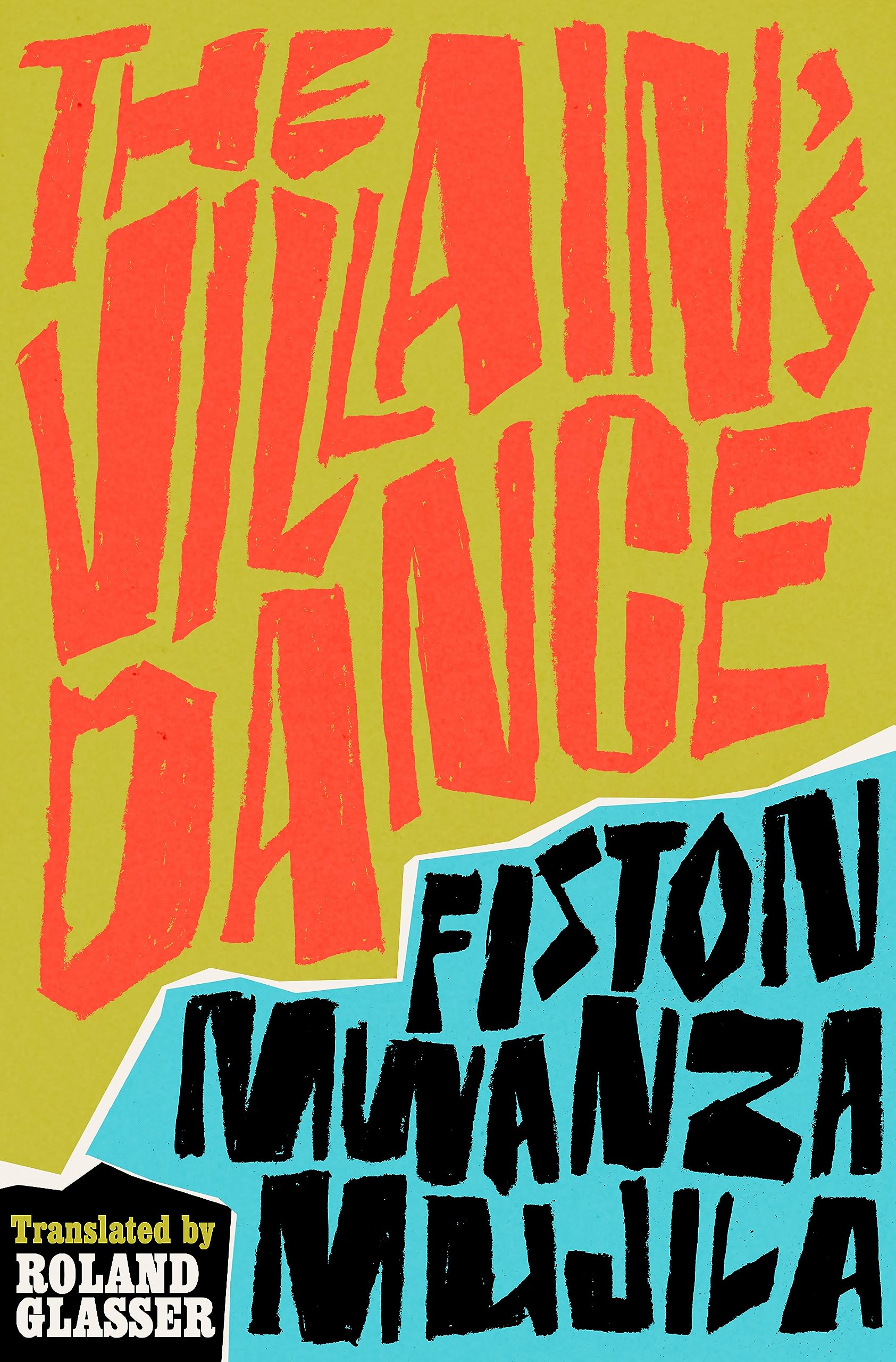
THE VILLAIN'S DANCE, apt title for this cautionary tale of the societal chaos of civil war
THE VILLAIN'S DANCE
FISTON MWANZA MUJILA (tr. Roland Glasser)
Deep Vellum (non-affiliate Amazon link)
$9.99 Kindle edition, available now
Rating: 4.5* of five
The Publisher Says: Following the international success of his debut novel Tram 83, Fiston Mwanza Mujila is back with his highly anticipated second novel, which follows a remarkable series of characters during the Mobutu regime.
The Democratic Republic of Congo, otherwise known as Congo-Kinshasa or DRCongo, has had a series of names since its founding. The name of Zaire best corresponds to the experience of the novel’s characters. The years of Mobutu’s regime were filled with utopias, dreams, fantasies and other uncontrolled desires for social redemption, the quest for easy enrichment and the desecration of places of power.
Among these Zairians’ immigration to Angola during the civil war boycotting the borders inherited from colonization, as if the country did not have its own diamonds, and the occupation of public places by children from outside. The author creates the atmosphere of the time through a roundup of the diviner Tshiamuena, also known as Madonna of the Cafunfo mines, prides herself of being God with whoever is willing to listen to her. Franz Baumgartner, an apprentice writer originally from Austria and rumba lover, goes around the bars in search of material for his novel. Sanza, Le Blanc and other street children share information to the intelligence services when they are not living off begging and robbery. Djibril, taxi driver, only lives for reggae music.
As soon as night falls, each character dances and plays his own role in a country mined by dictatorship.
I RECEIVED A DRC FROM THE PUBLISHER VIA EDELWEISS+. THANK YOU.
My Review: Want to know how much I appreciate Author Fiston Mwanza Mujila's talents?
I didn't pan, belittle, or insult his poetry. All y'all know how I feel about poetry. And I gave it more than three stars! Be amazed, be impressed...I hope you'll be inspired to go get one. Tram 83 worked for me, as well; I know a lot of folks were't fans but it felt like a breeze from Africa to me, hot, wet, heavily freighted. This impression left me for dead in the first instance; I was less enrapt with its story and atmosphere then than I am in retrospect. In part that's down to my subsequent experience of reading The Villain's Dance.
In common with my earlier reads of the author's books, I began this one with an awareness of atmosphere. He is always, or so it feels to me, careful to begin as he means to go on. I'm reasonably sure the huge majority of my readers are unaware of Mobutu's identity, and are more or less uninformed about tthe name "Zaire" and its history...many in my generation will have known the name Zaire vaguely applies to a huge place near the Congo River but be blissfully unaware that the name is no longer used, or why that happened.
I think that gives the novel almost an SFnal appeal. There's little sense of geography encompassing the story in US readers, so why not just go all the way and market it as taking place on a different planet entirely? *I* can do this, I'm a book reviewer, the publisher can't. The level of outrage engendered would be epic. However, let me propose this to you: If you're willing to learn the names of made-up places like Middle Earth, Arrakis, Pern, Atlantis, Downbelow Station, and their different inhabitants, conflicts, social norms, what's the hold up on Zaire and Brazzaville?
Maybe the tiniest taint of racism? Worth some energy to think about.
Assuming you're in the already-overcame-it or the overcoming-it-now group, this story's got great conflicts between dark-grey, pitch-black, and palest shades of violet people trying their best to make it in a world where up and down just switched places...like being on a space station whose spin just changed speeds dramatically.
Maybe my increased appreciation for this read makes more sense than I thought it did at first.
The people in this book aren't just as well-realized as the setting, for the most part; see below. The pace of the story is provided by history, as it's based on the realities then prevailing. The entire enterprise of nation-building collapsing into civil war (by definition a chaotic break in the life of a society) honestly needs little of that tarting up to make it compelling, even riveting, reading. What Author Fiston does very well here is to fragment the locations of the chaos to give different people reason to speak their truth without losing the core purpose of telling us this story. Like Do Androids Dream of Electric Sheep?, we are taken into realms of deep desperation and left there long enough to get it; then we're offered a peek into the purpose of the extraction and the exploitation that requires...we're not left to wallow, the way The Octopus, f/ex, does with us in service of the same sharp criticism of the cutting edge of capitalism. Poe said it very succinctly in the nineteenth century: "{C}orporations, it is very well known, have neither posteriors to be kicked, nor souls to be damned." (Thanks for showing me the accurate quote again, P-E!)
Edges, as noted above, cut; in this story we're in the path of the blade so see both the wielding and cutting inherent in its very existence. People fail. It is inevitable. Challenges go unmet still less mastered. As often as not that is a design feature of the challenge. It engenders judgment and contempt for failure, but leaves the challenge, well, unchallenged. I suspect the true-to-life experience of people showing up for a minute then vanishing will affront a lot of complacently smug story-structure addicts. It's not by accident, y'all; it's a feature not a bug. Like life in an unstable place at a volatile time, different people will come, only to go without fanfare, or even explanation. Most of the characters trying to make it any old how they can haven't got the wherewithal to care, often enough to notice, who is who except at the precise flash of the camera that "now" represents.
I am trying as best I can to explain away the most common issues I've seen raised in others's assessments of the book. I'm not sure it matters. I hope y'all will attend to my 4.5* rating more closely than to my blandishments. A book of this trenchance is not to be dismissed. I'm hopeful that a few will take this moment of US culture shock to see what has happened in other places at this kind of inflection point.
Forewarned is forearmed.
Thursday, March 14, 2024
AND WHAT CAN WE OFFER YOU TONIGHT, multi-award-winning novella and damning takedown of a hypercapitalist hellscape
AND WHAT CAN WE OFFER YOU TONIGHT
PREMEE MOHAMED
Neon Hemlock Press
$12.99 all formats, available now
Rating: 5* of five
The Publisher Says: Winner of the 2022 Nebula Award and World Fantasy Award for Best Novella.
In a far future city, where you can fall to a government cull for a single mistake, And What Can We Offer You Tonight tells the story of Jewel, established courtesan in a luxurious House. Jewel’s world is shaken when her friend is murdered by a client, but somehow comes back to life. To get revenge, they will both have to confront the limits of loyalty, guilt, and justice.
I RECEIVED A DRC FROM THE PUBLISHER VIA NETGALLEY. THANK YOU.
My Review: Self-esteem, self-love, class solidarity, friendship, Love...big, big themes to tackle in under a hundred pages. Yet as one expects from Premee Mohamed, tackled they are, and indeed pinned to the mat of argument.
There are those who say they have no patience for future-set stories, yet who will gobble the stories that center amateur sleuths who are not arrested and abused by police and courts who do not approve of this behavior...inconsistent much? Each is unbelievable in its own way, and this story’s amateur sleuths have some *very* powerful motives for their far higher stakes poking around. I know others whose taste in storytelling excludes tales that begin in medias res. That being a taste that can not be argued with, I warn those folk that this is not one for them.
The authorial voice here, Jewel’s stream of consciouness and self-aware of its floridity, would wear on my nerve if it lasted more than the eightyish pages that it does. In this size of a dose, it counterpoints the horrifying, bleak dystopia that these young people are...existing is a better fit than living...within. The brothel where they work is a reputaable one, yet a client murders one of them and no one in power cares, or pursues justice.
Sound familiar, y’all?
Unlike boring old twenty-first century reality, though, the murdered party returns for revenge, not as a zombie or vampire but simply undead. Go with it. As the co-sex-worker Winfield sets about getting the revenge that I myownself feel is richly deserved, the story meditates on the larger, darker themes of living in a hypercapitalist hellscape. The ending is, as expected, satisfying. The truths Author Mohamed tells us in the course of this bleak vision of a future where money = justice, where might = rights, where even the meagerest of existences is contingent on selling one’s own body for the gratification of others, are readily applicable to the world around us.
That horrifying truth is how this very short, sharp shock to the reader’s system won the very high-powered awards that it did. Very highly recommended.
Friday, September 2, 2022
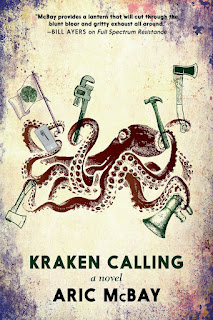
KRAKEN CALLING, best be sure to pick up *now*
KRAKEN CALLING
ARIC McBAY
Seven Stories Press
$22.95 trade paper, available now
Rating: 4* of five
The Publisher Says: A sweeping near future dystopic fantasy in the Octavia Butlerian vein of the Parable of the Sower novels.
Political activist and anarchist author Aric McBay (Full Spectrum Resistance) toggles between the years 2028 and 2051 to give us the experience, with breathtaking realism, of what might happen in the span of just one generation to a society that is already on the brink of collapse.
In 2028 environmental activists hesitate to take the fight to the extreme of violent revolution. Twenty years later, with the natural environment now seriously degraded, the revolution is brought to the activists, rather than the other way around, by an authoritarian government willing to resort to violence, willing to let the majority suffer from hunger and poverty, in order to control its citizens when the government can no longer provide them with a decent quality of life.
So it is the activists who must defend their communities, their neighbors, through a more humane and in some ways more conservative status quo of care and moderation.
And the outcome here is determined by the actions of those who resist more than it is by the actions of the nominally powerful.
I RECEIVED A DRC FROM THE PUBLISHER VIA EDELWEISS+. THANK YOU.
My Review: Non-fiction writer (Peak Oil Survival, Deep Green Resistance) Aric McBay makes his points in fictional form. What he has done is not the usual thing for him, analyzing and contextualizing social and political trends for a left-leaning audience; this has always been his forte as a writer.
I think it still is. This novel makes a very trenchant attempt to put human skin on the bones of social movements for change, favoring equitable and reasonable restructuring of our self-evidently unsustainable lives.
“It’s always hard to tell, isn’t it? How the future could change from the smallest actions,“ Simón mused. “I believe we made things better. We bought time. Breathing room. We stopped one more. We didn’t improve things as dramatically as we hoped. But we made room for a hundred other movements to flower. Some of them failed, but some of them are amazing....”
“The tides always rise and fall for us,”Simón said. “That’s the nature of struggle. There is no guarantee, no permanent victory.”
“The work of the revolutionary is to plow the sea,” Addy quoted.”
It is indeed, Addy. It is indeed. To see your best efforts subsumed under the heaving mass of humanity in its indifference and fearful rejection of change. To know you're not ever going to prevail, no matter how many times you win. But to be sure you're harrowing the surfaces of the waters plowed and allowing things buried to come to the surface? It's a reward beyond price.
Dystopia, then, is inevitable? I don't think it is, though a lot depends on the individual's concept of "dystopia" and their tolerance for ambiguity. Most revolutionaries are absolutists, and should be kept far, far away from the levers of power. We're seeing that in the House of Representatives in the US during 2022. Revolution is hard, and requires people to be very, very hard...and these revolutionaries are obdurate, but brittle.
This means that, like Evelyn in our near-term future (2028), we need to be sure to combat that obduracy effectively. Or the 2051 sections of the story won't be a warning klaxon but a sad prediction.
Friday, September 17, 2021
SAVING PROXIMA, a real rocket scientist tells a first-contact story
SAVING PROXIMA
TRAVIS S. TAYLOR, LES JOHNSON
Baen Books
$25.00 hardcover, available now
Rating: 3* of five
The Publisher Says: A message from space leads to a desperate race against time and across space to our nearest stellar neighbor in a new hard science fiction thriller from Travis S. Taylor and Les Johnson.
THE ANSWER LIES OUT THERE
The year is 2072. At the lunar farside radio observatory, an old-school radio broadcast is detected, similar to those broadcast on Earth in the 1940s, but in an unknown language, coming from an impossible source, and originating at an equally impossible location—Proxima Centauri. While the nations of Earth debate making first contact, they learn that the Proximans are facing an extinction-level disaster, forcing a decision: will Earth send a ship on a multiyear trip to provide aid?
Interstellar travel is not easy, and by traveling at the speeds required to arrive before disaster strikes at Proxima, humans will learn firsthand the effects of Einstein’s Special Relativity and be forced to ponder the ultimate questions: Are we alone in the universe? What does it mean to be human?
I RECEIVED A DRC FROM THE PUBLISHER VIA EDELWEISS+. THANK YOU.
My Review: What you need to know right up front is that the authors are actual rocket scientists. So, even when there's disbelief to be suspended (the planetary science of Proxima b isn't likely to stand up to a planetary scientist's scrutiny), it's made as easy as possible to suspend.
What made me want to read the book in the first place is Author Taylor's Aughties appearances on The Universe and the like. He's got a likable way about him, and clearly understands his subject well. That and a co-author with whom he has a lot of collaborative writing experience led me to expect I'd get a second helping of the character types I'd enjoyed from an earlier collaborative book of theirs (see below). He adds his very definite personality to the stories I've read by this team. I can hear his voice as I'm reading.
As to the story, I found some parts easier to accept than others. I wasn't convinced by the means they explained away our long-term SETI searches missing the Proximans. And now, suddenly, exactly when Earth tech is stretched-but-capable of making the trip, the Proximans make themselves known? Hm. I am allergic to such high doses of handwavium....
Anyway, the story's a good old-fashioned saddle-up-and-ride tale of interstellar derring-do. I liked the science that the middle third of the book handed to us in abundance, so I don't think of it as an imposition or an infodump. For me, it was involving and intriguing. What was permaybehaps not quite so effective was the ending. I don't think it's a huge spoiler to say that the mission to Proxima b is a success...would the title be SAVING Proxima if it failed?...and that there is a reason the Proximans are so very readily able to understand us, to relate in so many ways to Earth people. The notion of panspermia is ripe for exploration in what I confidently predict will happen, ie a sequel. There's no promo for it in this book, but it honestly would be a rotten trick to play on the readers not to give us one and a poor use of the well-loved set-up if the Baen folk don't!
In my never-remotely humble opinion, this read's success depends on you. If you're in the mold of traditional sci-fi readers, those who enjoy the adventure of space travel and the science that underpins it, then this is your book. I am numbered among you, so it was mine, and I enjoyed the heck out of the read.
++++++++++++++++++++++++++++++++++++++++++++++++++++++++++++++++
ON TO THE ASTEROID
TRAVIS S. TAYLOR, LES JOHNSON
Baen Books
$6.99 ebook editions, available now
Rating: 3* of five
The Publisher Says: Realistic thriller crackling with action and danger as an asteroid threatens the Earth, and dedicated astronauts and scientists try to save the planet.
LOOMING DESTRUCTION FROM SPACE!
It's the beginning of a new golden age of space exploration. Finally, humanity is taking the commercialization of space to the next level—mining asteroids. The new gold rush of the commercial space era has begun.
Another commercial venture, an attempt to put a hotel on the Moon, is seeking the space tourism gold of the ultra wealthy. And it seems as if the dream of finally sending people to Mars is finally going to happen using a ship propelled by a powerful nuclear rocket.
But space travel isn’t cut and dry, and there is nothing routine about it. In order to mine an asteroid the goal is to bring it closer to Earth, but orbital mechanics are tricky and close to Earth proves to be far too close for comfort—with looming destruction from space about to become a grim reality. Now astronauts, scientists, engineers, and people in all the burgeoning space businesses must team together to stop the asteroid before it is too late for humanity and the planet it calls home.
I RECEIVED A DRC FROM THE PUBLISHER VIA EDELWEISS+. THANK YOU.
My Review: The authors wrote this book five years ago and here I am reviewing it at last...it was the SpaceX launch of Inspirati④n that brought it back to mind. I can honestly say that the Gold Rush into space has begun with Inspirati④n and its all-civilian crew. And that's the basic premise of this book: A crew of space capitalists are screwing with an asteroid in order to get the riches it contains close enough to Earth to profit from when it all goes sideways. Scientists and engineers and some seriously brave astronauts are going to fix what greed broke (if they can) and, in case you thought that wasn't a big deal, the situation if they fail will be Chicxulub-y. Well, maybe not *that* bad but nasty enough for it to matter a lot that it not happen.
I think my favorite thing about the read was the fact that there's never, and I mean this literally, ever a moment without action. The story is full-throttle adventure and would make a terrific film to supplant Armageddon at last. The authors are, in their day jobs, rocket scientists. They do not bring their B-game science to the table. But, unlike Saving Proxima above, there's not extensive explication in this book. Some science talk, I'd've been disappointed if there wasn't any, but not as much as above. To be expected...the problems to be solved aren't those of serious long-distance relativistic travel.
I'm not politically aligned with the authors, and that is noticeable. I think the Chinese rogue agent is a single mustachio-twirl away from being Dr. Fu Manchu. Since I grew up reading Golden Age sci fi, I'm pretty adept at filtering that into background noise. Luckily for me, it did not form a *huge* part of the narrative. Of course not at all would've been better....
Feminists...women in general, persons of Chinese descent, and my more vocally progressive friends are strongly cautioned. This isn't like Thanksgiving with your MAGA uncle. It's like ice-water tea with his wife. Quieter but still Very Very Sure They're RIGHT. One area where I think we can all agree is that the authors strongly disapprove of cutting corners out of greed. I'm not all the way convinced that Business can solve problems...but the action's great, the story's one I suspect they'll be hailed as prescient for writing, and sometimes one (this one, anyway) needs a solidly crafted action narrative. And here it is.
Monday, July 19, 2021
TWO COLD-WAR SF STORIES, "The Last Crusade" and "Baby"
THE LAST CRUSADE
GEORGE H. SMITH
IF: WORLDS OF SCIENCE FICTION
February 1955 edition, pages 74-85, free Project Gutenberg download at link above
Rating: 4* of five
My friend Joachim Boaz has a review of this title on his site as part of a Terry Carr collection. It's a Cold War dystopian tale of the futile and self-perpetuating nature of that conflict. Clearly George H. Smith, largely forgotten today, was a clear-eyed observer of the idiocies of the 1950s. As the world was moving faster and faster, and the role of technology in it was increasing, Smith's was a reasonable near-future projection of soldiers contained in full-service "mecho-suits." The battleships on legs that they're isolated from the world they're destroying within...our narrator even touches briefly on the fact that he has no idea what any of his fellow soldiers look like, sealed inside their battle- and life-support pods, and has stopped caring...seemed practical, desirable. And true to Smith's sexual fixation, he even tosses (!) in the speculation that "Realie TV" will supply the men (of course) sealed up with, um, services like there were "girls" right there in the pods with them. Southern-born Smith wrote more extensive sexual SF, as well as a reverse-PoV version of Doctor Strangelove about a rogue Russian general who launches an atomic attack on the US.
The military, as personified by our ignorant grunt narrator and a pointed parody General called "Fightin' Joe Mac Williams" (who is clearly the performative battle-boy Douglas MacArthur, he of the famous "I shall return" speech and the chestful of medals) does not get the standard Cold-War adulation. Here that stupidity is beautifully lampooned by the narrator listening to a speech that he knows will cause a lot of death in this Paris, barely even sketched in, that we're told is the scene of the action: "A voice that used to sell us bath soap is selling us war."
The story appeared in 1955, shortly after the Korean War that MacArthur famously wanted to run very differently from then-President Truman, and got himself fired for insubordination as he went public with their differences. It was a case of being kicked upstairs, though, as MacArthur landed a role as leader of defense contractor and computer innovator Remington Rand, whose main business was in typewriter sales at that time. MacArthur, the War Hero as he would never, ever hesitate to remind you, taking such a deeply civilian job as selling typewriters and electric razors, was the source of the dig I quoted above. The dénouement takes place in the Louvre...and it's really nothing less than heart-breaking, if heavy-handed, in delivering its (more suited to the Sixties) message: What are we fighting for, again?
In all, I was very pleased to follow Dr. B down this weird little side-path of SF history, learn more about a writer I feel sure I'd never read a single word by before now, and renew my Cold War memories of people and events now dusty with the uninterest of the modern audience.
+++++++++++++++++++++++++++++++++++++++++++++++++++++++++++++++++
BABY
CAROL EMSHWILLER
The Magazine of Fantasy and Science Fiction
February 1958 edition, free to read on pages 114 to 128 linked above
Rating: 5* of five
My friend Joachim Boaz is reading through the short fiction of Carol Emshwiller...his review of this story is here.
Possibly the bleakest story I've ever read. This is the end of days, the end of Humanity...and it's all our fault. Our creations, those meant to care for us, have long outlived their responsibilities and, while executing irrelevant or now-harmful duties, are making the world impossible for us to live in.
Emshwiller and her compatriots warned us. And, while it doesn't look precisely like she predicted, the events of the present year are seriously in line with the predictions she made sixty-three years ago. I'm never quite sure the world's failing is real; then I read this, the systems slowly collapsing, the zombies of Reassurance and Normality trying to wish away the plague and the increasingly obvious shortages. I'm not crazy after all. (Well, yes I am, but not in the "lost-to-reality" way...more's the pity.)
Baby's young-adult body, not equipped with an education or a language to handle the new world he lives in, is naked and vulnerable to the world, acted on without his consent and/or despite his resistance as the zombie systems try the same solutions for the new problems. They fail utterly to help. The man is starving. The man is going to die.
It's 1958, so he Finds a Woman (called Honey) and Has a Purpose. Let's just put that down to the poison of the era, nothing can exist outside the Binary Amen World Without End, and draw a line under it.
The larger story of Baby is the resources of the planet will only last so long. When we run out of what we think we need, what will we be able to do about it when we have no knowledge to create anything new? And from what resources we have, are we going to allocate them and use them equitably? After all, Baby set out on his voyage of discovery because he was starving and Honey still has food. The Central that Baby invokes (I'd say "prays to" if he'd ever had a concept of Divinity) doesn't run properly anymore or he'd have supplies. The chocolate pie he eats in House 76 at the beginning of the story stands in for Emshwiller's ever-so-American suspicion of a central planner with the authority to do things for you. "And when it fails?" she asks without subtlety.
It's not at all a bad question to ask...Baby and Honey are as infantilized as I fear most people are becoming as the educational fads of today fail to prepare them even to read fluidly. (Read my review of this book.) Of course the automated Library has failed Baby and his Guardians, too...as I'm hugely dependent on my ereader, I recognize with no small trepidation how vulnerable that leaves me to technological disruptions that are, quite frankly, inevitable. I hope to be dead before they bite too hard....
But Emshwiller's main achievement in these dozen pages is really more impressive than simply Cassandra-ing up a future we should all dread. What she did was, as a woman, tell a story in a misogynistic field to readers not predisposed to like the way she presents it...Cold War SF fans...and without making it Sentimental. (Still ignoring Honey.) She did, ironically, marry and have kids shortly after this piece appeared and was silenced for almost an entire decade by the life of a Wife and Mother. She also came back from that silence, see her bibliography. This voice spoke wisdom, and did not stop speaking it. Seek her work out.
Friday, May 28, 2021
NOTHING PERSONAL, an overlooked essay by a master of the form
NOTHING PERSONAL
JAMES BALDWIN
Beacon Press
$10.99 ebook editions, available now
Save 30% on everything at their site (linked above) through December 31 using code HOL30!
Rating: 5* of five
The Publisher Says: James Baldwin's critique of American society at the height of the civil rights movement brings his prescient thoughts on social isolation, race, and police brutality to a new generation of readers.
Available for the first time in a stand-alone edition, Nothing Personal is Baldwin's deep probe into the American condition. Considering the Black Lives Matter protests in the summer of 2020--which were met with tear gas and rubber bullets the same year white supremacists entered the US Capitol with little resistance, openly toting flags of the Confederacy--Baldwin's documentation of his own troubled times cuts to the core of where we find ourselves today.
Baldwin's thoughts move through an interconnected range of questions, from America's fixation on eternal youth, to its refusal to recognize the past, its addiction to consumerism, and the lovelessness that fuels it in its cities and popular culture. He recounts his own encounter with police in a scene disturbingly similar to those we see today documented with ever increasing immediacy. This edition also includes a new foreword from interdisciplinary scholar Imani Perry and an afterword from noted Baldwin scholar Eddie S. Glaude Jr. Both explore and situate the essay within the broader context of Baldwin's work, the Movement for Black Lives, the COVID-19 pandemic, and the presidency of Donald Trump.
Nothing Personal is both a eulogy and a declaration of will. In bringing this work into the twenty-first century, readers new and old will take away fundamental and recurring truths about life in the US. It is both a call to action, and an appeal to love and to life.
I RECEIVED A DRC FROM THE PUBLISHER VIA EDELWEISS+. THANK YOU.
My Review: It is hard for me to believe that this essay was, for a long time, relegated to text around Richard Avedon's amazing photos. The fact that Avedon and Baldwin knew each other, and since high school, hadn't made my radar screens either. This is the first time I've ever seen the essay, and how I wish it wasn't.
Author Baldwin was a man whose vision was clearer than most people's sight.
Possibly the best proof you can have that Baldwin, a skinny gay Black kid, was a man out of time is this:
He already foresaw the gigantic changes in humor that our generation is undergoing; they were underway even then. The Smothers Brothers on their three-season comedy show sparked a revolution in what could and should be grounds for humor. It makes my eyes water to remember how much guff the "comedy" of my parents' generation desensitized them to. They were both alive before the last vestiges of vaudeville were destroyed by radio. Blackface and minstrel songs were things they heard and saw. Racism was in the air, was utterly pervasive...it was the time of Jim Crow laws, it was the time when lynchings were happening with regularity, and a flag was hung out in front of the NAACP Building in New York:
Baldwin, Harlem native that he was, would've seen that flag time and time again, would've associated it with his own Black body, his own maleness.
This is something I understand viscerally. The police do not, as a rule, like faggots; if one is found in any place or at any time being faggoty in pubic, they will harass you and intimidate you to the maximum extent they can get away with; if reported, their defense is "that's a lie" and I promise you your word against their words amounts to less than nothing. This is my lived experience, so arguments are not welcome.
Imani Perry, author of the Foreword to this edition of Nothing Personal, says this of our deeply American inability to believe others' experiences are real:
It is fuctionally impossible to believe, believe in, trust another when you don't believe in your own value to the point that you feel compelled to ask your body to endure surgeries, toxic chemicals, and endless damaging stress in order to feel you're even acceptable to look at.
James Baldwin is a writer of great and unendingly valuable insight and moral authority. He was clear-sighted, his vision of what could be was articulated from a high moral base as a former believer in Christianity, and he never once backed down from his conviction that we could reach the City upon a Hill. He was a realist, however, schooled in the rejections of his gayness and effeminacy and Blackness by even those whose job it was to love him. He didn't believe we would reach that paradisiacal state; he never let go of the unshakeable assurance that we should never, ever cease to strive after it.
Happen I agree. Happy Memorial Day long weekend.
JAMES BALDWIN
Beacon Press
$10.99 ebook editions, available now
Save 30% on everything at their site (linked above) through December 31 using code HOL30!
Rating: 5* of five
The Publisher Says: James Baldwin's critique of American society at the height of the civil rights movement brings his prescient thoughts on social isolation, race, and police brutality to a new generation of readers.
Available for the first time in a stand-alone edition, Nothing Personal is Baldwin's deep probe into the American condition. Considering the Black Lives Matter protests in the summer of 2020--which were met with tear gas and rubber bullets the same year white supremacists entered the US Capitol with little resistance, openly toting flags of the Confederacy--Baldwin's documentation of his own troubled times cuts to the core of where we find ourselves today.
Baldwin's thoughts move through an interconnected range of questions, from America's fixation on eternal youth, to its refusal to recognize the past, its addiction to consumerism, and the lovelessness that fuels it in its cities and popular culture. He recounts his own encounter with police in a scene disturbingly similar to those we see today documented with ever increasing immediacy. This edition also includes a new foreword from interdisciplinary scholar Imani Perry and an afterword from noted Baldwin scholar Eddie S. Glaude Jr. Both explore and situate the essay within the broader context of Baldwin's work, the Movement for Black Lives, the COVID-19 pandemic, and the presidency of Donald Trump.
Nothing Personal is both a eulogy and a declaration of will. In bringing this work into the twenty-first century, readers new and old will take away fundamental and recurring truths about life in the US. It is both a call to action, and an appeal to love and to life.
I RECEIVED A DRC FROM THE PUBLISHER VIA EDELWEISS+. THANK YOU.
My Review: It is hard for me to believe that this essay was, for a long time, relegated to text around Richard Avedon's amazing photos. The fact that Avedon and Baldwin knew each other, and since high school, hadn't made my radar screens either. This is the first time I've ever seen the essay, and how I wish it wasn't.
Generations do not cease to be born, and we are responsible to them because we are the only witnesses they have.
The sea rises, the light fails, lovers cling to each other, and children cling to us. The moment we cease to hold each other, the moment we break faith with one another, the sea engulfs us and the light goes out.
Author Baldwin was a man whose vision was clearer than most people's sight.
Possibly the best proof you can have that Baldwin, a skinny gay Black kid, was a man out of time is this:
We have all heard the bit about what a pity it was that Plymouth Rock didn't land on the Pilgrims instead of the other way around. I have never found this remark very funny. It seems wistful and vindictive to me, containing, furthermore, a very bitter truth. The inertness of that rock meant death for the Indians, enslavement for the {B}lacks, and spiritual disaster for those homeless Europeans who now call themselves Americans...
He already foresaw the gigantic changes in humor that our generation is undergoing; they were underway even then. The Smothers Brothers on their three-season comedy show sparked a revolution in what could and should be grounds for humor. It makes my eyes water to remember how much guff the "comedy" of my parents' generation desensitized them to. They were both alive before the last vestiges of vaudeville were destroyed by radio. Blackface and minstrel songs were things they heard and saw. Racism was in the air, was utterly pervasive...it was the time of Jim Crow laws, it was the time when lynchings were happening with regularity, and a flag was hung out in front of the NAACP Building in New York:
Baldwin, Harlem native that he was, would've seen that flag time and time again, would've associated it with his own Black body, his own maleness.
The violence was being perpetrated mainly against {B}lack men...the strangers; and so it didn't count. But, if a society permits one portion of its citizenry to be menaced or destroyed, no one in that society is safe.
This is something I understand viscerally. The police do not, as a rule, like faggots; if one is found in any place or at any time being faggoty in pubic, they will harass you and intimidate you to the maximum extent they can get away with; if reported, their defense is "that's a lie" and I promise you your word against their words amounts to less than nothing. This is my lived experience, so arguments are not welcome.
Imani Perry, author of the Foreword to this edition of Nothing Personal, says this of our deeply American inability to believe others' experiences are real:
Then, and now: we have acquired an endless habit of the most superficial forms of self-correction, makeup to make up for our perceived inadequacy as it were, nipping, tucking, coloring, all as a displacement for the possibilities of deeper self-reflection and self-creation.
It is fuctionally impossible to believe, believe in, trust another when you don't believe in your own value to the point that you feel compelled to ask your body to endure surgeries, toxic chemicals, and endless damaging stress in order to feel you're even acceptable to look at.
James Baldwin is a writer of great and unendingly valuable insight and moral authority. He was clear-sighted, his vision of what could be was articulated from a high moral base as a former believer in Christianity, and he never once backed down from his conviction that we could reach the City upon a Hill. He was a realist, however, schooled in the rejections of his gayness and effeminacy and Blackness by even those whose job it was to love him. He didn't believe we would reach that paradisiacal state; he never let go of the unshakeable assurance that we should never, ever cease to strive after it.
Happen I agree. Happy Memorial Day long weekend.
Sunday, November 1, 2020
THE CARE MANIFESTO, a short read but an intense and inspiring one
THE CARE MANIFESTO: The Politics of Interdependence
THE CARE COLLECTIVE
Verso Press
$9.99 Kindle edition, available now
Rating: 3.75* of five
The Publisher Says: We are in the midst of a global crisis of care. How do we get out of it?
The Care Manifesto puts care at the heart of the debates of our current crisis: from intimate care—childcare, healthcare, elder care—to care for the natural world. We live in a world where carelessness reigns, but it does not have to be this way.
The Care Manifesto puts forth a vision for a truly caring world. The authors want to reimagine the role of care in our everyday lives, making it the organising principle in every dimension and at every scale of life. We are all dependent on each other, and only by nurturing these interdependencies can we cultivate a world in which each and every one of us can not only live but thrive.
The Care Manifesto demands that we must put care at the heart of the state and the economy. A caring government must promote collective joy, not the satisfaction of individual desire. This means the transformation of how we organise work through co-operatives, localism and nationalisation. It proposes the expansion of our understanding of kinship for a more 'promiscuous care'. It calls for caring places through the reclamation of public space, to make a more convivial city. It sets out an agenda for the environment, most urgent of all, putting care at the centre of our relationship to the natural world.
I RECEIVED A DRC OF THIS TITLE FROM THE PUBLISHER VIA EDELWEISS+. THANK YOU.
My Review: A pamphlet in length, a Bible in heft, and very British in tone, this is a cri de coueur and a call to arms at one and the same time. There is no one thing in the text that is or could be made into an action item, so activists take note. The purpose of this work is to examine the failures of our present end-stage capitalist system of delivering "care" to its consumers. Spoiler alert: it's a shambles, with horrific social and economic costs.
Then, after wasting exactly no words on belaboring (!) their point, the contributors outline theoretical bases for extending the concept of care, starting with feminist thinker Joan Tronto's formulation of types of care. First there is caring for, the step-one state of all care, the delivering care from one person to another. Next comes caring about, the empathetic connection that leads us to extend our hand to others, often strangers to us. And caring with, the hardest stage of care that Tronto identifies...the urge to act, to make one's ideas and suggestions work in the wider world, for example the people who join Greenpeace or Doctors Without Borders.
The contributors use this ingenious and simple system of ideas about caring to offer some blissfully utopian suggestions for enabling "promiscuous care," which sounds a lot racier than it is. I hoped for something louche; I got the idea that a truly well-run planet would be promiscuously cared for, about, and with because the Collective urges on us a paradigm shift into drawing no distinctions between the needy and caring. Animals, ecosystems, all are in need of care; souls and minds and bodies, no matter whose or what's bodies and souls we're talking about, should be able to expect care. Simply for existing.
If that does not make your heart swell and your eyes leak a bit, you're dead inside.
How this should be accomplished and what enforcement regime will be in place, well...no plan this blissfully Right can be that precise. I did not come away from this read equipped with solutions, but I darn sure came away with answers that I want to summon into existence. And that is a great place to start thinking through the "what comes next" part of the Revolution that capitalism's collapse will bring.
THE CARE COLLECTIVE
Verso Press
$9.99 Kindle edition, available now
Rating: 3.75* of five
The Publisher Says: We are in the midst of a global crisis of care. How do we get out of it?
The Care Manifesto puts care at the heart of the debates of our current crisis: from intimate care—childcare, healthcare, elder care—to care for the natural world. We live in a world where carelessness reigns, but it does not have to be this way.
The Care Manifesto puts forth a vision for a truly caring world. The authors want to reimagine the role of care in our everyday lives, making it the organising principle in every dimension and at every scale of life. We are all dependent on each other, and only by nurturing these interdependencies can we cultivate a world in which each and every one of us can not only live but thrive.
The Care Manifesto demands that we must put care at the heart of the state and the economy. A caring government must promote collective joy, not the satisfaction of individual desire. This means the transformation of how we organise work through co-operatives, localism and nationalisation. It proposes the expansion of our understanding of kinship for a more 'promiscuous care'. It calls for caring places through the reclamation of public space, to make a more convivial city. It sets out an agenda for the environment, most urgent of all, putting care at the centre of our relationship to the natural world.
I RECEIVED A DRC OF THIS TITLE FROM THE PUBLISHER VIA EDELWEISS+. THANK YOU.
My Review: A pamphlet in length, a Bible in heft, and very British in tone, this is a cri de coueur and a call to arms at one and the same time. There is no one thing in the text that is or could be made into an action item, so activists take note. The purpose of this work is to examine the failures of our present end-stage capitalist system of delivering "care" to its consumers. Spoiler alert: it's a shambles, with horrific social and economic costs.
Then, after wasting exactly no words on belaboring (!) their point, the contributors outline theoretical bases for extending the concept of care, starting with feminist thinker Joan Tronto's formulation of types of care. First there is caring for, the step-one state of all care, the delivering care from one person to another. Next comes caring about, the empathetic connection that leads us to extend our hand to others, often strangers to us. And caring with, the hardest stage of care that Tronto identifies...the urge to act, to make one's ideas and suggestions work in the wider world, for example the people who join Greenpeace or Doctors Without Borders.
The contributors use this ingenious and simple system of ideas about caring to offer some blissfully utopian suggestions for enabling "promiscuous care," which sounds a lot racier than it is. I hoped for something louche; I got the idea that a truly well-run planet would be promiscuously cared for, about, and with because the Collective urges on us a paradigm shift into drawing no distinctions between the needy and caring. Animals, ecosystems, all are in need of care; souls and minds and bodies, no matter whose or what's bodies and souls we're talking about, should be able to expect care. Simply for existing.
If that does not make your heart swell and your eyes leak a bit, you're dead inside.
How this should be accomplished and what enforcement regime will be in place, well...no plan this blissfully Right can be that precise. I did not come away from this read equipped with solutions, but I darn sure came away with answers that I want to summon into existence. And that is a great place to start thinking through the "what comes next" part of the Revolution that capitalism's collapse will bring.
Tuesday, October 27, 2020
THE CORONA CRASH, a leftist's view of the unfolding economic collapse
THE CORONA CRASH: How the Pandemic Will Change Capitalism
GRACE BLAKELY
Verso Books
$9.99 Kindle edition, now available and on sale! See Verso's website for details.
Rating: 4* of five
The Publisher Says: In The Corona Crash, leading economic commentator Grace Blakeley anatomises the long term causes for the financial fragility and offers a series of radical means to not only restore but revolutionise the world's economy.
We have never experienced such an economic moment such as this one. The coronavirus pandemic heralded one of the most catastrophic financial crashes in history. In March, stock markets collapsed. In April unemployment figures skyrocketed and the price of oil went negative. Meanwhile the human cost is recorded in an ever spiraling death toll as the world, it seems, is in lock down. The pandemic has caused the deepest global recession since the Second World War. Meanwhile the US human cost is reflected in our still-rising death toll, as many states find themselves unable—and some unwilling—to grapple with the effects of the virus. Whatever happens, we can never go back to business as usual.
This moment demands a radical programme similar to the Green New Deal that demands social justice, equality and an economy with the future of the planet at the fore. This crisis will tip us into a new era of monopoly capitalism, argues Blakeley, as the corporate economy collapses into the arms of the state, and the tech giants grow to unprecedented proportions.
We need a radical response. The recovery could see the transformation of our political, economic, and social systems based on the principles of the Green New Deal. If not, the alternatives, as Blakeley warns, may be even worse than we feared.
I RECEIVED A DRC OF THIS BOOK FROM VERSO BOOKS VIA EDELWEISS+. THANK YOU.
My Review: The UnHoly Trinity of metastatic capitalism: financialization, monopoly, stagnation. We're seeing the results of around forty-five years of neoliberal nightmare-fodder economic and social policy: A US state, a UK state both hobbled by incompetent and apparently actively evil governments whose vision of how to control the pandemic is to punish the people who live in their states.
I reviewed Thomas Piketty's Why Save the Bankers? collection of columns not long ago; that was the crisis before this one, in 2008, if COVID-19 Fog has reduced your mental time horizons to "was it ever not like this?" Here we have a quite short book—it might take you a morning and an evening commute to finish—that updates the same message as Piketty brought to us then: Change is possible, and desirable, even vital, but we must seize the moment and bring all our power-of-numbers to bear on the problem of forcing change.
Before that, we must do the thinking of "what kind of change do we want to see?" Because in the absence of a rational, harmonious vision for the changes we want to see come to the world, the capitalists will sow dissension and scream about irrelevancies like tradition, continuity, the sacredness of institutions...which they've been subverting for decades, largely and ineffectively when done unopposed. The tech giants whose dominance in the financialized capitalism of the 21st century achieved such glittering heights of social and societal control have done so largely frictionlessly.
As of this month, there has been one are of friction that actually points up the prior ease of these monopolies' formation: The Section 230 hearings on how to force tech giants to accept responsibility for their part in spreading disinformation—which goal the giants themselves *want* the laws to spell out, the original was written 25 years ago!—degenerated into a right-wing bash-fest calling for, effectively, the internet to be limited to their own mouthpieces. This is the naked, ugly ass that the capitalists are showing the world, and this is a clear sign that this election cycle in the US truly is an existential choice between more of what we had versus less of everything we've earned. (The UK is, as Author Grace Blakeley makes clear, in a slightly different place. The social safety net there is under attack too, but it has much farther to fall.)
While I'm no fan of any tech giant, and I am sure that these companies possess monopoly powers that urgently need curbing, what the hearings in the Senate demonstrated was that the right-wing party here wants the monopoly powers to remain in place and thus be usable by them to make their propaganda the only accessible viewpoint. That would mean that their worldview would, for many unsophisticated consumers, become to all intents and purposes, Reality.
If you ever needed a proof that the monopolistic inevitability of capitalism is extremely bad for you and me, that should be it.
But there is another piece of this disaster that we're not talking near enough about (pace AOC): The austerity screams of days gone by were made in bad faith, for the purpose of greater control by capital of the levers of government, and the proof is in the present-day response of the US and UK governments to the COVID Crash. They created literal trillions (that's 2,200,000,000,000 dollars in US relief spending...look at all those zeroes!) in spending power to rescue banks and prevent huge corporations from having to use their massive piles of cash to pay their bills. As a result, the stock markets have gone haywire, up hugely, down enormously, lather rinse repeat. The signal is unclear yet unambiguous: We'll do whatever it takes to stay in power, but we can't be arsed to feed the people who need to eat and buy in order to fuel the economy...that way is a long-term downturn and a disaster for the corporate entities who rely on consumption to survive. Author Blakeley trots out the eye-popping statistic that 65% of the UK GDP is consumer-spending led. And the US can't be far behind. Ignoring the support needs of the consumers is stupid, but offers a giant opening for the Left to make real, systemic change.
The capitalists have created the state-monopoly-capitalist central planning system they've been demonizing for generations. There is no denying it now. Those trillions of spendable credits materialized...and they did so in certain hands...and so, gentlemen, your shibboleth is revealed as the straw man it always was, your cries of "socialism is evil" were merely covers for the fact that you were building a small, exclusive socialist state at the top income level.
Which also reveals the core idiocy and ignorance that the neoliberal idea of socialism always was. The central planning part clearly wasn't the awful monster to be fought, since two successive crises have brought the capitalists' eagerness to centralize planning power. It was always about the idea of democratic control of planning, of returning the control of the economy to a consortium of government, labor, and capital...of including again the people in the decisions that affect them most of all.
The Green New Deal gets a lot of play in this book. What that means is never spelled out in there, and the fact is that's a sign of how quickly this book was put together. Representative democracy that includes representatives of the laboring classes has largely been dismantled by the neoliberal austerity hawks. The few remaining vestiges of that era of workers' unions with actual power are increasingly, in this crisis, seeing their agenda picked back up: extensive polling in the US and UK (eg, YouGov) that a solid plurality of the people want a Green New Deal. Now what will happen post 3 November 2020? The Biden campaign has a consistency issue, but is broadly aware that the time to act is now. A Left-led charge, using the Covid Crash as a combination crowbar and bludgeon, stands some chance of making substantial progress. If 45 is re-elected, there's no point in worrying about it because the Apocalypse is assured.
It's true that this book's origins in the UK and in haste explain a lot of troubles I've had with reading it...examples from UK economic and political realities don't make instant sense to me here in the US...but there is a larger dissatisfaction that led to my knocking a whole star off the review. An example of it is: "Climate breakdown is accelerating at rates that would render many parts of the planet uninhabitable in just a few short years." The Uninhabitable Earth: Life After Warming is the entire source cited in footnotes. This is plain old sloppy. Your sweeping statement is backed up by a non-specific reference to a secondary source? Well then! I'll just fall in behind you because I agree with what you're saying, shall I?
That's not something I pass over lightly. This is meant to be a book I can press on people whose concerns are growing, to show them that they are correct to trust the Left has the ideas and plans to meet and address those concerns. This isn't the effect of such slapdashery as exemplified above, and that is not the only instance of such in the work. But, all in all, I do agree with what Author Blakeley and Verso Books are presenting to us; I do think the Left, in the US people such as AOC and Senator Elizabeth Warren, possess the ideas and plans that can lead us out of the plague crises, and the climate crisis. I urge all of you to invest the under two hours it takes to read this trenchant and tendentious book.
GRACE BLAKELY
Verso Books
$9.99 Kindle edition, now available and on sale! See Verso's website for details.
Rating: 4* of five
The Publisher Says: In The Corona Crash, leading economic commentator Grace Blakeley anatomises the long term causes for the financial fragility and offers a series of radical means to not only restore but revolutionise the world's economy.
We have never experienced such an economic moment such as this one. The coronavirus pandemic heralded one of the most catastrophic financial crashes in history. In March, stock markets collapsed. In April unemployment figures skyrocketed and the price of oil went negative. Meanwhile the human cost is recorded in an ever spiraling death toll as the world, it seems, is in lock down. The pandemic has caused the deepest global recession since the Second World War. Meanwhile the US human cost is reflected in our still-rising death toll, as many states find themselves unable—and some unwilling—to grapple with the effects of the virus. Whatever happens, we can never go back to business as usual.
This moment demands a radical programme similar to the Green New Deal that demands social justice, equality and an economy with the future of the planet at the fore. This crisis will tip us into a new era of monopoly capitalism, argues Blakeley, as the corporate economy collapses into the arms of the state, and the tech giants grow to unprecedented proportions.
We need a radical response. The recovery could see the transformation of our political, economic, and social systems based on the principles of the Green New Deal. If not, the alternatives, as Blakeley warns, may be even worse than we feared.
I RECEIVED A DRC OF THIS BOOK FROM VERSO BOOKS VIA EDELWEISS+. THANK YOU.
My Review: The UnHoly Trinity of metastatic capitalism: financialization, monopoly, stagnation. We're seeing the results of around forty-five years of neoliberal nightmare-fodder economic and social policy: A US state, a UK state both hobbled by incompetent and apparently actively evil governments whose vision of how to control the pandemic is to punish the people who live in their states.
I reviewed Thomas Piketty's Why Save the Bankers? collection of columns not long ago; that was the crisis before this one, in 2008, if COVID-19 Fog has reduced your mental time horizons to "was it ever not like this?" Here we have a quite short book—it might take you a morning and an evening commute to finish—that updates the same message as Piketty brought to us then: Change is possible, and desirable, even vital, but we must seize the moment and bring all our power-of-numbers to bear on the problem of forcing change.
Before that, we must do the thinking of "what kind of change do we want to see?" Because in the absence of a rational, harmonious vision for the changes we want to see come to the world, the capitalists will sow dissension and scream about irrelevancies like tradition, continuity, the sacredness of institutions...which they've been subverting for decades, largely and ineffectively when done unopposed. The tech giants whose dominance in the financialized capitalism of the 21st century achieved such glittering heights of social and societal control have done so largely frictionlessly.
As of this month, there has been one are of friction that actually points up the prior ease of these monopolies' formation: The Section 230 hearings on how to force tech giants to accept responsibility for their part in spreading disinformation—which goal the giants themselves *want* the laws to spell out, the original was written 25 years ago!—degenerated into a right-wing bash-fest calling for, effectively, the internet to be limited to their own mouthpieces. This is the naked, ugly ass that the capitalists are showing the world, and this is a clear sign that this election cycle in the US truly is an existential choice between more of what we had versus less of everything we've earned. (The UK is, as Author Grace Blakeley makes clear, in a slightly different place. The social safety net there is under attack too, but it has much farther to fall.)
While I'm no fan of any tech giant, and I am sure that these companies possess monopoly powers that urgently need curbing, what the hearings in the Senate demonstrated was that the right-wing party here wants the monopoly powers to remain in place and thus be usable by them to make their propaganda the only accessible viewpoint. That would mean that their worldview would, for many unsophisticated consumers, become to all intents and purposes, Reality.
If you ever needed a proof that the monopolistic inevitability of capitalism is extremely bad for you and me, that should be it.
But there is another piece of this disaster that we're not talking near enough about (pace AOC): The austerity screams of days gone by were made in bad faith, for the purpose of greater control by capital of the levers of government, and the proof is in the present-day response of the US and UK governments to the COVID Crash. They created literal trillions (that's 2,200,000,000,000 dollars in US relief spending...look at all those zeroes!) in spending power to rescue banks and prevent huge corporations from having to use their massive piles of cash to pay their bills. As a result, the stock markets have gone haywire, up hugely, down enormously, lather rinse repeat. The signal is unclear yet unambiguous: We'll do whatever it takes to stay in power, but we can't be arsed to feed the people who need to eat and buy in order to fuel the economy...that way is a long-term downturn and a disaster for the corporate entities who rely on consumption to survive. Author Blakeley trots out the eye-popping statistic that 65% of the UK GDP is consumer-spending led. And the US can't be far behind. Ignoring the support needs of the consumers is stupid, but offers a giant opening for the Left to make real, systemic change.
The capitalists have created the state-monopoly-capitalist central planning system they've been demonizing for generations. There is no denying it now. Those trillions of spendable credits materialized...and they did so in certain hands...and so, gentlemen, your shibboleth is revealed as the straw man it always was, your cries of "socialism is evil" were merely covers for the fact that you were building a small, exclusive socialist state at the top income level.
Which also reveals the core idiocy and ignorance that the neoliberal idea of socialism always was. The central planning part clearly wasn't the awful monster to be fought, since two successive crises have brought the capitalists' eagerness to centralize planning power. It was always about the idea of democratic control of planning, of returning the control of the economy to a consortium of government, labor, and capital...of including again the people in the decisions that affect them most of all.
The Green New Deal gets a lot of play in this book. What that means is never spelled out in there, and the fact is that's a sign of how quickly this book was put together. Representative democracy that includes representatives of the laboring classes has largely been dismantled by the neoliberal austerity hawks. The few remaining vestiges of that era of workers' unions with actual power are increasingly, in this crisis, seeing their agenda picked back up: extensive polling in the US and UK (eg, YouGov) that a solid plurality of the people want a Green New Deal. Now what will happen post 3 November 2020? The Biden campaign has a consistency issue, but is broadly aware that the time to act is now. A Left-led charge, using the Covid Crash as a combination crowbar and bludgeon, stands some chance of making substantial progress. If 45 is re-elected, there's no point in worrying about it because the Apocalypse is assured.
It's true that this book's origins in the UK and in haste explain a lot of troubles I've had with reading it...examples from UK economic and political realities don't make instant sense to me here in the US...but there is a larger dissatisfaction that led to my knocking a whole star off the review. An example of it is: "Climate breakdown is accelerating at rates that would render many parts of the planet uninhabitable in just a few short years." The Uninhabitable Earth: Life After Warming is the entire source cited in footnotes. This is plain old sloppy. Your sweeping statement is backed up by a non-specific reference to a secondary source? Well then! I'll just fall in behind you because I agree with what you're saying, shall I?
That's not something I pass over lightly. This is meant to be a book I can press on people whose concerns are growing, to show them that they are correct to trust the Left has the ideas and plans to meet and address those concerns. This isn't the effect of such slapdashery as exemplified above, and that is not the only instance of such in the work. But, all in all, I do agree with what Author Blakeley and Verso Books are presenting to us; I do think the Left, in the US people such as AOC and Senator Elizabeth Warren, possess the ideas and plans that can lead us out of the plague crises, and the climate crisis. I urge all of you to invest the under two hours it takes to read this trenchant and tendentious book.
Saturday, November 23, 2013
RED TO BLACK, A not very thrilling thriller that'll scare you witless
RED TO BLACK
ALEX DRYDEN (Anna Rensikov #1)
HarperCollins (non-affiliate Amazon link)
$8.49 Kindle edition, available now
Rating: 3.5* of five
The Publisher Says: Finn is a veteran MI6 operative stationed in Moscow. In the guise of an amiable trade secretary, he has penetrated deep into the dangerous labyrinth that is Russia under Vladimir Putin to discover some of its darkest secrets, thanks to a high-level source deep within the Kremlin.
The youngest female colonel in the KGB, Anna is the ambitious daughter of one of the former Soviet Union's elite espionage families. Charged with helping to make Russia strong again under Putin, she is ordered to spy on Finn and discover the identity of his mole.
At the dawn of the new millennium, these adversaries find themselves brought together by an unexpected love that becomes the only truth they can trust. When Finn uncovers a shocking and ingenious plan—hatched in the depths of the Cold War—to control the European continent and shift the balance of world power, he and Anna are thrust into a deadly plot in which friend and foe wear the same face. With time running out, they will race across Europe and risk everything -—career, reputation, and even their own lives— to expose the terrifying truth.
My Review: I enjoyed this read more than I expected to, and less than I should have. It's a very, very scary and plausible tale of a plot to use the West's greed to bring it down. After all, Marx wrote, “The last capitalist we hang shall be the one who sold us the rope.” He was a prescient thinker, was Marx.
I'm not going to go into the bits of the story because the spoilers would be epic. And also, the story told is either instantly obvious...the New Russia is a viciously capitalist and socially Darwinian funhouse mirror of the West's nastiest, least admirable qualities, and will therefore succeed in out-competing the West...or completely incredible, as to a triumphalist Teabagger idiot.
I'm on the instantly obvious side, obviously, and that's why I enjoyed the book more than I expected to. Russia's manifold social problems are all traceable to its insanely lopsided wealth distribution. That should ring an entire cathedral's worth of bells for anyone in the USA. If it doesn't, then the Teabagger idiot triumphalism is likely to obscure the evidence of a calculated takedown of Western economies.
Anyway. What didn't work well for me was the narrative structure of the book, with its reported-not-experienced quality, and the fact that the main characters were sketched more than drawn. I need to feel some sense of connection, positive or negative, to the people who are taking me on the journey that is a book. Here, in Anna and Finn, I felt I was being told a bit about the people in a not-very-close friend's long, detailed story. That was, I think, a result of the all-flashback narrative structure. The past can enhance the present in a story, there is no doubt, but the past doesn't enhance the past with anything like as much intensity. It simply becomes more flashback.
Overall, in the scheme of things, is this a thriller I'd recommend to a fellow subway rider? Maybe not, since it's so slow-paced. But for me, and those like me who lean to the political left, it's got a lot of confirmation-bias appeal. The fact that the author makes a very strong point of thanking Russian sources who need to remain anonymous is telling. And unsurprising.
And very, very disheartening.
This work is licensed under a Creative Commons Attribution-NonCommercial-ShareAlike 3.0 Unported License.
Subscribe to:
Posts (Atom)