Pages
- Home
- Mystery Series
- Bizarro, Fantasy & SF
- QUILTBAG...all genres
- Kindle Originals...all genres
- Politics & Social Issues
- Thrillers & True Crime
- Young Adult Books
- Poetry, Classics, Essays, Non-Fiction
- Science, Dinosaurs & Environmental Issues
- Literary Fiction & Short Story Collections
- Sookie Stackhouse/Southern Vampire Books & True Blood
- Books About Books, Authors & Biblioholism
Showing posts with label Kindle edition. Show all posts
Saturday, June 19, 2021
TWO XENA: WARRIOR PRINCESS GRAPHIC NOVELS
XENA: WARRIOR PRINCESS, Volume 1: All Roads
GENEVIEVE VALENTINE (Author); Ariel Medel, Jenny Frison (artists)
Dynamite (non-affiliate Amazon link)
$15.99 Kindle edition, available now
Rating: 4.9* of five
The Publisher Says: To the thrill of rabid fans the world over, television's Xena: Warrior Princess is back for swashbuckling new adventures!
After the Twilight of the Gods, the world is precariously uncertain, and Xena and Gabrielle have been missing for twenty-five years. The power of Rome is growing; Caesar is determined to conquer by lies what he can't conquer by force, and the people at its edges know what's coming.
Our heroines return to stop him before they have to wage war against a man they once called a friend... but along the way, Xena will have to confront her past against a rogue band of women warriors, and Gabrielle, whose secret visions are becoming prophecy, will have to protect her partner at any cost.
I RECEIVED A DRC FROM THE PUBLISHER VIA EDELWEISS+. THANK YOU.
My Review: I'm not a native comic-book reader. It wasn't A Thing, I just wasn't offered them by anyone I knew until (apparently) too late in my development of story-acquiring techniques. In my ongoing quest to remain mentally flexible, though, I determinedly seek out graphic novels to challenge my preconceived notion that they're somehow lesser-than and unequal to text story presentations.
Xena, OTOH, has never once since she showed up in The Adventures of Iolaus and that other jackanapes I don't like, failed to amuse, entertain, delight, or just generally please me. So what could be better than a freebie look at a Xena story? No risk, decent possibility of reward.
Rewarded. I can't reproduce the artwork from this lovely story, sorry, but good gawd is it lush and smooth and expertly emotion-tweaking. It's clearly meant for adults, and by adults I mean mental ones if not necessarily chronological ones.
Everything about the artwork as relates to the story made all my hairs stand up. I kept going back a few pages to see where *this* little detail turned into that pretty focus. I love that paintings of Hieronymus Bosch for this same effect on my attention, though I'm no way no how comparing the capable artists here to The Great Master Bosch. Don't, fellow comic-book snobs, make the mistake of thinking you're in for a lesser storytelling experience. Different, yes; lesser, no.
+++++++++++++++++++++++++++++++++++++++++++++++++++++++++++++++++
XENA: WARRIOR PRINCESS, Road Warrior
VITA AYALA (Author), OLYMPIA SWEETMAN (artist)
Dynamite (non-affiliate Amazon link)
$15.99 Kindle edition, available now
Rating: 4* of five
The Publisher Says: In a time of ancient gods, warlords and kings...a land in turmoil called out for a hero! She was XENA, a mighty princess forged in the heat of battle! In this all-new series, writer VITA AYALA (Black Panther, Shuri, Wonder Woman, The Wilds) and artist OLYMPIA SWEETMAN throw Xena and her companion Gabrielle headfirst into a mysterious adventure. Can Xena discover the secrets of a village full of super-strong children, before jealous and petty GODS get involved?
I RECEIVED A DRC FROM THE PUBLISHER VIA EDELWEISS+. THANK YOU.
My Review: The very best thing about this storyline is that Xena and Gabrielle are very, very firmly A Couple. There is not hinting, or hairpin dropping, or waffling: The ladies are together and they are not making any bones about it. As it goddamned well always should have been.
There is a risk in doing something unfamiliar and not entirely to one's taste twice in a row. That is what happened here. It's not just the artists weren't quite as aesthetically to my personal taste as the ones above...it was that the illustrations were uneven in quality.
I'm still very, very impressed that the storytelling is so well mated to the ideas and images. I'm just not quite as blown away. Still, I remain open to the pleasures this visual storytelling medium has to offer a very textual person. That's quite a thing for an artform to be able to do.
Friday, November 6, 2020
MISS LONELYHEARTS, a biting and supremely outraged novella of alienation and the Problem of Evil
MISS LONELYHEARTS
NATHANAEL WEST
Books on Demand (non-affiliate Amazon link)
99¢ Kindle edition, available now
Rating: 4.75* of five
The Publisher Says: Praised by great writers from Flannery O'Conner to Jonathan Lethem, Miss Lonelyhearts is an American classic. A newspaper reporter assigned to write the agony column in the depths of the Great Depression seeks respite from the poor souls who send in their sad letters, only to be further tormented by his viciously cynical editor, Shrike.
This single volume of Miss Lonelyhearts features its original Alvin Lustig jacket design, as well as a new introduction by Harold Bloom, who calls it "my favorite work of modern American fiction."
My Review: Totally with Harold Bloom here, this is one of the USA's cultural treasures. In just under 100pp, anomie and alienation and the Problem of Evil (solved, allegedly anyway, by theodicy, resolving the evidential problem of evil that is the essence of the story West tells here) are examined thoroughly and from several viewpoints. While telling a louche little tale of drinking, fucking, and cheating, West also manages to incorporate an acid bath of gallows humor into the proceedings:
But now let us consider the holes in our own bodies and into what these congenital wounds open. Under the skin of man is a wondrous jungle where veins like lush tropical growths hang along over-ripe organs and weed-like entrails writhe in squirming tangles of red and yellow. In this jungle, flitting from rock-gray lungs to golden intestines, from liver to lights and back to liver again, lives a bird called the soul.
His nudges and winks at the audience are almost post-modern: Shrike, who is the otherwise-unnamed Miss Lonelyhearts' editor, is named for a particularly nasty bird of prey, and the man we call "Miss Lonelyhearts" is both emasculated and depersonalized by his yclepture.
He knew now what this thing was — hysteria, a snake whose scales are tiny mirrors in which the dead world takes on a semblance of life. And how dead the world is . . . a world of doorknobs. He wondered if hysteria were really too steep a price to pay for bringing it to life.
It's hard to imagine a more complete telling of the tale of man's bitter fate than this one. Trudge along in your path, you dumb oxen, and this is what will overtake you; lift your heads, look at the sky, and dare to yearn?
Love a man even in his sin, for that is the semblance of Divine Love and is the highest love on eath. Love all God's creation, the whole and every grain of sand in it. Love the animals, love the plants, love everything. If you love everything, you will percieve the divine mystery in things. Once you percieve it, you will begin to comprehend it better every day. And you will come at last to love the whole world with an all-embracing love.
This is what will overtake you. West knew it, felt it, and ultimately lived it by dying early as he drove drunk.
Fitting, isn't it.
Saturday, October 31, 2020
THE SHORTEST DAY, a quick hit of Irish magical realism from Colm Tóibín
THE SHORTEST DAY
COLM TÓIBÍN
Amazon Original Stories
$1.99 Kindle edition, available now
Rating: 4.75* of five
The Publisher Says: In Ireland, a man of reason is drawn to a true mystery older than the Pyramids and Stonehenge in this enthralling story about ethereal secrets by New York Times bestselling author Colm Tóibín.
During the winter solstice, on the shortest day and longest night of the year, the ancient burial chamber at Newgrange is empowered. Its mystifying source is a haunting tale told by locals.
Professor O’Kelly believes an archaeologist’s job is to make known only what can be proved. He is undeterred by ghost stories, idle speculation, and caution. Much to the chagrin of the living souls in County Meath. As well as those entombed in the sacred darkness of Newgrange itself. They’re determined to protect the secret of the light, guarded for more than five thousand years. And they know O’Kelly is coming for it.
I RECEIVED A DRC OF THIS STORY FROM THE PUBLISHER VIA NETGALLEY. THANK YOU.
My Review: I can't imagine too many people I know need to be told what and where Newgrange is.
this image via newgrange.com
It is a stunning and majestic sight, though the location you see has been reconstructed...a fact whose advisability is, to put it mildly, debated in the archaeological community. No matter; here it is, here it stays, and good goddesses isn't it *spectacular*?!
The story Author Tóibín tells us is a simple one: a man of resolutely practical materialistic worldview is contemplating his imminent visit to Newgrange. It is almost Christmas, and in his deeply rooted preciseness of action, he has arranged to be gone *just* until Christmas Eve morning so as to, as always, spend his holidays with wife and children.
The Yule Solstice, a time of great power in Neolithic societies (if the number of archaeological sites with demonstrable connections to the Sun's position on that date is any evidence), has come to his attention as an important time at Newgrange as well. He feels duty bound, as the first archaeologist to possess this information, to investigate despite his unshakeable materialism:
So two things are immediately apparent from this. First is that this is a story set in the past, as the site in its present state dates from after 1982 (see link beside the photo). Second is that there are those who know more than they have told about the site in the many years of Ireland's fussing about with it. That's very interesting....
As the tale is a short one, I don't want to give too much away. I am sure that the author's fans will, or already have, preordered the story. I know they won't want to know everything...but the story's best qualities are those that Author Tóibín uses in all his works, that remarkable ability to bring you with him as he astrally projects himeself (or whatever sorcery he actually does) into the worlds and eyes and minds of people perfectly real.
His gift is deployed on several strands. It makes me feel completely and happily immersed in the world he's created for them to enact this delightful confluence of streams of thought. It is a damn near perfect read for this wonderfully numinous time of year. Why, even Professor O'Kelly experiences an unaccustomed immanence while he is at Newgrange on the morning of the Solstice:
Even if it's just a hair too ungenerous with the Professor's character-building (that missing quarter-star explained), it is a delight and a worthy enhancement of your avoidance of the stressful events awaiting us on the third.
COLM TÓIBÍN
Amazon Original Stories
$1.99 Kindle edition, available now
Rating: 4.75* of five
The Publisher Says: In Ireland, a man of reason is drawn to a true mystery older than the Pyramids and Stonehenge in this enthralling story about ethereal secrets by New York Times bestselling author Colm Tóibín.
During the winter solstice, on the shortest day and longest night of the year, the ancient burial chamber at Newgrange is empowered. Its mystifying source is a haunting tale told by locals.
Professor O’Kelly believes an archaeologist’s job is to make known only what can be proved. He is undeterred by ghost stories, idle speculation, and caution. Much to the chagrin of the living souls in County Meath. As well as those entombed in the sacred darkness of Newgrange itself. They’re determined to protect the secret of the light, guarded for more than five thousand years. And they know O’Kelly is coming for it.
I RECEIVED A DRC OF THIS STORY FROM THE PUBLISHER VIA NETGALLEY. THANK YOU.
My Review: I can't imagine too many people I know need to be told what and where Newgrange is.
this image via newgrange.com
It is a stunning and majestic sight, though the location you see has been reconstructed...a fact whose advisability is, to put it mildly, debated in the archaeological community. No matter; here it is, here it stays, and good goddesses isn't it *spectacular*?!
The story Author Tóibín tells us is a simple one: a man of resolutely practical materialistic worldview is contemplating his imminent visit to Newgrange. It is almost Christmas, and in his deeply rooted preciseness of action, he has arranged to be gone *just* until Christmas Eve morning so as to, as always, spend his holidays with wife and children.
The Yule Solstice, a time of great power in Neolithic societies (if the number of archaeological sites with demonstrable connections to the Sun's position on that date is any evidence), has come to his attention as an important time at Newgrange as well. He feels duty bound, as the first archaeologist to possess this information, to investigate despite his unshakeable materialism:
The job of an archaeologist was to make known only what can be proved. The rest was idle speculation.
So two things are immediately apparent from this. First is that this is a story set in the past, as the site in its present state dates from after 1982 (see link beside the photo). Second is that there are those who know more than they have told about the site in the many years of Ireland's fussing about with it. That's very interesting....
As the tale is a short one, I don't want to give too much away. I am sure that the author's fans will, or already have, preordered the story. I know they won't want to know everything...but the story's best qualities are those that Author Tóibín uses in all his works, that remarkable ability to bring you with him as he astrally projects himeself (or whatever sorcery he actually does) into the worlds and eyes and minds of people perfectly real.
His gift is deployed on several strands. It makes me feel completely and happily immersed in the world he's created for them to enact this delightful confluence of streams of thought. It is a damn near perfect read for this wonderfully numinous time of year. Why, even Professor O'Kelly experiences an unaccustomed immanence while he is at Newgrange on the morning of the Solstice:
The professor was almost tempted to note that these people, if studied in the light of these designs on stone, knew something about what was palpable and also what was tangible: they knew about spirit, and they knew about line.
–and–
They must have loved the sun, or trusted it. They lured it down this corridor as though they were pulling it into the chamber by rope.
Even if it's just a hair too ungenerous with the Professor's character-building (that missing quarter-star explained), it is a delight and a worthy enhancement of your avoidance of the stressful events awaiting us on the third.
Thursday, October 29, 2020
THE UNINVITED GUESTS, an almost-good ghost story lushly described
THE UNINVITED GUESTS
SADIE JONES
HarperCollins
$6.99 Kindle edition, available now
KINDLE EDITION IS $1.99 UNTIL 7 FEBRUARY 2022
Rating: 3* of five
The Publisher Says: One late spring evening in 1912, in the kitchens at Sterne, preparations begin for an elegant supper party in honor of Emerald Torrington's twentieth birthday. But only a few miles away, a dreadful accident propels a crowd of mysterious and not altogether savory survivors to seek shelter at the ramshackle manor—and the household is thrown into confusion and mischief.
The cook toils over mock turtle soup and a chocolate cake covered with green sugar roses, which the hungry band of visitors is not invited to taste. But nothing, it seems, will go according to plan. As the passengers wearily search for rest, the house undergoes a strange transformation. One of their number (who is most definitely not a gentleman) makes it his business to join the birthday revels.
Evening turns to stormy night, and a most unpleasant parlor game threatens to blow respectability to smithereens: Smudge Torrington, the wayward youngest daughter of the house, decides that this is the perfect moment for her Great Undertaking.
The Uninvited Guests is the bewitching new novel from the critically acclaimed Sadie Jones. The prizewinning author triumphs in this frightening yet delicious drama of dark surprises—where social codes are uprooted and desire daringly trumps propriety—and all is alight with Edwardian wit and opulence.
SURPRISE TWIST ENDINGS ONLY WORK WHEN THEY LEAVE YOU BREATHLESS. TELL TOO MUCH, MAKE YOUR SURPRISE TWIST A SAD BID FOR APPROVAL.
My Review: Emerald Torrington turns twenty today. Her shabby-genteel mama Charlotte, bratty brother Clovis, and afterthought baby sister Smudge, née Imogen, are celebrating with a dinner party, to include Emerald's old friend Insignificance, née Patience, and her brother Ernest; and a last-minute addition, rich local businessman John Buchanan. Charlotte is hoping John will marry Emerald, who Does Not Fancy him and wastes no time letting him know this; he responds by laughing at her arrogance (go John!), yet he still gives her a beautiful cameo as a birthday gift, and still feels...well.
The the Railway wishes upon the family an entire carriage-load of strangers due to an accident which occurred on the branch line. Florence, the housekeeper tasked with keeping house and making a party with one maid who's time is in demand as a hairdresser-cum-lady's-maid for all the abovestairs women, fetches them tea and then the whole household, and invited guests, forget about them.
Except Charlie. Charlie, from First Class unlike the ragtag and bobtail who arrived before him, moves right on in to the birthday party, with surprising...shocking, in fact...results.
Some guests are more uninvited than others. Poor Emerald...such a decent sort trapped in that last moment of adolescent intolerability and intolerance. Well...not any more.
Three stars? Does that seem a bit mingy? It isn't. I'll tell you why.
What begins as a species of Edwardian-style Heyeresque silliness turns into The Turn of the Screw, and for no really good reason. It's nicely written, being a Sadie Jones novel, and it's plotted with some care, but the mash-up takes a lot of suspension of disbelief and it's not asked of one until too late in the game. I don't think of myself as an inattentive or oblivious reader. No adequate set-up was done for the surprise twist, and so instead of feeling excited and pleased, I felt slightly seasick at the sudden change of direction as the boat, previously making for a harbor I could see miles away, goes across the waves' direction towards a more distant island.
Surprise me, yes; do a hard one-eighty, and you risk making me feel duped instead of pleasantly surprised. And that is where The Uninvited Guests left me. Looking for clues as to why I ended up in Calais when my ticket says Southampton.
SADIE JONES
HarperCollins
$6.99 Kindle edition, available now
KINDLE EDITION IS $1.99 UNTIL 7 FEBRUARY 2022
Rating: 3* of five
The Publisher Says: One late spring evening in 1912, in the kitchens at Sterne, preparations begin for an elegant supper party in honor of Emerald Torrington's twentieth birthday. But only a few miles away, a dreadful accident propels a crowd of mysterious and not altogether savory survivors to seek shelter at the ramshackle manor—and the household is thrown into confusion and mischief.
The cook toils over mock turtle soup and a chocolate cake covered with green sugar roses, which the hungry band of visitors is not invited to taste. But nothing, it seems, will go according to plan. As the passengers wearily search for rest, the house undergoes a strange transformation. One of their number (who is most definitely not a gentleman) makes it his business to join the birthday revels.
Evening turns to stormy night, and a most unpleasant parlor game threatens to blow respectability to smithereens: Smudge Torrington, the wayward youngest daughter of the house, decides that this is the perfect moment for her Great Undertaking.
The Uninvited Guests is the bewitching new novel from the critically acclaimed Sadie Jones. The prizewinning author triumphs in this frightening yet delicious drama of dark surprises—where social codes are uprooted and desire daringly trumps propriety—and all is alight with Edwardian wit and opulence.
SURPRISE TWIST ENDINGS ONLY WORK WHEN THEY LEAVE YOU BREATHLESS. TELL TOO MUCH, MAKE YOUR SURPRISE TWIST A SAD BID FOR APPROVAL.
My Review: Emerald Torrington turns twenty today. Her shabby-genteel mama Charlotte, bratty brother Clovis, and afterthought baby sister Smudge, née Imogen, are celebrating with a dinner party, to include Emerald's old friend Insignificance, née Patience, and her brother Ernest; and a last-minute addition, rich local businessman John Buchanan. Charlotte is hoping John will marry Emerald, who Does Not Fancy him and wastes no time letting him know this; he responds by laughing at her arrogance (go John!), yet he still gives her a beautiful cameo as a birthday gift, and still feels...well.
The the Railway wishes upon the family an entire carriage-load of strangers due to an accident which occurred on the branch line. Florence, the housekeeper tasked with keeping house and making a party with one maid who's time is in demand as a hairdresser-cum-lady's-maid for all the abovestairs women, fetches them tea and then the whole household, and invited guests, forget about them.
Except Charlie. Charlie, from First Class unlike the ragtag and bobtail who arrived before him, moves right on in to the birthday party, with surprising...shocking, in fact...results.
Some guests are more uninvited than others. Poor Emerald...such a decent sort trapped in that last moment of adolescent intolerability and intolerance. Well...not any more.
Three stars? Does that seem a bit mingy? It isn't. I'll tell you why.
What begins as a species of Edwardian-style Heyeresque silliness turns into The Turn of the Screw, and for no really good reason. It's nicely written, being a Sadie Jones novel, and it's plotted with some care, but the mash-up takes a lot of suspension of disbelief and it's not asked of one until too late in the game. I don't think of myself as an inattentive or oblivious reader. No adequate set-up was done for the surprise twist, and so instead of feeling excited and pleased, I felt slightly seasick at the sudden change of direction as the boat, previously making for a harbor I could see miles away, goes across the waves' direction towards a more distant island.
Surprise me, yes; do a hard one-eighty, and you risk making me feel duped instead of pleasantly surprised. And that is where The Uninvited Guests left me. Looking for clues as to why I ended up in Calais when my ticket says Southampton.
Sunday, October 25, 2020
FALLOW, eighth Whyborne & Griffin tale from Widdershins, Massachusetts (near Innsmouth and Arkham)
FALLOW
JORDAN L. HAWK (Whyborne & Griffin #8)
Kindle edition
$4.99, available now
Rating: 4.5* of five
The Publisher Says: When Griffin’s past collides with his present, will it cost the lives of everyone he loves?
Between the threat of a world-ending invasion from the Outside and unwelcome revelations about his own nature, Percival Endicott Whyborne is under a great deal of strain. His husband, Griffin Flaherty, wants to help—but how can he, when Whyborne won’t tell him what’s wrong?
When a man from Griffin’s past murders a sorcerer, the situation grows even more dire. Once a simple farmer from Griffin’s hometown of Fallow, the assassin now bears a terrifying magical corruption, one whose nature even Whyborne can’t explain.
To keep Griffin’s estranged mother safe, they must travel to a dying town in Kansas. But as drought withers the crops of Fallow, a sinister cult sinks its roots deep into the arid soil. And if the cult’s foul harvest isn’t stopped in time, Fallow will be only the first city to fall.
Fallow is the eighth book in the Whyborne & Griffin series, where magic, mystery, and m/m romance collide with Victorian era America.
SINCE WE'RE AMID THE FORMATION OF A NEW, DOUBLE-LOVECRAFTIAN GILDED AGE...WHY NOT SEE WHAT HAPPENED THEN?
My Review: The half star off is for the slithering jim-jams the Big Baddie in this one has given me. I am not sleeping for the foreseeable future. *convulsive shudder*
***next day***
As predicted, sleep was elusive after reading this frightfest. I haven't had that response to any other book in the series but this one Did Me In. The name, "the rust," gave me all the horror-movie shudders I could ever (not) want.
Excuse me I need to bleach my every body part and scrub my innards with Lysol.
The main thrust of this story is betrayal. The awfulness of experiencing betrayal is, by definition, that it's only one's intimates that can perpetrate it. Author Hawk was so deft in portraying the double-edged sword of betrayal in each leg of the multiple relationships that underwent it that I can only applaud. All of the betrayals were very real, as in understandable and organic to the relationships involved. No overwrought "because I am eeeeeeviiiiiillllll" emotionality; instead the betrayals (very much in the plural) are simply fallible humans failing to reach for love when confronted by conundrums in coping with unmet expectations.
This is a phenomenon that all of us experience at some level, at some time; but gay people are a lot more likely than most US citizens to experience it, and more likely to have it come from within their families of origin; make no mistake, though, the betrayal also comes from Government and the social safety net bureaucracies as enabled by the filth and scum appointed by 45. In Griffin's uniquel awful case, he's experiencing the double betrayal of an adoptive family's rejection. It makes me want to unswallow when I think of the US Administration unleashing this life-defining, spirit-crushing betrayal on innocent children in 2020.
Along with the Big Baddie *wracking shudder* we're treated to Whyborne's meditations on Widdershins' magical vortex and its role in his life. We're given a short burst of Persephone Whyborne. We're teased with an oncoming apocalyptic confrontation. We're left to ponder the role of pragmatism in Whyborne and Griffin's mutual fate as allies become scarce. In short, book 8 is one helluva ride and I had a damn good time ripping through it.
Except for "the rust" *nauseated convulsive shudder* that is.
Monday, October 12, 2020
A FASHIONABLE INDULGENCE, Regency England romantic novel featuring men in love with each other
A FASHIONABLE INDULGENCE (Society of Gentlemen #1)
KJ CHARLES
Loveswept
$6.99 Kindle edition, available now
Rating: 4.75* of five
The Publisher Says: In the first novel of an explosive new series from K. J. Charles, a young gentleman and his elegant mentor fight for love in a world of wealth, power, and manipulation.
When he learns that he could be the heir to an unexpected fortune, Harry Vane rejects his past as a Radical fighting for government reform and sets about wooing his lovely cousin. But his heart is captured instead by the most beautiful, chic man he’s ever met: the dandy tasked with instructing him in the manners and style of the ton. Harry’s new station demands conformity—and yet the one thing he desires is a taste of the wrong pair of lips.
After witnessing firsthand the horrors of Waterloo, Julius Norreys sought refuge behind the luxurious facade of the upper crust. Now he concerns himself exclusively with the cut of his coat and the quality of his boots. And yet his protégé is so unblemished by cynicism that he inspires the first flare of genuine desire Julius has felt in years. He cannot protect Harry from the worst excesses of society. But together they can withstand the high price of passion.
My Review: Don't dismiss Romances without reading at least one KJ Charles romantic novel first. This Regency possesses all the charms of the best in the field at conveying the sense of an exquisitely beautiful lifestyle lived by rather dreadful people being, nonetheless, quite extraordinarily tempting an offer. Harry Vane, legitimate son of a pair of narcissists from wildly different social milieux, has that offer made:
No, I don’t want to be sober and restrained {like his older Vane cousin}. I want to be beautiful. Bright. Confident. Perfect. I want to be you.
he thinks of his mentor, Julius, lusting and admiring and trying so hard to please:
“Again. No. With grace.”
Harry bowed hopelessly, a clumsy movement. “I don’t feel graceful.”
“Of course you don’t. You aren’t. You resemble a cart horse attempting to caracole. Very well, stop.”
Harry's noble father ran away from power, money, position to marry his mill-owner's daughter of a mother, and neither was ever going to be welcomed home because they embraced the Ned Ludd radicalism that led to them racing ahead of the hangman's noose to France. Napoleon's France. The one still reeling from their aborted revolution. And at daggers drawn with England.
Harry, in short, was never ever going to feel safe anywhere...but then his fortunes changed when his paternal grandfather needed him, now that he's twenty-three and has lived hand-to-mouth in London (after the parents had the balls to die at the same time) to carry on the family name. And it is here, my olds, that the action springs to life.
Julius is a man in misery, sadly, and the kind that warps one's view of humanity as much as Harry's uncertain upbringing does: He is Other, a queer gent in a time when that was a hanging offense; he is not on good terms with his family, not for his sexuality (one receives the distinct impression that they are in the dark about the subject), but for a tragic accident that took place at Waterloo. (No, not talkin' about it here. Read it for y'all's selves.) These two men, so young...Julius turns thirty during the story, and that's a big, big part of the story...and so damaged, gravitate together.
And everything he hated, the saliva, the fleshiness, the taste of other people’s food and breath and teeth and sweat, was here. Harry’s skin was as flawed as anyone’s close up. He had wide pores and what looked like red pinpricks, hairs in his nostrils and the sharp brown points of stubble, the first hints of what would be wrinkles when he aged, and stray hairs under his thick brows that could have been plucked away. He was imperfect flesh, like any man, and Julius buried himself in that imperfection because it was alive.
Harry's imperfections bother Julius; Julius's perfection bothers Harry:
“When my namesake, the great Caesar, rode in triumph,” Julius said, “he was accompanied by a slave whose role was to whisper to him, You are but mortal. To remind him he was merely a man who would one day die like any other.
If I could, I should have you at my side to remind me that I am alive, because I have not felt alive in so damned long, and with you, I do. No, I don’t want you to marry, any more than I want you to return to your dirty democrats. I want to show you the world, and see you smile, and keep you with me while my soul grows back. Don’t gape like that.”
The last line is directed at a completely overawed, overjoyed Harry, slackjawed that someone who opens his mouth and just spills this kind of
So there are plot twists; Harry is banished forever (lasts about two weeks) from Julius's side because he wasn't completely honest once; Julius and the other men in their circle rally round Harry as some exceedingly horrible events transpire; a murder, a suicide, a long-awaited restoration of ma'at all occur. In short, it's a romance. And a fine one, replete with period details (look up "gamahuche"! Haw), and like all Author Charles's books, agreeably smutty and louche. (Straight-straight people: NO.)
I'd be deeply remiss if I didn't mention one major thread running through the read: Harry's parents flight from England cost one of their very staunchest supporters a flogging, which is no small matter in today's world but could then, if the flogged was unlucky, be fatal in the form of infection. Their supporter, Silas, nonetheless opens his home and his seditious printing shop to orphaned Harry when he has no one (certainly not his noble relatives!) to turn to. Harry, after being fished out of this cesspool of democratic radicals, leaves them all behind but with many a guilty twinge. He does finally go back after being Banished Forever by Julius (as if!), to talk to Silas:
He planted a thick, ink-stained finger on the table in front of Harry. “And here’s Mr. Aristocrat Vane, the clothes on your back enough to feed a family for a month, I’ll be bound, come crying to me because you’ve squabbled with a fop over a pink coat. Because you’ve sold yourself and you don’t like the price. Is that the best you can do?”
–then–
“If you can’t be happy, then be something else. Be useful, that would be good. Decorative, if you like. Selfish, if you must. But don’t whine about it.” He scowled, rubbing his hand over his short-cropped, brindled hair. “And be careful.”
It is that last that shows Silas for what he truly is: A mother hen of a man, always taking good care of whoever needs it and be damned to his own needs.
The usefulness of any read is what the reader needs from it at the time of the reading. I needed something to help me combat crippling wretchedness by reminding me that there is love, compassion, and commitment in the world. This story was exactly that for me. Is it Dostoevsky? No. I didn't want Litrachure and its many, many tedious foibles, as I needed to be convinced that the world has always been filled with better people than I am used to seeing on the news.
Success!
Sunday, October 11, 2020
WHY IS THE GLOBAL ECONOMY LIKE THIS?, a damned good question too few seem to ask themselves
WHY IS THE GLOBAL ECONOMY LIKE THIS?
CORNELIS BAL
Partridge Publishing Singapore
$3.92 Kindle edition, available now
Rating: 3* of five
The Publisher Says: Have you ever wondered just how our current global economy came about—and how its laws and regulations rule and influence our lives?
In this commonsense discussion of world economics, author Cornelis Bal presents a brief exploration of these questions and offers suggestions for how we might change our economic system in order to improve our lives. His explanation draws a comparison between the laws of nature and the laws of economics, considering how the rapid development of technology in the last century has drastically affected how we work and live and these technological developments will continue to influence our lives beyond imagination in the very near future. Rather than presenting elaborate mathematical models to support his conclusions, he relies on straightforward language and observations that anyone might make. Bal explains that the present global economic system does not seem to have a sustainable future unless we make drastic changes, we will continue to experience increasing anarchy.
My Review: Super basic, entry-level discussion of a complex problem aimed at complete novices to the topic.
See? We're talkin' basic-basics here. Most anyone reading my reviews will smirk and pass on, utterly uninterested and unmoved.
BUT!
Author Cornelis takes us on a whirlwind tour of the world as it is. The concepts are barely sketched in. The issues are skeletonized. The usefulness of the piece is to present barebones basics to the absolute novice to the topic.
Do you begin to sense the reason I wanted to bring this to your attention? And, for the persons not of a progressive bent, the author offers this self-assessment: "I want you to know that I am not a socialist; I am a realist!", and to prove it, he goes on, "The design parameters of any new system must include greed and envy otherwise it is bound to fail." This, he asserts, is what sunk the "communist" experiment in the Soviet bloc. Since I agree with that assessment of the USSR's primary failure, I am willing to suggest an audience for this short, inexpensive piece.
Is your high-school kid or college freshman driving you bonkers about how awful everything is (like this is a newsflash to adults, but hey, we all start somewhere)? Give them this short, readily understood piece. Then they can go to bat with better questions. And really, isn't that all we can ask of each other? Ask better questions and find better answers, case by case and bit by bit?
CORNELIS BAL
Partridge Publishing Singapore
$3.92 Kindle edition, available now
Rating: 3* of five
The Publisher Says: Have you ever wondered just how our current global economy came about—and how its laws and regulations rule and influence our lives?
In this commonsense discussion of world economics, author Cornelis Bal presents a brief exploration of these questions and offers suggestions for how we might change our economic system in order to improve our lives. His explanation draws a comparison between the laws of nature and the laws of economics, considering how the rapid development of technology in the last century has drastically affected how we work and live and these technological developments will continue to influence our lives beyond imagination in the very near future. Rather than presenting elaborate mathematical models to support his conclusions, he relies on straightforward language and observations that anyone might make. Bal explains that the present global economic system does not seem to have a sustainable future unless we make drastic changes, we will continue to experience increasing anarchy.
My Review: Super basic, entry-level discussion of a complex problem aimed at complete novices to the topic.
Although the economy is growing, the number of people and corporations involved in the money-generating process is shrinking. This means that the number of people depending on the people generating money will grow, leading to an imbalance.
See? We're talkin' basic-basics here. Most anyone reading my reviews will smirk and pass on, utterly uninterested and unmoved.
BUT!
Author Cornelis takes us on a whirlwind tour of the world as it is. The concepts are barely sketched in. The issues are skeletonized. The usefulness of the piece is to present barebones basics to the absolute novice to the topic.
The economic laws have been created by a relatively small number of people who had and have both the power and selfish interest to create the rules and regulations as we now know them. ... The first question I ask is this: why do we continue to accept current economic rules and regulations without question?
Do you begin to sense the reason I wanted to bring this to your attention? And, for the persons not of a progressive bent, the author offers this self-assessment: "I want you to know that I am not a socialist; I am a realist!", and to prove it, he goes on, "The design parameters of any new system must include greed and envy otherwise it is bound to fail." This, he asserts, is what sunk the "communist" experiment in the Soviet bloc. Since I agree with that assessment of the USSR's primary failure, I am willing to suggest an audience for this short, inexpensive piece.
Is your high-school kid or college freshman driving you bonkers about how awful everything is (like this is a newsflash to adults, but hey, we all start somewhere)? Give them this short, readily understood piece. Then they can go to bat with better questions. And really, isn't that all we can ask of each other? Ask better questions and find better answers, case by case and bit by bit?
Saturday, February 16, 2019
GIRL SLEUTH, author Melanie Rehak's recounting of Nancy Drew's origins
GIRL SLEUTH: NANCY DREW AND THE WOMEN WHO CREATED HER
MELANIE REHAK
Houghton Mifflin Harcourt
$14.39 Kindle edition, available now
Rating: 4* of five
The Publisher Says: A plucky "titian-haired" sleuth solved her first mystery in 1930. Eighty million books later, Nancy Drew has survived the Depression, World War II, and the Sixties (when she was taken up with a vengeance by women's libbers) to enter the pantheon of American girlhood. As beloved by girls today as she was by their grandmothers, Nancy Drew has both inspired and reflected the changes in her readers' lives. Now, in a narrative with all the vivid energy and page-turning pace of Nancy's adventures, Melanie Rehak solves an enduring literary mystery:
Who created Nancy Drew? And how did she go from pulp heroine to icon?
The brainchild of children's book mogul Edward Stratemeyer, Nancy was brought to life by two women: Mildred Wirt Benson, a pioneering journalist from Iowa, and Harriet Stratemeyer Adams, a well-bred wife and mother who took over as CEO of the pioneering Stratemeyer Syndicate after her father died. In a century-spanning story Rehak traces their roles--and Nancy's--in forging the modern American woman. With ebullience, wit, and a wealth of little-known source material, Rehak celebrates our unstoppable girl detective.
My Review: When I was about nine, I went through a Hardy Boys phase. My mother, who went from buying Oldsmobile-priced cocktail dresses at Henri Bendel and Chevrolet-priced suits at Bonwit Teller to working three jobs to support us, never said no when it came to buying me a book. So I read my way through the catalog, and looked around for more. Mama somewhat diffidently pointed out the Nancy Drew books. I asked if she solved crimes. “Yes, and drives a blue roadster,” said the wily old girl, and I had another school year's reading at a quarter a book. (Used. We most often bought used...Mama said the words didn't wear out and who cared about the cover anyway?)
Ever after, I've had a “thing” for All-American boys and girls who just damn well do it for themselves. From such acorns....
Mystery-reading pleasure was a given. Mother and sister were big consumers of the genre. I got my own books, and they were not mysteries, but good heavens a boy can't survive on a book a week! I mean really! So I read their mysteries. I checked mysteries out of the liberry. I read all the Hardy Boys (always preferred Joe to Frank, Iola be hanged) and Nancy Drew (what a maroon Ned Nickerson was!) a couple times each. They lost their luster about the time I found good SF.
But do you ever forget that first kiss? I know I haven't. Nancy, Frank, and Joe...oh my how I treasured their orderly world. No one behaved badly (my narcissistic parents were astonishingly insensitive and ill-mannered in their divorcing) without consequences, and crimes were punished. I liked that a lot! And I still do.
Melanie Rehak apparently did, too. She set out to tell the story, public since the 1970s at least, of the origins of Nancy Drew, Girl Sleuth. All the ookie bleccchhhy part about families in conflict over Smothers-Brothers-y “dad always liked you best” and “I sit here with mom and you swan about” and so on; all the fish-out-of-water growing up of a major tomboy with a ginormous brain, in a rinky dink dink little wide spot in the road, leading to Iowa State and college degree in the 1920s; all the nasty mean greedy behind-the-scenes moneygrubbing everyone seems to have thought nothing of.
It's as good as a novel. It's as much fun as a Nancy Drew story to unravel. It's not perfect, but it's got a lot of story and it tells the story concisely, yet without leaving annoying holes or piling numbing crap all over the reader.
The focus is on Nancy, her “father” Edward Stratemeyer, her “mother” Mildred Wirt, and wicked stepmother Harriet Stratemeyer Adams. That's enough for a 600pp doorstopper, let me assure you! Author Rehak got out her laser, finely cut and carefully etched the truly important bits from these three peoples' lives and then soldered and electroplated the whole thing into a lovely, solid bracelet shaped like Nancy Drew.
Even if you've never read one of these books, THIS book is a very good read, and an intriguing side window onto American culture in the mid-20th century. As a hallmark of that finger-on-the-pulse quality that Stratemyer and his heirs have always had, Nancy Drew is getting her own TV show! The long-awaited CW TV adaptation has tapped a newcomer to play Nancy Drew. Exciting news, since the CW is the logical home for a drama based on her career.
Thursday, March 29, 2018
THE INVISIBLE LIBRARY, first in a YA steampunk/urban fantasy series
THE INVISIBLE LIBRARY
GENEVIEVE COGMAN (The Invisible Library #1)
Ace Books (non-affiliate Amazon link)
$2.99 Kindle edition, available now
Rating: 4* of five
The Publisher Says: Irene is a professional spy for the mysterious Library, which harvests fiction from different realities. And along with her enigmatic assistant Kai, she's posted to an alternative London. Their mission - to retrieve a dangerous book. But when they arrive, it's already been stolen. London's underground factions seem prepared to fight to the very death to find her book.
Adding to the jeopardy, this world is chaos-infested - the laws of nature bent to allow supernatural creatures and unpredictable magic. Irene's new assistant is also hiding secrets of his own.
Soon, she's up to her eyebrows in a heady mix of danger, clues and secret societies. Yet failure is not an option - the nature of reality itself is at stake.
The Masked City review–The Burning Page review–The Lost Plot review–The Mortal Word review–The Secret Chapter review–The Dark Archive review
My Review: I want to be a Librarian.
The atmosphere of the place soothed her automatically; the rich lantern lights, the sheer scent of paper and leather, and the fact that everywhere she looked, there were books, books, beautiful books.Need I say more?
***
She was a Librarian, and the deepest, most fundamental part of her life involved a love of books. Right now, she wanted nothing more than to shut the rest of the world out and have nothing to worry about except the next page of whatever she was reading...
***
And then they were inside, and out of the wind, and surrounded by comforting walls and walls of books. The rich, delightful smell of old paper, leather and ink permeated the place, washing away the pettier odours of blood and oil and smog.
A high level of chaos would mean that they could expect to meet the Fae, creatures of chaos and magic, who were able to take form and cause disorder on such a corrupted world. And that was never good news.Now. Are you sold? If not, skip it and regret nothing. The rest of us who aren't dead-souled potato heads will be happily reading the five extant volumes for the sheer verve with which Author Cogman lobs twists at us.
***
A Librarian’s mission to seek out books for the Library developed, after a few years, into an urge to find out everything that was going on around one. It wasn’t even a personal curiosity. It was a simple, impersonal, uncontrollable need to know. One came to terms with it.
***
And if she’d been able to choose her options a few hours ago, being trapped in a dead vampire’s private study with an angry Fae would not have been one of them.
***
Irene sighed. “So we have an incredibly glamorous female cat burglar who slinks around in a black leather cat-suit, who kills vampires in her spare time?”
Thursday, March 15, 2018
UNNATURAL, fourth in the Enlightenment series of Joanna Chambers' Late-Regency novels
UNNATURAL
JOANNA CHAMBERS (Enlightenment #4)
Kindle original (non-affiliate Amazon link)
$4.99 available now
Rating: 4.5* of five
The Publisher Says: Captain Iain Sinclair has looks, charm, military honours—even the favour of the king himself. He has everything—everything, that is, except the friendship of the one man whose good opinion he has ever cared for, scientist, James Hart.
James has loved Iain all his life, but after the last disastrous encounter between them, he vowed to accept no more crumbs from Iain’s table. If Iain cannot be the lover James wants, then James will have no more to do with him.
Disenchanted with his career, and miserable without James in his life, Iain decides to leave military service and embark upon a new career in India. Before he leaves England behind, though, he is determined to try one last time to reconcile with his dearest friend.
An invitation to a country house party from James’s sister provides the perfect opportunity to pin James down and force him to finally listen to Iain’s apology. But when Iain discovers that an apology is not enough—that James is not willing settle for less than a lover—he is forced to reconsider everything: his life, his future career, and most of all, his feelings for James.
My Review: A series that ends with a secondary character's starring role in a series novel is a very strong series indeed. This book takes a character from book 2 of the main series, Enlightenment, and gives him a star turn. Captain Iain Sinclair is King George IV's aide-de-camp, responsible to the newly enthroned Prinny for managing the flow of people seeking his attention all the while serving his army masters as a spy on His Pathetic Majesty's private life and thoughts.
Characteristically for the charismatic and unprincipled Iain, it's the tedium and not the moral questionability of his job that drives him to resign his commission in His Majesty's Army. Dealing with the Royal Twit's sulks, tantrums, and crotchets makes Iain crazy. He does it for three years because he's ashamed to let go of the army career that has enabled him to feel his father's mildest, most conditional affection every once in a way.
You see, Iain had the bad taste to be gay. He's a younger son, so there aren't dynastic consequences. But his father, already disappointed in his own life, puts extra weight on Iain and feels he was sorely let down by him on a horrible occasion back before discovering the lad's gayness. He speaks awful, hateful words to his son, and essentially does his dead-level best to be hateful and terrible to him as often as possible. This is made easier for "Father" Dear as his personal and familial disappointments are constantly laved in the (un-)balm of alcohol. Iain is only slightly redeemed by his Army commission and his tales of derring-do in battle.
But then the Napoleonic Wars end. Being an aide-de-camp to the King...well...not quite so exciting as battlefield stuff, though goddesses know that most fathers of that era would be kvelling over their son's closeness to the Royal Person. Not Iain's, no indeed. Where does Iain turn for his affections to be returned?
His best friend, the younger but more intelligent James Hart. Jamie has hero-worshipped his dashing, sophisticated older friend most of his life. Their mothers and older sisters are fast friends. Their proximity and their mutual admiration lead the usual places for young gay boys in the country with no other objects of desire. But only after the older Iain has some experience under his belt, having been away in the Army and all. And James gets a first-hand look at what Iain has learned! Mind=blown.
So what if Iain isn't the marrying kind and his country mouse is?
When we meet Iain in the series universe it is as a fellow debauchee of starchy David Lauriston's rakehell true love, Lord Murdo Balfour. The King's Scottish tour was organized to keep the fat old fool busy while the *real* governing class gets on with drawing a plan to keep peace and foster stability in all of Europe. (It was remarkably successful.) The fool's progress through Scotland was Iain's worst nightmare and his resignation came shortly after it was over. Iain is still hurting from James' inability to be just friends with the man he loves and idolizes. After one truly gorgeous lovemaking session, a romantic and loving scene described by Author Chambers in her trademark spare and evocative style, Iain has severe collywobbles and runs away, comme d'habitude. James is...done, through, out of patience with his beloved's assholish behavior, both at that moment and later when James runs Iain to ground to have it out with him in fashionable London's bordello of choice for sodomites. (Doubly funny since the sin of the Sodomites was lack of hospitality to strangers, and what could *possibly* be more hospitable than a bordello?! That lack of the hospitable spirit's why ol' Yhwh rained fire and brimstone down on 'em. Look it up! It's right there in that Bible the homophobes beat us up with.)
This novel's structure shifts points of view between the men as well as time-shifts between past and present. That can feel a little seasick at times. There is one section of the men at a fight that I skimmed...I don't like boxing...plus it went on a bit long. But in the moments that make the series of novels work, the quiet and private moments of two young men flouting every tradition and every custom they've been raised to uphold and revere, Author Chambers delivers the goods and then some.
There is a love nest scene...the young men coming into a prepared love nest for the first time...that made me smile as wide as anything I've ever read. There was an al fresco scene that caused a mild attack of the vapours. There was a moment between two siblings that made me sadly aware that very few gay people in this country, and in this world, have real families. There were deeply affecting scenes in almost every chapter (every if you're more boxing tolerant than I am). This is an historical novel with gay main characters, though, and make no mistake. Romantic yes, romance no. It's closer to a romance than the main trilogy, which I'd call a long historical novel, is, but still not enough of the beats of a genre romance are there for that subset of readers.
I went into the read expecting that to be the case so I was not jolted by the lacks and absences. If you'll set aside romance novel ideation and think of the books as historical novels, I suspect you'll thoroughly enjoy the reads.
ENLIGHTENED, third Joanna Chambers historical novel in the Enlightenment series
ENLIGHTENED
JOANNA CHAMBERS (Enlightenment #3)
Kindle original (non-affiliate Amazon link)
$4.99 available now
Rating: 4.5* of five
The Publisher Says: David Lauriston has been recuperating at Lord Murdo Balfour’s Laverock estate for the last five months. At Laverock, he has regained his health and confidence and has found—with Murdo—more happiness and contentment than he has never known before.
David is all too aware that some day soon he will have to leave Laverock—and Murdo—and return to his legal practice in Edinburgh, just as Murdo will have to return to his life in London. But when David’s mentor, Patrick Chalmers, asks David to return to Edinburgh to visit him on his deathbed, it seems that day has come sooner than either David or Murdo would have wished.
Chalmers begs David to undertake one last piece of business for him: to secure the future of Chalmers’s daughter Elizabeth. But to carry out his old mentor’s wishes, David must travel to London, with Murdo.
No sooner have the two men arrived in the capital than they encounter Murdo’s ruthlessly manipulative father, who reveals a shocking secret that rocks David to his foundations. What’s more, when David discovers Elizabeth is facing far greater danger than even her father feared, he is determined to help her, no matter the cost to his own safety.
As the stakes rise, it is Murdo who must choose what he is prepared to sacrifice to keep David at his side, and ask whether there is any possibility of lasting happiness for men like them.
My Review: Yes indeed, this is the way to end a series/long book. A completely satisfying and inevitable ending that managed to come about in a logical and challenging way.
The lead-up to the ending ain't half bad, either, but it's this ending...won't spoiler it for y'all, the Antispoilerization Brigade gets downright violent...that explains why I connected with this series of just-post-Regency-set books.
How to explain without giving the show away...geez...this is as rough as explaining what the fuss about non-masturbatory orgasms is to one who has never had one...okay, lemme see here, you know how your intimate loved one has this set of things you know they do and do well? Your Lovely Other, as a Kiwi friend of mine refers to her partner, operates in this expected way and you're happy with that (or you're the Remodeler and should be excoriated and shunned, if you don't like the house don't buy it), even proud of the high end of the range of behaviors.
Then comes the day when there's a lot at stake, the high end of the range that you love in them isn't going to solve all the problems but hey, pobody's nerfect, and...
...
...they come ripping through good enough and fly up to jaw-dropping otherworldly excellence-cum-terrifying gut-wrenching omigawd-we're-gonna-die recklessness...
...
...and there you are arms outstretched to catch them when the inevitable fall comes, praying you're strong enough to keep them at least alive...
...
...and they land light as a feather next to you, take your hand, smile and say, "shall we go home now, dear?"
And that, my friends, is that. You will never, ever look at another human being without thinking, "you poor miserable sod, My Very Own Love doesn't know you're alive but can't wait to get home to *me*," with a smug, superior smirk on your nasty little unfairly-lucky-rotter face.
Fortunately we have fiction to take us there. It's not the most common IRL experience, is it. This series/fairly long novel gave me that experience. Read the three main novels and it's just possible it might give you the same one. I encourage you to try at least volume 1, Provoked.
*cue evil cackle and commence addictive reading in 3...2...1...*
Wednesday, March 14, 2018
BEGUILED, second Enlightenment novel by Joanna Chambers
BEGUILED
JOANNA CHAMBERS (Enlightenment #2)
Kindle original (non-affiliate Amazon link)
$4.99 available now
Rating: 4* of five
The Publisher Says: Two years after his last encounter with cynical nobleman Lord Murdo Balfour, David Lauriston accidentally meets him again in the heart of Edinburgh.
King George IV is about to make his first visit to Edinburgh and Murdo has been sent North by his politician father to represent his aristocratic family at the celebrations.
David and Murdo’s last parting was painful—and on Murdo’s part, bitter—but Murdo’s feelings seem to have mellowed in the intervening years. So much so, that he suggests to David that they enjoy each other’s company during Murdo’s stay in the capital.
Despite his initial reservations, David cannot put Murdo’s proposal from his mind, and soon find himself at Murdo’s door—and in his arms.
But other figures from David’s past are converging on the city, and as the pomp and ceremony of the King’s visit unfolds around them, David is drawn into a chain of events that will threaten everything: his career, his wellbeing, and the fragile bond that, despite David’s best intentions, is growing between him and Murdo.
My Review: One quote to rule the book:
A man will fight for hate for a long time, but he will fight for love to the death.
Every single moment of this entry into the series is about Murdo's hate for the way his world wants him to behave, and his love for David, which is (he very much fears) unreciprocated.
It is also about how deeply David detests his weakness of character that forbids him to turn his face to his true love and say, simply and directly, "I love you, Murdo."
These men fight like wounded Spartans at Thermopylae for the victory of love...for others, straight others at that...and end up with a situation neither could've planned, predicted, laid a course for, and that perfectly suits their almost desperate hunger for space and time to revel in the love they share but can't quite figure out how to make manifest.
And can't admit they share because Rules and Reasons. Well, as you'd expect in a romantic novel, the Rules go right out the door and the Reasons fly out the window behind them. The plot device for this to happen is quite bittersweet, involving loss and pain for starchy little prig David, whose quite fragile heart is at odds with his armor-clad and spike-encrusted Sense of Honour. Murdo is, as always, staunch in his defense of David's well-being even when it hurts him quite deeply to privilege the twerp's sense of ma'at over his own desperate needs. They are, after all, of different classes and from radically (!) different kinds of families. Dynastic and political pressures apply to Murdo that simply pass lower-class David's ken. But one thing we all know: In books, Love Conquers All.
Eventually.
The historical aspects of the series please me, the characters are limned economically if, at times, a bit repetitively...one more of Murdo's "fractional relaxation"s and Imma cut a bitch....and the timelessness of men's cowardliness in the face of vulnerability makes volume 3 a must-read. Goodreads reviewer Heather_k described the series as one long novel. I concur. Start at the beginning, read to the end; it's also got a short fiction entry, Seasons Pass, which is best read for free before reading this book. It explains in detail the way Murdo ends up in Edinburgh at the Royal Tour.
It also sets up the fourth book of the trilogy, much like The Hitchhiker's Guide to the Galaxy trilogy of five books, which I hope you'll get hooked enough to want to read.
Tuesday, March 13, 2018
HOARFROST, sixth Whyborne & Griffin paranormal romp...set in Gold-Rush era ALASKA!
HOARFROST
JORDAN L. HAWK (Whyborne & Griffin #6)
Kindle edition
$4.99 available now
Rating: 4.5* of five
The Publisher Says: Sorcerer Percival Endicott Whyborne and his husband Griffin Flaherty have enjoyed an unprecedented stretch of peace and quiet. Unfortunately, the calm is shattered by the arrival of a package from Griffin’s brother Jack, who has uncovered a strange artifact while digging for gold in Alaska. The discovery of a previously unknown civilization could revive the career of their friend Dr. Christine Putnam—or it might kill them all, if the hints of dark sorcery surrounding the find are true.
With Christine and her fiancé Iskander, Whyborne and Griffin must journey to the farthest reaches of the arctic to stop an ancient evil from claiming the life of Griffin’s brother. But in the rough mining camp of Hoarfrost, secrets fly as thickly as the snow, and Whyborne isn’t the only sorcerer drawn by the rumors of magic. Amidst a wilderness of ice and stone, Griffin must either face his greatest fear—or lose everyone he loves.
My Review: And here is where everything changes.
The first words of this book, Griffin's words which marks the first big change, are:
Pa was dead.POW just like that you, the series' reader on through this sixth entry, are busted in the chops. The long history of Griffin and his adoptive father is now over. The possibility of a reconciliation is gone forever. Now Griffin has to find a way to forgive. Forgiveness is vital to an injured, abused child. It doesn't always mean restored relationships. But Griffin is now past the point where that can happen.
First words of the first page. THAT is bravery, Author Hawk.
Will it surprise you to learn that Griffin's revelation is but the first painful wrench in this journey? I thought not. Griffin's father's memorial service, as he was asked by his adoptive mother not to attend the funeral, brings comfort to Griffin from the depths of the sea that Widdershins abuts, and allows him to hope in his desolated heart that the letters his father returned to sender unopened will finally reach the hard, unforgiving heart of the old man via their smoke.
The events of the book begin on a beach in Widdershins and end on a dockside in Alaska, and there is not one moment of downtime anywhere along the way. We're treated to mushing across the frozen tundra, spelunking for relics of an ancient civilization, sibling and familial rivalries that can never fully be resolved, and meetings with old enemies that change the course of countless lives. Whyborne and Griffin are, through it all, steadfastly each others' rock and refuge. Their misunderstandings are all based in the intense desire of the lover to protect the beloved at all costs. Their ultimate challenge is always "how can I be sure my own true love is safe? how can I make him safe first, then whole, then happy?"
The answers are, for the first time, given in chapters told from alternating points of view. It's about time that Author Hawk gave Griffin some real, extended attention. I welcome this new format. Also welcome is Griffin's newfound brother Jack. He's got possibilities, and I hope we'll see him again. The memory he shared of giving his coat to Griffin as he was taken in by a different family, one that wasn't like Griffin's, was deeply moving.
If my previous warblings of pleasure haven't convinced you to give the series a try, this one won't either. But you are missing a treat.
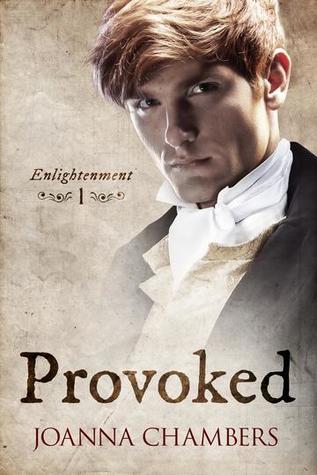
PROVOKED, first in the Enlightenment series of historical novels featuring David Lauriston and Lord Murdo Balfour
PROVOKED
JOANNA CHAMBERS (Enlightened #1)
Kindle original (non-affiliate Amazon link)
$4.99 available now
Rating: 4* of five
The Publisher Says: Tormented by his forbidden desires for other men and the painful memories of the childhood friend he once loved, lawyer David Lauriston tries to maintain a celibate existence while he forges his reputation in Edinburgh’s privileged legal world.
But then, into his repressed and orderly life, bursts Lord Murdo Balfour.
Cynical, hedonistic and utterly unapologetic, Murdo could not be less like David. And as appalled as David is by Murdo’s unrepentant self-interest, he cannot resist the man’s sway. Murdo tempts and provokes David in equal measure, forcing him to acknowledge his physical desires.
But Murdo is not the only man distracting David from his work. Euan MacLennan, the brother of a convicted radical David once represented, approaches David to beg him for help. Euan is searching for the government agent who sent his brother to Australia on a convict ship, and other radicals to the gallows. Despite knowing it may damage his career, David cannot turn Euan away.
As their search progresses, it begins to look as though the trail may lead to none other than Lord Murdo Balfour, and David has to wonder whether it’s possible Murdo could be more than he seems. Is he really just a bored aristocrat, amusing himself at David’s expense, or could he be the agent provocateur responsible for the fate of Peter MacLennan and the other radicals?
My Review: I'd rate this lower if I hadn't been prepared for the modest sexual content. What there was the author did well and it wasn't gratuitous or inorganic. I was sure the story needed to be in that place at that moment; I was sure the characters were true to their established motivations; in the end, it wasn't about dissatisfaction that I've read from a few other reviewers. I suspect the issues arose from what I was inclined to see as "instaluuuv" between men of radically (!) different stations in Regency life.
That mattered a great deal more then than it does now. Not that it doesn't now, it definitely does, but then it was an issue front and center in every act of daily life. How Balfour comes on to David is completely believable. How David responds, and how he feels, is also completely believable.
That Murdo Balfour argues for the pragmatic accommodation of self to society is unremarkably in character; that David starchily stands for conformity to the harshest possible code of actions while suffering for it is also unremarkably in character for his Presbyterian upbringing. A sect that preached predestination...your soul's salvation was not earned or even earnable since God decided the identity of the 144,000 saved at the beginning of time....wasn't likely to produce anything but the most craven sorts of lickspittles.
What made the read pleasurable for me was the sense that the men were genuinely, if ineptly and obtusely, falling for the person wearing the pretty face that neither could quite unsee. David's red hair, Balfour's dark eyes, David's slightness and Balfour's height and heft...timelessly, opposites do indeed attract. But the characters, the bits that have to fit if a passion is to alter its bell curve towards love's more complex shapes, do match. The men are motivated by their respective and surprisingly similar sense of honor.
It's just a pity that David's sense of humor is so impaired at the expense of that sense of honor.
Not for the squeamishly heterosexual.
Wednesday, March 7, 2018
FOR WE ARE MANY, second Bobiverse book in a totally geekfest series
FOR WE ARE MANY
DENNIS E. TAYLOR (Bobiverse #2)
Worldbuilders Press (non-affiliate Amazon link)
$4.99 ereader platforms, available now
Rating: 4* of five
The Publisher Says: Bob Johansson didn't believe in an afterlife, so waking up after being killed in a car accident was a shock. To add to the surprise, he is now a sentient computer and the controlling intelligence for a Von Neumann probe.
Bob and his copies have been spreading out from Earth for 40 years now, looking for habitable planets. But that's the only part of the plan that's still in one piece. A system-wide war has killed off 99.9% of the human race; nuclear winter is slowly making the Earth uninhabitable; a radical group wants to finish the job on the remnants of humanity; the Brazilian space probes are still out there, still trying to blow up the competition; And the Bobs have discovered a spacefaring species that sees all other life as food.
Bob left Earth anticipating a life of exploration and blissful solitude. Instead he's become a sky god to a primitive native species, the only hope for getting humanity to a new home, and possibly the only thing that can prevent every living thing in the local sphere from ending up as dinner.
REVIEW OF BOOK 1—REVIEW OF BOOK 3
My Review: This entry in the three-book series is less of a romp than the first because, of course, because the territory is no longer new or fresh; but it's still a hoot and a holler. I had such a great time going back to the Bobiverse! These books are a pleasure to me because their humor resonates with me:
At times like this, I wondered if I hadn’t gone a little overboard with the level of detail in my virtual-reality environment. There was no reason for me to even have nether regions, let alone for them to pucker.And that should tell you what you need to know about the suitability of the series to your reading needs. If that neither makes you laugh nor gives you a sense of the subject of the books, best you pass them by.
This installment brings us past the previously known Bobiverse...the bubble of space that Bob's previously created new selves have gone off to explore...and into contact with more new species. There are new threats, new ways of getting the heck rid of old threats, and plenty of the old threats come around again:
I sincerely hoped that in the fullness of time, they’d have the opportunity to get all bent out of shape about environmentalism.Seems that "intelligence" is a menace...and maybe VEHEMENT had a point. (Bobiversals will get that.) But there's nothing like a replicant on a mission to make the Universe safe for sentient life. The Bobs come through this book without a hint of middle-book-itis. The action doesn't slack. The stakes don't falter. The pace of the book doesn't dilly-dally and the Bobs, bless 'em, don't shilly-shally as they tackle problems on a greater-than-human timescale. I can't spoiler stuff since the Anti-spoiler Activists get so stroppy about it. But I can say that there's no good reason for someone who liked the first book not to get the second ASAP and there's no reason for someone who didn't like the first book to even consider this one.
As for me, I'm on to book three and might even have bumped this one up a rating point had it not been for the clear affection and acceptance herein shamelessly flaunted for a lifeform utterly unworthy of it:
The cat’s A.I. was realistic, right down to the total lack of loyalty.
Monday, January 29, 2018
GOD STALK, a 35-year-old first fantasy novel that spawned a series still going today
GOD STALK
P.C. HODGELL (Chronicles of the Kencyrath #1)
Baen Books
$6.99 eReader platforms, available now
Rating: 3.5* of five
The Publisher Says: In the first book of the Kencyrath, Jame, a young woman missing her memories, struggles out of the haunted wastes into Tai-tastigon, the old, corrupt, rich and god-infested city between the mountains and the lost lands of the Kencyrath.
Jame's struggle to regain her strength, her memories, and the resources to travel to join her people, the Kencyrath, drag her into several relationships, earning affection, respect, bitter hatred and, as always, haunting memories of friends and enemies dead in her wake.
My Review: I read this 35-year-old fantasy novel because a good LibraryThing friend of mine ran a group read of it. She contended that the book was underfamous and underappreciated. I don't know about you, but I'd say any first-in-series book that's followed by eight others (to date) set in the same universe, and which has an 816 page fandom wiki, isn't exactly a concealed target.
Still.
Reading older books in the speculative fiction genre is an education in revised expectations and their invisibility until challenged. Modern fantasy nonillionologies, each volume a minimum of a jillion pages densely packed with made-up language vocabulary and/or Randomly capitalized normal Words that indicate they're being used as something More Than their mundane meaning, are now the minimum standard. This book predates that trend. As a result, its brevity can feel...unfinished...to a 21st century sensibility. There were many, many moments that the author moved through hastily or simply glided past entirely that would, in modern times, be entire novels.
I've complained about book bloat and editing fails so often and so publicly that I expect someone will quite soon point this out with a smug "gotcha!" of some sort. To those legions of carping natterers, I say "oh shut up" and remind them that 1) consistency is the hobgoblin of small minds and 2) there's such a thing as a happy medium.
I'm not a huge consumer of fantasy novels at the best of times because magic makes me itch. It seems so nonsensical, so counter to the realities of physical laws under which we live; it flies in the face of experiential existence; but it satisfies a deep need in many people, just not me. Also, almost always, the protagonist is An Exceptional Adolescent (usually female), and that's very much not my favorite kind of person. Adolescence stank, and so do adolescents. Just not where I want to be, or to stay for any length of time.
This novel's magical system got in under my radar because it feels to me, like the magic in Kai Ashante Wilson's marvelous Africa-set fantasy stories, as though any second we're going to be told that it's a form of technology we don't recognize as such. I can hang with that. Most of what the main character does isn't terribly magical, and the city of Tai-Tastigon itself is the source of the overall magic. We're teased with the notion of the city's magic being the reason there are so many gods in it; in fact, there's a truly delicious idea that temples to the gods are actually ways for the mundane people to *trap* the gods, to limit their scope for activity, instead of mere places of worship.
Jame, our main character, even targets one of these gods in an experiment to test the limits of its power. She causes the god to lose its worshipers in the process, and the results prove to Jame that there is something very hinky about the way the gods function. This subplot is played for comedy, but I was happy to note that the very real consequences for this god and its priest were later sources of shame and remorse for Jame. She goes out of her way to fix the damage she's done, and in the process discovers an amazing library of knowledge that this god's temple has hidden for ages. It is one of the wonderful things about the tapestry of Tai-Tastigon created by Author Hodgell.
The city and its quirks, its societal and legal peculiarities, are incredibly enough left to one side as soon as they're revealed! Inconceivable, and that word does mean what I think it means, in today's publishing world. I was intrigued by the Cloudies, a subset of society that's decided to take to the rooftops and not touch the ground: whence came they, what do they do for a living, how come they're not subject to groundling law, and so on and so forth. Never answered. Never addressed. The Thieves' Guild that Jame enters without the smallest tiniest bit of effort on her part is an entire multi-volume storytelling universe! The history that Jame barely skates over with her sort of accidental Thieves' Guild master, one Penari the ancient master thief, is another multi-volume series of novels. I am all for rich texture in a story, and I got it here, but there are way too many delicious side trails that lead nowhere in this book.
At the end of the book came my personal biggest disappointment as Jame left Tai-Tastigon for parts unknown. This was inevitable, given the fact that she enters the city from parts only slightly less unknown and for reasons utterly unclear and unclarified. This is a fantasy novel, and the first in a series. Of course there will be a quest, and of course it will lead away from any one location. That doesn't make me any happier about it. The textures of Tai-Tastigon's tapestry are involving and exciting, and I'd like to stay here please.
Which is how I know Author Hodgell created a wonderful thing in this book, and why it's no real surprise that her fantasy universe has spawned an 816-page wiki. She understands her readers' need to feel immersed and invested in more than a simple, surface-gleaming world. She delivers those goods. My various dissatisfactions with the execution of this tale aside, I admire her ability and her vision. I won't continue reading the series because I'm less interested in Jame than I am in Tai-Tastigon, but I will likely pick up any future book that returns to this setting.
Tuesday, December 19, 2017
WHITE SILENCE, a suspenseful thriller to give your Disaster Magnet friend
WHITE SILENCE
JODI TAYLOR (Elizabeth Cage #1)
Headline Books (non-affiliate Amazon link)
$5.99 Kindle edition, available now
Rating: 5* of five
The Publisher Says: "I don't know who I am. I don't know what I am."
Elizabeth Cage is a child when she discovers that there are things in this world that only she can see. But she doesn’t want to see them and she definitely doesn’t want them to see her.
What is a curse to Elizabeth is a gift to others – a very valuable gift they want to control.
When her husband dies, Elizabeth’s world descends into a nightmare. But as she tries to piece her life back together, she discovers that not everything is as it seems.
Alone in a strange and frightening world, she’s a vulnerable target to forces beyond her control.
And she knows that she can’t trust anyone…
White Silence is a twisty supernatural thriller that will have you on the edge of your seat.
My Review: I cannot believe I did it voluntarily. I mean, I'm completely current in Author Taylor's The Chronicles of St Mary's series...eight novels, eleven novellas and stories released...so I can't plead ignorance of her vicious, violent, eviscerating cruelty. I have been reduced to a quivering heap of snot and tears by Author Taylor on more than one occasion. It's not like I didn't buy the book aware of what would happen to me.
In fact I was unable to read a part of the book around 16-17% because it triggered my personal issues around claustrophobia. I solved this by skipping ahead to the next chapter and inferring what happened from what was then going on. It was too much for my frail little fleur of a heart to live through Mrs Cage's horrid experience, and then in the chapter I skipped to there was an equally awful moment of encavmaphobia (google it) when I thought "oh right then, I'm going to close this file and quietly remove the book from my Kindle" but, at the end of the day, left it on there and just didn't read anymore.
Two months passed. I finished a romantic novel, last in a series I've been following despite the absurd and disgusting and overused winking trope that author insists on fouling her books with, when I thought to myself, "Self," I thought, "never in all the history of personkind would Author Taylor have a character *shudder* wink at another character. You are safe, Self, so finish up White Silence at last."
I did. I am so glad. (There was no winking.)
While Elizabeth Cage doesn't have a smooth ride in this book, she does have a fascinating psionic power and the range to use it. She is clearly unmoored by her beloved husband's death. She forms an attachment to a damaged spy that came rather out of nowhere. Her life is turned upside down by several of Author Taylor's trademark dreadful, sadistic maulings of her readers' emotions. I mean characters' arcs, silly me.
There is so much that happens in this book that giving a book report is almost desirable, but I shall refrain because spoilers make people very angry. Suffice to say that each event in the book will have repercussions within seismic shifts atop temporal tsunamis. Absolutely nothing is as it seems, which we know from about the 90% mark on, though the full and devious range of Author Taylor's sadism hasn't come anywhere near to being tested or revealed.
*happy sigh*
So I tell you true, reader, the Disaster Magnet (aka Jodi Taylor follower via the Chronicles of St Mary's) that you love will adore this book. You will get so many bonus points with your Disaster Magnet that you could come out as a 45 supporter or Brexiteer and earn no more than a hurt look and some tutting. And it will guarantee several hours of dead silence as your beloved slurps it down in which you can watch sports or planetary explosion movies or even go out with your buds and get no more than a vague wave and distracted "take your mother with you."
JODI TAYLOR (Elizabeth Cage #1)
Headline Books (non-affiliate Amazon link)
$5.99 Kindle edition, available now
Rating: 5* of five
The Publisher Says: "I don't know who I am. I don't know what I am."
Elizabeth Cage is a child when she discovers that there are things in this world that only she can see. But she doesn’t want to see them and she definitely doesn’t want them to see her.
What is a curse to Elizabeth is a gift to others – a very valuable gift they want to control.
When her husband dies, Elizabeth’s world descends into a nightmare. But as she tries to piece her life back together, she discovers that not everything is as it seems.
Alone in a strange and frightening world, she’s a vulnerable target to forces beyond her control.
And she knows that she can’t trust anyone…
White Silence is a twisty supernatural thriller that will have you on the edge of your seat.
My Review: I cannot believe I did it voluntarily. I mean, I'm completely current in Author Taylor's The Chronicles of St Mary's series...eight novels, eleven novellas and stories released...so I can't plead ignorance of her vicious, violent, eviscerating cruelty. I have been reduced to a quivering heap of snot and tears by Author Taylor on more than one occasion. It's not like I didn't buy the book aware of what would happen to me.
In fact I was unable to read a part of the book around 16-17% because it triggered my personal issues around claustrophobia. I solved this by skipping ahead to the next chapter and inferring what happened from what was then going on. It was too much for my frail little fleur of a heart to live through Mrs Cage's horrid experience, and then in the chapter I skipped to there was an equally awful moment of encavmaphobia (google it) when I thought "oh right then, I'm going to close this file and quietly remove the book from my Kindle" but, at the end of the day, left it on there and just didn't read anymore.
Two months passed. I finished a romantic novel, last in a series I've been following despite the absurd and disgusting and overused winking trope that author insists on fouling her books with, when I thought to myself, "Self," I thought, "never in all the history of personkind would Author Taylor have a character *shudder* wink at another character. You are safe, Self, so finish up White Silence at last."
I did. I am so glad. (There was no winking.)
While Elizabeth Cage doesn't have a smooth ride in this book, she does have a fascinating psionic power and the range to use it. She is clearly unmoored by her beloved husband's death. She forms an attachment to a damaged spy that came rather out of nowhere. Her life is turned upside down by several of Author Taylor's trademark dreadful, sadistic maulings of her readers' emotions. I mean characters' arcs, silly me.
There is so much that happens in this book that giving a book report is almost desirable, but I shall refrain because spoilers make people very angry. Suffice to say that each event in the book will have repercussions within seismic shifts atop temporal tsunamis. Absolutely nothing is as it seems, which we know from about the 90% mark on, though the full and devious range of Author Taylor's sadism hasn't come anywhere near to being tested or revealed.
*happy sigh*
So I tell you true, reader, the Disaster Magnet (aka Jodi Taylor follower via the Chronicles of St Mary's) that you love will adore this book. You will get so many bonus points with your Disaster Magnet that you could come out as a 45 supporter or Brexiteer and earn no more than a hurt look and some tutting. And it will guarantee several hours of dead silence as your beloved slurps it down in which you can watch sports or planetary explosion movies or even go out with your buds and get no more than a vague wave and distracted "take your mother with you."
Sunday, November 26, 2017
MAKEPEACE, third in the Taking Shield space opera series
MAKEPEACE
ANNA BUTLER (Taking Shield #3)
Glass Hat Press
$3.99 various ebook platforms, available now
Rating: 4.almost-...oh hell, make it five of five
The Publisher Says: Returning to duty following his long recovery from the injuries he sustained during the events recounted in Heart Scarab, Shield Captain Bennet accepts a tour of duty in Fleet as flight captain on a dreadnought. The one saving grace is that it isn’t his father’s ship—bad enough that he can’t yet return to the Shield Regiment, at least he doesn’t have the added stress of commanding former lover Fleet Lieutenant Flynn, knowing the Fraternisation Regulations will keep them apart.
Working on the material he collected himself on T18 three years before, Bennet decodes enough Maess data to send him behind the lines to Makepeace, once a human colony but under Maess control for more than a century. The mission goes belly up, costing Albion one of her precious, irreplaceable dreadnoughts and bringing political upheaval, acrimony and the threat of public unrest in its wake. But for Bennet, the real nightmare is discovering what the Maess have in store for humanity.
It’s not good. It’s not good at all.
THE AUTHOR PROVIDED ME WITH DIGITAL ARCs FOR WHICH I THANK HER. I THINK.
My Review: What makes a series work for me is the way the author handles the characters whose lives need to feel real enough to make me go with the unreality of fiction. A series of novels, stories, television episodes...all the same standard. Make me care, make me believe, or make your goodbyes as I move on to greener pastures.
Okay, I surrender. I am officially Author Butler's fanboy. The series has me by the eyelashes and I'm eager to dive into book four, The Chains of Their Sins.
A warning for those who follow me down this rabbit-hole: Do not buy the books one at a time. When you get to the ending of this book, you will be very frustrated if the next book isn't already queued up.
I am an old-time fan of space opera. I like the sweep of a long story. I adore space battles (I'm a guy, shut up). Tech talk isn't up there with dirty flirty but it's close. I want to be told stories that make sense (not necessarily in a straight line you understand, just make sense please) and I like 'em set in space because SPACE my goddesses what could possibly be more interesting?! I mean in fact as well as fiction. And I'm also a big old mushball and want my heroes to find love because heroes have hearts too. Sexytimes are fine, but I *need* my men to fall in love as well as get 'em some or why not just watch porn. (For the sake of argument, you understand.)
So here I am telling you to buy the series, ye fans of SF and ye readers of love-novels but not expecting sex or romance-novel level involvement in our hero's world. He is the hero, the story isn't totally about him, and his world is rich and densely packed with great stuff.
It isn't perfect, of course, but I'll accept the flaws for the great parts.
I'm also really excited by the major development of this book's self-contained plot arc, regarding the military future of Albion.
Labels:
#Booksgiving,
#PrideMonth,
#QUILTBAG,
5 star review,
Anna Butler,
bisexual male lead,
gay,
gay SF,
Glass Hat Press,
Kindle edition,
Planet Albion,
SFF,
space opera,
Taking Shield Series
The TAKING SHIELD series, the first four of five (plus a prequel novella) planned I've read and loved
**REVIEWS ARE HERE: #1 GYRFALCON ; #2 HEART SCARAB ; #3 MAKEPEACE ; #4 THE CHAINS OF THEIR SINS ; #5 DAY OF WRATH
This is an overview of the Planet Albion, the setting of all four novels currently available in Author Anna Butler's space opera series, Taking Shield. It set in a 10,000-year-future Earth colony, mother planet to other colonies and in a war for survival with the alien race they've named the Maess. Yep, "Albion" like the old-fashioned personification of England (not Britain, Americans, ENGLAND and yes, there's a big difference).
Albion, as envisioned (literally!) by William Blake (Wikimedia image)
The Albionese have only one name, used in conjunction with a title where appropriate (eg, titled aristocrats, military personnel). I was a little bumfuzzled by this at first. There are bound to be billions of humans on Albion and its colonies, after all. But then it occurred to me that, in a society as advanced as this one, there are multiple biometric forms of identification available, so identifying yourself officially isn't name-dependent and socially how many of us are known by our full names now? There would be significant social pressure not to use names too freely. I can dig it.
The Albionese worship a Pantheon of Gods derived from Egyptian models, settled in Albion's landmasses with Hellenistic province names, and have a Parlialimentary (not a typo) democracy that very closely resembles the debased and disgusting kakistocracy (get it now?) of today. Author Butler starts us out with the following teaser on her website:
Taking Shield started out as a simple ‘what if’ set of questions. What if in some AU universe Earth’s been a burnt out dustball for the last ten thousand years? What if we do a riff on the Exodus and have remnants of humanity escape, but led by Pharaohs? What if the new world they found, Albion, is at war with an enemy no one has ever seen? What if the hero is a member of Albion’s special forces *and* the Military Strategy Unit? What if he finds something that seriously threatens Albion? What if he falls in love with a Fleet pilot and has his life turned upside down?My issues with the Albionverse are few, really, the biggest having to do with the improbability of feet, miles, a.m. and other specific-to-earth measurements surviving more than 10,000 years when meters, kilometers, light-years, and military time-keeping are so much better suited for the Universe as we know it. Author Butler saw my bleat of dissatisfaction, recognized it for what it is...a fan's grumble not a detractor's brickbat...and gave me the following explanation, which I present to you with her consent:
And somehow that grew into a serial of four books so far with more to come.
Albion's days, months and years are not the same as Earth's but the words used for those measurements of time on Earth have translated across with different values*. Similarly other earth measurements have translated. Some - like parsec or lightyear remain constants because immutable physical law demands they do. Others have new, Albion-specific values. My reasoning was that having lost Earth to catastrophe (see Passing Shadows, the prequel, for what happened), the survivors clung very hard to whatever of Earth they could take with them. I'm English. We have the most mixed system here of decimalised coinage and weights and measures, but still measure our distances and things like car speeds in terms of miles. Nostalgia has the people of Albion clinging to the terms their ancestors knew best. From which you may gather that despite the Egyptian overtones, Albion (and Bennet) is most definitely British!These are the sorts of details that vastly increase my personal pleasure in a series of books set on a made-up planet. I figure that, since you're reading my blog, you're at least slightly more likely than the Normals to want some sort of satisfaction regarding seeming inconsistencies that are actually designed-in landscape features. Just think of Author Butler as a literary Capability Brown.
* Albion has a normal year of 412 days:
ten months of forty days each divided into four equal ten-day weeks plus an extra week at the end of each year, Yule week, to absorb the outstanding 12 days.
each day has 25 hours, each hour has 100 minutes.
Those minutes, hours, days are not the same as Earth's. I worked out to my own satisfaction that each Albion day of 25 hours is equivalent to around 29 Earth hours, 35 minutes . So each Albion minute = 42.6 Earth seconds.
Albion's actual rotation is 412 and some 8 hours so in every third year, Yule week is 13 days long, with an extra day to compensate and to align the calendar with the sun's apparent position—pretty much like our leap years. Albion's leap day is actually a few extra minutes longer than normal, for real accuracy, but I don't trouble my head about that level of detail!
There are truly arbitrary figures that doesn't at all *matter* in terms of the story, but were created for my own amusement and which I now share, for yours.
I'd love to see more of the Egyptian roots of the world, for an example of an area of dissatisfaction; the series is clearly populated by people of England-English descent, based on the culture's stratification and its Parliamentary democracy in place. How'd we get to Egypt? I'm not against it, or bitching about it, just curious. What would lead a bunch Brits to mummify their dead, for example? I get the whole art style revival since they've done it twice before (the 1790s and the 1970s), but this is a deep cleavage from British norms and bears some 'splainin'. And Bennet *is* an historian....
The website has a handy-dandy obsessive fanboy's guide to the rich background of Albion and its institutions as they are at the time of the stories herein told. It's a really interesting way to get your obsessive series-reader's feet wet. Try the first book risk-free, for free, freeing you up to decide whether Bennet and Flynn and Albion and the Maess are your cuppa joe. (I hate tea.)
Subscribe to:
Posts (Atom)