Showing posts with label social SF. Show all posts

Wednesday, July 22, 2026

THE MULAI, consider the comps given by the publisher as gospel


THE MULAI
MUNIR HACHEMI
(tr. Julia Sanches)
Coach House Books (non-affiliate Bookshop.org link)
$14.99 ebook, available now

Rating: 4.25* of five

The Publisher Says: Interstellar via Invisible Cities: spec-fic translated from Spanish imagines a utopian way of life on another planet.

Years after the climate wars on Earth, the Mulai have settled into their new home on an unnamed planet. Supplies stopped arriving from Earth many years ago, and the Mulai have found a way to live. But now the people of Earth want to know what happened to the settlers, so they send The Archaeologist.

He finds that they have become a different people: uncannily similar to us but with something radically Other about them. Their language has become more about change than stability, and the ways they eat, reproduce, bury their dead, and understand gender have all transformed into something almost unrecognizable. The Archaeologist feels like his trip is one extended misunderstanding.

With fragments from The Archaeologist’s notes and the stories of Flukeh and Faida, who map both their world and their language, The Mulai offers a glimpse of a world adjacent to ours – one that just may be a model for how to better our own.

From one of Granta’s Best Young Spanish-Language Novelists and author of the celebrated Living Things, and translated by the award-winning Julia Sanches, comes a bold new Borgesian reimagining of what ‘civilization’ might look like.

I RECEIVED A DRC FROM THE PUBLISHER VIA EDELWEISS+. THANK YOU.

My Review
: “Only when we encounter the other can we truly see ourselves.”

This is the crux of this story's argument. It is spoken by The Archaeologist, Dr. Cordovero, in an unironic way as he executes the duties of a scholar to interpret the Mulai, a culture not his own. So, a colonizer's PoV...a man whose cultural matrix he's so embedded within that he can't see how it forms...distorts...his picture of Reality. This being a story about how a human culture simply...vanished...without making a ripple in water left behind, it made perfect sense this should be the case. The Archaeologist’s notes are his rigid way of trying to fix an understanding of the Mulai's lifeways into a clear explanation of power structures, kinship patterns, and language architecture.

None of these concepts apply.

Seen from The Archaeologist’s PoV, a Mulai library f/ex is not anything like a library. A bit like Samuel Beckett's splices from late in his life, these places are collecting points for unbound unconnected sheets that do not necessarily tell any kind of cohesive story...just as random pages torn willy-nilly then taped together did not form a deliberate Beckett story, though it was what Beckett intended. The Archaeologist is sure, with typical colonizer arrogance, that these distant cousins of Earth's humans have let him in, have answered his questions as he intended them to not as they intended to. Life lived in translation is always tough. Life lived in denial, blindness, in a fog of culture-bits one does not know is obscuring clear vision...harder still.

That this story about a life lived in (mis)translation is itself a translation is either a step too twee or a layer of hot fudge atop the whipped cream of sociological SF from an earlier literary era wrapping up a rich, dense custard of story. It's a novel that requires you-the-reader to think past the obvious, to dig your spoon under the rich topping of the SFnal setting, through the soothing sweetness of the story's meaning, into the heavy, velvety lushness of Author Hachemi's ideas about how culture, language, and art emulsify into this marvel of delightful idea-sharing.

What actually happens on the page is far less important to this reading experience than what happens inside you as you read it. Did you just read the glossy surface...did you just give the story your attention without turning it over and over as you read, after you finished...or is this a "too hard, turn on the TV" kind of experience? They're all in here.

It's a lot, but it's rewarding no matter where you end up.

Friday, July 17, 2026

BALSAM KARAM'S PAGE: using pieces of the SFF toolkit to great effect without writing SF or F


EVENT HORIZON
BALSAM KARAM
(tr. Saskia Vogel)
The Feminist Press (non-affiliate Bookshop.org link)
$16.95 all editions, available now

Rating: 4.5* of five

The Publisher Says: From the author of The Singularity, a saga of one girl's resistance and exile in the stars and soil of empire.

Seventeen-year-old Milde is from the Outskirts, a place beyond the mountains where the dirt is corpse-rich and mothers and daughters make their living banished from society—without rights, access to care, or legal status. Simmering under the surface of their day-to-day survival is a desire for change—and one day, Milde and her friends act on it, setting fire to government buildings in the city that has rejected them.

When Milde is framed as the instigator of the uprising, she is arrested, imprisoned, tortured, and eventually presented with a final choice: to be executed publicly or to be launched into space, into a black hole called the Mass, for an experiment. Milde chooses the Mass.

Event Horizon is an exquisite existential novel, dark as deep space, woven with reflection on oppression, solidarity, trauma, and loss. With a completely unique voice, Balsam Karam writes about the swirl of hope and despair in the lives of the marginalized and a young woman’s unwavering belief in a better world.

I RECEIVED A DRC FROM THE PUBLISHER VIA EDELWEISS+. THANK YOU.

My Review
: First, read this:
They're talking about deportation, we told them, Do you understand what that means? They're talking about taking us across the border and leaving us there, they're saying we have to go home, but what home do we have other than this one, I told them. I was born here and my child was born here, I told them—It's true that we've been living without papers for all these years, but now were being deported—is that acceptable? These are our lives I told them, but no one wanted to listen and so we ended up here. Milde listens to her mother and sits down beside her, watching the buildings rise one by one, wishing she already knew how to build a home.
Maybe I resonate with this despairing cry because I experienced a similar feeling, if not legal process, with my own homeplace rejecting my very being as a gay man. Displacement is a violent painful amputation without mercy or understanding or empathy...and it goes on every single day all over the world, in homes in cities in countries in (especially) religions.

Every time it occurs it is an evil, a wound to the spirit of all who perpetrate and/or experience it. It is a wound on the masses of people who, like those who stay in Omelas, ignore it. Milde chooses a course of action in recation to this wrong that commits the most terrible crime imaginable: It is meant to, in the metaphorical structure of Omelas, show the complacent, the docile and unquestioning, the cost of their dreamworld. Terrorism! the shout rises, led by those terrorizing Others to please and entertain the unthinking and disengaged. Milde must be punished, must be seen to be punished, not to deter future "terrorists" but to satiate the appetite for cruelty of the dociles, passive entertainment to slake the human thirst for blood.

Milde makes an ugly bargain with the evil system:
Sure, I can go to space and die, why not? I'd rather die in the depths of a black hole than wait around to be executed here, if you see what I mean. I'm doing this so that I can sit back and rest for once, no knife or metal lid hidden under my pillow, and so that, if only for a day, I won't have to look at those same white faces that wish me harm.
Her consent to be sent into the uttermost unknown to die while providing data (her suffering and death) is about as meaningful to the "white faces that wish {her} harm" as clicking "accept and close" is. There is no meaningful other option, but make it look good for those who can't be arsed to see how wrong, how painful it really is.

Swedish Kurdish author Balsam is the child of a man who experienced the horrors of a "terrorist" who chose his course of action to resist colonization. That crime resulted in his daughter being a Swede not a Kurd by nationality, a displacement that will reverberate through her entire life short or long. Everyone makes these decisions for their children, it's inherent in having them; but as all parents know it's never what you say but what they hear that counts. Author Balsam's feelin' some kinda way about these choices, and seeing the world in a unique cast of light as a result.

All of us Anglophones can see it because she let us in on experiences we don't precisely share, but still can find ways to be with. We can all feel echoes pressing on our emotional eardrums that come from a similar place of "injustice happened to me, to my life, that I had no pwer to resist"...maybe enabling us as a result to make the effort to help the world resist, reject the bloody hunger for revenge or simply the vicious desire to hurt Others to slake Humanity's thirst for it.

Eminent Translator Vogel has been at work for a good long time so it's no surprise her skills make this feel like a native English speaker wrote it. In fact I bring it up here because I was suddenly struck about the halfway point that I was not having my usual internal debate about "what word was that in {language}?" I checked the copyright twice during this read...yep, translation. This is very unusual for me. It's even more surprising because this is Author Balsam's first book.

The outrage that simmers under this lovely surface is definitely part of the reading experience. There is not sweetness in the story, or in the language; there is precision, but not distance, or chill. It's going to make emotional demands of you-the-reader. Milde experiences the constant reminder of difference that is used by polite people to maintain their superiority in the hierarchy. Her mother Essa is not even as far into the acculturation process as she is; it's a process defined by exclusion, rejection, after all. Milde's course as a resister is set thereby and this her fate sealed.

Her violent terrorism is what is left to a powerless woman in the face of an entire power structure built for the purpose of excluding her forever. Her resistance is all she has; it can only be what it compelled her to enact; so her phases of punishment *must* result in her body being launched into a black hole to die in as-yet-unknown suffering that must be public. It must be shared, this last and most intimate violation of her humanity. Otherwise she will not have paid for her "crime."

It is the best of all possible validations for the power structure. It is the best of all possible tricks to play on the power structure for Milde. It was chilling how much courage Milde possessed accepting this final, long act of her life. Even Christ only suffered for hours.

++++++++++++++++++++++++++++++++++++++++++++++++++++++++++++++++
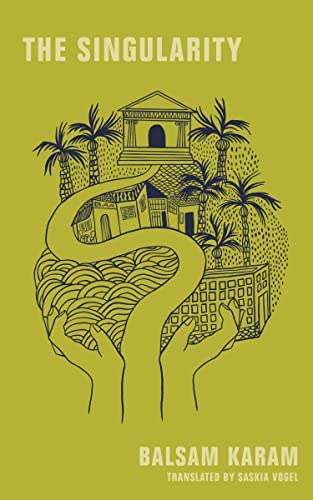

THE SINGULARITY
BALSAM KARAM
(tr. Saskia Vogel)
The Feminist Press (non-affiliate Bookshop.org link)
$16.95 all editions, available now

Rating: 4.25* of five

The Publisher Says: Lyrical and devastating, The Singularity is a breathtaking study of grief, migration, and motherhood from one of Sweden’s most exciting new novelists.

In an unnamed coastal city filled with refugees, the mother of a displaced family calls out her daughter’s name as she wanders the cliffside road where the child once worked. The mother searches and searches until, spent from grief, she throws herself into the sea, leaving her other children behind. Bearing witness to the suicide is another woman—on a business trip, with a swollen belly that later gives birth to a stillborn baby. In the wake of her pain, the second woman remembers other losses—of a language, a country, an identity—when once, her family fled a distant war.

Balsam Karam weaves between both narratives in this formally ambitious novel and offers a fresh approach to language and aesthetic as she decenters a white European gaze. Her English-language debut, The Singularity is a powerful exploration of loss, history, and memory—an experience akin to “drinking directly from a flood of tears” (Aftonbladet).

I RECEIVED A DRC FROM THE PUBLISHER VIA EDELWEISS+. THANK YOU.

My Review
: Published first but written second in Author Balsam's career.
The grandmother picked them up and held them close in sleep almost no sleep at all and then muttered that no one beyond the ruined wall wished them well and that she couldn’t bear another loss – again and again she said she couldn’t bear any more loss and even though the children didn’t understand how or why, they knew that the loss was now a part of them and that at any moment it could strike again.
It's the world of Event Horizon (review above) on Swedish soil in the camp the women live in as they have no recourse or options:
It’s your first winter in the house with the little garden, the darkness outside. Something hard hits the windows and your brother stands up, puts on his coat. After a while he comes back in, says he needs something to wipe off the dog shit from the window and the postbox. In his hand is a blue and yellow sticker that he’s torn off, like the ones you’ve seen high up on lampposts around town.

–and–
Later, your mum tells you that the first thing she was told after talking about how she had been tortured in prison was that no one would hire a person like her. One eye missing, older and not entirely fluent – it’ll be tough, the caseworker had said.
Nice people do not shout racist slogans in your face. It does not mean they are not going to behave in racist ways. The story's narrative risk-taking is more evident in its middle third:
/ do you think of her often, Marcus or Magnus asks softly / we ate bean stew with rice and yoghurt and I drank a whole pot of tea afterwards / you nod, of course you do / Gran was the happiest of us all I think / I think of her and of my grandmother you say and put the cup down / she took you in her arms and then I made sure to sleep while I had the chance / do you know anything about black holes? you later ask the counsellor / and I only got out of bed the next morning can you imagine? / inside a black hole is a place that is also a state — do you know about this? you ask, facing Patrick or Henry in his chair / a few days later Rozia's mother visited with little Rozia in her arms and a basket full of fruit /no, I'm afraid I don't know much about space, says Eric or Martin and continues to take no notes / then the two of you would meet up practically every day / you say it's called the singularity - that's what the place is called and lean over the bed / you and Rozia were like twins, we thought - the same round face and your hair as big and black / inside the singularity, the force of gravity is so strong it can't be calculated, can you imagine? you tell the counsellor / the pair of you often played in Rozia's yard and sometimes you stood by the big road even though you weren't allowed to and the soldiers could show up at any moment / that force pushes bodies together and renders the distance between them nil / because you both liked Gran's fried potatoes and her bean stew, you mostly ate at ours Mum says / you use your hands to show how no space remains between bodies in the singularity
It doesn't scan easily, but I promise you it is not flummery, a brummagem gaud of "Style" that distracts with difference without adding into meaning. In the more conventional first and last parts, the harrowing tales told do the work of impacting you in dark corners of your Safe Place, you are not safe, ever, as long as you are Other. While you are reading Author Balsam's story you are Other along with her.

It's a passionate document about grieving. It is a horrible chronicle of losing a child, losing an infant, losing losing losing without a moment of respite and never once ever giving up.

Until the final act of control is yours.

If you need a—any—content warning, do not pick this read for yourself.

Sunday, October 17, 2021

#The1976Club: WOMAN ON THE EDGE OF TIME by Marge Piercy...well titled indeed ***SPOILERS***


WOMAN ON THE EDGE OF TIME
MARGE PIERCY

Ballantine Books
$13.99 ebook editions, available now

Rating: 3.5* of five

The Publisher Says: Hailed as a classic of speculative fiction, Marge Piercy’s landmark novel is a transformative vision of two futures—and what it takes to will one or the other into reality. Harrowing and prescient, Woman on the Edge of Time speaks to a new generation on whom these choices weigh more heavily than ever before.

Connie Ramos is a Mexican American woman living on the streets of New York. Once ambitious and proud, she has lost her child, her husband, her dignity—and now they want to take her sanity. After being unjustly committed to a mental institution, Connie is contacted by an envoy from the year 2137, who shows her a time of sexual and racial equality, environmental purity, and unprecedented self-actualization. But Connie also bears witness to another potential outcome: a society of grotesque exploitation in which the barrier between person and commodity has finally been eroded. One will become our world. And Connie herself may strike the decisive blow.

THIS READ WAS PART OF A LOOSE BLOGGER READ-A-THON CALLED THE 1976 CLUB. THERE ARE SPOILERS FOR THE ENDING BELOW.

My Review
: I began this read eager to know why I've owned several editions of this book over the decades...one from my bookstore-having sister in the Seventies, one from my Manhattan years in the later Eighties, a British one from the Aughties...but never remember reading it! And now that I've read it again, I remember why I don't remember.

What a disappointment.

The ending just...isn't. The sense of resolution, of the fit between story and ending, is unsatisfying to me. And it took over sixty pages to get there.

You know from the publisher's synopsis that Connie Ramos, our third-person-limited PoV character, is a mental patient. It's the 1970s and psychopharmacology wasn't as advanced as it is now (I'd argue it's still roughly where surgery was in the pre-Lister 1840s). Much that is wrong with Connie is situational, and it's utterly unsurprising. She's "treated" by the standards of the day, which is to say confined and contained and circumscribed so she can't act out her acute agony. She's in need of psychotherapy, Cognitive Behavioral Therapy; she gets diagnosed as schizophrenic and the full machinery of experimental psychology gets to work on her.

But are they wrong? She claims she's been to the year 2137. And the world is....

Off we go! Luciente reaches her to show her a beautiful, granola-and-grown-out-hair Seventies egalitarian-hippie-commune future that I loved. "Gender" roles? Umm...what is per (their all-purpose pronoun, love that!) talking about, Luciente? Sex is biological...what is gender role? Part of the false dichotomies we've left behind.... What *wasn't* left behind was the of-the-time disrespect for sex work and workers, equating them to slaves. Reductive, shown to be inaccurate, but very feminist-70s. What isn't left behind is the disrespect of the future for the past. Luciente and all per people in Mattapoisett seem to know less than a US grade-school child about their own history. Connie says things that dumbfound these folk regularly...did all the books and digital records get destroyed? Then find a way to tell me so! (Goodness knows Author Piercy isn't afraid of infodumps.)

What I mostly didn't love was the way Connie, my PoV!, didn't look around and note things! But...well...this is a story about an abused and frankly impoverished and ethnically othered, therefore expendable, woman. All of those things are still stigmas, but they were a great deal moreso in the Seventies, and as Luciente's world (is Mattapoisett a Utopia, really, because war and societal conflict still exist there and then) bleeds into her own reality the Seventies Bellevue staff become less and less empathetic, more and more afraid of and for her, and act with more controlling behavior. It wasn't a joyride for Connie before but, as the life with Luciente recedes and Connie becomes mired in the mental hospital's horrors, the way she copes is...awful.

The aforementioned sixty-plus pages. I didn't like 'em. I did, however, recognize 'em. The months I spent in a locked ward in 2014 were a real eye-opener for me, and this might be why I didn't much enjoy the ending. My roommates were schizophrenic men. I had a really strong introduction to the hopelessness of schizophrenia and its utterly ineffective treatments. I think a big part of my getting my own brain back under my control was my sense of deep, abiding gratitude that I don't have *that* problem.

But does Connie? Is that really what's going on here? In her records, which we see, it says her intelligence is "Average" and is this detailed, consistent fantasy really something a person of average intelligence could come up with? It was here that I began to think the ending, besides just not being to my taste, actually missed a trick. What occurs isn't unrealistic. What it is, though, is without nuance. It asserts that Reality Is Reality. That's what we've just spent over three hundred pages interrogating! Taking that tack over quite an extended ending is...well...why not keep the interrogation, is Connie mad? is Connie telling us the truth? is Connie ever going "home"? going, that is, back to Mattapoisett. Instead the story ends with a THUD. And that wasn't at all on my Bingo card.

Author Piercy's prose is adequate.
“Never in your life have you been helpless—under somebody’s heel. You never lived where your enemies held power over you, power to run your life or wipe it out. You can’t understand. That’s how come you stand there feeding me empty slogans!”

Luciente bowed her head. “You crit me justly, Connie. Forgive me. I’ll try to see your situation more clearly and make less loud noises in your ears.”
–and–
“Only in us do the dead live. Water flows downhill through us. The sun cools in our bones. We are joined with all living in one singing web of energy. In us live the dead who made us. In us live the children unborn. Breathing each other’s air, drinking each other’s water, eating each other’s flesh, we grow like a tree from the earth.”
–and–
Every day was a lesson in how starved the eyes could grow for hue, for reds and golds; how starved the ears could grow for conga drums, for the blare of traffic, for dogs barking, for the baseball games chattering from TVs, for voices talking flatly, conversationally, with rising excitement in Spanish, for children playing in the streets, the Puerto Rican children whose voices sounded faster, harder, than Chicano Spanish, as if there were more metal in their throats.

Never that I saw did it get better than that, and those are peaks that I've chosen. They're good, they're good, before someone says I'm saying otherwise. What they aren't is...tingly. That feeling you get when someone writes something that spears you with its sounds and feelings. I never got that in this read...and I'm pretty sure most others didn't either. What I saw praised, when I read the reviews others had written of the book after I finished my own read, was the ideas Author Piercy presented for the future, the cold analysis of the present...but not the prose. It's fine! It's not awkward, or lumpen; it's...fine.

But that's all it is. And that, I think, is my best summation of this read: It was fine, it had much to recommend it, but its heights weren't all that high and its lows weren't low.

It was fine.

Monday, October 4, 2021

THE BODY SCOUT, Lincoln Michel's big, fast racing machine of a sci-fi thriller


THE BODY SCOUT
LINCOLN MICHEL

Orbit Books
$27.00 hardcover, available now

Rating: 4* of five

The Publisher Says: In the future you can have any body you want—as long as you can afford it.

But in a New York ravaged by climate change and repeat pandemics, Kobo is barely scraping by. He scouts the latest in gene-edited talent for Big Pharma-owned baseball teams, but his own cybernetics are a decade out of date and twin sister loan sharks are banging down his door. Things couldn't get much worse.

Then his brother—Monsanto Mets slugger J.J. Zunz—is murdered at home plate.

Determined to find the killer, Kobo plunges into a world of genetically modified CEOs, philosophical Neanderthals, and back-alley body modification, only to quickly find he's in a game far bigger and more corrupt than he imagined. To keep himself together while the world is falling apart, he'll have to navigate a time where both body and soul are sold to the highest bidder.

Diamond-sharp and savagely wry, The Body Scout is a timely science fiction thriller debut set in an all-too-possible future.

I RECEIVED MY DRC FROM THE PUBLISHER VIA NETGALLEY. THANK YOU.

My Review
: First, read this:
"We build better livers, and someone concocts stronger booze. We get sun treatments, then our chemicals burn up the ozone even more. Cure one disease, and another pops up. The pitcher juices up his throw, and the batter juices up his swing. On and on it goes."
–and–
“We’re all trapped in these forms, aren’t we? Our minds get poured into them without anyone even asking us. We grow and live in them, and yet in many ways they are as incomprehensible to us as the cosmos.”
–and–
"We've got 'em all. Mammoth burgers, teriyaki tyrannosaurs wings, saber-toothed gyro platters. Those cocksuckers thought they could avoid being eaten by going extinct. Bunch of buffoons. Didn't count on human ingenuity. We can eat anything these days. Eat the past, present or future."

The flavor of the writing is right there...wry, world-weary, ever so slightly facetious...and if that ain't your jam, baby, move along. Author Michel, whose story collection Upright Beasts earned praise from me, fails to shock me with his writing and planning chops. It's very clear why he offers writing advice for a living.

What would happen if Gattaca and Moneyball had a bastard love-child? This book. From the off, I loved the choices Author Michel made. Baseball is my only organized sport love. Having the Mets (my team since the 1969 Miracle Mets defeated the BodyMore Inc....I mean Baltimore!...Orioles in the seventh game of the World Series) owned by Monsanto was, while revolting, not entirely unthinkable. Choosing baseball for the body-modding corporate shills to play made perfect sense because there's so much more to work with in the prowess-enhancement department. Baseball players are required to specialize in this day and age...don't get me started about the designated-hitter rule!...and yet by the very nature of the game there is a constellation of skills they still need to possess to some degree, like running and fielding the ball. The development of modifying tech, driven by the need/want of the Big Pharma owners, gets laid right at present-day capitalism's (and its political stooge class's) door, as the present-day pandemic accelerated the mad dash for corporate ownership of everything into sports. It's not at all unlikely, given that corporations own teams in Japan....

But the fact that the world Kobo Zunz lives in, the one that allows him to modify his body to an absurd degree despite having become a talent scout thus no longer playing baseball, is chock-a-block with delightfully pointed choices embodied in other characters: Dolores ("sorrows" or "pains") is Kobo's friend/kinda-ex, a Deaf person who elected not to restore her hearing but to enhance her sight (GoogleGlasses-esque modifications to one eye that present speech translated into ASL); Natasha the Neanderthal, the Big Pharma enforcing muscle and that's not a nickname but a descriptive label as she's of the genetically engineered re-introduced Neanderthals; Lila, the Angry Young Girl who, like Greta Thunberg, is outraged into incandescence at the gigantic mess her elders are leaving for her to clean up. I love that, when Kobo the expert at foreseeing trends in body modification (always ask an addict to get an accurate vision of the addiction's course) is summoned to solve the gruesome and very public murder of his adopted brother, Monsanto Mets batting (aka "slugging") star JJ Zunz, it's by a manager whose only name is "the Mouth." Ha! Kobo's debts incurred in body modding will be paid in full...if he pins the very public, obviously message-sending murder on a particular rival team. That will get the scary, violent loansharks who have been funding his biomechanical enhancement addiction, Brenda and Wanda, off his terrifying-nightmares list.

So what am I saying about this read? Much delighted me, mentioned above. There are things that didn't delight me near so much. The length of the story, for example, would support more exploration of side characters who got little (JJ's mother, who adopted Kobo). But in all honesty I'd've been much happier if some of the amazing ideas and snarky asides had been held in RAM for a sequel, leaving a fizzier and more propulsive through-line. It's not like it's a slow read, or wasn't for me; it's just densely packed with irresistible shiny baubles and it could've been told in less time and at a more spanking pace. I presume this is not the start of a series because the publishers would've trumpeted that fact if it had been. If Author Michel chooses to make it into a series, which I really hope he will, quite a lot of the underexplored material will be very expandable.

What isn't expandable is the ending. A very weird change of tone takes place as we're coming in for our landing. It becomes...sweet. Kind of sentimental. This felt so very wrong to me, like Philip Marlowe got a hit of some opiods and turned into Ted Lasso.

What I will say is that you're going to love The Body Scout if you loved George Alec Effinger's Marîd Audran books, or the early William Gibson. I did; I do; and all cavils aside, I'd encourage any baseball fans, bleak/noir fiction lovers, and anti-capitalists to hop on board. A few bumps on the journey shouldn't detract from the way-cool scenery.

Sunday, September 12, 2021

THE 1976 CLUB...not a title, an Event


I periodically participate in the Internet-wide read-and-review year-based "Clubs" that some book bloggers do. This one coming up is The 1976 Club.


First Alfred A. Knopf edition, 1976
I decided to read Marge Piercy's feminist SF time-travel classic, Woman on the Edge of Time. It's been on my TBRadar since ~1977, has come so close to being read that I have purchased it at least twice, but somehow hasn't made it to the top of the pile...until now. If not for Neglected Books, Kaggsy's Bookish Ramblings, and Simon from Stuck in a Book (linked above), who knows when/if it'd ever have happened.


                                   My 2016 Del Rey Books edition
So, anyone else want to try something from 1976? Look at your library on your cataloging site (on LibraryThing, a free site, you can sort by copyright dates!). Wikipedia has a handy-dandy listicle of "notable" things published that year; the various awards given all have their honorees listed by date, eg the World Fantasy Award lists annual winners at this link and it includes multiple categories! There's no reason to limit yourselves...read a/some/all the novel(s)/story(s)/poem(s) on the Pulitzers list, or any other list of Awards/Prizes/Medals given in 1976 at the Awards Archive.

This is a chance to read something unexpected, read something new to you, read something exactly like/opposite to your usual preferred length, category, genre. Or embrace your guilt, choose something you already own that was published that year. Do it, in other words, however the heck you want...and still have a special time period to do it in (or by, if you read slowly)...with as many or as few others you'd like to tell about this fun Internet Event.

Sounds pretty much can't-lose-ish to me.

Monday, July 19, 2021

TWO COLD-WAR SF STORIES, "The Last Crusade" and "Baby"


THE LAST CRUSADE
GEORGE H. SMITH

IF: WORLDS OF SCIENCE FICTION
February 1955 edition, pages 74-85, free Project Gutenberg download at link above

Rating: 4* of five

My friend Joachim Boaz has a review of this title on his site as part of a Terry Carr collection. It's a Cold War dystopian tale of the futile and self-perpetuating nature of that conflict. Clearly George H. Smith, largely forgotten today, was a clear-eyed observer of the idiocies of the 1950s. As the world was moving faster and faster, and the role of technology in it was increasing, Smith's was a reasonable near-future projection of soldiers contained in full-service "mecho-suits." The battleships on legs that they're isolated from the world they're destroying within...our narrator even touches briefly on the fact that he has no idea what any of his fellow soldiers look like, sealed inside their battle- and life-support pods, and has stopped caring...seemed practical, desirable. And true to Smith's sexual fixation, he even tosses (!) in the speculation that "Realie TV" will supply the men (of course) sealed up with, um, services like there were "girls" right there in the pods with them. Southern-born Smith wrote more extensive sexual SF, as well as a reverse-PoV version of Doctor Strangelove about a rogue Russian general who launches an atomic attack on the US.

The military, as personified by our ignorant grunt narrator and a pointed parody General called "Fightin' Joe Mac Williams" (who is clearly the performative battle-boy Douglas MacArthur, he of the famous "I shall return" speech and the chestful of medals) does not get the standard Cold-War adulation. Here that stupidity is beautifully lampooned by the narrator listening to a speech that he knows will cause a lot of death in this Paris, barely even sketched in, that we're told is the scene of the action: "A voice that used to sell us bath soap is selling us war."

The story appeared in 1955, shortly after the Korean War that MacArthur famously wanted to run very differently from then-President Truman, and got himself fired for insubordination as he went public with their differences. It was a case of being kicked upstairs, though, as MacArthur landed a role as leader of defense contractor and computer innovator Remington Rand, whose main business was in typewriter sales at that time. MacArthur, the War Hero as he would never, ever hesitate to remind you, taking such a deeply civilian job as selling typewriters and electric razors, was the source of the dig I quoted above. The dénouement takes place in the Louvre...and it's really nothing less than heart-breaking, if heavy-handed, in delivering its (more suited to the Sixties) message: What are we fighting for, again?

In all, I was very pleased to follow Dr. B down this weird little side-path of SF history, learn more about a writer I feel sure I'd never read a single word by before now, and renew my Cold War memories of people and events now dusty with the uninterest of the modern audience.

+++++++++++++++++++++++++++++++++++++++++++++++++++++++++++++++++


BABY
CAROL EMSHWILLER

The Magazine of Fantasy and Science Fiction
February 1958 edition, free to read on pages 114 to 128 linked above

Rating: 5* of five

My friend Joachim Boaz is reading through the short fiction of Carol Emshwiller...his review of this story is here.

Possibly the bleakest story I've ever read. This is the end of days, the end of Humanity...and it's all our fault. Our creations, those meant to care for us, have long outlived their responsibilities and, while executing irrelevant or now-harmful duties, are making the world impossible for us to live in.

Emshwiller and her compatriots warned us. And, while it doesn't look precisely like she predicted, the events of the present year are seriously in line with the predictions she made sixty-three years ago. I'm never quite sure the world's failing is real; then I read this, the systems slowly collapsing, the zombies of Reassurance and Normality trying to wish away the plague and the increasingly obvious shortages. I'm not crazy after all. (Well, yes I am, but not in the "lost-to-reality" way...more's the pity.)

Baby's young-adult body, not equipped with an education or a language to handle the new world he lives in, is naked and vulnerable to the world, acted on without his consent and/or despite his resistance as the zombie systems try the same solutions for the new problems. They fail utterly to help. The man is starving. The man is going to die.

It's 1958, so he Finds a Woman (called Honey) and Has a Purpose. Let's just put that down to the poison of the era, nothing can exist outside the Binary Amen World Without End, and draw a line under it.

The larger story of Baby is the resources of the planet will only last so long. When we run out of what we think we need, what will we be able to do about it when we have no knowledge to create anything new? And from what resources we have, are we going to allocate them and use them equitably? After all, Baby set out on his voyage of discovery because he was starving and Honey still has food. The Central that Baby invokes (I'd say "prays to" if he'd ever had a concept of Divinity) doesn't run properly anymore or he'd have supplies. The chocolate pie he eats in House 76 at the beginning of the story stands in for Emshwiller's ever-so-American suspicion of a central planner with the authority to do things for you. "And when it fails?" she asks without subtlety.

It's not at all a bad question to ask...Baby and Honey are as infantilized as I fear most people are becoming as the educational fads of today fail to prepare them even to read fluidly. (Read my review of this book.) Of course the automated Library has failed Baby and his Guardians, too...as I'm hugely dependent on my ereader, I recognize with no small trepidation how vulnerable that leaves me to technological disruptions that are, quite frankly, inevitable. I hope to be dead before they bite too hard....

But Emshwiller's main achievement in these dozen pages is really more impressive than simply Cassandra-ing up a future we should all dread. What she did was, as a woman, tell a story in a misogynistic field to readers not predisposed to like the way she presents it...Cold War SF fans...and without making it Sentimental. (Still ignoring Honey.) She did, ironically, marry and have kids shortly after this piece appeared and was silenced for almost an entire decade by the life of a Wife and Mother. She also came back from that silence, see her bibliography. This voice spoke wisdom, and did not stop speaking it. Seek her work out.

Wednesday, December 9, 2020

THE LIGHT YEARS, debut SF novel that feels more heartfelt than any other I've read this year


THE LIGHT YEARS
R.W.W. GREENE

Angry Robot Books (non-affiliate Amazon link)
$6.99 Kindle edition, available now

Rating: 4* of five

The Publisher Says: Hisako Saski was born with her life already mapped out. In exchange for an education, better housing for her family, and a boost out of poverty, she's been contracted into an arranged marriage to Adem Sadiq, a maintenance engineer and amateur musician who works and lives aboard his family's sub-light freighter, the Hajj.

Hisako is not happy with the deal. The arcane branch of physics it requires her to study broke off a thousand years before, and she is not keen on the idea of giving up everything she knows to marry a stranger and move onto an aging spaceship.

Onboard the Hajj, Hisako soon learns her dilemmas are overshadowed by the discovery of ancient secrets, a derelict warship, and a chance at giving the survivors of Earth a fresh start.

I RECEIVED A DRC OF THE BOOK FROM THE AUTHOR. THANKS, ROB!

My Review
: I wasn't eager to read this book...I don't like being mean to people, and a first novel about relativistic space travel wasn't likely to excite me in a good way...but Rob asked me to read it in an unrefusable way: "I'll take my chances."

Major respect for that, dude.

So here I am reviewing it and recommending it for #Booksgiving. That's unusual for a first novel. A first novel with a casually bisexual male lead, a culture of selling unborn brides to traders on sub-light freighters that function like planets with clashing cultures. And I'm recommending it?

Yes. It's trenchant. I sat still for a minute after reading the teenaged ruminations of the bride bought for male lead, Adem, on learning the boy she was about to mess around with was her unmet fiancé's fanboy. That needs a bit of unpacking....

Adem messes around in his offtime from being a trader, the son of the captain of the ship, and a bored (sort of) twentysomething horndog by recording and broadcasting ancient Earth songs he's discovered. The City of New Orleans, A Boy Named Sue, that kind of thousand-year-old cultural relic. Hey, we have the Academy of St. Martin in the Fields so this isn't remotely far-fetched. Add to that the fact that there are literally thousands of broadcast hours of Earth music...well, something is going to survive. Maybe even some good stuff, though I wouldn't bet on it. And those lightspeed broadcasts have reached his bride's planet, Gaul, where she is about to take A Big Step with one of her fiancé's fanboys. (Her virginity wasn't required for the marriage contract to be honored.)

That's a moment, a passage from one part of life to another, that is frequently accompanied by music. Not usually that of one of the parties' intended marital partner. And that union set to occur quite a long time (a decade, almost) in her future. About which contract she's been aware since she was twelve...and the groom was twenty-six when it was contracted and will arrive on Gaul about twenty-six still because near-light-speed relativistic travel makes your brain hurt when thinking about its social consequences.

That brain-bending reality the two main caracters live in is really the reason I want you to read this. In the best possible way, this novel resembles a novel of manners set in a society where the people getting married come from two different worlds. What can possibly be better described as speculative fiction than that?

There are numerous caveats and addendums to the basic story, of course, though none of them involve explicit sex or even serious romantic entanglement. Again the echo of the novel of manners...and while the publisher's marketing push might lead one to expect something more on the salacious side, it will only bring disappointment to go into the read expecting this.

Don't think it's not involving, don't imagine it's got no narrative tension! Remember how utterly engrossing and un-put-downable The House of Mirth was? Lily Bart's rise from nothing is a lot like Hisako's...but there is so much fun to be had in following the path Author Greene is marking out for you that I'll avoid spoilering it for you. Developments don't stop with the inner worlds of the characters...in a late-stage capitalist future that accepts prenatal marriage contracts (shades of 1300!), you can bet there is a lot of Evil to be done. Quite a bit of it is done to/by Hisako's poet-father.

A keen eye was cast on the twenty-first century and a report card was issued in this novel's background. It wasn't an F, exactly. The room for improvement noted was pretty sizable.... As I'm in sympathy with this point of view, it was largely invisible to me until I started a second read-through. Many abuses of people, living people in your polity, are no better than the extremes posited here. And they need to be addressed. If this plague year has done nothing else good, it's made that fact clear to more people than were clear about it before.

But Rob...srsly my dude...NO MORE W-BOMBS.

Saturday, October 31, 2020

BEYOND BEDLAM, a condensed sprawling novel of a novella that needs rediscovery

BEYOND BEDLAM
WYMAN GUIN

Project Gutenberg
Free; reprint of original Galaxy Magazine publication, August 1951

Rating: 4.5* of five

The Book Report: (adapted from The Science Fiction Encyclopedia)
A brilliant novelette describing an Earth about a thousand years hence where Drugs enforce a strictly regulated schizophrenia in every human being in a five-days-on, five-days-off routine, each body inhabited alternately by two personalities. The balance created between the two personalities' divergent aspects ends up serving to nullify Humanity's subconscious aggressions, thus eliminating the "paranoid wars" of the "ancient Moderns" aka "us." But passion and art likewise disappear. The good and evil of this system are explored with a literacy and verisimilitude that make it a startling, propulsively readable and interesting variation on Aldous Huxley's vision of drug-enforced stability in Brave New World.

My Review: This antique survivor of the post-war optimism about advances in medicine and psychology takes a radical turn on the medicate-me-well paradigm. Very unusual to read a story that celebrates schizophrenia as the savior of humanity, as the road out of the Mutually Assured Destruction deterrent days. I learned of this story's existence via James W. Harris's blog, Classics of Science Fiction, and I seem to have liked it just a bit more than he did.

Author Wyman Guin was certainly a man you'd trust to tell this story of a future, beautifully functional schizophrenic society balanced into cultural stasis by lifelong usage of psychoactive drugs. He was a Big Pharma man as his career, and so uniquely well placed to create a story of hyperalters and hypoalters (dominant and recessive personality traits) cohabiting in the same brain.

Of course there is no story in a happy, smoothly functioning world. Something must go pear-shaped, and in this instance it's the emergence of a man's love for a completely, utterly forbidden-to-him woman. The wife of the one person he absolutely can not get away with cuckolding.

His hypoalter.

Bill Walden, bookish and genius-level smart, has a wife (there clearly is no room for queer folk in Guin's future) and a child. All three of them are hyperalters, the different bodies' dominant personalities. He isn't getting much deeply drug-addled emotional juice from the wife, and simply cares nothing for the child. He somehow decides his hypoalter's wife (who is his own wife's hypoalter) is The One. She agrees, naturally, and they embark on the Grand Passion journey that absolutely never ends in sunshine, lollipops, and rainbows.
They needed each other as each had been, before fear had bleached their feeling to white bones of desperation.

(This is why affairs always end badly, or turn into replacement primary relationships, or not infrequently both.) This outcome being their world's major promise to its schizophrenic folk, there is a power structure...the Medicorps...with dictatorial powers and uberinvasive surveillance monitoring the individuals in each body, assuring that they are all in medical compliance or else. The Medicops (don't you just love this idea? The Medicops! What a donnybrook that concept would start in 2020 Merica!) are arbiters of the thousand-year peace that "Better Living Through Chemistry" as a social system has enabled (enforced) at very, very significant cost. That cost being in the rather distant past, the ancient "Moderns" of the 20th and 21st centuries, Bill and his fellows are truly well-established in a working, stable, functionally fulfilling society.

But here's Bill Walden, in love with Forbidden Fruit. Human beings will not just stop being the chaos vectors we started out to be. So Bill, as a tragic hero must, sows the seeds of his downfall...not the wife-shagging part that unglues the armature, but the neglected and unloved child. Out of the mouths of babes comes truth, and that is almost never a good thing for adults. In this case it's a gigantic chaotic reckoning of the transgressors, the victims, and the entire model of the society that has held sway on Earth for most of a thousand peaceful, unwartorn years.

All it took to create it was the suppression (however partially successful, however massively destructive) of human nature by drugs.

Listen, I'm not ever going to complain about psych drugs. Anti-depressants literally saved my life after a suicidal break six years ago; months and months in a locked hospital ward being treated with psych meds enabled me to put myself back together, and here I am. I will say that, as this story came out in 1951, the drugs I took were but fantasies to the doctors of the day. So the idea central to the story, that pharmacology could fix psychological problems, is even more believable now than it was then. Yes, there are many who rail against medicalizing psychological issues. I won't get into that debate; but I'll point out that dead people don't use many psychological services and there would be more dead people (me, for one) without the help the drugs can be.

Another strand of this story that resonates strongly today is the Medicorps. We're in a pandemic where people are refusing to follow the informed and reasonable plans made by educated subject-matter experts. In the story, this issue was explicitly dealt with in a kind of flashback sequence. I approved. Since the ebook is free and short enough to read in an afternoon, maybe you'll take a look and see if you do as well. Like all Utopias, especially medicalized ones like this and Brave New World, there is a repressive government in charge of everything. Unlike Brave New World, there is no pocket of defiantly Other people. The simple truth is that no human being believes we can be trusted to run our own lives in such a way as to minimize conflict with other human beings. I know I don't.

But the yearning for freedom, for unfettered experiences, is powerful and motivates many of our species' most enduring creations. For good and ill, of course. Like the drugs that accidentally harmonize the formerly disabling condition of schizophrenia into the basis of a stable society. The drugs that were invented led to a centuries-long breeding program resulting in humans with two and only two personalities. The social structure, rigid of course, built on this discovered binary has a lot of tech backing it up, like the drugs designed to enhance, enforce even, the bifurcation of the hyperalters and hypoalters into separate and un-overlapping lives. In a 21st century where we have fMRI and CAT and PET scanning technologies, the dénouement of this piece is a lot more believable than it was in 1951.

Like all humans, Bill wants to be his unmediated self. But in a society where everyone is a binary, sharing bodies and faces, what keeps confusion from reigning supreme? Of course there is a shift-based apartheid system to ensure minimal social overlap of hypers and hypos; as the hypers are the dominant personalities, the hypos are waging a cultural battle to retire those denigratory terminologies:
Those idealists—they were almost all hypoalters, of course—who wanted the old terminology changed didn't take {the stability of society} into account. Next thing they'd want children to live with their actual parents!

But the system has more elaborate ploys! Makeup, for one: Everyone wears it; everyone is ashamed to be seen without it; and in cases like Bill's, where he has anti-socially "forced a shift" on his hypoalter to spend time with the man's wife, wearing the alter's makeup and clothing is repugnant to the other, socially conditioned to see that other as unreachable.
She pulled the sheet tighter about her and said icily, "I will not wear that woman's clothes." ... {Bill} shifted! He left me with...Oh, I'm so ashamed!"
There was no way to escape the conditioning of childhood—sex relations between hyperalter and hypoalter were more than outlawed, they were in themselves disgusting.

There is a lot more depth to this world than can possibly be contained in the under-100 pages of the written tale. No sequel or other work was ever written in the man's lifetime, nor was this story ever filmed (as best I can tell).

And that, my friends, is a damned shame. This would be a *superb* movie, with big names and lush effects and a biting wit to the screenplay. It could even be a terrific little morality tale for the present climate of fear and distrust of Experts. Does anyone here know how to reach Ryan Reynolds? He'd be *awesome* as Bill!