Showing posts with label social science. Show all posts

Wednesday, July 22, 2026

THE MULAI, consider the comps given by the publisher as gospel


THE MULAI
MUNIR HACHEMI
(tr. Julia Sanches)
Coach House Books (non-affiliate Bookshop.org link)
$14.99 ebook, available now

Rating: 4.25* of five

The Publisher Says: Interstellar via Invisible Cities: spec-fic translated from Spanish imagines a utopian way of life on another planet.

Years after the climate wars on Earth, the Mulai have settled into their new home on an unnamed planet. Supplies stopped arriving from Earth many years ago, and the Mulai have found a way to live. But now the people of Earth want to know what happened to the settlers, so they send The Archaeologist.

He finds that they have become a different people: uncannily similar to us but with something radically Other about them. Their language has become more about change than stability, and the ways they eat, reproduce, bury their dead, and understand gender have all transformed into something almost unrecognizable. The Archaeologist feels like his trip is one extended misunderstanding.

With fragments from The Archaeologist’s notes and the stories of Flukeh and Faida, who map both their world and their language, The Mulai offers a glimpse of a world adjacent to ours – one that just may be a model for how to better our own.

From one of Granta’s Best Young Spanish-Language Novelists and author of the celebrated Living Things, and translated by the award-winning Julia Sanches, comes a bold new Borgesian reimagining of what ‘civilization’ might look like.

I RECEIVED A DRC FROM THE PUBLISHER VIA EDELWEISS+. THANK YOU.

My Review
: “Only when we encounter the other can we truly see ourselves.”

This is the crux of this story's argument. It is spoken by The Archaeologist, Dr. Cordovero, in an unironic way as he executes the duties of a scholar to interpret the Mulai, a culture not his own. So, a colonizer's PoV...a man whose cultural matrix he's so embedded within that he can't see how it forms...distorts...his picture of Reality. This being a story about how a human culture simply...vanished...without making a ripple in water left behind, it made perfect sense this should be the case. The Archaeologist’s notes are his rigid way of trying to fix an understanding of the Mulai's lifeways into a clear explanation of power structures, kinship patterns, and language architecture.

None of these concepts apply.

Seen from The Archaeologist’s PoV, a Mulai library f/ex is not anything like a library. A bit like Samuel Beckett's splices from late in his life, these places are collecting points for unbound unconnected sheets that do not necessarily tell any kind of cohesive story...just as random pages torn willy-nilly then taped together did not form a deliberate Beckett story, though it was what Beckett intended. The Archaeologist is sure, with typical colonizer arrogance, that these distant cousins of Earth's humans have let him in, have answered his questions as he intended them to not as they intended to. Life lived in translation is always tough. Life lived in denial, blindness, in a fog of culture-bits one does not know is obscuring clear vision...harder still.

That this story about a life lived in (mis)translation is itself a translation is either a step too twee or a layer of hot fudge atop the whipped cream of sociological SF from an earlier literary era wrapping up a rich, dense custard of story. It's a novel that requires you-the-reader to think past the obvious, to dig your spoon under the rich topping of the SFnal setting, through the soothing sweetness of the story's meaning, into the heavy, velvety lushness of Author Hachemi's ideas about how culture, language, and art emulsify into this marvel of delightful idea-sharing.

What actually happens on the page is far less important to this reading experience than what happens inside you as you read it. Did you just read the glossy surface...did you just give the story your attention without turning it over and over as you read, after you finished...or is this a "too hard, turn on the TV" kind of experience? They're all in here.

It's a lot, but it's rewarding no matter where you end up.

Thursday, June 25, 2026

THE MESSI EFFECT: How the Global Legend Changed the Future of American Soccer, The Athletic journalist provides the archival data basis for future fans


THE MESSI EFFECT: How the Global Legend Changed the Future of American Soccer
PAUL TENORIO

St. Martin's Press (non-affiliate Bookshop.org link)
$15.99 ebook, available now

Rating: 4* of five

The Publisher Says: In The Messi Effect, Paul Tenorio, national soccer writer for The Athletic, who has spent more than a decade breaking news and providing critical insight into the power and politics of the sport, draws on his numerous high-ranking sources inside Inter Miami, American soccer, and overseas to bring readers behind the scenes and chronicle the last act of Lionel Messi.

The Messi Effect takes you inside the locker room as Messi’s arrival turned a last-place team into a global phenomenon, and into the Major League Soccer boardroom as league owners debated how to leverage Messi’s arrival to shape the future of the league and sport in America. From his cinematic debut goal to his first trophy with Miami and across two more transformative seasons, Messi’s impact was immediate and enormous. His pink No. 10 shirt became the world’s best-selling jersey, MLS stadiums sold out in city after city, and Inter Miami’s valuation soared past $1 billion.

This is a book about one man's legacy in a rapidly growing and changing game. It's a story about the business of sport and how a player can be both athlete and economic engine. It’s an inside look at how the business of MLS evolved historically and in real time after the legend’s arrival. And it's the story of how a GOAT rides off into the sunset, the choices he makes, and the aftereffects of his greatness for future generations.

I RECEIVED A DRC FROM THE PUBLISHER VIA NETGALLEY. THANK YOU.

My Review
: At 39, Lionel Messi owns the World Cup scoring all-time record: 18 goals at the FIFA World Cup, the most by any player in the tournament's history. He's amassed his record over the course of six appearances; the sixth-place scorer with 13 all-time World Cup goals achieved twelve of those thirteen in one World Cup in 1958. We are, in other words, talking about the absolute pinnacle of the sport's possibilities.

Lionel Messi won't keep his record, most likely, as a 27-year-old Paris native called Mbappé is tied for fourth in this astoundingly talented pool of athletes with a long career ahead.

Bear in mind this data is being spouted by a midcentury-modern old queer guy who loves baseball since the 1969 Miracle Mets shat on the Orioles in game seven of the misnamed World Series, grew up in the fatherland of high-school football mania (Friday Night Lights was a documentary, people), and eschews all television...and I still know this stuff. Soccer has come a very very long way in the US since 1994 when MLS was first organized after the first-ever US-hosted World Cup.

Author Tenorio traces the growth of the sport through the lens of Messi's career. As a huge media market, the US has been the Great White Whale of soccer forever. It's been the Messi years that have turbocharged the sport's rise here. Politics, logistics, demographics, marketing are all discussed by sports journalist Tenorio as he brings all the relevant developments and history together for future fans.

As with all human endeavors, the gigantic oceans of cash sloshing into the World Cup's governing body has led to breathtaking corruption and appalling capitulation to moneyed interests' importuningsfor more and more and more of a share in the pilf. There has never been another way for it to be, so of course it's what's happening now. (Eg, the water breaks making Fox/Disney very very very rich.) Author Tenorio doesn't gloss over greed. Messi's career as his lens means he's got a lot of time-relevant data about scandals galore. The FIFA Peace Prize, anyone?

A lovely gift for your newly minted soccer/football fan, one that will catch them up on why the US seems finally-at-last to be getting on the global sports train. I will not be dull, if this read is any indicator.

Monday, March 30, 2026

BLACK BAG, award-winning poet/novelist tantalizes with identity-exploring novel


BLACK BAG
LUKE KENNARD

Zando (non-affiliate Bookshop.org link)
$14.99 ebook, available now

The Independent Press Top 40 Bestsellers: Fiction For the week ending August 18, 2026

LONGLISTED FOR THE 2026 BOOKER PRIZE Shortlist will be announced on September 22.

Rating: 3.75* of five

The Publisher Says: An out-of-work actor accepts the role of a lifetime—sitting soundlessly in a lecture theater, zipped into a large leather bag—to aid a professor’s psychological experiment. What could possibly go wrong?

In Luke Kennard’s audacious new novel, a penniless and out-of-work actor picks up a job working for Dr. Blend, a university professor who is conducting a psychological experiment. How will Dr. Blend’s students react to someone zipped into an oversized bag, sitting at the back of the lecture hall over a series of Fall lectures? The role, eagerly accepted, soon has unexpected consequences. A professor of post-humanism develops research questions of her own—in particular, can you love someone secreted away inside a black bag?—and the actor’s childhood friend forms a vision for monetizing this new situation . . .

A warped campus novel, an investigation into the crisis of masculinity, and an off-kilter love story, Black Bag is a firework of a blazingly funny and profoundly humane.

I RECEIVED A DRC FROM THE PUBLISHER VIA NETGALLEY. THANK YOU.

My Review
: I...don't know about the impact, impression, image this one's left on and in my brain. It's kind of a lot as a read. Many will flinch at the punctuation and dialogue tags being unorthodox. Others (me among 'em) will get cold collywobbles from the fact this is based around a real experiment performed in an academic setting.

I'll never be fully easy around stories where people do bizarre, kind of abuse-enabling things for money. Please see Docile by K.M. Szpara for my perfect squeam-book. This story is worse...it basically happened, though this is not non-fiction about the real events.

The premise, as you've seen, is weird...the jacket illustration is about the best match for the subject one will ever find. So there is no ambiguity or misdirection in aesthetic or factual presentation. That's where unambiguous territory ends in this story. Our actor MC, hereinafter "Black Bag" because his name is never vouchsafed to us, is slightly desperate for a paying gig, but as we discover over time he is generally slightly desperate. Dr. Blend (!) chose him well, deliberately, and knowingly as we learn over the course of the story. His job is to be physically present in the back of this psychology class, featureless and silent, for some socially experimental purpose.

It doesn't take long for the students to attempt interactions with Black Bag. Could you resist a looming presence that's giving nothing of any human sort? No eyes? No face? No noises of normal body functioning...breathing, swallowing, sighing...all muffled by the bag? What sounds uncanny would naturally become deeply unsettling, irresistibly fascinating, unnervingly alluring, as it sat among, but not a part of, the entire class. There are characters attempting to get responses from Black Bag. There are characters thinking of Black Bag, not obviously gendered, as a sexual challenge. Others as a gender-wars provocation. Others still as a threat of undetermined severity and unknown nature. What those responses start as, and how they morph through Black Bag's unresponsive presence, is utterly unexpected to the participants in the experiment.

Is that an entire over-300-page novel's-worth of story? It's true I was always interested in the read. As it happened, the story flowed from sentence to sentence with pleasurable facility of expression as one would expect of award-winning Author Kennard. At the end of the chapters...and there are 89 of 'em...I'd lose steam in the reading experience and it would take a week or more for me to feel prompted to pick it up again. I'm not entirely sure this is not related to my own participation in the experiment through the read...was I ever not part of the experiment, as in did Author Kennard not envision that the act of reading this story was another facet of responding to Black Bag? Was he also responding to the experiment by getting fascinated by the story, writing it...always an act of externalization as writing requires, at its core, a version of narrative therapy?

As we travel through the course being taught, the effects of the experiment on Black Bag himself morph and grow more and more pervasive. It's not surprising, on the one hand, that he becomes really comfortable in the protective space of the black bag. He's a struggling actor. His career prospects, before the anonymity of the black bag, weren't great. But inside the black bag, his identity is mysterious, intriguing, alluring...all things an actor loves, relies on for securing and doing his job. He wasn't being seen as those things walking around in his normal condition and now he is.

So walking around the campus and the town as Black Bag makes perfect sense, then.

Not to my claustrophobic self. I battled a sense of desperate, breathless resistance every time he put the stupid thing on.

So that might explain why I found the ending...wanting. Justine, a true and complete freak, enters into Black Bag's orbit with the firm intent of making Black Bag a conquest. Claudio, more reserved but still excitable and into Black Bag (apparently platonically though there's ambiguity and vibey-ness enough to make my gaydar ping) is the other side character who interested me. Others are involved, but honestly, they're just not that fascinating to me. Squishy, blah Sophie most of all. All the way through the read he's Black Bag, he's there as a screen for these people to project fantasies, needs, fears onto all blank and visually heavy like black objects tend to be.

The experiment, the last one Dr. Blend will conduct as he is retiring after this course, is ambiguous in design by design. That means it ends ambiguously. I was expecting that. I felt, however, this iteration of the story left the events unresolved in the dramatic sense...the final scene as an ending wasn't, the real ending as in the place the story resolved itself was earlier, with this musing inner speech from Black Bag:
Have you ever met a man who got exactly what he wanted? They always seem a little confused, even shell-shocked, They speak at one remove, as if delivering their own eulogy.
I wish to be alive, to continue to live, even should that mean a state of constant deferral. How much do you want to appear in other people's thoughts at all? As little as possible, I think. If I could, I would take everything I have ever thought about anyone else and delete it forever.

I think the story is fascinating but the not-main characters less so. I'd say this is an ideal library borrow, one that will reward you for reading it but not compel most of us to revisit it time and again.

Saturday, January 31, 2026

ISLAND AT THE EDGE OF THE WORLD: The Forgotten History of Easter Island, new data and modern analysis change the game


ISLAND AT THE EDGE OF THE WORLD: The Forgotten History of Easter Island
MIKE PITTS

Mariner Books (non-affiliate Bookshop.org link)
$15.99 ebook, available now

Rating: 4* of five

The Publisher Says: A vital and timely work of historical adventure and reclamation by British archaeological scholar Mike Pitts—a book that rewrites the popular yet flawed history of Rapa Nui (Easter Island) and uses newly unearthed findings and documents to challenge the long-standing historical assumptions about the manmade ecological disaster that caused the island’s collapse.

Rapa Nui, known to Western cultures as Easter Island for centuries, has long been a source of mystery. While the massive stone statues that populate the island’s landscape have loomed in the popular Western imagination since Europeans first set foot there in 1722, in recent years, the island has gained infamy as a cautionary tale of eco-destruction. The island’s history as it’s been written tells of Polynesians who carelessly farmed, plundered their natural resources, and battled each other, dooming their delicate ecosystem and becoming a warning to us all about the frailty of our natural world.

For too long, people have imposed their own theories on this extraordinary place and its inhabitants. Thor Heyerdahl, after his famous Kon-Tiki expedition, claimed the island had been discovered by light-skinned people from South America, believing only they could have been capable of travelling there and building the statues. Erich von Däniken took it to greater extremes, saying the statues had been carved by aliens. More recently, Jared Diamond's theory of ecocide—that Islanders destroyed their world by cutting down all the trees—has become popular as a vital message about the need to conserve our planet's resources.

But what if that history is wrong?

In The Island at the Edge of the World, archaeological writer and scholar Mike Pitts offers a direct challenge to the orthodoxy of Rapa Nui, bringing to light new research and documents that tell a dramatic and surprising story about what really led to the island’s downfall. Relying on the latest archaeological findings, he paints a vastly different portrait of what life was like on the island before the first Europeans arrived, investigating why a Polynesian people who succeeded for centuries throughout the South Pacific supposedly failed to thrive in Rapa Nui. Pitts also unearths the vital story of one of the first anthropologists to study Rapa Nui, an Oxford-trained iconoclast named Katherine Routledge, who was instrumental in collecting firsthand accounts from the Polynesians living on Rapa Nui in the late nineteenth and early twentieth centuries. But though Routledge’s impressive scholarship captured the oral traditions of what life had been like pre-1722, her work was widely dismissed because of her gender, her reliance on indigenous perspectives, and her conclusions which contradicted her historical peers.

A stunning work of revisionism, this book raises critical questions about who gets to write history and the stakes of ignoring that history’s true authors. Provocative and illuminating, The Island at the Edge of the World will change the way people think about Easter Island, its colonial legacy, and where the blame for its devastation truly lies.

I RECEIVED A DRC FROM THE PUBLISHER VIA NETGALLEY. THANK YOU.

My Review
: An archaeologist with access to twenty-first century morals and mores and technology is not going to write with kindness towards the previous generations' conclusions. They're rooted in outdated assumptions, using techniques that feel shockingly cursory to modern sensibilities; most shocking is the unquestioning racism of so very much of the analysis made by earlier generations.

A third, the first third, of the book relays those earlier analyses with what felt to me as condign levels of condemnation or disagreement, couched in evocative language. If you're offering a different light on past data with newer data and previously unavailable technology, casting shade is inevitable. Why not begin with tendentious tones? Many cavil at this. I do not.

After bringing attention to, in the second third, an underknown and too-little celebrated Katherine Routledge and her astute observations and contextualizations of the society and culture of the island, Pitts goes into the modern archaeology and emerging understanding of Rapa Nui. It's a paradigm shift, and we're seeing it in its earliest days.

I found the book as a whole fascinating, creating a gestalt of scholarly opinion's mechanisms of change as evidence...and society's changing mores...demand. It is not a simple bowing to the winds of fashion as the reactionaries and recidivists with political axes to grind insist. It is the scientific method at work, correcting its data to account for developments across all fronts of scholarship. No "Truth" is immutable, scary as many people find that fact. Fixing thoughts into cages of ideology is never permanent. Examining data, analyzing orthodoxy's tenets, is how Einstein blew open the ideas of physics...out came cell phones, computers, the entire internet.

I won't pretend I was completely fascinated during the whole read. It was a slog to read the archaeology jargon but it yielded a really fascinating new understanding of a place most of us are intrigued by. More than that, though, this is a perfect example of how science works: take a data set, examine it, add to it, and analyze both the before and after data sets. Present conclusions as "this new data refutes/supports previous data; the current, amended data set supports/refutes the following conclusions."

It's a message I like, I support, and I choose to amplify.

Tuesday, December 9, 2025

LOLLAPALOOZA: The Uncensored Story of Alternative Rock's Wildest Festival, lives up to that promise


LOLLAPALOOZA: The Uncensored Story of Alternative Rock's Wildest Festival
RICHARD BIENSTOCK & TOM BEAUJOUR

St. Martin's Press (non-affiliate Bookshop.org link)
$16.99 ebook, available now

Rating: 4* of five

The Publisher Says: The definitive, no-holds-barred oral history of 1990s alt-rock festival Lollapalooza―told by the musicians, roadies, and industry insiders who lived it. From the New York Times bestselling authors of Nothin’ But A Good Time.

Through hundreds of new interviews with artists, tour founders, festival organizers, promoters, publicists, sideshow freaks, stage crews, record label execs, reporters, roadies and more, Lollapalooza chronicles the tour’s pioneering 1991-1997 run, and, in the process, alternative rock’s rise – as well as the reverberations that led to a massive shift in the music industry and the culture at large.

Lollapalooza features original interviews with some of the biggest names in music, including Perry Farrell and Jane’s Addiction, Pearl Jam, Soundgarden, Nine Inch Nails, Sonic Youth, Tool, Smashing Pumpkins, Ice-T, Rage Against the Machine, Green Day, Patti Smith, Alice in Chains, Metallica and many more.

Conceived by Farrell as a farewell tour for Jane's Addiction, Lollapalooza’s inaugural outing across the US in the summer of 1991 helped to coalesce an ideology and aesthetic that not only washed over popular music but seeped into fashion, film, television, literature, food, politics and more. Throughout the decade, Lollapalooza offered a vast and diverse ensemble of bands, breaking barriers of genre and creating the template for the modern American music festival and the scores of other contemporary destination events.
Unorthodox not just in music, Lollapalooza also spotlighted visual arts, nonprofit organizations, political outfits and even the occasional freak show, offering a tantalizing cocktail of culture, art, and activism that, taken together, defined the alternative mindset that dominated the 1990s. Today, Lollapalooza remains one of the world's largest music festivals, cemented by annual sellouts at destination events all over the globe and an estimated 400,000 attendees at the flagship Chicago fest each summer.

A nostalgic look back at 1990s music and culture, Lollapalooza traces the festival’s groundbreaking origins, following the tour as it progresses through the decade, and documenting the action onstage, backstage, and behind-the-scenes in detailed, uncensored, and sometimes shocking first-person accounts. This is the story of Lollapalooza and the 1990s alternative-rock revolution.

I RECEIVED A DRC FROM THE PUBLISHER VIA NETGALLEY. THANK YOU.

My Review
: People who get famous are,it seems, still just peopl...racist, homophobic jerks, divas who "think who they are," the run-of-the-mill addicts and freeloaders.

May be more information in here than is comfortable to know at thirty years' social and societal change. Many things were uttered aloud, recorded, and transcribed, that would get the speaker in a lot of trouble nowadays. You the reader have been warned.

Lots of names get bandied about, so stay on your toes! Bookmark the cast of characters in the fromt or it will get confusing. One anecdote you won't forget: Rage Against the Machine protesting Tipper Gore's foolish music-censorship stuff by doing their 1993 set naked! Socks over their cocks was all that stopped them from getting unwanted legal attention. Pity there were no cameraphones in 1993, isn't it....

Because it's so anecdotal, it's more a browser's book than a read-right-through binge machine. I don't know if there are photos in the finished books, but there were none in the DRC, so I have no comment to make about thm (assuming there had to be some).

A treat for your 90s-nostalgia giftee, your music fan giftee, and anyone who was there in any of the years...it's a long, long time now and it's still goin' on, so...everyone's bound to know SOMEone who's been to at least one.

I took a lovely, fun, often funny and always instructive wander through my last thirty-plus years with the performers, the reporters, and me. I'm not as fascinated as some are by bands and their personnel. I still found myself downing a festival or two a week. Pretty good going to keep an old guy that interested!

Wednesday, September 24, 2025

ANOINTED: The Extraordinary Effects of Social Status in a Winner-Take-Most World, sets out to do just that


ANOINTED: The Extraordinary Effects of Social Status in a Winner-Take-Most World
TOBY STUART

Simon & Schuster (non-affiliate Bookshop.org link)
$14.99 ebook, available now

Rating: 4* of five

The Publisher Says: A leading organizational theorist takes us deep into the realm of humanity’s most powerful invisible force—social status—and how it shapes everything from who we trust and what we value to which ideas and innovations change the world and who gets credit for their success.

Why does an authentic Rembrandt fetch hundreds of millions while a nearly identical painting by his most talented disciple goes for a tiny fraction of that price? What makes a restaurant “hot,” a neighborhood “up-and-coming,” or a technology “the next big thing”? Why do people often choose the same seats in recurrent office meetings? Who is most likely to interrupt someone else mid-sentence? Why do big name lawyers earn so much? Why are health disparities so pronounced? And why, when someone gets a bit ahead in life, does the small advantage so often compound?

The answer to all these questions is social status—invisible hierarchies that influence every aspect of our lives, from our health to our personal relationships and careers to how we behave in social and work settings to the tastes and preferences we form. Without it, we’d be lost and paralyzed when faced with even the simplest decisions. But it comes at a steep status works as a powerful amplifier, turning small initial advantages into insurmountable leads. Inequality is baked into its core.

Through compelling examples from business, economics, literature, art, fashion, and beyond, Anointed demonstrates how status cascades through society, creating winners and losers in ways that often have little to do with merit. And how new technology offers a glimpse of a more equitable future.

I RECEIVED A DRC FROM THE PUBLISHER VIA NETGALLEY. THANK YOU.

My Review
: Analyzing what inequality *does* is pretty much the most important topic in the vastly-more-polarized world of 2025. Why it does those things is harder to pin down because that makes the researcher confront very touchy topics like racism, sexism, class snobbery...all very germane to the topic but also more fungible due to their seeming inevitability. In a world with slavery going on in it this exact instant yet that fact being unacknowledged, unacknowledgable in fact, how does one tease out the roots of the practice? Never mind that it goes back over five thousand years. That we're sure of.

So what's the evidence we have, mountains and mountains of it, say? That inequality exists, that it does some good things...you specifically and personally have the following choices based on your status is a good way to avoid overload when making decisions...and bad ones like "this thing you need to save your life is not available to people of your status." There are obviously many points along the continuum between those arbitrarily opposed points. The author is more careful in framing his examples than I choose to be in this review. As you'd expect.

The conferred prestige of social worth by being in some specific in-group is a golden passkey to benefits at every level of human endeavor. The author does a cracking job of putting this fact before us in blue-chip language backed by stellar research done in prestigious institutions. What does it mean is permaybehaps not always as clear. Does the author, does the data more importantly, support the common perception that this is unjust?

To whom?

There is a lot of data digested, a lot of analysis done, and at the end of the read...copiously annotated and with a very impressive bibliography...I do not have an answer to give you. There may be no answer to be found in the data.

So, my idea is: look at the data left unexamined. No one can look at everything. Do this same himalaya of work with the other stuff. This book is a terrific curiosity lighter, an excellent introduction to the study of inequality, and not an epitome or summation of it. Nor does the author present it as such. He makes no claims to resolving any debates, he presents case studies...the Rembrandt one he opens with is very trenchant indeed...he leads you through facts that illuminate the issues and then expects you'll do some work.

People who vaguely wonder "why does my boss get a reserved spot near the door?" are well-advised to get this study into their grasp. Status and prestige are very important in your daily life, it behooves you to get a handle on how and (to an extent) why they exist.

The best companion read to this book is Steven Pinker's latest, When Everyone Knows That Everyone Knows...: Common Knowledge and the Mysteries of Money, Power, and Everyday Life. "What everyone knows" is a hugely powerful forever.

Friday, December 13, 2024

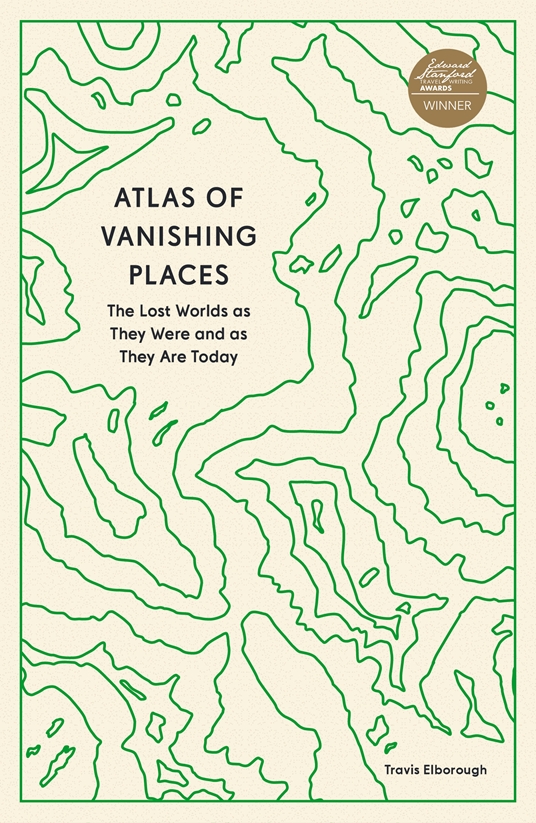
ATLAS OF VANISHING PLACES, great travel-guide gift that was the Illustrated Book of the Year - Edward Stanford Travel Writing Awards


ATLAS OF VANISHING PLACES: The Lost Worlds as They Were and as They are Today (Unexpected Atlases series)
TRAVIS ELBOROUGH; Cartography by Martin Brown
White Lion Publishing (non-affiliate Amazon link)
$15.99 trade paper, available now

Rating: 4.5* of five

The Publisher Says: Maps offer us a chance to see not just how our world looks today, and how it once looked. But what about the places that have vanished from modern atlases? With beautiful maps and stunning photography, Travis Elborough takes you on a voyage to all corners of the world in search of the lost, disappearing and vanished.

2020 WINNER OF THE EDWARD STANFORD TRAVEL ILLUSTRATED BOOK OF THE YEAR AWARD

Discover unusual and secret places that have disappeared from modern atlases, and revel in imagining what the world once looked like. Award-winning author Travis Elborough takes you on a fascinating voyage to all corners of the world in search of the lost, disappearing and vanished.

Unearth ancient seats of power and long-forgotten civilizations through the Mayan city of Palenque; delve into the mystery of a disappeared Japanese islet; and uncover incredible hidden sites like the submerged Old Adaminaby, once abandoned but slowly remerging.

With beautiful maps and stunning colour photography, Atlas of Vanishing Places shows these sites as they once were, together with how they look today—it’s a travel guide, a modern atlas and a passage through geography like no other: travel writing has rarely been so inspiring.

I RECEIVED A DRC FROM THE PUBLISHER VIA EDELWEISS+. THANK YOU.

My Review
: I love the idea of travel more than the reality of it. My disabilities aren't forgiving of the physical exertion of my body that travel requires. A book like this one is a grace note in a more restricted life than most are required to lead. I'm glad that I could go on these historic-site voyages with the eloquent guidance of Author Elborough.

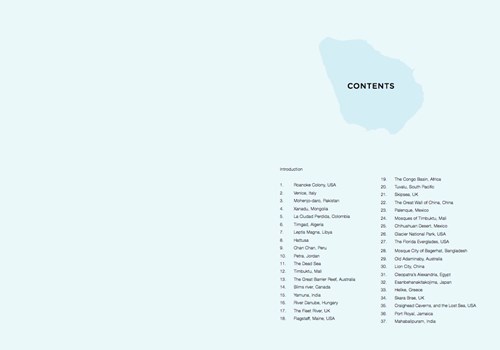
The Table of Contents is the clear road map of where we'll be going. It's always worth a close look, to gauge your giftee's interest in the book's direction.

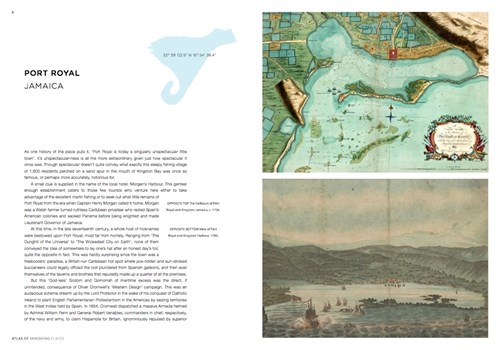
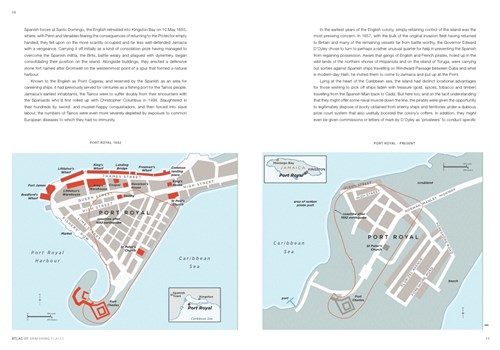
Vanished Port-Royal, Jamaica:

A modern city submerged by an earthquake? Cool beans, four hundred years later. The tragedy no longer stings but the place is a fascinating reminder of what can happen to human places when the planet shrugs its shoulders.

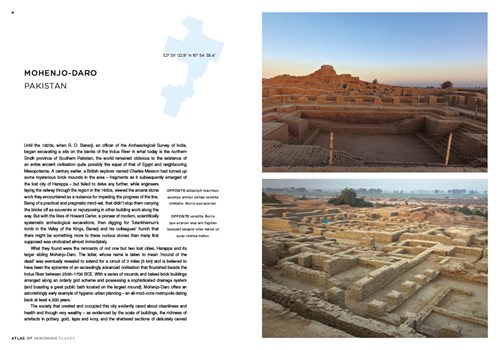
The ruins of Mohenjo-Daro in modern-day Pakistan, on the dried-up course of the ancient Indus River:

The Indus Valley civilization is deeply fascinating if very underknown in the US, and the global north generally. Comparatively little attention gets paid to it, partly because it had the misfortune to be uncovered at the same time King Tut's tomb was dominating world archaeological news. Lacking gold "treasures" and charismatic stone statuary, it simply failed to gain traction. It's never recovered in the world's attention. It is so much older than other urban centers, and well-preserved because the Indus River dried up millennia ago, so no one ever came along to reuse the land on which it stands.

Examples of Author Elborough's agenda...places vanished from our collective memory and yet still present, more or less, to be visitable. Armchair travel is, for me, the best kind. The fact that these are all places with really intriguing history attached to them is a huge plus to elderly me as a reader.

Who in your gifting circle needs this? Who needs an escape from where they are, but can't do it in body?

Here's a great value-for-dollar way to help them.