Pages
- Home
- Mystery Series
- Bizarro, Fantasy & SF
- QUILTBAG...all genres
- Kindle Originals...all genres
- Politics & Social Issues
- Thrillers & True Crime
- Young Adult Books
- Poetry, Classics, Essays, Non-Fiction
- Science, Dinosaurs & Environmental Issues
- Literary Fiction & Short Story Collections
- Sookie Stackhouse/Southern Vampire Books & True Blood
- Books About Books, Authors & Biblioholism
Showing posts with label anti-corporatism. Show all posts
Monday, December 1, 2025
PIGEONS!: A Fable For Our Times, and many others throughout history
PIGEONS!: A Fable For Our Times
MARC CHALVIN
Street Noise Books (non-affiliate Bookshop.org link)
$25.99, available now
Rating: 4.5* of five
The Publisher Says: A contemporary political allegory of power, to remind us of the dangers of following a dictator and surrendering your freedom.
Life is simple for the pigeons. They have no desire to contemplate their future or take control of it. Free from responsibility, they are all too willing to submit to a strong authority. This is precisely what a cruel and power-hungry crow was waiting for—a perfect opportunity to wield his natural talents as a tyrant. The crow enforces law and order, but also terror and arbitrary rules. Everyone seems to accept this situation—or maybe, they are too scared to resist. Until an idealistic seagull steps in, determined to challenge the system through debate and free elections.
I RECEIVED A DRC FROM THE PUBLISHER VIA EDELWEISS+. THANK YOU.
My Review: I really think everything I could say would be superfluous...if you wonder, like me, WHY people choose authoritarian social orders with such alacrity and frequency, this is your answer. Only told with sequential artwork, featuring pigeons.
Now look at the art.
I could go on, the publisher's been very generous with art for publicity, but I feel my point is made. Wisecracking birds in thrall to an authoritarian bird might make some of this make some sense.
Mostly I think the graphic-novel medium will let some messages slide through your at-risk young male giftee's defenses. It sure as hell can't hurt, it's cheap as a psychic inoculation against authoritarian/fascist bullshit goes.
Saturday, October 11, 2025
A SILENT FURY: The El Bordo Mine Fire, in case you wondered why Mexicans do not love the US
A SILENT FURY: The El Bordo Mine Fire
YURI HERRERA (tr. Lisa Dillman)
And Other Stories (non-affiliate Bookshop.org link)
$13.95 paperback, available now
Rating: 3.5* of five
The Publisher Says: On March 10, 1920, in Pachuca, Mexico, the United States Smelting, Refining and Mining Company―the largest employer in the region, and known simply as the Company―may have been guilty of murder.
The alert was first raised at six in the morning: a fire was tearing through the El Bordo mine. After a short evacuation, the mouths of the shafts were sealed. Company representatives hastened to assert that “no more than ten” men remained in the shafts at the time of their closure, and Company doctors hastened to proclaim them dead. The El Bordo stayed shut for six days.
When the mine was opened there was a sea of charred bodies―men who had made it as far as the exit, only to find it shut. The final death toll was not ten, but eighty-seven. And there were seven survivors.
Now, a century later, acclaimed novelist Yuri Herrera has carefully reconstructed a worker’s tragedy at once globally resonant and deeply personal: Pachuca is his hometown. His sensitive and deeply humanizing work is an act of restitution for the victims and their families, bringing his full force of evocation to bear on the injustices that suffocated this horrific event into silence.
I RECEIVED A DRC FROM THE PUBLISHER VIA EDELWEISS+. THANK YOU.
My Review: Short, sharp bark of outrage at a century's remove. Corporate personhood was taking shape as this nightmarish dereliction of responsibility and duty of care took place; no punishment, no justice, not even the cold, uncaring offer of cash recompense was ever levied. Certainly none was offered.
Yuri Herrera's emotional recounting of these events is short, never easy to read, and quite possibly better in theory than practice. I agree with his points, and yet was feeling hectored by the read. Might better've been a novel, with the incandescent outrage presented from multiple PoVs.
As it is, this is an anticapitalist screed for those of us already on the pews.
Thursday, September 4, 2025
YOSS'S PAGE: A PLANET FOR RENT, bitterly personal takedown of capitalist tourism, & RED DUST, same except it's law'n'order/security
RED DUST
YOSS (tr. David Frye)
Restless Books (non-affiliate Bookshop.org link)
$14.99 ebook, available now
Rating: 4* of five
The Publisher Says: From beloved Cuban science fiction author Yoss comes a bitingly funny space-opera homage to Raymond Chandler, about a positronic robot detective on the hunt for some extra-dangerous extraterrestrial criminals.
On the intergalactic trading station William S. Burroughs, profit is king and aliens are the kingmakers. Earthlings have bowed to their superior power and weaponry, though the aliens—praying-mantis-like Grodos with pheromonal speech and gargantuan Collosaurs with a limited sense of humor—kindly allow them to do business through properly controlled channels.
That’s where our hero comes in, name of Raymond. As part of the android police force, this positronic robot detective navigates both worlds, human and alien, keeping order and evaporating wrongdoers. But nothing in his centuries of experience prepares him for Makrow 34, a fugitive Cetian perp with psi powers. Meaning he can alter the shape of the Gaussian bell curve of statistical probability—making it rain indoors, say, or causing a would-be captor to shoot himself in the face. Raymond will need all his training—and all his careful study of Chandler’s hardbitten cops—to meet his match.
As he did in his brilliantly funny and sharp science-fiction parables A Planet for Rent, Super Extra Grande, and Condomnauts, Yoss makes the familiar strange and the strange familiar in Red Dust, giving us an unforgettable half-human hero and a richly imagined universe where the bad guys are above the laws of physics.
I RECEIVED A DRC FROM THE PUBLISHER VIA EDELWEISS+. THANK YOU.
My Review: Raymond (short for Raymond Chandler), a pozzie living on space station William S. Burroughs of the Galactic Trade Confederation, presses an already-imprisoned Gaussical into helping him catch a fellow Gaussical whose probability-bending is getting too greedy. Raymond believes like will call to like, and trusts he's Philip Marlowe not Miles Archer.
If none of that made sense, but you're still intrigued, sign up for this voyage of the Cuban-registered spaceship Yoss powered by much the same sense of absurdity that powered Douglas Adams to fame and fortune. Only he wrote it in Spanish. Lots of kinetic to-and-fro, lots of pseudo-hardboiled dialogue, innumerable odd lifeforms (the Gaussians, psionically gifted Cetian benders of probability, are my favorites but are not alone) pack the under-two-hundred pages set in the same fictional universe as A Planet for Rent (q.v.) very full.
Too full, most likely; and almost entirely male, so the misogyny Yoss is known for doesn't flare up. But don't think he's at a loss for slurs! Or any other colorful language, this man's right up there in the inventiveness standings. While I just said the short book's maybe a bit too packed, it's not filler...but it's also not moored onto a solid foundation unless you have read A Planet for Rent. They are not interconnected in plot or characters, but in background assumptions like Humanity's made up of wildly unpredictable, untrustworthy wild cards who need watching and controlling for their own good. (And their overlords' profit.) And our pozzie Raymond (positronic-brained android) is part of the machinery that keeps conflict between Humanity and the Xenoids to a dull roar. It's because of that the fascination with Raymond Chandler got hold of MSX-3482-GZ. We're all friends so let's use keynames, though. Sets the proper tone. As the events unfold we should be getting set up for the two Gaussians (you know, Gauss? numerical analysis, conformal mapping, all that stuff y'all already know too much about for me to go into it) confronting each other with one (reluctantly) representing Order and one not. And it never happens. Fifth star gone.
Rooted in Yoss's experiences of the 1990s collapse of socialist Cuba, his well-founded mistrust and anger at capitalism is loud and clear in the stories that precede this novella, where they reach a high shine. It's clear to me that the loud clanging of alarm bells in these two titles should have been heeded quite a while ago.
Best ten years ago; second-best, today.
+++++++++++++++++++++++++++++++++++++++++++++++++++++++++++++++
A PLANET FOR RENT
YOSS (tr. David Frye)
Restless Books
$14.99 ebook, available now
Rating: 4* of five
The Publisher Says: Out of the modern-day dystopia of Cuba comes an instant classic from the island’s most celebrated science fiction author: a raucous tale of a future in which a failing Earth is at the mercy of powerful capitalist alien colonizers.
In A Planet for Rent, Yoss critiques life under Castro in the ‘90s by drawing parallels with a possible Earth of the not-so-distant future. Wracked by economic and environmental problems, the desperate planet is rescued, for better or worse, by alien colonizers, who remake the planet as a tourist destination. Ruled over by a brutal interstellar bureaucracy, dispossessed humans seek better lives via the few routes available—working for the colonial police; eking out a living as black marketeers, drug dealers, or artists; prostituting themselves to exploitative extraterrestrial visitors—or they face the cold void of space in rickety illegal ships.
This inventive book marks the English-language debut of an astonishingly brave and imaginative Latin American voice.
I RECEIVED AN ARC FROM THE PUBLISHER. THANK YOU.
My Review: The Intergalactic League has been to Earth, has looked around, and has decided this shithole of a place is good for sex work and raw materials. The Planetary Tourism Authority licenses the visitors under some (largely notional not actual) rules, including the ready availability of Body Spares (humans to be...inhabited) for tourists who can't handle our atmosphere.
It's not terribly subtle; it is terribly biting. As satire often is.
Your tolerance for the howling outrage of a man who's seen his country get so desperate that it encouraged the "mulatta" women to become sex workers to balance the country's economic health on their bodies will determine your pleasure in the read.
Every facet of the capitalist colonization of "smaller" countries is brought into angry focus as the Xenoids, our spacefaring overlords, best us at sports we've never heard of, as they watch eagerly while a human performance artist uses his own, slow and painful, suicides (assisted by their superior technology to remain alive and reassemble afterwards) as artistic statements they can savor; most horribly, and pointedly, there is Buca, a Social (sex) worker, who's headed offworld with her Xenoid client to...nope. That one you need to read.
It is chilling to think immigrants to capitalist countries are sufficiently desperate to see what they know awaits them as preferable to what they're leaving.
And we, obliviously, heap more and worse atop them. It cannot last forever. Read about it from the other side, see at last why that's so.
Saturday, April 5, 2025
THE FOURTH CONSORT, latest sci-fi funfest with a serious well-made point from Edward Ashton

THE FOURTH CONSORT
EDWARD ASHTON
St. Martin's Press (non-affiliate Amazon link)
$14.99 ebook, available now
Rating: 4* of five
The Publisher Says: A new standalone sci-fi novel from Edward Ashton, author of Mickey7 (the inspiration for the major motion picture Mickey 17).
Dalton Greaves is a hero. He’s one of humankind’s first representatives to Unity, a pan-species confederation working to bring all sentient life into a single benevolent brotherhood. That’s what they told him, anyway. The only actual members of Unity that he’s ever met are Boreau, a giant snail who seems more interested in plunder than spreading love and harmony, and Boreau’s human sidekick, Neera, who Dalton strongly suspects roped him into this gig so that she wouldn’t become the next one of Boreau’s crew to get eaten by locals while prospecting.
Funny thing, though—turns out there actually is a benevolent confederation out there, working for the good of all life. They call themselves the Assembly, and they really don’t like Unity. More to the point, they really, really don’t like Unity’s new human minions.
When an encounter between Boreau’s scout ship and an Assembly cruiser over a newly discovered world ends badly for both parties, Dalton finds himself marooned, caught between a stickman, one of the Assembly’s nightmarish shock troops, the planet’s natives, who aren’t winning any congeniality prizes themselves, and Neera, who might actually be the most dangerous of the three. To survive, he’ll need to navigate palace intrigue, alien morality, and a proposal that he literally cannot refuse, all while making sure Neera doesn’t come to the conclusion that he’s worth more to her dead than alive.
Part first contact story, part dark comedy, and part bizarre love triangle, The Fourth Consort asks an important how far would you go to survive? And more importantly, how many drinks would you need to go there?
I RECEIVED A DRC FROM THE PUBLISHER VIA NETGALLEY. THANK YOU.
My Review: My god, what a place Author Ashton's head is. A ruthless, greedy giant snail, a human diplomat of murky ethics, a race of only vaguely comprehensible planetary natives so protocol-obsessed that it can be lethal to say "hello" in the wrong way...who also just so happen to have murderously invaded Earth in Dalton's lifetime. Oh, and Dalton's kinda coerced as a condition of not being killed to become the consort of their ruler. The fourth consort...and let's not get into why he's fourth.
Dalton's a Swiss-Army knife of a guy. He studied engineering...most practical people in the world, engineers...he was a soldier/POW in the invasion, a tech bro, and now works for a Galaxy-wide org that needs him as a first-contact specialist. You can see how this trajectory launched. Now that he's out doing the stuff he was hired by the Unity for, it's kind of a rude awakening. It always is when your principles and your training all get engaged with the messy, disorganzed systemless world. (That engineering background becoming even more valuable in these circs.)
What happens when the Great Awakening comes? When you are forced by events to re-evaluate everything that underpins your view of the world? You question yourself first, but assuming you're pretty well-educated, that answers only a fraction of your new questions. Permaybehaps you're not on the side of Right and Reason after all?
Poor Dalton's doing this questioning among people who will eat his flesh...his spirit's probably not very nourishing just at that moment locked as it is in crisis. His situation is rife with possibilities for own goals, and unsurprisingly there are a few. The thrust of the story, though, is the act of questioning the reality of your assumptions in the face of countervailing evidence. Dalton, using copious amounts of sarcasm and not a little facetiousness, has the courage to do this. It helps him, and us, that he's worked his whole adulthood troubleshooting systems. Better training for analysis I can't conjure.
The role of honor and duty is large in the story. Largely, it must be said, in its absence when most required. Dalton's got trouble on every side because of this absence among those meant to have his back. It resembles our own hypercapitalist world in this way. Dalton's troubles, I will say, are external; the struggling he does is, too, so I never felt I was with him in his sea of woe. I'm an observer of the results, not a participant in the process.
This is not a knock. The fact is I'm not here for that story, I'm here for a fun action-romp that takes me over some very interesting terrain. I thoroughly enjoyed seeing Dalton navigate the choppy waters of Reality in a skiff formed of principles (his) and held together by pressures (the Unity's). The story does this job very well indeed, though with rather less characterization of side characters than I prefer (hence a missing half-star) Getting us through this plot, however, militated against the time needed being spent that way. That said, I was aware of wanting to spend more time with the second and third consorts and less with his fellow Unity operative. The other missing half-star comes from Dalton's attitude of..."kindness and acceptance" sounds better than "craven lickspittle sycophancy" doesn't it...for a character who does NOT deserve it. I get why Author Ashton made that choice but I do not agree with it to the point of getting frothingly furious at the way it plays out. I shouted at my Kindle from 97% on.
On balance, which I confess I lost along the way, I was amused and entertained by our hypercapitalist snail (as a former veggie gardener I'm here to tell you a better metaphor for the kind of greedy shit who runs an economy solely for personal gain there has never been), by the second and third consorts, and the rest of the cast...telling that I can't remember their names, eh what? (Wait, "Breaker" was one, I think.)
I devoutly hope Author Ashton's name is familiar to you by now from the film of his book Mickey7 (link to my review of it above). I thought that story was terrific. I think this story is, too, with minor reservations that do not vitiate the pleasures I found in the read.
Thursday, March 20, 2025
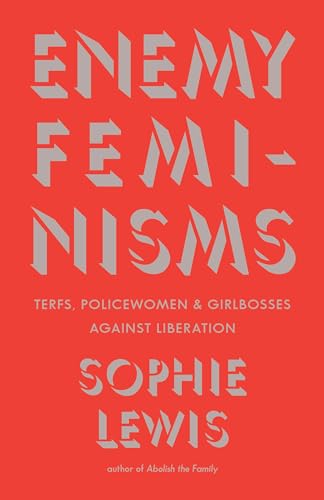
ENEMY FEMINISMS: TERFs, Policewomen, and Girlbosses Against Liberation, challenging and emotionally difficult read...necessary, too
ENEMY FEMINISMS: TERFs, Policewomen, and Girlbosses Against Liberation
SOPHIE LEWIS
Haymarket Books (non-affiliate Amazon link)
$9.99 ebook, available now
Rating: 4* of five
The Publisher Says: From the author of Abolish the Family, a provocative compendium of the feminisms we love to dismiss and making the case for the bold, liberatory feminist politics we’ll need to stand against fascism, nationalism, femmephobia, and cisness.
In recent years, “white feminism” and girlboss feminism have taken a justified beating. We know that leaning in won’t make our jobs any more tolerable and that white women have proven to be, at best, unreliable allies. But in a time of rising fascism, ceaseless attacks on reproductive justice, and violent transphobia, we need to reckon with what Western feminism has wrought if we have any hope of building the feminist world we need.
Sophie Lewis offers an unflinching tour of enemy feminisms, from 19th century imperial feminists and police officers to 20th century KKK feminists and pornophobes to today’s anti-abortion and TERF feminists. Enemy feminisms exist. Feminism is not an inherent political good. Only when we acknowledge that can we finally reckon with the ways these feminisms have pushed us toward counterproductive and even violent ends. And only then can we finally engage in feminist strategizing that is truly antifascist.
At once a left transfeminist battlecry against cisness, a decolonial takedown of nationalist womanhoods, and a sex-radical retort to femmephobia in all its guises, Enemy Feminisms is above all a fierce, brilliant love letter to feminism.
I RECEIVED A DRC FROM THE PUBLISHER VIA EDELWEISS+. THANK YOU.
My Review: Oh dear. Another excellent, necessary message to everyone in the US lost to a wide audience. I'm in the choir and I still felt hectored, lectured at, and blamed personally by the author's tone.
I did not enjoy the experience.
I can't fault Author Lewis's collection of facts or her citations. Capitalist feminism is indeed a huge existential threat to women's rights. I'd say, however, that the Cult of Mother needed a much, much more savage pounding than capitalism receives. Apparently not one of the author's targets, though, in spite of being so ready to condemn the woman-controlling bodily autonomy denial of abortion restriction.
I question how effective the chapter against "girl-boss" glamorization really is. It's gendered, but is this not a case where celebrating the still-rare sight of women in control of their economic future, and the economy in general, not worth it? I don't think this is the threat to female equality it's presented as, but it's certainly made me consider the issue in a new light. Which, come down to it, is the great strength of this book and books like it, as well as the reason I give it four stars.
So it's style, not substance, that I find unwelcoming and unpleasant. That does not mean I didn't take a lot of positive information, and a hefty amount of psychic homework, away from the read. I found her challenging the hidden enemy in us all bracing and grounds for a lot of self-reflection. Ironic given my whinging about her tone, I know, but in a review for readers I'm not aiming for critical standards of an essay but information, and I hope a shove to get it and read it, for the laity.
Friday, February 2, 2024
THE CANCER FACTORY: Industrial Chemicals, Corporate Deception, and the Hidden Deaths of American Workers
JIM MORRIS
Beacon Press
$29.95 hardcover, available now
Rating: 5* of five
The Publisher Says: The story of a group of Goodyear Tire and Rubber workers fatally exposed to toxic chemicals, the lawyer who sought justice on their behalf, and the shameful lack of protection our society affords all workers
Working at the Goodyear Tire and Rubber Company chemical plant in Niagara Falls, New York, was considered a good job. It was the kind of industrial manufacturing job that allowed blue-collar workers to thrive in the latter half of the 20th century—that allowed them to buy their own home, and maybe a boat for the lake.
But it was also the kind of job that gave you bladder cancer.
The Cancer Factory tells the story of the workers who experienced one of the nation's worst, and best-documented, outbreaks of work-related cancer, and the lawyer who has represented the bladder-cancer victims at the plant for more than thirty years, as well as the retired workers who have been diagnosed with the disease and live in constant fear of its recurrence.
In doing so it tells a story of corporate malfeasance and governmental neglect. Workers have only weak protections from exposure to toxic substances in America, and regulatory breaches contribute to an estimated 95,000 deaths from occupational illness each year. Goodyear, and its chemical supplier, Dupont, knew that two of the chemicals used in the plant had been shown to cause cancer, but made little effort to protect the plant's workers until the cluster of bladder cancer cases—and deaths—was undeniable. Based on four decades of reporting and delving deeply into the scientific literature about toxic substances and health risks, the arcana of worker regulations, and reality of loose enforcement, The Cancer Factory exposes the sometimes deadly risks too many workers face.
I RECEIVED A DRC FROM THE PUBLISHER VIA EDELWEISS+. THANK YOU.
My Review: The problems of a corporatized economy are multitudinous. One of the biggest is the existence of actual, unkillable zombies: the artificial persons we call corporations. The existence of corporations is not, by itself, evil or even provocative of evil. What happens, though, when one endows a legal fiction with personhood without accountability or mortality is that it never develops morality or empathy.
No entity that could look at the actual people whose lives were ruined, or ended, by the awfulness that is bladder cancer, know that the actions to prevent others from suffering like fates were within its power to enact, and not do it because it might hurt profits, has any business whatsover being given "rights" to free speech or anything else. But that is what the legal fiction of corporate personhood does. The managers and legal eagles who fought the enactment of even the most minimal safety regulations are actual people and can be held accountable. The corporation is the source of the culture that encouraged these people not to see the suffering of actual human beings as a reality to be valued as highly as they saw more money...money they would share in minimally, if at all. They, in their fiduciary duty to the corporation, did not see human life as more worthy of protection and duty of care than corporate profits, and as these corporations are not real people but only fictions, this is utterly outside any system of moral accountability.
Fines, sanctions, no kind of economic penalty can train a corporation not to see its eternal quest for MORE as evil and as detrimental to the world as it is, because it is a gestalt, a culture, not a human being. The human beings who make up the corporations' staff and management can all, plausibly, point to the fact they are just following orders.
So was Adolf Eichmann.
This book, using decades of reporting, writing, and reasearch of the author's own and also from many sources, makes the case for abolishing corporate personhood indirectly and compellingly by bringing to life the consequences of profits before people in a dangerous, necessary business through personal stories of its victims. There are no innocents here...people needed jobs and ignored the evident consequences to get the paychecks. The problem isn't one way only. The problem is the widely pervasive mindset that enables such oblivious, unchecked greed to flourish.
But what about the law, the regulations that exist to protect the people who handle dangerous chemicals? Yes, indeed...what about them. First, does the substance meet the standards to have a regulation in place to restrict who can handle it and how they can do it? The steps needed to prove that exact regulation is needed must take place in specific ways and have specific thresholds of evidence met for regulations to be drafted at all...that involves both the maker and the user of the substance, who have entire law firms lying, obfuscating, paying off whoever needs paying off to prevent the regulations from taking place for as long as it can be avoided while more profits are stockpiled. Then there are the regulators...subject to bought-and-paid-for politicians' oversight, aka interference, delaying and derailing as much as possible while more profits are stockpiled. More lives lost, more havoc rained on the workers, who don't leave their jobs desite the evident hazards because they need the paychecks, even though evidence mounts that the jobs are killing them...literally. All while more profits are stockpiled.
So a regulation finally, grudgingly, attenuatedly takes effect. Who enforces it? The corporation, and this obvious conflict of interest is lightly supervised by a staff of very very overstretched regulatory enforcers usually drawn from the regulated industry...as often as not from the violator corporation. All of whom answer to the corrupted-by-corporate-money politicians and their appointees.
Does the magnitude of the problem begin to dawn on you?
This book does what I can't do in a review. It marshals sources and resources for you to look at the facts and make your own judgments about the nature of the corporate entities, as they present themselves in relation to workers they can no longer deny harming. It's been established in courts of several levels of jurisdiction. The journalists, activists, and the lawyers who worked with the victims to get them justice and compensation for the abusive practices used by their employers are much to be lauded. They are not, however, teaching a human being by imposing consequences on them. They are inconveniencing entities that are without minds or consciences in their profit-taking, and in their one effectively attackable weak spot: public reputation.
Bad reputation is the one way to punish the entities who remorselessly, repeatedly, and knowingly enact all the harms detailed in this book. They have used giant, costly media campaigns...that you pay for with higher prices...to distract and misinform you as they move the plants that cause this havoc to powerless minority communities, or countries that have even less regard than the US for their peoples' health.
If there is a solution to this problem, I do not know of it.
Monday, July 19, 2021
TWO COLD-WAR SF STORIES, "The Last Crusade" and "Baby"
THE LAST CRUSADE
GEORGE H. SMITH
IF: WORLDS OF SCIENCE FICTION
February 1955 edition, pages 74-85, free Project Gutenberg download at link above
Rating: 4* of five
My friend Joachim Boaz has a review of this title on his site as part of a Terry Carr collection. It's a Cold War dystopian tale of the futile and self-perpetuating nature of that conflict. Clearly George H. Smith, largely forgotten today, was a clear-eyed observer of the idiocies of the 1950s. As the world was moving faster and faster, and the role of technology in it was increasing, Smith's was a reasonable near-future projection of soldiers contained in full-service "mecho-suits." The battleships on legs that they're isolated from the world they're destroying within...our narrator even touches briefly on the fact that he has no idea what any of his fellow soldiers look like, sealed inside their battle- and life-support pods, and has stopped caring...seemed practical, desirable. And true to Smith's sexual fixation, he even tosses (!) in the speculation that "Realie TV" will supply the men (of course) sealed up with, um, services like there were "girls" right there in the pods with them. Southern-born Smith wrote more extensive sexual SF, as well as a reverse-PoV version of Doctor Strangelove about a rogue Russian general who launches an atomic attack on the US.
The military, as personified by our ignorant grunt narrator and a pointed parody General called "Fightin' Joe Mac Williams" (who is clearly the performative battle-boy Douglas MacArthur, he of the famous "I shall return" speech and the chestful of medals) does not get the standard Cold-War adulation. Here that stupidity is beautifully lampooned by the narrator listening to a speech that he knows will cause a lot of death in this Paris, barely even sketched in, that we're told is the scene of the action: "A voice that used to sell us bath soap is selling us war."
The story appeared in 1955, shortly after the Korean War that MacArthur famously wanted to run very differently from then-President Truman, and got himself fired for insubordination as he went public with their differences. It was a case of being kicked upstairs, though, as MacArthur landed a role as leader of defense contractor and computer innovator Remington Rand, whose main business was in typewriter sales at that time. MacArthur, the War Hero as he would never, ever hesitate to remind you, taking such a deeply civilian job as selling typewriters and electric razors, was the source of the dig I quoted above. The dénouement takes place in the Louvre...and it's really nothing less than heart-breaking, if heavy-handed, in delivering its (more suited to the Sixties) message: What are we fighting for, again?
In all, I was very pleased to follow Dr. B down this weird little side-path of SF history, learn more about a writer I feel sure I'd never read a single word by before now, and renew my Cold War memories of people and events now dusty with the uninterest of the modern audience.
+++++++++++++++++++++++++++++++++++++++++++++++++++++++++++++++++
BABY
CAROL EMSHWILLER
The Magazine of Fantasy and Science Fiction
February 1958 edition, free to read on pages 114 to 128 linked above
Rating: 5* of five
My friend Joachim Boaz is reading through the short fiction of Carol Emshwiller...his review of this story is here.
Possibly the bleakest story I've ever read. This is the end of days, the end of Humanity...and it's all our fault. Our creations, those meant to care for us, have long outlived their responsibilities and, while executing irrelevant or now-harmful duties, are making the world impossible for us to live in.
Emshwiller and her compatriots warned us. And, while it doesn't look precisely like she predicted, the events of the present year are seriously in line with the predictions she made sixty-three years ago. I'm never quite sure the world's failing is real; then I read this, the systems slowly collapsing, the zombies of Reassurance and Normality trying to wish away the plague and the increasingly obvious shortages. I'm not crazy after all. (Well, yes I am, but not in the "lost-to-reality" way...more's the pity.)
Baby's young-adult body, not equipped with an education or a language to handle the new world he lives in, is naked and vulnerable to the world, acted on without his consent and/or despite his resistance as the zombie systems try the same solutions for the new problems. They fail utterly to help. The man is starving. The man is going to die.
It's 1958, so he Finds a Woman (called Honey) and Has a Purpose. Let's just put that down to the poison of the era, nothing can exist outside the Binary Amen World Without End, and draw a line under it.
The larger story of Baby is the resources of the planet will only last so long. When we run out of what we think we need, what will we be able to do about it when we have no knowledge to create anything new? And from what resources we have, are we going to allocate them and use them equitably? After all, Baby set out on his voyage of discovery because he was starving and Honey still has food. The Central that Baby invokes (I'd say "prays to" if he'd ever had a concept of Divinity) doesn't run properly anymore or he'd have supplies. The chocolate pie he eats in House 76 at the beginning of the story stands in for Emshwiller's ever-so-American suspicion of a central planner with the authority to do things for you. "And when it fails?" she asks without subtlety.
It's not at all a bad question to ask...Baby and Honey are as infantilized as I fear most people are becoming as the educational fads of today fail to prepare them even to read fluidly. (Read my review of this book.) Of course the automated Library has failed Baby and his Guardians, too...as I'm hugely dependent on my ereader, I recognize with no small trepidation how vulnerable that leaves me to technological disruptions that are, quite frankly, inevitable. I hope to be dead before they bite too hard....
But Emshwiller's main achievement in these dozen pages is really more impressive than simply Cassandra-ing up a future we should all dread. What she did was, as a woman, tell a story in a misogynistic field to readers not predisposed to like the way she presents it...Cold War SF fans...and without making it Sentimental. (Still ignoring Honey.) She did, ironically, marry and have kids shortly after this piece appeared and was silenced for almost an entire decade by the life of a Wife and Mother. She also came back from that silence, see her bibliography. This voice spoke wisdom, and did not stop speaking it. Seek her work out.
Sunday, January 22, 2017
FOOL ME TWICE, a truly scary look at the organized, cynical, and disturbingly effective war on science...all kinds of science
FOOL ME TWICE: Fighting the Assault on Science in America
SHAWN LAWRENCE OTTO
Rodale Books
$25.99 hardcover, available now
Rating: 4.5* of five
The Publisher Says: "Whenever the people are well informed,” Thomas Jefferson wrote, “they can be trusted with their own government.” But what happens in a world dominated by complex science? Are the people still well-enough informed to be trusted with their own government? And with less than 2 percent of Congress with any professional background in science, how can our government be trusted to lead us in the right direction?
Will the media save us? Don't count on it. In early 2008, of the 2,975 questions asked the candidates for president just six mentioned the words "global warming" or "climate change," the greatest policy challenge facing America. To put that in perspective, three questions mentioned UFOs.
Today the world’s major unsolved challenges all revolve around science. By the 2012 election cycle, at a time when science is influencing every aspect of modern life, antiscience views from climate-change denial to creationism to vaccine refusal have become mainstream.
Faced with the daunting challenges of an environment under siege, an exploding population, a falling economy and an education system slipping behind, our elected leaders are hard at work ... passing resolutions that say climate change is not real and astrology can control the weather.
Shawn Lawrence Otto has written a behind-the-scenes look at how the government, our politics, and the media prevent us from finding the real solutions we need. Fool Me Twice is the clever, outraged, and frightening account of America’s relationship with science—a relationship that is on the rocks at the very time we need it most.
My Review:
This book is exactly as tendentious as my book report is. If you don't already agree with its premise, then you're unlikely to consider picking it up. Which is a pity, in my view. For those of us who already agree, this acts either as a call to arms, or a horribly depressing reminder of how the New Dark Ages have already begun. For make no mistake: Stupidity has more gravity than intelligence, and hate has more brightness than enlightenment. Science has proven too many times that mass and heat always win for me to have any significant hope that Good will triumph over Willful Ignorance:
Please prove me wrong. Read this book and get energized to fight the Yahoos. Please. We must try to re-establish science as the basis for increasing American freedom and for providing a solid foundation for the future. We are no longer in an age where just one more coal-fired powerplant or one more high-tech deep-sea trawler that ravages ecosystems we know nothing about won't make an impact on the ancient concept of the “common property of humankind.” I am appalled at the stupidity and/or greed of politicians and those who voted for them who fail to understand this universal benefit argument that "[t]he evidence shows that successful regulations that define a fair trade in the commons do not reduce freedom, they increase it."
That dream, that beautiful vision of a planet run for the best possible results of our individual actions resulting in a healthy world for all of its people, has always been a motivating factor for the bulk of the scientists I've known personally or known of professionally. How much more elegant it is to imagine a world with intact ecosystems that offer the humanity we create abundantly and thoughtlessly sustenance, health, a future as good as or better than the present:
SHAWN LAWRENCE OTTO
Rodale Books
$25.99 hardcover, available now
Rating: 4.5* of five
The Publisher Says: "Whenever the people are well informed,” Thomas Jefferson wrote, “they can be trusted with their own government.” But what happens in a world dominated by complex science? Are the people still well-enough informed to be trusted with their own government? And with less than 2 percent of Congress with any professional background in science, how can our government be trusted to lead us in the right direction?
Will the media save us? Don't count on it. In early 2008, of the 2,975 questions asked the candidates for president just six mentioned the words "global warming" or "climate change," the greatest policy challenge facing America. To put that in perspective, three questions mentioned UFOs.
Today the world’s major unsolved challenges all revolve around science. By the 2012 election cycle, at a time when science is influencing every aspect of modern life, antiscience views from climate-change denial to creationism to vaccine refusal have become mainstream.
Faced with the daunting challenges of an environment under siege, an exploding population, a falling economy and an education system slipping behind, our elected leaders are hard at work ... passing resolutions that say climate change is not real and astrology can control the weather.
Shawn Lawrence Otto has written a behind-the-scenes look at how the government, our politics, and the media prevent us from finding the real solutions we need. Fool Me Twice is the clever, outraged, and frightening account of America’s relationship with science—a relationship that is on the rocks at the very time we need it most.
My Review:
Ideology and rhetoric increasingly guide policy decision, often bearing little relationship to factual reality. And the America we once knew seems divided and angry, defiantly embracing unreason.The most unnerving reality in today's social, political, and educational reality is that science, which you are benefiting from this very second as you read this review on the internet, is underfunded, undertaught, and underapprecitaed by the people of the USA and their political overlords. The reason for this is that an insane religious know-nothingism has infected the Body Politic with a conservative (in the worst possible meaning of that never-good term) resistance to accepting reality as it is, instead of how one fancies it should be. This book quantifies the horrors on their way down the pike as this horrifying metastatic stupidity continues unchecked and even promoted by the small-souled fear-mongering Yahoos, in the original Swiftian sense, who shout and rail and spew on Fox "News" and the related echo chambers. The author explores some psychological mechanisms of belief as it relates to the acceptance of authority, which really helps illuminate why the doomsday warnings about ignoring climate change only seem to make the religious authoritarians more resistant to the mounting—burgeoning!—evidence of its current reality. Otto then provides specific suggestions that could lead to more effective ways to address the concerns of these people, allowing for a rational debate and increasing the likelihood that some kind of useful agreement could be reached:
"When a person holds a belief, especially a strong one that is linked to important values (e.g. some sociopolitical beliefs), information threatening that belief creates inconsistency in the cognitive system that threatens one's self-image as a smart person. This produces an unpleasant emotional state." That belief resistance—and this is a critically important point—is largely coming from the adult ideological worldview. This is why education is political in the first place, and why the children of scientists are the most likely next generation of scientists—and effect that is slowly striating society into knowledge haves and have-nots and can only increase partisanship along science lines.
This book is exactly as tendentious as my book report is. If you don't already agree with its premise, then you're unlikely to consider picking it up. Which is a pity, in my view. For those of us who already agree, this acts either as a call to arms, or a horribly depressing reminder of how the New Dark Ages have already begun. For make no mistake: Stupidity has more gravity than intelligence, and hate has more brightness than enlightenment. Science has proven too many times that mass and heat always win for me to have any significant hope that Good will triumph over Willful Ignorance:
Espousing the anti-science argument, that the lack of absolute certainty that something is true is grounds for inaction or doubt, or that we should hear out all perspectives equally, is evidence of either a lack of understanding of reason or motivation by an unreasonable agenda. Such people should not be trusted with making decisions that will have serious impacts upon others.
Please prove me wrong. Read this book and get energized to fight the Yahoos. Please. We must try to re-establish science as the basis for increasing American freedom and for providing a solid foundation for the future. We are no longer in an age where just one more coal-fired powerplant or one more high-tech deep-sea trawler that ravages ecosystems we know nothing about won't make an impact on the ancient concept of the “common property of humankind.” I am appalled at the stupidity and/or greed of politicians and those who voted for them who fail to understand this universal benefit argument that "[t]he evidence shows that successful regulations that define a fair trade in the commons do not reduce freedom, they increase it."
That dream, that beautiful vision of a planet run for the best possible results of our individual actions resulting in a healthy world for all of its people, has always been a motivating factor for the bulk of the scientists I've known personally or known of professionally. How much more elegant it is to imagine a world with intact ecosystems that offer the humanity we create abundantly and thoughtlessly sustenance, health, a future as good as or better than the present:
In the end this is what matters most: the beauty. It's why scientists do science: to apprehend the great beauty of nature. They are Puritans, four hundred years hence, with more data, but still searching for that direct communion with wonder an the aesthetic. In this way science is not unlike art or religion. In fact art often anticipates and reflects the forms science discovers, as does religion. Science is much bigger than just solving challenges, as important as they are. It is about who we are as human beings, about or ability to love, to wonder, to imagine, to heal, to care for one another, to create a better future, to dream of things unseen.
Friday, January 20, 2017
ROSSET, the memoir of the man who made America safe for porn
ROSSET: My Life in Publishing and How I Fought Censorship
BARNEY ROSSET
OR Books
$10 ebook platforms, available now
Rating: 5* of five
The Publisher Says: Genet…Beckett…Burroughs…Miller…Ionesco, ÅŒe, Duras. Harold Pinter and Tom Stoppard. Hubert Selby Jr. and John Rechy. The legendary film I Am Curious (Yellow). The books that assaulted the fort of propriety that was the United States in the 1950s and ’60s, Lady Chatterley’s Lover and The Tropic of Cancer. The Evergreen Review. Victorian “erotica.” The Autobiography of Malcolm X. A bombing, a sit-in, and a near-fistfight with Norman Mailer. The common thread between these disparate elements, a number of which reshaped modern culture, was Barney Rosset.
Rosset was the antidote to the trope of the “gentleman publisher” personified by other pioneering figures of the industry such as Alfred A. Knopf, Bennett Cerf and James Laughlin. If Barney saw a crowd heading one way—he looked the other. If he knew something was forbidden, he regarded it as a plus. Unsurprisingly, financial ruin, along with the highs and lows of critical reception, marked his career. But his unswerving dedication to publishing what he wanted made him one of the most influential publishers ever.
Rosset began work on his autobiography a decade before his death in 2012, and several publishers and a number of editors worked with him on the project. Now, at last, in his own words, we have a portrait of the man who reshaped how we think about language, literature—and sex. Here are the stories behind the filming of Norman Mailer’s Maidstone and Samuel Beckett’s Film; the battles with the US government over Tropic of Cancer and much else; the search for Che’s diaries; his romance with the expressionist painter Joan Mitchell, and more.
At times appalling, more often inspiring, never boring or conventional: this is Barney Rosset, uncensored.
***I RECEIVED A REVIEW COPY FROM OR BOOKS. THANK YOU!***
My Review: Today is a dark day for me personally. A person I do not respect, in fact one I disrespect with a virulence approaching hatred, is taking the oath of office of the presidency of the United States of America. Appallingly enough, I am required by my conscience to wish this person good health and godspeed because, in the event of his demise, impeachment, or removal from this mortal coil, a worse person will assume the most powerful political office in the country and possibly the entire world.
Barney Rosset, had he lived, would be likely to take some loud and public and effective action in opposition to this horrible eventuality. Barney was a mouthy old bastard. Barney was an opponent of kakistocracy, an enemy of the brummagem and the bloated, overblown, pretentious, and useless in life and art. His life-long battle against the booboisie wouldn't have allowed him to remain silent in the teeth of the gale of poisonous poltroonery emitted by the president elect.
I was only acquainted with Barney for a short while in the 1990s. In the course of my work as a literary agent, his company Foxrock Books published Lo's Diary, a companion piece to Vladimir Nabokov's immortal Lolita. As the book was not a critical success in the US, my company's efforts to vend its paperback rights were unavailing. I'm still saddened and puzzled by this wrong-headed reception by US readers. Be that as it may, Barney's taste as a publisher was on clearest possible display at that point just as clearly as it was when he went to war with the United States Post Office to ensure US citizens legal and unrestricted access to literary greats like Henry Miller and D.H. Lawrence.
Reading this memoir of one of the great iconoclasts of the 20th century was heartening to me in a way I cannot overstate. Barney faced the entire weight of the conservative establishment from the moment he made his first film, Strange Victory, to the moment he relinquished the reins of this life in 2012. He never stopped until he stopped forever. And that, my friends and neighbors, is a fable for me to guide the next four years of my own life. No less a scion of privilege than Barney himself, can I do less than my honored predecessor did in my pursuit of a world more open and liberal than it is? I want to do as much as Barney did, but I can't jump the height of the bar he set. I don't think many people of any age or station can.
I am most definitely inspired to try. I am most certainly heartened to face up to the battle against the gravity of the least and the last and the lowest that is even now doing its dead-level best to make America great at hate again. Or greater at it than it already is.
Buy this book, read it, and take heart from the fact that this battle we face is but one more in a war our elders and betters have fought before us. They succeeded; they failed; they changed and couldn't change and, most important to remember on this dark, difficult day, they did not give up and give in and give way.
Please help everyone, and I mean everyone, even those who don't see it as help, to stand up and stand for that most American of values: Personal liberty.
#ReadingIsResistance
BARNEY ROSSET
OR Books
$10 ebook platforms, available now
Rating: 5* of five
The Publisher Says: Genet…Beckett…Burroughs…Miller…Ionesco, ÅŒe, Duras. Harold Pinter and Tom Stoppard. Hubert Selby Jr. and John Rechy. The legendary film I Am Curious (Yellow). The books that assaulted the fort of propriety that was the United States in the 1950s and ’60s, Lady Chatterley’s Lover and The Tropic of Cancer. The Evergreen Review. Victorian “erotica.” The Autobiography of Malcolm X. A bombing, a sit-in, and a near-fistfight with Norman Mailer. The common thread between these disparate elements, a number of which reshaped modern culture, was Barney Rosset.
Rosset was the antidote to the trope of the “gentleman publisher” personified by other pioneering figures of the industry such as Alfred A. Knopf, Bennett Cerf and James Laughlin. If Barney saw a crowd heading one way—he looked the other. If he knew something was forbidden, he regarded it as a plus. Unsurprisingly, financial ruin, along with the highs and lows of critical reception, marked his career. But his unswerving dedication to publishing what he wanted made him one of the most influential publishers ever.
Rosset began work on his autobiography a decade before his death in 2012, and several publishers and a number of editors worked with him on the project. Now, at last, in his own words, we have a portrait of the man who reshaped how we think about language, literature—and sex. Here are the stories behind the filming of Norman Mailer’s Maidstone and Samuel Beckett’s Film; the battles with the US government over Tropic of Cancer and much else; the search for Che’s diaries; his romance with the expressionist painter Joan Mitchell, and more.
At times appalling, more often inspiring, never boring or conventional: this is Barney Rosset, uncensored.
***I RECEIVED A REVIEW COPY FROM OR BOOKS. THANK YOU!***
My Review: Today is a dark day for me personally. A person I do not respect, in fact one I disrespect with a virulence approaching hatred, is taking the oath of office of the presidency of the United States of America. Appallingly enough, I am required by my conscience to wish this person good health and godspeed because, in the event of his demise, impeachment, or removal from this mortal coil, a worse person will assume the most powerful political office in the country and possibly the entire world.
Barney Rosset, had he lived, would be likely to take some loud and public and effective action in opposition to this horrible eventuality. Barney was a mouthy old bastard. Barney was an opponent of kakistocracy, an enemy of the brummagem and the bloated, overblown, pretentious, and useless in life and art. His life-long battle against the booboisie wouldn't have allowed him to remain silent in the teeth of the gale of poisonous poltroonery emitted by the president elect.
I was only acquainted with Barney for a short while in the 1990s. In the course of my work as a literary agent, his company Foxrock Books published Lo's Diary, a companion piece to Vladimir Nabokov's immortal Lolita. As the book was not a critical success in the US, my company's efforts to vend its paperback rights were unavailing. I'm still saddened and puzzled by this wrong-headed reception by US readers. Be that as it may, Barney's taste as a publisher was on clearest possible display at that point just as clearly as it was when he went to war with the United States Post Office to ensure US citizens legal and unrestricted access to literary greats like Henry Miller and D.H. Lawrence.
Reading this memoir of one of the great iconoclasts of the 20th century was heartening to me in a way I cannot overstate. Barney faced the entire weight of the conservative establishment from the moment he made his first film, Strange Victory, to the moment he relinquished the reins of this life in 2012. He never stopped until he stopped forever. And that, my friends and neighbors, is a fable for me to guide the next four years of my own life. No less a scion of privilege than Barney himself, can I do less than my honored predecessor did in my pursuit of a world more open and liberal than it is? I want to do as much as Barney did, but I can't jump the height of the bar he set. I don't think many people of any age or station can.
I am most definitely inspired to try. I am most certainly heartened to face up to the battle against the gravity of the least and the last and the lowest that is even now doing its dead-level best to make America great at hate again. Or greater at it than it already is.
Buy this book, read it, and take heart from the fact that this battle we face is but one more in a war our elders and betters have fought before us. They succeeded; they failed; they changed and couldn't change and, most important to remember on this dark, difficult day, they did not give up and give in and give way.
Please help everyone, and I mean everyone, even those who don't see it as help, to stand up and stand for that most American of values: Personal liberty.
#ReadingIsResistance
Sunday, January 15, 2017
AND AFTER MANY DAYS, debut Nigerian novelist tells personal/political tale of loss
AND AFTER MANY DAYS
JOWHOR ILE
Tim Duggan Books
$11.99 eBook platforms, available now
Rating: 4.5* of five
The Publisher Says: During the rainy season of 1995, in the bustling town of Port Harcourt, Nigeria, one family's life is disrupted by the sudden disappearance of seventeen-year-old Paul Utu, beloved brother and son. As they grapple with the sudden loss of their darling boy, they embark on a painful and moving journey of immense power which changes their lives forever and shatters the fragile ecosystem of their once ordered family. Ajie, the youngest sibling, is burdened with the guilt of having seen Paul last and convinced that his vanished brother was betrayed long ago. But his search for the truth uncovers hidden family secrets and reawakens old, long forgotten ghosts as rumours of police brutality, oil shortages, and frenzied student protests serve as a backdrop to his pursuit.
In a tale that moves seamlessly back and forth through time, Ajie relives a trip to the family's ancestral village where, together, he and his family listen to the myths of how their people settled there, while the villagers argue over the mysterious Company, who found oil on their land and will do anything to guarantee support. As the story builds towards its stunning conclusion, it becomes clear that only once past and present come to a crossroads will Ajie and his family finally find the answers they have been searching for.
And After Many Days introduces Ile's spellbinding ability to tightly weave together personal and political loss until, inevitably, the two threads become nearly indistinguishable. It is a masterful story of childhood, of the delicate, complex balance between the powerful and the powerless, and a searing portrait of a community as the old order gives way to the new.
***TIM DUGGAN BOOKS PROVIDED ME WITH A REVIEW COPY AT MY REQUEST. THANK YOU.*** SEE AUTHOR ILE'S 2020 CAINE PRIZE-NOMINATED STORY, FISHERMAN'S STEW!
My Review: This is a beautifully written novel. It is, if other commenters are to be believed, poorly or simply un-structured. I don't agree with this assessment. I see the author's structure as like that of life itself: Free-floating, connected and interconnected and bound tightly and tenuously, resembling nothing so much as a kaleidoscope. Structure and pattern are artifacts of observation. Hey, life is an emergent process of quantum energy. Or some such.
By setting the novel in 1995 Nigeria, the author enables the reader to participate viscerally in the rite of passage that is civil war. It is painful when viewed whole; it is mundane when lived through. Dinner is still cooked, even if it's over an open fire; bedtime still comes for all the young children, even if it's accompanied by gunshots and missing relatives. It was a crisis point for the anti-imperialism trying to stop the economic looting and environmental destruction of international oil companies that persist in Southern Nigeria to this day.
Children see this, like everything else, with pitiless clarity and unsparing judgment:
Family is completely unique in the eyes of each member. It's a funny (sense ha-ha, and sense hmmm) truth that the social group that forms each member's similar and different qualities, ideas, opinions is utterly unique and unknowable to each other member:
Paul is a fine young man. Paul is a good soul. Ajie, locked in mortal combat with his closer sibling Bibi, senses the gulf between himself and Paul as unbridgeable. Of course he sees it that way, childhood and adolescence are by definition this life's perspectiveless passages:
But a sibling's world isn't the only one that a family has to contain. A mother's, a father's, existence is tied to the permanent creation of this temporary life. Structure exists because we summon it into being, and we do so with the materials we have, the ideas we grab from...anywhere, I suppose...and the living energy of the beings around us:
Agnosticism is logic. Atheism is visceral certainty that no higher power could demand this of her creation.
This sentence sums up the only way many of us who have lost that deeply keep moving, breathing, functioning at whatever level we are able to summon:
JOWHOR ILE
Tim Duggan Books
$11.99 eBook platforms, available now
Rating: 4.5* of five
The Publisher Says: During the rainy season of 1995, in the bustling town of Port Harcourt, Nigeria, one family's life is disrupted by the sudden disappearance of seventeen-year-old Paul Utu, beloved brother and son. As they grapple with the sudden loss of their darling boy, they embark on a painful and moving journey of immense power which changes their lives forever and shatters the fragile ecosystem of their once ordered family. Ajie, the youngest sibling, is burdened with the guilt of having seen Paul last and convinced that his vanished brother was betrayed long ago. But his search for the truth uncovers hidden family secrets and reawakens old, long forgotten ghosts as rumours of police brutality, oil shortages, and frenzied student protests serve as a backdrop to his pursuit.
In a tale that moves seamlessly back and forth through time, Ajie relives a trip to the family's ancestral village where, together, he and his family listen to the myths of how their people settled there, while the villagers argue over the mysterious Company, who found oil on their land and will do anything to guarantee support. As the story builds towards its stunning conclusion, it becomes clear that only once past and present come to a crossroads will Ajie and his family finally find the answers they have been searching for.
And After Many Days introduces Ile's spellbinding ability to tightly weave together personal and political loss until, inevitably, the two threads become nearly indistinguishable. It is a masterful story of childhood, of the delicate, complex balance between the powerful and the powerless, and a searing portrait of a community as the old order gives way to the new.
***TIM DUGGAN BOOKS PROVIDED ME WITH A REVIEW COPY AT MY REQUEST. THANK YOU.*** SEE AUTHOR ILE'S 2020 CAINE PRIZE-NOMINATED STORY, FISHERMAN'S STEW!
My Review: This is a beautifully written novel. It is, if other commenters are to be believed, poorly or simply un-structured. I don't agree with this assessment. I see the author's structure as like that of life itself: Free-floating, connected and interconnected and bound tightly and tenuously, resembling nothing so much as a kaleidoscope. Structure and pattern are artifacts of observation. Hey, life is an emergent process of quantum energy. Or some such.
By setting the novel in 1995 Nigeria, the author enables the reader to participate viscerally in the rite of passage that is civil war. It is painful when viewed whole; it is mundane when lived through. Dinner is still cooked, even if it's over an open fire; bedtime still comes for all the young children, even if it's accompanied by gunshots and missing relatives. It was a crisis point for the anti-imperialism trying to stop the economic looting and environmental destruction of international oil companies that persist in Southern Nigeria to this day.
Children see this, like everything else, with pitiless clarity and unsparing judgment:
Things happen in clusters. They would remember it as the year the Mile Three ultramodern market burned down in the middle of the night… It was the year of the poor. Of rumors, radio announcements, student riots and sudden disappearances. It was also the year news reached them of their home village, Ogibah, that five young men had been shot dead by the square in broad daylight.None of it makes sense or creates a pattern. Yet.
Family is completely unique in the eyes of each member. It's a funny (sense ha-ha, and sense hmmm) truth that the social group that forms each member's similar and different qualities, ideas, opinions is utterly unique and unknowable to each other member:
Before the beginning of his memory, which was to say from the beginning of this life, there had always been the three of them. Paul and Bibi were the first people he saw, the first he touched. Everything he resented and liked, everything he knew, thought and felt, his smile and the angry pounding in his veins were all from them, and now, for the first time, taking notice of this made him feel incredibly lonely. The sort of lonely feeling that Bibi would have been tempted to slap out of him. Just the kind of thing that would have made Paul look at him in his usual bemused way and say, 'My friend, what are you saying? Please be serious'. But he sensed it that night, it hung about the room, the feeling that things may not always be like this, that they would one day grow up and live across town from each other like Ma and her cousin Aunty Julie or even die like all of Bendic's siblings whom he hardly ever spoke of. Paul turned around in his bed, the distant drumming had stopped, and mumbled something in his sleep, and Ajie was sure he could hear Bibi softly breathing from the room next door.How does a younger sibling explain this sense of the fragile reality of family and life to an older one already interested in bigger things, smaller in importance to you just now, but much more immediate and pressing to their eyes?
Paul is a fine young man. Paul is a good soul. Ajie, locked in mortal combat with his closer sibling Bibi, senses the gulf between himself and Paul as unbridgeable. Of course he sees it that way, childhood and adolescence are by definition this life's perspectiveless passages:
Now, this was what Ajie wanted, this way that Paul had of becoming something after he had read about it; this way he had of claiming things for himself. He had joined himself to a we, an us. A corrupt official had been exposed in the papers for misappropriating pension funds, and Paul was expressing betrayal, even anger, about it.Poor Ajie, having a lifetime of living in a big brother's big shadow. And one just enough older to make a big difference in your world! How can he know that one fine day he too will understand and opine upon the matters of a world that, now anyway, is so much wider than your own as to be imperceptible to you?
How do you make yourself do that? How do you learn how to work yourself up over something that's not directly your concern?
But a sibling's world isn't the only one that a family has to contain. A mother's, a father's, existence is tied to the permanent creation of this temporary life. Structure exists because we summon it into being, and we do so with the materials we have, the ideas we grab from...anywhere, I suppose...and the living energy of the beings around us:
They have waited many years for an answer, and one has finally arrived, dry and diminished, resting inside the box before them, and not one of them in the room knows how to approach the coffin. Ajie feels it's his place to take the lead; he steps forward to the casket and opens it. When Ma draws close, he holds her hand while Bibi looks in from the other side of the casket. He holds Ma's hand tight but can still feel the tremor running through it. These bones formed inside her, Ajie thinks.The surprise, for me at least, in the aging process...I'm older than most of the world's people will ever get to be...is how banal agony becomes. It is no less sharp or debilitating. It is simply part of the scenery, an item of furniture that serves no positive purpose but sits in exactly the place it is most likely to bark your shins or stub your toe. Of course Ma is in exquisite agony: She is looking at bones that grew inside her. Mothers...parents...are now in tears, in silent screams, in deepest possible denial. No one should know what their child's death looks like. It is asking too much of a human soul to bear this. But it happens every single minute of every single day that God sends.
Agnosticism is logic. Atheism is visceral certainty that no higher power could demand this of her creation.
This sentence sums up the only way many of us who have lost that deeply keep moving, breathing, functioning at whatever level we are able to summon:
The dead will not be consoled; neither will those who live in the skin of their dead.
Monday, January 2, 2017
SNOWBALL'S CHANCE, the dystopia of ANIMAL FARM gets worse

SNOWBALL'S CHANCE
JOHN REED
The Neversink Library
$15 trade paper, available now
Rating: 5* of five
The Publisher Says: This unauthorized companion to George Orwell’s Animal Farm is a controversial parable about September 11th by one of fiction’s most inventive and provocative writers
Written in 14 days shortly after the September 11th attacks, Snowball’s Chance is an outrageous and unauthorized companion to George Orwell’s Animal Farm, in which exiled pig Snowball returns to the farm, takes charge, and implements a new world order of untrammeled capitalism. Orwell’s “All animals are equal, but some animals are more equal than others” has morphed into the new rallying cry: “All animals are born equal—what they become is their own affair.”
At first Snowball’s regime prospers: heated stalls, running water, and a window for each animal. The farm moves away from its agricultural economy as Snowball and his team of educated Goats recreate Animal Farm as Animal Fair, replete with citizen performers and criminal sideshows.
A brilliant political satire and literary parody, John Reed’s Snowball’s Chance caused an uproar on publication in 2002, denounced by Christopher Hitchens, and barely dodging a lawsuit from the Orwell estate. Now, a decade later, with America in wars on many fronts, readers can judge anew the visionary truth of Reed’s satirical masterpiece.
My Review: Fifteen years on, Snowball's Chance is more relevant than ever. The 9/11 attacks appalled the world, and thereby gave the USA (assuming its leaders had been savvy and swift on the uptake) its single best opportunity to cement cooperation and common cause with our self-serving agenda in recent history.
We all remember how that turned out. Our soldiers are still paying the price for the bad-to-the-point-of-idiocy decisions made by the administration of the day.
But oh my my, it wasn't sold to the sheep—people, I mean—that way! Neigh neigh neigh, as the workhorses of the armed forces emitted. The glory days have begun at last! We'll shock and awe those sand-n-words back to the stone age!
The animals, even the pigs and the dogs, reveled in the song—not only in the group dancing, which was a new experience for all, but to have their voices joined together once again.And the strains of the 21st century's first recrudescence of Horst Wessel were heard throughout the land. The Prize Pig squealed it loudest. And behind the Prize Pig stood Snowball, quietly examining the trusting mugs of the great unwashed masses for glimmers of intelligence and signs of dissent. These were bad things, unpatriotic things, to be subdued by every means available to the state. And those means were (and are) considerable, technology having no conscience and technologists little interest in ethics. All that was needed now was some sort of fig leaf to hide the swollen cock butt-fucking the body politic with no grease and not even a pretense at a kiss.
Just like the days of the rebellion!
And the thing so nice about it, was that now, with no more than a little song and a side-step, they could feel like this whenever they wanted—even when they were working in the fields!
It was then announced by Snowball, that by the Prize Pig's decree, the Manor Farm would henceforth be known by its proper name—
Animal Farm.
The USA-PATRIOT Act. Mass surveillance, suspended civil liberties, immense extensions of the government's power to act against its citizens if it damned well wanted to...amended, killed, then resurrected as the USA FREEDOM Act in 2015. No government ever gives up a power it has given itself. The names are changed to protect the guilty.
The debate was reported at length in The Daily Trotter, where Minimus, in his sudden November turn-around, proclaimed that the concessions Snowball had made to his various concerns were more than enough to allay any fears. His faith in Snowball was complete—and every animal on the farm should feel exactly the same way. "Forward Ho!" proclaimed The Daily Trotter. In a letter-to-the-editor (penned by an excitable field mouse), it was suggested that Snowball was not forceful enough to capture the character of the visionary, and that perhaps "Snowstorm" would be more appropriate. The next week, Minimus showed up at the Sunday Meeting looking like he had sat on a fretful porcupine. The Trotter reported that he was suffering a case of constipation....Hot water and air conditioning buy a lot of silence, it would seem; as does the saddling of an entire nation with slave status under the yoke of the banksters. Get stroppy, get fired, get foreclosed on. I know this happens, it happened to me in 2005.
And when the hot water and showers and bathtubs and lights and electric heaters and air-conditioners were turned on—on January 14th—what a glorious day it was! What a glorious winter it was! And what a glorious spring it was! And what a hero Snowball was!
But the fable continues its inexorable course, one that we're familiar with from the 9/11 events but apparently haven't got the mother-wit to recognize happening again in the form of the most recent election's run-up and results. The post-mortems and the mea-culpas will last for years. None of which changes the events:
It would later be argued as to whether the evil-doers had secured preplaced weaponry from a passing peanut cart, or had foiled the bloodhounds by dousing themselves and their arsenal in apple-wood oil, in order to mask any tell-tale odor. But regardless of the method that his treachery had taken, this ferret's time had come....From there, the Twin Mills were struck down and the Woodland Creatures exacted their vengeance on the Pig Fair. And the fable ends.
He had drawn his blade, cut the throat of Arthur the Poodle, and assumed the controls of the Ferris Wheel—and before anyone could understand what was happening (was it part of the ride?) the Ferris Wheel had accelerated to its top speed. Gears ground. Sparks flew. And two pairs of squirrels were dragging paper bags through the ironwork—up to the axle that held the wheel in place. And then, in a moment horrifyingly lucid, the squirrels doused themselves with some greasy liquid, and set themselves on fire. The bags exploded, and the Ferris Wheel was loosed—kicked from its moorings.
The future doesn't, however. The value of fiction is that it doesn't stop being relevant when its inspiration recedes into memory then fades into myth. To Kill a Mockingbird is still challenged for removal from school curricula and libraries. Young people are, if not encouraged, then allowed to piss and moan about its "relevance" as a means of delegitimizing the book's enduring and invaluable lessons of the costs of Doing the Right Thing even when everyone you know shouts you down. There's no reason to suspect a book that features a flinty, honorable fighter for justice and the daughter who worships his ideals wouldn't be popular with a political elite such as the one we have now, is there?
My review of Animal Farm argues for the continued relevance of a parable of corruption's eternal depredations. The book isn't about Stalinist Soviet times. It's about the time-tested maxim that power corrupts, and absolute power corrupts absolutely. Snowball's Chance tills the same fertile soil. John Reed saw the need for a stern reminder of the eternal verity that people are no damn good, and wisely chose to "stand on the shoulders of a giant," to paraphrase the probably apocryphal utterance attributed to Isaac Newton. George Orwell was no monadnock of probity: he's known to have snitched on leftist friends, expressed privately an anti-Semitism he didn't condone publicly, and was a homophobe. Hardly a role model. Except he was right about the very important fact that Stalin was a monster and the left of his time was willfully ignoring the truth in order to preserve what they saw as a greater good: Socialism was a laudable political path and socialists must needs be lauded.
Hogwash. No more does John Reed accept the moral purity of Snowball, or of Minimus, or of Diso the beaver. He and Orwell jab at the clay feet of the idols that are used to distract the bulk of humanity. The idols fall as they may, and that's a good thing. That's the reason Snowball's Chance needs to land on your TBR. Never miss a chance to topple an idol, even—or especially—one of your own.
Subscribe to:
Posts (Atom)