Showing posts with label feminism. Show all posts

Thursday, March 20, 2025

ENEMY FEMINISMS: TERFs, Policewomen, and Girlbosses Against Liberation, challenging and emotionally difficult read...necessary, too


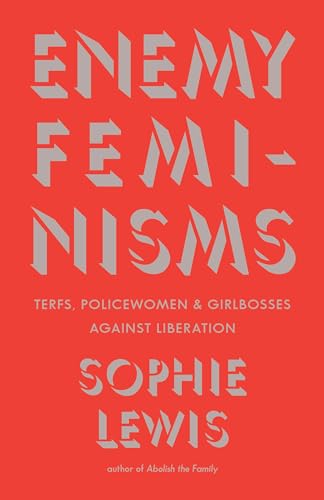
ENEMY FEMINISMS: TERFs, Policewomen, and Girlbosses Against Liberation
SOPHIE LEWIS

Haymarket Books (non-affiliate Amazon link)
$9.99 ebook, available now

Rating: 4* of five

The Publisher Says: From the author of Abolish the Family, a provocative compendium of the feminisms we love to dismiss and making the case for the bold, liberatory feminist politics we’ll need to stand against fascism, nationalism, femmephobia, and cisness.

In recent years, “white feminism” and girlboss feminism have taken a justified beating. We know that leaning in won’t make our jobs any more tolerable and that white women have proven to be, at best, unreliable allies. But in a time of rising fascism, ceaseless attacks on reproductive justice, and violent transphobia, we need to reckon with what Western feminism has wrought if we have any hope of building the feminist world we need.

Sophie Lewis offers an unflinching tour of enemy feminisms, from 19th century imperial feminists and police officers to 20th century KKK feminists and pornophobes to today’s anti-abortion and TERF feminists. Enemy feminisms exist. Feminism is not an inherent political good. Only when we acknowledge that can we finally reckon with the ways these feminisms have pushed us toward counterproductive and even violent ends. And only then can we finally engage in feminist strategizing that is truly antifascist.

At once a left transfeminist battlecry against cisness, a decolonial takedown of nationalist womanhoods, and a sex-radical retort to femmephobia in all its guises, Enemy Feminisms is above all a fierce, brilliant love letter to feminism.

I RECEIVED A DRC FROM THE PUBLISHER VIA EDELWEISS+. THANK YOU.

My Review
: Oh dear. Another excellent, necessary message to everyone in the US lost to a wide audience. I'm in the choir and I still felt hectored, lectured at, and blamed personally by the author's tone.

I did not enjoy the experience.

I can't fault Author Lewis's collection of facts or her citations. Capitalist feminism is indeed a huge existential threat to women's rights. I'd say, however, that the Cult of Mother needed a much, much more savage pounding than capitalism receives. Apparently not one of the author's targets, though, in spite of being so ready to condemn the woman-controlling bodily autonomy denial of abortion restriction.

I question how effective the chapter against "girl-boss" glamorization really is. It's gendered, but is this not a case where celebrating the still-rare sight of women in control of their economic future, and the economy in general, not worth it? I don't think this is the threat to female equality it's presented as, but it's certainly made me consider the issue in a new light. Which, come down to it, is the great strength of this book and books like it, as well as the reason I give it four stars.

So it's style, not substance, that I find unwelcoming and unpleasant. That does not mean I didn't take a lot of positive information, and a hefty amount of psychic homework, away from the read. I found her challenging the hidden enemy in us all bracing and grounds for a lot of self-reflection. Ironic given my whinging about her tone, I know, but in a review for readers I'm not aiming for critical standards of an essay but information, and I hope a shove to get it and read it, for the laity.

Friday, September 27, 2024

ABORTION STORIES: DEEP CARE: The Radical Activists Who Provided Abortions, Defied the Law, and Fought to Keep Clinics Open, & WE CHOOSE TO: A Memoir of Providing Abortion Care Before, During, and After Roe


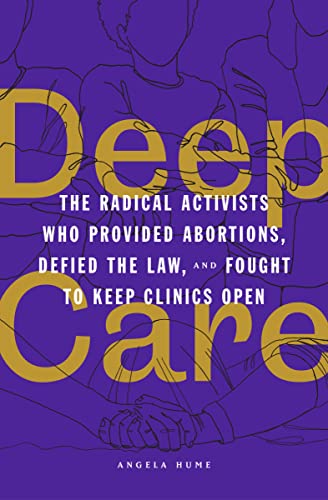
DEEP CARE: The Radical Activists Who Provided Abortions, Defied the Law, and Fought to Keep Clinics Open
ANGELA HUME

AK Press (non-affiliate Amazon link)
$10.99 Kindle edition, available now

Rating: 4* of five

The Publisher Says: The story of the radical feminist networks who worked outside the law to defend abortion.

Starting in the 1970s, small groups of feminist activists met regularly to study anatomy, practice pelvic exams on each other, and learn how to safely perform a procedure known as menstrual extraction, which can empty the contents of the uterus in case of pregnancy using equipment that can be easily bought and assembled at home. This “self-help” movement grew into a robust national and international collaboration of activists and health workers determined to ensure access to reproductive healthcare, including abortion, at all costs―to the point of learning how to do the necessary steps themselves.

Even after abortion was legalized in 1973 with Roe v. Wade, activists continued meeting, studying, and teaching these skills, reshaping their strategies alongside decades of changing legal, medical, and cultural landscapes such as the legislative war against abortion rights, the AIDS epidemic, and the rise of anti-abortion domestic terrorism in the 1980s and 90s. The movement’s drive to keep abortion accessible led to the first clinic defense mobilizations against anti-abortion extremists trying to force providers to close their doors. From the self-help movement sprang a constellation of licensed feminist healthcare clinics, community programs to promote reproductive health, even the nation’s first known-donor sperm bank, all while fighting the oppression of racism, poverty, and gender violence.

Deep Care follows generations of activists and clinicians who orbited the Women's Choice clinic in Oakland from the early 1970s until 2010, as they worked underground and above ground, in small cells and broad coalitions and across political movements with grit, conviction, and allegiances of great trust to do what they believed needed to be done―despite the law, when required. Grounded in interviews of activists sharing details of their work for the first time, Angela Hume retells three decades of this critical, if under-recognized story of the radical edge of the abortion movement. These lessons are more pertinent than ever following the Supreme Court’s 2022 Dobbs v. Jackson decision and the devastation to abortion access nationwide.

I RECEIVED A DRC FROM THE PUBLISHER VIA EDELWEISS+. THANK YOU.

My Review
: By limiting her scope to activists in the Bay Area of California, Author Hume enables herself to dive deeply into the whys, hows, and wherefores of the activists who believed then, and will inspire others now to believe, in the truest expression of "self-help." There is a huge weight of wrongheadedness and immorality bearing down on women's rights. There always has been, of course; patriarchy isn't a new idea, and making up a matriarchal past from evidence so fragmentary as to be useless for tendentious argument is not particularly helpful to resisting the current, powerful, well-funded assault.

Author Hume does not shy away from graphic evocation of the procedures she enumerates the activists providing. It's astonishing to me how very difficult pregnancy is...to start, to finish, to understand in its myriad complexities. It was not always pleasant to encounter this information.

The broader framework of resistance and activism on multiple social fronts in that fifty-years-gone time and place is not skimped. The long-gone groups, their interlocking aims, their interpenetration of membership, wildly proliferate and birth acronym after abbreviation thus are correspondingly difficult to keep track of. As is so often the case among resisters of any facet of the status quo, the vicious internecine fights are hard to read about. I have this wild, unruly desire to scream at the idiots fighting over nonsense to grow up and get a grip! Fight the right-wingers in charge, not each other! It's just handing the rotters victory in their efforts to control and exploit everone for fun and profit to fight among yourselves!

I took long breaks from this read to avoid having more strokes from fury at the dimwits who refuse to accept impure, compromise positions because they are RIGHT and that should be OBVIOUS so everyone should do as they say! Which is, oddly enough, exactly what the right-wingers say.

Funny, that.

The thrust of this book is, as I see it, what worked before can work again. Get your gloves out, the literal healthcare ones and the metaphorical battle ones. The world's going to go into reverse unless we all do a LOT OF RESISTING, at ballot boxes, at clinic-defense events, at community meetings.

It worked before, it can again, but not without personal, individual commitments to show up in the flesh. Slacktivism is helpful to direct the conversation but more is needed to oppose the wave of nightmare invasive evil laws.

+++++++++++++++++++++++++++++++++++++++++++++++++++++++++++++++++
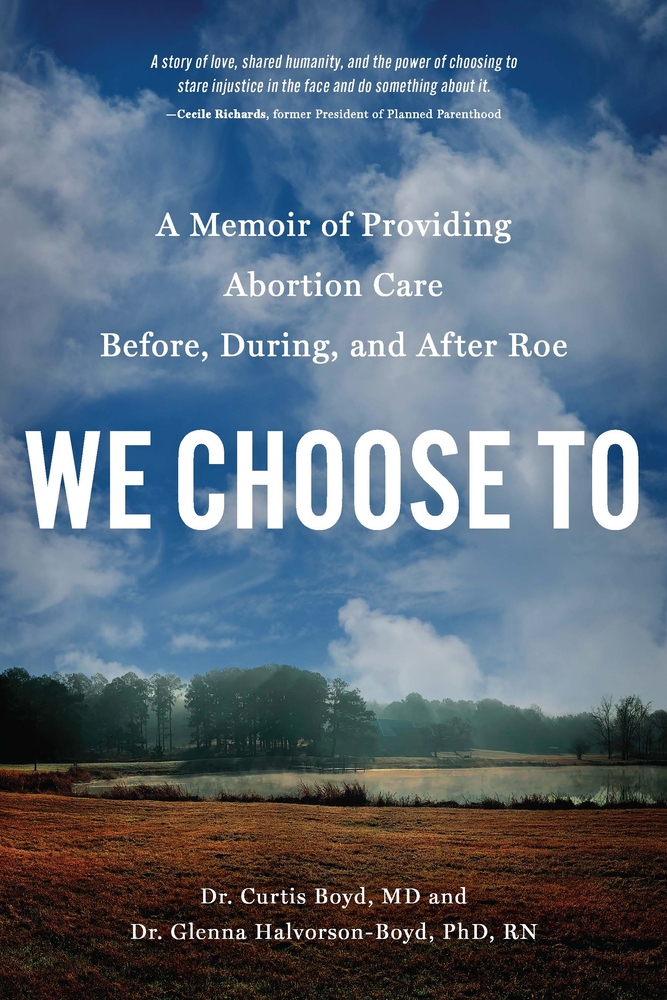

WE CHOOSE TO: A Memoir of Providing Abortion Care Before, During, and After Roe
CURTIS BOYD & GLENNA HALVORSON-BOYD

Disruption Books (non-affiliate Amazon link)
$11.49 Kindle edition, available now

Rating: 4* of five

The Publisher Says: Although the Dallas Fire Department had saved the clinic, we were shaken and heartsick that our son had just spent Christmas Day at a crime scene. I had performed my first abortion in the year Kyle was born, and though he had long supported our work, he now felt worried for us in ways he’d never expressed. As we stood near the ruins, breathing fresh air in gulps, he said, “Do you have to keep doing this work?”

We were both silent for long moments before I simply said, “No. We choose to.”

In this deeply personal account, Dr. Curtis Boyd and Dr. Glenna Halvorson-Boyd reflect on their lives in abortion care, from the childhood experiences that shaped their paths to the Supreme Court decision that forced the closure of their Dallas clinic. Their stories begin in the 1960s, as Curtis opens a clandestine abortion practice while breaking with the beliefs of his Baptist family and Glenna pursues psychology while coming to understand the world of restrictive gender roles. When the two of them meet shortly after abortion is legalized, they bond over a common commitment to women, forming a professional and personal partnership that will weather the coming decades. We Choose To is the story of that partnership, and the staff and patients that have shaped the history of modern abortion.

In these pages, Curtis and Glenna share their holistic, morally rooted approach to their work. Led by a desire to empower patients, they advance abortion and mental health care further than ever even as they find themselves at the center of a controversial new issue in American life. Sweeping, introspective, and deeply honest, We Choose To is a rare portrait of abortion providers and the world in which they work, where abortion is not a talking point in a culture war but a private, even spiritual, act.

I RECEIVED A DRC FROM THE PUBLISHER VIA EDELWEISS+. THANK YOU.

My Review
: If you're wondering what kind of person is drawn to resist social injustice, read this joint memoir by two powerfully rooted in faith people. They set themselves out to provide care for women who were not being served in their time of need by any system allegedly meant to do so.

I'm strongly anti-religion because people like the authors are far too seldom to be found in the ranks of churchgoers. These people are exemplars of walking the walk while self-awarely not talking the most frquently heard talk from the faith they once shared.

I emerged from this read far more ready to smile about the world's future. These deeply admirable people have raised kids and lived lives of service and, by example, inspired others. What more can one ask?

Thank you both for sharing your motivations and reasons for being genuinely good.
Monday, September 16, 2024

A MUZZLE FOR WITCHES, probably the last time we'll get to hear from a feminist ikon


A MUZZLE FOR WITCHES
DUBRAVKA UGREŠIĆ
(tr. Ellen Elias-Bursać)
Open Letter Books
$14.95 trade paper, available tomorrow

August 2025: 40% discount on all Open Letter titles written or translated by female-identifying artists. (Discount is applied automatically at checkout on publisher's website and applies to all hardcover, paperback, and ebook editions.)

Rating: 4.5* of five

The Publisher Says: Winner of the Neustadt International Prize for Literature As with the rest of her literary career, Dubravka Ugresić's final work, A Muzzle for Witches, is uncategorizable. On its surface, the book is an conversation with the literary critic Merima Omeragić, covering topics such as "Women and the Male Perspective," "The Culture of (Self)Harm," and "The Melancholy of Vanishing."

But the book is more than a simple interview: It's a roadmap of the literary world, exploring the past century and all of its violence and turmoil—especially in Yugoslavia, Ugresić's birth country—and providing a direction for the future of feminist writing.

One of the greatest thinkers of the past hundred years, Ugresić was one-of-a-kind, whose novels and literary essays pushed the bounds of form and content, and A Muzzle for Witches offers the chance to see her at her most raw, and most playful.

I RECEIVED A DRC FROM THE PUBLISHER VIA EDELWEISS+. THANK YOU.

My Review
: "Raw and playful" are not frequently paired in a publisher's synopsis. In this outraged, affronted growl, they're two of the best words for Ugresić's œuvre as a whole, and this last distilled, refined-to-purity last work in particular. Her métier was the essay, I've even said before the screed, and this one-sitting book is a great way to get one's eye in to the tenor of her work.

It's quite an achievement to call out, I'd venture to say even to take down, the sexist, fascist Establishment that's controlled...notionally, in her case...the course of both life and career, while being amusing. Mordantly so, but amusing nonetheless. Author Dubravka does this trick regularly. I'm very impressed by this because it means her focus is not on her topic of outrage. The outrage is there, but unlike the literature of grievance that grows so stale so very quickly. Jeremiads are so deeply tedious as anything except a light seasoning on top of one's regular reading.

The title of these collected interviews with a literary critic from Croatia, Merima Omeragić, is a call-out to the (male-dominated) Croatian establishment's characterization of her as a "witch" when her anti-war attitudes got her hounded into exile in 1993. "Muzzle me, you dickheads?" one can hear her thinking in this title. I do not know if she chose it, but it certainly captures her acerbic, flensing-knife wit.

What we, as a literary society, lost on her 2023 death, was an acute observer...better to say "witness" of the Ship of Fools we're riding on. Dubravka Ugrešić saw it from her berth in Second Class, where she was assigned, but never, ever stayed. Her head was the Imperial Suite's sole occupant. She saw right through the oppressive systems designed to reduce her to a compliant drone, a life support system for a uterus.

We need this voice as a society. The women who vote in the 2024 US elections should read this, and other feminists of an earlier generation, because their privileges are not secure when their very rights to bodily autonomy are being rolled back at a great rate of speed.

Friday, August 9, 2024

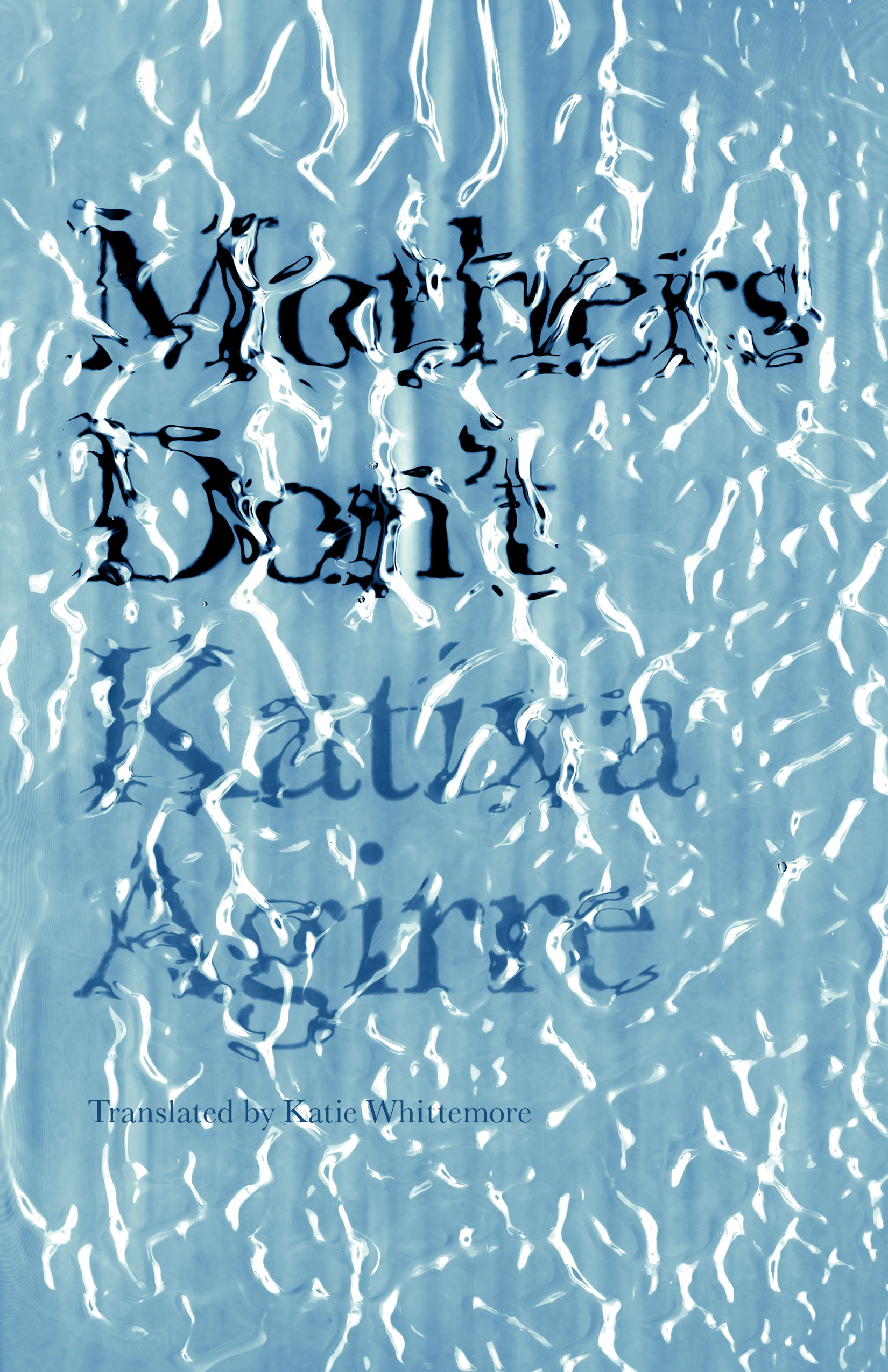
MOTHERS DON'T, Basque-language translation of very difficult subject


MOTHERS DON'T
KATIXA AGIRRE
(tr. Katie Whittemore)
Open Letter Books
$15.95 trade paper, available now

August 2025: 40% discount on all Open Letter titles written or translated by female-identifying artists. (Discount is applied automatically at checkout on publisher's website and applies to all hardcover, paperback, and ebook editions.)

Rating: 4* of five

The Publisher Says: A mother kills her twins. Another woman, the narrator of this story, is about to give birth. She is a writer, and she realizes that she knows the woman who committed the infanticide. An obsession is born. She takes an extended leave, not for child-rearing, but to write. To research and write about the hidden truth behind the crime.

Mothers don't write. Mothers give life. How could a woman be capable of neglecting her children? How could she kill them? Is motherhood a prison? Complete with elements of a traditional thriller, this a groundbreaking novel in which the chronicle and the essay converge. Katixa Agirre reflects on the relationship between motherhood and creativity, in dialogue with writers such as Sylvia Plath and Doris Lessing. Mothers Don't plumbs the depths of childhood and the lack of protection children face before the law. The result is a disturbing, original novel in which the author does not offer answers, but plants contradictions and discoveries.

I RECEIVED A DRC FROM THE PUBLISHER VIA EDELWEISS+. THANK YOU.

My Review
: Seeing Motherhood, that uncriticizable cult, as a prison exclusively populated by and designed for women, is very culturally risky. Think I'm exaggerating? Call Motherhood a "sacred cow" in public.

Crowds will gather. Trouble will brew. The speaker will be set upon from every point of the cultural compass. Like saying "religion is evil, a force for the worst people to do the most intentional damage to the greatest number of others" it results in much, much shouting about it from those alleging they most value the freedom to express ideas freely. Feminists will decry the insult perceived in comparing a woman to an animal, a Hindu will shout about colonialist appropriation of a cultural symbol, a mother will complain she is misunderstood....

I know this from experience.

That reality told me Author Agirre was on to a winner in this journalistic investigative thriller of a wealthy woman's "inexplicable" infanticide. I'm going to have to contextualize all of that: by definition, all things pertaining to mothers and motherhood are domestic; a story that centers a journalist investigating a crime in front of us is journalistic; a story involving the uncovering of the "why" of a violent crime no one wants investigated is a thriller. That exactly none of these things are present in their essential forms makes this literary fiction; that the center of the story is absolutely, essentially, irreducibly about femaleness's exclusive biological function, unshared and unshareable with men makes it feminist.

The entanglements do not stop there. This is a web, and it is meant to be. Meanings are massively interwoven: Do these women have a relationship, or is it a case of scraping a connection? Does our journo using an extended leave, not to care for her own child but to write about the infanticide as it travels through the legal system, suggest her fascination might be rooted in some envy? Her old connection is an artist, married to a wealthy man, possessed of an au pair...her own Swedish man isn't wealthy but she has resources many would envy just by giving birth there. Her story is of a difficult birth, a lot of time away from her child, permaybehaps escaping the overwhelming, extinguishing identity Mother, instead of drowning her child in a bathtub.

The story, in pop culture and true crime, is as old as the state of Motherhood. Sometimes it's just too much. Some people aren't interested in doing this lifelong job. Some aren't suited to it. And the less we talk about it, the more women fall into a life they do not want to lead because they had no external guidance to consequences, alternatives, solutions. Tragedies come when people, all of us, refuse to talk through the realities of life. That leaves us all at the mercy of myths. Myths arise to address needs; myths also get crafted, honed to serve as weapons. One thing is certain: The Cult of Mother is incredibly old and powerfully supported, and only a brave soul says, "No."

These kinds of stories tell us about a tragedy arising from the myth remaining unchallenged. That ought to be enough to send all y'all scurrying out to get a copy. I hope it will. For me, this was an above-average reading experience that didn't quite reach the pinnacles I always hope for a read to reach. As a translation of a translation, I wonder if that might be it. Translator Whittemore does a creditable job but I'm...unthrilled. Pleased. Contented. Unthrilled, though, and I am absolutely the audience for this tale. My own mother should never have had me, or any other child, because I can tell you her laziness was the only reason she never killed me. It was easier not to vaccinate me and to ignore my physical problems.

Not kidding. Being female does not mean a person is automatically suited to motherhood.

So, well, do I recommend the read? Yes. It is stylistically interesting, it tells a story I think many will find very involving and will invest their energy into while receiving ample rewards.

It will entertain, it will inform, it will offer rewards. The sale price, had I paid it, would feel very well worth the investment.

Monday, May 13, 2024

VLADIVOSTOK CIRCUS, lovely tale of self-discovery through running away and joining the circus


VLADIVOSTOK CIRCUS
ÉLISA SHUA DUSAPIN
(tr. Aneesa Abbas Higgins)
Open Letter Books (non-affiliate Amazon link)
$15.95 trade paper, available now

August 2025: 40% discount on all Open Letter titles written or translated by female-identifying artists. (Discount is applied automatically at checkout on publisher's website and applies to all hardcover, paperback, and ebook editions.)

Rating: 4* of five

The Publisher Says: Tonight is the opening night. There are birds perched everywhere, on the power lines, the guy ropes, the strings of light that festoon the tent . . . when I think of all those little bodies suspended between earth and sky, it makes me smile to remind myself that for some of them, their first flight begins with a fall.

Nathalie arrives at the circus in Vladivostok, Russia, fresh out of fashion school in Geneva. She is there to design the costumes for a trio of artists who are due to perform one of the most dangerous acts of all: the Russian Bar.

As winter approaches, the season at Vladivostok is winding down, leaving the windy port city empty as the performers rush off to catch trains, boats and buses home; all except the Russian bar trio and their manager. They are scheduled to perform at a festival in Ulan Ude, just before Christmas.

What ensues is an intimate and beguiling account of four people learning to work with and trust one another. This is a book about the delicate balance that must be achieved when flirting with death in such spectacular fashion, set against the backdrop of a cloudy ocean and immersing the reader into Dusapin’s trademark dreamlike prose.

I RECEIVED A DRC FROM THE PUBLISHER VIA EDELWEISS+. THANK YOU.

My Review
: In less time than it takes Houellebecq to clear his throat in The Possibility of an Island, a book which goes on a similar trip, Dusapin starts and finishes this story. Nathalie is a woman who leaves, finds, and abandons in a country that, unluckily for the author, is an international pariah at the time her novel appears in English. Even more unluckily, it features a Ukrainian acrobat performing in a Russian circus troupe. So, through no fault of her own, Dusapin has created an artifact of a bygone time in this story.

Swiss-educated Nathalie has a fashion degree, which she is using in Vladivostok, Siberia, to work with a troupe of acrobats as they pursue a very difficult performance piece. So, already the theme of leaving is prominent: She left tidy, bourgeois Switzerland for the extreme edge of the wildest place in a wild country, Siberia, at the edge of Russia. The country is itself at the edge of the Asian continent; something I think a lot of people forget is that Korea, Dusapin's previously centered culture, is very close to Siberia. Nathalie is now, temporarily, in a port city, working with a troupe of performers who tour with a circus, and who are practicing an extremely difficult maneuver called "the Russian Bar," a name that carries a whole different cultural freight of metaphor in 2024 than it did when she wrote the book in 2020.

This is, one would expect, the McGuffin, the thing that motivates the action but, in itself is fungible. I thought it sounded like a great McGuffin for a young woman abandoning the bourgeois life that a Swiss fashion design degree virtually condemns one to, by literally running away from home to join the bloody circus.

Only partially true.

We do indeed have the young woman (instead of Daniel, the narrator of The Possibility of an Island and my idea of "the Houellebecqian man") on a voyage of self-discovery among the acrobats. Their extremes of hard, dangerous work, their deeply set bonds of trust built from many, many painful falls and much incredibly focused work on balance and dexterity, aren't exactly subtle metaphors for the young woman who abandons an entire life in Switzerland to start afresh to encounter. The work that Nathalie does, the external and honestly almost extraneous work of dressing these finely honed athletic bodies pales beside their training. Her choreography likewise is just a way of getting them out of one position in time to enact another athletic feat, while telling a story.

So she is only a part of the externals, the appearances of the actual group...the men and women whose work and commitment to each other, to building their trust in each other, makes the act...verb and noun...possible in the first place. But this semi-outsider is the one needed to refine and design the public face, the pretty dress that they need to sell the act...verb and noun...to a group of judges.

Okay? You with me on the meaning, and the stakes?

But the McGuffin is decidedly not just the moitvator here. Author Dusapin, deft of phrase, makes this McGuffin into a deeply explored reality:
Backstage, a pungent animal smell hits me. Straw scattered on the ground. Streaks of dirt on the walls. Like a stable but with velvet lining—hoops instead of horses, waist-high wooden balls, metal poles, tangles of cables, drones in the shape of planes, straw hats hanging on hooks. Leon tugs a cord and the curtains part.
–and–
She places a chair on the bar, balances it on two legs. They hold it in place for as long as they can, barely moving a muscle. Sometimes Leon is there with me. He explains to me why exercises of this kind are so important: the flyer has to rely entirely on the bases for balance and not try to stabilise herself at all. Think of Anna as the chair, he says, that’s how passive she has to be. It’s one of the hardest things about the Russian bar discipline.

There's a lot more detail about the specifics of the Russian Bar, and while I applaud Author Dusapin for making the physicality of the act...verb and noun...so starkly plain to us, and drawing our attention to the extreme discipline it takes a woman to perform as expected under the constant pressure of a hypercritical, unseen audience, its details are rather more prominent in the story than my interest in them required. It gave me rather less pleasure, then, than Author Dusapin's previous novels did.

But let's be clear about this: I enjoyed this novel a good deal more than most. I enjoyed the lovely translation. I enjoyed the thought-provoking metaphor of acrobatic performance for a young woman's acquired presentation of self; I enjoyed the Asian setting's evocative potentials. This is a compact, intense dose of good storytelling.