Showing posts with label mental health. Show all posts

Thursday, May 21, 2026

THE MADNESS PILL: One Doctor's Quest to Understand Schizophrenia, can be a tough read but has a hopeful ending


THE MADNESS PILL: One Doctor's Quest to Understand Schizophrenia
JUSTIN GARSON

St. Martin's Press (non-affiliate Bookshop.org link)
$15.99 ebook, available now

Rating: 4.5* of five

The Publisher Says: A rollicking history of the life and work of an unheralded genius: Dr. Solomon Snyder, whose experiments with mind-altering drugs helped change the way we think about the causes and treatments of schizophrenia.

In the 1950s, the field of psychiatry had nothing to show for itself. While polio was being cured, antibiotics were being discovered, and cancer research was developing, the mental health world had no wins. Asylums were full and nobody had figured out how to fix insanity—specifically schizophrenia, the severest mental illness. Scientists became convinced that if they could engineer a pill to create madness, then they could cure it.

Centered around Solomon Snyder, the psychiatrist who ultimately did identify the madness pill, and the community of doctors and researchers he worked with, THE MADNESS PILL recounts the drug-fueled quest to cure schizophrenia. A wunderkind who started medical school at 19, Snyder worked steadily for decades to replicate the illness, ultimately finding in 1970 that amphetamines could trigger a schizophrenia-like state by flooding the brain with dopamine. Five years later, he went on to discover the dopamine receptor and proved that antipsychotic drugs work by disabling dopamine neurons. Snyder’s dopamine hypothesis inspired a generation of researchers to part ways with psychoanalysis and look for the biological basis of schizophrenia and other mental disorders.

Using first-hand research and interviews, THE MADNESS PILL is at once a raucous history and insightful portrait of a remarkable scientist who turned psychiatry into a respected science by transforming how mental illness is treated.

I RECEIVED A DRC FROM THE PUBLISHER VIA NETGALLEY. THANK YOU.

My Review
: I did not think I'd review this book all that politely. The publicists who wrote the synopsis above used two words in particular that felt...off, odd, even a smidge dishonest, in my mental ear: "rollicking" and "raucous." A scientist's life's work decribed in storytelling superlatives, not scientific ones like "groundbreaking" or "paradigm-shifting"? ::side-eye::

One victory for y'all, publicists. This story as told by Author Garson does indeed rollick raucously through Solomon Snyder's life's work in neurochemistry. I'm a big proponent of talk therapy for those able to benefit from it. Those who can benefit include me (happily) when, after a major crisis that was stabilized by antidepressants, aka neurochemicals, I entered another phase of talk therapy that has presented me with ongoing benefits that I remain deeply grateful for.

Schizoaffective disorder and the multitude of brain-chemistry malfunctions related to it is not adequately addressed by talk therapy. Until Solomon Snyder got to pokin' around because there was zero progress towards curing this life-ruining disorder, there was no good outcome for its sufferers on offer anywhere. It's still a horrendously difficult condition to manage even with neurochemical models explaining some root causes of its symptoms, and chemical therapies helping manage some of devastatingly painful results of its symptoms.

Author Garson is chatty in his presentation of the facts uncovered by Sol, as Dr. Snyder seems to be universally referred to after a time, and his collaborators and even enemies. (No one who changes paradigms is going to be without enemies, detractors, and ill-wishers.) The chattiness and the organizing principle of Sol's personality and perspicacity leads to the strange sense that we're getting to know *about* Sol, getting to know how he affected people and worked with them...or didn't...but not to *know* him. The research, the systems of conducting it, aren't glossed over or lingered on. It's very uncomfortable stuff to our twenty-first century eyes. Sol was in the thick of it. He did wonders for people who previously had little to hope for; getting there, he caused harm and suffering. Those who suffer with experimental animals are strongly cautioned not to read this story; those who feel raw about issues of consent are not going to find this subject matter at all easy to contend with.

There truly is no light without shadow.

Light there is, all in despite of the dark tunnel traversed to get to it. I have known eople suffering with schizophrenia who, when medicated, felt worlds better than without these hard-won treatments. Some have not felt the positive effects outweigh the frustrations of the side-effects that come from altering one's brain chemistry long term. My sample size might not be huge but is exactly in line with the results reported, and analyzed, in Author Garson's story. The names of the chemicals, the names of the drugs, the explication of the functions of them...all of that's a lot, and be ready to use Google often. But the reason to keep your attention on the page is that this detailed information is the foundation of the genuine miracle that is the help offered to previously unhelpable sufferers.

I was so buoyed up by this end result that I was able to consider the abusive and unethical (by today's standards) actions committed and/or not opposed at any point in the process as distasteful, but not disqualifying of the results as very much positive. I do not feel that way about, say, watching a Weinstein-produced film now that I know the crimes he committed, or the awfulness of that transphobic conversion-therapy supporter whose wizard books I once enjoyed.

I offer my ethical calibration for your reference only. Your decision about learning the good with the unpleasant in search of help for the mentally ill is not for me to do more than inform. I felt all the way through the read that I'd've been even happier had Author Garson discussed ethics in specific and open terms as we went along but the way he chose to address the issues passed my muster. Barely...more would've been better.

Again I strongly caution those sensitive to animal suffering to avoid this entire topic. It will not reward you commensurate with your own distress.

Thursday, February 5, 2026

SMITTEN: Romantic Obsession, the Neuroscience of Limerence, and How to Make Love Last, a neuroscientist's self-help


SMITTEN: Romantic Obsession, the Neuroscience of Limerence, and How to Make Love Last
TOM BELLAMY

St. Martin's Essentials (non-affiliate Bookshop.org link)
$15.99 ebook, available now

Rating: 3.5* of five

The Publisher Says: A groundbreaking exploration of the psychology of infatuation, how to recognize it, and how to move beyond it towards a healthier experience of love.

“Butterflies” in the stomach, intrusive thoughts, fantasies about imaginary scenarios, mood swings from euphoria to despair… aren't these all the familiar hallmarks of new love? Not quite. These are characteristics of the psychological state of “limerence,” also known as obsessive, passionate or addictive love that can become unhealthy.

Millions of people experience limerence at some point in their life. In this book, neuroscientist Tom Bellamy explores advances in neuroscience since the term was coined in the 1970s, and sheds light on this little-understood element of the human experience. Discover:

· what drives limerence
· how to recognize limerence in yourself and others
· how to manage the phases of addiction to another person
· how to move past it to sustain longer, more fulfilling relationships.

With supportive advice about next steps, this book will help readers struggling with unwanted feelings to find emotional equilibrium. Rooted in neuroscience, this book offers practical guidance for those experiencing obsessive love and seeking a path to a healthy relationship.

I RECEIVED A DRC FROM THE PUBLISHER VIA NETGALLEY. THANK YOU.

My Review
: Living with Limerence is the author's blog of his experience as a sufferer from this recently described sociopsychological issue. It is not a diagnosis; it is not a presently recognized area of formal study; the author does not present himself as a mental-health professional, so is not held to any of the standards of those practitioners. His bio makes all this clear in what it does and does not say:
I’m a neuroscientist, writer and academic. I graduated with a PhD in Neuroscience from University College London in 2001, then worked as a research scientist at the Medical Research Council, and the Babraham Institute, Cambridge, before moving to the University of Nottingham in 2010.

Since then, I’ve run a research group investigating the nuts-and-bolts of how the brain works, and published dozens of papers on esoteric aspects of neurophysiology.

That background gave me a unique perspective on limerence, how to make sense of what’s going on in our traitor brains, and how to reprogram ourselves into leading more purposeful lives.
He is speaking from his own experience with confronting limerence in his life, and relatedly from his academic training in the workings of the brain. He is admirably clear of expression, understands the power of humor as well as the force of public vulnerability, in the discussion of what most of us don't experience when we get a crush or develop an infatuation or fall in (unrequited) love.

It is a study area just waiting for its academics to bring rigor, develop methodologies and establish vocabularies for, and grapple with the implications of, as our world becomes more and more mediated by machines. We're losing crucial social skills to social media and "AI"-centered experiences displacing sitting down to have a conversation with a real human.

Limerence is only going to rise in its prominence because of its intersection with parasocial interactions. Author Bellamy, and his seeming role model in limerence study Dorothy Tennov, come at this ancient but only-recently described feeling from different angles: she was a psychologist attempting to get "Love Studies" on an academic footing while his more function-of-the-brain focus arises from his neurobiology training.

In writing this book and its blog predecessor, Author Bellamy does yeoman work presenting the current state of the science. He is also careful to stress, through reinforcing restatement, the liberating reality check: Limerence is not, in itself, mental illness; it can be an indicator of underlying issues such as those present in attachment theory (q.v.) but are not necessarily full-on symptoms of anything. It is a very helpful reminder not to self-diagnose. However, I'm not entirely comfortable with the self-help half of the read. The author speaks from personal experience of the issue and has conducted polls to determine certain facts from other self-described sufferers, but this is not (nor is it presented as) peer-reviewed science. Yet. I predict it will be, and relatively soon, because the incidences of limerence in my own social circle are not falling....

As with all mental-health and -adjacent issues I encourage you to read all self-help books with the intention of going on to have fuller, more wide-ranging conversations with someone trained and licensed to interact with you on a theraputic footing. It will hurt you not at all to go into those conversations with information you have acquired by reading self-help books. Be ready to discuss the reading's merits with your mental-health as openly as you can. Not every expert can be trusted to address your unique personal needs.

I think my review needs to include this clear-sighted, honest, grounded in experience statement from Author Bellamy:
Limerence fades. Regardless of how spectacular the thrills are at the beginning of a relationship, expecting that euphoric connection to last more than a few months is unrealistic. Quite apart from how exhausting it would become, it doesn't make sense from an evolutionary perspective. Limerence is the drive to form a pair bond tight enough to result in conception; it has no real role in making it last.
It's true, it's a fact known for thousands of years (in writing; millennia before that, since humans aren't so very different seen as a whole), and it always, always helps to know you are not the first, you are not the only, and you are not alone in the struggles you're having.

I can't be more generous with my stars for the trepidatious responses outlined above, but combined with appropriate professional consultation I think the information presented here in a highly...almost annoyingly...conversational style bids fair to give the reader a giant gift of feeling Seen and understood.

Wednesday, February 5, 2025

HOW TO BE ENOUGH: Self-Acceptance for Self-Critics and Perfectionists, or "explaining my entire life to me"


HOW TO BE ENOUGH: Self-Acceptance for Self-Critics and Perfectionists
ELLEN HENDRIKSEN, Ph.D.

St. Martin's Essentials (non-affiliate Amazon link)
$14.99 ebook edition, available now

Rating: 4.25* of five

The Publisher Says: Are you your own toughest critic? Learn to be good to yourself with this clear and compassionate guide.

Do you set demanding standards for yourself? If so, a lot likely goes well in your life: You might earn compliments, admiration, or accomplishments. Your high standards and hard work pay off.

But privately, you may feel like you’re falling behind, faking it, or different from everybody else. Your eagle-eyed inner quality control inspector highlights every mistake. You try hard to avoid criticism, but criticize yourself. Trying to get it right is your guiding light, but it has lit the way to a place of dissatisfaction, loneliness, or disconnection. In short, you may look like you’re hitting it out of the park, but you feel like you’re striking out.

This is perfectionism. And for everyone who struggles with it, it’s a misnomer: perfectionism isn’t about striving to be perfect. It’s about never feeling good enough.

Dr. Ellen Hendriksen—clinical psychologist, anxiety specialist, and author of How to Be Yourself—is on the same journey as you. In How to Be Enough, Hendriksen charts a flexible, forgiving, and freeing path, all without giving up the excellence your high standards and hard work have gotten you. She delivers seven shifts—including from self-criticism to kindness, control to authenticity, procrastination to productivity, comparison to contentment—to find self-acceptance, rewrite the Inner Rulebook, and most of all, cultivate the authentic human connections we’re all craving.

With compassion and humor, Hendriksen lays out a clear, effective, and empowering guide. To enjoy rather than improve, be real rather than impressive, and be good to yourself when you’re wired to be hard on yourself.

I RECEIVED A DRC FROM THE PUBLISHER VIA NETGALLEY. THANK YOU.

My Review
: I was the youngest child of my parents. My older siblings were more like aunts than siblings...we were two presidencies apart, almost three...and as adolescents lumbered with a toddler they didn't want in their ambit, weren't any more careful of word or deed than one would expect from members of a toxic system at a terrible passage in human life. In other words, not kind, not loving, not supportive. Add that to parents who didn't model those things and...well.

This book understood me.

So much of the world is based on conditionality: if you want this thing/state/privilege, you must give that thing/service. Conditionality and capitalism are deeply intertwined, I venture to suggest inseparably so. One's self-worth in a capitalist system becomes imbued with that transactional conditionality: I'm not working hard enough to deserve this or that bauble. Far worse is the knock-on of that, I'm too "poor" to afford this thing/service so I must be lazy/undeserving/unworthy.

It enters one's bones and imbues all one's relationships: I'm not getting this thing/behavior/feeling I need so I must not deserve it...if I work harder/behave better/give more of this or that resource I have, maybe then I will deserve or even get it.

The internalization of perfectionism is thus complete and the transactional relationship template is frozen into immobility. As are many of us who got this message. We're frozen into immobility because then the desired whatevers *not* being ours makes sense. We don't deserve whatever. Therefore the world makes sense because we don't have it.

A book like this one that makes the pathology plain does a huge service to the sufferer from the condition. It's wonderful to be told plainly and baldly that: "Pretty much every high achieving person experiences a gravitational pull to feel left out. Meaning we reflexively look for signs and signals that tell you you’re being excluded or not wanted." It's a balm to know the roots of this awful paralysis are there in multitudes of us, then be told how that: "What perfectionism neglects to tell us is that getting it right doesn’t make us part of a community." Ultimately, we've bought the bullshit and not the bull himself; we paid for the bull, and now here's a way to get him.

The author is, I suspect, an excellent therapist in practice. In writing she is clear, concise, and manages to be evocative in her phrasemaking. No small feat! I don't tthink this book is for those who struggle to see their own pathologies, there are more effective tools to break walls of denial. I think most readers are some way into the process of denial-busting, but again the best audience for the read are those who already see their perfectionism, have an idea it's a problem, and would like some help building coping strategies for its dismantling.

This book is a wonderfully useful tool for that purpose. I can't offer a full fifth star because there is just that soupçla;on too little interlinking of strategic implementation: How, after this insight hits home, the reader should look for that and the other one to arise.

As cavils go, it's really pretty minor. As self-help books go, this one belongs on far more bookshelves/Kindles than it doesn't.

Thursday, October 3, 2024

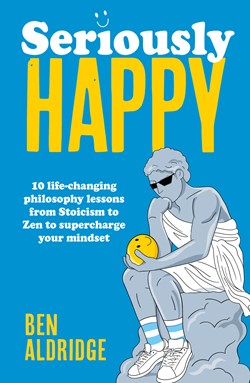
SERIOUSLY HAPPY: 10 life-changing philosophy lessons from Stoicism to Zen to supercharge your mindset, actionable means to the end result of happier living


SERIOUSLY HAPPY: 10 life-changing philosophy lessons from Stoicism to Zen to supercharge your mindset
BEN ALDRIDGE
(illus. Michelle Brackenborough)
Holler/Quarto Group (non-affiliate Amazon link)
$10.99 Kindle edition, available now

Rating: 4.5* of five

The Publisher Says: Seriously Happy is a practical self-help guide for teens, exploring 10 life lessons based on ancient philosophy—from Stoicism to Zen—to help tackle self-doubt, build resilience, and banish anxiety.

Seriously Happy is a highly practical self-help guide exploring 10 life-changing lessons based on teachings of the ancient philosophers.

YA readers are encouraged to discover how Stoicism can improve your mental resilience; the calming, meditative influence of Zen; the decision-making prowess of Aristotle or the confidence-boosting ideas of the Cynic philosophers.

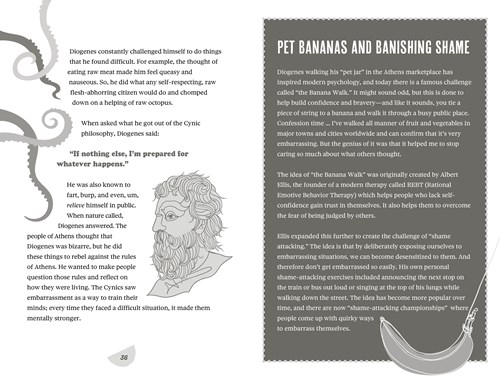
As a young man, author Ben Aldridge struggled with debilitating anxiety and self-doubt, until he discovered Stoicism and other philosophies which helped him restore balance, peace and contentment in his life. In this book, Ben shares over 20 practical challenges rooted in ancient philosophy that will power up your focus and confidence, improve your critical thinking, build mental resilience, and embrace happiness. The text is accompanied by gorgeous illustrations by Michelle Brackenborough.

The challenges are based on ancient philosophical ideas—such as ‘shame attacking’, facing your fears, and appreciating the small things in life—as well as the ancient arts of Tai-Chi, Qi-Gong and meditation. Seriously Happy shows how to harness the power of ancient philosophies to deal with the real-world stress and anxieties of today.

  • Learn to master a growth mindset and face your fears with fun tasks and challenges such as 'the banana walk', inspired by Cynic philosophers.
  • Get curious, question everything, and power up your critical thinking like Socrates.
  • Learn how to make good life choices inspired by Aristotle’s Golden Mean.
  • Train your mind and embrace discomfort with cold-water therapy or digital fasting like Buddhist teachers.
  • Increase your mental resilience by keeping a setback diary like the Stoics.
  • Power up your focus & concentration with a walking meditation inspired by Zen philosophy.
  • Protect your wellbeing by practising Tai Chi and being in nature like the Taoists.

  • Be calm, be confident, and be (seriously) happy!

    I RECEIVED A DRC FROM THE PUBLISHER VIA EDELWEISS+. THANK YOU.

    My Review
    : Philosophy made simple. You and I, dear reader, are old enough to have perspective...hard won, and fleeting though it might be...to help us through the dark night of the soul. Our kids and grands need us to model that life-saving skill.

    There are a lot of slightly desperate thoughts along the lines of, "...and just how am I meant to do that exactly?" running through a lot of y'all's heads. I'd love to have a glib answer all ready for you. I don't, and thus I'm telling you about this book.

    I myownself, after more than sixty years on Earth, am convinced by Epicurean philosophy (see my review of The Swerve) that logic and evidence outweigh feelings and dogma as a way to understand the world. Author Aldridge suffered through anxiety and self-doubt and the depression that inevitably flowed from those conditions of being. He used the cultural legacy of many philosophers in multiple traditions to acquire the perspective to see the evidence that the world *is* comprehensible, that there *are* answers to the question "how do I do that?", and shares them very accessibly here.

    In this election year, so fraught with rage and peril, I think offering the newly-minted teen/high-school student/recent graduate a leg up on making the noise make sense is a great thing to do.

    No one needs to know you read it yourself first.

    The illustrations did nothing for me personally, but I suppose anything one wishes to sell to kids must have 'em.

    Friday, August 9, 2024

    MOTHERS DON'T, Basque-language translation of very difficult subject


    MOTHERS DON'T
    KATIXA AGIRRE
    (tr. Katie Whittemore)
    Open Letter Books
    $15.95 trade paper, available now

    August 2025: 40% discount on all Open Letter titles written or translated by female-identifying artists. (Discount is applied automatically at checkout on publisher's website and applies to all hardcover, paperback, and ebook editions.)

    Rating: 4* of five

    The Publisher Says: A mother kills her twins. Another woman, the narrator of this story, is about to give birth. She is a writer, and she realizes that she knows the woman who committed the infanticide. An obsession is born. She takes an extended leave, not for child-rearing, but to write. To research and write about the hidden truth behind the crime.

    Mothers don't write. Mothers give life. How could a woman be capable of neglecting her children? How could she kill them? Is motherhood a prison? Complete with elements of a traditional thriller, this a groundbreaking novel in which the chronicle and the essay converge. Katixa Agirre reflects on the relationship between motherhood and creativity, in dialogue with writers such as Sylvia Plath and Doris Lessing. Mothers Don't plumbs the depths of childhood and the lack of protection children face before the law. The result is a disturbing, original novel in which the author does not offer answers, but plants contradictions and discoveries.

    I RECEIVED A DRC FROM THE PUBLISHER VIA EDELWEISS+. THANK YOU.

    My Review
    : Seeing Motherhood, that uncriticizable cult, as a prison exclusively populated by and designed for women, is very culturally risky. Think I'm exaggerating? Call Motherhood a "sacred cow" in public.

    Crowds will gather. Trouble will brew. The speaker will be set upon from every point of the cultural compass. Like saying "religion is evil, a force for the worst people to do the most intentional damage to the greatest number of others" it results in much, much shouting about it from those alleging they most value the freedom to express ideas freely. Feminists will decry the insult perceived in comparing a woman to an animal, a Hindu will shout about colonialist appropriation of a cultural symbol, a mother will complain she is misunderstood....

    I know this from experience.

    That reality told me Author Agirre was on to a winner in this journalistic investigative thriller of a wealthy woman's "inexplicable" infanticide. I'm going to have to contextualize all of that: by definition, all things pertaining to mothers and motherhood are domestic; a story that centers a journalist investigating a crime in front of us is journalistic; a story involving the uncovering of the "why" of a violent crime no one wants investigated is a thriller. That exactly none of these things are present in their essential forms makes this literary fiction; that the center of the story is absolutely, essentially, irreducibly about femaleness's exclusive biological function, unshared and unshareable with men makes it feminist.

    The entanglements do not stop there. This is a web, and it is meant to be. Meanings are massively interwoven: Do these women have a relationship, or is it a case of scraping a connection? Does our journo using an extended leave, not to care for her own child but to write about the infanticide as it travels through the legal system, suggest her fascination might be rooted in some envy? Her old connection is an artist, married to a wealthy man, possessed of an au pair...her own Swedish man isn't wealthy but she has resources many would envy just by giving birth there. Her story is of a difficult birth, a lot of time away from her child, permaybehaps escaping the overwhelming, extinguishing identity Mother, instead of drowning her child in a bathtub.

    The story, in pop culture and true crime, is as old as the state of Motherhood. Sometimes it's just too much. Some people aren't interested in doing this lifelong job. Some aren't suited to it. And the less we talk about it, the more women fall into a life they do not want to lead because they had no external guidance to consequences, alternatives, solutions. Tragedies come when people, all of us, refuse to talk through the realities of life. That leaves us all at the mercy of myths. Myths arise to address needs; myths also get crafted, honed to serve as weapons. One thing is certain: The Cult of Mother is incredibly old and powerfully supported, and only a brave soul says, "No."

    These kinds of stories tell us about a tragedy arising from the myth remaining unchallenged. That ought to be enough to send all y'all scurrying out to get a copy. I hope it will. For me, this was an above-average reading experience that didn't quite reach the pinnacles I always hope for a read to reach. As a translation of a translation, I wonder if that might be it. Translator Whittemore does a creditable job but I'm...unthrilled. Pleased. Contented. Unthrilled, though, and I am absolutely the audience for this tale. My own mother should never have had me, or any other child, because I can tell you her laziness was the only reason she never killed me. It was easier not to vaccinate me and to ignore my physical problems.

    Not kidding. Being female does not mean a person is automatically suited to motherhood.

    So, well, do I recommend the read? Yes. It is stylistically interesting, it tells a story I think many will find very involving and will invest their energy into while receiving ample rewards.

    It will entertain, it will inform, it will offer rewards. The sale price, had I paid it, would feel very well worth the investment.

    Sunday, January 14, 2024

    ACTIVATING THE COMMON GOOD: Reclaiming Control of Our Collective Well-Being, a goal more important than ever


    ACTIVATING THE COMMON GOOD: Reclaiming Control of Our Collective Well-Being
    PETER BLOCK

    Berrett-Koehler Publishers
    $27.95 hardcover, available now

    Rating: 5* of five

    The Publisher Says: A powerful, inspiring, and achievable vision of a society based on cooperation and community instead of competition and commodification.

    This book counters the dominant and destructive story that we are polarized, violent, selfish, and destined to consume everything in sight. That is not who we are.

    The challenge, Peter Block says, is that we are suffering under an economic theology that is based on scarcity, self-interest, competition, and infinite growth. We’re told we can purchase and outsource all that matters. Block calls this the “business perspective narrative.” It dominates not only the economy but also architecture, faith communities, journalism, arts, neighborhoods, and much more.

    Block offers an alternative in the “common good narrative.” It embodies the belief that we are basically communal and cooperative. And that we have the capacity to communally produce what we care most raising a child, safety, livelihood, health, and a clean and sustainable environment.

    This book describes how shifts to the common good perspective could transform many areas, fostering journalism that reports on what works, architecture that designs habitable spaces creating connection, faith collectives that build community, a market that is restrained and local, and leadership and activism that build social capital by creating trust among citizens. With these shifts, we would fundamentally change the world we live in for the better.

    I RECEIVED A DRC FROM THE PUBLISHER VIA EDELWEISS+. THANK YOU.

    My Review
    : A business guru wrote this book, this loud call to rein in our enshrined attitude of greed and selfishness. That delights me more than anything else about the read. I resonate like a struck bell to the author’s call to rethink our cultural norms. Given how entrenched the mindset of me first, me on top is, the best thing to do is to begin the process of change at the personal and local level.

    Visit the website, The Abundant Community, that the author and his collaborator John McKnight run. It is chock-a-block with ideas and resources to accomplish this. The book at hand is an excellent read to guide you to the areas that you most need to focus on, be they personal or community based. Our individual well-being is tied closely to our social well-being and this is a frequently discussed facet of life that the author is at pains to weave throughout the short book. From the Introduction, entitled “We Are Not Divided”, forward, Author Block makes the case for beginning one’s journey with the personal commitment to calibrating one’s mind to a "we are not alone" mindset. The difference between "alone" and "divided" recurs throughout the book, very much ringing through the ideas for actions we as citizens of this system of divide-and-conquer tactics can effectively take.

    There is nothing at all unattainable in any of the goals Author Block offers to us as models for effecting change. That he offers them in actionable formats and in digestible, relatable examples makes the read both pleasant, easy, and short and offers real-world results to those willing to undertake his tried-and-tested steps toward a common-good focused world.