Showing posts with label George Orwell. Show all posts

Monday, January 2, 2017

SNOWBALL'S CHANCE, the dystopia of ANIMAL FARM gets worse


SNOWBALL'S CHANCE
JOHN REED

The Neversink Library
$15 trade paper, available now

Rating: 5* of five

The Publisher Says: This unauthorized companion to George Orwell’s Animal Farm is a controversial parable about September 11th by one of fiction’s most inventive and provocative writers

Written in 14 days shortly after the September 11th attacks, Snowball’s Chance is an outrageous and unauthorized companion to George Orwell’s Animal Farm, in which exiled pig Snowball returns to the farm, takes charge, and implements a new world order of untrammeled capitalism. Orwell’s “All animals are equal, but some animals are more equal than others” has morphed into the new rallying cry: “All animals are born equal—what they become is their own affair.”

At first Snowball’s regime prospers: heated stalls, running water, and a window for each animal. The farm moves away from its agricultural economy as Snowball and his team of educated Goats recreate Animal Farm as Animal Fair, replete with citizen performers and criminal sideshows.

A brilliant political satire and literary parody, John Reed’s Snowball’s Chance caused an uproar on publication in 2002, denounced by Christopher Hitchens, and barely dodging a lawsuit from the Orwell estate. Now, a decade later, with America in wars on many fronts, readers can judge anew the visionary truth of Reed’s satirical masterpiece.

My Review: Fifteen years on, Snowball's Chance is more relevant than ever. The 9/11 attacks appalled the world, and thereby gave the USA (assuming its leaders had been savvy and swift on the uptake) its single best opportunity to cement cooperation and common cause with our self-serving agenda in recent history.

We all remember how that turned out. Our soldiers are still paying the price for the bad-to-the-point-of-idiocy decisions made by the administration of the day.

But oh my my, it wasn't sold to the sheep—people, I mean—that way! Neigh neigh neigh, as the workhorses of the armed forces emitted. The glory days have begun at last! We'll shock and awe those sand-n-words back to the stone age!
The animals, even the pigs and the dogs, reveled in the song—not only in the group dancing, which was a new experience for all, but to have their voices joined together once again.

Just like the days of the rebellion!

And the thing so nice about it, was that now, with no more than a little song and a side-step, they could feel like this whenever they wanted—even when they were working in the fields!
It was then announced by Snowball, that by the Prize Pig's decree, the Manor Farm would henceforth be known by its proper name—

Animal Farm.
And the strains of the 21st century's first recrudescence of Horst Wessel were heard throughout the land. The Prize Pig squealed it loudest. And behind the Prize Pig stood Snowball, quietly examining the trusting mugs of the great unwashed masses for glimmers of intelligence and signs of dissent. These were bad things, unpatriotic things, to be subdued by every means available to the state. And those means were (and are) considerable, technology having no conscience and technologists little interest in ethics. All that was needed now was some sort of fig leaf to hide the swollen cock butt-fucking the body politic with no grease and not even a pretense at a kiss.

The USA-PATRIOT Act. Mass surveillance, suspended civil liberties, immense extensions of the government's power to act against its citizens if it damned well wanted to...amended, killed, then resurrected as the USA FREEDOM Act in 2015. No government ever gives up a power it has given itself. The names are changed to protect the guilty.
The debate was reported at length in The Daily Trotter, where Minimus, in his sudden November turn-around, proclaimed that the concessions Snowball had made to his various concerns were more than enough to allay any fears. His faith in Snowball was complete—and every animal on the farm should feel exactly the same way. "Forward Ho!" proclaimed The Daily Trotter. In a letter-to-the-editor (penned by an excitable field mouse), it was suggested that Snowball was not forceful enough to capture the character of the visionary, and that perhaps "Snowstorm" would be more appropriate. The next week, Minimus showed up at the Sunday Meeting looking like he had sat on a fretful porcupine. The Trotter reported that he was suffering a case of constipation....

And when the hot water and showers and bathtubs and lights and electric heaters and air-conditioners were turned on—on January 14th—what a glorious day it was! What a glorious winter it was! And what a glorious spring it was! And what a hero Snowball was!
Hot water and air conditioning buy a lot of silence, it would seem; as does the saddling of an entire nation with slave status under the yoke of the banksters. Get stroppy, get fired, get foreclosed on. I know this happens, it happened to me in 2005.

But the fable continues its inexorable course, one that we're familiar with from the 9/11 events but apparently haven't got the mother-wit to recognize happening again in the form of the most recent election's run-up and results. The post-mortems and the mea-culpas will last for years. None of which changes the events:
It would later be argued as to whether the evil-doers had secured preplaced weaponry from a passing peanut cart, or had foiled the bloodhounds by dousing themselves and their arsenal in apple-wood oil, in order to mask any tell-tale odor. But regardless of the method that his treachery had taken, this ferret's time had come....

He had drawn his blade, cut the throat of Arthur the Poodle, and assumed the controls of the Ferris Wheel—and before anyone could understand what was happening (was it part of the ride?) the Ferris Wheel had accelerated to its top speed. Gears ground. Sparks flew. And two pairs of squirrels were dragging paper bags through the ironwork—up to the axle that held the wheel in place. And then, in a moment horrifyingly lucid, the squirrels doused themselves with some greasy liquid, and set themselves on fire. The bags exploded, and the Ferris Wheel was loosed—kicked from its moorings.
From there, the Twin Mills were struck down and the Woodland Creatures exacted their vengeance on the Pig Fair. And the fable ends.

The future doesn't, however. The value of fiction is that it doesn't stop being relevant when its inspiration recedes into memory then fades into myth. To Kill a Mockingbird is still challenged for removal from school curricula and libraries. Young people are, if not encouraged, then allowed to piss and moan about its "relevance" as a means of delegitimizing the book's enduring and invaluable lessons of the costs of Doing the Right Thing even when everyone you know shouts you down. There's no reason to suspect a book that features a flinty, honorable fighter for justice and the daughter who worships his ideals wouldn't be popular with a political elite such as the one we have now, is there?

My review of Animal Farm argues for the continued relevance of a parable of corruption's eternal depredations. The book isn't about Stalinist Soviet times. It's about the time-tested maxim that power corrupts, and absolute power corrupts absolutely. Snowball's Chance tills the same fertile soil. John Reed saw the need for a stern reminder of the eternal verity that people are no damn good, and wisely chose to "stand on the shoulders of a giant," to paraphrase the probably apocryphal utterance attributed to Isaac Newton. George Orwell was no monadnock of probity: he's known to have snitched on leftist friends, expressed privately an anti-Semitism he didn't condone publicly, and was a homophobe. Hardly a role model. Except he was right about the very important fact that Stalin was a monster and the left of his time was willfully ignoring the truth in order to preserve what they saw as a greater good: Socialism was a laudable political path and socialists must needs be lauded.

Hogwash. No more does John Reed accept the moral purity of Snowball, or of Minimus, or of Diso the beaver. He and Orwell jab at the clay feet of the idols that are used to distract the bulk of humanity. The idols fall as they may, and that's a good thing. That's the reason Snowball's Chance needs to land on your TBR. Never miss a chance to topple an idol, even—or especially—one of your own.

Sunday, January 1, 2017

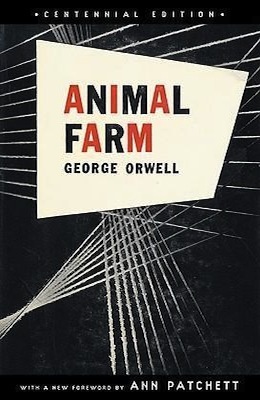
ANIMAL FARM, the 20th century's best, most biting political satire


ANIMAL FARM
GEORGE ORWELL

Everyman's Library
$20 hardcover, available now

Rating: 5* of five

The Publisher Says: Signet Classics 1996 edition:
A farm is taken over by its overworked, mistreated animals. With flaming idealism and stirring slogans, they set out to create a paradise of progress, justice, and equality. Thus the stage is set for one of the most telling satiric fables ever penned –a razor-edged fairy tale for grown-ups that records the evolution from revolution against tyranny to a totalitarianism just as terrible.

When Animal Farm was first published, Stalinist Russia was seen as its target. Today it is devastatingly clear that wherever and whenever freedom is attacked, under whatever banner, the cutting clarity and savage comedy of George Orwell’s masterpiece have a meaning and message still ferociously fresh.
Penguin Classics 2000 edition:
'It is the history of a revolution that went wrong – and of the excellent excuses that were forthcoming at every step for the perversion of the original doctrine,' wrote Orwell for the first edition of Animal Farm in 1945. Orwell wrote the novel at the end of 1943, but it almost remained unpublished. Its savage attack on Stalin, at that time Britain's ally, led to the book being refused by publisher after publisher. Orwell's simple, tragic fable, telling what happens when the animals drive out Mr Jones and attempt to run the farm themselves, has since become a world famous classic.
NAL 2003 edition:
"All animals are equal. But some animals are more equal than others."

One night on an English farm, Major the boar recounts his vision of a utopia where his fellow creatures own the land along with the means of production and are no longer the slaves of humans.

Before long his dream comes true, and for a short while all animals really are equal. But the clever pigs educate themselves and soon learn how to extend their own power, inevitably at the expense of the rest of the community.

This well-loved tale is, of course, a satire on the Soviet Communist system that still remains a powerful warning despite the changes in world politics since "Animal Farm" was first published.
Everyman's Library 1993 edition:
Animal Farm is the most famous by far of all twentieth-century political allegories. Its account of a group of barnyard animals who revolt against their vicious human master, only to submit to a tyranny erected by their own kind, can fairly be said to have become a universal drama. Orwell is one of the very few modern satirists comparable to Jonathan Swift in power, artistry, and moral authority; in animal farm his spare prose and the logic of his dark comedy brilliantly highlight his stark message.

Taking as his starting point the betrayed promise of the Russian Revolution, Orwell lays out a vision that, in its bitter wisdom, gives us the clearest understanding we possess of the possible consequences of our social and political acts.

My Review: What on earth is the point of reviewing this book? Why should I ask you to read a review of something that, in all likelihood, you're already familiar with and have a strong memory of and opinion about? Italo Calvino said it for me: "A classic is a book that has never finished saying what it has to say." And therefore a classic is a book about which the serious lover of reading should never stop talking or thinking about, or re-evaluating, re-reading, re-responding to.

I did not remember this passage from the first chapter:
I merely repeat, remember always your duty of enmity towards Man and all his ways. Whatever goes upon two legs is an enemy. Whatever goes upon four legs, or has wings, is a friend. And remember also that in fighting against Man, we must not come to resemble him. Even when you have conquered him, do not adopt his vices. No animal must ever live in a house, or sleep in a bed, or wear clothes, or drink alcohol, or smoke tobacco, or touch money, or engage in trade. All the habits of Man are evil. And, above all, no animal must ever tyrannise over his own kind. Weak or strong, clever or simple, we are all brothers. No animal must ever kill any other animal. All animals are equal.
Old Major the boar addresses the assembled animals of Jones's Farm thus; he's had a long life and over four hundred children, a lot of time to think, and thus has earned the right to instruct the younger, the less able (like poor old Boxer the workhorse).

Life has a new zest for the animals after Farmer Jones and his henchmen are driven off the farm. The incontestable truth that the fruits of one's labor are sweeter than any others is brought home to the hardworking animals:
The animals were happy as they had never conceived it possible to be. Every mouthful of food was an acute positive pleasure, now that it was truly their own food, produced by themselves and for themselves, not doled out to them by a grudging master. With the worthless parasitical human beings gone, there was more for everyone to eat. There was more leisure too, inexperienced though the animals were.
Tomatoes one grows one's own self are always sweeter than store-bought; food made with one's own hands is tastier than fast food can ever be. Of course, all the animals do the work together, so of course they eat the fruits of their labor together, equally. Of course! Why would you imagine that it would ever be any other way?
The early apples were now ripening, and the grass of the orchard was littered with windfalls. The animals had assumed as a matter of course that these would be shared out equally; one day, however, the order went forth that all the windfalls were to be collected and brought to the harness-room for the use of the pigs. At this some of the other animals murmured, but it was no use. All the pigs were in full agreement on this point, even Snowball and Napoleon. Squealer was sent to make the necessary explanations to the others.

“Comrades!” he cried. “You do not imagine, I hope, that we pigs are doing this in a spirit of selfishness and privilege? Many of us actually dislike milk and apples. I dislike them myself. Our sole object in taking these things is to preserve our health. Milk and apples (this has been proved by Science, comrades) contain substances absolutely necessary to the well-being of a pig. We pigs are brainworkers. The whole management and organisation of this farm depend on us. Day and night we are watching over your welfare. It is for YOUR sake that we drink that milk and eat those apples. Do you know what would happen if we pigs failed in our duty? Jones would come back! Yes, Jones would come back! Surely, comrades,” cried Squealer almost pleadingly, skipping from side to side and whisking his tail, “surely there is no one among you who wants to see Jones come back?”

Now if there was one thing that the animals were completely certain of, it was that they did not want Jones back. When it was put to them in this light, they had no more to say. The importance of keeping the pigs in good health was all too obvious. So it was agreed without further argument that the milk and the windfall apples (and also the main crop of apples when they ripened) should be reserved for the pigs alone.
Of course.

But nothing ever stays the same, does it? The animals have no reason to complain, surely! The work they do is rewarded with food...not apples or milk, it's true, but food...and they're all pulling together and doing their work together and deciding what the farm will produce together! Of course the pigs, the cleverest animals, are thinking the hardest and making the proposals for plans. That's natural, isn't it, the cleverest do the brain-work and think through the problems for the best solutions. And the cleverest pigs, Snowball and Napoleon, are always planning and thinking and exhorting the other animals. The trouble is that they almost never have the same plan. Snowball talks the animals around, but Napoleon always makes the last decision. Animals discuss the problem, the pigs compromise, but the situation just won't change.
But just at this moment Napoleon stood up and, casting a peculiar sidelong look at Snowball, uttered a high-pitched whimper of a kind no one had ever heard him utter before.

At this there was a terrible baying sound outside, and nine enormous dogs wearing brass-studded collars came bounding into the barn. They dashed straight for Snowball, who only sprang from his place just in time to escape their snapping jaws. In a moment he was out of the door and they were after him. Too amazed and frightened to speak, all the animals crowded through the door to watch the chase. Snowball was racing across the long pasture that led to the road. He was running as only a pig can run, but the dogs were close on his heels. Suddenly he slipped and it seemed certain that they had him. Then he was up again, running faster than ever, then the dogs were gaining on him again. One of them all but closed his jaws on Snowball’s tail, but Snowball whisked it free just in time. Then he put on an extra spurt and, with a few inches to spare, slipped through a hole in the hedge and was seen no more.
Things change when the boss says they change. Then they change how the boss wants them to change. It's the single clearest hallmark of authoritarian government, and it's coming disturbingly close to US reality. Surely things won't, can't, get worse!

And then...
Napoleon, with the dogs following him, now mounted on to the raised portion of the floor where Major had previously stood to deliver his speech. He announced that from now on the Sunday-morning Meetings would come to an end. They were unnecessary, he said, and wasted time. In future all questions relating to the working of the farm would be settled by a special committee of pigs, presided over by himself. These would meet in private and afterwards communicate their decisions to the others. The animals would still assemble on Sunday mornings to salute the flag, sing ‘Beasts of England’, and receive their orders for the week; but there would be no more debates.

In spite of the shock that Snowball’s expulsion had given them, the animals were dismayed by this announcement. Several of them would have protested if they could have found the right arguments. Even Boxer was vaguely troubled. He set his ears back, shook his forelock several times, and tried hard to marshal his thoughts; but in the end he could not think of anything to say. Some of the pigs themselves, however, were more articulate. Four young porkers in the front row uttered shrill squeals of disapproval, and all four of them sprang to their feet and began speaking at once. But suddenly the dogs sitting round Napoleon let out deep, menacing growls, and the pigs fell silent and sat down again. Then the sheep broke out into a tremendous bleating of “Four legs good, two legs bad!” which went on for nearly a quarter of an hour and put an end to any chance of discussion.
Sounds familiar, doesn't it? The growling of the dogs set to protect the pig-in-chief at any cost, the unquestioning loyalty of the pack for its alpha. Disturbingly reminiscent of our president elect's command of a Twitter propaganda force, a CNN flying squad of apologists and face-timers. It's been so frequently seen that it's not even remarked upon in any way except to disagree with what's being spread around. The fact of it is...how I hate to say this...normal. Familiar, so normal.

Far more upsettingly familiar is the pronouncement of anathema upon the expelled Snowball:
“Comrades,” [Napoleon] said quietly, “do you know who is responsible for this? Do you know the enemy who has come in the night and overthrown our windmill? SNOWBALL!” he suddenly roared in a voice of thunder. “Snowball has done this thing! In sheer malignity, thinking to set back our plans and avenge himself for his ignominious expulsion, this traitor has crept here under cover of night and destroyed our work of nearly a year. Comrades, here and now I pronounce the death sentence upon Snowball. ‘Animal Hero, Second Class,’ and half a bushel of apples to any animal who brings him to justice. A full bushel to anyone who captures him alive!”
Julian Assange. Edward Snowden. Chelsea Manning. Put any of these names in Snowball's place. You won't notice a difference. Speaking out is treason. People who do are traitors and are directly and personally responsible for all the ills they spoke out against.

Some few of us are old. We have a memory of how things once were that isn't dependent on the pronunciamentos of the Powers That Be. It upsets the old folk to look at the way things are and compare them to the way we remember them to be, to remember how we wanted things to be for our children and grandchildren after us:
As Clover looked down the hillside her eyes filled with tears. If she could have spoken her thoughts, it would have been to say that this was not what they had aimed at when they had set themselves years ago to work for the overthrow of the human race. These scenes of terror and slaughter were not what they had looked forward to on that night when old Major first stirred them to rebellion. If she herself had had any picture of the future, it had been of a society of animals set free from hunger and the whip, all equal, each working according to his capacity, the strong protecting the weak, as she had protected the lost brood of ducklings with her foreleg on the night of Major’s speech. Instead — she did not know why — they had come to a time when no one dared speak his mind, when fierce, growling dogs roamed everywhere, and when you had to watch your comrades torn to pieces after confessing to shocking crimes. There was no thought of rebellion or disobedience in her mind. She knew that, even as things were, they were far better off than they had been in the days of Jones, and that before all else it was needful to prevent the return of the human beings. Whatever happened she would remain faithful, work hard, carry out the orders that were given to her, and accept the leadership of Napoleon.
The rise of an ever-more authoritarian governmental structure in response to the economic depredations of the banksters is, if not inevitable, then more and more likely. This sensation of loss and the theft of the dream we invested our labor into realizing is acute, painful, and miserable. The mere notion of this Orwellian outcome of this latest presidential election is nauseating.

The simple distillation of the novella's point is almost too painful to read:
Somehow it seemed as though the farm had grown richer without making the animals themselves any richer-except, of course, for the pigs and the dogs. Perhaps this was partly because there were so many pigs and so many dogs. It was not that these creatures did not work, after their fashion. There was, as Squealer was never tired of explaining, endless work in the supervision and organisation of the farm. Much of this work was of a kind that the other animals were too ignorant to understand. For example, Squealer told them that the pigs had to expend enormous labours every day upon mysterious things called “files,” “reports,” “minutes,” and “memoranda”. These were large sheets of paper which had to be closely covered with writing, and as soon as they were so covered, they were burnt in the furnace. This was of the highest importance for the welfare of the farm, Squealer said. But still, neither pigs nor dogs produced any food by their own labour; and there were very many of them, and their appetites were always good.
Those who produce nothing are taking everything. It is happening now. Banksters and fraudsters and capitalists care nothing for anyone or anything that doesn't fill their feed-bag with more, more, more. There is no such thing as enough for these people. When the place a spirit should be is empty, the entire earth doesn't have enough substance to plug the hole.
He had only one criticism, he said, to make of Mr. Pilkington’s excellent and neighbourly speech. Mr. Pilkington had referred throughout to “Animal Farm.” He could not of course know — for he, Napoleon, was only now for the first time announcing it — that the name “Animal Farm” had been abolished. Henceforward the farm was to be known as “The Manor Farm”— which, he believed, was its correct and original name.