Showing posts with label dystopia. Show all posts

Friday, September 4, 2026

THE FIRSTS: A History of French Superheroes, fun and relevant and undemanding


THE FIRSTS: A History of French Superheroes
XABI MOLIA
(tr. Alexander Hertich)
Dalkey Archive (non-affiliate Bookshop.org link)
$9.99 ebook, available now

Rating: 3.75* of five

The Publisher Says: The ugly side of superheroes

What if you suddenly had superpowers? What would you do? How would your friends and family react? What would your obligations to society be?


The superheroes’ first missions—combating terrorists or rescuing disaster victims—are a boon to France. Yet while these actions bring the country pride, unity quickly starts to unravel. These superheroes, ultimately, are human. Paparazzi are everywhere. One has an affair with another’s wife. Another questions following the government’s imperialist agenda. Meanwhile the public carps on social media.

Molia takes our fascination with superheroes and adds a cutting portrayal of contemporary social mores to create an entertaining and disturbing work with deep dystopian underpinnings.

I RECEIVED A DRC FROM THE PUBLISHER VIA EDELWEISS+. THANK YOU.

My Review
: Remember the 1995 one-hit wonder "(What If God Was) One of Us?" It was a monster hit around the world. Its central question was one I think troubles people; it makes us all wonder why her and not me, why is there such an unfair randomness to divinity, what Greeks explained as someone being a demigod like Achilles or Herakles.

What we now call "superheroes."

In the labyrinth of the human soul, the superhero is tucked into a corner along the same stretch of hallway as the demigod. It's about wanting the anthropomorphic Divine to share more substance with us, not seeing the genuinely miraculous, divine acts of creation we interact with daily: my meds, the ones that keep my blood free of oversupplies of uric acid, the ones that keep mmy heart beating in normal rhythm, the computer I'm typing on, the phone you're reading this on, the software, the microchips...all designed by a human, all manufactured by human-designed machines...miracles surround us, the divine in us engendered them. But we use our miracles profligately. The computer and internet that give us access to the immense body of knowledge that's enabled wonders also gave us social media and streaming news.

I think of the first examples as Divine, the last as what we humans do when our reach exceeds our grasp...or demigods those superheroes come to life. Philosophical 3am maunderings aside, the novel The Firsts uses our overreach to explain our grasp to us. The ordinary people with superpowers are observed, as we all are, and reported on, scrutinized as celebrities are as part of their bargain for our attention. It's not the newest wrinkle in the communal brain, the soap operas that are comic books have pulled this idea out every so often. I'm not blaming or running down the book or its author, no idea is totally new or it would be ignored or rejected. Delivering dystopian stories can't really add a burden of novelty onto the already painful message of self-examination's fruits.

Science fiction's used the media-snippets (notably, prize-baitingly The Sheep Look Up, about fifty-five years old) and for centuries before that epistolary novels (Dracula for one) fake that same sense of immediacy and intimacy of perception, for generations. updating it for newly available tech underlines the basic reality of the human desire to share...willingly or not...our fellows' and our betters' deepest depths. As long as they're glowed up, glossy, and either unthreatening or in some way humiliating to them but never to us.

It's not fresh, then, the format of this story's delivery, and it obeys all these rules. It's French so its reactions to two superheroes' scandalous infidelity is more gleeful in tone than the US puritanical moralizing judgment, but really what we have here is not groundbreaking fiction or social observation or advancement in techniques of writing.

But it's a damn fun day or reading as people, ordinary people, grapple with the tweaked superpowers we all factually possess (you read that list-paragraph above, right?); if you go into this read expecting a good time that's not as demanding of your concentration and thinking as most stories from this publisher are, you can enjoy a well-told tale in a format not new or fresh but well-used in the story's service.

Wednesday, September 2, 2026

FRUITS OF OUR LABOR, very trenchant, very loudly thinking about taboo topics


FRUITS OF OUR LABOR
IAN PATTERSON

Shiraki Press (non-affiliate Bookshop.org link)
$9.99 ebook, available now

Rating: 4* of five

The Publisher Says: A new world is emerging, one parthenogenetic birth at a time.

In a near-future America where women have just achieved asexual reproduction, Samara yearns for freedom from her dying relationship, and a child of her own—fully her own.

As parthenogenetic birth takes hold and the role of men in the survival of the species diminishes, protest and outcry sweep across the nation. Sierra, one of the first “partho babies”, is bullied relentlessly as she grows up and seeks her place in this new pressure cooker of changing gender roles and norms.

And in the aftermath of the “Days of Horror”, a period of violent backlash from displaced men, a professor of history looks back on the rise of PG birth in an attempt to understand the impact of this era of upheaval on the world.

Together, these three converging perspectives tell the story of a profound societal transformation that asks who gets to have autonomy, who gets to write the future, and who that future is for.

I RECEIVED A DRC FROM THE PUBLISHER VIA NETGALLEY. THANK YOU.

My Review
: What fresh hell is this, Dorothy Parker famously (sort of) said. It's probably a situation that sounds perfect to some, reproducing only yourself; it eliminates some troublesome, destructive friction in society.

Does it? Would it? Could it?
"Maybe it’s evolution, maybe it’s divine influence, but at the end of the day, does it matter? I’ll let you in on a secret: I don’t think I’m special at all. I’m just the first woman to figure out she didn’t need a man to have a baby. I bet you we’re all capable of it, of self-birth. And if every woman out there focused on it like I did, I think we’d find our true power. And it would change everything."
It's a novella, under 160pp, and it's told in multiple timelines; pay attention, or who is speaking to you could easily slip away from your awareness. It's well-paced and well-designed to make its points with facts (parthenogenesis is seen in all other lineages, but not mammals, so it's not a stretch to see how it might develop) and conjectures (the Manosphere would have hysterics over this and it's not hard to see how violent the response would likely be to this). As an exploration of an idea this is fascinating. As a summation of the awful state of gender politics, it's chilling. And as a meditation on what is invisible to those in the binary mindset, it's...essentialist. No one transmasc has a viewpoint at all; I'm not surprised, because we're talking about exalting Woman, after all. No one transfem is in the book, either; are these oversights or just biases that permeate culture so deeply they're invisible in this Brave New World of all women?

Can't get to a perfect five, but I can definitely say I think more about these issues of sex-essentialism and gendered violence in this framework. I'm fascinated by every twist and turn in the compact story, and hope y'all will be too.

Friday, May 15, 2026

SANCTUARY, a talented writer's debut dystopian cli-fi tale of tomorrow's reality


SANCTUARY
JAMES CLEARY

Berkley Books (non-affiliate Bookshop.org link)
$14.99 ebook, available now

Rating: 4.25* of five

The Publisher Says: “The meek shall inherit the Earth, unless the rich get there first.” That’s the reality of the post-apocalyptic world in this electrifying debut thriller.

The near future…

Climate disasters have crippled the United States. With half the country under water and the other half a dust bowl, civil unrest would soon escalate into something darker, something unstoppable. Billionaire John Brandt anticipated this and channeled his money, power, and influence into being prepared for the great unraveling.

Now Brandt, his family, and his security team must retreat to Sanctuary, their underground bunker—a vast luxury mansion beneath the parched earth of the Nebraskan Great Plains. But they are not alone. Above ground a group of raiders are desperate to survive and will use any means possible to accomplish that goal.

As tensions mount both inside and out, battle lines are drawn—between the haves and the have-nots, between decency and expediency, between life and death. In this game, everyone's a loser.

I RECEIVED A DRC FROM THE PUBLISHER VIA NETGALLEY. THANK YOU.

My Review
: Eco-thriller beginnings as the planet's climate collapses into chaos, the US follows suit, and the civilization we take for granted vanishes. Dystopian survival story post-collapse nightmare comes for us all. The necessary, we-will-have-it conversation of how much is enough, how will you share your excess, if you won't do it voluntarily we will make you. Thhese three storytelling modes co-exist, with highly permeable boundaries, in debut Author Cleary's book.

It's a melange of ideas that turns at times into a melee. The combatants are all possessed of powerful motivation, survival, and thus give it their all. We-the-reader are given a straightforward narrative that propels the story from inception to ending (if just a bit abrupt in our arrival there) interleaved with journal entries that add emotional textures and act as masses that alter the flow of the story's movement. I did not feel this was quite deft enough in its execution for me to offer that fifth star, but it's a hard tick to pull off. So a quarter-star for the right idea not exactly well executed.

None of the above touches on the emotional punch of this story. The coinage of "grey swan" on analogy with "black-swan event" is particularly deft and effective. A grey-swan event is visible, clearly understood to be coming, and yet somehow still ignorable thus ignored. Very like the characterization of bureaucratic pettifoggers being said to "rearrange the deck chairs on the Titanic" as the Depression of 1929-1939 unfolded.

I hope I do not need to belabor this point's relevance to 2026's audiences.

As hunger, true hunger, bites these people in this world, morality shifts. We in the US have not faced hunger of famine proportions in so long it is not even in living memory. Our insulation will be stripped away. It will bring dark, ugly revelations to individual members of the out group. It's a stark truth, attested for many millennia, that starving people will do anything at all to survive. It is built into us as animals. It changes the people in this story: "The dad. The husband. The carpenter…The murderer? Yes…It hadn’t even been that hard."

It's a lot to take in, but it is a distillation that rises from much documentary evidence.

Start preparing now. The Grey Swan is looming.

Wednesday, January 7, 2026

WHERE THE AXE IS BURIED, Ray Nayler gets his Nostradamus on


WHERE THE AXE IS BURIED
RAY NAYLER

MCD x FSG (non-affiliate Bookshop.org link)
$14.99 ebook, available now

FINALIST for the 2026 Locus Award for SCIENCE FICTION NOVEL!

Rating: 4.5* of five

The Publisher Says: All systems fail. All societies crumble. All worlds end.

In the authoritarian Federation, there is a plot to assassinate and replace the President, a man who has downloaded his mind to a succession of new bodies to maintain his grip on power. Meanwhile, on the fringes of a Western Europe that has renounced human governance in favor of ostensibly more efficient, objective, and peaceful AI Prime Ministers, an experimental artificial mind is malfunctioning, threatening to set off a chain of events that may spell the end of the Western world.

As the Federation and the West both start to crumble, Lilia, the brilliant scientist whose invention may be central to bringing down the seemingly immortal President, goes on the run, trying to break out from a near-impenetrable web of Federation surveillance. Her fate is bound up with a worldwide group of others fighting against the global status quo: Palmer, the man Lilia left behind in London, desperate to solve the mystery of her disappearance; Zoya, a veteran activist imprisoned in the taiga, whose book has inspired a revolutionary movement; Nikolai, the President’s personal physician, who has been forced into more and more harrowing decisions as he navigates the Federation’s palace politics; and Nurlan, the hapless parliamentary staffer whose attempt to save his Republic goes terribly awry. And then there is Krotov, head of the Federation’s security services, whose plots, agents, and assassins are everywhere.

Following the success of his debut novel, The Mountain in the Sea, Ray Nayler launches readers into a thrilling near-future world of geopolitical espionage. A cybernetic novel of political intrigue, Where the Axe is Buriedcombines the story of a near-impossible revolutionary operation with a blistering indictment of the many forms of authoritarianism that suffocate human freedom.

I RECEIVED A DRC FROM THE PUBLISHER VIA NETGALLEY. THANK YOU.

My Review
: Political allegory is risky for authors to indulge themselves by creating. "The irony that haunts our entire history is that we humans have been the ones standing in the way of our own happiness the whole time" is a pithy truism. It's not much to hang a novel on.

Yet hang it does. The near-future techno-dystopia is all too real, all too probable, and dankly depressingly akin to the tech...bros...in charge of the most important functions of infrastructure's clear intentions. Why is "hacking" a crime? Because it interferes with the Aynholes' desires to install ransomware in all societal functions to exert supreme control over all humans. "The question isn’t who is going to let me; it’s who is going to stop me," is Ayn Rand's own deeply evil, greedy, and selfish distillation of the deeply evil, selfish, and destructive soi-disant "philosophy" entrenched in the tech industry, that reaches apotheosis in this story.

There are no good, humane systems in this novel, albeit they are uniformly very human-centered. Control of Humanity has always been at the center of all social and governmental systems throughout time. The eternal tension between the ideal of individual liberty and the safety of others has never, in my opinion can never, be anything more than temporarily balanced. It's the moment of imbalance, the time when the system built is not in equilibrium that makes this a novel not a short story. Looking into a dark and a deep void is courting vertigo. It's vertigo, a sense of the ground deciding it's not going to support one's weight any longer that defined this story to me.

Author Nayler blew past the discomfiting (to me) notion of AI government leaders into nightmare territory with the Federation president whose personality is digitized and downloaded time and time again into fresh bodies. An immortal being, like the Meths in Richard K. Morgan's Altered Carbon, will not in any meaningful way be human. I don't even think the present-day model for this character is human. Well, genetically so but not humane or honorable in human terms. Be that as it may...this is a cautionary tale about ignoring mile-long freight trains barreling towards you. You will get flattened.
“What a world, Nikolai,” the president had said. “no old age, no sickness, and no death. Finally, we can have both our wisdom and our health.”

The president said we—but it was only he who could have those things. It was only he who could escape old age, sickness, and death.”
Like the immense benefits promised to thee and me in the rollout of "AI" there's a very, very low likelihood of anyone under billionaire status deriving more than the tiniest benefits, and as few of those as they can manage, from "AI". Assuming it's ever better than it is at this moment, where the divide is already stark, it will immiserate billions and make greedy oligarchs a scoche richer.

The essence of the story is:
“That was how it was. One day you had your own country. Next day you were a refugee. You were in a line, waiting to be someone again. To be legal again. Not to be nothing.

You could spend your whole life waiting.”
...and you will.

It's a bitter pill of a tale written by Author Naylor from a far greater pool of knowledge than mine on every story axis. It is not me, an old, bitter, angry socialist, shouting at the clouds the tech...bros...float atop. It is one of their own saying, "pay attention now before you pay a very steep price for lazy inattention."

It behooves us without his knowledge, or his storytelling nous, to listen up while we can.

Monday, September 29, 2025

VLADIMIR SOROKIN'S PAGE: Oprichnik's Russia duology


THE SUGAR KREMLIN (Oprichnik's Russia #2)
VLADIMIR SOROKIN (tr. Max Lawton)
Dalkey Archive Press (non-affiliate Bookshop.org link)
$18.95 trade paper, preorder for fulfillment tomorrow

Rating: 4* of five

The Publisher Says: A puzzle of colorful, sardonic episodes that come together as a portrait of totalitarian society as a whole.

Sugar Kremlin follows the near-future universe of Sorokin’s Day of the Oprichnik, crafting a set of 15 chapters that all return to the symbol of the The Sugar Kremlin. Thousands of these creations are being given away to citizens on the street, from lucky children to secret political dissidents, torture-obsessed civil servants, sex workers in a nearby bordello, and more.

As Sorokin moves from story to story, he draws the reader through the dark streets of life in Russia, creating a metaphysical encyclopedia of the Russian soul through a deceptively sweet sugary treat. Presenting a wide variety of genres and tones, Sugar Kremlin lays out a frightening vision of speculative mercilessness and quirky political horror.

I RECEIVED A DRC FROM THE PUBLISHER VIA EDELWEISS+. THANK YOU.

My Review
: Not a novel. A collection of fifteen stories set in the storyverse of Day of the Oprichnik but without overlapping or recurring characters. The structure here is centered around a literal "sugar Kremlin", a treat made of sugar in the shape of the Kremlin that's like an Advent calendar or a fruitcake or other holiday treat in ubiquity and celebratory affect.

That alone makes this unnerving, dystopian fantasia of a 2028 Russia unsettlingly like the Project 2025 US we're living in. The characters are constantly munching on, consuming, discussing the lusciousness of, this nutritionless pure sugar abomination.

On the nose much, Author Sorokin?

Expect the usual transgressive behaviors (I've been uneasily eyeing my hammer), the expected degradation and cruelty, the obligatory violent and vicious conduct. Sorokin is not going to coddle your imagination. The stakes here are too high. This duology (this one published in 2008 in Russian, 2025 in English, printed now that Dalkey Archive's under new ownership) is a trumpet blast, containing every dissonant and perverse note in Literature's instrumentation, to get the reader to see, really see, what is going on. It's been the brief of this press since its founding in 1984.

What made this a slightly-less-stellar read than Day of the Oprichnik for me was the episodic nature of stories...they don't really synergize to create a paralyzing terrified awareness of the overarching story's validity and possibly even applicability to 2025 US life. It's not what stories do, nor are they supposed to. What they've done as collected here is make the whole feel more melodramatic than dramatizing reality as a novel does. I was a bit thrown by a story titled "The Queue" because that's also an (unrelated) novel by Author Sorokin. It was brief but it threw me out of my flow state.

I am, then, one of those who are not au fait with Author Sorokin's contention that "The contemporary world is so complex and protean that it is no longer possible to describe it with linear prose and squeeze it into a traditional novel's structure." (From his interview with Joshua Cohen that forms the Introduction to the book.) I read a lot of linear novels; they do a creditable job of linear presentation of an inherently nonlinear world; I do not see that what I've just read has a notable advantage over, say, The Words That Remain (a linear-prose novel that presents complexity, pathos, cruelty, and love effectively). I readily stipulate that I'm possibly missing the point of his statement, or too dull of apprehension to get more than a dim gist of it.

Nonetheless, I experienced this read as a collection of well-made stories ready to épater les bourgeois as they...we...so badly need literature to do. Author Sorokin is ready, willing, and able to do this duty, with verve and panache, and scatology and violence.

It needs doing. It needs reading.

++++++++++++++++++++++++++++++++++++++++++++++++++++++++++++++++


DAY OF THE OPRICHNIK (Oprichnik's Russia #1)
VLADIMIR SOROKIN (tr. Jamey Gambrell)
FSG
$9.99 ebook, available now

Rating: 4.5* of five

The Publisher Says: Moscow, 2028. A cold, snowy morning.

Andrei Danilovich Komiaga is fast asleep. A scream, a moan, and a death rattle slowly pull him out of his drunken stupor—but wait, that’s just his ring tone. And so begins another day in the life of an oprichnik, one of the czar’s most trusted courtiers—and one of the country’s most feared men.

Welcome to the new New Russia, where futuristic technology and the draconian codes of Ivan the Terrible are in perfect synergy. Corporal punishment is back, as is a divine monarch, but these days everyone gets information from high-tech news bubbles, and the elite get high on hallucinogenic, genetically modified fish.

Over the course of one day, Andrei Komiaga will bear witness to—and participate in—brutal executions; extravagant parties; meetings with ballerinas, soothsayers, and even the czarina. He will rape and pillage, and he will be moved to tears by the sweetly sung songs of his homeland. He will consume an arsenal of drugs and denounce threats to his great nation’s morals. And he will fall in love—perhaps even with a number of his colleagues.

Vladimir Sorokin, the man described by Keith Gessen (in The New York Review of Books) as “[the] only real prose writer, and resident genius” of late-Soviet fiction, has imagined a near future both too disturbing to contemplate and too realistic to dismiss. But like all of his best work, Sorokin’s new novel explodes with invention and dark humor. A startling, relentless portrait of a troubled and troubling empire, Day of the Oprichnik is at once a richly imagined vision of the future and a razor-sharp diagnosis of a country in crisis.

I RECEIVED A DRC FROM THE PUBLISHER. THANK YOU.

My Review
: From the vantage point of late 2025, a post-Putin neo-medieval Russia in 2028 sounds...oddly optimistic...as well as wrong. From 2005's standpoint it probably seemed more likely; even though nothing in this book could be called hopeful, it was probably sounding good to Sorokin just not to have Little Vladdy Pu-Pu on the tsar's throne.

Predictions always miss something. Usually they're too optimistic, too hopeful, and weird to say that's the problem with this bleak prediction-fest. *waves at Little Vladdy Pu-Pu on his throne* I'm not entirely convinced the religious fervor of the Oprichnia, as revived from the days of Ivan the Terrible (an epithet with multiple valences in English, all of them applicable to the bearer then...and by extension now), is not active in 2025 let alone 2028.

With his characteristic OTT revulsion-inducing behaviors foregrounded, this book is automatically beyond the pale of all too many squeamish readers. I would say "try to get past it" but honestly...don't. One is meant to be revolted and put off by it, much as the 1972 John Waters shocker Pink Flamingos is not meant to titillate but shock and offend (fifty-plus years on, it still does). The world Author Sorokin posits is intended to be just as appalling and revolting, to disgust you and repel you! The entire reason to hold a dark mirror of satire up is to draw attention to the wrongness and cruelty of the world being posited. By no means is it accidental that so much of it is grimly familiar. The theocratic angle is the one not quite fully rolled out by our allegedly separate government. Just wait.

This edition was published in 2011, and it is only more relevant and more horripilating in 2025's world of ICEstapo and wholesale social upheaval caused and inflamed by the most powerful in our country.

Monday, January 20, 2025

DARKMOTHERLAND, an IMAX movie played on a 1080i screen


DARKMOTHERLAND
SAMRAT UPADHYAY

Soho Press (non-affiliate Amazon link)
$14.99 Kindle edition, available now

Rating: 3.75* of five

The Publisher Says: An epic tale of love and political violence set in earthquake-ravaged Darkmotherland, a dystopian reimagining of Nepal, from the Whiting Award–winning author of Arresting God in Kathmandu

In Darkmotherland, Nepali writer Samrat Upadhyay has created a novel of infinite embrace—filled with lovers and widows, dictators and dissidents, paupers, fundamentalists, and a genderqueer power player with her eyes on the throne.

At its heart are two intertwining narratives: one of Kranti, a revolutionary’s daughter, who marries into a plutocratic dynasty and becomes ensnared in the family’s politics. And then there is the tale of Darkmotherland’s new dictator and his mistress, Rozy, who undergoes radical body changes and grows into a figure of immense power.

Darkmotherland is a romp through the vast space of a globalized universe where personal ambitions are inextricably tied to political fortunes, where individual identities are shaped by family pressures and social reins, and where the East connects to and collides with the West in brilliant and unsettling ways.

I RECEIVED A DRC FROM THE PUBLISHER VIA DEDLWEISS+. THANK YOU.

My Review
: There is a lot to be said for ambition in storytelling. This book, for the first third, was destined for enshrinement in my hall of fame; the second third for my favorites list; and by the end for my "you should read it if you love, or need, a full-immersion wide-angle view of what chaos really does." You should know going in that women have significant challenges regarding consensual sex here. The centering of a transfem character's experiences made for sharp commentary on gender roles in a repressive, fascistic regime, yet also made my hackles rise. I have trans folk in my life whose potential feelings about this book's explicitness I constantly found obtruding in my reading.

It's not to say this is a pure negative. I'm all for people writing uncomfortable takes on the world as we find it today. The fact that Rozy is a person with agency, albeit in a very twisted system, felt both natural and unhappy. Her choices were severely limited, and yet also used to prove the point that pressure can cause a person to become more powerful the same way water under pressure can become a weapon.

The fictionalized country in the story was a background for me, a setting; the events played out on its stage. I was unable to get deeper than that, despite the story's evident desire for me to do so, by the sheer size if the cast we're following. It is always a risk to expand a cast beyond a handful of people. The great trick of numbing people to the reality of suffering is to follow Stalin's epigrammatic maxim: "The death of one man is a tragedy. The death of millions is a statistic." Like teaching history, telling a story in novel form only becomes less involving when you dilute your message (especially when it's essentially the same message repeated) beyond a certain point. I'm not clear if that was an intentional choice of metacommentary on the author's and publisher's part.

This story of the chaos and upheaval that attend a violent ending suffers from this dilution. It also tries its best to invest you in its very deeply felt observations on how cruelty ultimately undermines itself as it metastasizes. As ever, the issue of what is celebration and/or normalization arises as repetition of violent language and behaviors continues to assault one's readerly experience. This fine balance between intention and reception is always deeply personal. It crossed my internal line shortly after midpoint; I was too deeply interested in the results the author intended to bring to quit, as I ordinarily would have done. That's why I got as close as I did to a full four stars.

I'm not doing a good job, I fear, of expressing how deeply enfolding a tale is told here. I'm very much a fan of stories that require me to think and deeply consider the places and times and inhabitants of the storyscape before me. I think a read that makes demands on my deeper cognitive resources is a fun read. This story does that. I'm very interested in tales of messy endings that are inevitable and inherent in the setup of the world being built. This story could be the poster child for that. I was, then, very much on the side of the author and his project of elucidation.

But because of certain choices he made, it began to feel like it was just that: a project.

I wanted to end the read as much, or more in love with it as I started our being. I'm bummed that I couldn't.

Friday, September 13, 2024

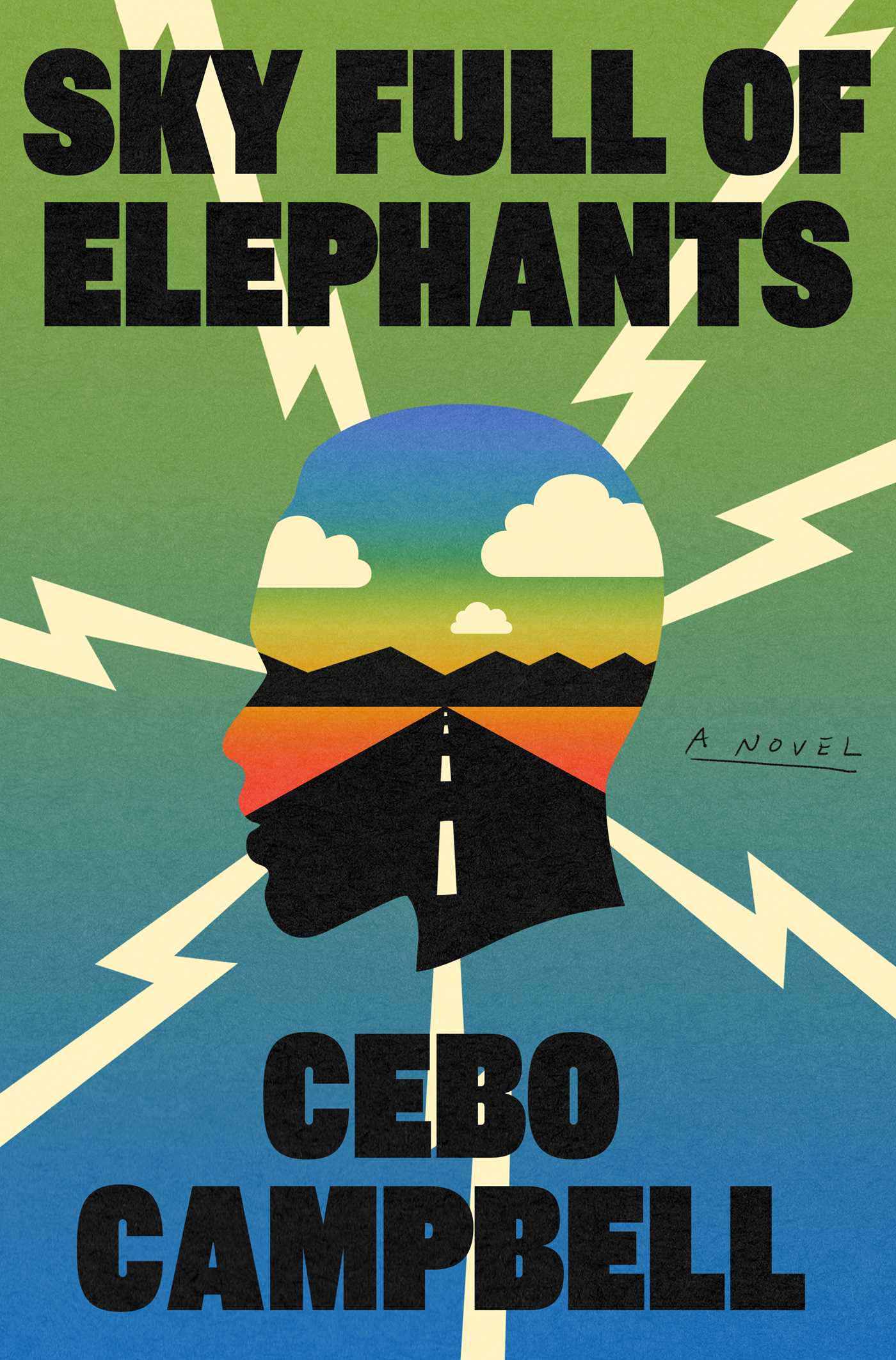
SKY FULL OF ELEPHANTS, debut novel with ideas that have real power


SKY FULL OF ELEPHANTS
CEBO CAMPBELL

Simon & Schuster
$27.99 hardcover, available now

Rating: 4.5* of five

The Publisher Says: In this exquisite speculative novel set in a world where white people no longer exist, college professor Charlie Brunton receives a call from his estranged daughter Sidney, setting off a chain of events as they journey across a truly “post-racial” America in search of answers.

One day, a cataclysmic event occurs: all of the white people in America walk into the nearest body of water. A year later, Charles Brunton is a Black man living in an entirely new world. Having served time in prison for a wrongful conviction, he’s now a professor of electric and solar power systems at Howard University when he receives a call from someone he wasn’t even sure existed: his daughter Sidney, a nineteen-year-old who watched her white mother and step-family drown themselves in the lake behind their house.

Traumatized by the event, and terrified of the outside world, Sidney has spent a year in isolation in Wisconsin. Desperate for help, she turns to the father she never met, a man she has always resented. Sidney and Charlie meet for the first time as they embark on a journey across America headed for Alabama, where Sidney believes she may still have some family left. But neither Sidney or Charlie is prepared for this new world and how they see themselves in it.

When they enter the Kingdom of Alabama, everything Charlie and Sidney thought they knew about themselves, and the world, will be turned upside down. Brimming with heart and humor, Cebo Campbell’s astonishing debut novel is about the power of community and connection, about healing and self-actualization, and a reckoning with what it means to be Black in America, in both their world and ours.

I RECEIVED A DRC FROM THE PUBLISHER VIA NETGALLEY. THANK YOU.

My Review
: Well, this was a read and a half. A fantasia, an attempt to view the culture of privilege and prejudice confronted by a man and the mixed-race daughter he never knew he had in the wake of white peoples' mass lemming-like vanishing.

Now, let me bring something up: This is in no way some triumphalist "wouldn't it be cool if all the white people vanished?" racist fantasy. It isn't that kind of facile storytelling, or revenge fantasy. It's a fantasia on the inscrutable ways of the Universe, an unknowable, unfathomably powerful external force that, this time, spared you; but...Amid the reorgaization of society, there's that unease that comes from an unresolved stressor, like the Bomb in the Cold War.

A lot like Le Guin's The Dispossessed, A Morally Ambiguous Utopia, the ideas in this story are heady indeed. The overculture in each of these different stories presupposes the existence of a hegemonic economic system that can only be opposed not reimagined. In Author Campbell's story, the presumption includes the fact that when whiteness and its (largely) unexamined privilege vanish, the enforcement of the hegemonic capitalism dies. Is everything suddenly perfect? No, but it's free from many of the more abusive qualities of capitalism and racism. I myownself am not quite so confident that capitalism would wither so completely or so quickly; it's too effective a tool of control, that most human of needs. Leaving that aside, the Brave New World presented feels...right, just, positive. I say this as someone explicitly excluded from this world. That fact is, I suspect, what led a LOT of whiny little butthurt arrested adolescents to ratings-bomb the book on Goodreads. Such arrant nonsense makes Author Campbell's premise's point for him. It also embarrasses me, an old white man, to be relegated among such angry, hateful, immature people.

The author's imagination, then, can't be faulted. This is his debut novel, so technique is logically enough less well-honed than his idea-generating musculature. I kept saying to my DRC, "Please don't explain so much to me. Trust that the stories you've imagined so richly will, in fact, lead me where you're wanting me to go. Conflicts whose roots and results you carefully elucidate aren't tense enough to keep me eagerly reading." I'm confident this can be attributed to his tyro status. I'm also very eager to read his next work when it comes out.

The ending of the story, while not exactly a release from tension, does flow from the events of the preceding action. It felt...I'm not sure "inevitable" is precisely correct, but it has the leadenness of affect I want to convey.

I've rated the book with four stars because I was brought up short and required to consider the ideas of the story multiple times. Good SF/F does that wonderful job better than any other form of storytelling.

This is good SF. That explains the other half-star.

Monday, September 2, 2024

THE MONSTERS IN OUR SHADOWS, atmospheric horror/dystopia with a lot to say


THE MONSTERS IN OUR SHADOWS
EDWARD J. CEMBAL

Tempus Press (non-affiliate Amazon link)
$4.99 Kindle edition, available now

Rating: 4.5* of five

The Publisher Says: It’s been a century since “the great consumption.” Humanity has been devoured to the edge of extinction by the ever-ravenous Shivers – terrifying, shapeless creatures that latch onto their hosts, tormenting them over time before consuming them all at once. The last of civilization lives in the crumbling city of Atlas, where they subsist on processed insects and await their inevitable fate.

Anthem is the city Exilist, tasked with trapping the Shivers and banishing them to the malevolent Deadlands outside the city walls. But Anthem is ailing and destined to soon fall victim to his own Shiver, a fate he’s reluctantly accepted. As Anthem begins to withdraw from his world, a threat he’s unprepared for comes hurtling home. If he is to save anyone, he will have to travel into the Deadlands in search of a remedy to tame these creatures. But no Atlas dweller has ever made it back alive, and Anthem must confront his own darkness before humankind is forever lost to the monsters in our shadows.

I RECEIVED A DRC FROM THE PUBLISHER VIA NETGALLEY. THANK YOU.

My Review
: I like horror stories about things I can believe exist, and the Shiver is one of those things. A thing unseen and unseeable to direct examination but real, and perceptible only obliquely? A thing that costs you huge energy to overcome the fear of, and ultimately it's most likely the thing that carries you off anyway?

Sounds like Life to me. Only this time it's seen from the widdershins view. No demons or supernatural gubbins or things from legend that don't exist. A real, demonstrably harmful...something...that we just don't understand. Like diseases we can't cure, conditions we can't treat, mental illnesses we refuse to look at.

Anthem, our PoV character, lives in Atlas, a walled city that's been erected to "protect" people yet it can't keep them safe from their Shiver. His job is to identify the threatened person's Shiver and get it corralled so he can take them both to the Deadlands outside Atlas's walls. He succeeds, he fails, but all he can do is treat the symptoms of the Shiver by ridding Atlas of the affected and their affliction. The drug that has prevented mass deaths is no longer effective, and Atlas needs a real solution...but where's it going to come from?

Atlas is under the control of a "savior" called The Architect whose walls have failed to keep out the Shiver, and whose claims to be the only one who can understand the Shiver and keep Atlas's people safe from it are wearing thin. The drug's no longer available and the price of cruelly exiling the sufferers to die outside Atlas is...well...distasteful. Anthem himself is now aware he needs to be exiled as his own Shiver is about to finish its ugly work.

The point of the story won't need belaboring, I trust, and the parallels won't need explication. The most effective part of the read is the sensory world Author Cembal evokes. The tense, paranoid, claustrophobic Atlas he creates is very effective. The way he adds sensory cues smalls and sights and sounds that get right to the emotional heart of the scene they're in...*chef's kiss*

I won't give the ending away. I will say that, by the end of the read, I felt I was rewarded by the story.

Saturday, December 30, 2023

THE ARREST, cozy catastrophe from a monadnock of literary SF


THE ARREST
JONATHAN LETHEM

Ecco
$16.99 trade paper, available now

Rating: 3* of five

The Publisher Says: The Arrest isn't post-apocalypse. It isn't a dystopia. It isn't a utopia. It's just what happens when much of what we take for granted—cars, guns, computers, and airplanes, for starters—stops working... Before the Arrest, Sandy Duplessis had a reasonably good life as a screenwriter in L.A. An old college friend and writing partner, the charismatic and malicious Peter Todbaum, had become one of the most powerful men in Hollywood. That didn't hurt.

Now, post-Arrest, nothing is what it was. Sandy, who calls himself Journeyman, has landed in rural Maine. There he assists the butcher and delivers the food grown by his sister, Maddy, at her organic farm. But then Todbaum shows up in an extraordinary a retrofitted tunnel-digger powered by a nuclear reactor. Todbaum has spent the Arrest smashing his way across a fragmented and phantasmagorical United States, trailing enmities all the way. Plopping back into the siblings' life with his usual odious panache, his motives are entirely unclear. Can it be that Todbaum wants to produce one more extravaganza? Whatever he's up to, it may fall to Journeyman to stop him. Written with unrepentant joy and shot through with just the right amount of contemporary dread, The Arrest is speculative fiction at its absolute finest.

I RECEIVED A DRC FROM THE PUBLISHER VIA NETGALLEY. THANK YOU.

My Review
: I should've read this in 2020. It would've suited the mood of that plague-stopped world perfectly.

Since I didn't, I read the book without any frisson whatsoever. As always with Lethem's writing, the sentences pass with their unshowy but tremendously high level of craftsmanship causing them to slide directly into your brain. This, despite every character being pretty much...average. They don't stand out; they aren't meant to. This is a cozy catastrophe, not a Hero's Journey. I don't know if that was Author Lethem's intent but it's what we got.

The most vivid presence, the one truly blaringly alive character, isn't the blah "Journeyman"...an ycleture entirely self-generated as no one addresses or refers to the main character by that name...but Todbaum (literally "death tree") the thinly-veiled satirical caricature of 45. Plowing through the landscape, crushing all remaining shelter and destroying the livelihoods of all unlucky enough to be in his way, his nuclear-powered engine of destruction was made before the catastrophe of The Arrest so is the only surviving example of technology that Lethem posits destroyed us. Now, in the post-Arrest world, people are clueless and helpless. Then here comes Todbaum to destroy them anew with his sociopathic indifference and hoarded tech.

Pretty on-the-nose as a caricature of 45, but equally applicable to the billionaire class and their survival bunkers as a whole.

What would've worked better for me, personally, in 2020 was the laying-bare of the then-president's sociopathy before January 6th, 2021, rendered fiction about his toxicity irrelevant to the point of becoming distasteful. I was mildly amused, and always entertained, by the story. I was never inside it, or moved to want more of it. I read the book and appreciated the author's skill. I didn't invest in anyone inside the story but watched passively as events happened to and around them.

In a way I suppose this is as close as I can get to the experience of people who consume stories by staring at them on TV. I accepted what I was shown. I never once thought about whys, or hows, or what-ifs. What's here is all there is. This is not my preference, to be honest; it leaves me outside and while I expect that was the point, I didn't enjoy it much.

For me, this was a case of wishy meets washy in a beige future world that's too much and not enough like the present for it to work as allegory, satire, or parable. I'd be angry and upset with it, except that it's too well-made, too craftsmanlike, to truly disappoint that much. While it delivers what it promises it will, it doesn't delight the way Author Lethem most assuredly can.

Wednesday, December 13, 2023

WEAVER will make a weaver of the reader in this post-apocalyptic tale


WEAVER
KELLY ANN JACOBSON

Livingston Press
$19.95 trade paper, available now

Rating: 4.5* of five

The Publisher Says: In this Cloud Atlas-style speculative novel, humans are the alien invaders. The reader learns through many documents—police reports, legal depositions, speech transcripts, and diary entries—that a human company named HealthCorp has attempted to enslave two alien the Laffians stranded on a planet-wide ocean and the feline HoFe living on a bed of hofellium. Now, those same aliens have come to Earth in the hopes of using the planet to safely repopulate. The overriding question becomes whether these three groups can reconcile on Earth without killing each other first. . . .

I RECEIVED A DRC FROM THE PUBLISHER VIA NETGALLEY. THANK YOU.

My Review
: Definitely a message I endorse: anti-capitalist, anti-racist, greedshaming, selfish, tribalistic thoughts and actions disparaged and criticized in a post-apocalyptic novel that is very queer-inclusive. The author's previous two excursions into mostly YA storytelling but that are suitable for adults to enjoy too (ROBIN AND HER MISFITS, TINK AND WENDY) were favorites of mine earlier this year.

Author Jacobson's storytelling chops, in this book, are aptly held up against David Mitchell's famously fractured framework in Cloud Atlas and, while I wasn't a fan of that book, I felt this iteration of that multi-documentary style worked...and didn't work...in the same ways here. It makes the worldbulding, particularly important in a story with an alien species introduced to Earth, a bit spottier and harder to follow than is my personal sweet spot for reading.

What definitely works is Author Jacobson's certainty that all her queer-coded characters are central to the narrative of humanity's survival. It is by no means certain that humanity will survive, but we're giving it a good, solid go in our confict with the superior forces of an uncaring galactic horde. The story is moe than rich enough in detail to make the average teen reader use their pattern-spotting skills, keeping track of the many different threads of the story.

A terrific choice for the experienced SFF reader, the young queer or questioning reader will find themself in here too, and the grown person will enjoy this non-triumphalist, question-authority vibed tale of working for survival.
Highly recommended for the Booksgiving choice to unwrap and dive right into.

Friday, September 2, 2022

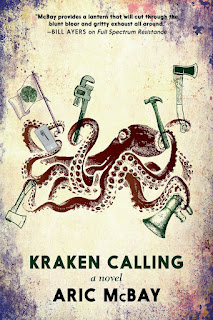
KRAKEN CALLING, best be sure to pick up *now*


KRAKEN CALLING
ARIC McBAY

Seven Stories Press
$22.95 trade paper, available now

Rating: 4* of five

The Publisher Says: A sweeping near future dystopic fantasy in the Octavia Butlerian vein of the Parable of the Sower novels.

Political activist and anarchist author Aric McBay (Full Spectrum Resistance) toggles between the years 2028 and 2051 to give us the experience, with breathtaking realism, of what might happen in the span of just one generation to a society that is already on the brink of collapse.

In 2028 environmental activists hesitate to take the fight to the extreme of violent revolution. Twenty years later, with the natural environment now seriously degraded, the revolution is brought to the activists, rather than the other way around, by an authoritarian government willing to resort to violence, willing to let the majority suffer from hunger and poverty, in order to control its citizens when the government can no longer provide them with a decent quality of life.

So it is the activists who must defend their communities, their neighbors, through a more humane and in some ways more conservative status quo of care and moderation.

And the outcome here is determined by the actions of those who resist more than it is by the actions of the nominally powerful.

I RECEIVED A DRC FROM THE PUBLISHER VIA EDELWEISS+. THANK YOU.

My Review
: Non-fiction writer (Peak Oil Survival, Deep Green Resistance) Aric McBay makes his points in fictional form. What he has done is not the usual thing for him, analyzing and contextualizing social and political trends for a left-leaning audience; this has always been his forte as a writer.

I think it still is. This novel makes a very trenchant attempt to put human skin on the bones of social movements for change, favoring equitable and reasonable restructuring of our self-evidently unsustainable lives.
“It’s always hard to tell, isn’t it? How the future could change from the smallest actions,“ Simón mused. “I believe we made things better. We bought time. Breathing room. We stopped one more. We didn’t improve things as dramatically as we hoped. But we made room for a hundred other movements to flower. Some of them failed, but some of them are amazing....”

“The tides always rise and fall for us,”Simón said. “That’s the nature of struggle. There is no guarantee, no permanent victory.”

“The work of the revolutionary is to plow the sea,” Addy quoted.”

It is indeed, Addy. It is indeed. To see your best efforts subsumed under the heaving mass of humanity in its indifference and fearful rejection of change. To know you're not ever going to prevail, no matter how many times you win. But to be sure you're harrowing the surfaces of the waters plowed and allowing things buried to come to the surface? It's a reward beyond price.

Dystopia, then, is inevitable? I don't think it is, though a lot depends on the individual's concept of "dystopia" and their tolerance for ambiguity. Most revolutionaries are absolutists, and should be kept far, far away from the levers of power. We're seeing that in the House of Representatives in the US during 2022. Revolution is hard, and requires people to be very, very hard...and these revolutionaries are obdurate, but brittle.

This means that, like Evelyn in our near-term future (2028), we need to be sure to combat that obduracy effectively. Or the 2051 sections of the story won't be a warning klaxon but a sad prediction.

Monday, July 5, 2021

WHEN THE SPARROW FALLS, a debut SF novel with


WHEN THE SPARROW FALLS
NEIL SHARPSON

Tor Books
$26.99 hardcover, available now

Rating: 4.1* of five

The Publisher Says: Life in the Caspian Republic has taught Agent Nikolai South two rules. Trust No One. And work just hard enough not to make enemies.

Here, in the last sanctuary for the dying embers of the human race in a world run by artificial intelligence, if you stray from the path - your life is forfeit. But when a Party propagandist is killed - and is discovered as a "machine" - he's given a new mission: chaperone the widow, Lily, who has arrived to claim her husband's remains.

But when South sees that she, the first "machine" ever allowed into the country, bears an uncanny resemblance to his late wife, he's thrown into a maelstrom of betrayal, murder, and conspiracy that may bring down the Republic for good.

WHEN THE SPARROW FALLS illuminates authoritarianism, complicity, and identity in the digital age, in a page turning, darkly-funny, frightening and touching story that recalls Philip K. Dick, John le Carré and Kurt Vonnegut in equal measure.

I RECEIVED MY DRC FROM THE PUBLISHER VIA NETGALLEY. THANK YOU.

My Review
: First, read this:
Nominally, the currency of the Caspian Republic is the moneta, but in truth the coin of the nation was fear. Whoever could inspire fear was rich, whoever lived in fear was poor.
–and–
For a writer's work to be circulated amongst the upper levels of the party was usually the precursor to them coming down with a rather permanent case of writer's block, but not this time. {He} was offered a position in The Truth (then viewed as a rather out of touch and elitist organ), and asked to bring his rough, authentic, working-class voice to the paper's readers, who were left with nothing to do but wonder what they had done to deserve it.

You know already where you are. You'd be stupid or frankly insentient if you didn't recognize the various totalitarian régimes of our present century. Here's what you don't know in the first few chapters of this extraordinarily exciting tale: You will not be leaving the Caspian Republic until events have reached their logical limits. Until then, settle in and surrender your schedule and your other plans.

I would love to spoil the bejabbers out of this read. It is almost painful not to. I want someone to kvell over the ending with; I want someone to be full of the rat's-nest of emotions with me...and not one soul I know can be!

I understand the feelings expressed at the ending of the book so very much better now.

When you send your request in to the bookery of your choice for this story, I think you should know that the author's purpose in writing it was to rob you of any sense of actual control over your life and the world around you. But it will, in fact, be okay. I can't tell you why but let's just say Epicurus's famous formulation of the Problem of Evil:
“Is God willing to prevent evil, but not able? Then he is not omnipotent. Is he able, but not willing? Then he is malevolent. Is he both able and willing? Then whence cometh evil? Is he neither able nor willing? Then why call him God?”

Well-trodden tracks lead through this thicket. The response from the god-addled is, "She has Her Reasons, which Reason knoweth not," or something similar to that. In fact the story contains that very argument, put in the mouth of a deeply important figure. (It is only resolvable for the goddists by their huffy assumption that you, o skeptic, are nowhere near as smart as you think you are; and for the bare-faced atheists by using the same argument in reverse.) But what if there *is* a solution....
It was the face beneath mine on the beach when she had been pulled from the ocean and my breath had not been enough.

What, indeed.

Spending a day immersed in the Caspian Republic is a pleasure I'm deeply glad to inform you is exactly what this rather somber, for me at least, holiday required. I needed morally complex characters, ones whose simplest expressions of self are free of embarrassing innocence and unmarred by mawkish candor. I needed to be with my fellow hideously betrayed and painfully reassembled, then betrayed again...and again...and again...bitter, disappointed, unable to imagine what trust would even look like, romantics. They teem in the totalitarian terrors of the Caspian Republic. I needed to feel that my brain's energy was fully and unremittingly drawn down to understand the convolutions of the story's moral landscape.
"Everyone's soul is unique...{a}nd just as your body is built with the protein and calcium and iron you consume every day, your soul is built with words. The words you read, and the words you hear. The soul consumes words, and then it expresses itself through them in a way that is unique to that soul."

Success!

Love will always fuck you up; and the ways in which love fucks you up are truly epic in this story. Thee and me, fellow QUILTBAGgers, are presented on these pages as people of complexity and subtlety. There's really no sex of any sort; it's alluded to and it's very much part of the proceedings, but nobody gets down to business. In exchange, lesbians' love is utterly unremarkable. Men's love is less present; but it does come, when it shows up, as a moment of bathos and facetious secretiveness ("...what did he do?" Your husband, unless I completely misread the subtext, isn't particularly respectful from a cishet man no matter that it's amusingly phrased). Oh well...can't really expect otherwise, given the two men involved. There was absolutely no way on Earth I'd've picked those guys out as my fellows, gotta hand that to Author Sharpson!

So half-a-star gone for the three w-bombs dropped on my innocent, unsuspecting head; another half-star for being sniggeringly dismissive of the only gay male couple in the entire book.

But leaving the read, the ending, well...that has to put some luster back on the read...it's a delight, if a marred and flawed delight, of a read. It gives a reader a rare treat: Reading about grown people, the adult end of the room, is a rapturous and infrequently encountered pleasure in the YA-heavy lists of SF/F publishers. A novel of ideas, one that examines the cracks and the broken places in Love and Trust, one that asks you to spend more than just the usual amount of energy on the read deserves a warm and delighted welcome, louder and stronger for the fact that it's the first...hopefully in a long line.

But seriously. No more w-verbing. It's gross.

Monday, March 30, 2020

A JUSTIFIED STATE, first of three medium-future Scotland's awful torments, and SUPER good COVID-19 reading


A JUSTIFIED STATE
IAIN KELLY
(The State Trilogy #1)
Self-Published
$1.99 Kindle edition, available now

Rating: 4.5* of five, a half-star off for the heinous w-bomb dropped at 52%

The Publisher Says: In the future, The State is ruled by the socially reformist Central Party Alliance. Poverty and homelessness have been eradicated, but overpopulation, an energy crisis and an ongoing overseas war are threatening the stability of the country. When a local politician is assassinated, Detective Danny Samson finds himself thrust into the middle of the investigation. Still grieving for his dead wife and children, Danny tracks down the assassin, an ex-military sniper called Gabriella, only to discover she may not be the real villain.

The secret behind the murder of one politician may bring down the entire ruling Party, and Danny soon learns those in power will go to any lengths to protect The State. Joining forces with Gabriella and the mysterious government agent Phillips, Danny must unearth the truth and bring the guilty to justice, before they catch up with him first.

My Review: No one is talking about this book and I can not figure out why. I think it's superb. A Justified State is really dark, involving, and quite exciting. Think Enemy of the State only written by Philip K. Dick in an unusually grim mood. It's near-future, like the In Death series, and can't fairly be classed with them because the stakes are SO. VERY. HIGH.

The world is, as I suspect you know by now, going directly to hell in a very cramped handbasket. There are 7.5 billion of us, and the planet's ability to support us all is creaking. That's not because of scarcity of resources, mind you, it's because we distribute resources in truly pathological ways. The COVID-19 pandemic during which I am writing this review, and whose assault on my nerves I read this book to mitigate, has thrown this 2018 title's central thesis into bright relief. Things, in Detective Danny Samson's unnamed-but-evidently medium-future Glasgow, are both better...the environment is recovering, the sea-level rises we're going to get (don't bother equivocating, they're coming so make your plans accordingly) are well-mitigated...and worse...we're all forced to live in Social Housing cubes, prefab characterless nightmares of conformity, and while no one is hungry only the very top echelons regularly eat natural foods. (None of this, BTW, is remotely far-fetched as we're in this situation today; you're just not used to looking at it from that angle.)

The electric grid that sustains dense city immense population is struggling. The lifespan of an average citizen is about 110 years; Danny's not quite middle-aged at 47. But it's not the years, it's the mileage, as Danny's life ceased to have any meaning after his twin children died shortly after birth, followed by his wife's depression and suicide. No one is going to be chipper under these circumstances. Danny, as a State Police Officer, is forced (note verb) to take compassionate leave to process his losses. When the story opens, a murder is in process; the lucky State Police Detective to draw the short straw of investigating the first violent homicide the City has seen in who-knows-when is Danny. That the murdered man is a Consul, a high but local State official, suggests to all and not least to Danny, that the desired result of the investigation isn't The Truth Coming Out, but the forms being filled out and filed. He's dead, it's awful, what's next.

I'll tell you what's next: Danny the Depressed needs answers because he's lost love, he's lost purpose, and he's rapidly losing the little faith in Humanity he's clung to. Solving a man's murder, even a man as far "above" Danny as the dead Consul was, will enable Danny to restore ma'at, will bring a deal of justice to a world where even-handed has been defined as fair. The reason the opening murder is committed will, I promise you, set your preconceived notions on their ear. It's a deep and twisty thing, power, and grabbing it makes enemies.

Sometimes very, very angry ones. Righteously angry.
Where there were those in power, those with more wealth, they would always seek to rise above those below them, to maintain their position and protect their interests.
I do not care what kind of social system, with what kind of social controls on thought and behavior, people invent, there will be someone who will find a way to subvert the purpose of the situation for their own gain. Every system starts with a purpose, often a laudable one; we, the hoi polloi, are assured that ALL must obey the strictures put in place to benefit the many at the expense of the few.
Openness and transparency, those were the cornerstones of the Central Alliance Party that had swept to power after years of corrupt and ineffectual governance. If {the Party} had the ability to fake {location} data, then {police} reports were at best meaningless and at worst providing alibis that allowed State leaders to go wherever they wanted and do whatever they desired.
It will surprise you to learn that this is, in fact, the least of the worms crawling out of the can that Danny and his weirdly assorted not-enemies (it's too much to call them "allies") have collectively opened. This is an iceberg whose long gestation has caused much, much displacement in the ocean of Danny's life.

I can't go more into that because the Spoiler Stasi will shriek at and dive-bomb me. (An unpleasant experience, I've found, and to be avoided even if their sensitivity seems to me outsized and outlandishly emotional.) But this is a book I want you to read, so I won't spoiler the real, and utterly appalling, motive for the murder of the Consul. The deaths that follow are, in fact, all tied to the central horror, the unbelievable (and I mean this literally, you will not want to believe the central crime could ever happen) cruelty and vileness, which the Consul set in motion.

Seriously, y'all, this book's been out there 18 months and it's not a bestseller yet?! Hop on it! Three bucks for five hours'-worth of twisty, dark, well-plotted, tautly paced, and almost entirely well-thought-out worldbuilding telling a deeply heartfelt moral story.


******CODA******
I do have a few minor cavils. There are, in this Brave New World, some absences that are carefully explained. No bars, casinos, or parties; only State-approved music; one mass celebration allowed, the New Year. No old-fashioned dwellings with things like fireplaces. Not in generations. And yet Danny knows how to tend a fire? And Danny knows the barman behind the bar in an illicit casino (a word he shouldn't know, a concept he shouldn't have) how exactly?

But these are cavils. I can probably MacGyver up a patch, to do with the fact that Danny's father was older when he was born and his great-grandfather was a known troublemaker, something like that. But honestly when I am so enrapt and fully invested in the story, I don't much like having to retcon myself. Call me crazy but that's the author's job to my mind.

Tuesday, August 1, 2017

MISSIONARY is my six-star read of 2017, deserves your paltry money and your eyeblinks


MISSIONARY
LEHI RENNER

Smashwords
$4.99 electronic edition, available now

Rating: 6* of five

The Publisher Says: The Prophet provides everything for the Flock, demanding absolute devotion in return. Before allowing men to wed, they must serve Him, which they do willingly to get their brides. There’s only one little problem. When each man has multiple wives, there’s simply far too many boys.

Knowledge isn’t always power, but ignorance isn’t always bliss…

Jacob Wright’s questioning nature has always gotten him into trouble. The only book he has access to is The Word, but he thinks too deeply about the contents, far more than a devout boy should. When he’s called by the Prophet to serve a mission, Jacob believes his quest for answers has begun, only to discover the more he knows the less he believes.

Kerioth Marshal is an authoritarian, keeper of all knowledge past and present. His duty is to oversee the missionary center library, holding close the secrets of the Prophet. He’s accepted loneliness as part of his job, but then Jacob comes, offering him an escape from isolation. At first, Jacob’s inquisitive nature amuses and enchants him, but how long will it be before Jacob realizes Kerioth has saved him from one horrible fate only to subject him to another?

My Review: Where do I begin...first, this book was a complete surprise to me. Its existence was a surprise. Its subject matter was a surprise. Its imaginative universe was a gobsmacking surprise. So yeah, I was surprised.

Second, I would never have found the book had it not been for a Goodreads group called Gay Science Fiction. I'm coming out of a nasty reading slump and that makes me, to be frank, unwilling to translate from the heterosexual into my native tongue. I'm tired of reading about women who don't like their husbands, are abused by their fathers, etc etc etc. And the unbearable white heteronormative genre that SF has always been gets dreary too. I needed a resource to guide me past yet more gynergy or, worse still, misogyny. I found the group, I found the bookshelf and, best of all, I found one of the mods had posted about this title finally being available.

I read the synopsis above. Mmm...high stakes! Daddy/son relationship! A religious dystopia! Check, check, and check on my readerly desiderata list. A $3.99 gift card later, I settled in for a long summer's afternoon of getting safely riled up about fiction instead of world events that upset me.

Fucking hell.

This North Korea-run-by-Mormons tale smacked my teeth in, kicked my kneecaps, and made the Kindle pages blink past as fast as my thumb could tap the screen. In the Flock's territory, the Prophet is the autocratic leader of the church and the state. The Prophet's many, many wives have given him many, many children. The other church leaders have equally cushy tushy supply. The average man has three wives, the more status he has the more wives he adds.

How, you might wonder, does that work. The women are property, barely educated since their purpose in the world is to bear children (one woman is revealed to have died giving birth to the eighteetnth child). They have no semblance of rights, and are married off as early as twelve years old. The average man has no semblance of meaningful rights. He's led by the Prophet's local guy, he's required to make his children perform physical labor for the Prophet starting as young as five years of age, and the Prophet has set up a system to "call into missionary service" prepubescent boys who are...misfits...some too aggressive, some too full of questions, some physically unfit...and from there springs our story.

Jacob Wright is bursting with questions about everything. His father, his first, second, and third mothers, his teachers can't keep up. In an information-poor society they aren't equipped to answer the questions anyway. But no amount of disapproval can keep Jacob from asking and wondering and pondering. Thus it is that he is called to the missionary training center, where he expects to be trained and sent out among the Heathens outside the Gate to convert them. Jacob's bus ride to the missionary center is excitingly interrupted by a military attack from the heathens, whom Jacob sees for the first time. He sees desperate, dirty soldiers who will attack a busload of children, and cracks form in his idea of why he's off to become a missionary.

Things do not go as expected by Jacob. Nor do they go as planned by the theocratic machinery. Kerioth, the missionary center's authoritarian (head dude in charge of being in charge), interviews Jacob and senses something within the boy that makes him special and valuable. Kerioth singles Jacob out for special education, pays him personal attention, and generally makes life in the rigidly compartmentalized and hierarchical center endurable.

As time passes, Jacob learns more and more about Kerioth and more and more about the Flock's society. He is, after his eighteenth birthday, finally admitted into Kerioth's extremely difficult work world as well as his bed. The child has become a young man; the questing intelligence has matured into a worthy and beloved intellectual companion to the lonely and isolated Kerioth.

The job of authoritarian...to be the Flock's memory of dead times and forbidden practices...is one that Kerioth shares to a limited degree with Jacob. The years that flow past the men are full of silences both beautiful and tense. The slow unfolding of Jacob's understanding of the Prophet, his family, and the very terrifyingly evil way the Flock keeps its promise of three wives for every average man, more for men of higher status, is a titanic blow to Jacob's sense of the rightness of the world he grew up in.

And, at the end of the book, the natural and inevitable and inescapable conclusion to the story...

...is completely upended and shook around and pounded on the storytelling rocks Author Renner has gathered, placed, balanced, and mortared into place, like an octopus being tenderized for dinner. Tentacles of tale meat flail in every direction. Eyes and brains pop against the solid foundation rocks with the force of the change in direction.

But for once this sudden shift isn't cause for puma-screaming killing rage. It is a far, far, far more important story that, in the last lines, Author Renner promises us.

Six stars for that alone.

Also boosting the six-of-five case is Kerioth's intense and respectful passion, love, and need for Jacob. In a society that spends huge effort on controlling all females, males are untrammeled in any meaningful psychosexual ways. Kerioth could have started sexing up Jacob the second he saw the boy had he wanted to. Not one peep would've been uttered by anyone. Kerioth is so appalled by the idea of sexual abuse of children that he simply refuses to countenance it.

This resonates with me, as the child of a sexually abusive pedophile mother. It made me feel Kerioth, for all his fears and quirks, was at heart a decent man with a bedrock of honor from which he operates.

Jacob's growth into a partner for Kerioth is satisfying as well. Jacob never stops learning. Jacob also has a sneaky streak in his pragmatic nature. He "manages upward," so to speak, leading Kerioth to the conclusions that Jacob wants him to arrive at. The more information Jacob acquires, the more he leads his true love Kerioth into rebellious and seditious thought-patterns.

But the secret that the missionary center conceals...its true purpose to the Flock...is so extremely NOT what Jacob or I was expecting that it rockets this theocratic dystopia to the very top of my reading list for 2017. It is stunning. I can't even hint at it. I want everyone I know to read the book RIGHT NOW so we can all discuss this, this, I can't even be coherent, this abomination, this darker, more horrifying, more unspeakable cousin of the Final Solution.

Yes. I went there. Author Renner has, in these 300-ish pages, created a nightmare theocracy that is built on something worse than the Final Solution.

Fear him. Words have power. Read his $3.99 vision of a hell so awful you will not be able to look away or to fully process its scope.

Sunday, January 1, 2017

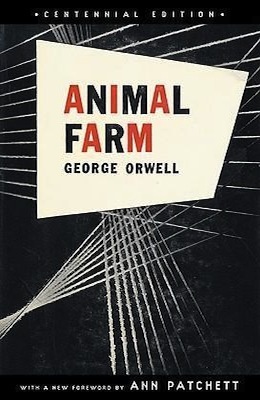
ANIMAL FARM, the 20th century's best, most biting political satire


ANIMAL FARM
GEORGE ORWELL

Everyman's Library
$20 hardcover, available now

Rating: 5* of five

The Publisher Says: Signet Classics 1996 edition:
A farm is taken over by its overworked, mistreated animals. With flaming idealism and stirring slogans, they set out to create a paradise of progress, justice, and equality. Thus the stage is set for one of the most telling satiric fables ever penned –a razor-edged fairy tale for grown-ups that records the evolution from revolution against tyranny to a totalitarianism just as terrible.

When Animal Farm was first published, Stalinist Russia was seen as its target. Today it is devastatingly clear that wherever and whenever freedom is attacked, under whatever banner, the cutting clarity and savage comedy of George Orwell’s masterpiece have a meaning and message still ferociously fresh.
Penguin Classics 2000 edition:
'It is the history of a revolution that went wrong – and of the excellent excuses that were forthcoming at every step for the perversion of the original doctrine,' wrote Orwell for the first edition of Animal Farm in 1945. Orwell wrote the novel at the end of 1943, but it almost remained unpublished. Its savage attack on Stalin, at that time Britain's ally, led to the book being refused by publisher after publisher. Orwell's simple, tragic fable, telling what happens when the animals drive out Mr Jones and attempt to run the farm themselves, has since become a world famous classic.
NAL 2003 edition:
"All animals are equal. But some animals are more equal than others."

One night on an English farm, Major the boar recounts his vision of a utopia where his fellow creatures own the land along with the means of production and are no longer the slaves of humans.

Before long his dream comes true, and for a short while all animals really are equal. But the clever pigs educate themselves and soon learn how to extend their own power, inevitably at the expense of the rest of the community.

This well-loved tale is, of course, a satire on the Soviet Communist system that still remains a powerful warning despite the changes in world politics since "Animal Farm" was first published.
Everyman's Library 1993 edition:
Animal Farm is the most famous by far of all twentieth-century political allegories. Its account of a group of barnyard animals who revolt against their vicious human master, only to submit to a tyranny erected by their own kind, can fairly be said to have become a universal drama. Orwell is one of the very few modern satirists comparable to Jonathan Swift in power, artistry, and moral authority; in animal farm his spare prose and the logic of his dark comedy brilliantly highlight his stark message.

Taking as his starting point the betrayed promise of the Russian Revolution, Orwell lays out a vision that, in its bitter wisdom, gives us the clearest understanding we possess of the possible consequences of our social and political acts.

My Review: What on earth is the point of reviewing this book? Why should I ask you to read a review of something that, in all likelihood, you're already familiar with and have a strong memory of and opinion about? Italo Calvino said it for me: "A classic is a book that has never finished saying what it has to say." And therefore a classic is a book about which the serious lover of reading should never stop talking or thinking about, or re-evaluating, re-reading, re-responding to.

I did not remember this passage from the first chapter:
I merely repeat, remember always your duty of enmity towards Man and all his ways. Whatever goes upon two legs is an enemy. Whatever goes upon four legs, or has wings, is a friend. And remember also that in fighting against Man, we must not come to resemble him. Even when you have conquered him, do not adopt his vices. No animal must ever live in a house, or sleep in a bed, or wear clothes, or drink alcohol, or smoke tobacco, or touch money, or engage in trade. All the habits of Man are evil. And, above all, no animal must ever tyrannise over his own kind. Weak or strong, clever or simple, we are all brothers. No animal must ever kill any other animal. All animals are equal.
Old Major the boar addresses the assembled animals of Jones's Farm thus; he's had a long life and over four hundred children, a lot of time to think, and thus has earned the right to instruct the younger, the less able (like poor old Boxer the workhorse).

Life has a new zest for the animals after Farmer Jones and his henchmen are driven off the farm. The incontestable truth that the fruits of one's labor are sweeter than any others is brought home to the hardworking animals:
The animals were happy as they had never conceived it possible to be. Every mouthful of food was an acute positive pleasure, now that it was truly their own food, produced by themselves and for themselves, not doled out to them by a grudging master. With the worthless parasitical human beings gone, there was more for everyone to eat. There was more leisure too, inexperienced though the animals were.
Tomatoes one grows one's own self are always sweeter than store-bought; food made with one's own hands is tastier than fast food can ever be. Of course, all the animals do the work together, so of course they eat the fruits of their labor together, equally. Of course! Why would you imagine that it would ever be any other way?
The early apples were now ripening, and the grass of the orchard was littered with windfalls. The animals had assumed as a matter of course that these would be shared out equally; one day, however, the order went forth that all the windfalls were to be collected and brought to the harness-room for the use of the pigs. At this some of the other animals murmured, but it was no use. All the pigs were in full agreement on this point, even Snowball and Napoleon. Squealer was sent to make the necessary explanations to the others.

“Comrades!” he cried. “You do not imagine, I hope, that we pigs are doing this in a spirit of selfishness and privilege? Many of us actually dislike milk and apples. I dislike them myself. Our sole object in taking these things is to preserve our health. Milk and apples (this has been proved by Science, comrades) contain substances absolutely necessary to the well-being of a pig. We pigs are brainworkers. The whole management and organisation of this farm depend on us. Day and night we are watching over your welfare. It is for YOUR sake that we drink that milk and eat those apples. Do you know what would happen if we pigs failed in our duty? Jones would come back! Yes, Jones would come back! Surely, comrades,” cried Squealer almost pleadingly, skipping from side to side and whisking his tail, “surely there is no one among you who wants to see Jones come back?”

Now if there was one thing that the animals were completely certain of, it was that they did not want Jones back. When it was put to them in this light, they had no more to say. The importance of keeping the pigs in good health was all too obvious. So it was agreed without further argument that the milk and the windfall apples (and also the main crop of apples when they ripened) should be reserved for the pigs alone.
Of course.

But nothing ever stays the same, does it? The animals have no reason to complain, surely! The work they do is rewarded with food...not apples or milk, it's true, but food...and they're all pulling together and doing their work together and deciding what the farm will produce together! Of course the pigs, the cleverest animals, are thinking the hardest and making the proposals for plans. That's natural, isn't it, the cleverest do the brain-work and think through the problems for the best solutions. And the cleverest pigs, Snowball and Napoleon, are always planning and thinking and exhorting the other animals. The trouble is that they almost never have the same plan. Snowball talks the animals around, but Napoleon always makes the last decision. Animals discuss the problem, the pigs compromise, but the situation just won't change.
But just at this moment Napoleon stood up and, casting a peculiar sidelong look at Snowball, uttered a high-pitched whimper of a kind no one had ever heard him utter before.

At this there was a terrible baying sound outside, and nine enormous dogs wearing brass-studded collars came bounding into the barn. They dashed straight for Snowball, who only sprang from his place just in time to escape their snapping jaws. In a moment he was out of the door and they were after him. Too amazed and frightened to speak, all the animals crowded through the door to watch the chase. Snowball was racing across the long pasture that led to the road. He was running as only a pig can run, but the dogs were close on his heels. Suddenly he slipped and it seemed certain that they had him. Then he was up again, running faster than ever, then the dogs were gaining on him again. One of them all but closed his jaws on Snowball’s tail, but Snowball whisked it free just in time. Then he put on an extra spurt and, with a few inches to spare, slipped through a hole in the hedge and was seen no more.
Things change when the boss says they change. Then they change how the boss wants them to change. It's the single clearest hallmark of authoritarian government, and it's coming disturbingly close to US reality. Surely things won't, can't, get worse!

And then...
Napoleon, with the dogs following him, now mounted on to the raised portion of the floor where Major had previously stood to deliver his speech. He announced that from now on the Sunday-morning Meetings would come to an end. They were unnecessary, he said, and wasted time. In future all questions relating to the working of the farm would be settled by a special committee of pigs, presided over by himself. These would meet in private and afterwards communicate their decisions to the others. The animals would still assemble on Sunday mornings to salute the flag, sing ‘Beasts of England’, and receive their orders for the week; but there would be no more debates.

In spite of the shock that Snowball’s expulsion had given them, the animals were dismayed by this announcement. Several of them would have protested if they could have found the right arguments. Even Boxer was vaguely troubled. He set his ears back, shook his forelock several times, and tried hard to marshal his thoughts; but in the end he could not think of anything to say. Some of the pigs themselves, however, were more articulate. Four young porkers in the front row uttered shrill squeals of disapproval, and all four of them sprang to their feet and began speaking at once. But suddenly the dogs sitting round Napoleon let out deep, menacing growls, and the pigs fell silent and sat down again. Then the sheep broke out into a tremendous bleating of “Four legs good, two legs bad!” which went on for nearly a quarter of an hour and put an end to any chance of discussion.
Sounds familiar, doesn't it? The growling of the dogs set to protect the pig-in-chief at any cost, the unquestioning loyalty of the pack for its alpha. Disturbingly reminiscent of our president elect's command of a Twitter propaganda force, a CNN flying squad of apologists and face-timers. It's been so frequently seen that it's not even remarked upon in any way except to disagree with what's being spread around. The fact of it is...how I hate to say this...normal. Familiar, so normal.

Far more upsettingly familiar is the pronouncement of anathema upon the expelled Snowball:
“Comrades,” [Napoleon] said quietly, “do you know who is responsible for this? Do you know the enemy who has come in the night and overthrown our windmill? SNOWBALL!” he suddenly roared in a voice of thunder. “Snowball has done this thing! In sheer malignity, thinking to set back our plans and avenge himself for his ignominious expulsion, this traitor has crept here under cover of night and destroyed our work of nearly a year. Comrades, here and now I pronounce the death sentence upon Snowball. ‘Animal Hero, Second Class,’ and half a bushel of apples to any animal who brings him to justice. A full bushel to anyone who captures him alive!”
Julian Assange. Edward Snowden. Chelsea Manning. Put any of these names in Snowball's place. You won't notice a difference. Speaking out is treason. People who do are traitors and are directly and personally responsible for all the ills they spoke out against.

Some few of us are old. We have a memory of how things once were that isn't dependent on the pronunciamentos of the Powers That Be. It upsets the old folk to look at the way things are and compare them to the way we remember them to be, to remember how we wanted things to be for our children and grandchildren after us:
As Clover looked down the hillside her eyes filled with tears. If she could have spoken her thoughts, it would have been to say that this was not what they had aimed at when they had set themselves years ago to work for the overthrow of the human race. These scenes of terror and slaughter were not what they had looked forward to on that night when old Major first stirred them to rebellion. If she herself had had any picture of the future, it had been of a society of animals set free from hunger and the whip, all equal, each working according to his capacity, the strong protecting the weak, as she had protected the lost brood of ducklings with her foreleg on the night of Major’s speech. Instead — she did not know why — they had come to a time when no one dared speak his mind, when fierce, growling dogs roamed everywhere, and when you had to watch your comrades torn to pieces after confessing to shocking crimes. There was no thought of rebellion or disobedience in her mind. She knew that, even as things were, they were far better off than they had been in the days of Jones, and that before all else it was needful to prevent the return of the human beings. Whatever happened she would remain faithful, work hard, carry out the orders that were given to her, and accept the leadership of Napoleon.
The rise of an ever-more authoritarian governmental structure in response to the economic depredations of the banksters is, if not inevitable, then more and more likely. This sensation of loss and the theft of the dream we invested our labor into realizing is acute, painful, and miserable. The mere notion of this Orwellian outcome of this latest presidential election is nauseating.

The simple distillation of the novella's point is almost too painful to read:
Somehow it seemed as though the farm had grown richer without making the animals themselves any richer-except, of course, for the pigs and the dogs. Perhaps this was partly because there were so many pigs and so many dogs. It was not that these creatures did not work, after their fashion. There was, as Squealer was never tired of explaining, endless work in the supervision and organisation of the farm. Much of this work was of a kind that the other animals were too ignorant to understand. For example, Squealer told them that the pigs had to expend enormous labours every day upon mysterious things called “files,” “reports,” “minutes,” and “memoranda”. These were large sheets of paper which had to be closely covered with writing, and as soon as they were so covered, they were burnt in the furnace. This was of the highest importance for the welfare of the farm, Squealer said. But still, neither pigs nor dogs produced any food by their own labour; and there were very many of them, and their appetites were always good.
Those who produce nothing are taking everything. It is happening now. Banksters and fraudsters and capitalists care nothing for anyone or anything that doesn't fill their feed-bag with more, more, more. There is no such thing as enough for these people. When the place a spirit should be is empty, the entire earth doesn't have enough substance to plug the hole.
He had only one criticism, he said, to make of Mr. Pilkington’s excellent and neighbourly speech. Mr. Pilkington had referred throughout to “Animal Farm.” He could not of course know — for he, Napoleon, was only now for the first time announcing it — that the name “Animal Farm” had been abolished. Henceforward the farm was to be known as “The Manor Farm”— which, he believed, was its correct and original name.