Showing posts with label Seven Stories Press. Show all posts

Thursday, April 3, 2025

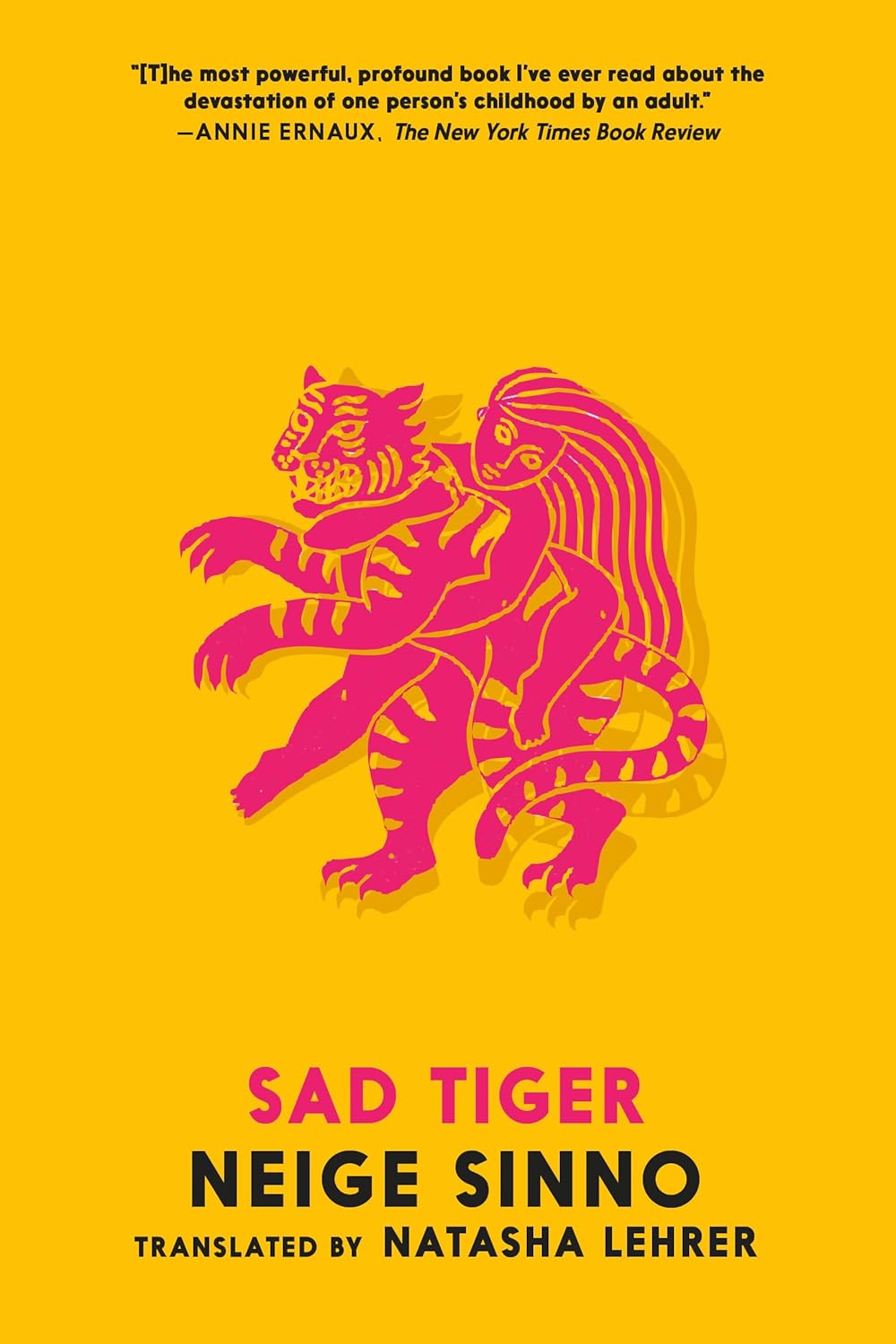
SAD TIGER, French-Mexican author NEIGE SINNO begins a society-wide conversation


SAD TIGER
NEIGE SINNO
(tr. Natasha Lehrer)
Seven Stories Press (non-affiliate Amazon link)
$12.99 ebook, available now

One of Lit Hub’s 43 Favorite Books of 2025!

2025 National Book Critics Circle Award WINNER of the BARRIOS BOOK IN TRANSLATION PRIZE!

Rating: ???

Read this fascinating interview with Author Sinno!

The Publisher Says: Winner of multiple prizes, Neige Sinno has created a powerful literary form with Sad Tiger, a book that took France by storm and is an international phenomenon.

Sad Tiger is built on the facts of a series of devastating events. Neige Sinno was seven years old when her stepfather started sexually abusing her. At 19, she decided to break the silence that is so common in all cultures around sexual violence. This led to a public trial and prison for her stepfather and Sinno started a new life in Mexico.

Through the construction of a fragmented narrative, Sinno explores the different facets of memory—her own, her mother’s, as well as her abusive stepfather’s; and of abuse itself in all its monstrosity and banality. Her account is woven together with a close reading of literary works by Vladimir Nabokov, Virginia Woolf, Toni Morrison, Christine Angot, and Virginie Despentes among others.

Sad Tiger—the title inspired by William Blake’s poem “The Tyger”—is a literary exploration into how to speak about the unspeakable. In this extraordinary book there is an abiding concern: how to protect others from what the author herself endured? In the midst of so much darkness, an answer reads crystal clear: by speaking up and asking questions. A striking, shocking, and necessary masterpiece.

I RECEIVED A DRC FROM THE PUBLISHER VIA EDELWEISS+. THANK YOU.

My Review
: Reading this story was hellish. Like Sinno, I was sexually abused and gaslighted...by my mother. Her actions to isolate me, to define reality and acceptability and maintain her power over me were appalling. Adult me, in his sixties, has never had a moment of life without this disgusting stain leaching through every act, thought, relationship; it is impossible to describe the utter life-changing (blighting, really) miasma the incest survivor exists under. Again like Sinno, I started a new life far away...in New York, not *quite* as far as Mexico is from France.

Like Sinno, I experienced the isolation of the victim in the cage of silence...doubled by the fact that I'm male, and my abuser female. In an incest-survivors' group I sought out (at my stepmother's urging, she knew the signs from experience) in 1980s New York City, the women who greeted me with great hostility for simply being male also accused me of lying..."no woman would do that!"...so more years were lost to silent rage and pain.

I think it's very telling that #MeToo never included incest survivors in its public faces. Sinno relates the probable reasons in a section she calls "Reasons for not wanting to write this book," all of which made me nod along.

Like Sinno, people I told about my mother's rape of me were appalled...and immediately wondered what made my mother do this awful thing (her father did it to her, her older brother told me). No one ever seemed to think much about how I was handling my emotional responses. I learned, not for the first time, that women do not want to talk about feelings and emotions OF men, only about theirs AT men. Listen to me complain but don't say a word about yourself, you self-centered abuser. This is a paraphrase, but it is a valid one.

Decades of therapy later, I view everything connected to incest very differently than I did while women were emotionally abusing or simply ignoring my scarred, scared trauma survivorhood. It became second nature to deflect or avoid emotional contact with any others, especially women. Friends kept at a distance, lovers reduced to objects...all of this is part of my incest survival strategy. Sinno and her book could, if the culture allows it and if those of us who know the costs of silence speak in support of it, make a substantive change for the better in later survivors' experiences.

This is me speaking in support of this necessary, awful read. Most especially for those who say "it's horrifying, I can't read that" to themselves or out loud.

Your failure of empathy speaks louder than any words.

Tuesday, February 11, 2025

LIVING IN YOUR LIGHT, sad acknowledgment of power denied, flouted, repressed


LIVING IN YOUR LIGHT
ABDELLAH TAÏA
(tr. Emma Ramadan)
Seven Stories Press (non-affiliate Amazon link)
$12.99 ebook edition, available for pre-order

Rating: 4.75* of five

One of LitHub's 100 Notable Small Press Books for 2025!

The Publisher Says: A story in in praise of a woman, a fighter, a survivor from the award-winning French-Moroccan novelist known for humanizing North Africa’s otherwise marginalized characters—prostitutes and thieves, trans and gay people in a world where being LGBTQ+ can be a dangerous act.

Shortlisted for the prestigious Prix Goncourt in 2022.


Three moments in the life of Malika, a Moroccan countrywoman is her voice we hear in Abdellah Taïa’s stunning new novel, translated by Emma Ramadan, who won the PEN Translation Prize for her translation of Taïa’s last novel, A Country for Dying.

Malika’s first husband was sent by the French to fight in Indochina, the novel takes place from 1954 to 1999—from French colonization to the death of King Hassan II. In the 1960s, in Rabat, she does everything possible to prevent her daughter Khadija from becoming a maid in a rich French woman’s villa. The day before the death of Hassan II, a young homosexual thief, Jaâfar, enters her home and wants to kill her. Malika recounts with rage her strategies to escape the injustices of history. To survive and to have a little space of her own.

Malika is Taïa’s M'Barka Allali Taïa (1930-2010). This book is dedicated to her.

I RECEIVED A DRC FROM THE PUBLISHER VIA EDELWEISS+. THANK YOU.

My Review
: I read Taïa's novels to feel the world as I experience it from a the experience of a true stranger...étranger, foreigner, other, Other, the French don't parse things down near as fine-tipped as Anglophones do...who, like me, believes queer desire runs the world.

Save it, apologists for the inversion of nature that is hetero identity, it's just unnatural or we wouldn't have so many bloody-minded religious and civil laws shoring it up. One doesn't prohibit what people don't like.

As I was saying before that irritated tangent: Taïa’s stories center queer desire, feature queer people, are about things we understand a little differently than hetero people do. It's like a warm blanket in a freezing, windy steppe that isn't for you, doesn't give a shit about your happiness or satisfaction unless it somehow comes up and gives "them" a frisson of what you're expected to endure your entire life in which case shut up and stop bothering "them". This is Taïa’s reality, and thus where his fiction lives. It's a whole lot worse in god-ridden spaces than it currently is in the US.

So how does this relate to a story about Malika, an aging mother of eight whose life is ending, but whose track record is not close to what she ever wanted it to be? Her tragic inflection points are all around collisions with Authority, a thing every QUILTBAGger is deeply, existentially familiar with. She fails to keep her first husband home from the war that kills him, despite it being fought for the same people who have colonized their country. She fails to convince her money-motivated daughter to eschew the colonialist inducement of cash for submission and become a mail in a wealthy French family's service. Lastly, her gay son chooses his identity over her idea of duty to their country after he is raped by men in their neighborhood who claim to hate homosexuals...yet exert their sexual rights as straight men by fucking him...Rape is a crime of power, an abuse of autonomy and self-ownership, not sex itself, of course. That's pretty well established as fact. But someone needs to explain to me, slowly and in simple words, how the sex act they're engaging in makes any sense in this framework, given male penetration requires a physiological state of excitement to a sexual object.

I don't get it. But I'm back on a tangent.

Malika wants her powerful will to be obeyed because she is Right. The problem is she's correct a lot of the time, but that's not enough for her...she must be Right, and that is uniformly fatal to successful imposition of one's will. In a long life of mixed emotional results, that central truth does not come clear for her. It's the human condition to live life backwards, learning more and more as the need for applicable knowledge diminishes. It's the reason to have elders in the family system, expandable to encompass every level of social organization...a thing Malika would've reveled in, but did herself out of by insisting she be seen as Right. The world needs us oldsters to give up our addiction to the powerful substance of Rightness, and accept they're doing it differently now so offer advice without judgment.


As if.

So we read stories. It helps us all make sense of each other, helps us see the humanity in people deeply and fundamentally not-U, in Mitford's 1955 formulation. I'd offer all five stars with a big smile if the story was longer, developing the parts I was most curious about...Malika's time under colonialism would be so fascinating to learn about!...but this récit isn't designed to do that, and as it is written, is a beautiful evovation of a complex woman's life as a second-class partially empowered participant in a wildly passionately tumultuous world.

Her contributions to that world's growth earn my four and three-quarters star rating for their telling here.

Friday, September 2, 2022

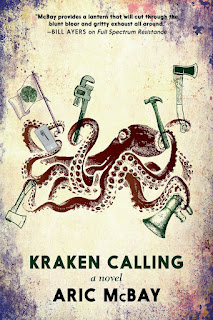
KRAKEN CALLING, best be sure to pick up *now*


KRAKEN CALLING
ARIC McBAY

Seven Stories Press
$22.95 trade paper, available now

Rating: 4* of five

The Publisher Says: A sweeping near future dystopic fantasy in the Octavia Butlerian vein of the Parable of the Sower novels.

Political activist and anarchist author Aric McBay (Full Spectrum Resistance) toggles between the years 2028 and 2051 to give us the experience, with breathtaking realism, of what might happen in the span of just one generation to a society that is already on the brink of collapse.

In 2028 environmental activists hesitate to take the fight to the extreme of violent revolution. Twenty years later, with the natural environment now seriously degraded, the revolution is brought to the activists, rather than the other way around, by an authoritarian government willing to resort to violence, willing to let the majority suffer from hunger and poverty, in order to control its citizens when the government can no longer provide them with a decent quality of life.

So it is the activists who must defend their communities, their neighbors, through a more humane and in some ways more conservative status quo of care and moderation.

And the outcome here is determined by the actions of those who resist more than it is by the actions of the nominally powerful.

I RECEIVED A DRC FROM THE PUBLISHER VIA EDELWEISS+. THANK YOU.

My Review
: Non-fiction writer (Peak Oil Survival, Deep Green Resistance) Aric McBay makes his points in fictional form. What he has done is not the usual thing for him, analyzing and contextualizing social and political trends for a left-leaning audience; this has always been his forte as a writer.

I think it still is. This novel makes a very trenchant attempt to put human skin on the bones of social movements for change, favoring equitable and reasonable restructuring of our self-evidently unsustainable lives.
“It’s always hard to tell, isn’t it? How the future could change from the smallest actions,“ Simón mused. “I believe we made things better. We bought time. Breathing room. We stopped one more. We didn’t improve things as dramatically as we hoped. But we made room for a hundred other movements to flower. Some of them failed, but some of them are amazing....”

“The tides always rise and fall for us,”Simón said. “That’s the nature of struggle. There is no guarantee, no permanent victory.”

“The work of the revolutionary is to plow the sea,” Addy quoted.”

It is indeed, Addy. It is indeed. To see your best efforts subsumed under the heaving mass of humanity in its indifference and fearful rejection of change. To know you're not ever going to prevail, no matter how many times you win. But to be sure you're harrowing the surfaces of the waters plowed and allowing things buried to come to the surface? It's a reward beyond price.

Dystopia, then, is inevitable? I don't think it is, though a lot depends on the individual's concept of "dystopia" and their tolerance for ambiguity. Most revolutionaries are absolutists, and should be kept far, far away from the levers of power. We're seeing that in the House of Representatives in the US during 2022. Revolution is hard, and requires people to be very, very hard...and these revolutionaries are obdurate, but brittle.

This means that, like Evelyn in our near-term future (2028), we need to be sure to combat that obduracy effectively. Or the 2051 sections of the story won't be a warning klaxon but a sad prediction.

Thursday, June 30, 2022

ARCADIA, rare intersex representation & THE WASTELAND, London life of gay poet/literary ikon T.S. Eliot


THE WASTELAND
HARPER JAMESON

Level 4 Press (non-affiliate Amazon link)
$3.99 Kindle edition, available now

Rating: 3.75* of five

The Publisher Says: The extraordinary career and devastating life of T.S. Eliot.

T.S. Eliot is a hollow man trapped in a dreary world. He works at a bank, a slave to the clock, the same routine, day after day. While London’s elite enjoy a Great Gatsby lifestyle and poets like Robert Frost are rock stars, attracting thousands of fans to each reading, Mr. Eliot walks past life, peering at it through cracks or around corners. Only in his imagination does the world drip with color.

Then one day he comes across Jack, an out and proud gay man being badly beaten, and something compels him to intervene. Life will never be the same.

Jack introduces Mr. Eliot to the gay underground of early twentieth-century London and to feelings Mr. Eliot had crammed down and locked away. And with freedom comes poetry. Extraordinary poetry that takes London by storm. But as Mr. Eliot’s fame increases, pressure for conformity does as well. Religious intolerance, fascism’s increasingly popular message of traditional values, and the allure of untold success present him with a decision that could have devastating consequences.

The Wasteland is the untold story of T.S. Eliot, his secret struggle with being gay, the people left in the wake of his meteoric career trajectory, and the madness that helped produce his greatest work.

I RECEIVED A DRC FROM THE PUBLISHER VIA EDELWEISS+. THANK YOU.

My Review
: Sadness. Grey, enveloping sadness. That's the take-away I had from this technically adept reinvention of poet T.S Eliot's early-1920s life in London.
Even if there were no light on the bank, Mr. Eliot would still know it was there. It's always there, waiting to welcome him with open arms, more than willing to take more tocks from his clock.

–and–

"We return you now to our regular broadcast," the announcer drones.

"Clair de Lune." Claude Debussy. Relaxation. Baloney.

Baloney indeed, and more than just that in a penitential dry sandwich consumed in a lonely penitentiary. With the aplomb of a dab hand at this fantastical-reimaging stuff, Eliot's life is peopled with the souls embodied and conjured on a magical-realist visit with the great poet. We even see him conjuring Mr. J. Alfred Prufrock (whose peaches are uneaten and coffee spoons resolutely empty) on the day he learns his new crush, Jack, is no longer with the bank. But Mr. Eliot is in for a major surprise in this case....

...as are the readers of this historical fantasia on themes of gay men's circumscribed lives. Mr. Eliot, for I cannot bear to call him Tom, is a creative and passionate soul in the body of a Puritan. He is deformed and damaged by a world he despises as he obeys it. Mr. Eliot will get his revenge. He blares forth a trumpet of poetic passion that has stood its ground atop English-language poetry. Its creator is given, here, by Author Jameson, a life that commingles reality and fantasy as only a poet could merit, warrant, summon forth from beyond the grave's creative silence.

++++++++++++++++++++++++++++++++++++++++++++++++++++++++++++++++


ARCADIA
EMMANUELLE BAYAMACK-TAM
(tr. Ruth Diver)
Seven Stories Press
$13.96 trade paper, available now

Rating: 3.5* of five

25% OFF DIRECT PURCHASES OF #WITMONTH TITLES HERE: https://sevenstories.com/blogs/385-celebrate-women-in-translation-month-2025

The Publisher Says: An English-language debut that reveals and subverts contemporary conceptions of normative sexuality, capitalist culture, and environmental degradation.

Winner, Prix du Livre Inter, 2019

Farah moves into Liberty House–an arcadia, a community in harmony with nature–at the tender age of six, with her family. The commune’s spiritual leader, Arcady, preaches equality, non-violence, anti-speciesism, free love, and uninhibited desire for all, regardless of gender, age, looks, or ability. On her fifteenth birthday, Farah learns she is intersex, and begins to question the confines of gender, and the hypocritical principles those within and outside the confraternity live by. What, Farah asks, is a man or a woman? What is it to be part of a community? What is the endgame for a utopia that exists alongside refugees seeking shelter by the millions and in a society moving ever farther away from nature and its protections. As Liberty House devolves into a dystopia amidst charges of sexual abuse, it starts to look a lot like the larger world, confused in its fears and selfish hedonism.

Emmanuelle Bayamack-Tam delivers a magisterial novel, a scathing critique of innocence in the contemporary world.

I RECEIVED A DRC FROM THE PUBLISHER VIA EDELWEISS+. THANK YOU.

My Review
: Really, really squicked out by what I see as a borderline-coercive sexual relationship between a fifteen-year-old who's just discovered they're intersex and the much-older leader of the cult that they and their family now belong to. I took a long break from the read because I was not sure I wanted to finish this entire story. It brought up my mother's sexually abusive power-plays against me. That was not comfortable at all.

So I'm unusually alert to sexual undertones in relationships between kids and adults. I felt Arcady, the cult/commune leader, was less grooming Farah than responding to Farah's burgeoning sense of themself as a sexual, intersex person. While that doesn't lessen my personal discomfort with Arcady's power imbalance with Farah, it does show that Author Bayamack-Tam possesses a clear sense of the need to keep the power dynamic in balance. Add to that Farah's rare and possibly genetically-heritable anatomical anomaly resulting in an indeterminate sex and gender presentation.

Prime candidate for a charismatic cult leader's sexual manipulation. Which, it must be said, is present; but the clear and repeated caveat from older Arcady is that they reach maturity before he will sexually engage with them. Farah, quite understandably, is not willing to wait some indeterminate amount of time for someone not her to decide they're capable of offering informed consent and, mirabile dictu, pushes the schedule to meet their burgeoning sexual desires.

Totally understand that. But great-grandfather does not think with a teen's hormones, and holds Arcady to a higher standard. But anyway, this was not anything Farah regrets or has doubts about; and again, the stage was set for this to be as unrevolting as possible because we know what Farah is thinking and feeling.

I've gone on about the subject and left out the nudist free-spirit grandmother, the cypher parents who really are affectless, the communards whose existence is merely suggested not explored in even the slightest depth...in general, this is a decent novel by a hippie-wannabe, a French-lady Brautigan, with an agenda and an axe being ground noisily in the background. Also a fun story to read.

Thursday, June 2, 2016

INFIDELS, Author Abdellah Taïa's deeply felt & extremely unpopular among Muslims short novel


INFIDELS: A Novel
ABDELLAH TAÏA
(tr. Alison L. Strayer)
Seven Stories Press
$23.95 hardcover, available now

25% OFF DIRECT PURCHASES OF #WITMONTH TITLES HERE: https://sevenstories.com/blogs/385-celebrate-women-in-translation-month-2025

Rating: 4* of five

The Publisher Says: Set in Salé, Morocco—the hometown Abdellah Taïa fled but to which he returns again and again in his acclaimed fiction and films—Infidels follows the life of Jallal, the son of a prostitute witch doctor—"a woman who knew men, humanity, better than anyone. In sex. Beyond sex." As a ten-year-old sidekick to his mother, Jallal spits in the face of her enemies both real and imagined.

The cast of characters that rush into their lives are unforgettable for their dreams of love and belonging that unravel in turn. Built as a series of monologues that are emotionally relentless—a mix of confession, heart's murmuring, and shouting match—the book follows Jallal out of boyhood on the path to Jihad. It's a path that surprises even him.

I RECEIVED AN ARC FROM THE PUBLISHER. THANK YOU.

My Review
: Stellar, stellar read. I was sent to the online translation-dictionary at least 10 times, which is a good thing for me. It's a genuine pleasure to look at and hold, as you'd expect from a Seven Stories book. The story only makes the aesthetic pleasure better, as well-crafted as such a concentrated fiction can possibly be.

As with all of Taïa's writing, this is a spectacularly beautiful-sounding text.
War was declared from the very first note. This woman...was not afraid of repeating herself, of saying the same words over and over, fighting a solitary battle. The battle of love, of course.
You whose love gave my life flavor, color
I'll never give you up, whatever happens
Whatever happens
And if a word was said in anger
And injured our hearts
We forget our sadness
And which of us spoke,
It's through the soul that we love
We'll always be together
All our lives, together
Whatever happens
I loved you
When I found you
Before my eyes a distant dream
Was in my eyes
Out of reach
The next moment it was in my hand
Who chooses to leave paradise?
Why destroy our own hopes
And spend the rest of our lives regretting
What happened?
You whose love gave my life flavor, color
I'll never give you up, whatever happens
Whatever happens
Never
Never
Give you up
Whatever happens.

It took our breath away.
The song lasted almost seven minutes. It was so powerful. And the voice...rang out from the heart of the war. War to the bitter end, the final breath. ...
"The man she's talking about in that song doesn't exist. No man can be worthy of such love and sacrifice."

You will never know how much the moment costs while you're in it, but that is the precise inflection point where a youth becomes a warrior.

It is Part III that seems to cause Muslims the most outrage, the betrayed hurt of being misunderstood from within; Taïa is one of their own! He sends young Jallal into such pain and loneliness that not even a god could endure; a mother murdered before her body dies and all for what? What justifies the torture of another soul? (Nothing, of course, but there's always a reason even when there can be no excuse.) And here is Mouad, a stranger, a Belgian whose heart heard the Prophet's call; he has parts of Jallal's mother that her son can't see or hear, so naturally he hates the man who usurped his child's place beside his mother.

But it is Mouad who, indirectly, leads Jallal to Mathis-Mahmoud; leads him to a death that is Resurrection and completion.

Yes, the horror happens.

But God is beyond mere human hates and judgments. Mathis-Mahmoud and Jallal are, in a soliloquy of God's, united and blessed and made whole together.
You see, I'm like you. In misfortune and in power. Divine and orphaned. I'm made of the same stuff as you. I'm in you. In every body. Every night. Every dream.
Don't cry, Jallal.
Take his hand, Mathis.
Go. Go. As brothers of the heart. There, behind that door, life has not even begun for you.
Go. On the way you'll pass a beautiful pomegranate tree. Pick two pomegranates. And later, before you go to sleep, take a moment to eat them.

Tuesday, April 1, 2014

MUNDO CRUEL, stories with huge bite force and better aim


MUNDO CRUEL: Stories
LUIS NEGRÓN
(tr. Suzanne Jill Levine)
Seven Stories Press
$13.93 all editions, available now

WINNER OF THE 26th Lambda Literary Award—BEST GAY GENERAL FICTION!

25% OFF DIRECT PURCHASES OF #WITMONTH TITLES HERE: https://sevenstories.com/blogs/385-celebrate-women-in-translation-month-2025

Rating: 5* of five

The Publisher Says: Luis Negrón’s debut collection reveals the intimate world of a small community in Puerto Rico joined together by its transgressive sexuality. The writing straddles the shifting line between pure, unadorned storytelling and satire, exploring the sometimes hilarious and sometimes heartbreaking nature of survival in a decidedly cruel world.

My Review: I read the book in 1974. I got a hardcover Modern Library edition from my decade-older sister, who owned a bookstore. I read it in one solid week of enchantment, followed by a year of revisits and studies of the notes and other references. (The librarians at my high school agreed with the kids who teased me for being weird.)

This is a new translation, I have a copy, but many chunksters await my attention that I haven't read before. I'll get back to it. I look forward to getting back to it! I'll be using the Bryce Method to give you a story-by-story précis of my opinions.

The Chosen One

The Vampire of Moca

For Guayama

La Edwin

Junito

Botella

So Many: Or On How the Wagging Tongue Sometimes Can Cast a Spell

The Garden

Mundo Cruel