Pages
- Home
- Mystery Series
- Bizarro, Fantasy & SF
- QUILTBAG...all genres
- Kindle Originals...all genres
- Politics & Social Issues
- Thrillers & True Crime
- Young Adult Books
- Poetry, Classics, Essays, Non-Fiction
- Science, Dinosaurs & Environmental Issues
- Literary Fiction & Short Story Collections
- Sookie Stackhouse/Southern Vampire Books & True Blood
- Books About Books, Authors & Biblioholism
Showing posts with label lesbian author. Show all posts
Thursday, January 29, 2026
MISSING SAM, urgently tale urgent told
MISSING SAM
THRITY UMRIGAR
Algonquin Books (non-affiliate Bookshop.org link)
$29.00 hardcover, available now
Rating: 4* of five
The Publisher Says: From bestselling author Thrity Umrigar, a thrilling and haunting story of an Indian-American woman who becomes the prime suspect when her wife goes missing.
When Aliya and Samantha have a fight one night, Samantha goes for a run early the next morning—and doesn’t come back.
Aliya reports her wife Samantha as missing, but as a gay and Muslim daughter of immigrants, she’s immediately suspected by her neighbors in Samantha's disappearance. Scared and furious and feeling isolated as everyone around her doubts her innocence, Aliya makes one wrong choice after another. All the while, Samantha is being held captive, strategizing how to escape before things escalate even more. Meanwhile, Aliya must fight to prove her innocence in the public eye and save her wife. But is safety ever truly possible for these women even after Samantha is rescued?
A provocative examination of suburban mores, Missing Sam captures the terror manifested in today’s political climate, and the real dangers, both physical and psychological, of being Brown and queer in America.
I RECEIVED A DRC FROM THE PUBLISHER VIA NETGALLEY. THANK YOU.
My Review: I was leery of reading this expansion on the "be careful of your words, you do not which will be your last" aphorism. I took the DRC because I like stories by and about my lesbian siblings in Otherhood, and because I'm pretty damned sure we're going to see this kind of horror again in the future so I wanted to get it out there.
Sam and Ali are well-drawn, fully realized people. We see each one's PoV, so we know what Ali doesn't, that Sam is alive. It should diminish the stakes, yet Author Umgar uses the technique well enough that it did not.
I was, for the most part, glad to keep reading the story though as parents and social media and investigators kept becoming more toxic by the page I wanted to say, "Thrity! enough already!" When piling on the trouble the story begins to feel like the artificial construct it is. Never mind that reality does this ad more to people...fiction is different, plays by different rules. When COVID hit, I hit the wall. It took some time for me to come back.
After Sam is rescued, the true horror (for me) began: How do you put yourself...your wife...you entire life...back together after the sheer awfulness of what each of you has been through? What alchemy do you need to work in order to remake bonds that have been, without either one's volition, shattered? This horror was very well, very believably, explored. The ending was the culmination of multiple strands of un/making and remodeling.
What kept me from making a bigger fuss about the book was the dropped and abandoned threads, eg Kabir's development. I loved the challenged queer marriage that had to sustain or fail the spouses...it's the way reality is when you're in a committed relationship. The resolution Author Umrigar presents is pitch-perfect. I think the story of an immigrant, a Muslim, a queer woman, interacting with the power structures that see her as enemy Other, is one we should all reckon with.
It's not like the world is waiting for us to wake up to injustice on our own. It is ringing alarm bells and sounding klaxons and stories like this one are the easy way to see why waking up to it is so important.
Wednesday, December 17, 2025
LOWEST COMMON DENOMINATOR, first in a fictional series called The Autobiographical Trilogy
LOWEST COMMON DENOMINATOR (The Autobiographical Trilogy #1)
PIRKKO SAISIO (tr. Mia Spangenberg)
Two Lines Press (non-affiliate Bookshop.org link)
$12.00 ebook, available now
Rating: 4.5* of five
The Publisher Says: For readers of Eileen Myles and Patti Smith, Lowest Common Denominator is an ecstatic coming-of-age novel by the Finlandia-prize-winning author of The Red Book of Farewells
Writing in the wake of her father’s death, the narrator of Pirkko Saisio’s autofictional novel (translated from Finnish by Mia Spangenberg) transports us to the 1950s Finland of her youth, where she navigates life as an only child of communist parents. Convinced she will grow up to become a man, a young Saisio keeps trying and failing to meet the expectations of the adults around her. Writing with her trademark wit and style, each formative experience—with the Big Bad Wolf, a bikini-clad circus announcer, and Jesus Christ “who has a beard like a man but a skirt and long hair like a woman”—drives her further and further from her family and others.
Struggling to understand her place in the world around her, it’s in language that she discovers a refuge and a way to be seen at last.
I RECEIVED A DRC FROM THE PUBLISHER VIA NETGALLEY. THANK YOU.
My Review: I have to believe Author Pirkko (as distinct from Narrator Pirkko, her stand-in) when she says this is autobiographical fiction, not a memoir; but honestly it reads like a memoir. It's that immediate, it's that intimate, it takes on the core issue of queer life...identity...so fully and so bravely. I suppose the reason for novelizing something that otherwise would get criticized for being invented but passed off as factual. Instead, write it as a novel and tell the truth that way.
I looked triumphantly at Father, who was in his shirtsleeves drinking black coffee and reading the Tyƶkansan Sanomat newspaper.I was drawn in, as I'm confident all my queer siblings would be, to the story of knowing you're different, Other, thus feeling like you're a disappointment. Or, more terribly, being told you're a disappointment. Like Author Pirkko I had the experience of viewing myself and my world from the outside as a child. In my case it was my utter certainty there was no god at all and religion was a deliberate lie. My gayness, known to myself from about the same time, was nebulous until adolescence brought the specifics into focus. So my relationship to the central fact of this story was immediate and powerful.
Mother stood by the entryway mirror spreading a touch of rouge from her lips to her cheeks as has hummed "Harbor Nights."
Neither of them noticed that I had become she, the one always under observation.
It's a trauma to be required by your sense of yourself to see the Otherness, to experience the selfhoods of your family at too early an age occasioned by that explosion of the idea of community. The family never looks the same, never feels safe and welcoming, when you see yourself as unequivocally an outsider to it. That realization should come in adolescence with more life under one's belt. Author Pirkko stunned me by explaining this fundamental truth of my life to me in terms of her (or her stand-in's) own life; she did it both matter-of-factly and with the greatest emotional honesty.
The story takes us around and about in time, revealing generational traumas that all families carry. In a novel format the time-hopping can logically come at key moments not from an organizing principle like non-fiction imposes. We're never far from another point of change in her family's history that resonates with her Otherness. It wove a net that caught both the reality of solitary experiences of reality being all we have and the often obscure fact that families are made of communities of Otherness. Closeness is hard when the Otherness is pathologized as queerness is...as political unorthodoxy does...by most outside cultural forces.
Author Pirkko writing as she does from personal resonance with this reality makes this read a deeply satisfying one for me. I suspect many, if not most, will find many points of fellow feeling for this story. It's a shame she was only inspired to write it by her father's death.
What opportunities for healing were squandered. Very saddening to me.
Friday, June 27, 2025
PALM MERIDIAN, Grace Flahive's satisfying lesbian-love in retirement set in 2067
PALM MERIDIAN
GRACE FLAHIVE
Avid Reader Press / Simon & Schuster (non-affiliate Bookshop.org link)
$14.99 ebook, available now
Rating: 4.25* of five
The Publisher Says: A rollicking, big-hearted story of long-lost love, friendship, and a life well-lived, set at a Florida retirement resort for queer women, on the last day of resident Hannah Cardin’s life—for readers of Less and The Wedding People.
It’s 2067 and Florida is partially underwater, but even that can’t bring down the residents of Palm Meridian Retirement Resort, a utopian home for queer women who want to revel in their twilight years. Inside, Hula-Hoopers shimmy across the grass, fiercely competitive book clubs nearly come to blows, and the roller-ski team races up and down the winding paths. Everywhere you look, these women are living large.
Hannah Cardin has spent ten happy years under these tropical, technicolor skies, but after receiving a terminal cancer diagnosis, she has decided that tomorrow morning she will close her eyes for the very last time. Tonight, however, Hannah and her raucous band of friends are throwing one hell of an end-of-life party. And with less than twenty-four hours left, Hannah is holding out for one final, impossible thing…
Amongst the guest list is Sophie, the love of Hannah’s life. They haven’t spoken since their devastating breakup over forty years ago, but today, Hannah is hoping for the chance to give her greatest love one last try.
As Hannah anxiously awaits Sophie’s arrival, her mind casts back over the highs and lows of her kaleidoscopic life. But when a shocking secret from the past is revealed, Hannah must reconsider if she can say goodbye after all.
Spanning the course of a single day and seventy-odd years, and bursting with irresistible hope, humor, and wisdom, this one-of-a-kind novel celebrates the unexpected moments that make us feel the most alive.
I RECEIVED A DRC FROM THE PUBLISHER VIA NETGALLEY. THANK YOU.
My Review: The idea that people born in the 1990s will be retiring to (surviving) Florida in 2067 feels...exuberantly optimistic...but I'll go with it. More especially I'm thrilled at the notion of the right to die being well established in this future, and the existence of queer elder spaces is just ordinary, and hell! sign me up!
Of course I'd be well into supercentenarianhood in 2067, the year the book's set, which ya know what, maybe not so much, thanks anyway.
The point of this story is satisfying to me, the way at the end pf life one wants to take stock and to see what can be fixed among the innumerable errors we've made. Sophie, our PoV character's "one that got away," is invited to Hannah's end of life celebration. We see their relationship in flashbacks, which does not add suspense in the usual way...we know the relationship collapses...but does make Hannah's desire to see Sophie again before she chooses to escape the awfulness of her end-stage cancer more impactful.
It's really moving in a quiet, contemplative way. Wrenching losses remembered, not lived through in real time...choices muffed, but long ago...people loved and cherished for an entire lifetime who only know the event we're reading about and the actors in this present resolution as names, or as their survivor selves. It's poignant, it's moving, and I think it's done very well indeed.
It is not a Big! Dramatic! Finish!
I wouldn't've liked the read had it been so. I did very much wish I'd felt the flashbacks into Sophie and Hannah's early relationship in the 2020s had somehow sowed seeds for their world of 2067. I get just how spoiled a readerly reaction that is, yet as it is the flashbacks don't do more than tell me how awful the two people were in their youth. It isn't all that interesting, that point, and the net result is to take more away from the effect of the read than add to it.
I'm not at all trying to discourage you from reading the book. I hope you will because the imperfect future ahead of us is so hopefully presented in Hannah's story. It's got lots of problems, but when has the world not had problems? Have you not yet had enough of doomscrolling?
If so, come to Palm Meridian, settle in, and be told that the world will muddle through, that we will manage somehow to love and care for each other, and make it work as best we can.
Thursday, May 29, 2025
FOREST EUPHORIA: The Abounding Queerness of Nature offers a bracing dose of Reality to "gender essentialists"
FOREST EUPHORIA: The Abounding Queerness of Nature
PATRICIA ONONIWU KAISHIAN
Spiegel & Grau (non-affiliate Amazon link)
$14.99 ebook, available now
The Independent Press Top 40 Bestsellers: Non-Fiction For the week ending September 16, 2026
Time's The 100 Must-Read Books of 2025 selection
Rating: 4.75* of five
The Publisher Says: A thrilling book about the abounding queerness of the natural world that challenges our expectations of what is normal, beautiful, and possible.
Growing up, Patricia Ononiwu Kaishian felt most at home in the swamps and culverts near her house in the Hudson Valley. A child who frequently felt out of place, too much of one thing or not enough of another, she found acceptance in these settings, among other amphibious beings. In snakes, snails, and, above all, fungi, she saw her own developing identities as a queer, neurodivergent person reflected back at her—and in them, too, she found a personal path to a life of science.
In Forest Euphoria, Kaishian shows us this making of a scientist and introduces readers to the queerness of all the life around us. Fungal species, we learn, commonly encompass more than two biological sexes—and some as many as twenty-three thousand. Some intersex slugs mutually fire calcium carbonate “love darts” at each other during courtship. Glass eels are sexually undetermined until their last year of life, a mystery that scientists once dubbed “the eel question.” Nature, Kaishian shows us, is filled with the unusual, the overlooked, and the marginalized—and they have lessons for us all.
Wide-ranging, richly observant, and full of surprises, Forest Euphoria will open your eyes and change how you look at the world.
I RECEIVED A DRC FROM THE PUBLISHER VIA EDELWEISS+. THANK YOU.
My Review: Honestly, our very much elder siblings the fungi, part of a family we do not share but the most distant connection with, have more to teach us about Life than I expected. Author Kaishian is a very well qualified guide into their world, having several degrees in mycological subjects and being the New York State museum's curator of mycology. An unimpeachable fount of expert knowledge, then.
I've never really thought about the gender realities of fungi before now. I knew they were ubiquitous...the wood-wide web...and enormous (that several-square-mile honey fungus in Oregon), for two memorable examples...but how they got it on was hazy, limited to fruiting bodies producing spores in my infobase. I am of greatly expanded consciousness now.
Fungus is just the beginning of queerness, of "gender non-conformity" that culture-specific ungeneralizable concept, in Nature. The examples are weird...eels? what the hell my dudes?...slugs *shudder* doing unspeakable things to each other after sex...and the list isn't even fairly begun. Vertebrates, our fellow spine-havers, get themselves up to some wild shenanigans, like the fish harems where the physically largest female becomes male when the old one dies. How do they know? Who thought this was a good idea?
But, overall, the thing I loved about this read was not the fount of factfulness but the fountain of meditative, calm reflection that Author Patty (she refers to herself as such on her website so I'm presuming to do so too) uses to soothe away the hurts being queer in a hostile world has wrought. Her Irish-Armenian heritages, her neurodivergent presentation of self, her life experiences, all give her the invaluable, painful gift of Otherhood. It is a thing I've been grateful for in my older years of life. It takes Otherhood to see the absurdity of the prejudices most people use in place of learning, thinking, meditating. Author Patty gets this on such a core level that as she lets us in on her uncoverings it feels organic (!) instead of calculated as is so often the case. Even her coinage of "eco-spirituality" to describe this manner of being in the world feels uncondescending. It could easily have read brummagem and insulting. Instead it's all of a piece with her shared factual information as viewed through her lens of personal reflection. Like this:
I like blurring the line between human and nature because I believe we, as a species, have become profoundly lonely in our self-enforced isolation. And it’s because of this that the planet is spinning through a devastating loss in biodiversity. The species that have brought me the most companionship, assurance, and inspiration are those furthest banished from human society, those least associated with the “desirable” traits of being human—upright and logical, two-legged and binary-sexed. My personal connections to these organisms have brought me a sense of queer belonging and comfort in the heaviest of times. In exchange, I hope to do my small part by sharing their stories. And I hope that in sharing these stories, you too will feel the closeness of the earth, the lack of space between our cells, and the memory of each other.I think the last word has been had. I'm just that hair away from five stars because I still find slugs utterly repugnant and with a gardener's eye of loathing.
Monday, October 14, 2024
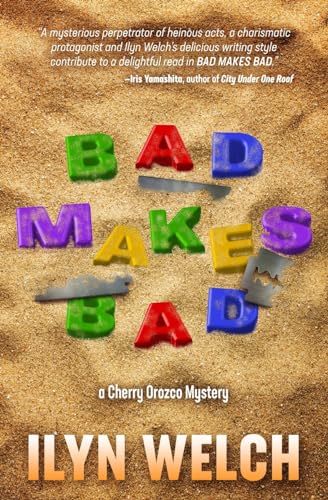
BAD MAKES BAD, second Cherry Orozco cozy lesbian horror...that even *looks* weird typed out

BAD MAKES BAD
ILYN WELCH (A Cherry Orozco Mystery #2)
Shotgun Honey Books (non-affiliate Amazon link)
$4.99 Kindle edition, available now
Rating: 4.25* of five
The Publisher Says: Cherry Orozco keeps slapping women—in her dreams. And she’s a sleep-deprived mess. Free group therapy at a neighborhood mental-health center steers her to confront issues of past and present trauma, including those about childhood frenemy Lana Picasso, a one-psycho hazing factory. Adding to her angst is the fact some monster is on the loose, booby-trapping area playgrounds with razor blades among other crimes.
The support sessions appear to help, plus Cherry clicks with a kindred smart-ass named Parvati who devours serial-killer paperbacks and clashes with the indifferent therapist. As group members bare their souls and work on coping strategies, the razor-blade incidents escalate outside the center’s walls. When the villainy is brought up at therapy, Parvati goes overboard relishing the gory details, making her Cherry’s number-one suspect—until she disappears.
I RECEIVED A DRC FROM THE PUBLISHER VIA NETGALLEY. THANK YOU.
My Review: Book 2 of two so far, and what a weird find it is! Book 1 is Signs of Pain, which I have not read...yet...but, as this is a development from it, I think I get the drift.
I've said often enough that horror only scares me when it's about people. This weirdly cozy story is in the vein (!) of Dan Wells's I Am Not a Serial Killer. Only this time it's queer and female-centered, which renders (!) it an even-more relatable process of struggle against urges one is not wise to give in to...to put it mildly. And Cherry Orozco, on Ilyn Welch's storyrelling hands, still finds a credible way to harness the energy of the urges in her group therapy sessions.
Given the nature of those urges, she's got a rough go to get something good out of it. The story's got the absolute weirdest cozy vibe imaginable. I was expecting something along the lines of Dexter's hyperbloody quirkiness, and instead got something that vibes like Joan Hess's Maggody. (Though I don't want to mislead you: there is gore. Just, well, cozy gore.) That's a compliment of a high order as Arly (short for "Aerial" as in "photo") and her mom Ruby Bee (short for Rubella Belinda, as in the thing we get our kids vaccinated against) are genuinely fun to hang (!) with.
I've got to stop.
So Cherry has to get, and keep, her head in shape to find the rotten-souled responsible party behind a series of horrible mutilations of kids who encounter the razor blades left on playgrounds. As this is so horrifying to me I wanted a revenge-fantasy ending with all kinds of screaming and blood spurting as the perp was dismembered slowly. (I disapprove of traumatizing children.) Buuut noooo we got a...much more sane, more proportional if less condign ending. Dammit!
Honestly, though, do you need a better reason to pick these up than the fact they're set in Raptor Flats?! I mean! Raptor. Flats. I've about got my trunks half-packed for the move. The side characters all have a well-settled feel, so I'm guessing they's mostly brought along from book 1. Crucially I felt more like I wanted to go get to know them, not like I was trying to make new friends in high school.
The oddness of the idea is what makes my response to the book so welcoming, I think. I'm delighted by Cherry and her inner monologue; I'm charmed by the folk of Raptor Flats; I'm ready to go back already. I'm not going to tell you it's an intricately plotted puzzle. Instead I'll tell you that, every step of the way, Ilyn Welch told me a story I enjoyed reading and believed (within my scope of suspension of disbelief) was completely true to the people it involved.
I even accepted the villain's heinous villainy, and what a genuinely detestable villain indeed!, and thus child-endangering actions. Though I won't again. Once is all you get.
Fun #Deathtober romp, well worth your time and such a truly minimal amount of your treaure.
Monday, May 27, 2024
PERFUME & PAIN, raucous raunchy ribald reading...go get one NOW!
PERFUME & PAIN
ANNA DORN
Simon & Schuster
$18.99 trade paper, available now
Rating: 4* of five
The Publisher Says: A controversial Los Angeles author attempts to revive her career and finally find true love in this hilarious nod to 1950s lesbian pulp fiction.
Having recently moved both herself and her formidable perfume bottle collection into a tiny bungalow in Los Angeles, mid-list author Astrid Dahl finds herself back in the Zoom writer’s group she cofounded, Sapphic Scribes, after an incident that leaves her and her career lightly canceled. But she temporarily forgets all that by throwing herself into a few sexy distractions—like Ivy, a grad student who smells like metallic orchids and is researching 1950s lesbian pulp, or her new neighbor, Penelope, who smells like patchouli.
Penelope, a painter living off Urban Outfitters settlement money, immediately ingratiates herself in Astrid’s life, bonding with her best friends and family, just as Astrid and Ivy begin to date in person. Astrid feels judged and threatened by Penelope, a responsible older vegan, but also finds her irresistibly sexy.
When Astrid receives an unexpected call from her agent with the news that actress and influencer Kat Gold wants to adapt her previous novel for TV, Astrid finally has a chance to resurrect her waning career. But the pressure causes Astrid’s worst vice to rear its head—the Patricia Highsmith, a blend of Adderall, alcohol, and cigarettes—and results in blackouts and a disturbing series of events.
Unapologetically feminine yet ribald, steamy yet hilarious, Anna Dorn has crafted an exquisite homage to the lesbian pulp of yore, reclaiming it for our internet- and celebrity-obsessed world.
I RECEIVED A DRC FROM THE PUBLISHER VIA EDELWEISS+. THANK YOU.
My Review: Have you read Highsmith's Carol (aka The Price of Salt)? This has that particular kind of Questa o Quella? Rigoletto-but-sapphic-romance aura. And, follow-up concept, are you aware that Highsmith was a cruel, nasty piece of work? This has that same mean-creative story aura.
Having now hooked a few, driven a few off, and confused most, let's talk about lesbians. I'm the gay brother of a spiky, difficult lesbian. (She said so before I did! But, to be scrupulously fair, our entire family is/was spiky and difficult.) Astrid's 'tude is nowhere near as unkind as the reviews led me to believe it would be, by my own family's standards. What she is, that seems to surprise and unnerve the people around her in the story, is what I think interesting people usually are: Opinionated. I note without pleasure that opinionated women get miles of stick from persons of all genders and orientations. Just ask Hillary Clinton if you doubt me. It shows also in the readers' reviews I've seen around and about. Lots of people, even the ones who liked the story fine, commented on how abrasive Astrid was. Well, yeah. She's smarter than a solid 95% of the people around her. She's in a highly stressed passage in her life. She's abrasive because she's rubbed raw by her life.
Her happy place is perfume. Think about what that means. She collects something that is designed to hide and to enhance a person's most intimate quality, their smell. She doesn't even collect the stuff itself! She collects the containers...the carefully designed vessels that seduce the eyes but in and of themselves provide nothing but a space to be filled! The capitalist/consumer seductions carefully designed to increase your (largely female, as these are perfume bottles) cultural anxiety about your fundamental attractor or repeller of intimacy, smell!
This Anna Dorn, she knows her onions. Show me, please, another author whose depth of character development includes these intense sociopolitical shades whose prose isn't clunking, juddering, jelly-like didacticism. Author Dorn's got little enough competition in the witty-banter segment. She's sui generis in the segment of the Venn diagram where that overlaps anti-capitalist/feminist discourse.
Happily so. I'm glad Simon & Schuster offered me this DRC because, old gay man that I am, I hadn't heard of Author Dorn before. Now it's me for Vagablonde.
I see a few raised eyebrows contemplating an expected fifth star, after that gush. I wanted to put a fifth star on, I promise! I couldn't because Astrid being wishy-washy about Ivy-vs-Penelope was overplayed. I think will-they-won't-they is an easy trope to allow to outstay its actual usefulness. My perception is that this is what happened here. I'm also a wee bit wary of things like cancel culture/getting canceled being enshrined in stories that say bigger, more trenchant things about inclusion and cultural norms. It feels more like an add-on to use Astrid's canceling for her unguarded comments than an actual feature of the entire conversation the rest of the story is having about the greater issues abovementioned.
So okay, I didn't find myself sitting slackjawed, wondering how this author faceted this sparkling thousand-carat diamond. (That experience is what I call six-stars-of-five storytelling.) But make no mistake, this wordsmith will be on my readar as I wait for her to do just that.
It seems very likely to happen.
Saturday, May 25, 2024
CECILIA, sapphic obsessive love and bodily fixation in gorgeous prose
CECILIA
K-MING CHANG
Coffee House Press
$14.95 trade paper, available now
Rating: 4.5* of five
The Publisher Says: A surreal novella about the intensity and eroticism of girlhood friendships, the ecstasy of desire and disgust, and matriarchal mythmaking.
Seven, who works as a cleaner at a chiropractor’s office, reencounters Cecilia, a woman who has obsessed her since their school days. As the two of them board the same bus—each dubiously claiming not to be following the other—their chance meeting spurs a series of intensely vivid and corporeal memories. In the defamiliarization that follows, the narrator begins to experience queerness itself as an alienation from normative time.
Smart, subversive, and gripping, Cecilia is a winding, misty road trip through bodily transformation, inextricable histories of desire and violence, diaspora, and obsessive love.
I RECEIVED A DRC FROM THE PUBLISHER VIA EDELWEISS+. THANK YOU.
My Review: This short read is much more affecting than most its length are. That is a funcrion of K-Ming Chang's bravura performance with English as a weapon:
When I reached up to touch my face, I felt no protrusions, no new bones inflecting my surface, and yet, when Cecilia and I looked at each other, we saw them: beaks mountaining out of our mouths, rooted to the shadows of our jawbones. Beaks shining like the perfect darkness preserved inside a belly.
You are on notice: Pay attention to the words chosen, pay attention to the images described, or this very slightly surreal...in its literal meaning, the meaning of the parts it's made of, "overreal, above real, on top of real"...narrative of two girls discovering love, passion, intense vibrant hypercolored Experience, will simply squash you, split the space where you are and move through it.
An intense experience will be had; your choice of framing for the act of being engaged with this story will determine its positive or negative perception for you. I am resolutely positive about the experience because anyone who can, and will, and does explore the sensation of Obsession to burnout is my idol.
That will trigger very strong and not always positive memories for some readers. Be aware of this fact particularly if you have been, or are being, stalked.
Readers who prefer direct action will not resonate to the Proustian aide-memoire of this novella. The story, as in plot, is spare to the point of threadbare: Old friends with a past connection of unrequited lust, requited love, and sensual obsession, meet at one's place of work, chat, then get on a bus to go home...not together. Just that isn't gonna drag the hoi polloi into this tent, there to be entertained. The story is of the rung-bell resonance of girls loving each other before womanhood imbues loving, intense intimacy with a bodily expression's inevitability. The immensely divisive choice of piss as a focus of fascination, desire, disgust, and connection is definitely going to upset some people. It is, I think, an example of how little female desire is examined in our literary landscape that this choice has occasioned such a response across the spectrum of readers. Women, even sapphically inclined ones, are still called on to present a particular strain of pure, clean, unsullied neutered bodiless Love and not filthy, sweaty, bodily based Lust...that's reserved for intimacy, things done and thought in private. Shame, in other words. In porn, these acts are Done To women as a form of punishment or humiliation. K-Ming Chang's Seven is not humiliated or punished. She's so obsessed that this is an urgently desired act of further possession and imtimacy. There's more than a whiff of body horror to the way bodily processes and even body parts are casually discussed, possessed, and even deployed throughout the read.
The author's choice of making her girls of Chinese descent, living in the US diaspora, is...to my surprise...not foregrounded. I expected it to be more of a focus because so much is made of the author's own ethnicity. It was something I didn't really notice until I'd read the story and was thinking about responses to the author's realier works (eg, Bestiary, Bone House, Gods of Want), where ethnicity is apparently made more of within those stories. Haven't read 'em, can't speak with an informed eye, but this story doesn't make a meal of it as I suspected it might.
I definitely don't think this read is for everyone, but the right reader will be unfazed by childbirth evocations and livers of others as property to be treasured. The right reader will immerse their awareness in the meaty world of loving someone so much that consuming them is desirable, not in the Hannibal Lecter sense I hasten to say. The right reader will give their readerly ears to the very idiosyncratic music of K-Ming Chang's creation.
It's me. I'm the right reader.
Wednesday, May 15, 2024
MY DARLING DREADFUL THING, sapphic Dutch Gothic horror...my first such...please not last, though
MY DARLING DREADFUL THING
JOHANNA van VEEN
Poisoned Pen Press
$17.99 trade paperback, available now
Rating: 4* of five
The Publisher Says: In a world where the dead can wake and walk among us, what is truly real?
Roos Beckman has a spirit companion only she can see. Ruth—strange, corpse-like, and dead for centuries—is the only good thing in Roos’ life, which is filled with sordid backroom sĆ©ances organized by her mother. That is, until wealthy young widow Agnes Knoop attends one of these sĆ©ances and asks Roos to come live with her at the crumbling estate she inherited upon the death of her husband. The manor is unsettling, but the attraction between Roos and Agnes is palpable. So how does someone end up dead?
Roos is caught red-handed, but she claims a spirit is the culprit. Doctor Montague, a psychologist tasked with finding out whether Roos can be considered mentally fit to stand trial, suspects she’s created an elaborate fantasy to protect her from what really happened. But Roos knows spirits are real; she's loved one of them. She'll have to prove her innocence and her sanity, or lose everything.
I RECEIVED A DRC FROM THE PUBLISHER VIA NETGALLEY. THANK YOU.
My Review: Satisfying sapphic romantic story of a woman who uses legit psychic powers in service of a horrible, harridanly charlatan. Or the story of an impressionable mentally ill young woman in thrall to a horrible, harridanly charlatan who grabs hold of sapphic love to effect her escape from abuse.
Either one fits. Both take us down the very dark, quite chilling paths that Author Johanna ushers the reader down. Roos, our PoV, has never experienced a normal life. It's the second culturally Dutch novel I've read this month that paints a very bleak picture of Dutch life after WWII, though I suppose that isn't exactly a shock is it. What does surprise me is the deeply homophopbic atmosphere Author Johanna portrays...I suppose the patriarchal horror of the world she's limned before our utterly appalled eyes is a big part of that, as the homophobia in question is directed at sapphic lovers.
If I'm to offer you one inducement to exceed all the others to get this book into y'all's hands, I'm going with: Dutch Author Johanna wrote this book in English, about lesbian survivors of a horrifying war in the Netherlands, because she's Dutch, because she's lesbian, and because she's clearly not quite right. How many people can accrete so many out-of-mainstream identities, write a story directly centered in them all, and get it published in the insular US market? And then, topping the high-calorie literary sundae with its obligatory gorgeously red cherry, create the undead/zombie character that twangs your readerly heartstrings with her fullness and pathos? Sweet, dead Ruth...my favorite zombie!
There are no others, just this one.
You can read, and there's a synopsis above this, so you know what's going on. I'm here to tell you if I think Author Johanna did the job of convincing me to invest in her world: Yes. Did she make me think long and hard about how the transactional world cheapens, while defining, human relationships: Better than the Southern Gothics. Roos is a classic Tennessee Williams character, a Blanche Dubois plus agency, with the psychic fragility and serious Love problems; Ruth puts me in mind of a gender-flipped Darl Bundren, articulate, doomed. Did her writing cause me to sit quiet for long moments, committing parts to memory: once, which is once more than most books I read. (It's a spoiler, so I daren't share; the Spoiler Stasi are ever vigilant and quick with their truncheons.)
The unique quality I literally never expect from horror, especially Gothic horror, novels is, here, the pervasive Dutchness of the story. It could not be reset in the US, or England, without losing the special something that kept luring me past my usual guardrails against con-artist faux psychics and fantastical stories of spirit lovers. These are usually the tropes I use as reminders that I have compararively few eyeblinks left and don't want to waste them. Author Johanna, in using postwar, post-Occupation Netherlandish settings, convinced me not to pre-judge these characters. Their long national trauma, their dark personal traumas, their battles faught against real cultural horrors, all formed a gestalt of world and people that convinced me to set my usual intolerance for these ideas aside and consider them as real...to the characters, thus opening the door to my belief as well.
That's a huge achievement for an author I'm unfamiliar with. I'm really pleased to say that I felt the ending was indeed a payoff commensurate with my investment of care and attention.
Brava, Johanna van Veen. Clearly your genesis as the odd-triplet-out was predictive of your sui generis selfhood. I'm eager for more from you.
Wednesday, December 13, 2023
WEAVER will make a weaver of the reader in this post-apocalyptic tale
WEAVER
KELLY ANN JACOBSON
Livingston Press
$19.95 trade paper, available now
Rating: 4.5* of five
The Publisher Says: In this Cloud Atlas-style speculative novel, humans are the alien invaders. The reader learns through many documents—police reports, legal depositions, speech transcripts, and diary entries—that a human company named HealthCorp has attempted to enslave two alien the Laffians stranded on a planet-wide ocean and the feline HoFe living on a bed of hofellium. Now, those same aliens have come to Earth in the hopes of using the planet to safely repopulate. The overriding question becomes whether these three groups can reconcile on Earth without killing each other first. . . .
I RECEIVED A DRC FROM THE PUBLISHER VIA NETGALLEY. THANK YOU.
My Review: Definitely a message I endorse: anti-capitalist, anti-racist, greedshaming, selfish, tribalistic thoughts and actions disparaged and criticized in a post-apocalyptic novel that is very queer-inclusive. The author's previous two excursions into mostly YA storytelling but that are suitable for adults to enjoy too (ROBIN AND HER MISFITS, TINK AND WENDY) were favorites of mine earlier this year.
Author Jacobson's storytelling chops, in this book, are aptly held up against David Mitchell's famously fractured framework in Cloud Atlas and, while I wasn't a fan of that book, I felt this iteration of that multi-documentary style worked...and didn't work...in the same ways here. It makes the worldbulding, particularly important in a story with an alien species introduced to Earth, a bit spottier and harder to follow than is my personal sweet spot for reading.
What definitely works is Author Jacobson's certainty that all her queer-coded characters are central to the narrative of humanity's survival. It is by no means certain that humanity will survive, but we're giving it a good, solid go in our confict with the superior forces of an uncaring galactic horde. The story is moe than rich enough in detail to make the average teen reader use their pattern-spotting skills, keeping track of the many different threads of the story.
A terrific choice for the experienced SFF reader, the young queer or questioning reader will find themself in here too, and the grown person will enjoy this non-triumphalist, question-authority vibed tale of working for survival.
Highly recommended for the Booksgiving choice to unwrap and dive right into.
Monday, July 31, 2023
A CRIME OF SECRETS (A Donner & Longstreet Mystery #1) lesbian-led Gilded Age New York series you need to read
A CRIME OF SECRETS (A Donner & Longstreet Mystery #1)
ANN APTAKER
Bywater Books
$9.99 ebook editions, available now
Rating: 4.5* of five
The Publisher Says: New York City, 1899.
A city on the cusp of a new century. A city growing taller, faster, a city of new inventions, new ideas—and old dangers on its shadowy streets where crime, misery, and murder lurk.
When Pauline Godfrey, a young woman embodying the coming modern age, is viciously murdered, her throat cut, private inquiry agents Finola “Fin” Donner and Devorah Longstreet must navigate a world of violence and passion, lust and betrayal, where duty is twisted into bitter obedience and love is soiled.
Fin, a tough survivor of the dockside slums, and her beloved companion, the elegant, intellectual socialite Devorah, probe deep into the festering secrets of a family, the rot and corruption of the police department, and the sinister world of the city’s thieves, whores, and thugs to find the killer.
I RECEIVED A DRC FROM THE PUBLISHER VIA EDELWEISS+. THANK YOU.
My Review: Sapphic sleuths in Gilded Age Manhattan? ANN APTAKER penned?! Sign me right the *bleep* up! Do I particularly care whose murder this concerns? Nope! I want the pleasure of watching as Author Aptaker upends the worldview of the hoi polloi with two people who decline to participate in their tedious little black-or-white, top-or-bottom nuanceless tosh.
That, comme d'habitude, she does. *happy sigh*
A new historical fiction crime series is always a welcome development for me.I like the QUILTBAG worlds that they inhabit to come back alive and crack the false front of heteronormative society's homogeneity without our homosexuality into flinders. Author Aptaker has done this before with the Cantor Gold Crimes series in New York's pre-Stonewall art world. They're refreshingly nonconformist and still part of the long mystery novel tradition of upholding ma'at.
I don't use "law and order" here, because cruel, immoral laws are passed daily all over the world, and vicious repressive order maintained by the small-souled pursey-lipped fear-driven fools that abound in every single time period of human history. Ma'at means something altogether more agreeable to me (and I suspect to most others): The rightness and fitness of things in the world; the always joyous sense of your world running well. Ma'at herself is the center of the Afterlife as the one who weighs the dead person's heart against her feather; if the heart is heavier than the feather, that person is utterly expunged; is prevented thereby from participating in an eternal existence of harmony and pleasure. I wonder often how many righteous crusaders for Truth God and Justice will pass this test....
Certainly the outwardly, conformally Proper and Good Citizens in this story won't. How this series will take that inner-vs-outer duality ball and run with it is set up with clarity and simplicity in the choice of main charcters. Fin and Dev are from wildly different milieux, one a rough-and-tumble survivor of the wild and violent streets and the other a Lady of Quality. Very much like Nick and Nora, Author Aptaker's couple are beautifully suited in ways they continue to discover as their time together expands and their experience of each other's kindness and blindness deepens. In this initial outing, the glossy surfaces are just not quite ever matched by smooth underpinnings. Rough exteriors can, and most likely will, smooth out. Long-unquestioned shibboleths fall, leaving no thick coatings of dust just light blurrings of their outlines. It's a gift to be allowed to see a character's growth instead of meeting them fully formed here in the first book. Well chosen, Author Aptaker!
The web of lies and vileness that Fin and Dev unravel in 1899 Manhattan is nothing if not relevant to today's world where misery is considered the proper condition of the poor, the disabled, the Other. The horrible perpetuators of that misery appall and offend these upright people, who subscribe to the ma'at I described above. The fact that they come at it from very different starting points gives rise to some of the most relatable conflicts in the story: Dev feels, for example, the ugly gnaw of jealousy; Fin the hollowness of insecurity. These being inevitable in any long-term relationship, it's good to see them here, and see them seen off by the women...together.
What I most needed on a hot July weekend when going outside was, for multiple reasons, not a great idea. It kept me engaged in, interested by, rooting for, our ma'at-maintaining duo. There's not a lot stronger recommendation I can give you.
Sunday, June 12, 2022
SOLO DANCE, East Asian queerness finds an English-language voice BUT CW for suicidal ideation
SOLO DANCE
KOTOMI LI (tr. Arthur Reiji Morris)
World Editions
$17.99 trade paper, available now
ONE OF NBC'S BEST LGBTQ BOOKS OF 2022!
Rating: 4* of five
The Publisher Says: An important queer voice from East Asia’s millennial generation
ChÅ Norie, twenty-seven and originally from Taiwan, is working an office job in Tokyo. While her colleagues worry about the economy, life-insurance policies, marriage, and children, she is forced to keep her unconventional life hidden—including her sexuality and the violent attack that prompted her move to Japan. There is also her unusual fascination with death: she knows from personal experience how devastating death can be, but for her it is also creative fuel. Solo Dance depicts the painful coming of age of a gay person in Taiwan and corporate Japan. This striking debut is an intimate and powerful account of a search for hope after trauma.
I RECEIVED THIS DRC FROM THE PUBLISHER VIA EDELWEISS+. THANK YOU.
My Review: Asian cultures don't, as a rule, deal well with modern QUILTBAG identities. The perception of queer folks isn't anything like as angry as the anti- crowd here in the West but it's close in emotional terms to our unenviable habit of emotional violence and rejection. Homophobia is something queer folks battle no matter where we are. Doesn't say great things about human beings, does it.
What Author Li does in Solo Dance is deeply personalize the costs of being out in the culture of Taiwan, which leads to violent assault, and in Japan's less physical homophobic world, where it's simply ignored. Slighted, denigrated, and rejected; but without ever saying the awful words "gay" or "lesbian". This ostracization is crueler even than physical beatings.
But that is what ChÅ Norie prefers to her native Taiwan's brutality. She came to Japan unable to speak Japanese, as a Taiwanese woman, with all the cultural frieght that carries. Her great-grandmother's generation was used as "comfort women" and her own is a kind of slighted immigrant worker-bee, needed but not valued in larger Japanese society...and that suits ChÅ down to the ground. Maybe, after all, if she *can't* speak the language, no one will demand she speak at all. Thus is denial and emotional cowardice perpetuated in ChÅ's new, self-selected life.
With the long-standing Japanese cultural celebration of suicide, the Ghost Forest and the Wind Phone joining the long-standing ritual suicide of seppuku; it seems utterly unsurprising, then, that ChÅ comes here to make a life while obsessing over, planning for, lovingly dwelling on, her own suicide to come, as well as the past. (It should be noted that Japanese society is being deliberately steered away from this cultural acceptance.)
She didn’t have a strong inclination towards death, but she had no attachment to living either. While she still had breath in her lungs, she would do her best in life, yet should it ever reach that point where it was no longer bearable, she would choose death without hesitation.
Since that is the very first page of the story, I think it acceptable to quote it here; if this is in the least triggering for you and you've read this far into the review, it's a poor fit for you.
The main point of my discussing this book, though, is to say that it is a gorgeous work of prose, in a quiet and mannered way. It is an honest and bleak account of Otherness in a culture that greatly values comformity. It is a deep dive into a woman's blocked relationship with her body, with the pleasures of sex and intimacy, stemming from sexual violence. ChÅ runs away from Taiwan because she does not want to confront her rape in every living moment. Japan does not, to no one's surprise, encourage healing in its culture of silence around matters sexual. Her own fearfulness about her emotional state, then, is never in any way the focus of any positive intervention.
It is not a hopeful story of a survivor.
She was twenty-seven and this real-world conversation shouldn’t feel so remote, but she couldn’t force herself to get interested. There was an insurmountable wall that prevented her from fully engaging with it. All this talk of a decade from now, two decades from now, seemed like the distant future—hundreds if not thousands of years away. A world in which her existence wouldn’t make any difference. That was the true representation of her feelings.
ChÅ Norie, as she has chosen to be known, is not Yingmei the child whose early life contains earthquakes (fascinating to read about how her family copes with those!) and the death of a classmate-cum-crush-object of Yingmei's which is met with emotional ceremonies and discussions that she is utterly unable to process or participate in. ChÅ is a woman born out of intent...a creation not the being created, an auto-Galatea. And as a result, ChÅ has few inner resources to meet the few concerned people she encounters in Japan, even fewer to meet the awful and brutal rejection of a character ChÅ is (somewhat bloodlessly) involved with.
What, then, is the source of my four-star rating? First, beautifully translated imagery-laden writing. I think Translator Arthur Reiji Morris did a beautiful job of putting flattering English clothes on this very Japanese body. Enough context is presented that I never felt lost or left out; I suspect those were crafted for the translation, and it was done with great facility. Second, the fact that ChÅ was a woman made up, and one composed of literary antecedents. There are many works of literature harkened back to and that always gets my upvote.
There's a last thing you should know before starting on this journey: The ending. It is, to be as succinct as I can be, fantastical. Whether real or fantasized or merely cooked up, it does not resolve the events of the book. It leaves room for you to do that and, in the context of a book of this kind of interiority (though not a récit, it comes close), that fel to me like a worthy choice. It was not satisfying, though, in that "...and that was a fascinating story! *closes cover*" way.
Like all unfinished business, it lingers.
Subscribe to:
Posts (Atom)