Showing posts with label World Editions. Show all posts

Friday, April 24, 2026

THE PERFECT CIRCLE, exploring the odd geometry of Love


THE PERFECT CIRCLE
CLAUDIA PETRUCCI
(Tr. Anne Milano Appel)
World Editions (non-affiliate Bookshop.org link)
$14.99 ebook, available now

Rating: 4.25* of five

The Publisher Says: Two women far apart in time, a mysterious unsellable mansion in Milan that connects them: two lives that start to overlap as impossible parallels are revealed in this story of passion, betrayal, and selfish desire.

In the round house on Via Saterna, its Palladian square exterior nothing but a trompe-l’oeil, the sun pierces through the central skylight. Its rays pass three floors unobstructed, before reaching the circle below at the heart of the house: four fingers of water filling a little silver basin. It is here that young Lidia dies, setting an end to her clandestine love affair with the ambitious architect. It is this house that real-estate agent Irene is asked to sell, decades later, as the climate catastrophe escalates, cloaking the divided city in a permanent orange haze. Returning to her native Milan for the sale, Irene feels the brunt of her father’s judgement. He is a proud Italian and prouder architect—how could his own daughter make a living selling cultural patrimony to the highest foreign bidder?

As she faces this new Milan and the old family tensions she had avoided while living in Rome, Irene throws herself into the impossible sale, getting to know Via Saterna intimately—this space that is as unsettling as it is hostile, with the slowly emerging traces of Lidia’s interrupted life. In every room of the house, the burden of a mysterious, unresolved past can be felt, remnants of a selfish and manipulative love.

The Perfect Circle tackles themes like time, death, and repetition with depth and originality, while carrying its philosophy lightly. Through it all, the novel is a subtly disturbing page-turner, every new page adding a new layer and twist.

I RECEIVED A DRC FROM THE PUBLISHER VIA NETGALLEY. THANK YOU.

My Review
: The Performance, my previous experience by this author/translator duo, was not a success the way this read was. It was not the prose that presented me with a problem, it was the story the elegant and insightful prose was telling that turned me off. "Positive gaslighting" is a bridge too far for this old-man brain to go along with.

Thank all those useless gods I'm not confronted by this issue in The Perfect Circle. I remember the Milan of the 1980s, and it's evoked very clearly in the setting of this strange, almost sentient-seeming house at 7 Via Saterna. I spent my earliest years in a house that, like this one, felt deeply and unnervingly like it was aware. I hope whoever lives there now has made friends with the house, otherwise it will eat their happiness the way my house and the Via Saterna did to its earlier inhabitants. I'm clear about why Lidia, the owner from 1985 and Dario, the architect she hired to revamp the place ended up the way they did. Their passionate, relationship-destroying affair, the tragedies (see the "CW" tag and heed it) that come from it...all of it was that damned house! In truth, the house should be exorcised.

If you're not clear which house I'm referring to, both is your best assumption.

The evevnts of the 1980s provide the foundation for a story in the near future, in a Milan that's more entombed than protected from a dystopian world as the smog of the 1980s is now...um...fog/mist/atmospheric weirdness. 7 Via Saterna is unoccupied, never was, and will finally be sold once Irene gets to work on the problem of how to present it to buyers. She didn't count on discovering the unoccupied house is lived in by a young woman called, interestingly, Lidia. Now what can she do to shift this property as she's contracted to do? Who is the mysterious young Lidia, who can't be the 1980s woman who owned the house or a descendant of hers as there were no descendants?

What's so wonderful about Author Petrucci's Italian text and Translator Appel's rendering of it is how sinuous and beautifully recursive it is. The clues as to your place in time during any given moment of the story are subtle, easy to miss; I missed them all...I was only aware that I had missed them once I twigged to the storytelling technique that had worked so perfectly on me.

I'm a pretty experienced reader. It takes a masterful hand to wave my attention away without also losing my interest in so doing. I was left feeling really impressed, really delighted, when at the very end of the story I caught on to what was happening.

That sounds like a five, or even five-plus star review. There aren't five full stars on the rating scale. What happened? The hints and tickles of a lesbian attraction, that's what. It was so underdeveloped as to be pointless, a distraction that added nothing to the story. In 2026 that feels like queerbaiting, not character-building; it could easily be snipped out without the smallest change to anything being needed. So no, no perfect rating...but a whole huge leap up over the first Petrucci I read in my esteem.

I hope this team will bring more stories to the anglophone world.

Wednesday, February 4, 2026

THE CUT LINE, survival...contingent contentment...solitude


THE CUT LINE
CAROLINA PIHELGAS
(tr. Darcy Hurford)
World Editions (non-affiliate Bookshop.org link)
$14.99 ebook, available now

Rating: 4.25* of five

The Publisher Says: In the dog days of an Estonian summer, Liine flees to the countryside to put a conclusive end to her toxic 14-year relationship.

She undergoes every stage of separation in a lone farmstead amid forests. A lot of physical labor and gardening help her withstand her ex-partner’s threats, the incredulity of friends and family, and her own anguish.

Dread is pervasive in this novel. Set in the near future, it is filled with vivid depictions of the threat of climate change. All around Liine, nature is facing acute drought and heat. No less menacing is the presence of an expanding NATO base close to the cottage at the Russian border. The world’s largest military alliance is practicing for an attack. Explosions and shots ring in the distance while Liine tries to recover from fourteen years of violence.

Yet she simply follows the rhythm of nature as summer unfolds. While her environment changes around her, Liine—always in the garden chopping wood, weeding, sowing—undergoes profound transformations, too. The Cut Line is a story of fear, self-blame, grief, numbness, and anger ultimately giving way to hope and healing, joy and lightness.

I RECEIVED A DRC FROM THE PUBLISHER VIA EDELWEISS+. THANK YOU.

My Review
: Reckoning with the toxicity of Love is the most difficult emotional task I know of; it is the central concern of this story. In Liine's life there is no softness in the emotional gifts anyone around her grudgingly and contingently grants to her. She finally accepts her partner will never be a validating, accepting, kind force supporting her own betterment. Running away at last, she lands at a family property far from the city, where there is nothing much in the way of modern conveniences. She's also hounded...well...tracked down anyway by her family who think she should accept that her violent, withholding ex is as good as she'll ever get for a man to be with.

Been there, Liine.

Her stubborn resistance to submit to family or ex is rooted in her desire to survive, maybe begin to thrive. But there's a catch (of course there is): her rural haven is under severe stress from climate change; and it's very close to a NATO base provocatively situated close to Estonia's border with Russia, their former colonial power. Liine might have leapt out of the frying pan but it looks like the fire is fast approaching.

Her willingness to work hard is barely keeping her even with the environmental changes; her emotional healing work is under siege from the perfidious ex's smear campaign in their friend circle (after a breakup, Liine, walk away and let those who care follow you; those who don't are not your friends), and her family's pressure to go back; the NATO base is constantly "testing" ie exploding weapons in a cacophonous assault on nature. An environment that does not support her much-needed self-repair work. So what else is new.

It sounds very challenging, right? It really is; it really demands we invest in Liine to overcome her manifold obstacles to becoming herself, for herself, not answering to anyone else. If she can stay the course...if she can pull the heroic feat of self-reinvention off....

In under 150pp, you're not getting a full redemption arc. It's more a book about vibes, about being in the moment with the character. I was rooting for her to live each day, since she tells us directly that "at night I die several times" to make sure we get how intense the labor she does really is.
It comes from deep within, an anger I've never dared to feel before. It's a wild feeling of injustice that I've been treated like an inferior kind of being that doesn't deserve respect. Like someone who can be pushed about, who can be manipulated, who can be reproached, humiliated, and who won't fight back. Why didn't I fight back? Why did I put up with it all? I'm mad at myself as well. No, hold on a moment. That's another thing that's been planted in me: blame yourself, descend into an endless labyrinth where you find nothing but your own faults. Analyze only what you did wrong. Consider what you did to deserve it. And anyway, if it was so bad, why didn't you leave sooner? Stop.
That's a distillation of the work of recovery from abuse that can't be bettered.

What you're getting in this plunge-pool of a story is the dive not the swim. The ending isn't A Resolution; it's Liine committing herself to resolving the problems she came to sort out, to coping with the problems she has limited control over (nature, NATO), and being her own, real, honest self.

It is a gratifying story to read to me in this moment I'm making changes in my own life. It is not all tied up with a bow. That won't be to everyone's taste, some facets (eg going to her sister for...what? nothing happens) were not to mine. No perfect score from me; but a deep, enfolding read about a tough woman finding the strong core she needs to stand on while facing down the world.

And she does it for herself.

Thursday, June 19, 2025

STATE OF EMERGENCY, historical novel about Singapore, Malaya, and how Malaysia came to be


STATE OF EMERGENCY
JEREMY TIANG

World Editions (non-affiliate Bookshop.org link)
$19.99 trade paper

Rating: 4.25* of five

The Publisher Says: Siew Li leaves her husband and children in Tiong Bahru to fight for freedom in the jungles of Malaya. Decades later, a Malaysian journalist returns to her homeland to uncover the truth of a massacre committed during the Emergency. And in Singapore, Siew Li's niece Stella finds herself accused of being a Marxist conspirator.

Jeremy Tiang's debut novel dives into the tumultuous days of leftist movements and political detentions in Singapore and Malaysia. It follows an extended family from the 1940s to the present day as they navigate the choppy political currents of the region. What happens when the things that divide us also bind us together?

I RECEIVED A DRC FROM THE PUBLISHER VIA NETGALLEY. THANK YOU.

My Review
: What happens when a woman dedicates herself to The Cause (whichever one it might be)? The kind of dedication that requires her to leave family behind, the way men have for millennia? She gets special treatment, in the worst sense of the words "special" when she is caught by the apparatus of state repression. That apparatus crushes communist cadres for the British Empire, then the state that became Malaysia, because heaven knows we can't have people thinking they have rights, deserve consultation on the way they'll be governed, any of that disorderly democratic foolishness! The people don't know (ever, according to their rulers) what is good for them! We'll have to lock 'em up and torture 'em for a while. How long? Who asked you, foreigner, to butt into our business?! Hand over some money so we can torture a few people you don't like, shut up and go away.

Authoritarians all have their eyes on the same hymnal, their hands in the same pot, and their souls AWOL. Doesn't matter the name of their "belief/political system" because they in themselves do not change.

Now that you're all ready for the read...understand that the prose is good but simple (Something heavy was settling onto her, an unpleasant awareness that the world was aslant and she was at the higher end. What could she do?), the characters are good but simple, the world they want to create is good but simple. I learned a good deal about the Emergency, something I wasn't very familiar with compared to the contemporaneous Viet Cong insurgency against the French. Unsurprising from a US reader...and also clear proof British propaganda efforts to keep the monster of American public opinion far away from the fraying Empire's horrific abuses.

There are six loosely linked PoVs in the story. It isn't the smoothest narrative technique but, for this time-hopping story, it works to the advantage of the tale of the Emergency as it develops and resonates through this clan's life. You'll need to be aware of who is addressing you to fully invest in their story, but it is not made difficult for you by Author Tiang. No unusual demands on your concentration are made, no mid-narrative jumps or other such Woolfian stuff; making it into Orlando: A Biography is not his aim.

I found its structure and its voice very easy to immerse myself into, allowing new information to settle into the places I lacked it. I was surprised to learn that women would be aware of what awaited them but still join the rebels. Sexist assumptions are hard to shed, clearly. Very much an ongoing project and welcome to find it reinforced here.

I'm ready for Author Tiang's next book whenever it comes. He has that thing no one can teach: Seeing his story through to its own ends. Nothing forced or misplaced. I'd've bestowed that fifth star had he done a tad bit more to signal how the interconnections really worked, but that isn't a full-star-off offense.

Wednesday, April 2, 2025

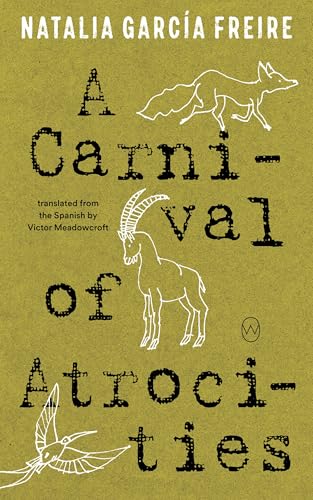
A CARNIVAL OF ATROCITIES, things going wrong? blame a woman!


A CARNIVAL OF ATROCITIES
NATALIA CARCÍA FREIRE
(tr. Victor Meadowcroft)
World Editions (non-affiliate Amazon link)
$14.99 ebook, available now

Rating: 5* of five

The Publisher Says: The residents of a desolate town nestled in the Ecuadorian Andes are forced to reckon with the legend of Mildred, a girl wronged by the town years ago

Cocuán, a desolate town nestled between the hot jungle and the frigid Andes, is about to slip away from memory. This is where Mildred was born, and where everything she had—her animals, her home, her lands—was taken from her after her mother’s death. Years later, a series of strange events, disappearances, and outbursts of collective delirium will force its residents to reckon with the legend of old Mildred. Once again, they will feel the shadow of death that has hung over the town ever since she was wronged. The voices of nine characters—Mildred, Ezequiel, Agustina, Manzi, Carmen, Víctor, Baltasar, Hermosina, and Filatelio—tell us of the past and present of that doomed place and Mildred's fate.

Natalia García Freire’s vivid language blurs the lines between dreams and reality and transports the reader to the hypnotic Andean universe of Ecuador.

I RECEIVED A DRC FROM THE PUBLISHER VIA EDELWEISS+. THANK YOU.

My Review
: Nine PoVs in under 160pp. Why is my rating even a speck over 3 stars?

Mildred.

How perfect that her memory is, not celebrated exactly, but very much incorporated into the life of the town she was Othered, abused, and abandoned by in life. She never once left the midrange of the townsfolk's memories. Funny about that, since all she ever got was a grudging corner in life. Now Cocuán, never a place that loomed large on the world's stage (or even Ecuador's), is slowly and steadily vanishing. It's an unnerving process to read about. The place is, under the pressure of shared guilt, Brigadooning itself as monsters (real? psychic?) claim all of Cocuán.

Told in the kind of prose that I'm reluctant to call "dreamlike" because that means all y'all will click away in search of meatier fare, it's akin to a folktale. A kind of Silver John the Balladeer reading experience. The nine (9) PoVs all expand, like in the Appalachian folktales I've referenced, the reach of Mildred's...presence? ghost? transitional object-iveness?...serves to illuminate the magic in magical realism. She (please attend to pronoun) is killing the place that killed her by causing (how?) the trauma they inflicted on her to make itself manifest in themselves. Revenge? Whose, and on whom?

It is as easy to see Mildred as Silver John the Balladeer's rejected suitor Evadare, pining unto death for what she is denied in life, as it is to see her as John the competent and potent restorer of ma'at to the town. It's a role that folktales love, the bringer of justice and balance who is not quite of this world, but was, and still cares about it.

As easily as that more esoteric take I can defend this story as a restoration of justice for a victim of cultural misogyny, whose maltreatment and displacement by the town was so deeply unjust that it haunts each perpetrator or passive unsavior unto death. The town's vanishing because their collective responsibility to a woman seeking only to exercise the rights they all demand to life and liberty signally failed. They project onto the space called Mildred all the consequences of their failings as women have always endured. Every bad thing is someone else's fault, never one's own. Othering and blaming Mildred for the forces shutting down their town gives Cocuán double psychic relief: exoneration for how they treated her, and an explanation for the advancing death rattles of Cocuán.

Plus it's got cool monstrous doins!

Real or fantasy, Mildred and Cocuán and their wildly entangled realities, as the author and the translator have thrown into relief with words of the most precisely calculated illumination, get all five stars from me.

Monday, February 3, 2025

RÍO MUERTO, 2025's first all-five read, though not for the fantasy-averse reader


RÍO MUERTO
RICARDO SILVA ROMERO
(tr. Victor Meadowcroft)
World Editions (non-affiliate Amazon link)
$14.99 ebook editions, available tomorrow

FINALIST for the 2026 PEN Translation Prize! Winner announced 31 March 2026.

Rating: 5* of five

The Publisher Says: On the outskirts of Belén del Chamí, a town that has yet to appear on any map of Colombia, the mute Salomón Palacios is murdered a few steps away from his home. His widow, the courageous and foul-mouthed Hipólita Arenas, completely loses her sanity and confronts the paramilitaries and local politicians, challenging them to also kill her and her two fatherless sons. Yet as Hipólita faces her husband’s murderers on her desperate journey, she finds an unexpected calling to stay alive.

This poetic and hypnotizing novel, told from the perspective of Salomón’s ghost, denounces the brutal killings of innocent citizens and at the same time celebrates the invisible: imagination, memories, hope, and the connection to afterlife.

I RECEIVED A DRC FROM THE PUBLISHER VIA EDELWEISS+. THANK YOU.

My Review
: South America's cultural impact is never more delightfully represented, to me at least, than when I read magical-realist works whether in translation or not. A novel narrated by a ghost definitely counts as "magical" in my book (!), so I was prepared for something to get me, to find the chinks in my emotional armor.

Not prepared enough.

That there's a civil war, a narcoterror regime, and immense unrest in Colombia was known to me. How pervasive it was didn't seem to me to be a reason to be surprised until I read the author's explanation that these events are fictionalized, not merely fiction...that "based on a true story" line we see so often hit home hard, because this is a friend's life skinned in fiction but boned by facts.

It's really down to this:
I am telling what I was told to me: that Salomón Palacios was gunned down only a few paces from his home and died and became a nameless thing in the gloom—the closing in—before returning from the dead. That he took an eternity in coming back, for the soul recovers memory in its own time, at its own rhythm, but that he must be out there now, and always will be, because death is the true present and because some murder victims do not depart.

Time passes subjectively, per Einstein; I'm not entirely ready to say velocity's the one governing factor until someone can really explain time fully. Maybe Death really does equal time; after reading this book, I have to be open to the possibility. For one of the few times in my reading life I find myself agreeing with a Pentecostal character: the apocalypse really has begun.

What makes Salomón such a great narrator is his ongoing physiological voicelessness. In life, in death, he makes no auditory impact. His existence as a ghost is in a powerfully evocative way a continuation of his voiceless, ineffectual life. Small gestures of kindness, his eking of a living by doing odd jobs, his very death carry the same burden of being a little guy living a little life that couldn't possibly threaten anyone who gets killed in spite of his death changing nothing.

Well, it unhinges his wife. She goes on a campaign to force his killers to kill her, and their sons, too. The sons have other ideas. Her plan to confront the boss who ordered Salomón's death to force him to martyr her, and her boys, in order to...what, exactly? no one in their town doubts who caused the thugs who did it to pull the triggers...or is she simply and selfishly out to commit suicide to avoid feeling grief for her genuinely loved with all his flaws husband? Insisting the sons she birthed join her in this spectacular suicide-by-provocation motivates Salomón in ghostly form to attempt to communicate love felt, love given to be received, to the maddened Hipólita to cause her to reinvest in life, to use her rage to pick up her boys and get the hell out of there. It would give his death, and his life, meaning.

How can a man voiceless in embodied life, in other words, find a voice now he's bodiless?

Author Silva Romero wrote a story I did not want to inhabit, but I did inhabit as fully as I have most stories I've read, because few kinds of story command my involvement more than grief, love, and power dynamics in emulsion. He chose a story I couldn't not get myself into. He chose a storytelling voice I could not avoid investing my empathy, sympathy, and tearducts into. Salomón loved deeply and mutely showed his love in practical simple deeds; he loved so much he was motivated to reach around the barrier of death. Author Silva Romero, ably served by his translator Victor Meadowcroft, did a fine job evoking a violent time's hideous human cost, as well as human beings' overpowering need to force the world to make those costs make sense.

It's impossible to do that, I say confidently, as I read the story of how it is done. All five stars.

Saturday, August 31, 2024

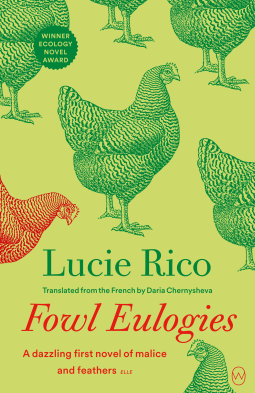
FOWL EULOGIES, strange, absurd, and very French


FOWL EULOGIES
LUCIE RICO
(tr. Daria Chernysheva)
World Editions
$17.99 trade paper, available now

Rating: 4.5* of five

The Publisher Says: Fowl Eulogies is an absurd fairy tale for the ethical carnivore, fiction of perfect madness, of brutal and unprecedented humor. From the meadow to the supermarket, this dazzling first novel of mischief and feathers, brings to life the singular poetry of the industrial chicken.

Upon her mother's death, Paule Rojas, a vegetarian city-dweller, returns to the chicken farm where she grew up. Pressured to fulfil her mother's last request, Paule rediscovers pleasure and meaning in running the old family business. Yet, eager to bring something of herself to a family tradition, Paule embarks on increasingly intricate ways of helping the chickens to self-actualize before their deaths. She records the chickens' life stories, adding them to the labels that decorate the vacuum-packed meat sent off to market—an individual biography for every chicken.

But not all runs smooth in her childhood village; Paule finds she has few friends and many enemies. She is forced to spread her wings, relocate her livestock, and oversee the construction of an urban farm of never-before-seen practices and proportions.

I RECEIVED A DRC FROM THE PUBLISHER VIA EDELWEISS+. THANK YOU.

My Review
: A fable of modern factory farming that manages to be cautionary, amusing, and thought-provoking.

A woman whose mode of survival as a being is a rejection of her mother's means of support deals with the grief of losing a mother she...felt conflicted about, let's say...reassesses everything as she goes through the process. What I've always known about les animaux, their individualty and complexity within their scope, is apparently a revelation to Paule. That bumfuzzles me a bit, as it seems someone who has had life-long contact with them ought to have picked up on that before. After all, she did go vegetarian, yet *now* as she's learning to like killing chickens, she discovers their individuality...? Well, just go with it, I advised myself.

The pleasure of the read, to me at least, is in the fantastical element of mass public response to Paule's oddball response to being a chicken-killer for a living: Those obituaries for the bird you're roasting as dinner catching fire (!) with the bird-munching public seems wildly improbable to me. It makes me grin. It gave me a moment of wistful acknowledgment that my existence is predicated on the deaths of innumerable other living things I'll never know a thing about. In this vein of response, the story reminded me of that other very, very French novel of wildly improbable events, A Novel Bookstore.

It seems a truly French thing is to use fantastical and unlikely human responses to things in order to question those underpinnings of our world we don't spend a lot of time considering. It doesn't take Author Rico a huge page-count to get to the meat (!) of her fable. There's a sting in the tail of the tale, I suspect put there to cause discomfort. How many people can, if they really *know*, genuinely get that the food they eat is mass death? This applies equally to vegetarians, of course, but they seem not to worry overmuch about plant sentience. As forms of denial of evidence go, that one's pretty sensible since the world does not support the exitence of billions of Jains.

As a story meant to provoke thought, I'm on a different point on the curve of Author Rico's trajectory. I was far more focused, for my edification and education, on the many iterations of the vile, evil Violet Gamart of The Bookshop that populate the story. The innumerable, deeply solipsistic NIMBYs, the no-change stasis lovers, the PTB threatened in their sacred wallets by new ideas, all abound. I was varyingly infuriated, repulsed, and appalled at Paule's detractors. It was thus saddening to see Paule gradually submerge into The Capitalist System. I expected it. I was still saddened.

I suspect her evoking of my sadness is meant to remind me that collusion can be coerced from any of us; that principles are costly; that human nature is destructive always in all ways. Bleak as it is, this is a truth self-evident to any remotely honest observer of life.

As a way to "eat my spinach," this read is a properly well-made inducement. As a translation, it is smoothly made. As a narrative, your French gear needs to be engaged or its absurdity will clonk you hard. If you can shift that gear, this is a delight of a read.

Wednesday, June 26, 2024

SELAMLIK, a lovely idea, a word we in the world need


SELAMLIK
KHALED ALSMAEL
(tr. Leri Price)
World Editions
$19.99 trade paper, available now

Rating: 4.5* of five

The Publisher Says: An emotional and unflinching story about Arab masculinity and homoeroticism

Furat, a Syrian in his early 20s, visits Sibki Park in Damascus, which serves as a gathering place for gay men from all over the city. He learns about the Hammams, secret meeting places for gays located throughout the old city.

Inside these public baths, the air is thick with the scent of bay laurel soap, and naked men hide in the steam. Despite society, religion and regime disapproval, Furat finds the love he seeks just before being forced to flee as his world changes. Later on, Furat wakes up in a cold sweat at an asylum in the Swedish forest recalling a terrifying dream in which he was blindfolded and bound. Having seen the horrific clips of what extremists do to gays circulating on the internet, he begins to write about his experience while locked in the toilet.

This is the story of Furat's journey, along with that of other refugees, as they struggle against physical and economic challenges, migration laws, and deep-seated fears of loss, shame, and hatred. However, amid these difficulties also lie moments of passion and pleasure. Despite everything, Furat remains steadfast in his pursuit of love.

I RECEIVED A DRC FROM THE PUBLISHER VIA EDELWEISS+. THANK YOU.

My Review
: This story felt to me like a roadmap of what the great-haters want gay life to become in the US. Religious nuts are not to be trusted with the well being of those they don't like. Their allgedly holy book allows things well beyond the pale in the modern world. That's where the damn things belong, beyond the pale.

Think I'm being strident again? Read Furat's story, much like the author's own, to see how disfiguringly awful it is to be denied expression of your honest, authentic self.

The book isn't long, under two hundred pages, and covers three countries that create, dislike, or accept refugees. Syria's pre-civil-war accommodation of gay men wasn't acceptance, exactly, more a species of tolerance..."don't make us notice you, stay over there"...and Turkey's is roughly similar. Furat's deep discomfort dealing with the straight men (and "straight" men) who surround him comes vibrating off the page. The author clearly drew this from his own lived experience. It's a revelation of self that would likely get him beaten or worse in most macho cultures.

The way the novel is structured is likely going to put some people off. I hope you'll think of the structure as a way of communicating Furat's lived experience of fragmentation and alienation; as a deliberate and careful evocation of the world as it appears to someone who has no home, never felt at home, never had more than mere toleration offered to him. The jagged edges of severed relationships...what happened to Ali?...are the price exacted by the great-haters for one's being alive in "their" world.

"Their" world definitely includes the world of Sweden. This paragon of accepting refugees hasn't told its people that kindness and acceptance might be better for all concerned than rejection and intolerance. That's rich coming from an American, I agree, but the fact is that my majority-immigrant country has its head up its religious-nut ass. I would hope for better from the Swedes. I would, it seems, be wrong. Furat's life is better. It's not in danger anymore. His Life is. This Life, this wonderful world of lovingkindness and acceptance, of deep connection and relationship, is still beyond his reach.

The title's a word that describes and defines the concept gay men, all that I've known in my nearing-seventy years on earth, want: a place of intimate connection of men's bodies and minds.

The story has its challenges for the reader. It's not going to make the eww-ick homophobes blench. It's not going to make the linear-story reader into a fan of stream of consciousness. It's not the book's job. It is going to give its readers a personal intimate view of the way a man of multiple marginalizations navigates becoming his authentic self.

That, for this reader, is a beautiful gift.

Sunday, May 12, 2024

AFTERLIGHT, love, loss, and learning as they look from The End


AFTERLIGHT
JAAP ROBBEN
(tr. David Doherty)
World Editions
$19.99 all editions, available now

Rating: 4* of five

The Publisher Says: This moving novel gives voice to the silent grief of the mothers of stillborn children

The young free-spirited florist Frieda grew up in a strictly Catholic environment in the 1960s. When she steps onto a frozen river on a late winter afternoon, little does she know that everything is about to change for her. On the ice, she meets the married Otto. They experience a love that begins stormy and ends with Frieda becoming pregnant—a scandal in the world in which she moves. And so she must never be the mother of her secret child.

For decades she kept her memories of this episode in her life to herself. But the grief for the lost child remains, despite the later marriage, despite the son she still has. At the age of eighty-one, Frieda is suddenly alone again. The silent sorrow returns with force. Only then does she dare to face her story—and to share it.

With Afterlight, inspired by true events, Robben not only pulls back the veil on Frieda’s story but also shines a light on the experiences of countless women between the 1950s and 1980s. The result is an impressive story about buried female trauma, caused by society, organized religion, and the dominant social mores.

I RECEIVED A DRC FROM THE PUBLISHER VIA EDELWEISS+. THANK YOU.

My Review
: I lost my love a lot earlier in life than Frieda did. He needed the level of care that Frieda does as the story begins, not me; nor have I yet reached the point where she is, of needing basic-living help.

Thank goodness the strokes I had in 2023 didn't make that help a lifelong need. But I still had the points of recognition and connection with Frieda from my life's story. I was right there with her as she adjusted to a new place to live that doesn't belong to her; I felt her dislocation as the night's disturbances had her groping around the unfamiliar space to find things she's sure she has, and still needs...only they aren't there and won't be again.

I am also familiar with the awful pains of being Othered by "religious" people, and told by The World that who you are is bad, and wrong, and will always cause their gawd to hate you and doom you to an eternity of punishment. Poor Frieda. I wouldn't say she overcomes that abusive horror in this story. I would say she makes her own way in life with the miracle of love offered her by the now-dead Louis...the one who fully expected he would survive her as she declined and lost more and more of herself. I asked Rob to read this book, and, after hearing what it was about, he looked at me through the computer screen and said, "No." Simple, final. Understandable.

It's a lot to ask: Frieda's happiness was bookended by a lot of pain. It is, though, the kind of pain that older people will relate to. It is a very familiar world that Frieda brings back to us in each time period. We've all been too young for some major life event that happened to us anyway. We've all felt unloved and abandoned...rightly, as in Frieda's case, or wrongly...and many, if not most, of us can relate deeply to loving someone and losing them. A lot of my readers are getting to the place where they, or their parents, are needing help that wasn't needed in the recent past. And all of that is what you and I share with Frieda.

Do you want to read about it for entertainment? Well, I did. I was pleased to have the fellow-feeling of Frieda's journey into the undignified, unpleasant (to me) world of bodily aging; as this is a story set in two timelines, though, I was expecting to be led into the sunnier meadows of the earlier life she led, and its youthful exuberance. Here is where the story fell short of the five stars all stories I read start with for me.

This is not a short book—three hundred-ish pages. There was space to develop the dual timeline, and it wasn't done. What's enjoyable about the way Author Jaap writes Frieda's story is the immediacy of it. He gets the sense of her, at every age, as a woman very much alert to the world around her; and yet unable to reach it, grasp it, without mediation...hearing aids, glasses, nurses, her husband, gawd...and so never fully having her own undiluted experience of anything.

Youthful inexperience prevented her from seeing the man who impregnated her in 1963 with any clarity, led to her downfall by the mediation of a religious upbringing that so starved her for genuine experience that she fell for the most unsubtle of lures. There's the consequences part of that in the book, but the stick gets applied without the carrot in my estimation.

That said, I liked this read. I liked its soft edges on hard realities...its gentle Impressionistic blur is, though, down to poor vision, not to a soft reality. That made it the more poignant to read. It's an enjoyable, relatable story well-told by an author who knows his subject. It's deftly translated...no clunks or clanks, and nothing that my early-learner study of Dutch saw as out of place...which helps.

Good is not the enemy of great when it is enough in itself.

Saturday, December 16, 2023

BIOGRAPHY OF A FLY, lovely gift item for someone who loves Art & Nature both, either...


BIOGRAPHY OF A FLY
JAAP ROBBEN
(tr. David Doherty) Art by Paul Faassen
World Editions
$16.99 hardcover, available now

Rating: 4.5* of five

The Publisher Says: For readers of The Boy, the Mole, the Fox and the Horse comes a beautifully illustrated philosophical book on the value of friendship and life, told from the perspective of a fly, and a gift book for all ages.

What if you were thrown into existence in the middle of your life, with numbered days left ahead of you? Would you see the world in the same way?

In his inimitable style, Jaap Robben answers these questions through the unexpectedly witty lens of a fly, from the moment it enters the world as a larva right up to its deathbed. Watch this humble fly throw himself into life and his unlikely friendships with gusto, however short that life may be. Irresistibly charming, funny, and sprinkled with entomological details, this is a moving tale for any stage of life, about how we are all ultimately alone, and yet also together.

I RECEIVED A DRC FROM THE PUBLISHER VIA EDELWEISS+. THANK YOU.

My Review
: Beautiful, weird little meditation on Nature, and the nature of Life. A fly’s life, from larva to deathbed, told in direct and (as far as I could tell without doing more research than seemed warranted) accurate manner.
That life being short, it’s good to follow it chronologically and to deal with the Stuff of Life (warning to the squeamish...lots of honest talk about shit) in a way that will inform the reader of, say, eight and up about more than just the biology involved in living.

I don’t find bodily functions as unpleasant to discuss as many seem to. The fact is, we all shit or we are dead. Eating, sleeping, shitting, sweating...take the stigma out of bodily functions for kids, I beg of you. It does no good at all to teach a child to feel disgust for their body.

A book like this is a very easy way to start that goal off. Enjoyable on many levels, for many ages...most art fans will like the minimalist color palette and the gloriously weird framing of the images, and thoughtful readers will enjoy the philosophizing.
What kind of squeamish speciesist could resist this face?

Sunday, June 12, 2022

SOLO DANCE, East Asian queerness finds an English-language voice BUT CW for suicidal ideation


SOLO DANCE
KOTOMI LI
(tr. Arthur Reiji Morris)
World Editions
$17.99 trade paper, available now

ONE OF NBC'S BEST LGBTQ BOOKS OF 2022!

Rating: 4* of five

The Publisher Says: An important queer voice from East Asia’s millennial generation

Chō Norie, twenty-seven and originally from Taiwan, is working an office job in Tokyo. While her colleagues worry about the economy, life-insurance policies, marriage, and children, she is forced to keep her unconventional life hidden—including her sexuality and the violent attack that prompted her move to Japan. There is also her unusual fascination with death: she knows from personal experience how devastating death can be, but for her it is also creative fuel. Solo Dance depicts the painful coming of age of a gay person in Taiwan and corporate Japan. This striking debut is an intimate and powerful account of a search for hope after trauma.

I RECEIVED THIS DRC FROM THE PUBLISHER VIA EDELWEISS+. THANK YOU.

My Review
: Asian cultures don't, as a rule, deal well with modern QUILTBAG identities. The perception of queer folks isn't anything like as angry as the anti- crowd here in the West but it's close in emotional terms to our unenviable habit of emotional violence and rejection. Homophobia is something queer folks battle no matter where we are. Doesn't say great things about human beings, does it.

What Author Li does in Solo Dance is deeply personalize the costs of being out in the culture of Taiwan, which leads to violent assault, and in Japan's less physical homophobic world, where it's simply ignored. Slighted, denigrated, and rejected; but without ever saying the awful words "gay" or "lesbian". This ostracization is crueler even than physical beatings.

But that is what Chō Norie prefers to her native Taiwan's brutality. She came to Japan unable to speak Japanese, as a Taiwanese woman, with all the cultural frieght that carries. Her great-grandmother's generation was used as "comfort women" and her own is a kind of slighted immigrant worker-bee, needed but not valued in larger Japanese society...and that suits Chō down to the ground. Maybe, after all, if she *can't* speak the language, no one will demand she speak at all. Thus is denial and emotional cowardice perpetuated in Chō's new, self-selected life.

With the long-standing Japanese cultural celebration of suicide, the Ghost Forest and the Wind Phone joining the long-standing ritual suicide of seppuku; it seems utterly unsurprising, then, that Chō comes here to make a life while obsessing over, planning for, lovingly dwelling on, her own suicide to come, as well as the past. (It should be noted that Japanese society is being deliberately steered away from this cultural acceptance.)
She didn’t have a strong inclination towards death, but she had no attachment to living either. While she still had breath in her lungs, she would do her best in life, yet should it ever reach that point where it was no longer bearable, she would choose death without hesitation.

Since that is the very first page of the story, I think it acceptable to quote it here; if this is in the least triggering for you and you've read this far into the review, it's a poor fit for you.

The main point of my discussing this book, though, is to say that it is a gorgeous work of prose, in a quiet and mannered way. It is an honest and bleak account of Otherness in a culture that greatly values comformity. It is a deep dive into a woman's blocked relationship with her body, with the pleasures of sex and intimacy, stemming from sexual violence. Chō runs away from Taiwan because she does not want to confront her rape in every living moment. Japan does not, to no one's surprise, encourage healing in its culture of silence around matters sexual. Her own fearfulness about her emotional state, then, is never in any way the focus of any positive intervention.

It is not a hopeful story of a survivor.
She was twenty-seven and this real-world conversation shouldn’t feel so remote, but she couldn’t force herself to get interested. There was an insurmountable wall that prevented her from fully engaging with it. All this talk of a decade from now, two decades from now, seemed like the distant future—hundreds if not thousands of years away. A world in which her existence wouldn’t make any difference. That was the true representation of her feelings.

Chō Norie, as she has chosen to be known, is not Yingmei the child whose early life contains earthquakes (fascinating to read about how her family copes with those!) and the death of a classmate-cum-crush-object of Yingmei's which is met with emotional ceremonies and discussions that she is utterly unable to process or participate in. Chō is a woman born out of intent...a creation not the being created, an auto-Galatea. And as a result, Chō has few inner resources to meet the few concerned people she encounters in Japan, even fewer to meet the awful and brutal rejection of a character Chō is (somewhat bloodlessly) involved with.

What, then, is the source of my four-star rating? First, beautifully translated imagery-laden writing. I think Translator Arthur Reiji Morris did a beautiful job of putting flattering English clothes on this very Japanese body. Enough context is presented that I never felt lost or left out; I suspect those were crafted for the translation, and it was done with great facility. Second, the fact that Chō was a woman made up, and one composed of literary antecedents. There are many works of literature harkened back to and that always gets my upvote.

There's a last thing you should know before starting on this journey: The ending. It is, to be as succinct as I can be, fantastical. Whether real or fantasized or merely cooked up, it does not resolve the events of the book. It leaves room for you to do that and, in the context of a book of this kind of interiority (though not a récit, it comes close), that fel to me like a worthy choice. It was not satisfying, though, in that "...and that was a fascinating story! *closes cover*" way.

Like all unfinished business, it lingers.

Wednesday, November 17, 2021

PLANET OF CLAY, tale of the toll living exacts on the different


PLANET OF CLAY
SAMAR YAZBEK
(tr. Leri Price)
World Editions
$16.99 trade paper, available now

Rating: 4* of five

The Publisher Says: An ode to fantasy and beauty in the midst of war-torn Damascus

Rima, a young girl from Damascus, longs to walk, to be free to follow the will of her feet, but instead is perpetually constrained. She finds refuge in a fantasy world full of colored crayons, secret planets, and The Little Prince, reciting passages of the Qur’an like a mantra as everything and everyone around her is blown to bits. Since Rima hardly ever speaks, people think she’s crazy, but she is no fool—the madness is in the battered city around her.

One day while taking a bus through Damascus, a soldier opens fire and her mother is killed. Rima, wounded, is taken to a military hospital before her brother leads her to the besieged area of Ghouta—where, between bombings, she writes her story.

In Planet of Clay, Samar Yazbek offers a surreal depiction of the horrors taking place in Syria, in vivid and poetic language and with a sharp eye for detail and beauty.

I RECEIVED A DRC FROM THE PUBLISHER VIA EDELWEISS+. THANK YOU.

My Review
: First, read this:
We needed to take two buses to reach {my mother's job} from our house, which was at the end of Jaramana Camp in southern Damascus. I am happy for you if you haven't heard of it.
–and–
Personally, I turn over the coffee tray and make it into a desk, then I pick up the blue pen which I found among the stacks of paper, and I begin. You must not set off before the sound has started. Don't stop unless you are faint from exhaustion, but it must be from exhaustion and not fear. If all this isn't done properly, I mean using the blue pen to play with words on a blank page, then my instructions will fail, the blank page won't like you, and the roar of the aeroplanes won't disappear.

The rational response to an irrational world, one filled with mortal danger, will always be different for a small child. When a small child is required to make the world make sense when it simply doesn't, such as in a war zone, there will arise adaptive responses that are in the long run maladaptive. And add in the probability of the person being neurodivergent from the get-go...well, what are the odds of that person reaching adulthood? Still less unscathed.

Rima's mother knows her daughter isn't the usual sort of child. She's got "her brains in her feet," meaning a mania for walking, walking, always walking if she can stay on her feet...in other words, a need to escape...and on one of her very first outings, so to speak, a group of well-meaning adults stop her and ask her all sorts of urgent questions...what's your name, where's your mother...that she simply can't process fast enough to answer. Thus is an elective mute created.

So now Rima's mother is living in a war zone with a manic, elective mute daughter. She does what any mother would do...she makes the medical rounds, seeking answers. Getting none, she does the thing mothers have done since the beginning of time: She improvises. She gets some rope and ties Rima to her wrist when she has to go out and, when the girl's too much of a woman for that to be safe, she ties her to their bed.

That sounds horrific to a Western person who's safe inside a house every night, with only police drones and cop cars to worry about. But think of this: How safe is a young woman on the streets here in your fat-and-happy country? You'll always teach her to be aware of the threat posed by Them. (You'll be filling in that space with the people you dislike the most, of course, but I assure you she's safer from Them than from the nice, entitled, self-satisfied boys in her school.) For someone with fewer resources than the poorest person in this country of ours, the solution fits the need admirably.

What it doesn't, can't do is prepare Rima for one of the personal calamities that even the mildest "police action" or "guerrilla war" engenders: The loss of a parent. In this case, an only parent...her father's never even been a presence for his absence to be felt. What this means is her world is effectively over. And yet her life goes on, in her mother's permanent absence and her brother's disappearance into the guerrillas' ranks.

What makes this such a perfect read for this moment is the Belarus-vs-Poland manufactured refugee crisis permeating the news cycle right now. It's a necessary and salutary reminder that the world's not in good shape, plague aside; the people, living breathing people, who are caught between two sets of disgusting racist piece-of-shit countries and who will continue to die of exposure as the world idly watches it happen, aren't going to get what they need any more than Rima did.

Mirabile dictu, Rima's brother shows up! He finds her! And they begin the refugee's eternal dance, the homeless and placeless and stateless state of being, of non-personhood. Of course to Rima it's not that way...she simply does. She lives. She is in touch with something utterly invaluable for a refugee: Her self. It is clear to her who she is, she is Rima and she reads, she sings the Qu'ran's sutras, she draws. It is a saving grace. What it isn't is easy for a storyteller to sell. She is simultaneously simple and sophisticated, ignorant and wise and way over her head.

Let me show you:
You will understand that I don't have enough time to explain to you about forgetting. Later, you can throw away whatever pages you want to. What matters to me is {the old caretaking woman} who wanted to understand how I knew how to use tartil in reciting the Qu'ran. Really, it was difficult to explain to her, because my tongue was stopped, and like {her} I don't understand much of what surrounds me.
–and–
I am a story, I too will disappear (or maybe I am with you now as you read my scattered words) like the Cheshire Cat did in the story of Alice.

That is some very sophisticated abstract thought for someone with the neurodivergence Rima has displayed...in the circumstances of her upbringing, I'd be impressed with that level of eloquent abstraction in a neurotypical young adult.

All in all, though, as a work of fiction, I was compelled by the story, by the character, by the narrative's timeliness and timelessness. I'm very impressed as this is the first work I've read by Author Yazbek. It is, as she has Rima say of her own storytelling, one of those "circular stories with intersecting centers which are only completed by retellings and new details."

The problem is reassembling my heart after the story ends....

This is a very special, very timely yet a timeless read...there is no realistic chance the subject matter will lose its relevance. It is a FINALIST for the 2021 Best Translated Literature category at the National Book Awards! The winner will be announced this evening.