Showing posts with label why science matters. Show all posts

Thursday, November 13, 2025

GEMINI: Stepping Stone to the Moon—The Untold Story, the Moon landing's precursor


GEMINI: Stepping Stone to the Moon—The Untold Story
JEFFREY KLUGER

St. Martin's Press (non-affiliate Bookshop.org link)
$16.99 ebook, available now

Time's The 100 Must-Read Books of 2025 selection

Rating: 5* of five

The Publisher Says: From the bestselling author of Apollo 13 comes the thrilling untold story of the pioneering Gemini program that was instrumental in getting Americans on the moon.

Without Gemini, there would be no Apollo.

After we first launched Americans into space but before we touched down on the moon’s surface, there was the Gemini program. It was no easy jump from manned missions in low-Earth orbit to a successful moon landing, and the ten-flight, twenty-month celestial story of the Gemini program is an extraordinary one. There was unavoidable darkness in the program—the deaths and near-deaths that defined it, and the blood feud with the Soviet Union that animated it.

But there were undeniable and previously inconceivable successes. With a war raging in Vietnam and lawmakers calling for cuts to NASA’s budget, the success of the Gemini program—or the space program in general—was never guaranteed. Yet against all odds, the remarkable scientists and astronauts behind the project persevered, and their efforts paid off. Later, with the knowledge gained from the Gemini flights, NASA would launch the legendary Apollo program.

Told with Jeffrey Kluger’s signature cinematic storytelling and in-depth research and interviews, Gemini is an edge-of-your-seat narrative chronicling the history of the least appreciated—and most groundbreaking—space program in American history. Finally, Gemini’s story will be told, and finally, we’ll learn the truth of how we landed on the moon.

I RECEIVED A DRC FROM THE PUBLISHER VIA NETGALLEY. THANK YOU.

My Review
: First, read this:
America would ultimately celebrate Mercury and Apollo—its first venture into space and its first venture to another world—louder and longer and with more passion than it would celebrate Gemini, the middle sibling of the manned space program. But it was Gemini that taught the US to live in space, to work in space, to walk in space, to thrive in space. Without Gemini, men would never have walked on the moon. The green shoots of space habitation poked up in the soil that was the Gemini program. Sixteen men flew those ten missions—and those same sixteen men have never been fully celebrated for the greatness they exhibited. Let history right that wrong at last.
I was alive, and eagerly obsessed, for the whole space race. I honestly forgot Gemini existed until I was reminded by this book. I'd say the author got his thesis exactly right...we needed the knowledge gained by the Gemini program to land on the moon, but once that happened, we rather forgot the Gemini program that taught us the lessons.

So I read this fascinating, detailed recapitulation of all the many milestones the Gemini and its personnel achieved, the engineers as well as the astronauts, the designers and testers and troubleshooters...all making important contributions to the pursuit of real knowledge. I was as exciting to me as it was when I watched Uncle Walter (Cronkite) carefully elucidating the sheer miraculous science underpinning these incredible achievements.

As an old man I'm more aware of the reasons the space race took place. I'm still astounded that the Congress appropriated that much money to accomplish these scientific goals. I'm still sad that the education budget was ever-expanding then because we wanted our country to have the knowledge base to solve these sorts of problems to achieve the goal of solving them, no matter it was for a political game of one-upsmanship. We now have a system that's not interested in this kind of goal anymore. "AI" is a cash grab and a thought-control mechanism, not a pursuit of knowledge that resulted in huge advances in chemistry and engineering and electronics that ended up benefiting the general public.

Gemini's technical achievements were lovely to recall because the public was very invested in their success. I remember the techno-optimism of the era with wistful amusement. I'd love to see something get the hoi polloi reinvested in expanding human knowledge for the simple reason that it is a worthy goal. Alas....

I deeply enjoyed the period headlines, reimmersing me into the era's emotional valence; I was delighted that there were notes and a bibliography to allow me to follow the author's thought processes; I appreciated the clarity of the technical talk, the way the jargon was explained (though one is expected to recall the details, they aren't continually restated) in context.

The audience for the story is me: someone who wants technical explanations with context, not a social history with some jargon sprinkled in. Put in the effort and the story's rewarding. The telling in non-fiction terms might not work for you, so I recommend reading a Kindle sample to see if you resonate positively with Author Kluger's writing.

My fellow elderly kids of the 1960s might really love this as a Yule gift. I know I'd've been thrilled by it had I received it as a gift!

Tuesday, December 3, 2024

SO COLD!: “Call me Freezeman!”


SO COLD!
JOHN COY (illus. Chris Park)

Minnesota Historical Society Press (bookshop.org link)
$17.95 hardcover, available now

Rating: 5* of five

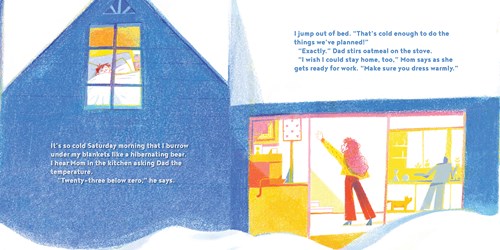
The Publisher Says: Embrace the cold with this engaging children's book about a father and son who practice science experiments using household objects outside on a snowy day!

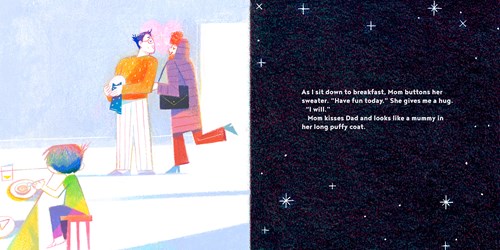
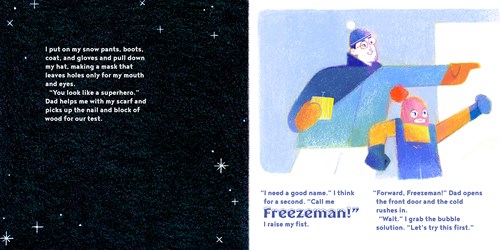
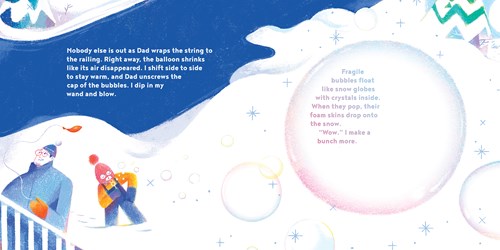
When the temperature drops far below freezing, many people plan to stay warm and cozy inside. But when it’s “so cold” that everyday things behave in unusual ways, it is worth the effort to get outside and play! In this vibrantly illustrated children's story, a boy and his father dress in layer after layer before braving the cold, and the youngster declares: “Call me Freezeman!”

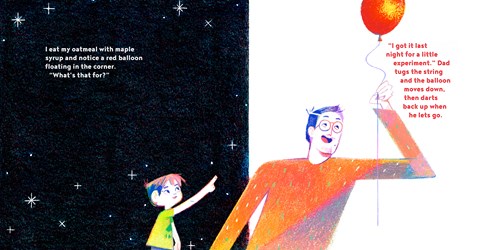
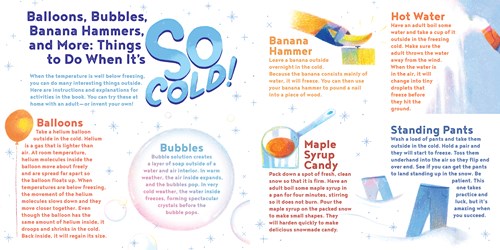
Together the two experiment: What happens when boiling water is flung into the air? Or when maple syrup is poured on clean snow? The night before they left a banana outside: now it’s frozen solid. Can they can use it like a hammer? A helium balloon that floats inside the house changes dramatically in the freezing air.

These and other discoveries await explorers bold enough to venture out on a bright and chilly day. Back inside at the end of the day, no wonder Freezeman declares: “so cold is so fun!” This playful narrative by John Coy celebrates curiosity and exploration, while Chris Park’s brilliant artwork illuminates a winter landscape that is anything but bleak. An author’s note explains the science behind the various experiments, leaving just one question: with all these amazing activities to undertake with your favorite adult when it’s “so cold,” why would anyone prefer to stay inside?

I RECEIVED A DRC FROM THE PUBLISHER VIA EDELWEISS+. THANK YOU.

My Review
: Cold! Glorious cold! Delicious, delightful absence of humidity, sweat, blasting battering sunshine that inescapably sears your skin in a human version of the Maillard Reaction. I'm pink like a pig, it's true, but I don't want to be treated like articulated chops! Heat rots, literally; cold preserves. You don't go to the stove to get last week's groceries...unless you're a fly larva, anyway.

So when your kidlet, nibling, or grand shows signs of hibernation to escape winter's gorgeous gift of escape from the horror that is heat, present them with this adorable little exploration of the reason for, and fun of, the cold.
Particularly pleased props for the story featuring Dad, not Mom, doing stuff with the kidlet. Text is suitable for independent reading, fine for lap-reading as well. I found the art suitably cold of pallette and suitably kinetic of image. It conveyed, to my eyes anyway, the desired image of activity enhanced by the cold.

I don't know how much longer this will be relevant but it is now. I recommend it.

Friday, December 22, 2023

THE JANUS POINT: A New Theory of Time, difficult, worthwhile read for #Booksgiving


THE JANUS POINT: A New Theory of Time
JULIAN BARBOUR

Basic Books
$32.00 hardcover, available now

Rating: 4* of five

The Publisher Says: In a universe filled by chaos and disorder, one physicist makes the radical argument that the growth of order drives the passage of time — and shapes the destiny of the universe.

Time is among the universe's greatest mysteries. Why, when most laws of physics allow for it to flow forward and backward, does it only go forward? Physicists have long appealed to the second law of thermodynamics, held to predict the increase of disorder in the universe, to explain this.

In The Janus Point, physicist Julian Barbour argues that the second law has been misapplied and that the growth of order determines how we experience time. In his view, the big bang becomes the "Janus point," a moment of minimal order from which time could flow, and order increase, in two directions. The Janus Point has remarkable implications: while most physicists predict that the universe will become mired in disorder, Barbour sees the possibility that order — the stuff of life — can grow without bound.

A major new work of physics, The Janus Point will transform our understanding of the nature of existence.

I RECEIVED A DRC FROM THE PUBLISHER VIA NETGALLEY. THANK YOU.

My Review
: On the Solstice, I think a lot about time. Why time's arrow only points in one direction, for example. I am always bothered by the implication inherent in the laws of physics that we presently understand that this is an observational artifact, not part of the structure of physics.

While I sit and ponder the strange dichotomies between what we observe and what theory tells us is possible, Author Barbour sets himself the task of learning the why, and questioning the how, of all the factors in physics that determine this issue's boundaries. That is an immense task.

It is also one well beyond most people's educational, vocational, and experiential capacities. The author isn't writing an academic paper in this book. He is, however, presupposing a lot of knowledge on the reader's part...if you don't know what a Boltzmann brain is, for example, this book will be lost on you...and even for those with the requisite grounding in at least the people who created the outlines of the Standard Model of particle physics, the need for frequent research breaks, aka "fallings down the many rabbit holes", is ever-present.

Very much not a Wikipedia-level treatment of an immensely important topic being argued, studied, researched, and pondered by some of the best-furnished minds in the field of physics today; yet it does not repel boarders with its case-shot loaded cannons of erudition. Author Barbour is quippy and quotable. The problem is quoting him won't help. This is someone with a very broad grasp of physics, history, cultural anthropology, etc. He lays out arguments that I suspect I only dimly grasp for his new model of endlessly repeatable order, ie creation of matter instead of its inevitable and complete decay, grounded in all the currents of thought there are.

Not, as you'd expect, a mere bagatelle to be consumed of an evening. Took me two years to read it, and I regret not a page or a minute of it. I was rewarded with a greatly expanded idea of what the science of physics is reaching for in its quest for a unified theory.

At this #Booksgiving moment, self-gifting this immensely challenging and deeply absorbing book is a great way to invest in your brain's expansion in entirely new ways and directions. It will be a Project. It is also well worth your eyeblinks.

Monday, December 28, 2020

2020...GAWD it stank! Here are some reads to remind us what's at stake in 2021


MILL TOWN: Reckoning with What Remains
KERRI ARSENAULT

St. Martin's Press
$27.99 hardcover, available now

Rating: The Full Five

The Publisher Says: A galvanizing and powerful debut, Mill Town is an American story, a human predicament, and a moral wake-up call that asks: what are we willing to tolerate and whose lives are we willing to sacrifice for our own survival?

Kerri Arsenault grew up in the rural working class town of Mexico, Maine. For over 100 years the community orbited around a paper mill that employs most townspeople, including three generations of Arsenault’s own family. Years after she moved away, Arsenault realized the price she paid for her seemingly secure childhood. The mill, while providing livelihoods for nearly everyone, also contributed to the destruction of the environment and the decline of the town’s economic, physical, and emotional health in a slow-moving catastrophe, earning the area the nickname “Cancer Valley.”

Mill Town is an personal investigation, where Arsenault sifts through historical archives and scientific reports, talks to family and neighbors, and examines her own childhood to illuminate the rise and collapse of the working-class, the hazards of loving and leaving home, and the ambiguous nature of toxics and disease. Mill Town is a moral wake-up call that asks, Whose lives are we willing to sacrifice for our own survival?

A FINALIST!! The National Book Critics' Circle's annual John Leonard Prize for a first book.

Many thanks to NetGalley and St. Martin's Press for my DRC.

My Review
: The 2020 book I couldn't review because I always end up screaming at my computer and kicking my laundry bag...it is that good, that real, that intense and necessary a read. Using her own hometown, and her entire youth there, as a lens to expose and excoriate corporate chicanery, Author Arsenault is taking no prisoners. Like her predecessors in exposé-dom Katherine Boo (Behind the Beautiful Forevers) and Rachel Carson (Silent Spring), she dug deep, interviewed widely, and concluded with a shout of outrage you really owe it to yourself to experience.

++++++++++++++++++++++++++++++++++++++++++++++++++++++++++++++++


REFINERY TOWN: Big Oil, Big Money, and the Remaking of an American City
STEVE EARLY

Beacon Press
$27.95 hardcover, $14.99 ebook editions, available now

Rating: 4* of five

The Publisher Says: The People vs. Big Oil--how a working-class company town harnessed the power of local politics to reclaim their community

With a foreword by Bernie Sanders


Home to one of the largest oil refineries in the state, Richmond, California, was once a typical company town, dominated by Chevron. This largely nonwhite, working-class city of 100,000 suffered from poverty, pollution, and poorly funded public services. It had one of the highest homicide rates per capita in the country and a jobless rate twice the national average.

But when veteran labor reporter Steve Early moved from New England to Richmond in 2012, he discovered a city struggling to remake itself. In Refinery Town, Early chronicles the 15 years of successful community organizing that raised the local minimum wage, defeated a casino development project, challenged home foreclosures and evictions, and sought fair taxation of Big Oil.

A short list of Richmond's activist residents helps to propel this compelling chronicle:

- 94 year old Betty Reid Soskin, the country's oldest full-time national park ranger and witness to Richmond's complex history
- Gayle McLaughlin, the Green Party mayor who challenged Chevron and won
- Police Chief Chris Magnus, who brought community policing to Richmond and is now one of America's leading public safety reformers


Part urban history, part call to action, Refinery Town shows how concerned citizens can harness the power of local politics to reclaim their community and make municipal government a source of much-needed policy innovation.

Many thanks to Edelweiss+ and Beacon Press for my DRC.

My Review
: There is nothing worse than a corporate lobbyist seeking the blinding of oversight for their industry: Congressional intervention alone saved the Chemical Safety & Hazard Investigation Board in 2017, whose paltry $11 million budget stands in stark contrast to the $530 billion industry they're charged with regulating. Author Early, in his extremely tendentious résumé of the many battles fought by the Richmond (CA) Progressive Alliance, some won and others lost but all in service of the humans of the city, kept me gasping in outraged sympathy. I definitely encourage Bernie supporters, environmentalists, and progressives to make the considerable effort to read this case study of a movement.

++++++++++++++++++++++++++++++++++++++++++++++++++++++++++++++++


COMING OF AGE AT THE END OF NATURE: A Generation Faces Living on a Changed Planet
JULIE DUNLAP & SUSAN A. COHEN

Trinity University Press
$18.95 paperback, $14.99 ebook editions, available now

Rating: 4.5* of five

The Publisher Says: Coming of Age at the End of Nature explores a new kind of environmental writing. This powerful anthology gathers the passionate voices of young writers who have grown up in an environmentally damaged and compromised world. Each contributor has come of age since Bill McKibben foretold the doom of humanity’s ancient relationship with a pristine earth in his prescient 1988 warning of climate change, The End of Nature.

What happens to individuals and societies when their most fundamental cultural, historical, and ecological bonds weaken—or snap? In Coming of Age at the End of Nature, insightful millennials express their anger and love, dreams and fears, and sources of resilience for living and thriving on our shifting planet.

Twenty-two essays explore wide-ranging themes that are paramount to young generations but that resonate with everyone, including redefining materialism and environmental justice, assessing the risk and promise of technology, and celebrating place anywhere from a wild Atlantic island to the Arizona desert, to Baltimore and Bangkok. The contributors speak with authority on problems facing us all, whether railing against the errors of past generations, reveling in their own adaptability, or insisting on a collective responsibility to do better.

Many thanks to Edelweiss+ and Trinity University Press for my DRC.

My Review
: A wildly variable collection of young peoples' responses to the horrific crisis my generation refused to mitigate or ameliorate in any way, shape, or form. I enjoyed a few essays that explored personal connections...a young parent pondering the ethics of childbirth at this historical point, a National Park docent contrasting the biome she guides people through with last century's paean essays to its lost glory...empathized with all, and ended up wanting to pen an apologia not a review. If the gutting of oversight and enforcement of regulations and standards on industry, and the all-but-abolishment of Federal land stewardship, causes you pain, read these essays to become galvanized and energized with purpose to fight our planet's hastened end.

++++++++++++++++++++++++++++++++++++++++++++++++++++++++++++++++


HOW TO CHANGE A LAW: Improve Your Community, Influence Your Country, Impact the World
JOHN THIBAULT

iLobby (non-affiliate Amazon link)
$2.99 ebook editions, available now

Rating: 5* of five

Many thanks to NetGalley and iLobby for my DRC.

I began this book wondering what the heck I could do to impact the legislative process; I ended it eager to apply the seven steps to self-empowerment in the political process. The most mind-blowingly direct, unfussy, and above all practical guide to speaking the language of successful influencers I can imagine. If the 2021 administration change has heartened you to imagine your voice can and should be heard, spend the extremely modest investment in this book and prepare wield your citizen's power effectively.

Sunday, January 22, 2017

FOOL ME TWICE, a truly scary look at the organized, cynical, and disturbingly effective war on science...all kinds of science

FOOL ME TWICE: Fighting the Assault on Science in America
SHAWN LAWRENCE OTTO

Rodale Books
$25.99 hardcover, available now

Rating: 4.5* of five

The Publisher Says: "Whenever the people are well informed,” Thomas Jefferson wrote, “they can be trusted with their own government.” But what happens in a world dominated by complex science? Are the people still well-enough informed to be trusted with their own government? And with less than 2 percent of Congress with any professional background in science, how can our government be trusted to lead us in the right direction?

Will the media save us? Don't count on it. In early 2008, of the 2,975 questions asked the candidates for president just six mentioned the words "global warming" or "climate change," the greatest policy challenge facing America. To put that in perspective, three questions mentioned UFOs.

Today the world’s major unsolved challenges all revolve around science. By the 2012 election cycle, at a time when science is influencing every aspect of modern life, antiscience views from climate-change denial to creationism to vaccine refusal have become mainstream.
Faced with the daunting challenges of an environment under siege, an exploding population, a falling economy and an education system slipping behind, our elected leaders are hard at work ... passing resolutions that say climate change is not real and astrology can control the weather.

Shawn Lawrence Otto has written a behind-the-scenes look at how the government, our politics, and the media prevent us from finding the real solutions we need. Fool Me Twice is the clever, outraged, and frightening account of America’s relationship with science—a relationship that is on the rocks at the very time we need it most.

My Review:
Ideology and rhetoric increasingly guide policy decision, often bearing little relationship to factual reality. And the America we once knew seems divided and angry, defiantly embracing unreason.
The most unnerving reality in today's social, political, and educational reality is that science, which you are benefiting from this very second as you read this review on the internet, is underfunded, undertaught, and underapprecitaed by the people of the USA and their political overlords. The reason for this is that an insane religious know-nothingism has infected the Body Politic with a conservative (in the worst possible meaning of that never-good term) resistance to accepting reality as it is, instead of how one fancies it should be. This book quantifies the horrors on their way down the pike as this horrifying metastatic stupidity continues unchecked and even promoted by the small-souled fear-mongering Yahoos, in the original Swiftian sense, who shout and rail and spew on Fox "News" and the related echo chambers. The author explores some psychological mechanisms of belief as it relates to the acceptance of authority, which really helps illuminate why the doomsday warnings about ignoring climate change only seem to make the religious authoritarians more resistant to the mounting—burgeoning!—evidence of its current reality. Otto then provides specific suggestions that could lead to more effective ways to address the concerns of these people, allowing for a rational debate and increasing the likelihood that some kind of useful agreement could be reached:
"When a person holds a belief, especially a strong one that is linked to important values (e.g. some sociopolitical beliefs), information threatening that belief creates inconsistency in the cognitive system that threatens one's self-image as a smart person. This produces an unpleasant emotional state." That belief resistance—and this is a critically important point—is largely coming from the adult ideological worldview. This is why education is political in the first place, and why the children of scientists are the most likely next generation of scientists—and effect that is slowly striating society into knowledge haves and have-nots and can only increase partisanship along science lines.

This book is exactly as tendentious as my book report is. If you don't already agree with its premise, then you're unlikely to consider picking it up. Which is a pity, in my view. For those of us who already agree, this acts either as a call to arms, or a horribly depressing reminder of how the New Dark Ages have already begun. For make no mistake: Stupidity has more gravity than intelligence, and hate has more brightness than enlightenment. Science has proven too many times that mass and heat always win for me to have any significant hope that Good will triumph over Willful Ignorance:
Espousing the anti-science argument, that the lack of absolute certainty that something is true is grounds for inaction or doubt, or that we should hear out all perspectives equally, is evidence of either a lack of understanding of reason or motivation by an unreasonable agenda. Such people should not be trusted with making decisions that will have serious impacts upon others.

Please prove me wrong. Read this book and get energized to fight the Yahoos. Please. We must try to re-establish science as the basis for increasing American freedom and for providing a solid foundation for the future. We are no longer in an age where just one more coal-fired powerplant or one more high-tech deep-sea trawler that ravages ecosystems we know nothing about won't make an impact on the ancient concept of the “common property of humankind.” I am appalled at the stupidity and/or greed of politicians and those who voted for them who fail to understand this universal benefit argument that "[t]he evidence shows that successful regulations that define a fair trade in the commons do not reduce freedom, they increase it."

That dream, that beautiful vision of a planet run for the best possible results of our individual actions resulting in a healthy world for all of its people, has always been a motivating factor for the bulk of the scientists I've known personally or known of professionally. How much more elegant it is to imagine a world with intact ecosystems that offer the humanity we create abundantly and thoughtlessly sustenance, health, a future as good as or better than the present:
In the end this is what matters most: the beauty. It's why scientists do science: to apprehend the great beauty of nature. They are Puritans, four hundred years hence, with more data, but still searching for that direct communion with wonder an the aesthetic. In this way science is not unlike art or religion. In fact art often anticipates and reflects the forms science discovers, as does religion. Science is much bigger than just solving challenges, as important as they are. It is about who we are as human beings, about or ability to love, to wonder, to imagine, to heal, to care for one another, to create a better future, to dream of things unseen.

Friday, January 13, 2017

THE FABRIC OF REALITY, twenty years on, presents the Multiverse argument clearly and concisely and still freshly


THE FABRIC OF REALITY: The Science of Parallel Universes--and Its Implications
David Deutsch

Penguin Books
$17.00 trade paper, available now

Rating: 4* of five

The Publisher Says: For David Deutsch, a young physicist of unusual originality, quantum theory contains our most fundamental knowledge of the physical world. Taken literally, it implies that there are many universes “parallel” to the one we see around us. This multiplicity of universes, according to Deutsch, turns out to be the key to achieving a new worldview, one which synthesizes the theories of evolution, computation, and knowledge with quantum physics. Considered jointly, these four strands of explanation reveal a unified fabric of reality that is both objective and comprehensible, the subject of this daring, challenging book.

The Fabric of Reality explains and connects many topics at the leading edge of current research and thinking, such as quantum computers (which work by effectively collaborating with their counterparts in other universes), the physics of time travel, the comprehensibility of nature and the physical limits of virtual reality, the significance of human life, and the ultimate fate of the universe. Here, for scientist and layperson alike, for philosopher, science-fiction reader, biologist, and computer expert, is a startlingly complete and rational synthesis of disciplines, and a new, optimistic message about existence.

My Review: I report that The Fabric of Reality by David Deutsch is simply wonderful. Clear, well-turned prose, ample illustrative examples of his points, and a beautifully thought-out explication of the bizarre nature of reality as explained in the far reaches of physics. The fact that Richard Dawkins is cited as an inspiration for Mr. Deutsch's work should forewarn the spiritual seekers in the audience to avoid this book at all costs. It takes a very clear stance against there being a supernatural agency in the workings of the Multiverse.

Instead, Deutsch says that the Multiverse is weird enough to contain answers to all questions couched in numinous terms and to explain all phenomena and experiences the species has filed in the "supernatural" bin. His arguments are presented without condescension or hectoring, which is a common failing in the prose that wishes to "debunk" the spiritual experience. He simply explains how the experiences fit into the framework of the Multiverse. From there, he says, it's up to you the reader.

THIS is an attitude I can endorse and enjoy. I dislike the spiritual imperialism that says, "My way is Right and all others are Wrong," and equally dislike the materialist dogma that "There IS no spiritual and those who imagine there is are deluded and foolish." (I reserve that dismissive and rejecting locution for religion, not the spiritual, as they are unrelated things.) I want the arguments presented and then leave it up to me to decide what to do with the information presented. Please don't do my thinking for me! And that, laddies and gentles all, is what I feel Mr. Deutsch makes an overall successful stab at NOT doing. He favors the material explanation, and makes no bones about it; but he is very reasonable and reasoned in his advocacy, not shrill or hectoring.

A well-done work of enduring value in the cultural conversation about the nature of reality as we find it. And for reasons that I can't understand, not a gigantic bestseller. I hope that will change....