Showing posts with label family fiction. Show all posts

Saturday, March 7, 2026

REPETITION, recursion...refashioning...recasting....


REPETITION
VIGDIS HJORTH
(tr. Charlotte Barslund)
Verso Books (non-affiliate Bookshop.org link)
$9.99 ebook, available now

One of Maris Kreizman’s Best of Books of 2026 So Far

Rating: 4* of five

The Publisher Says: Prize-winning novel by one of the foremost writers of her generation, explores the horror and beauty of being sixteen-years-old.

In a Norwegian November, when it is dark at waking and dark at sleeping, a novelist in her sixties sits next to a teenaged girl at the opera, and through their padded jackets feels a dreadfully familiar tension conducted from the parents seated on her far side. She thinks back to her sixteenth year. The year she first got drunk and the year she first had sex with a boy. A year of being circled by an anxious, hawkish mother and, at a notable distance, her silent father.

The year her family made an unspoken decision, and an unspeakable sacrifice.

I RECEIVED A DRC FROM THE PUBLISHER VIA NETGALLEY. THANK YOU.

My Review
: "Repetition" and "repetitive" have pretty negative connotations in literary discourse. We'll generally reach for "recursion" (the older term by nearly two centuries) and "recursive" to move the affect into a more positive light. Most of this very short read I was leaning towards grousing about repetitive prose making me feel kinda seasick, like Invisible Man always has; I've never managed to finish the read because of it. This being a novella there was no time for me to get really, really tired of it.
Hope is like a new garment—stiff, tight and glittering—but until you try it on, you won't know if it fits or suits you, while memory is like an old garment: no matter how pretty it is, it no longer suits you, you've outgrown it.

Repetition, however, is like a durable garment that hugs you tenderly, but never constricts or swamps you. I was glad that I hoped for nothing, but why then this feeling of dread?
Early on, we're told there will be repetition, and it's the bloody title of the story; I cannot whinge that I was blindsided or misled. As I said in my review of
Is Mother Dead?, "'Do I confront my deepest self?' asks Johanna, our narrator, in a passage that honestly sums up the entire experience of reading Author Hjorth's writing," an assessment I equally happily apply to this read.

But that repetitive prose...it was not until the Big Reveal about three-quarters into the read that I realized we were in recursive territory, we were shading there all along, as every iteration of the memories our narrator, a woman of my age, recalls her sixteenth year's events and feelings, alive now to their emotional and practical freight in a way impossible to a sixteen-year-old.
She was suspicious and she had cause to be, but I didn’t know that at the time—though I had an inkling that not everything was as it should be with me—that something lived deep within me, was working away in me, and if it led to confirmation, then what? She was looking for signs of something she simultaneously suspected and feared, desperately hoping not to find anything in order to be reassured and so far she hadn’t found anything, but still she didn’t feel safe, because she didn’t know what she was looking for. She wanted to get rid of her unnerving, intrusive suspicion of what might have happened to me by finding evidence that would prove her suspicion was baseless, but seeing as that was impossible, she sought instead to prevent the potential consequences of what she suspected and feared but didn’t actually want to deal with, from a twisted belief that it was possible to do so by smothering me, by forcing me, by nudging me into acting and behaving like a healthy, normal teenager. Only she didn’t realise that her hysteria and fear ultimately suggested and homed in on the very thing she didn’t want to know.
Knowing what you don't want to know is corrosive. It destroys happiness, safety, even selfhood dissolves in its caustic bath. I should know, it's been my reality since 1982.

I was not primed to feel the shock of this story's revelation, then, but rather to bear witness with the narrator. The very best gift to give her is to be with her on her level, in her time, without drama that draws the focus away from her.
I rewrite and I reproduce like Munch painted several versions of The Scream, I repeat and I vary the repetition, shamelessly, with my heart on my sleeve and suffering inevitable heartburn in order to process and understand and put it behind me or to reinforce the bitterness and excitement inside me, in order to change myself through repeating and varying patterns . . .
Recursion, in other words. That's a word mostly used in math or computer science, occasionally someone trots out Chomsky's no-longest-sentence reasoning; but mostly this word is treated like it's wearing a starched white lab coat and a pocket protector (is my age showing or what?) in my opinion quite unfairly. This story is the most recursive thing I've read this year and proudly so. It's the zoomed-in fractal of trauma. It's the infinite capacity of language to iterate until the reader's eyes bleed. In under 150pp.

Truth is always hard to endure. This novel is truthtelling, degrading and repugnant truths told like it or not. The reason I think you should read it is simple: You can put it down. You can take some time to get your head around it. You can, in a pinch, apply the Pearl Rule.

Unlike life.

Facing truth as it's told is hard and it costs you many hard-to-lose things, like illusions and the warm loving comfort of being lied to. Practice in a novel; think about how the second person works as a narrative device; put your chest in the narrator's poking finger's path.

Imagine if there is no choice afforded you.

Welcome to the ugly side.

Friday, May 16, 2025

THE IMAGINED LIFE, a very apt title about the illusions Life makes up for us


THE IMAGINED LIFE
ANDREW PORTER

Alfred A. Knopf (non-affiliate Amazon link)
$14.99 ebook, available now

Rating: 4* of five

The Publisher Says: From the award-winning, internationally acclaimed writer, a taut, elegiac novel about a man trying to uncover the truth about the father who left him behind

Steven Mills has reached a crossroads. His wife and son have left, and they may not return. Which leaves him determined to find out what happened to his own father, a brilliant, charismatic professor who disappeared in 1984 when Steve was twelve, on a wave of ignominy.

As Steve drives up the coast of California, seeking out his father’s friends, family members, and former colleagues, the novel offers us tantalizing glimpses into Steve’s childhood—his parents’ legendary pool parties, the black-and-white films on the backyard projector, secrets shared with his closest friend. Each conversation in the present reveals another layer of his father’s past, another insight into his disappearance. Yet with every revelation, his father becomes more difficult to recognize. And, with every insight, Steve must confront truths about his own life.

Rich in atmosphere, and with a stunningly sure-footed emotional compass, The Imagined Life is a probing, nostalgic novel about the impossibility of understanding one’s parents, about first loves and failures, about lost innocence, about the unbreakable bonds between a father and a son.

I RECEIVED A DRC FROM THE PUBLISHER VIA NETGALLEY. THANK YOU.

My Review
: When your life in the present collapses, you look to the past. It's natural to make the trip back over any life, no matter how deeply quotidian it was. To know who you are you need a vantage point to look at the whole of it from and kidhood's the natural one to choose.

There's a reason this plot's an evergreen; for a reason as basic as growing old, that much-resented thing no one guaranteed the privilege of doing. Among male writers, anyway...Falconer by John Cheever, Montana 1948 by Larry Watson are two favorites of mine. I hope you're all at least passingly familiar with them so the next bit will make sense.

Looking for your father is probably the most commonly human thing a man does in his life. Fathers are often gone, voluntarily or not...wars, jobs, or simple absence of love for the mother are all ordinary reasons for Dad to book it out the door. Does it pay to know why? I can only say it's so uniquely difficult to accomplish this feat of vanishing now that maybe it did then, but not now.

Which is at the heart of my issue with this book: It evokes a day I lived in, and does it well; but it took the narrator decades to decide to search for his father with today's incredible web of tech? Then when he decides to do it in the ashes of his own family, it's to find out who's to blame for his brokenness? Therapy first, my dude, then when you have a framework to cope with the damage done to you, find the perp. It isn't like he didn't have literal decades of living in the modern world to figure out he was wounded. It's a realistic thing, taking your time to find out the wounds inflicted on you. It's not like there's a timetable. The reason it didn't sit all the way right with me is down to my having lived through those years where awakening followed awakening. The narrator's way too smart and too savvy not to have seen them, too.

Still and all, I read the story with a lot of nodding along, a good bit of emotional investment, and a strong interest in seeing where the resolution to his growth spurt would lead. I was...okay with the resolution. I'm making my issues loom large only to show y'all why a full four stars is such a strong testament to Author Porter's writing talents.

Friday, February 7, 2025

THE BEE STING, Paul Murray's calling-card book


THE BEE STING
PAUL MURRAY

Farrar, Straus and Giroux (non-affiliate Amazon link)
$12.99 ebook editions, available now

Rating: 3.5* of five

The Publisher Says: From the author of Skippy Dies comes Paul Murray's The Bee Sting, an irresistibly funny, wise, and thought-provoking tour de force about family, fortune, and the struggle to be a good person when the world is falling apart.

The Barnes family is in trouble. Dickie’s once-lucrative car business is going under―but rather than face the music, he’s spending his days in the woods, building an apocalypse-proof bunker with a renegade handyman. His wife Imelda is selling off her jewelry on eBay, while their teenage daughter Cass, formerly top of her class, seems determined to binge-drink her way through her final exams. And twelve-year-old PJ is putting the final touches to his grand plan to run away from home.

Where did it all go wrong? A patch of ice on the tarmac, a casual favor to a charming stranger, a bee caught beneath a bridal veil―can a single moment of bad luck change the direction of a life? And if the story has already been written―is there still time to find a happy ending?

I RECEIVED A DRC FROM THE PUBLISHER VIA NETGALLEY. THANK YOU.

My Review
: This book is A Lot. Long, deep, densely packed.

I enjoy reading anything that plays in the quantum fields of many worlds. The idea of one.little.change. making all the difference in one's life is very empowering, as well as nonsense, and honestly hazardous. All of those are reasons we love to mess with it safely in our fiction. Here Paul Murray goes full-tilt boogie down this waterslide, wets us to the bone in the spume of his landing, and completely destroys our hairdos.

Is it good anyway? Well...honestly...yes, but in a curious way no. Want to laugh hollowly at the folly of the merely mortal? Come hither, disciple dearest. Want to process your grief at the titanic (or Titanic) sinking of the life you planned? This is your altar call. Or is the appeal of a stonking novel immersive and redemptive reading? Hie thee hence, pilgrim. Nothing for you here...there is no redemption here, no one's gettin' what they think they deserve before the Apocalypse that's looming calypses. Need rigorous copyediting with Oxford commas, periods, line breaks, and other such embankments to channel the flow of the words? Ite, missa est. No communion cookies for you, though madeleines will be served in the Sodality of Marcel's post-tea.

Digressive is my word for this seemingly Irish specialty of novels (Milkman's another favorite) that don't give a feck for your English rules. Me, I'm down with it, I like things that don't slavishly straiten their gates to some Authority's pre- and proscriptions just cuz. Cry havoc and let slip the dogs of the culture wars! Whatever you do, don't be boring!

That said...well, honestly I found the central thesis of the family tedious and predictable: Dad's crushed, Mom's hogtied and struggling, Junior's got his antennae out so far they can find meaning in electric currents imperceptible to an ammeter, Sis is in thrall to the Mother of All Crushes on the most dreary poseur in all of literature...really, does this need retelling? The Man in the Grey Flannel Suit, To the Lighthouse, The Prime of Miss Jean Brodie, and every Colleen Hoover book ever written fill these separate niches extremely ably...have for most of a century. (It felt like a century passed when I read 102pp of It Ends With Us. *shudder* I {mildly mis-}quote that nasty little creep Truman Capote: "That's not writing, that's typing.")

So my bag was mixed. I loved parts, liked most of it, and was impatiently awaiting liftoff that never quite generated enough thrust to get me over the literary Kármán line. Hence my stingy-feeling 3.5 stars. It might be stingy but it's waaay better than most stuff I read and toss aside. I'm really umpressed with Author Murray's swinging for the fences in all his writing and storytelling. I mean, mad respect for going toe-to-toe with the twentieth century's greats (and megabestselling hack Hoover)! But coming for the monarch isn't safe lest you fail to slay them.

No slaying here, though some serious wounds were delivered.

Thursday, November 7, 2024

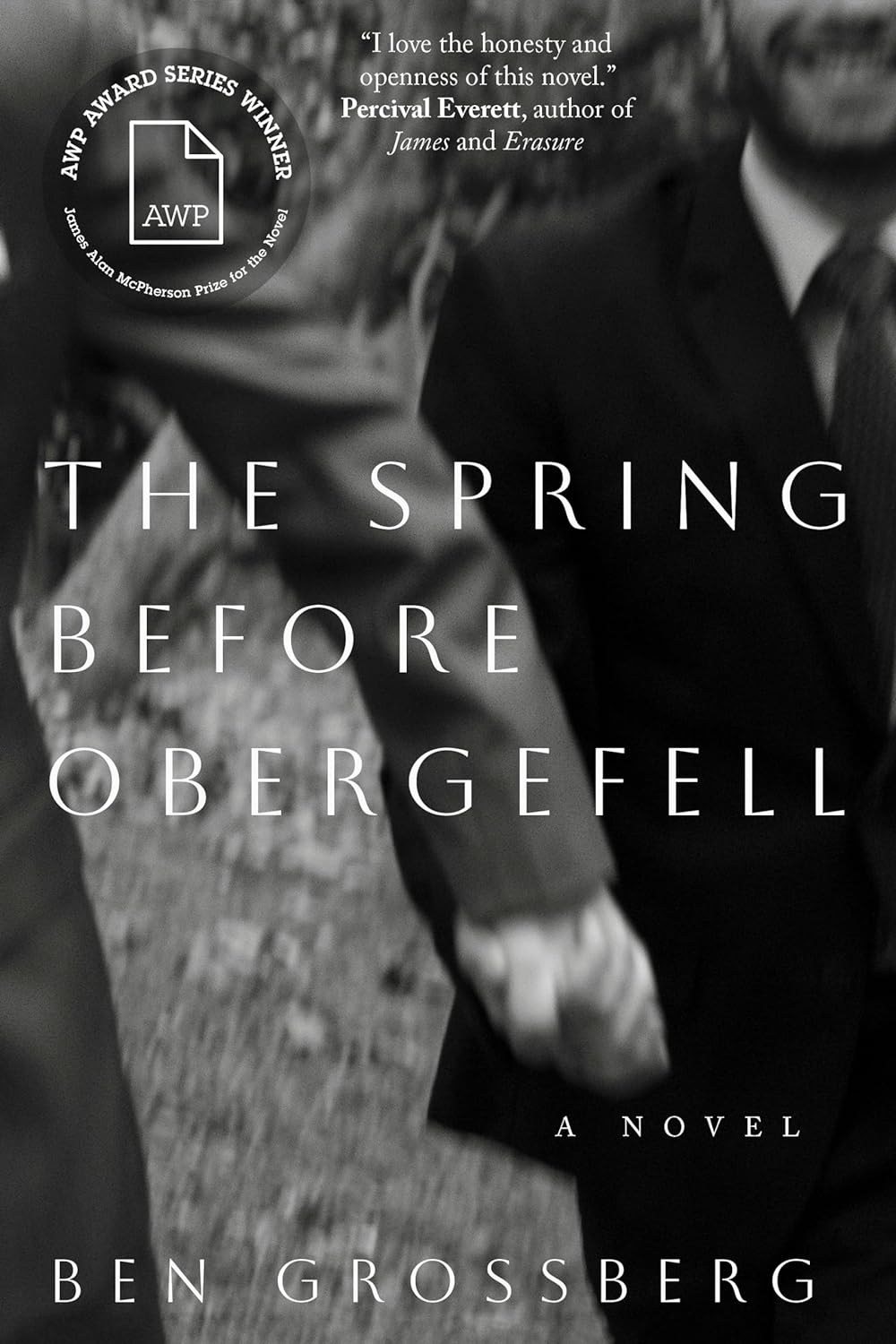
THE SPRING BEFORE OBERGEFELL, hope in dark times...aimed directly at older gay men


THE SPRING BEFORE OBERGEFELL
BENJAMIN S. GROSSBERG

University of Nebraska Press (non-affiliate Amazon link)
$20.85 Kindle edition, available now

WINNER OF THE 37TH Lambda Literary Awards for Gay Romance!

Rating: 4.5* of five

The Publisher Says: It’s not easy for anyone to find love, let alone a middle-aged gay man in small-town America. Mike Breck works multiple part-time jobs and bickers constantly with his father, an angry conservative who moved in after Mike’s mother died. When he’s not working or avoiding his father, Mike burns time on hookup apps, not looking for anything more. Then he meets a local guy, Dave, just as lonely as he is, and starts to think that maybe he doesn’t have to be alone. Mike falls hard, and in a moment of intimacy, his pent-up hopes for a relationship rush out, leading him to look more honestly at himself and his future.

Winner of the James Alan McPherson Prize for the Novel, Ben Grossberg’s The Spring Before Obergefell is about real guys who have real problems, yet still manage to find connection. Funny, serious, meditative, and hopeful, The Spring Before Obergefell is a romance—but not a fairytale.

I RECEIVED A DRC FROM THE PUBLISHER VIA NETGALLEY. THANK YOU.

My Review
: I so relate to Matteo, Mike's first RL shot at Love. Catalyzes something good and big; doesn't get to participate, too acerbic and just Too Much.

It's a curse, unless of course it's not. It felt very very good to read Dave and Mike's borning relationship.

A story set ten years ago about the challenges of forming relationships as gay men in homophobic Murrika. There has never been a moment where this subject, treated with hope, has been more welcome. We're now looking into the maw of Project 2025. *horripilation*

Nothing in this book leads me to believe the author was predicting the future as he wrote it. It's still a welcome moment of hope in a bleak landscape. Part of keeping hope alive is to feed it. The Spring Before Obergefell offers readers, gay men in particular, and older gay men for sure, a story that deals with the reality of family in this new age of darkness. There is always hope. It feels like there is not sometimes. Mike and his world...well...hope is what he found. That message trumps all the noise and chaos of the world.

Monday, October 28, 2024

BLUE LIGHT HOURS, first novel by established literary luminary of translation


BLUE LIGHT HOURS
BRUNA DANTAS LOBATO

Grove Press/Black Cat
$17.00 trade paper, available now

Rating: 4* of five

The Publisher Says: of a young Brazilian woman’s first year in America, a continent away from her lonely mother, and the relationship they build over Skype calls across borders

In a small dorm room at a liberal arts college in Vermont, a young woman settles into the warm blue light of her desk lamp before calling the mother she left behind in northeastern Brazil. Four thousand miles apart and bound by the angular confines of a Skype window, they ask each other a simple question: what’s the news?

Offscreen, little about their lives seems newsworthy. The daughter writes her papers in the library at midnight, eats in the dining hall with the other international students, and raises her hand in class to speak in a language the mother cannot understand. The mother meanwhile preoccupies herself with natural disasters, her increasingly poor health, and the heartbreaking possibility that her daughter might not return to the apartment where they have always lived together. Yet in the blue glow of their computers, the two women develop new rituals of intimacy and caretaking, from drinking whiskey together in the middle of the night to keeping watch as one slides into sleep. As the warm colors of New England autumn fade into an endless winter snow, each realizes that the promise of spring might mean difficult endings rather than hopeful beginnings.

Expanded from a story originally published in The New Yorker, and in elegant prose that recalls the work of Sigrid Nunez, Katie Kitamura, and Rachel Khong, Bruna Dantas Lobato paints a powerful portrait of a mother and a daughter coming of age together and apart and explores the profound sacrifices and freedoms that come with leaving a home to make a new one somewhere else.

I RECEIVED A DRC FROM THE PUBLISHER VIA NETGALLEY. THANK YOU.

My Review
: A tight, compact barely-more-than-novella based on the author's fiction debut story. She's translated work from Brazilian that I've loved (The Words That Remain) and liked a lot (Moldy Strawberries), so I was primed for a good experience. I got that indeed.

Loneliness and that indescribable parent-feeling compounded of intense longing for the child you've had every day of their life as your primary focus mixed with huge dollops of pride in their accomplisment that's led them away from you, and the freezing fear of what you know can and will happen to hurt them where you just can't be. And, of course, resentment that this stellar being needs to be so far away to feel grown up. I was pleased that the author's stand-in was so dutiful and so genuinely, if sometimes impatiently, loving toward her mother in their long-distance relationship.

If you have, or were, a child, it's going to speak to you. It's told mostly from the author-placeholder's PoV, but we do hear directly from her mother at the end. It will sound, and feel, familiar to older folks. It will offer some insights to younger ones. It will do all this without leaving you feeling Taught. I am morally certain Author Lobato has been in this exact skin, it fits the reader so well.

Why I recommend it to you now is the fall has fallen, there's chill in our Northern Hemisphere air, trees are coloring up, and that's the time for a hot steaming mug for sipping and a long sleeve for sniffling into. You'll do a lot of both of 'em.

I'd offer a fifth star had the ending not felt like it was given a mildly short shrift. It's not bad, it's organic to the story, it's just not quite enough for a full, complete experience of her mother's part of their life.

A first novel made from Life, and grown from a short story could not hope for a better apotheosis. This will not, I hope, be the last work of her own long fiction Author Lobato publishes. Those will feel even more accomplished.

Wednesday, November 15, 2023

DAY: A Novel, growing up is hard, growing old isn't


DAY: A Novel
MICHAEL CUNNINGHAM

Random House
$28.00 hardcover, available now

Rating: 4* of five

One of Literary Hub's Best Reads od 2023!

One of Harpers Bazaar's 45 Unputdownable Books of 2023!

The Publisher Says: As the world changes around them, a family weathers the storms of growing up, growing older, falling in and out of love, losing the things that are most precious—and learning to go on—from the Pulitzer Prize–winning author of The Hours

April 5, 2019 : In a cozy brownstone in Brooklyn, the veneer of domestic bliss is beginning to crack. Dan and Isabel, troubled husband and wife, are both a little bit in love with Isabel’s younger brother, Robbie. Robbie, wayward soul of the family, who still lives in the attic loft; Robbie, who, trying to get over his most recent boyfriend, has created a glamorous avatar online; Robbie, who now has to move out of the house—and whose departure threatens to break the family apart. Meanwhile Nathan, age ten, is taking his first uncertain steps toward independence, while Violet, five, does her best not to notice the growing rift between her parents.

April 5, 2020: As the world goes into lockdown, the brownstone is feeling more like a prison. Violet is terrified of leaving the windows open, obsessed with keeping her family safe, while Nathan attempts to skirt her rules. Isabel and Dan communicate mostly in veiled jabs and frustrated sighs. And beloved Robbie is stranded in Iceland, alone in a mountain cabin with nothing but his thoughts—and his secret Instagram life—for company.

April 5, 2021: Emerging from the worst of the crisis, the family reckons with a new, very different reality—with what they’ve learned, what they’ve lost, and how they might go on.

From the brilliant mind of Pulitzer Prize winner Michael Cunningham, Day is a searing, exquisitely crafted meditation on love and loss and the struggles and limitations of family life—how to live together and apart.

I RECEIVED A DRC FROM THE PUBLISHER VIA NETGALLEY. THANK YOU.

My Review
: A novel about liminal spaces, a story about transitions, endings, startings-out, and ultimately survival. So, status quo ante for Author Cunningham. As one expects from him, the prose is just beautiful, the characters appealing, the story, while slow paced, one that compels the reader's attention.

The fact of the matter is that novels about the COVID pandemic...a distinct class from pandemic novels, which can be set at any time...are going to need a certain timelessness to be anything other than nonce books. Cunningham's track record suggests that he's well-aware of his task (The Hours was an epidemic novel on several levels and has survived the epidemics it was set during). How better to address this than to focus on the family?

The great, consuming monster that is family, made or found, genetic or simply relational.

The Big Lie of postwar culture was that falling in love with someone meant that one should feel fulfilled, completed, and Happy with them as a partner. The divorce rates of the 1960s and 1970s gave that a thorough debunking. What happens in the made family that, in US culture, goes by the apt name "Nuclear" is often, inevitably more akin to fission than fusion. Dan, the husband, is an almost-was musician turned househusband. Isabel, the mother, is frustrated that she never got the life she expected with the husband she wanted. Robbie, the gay uncle, is their relief valve. They rely on him way too much to jell their emotional experiences of life together. He's living in their attic...which metaphor I'll leave unexplored... while he sorts out his own tangled love-life and career. There's also Dan's brother, his brother's platonic babymama, and their child. Dan and Isabel have two kids, and the kids are unaware of how much this life they've all lived together can change.

For a novel that takes place on three days albeit ones separated by one year from each other, this felt from the get-go to me like an overabundance of points of view. Nothing that happened changed my mind. The brother/babymama drama left me wondering how the lummox didn't see this coming, nor were his family members innocent in not discouraging him from being a sperm donor. He wasn't emotionally prepared for fatherhood so shouldn't have consented. There lies my first bleat of irritation. Isabel, during the pandemic, decides to write Violet, her traumatized daughter, a letter detailing her emotional unraveling and the end of her marriage to Dan to the fifteen-years-older Violet. Since Robbie is at that point in Iceland living his online masquerade life as Wolfe (it actually makes sense in the book) she had to express her disillusionment with her life choices to someone. May I just say that, as someone who was waaay overshared with by his parents (to put it mildly), I say without hesitation that this is a truly terrible idea. There is no point at which a child needs to know what led Mom to not wanting to be mom anymore. If they ask, parents are well advised to deflect.

Robbie, the fulcrum of the levers shoving these people ever-farther apart, is a case-study all by himself in how not to be in relationships. He's crafted...with Isabel, his sister...an Instagram persona that is an extrapolation of himself into omnicompetence, an unattainable goal for flesh-and-blood people, and is seducing others into accepting it as real not just the extra-curated version of himself. There's an element of catfishing in this; it's dishonest at the minimum. The fact that Isabel is both a co-conspirator in and, bizarrely, a victim of, this weird catfishing says a lot about the fundamental performative nature of family life. Aren't we all constructing and curating personas within a family, in fact a relationship of any sort? There's an entire sociological concept devoted to this idea.

If this is to be a lasting artwork explaining the COVID pandemic to us and our heirs, it has to get something otherwise unavailable from the pandemic setting. Here's where I falter in my appreciation for Author Cunningham's dramaturgical eye. I got my expected frisson of lovely-language-gasm. I got my soap-opera needs met with the dynamics of the family decohering and then showing signs of coalescing into other forms. But did any of this illuminate the pandemic's unique social upheaval?

On balance, yes but in a curious way no. This family was always going to undergo fission...people who can't, or don't, or won't communicate clearly and honestly with each other will always fail as a system...and that is just accelerated by the pandemic. That the family is made up of generationally appropriately queer-friendly people is just recognizing realities that are the source of the screeching angst of the change-intolerant religious nuts. The parts of the story that I felt illuminated the pandemic were the grace notes of style, using the forms and format of social media, to make the point that life moved on even while reality stopped. I think some people saw this as a bug, but I believe it's a feature. Insta will, goddesses willing, be long dead by the time pandemic babies are old enough to read this novel, but they'll see how deep and unquenchable life's demand for love and conncection really was back in the quaint pre-wearable-quantum devices days of Mom and Dad's youth. They'll see that the familys they live in were new, slightly scary, ideas yet to develop into what they accept as normal. They can get from this read a sense of the liminality of forced change and its many many echoes.

I think this novel will, like The Hours, stand up to the passage of time. Of course, I'll be dead by the time the verdict is rendered. But I feel good about my chances of being right.

Thursday, January 20, 2022

JOAN IS OKAY, the title's a complete lie; & THREE APPLES FELL FROM THE SKY, a fairy/folk tale of the Armenian Genocide


JOAN IS OKAY
WEIKE WANG

Random House
$27.00 hardcover, available now

One of NPR's Best Books of 2022!

Funny how Life works out, isn't it? This wasn't *meant* to be a pandemic novel, says Weike Wang.

LONGLISTED for the 2023 Andrew Carnegie Medal for Excellence in Fiction!


Rating: 4* of five

The Publisher Says: A witty, moving, piercingly insightful new novel about a marvelously complicated woman who can’t be anyone but herself, from the award-winning author of Chemistry

Joan is a thirtysomething ICU doctor at a busy New York City hospital. The daughter of Chinese parents who came to the United States to secure the American dream for their children, Joan is intensely devoted to her work, happily solitary, successful. She does look up sometimes and wonder where her true roots lie: at the hospital, where her white coat makes her feel needed, or with her family, who try to shape her life by their own cultural and social expectations.

Once Joan and her brother, Fang, were established in their careers, her parents moved back to China, hoping to spend the rest of their lives in their homeland. But when Joan’s father suddenly dies and her mother returns to America to reconnect with her children, a series of events sends Joan spiraling out of her comfort zone just as her hospital, her city, and the world are forced to reckon with a health crisis more devastating than anyone could have imagined.

Deceptively spare yet quietly powerful, laced with sharp humor, Joan Is Okay touches on matters that feel deeply resonant: being Chinese-American right now; working in medicine at a high-stakes time; finding one’s voice within a dominant culture; being a woman in a male-dominated workplace; and staying independent within a tight-knit family. But above all, it’s a portrait of one remarkable woman so surprising that you can’t get her out of your head.

I RECEIVED A DRC FROM THE PUBLISHER VIA NETGALLEY. THANK YOU.

My Review
: First things first: I think Joan's neurodivergent. There. I said it.

What else is Joan? A disappointing daughter, who isn't going to give her mother the expected grands. An annoying sister, who is resolutely unimpressed with her brother's lavish getting-and-spending lifestyle. A breathtakingly good, effective ICU doctor at the outset of the Plague. A clueless, oblivious object of somewhat diffident romantic interest...utterly unrequited...for her neighbor. And most of all, most satisfyingly and unbreakably, Joan is herself.

If you don't like to read "women's fiction" because it's about men (how to catch), read this book. It's about Others (how to evade), when it's about anyone not Joan. And that was exactly why I enjoyed the read so much. Joan's struggles are typical for an atypical person, and her intelligence isn't a problem but a solution, making her an extra delightful companion for this reader. As everyone around her tries to make her feel she's missing out, lacking something, somehow wanting for something, and until she decides for herself what she thinks, she remains upset and at sea. In her enforced idleness (bereavement leave? for a father she felt little connection to still less affection for, shouting abuser that he was?) she loses the armor of being too busy to deal with all the mishegas of ordinary life.

It is great to read about the woman lead's sense of self being explored and resolved without a boyfriend at the beginning, middle, or end of the process. It is bracing to read the genuinely painful experience of the first-generation American in attempting to come to a happy resolution to a parent's desires when these are rooted in a wildly different world. But then, as the visibly different as well as culturally different as well as neurologically different (this last is not explicit in the text, but its factuality is the hill I'll die on) Joan thinks, "Why try to explain yourself to someone who had no capacity to listen?" She thinks this in a different relationship's context but the truth is, it is Joan all the way. She's not going to do the same thing a dozen...even, I suspect, a pair of...times expecting or hoping for different results. What kept me from giving it all five stars was, however, that very thing: I felt Joan was harshly judgmental from beginning to end, despite questioning herself and her responses as we went through the story. I think that's a bit unbelievable, it seemed to me she would've adjusted some of her private judgments...still, not a fatal flaw since I liked her from giddy-up to whoa.

In fact, in just over 200pp, I fell in love with Joan as she is. I think you might do the same. Give her a few of your hours. She's a good companion.

++++++++++++++++++++++++++++++++++++++++++++++++++++++++++++++++


THREE APPLES FELL FROM THE SKY
NARINE ABGARYAN
(tr. Lisa C. Hayden)
OneWorld Publications (non-affiliate Amazon link)
99¢ Kindle edition, available now

Rating: 4* of five

The Publisher Says: The Russian bestseller about love and second chances, brimming with warmth and humour

In the tiny village of Maran nestled high in the Armenian mountains, a place where dreams, curses and miracles are taken very seriously, a close-knit community bickers, gossips and laughs, untouched by the passage of time. A lifelong resident, Anatolia is happily set in her ways. Until, that is, she wakes up one day utterly convinced that she is dying. She lies down on her bed and prepares to meet her maker, but just when she thinks everything is ready, she is interrupted by a surprise visit from a neighbour with an unexpected proposal.

So begins a tale of unforeseen twists and unlikely romance that will turn Maran on its head and breathe a new lease of life into a forgotten village. Narine Abgaryan's enchanting fable is a heart-warming tale of community, courage, and the irresistible joy of everyday friendship.

THIS WAS A FREE DOWNLOAD VIA BOOKBUB. I THINK. ANYWAY, THANK YOU.

My Review
: A clever little folk-tale that mimics the forms of earlier tales with modern, relatable trappings. It’s meant to be a means of processing the upheavals of Armenia as it bumpily traveled from tsars to commissars to…chaos, pure capitalism, as part of Russia then on its own with no stops at any rational place anywhere along the way. We’re not given much information but the wretchedness of the people to use as a calendar. The main event is World War I's Armenian Genocide, there was much suffering; there was much suffering throughout, but the weird thing about it is how little of it seemed to penetrate the inner lives of the characters, really better called "survivors" given how many die in the course of the story. Their village, isolated and insulated all together, goes on, despite the horrific events that unfurl between and around them.

Is that realistic? What do I, fat comfortable American that I am, know about that; I know the author chose the fairy-tale/folk-tale structure and tenor for a reason. The Armenians have a saying:
As has been established in Maran legends since time immemorial, the night will drop them to earth from the sky:
And three apples fell from heaven:
One for the storyteller,
One for the listener,
And one for the eavesdropper.

Welcome, fellow eavesdropper, to the juicy apple of Narine Abgaryan's bestselling Russian-language tale of Armenia's wild ride through the 20th century. Strap your helmet on a little tighter. You're going to meet a lot of people, and not all of them have names you'll be able to pronounce. It does not matter a whit. Love them for who they are, not how they sound in your monoglot's ear. Anatolia, the woman at the actual center of the story, is one of the world's readers-cum-librarians so she merits our rapt attention. It's not hard to give.
Little by little, thanks to intuition and innate taste, she learned to distinguish good literature from bad and fell in love with Russian and French classics, though she came to hate Count Tolstoy, unequivocally and forever, as soon as she finished Anna Karenina.
Happen I agree...but the less said of her shelving preferences the better. Her travails, those of her fellow villagers, are deeply experienced in the author's (and translator's, what a great job Lisa Hayden did on this book! I honestly forgot it was a translation most of the time, and that is meant as a compliment) open, honest, and still lyrical prose:
For eight long, unbearable years, the war reaped a harvest of restless souls around the world, but one day it sputtered out and retreated, howling and limping and licking its bloody paws.
–and–
Anatolia suddenly grasped that there was no heaven and no hell: happiness was heaven and grief was hell. And their God was everywhere, all over, not just because He was all-powerful but also because He was the unseen threads that connect them with each other.

The other feature of the prose you'll have discerned by now is the simple, direct wisdom of it. The author and translator have taken care to make sentences that sound like they've rolled around simple peoples' minds and mouths for long enough to become weighty with meaning and light of touch:
“There’s nothing more destructive than idleness,” his father had loved repeating. “Idleness and leisure deprive life of purpose.”

Vasily now understood the truth of his father’s words. Life does, indeed, lose its purpose at the very instant a person ceases bringing benefit to those around him.

Which is a truth that many of us, disabled and/or retired, learn at a very high cost in self-esteem and peace of mind. It's not, youthful imaginings to the contrary, at all fun to be idle. So what is one meant to do? Find something useful to do! Me, I write book reviews...how about you?

Monday, January 10, 2022

30 THINGS I LOVE ABOUT MYSELF, a truly pleasurable read that just could not be more fun to read


30 THINGS I LOVE ABOUT MYSELF
RADHIKA SANGHANI

Berkley Books (non-affiliate Amazon link)
$9.99 Kindle edition, available now

Rating: 4* of five

The Publisher Says: When a British Indian woman's life hits rock bottom, she decides to change her stars by falling in love...with herself—a hilarious, heartfelt story from outrageously funny novelist Radhika Sanghani.

Nina didn't plan to spend her thirtieth birthday in jail, yet here she is in her pajamas, locked in a holding cell. There's no Wi-Fi, no wine, no carbs—and no one to celebrate with.

Unfortunately, it gives Nina plenty of time to reflect on how screwed up her life is. She's just broken up with her fiancé, and now has to move back into her childhood home to live with her depressed older brother and their uptight, traditional Indian mother. Her career as a freelance journalist isn't going in the direction she wants, and all her friends are too busy being successful to hang out with her.

Just as Nina falls into despair, a book lands in her cell: How to Love Yourself (and Fix Your Shitty Life in the Process). It must be destiny. With literally nothing left to lose, Nina makes a life-changing decision to embark on a self-love journey. By her next birthday, she's going to find thirty things she loves about herself.

I RECEIVED A DRC FROM THE PUBLISHER VIA NETGALLEY. THANK YOU.

My Review
: You can't be sure you're reading a novel until Nina actually reads How to Love Yourself (and Fix Your Shitty Life in the Process). Really? A bit on-the-nose to reach her when she's in the clink! I mean, I'd just sit out the sentence before I'd read that. Still, Nina's pretty much looking at her (pretty comedic) arrest as an intervention from the Universe.

But, given her inability even to make a decent choice of only-phone-call recipient resulting in her return to her *truly*ghastly* mother's orbit, that could prove to be life saving. Or losing...it's a close-run thing whether she'll survive Daily Mailish history-chucking-out nightmare Mum. *I* almost didn't survive Mother Mistry. What a gorgon. In fact...just being totally transparent here!...I really didn't like wishy-washy, what's-the-female-nebbish-called Nina. I get it...a mother like that one would kick the sense and the sensibility right out of you. No one knows more or better than she does! Then there's drippy, dreary, depressed closet case Kal. Yeesh!

Why, then, am I reviewing it. Two words: Tantric. Sex.

You'll have to read the book to figure out why. But you'll have a lot of fun doing it, so I'm not wasting my tears for you. You're going to be glad you did, you nutty slacker. Glad you powered past the ex bringing his new squeeze to a party when Nina was guaranteed to be there...because dear ol' Mum dragged her. Glad you ignored the fact that a thirty-year-old online journalist needed her brother to explain doxing to her. Or when her self-immolative attempts to go up against a TV shock jock are so very, so painfully naive....

And let's be honest, folks, the sheer number of us humans who can use...really, really use...the truth behind Andrew Solomon's quoted-in-story quote, "The opposite of depression is not happiness but vitality..." runs into the octuple digits. I suspect, though, that quite a lot more of y'all will follow Nina Mistry, Financial Abundance Manifester, in her (unorthodox but) proven effective plan to get the, um, kitty replenished.

What the heck is all this in aid of...well, my olds, there is absolutely no better time than the New Year to manifest self-love and self-acceptance by reading something that will make you giggle, and squirm, and blush. Cringe comedy lovers, here's you a book! Silly self-help sozzlers, here's you a book! You are in need of grins? You are in luck, here's you a book!

And you know what? Many more books need to have "Namaste, bitches," in them.

Friday, August 13, 2021

EDGE CASE, YZ Chin's wry assessment of how "love and marriage" ≠ security


EDGE CASE
YZ CHIN

Ecco Press
$26.99 hardcover, available now

Rating: 4* of five

A BEST-OF-2021 PICK FROM NPR BOOKS!

The Publisher Says: When her husband suddenly disappears, a young woman must uncover where he went—and who she might be without him—in this striking debut of immigration, identity, and marriage.

After another taxing day as the sole female employee at her New York City tech startup, Edwina comes home to find that her husband, Marlin, has packed up a suitcase and left. The only question now is why. Did he give up on their increasingly hopeless quest to secure their green cards and decide to return to Malaysia? Was it the death of his father that sent him into a tailspin? Or has his strange, sudden change in personality finally made Marlin and Edwina strangers to each other?

As Edwina searches the city for traces of her husband, she simultaneously sifts through memories of their relationship, hoping to discover the moment when something went wrong. All the while, a coworker is making increasingly uncomfortable advances toward her. And she can’t hide the truth about Marlin’s disappearance from her overbearing, eccentric mother for much longer. Soon Edwina will have to decide how much she is willing to sacrifice in order to stay in her marriage and in America.

Poignant and darkly funny, Edge Case is a searing meditation on intimacy, estrangement, and the fractured nature of identity. In this moving debut, YZ Chin explores the imperfect yet enduring relationships we hold to country and family.

I RECEIVED A DRC FROM THE PUBLISHER VIA NETGALLEY. THANK YOU.

My Review
: First, read this:
Being very polite to train conductors and building security guards for the past decade has made my deferential way of speaking second nature. Though what an odd saying. What is my first nature?
–and–
He stood out, his skin a shade that I had seen compared to food items like chocolate or coffee in American books. Looking at him, I thought not of food, but of a neutral coolness that disguised something else, like an envelope that contained either really good tidings or earth-shattering bad news.

First novelist YZ Chin isn't playing around. She wrote those two passages early in this book. There isn't, this writing informs you, going to be any false modesty in here. I am going to talk about how a Straits Chinese woman married to a Chindian man, a fat woman married to a lean, athletic man who loves her, feels when "America" does its number on them together, separately, and as Symbols. They're two damaged people, they're altogether too small to withstand the pressure of being Symbols, and they're cracking under the strains. Which is why the book is narrated by Edwina in phone-and-internet conversations with her not-quite-licensed (it's just a paperwork thing, nothing important) therapist (see INS form I-693) after Marlin leaves her.

Edwina is an abused daughter of a harridan of a mother (The Banana Tree Spirit Story! OMG!!), a vegetarian to her dark, lean husband's more exacting veganism, a "quality control analyst" in a dudebro startup firm called, fully explanatorily, "AInstein," that lost its VCs a boatload of money by screwing some important code up and still releasing it to a client. Oopsie. Get a girl to handle it...an immigrant who won't dare make much trouble, cause any stress but will fill the role...one who won't be missed when we have to fire her for whatever screw-up she can't make us fix.
The bug was what’s called an integer overflow, which is when a number is too large for its assigned storage capacity and thus can manifest instead as a negative figure. For example, if the number 128 were forced into a signed field that could express only up to 127, the input would ‘overflow’ and be displayed as ˗128. It was mildly gratifying to learn that the human body could also overflow. I idly wondered if, any day now, my pain would grow so great that it converted into happiness.

What a terrific job, no? Not even a company-sponsored green card application, no no, you'll get your H1-C visa and that's it. Why, if she didn't really, really, really want to stay away from the poisonous reach of her mother's awful, barbed "past-life stories." Marlin's job, less pointless it seems, even affords him a few American friends, like best buddy Eamon and the guys he goes to the rock-climbing gym with. But everything changes when Marlin's father suddenly dies back in Malaysia.

At his funeral, the pair of them expensively in attendance as the ceremonies take place, along comes Edwina's mother to tell the Banana Tree Spirit story about betrayal, misery, and hateful ignorance carrying the day. That was bad enough, being about her daughter's "past life," but the many, many echoes this latest piece of cruelty has bids fair to have broken poor Marlin. At this lowest, most grief-ridden moment, the words have twisted themselves into a noose around his logical self so the corpse is all that's left in an ever-darkening relationship to Edwina.

A little detail about the pair returning from Malaysia into Trump's Murruhkuh, how they were treated at Customs, should make your blood boil, your mouth taste sour, and your eyes reflexively leak tears. I half-wondered if Edwina's speculation that "America made Marlin feel unwelcome, and so he left me," wasn't at least half right....
The US government actually monitored immigrants online, and anything I typed might be used against me—that was what internet advice hinted at. Resources for immigrants cautioned that we should "avoid profanity and the use of aggressive or threatening language" while posting online, which really voided the whole purpose of being on Twitter.

Of course, that internet false-identity therapy makes all the sense in the world in that light, doesn't it. Especially since the internet has a random, unidentifiable Crazy Person (or two, or fifty) to tell the suffering how, exactly, not to suffer anymore:
Surely I was better than these people with their loud, false bravado. Yet wasn’t I on the internet precisely because I wanted someone to give me a to-do list? I objected to the content of the lists, found them laughable, but still—I wanted my hand held, didn’t I?

Oh Edwina...that kind of comfort is so, so cold.
I decided the problem was that none of the results mentioned meddling by spirits.

Attagirl!
But when I typed in "spirits told my spouse to leave me," there was a tidal wave of marriages ended by alcoholism.

See? See what I mean, Edwina? Cold comfort...there're people out there a lot more fucked up than you and/or Marlin.
What good is marriage if you can just cancel it like cable?

Well. Now we're gettin' somewhere, Edwina. "Grieving in the form of research, because we believed in productivity above all else," might as well be tattooed on every modern workerbee, don't you think?

Well...she wanted a way to manage her grief at Marlin's weird, sudden abandonment...what about being told you're so unvalued at work that your serious problems with the MVP beta are being ignored? Before one of the dudebros tries to kiss you at a company party? And yes, Edwina, in today's world that IS sexual assault. Her revenge? Condign. (If premature...?)

It was no wonder to me that Edwina ended up doing what she did at the Korean deli. And it was actually a lovely surprise, a way of taking charge of her unhappiness. I can't help but wonder if this isn't, in fact, something that's in fact true and just not being discussed:
I didn't buy that depression was caused by low serotonin levels. No, what I felt was way more aggressive than a simple deficiency of certain neurotransmitters. There had to be another neurotransmitter that carried sadness, that handed out hopelessness like drugged candy. After all, even matter had antimatter.

But when matter and antimatter don't find a safe place to co-exist, what do they do then?
I'd send nail clippers (he was fastidious that way, or at least he used to be when he lived with me), ramen noodles (the fancy, super spicy ones, not the kind that tasted like boiled water that someone had farted in), a throw, maybe even a handheld gaming console.

No one who can write that sentence is done with being A Wife. Edwina, my dear lady, I've spent a grand total of five hours in your company, and they were grand hours! that ramen line!, but your modern-love-immigrant-style story isn't a huge revelation to me. Not once have you startled me, or surprised me, or done anything the least bit out of character.

And do you know what? I wouldn't have it any other way.

Thursday, August 12, 2021

PERSECUTION, trial by media and innuendo & how that destroys lives


PERSECUTION
ALESSANDRO PIPERNO
(tr. Ann Goldstein)
Europa Editions
$16.00 trade paper, available now

Rating: 3.9* of five

The Publisher Says: In a sprawling villa on the outskirts of Rome, the members of the Pontecorvo family have gathered for dinner. Leo Pontecorvo, an internationally revered pediatric oncologist, is forty-eight. His wife, Rachel, is a physician and the loving mother to Filippo and Samuel, two amiable pre-teens. The evening news is on in the living room but nobody pays it any attention until Dr. Pontecorvo's name surfaces from the background noise and a news item airs that will change the lives of the Pontecorvos forever.

Leo Pontecorvo has been publicly accused of a vile crime. A spotlight is turned on him that reveals the mistakes, regrets, and contradictions of a lifetime. Every detail of his private and professional life is about to come under scrutiny, to be debated by both friends and foes, by ravenous reporters and punctilious prosecutors. But Leo could bear all this if it weren't for the suspicious gazes of his wife and children. Surely they, of all people, believe in his innocence!

Alessandro Piperno is widely acknowledged as one of today's most talented European novelists. His voice is singular and shocking at times, yet always possessed of tenderness and enormous generosity of heart. His vision is broad and encompassing, his psychological insights penetrating and undeniable. In this deeply felt family drama, Alessandro Piperno paints a broad canvas and fills it with psychologically complex characters whom readers will instantly recognize and never forget.

Europa Editions provided this copy in a Goodreads giveaway. Thank you.

My Review
: Words can not only hurt, not only damage...they can kill. They can annihilate, destroy utterly the target of the carelessly spoken or maliciously uttered or calculatedly disseminated words. They can blow up a life, a family, a career, a vocation, they can eviscerate the worthy and worthwhile work a person has done.

And what if they're true? What if they're not true? Half true? He said, she said? It doesn't matter at all. Words, when spoken, can only be forgiven but never forgotten.

Piperno's novel of a Jewish pediatric oncologist's fall from the pinnacle of his life-saving profession is profoundly unsettling. It is discursive in style, and it is peculiarly intimate because of that. Very few paragraphs lead directly to the subject allegedly at hand, but all of them, each of them, serves to build the image of the Pontecorvo world, that of Dottore Leo, la signora Rachel, the pre-teen boys, Telma the Filipina maid...all these intersecting, interlocking worlds are completely and finally and irrevocably smashed and cannot be restored, only re-formed. The tracks in the thickets of words Piperno creates are like the game spoor a hunter follows, requiring patience and attention to interpret and encouraging the reader, the hunter, to look around carefully, to attend to the landscape as much as the path.

Ann Goldstein ably translates the Italian text in such a way as to suggest the varying uses made of familiar and formal address. It's a very hard thing to do, and it's impressive to see the job done so well. Part of the job of a translator is to create the mood of the original in a different idiom...never does Goldstein do this better than in the passages where the snobbery and class-consciousness that Leo faces when others refer to or speak to his wife, daughter of an observant Jew who also happens to be a businessman, in contrast to his more assimilated, haute bourgeois background.

I was transported in the reading of this novel, though not to a lovely sweet cotton-candy land of milk and honey. (Frankly, that's always sounded revolting to me. Not to mention sticky.) I was immersed in the life of the disintegrating Pontecorvo family. I emerged after a catharsis feeling, oddly, buoyed up, able to see the shore and feel the water of the sad existence below me support me as I started for solid ground.

Saturday, January 23, 2021

THE ROAD TO URBINO, or let's go to Italy and commit art theft!

THE ROAD TO URBINO
ROMA TEARNE

Gallic Books
$15.95 trade paper, available now

Rating: 3.5* of five

The Publisher Says: A story of obsession, love and art set in Tuscany, Sri Lanka and London.

Ras, a Sri Lankan who fled his country as a child following the violent death of his mother and his father's disappearance, has committed a crime. Dogged by his past and unable to come to terms with the killing of his mother, he struggles to make a new life for himself in the UK. Alex has loved Dee since he was 19 but failed to realise that it was a love he wouldn't find again. After Dee's marriage, he too struggles to build a meaningful life for himself. But when Ras' and Alex's lives connect, each man takes a new path culminating for Ras in the theft of a della Franceso painting, while Alex comes ever closer to Dee through tragedy in her life.

Beautifully written, with a strong narrative, The Road to Urbino is the story of two very different men and their love for the women in their lives, set against the backdrop of the heartbreaking horrors of the long-running conflict in Sri Lanka.

I RECEIVED AN ARC FROM THE PUBLISHER. THANK YOU.

My Review
: Similar to Donna Tartt's The Goldfinch in initial conditions...an art crime reverberates through the characters' lives, the painting that's stolen has resonances in the story's structure that only reveal themselves the deeper you get...Roma Tearne did not decide to re-write someone else's idea by any means.

When Ras, one of our main characters, escapes his war-torn country after terrible losses, he looks at the UK with the hungry eyes of a victim in search of a savior. The trouble with that, Ras, is that no external being can save you from yourself. He does experience the blessing of a peaceful country's many opportunities, and he takes advantage of them. Job as a museum curator, marriage, a family, a life...all the good stuff. The issue for Ras is, of course, the unhealed horrors of genocide live in his brain. His wife gives him a daughter, as he sees it, and he dotes on the child. Not so much on the mother. Lavish loving attention but nothing for Mama? The inevitable occurs, and the illusion of normal life is ripped apart again.

Lola, his daughter, is a case study in "when bad children happen to loving fathers." Spoiled by his undivided attention and by nature selfish, she is a Hot Mess. Listening to Daddy's stories of the Old Country is a way to get what she wants, but not in the least a way to feel connected to him or to the weird foreign place he originates. Ras isn't a reflective person, at least not at first, but he pips to his essential trapped loneliness at last. What does he do, go to a shrink? No. He goes to Italy! He will tour the countryside and Look At Art.

He does this, all right. He looks at Piero della Francesca's The Flagellation of Christ a bit wrong.
via Wikimedia
Reader, he steals the damned thing. A small-enough painting by religious standards, no more than three feet in any dimension, but...WHAT?! A museum curator steals another museum's painting?!

The shock I felt was slightly cushioned by my delight in Author Tearne's paean to Italy's sheer physical glory. It is no wonder so much great art has come from there, it is so beautiful. As I turned the pages for this second read, I was submerged in a soft golden afternoon's light and gently lapped by the waves of desire anticipating the meal I knew would come soon. (In Italy, a meal will always come soon.) This was the most delightful sensation while I'm trapped inside by COVID. I was even inclined to be forgiving of the absolutely bewildering break from reality that Ras's theft represents.

But that theft is the frame of the story, not the story. Ras, in jail in the UK, begins to speak to his solicitor Elizabeth with the intimacy and urgency of a shrink. Please, he begs, please re-connect me with my daughter! I want her to know her father is not a terrorist! A museum curator, fifty, is being called a terrorist...because he's South Asian. A white man in that cell for that crime would be a troubled citizen, count on it.

Speaking of white men...now enters the story a chap called Alex, the ex-lover of a museum colleague of Ras's. Why he's here you'll have to ask the author, I can't really see what his place is in this story. The only possible excuse I can find for Alex to exist is that he reinforces the idea that middle-aged men long for a woman. And this is where something important (leaving aside its overwhelming heteronormativity) hit me.

A talented woman writing a novel about men in crisis gives one unpleasant woman, Lola, all the ladies' speaking parts; from Elizabeth we hear stage prompts, meant to cue a dried-up actor to resume his speech. The middle-aged man at the center of it all is South Asian, at least, but honestly I can't imagine a book less likely to pass the Bechdel test. I don't think any woman speaks to another woman at all, let alone not about a man, but that's not something I was carefully looking out for.

I've mentioned before that I need to feel a character's trajectory has changed for a reading experience to fully satisfy me. This story's characters are all in mid-trajectory when we leave them, so I was a bit grumpus about that; I did finally settle myself because the fact is they're all launched in new directions. Not at all sure they'll stay on them, but they're set into motion and that's good enough for me.

In general terms, I'm not inclined to pick up books like this. I got it during my COVID infection and couldn't really focus on it. Since my backlog of unreviewed books is shocking, I needed to give it a bit of a brush-up to remind myself of the story's tenor and the characters' affects. The sneakily critical of racism nature of the story was a definite plus. The somewhat flat crime that is committed is only so because there's really just no conceivable reason for it to have happened. If I read this as a news report, I'd be eaten alive with curiosity to now WHY it occurred, probably to the point of calling the news outlet and demanding they assign an investigative reporter to ferret out the goodies.

Sadly, that doesn't occur and thus I'm left with a two-and-a-half star read that earns itself an extra star for its blissful evocation of Italy's delights. I enjoyed the read enough to review it; I'd recommend borrowing, not buying, the book if you are tempted.

Friday, January 22, 2021

ASK AGAIN, YES is a deeply felt, carefully observed, and difficult to read tale of family crises

ASK AGAIN, YES
MARY BETH KEANE
Scribner
$17.00 trade paper, available now

Rating: 4* of five

The Publisher Says: A profoundly moving novel about two neighboring families in a suburban town, the friendship between their children, a tragedy that reverberates over four decades, the daily intimacies of marriage, and the power of forgiveness. How much can a family forgive?

Francis Gleeson and Brian Stanhope, rookie cops in the NYPD, live next door to each other outside the city. What happens behind closed doors in both houses—the loneliness of Francis's wife, Lena, and the instability of Brian's wife, Anne, sets the stage for the explosive events to come.

Ask Again, Yes is a deeply affecting exploration of the lifelong friendship and love that blossoms between Kate Gleeson and Peter Stanhope, born six months apart. One shocking night their loyalties are divided, and their bond will be tested again and again over the next 40 years. Luminous, heartbreaking, and redemptive, Ask Again, Yes reveals the way childhood memories change when viewed from the distance of adulthood—villains lose their menace and those who appeared innocent seem less so. Kate and Peter’s love story, while haunted by echoes from the past, is marked by tenderness, generosity, and grace.

I DON'T REMEMBER WHO GAVE ME THIS LOVELY BOOK, BUT THANK YOU!

My Review
: I'm not a spoilerphobe, as I've mentioned before, but there are certain events in this book that it would just rot on ice for you not to see for yourself for the first time. So there will be some tap-dancing around some events.

What matters to me in a read, the thing I seek and must find or I'm put out and feel I've been hard done by, is the sense that I'm seeing characters make efforts, take chances, do things, and as a result of whatever combination of those things the author chooses, they need to change. Not necessarily dramatically, or for the better or for the worse. But there needs to be some perceptible alteration in that character's life, sense of purpose, or station.

That is very much not a problem in this story.

Immigrant Francis is Irish to his core. He moves to New York because 1970s Ireland was not the Celtic Tiger it became decades on. His adjustment to American manners and mores wasn't easy on him, but he fell in love with the right woman and built a life with her. So that base is solid, right?

It is a truth universally recognized that people are their own worst enemies. Actions that seem, in the moment, inevitable or destined to occur are deeply stupid and cause problems it's hard to imagine. Yet here we are, with only the moment to live and as often as not without a clear understanding of the past to build on. As Author Keane says, "We repeat what we don't repair." That just rang me like a bell the first time I read it. Such a lovely, distilled way to say the truth as I've learned it the hard way.
The quiet of the house when she kept to her room was not the peaceful silence of a library, or anywhere near as tranquil. It was...more like the held-breath interlude between when a button gets pushed and the bomb either detonates or is defused. He could feel his own heartbeat at those times. He could track his blood as it looped through his veins.

Families are the prime breeding ground for things that need repair. Most often we don't see that...in ourselves, of course, since it's incredibly easy to see in others and there's even this thing called "fiction" to feed our schadenfreude watching others screw up chances to repair the damage done to us. But some damage is done in some families that is, in the truest sense of these words, irreparable and unforgivable. That's when the stories get really good.
Telling her, bringing that story to England, spoiled England for her. When she left for America two years later, she knew she would be smarter. She'd bring none of Ireland with her.

But no matter where you go, there you are, right? Our selves and our bodies are coterminous if not identical, where one goes there the other is as well. It's not always that great a feeling. But unless we repair the breaks, well...you're adults, you know already. And how sad, how burdensome is that knowledge.

The burden travels down generational rivers, too. In this story, Peter the son of truly miserable man and truly evil woman, falls for Kate the daughter of stoic parents whose inability to communicate doesn't keep them from mangling each other. There's a bad patch (!!) and the young people are separated against their wills; there's a reunion, and what flowers is a very beautiful blossom of hope and love.
He dreamed of sharing an apartment with Kate someday, coming home to her each evening and telling her about his day, hearing about hers, going to bed naked with the covers pulled up to their chins, feeling her warm skin next to his when he woke up every morning.
–and–
If they could do all those things and pay their bills and not dread going to work each morning, coming home each night, then that was a life. That was a great life, in Kate’s view. What else could there be? If they reminded themselves that these small things were enough, she believed, then they’d always be okay.

They're having different relationships. That's so often the way with couples, and sadly most often between couples freshly in love. The true emotional core of the party of the second part isn't always easy to reach, but the fact is most people don't really even ever try. It's hard. It's vulnerable. It's often met with anger or rejection or outrage. Who tries, they are abusive! Intrusive! I need my space! Who resists, they are elusive! They are secretive! Why won't you trust me and let me in?

Surviving those shoals, accommodating each other and bending to and fro, allowance-making and temperature-taking, survival...until new shoals hove into view as soon as the seas looked smooth.
And then she saw it so clearly, the whole trajectory of their lives, a twin flare of lights against the gunmetal winter sky: we're born, we get sick, we die. Beginning, middle, end. She saw her life as if held aloft by her own hand, and in an instant it spun away from her. Where did she want it to land? She was in the middle. The exact middle. Peter too. How could she have failed to notice that the beginning had come to an end?
–and–
It wasn’t that she didn’t love him, he knew. It was that she loved him so much that it frightened her, loved him so much that she worried she might have to protect herself from it. He tried to let her know that he’d figured that out, finally, that there was no need to explain, but then he realized that she might not know it herself.

It is a damn difficult thing to keep being in a present-tense relationship with someone over a long period of time.
They'd both learned that a memory is a fact that has been dyed and trimmed and rinsed so many times that it comes out looking almost unrecognizable to anyone else who was in that room or anyone who was standing on the grass beneath that telephone pole.

Allow this novel's steady pace to lead you where the story goes. Possess your soul in patience, don't get agitated and skip and flip; stand on the grass with Author Keane. Make a memory. Make it well.

Monday, November 4, 2019

THE LINES, a family's devastation in malaise-era US by a master of voices


THE LINES
ANTHONY VARALLO

University of Iowa Press
$17.00 trade paper, available now

Rating: 4* of five

The Publisher Says: Set in the summer of 1979, when America was running out of gas, The Lines tells the story of a family of four—the mother, the father, the girl, and the boy—in the first months of a marital separation. Through alternating perspectives, we follow the family as they explore new territory, new living arrangements, and new complications. The mother returns to school. The father moves into an apartment. The girl squares off with her mother, while the boy struggles to make sense of the world. The Lines explores the way we are all tied to one another, and how all experience offers the possibility of love and connection as much as loss and change.

I RECEIVED A REVIEW COPY FROM THE PUBLISHER AT MY REQUEST. THANK YOU.

My Review
: I was a teenager during the 1970s, already a survivor of a "broken family," though I suspect my own family was less broken than unformed...rather like the asteroid belt, widely dispersed bodies intersecting with silent violence when they bother to interact at all. Hence my interest in Author Varallo's first novel (after several story collections, including 2005's kid-themed This Day In History which I read in the Aughties and LOVED).

What strikes me first is how subtle Varallo is in making his points. "The mother," "the father" (much less in evidence beginning to end...I suppose that was inevitable), "the girl," "the boy," are all people with names though not in relation to each other. I have sisters...my sister is the mental name of each, after all I know who I'm thinking/talking about...and thus the message is sent. Author Varallo is narrating the novel from the inside, like any omniscient third person narrator...oh wait, he's not using omniscience...hm...so we're limited in our viewpoint but intimate with the thoughts and the only people who have names are outsiders and so the narrator is The Family?

Did I parse that correctly?

And, most importantly, does it matter...after all, I wasn't wondering about or even aware of needing to wonder about that until I started writing this review. I like it when I'm aware of a writer's writerly craft in hindsight. It is all too often the case in what I am told we should call "literary fiction" (isn't all fiction of necessity literary? even the televised, broadcast, projected kind? or am I too "big-tent" in my application of its definition?) that the overriding impression I, and many other readers, take away is, "how very hard it must have been to perform that feat." I love the hell out of Ducks, Newburyport and rated it almost five stars, but it's a very literary book, one that's got a huge amount of craft in its composition and good goddesses how much sweat and graft in the editing, and it shows.

I'm not against working for my pleasure; I'm against not including more work of the pleasurable reading sort in the category "literary." This novel is a pleasure read; it was a pleasure to read; the story was deeply relatable; and it didn't push its complexities of construction and creation at the reader. That's a good enough reason to read it right there, assuming broken-family fiction is one's thing. Sales figures suggest that it's a lot of peoples' jam...so come get you some.

I was deeply saddened by the father's ineffectual solipsism. He wasn't able to reach out from his gravity well of depression to connect with anyone, certainly not the mother in her angular, cutting unkindness. The girl, a highly competent person in the mother's mold, wasn't particularly ready for her role as leader to fall on her so soon; the boy, well, what a mass of inabilities he was, and isn't that depressingly familiar. Marcus, the bullying stepbrother brought into the family by the mother's decision to be Cliff's woman, is my worst nightmare of a human being. He decides to "teach" the boy how to be a man. It goes, unsurprisingly, horribly wrong and ends up as a major adolescent pissing match. As the nightmare of the blending family unfolds, there is a moment on pages 206–206 where the mother crystallizes the problems she's faced all her life in one paragraph:
And what is the mother to make of this scene, her son and Marcus locked into some kind of adolescent combat, while her husband's old coin bank, that banal and detestable thing, inexplicably smolders on a grill that had, as far as she can recall, only held burgers and hot dogs? Smoke, thick and unnatural, rises from the grill's lid. The air feels heavy with lighter fluid. If ruin has a scent, this back yard reeks of it. See the smoke drifting into the neighbor's yard, as real and substantial as the boy's tears, which he wipes now, his breath heaving in his chest. This family has seen enough tears to last them for a good long while, but each day seems to show up with a fresh supply, unaware of surplus. Human misery, there's never a shortage of it. Surely the neighbors will detect its odor, if they haven't already gotten too heavy a whiff this summer. This house where so much has gone up in smoke.

The mother puts her hand on the boy's shoulder, says, "Where's your sister?"

Uplifting it isn't, but rewarding it is. The world as seen through eyes much like my own. A pleasure not to be dismissed or belittled, that.

Sunday, October 30, 2016

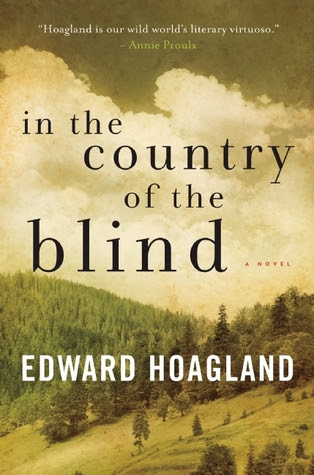
IN THE COUNTRY OF THE BLIND, essayist/novelist Hoagland's last novel


IN THE COUNTRY OF THE BLIND
EDWARD HOAGLAND

Arcade Publishing
$22.99 hardcover, available now

Rating: 3.5* of five

The Publisher Says: Sixty years after the publication of his first novel, Cat Man, Edward Hoagland is publishing his twenty-fifth book at the age of eighty-three. This capstone novel, set in Vermont’s Northeast Kingdom, introduces Press, a stockbroker going blind. Press has lost his job and his wife and is trying to figure out his next move, holed up in his Vermont cabin surrounded by a hippie commune, drug runners, farmers-gone-bust, blood-thirsty auctioneers, and general ne’er-do-wells. Solace and purpose come from the unlikeliest sources as he learns to navigate his new landscape without sight. Hoagland himself is going blind, and through this evocative, unsentimental novel, we experience the world closing in around Press, the rising panic of uncertainty, the isolation of exile, the increasing dependence upon the kindness of strangers, and a whole new appreciation of the world just beyond sight.

My Review: First, read this:
Press tucked necessities into an overnight bag and climbed in, cane and all, not omitting his passport. "Gone fishing" was what they said here. The smell was of sandwiches and coffee, but he sniffed for clues of who the car had belonged to before. A lady, a plasterer? Chuck drove east toward New Hampshire with careless aplomb, like a man who might put fifty thousand miles on a car's odometer every year or two. Blindness curtained much of the beauty they were passing but not his sense that it was there. White spots checkered his vision. How did people manage blind from youth?


Let me assure you that there's nothing in that excerpt to spoil your read. The novelist's last publication, though he is still alive as of 2021. Poignant story, as Hoagland is himself going blind (on top of a life-long stammer). Interesting in a terrifying way that it's an historical novel set in the Nixon era. All the accustomed Hoagland phrase-making is there in full force: “The milking machines sounded tranquilizing, and there was the collegiality of seventy animal spirits thriving, warming the barn with cud-chewing, nose-snuffling, and sisterly mammalhood.”

Well worth the eyeblinks.

Friday, November 1, 2013

THE ALUMINUM CHRISTMAS TREE, a religious tale about gratitude and self-worth...only GOOD!


THE ALUMINUM CHRISTMAS TREE
THOMAS J. DAVIS

Thomas Nelson Books
$6.99 Kindle edition, available now (non-affiliate Amazon link)

Rating: 3.5 very surprised stars of five

The Publisher Says: The shiny aluminum tree was the symbol of everything he thought was right in their lives and everything she thought was wrong. It was 1958 and Jimmy Jackson had it all: a wife, two kids, and the promotion that was his ticket to success. Finally, he could afford all those things he had gazed at in the Sears Roebuck catalog. But now that he had the money, would he find that the true cost was more than he could pay?

I RECEIVED A COPY OF THE BOOK FROM A DEAR OLD FRIEND. THANK YOU.

My Review
: A gift from a delightful old friend, this book arrived at precisely the right time. I was not at my most pleased and happy the day it came. I read the whole book in a sitting, and was much restored and refreshed.

Thomas Davis tells an oft-told tale of a man's descent into depression caused by his single-minded pursuit of material success with no nods towards his inner needs. His wife recounts the tale to her sympathetic audience after his death, which causes her to move to a new, smaller home in town from their half-century long country life on an apple orchard. She tells her cousin and his wife, who are helping her pack and move, the story of the year that almost ended the marriage most people thought was perfect.

I think the story of any well-lived life contains the passage that Mildred, our narratrix, recounts. It's instructive to be reminded of this in fiction as well as fact. All of us fallible humans can run off the rails, and it's often only after losing "everything" that we realize how much we really have that *can't* be lost, only thrown away.

The book breaks no new ground anywhere, but it takes the reader on its well-worn path with a pleasant tone and a loving heart. I can't recommend it to the cynical or the youthful, but anyone over 40 will recognize the situation and could probably benefit from a reminder of its perils and the tenuous nature of human relationships. Take care of them, feed them, prune them carefully, and a lifetime will seem too short.