Pages
- Home
- Mystery Series
- Bizarro, Fantasy & SF
- QUILTBAG...all genres
- Kindle Originals...all genres
- Politics & Social Issues
- Thrillers & True Crime
- Young Adult Books
- Poetry, Classics, Essays, Non-Fiction
- Science, Dinosaurs & Environmental Issues
- Literary Fiction & Short Story Collections
- Sookie Stackhouse/Southern Vampire Books & True Blood
- Books About Books, Authors & Biblioholism
Showing posts with label immigration issues. Show all posts
Thursday, April 2, 2026
CITIZENSHIP: NOTES ON AN AMERICAN MYTH, Daisy Hernández reflects on a cultural sea-change
CITIZENSHIP: NOTES ON AN AMERICAN MYTH
DAISY HERNÁNDEZ
The Hogarth Press (non-affiliate Bookshop.org link)
$13.99 ebook, available now
Rating: 4* of five
The Publisher Says: A provocative, personal, blazingly intelligent examination of one of the most vexing questions facing the United States today—who is, and should be, a citizen?
“How did ‘Give me your tired, your poor, your huddled masses yearning to breathe free’ turn upside down to where we are today? Everyone needs to read this book, citizens and non-citizens alike. Brilliant!”—Sandra Cisneros
"The most comprehensive book on citizenship/immigration I've ever read. A must-read!"—Javier Zamora
In this one-of-a-kind book, Daisy Hernández fiercely interrogates one of the most complicated subjects of contemporary life and citizenship. Braiding memoir, history, and cultural criticism, she exposes the truths and lies of how we define ourselves as a country and a people. Turning to her own family's stories—her mother arrived from Colombia, her father a political refugee from Castro's Cuba—Hernández shows how the very idea of citizenship is a myth and part of the stories we tell ourselves about the American soul and psyche.
Reframing our understanding of what it means to be an American, Notes on Citizenship is an urgent and necessary account of the laws, customs, and language we use to include and exclude, especially those who come from Latin America. With her scholar's mind and memoirist's gift for narrative, Hernández weaves a story both personal and national, while reckoning with our country's ongoing debate about who belongs and providing fresh ways of thinking about citizenship. At once bracing, fearless, and tender, Notes on Citizenship is a powerful portrait of one family's experiences in the borderlands of citizenship and an honest illumination of the country in which we live.
I RECEIVED A DRC FROM THE PUBLISHER VIA NETGALLEY. THANK YOU.
My Review: The Supreme Court has heard oral arguments on the deeply contentious topic of ending the age-old concept of "birthright citizenship," very much in the current regime's sights for elimination. Based on the Justice's tenor of questioning the Justice Department's counsel, I don't feel the regime can count on the ruling being in their favor.
This collection of essays has as its core a desire to think through how citizenship has changed in practice. The US Constitution defines citizenship in the Fourteenth Amendment, and it's pretty unambiguous about it. (That same amendment gifted us with the legal horror of corporate personhood.) It's been a longstanding desire of racist, fascist scum to make the idea of citizenship into a conditional grant...which, if anyone though about it for a single minute, would mean there's no citizenship for anyone at all.
Author Daisy thinks through the various ramifications of this terrible idea. Once a right is "granted" it can be taken away. That is why every time a law is passed that limits a right, like birthright citizenship, you...you personally...are at risk of losing whatever right it is. If this kakistocracy has not taught you the lesson that believing "they wouldn't/can't do that" is a dangerous illusion, read Author Daisy's essays. They can, and they will, and even court orders will not force the scum to cease and desist from illegal, immoral behavior. Look how many losses in court have been dealt the regime; yet no sign of meaningful compliance, compliance with the *intent* of the orders and laws, exists. This is, in other words, a coup against the form of government we take for granted.
Read these essays, even though the collection feels thematically scattered, because each essay is very clearly argued, and makes excellent points. It is a slowly unfolding disaster but it is unfolding...it's time to pull your socks up and do the work of citizenship.
Follow Author Daisy's example.
Sunday, June 8, 2025
DEEP HOUSE: The Gayest Love Story Ever Told does so very much for illuminating the reality of empathy
DEEP HOUSE: The Gayest Love Story Ever Told
JEREMY ATHERTON LIN
Little, Brown and Company (non-affiliate Bookshop.org link)
$29.00 hardcover, available now
Rating: 4.5* of five
One of Publishers Weekly's Top 10 Best Books of 2025!
One of Electric Literature’s Best Non-fiction Books of 2025!
The Publisher Says: From the National Book Critics Circle Award-winning author of Gay Bar comes a rule-breaking, sweat-soaked, genre-busting story of outlaw love.
It’s 1996, and Jeremy Atherton Lin has met the boy of his dreams—a mumbling, starry-eyed Brit—just as, amid a media frenzy, US Congress prepares the Defense of Marriage Act, denying same-sex couples federal rights including immigration. The pair steals away to remote forests and vast deserts, London fashion shows and Berlin sex clubs, dinner parties, back alleys, East Village hotel rooms, and San Francisco dives. Finding no other way to stay together, they shack up illicitly among unlikely allies in a “city of refuge.”
With Atherton Lin’s inimitable blend of tenderness and wicked humor, Deep House moves through the couple’s string of rented apartments while unlocking doors to a lineage of gay men who have come before—smuggling a foreign partner through national checkpoints or going public to stand up for the right to get down in the privacy of their own homes. They include hapless criminals, sexpot bartenders, friars, pirates, government workers who subverted the system, activists who went all the way to the Supreme Court, and the celebrated artist Felix Gonzalez-Torres.
Following Gay Bar—called “a rich tapestry” by Vanity Fair and “an absolute tour de force” by Maggie Nelson—Deep House juxtaposes whispered disclosures of undocumented domesticity with courtroom drama and political stunts to explore myriad forms of intimacy while questioning the mechanisms that legitimize love. Deep House is at once a historical kaleidoscope and the innermost tale of two boyfriends who made a home in the shadows of a turbulent civil rights battle.
I RECEIVED A DRC FROM THE PUBLISHER VIA NETGALLEY. THANK YOU.
My Review: A story whose timeliness could not possibly be greater. Author Jeremy takes us through a moment, thirty years ago, when the political landscape looked a lot like today's. He had just fallen in love with "Famous Blue Raincoat," an undocumented Brit, which is presenting practical problems of residence and life together. How do you rent an apartment, earn a living, make couple-friends? You're carrying the usual relationship stuff but on top of that is the need to be discreet, even secretive, about big pieces of your life.
What Author Jeremy chooses as his narrative strategy is lighter on the deeply personal details in favor of a potted history of the topic of marriage equality in the US from DOMA in 1996 through twists an turns of bi-national queer couples litigating their basic human rights (which is not how rights are supposed to work except here in looney-religious-land) through to the now-imperiled Obergefell v Hodges decision in 2015.
It's a lot to take in. The personal parts pertaining to Author Jeremy and "Famous Blue Raincoat" are sprinkled on like powdered sugar to make the wodges of information go down easier. There are so many facts that impinge on the love story he's telling that there's really no other way to tell the whole story. Author Jeremy was threading needle after needle after needle, trying not to be preachy while advocating equality, trying not to be confessional while honestly depicting the cost of a life defined by struggle to access simple equality, trying not to chirp triumphantly about battles won while they're being refought, yet leaving his readers with real hope in a world that does not do much to support it.
The amount of focused effort in these four-hundred-plus pages is humbling. It's a gift to receive this kind of careful craft on such a personal topic. I'd've given a full fifth star had I had citations, not simply end-notes; it's a "me" thing, it likely won't bother a lot of y'all, but when you're relying on sources to make factual cases and points within cases, I'd like to be pointed at those sources in the text not simply as end notes. I feel a bit unkind bringing it up in a time where even the inclusion of end notes is increasingly rare, but, well, I'm pedantic and grouchy and old.
Surprise!
Don't wait...get yourself a copy fast as you can for your #PrideMonth reading. It's a pleasurable way to appreciate fully and personally what is at stake in the current political crisis.
Sunday, May 11, 2025
STORIES FROM THE EDGE OF THE SEA, an edge I can see from my home, and wonder what's over it
STORIES FROM THE EDGE OF THE SEA
ANDREW LAM
Red Hen Press (non-affiliate Amazon link)
$9.99 ebook, available now
One of LitHub's 100 Notable Small Press Books for 2025!
Rating: 4.75* of five
The Publisher Says: Andrew Lam returns with a literary exploration of love, lust, and loss among Vietnamese immigrants in America.
At times humorous and ecstatic, other times poetic and elegiac, the fourteen pieces in Stories from the Edge of the Sea explore love and loss, lust and grief, longing and heartbreaks through the lives of Vietnamese immigrants and their children in California. A younger dancer is haunted by memories of almost dying on a boat when they escaped from Vietnam, a widow processes her husband’s death through frantic Facebook postings, a writer enters an old lover’s home and sees a ghost at twilight. If the human heart is a vast, open-ended terrain, then Andrew Lam’s short stories are its mountains, valleys, and lakes. Together they seek to chart barely explored country.
I RECEIVED A DRC FROM EDELWEISS+. THANK YOU.
My Review: How to go on, when you honestly think your world is ending, is at the heart of any immigrant's story. Your world is ending, are you going to end with it?
Not while someone is cold and hungry, I'm not. I immigrated from my happy world to this ugly, mean-spirited one entirely against my will. But here I am. My kettle's got words, but heads need filling...feeding...too.
In accordance with the Prophecy, the fourteen stories will be dealt with by the Bryce Method.
She in a Dance of Frenzy suffers. Beautiful faces and empty hearts so often go together. Why some people are gifted with looks but left, like all of us, without a single clue as to how to be truly happy.
Because, girl of great beauty, woman of the thousand broken hearts, empty vessel hollow drum moon void of course: Your value of face has no depth of learning, and only learning fills you up. 3.5*
Agape at the Guggenheim takes a solid look at how love, lust, longing, and the essentially fruitless effort of making sense of your own inner workings all walk around, sloshing and thumping into over and around one pretentious little culture queen's head.
Quit worrying about it, said old-man me to this youthful Asian version of me. Get up and find him or stay sitting and watch him go, either way chasing a fantasy won't explain you to yourself. But when your façade is as brittle and shiny as the lacquer on your umbrella handle, you won't listen, or hear when you do.
Told in a slightly annoying ever-so ever-so tone that will really rub the rust scales of some, that amused me no end. 4*
This Isle is Full of Noises provides the required amount of New Weid as vampires and werewolves crash a frat party where a Vietnamese immigrant lad, on the way to a glittering career as a doctor...he thinks...is apparently trippin' balls and working through some very, very serious PTSD.
Not my personal favorite, but it sure as hell twists its twist with absolute conviction! 3.5*
October Laments follows a woman who processes her grief in real time posts on Facebook, in a foreign language, for the hushand she shared twenty-five years of life with. As her teenaged daughter comments on some posts, the awful truth of marrying someone a lot older than you, marrying someone who becomes ill, withers and dies by choice, to end suffering, is caustically real.
The grief of being left behind, feeling greedy for wanting more, the resposibility of living on...well, social media is good for something after all. 5*
A Good Broth Takes Its Time "I insure people against tragedy, in a country built on it," says Toan, survivor and thriver on pho's magically Proustian-madeleine insubstantial waft. A solid thing, love, and it sloshes in the transparent magis of water, heat, and time that transmutes grossly physical things...nothing on Earth is more grossly physical than oxtail...into wafts of delightful odor.
Tragedy plus time equals comedy, said the long-forgotten hilarious inventor of The Tonight Show, Steve Allen. He specifically meant ha-ha comedy. I'd be amazed if Allen, and Author Lam, didn't also mean that tragedy turns its other mask to the reveling, partying eater of the divine pho. Savoring the tough bits, eating the insubstantial essence of things whose flavoring we call "herbs and spices" but whose bodies (leaves, fruits, seeds) we use up and discard. The broth that takes its time? Rich in the essences of things we can't see. Replete with the powerfully sensed, unseen, untouchable, enfolding vapor of the dead.
Heady. 5*
Bleak Houses are more than structures, they're memory palaces of lives unlived. Visiting someone you once loved deeply, were passionately entwined with, in his home now shared with a wife who knows who you were, with kids who know little enough about the world (such a kid thing) to Make Judgments, is...awkward. Seeing a ghost is the least of it. 4*
To Keep from Drowning tells us how lives end, how hard it is to live one, how much it costs in blood and treasure is only the beginning. Never tell all you know and it goes into the Void with you. And how that is okay.
Living each life is hard work, dying each death, moments you don't know what what's coming are the ones you should treasure because they are the ones that let you rest before the next bend on the hill. A family of origin takes shape on this trip to Land's End. And it is at the end your beginnings fall into focus. Rose's pain, Ben's work, Lou's seeking, all of them launch their family from the end of the land, from the muddy border of dirt and water and the air so redolent of rot. 4.5*
The Shard, The Tissue, An Affair said something deep, something profound, after smacking me in the teeth with some very self-indulgent poetry:
To fall in love is to have one's sense of geography grafted onto another's, no matter how tenuous, so as to form a new country. I saw Houston in my mind, a city of strip malls, grand old homes and gleaming glass-and-steel skyscrapers that coexist cheek by jowl. He, in turn, imagined San Francisco with its Transamerica Pyramid poking the blue sky, windblown hills the color of embers at twilight, sailboats gliding on the bay like white butterflies; he imagined—and I could tell this from his voice—that there was freedom somewhere in the next valley.It's true. You see their world with your own. You do not know, then, what that moment of vision will cost...sometimes a lot, others it pays you. A fleeting moment or a painting on the wall of your shared home.
A short work, a love song to the departed. 4*
Love in the Time of the Beer Bug gives me the heebiejeebies. COVID killed people still walking. It ruined so many lives. It put the stake in the heart of many a vampiric relationship, like Jan and Stan's.
It was a very annoying style to read it in but a story I thought I wouldn't see in here...the ending, and even then, a beginning as the narrator accepts a place in Yale's English department. 3.5*
Swimming from the Mekong Delta is proof that the old adage about lemons becoming lemonade only works if the lemonchucker gets a full, even overflowing, glass. And you get to watch as they have to drink it.
A standup routine I'd actually resubscribe to Netflix to see. 4*
What We Talk About When We Can't Talk About Love is dark. What talking does, in this immigrant's world, is fill the hot-air balloon that wafts him above the heads of the struggling so he won't see how hard it was for him in their sweaty. soot-streaked faces. The fire's coming, blow it out with words. Blow up into the ballon. Blow harder, blowhard.4.5*
5A, 5B, DEST: SGN gives someone ordinary a second chance. It's a beautiful dream, the second chance so deeply desired it connects your past self to a present you just...don't love, care about so little that you're ready to jump into the past without hesitation.
The "Canterbury Tales" format works well enough, but honestly it's so self-indulgent and sentimental I need insulin. 3*
Muni Diaries collects the vignettes a writer, a real dyed-in-the-wool wordhammerer, never leaves behind. The smallest moment stays in the filter like a random whole bean. It blocks the flow of coffee until you take it out and grind it just to get it out of the way.
The resulting liquid isn't quite coffee; it's not strong enough. Drop it into steamed milk? it's barely a macchiato. Slosh it into the instant oatmeal? Palatable, but after it gets cold waiting for you to finish your call, it's stodgy and there's no good way towards finishing it that won't result in gagging.
So blow the dust onto a napkin and draw faces with the dregs in the cup. 3.5*
The Tree of Life Elegy to a mother's love:
Fitst of all, when things get tough, remember to make soup. And, if you can, feed the hungry. More importantly, open your heart, stand with all your strength, with all your courage for life and living, even in the face of darkness and despair. Despite all your sadness and tears, stand steadfast under that tree and tend to it and watch its branches blossom and bear fruit. Stand until the very last light.
You can do no better than to live by these words. 5*
Saturday, November 9, 2024
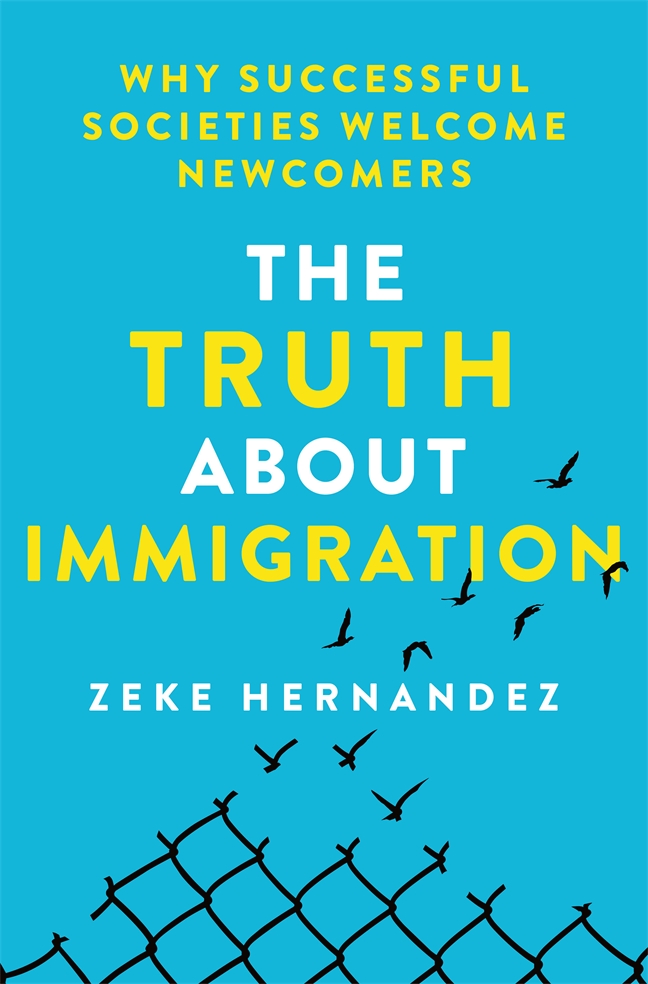
THE TRUTH ABOUT IMMIGRATION: Why Successful Societies Welcome Newcomers, careful, honest, trenchant and tendentious

THE TRUTH ABOUT IMMIGRATION: Why Successful Societies Welcome Newcomers
ZEKE HERNANDEZ
St. Martin's Press
$30.00 hardcover, available now
Rating: 4* of five
The Publisher Says: The go-to book on immigration: fact-based, comprehensive, and nonpartisan.
Immigration is one of the most controversial topics in the United States and everywhere else. Pundits, politicians, and the public usually depict immigrants as either villains or victims. The villain narrative is that immigrants pose a threat—to our economy because they steal our jobs; our way of life because they change our culture; and to our safety and laws because of their criminality. The victim argument tells us that immigrants are needy outsiders—the poor, huddled masses whom we must help at our own cost if necessary. But the data clearly debunks both narratives. From jobs, investment, and innovation to cultural vitality and national security, more immigration has an overwhelmingly positive impact on everything that makes a society successful.
In The Truth About Immigration, Wharton professor Zeke Hernandez draws from nearly 20 years of research to answer all the big questions about immigration. He combines moving personal stories with rigorous research to offer an accessible, apolitical, and evidence-based look at how newcomers affect our local communities and our nation. You'll learn about the overlooked impact of immigrants on investment and job creation; realize how much we take for granted the novel technologies, products, and businesses newcomers create; get the facts straight about perennial concerns like jobs, crime, and undocumented immigrants; and gain new perspectives on misunderstood issues such as the border, taxes, and assimilation.
Most books making a case for immigration tell you that immigration is good for immigrants. This book is all about how newcomers benefit you, your community, and your country. Skeptics fear that newcomers compete economically with locals because of their similarities and fail to socially assimilate because of their differences. You'll see that it's exactly the opposite: newcomers bring enduring economic benefits because of their differences and contribute positively to society because of their similarities. Destined to become the go-to book on one of the most important issues of our time, this book turns fear into hope by proving a simple truth: immigrants are essential for economically prosperous and socially vibrant nations.
I RECEIVED A DRC FROM THE PUBLISHER VIA NETGALLEY. THANK YOU.
My Review: Do you like to eat? Thank an immigrant, an economic migrant, as you chow down on those tomatoes and cucumbers.
*You* sure didn't go pick 'em.
Do you use Google, chat on Twitter, watch TikTok every day? Thank an immigrant. In this case, you're thanking said immigrant with your data being harvested to fatten his (they're all men, at least so far) coffers.
But that law'n'order fetish you got goin' on...surely that's the real reason to oppose immigration, to keep 'em out and chuck 'em out when they come anyway, right? The president-elect has more felonies on his record than a random immigrant. But they cost us money! Take money from needy Murrikinz! You're thinking of the GOP in the various legislatures. Immigrants pay taxes through their (upright & honest, or shady) employers. They're barred by law from getting any of those taxes back.
The author, unlike me, is apolitical. He has done the research and these are the facts he found. If you support immigration, read this book for talking points. There's a lot of 'em. If you don't support immigration, why the hell are you reading my reviews? If someone you care for is anti-immigrant, maybe this non-partisan voice will reach them. It sure can't hurt to try.
I'm not calm enough to care to engage with people like that. They're wrong. I needn't fuss about it because that kind of wrong loves a fight. Got nothin' left for that uselessness. If you do, great! And here's you a swiss army knife of evidence-backed facts to use in your noble work of Enlightenment.
Monday, October 28, 2024
BLUE LIGHT HOURS, first novel by established literary luminary of translation

BLUE LIGHT HOURS
BRUNA DANTAS LOBATO
Grove Press/Black Cat
$17.00 trade paper, available now
Rating: 4* of five
The Publisher Says: of a young Brazilian woman’s first year in America, a continent away from her lonely mother, and the relationship they build over Skype calls across borders
In a small dorm room at a liberal arts college in Vermont, a young woman settles into the warm blue light of her desk lamp before calling the mother she left behind in northeastern Brazil. Four thousand miles apart and bound by the angular confines of a Skype window, they ask each other a simple question: what’s the news?
Offscreen, little about their lives seems newsworthy. The daughter writes her papers in the library at midnight, eats in the dining hall with the other international students, and raises her hand in class to speak in a language the mother cannot understand. The mother meanwhile preoccupies herself with natural disasters, her increasingly poor health, and the heartbreaking possibility that her daughter might not return to the apartment where they have always lived together. Yet in the blue glow of their computers, the two women develop new rituals of intimacy and caretaking, from drinking whiskey together in the middle of the night to keeping watch as one slides into sleep. As the warm colors of New England autumn fade into an endless winter snow, each realizes that the promise of spring might mean difficult endings rather than hopeful beginnings.
Expanded from a story originally published in The New Yorker, and in elegant prose that recalls the work of Sigrid Nunez, Katie Kitamura, and Rachel Khong, Bruna Dantas Lobato paints a powerful portrait of a mother and a daughter coming of age together and apart and explores the profound sacrifices and freedoms that come with leaving a home to make a new one somewhere else.
I RECEIVED A DRC FROM THE PUBLISHER VIA NETGALLEY. THANK YOU.
My Review: A tight, compact barely-more-than-novella based on the author's fiction debut story. She's translated work from Brazilian that I've loved (The Words That Remain) and liked a lot (Moldy Strawberries), so I was primed for a good experience. I got that indeed.
Loneliness and that indescribable parent-feeling compounded of intense longing for the child you've had every day of their life as your primary focus mixed with huge dollops of pride in their accomplisment that's led them away from you, and the freezing fear of what you know can and will happen to hurt them where you just can't be. And, of course, resentment that this stellar being needs to be so far away to feel grown up. I was pleased that the author's stand-in was so dutiful and so genuinely, if sometimes impatiently, loving toward her mother in their long-distance relationship.
If you have, or were, a child, it's going to speak to you. It's told mostly from the author-placeholder's PoV, but we do hear directly from her mother at the end. It will sound, and feel, familiar to older folks. It will offer some insights to younger ones. It will do all this without leaving you feeling Taught. I am morally certain Author Lobato has been in this exact skin, it fits the reader so well.
Why I recommend it to you now is the fall has fallen, there's chill in our Northern Hemisphere air, trees are coloring up, and that's the time for a hot steaming mug for sipping and a long sleeve for sniffling into. You'll do a lot of both of 'em.
I'd offer a fifth star had the ending not felt like it was given a mildly short shrift. It's not bad, it's organic to the story, it's just not quite enough for a full, complete experience of her mother's part of their life.
A first novel made from Life, and grown from a short story could not hope for a better apotheosis. This will not, I hope, be the last work of her own long fiction Author Lobato publishes. Those will feel even more accomplished.
Sunday, August 22, 2021
CLASH OF CIVILIZATIONS OVER AN ELEVATOR IN PIAZZA VITTORIO, interesting hybrid genre story from Italian-Berber immigrant author
CLASH OF CIVILIZATIONS OVER AN ELEVATOR IN PIAZZA VITTORIO
AMARA LAKHOUS (tr. Ann Goldstein)
Europa Editions
$14.95 trade paper, available now
Rating: 3.75* of five
The Publisher Says: A compelling mix of social satire and murder mystery.
A small culturally mixed community living in an apartment building in the center of Rome is thrown into disarray when one of the neighbors is murdered. An investigation ensues and as each of the victim's neighbors is questioned, the reader is offered an all-access pass into the most colorful neighborhood in contemporary Rome. Each character takes his or her turn center-stage, giving evidence, recounting his or her story--the dramas of racial identity, the anxieties and misunderstandings born of a life spent on society's margins, the daily humiliations provoked by mainstream culture's fears and indifference, preconceptions and insensitivity. What emerges is a moving story that is common to us all, whether we live in Italy or Los Angeles.
This novel is animated by a style that is as colorful as the neighborhood it describes and is characterized by seemingly effortless equipoise that borrows from the cinematic tradition of the Commedia all'Italiana as exemplified by directors such as Federico Fellini.
At the heart of this bittersweet comedy told with affection and sensitivity is a social reality that we often tend to ignore and an anthropological analysis, refreshing in its generosity, that cannot fail to fascinate.
My Review: Reading that book description isn't necessarily helpful. Social satire plus murder mystery, to most book-readin' Murrikins, is gonna call forth the specter of Murder by Death. You are not in for a satire like that. You are in for a very sophisticated and layered short novel in which a murder is committed, but frankly no one really cares who did it because it needed doing, and the perp the police have identified is a community pillar. No one believes Amedeo committed this murder, which no one calls a crime.
Amedeo steps out of the stories of ten people who all live in a small apartment building on Rome's tatty side, on the Piazza Vittorio. All ten people are displaced, not Roman, and all are made to feel more alien than guest by Rome and its Romans. Amedeo comes to the rescue of each person here, in ways practical and spiritual. He's a fixer, a born organizer, he spends his time on this earth open to and listening for the truths under the stories his neighbors tell, the truths under the facts of Rome and Italian society, the truths that not very many people will bother to learn or, quite possibly, ever realize are there.
So how can the police suspect this wonderful, soothing, special man of MURDER?! Because he, like everyone else, fought with the shit who got murdered? No...because he has disappeared. Not for the first time in his life. He has vanished, and in police work, that's as good as a confession. The novel is told in the interviews the police take with all the residents of Amedeo's building.
Interspersed with these interviews are wails, the first-person accounts of Amedeo himself. They're called wails because Amedeo, né Ahmed Salmi in Algiers, spends a lot of time locked in his wife's bathroom with a tape recorder, setting down his impressions of the people around him, and vocalizing in that uniquely Arab way...the ululating wail, used for joy, for mourning, for any access of emotion that words can't encompass. It's a wonderful way to let us into the experience of being alive in the skin of a force of nature. We're inside Amedeo, Ahmed, we're privileged to be the unseen auditors of the story of his world.
His private world. We have no sense whatever of his work, his living...he remains in a tight little box, as do all the characters, one that focuses on someone we don't meet or hear from or, frankly, care about. The victim is not the point. The murderer didn't commit a crime so much as perform clean-up on aisle two. The more we hear about him, the less we care that he's dead. It works well as a narrative technique to emphasize the almost miraculous nature of listening, and its almost total lack in the modern world.
So why 3.75 stars, when all of the above sounds like such praise? Because the Italian reviews mention an exuberance of language, a gonzo balls-out feeling that the text gives. In Italian. The translation is like the book description above, not uninteresting but nobody's idea of gonzo or balls-out writing. It's a translation. It feels like a translation. It's never going to convey the sense that the original can, of different regional voices, of different classes and different kind of Italian, because American English isn't that kind of language and American culture doesn't, at least at the level of culture where one finds readers of translated novels, like “dialect writing” because it's not Nice.
We lose. I want to read this book in Italian now. It's bound to be more fun. The translation is a good book. The original, I will bet, is a fantastic one.
*sigh*
Friday, August 21, 2020
THE NEW FACE OF SMALL-TOWN AMERICA, a ten-year-old study of the realities that piss off White Nationalists
THE NEW FACE OF SMALL-TOWN AMERICA: Snapshots of Latino Life in Allentown, Pennsylvania
EDGAR SANDOVAL
A Keystone Book
$24.95 trade paper, out of print
Rating: 3.75* of five
The Publisher Says: Allentown, Pennsylvania, is a small city located along the Lehigh River in the eastern part of the state. Once the hiding place of the Liberty Bell, Allentown has become a popular destination for Latino immigrants. These Latinos, mostly from Puerto Rico, now make up about a quarter of the city's population, and their numbers continue to grow. The thirty-one stories collected in The New Face of Small-Town America do not reflect the reality of Allentown alone. With U.S. Census figures showing the arrival of Latinos in more small American cities than ever before, Allentown will continue to serve as an example.
These small cities have already experienced, or are about to experience, the transformation Allentown saw. Few communities embrace such change. It is only when one becomes familiar with a foreign concept (or foreigners) that fear disappears and understanding begins. Edgar Sandoval's essays show that behind the accents, ethnic customs, and other cultural differences exists a common humanity with universal problems and dreams. The Latinos profiled here want what everybody else wants: to fit in, to prosper, to offer their children a better future, to be recognized as important members of society by the mainstream. They want to coexist. These stories are not just about Latinos in Allentown, after all; they are about Latinos everywhere.
My Review: A series of newspaper columns written by a Mexican man hired to cover the largely Caribbean Latino population of the Lehigh Valley, this book offers a charming, if choppy and repetitious, insight into the new majority of many, if not most, smaller American cities, the Latinos.
Sandoval was hired by the (Anglophone) owners of the Allentown Daily Call to report on the 25% of the local population that the paper was simply missing. Typically, they hired someone from Mexico! These are *not* the same culture, not even a little bit, and the local Puertoriquenos and Nuyoricans and Dominicans were a little bit wary of the furrin dude with the wild-assed accent. He won them over by dint of his reportorial chops, his charm, and the way he could blend into the woodwork or the crowd, depending on the situational need.
The organizational thread of the book is...well...not very organized. It's all over the town, even the Valley. But it's a collection of newspaper pieces! It's NOT A NARRATIVE, so don't read it as such and you'll find it ever so much easier to enjoy. The book is intended by the author and the publisher to provide an Anglophone audience with a short entree into Latino life and community thought. This goal should be froemost in any reader's thoughts to make the book a successful reading experience.
Well, Mr, Sandoval and I hail from the same part of the world: Nine miles from Mexico, on the Texas/Nuevo Leon border. He's quite a lot younger than I am, but he was a reporter for The Monitor, the Rio Grande Valley's newspaper of record, so I betcha we know people in common: The longtime mayor of McAllen, Othal Brand, is a cousin of mine, and lots of the staffers at the paper know my brother from his years reporting there. So I started this book with a lot of points given to the writer for commonality of experience.
In the end, that is what gave me the reason to give the man 3.75 stars. Really and truly, the book isn't all that; not because Sandoval is deficient as a writer, but because the origin of the stories is a newspaper. There isn't any problem with that, basically, but it really doesn't make for a deep and hearty stew of a read, rather a tasty, lightly buttered toast-point with a decent pâté on it. Not bad at all! Just not something I'll charge about demanding others read instanter.
But do look into it if you're one of the many, many anti-immigrant idiots infecting the body politic. This is the story of your own ancestors, unless you're 100% Native American.
EDGAR SANDOVAL
A Keystone Book
$24.95 trade paper, out of print
Rating: 3.75* of five
The Publisher Says: Allentown, Pennsylvania, is a small city located along the Lehigh River in the eastern part of the state. Once the hiding place of the Liberty Bell, Allentown has become a popular destination for Latino immigrants. These Latinos, mostly from Puerto Rico, now make up about a quarter of the city's population, and their numbers continue to grow. The thirty-one stories collected in The New Face of Small-Town America do not reflect the reality of Allentown alone. With U.S. Census figures showing the arrival of Latinos in more small American cities than ever before, Allentown will continue to serve as an example.
These small cities have already experienced, or are about to experience, the transformation Allentown saw. Few communities embrace such change. It is only when one becomes familiar with a foreign concept (or foreigners) that fear disappears and understanding begins. Edgar Sandoval's essays show that behind the accents, ethnic customs, and other cultural differences exists a common humanity with universal problems and dreams. The Latinos profiled here want what everybody else wants: to fit in, to prosper, to offer their children a better future, to be recognized as important members of society by the mainstream. They want to coexist. These stories are not just about Latinos in Allentown, after all; they are about Latinos everywhere.
My Review: A series of newspaper columns written by a Mexican man hired to cover the largely Caribbean Latino population of the Lehigh Valley, this book offers a charming, if choppy and repetitious, insight into the new majority of many, if not most, smaller American cities, the Latinos.
Sandoval was hired by the (Anglophone) owners of the Allentown Daily Call to report on the 25% of the local population that the paper was simply missing. Typically, they hired someone from Mexico! These are *not* the same culture, not even a little bit, and the local Puertoriquenos and Nuyoricans and Dominicans were a little bit wary of the furrin dude with the wild-assed accent. He won them over by dint of his reportorial chops, his charm, and the way he could blend into the woodwork or the crowd, depending on the situational need.
The organizational thread of the book is...well...not very organized. It's all over the town, even the Valley. But it's a collection of newspaper pieces! It's NOT A NARRATIVE, so don't read it as such and you'll find it ever so much easier to enjoy. The book is intended by the author and the publisher to provide an Anglophone audience with a short entree into Latino life and community thought. This goal should be froemost in any reader's thoughts to make the book a successful reading experience.
Well, Mr, Sandoval and I hail from the same part of the world: Nine miles from Mexico, on the Texas/Nuevo Leon border. He's quite a lot younger than I am, but he was a reporter for The Monitor, the Rio Grande Valley's newspaper of record, so I betcha we know people in common: The longtime mayor of McAllen, Othal Brand, is a cousin of mine, and lots of the staffers at the paper know my brother from his years reporting there. So I started this book with a lot of points given to the writer for commonality of experience.
In the end, that is what gave me the reason to give the man 3.75 stars. Really and truly, the book isn't all that; not because Sandoval is deficient as a writer, but because the origin of the stories is a newspaper. There isn't any problem with that, basically, but it really doesn't make for a deep and hearty stew of a read, rather a tasty, lightly buttered toast-point with a decent pâté on it. Not bad at all! Just not something I'll charge about demanding others read instanter.
But do look into it if you're one of the many, many anti-immigrant idiots infecting the body politic. This is the story of your own ancestors, unless you're 100% Native American.
Subscribe to:
Posts (Atom)