Pages
- Home
- Mystery Series
- Bizarro, Fantasy & SF
- QUILTBAG...all genres
- Kindle Originals...all genres
- Politics & Social Issues
- Thrillers & True Crime
- Young Adult Books
- Poetry, Classics, Essays, Non-Fiction
- Science, Dinosaurs & Environmental Issues
- Literary Fiction & Short Story Collections
- Sookie Stackhouse/Southern Vampire Books & True Blood
- Books About Books, Authors & Biblioholism
Showing posts with label Chicago Review Press. Show all posts
Wednesday, May 29, 2024
OUT AT THE PLATE: The Dot Wilkinson Story, deep dive into a QUILTBAG legendary life
OUT AT THE PLATE: The Dot Wilkinson Story
LYNN AMES
Chicago Review Press
$28.99 hardcover, available now
Rating: 4.25* of five
The Publisher Says: “Dot Wilkinson is the greatest female catcher ever to play softball . A bold, pioneering athlete, she refused to let others define her and instead defined herself. Her story is an inspiration to people everywhere.” — Billie Jean King, Sports Icon and Champion for Equality
It’s not simply that Dot Wilkinson was one of the most decorated women’s softball players, bowlers, and athletes of all time and one of the original players from the three-time-world-champion PBSW Phoenix Ramblers softball team (1933–1965). Nor was it the length of her time here on Earth—over a century—although any of these things by itself would be impressive.
The magic of Dot’s story is in the details. It’s the tale of a childhood spent in poverty, an indomitable, unbreakable spirit, a determination to be the very best to play whatever sport she undertook, the independence to live her personal life on her own terms, and her tremendous success at all of it.
Over more than a decade of countless conversations and interviews, Dot shared all of it with her dear friend, author Lynn Ames. Dot held nothing back. Out at the Plate , told through the lens of Dot and Lynn’s friendship, is the story of a forgotten era in women’s history and sports, and one extraordinary woman’s place at the center of it all.
I RECEIVED A DRC FROM THE PUBLISHER VIA EDELWEISS+. THANK YOU.
My Review: I had a lesbian "grandma" of sorts, older than Dot Wilkinson, but with the same kind of unwillingness to submit to woman=weakness stereotyping. She saw what she wanted and went out of all ladylike bounds to get it. This included the love of her life, a widow with a son, and the family they made.
Dot Wilkinson is my kinda woman. (Or man, if I'm honest.) Reading about her life, its ups-downs-failures and unimaginably exciting successes, made me smile uncontrollably. QUILTBAG folk are fed a steady diet of disaster and crime with us as the victims, expecting that this will keep us quiet and invisible. This is the classic Linebarger tactic, used for generations now on "minorities" of all sorts. It is now modulated by stories of assimilation, of increased access to "The American Dream" of mortgaged house, kids who need college funds, etc etc. The Dot Wilkinsons who decide to do what the hell they want to do when they want to do it do not, oddly enough, get a lot of overcultural attention.
I can't think why this should be.
Dot Wilkinson deserves every bit of attention you have at your command because she actually was what we're told we love the most, should strive to be, here in the USA. She was strong by every metric, she was a maverick. She was routinely successful in her careers (plural). She lived with the love of her life for almost a half-century. Her example of grace and graciousness under pressure is one to emulate. She never turned it into any kind of doormat behavior. She was likable and well-liked at a time when her rejection of "normative womanhood" could easily have made her a pariah. Lynn Ames manages to convey all this without becoming cloying, though her fangirling over Dot is not at all veiled...or misplaced.
The one thing that leads to, on the "missing three-quarters-star" front, is the tendency to overexplain and repeat. By using many primary sources, Author Ames falls into the "it's really cool how much stuff there is" ditch and doesn't climb out. The sources very often concur, and maybe picking one quote then saying "this is one of the half-dozen angles on this story" could've been less wearing on the reader's nerve. My interest in softball, Dot's biggest claim to Fame and spotlights, is significantly less than hers....
Family issues weren't minimized. It was heartbreaking to learn of Dot's first love's early passing from the then-untreatable scourge of metastatic breast cancer. It was more heartbreaking still to read of Dot's mother's callous...let me be fair, surprisingly insensitive...response to Dot's deep grief at her loss. The fact is a sapphic love wouldn't register with most people as "real" in that day and time, so grief of that depth and duration would seem odd. Still, it's your child! Wouldn't that attune you to the reality of the feeling and thus summon up empathy not dismissiveness?
Apparently not. And honestly that bit upset me as much as the loss did. I was, as you can tell from that, fully invested in Dot Wilkinson's life, and was very, very happy I had this chance to learn about this older sister in queerness. I hope you will give it a chance to grab you, too.
Thursday, December 29, 2022
THE GAY IMMIGRANTS PAGE: AN ANGEL IN SODOM: Henry Gerber and the Birth of the Gay Rights Movement & WHEN THEY TELL YOU TO BE GOOD: A Memoir
WHEN THEY TELL YOU TO BE GOOD: A Memoir
PRINCE SHAKUR
Tin House
$27.95 hardcover, available now
Rating: 4.5* of five
The Publisher Says: After immigrating from Jamaica to the United States, Prince Shakur’s family is rocked by the murder of Prince’s biological father in 1995. Behind the murder is a sordid family truth, scripted in the lines of a diary by an outlawed uncle hell-bent on avenging the murder of Prince’s father. As Shakur begins to unravel his family’s secrets, he must navigate the strenuous terrain of conquering one’s inner self while confronting the steeped complexities of the Afro-diaspora.
When They Tell You to Be Good charts Prince Shakur’s political coming of age from closeted queer kid in a Jamaican family to radicalized adult traveler, writer, and anarchist in Obama and Trump’s America. Shakur journeys from France, the Philippines, South Korea, and more to discover the depths of the Black experience, and engages in deep political questions while participating in movements like Black Lives Matter and Standing Rock. By the end, Shakur reckons with his identity, his Jamaican family’s immigration to the US before his birth, and the intergenerational impacts of patriarchal and colonial violence.
A profoundly composed narrative parallel in identity to that of George M. Johnson’s All Boys Aren’t Blue and Eddie S. Glaude Jr.’s Begin Again: James Baldwin’s America and its Urgent Lessons for Our Own, Shakur compels the reader to consume the political world of young, Black, queer, and radical millennials today.
I RECEIVED A DRC FROM THE PUBLISHER VIA NETGALLEY. THANK YOU.
My Review: Introspection is part and parcel of getting old. But, and this is relatively new to my consciousness, that's because it's part and parcel of the Othering that US/capitalist society perpetuates, perpetrates even, daily. Old people are Othered, queer people are Othered, Black people, Asian people, female people: All are Othered by the depressing, repressive regime of normalizing cis-white male-straightness.
I'm sure that condition suits some people, but it gives me the shuddering horrors. Sounds more like something Cthulhu uses to torment victims than a desirable identity.
Author Shakur decides, early on, that "...if I was going to be lost and swallowed alive out in the world, then I’d at least get something for myself out of it," and he definitely makes good on that promise to himself. He is a generous soul and shares pieces of his journey to living authentically as an out, gay Jamaican-American man. He sees through structures at twenty-seven that took me another decade to understand as designed systems of repression, so of course I'm jealous as well as impressed. In about equal measure.
His mother, the one who chose his father, doesn't really know what to do about her wild, ungovernable son. Of course she sees his dad in him and, as the man was murdered for being his own resistant, wild self, she's got to be scared witless for her baby boy. His gayness seems to her an unnecessary provocation of the people who already hate her son for being. Being Black, being Jamaican, just (when you boil away the froth) being is his unatonable sin, his unwittingly committed crime.
The issues between mother and son don't stop; they are my own favorite moments in the book. After all, I'm old, and I'm thinking about the awful patterns of my own family that I've repeated ad infinitum. Reckoning with family damage will always command my attention. But Author Shakur, decades behind my age and out front of my life experience, is going through his travails for hisownself. That meant I got more of his politics than I, ideally, would've had. Not that I disagree with him! Just that I can already see where this truck is headed and am, therefore, not confident he'll get off voluntarily.
I realized that taking our history seriously and the fact that we are a part of shaping it is important. If we don’t engage with and protect our history, it will be mutilated or erased.
Very true, Author Shakur; but your mother's "don't be gay when you're here" is, in spite of being the antithesis of this truthful moment, excellent survival advice. While the two aren't from the same passage in the book, both represent the passage of Author Prince Shakur from angry kid to dangerously committed-to-action young adult.
What makes this first-ever book from Editor Hanif Abdurraqib less than a five-star read for me is the very thing that makes it a pleasure to read: The digressive and conversational writing of a talented young man. A bit of pruning of dangling participants, mentioned once and never again; a few smoothings of filler description when talking about places he's been to set a scene for us; minor, and understandable lapses from a tyro team. (Authors aren't always the most helpful editors...they already know where their fellow creator is headed, where we-the-readers don't always.)
I'll make a prediction: We will, if we are lucky, hear more from Author Prince Shakur. And it will get better and better. When it starts out this good, that's a wonderful future to look for.
++++++++++++++++++++++++++++++++++++++++++++++++++++++++++++++++
AN ANGEL IN SODOM: Henry Gerber and the Birth of the Gay Rights Movement
JIM ELLEDGE
Chicago Review Press
$30.00 hardcover, available now
Rating: 4.5* of five
The Publisher Says: Henry Gerber was the father of American gay liberation.
Born in 1892 in Germany, Henry Gerber was expelled from school as a boy and lost several jobs as a young man because of his homosexual activities. He emigrated to the United States and enlisted in the army for employment. After his release, he explored Chicago’s gay subculture: cruising Bughouse Square, getting arrested for “disorderly conduct,” and falling in love. He was institutionalized for being gay, branded an “enemy alien” at the end of World War I, and given a choice: to rejoin the army or be imprisoned in a federal penitentiary.
Gerber re-enlisted and was sent to Germany in 1920. In Berlin, he discovered a vibrant gay rights movement, which made him vow to advocate for the rights of gay men at home. He founded the Society for Human Rights, the first legally recognized US gay-rights organization, on December 10, 1924.
When police caught wind of it, he and two members were arrested. He lost his job, went to court three times, and went bankrupt. Released, he moved to New York, disheartened.
Later in life, he joined the DC chapter of the Mattachine Society, a gay-rights advocacy group founded by Harry Hay who had heard of Gerber’s group, leading him to found Mattachine.
An Angel in Sodom is the first and long overdue biography of the founder of the first US gay rights organization.
I RECEIVED A DRC FROM THE PUBLISHER VIA EDELWEISS+. THANK YOU.
My Review: A lifelong member of one or another sexual minority, I'm here to tell you that I've never once heard of Henry Gerber. Magnus Hirschfeld, the German sexologist and early campaigner for gay equality, I'm familiar with, I've even seen movies about him; Henry Gerber is terra incognita. And he lived in my own country!
This is why visibility matters, laddies and gentlewomen. This is why we need Jim Elledge and Hugh Ryan and Peter Staley and thousands of others who were there when things changed, whose voices are lifting the stories "They" would prefer to forget exist and are taking every action to be sure do not reach any wider an audience than "They" can prevent.
The publisher's synopsis above does a good recap of the outlines of the story being told here. I can add to it a few ideas I came away from the read sure I'd felt because I read Gerber's story: Some of us are born cranky and contrarian, prickly and often unpleasant to interact with. That was Josef Dettlef, as he was when he came to Chicago in 1913. He never changed...very few of us do.
The Germany he grew up in, not a privileged childhood by any means but not starving either, had a nascent gay-rights movement (follow the Hirschfeld link above) and was flirting with an unthinkable thought: Transgender people should be treated as the gender they identify, not simply in accordance to the sex organs the genetic lottery assigned them. The ethos, then, in young Dettlef's life wasn't like the one he found when he emigrated to Chicago (with a younger sister in tow) to find his future in Amerika. To be sure, Dettlef wasn't about to stop having sex with other men. Like every city everywhere ever, Chicago had such people in it who were amenable (often, for a price, the most surprising people become amenable to sex outside the ordinary) to handsome young Josef's advances.
What happens next is no surprise to any twenty-first century US citizen: entrapment and arrest, a stay in a mental institution being "cured". But young Josef, in World War One America, had a skill the US Armed Forces needed...he spoke fluent German. He was offered a fresh start if he'd go forth and sin no more, while working for a forces newspaper. What a mistake, a glorious, beautiful error of judgment that exposed Henry (as he now was) to organized, science-based, and well-led gay rights groups. A model, then, for Henry's future plans in Chicago where he returned in 1923.
I will say that, knowing what is to come, I felt desperately sad as Henry's legally constituted Society for Human Rights met its inevitable end at the hands of our very own Federal Government. Such a woke organization, what? Henry's energies being vast, he continued to work for the betterment of QUILTBAG people everywhere through multiple channels, including encouraging Robert Scully to finish A SCARLET PANSY, and during times when the risks were mortal. (One of his organizations, "Contacts," was one my own gay uncle belonged to in the 1930s!) It was part of Henry Gerber's life-long quest to make himself normal...not by changing himself, but by changing society.
What made this book so delightful to read was an accident of history. Henry Gerber would've faded into dust by now, dying as he did in 1972 before the American Psychiatric Association struck homosexuality off its list of mental disorders, but for a lovely surprise. His friend Manuel boyFrank started, and maintained, a correspondence with Henry Gerber that ranged over the rest of each of their lives. Since he kept all Henry's letters, we have the words of the man himself to tell us of his efforts, his feelings about them, and his life-long loneliness. (Cranky, spiky people often end up alone.)
That accident has delivered the twenty-first century a trove of real-life, real-time even, materials that aren't mediated in the way of most historical figures' life stories. There is, and make no mistake it is in this book!, a paper trail of some breadth behind Henry Gerber. It alone would give us none of the richness and texture of Author Jim Elledge's book. While that is greatly to the credit of the story-teller's art, it also tends to lead him into speculative reconstructions of things not necessarily on the source material's pages. This isn't a crime, however, and while I myownself would prefer not to have that much of it, the picture of Henry Gerber's life is deep and beautifully colored. It acts as a strong base and as a wide frame around gay life a century ago, when we weren't supposed to be here among you at all.
Wednesday, October 13, 2021
NEVER SILENT: ACT UP and My Life in Activism, an essential memoir about AIDS
NEVER SILENT: ACT UP and My Life in Activism
PETER STALEY (Foreword by Anderson Cooper)
Chicago Review Press
$26.99 hardcover, available now
Rating: 4* of five
FINALIST FOR THE 34th Lambda Literary Award--BEST GAY MEMOIR/BIOGRAPHY!
The Publisher Says: The previously untold stories of the life of the leading subject in David France’s How To Survive A Plague, Peter Staley, including his continuing activism
In 1987, somebody shoved a flyer into the hand of Peter Staley: massive AIDS demonstration, it announced. After four years on Wall Street as a closeted gay man, Staley was familiar with the homophobia common on trading floors. He also knew that he was not beyond the reach of HIV, having recently been diagnosed with AIDS-Related Complex.
A week after the protest, Staley found his way to a packed meeting of the AIDS Coalition To Unleash Power—ACT UP—in the West Village. It would prove to be the best decision he ever made. ACT UP would change the course of AIDS, pressuring the National Institutes of Health, the FDA, and three administrations to finally respond with research that ultimately saved millions of lives.
Staley, a shrewd strategist with nerves of steel, organized some of the group’s most spectacular actions, from shutting down trading on the floor of the New York Stock Exchange to putting a giant condom over the house of Senator Jesse Helms. Never Silent is the inside story of what brought Staley to ACT UP and the explosive and sometimes painful years to follow—years filled with triumph, humiliation, joy, loss, and persistence.
Never Silent is guaranteed to inspire the activist within all of us.
I RECEIVED MY DRC FROM THE PUBLISHER VIA EDELWEISS+. THANK YOU.
My Review: There is a certain kind of person who becomes a Wall Street "Master of the Universe," in their self-perpetuated self-applied description of their glorious, oversexed, hyper-entitled selves. The Eighties were the moments of national nightmare, both the ones we saw in Wall Street embodied by poor Michael Douglas delivering the "Greed is good" speech that haunts him to this day, and the ones we ignored, eg the S&L crisis whose little brother grew up to become the GFC of the Aughties. There was the moral crisis of the horror of the Reagan Administration's heinous, vile diplomatic disasters and raid on the Social Security Trust Fund. But these are large, generation-spanning structural and systemic disasters, unfolding on time scales not really important to ordinary people.
Then there was the AIDS crisis. Or, as it was at one point called, Gay-Related Immune Deficiency. This relates to the fact that the largest, most concentrated population suffering from the awful plague were urban gay men, whose "lifestyle" (how I loathe that term!) was recently, partially, and conditionally destigmatized. It burned through the New York gay-male community, it flared and killed in other gay-friendlier outposts across the country, and it was never a "gay disease" at all. Science, in its slow and ponderous way, had already established that the primary sufferers were Haitian and African heterosexuals by the end of the 1980s; this helped the disease get onto the Federal radar screens not at all.
Enter Peter Staley. Here's a Master of the Universe, a white male with all the privilege that conveyed then. And he's got AIDS-Related Complex. It was, in 1985, a kind of death sentence, a sort of scientific shrugging of the shoulders..."you ain't there yet, but it's where you're headed." And the poisonous priorities of the tax-cutting and faggot-hating "leaders" of the time meant little was being done, and that without much urgency, to discover and research the strange new disease.
This hateful cover, dated July 1985, was the moment I myownself realized why there were so many people I knew dying but not being discussed..."oh, that's them, that's something they get...not me, not my family. Sad, of course, but..." It's that poisonous little "but..." that makes the real source of the problem obvious. "As long as it stays among them, well, who really cares?"
So here's where Peter Staley was in the Eighties. He had an enviable future, one most white men regarded as dream-worthy; he had a fatal disease; and he had a country whose leadership wasn't interested in making his disease's cure or management or even treatment a priority, because by having it, he was Othered.
And he got mad.
Don't piss off the Peter Staleys of this world. They know how the world works, what value symbolism has, whose words will matter to the average person and whose story will move mountains. And, when they get mad, you will hear their voice. Loud and clear. ACT UP...AIDS Coalition To Unleash Power...was born when Staley had had enough of being told he was a dying victim, either of malevolent chance or a vengeful god or even a US government conspiracy to kill Africans. This book, in all its glorious (yet strangely not angry) insiderness, fills in a huge, huge gap in the history of a movement that forced the entire Federal medical-research machinery to create and implement more humane disease-treatment and prevention protocols. Part of that work has, no doubt, saved many many lives in the current COVID pandemic. Drug treatments and vaccine development are where they are, in part, because of a ten-year fight by the brave young men and women of that powerful coterie of angry queers.
The personal stories Staley tells, the intimate truths he reveals about the personal triumphs and sacrifices and battles that attended every step of ACT UP's early years, make the massive organization that it is today feel so much more important to me. Its continued work is very, very different from its genesis because it can be...ACT UP changed because it succeeded, and because it could start fighting for different things in this new millennium. And Staley, while no choirboy in youth or age, has never stopped fighting his demons and the dragons outside himself they light up. His life has had loss and tragedy and deep, dark passages...and he tells us about them honestly. What he doesn't do is score points off people who were once allies and friends. I admire that.
I admire Staley's work even more. ACT UP's safe-sex messages reached me, a Manhattan-resident sexually active queer in the Eighties, and very likely saved my life. The love of my life was an AIDS suffering Bajan wrestler, Bland (which he refused to answer to, "my name is B.J.!" he insisted). He was already diagnosed when we met, so all our sex was the safer sort. I lost him thirty years ago, when he was thirty-four; I miss him still.
But I am HIV-negative, and alive to do so, in no small part because of Peter Staley and the work he and his cohorts did. Thank you for my life, Peter Staley, all the awful and painful and joyous and rewarding moments of it happened because you wouldn't sit down and shut up. So now's your chance to get the story behind why he made the choices he did, what happened and to whom and when. But don't expect the unpleasant grinding noise of axes being honed to killing sharpness. A long life, longer than you ever thought it would be, teaches one the value of letting go of grudges and the futility of settling scores. Despite his own more recent challenges, Staley remains fully aware of grateful for the gift of his life. It is this that I hope our COVID-ridden youngers will absorb and embody. All who read NEVER SILENT: ACT UP and My Life in Activism have a great head start.
Monday, October 5, 2020
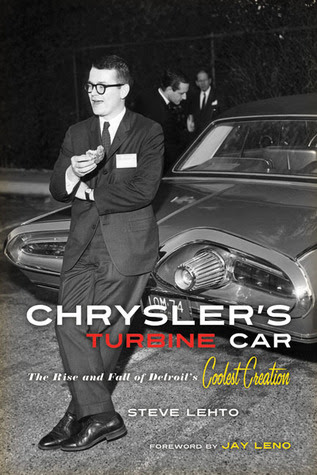
CHRYSLER'S TURBINE CAR, a history of squandered opportunities to reduce carbon emissions
CHRYSLER'S TURBINE CAR: The Rise and Fall of Detroit's Coolest Creation
STEVE LEHTO
$9.99 ebook editions, available now
Rating: 3.5* of five
The Publisher Says: The fascinating story of an almost-forgotten automotive phenomenon
In 1964, Chrysler gave the world a glimpse of the future. They built a fleet of turbine cars—automobiles with jet engines—and loaned them out to members of the public.
The fleet logged over a million miles; the exercise was a raging success.
These turbine engines would run on any flammable liquid—tequila, heating oil, Chanel #5, diesel, alcohol, kerosene. If the cars had been mass produced, we might have cars today that do not require petroleum-derived fuels. The engine was also much simpler than the piston engine—it contained one-fifth the number of moving parts and required much less maintenance. The cars had no radiators or fan belts and never needed oil changes.
Yet Chrysler crushed and burned most of the cars two years later; the jet car's brief glory was over. Where did it all go wrong? Controversy still follows the program, and questions about how and why it was killed have never been satisfactorily answered.
Steve Lehto has interviewed all the surviving members of the turbine car program--from the metallurgist who created the exotic metals for the interior of the engine to the test driver who drove it at Chrysler’s proving grounds for days on end. Lehto takes these first-hand accounts and weaves them into a great story about the coolest car Detroit ever produced.
I BORROWED THIS BOOK FROM MY LOCAL LIBRARY. SUPPORT YOUR LIBRARY, FOLKS!
My Review: A short, concise history of the very thing the title declares: The coolest creation ever to come out of Detroit!
Oh wow! Oh cool! Oh my GOD why didn't they make this?!
Well, after reading this book, I know why: It was too far ahead of its time, and when its time came, the company was on the ropes.
The author spoke to everyone he could find still living who participated in the most amazing PR campaign of all time: Chrysler made 50 of these babies and, over the course of 1964-1966, lent them out to 203 drivers for 90 days apiece. The 50 cars racked up over 1 million miles of travel, and had less than 1% downtime in all of that driving. Reliability was clearly not a huge issue. But what *was* a huge issue was the way the turbines needed to be manufactured, basically each one by hand. There was, in that pre-computer-control era, no way to automate the process of making the engine parts.
But then the what-if machine kicks in: The cars didn't need to use gasoline, or even petroleum products...they ran one car on tequila, and another on peanut oil. Had manufacture gone ahead, perhaps advances in technology would've speeded up computer-aided design and production. This kind of technology could've reduced carbon emissions....
Imagine a world where the car smells like a deep fryer and sounds like a jet, leaving water as its exhaust.
Lost chances. The very source of all good fiction. *turns on private bubble machine*
Friday, December 15, 2017
THE DOOMED CITY, Soviet-era scary predictive fiction
THE DOOMED CITY
ARKADY AND BORIS STRUGATSKY (tr. Andrew Bromfield)
Chicago Review Press
$13.00 ereader platforms, available now
Rating: 5* of five
The Publisher Says: Arkady and Boris Strugatsky are widely considered the greatest of Russian science fiction masters, and their most famous work, Roadside Picnic, has enjoyed great popularity worldwide. Yet the novel that was their own favorite, and that readers worldwide have acclaimed as their magnum opus, has never before been published in English. The Doomed City was so politically risky that the Strugatsky brothers kept its existence a complete secret even from their best friends for sixteen years after its completion in 1972. It was only published in Russia in the late 1980s, the last of their works to see publication.
It was translated into a host of major European languages, and now appears in English in a major new translation by acclaimed translator Andrew Bromfield. The Doomed City is set in an experimental city bordered by an abyss on one side and an impossibly high wall on the other. Its sole inhabitants are people who were plucked from Earth's history and left to govern themselves under conditions established by Mentors whose purpose seems inscrutable. Andrei Voronin, a young astronomer plucked from Leningrad in the 1950s, is a diehard believer in the Experiment, even though he's now a garbage collector. And as increasingly nightmarish scenarios begin to affect the city, he rises through the political hierarchy, with devastating effect.
THE PUBLISHER PROVIDED ME WITH A REVIEW COPY. THANK YOU.
My Review: I'll say this about the Strugatsky Brothers: They had *fearless* imaginations, tempered by fearful souls that quailed before publishing this nihilistic, absurdist, deeply subversive book in Soviet Russia. Completed in 1972, shelved until 1989, and published in a professional English translation only in 2016, this stateless satirical look at the amoral roots of True Belief in a System reads as well in 45's Amurruhkuh as it did in Brezhnev's USSR.
Voronin, our astronomer-turned-state-official, is an ideal. He is every system's beloved child, the True Believer who makes excuses and finds reasons instead of asking, "...the fuck...? Are they kidding with this?" As experience teaches him to question, he sidesteps. He changes his beliefs without batting an eyelash, a clue to his essential hollowness. For all that he is an eager participant in all the City's shifts of philosophical direction, the reason he can do so remains unexamined: He's complicit in the acts of the State, not driven by a desire to enact a Vision. His lack of an inner compass is rather amusing given that almost the entire novel is an internal monologue. I myownself found this a delightful twist, enjoying the musings of a centerless man as irony. Others might find that conceit wearing.
The things I found wearing were the astoundingly sexist and anti-Semitic attitudes of the characters (and, I suspect, the authors as well). There are horrible words used in connection with the two women I can recall at all...they might indeed have been the only two women mentioned, for I can summon no other woman to mind...and Katzman's presence in stereotypical fashion was not obviously played for ironic effect.
Given my track record for objecting to these facets of other older books, why am I giving this one the Full Five? Because, my friends, the story of a city between an unscalable wall and an endless abyss recommends itself to me as a parable for all of human life, and the awful attitudes of the PoV character are part and parcel of the falling, failing world that the Strugatskys were lampooning, dissecting, parodying, itemizing. These facets seem to me, even though I suspect and believe they were presented unironically, to be so much of a piece with the Experiment being ridiculed that I could easily make them objects of fun. Nonetheless they are there and merit mention lest an unsuspecting reader trip over them and feel blindsided.
Boris Strugatsky, in his Afterword, says it all and best:
How to live in conditions of ideological vacuum? How and what for? In my opinion this question remains highly relevant even today—which is why City, despite being so vehemently politicized and so categorically of its own time, potentially remains of interest to the present-day reader—provided that this reader has any interest at all in problems of this kind.
Subscribe to:
Posts (Atom)