Showing posts with label anti-semitism. Show all posts

Thursday, February 19, 2026

SKYLARK, Author Paula McLain's dual-timelines historical Paris novel


SKYLARK
PAULA McLAIN

Atria Books (non-affiliate Bookshop.org link)
$14.99 ebook, available now

Rating: 3* of five

The Publisher Says: The New York Times bestselling author of The Paris Wife weaves a mesmerizing tale of Paris above and below—where a woman’s quest for artistic freedom in 1664 intertwines with a doctor’s dangerous mission during the German occupation in the 1940s, revealing a story of courage and resistance that transcends time.

1664: Alouette Voland is the daughter of a master dyer at the famed Gobelin Tapestry Works, who secretly dreams of escaping her circumstances and creating her own masterpiece. When her father is unjustly imprisoned, Alouette's efforts to save him lead to her own confinement in the notorious Salpêtrière asylum, where thousands of women are held captive and cruelly treated. But within its grim walls, she discovers a small group of brave allies, and the possibility of a life bigger than she ever imagined.

1939: Kristof Larson is a medical student beginning his psychiatric residency in Paris, whose neighbors on the Rue de Gobelins are a Jewish family who have fled Poland. When Nazi forces descend on the city, Kristof becomes their only hope for survival, even as his work as a doctor is jeopardized.

A spellbinding and transportive look at a side of Paris known to very few—the underground city that is a mirror reflection of the glories above—Paula McLain’s unforgettable new novel chronicles two parallel journeys of defiance and rescue that connect in ways both surprising and deeply moving.

I RECEIVED A DRC FROM THE PUBLISHER VIA NETGALLEY. THANK YOU.

My Review
: Tunnels, underground/out of sight communication, hidden pathways...thematically this is the heart of Author McLain's story. The literal, factual tunnels under Paris start us out on the careful and hazardous reality of being a woman or, later, that other despised minority a Jew...yes, women were a social minority, rendered voiceless and affectless the way minorities always are...so we're going underground to follow them as they fight to survive without being Seen and still being effective actors in society. Spoiler alert: It doesn't go well.

There ya go. That's the story. It took almost five hundred pages of pretty sentences to get there.

They are pretty sentences but honestly, taken out of context they're pretty much meaningless. Describing a sculpture made by a side character, "... a lark with wings unfurled, fashioned from pale limestone with such delicate precision that it seems almost alive," is lovely...but its entire reason for being described is in fact its meaning and that's a gestalt. This is not a criticism of the writing, it's a statement of why I'm not quoting a lot more pretty sentences.

In my opinion reading this really interesting story-idea could have been a lot more fun had the author been less pretty and more concise in her writing. It's a fine way to spend a weekend in the company of two people marginalized for being...unpopular because they're Other...but I don't know that I felt adequately entertained to justify the length of time it all took to come together.

Saturday, August 9, 2025

THE PROPAGANDIST, a careful personal inquiry into that weird addiction, Hate (with a capital-H)


THE PROPAGANDIST
CÉCILE DESPRAIRIES
(tr. Natasha Lehrer)
New Vessel Press (non-affiliate Bookshop.org link)
$17.95 all editions, available now

Rating: 3.75* of five

The Publisher Says: In a grand Paris apartment, a young girl attends gatherings regularly organized by her mother. The women talk about beauty secrets and gossip, but the mood grows dark when the past, notably World War Two, comes under coded discussion in hushed tones.

Years later, the silent witness to these sessions has become a prominent historian, and with this chilling autobiographical novel she sets out to unmask enigmatic figures in and around her family. Why, she seeks to understand, did they betray their Jewish neighbors and zealously collaborate with the Nazi occupation of France, remaining for decades hence obsessive devotees of that evil lost cause.

I RECEIVED A DRC FROM THE PUBLISHER VIA EDELWEISS+. THANK YOU.

My Review
: Very much like My Dinner with Andre, only French and about Nazi collaborators, in their own damning words.

What a book to write from one's own experiences. I'm amazed she was not more vilified, as it seems her brother had the most powerful negative response to publishing what amounts to the filthiest of dirty laundry. The author "is a specialist in Germanic civilization and a historian of the Nazi occupation of France. She is the author of several historical works about the occupation and the Vichy regime. Born in Paris in 1957, The Propagandist is her first novel," though certainly not her first book (publisher's provided biographical info). I think my favorite title of hers is "Ville Lumière, Années Noirs" or roughly "City of Light in Years of Darkness" about the Nazi occupation. I wish someone would translate it because my days of slugging through big honkin' books in French are gone.

Lucie, the Propagandist of the title, was married to an Aryan named Friedrich before the convenient marriage to the narrator's rich father. It was Friedrich, the One True Love of Lucie's life and an early eugenics researcher, who formed the future matriarch's attitudes ever after. Lucie and her female relatives all use the corruption of French legal and social systems (this is the land of the Dreyfus Affair and the LePens' evil racism, recall) to benefit materially from the vanishing and lack of return of Parisian Jews.

Probably the best time I had reading about these vile people as they sat around discussing their necrotic morality was the details of how exactly the collaborators accomplished this feat of theft. "Listening" to them as they bemoaned being called collaborators and spewed hatred was, frankly, unpleasant. It's a lot like people in the US not protesting ICEstapo's disappearing of people the scum risen to the top don't like. If you're wondering what those "good Germans" and ordinary French collaborators thought of just sitting back and not speaking out, look in a mirror.

The last third of the book dragged past me. The horrified fascination of learning what these entitled sleazebags got up to in order to hide from justice while keeping their ill-got gains wore off; the stars fell from my eyes and my rating. The absence of a central conflict got to me at last. I can't help but praise the author and the book, while tutting over the story as a story.

What I want to say and do at this passage in US political history is very much what the author has done here: Hold an unsparing mirror to the inner workings of "good people" who make excuses for their inaction. Its consequences are real. The Gestapo, loyal only to The Leader, and constrained by no laws, is operating now.

What are you doing to resist it? Are you sitting in your comfy world tutting? At least sending money to help refugees somewhere? Anything? Or are you these detestable Parisian ladies' spiritual descendant?

Thursday, December 14, 2023

THE WARNER BROTHERS, the Jewish immigrants who created modern Hollywood


THE WARNER BROTHERS
CHRIS YOGERST

The University Press of Kentucky (Screen Classics series)
$34.95 hardcover, available now

Rating: 4* of five

The Publisher Says: One of the oldest and most recognizable studios in Hollywood, Warner Bros. is considered a juggernaut of the entertainment industry. Since its formation in the early twentieth century, the studio has been a constant presence in cinema history, responsible for the creation of acclaimed films, blockbuster brands, and iconic superstars.

These days, the studio is best known as a media conglomerate with a broad range of intellectual property, spanning movies, TV shows, and streaming content. Despite popular interest in the origins of this empire, the core of the Warner Bros. saga cannot be found in its commercial successes. It is the story of four brothers—Harry, Albert, Sam, and Jack—whose vision for Hollywood helped shape the world of entertainment as we know it.

In The Warner Brothers, Chris Yogerst follows the siblings from their family's humble origins in Poland, through their young adulthood in the American Midwest, to the height of fame and fortune in Hollywood. With unwavering resolve, the brothers soldiered on against the backdrop of an America reeling from the aftereffects of domestic and global conflict. The Great Depression would not sink the brothers, who churned out competitive films that engaged audiences and kept their operations afloat—and even expanding. During World War II, they used their platform to push beyond the limits of the Production Code and create important films about real-world issues, openly criticizing radicalism and the evils of the Nazi regime. At every major cultural turning point in their lifetime, the Warners held a front-row seat.

Paying close attention to the brothers' identities as cultural and economic outsiders, Yogerst chronicles how the Warners built a global filmmaking powerhouse. Equal parts family history and cinematic journey, The Warner Brothers is an empowering story of the American dream and the legacy four brothers left behind for generations of filmmakers and film lovers to come.

I RECEIVED A DRC FROM THE PUBLISHER VIA EDELWEISS+. THANK YOU.

My Review
: Four driven Jewish immigrants left Poland poor nobodies and became the architects of an entire multi-billion dollar empire...and multi-trillion dollar industry.
They didn't play nice all the time. They didn't hesitate to call out hypocrisy while practicing it. But they, for better or worse, made the modern celebrity/entertainment culture we all live in from their savviest business instincts and their unrelenting drive to be Safe in their new homeland. They were charitable with their money and made a big difference in many lives, for the better.

Their studio acquiesced to the Production Code, as they had to in order to stay in business, but produced subversively messaged anti-Nazi and anti-Klan movies. They innovated technologically (The Jazz Singer's sound was an invention of Sam Warner, who died before its premiere...one of the brothers' many personal tragedies). They created and massaged and changed advertising paradigms, distribution methods, audience metrics...and how to make a mess of your life. Jack Warner, a horrible man, comes out of this biographical book looking like Iago's mentor. He was awful to actresses, he was awful to his brothers, he was horrible to his son. No one that terrible should've made the amazing films he made.
Loads of black and white images make this a handy reference for studio publicity photo lovers, and enrich the general reader's experience of the story. It is told as a story, albeit not in the most exciting narrative voice. The author definitely wants you to know that he's done the research, thought through the implications of the Warner Brothers's effect on film as an art and an industry. He's not ignoring the personal details of their Shakespearan family saga. He just doesn't give it to you in punchy, quip-laden sentences.
Author Yogerst is telling us the story of an Institution, The Warner Brothers, a family of immigrant Jews in an anti-semitic world, who created the institution Warner Bros., whose thousands of films we've all watched our entire lives...pure Hollywood, that story. That will appeal to your film-buff giftee as well as your Jewish studies maven. The Warner Brothers are well-served by The Warner Brothers.

Sunday, June 20, 2021

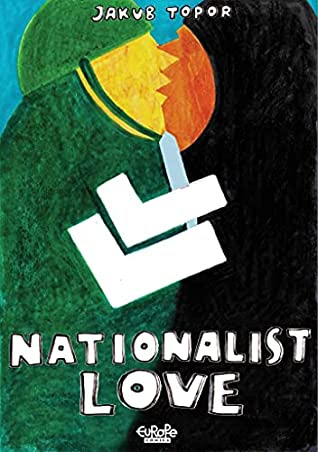
NATIONALIST LOVE, a Polish graphic novel about QUILTBAG people...just not the ones you're thinking of


NATIONALIST LOVE
JAKUB TOPOR

Europe Comics (non-affiliate Amazon link)
$11.99 ebook editions, available now

Rating: 5* of five

The Publisher Says: When Zapsky and Byro meet during a right-wing nationalist march, their joint escape from the police results in an unexpected and violent outburst of passion. Their initial euphoria quickly turns into doubt and fear—after all, if their buddies found out about them, the consequences would be terrible... But now that they’ve come together, will they be able to simply forget and move on with their lives? Or is it something more lasting, despite the risk it represents for both?

"Nationalist Love" is the third graphic novel by Jakub Topor, nominated for the graphic novel of the year award at the Lodz Comics Festival.

I RECEIVED A DRC FROM THE PUBLISHER VIA NETGALLEY. THANK YOU.

My Review
: Two skinhead boys, Zapsky and Byro, meet at a hate-rally held in their Polish city. The Nationalists, our Proud Boys writ Euro, throw stuff and set fires and hurt cops. These are some revolting people. They're each stupider than the other, they got no class or brains, yet still they find each other...attractive? available? attainable maybe. Their stupid antics require them to hide from the cops...naturally they decide to do it together, since Zapsky's mother is away for a month. Hijinks ensue.

This isn't the first time I've seen these boys, just never so thoroughly reduced to their ugliest shapes and colors. As a not-especially-convinced experiencer of sequential art, this was always something I found irritating...this kind of "artwork" would get the horselaugh from so many artsy types I've known. I'd absorbed that prejudice and simply never bothered to challenge or examine it until the past few years. Now, I look at this art's clumsiness and its garishness and think...well, how better to narrate this story?

Whaddaya expect, anyway, in a world centered on two losers without a shred of class or decency between them? They are always gonna have to hide abnormal, sick sexual proclivities from the world their undereducated, credulous, angry, and powerless class lives in. Funnily enough, like so many who live in that hate-defined and -bounded world, it's also the one they resent. But Zapsky and Byro got lucky, found each other....found love...which is the most dangerous thing of all. Zapsky definitely feels this, after a brief and deeply unsettling period of being truly happy with Byro, and under pressure to prove he's not a fag to his co-workers, he sends a break-up text that callously dismisses Byro.

Zapsky's Mammele, escaping her loser son's ubiquity and her own pointless existence, is at a beach resort-cum-health spa. And guess what? She meets A Man too! (Called Manfred. No lie.) The sheer awfulness of the art, as in the ugliness of the people and the garishness of the colors, goes so well with this horrible tale of numerous disgusting creeps that it's almost eerie. And that's when I felt myself really giving up, shedding the weight of, that habit of contempt. It isn't pretty! But who said art needs to be pretty? I like Jackson Pollock and Agnes Martin, for gods' sweet sake. I'm not one of those Impressionism-über-Alles sofa-matching-art people!

Or maybe I am...and hide it from myself by liking things that made my mother cringe? That certainly includes comic books...I've been so snobby about them for so long that it feels fake to say, "there is no other way this story could've been told, and it very much needed to be told," but it's just the truth.

Chapter 3 is called "Spoiled Rich Kids"...seems to be a pattern among Polish émigré writers. Like Jedrowski in Swimming in the Dark, Topor gets a character (Byro Bad-skin here) among the wealthy who are privileged to consume and exist as they like. Then he lets him sink or swim...sink in this case. Byro's rebounding from his breakup text, and searches the Internet for gay clubs...he decides he's going to fix himself up, be less Nationalist looking, by dressing better and hiding his skinhead under his loser father's long-unused toupée. The club scene scares him, he doesn't know the culture and is about to get himself into serious trouble but is rescued by one of the rich kids. They decide to keep him when leaving the club becomes a good idea...he almost loses his cool when a "darkie" (an Arab guy called Jamal) is in the house party, too. He's eventually, and inevitably, outed as a Nationalist; but not until after kissing a straight guy at the party. The violence the posers inflict on Byro is pretty mild...more about humiliating him for not being like them. And that, despite the fact he doesn't *want* to be like them, is the worst rejection he suffers. (Not that he is recovered from being rejected by Zapsky, please understand. Just trying to figure out how to move on.)

Mammele gets lucky with Manfred. That scene's just grisly. Even Byro's parents decide to fool around (more grisly still). Byro's Dadzio figures out the kid's got his wig. That should be fun! I thought, watching him explain what the hell he was doing with the damn thing....

Chapter 4 is "Zapsky Looks for a Girlfriend"...the co-workers' plan to get Zapsky laid results in him finding one. Because he's never been in any relationship at all except the brief honeymoon with Byro, he ignores the red flags of an abusive, angry, selfish woman looking for something in exchange for the sex she doles out to him. In his months-long journey through this hell, Zapsky confronts low self-esteem, and his work pals do a lot to support him and care for him. They are crude but actually touchingly kind. Since we focus on Zapsky, we never learn anything more about what happened after Byro's night out...disappointingly...or about Mammele's reactions to the girl Zapsky gets with.

But long story short: Girl gets dumped. Zapsky gets lonely. One rainy day who does he see under a bus shelter but...BYRO!! It's a loving reunion, the bond of real love between them reasserts itself, and they, well, do what young guys do when under the heady influence of reciprocal attraction and genuine connection. They fool around.

...and there's a PoS from their earlier Nationalist lives filming their reunion.

Naturally, the evidence gets shown to the wrong people. All the old gang, I mean this literally, are on the hunt for Zapsky. They find him.

Things end as they so often do.

It's awful to know that this happens and happens and happens to men and women, cis and trans, all around the world because "don't be so sensitive" and "it's just a joke" aren't seen for what they are.

They are normalizations of hate, and soft volleys preparing the way for violence.

I downloaded this graphic novel from Europe Comics, an outfit with whom I am unfamiliar...how shocking...so, if you're in the same boat, here's their mission statement from NetGalley:
Europe Comics is a joint digital initiative run by 13 European comics industry players from 8 European countries. Its main purpose is the creation of a pan-European catalog of award-winning graphic novels from across the continent, published digitally in English and available through major retailers and library networks. Europe Comics also works towards the promotion of European authors and the creation of a European comics online directory, meant for both comics readers and professionals.

Well...so this Polish creator found his way to this American oldster via a social system intermediated by several levels of technology that are under a lot of pressure all the time to justify its worst users' behaviors. This is an example of positive social and personal results from being massively online. Say hallelujah and bring the jubilee.

Tuesday, October 27, 2020

THE DISAPPEARANCE OF ÉMILE ZOLA, a wrenchingly sad case of a man exiled from his home for daring to speak truth to power

THE DISAPPEARANCE OF ÉMILE ZOLA: Love, Literature, and the Dreyfus Case
MICHAEL ROSEN

Pegasus Books
$16.99 Kindle edition, available now

Rating: 3.5* of five

The Publisher Says: It is the evening of July 18, 1898, and the world-renowned novelist Émile Zola is on the run. His crime? Taking on the highest powers in the land with his open letter "J'accuse"—and losing. Forced to leave Paris with nothing but the clothes he is standing in and a nightshirt wrapped in newspaper, Zola flees to England with no idea when he will return.

This is the little-known story of Zola's time in exile. Rosen has traced Zola's footsteps from the Gare du Nord to London, examining the significance of this year. The Disappearance of Émile Zola offers an intriguing insight into the mind, the loves, and the politics of the great writer during this tumultuous era in his life.

I BORROWED THIS BOOK FROM MY LOCAL LIBRARY'S I.L.L. PROGRAM. THANK THEM BEST BY USING THEIR SERVICES OFTEN.

My Review
: A very interesting digest of the paperwork, published sources, and private thoughts recorded between 13 January 1898 and Christmas 1900. The Dreyfus Affair's incredibly long shadow hasn't passed yet, though the anti-"foreigner" (Dreyfus was born a citizen) attitude of many of the French has shifted to the (also born citizens) Muslims. The rhetoric hasn't changed much.

Zola's response to the collective horror of his country's leaders...the men (all men, of course) charged with guiding the Ship of State into safe harbor, who listened to the lowest, the least, and the worst people in France and then gave them something they wanted...an Other to abominate and excoriate...was to scream his fury and rejection. These "leaders" then put the innocent-of-treason Dreyfus, that designated scapegoat to France's darkest impulses, onto a ship to die in their most horrifyingly ghastly prison colony. The baseness, the injustice, the inhumanity of it, ate at Zola like acid. He was the author of a multi-volume body of work called Les Rougon-Macquart, a daringly honest and searingly realistic 20-volume (!) cycle of tales about a clan of nothing-special French folk that earned Zola an international reputation for both talent and prurience. Reading them today, both seem reasonably accurate assessments.

So what, the guy's dead 118 years, the Dreyfus Affair happened 122 years ago.

Look around you. I would that we had a Zola to, in clear and direct prose, accuse the malefactors of our world of their crimes and, what's more, make the accusations stick. Would that it had been a lawyer named Mueller...I have kept hope alive that someone both could and would make a dent in the current administration's malfeasance. Now it looks as though there will be a coup attempt instead of a peaceful transfer of power! Hélas.

Rosen also includes translations of "Angelique," a "ghost story" that Zola wrote in London, as well as the stirring-if-stilted J'accuse! as it appeared in L'Aurore on 13 January 1898. If none of these events are familiar to you, go read this book immediately.

I'm stingy star-wise because Rosen's task includes the thankless one of framing his subject to people unfamiliar with the dramatis personae as well as the casus belli that got the whole thing going. As a result, he resorts to much inevitable spoon-feeding and that, I fear, caused my eyes to glaze over. It's necessary, it's even reasonably well-done, but it's bloody tedious and kept me from ever forgetting how Worthy the people were and how Relevant the warnings herein are. When my finger finds the overemphasis-via-shift key without being told to go there by my brain, we have a problem between us, Author Rosen.

Paradoxically, that makes me want all y'all to read this book all the more! The beauty of history is that we are able to view causes and effects in their entirety; a thing obviously impossible in the present. The tragedy of history is that those who don't read it don't learn from it; a thing that could prevent the present from repeating the past verbatim. I will say this: When you read this book, you will not feel like you're being told to keep chewing that wad of kale until it goes down your throat. More along the lines of, "here's some lovely dark bread to sustain you, love, and a big pat of real butter for yummies."

Saturday, September 13, 2014

WHAT MAKES SAMMY RUN?, a super read and a genuinely good classic Hollywood novel


WHAT MAKES SAMMY RUN?
BUDD SCHULBERG

Random House
$16.00 trade paper, available now

Rating: 4.5* of five

The Publisher Says: Everyone of us knows someone who runs. He is one of the symptoms of our times—from the little man who shoves you out of the way on the street to the go-getter who shoves you out of a job in the office to the Fuehrer who shoves you out of the world. And all of us have stopped to wonder, at some time or another, what it is that makes these people tick. What makes them run?

This is the question Schulberg has asked himself, and the answer is the first novel written with the indignation that only a young writer with talent and ideals could concentrate into a manuscript. It is the story of Sammy Glick, the man with a positive genius for being a heel, who runs through New York’s East Side, through newspaper ranks and finally through Hollywood, leaving in his wake the wrecked careers of his associates; for this is his tragedy and his chief characteristic—his congenital incapacity for friendship.

An older and more experienced novelist might have tempered his story and, in so doing, destroyed one of its outstanding qualities. Compromise would mar the portrait of Sammy Glick. Schulberg has etched it in pure vitriol, and dissected his victim with a precision that is almost frightening.

When a fragment of this book appeared as a short story in a national magazine, Schulberg was surprised at the number of letters he received from people convinced they knew Sammy Glick’s real name. But speculation as to his real identity would be utterly fruitless, for Sammy is a composite picture of a loud and spectacular minority bitterly resented by the many decent and sincere artists who are trying honestly to realize the measureless potentialities of motion pictures. To this group belongs Schulberg himself, who has not only worked as a screen writer since his graduation from Dartmouth College in 1936, but has spent his life, literally, in the heart of the motion-picture colony. In the course of finding out what makes Sammy run (an operation in which the reader is spared none of the grue-some details) Schulberg has poured out everything he has felt about that place. The result is a book which the publishers not only believe to be the most honest ever written about Hollywood, but a penetrating study of one kind of twentieth-century success that is peculiar to no single race of people or walk of life.

My Review: Budd Schulberg got a lot of grief for writing this "anti-Semitic" shriek of outrage at the backstabbing, grasping, greedy, hollow culture of Hollywood. Well, how else could he tell the story? The moguls of the time were almost all Jewish, and they weren't nice little yeshiva boys but street toughs with chips on their shoulders hell bent for leather to make it to the top.

Today it is a lot less true of Hollywood's power elite. Not the behavior, the Jewishness. The behavior is intact! Of this I assure you from personal experience. And people of both genders and all religious and cultural affiliations enact it there. Awful place. As one would expect from any place where there is that much money floating around. *Breathtaking* amounts of money. The greed of these people is utterly beyond the comprehension of mere mortals. "Enough" is what you say to the chauffeur you're firing who complains it's unjust.

Reading this book was a bitter and painful reliving of my education in how "no good deed goes unpunished" and I will never re-read it for that reason. But dayum! What a glorious excoriation of the moral midgets who make our movies, TV shows, and music! I am in *awe* that Schulberg got away with writing it and stayed in Hollywood! Steven Spielberg, that maker of iconically positive movies, said the book should never be made into a movie because it's too anti-movie-biz.

Guess what: It never has been. Even Ben Stiller, who wanted to star and direct, couldn't get it done when he was at his peak of fame and power.

Shows you just how true it was, is, and will remain. *shudder*

Creative Commons License
This work is licensed under a Creative Commons Attribution-NonCommercial-ShareAlike 3.0 Unported License.