Showing posts with label rural poverty. Show all posts

Thursday, August 1, 2024

OF SAINTS AND MIRACLES, family tragedy that creates a folk hero


OF SAINTS AND MIRACLES
MANUEL ASTUR
(tr. Claire Wadie)
New Vessel Press
$16.95 trade paper, available now

Rating: 4.5* of five

The Publisher Says: This mesmerizing novel opens with a fratricide in a beautiful if impoverished region of northern Spain.

The perpetrator, Marcelino, lives alone in his parental home where he recalls having doted on his baby brother and sought to protect their mother from their father’s drunken rages. Author Manuel Astur’s poetic language and seamless blend of lyricism with the grotesque renders this book a treasure for the reader that includes the mother’s bewitching tales about the sun, the moon, and an invisible horse-drawn carriage of death. Glimpses into other villagers’ lives reveal a community that gathers to slaughter pigs for feasts and to confront a mysterious plague of white worms.

The mountainous green of rural Asturias is as much a character as these residents, from whom Marcelino flees to the wild peaks after his brother’s slaying, becoming a cult hero as he evades authorities. Of Saints and Miracles is a sensuous portrayal of an outcast’s struggle to survive in a chaotic world of both tragedy and magical splendor.

I RECEIVED A DRC FROM THE PUBLISHER VIA EDELWEISS+. THANK YOU.

My Review
: What startled me most was being in medias res, knowing the murderer from the get-go and the inside out. That is a subversion of expectations that made me stick to the tale as it was being told. Normally I read murder-themed stories while looking for clues and hints from the off. I was made to think a different way about this true-life tale.

It worked in this read's favor, as the way the story's written is a joy to read:
When you see a weed in the vegetable plot you pull it out. When you've got more chickens than you need, you wring the neck of one and chuck it in the pot. When some dog mounts your bitch and she gives birth to a litter, you choose the best puppy, put the rest in an old potato sack with some stones and throw the sack in the river. When an apple tree no longer bears fruit, you cut it down and chop it up for firewood. When the grass in your field gets too long, you cut it, gather it up and store it in the hayloft. When a man in a suit comes and shows you some papers and tells you some stuff about mortgages and wants to take away your vegetable plot, your hens, your bitch and your fields, you defend yourself. Even if this man in a suit is your brother. And they can call you a revolutionary and talk about you on TV and in the papers and say who knows what about the oppressed peoples, or the last remaining guerrilla, but the truth is simpler, it's always simpler. And the truth is that you have to do what you have to do.
–and–
(Marcelino/)Leno's mother told him to give the little old lady a kiss. She smelled of cookies, earth, and bleach. Then she gave a toothless smile like a baby magpie and made a gurgling sound as if she had sand in her throat. She gurgled some more and his mother understood, even if he didn't. That was about all he could remember of the old world. The yellow smell of human piss and past lives filled with misery. A white washbowl with a tear shaped chip in its enamel, glowing in the darkness like an apparition. A one-eyed ginger cat asleep at the old woman's feet. A tatty old oil cloth on a rickety table. A few empty hooks, blackened by grease over the years. A handful of dried ears of corn tied up in a piece of cloth. Shadows dancing on the filthy wall. That's about it.

You like it, you don't...I don't think anyone can make much of a case that this isn't a robust storytelling voice. The way the voice comes across in telling this sad, brutal tale of a simple man solving problems he doesn't understand as best he can suited this reader as well as anything could.

The fearsomeness of committing a fratricide is never far from Marcelino's mind.
You see, this wound hurts just as much as yesterday’s wound, which hurt as much as the one before, and the one before the one before that, and as much as the first wound, the original wound that the first man feared. And though this wound is bleeding in the same way as all wounds bleed, and blood has always been the same, this wound thinks itself unique.
–and–
Death is never heroic. Life can be, but not death. Death comes to us all, but we know that if a woman watches over us on our deathbed, we’ll go to heaven.
–and–
All the dead are good because they are no longer alive and can therefore be imagined. As with fools and saints, we can lie about them because they can't defend themselves. They are a tale with countless morals, in illustration of whatever you like, a myth to be molded. The dead don't belong to the dead; the dead are ours.

These are simple thoughts, basic, grounded—even rooted—in the life of a man who has no sophisticated veneer to hide his innocent belief that the world can, and must, be made to make sense. Even or especially when it doesn't. Marcelino, based on a man called Tomasín whose life ended in exactly this concatenation of nightmares, becomes a symbol of the distant and rural province of Asturias's resistance to the rapidly modernizing economy of Spain after Franco's 1975 death. No one who's ever had a credit card or a cellphone contract won't, in some small way, fail to comprehend this desire to see someone stick it to The Man. No one whose family is normal won't, in some small way, recognize the urge to commit murder of a sibling who's just done you dirt.

Author Astur set out to tell us a story of a world, an old one, that is losing its battle to remain as it is. A world that pays attention, not compound interest. A world where Marcelino, salt of the Earth that he is, can be so in tune with Life that it becomes Art before his fulfilled eyes:
Just as a sun-soaked stone radiates heat for a while after nightfall, there is a point on still summer evenings whe objects appear to shine, as if to give back part of the generous daylight they've received. In such moments, Marcelino would stop what he was doing — clod of earth on the hoe, spade sunk deep in the hay, scythe dripping with fresh green blood — to stand up straight, wipe his brow with the back of his hand and contemplate the valley below. Everything would be gleaming, chiming like a bell of golden light. He would let his eyes fill with sky.

And so, as the sun set on that July evening, Marcelino stopped and contemplated. The house, the stilt granary, the cart with its shaft reaching skyward, the dry straw, the ears of corn, the cows in a single spine coming home along the track, the dog’s bowl, the rusty drum among the nettles, the axe in the tree stump, the woodchips and the logs, the sawdust on the ground, even the moss that hugged the stones in the walls of the small vegetable plot, even the trees in the nearby woods and the mountain peaks: everything shimmered, silhouetted against the deep-blue sky, in which a single bright star heralded the coming of a new age. Everything, that is, except the large bloodstain in the sawdust, and his brother’s body, both so dark they seemed to trap the light, as if the black ink that was slowly flooding the valley was seeping directly from them, saturating the sky and drawing the shapes of bats, which began to dance around the yellowish light of Cobre’s lone street lamp.

We go into this read certain murder is Wrong, murderers must be caught and required to suffer punishment; and come out without such a comfortable Certainty. Did Marcelino do wrong by killing his wicked brother? Yeah. Was he Wrong, was his action a rip in the fabric of society?

Dunno about you, but I came out of this read not at all sure. Read it soon, tell me what you thought.

Monday, August 29, 2022

REAL BAD THINGS, a very accurate title for a twisty story


REAL BAD THINGS
KELLY J. FORD

Thomas & Mercer
$4.99 Kindle edition, available for pre-order; releases Thursday

Rating: 4* of five

The Publisher Says: From the author of Cottonmouths, a Los Angeles Review Best Book of 2017, comes an evocative suspense about the cost of keeping secrets and the dangers of coming home.

Beneath the roiling waters of the Arkansas River lie dead men and buried secrets.

When Jane Mooney’s violent stepfather, Warren, disappeared, most folks in Maud Bottoms, Arkansas, assumed he got drunk and drowned. After all, the river had claimed its share over the years.

When Jane confessed to his murder, she should have gone to jail. That’s what she wanted. But without a body, the police didn’t charge her with the crime. So Jane left for Boston―and took her secrets with her.

Twenty-five years later, the river floods and a body surfaces. Talk of Warren’s murder grips the town. Now in her forties, Jane returns to Maud Bottoms to reckon with her past: to do jail time, to face her revenge-bent mother, to make things right.

But though Jane’s homecoming may enlighten some, it could threaten others. Because in this desolate river valley, some secrets are better left undisturbed.

I RECEIVED A DRC FROM THE PUBLISHER VIA NETGALLEY. THANK YOU.

My Review
: Like her previous novel Cottonmouths (my review linked above), this book is set in a rural area that could be anywhere but undeniably is the American South. At no point do we feel the curiously unmoored sensation that many crime-centered stories have, that eternal-now anywhereness. It starts from when Jane is released from steerage, I mean the commuter plane, onto the hot tarmac of a regional airport. Her mother's nasty phone message hissing in her newly single, newly homeless ear, "don't even think of running." Why Ma didn't say "again" is beyond me, because Jane's running hasn't stopped since it was "away to Boston, there a lesbian to be."

So now she's coming back to face the music for confessing to her stepfather's murder a quarter century ago. Note: confessing to. Not murdering. And that demented witch of a mother believes her, always has, she's been squatting in this nowhere town stewing in her rage and hate for the abnormal daughter who (she said she believed) murdered the abusive man who probably would've killed Ma by now had he lived.

Ah. Family ties.

Like many women with no options, her Ma had never met a nice guy and this latest one was the most violent yet. And the whole town knew it. Not a soul stepped in to help...except Jane's young love, Georgia Lee. Things go very Beautiful Creatures for a minute...Jane's brother Jason gets pulled in...it's all a major clusterfuck, in fact, and when it all settles down there's no Warren. I mean, he's dead, but there's no body. So, no body = no crime. Confess til ya turn purple, Janey luv, no body = no crime. She does spend a goodly amount of time in juvenile detention. The second that ends, she gets the hell out of Arkansas.

What is really clear while reading this book is the quiet insanity of country life. People are all up in each other's hip pockets, they know what's happening, but not a soul interferes. Wouldn't be proper, if a woman lets a man beat her up that's her lookout. Those kids won't amount to anything anyway, so what they suffer.

It's really like this, folks. This is what the world is. And it's ugly as all get out.

Now that everything changed because there's a body, surfaced after twenty-five years, Jane's home to face the music.

What music? She was a juvenile, she was in state custody until charges were dropped, and now there's *a* body but no one knows if it's that right one. (Lotsa men disappeared from this town over the years. No one seems to've looked into it. Not like they were anybody much.)

So we have ourselves a problem. What's Jane facing? Trial? Still no body...conviction? LOLOL

Her life. Her mother. Her ex, her first true love Georgia Lee. Even the little brother who simply existed throughout this ordeal, offering nothing to Jane. All that and more; vaster than oceans and more deep is the need in Jane for answers rather than lies or silences. The answers she finally gets are deeply unsettling. I could never call the last meeting of Jason and Jane a case of healing by honesty, but it was certainly an explanation of parts of their past that seemed weird and random.

Kelly J. Ford was formed by Arkansas and she has never forgiven it for that. As revenges go, this book is a great step.

Tuesday, June 9, 2020

JOE, the late, great Larry Brown's first masterwork in novel form


JOE
LARRY BROWN

Algonquin Books
$15.95 paper, available now

Now only $1.99 on Kindle, so don't wait. (non-affiliate Amazon link)

Rating: 4* of five

The Publisher Says: Joe Ransom is a hard-drinking ex-con pushing fifty who just won’t slow down—not in his pickup, not with a gun, and certainly not with women. Gary Jones estimates his own age to be about fifteen. Born luckless, he is the son of a hopeless, homeless wandering family, and he’s desperate for a way out. When their paths cross, Joe offers him a chance just as his own chances have dwindled to almost nothing. Together they follow a twisting map to redemption—or ruin.

Kirkus, back in 1991 when they hated everything, said this of the book: "...Brown...pares his prose close to the bone, stripping away the slightest hint of sociology or regional color. This is white trash, lumpen fiction with a vengeance, and a vision of angelic desolation."

My Review: Selected as the May 2020 Moderator's Choice in the On the Southern Literary Trail Goodreads group, this is the novel that solidified Larry Brown's place in Grit Lit/Hick Lit's pantheon. He was a major talent; his short stories will, I think, be anthologized and lionized for a long time to come. He started out as a writer known for them; and I think that, like Hemingway, they will be his lasting contribution to Southern Literature's grittier edge.

This is not to denigrate or diminish his accomplishment in this, his most successful novel:
The road lay long and black ahead of them and the heat was coming now through the thin soles of their shoes. There were young beans pushing up from the dry brown fields, tiny rows of green sprigs that stretched away in the distance.
You know where you are; you know who you're with; you're not going for a madeleine with Proust. This is poverty, this is heat, this is misery on an epic scale but never ever looked at...it's witnessed, it's so real and so present that there is just not one doubt about its honesty. Heat and poverty are characters in this scene so cinematically framed. The people are, in fact, incidental if not ornamental. They exist as morality-play embodiments of Poverty, and they continue to do so throughout the book.

Is that a flaw? Is honest appraisal and presentation of reality ever a flaw?
“That boy,” he said. “I’ve done him ever favor I could. Some folks you can’t do nothing with. Just sorry. God knows I’ve done plenty of drinking and stuff in my time, but I be damn if I ever tried to cheat anybody out of any money.”
Is that a speech delivered to make an author's point, or is it the vox populi, the distilled belief of the Average Man that he is in fact average, the proper measure of a man's worth? It's certainly a refutation of the three-hundred-year-old moralism vox populi, vox dei! There is no god in this book, there is no numinous or immanent quality to anything. The landscape is hot, dry, miserable; the people are dumb, violent, miserable; the vox regis or deorum is notable only for its absence.

Also notably absent here are women's voices. They exist to bear children and beatings. They are adversaries to what low, animal joys men can find in sex (more akin to rape, in my opinion) and beer. Children are the punishment women inflict on men (as these men see it) for the fleeting pleasure of the rut. The idea of pleasure is, in general, absent from this world. It is a place where no one at all ever makes even a feint at a genuine smile.

What redeems this read from being a complete, utter, suicidal-depression-inducing downer? Joe Ransom. Drunken convict that he is, awful father that he may in fact be, to Gary Jones he is Jesus freshly down from the cross. Gary's sperm donor is a memorable...a matchless, actually...portrait of the kind of person I, in my damned close to infinite privilege, have never interacted with. He pimps out his prepubescent daughter. He does nothing of value to anyone, not even himself:
“She don’t like to be around anybody drinkin, don’t even like to smell it. I drink and I like to drink. That’s it.”
That's the least-offensive thing the man utters in this book. Probably in the whole of life. His son, his who-knows-how decent and good-souled son, makes him feel more worthless than he already does; not, however, as worthless as he actually is.

Gary goes to work for Joe on a county work crew. Joe, ex-con bad dad Joe, shines like a savior to him, modeling the astounding heights of not-stealing, of not-beating while being a man. Gary's life changes because he sees a possibility he never saw before. As events unfold, that possibility is embodied in a redemptive act of startling generosity, of genuine salvation.

And Joe chooses to save, not his own flesh and blood, but someone whose life trajectory makes Joe's own fucked-up life look like my wealth and privilege by comparison. If not for Larry Brown, I doubt I'd've made a second's time for these men.

Isn't this what fiction's meant to do? To make us, all of us really but especially the most shockingly privileged among us, pause and allow The Other to take unsentimental shape in our emotions?

Larry Brown did this to me, for me, and I am deeply grateful to him for it.

Monday, September 26, 2016

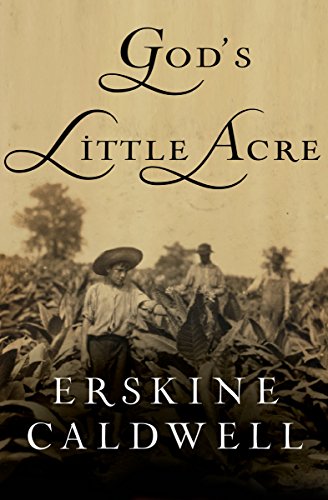
GOD'S LITTLE ACRE, a Banned Books Week sale from Open Road Media


GOD'S LITTLE ACRE
ERSKINE CALDWELL

Open Road Media
$1.99 Kindle edition, available now

Rating: 3.75* of five

The University of Georgia Says: Like Tobacco Road, this novel chronicles the final decline of a poor white family in rural Georgia. Exhorted by their patriarch Ty Ty, the Waldens ruin their land by digging it up in search of gold. Complex sexual entanglements and betrayals lead to a murder within the family that completes its dissolution. Juxtaposed against the Waldens' obsessive search is the story of Ty Ty's son-in-law, a cotton mill worker in a nearby town who is killed during a strike.First published in 1933, God's Little Acre was censured by the Georgia Literary Commission, banned in Boston, and once led the all-time best-seller list, with more than ten million copies in print. (This is the edition I read in 2012, which has a foreword by Lewis Nordan that I consider very important to read.)

Open Road Media Says: Caldwell’s blockbuster bestseller: In the Depression-era Deep South, destitute farmer Ty Ty Walden struggles to raise a family on his own

Single father and poor Southern farmer Ty Ty Walden has a plan to save his farm and his family: He will tear his fields apart until he finds gold. While Ty Ty obsesses over his fool’s quest, his sons and daughters search in vain for their own dreams of instant happiness—whether from money, violence, or sex.

God’s Little Acre is a classic dark comedy, a satire that lampoons a broken South while holding a light to the toll that poverty takes on the hopes and dreams of the poor themselves.

This ebook features an illustrated biography of Erskine Caldwell including rare photos and never-before-seen documents courtesy of the Dartmouth College Library.

**THE E-BOOK EDITIONS ARE ON SALE FOR BANNED BOOKS WEEK 2016**

My Review: First published in 1933, when the author was a mere slip of a thirty-year-old, this novel starts in a hole and keeps digging deeper and deeper. Literally, not metaphorically. Well, literally AND metaphorically.

Ty Ty and his sons are poor white Southern Americans in the grimmest economic times of the 20th century. There was revolution brewing because of the depth of the economic crisis, and the complete absence of any safety net for anyone at all. Ty Ty and his boys, like modern-day conservatives, are digging for gold in their unpromising Georgia home's unyielding land, and finding lots of dirt and not much else. The womenfolk are trying to keep food on the table and as many rapists as possible outside. The ones at home, well, we all have our crosses to bear, don't we?

Since the land's being dug up for gold instead of farmed for food, the boys go off to work in the textile mills. Yes Virginia, there once was a textile industry in the USA. Now it's all in Pakistan, where a couple dollars a month is a (barely) living wage. Mill owners naturally want to keep their costs down to maximize profits, and families are going hungry to make sure the rich get richer (is this sounding familiar?), until the unions come to town. With predictable results.

There's death, there's misery, there's hard work followed by failure, there's more misery, the end.

And what an end! What a beautiful piece of writing this is, and how very grim the picture it paints in its simple shapes and clear colors. There is nothing unclear or muddy about the book, except the minds of the characters, and that is by the author's design.

The search for gold isn't as stupid as it sounds. The Georgia north was Cherokee country until white folks found gold in them thar hills and booted the native inhabitants off the land. In the novel, some few flakes are found, but never enough to do what Ty Ty wants, which is free him and his family from want and dependence on others. It works well as a metaphor for the frayed and threadbare Murrikin dream, too: Keep working keep working keep working and the rewards will (not) come! Or if they come, at what cost, and ultimately to what end?

The title, God's Little Acre, refers to Ty Ty's gift of one acre of his farmland to God to support the church. But because Ty Ty wants gold for himself and his family, he moves the location of the acre at will, so he'll be sure not to give his gold away. Not so unfamiliar here, either, is it?

Murder, betrayal, lust, rage, and that's all before we get to the workplace! Is it any wonder this book was called obscene by the forces of reaction? It *was* obscene! The horrible exploitive relationships in every single nook and cranny of the world the characters inhabit is obscene. The dreadful ignorance, the grinding and maliciously intentional poverty, all of it obscene!

Sadly, with the slow withering of liberalism, the story's outlines are rapidly recrudescing in the modern Murrika being carved from the living flesh of the unwashed masses too drugged on the crack of an American Dream they will never, ever attain by Lotto or hard work or virtue rewarded. The horror is we've been here before, and a few brave and good men tried to steer us away from this hideous abyss. And here we are, back again.

Sick-making, isn't it? Read the book, and use it as a cautionary tale.

Thursday, July 7, 2016

Live today at The Oak Wheel! BAD THINGS HAPPEN by Kris Bertin, first story collection

Rating: 4* of five

My review of BAD THINGS HAPPEN is live now at The Oak Wheel. This CanLit collection, the first from author Kris Bertin, is worth ordering now before it has to go into a second printing. He's that good.

Biblioasis gets a big thank you for sending me my review copy, and I hope my almost-unqualified rave will be helpful. I want to support presses that find and publish authors of this quality. Please follow my lead!

Monday, June 13, 2016

KNOCKEMSTIFF by Donald Ray Pollock...reposting 5-star 2010 review


KNOCKEMSTIFF
Donald Ray Pollock

Anchor Books
$16.95 trade paper, $5.99 Kindle edition, available now

Rating: 5* of five

The Publisher Says: In this unforgettable work of fiction, Donald Ray Pollock peers into the soul of a tough Midwestern American town to reveal the sad, stunted but resilient lives of its residents. Knockemstiff is a genuine entry into the literature of place.Spanning a period from the mid-sixties to the late nineties, the linked stories that comprise Knockemstiff feature a cast of recurring characters who are irresistibly, undeniably real. A father pumps his son full of steroids so he can vicariously relive his days as a perpetual runner-up body builder. A psychotic rural recluse comes upon two siblings committing incest and feels compelled to take action. Donald Ray Pollock presents his characters and the sordid goings-on with a stern intelligence, a bracing absence of value judgments, and a refreshingly dark sense of bottom-dog humor.

My Review: Published in 2008, this collection of eighteen interwoven stories about the lives of the men and women and children caught in rural poverty is the first work by Donald Ray Pollock. He lived in Knockemstiff, a real, honest-to-goodness place. He escaped, sort of, by working for thirty years in a nearby town's papermill.

I don't remember who introduced me to the term “hillbilly noir.” Authors like Bonnie Jo Campbell of American Salvage fame as well as Pollock fall into this category of writers who mine the vein of American underclass misery worked so brilliantly by John Steinbeck and Erskine Caldwell. Noir it certainly is, thematically and in its laconic, almost kabuki play-like, emphasis on grotesque surfaces, implying that every action and every gesture is born out of unfathomable darkness and unbearable pain. The Publishers Weekly review of this collection compares Pollock's work to Winesburg, Ohio. I agree, from a structural point of view, but Sherwood Anderson's grim stories are the comedy stylings of P.G. Wodehouse compared to this collection.

Pollock is brilliantly successful at portraying the...no. Scratch that.

Donald Ray Pollock is brilliant.

I've been bitch-slapped by this writer's ten-inch dick of the imagination. The stories treated me the way those hillbillies treated Ned Beatty in Deliverance. No part of my brain will ever again be clean and unviolated.

There is one story in this collection that, in my humble (!) opinion, doesn't measure up and doesn't belong: “I Start Over,” about a trip through the Dairy Queen drive-through, would be the star turn of any other writer's collection of stories, but here it merely fills up page count and takes the book over 200pp. Left out, no one would notice or feel a lack.

There are two stand-out stories for me, two that should be in high-school literature anthologies and passed from reader to reader with whispered injunctions just to read it, read it: “Schott's Bridge” is the bleak and horrifying story of a young gay man and his fate in this grim, grim world; and “Bactine,” the shortest story in the collection, a quick hit of despair and decline, as two young men escape the present into a futureless fog. They are, in simplest terms, heart-stopping.

But the story that made me hurt the most, though it's not the finest structurally or stylistically, was “Knockemstiff.” Two strangers in a Cadillac convertible, husband and wife, pull into Maude's store for gas, and for the wife to take photos of the “Welcome to Knockemstiff” sign. The husband makes small talk with the clerk, commenting that “[i]t's hard to believe there's people that poor living in this country.” Their condescending words and actions are invisible to them. It's simply inconceivable to these privileged people that others are not, well, envious but impressed by them. They're blind to their cruelty.

I am that California goon, insensitive lout that he is. I've driven through countless places like Knockemstiff in my expensive car, looked out my window, and thought, “No way. This is a movie set. No one lives here, lives like this.” I've stopped for gas, bought a bag of chips, made inconsequential chat with the clerk, wondering the while how he drags himself out of bed to face another day in that kind of place.

I don't want to believe it's true, you see, and I don't like to think that it's not the subject of outrage and outreach and action.

It isn't. Donald Ray Pollock is their voice, these people in the hollers, shouting at us to look, to look, to see the cost of indifference. He's singing an old song. He's doing it well. He's making art, and seducing the susceptible into seeing the invisible, the ignored, the ignoble and unrefined. His artistry is superior. His eye is unerring. His ear is emotional sonar.

Donald Ray Pollock is brilliant.