Showing posts with label ecological disaster. Show all posts

Monday, June 15, 2026

THE BEASTS OF THE EAST: The Fall and Rise of America's Eastern Wilderness, positive stories from the frontlines of ecological recovery


THE BEASTS OF THE EAST: The Fall and Rise of America's Eastern Wilderness
ANDREW MOORE

Mariner Books (non-affiliate Bookshop.org link)
$15.99 ebook, available now

Rating: 4.25* of five

The Publisher Says: A celebration of the extraordinary lost natural wonder of the eastern U.S.—once the center of American wildness before its despoliation—and a lively tour through recent efforts to return elk, bison, wolves, and other creatures to their verdant native landscapes.

Before skyscrapers and smokestacks rose across the eastern U.S., elk, bison, wolves, and cougars roamed. Typically imagined as icons of the West, these large mammals are in fact native to what was once a kind of Eden—towering forests in the Northeast, rolling prairies in the Midwest, and cypress swamps in the Deep South. But, in mere decades, industrialization and unregulated hunting brought these emblems of the East to the precipice of extinction; by the 1950s, squirrels were one of the few wild mammals an easterner was likely to encounter.

Now, even as the climate and biodiversity crises loom, eastern wildlife are staging an unlikely comeback. Herds of bison graze on Illinois prairies, red wolves lurk in North Carolina’s coastal marshes, and abandoned coal mines in Kentucky are now home to thousands of elk. Such rewilding promises to restore balance to eastern ecosystems and return one of the most biodiverse regions in the world to its former luster—but not without controversy.

In Beasts in the East, we follow environmental writer and James Beard Award finalist Andrew Moore as he meets conservationists, hunters, biologists, and nature lovers as they confront herculean How can we enable wildlife migration in the midst of suburban sprawl? Are these success stories viable in the long-term? When humans and wildlife come in close contact, how do we define wilderness?

I RECEIVED A DRC FROM THE PUBLISHER VIA NETGALLEY. THANK YOU.

My Review
: As Fathers' Day looms, the eternal conundrum of what to get Dad or father-figure that is nit some wearable or technological frippery he'll forget he owns is pressing. If your Dad's like me, he reads or watches news and frets about you, your kids, or the world going directly to hell in his lifetime.

He/we ain't all the way wrong.

BUT! There is hope to be found. It's true we've screwed up the planet pretty hard and done too little to fix it. Some people have done more than most to ameliorate some of the worst, stupidest damage our (well my anyway) generation, the Boomers, have done. Their successes are underdiscussed generally, and likely do not reach far enough into awareness to combat the gloom that's so paralyzing.

Author Moore, whose delightful book Pawpaw: In Search of America’s Forgotten Fruit was nominated for a James Beard Foundation Award in 2016, writes capably and informatively about the successes and the failures of the US scientific and govermental bodies charged with mitigating disasters their predecessors either caused or failed to prevent. It's a chonky boi, weighing in at almost 450 pages, but that's how much room is needed to really do justice to the good and the bad news.

I don't know about the men in your gifting circle but I don't trust the happy-clappy "this is fine" dawgs who tell us good things and chirp relentlessly cheery stuff from their high perches. I guess they see different landscapes from up there, whereas I see and smell sewage while they're making noise meant to distract me. I trust Author Moore's presentation of the significant environmental gains all over the highly urbanized Eastern US *because* the failures aren't ignored or hurried past; they're not lingered over, either, which is the other untrustworthy pole: sticking into gloom and doom.

There are copious notes, sources that held up everywhere I stress-tested them, and a tone of honest and truthful pleasure in the impressive successes won. The battles going well, eg red wolves rewilded in North Carolina, truly heartened me. I was astonished to learn there were populations of bison as far East as Pennsylvania! Imagine looking out of your sod hut in Pittsburgh and seeing a six-foot tall bison wandering the streets! Less surprising was the story of the reclaimed tall-grass prairies of Illinois that now sustain smallish herds of bison, but keep expanding.

The many people Author Moore consulted in preparing the book all come across as guardedly optimistic...I've mentioned the absence of chirpiness...which, given their various fields of knowledge and work, makes me believe we're not Doomed!...Doooomed!...just yet.

Given how little celebratory noise I hear daily and how assiduously I seek it out, I think a book like this is a good gift idea for Dad, Uncle, father-figure who also gets tired of treading sewage not water, and still can't believe or trust the sunshine enema people to be fully truthful. It's evidently expertise-laden author does an admirable tightrope walk with his tone of delivery. Including so many sources is helpful too.

It's good to offer a counter-narrative to doom and gloom that's grounded in facts and data. A very good gift for anxious science nerds of every gender.

Wednesday, March 11, 2026

PEDRO THE VAST, mycohorror/sporror at full throttle


PEDRO THE VAST
SIMÓN LÓPEZ TRUJILLO
(tr. Robin Myers)
Algonquin Books (non-affiliate Bookshop.org link)
$11.99 ebook, available now

Rating: 4.25* of five

The Publisher Says: Simón López Trujillo’s “mind-blowing” (Gabriela Cabezón Cámara) debut takes readers into a dry and degraded, fire-prone landscape where humanity has encroached a step too far into the natural world, and a deadly fungus mounts its own resistance . . .

In the disorienting, devastatingly tense world of López Trujillo, a eucalyptus farm worker named Pedro starts coughing. Several of his coworkers die of a strange fungal disease, which has jumped to humans for the first time, but Pedro, miraculously, awakes. His survival fascinates a foreign mycologist, as well as a local priest, who dubs his mysterious mutterings to be the words of a prophet. Meanwhile Pedro's kids are left to fend for themselves: the young Cata, whose creepy art projects are getting harder and harder to decipher, and Patricio, who wasn't ready to be thrust into the role of father. Their competing efforts to reckon with Pedro’s condition eventually meet in a horrifying climax that readers will never forget.

For readers of Jeff Vandermeer and Samanta Schweblin, López Trujillo is a next-generation Bolaño with a fresh, speculative edge and a mind that's always one step ahead of us.

I RECEIVED A DRC FROM THE PUBLISHER VIA NETGALLEY. THANK YOU.

My Review
: Mycohorror, sometimes "sporror" (a play on "spore horror"), has a history that goes back a way. In our Anthropocene climate change-plagued times it's grown in prevalence and in popularity. The entire cultural interest in ecohorror is only growing. The Last of Us was quite a cultural moment; Jeff Vandermeer's Area X novels still fly off the shelves; in the QUILTBAG community T. Kingfisher's Sworn Soldier series makes a stir.

all of which makes my eyebrows rise a bit: y'all do realize this is the Earth herself rising in outraged fury against the disease process we represent to her body, like planetary chemotherapy, right? Considering the Anthropocene's awful effects on the Earth, we'll be lucky if all that happens is her fever goes up and she unleashes the ancient life-givers the fungi onto us because then a few will, by the immutable statistics of Life, will make it through.

Subtle weirdness abounds in the world-building, the eponymous Pedro being...affected...in ways that drive the plot but do not allow for him to be more than a name and a list of symptoms most of the time. The story reaches a climax I (experienced old weird-fiction reader that I am) saw coming, with a big reveal that was expected—albeit intense—and a niggling issue of "who exactly is telling me this story?" gets addressed.

I think the main draw of this read is the author's effective story design, and the excellent pitch of the prose...Translator Myers, take your well-earned bow...that makes it a pleasure to spend these 140ish pages with this team. I can see this being filmed and becoming a hit. Chile's natural beauty has been badly damaged, so it feels to me like the right cultural moment to do this story filmic justice.

It's short enough to make a solid weekend's reading but not so short you'll look up and think "...that's IT?" when you're done. The idea of horror is to give you a jolt, this does that (a bit late in the game, but definitely does it) and does a good job of reminding insular Anglophone readers that the world is much bigger than just our part.

I'd offer more stars if the twist was not so obvious. I've already said that this is a me thing; I expect you to know how much of my bugaboo stock you share by now, I've been at the reviewing game twenty years! Even if we share them all, this is a story I think is worth your time and treasure.

Tuesday, July 1, 2025

RED FLAG WARNING: Mutual Aid and Survival in California’s Fire Country, a very useful anthology of leaders-by-example


RED FLAG WARNING: Mutual Aid and Survival in California’s Fire Country
DANI BURLISON & MARGARET ELYSIA GARCIA
(editors; introduction by Manjula Martin)
AK Press (non-affiliate Bookshop.org link)
$18.00 ebook, available now

Rating: 4* of five

The Publisher Says: Two survivors of California fires compile a guide for living physically, mentally, and emotionally amid ecological destruction.

When warm temperatures, low humidity, and strong winds combine they produce an increased risk of fire danger called a "red flag warning"—a common event in Northern California. Through essays and interviews, Red Flag Warning sheds light on how wildfire impacts our communities and offers wisdom on living with fire from Indigenous Californians, community organizers, mental health care workers, environmentalists, fire analysts, sustainable loggers, parents, and more.

The collection explores the ways these fires take root and impact rural and urban Northern California, it examines our relationships to place and community and to understand the importance of mutual aid, organizing, community care, land stewardship, and resilience. Red Flag Warning covers the stories not frequently found in the often disaster-porn obsessed media and exposes what is lost in the news written by parachute journalists. Readers are invited to examine what fire can and does mean to them, what it means for us to reimagine the world, to prepare for the worst, and to examine flames through different lenses. Contributors include Manjula Martin, Hiya Swanhuyser, Zeke Lunder, Lasara Firefox Allen, Margo Robbins, Kailea Frederick, Redbird Willie, and more.

I RECEIVED A DRC FROM THE PUBLISHER VIA EDELWEISS+. THANK YOU.

My Review
: "Victims of climate disaster" is a very effective distancing and Othering way to look at the results of humanity's unbridled greed. It puts the reader, or viewer, outside the horrors enacted for their titillated pity.

This anthology of essays is not about that. It is a series of accounts from the people in the (sometimes literal) trenches; these are the stories that your news source draws from to present its gods'-eye view and enable thereby your hunger for information without the emotional investment of intimacy.

Tear off the bandage, look at the real wound.

We're pretty complacent, us readers. We eagerly feed our heads information. It's the miracle, and I do not use the term lightly, of the internet age. We sit on an IMMENSE information structure, one designed ad hoc. We get to edit what from it we consume, how we consume it...we never need to examine the act of consumption itself. When one consumes a thing it must be processed, broken into needed and not-needed parts, then winnowed to remove the not-needed bits.

Our minds perform this function automatically (thanks to many thousands of hours' training), just like our guts do with sustenance. The main difference is we can train our brains to do different things more readily than our guts. What we put into them is in both cases the determining factor of what we get out.

Consuming more "disaster porn" reportage is not informing you of anything more than some selectively presented bits of fact in a heavy sauce of context, aka distortion. It's not usually done maliciously or with the intent to misinform you, but that is always, inevitably, the effect of choosing an "angle" to report.

This very short anthology, under two hundred pages, is an excellent way to jailbreak your information stream with stories of how people really there, with property at risk and friends/lovers/neighbors to care for, managed the balancing act of keeping themselves safe while taking needed action. What did they lose? Who did they lose? How does the world look to them now? What does taking personal action look like in an overwhelming, immense, uncontrollable apocalypse?

More news coverage will only create a seriously unhelpful sense of remove from what is happening to us. It is not just happening around us. In the voices of those who actually faced this unimaginable horror and still used their learned empathetic response to do something selfless, the essays here give us a gift of example to use and to praise. Not every essay is perfectly polished, or equally carefully thought out; but that's the nature of this format, and they all add their bit to the gestalt: Do something. Help. Serve a greater purpose.

Learn and take inspiration from these stories of what ordinary people, acting on their empathetic promptings, did (and can do) for themselves and each other.

Saturday, December 7, 2024

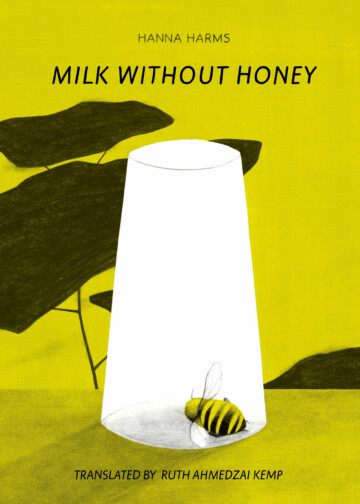
MILK WITHOUT HONEY, elegant graphic non-fiction about bees gracefully translated from German


MILK WITHOUT HONEY
HANNA HARMS
(tr. Ruth Ahmedzai Kemp)
Street Noise Books
$21.99 trade paper, available now

Rating: 4.5* of five

The Publisher Says: What would the future of the world look like without bees?
MILK WITHOUT HONEY chosen for NPR’s BOOKS WE LOVE!


Bees are vital to securing our food supply. We could live in a paradise where insects, especially bees pollinate fragrant seas of flowers whose fruits we harvest. Instead, vast lawns are now replacing flower gardens, and agriculture is characterized by monocultures. Pesticides and climate change are also causing insect mortality, with dramatic consequences for the global ecosystem. As we destroy the insect populations, honey is just one of many foods that will no longer be available to us, unless we learn to honor our innate connection with nature before it's too late.

In gorgeous, limited palette artwork, using contemplative images as well as informative charts, Hanna Harms brings us into the world of bees: their hives, their colonies, and their interactions with the global ecosystem. This is the perfect gift book for anyone concerned about climate change and the environment.

About the Author
Hanna Harms is an illustrator and comic author. She graduated from the Münster School of Design in Germany. She is currently studying for an MA in illustration at the Hamburg University of Applied Sciences. Hanna is co-editor and author of the comic zine Sander. The German edition of this debut graphic novel Milch ohne Honig, won the Ginco Award in 2020 in the Best Nonfiction Comic category.

I RECEIVED A DRC FROM THE PUBLISHER VIA EDELWEISS+. THANK YOU.

My Review
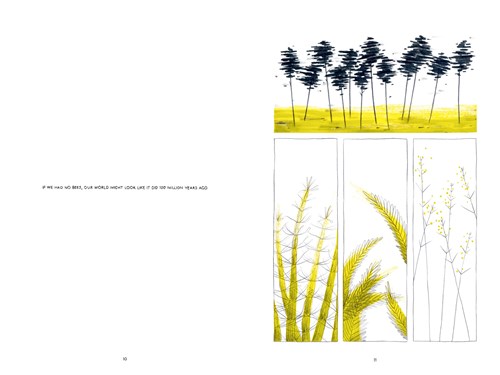
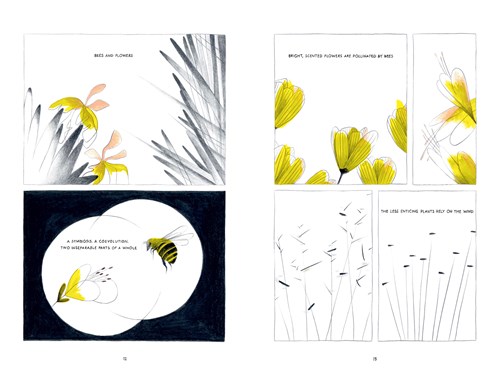
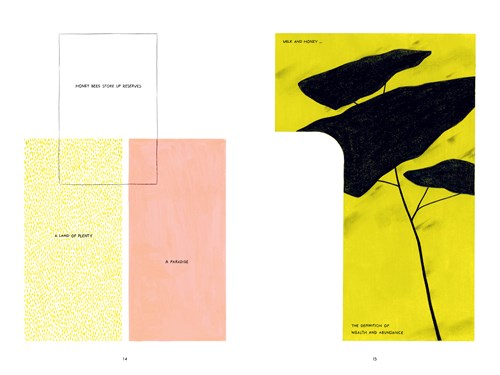
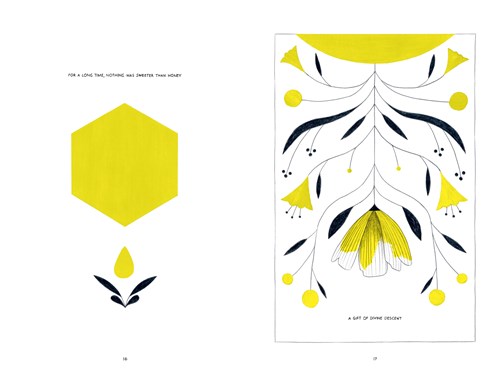
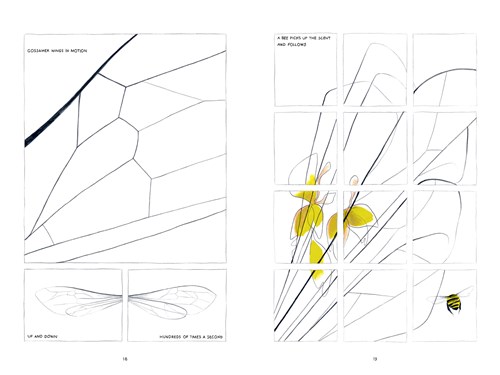
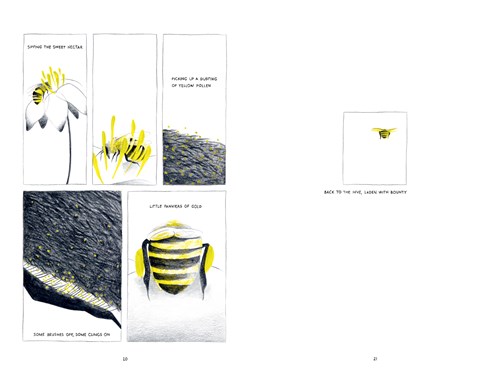
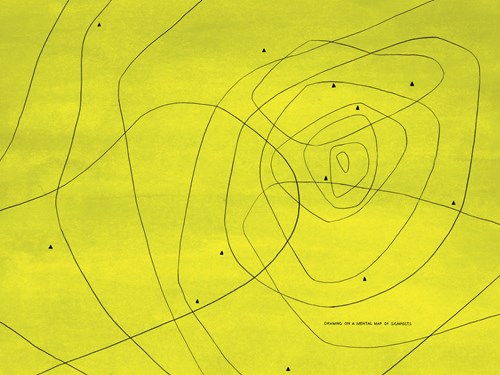
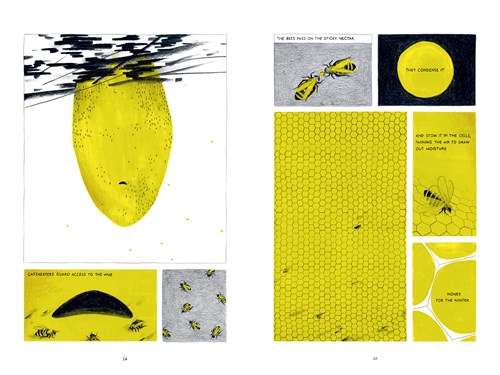
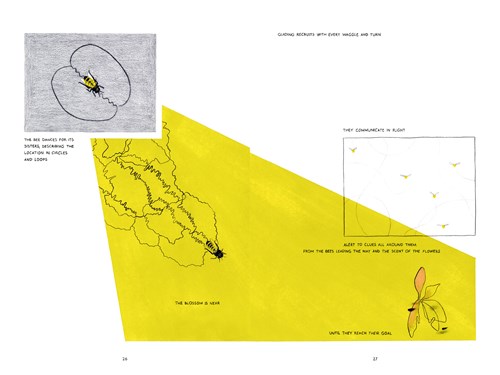
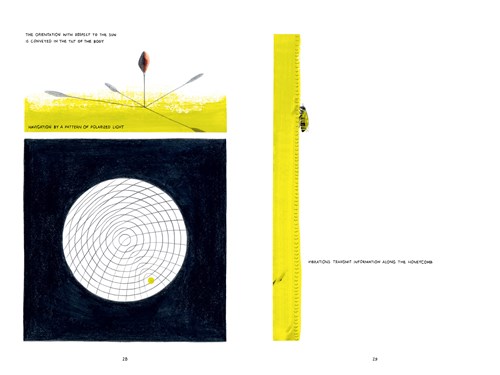
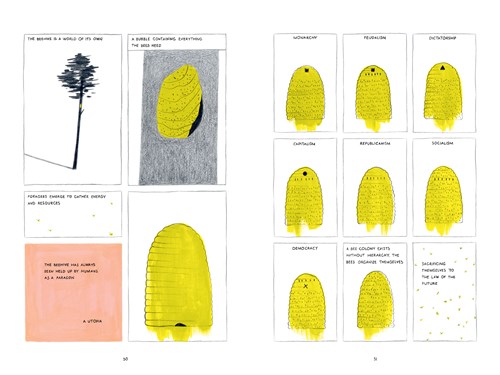
: A book receiving wide notice, a lot of praise, and all of it well-deserved. The author is German, and translator Ruth Ahmedzai Kemp did a seamless job of rendering the text into equally elegant English. Look at these spare, graceful pages:


Remember when I praised BIOGRAPHY OF A FLY by Jaap Robben? The style here is very similar, so of course I'm inclined to enjoy it.

The choice of yellow and black for the presentation is logical...what color is a bee, after all...but I wish they'd gone just a bit more bee-and-honey with the shade. As it is, the book is more pee-and-yellowjacket. It got a touch wearing. That's why the book only got 4.5 stars instead of five, which it otherwise fully merits.

That did not stop me from devouring the book, pardon my wordplay, eager to possess the images that Author Harms has created to explicate the nature of the problem that bees face. The depths of our species' dependence on the bee for its labors to feed itself, which thereby feeds us, makes this a very urgently needed book.

I hope you'll add it to your young ecowarrior's pile of gifts this Yule.

Friday, September 30, 2022

FEN, BOG and SWAMP: A Short History of Peatland Destruction and Its Role in the Climate Crisis, short not sweet & RUNAWAY: Notes on the Myths That Made Me, memoir that missed its moment


FEN, BOG and SWAMP: A Short History of Peatland Destruction and Its Role in the Climate Crisis
ANNIE PROULX

Scribner
$26.99 hardcover, available now

One of LitHub's 38 Favorite Books of 2022!

NOMINATED FOR A 2022 NBCC AWARD IN NON-FICTION! Winners will be announced on 23 March 2023. More information here.

Rating: 5* of five

The Publisher Says: From Pulitzer Prize winner Annie Proulx—whose novels are infused with her knowledge and deep concern for the earth—comes a riveting, revelatory history of our wetlands, their ecological role, and what their systematic destruction means for the planet.

A lifelong environmentalist, Annie Proulx brings her wide-ranging research and scholarship to the subject of wetlands and the vitally important yet little understood role they play in preserving the environment—by storing the carbon emissions that greatly contribute to climate change. Fens, bogs, swamps, and marine estuaries are the earth’s most desirable and dependable resources, and in four stunning parts, Proulx documents the long-misunderstood role of these wetlands in saving the planet.

Taking us on a fascinating journey through history, Proulx shows us the fens of 16th-century England to Canada’s Hudson Bay lowlands, Russia’s Great Vasyugan Mire, America’s Okeefenokee National Wildlife Refuge, and the 19th-century explorers who began the destruction of the Amazon rainforest. Along the way, she writes of the diseases spawned in the wetlands—the Ague, malaria, Marsh Fever—and the surprisingly significant role of peat in industrialization.

A sobering look at the degradation of wetlands over centuries and the serious ecological consequences, this is a stunningly important work and a rousing call to action by a writer whose passionate devotion to understanding and preserving the environment is on full and glorious display.

I RECEIVED A DRC FROM THE PUBLISHER VIA NETGALLEY. THANK YOU.

My Review
: First things first: Those title words aren't synonyms, exactly, so much as a family tree of naturally occurring wet places on Earth.

  • fens, fed by rivers and streams, usually deep, peat-forming, and supporting reeds and marsh grass

  • bogs, shallower water fed by rainfall, peat-forming, and supporting sphagnum mosses


  • swamps, a peat-making, shallow wetland with trees and shrubs


  • This information is important to fully understanding the scale and cost of wetland losses we've inflicted on the planet. Author Proulx (whose use of "yclept" in this book I note here with a big smile, as it's a favorite underused word of mine) is an experienced campaigner when it comes to putting English through its paces to evoke a sense of place and a perception of mood:
    The fen people of all periods knew the still water, infinite moods of cloud. They lived in reflections and moving reed shadows, poled through curtains of rain, gazed at the layered horizon, at curling waves that pummeled the land edge in storms.
    –and–
    It can take ten thousand years for a bog to convert to peat but in only a few weeks a human on a peat cutter machine can strip a large area down to the primordial gravel.

    Nothing made by human minds is ever perfect. I'm glad the title gave Author Proulx, eighty-six at this writing, an opportunity to mourn publicly the fens of her Connecticut childhood. I was fascinated by the information about the vanished English fens. But the bogs came in for a cursory examination in comparison, seen mostly through the lens of bog bodies. I acknowledge the personal element of the fact that they're bodies probably gave more heft to the science of peat bogs that really needed to be presented. I found it a distraction, though, while others may think of it as an enhancement.

    It is with the swamps and bayous of my erstwhile stomping grounds, Southern Texas and its adjacent lowlands, that the short shrift became apparent. Houston and its urban sprawl could, and should, form a book of damning indictments of greed and stupidity. New Orleans was, for reasons I simply can't understand, rescued as a human habitation after the death of the many bayous and wetlands south of it resulted in its near destruction...an expensive playground for rich people. Another book that should be written (again).

    But take away from any read the best, accept that not all of it was made with your taste in mind, and Author Proulx's essential message shines a harsh lime-light onto the instrumentalist Judeo-Christian worldview that's landed us in this awful mess:
    The attitude of looking at nature solely as something to be exploited—without cooperative thanks or appeasing sacrifices—is ingrained in western cultures.

    Our addiction to Being Right, to understanding the uses but not the purposes of this, our one and only planet, is killing us. And the death sentence has fallen on our generation. Lucky, lucky us we have Author Proulx to bear witness: "The waters tremble at our chutzpah and it seems we will not change."

    ++++++++++++++++++++++++++++++++++++++++++++++++++++++++++++++++


    RUNAWAY: Notes on the Myths That Made Me
    ERIN KEANE

    Belt Publishing
    $29.00 hardcover, available now

    One of NPR's Best Books of 2022!

    Rating: 4* of five, all for the startlingly apt and pointed phrases about her mother

    The Publisher Says: From Erin Keane, editor in chief at Salon, comes a touching memoir about the search for truths in the stories families tell.

    In 1970, Erin Keane’s mother ran away from home for the first time. She was thirteen years old. Over the next several years, and under two assumed identities, she hitchhiked her way across America, experiencing freedom, hardship, and tragedy. At fifteen, she met a man in New York City and married him. He was thirty-six.

    Though a deft balance of journalistic digging, cultural criticism, and poetic reimagining, Keane pieces together the true story of her mother’s teenage years, questioning almost everything she’s been told about her parents and their relationship. Along the way, she also considers how pop culture has kept similar narratives alive in her. At stake are some of the most profound questions we can ask ourselves: What’s true? What gets remembered? Who gets to tell the stories that make us who we are?

    Whether it’s talking about painful family history, #MeToo, Star Wars, true crime forensics, or The Gilmore Girls, Runaway is an unforgettable look at all the different ways the stories we tell—both personal and pop cultural—create us.

    I RECEIVED A DRC FROM THE PUBLISHER VIA EDELWEISS+. THANK YOU.

    My Review
    : Memories are, by definition, the things that form us, the things we re-member our selves from. A memoir descends to us from French, mémoire, which can mean:

  • memory: "the ability to retain information or a representation of past experience, based on the mental processes of learning or encoding, retention across some interval of time, and retrieval or reactivation of the memory" (APA Dictionary of Psychology)

  • memorandum: "a short note designating something to be remembered, especially something to be done or acted upon in the future; reminder" (dictionary.com)

  • store: "something that is stored or kept for future use. articles (as of food) accumulated for some specific object and drawn upon as needed : stock, supplies. something that is accumulated. a source from which things may be drawn as needed : a reserve fund" (Merriam-Webster)

  • mind: "broadly, all intellectual and psychological phenomena of an organism, encompassing motivational, affective, behavioral, perceptual, and cognitive systems; that is, the organized totality of an organism's mental and psychic processes and the structural and functional cognitive components on which they depend" (APA Dictionary of Psychology)

  • remembrance: "the act of remembering and showing respect for someone who has died or a past event" and/or "a memory of something that happened in the past" (Cambridge Dictionary)

  • dissertation: "a written essay, treatise, or disquisition" with special reference to scholarly use (Wordnik)

  • report: "an account or statement describing in detail an event, situation, or the like, usually as the result of observation, inquiry, etc." (dictionary.com)


  • ...as well as the sense Anglophones use it in; it's a word, in other words, for lots of things that mean "parts of a whole thing, or place to put those parts." Memories are like that, bits of a whole thing that often, when reassembled, aren't the thing itself. We can bless the French for allowing us the use of this multi-warheaded weapon of a word for reifying the brain's peculiar technology of making meaning from the electromagnetic stew we all swim in. Some of us more successfully than others, as Author Keane's researches into her family have vividly taught her.

    Had Author Keane's memoir, in any of those senses, of her life in pop-cultural mythic tones appeared two or even three years ago, it would be a triumph. As it is, it's a beautifully written memoir in the "store" or "report" sense, in the "place I've put fragments and pieces of things I want to remember and keep in some meaningful context." What it isn't is a successful book.

    You can take it from me that the author's chops as a phrase-smith are solid, impeccably pointed sentences darted into the hides of slow-moving shambolic man-things that ruined the lives of her mother, then her, with their thoughtless trampling solipsism. It's not the least bit arguable that this is a writer, and a journalist, of talent and training, of tenacity and fascinating insight.

    When she's talking about her mother, and her seriously screwed-up life.

    When she tries to connect this with her pop-culture fascinations, clearly re-evaluated in adulthood after #MeToo blew the blinders off the unwilling-to-see and forced them to look, look, at the cost their pretty little fantasy exacted. On everyone, really, since a damaged person does damage, too; but inarguably on women the most tellingly, the most vilely.

    What I can't make work in reading the piercingly honest redefinition of the author's life is why the John Ford/Woody Allen/et alii men are there. Yes, we know, they were ghastly people and treated women as playthings, they baked that attitude into their art, but...we know this. It's part of your mental furniture? Mine too. I swallowed it whole (though I never warmed to Woody Allen, too nebbishy for me). So did a few billion others. But you're talking about these men as though the betrayal of trust is fresh, without telling me why it *is* fresh for you, or putting into a time-context that would explain your palpable sense of betrayal.

    Some wounds aren't best explored too often because the sympathy of the audience goes from victim to monster. This is a tipping point to be avoided at all costs with the #MeToo men. Keep beating the drum, and it will reverberate on you more strongly than the intended audience.

    Anyway...very much a book of halves, one half excellent and the other...not.

    Monday, August 1, 2022

    40: A Novel, more than I expected and as much as I'd hoped for from Heathcock


    40: A Novel
    ALAN HEATHCOCK

    MCD x FSG
    $27.00 hardcover, available tomorrow

    Rating: 4.5* of five

    The Publisher Says: From the award-winning author Alan Heathcock comes an American myth of the future: a vision of civil war, spectacle, and disaster of biblical proportions.

    In a future America ravaged by natural disaster, pandemic, and political unrest, a fundamentalist faction emerges. As the Novae Terrae gain power, enticing civilians with bread and circuses, a civil war breaks out between its members and the US government.

    Mazzy Goodwin, a young soldier, only wants to find her little sister, Ava Lynn. One day, she wakes in a bomb crater to find wings emerged from her back. Has she died? Been gifted wings by God? Undergone a military experiment?

    The world sees a miracle. Mazzy is coaxed into seeing it as an opportunity: to become the angel-like figurehead of the revolution, in return for being reunited with her sister. Her journey leads her to New Los Angeles, where the Novae have set up the headquarters for their propaganda machine—right in the ruins of Hollywood. Aided by friends old and new, she must navigate a web of deceit while staying true to herself.

    Told in sharp, haunting prose, as cinematic as it is precise, Alan Heathcock’s 40 is a dizzyingly fantastical novel about the dangers of blind faith, the temptation of spectacle, and the love of family. In a tale by turns mythic and tragic, one heroine must come to terms with the consequences of her decisions—and face the challenges of building a new world.

    I RECEIVED A DRC FROM THE PUBLISHER VIA NETGALLEY. THANK YOU.

    My Review
    : Regulars to this blog will recognize the name Alan Heathcock from my warbling my fool lungs out about his collection, Volt: Stories. One big reason for that is that Author Heathcock does not mess around when he makes his imagery work your brain:
    "...I knew it'd come to this, you say. I knew I was right. The power of knowing the despair you ordered has finally come to pass makes you feel like a god. Let's be honest. It's what you want. You want this world to collapse. Want people to be every awful thing."

    –and–

    Grief was a demon of possession. When people talked of time healing wounds, they only meant that over time you become accustomed to that demon inside you, and what at first felt like an invasive presence, alien and nefarious, slowly became integrated into your being, the imp of sorrow crouched within you for the remainder of your days.

    I don't know how much clearer the man can be than that. I can feel these words, see the world through their gravity lens, perceive the distorted light that comes from every other direction than the original one to form the ghost of the initial thought behind them.

    Which is why I, devout atheist and committed anti-religion crusader, read a whole novel about a post-apocalyptic world run by and for evangelical evil-doers with hearts colder than emptiest space. Which is why I'm here telling you to go and get one of these books, these beautifully designed books (that jacket design!), or to pre-order the Kindle version so you'll open the device tomorrow morning and join Mazzy and Ava Lynn in the hellscape that Jo Sam the evangelist of doom designed and brought forth.

    Betrayal is only the beginning of Mazzy's journey. It's certainly true that she's not a trusting, sunny-hearted soul for a single second of her life. Her sister Ava Lynn calls out the only tenderness she allows herself to externalize. The child, whose fate is not ever easy, confounds Mazzy in her extremely self-possessed certainty. Mazzy being incapable of a single sustained good mood for more than the absolute minimum of time, she envies Ava Lynn and vows to protect her. Which, this being a novel, means that Mazzy is unable to do so.

    The amount of manipulative chicanery Mazzy experiences after she (unexpectedly and without external stimulus) becomes winged is, of course, the bulk of the novel's action. Her bewingèd state makes her very valuable to the evildoers around Jo Sam the evangelist, unsurprisingly, and so they use Ava Lynn to extort obedience out of Mazzy. The sheer outrage I experienced over this...! It's an effective tool, of course, the safety of one's child (dead mother) being hard coded into our protective circle by evolution. That it is never a violent threat, "we will hurt her," made me able to continue to read the story. They keep Mazzy from being with Ava Lynn to keep her working for their vile controlling cause.

    The day dawns, of course, when Mazzy is no longer suitable for their use; a series of things occurs that, in several moments, made me think I was being played by Author Heathcock. It's a pleasure to report that he played fair...but the ending of the story is still a major surprise. Yes, I saw the twist coming, but I think that's to be expected. A truly successful twist, in this case, means the expected event occurs but something you-the-reader would've dismissed as improbable happens after. Job done, Author Heathcock.

    I'll say that, after reading many, many chosen-one narratives and even more post-apocalyptic religion-used-for-evil tales over the past seven decades, I'm not sorry I read this one. I think it's well-made and well-written, I suspect it's something the author has allowed to simmer for a very long time before committing to words for others to read, and I'm pleased with the results he has achieved.

    Wednesday, July 14, 2021

    APPLESEED, Matt Bell's breakout big-ideas big book or I miss my guess


    APPLESEED
    MATT BELL

    Custom House
    $27.99 hardcover, available now

    TRADE PAPER EDITION AVAILABLE FOR $17.99

    Shortlisted for the inaugural Ursula K. LeGuin Prize for Fiction! Winners announced 21 October 2022.

    Rating: 4.75* of five

    A NEW YORK TIMES NOTABLE BOOK FOR 2021!

    A BEST-OF-2021 PICK FROM NPR BOOKS!


    The Publisher Says: In the vein of Neal Stephenson and Jeff VanderMeer, an epic speculative novel from Young Lions Fiction Award–finalist Matt Bell, a breakout book that explores climate change, manifest destiny, humanity's unchecked exploitation of natural resources, and the small but powerful magic contained within every single apple.

    In eighteenth-century Ohio, two brothers travel into the wooded frontier, planting apple orchards from which they plan to profit in the years to come. As they remake the wilderness in their own image, planning for a future of settlement and civilization, the long-held bonds and secrets between the two will be tested, fractured and broken—and possibly healed.

    Fifty years from now, in the second half of the twenty-first century, climate change has ravaged the Earth. Having invested early in genetic engineering and food science, one company now owns all the world’s resources. But a growing resistance is working to redistribute both land and power—and in a pivotal moment for the future of humanity, one of the company’s original founders will return to headquarters, intending to destroy what he helped build.

    A thousand years in the future, North America is covered by a massive sheet of ice. One lonely sentient being inhabits a tech station on top of the glacier—and in a daring and seemingly impossible quest, sets out to follow a homing beacon across the continent in the hopes of discovering the last remnant of civilization.

    Hugely ambitious in scope and theme, Appleseed is the breakout novel from a writer “as self-assured as he is audacious” (NPR) who “may well have invented the pulse-pounding novel of ideas” (Jess Walter). Part speculative epic, part tech thriller, part reinvented fairy tale, Appleseed is an unforgettable meditation on climate change; corporate, civic, and familial responsibility; manifest destiny; and the myths and legends that sustain us all.

    I RECEIVED A DRC FROM THE PUBLISHER VIA NETGALLEY. THANK YOU.

    My Review
    : When I read Author Bell's 2013 novel, In the House Upon the Dirt Between the Lake and the Woods, it was a startling experience. Sadly, it came at almost exactly the same time as my epic emotional collapse so I've only recently reviewed it. Let me tell you now, in brief, why I think it was an extraordinarily good read: Myth-making never ceases, no culture is without its myths; that book was an exploration of The Couple Myth at length; and there is no better way to make myths than to put the most complete possible vocabulary of the day around them. Appleseed is a fuller exploration of this technique applied to Climate Change.

    What myths are we exploring this time...is there a myth-set tale that this three-handed sonata plays on? Yes...the title's the first giveaway, there's a definite connection to the Johnny Appleseed myth made from John Chapman's actual life spent planting the American West with economically useful apple trees in advance of the settlers coming to Ohio (yes, that *was* the West then, surprising isn't it two hundred years on).

    Nathaniel, older human brother of Chapman the faun, does the work of finding the way, avoiding the humans who would hurt or kill his behornèd brother of the golden eyes and hoofed legs. Chapman knows the land, even the land he's never been on. It is his nature. And we all know what happens to Nature, don't we. The greater glory of a christian god is costly, always and in all ways; do you wish to continue past the point of no return?

    John lives in our near-term future, a recycler busily trying to undo the Works of Man that Chapman and Nathaniel, in their innocence, believe to be Progress instead of progressive rot. He travels alone when we meet him...he is looking for his (female, of course) buddy/pal/squeeze because, well, humans need each other. His dystopia, an Amercan West (the one we know as such today) is tinder-dry, eczema-dotted with our dams and roads and ghosts of towns that he wants to render inoperable and irreparable. Needless to say, the corporate entity that actually, formally, owns the whole expanse doesn't like some rando ruining perfectly usable infrastructure. Especially now that all those pesky people aren't cluttering it up. The slow reveal of why John and his ex are doing what they're doing to re-wild the West is a piece of misdirection I can't quite bring myself to spoil...but suffice it to say the era of mythmaking about Man's Plenipotentiary Powers à la Sisyphus is not over yet.

    And then there's C-432. This being lives many, many lives in our distant, glacier-scraped future. This way of live is enabled by spelunking the crevasses that always open in craters and reclaiming for reuse whatever materials from the time before are reclaimable. We're not-quite told that C-432 is a clone host for the consciousness of an earlier human...or maybe faun? note initial...and this iteration/incarnation is a risk-averse, therefore old, entity facing the reality that a scavenger doesn't produce anything so will, inevitably, pass from the scene. As a way of life it is severely limited.

    But, in each of these story lines, there is a leitmotif, a through-line, that Author Bell resurfaces for your easter-egging pleasure. The Loom might be my favorite fictional technology ever; the uses of the scavenged materials, the most poignant. The apple...the choice that C-432 has to make...there are absolutely delightful connections made among these grace notes. The complexity of the read is one of its pleasures and I encourage you, like you would with any rich and calorific consumable, to go slowly...make it last. Think about it as you go to sleep, dream its scenes as you're processing its sweet, sonorous prose.

    So why, if I'm practically crooning my pleasure in hopes of luring you to read it, am I rating it less than five full stars?

    Because, while I as a lifelong inhabitant of this country appreciate its US-centered myth-making and its implicit acceptance that our (in)actions are largely responsible for this disaster, it feels wrong to simply dismiss with a cursory glance the planet-wide scale of it. Because there's a weird, unnecessary straight-man sex scene that jolts progress to a halt while we indulge y'all's ugly needs. Because the ending...while interesting...wasn't anything like the rest of the book so felt merged from a different FTP with middling success.

    None of those things rise above the level of quibbles because the gestalt carries the day. There is such a beautiful tapestry woven of these lovely words. I've avoided quoting them to you because, well, which ones? Why those? Where's the perfect quote for this idea...this one, that one, no no the other one...and it got headachey trying to figure it out.

    What didn't get headachey was this phrase, this simple phrase, that says everything the book and the future need you to know: "No matter what you do, there will never be more time left to act than there is now."

    A call to arms, a fable of consequences, a myth of magisterial beauty and magical urgency.

    Thursday, May 13, 2021

    THE IMPOSSIBLE RESURRECTION OF GRIEF, Dr. Cade's dystopian vision expanded without expounding


    THE IMPOSSIBLE RESURRECTION OF GRIEF
    OCTAVIA CADE
    Read Arley Sorg's interview with her here!
    SPECIAL SALE AT: Stelliform Press
    $14.99 trade paper, available now

    Rating: 4* of five

    2022 WINNER, SIR JULIUS VOGEL AWARD—BEST NOVELLA!

    The Publisher Says: IN A DYING WORLD, GRIEF HAS A LIFE OF ITS OWN...

    With the collapse of ecosystems and the extinction of species comes the Grief: an unstoppable melancholia that ends in suicide. When Ruby’s friend, mourning the loss of the Great Barrier Reef, succumbs to the Grief, the letters she leaves behind reveal the hidden world of the resurrected dead. The Tasmanian tiger, brought back from extinction in an isolated facility, is only the first... but rebirth is not always biological, and it comes with a price.

    As a scientist, Ruby resists the Grief by focusing her research on resilient jellyfish, but she can’t avoid choosing which side she’s on. How can she fight against the dead and the forces behind them when doing so risks her home, her life, and the entire biosphere?

    I RECEIVED A DRC FROM THE PUBLISHER VIA NETGALLEY. THANK YOU.

    My Review
    : Here's how we start this tale:
    The Sea Witch lived in an abandoned salt water pool. I knew her when she was called Marjorie and had the office next to mine at the University, but when the Grief came on her she stopped coming into work and set herself up at the derelict public pool with a stack of useless journal articles and a lifetime supply of plastic.

    That's a high-octane start to what turns into a careening rush between ugly and awful, ending its trip at unthinkable.

    And you will not be blamed for wondering why I now say: Get this book right now. Sit down, open it, and then let Author Cade do her wicked, caustic thing for/to you.

    The jellyfish migrated through the lake during the day, and snorkelers could swim with them, with thousands of jellies, with millions of them, and see in their lovely, delicate forms the histories of another life. They pulsed around me like little golden hearts, shimmering in the surface layer of waters, and it was as close as I've ever come to religious communion.

    There is a Jellyfish Lake in Palau, first crossing my own personal radar in 1982, where there is an immense concentration of two sorts of stingless jellies isolated from the ocean for about twelve thousand years and therefore have lost the need for such strong self-defense and hunting measures. The two species are able to coexist, and are so very gorgeous they can stop your heart:

    The left are golden jellies, the right has one moon jelly in the middle. These are the creatures that take our narrator's heart from her. She is, from the moment she sees them, in thrall to the living heartbeats that are jellies, in all their many-shaped and -colored and -toxined glory. I can see why they would; in fact, these gorgeous animals are found literally everywhere there is an ocean, are brilliantly adapted to staying alive in every kind or sort of circumstance, and have changed themselves as little as possible over the millennia always just enough to stay in the hunt, just ahead of predators and just behind prey. In Author Cade's world, they are the only ocean creatures thriving as a result.

    Also on this Palau dive is a woman, Marjorie, who becomes the narrator's very best friend. Marjorie's obsession is the Great Barrier Reef. The ladies, scientists both, bond over their love of and understanding for the ocean's many and wildly variable ecosystems, all under threat from Anthropogenic Climate Change (maybe you've heard about it?)—but few ecosystems are under greater threat than the Great Barrier Reef. Marjorie succumbs to a new thing, the Grief, a declining mental health state that invariably ends in suicide, that is becoming more and more prevalent among humans who, for idiosyncratic reasons, suddenly can no longer bear to exist in the changing world.

    Our narrator, called Ruby as we discover about midway through the story, is apparently immune to the Grief. So is her Māori husband, George...not a scientist, an artist of science subjects, so it's really not science that saves or damns. But Marjorie retreats to behaviors so weird, so utterly foreign to her former self, and yet still sea-themed...she renames herself "the Sea Witch" from "The Little Mermaid" by H.C. Andersen, which is also what she named the expensive boat she bought herself before the Grief and burned to the water-line after it...that it's clear what the decline's end will be while remaining unclear what the hell she's going to do next. The next thing the Sea Witch does...well....

    That is a thing of spoilers. The things Marjorie, I mean the Sea Witch, does or causes or abets, are...disturbing. I will leave it to you to read the under-100 page novella, instead of doing what I would love to do and relating the scary, freaky, incredible things that Ruby rips from pillar to post to attempt to make sense of, to attempt to explain to herself (and very possibly the authorities, though which ones and what she could convince them to do in a Grief-stricken world is unclear even to her) what Grief is doing to some apparent survivors.

    Why I want you to get this book is really very simple: I need people to talk about it with! There are so many fascinating characters...Tasmanian Granny the Thylacine Jesus for one, addled by Grief but quite the scientist withal, and maybe the Sea Witch's relative...? Ruby goes to visit her at...well, because she gets a Message to, although George her husband isn't keen on it:
    "Hurt's easy enough to live with," he said. "If there's an end to it. Break your arm and it hurts, but it heals soon enough and the hurt goes away. Even a small pain, if it never leaves...It wears you down," he said. "In the end it isn't the hurt that gets you, it's the exhaustion."

    He's right; physical or psychic, it's the unending aches that cost one the most to survive. As for how that explains the Grief, and those who succumb, we don't know if it's causal or correlative, but Indigenous peoples all over are succumbing to the Grief in greater numbers than the population as a whole. Great grief is always a form of insanity, a melding of psychosis and depression, but Granny is extra no matter what yardstick we're using. The Sea Witch, if she's related, came by it honestly. Gawd...this climate-changed world of Author Cade's is one scary place! Resurrection is never a harbinger of sunshine lollipops and rainbows, anywhere, anytime.
    "Some people said...{t}he coming of people like me, and what we'd done to Tasmania, the rest of Australia, and what we'd don in New Zealand...the same devouring, the same indifference to the pre-existence of other life. The same conversation, over and over, with different settings and different subjects." (Ruby speaking)
    –and–
    "I guess we all got better and better at killing. What a shock it must be, to find how efficiency in slaughter always takes the upward trajectory." (George speaking)

    At the end of the read, Author Cade delivers a devastating truth to us, one that went straight into my commonplace book. Ruby is having the one conversation she most hoped she wouldn't have to have, and least expected to be remotely possible. In her newly cleared eyesight, she sees this: Self-knowledge was the clearest thing in the world. It was also the unkindest.

    Unholy, misbegotten things always survive, don't they? Isn't that Evolution's sick little secret?

    Sunday, April 1, 2018

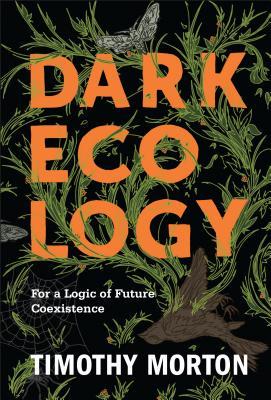
    DARK ECOLOGY presents a philosophical basis for understanding the Anthropocene Epoch


    DARK ECOLOGY: For a Logic of Future Coexistence
    TIMOTHY MORTON

    Columbia University Press
    $30.00 hardcover, available now

    Rating: 3.5* of five

    The Publisher Says: Timothy Morton argues that ecological awareness in the present Anthropocene era takes the form of a strange loop or M?bius strip, twisted to have only one side. Deckard travels this oedipal path in Blade Runner (1982) when he learns that he might be the enemy he has been ordered to pursue. Ecological awareness takes this shape because ecological phenomena have a loop form that is also fundamental to the structure of how things are.

    The logistics of agricultural society resulted in global warming and hardwired dangerous ideas about life-forms into the human mind. Dark ecology puts us in an uncanny position of radical self-knowledge, illuminating our place in the biosphere and our belonging to a species in a sense that is far less obvious than we like to think. Morton explores the logical foundations of the ecological crisis, which is suffused with the melancholy and negativity of coexistence yet evolving, as we explore its loop form, into something playful, anarchic, and comedic. His work is a skilled fusion of humanities and scientific scholarship, incorporating the theories and findings of philosophy, anthropology, literature, ecology, biology, and physics. Morton hopes to reestablish our ties to nonhuman beings and to help us rediscover the playfulness and joy that can brighten the dark, strange loop we traverse.

    THE PUBLISHER PROVIDED A REVIEW COPY OF THE BOOK. THANK YOU.

    My Review: I can honestly say that Author Morton was writing directly to my most dearly held concerns. The Anthropocene, the current post-Holocene epoch of geological time, is a given in the author's thinking; if you're not in sync with 21st-century thinking and deny that climate change is not only happening but is largely if not entirely of human genesis, this book will not do one single thing for you. That is, it will make you screechingly furious, but it won't change your mind.

    For the rest of us, the book's foundations in logic has lacunae. I'd expected to see the role of Big Science play a major part here; also Toxic Technology; instead Author Morton focuses on the philosophical and cultural roots of the Anthropocene. It's less about What Happened than it is about Why Things Are. We go down a bunch of rabbit holes to explore the nature of the Anthropocene's genesis, we spend a lot of time (in the footnotes) digging for truffles in the dirt of our Collective Unconscious, and in the end come to the surface of our minds with some useful new concepts. "Agrilogistics" and "ecognosis" are worthy neologisms for deep and tangled concepts. A simple explanation of them is that the reductive power of modern STEM-based environmental discussion ignores a huge reservoir of knowledge that comes from our shared, lived experience; this isn't in any way a comprehensive explanation so my suggestion is to read the 192 pages of the book slowly and carefully.

    It repaid me enormously to do so and it could do that for you as well.